Presentation on
fla-501
TOPIC: Morphological Characters, Breeding Method
and, Production Technological of Tuberose
Presented to: Presented by:
Dr. M.C. Talukdar Tara Bhuyan
Professor and HoD 14- AMJ-91
Deptt. of Horticulture M.Sc. (Agri.)
1st year 2nd sem
Faculty of Agriculture
Assam Agricultural University, Jorhat-13
INTRODUCTION :
 Scientific name : Polyathes tuberosa
 Family : Amaryllidaceae
 It is native to Mexico and then it spread to different parts of the world
 Tuberose occupies a very selective and special position among the
ornamental bulbous plant for its beauty , elegance and sweet pleasant
fragrance.
 It has a great economic potential for cut flowers trade and essential oil
industry.
 Due to their great demand, it is currently cultivated in most of the
tropical and sub-tropical countries of the world.
 India has a long tradition of floriculture.
CULTIVARS and varieties:
 There are three types of tuberose :-
i. Single with one row of corolla segments- varieties are
Calcutta Single, Shringar, Prajwal, Mexican single, Rajat
Rekha(NBRI, Lucknow)
ii. Semi-double bearing flower with 2-3 rows of corolla
segment,
iii.Double having more than three rows of corolla
segment- varieties are Calcutta Double, Suvasini.
Vyabhav , Swarna Rekha(NBRI, Lucknow)
Shringar Suvasini Swarna Rekha
Single Mexican Rajat Rekha
MORPHOLGICAL CHARACTERS
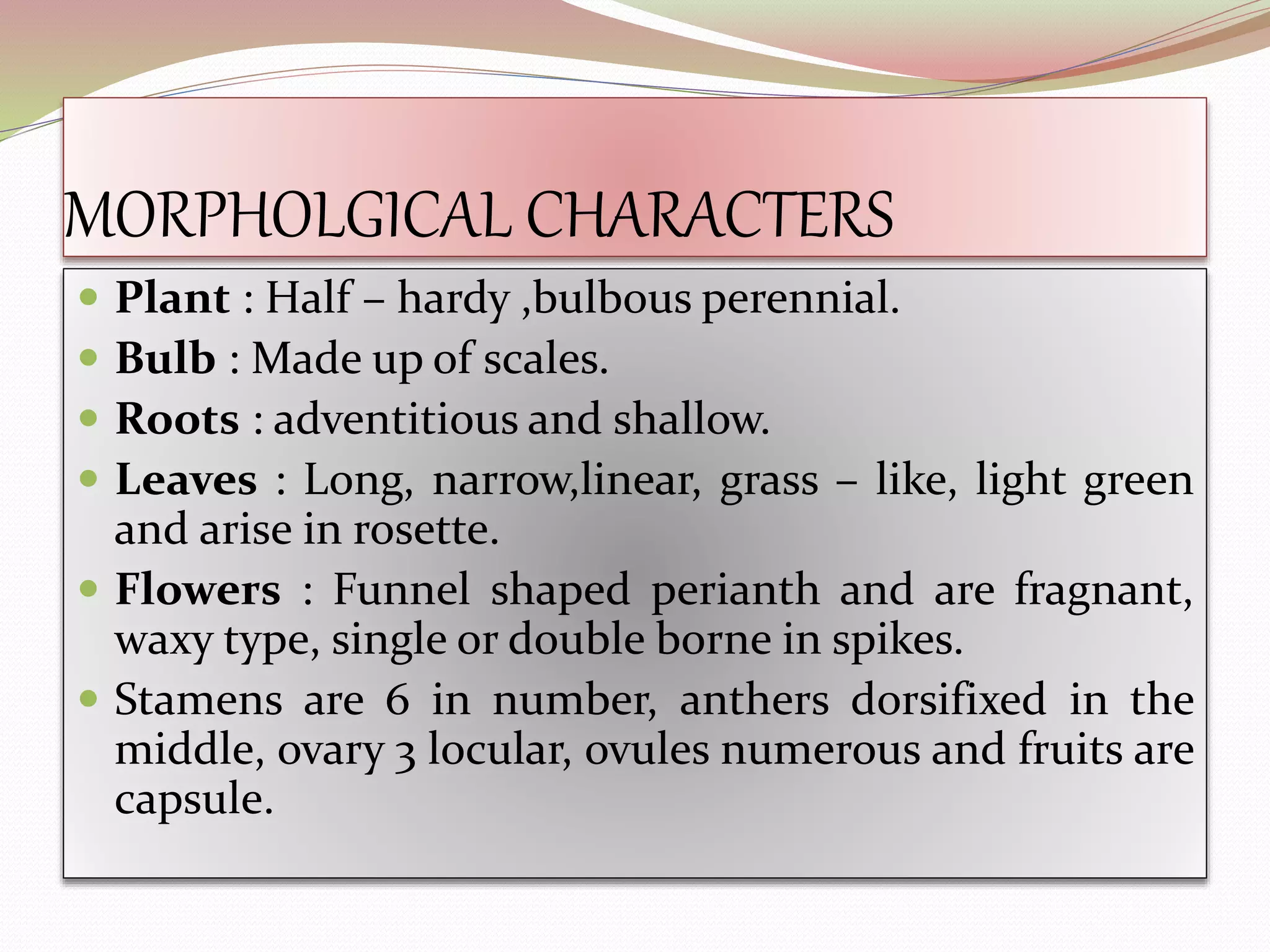
 Plant : Half – hardy ,bulbous perennial.
 Bulb : Made up of scales.
 Roots : adventitious and shallow.
 Leaves : Long, narrow,linear, grass – like, light green
and arise in rosette.
 Flowers : Funnel shaped perianth and are fragnant,
waxy type, single or double borne in spikes.
 Stamens are 6 in number, anthers dorsifixed in the
middle, ovary 3 locular, ovules numerous and fruits are
capsule.
BREEDING
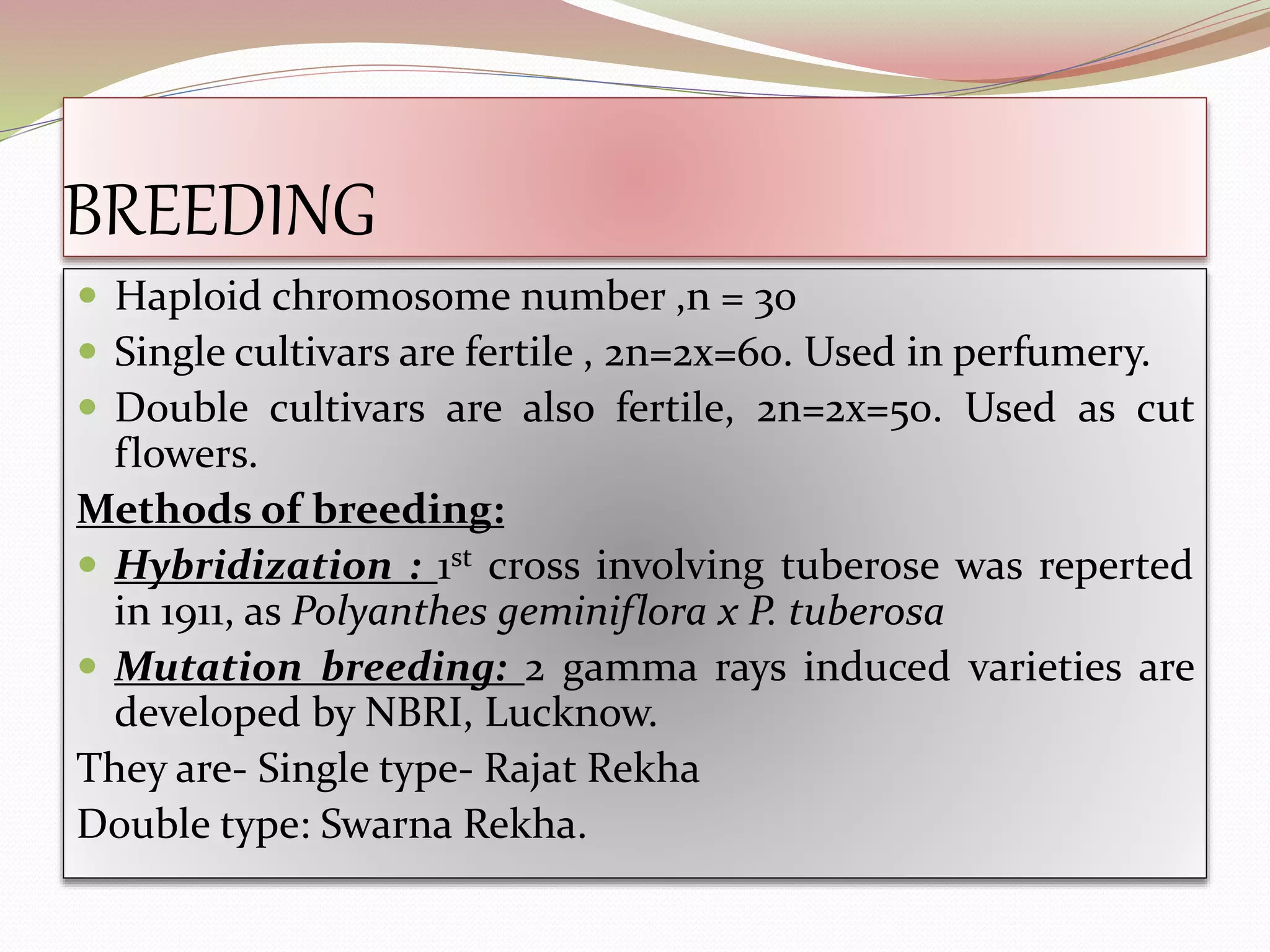
 Haploid chromosome number ,n = 30
 Single cultivars are fertile , 2n=2x=60. Used in perfumery.
 Double cultivars are also fertile, 2n=2x=50. Used as cut
flowers.
Methods of breeding:
 Hybridization : 1st cross involving tuberose was reperted
in 1911, as Polyanthes geminiflora x P. tuberosa
 Mutation breeding: 2 gamma rays induced varieties are
developed by NBRI, Lucknow.
They are- Single type- Rajat Rekha
Double type: Swarna Rekha.
Production technology
CLIMATE:
 Tuberose grows in mild climate without extremes of high and low temperature
even though it can be grown under a wide range of climatic conditions .
 In , India the commercial cultivation of tuberose is mainly confined in warm
humid area with average temperature range from 200 to 350°C
 Very low temperature and frost also damage the plant and flowers.
 Tuberose grows well in sunny situation.
SOIL:
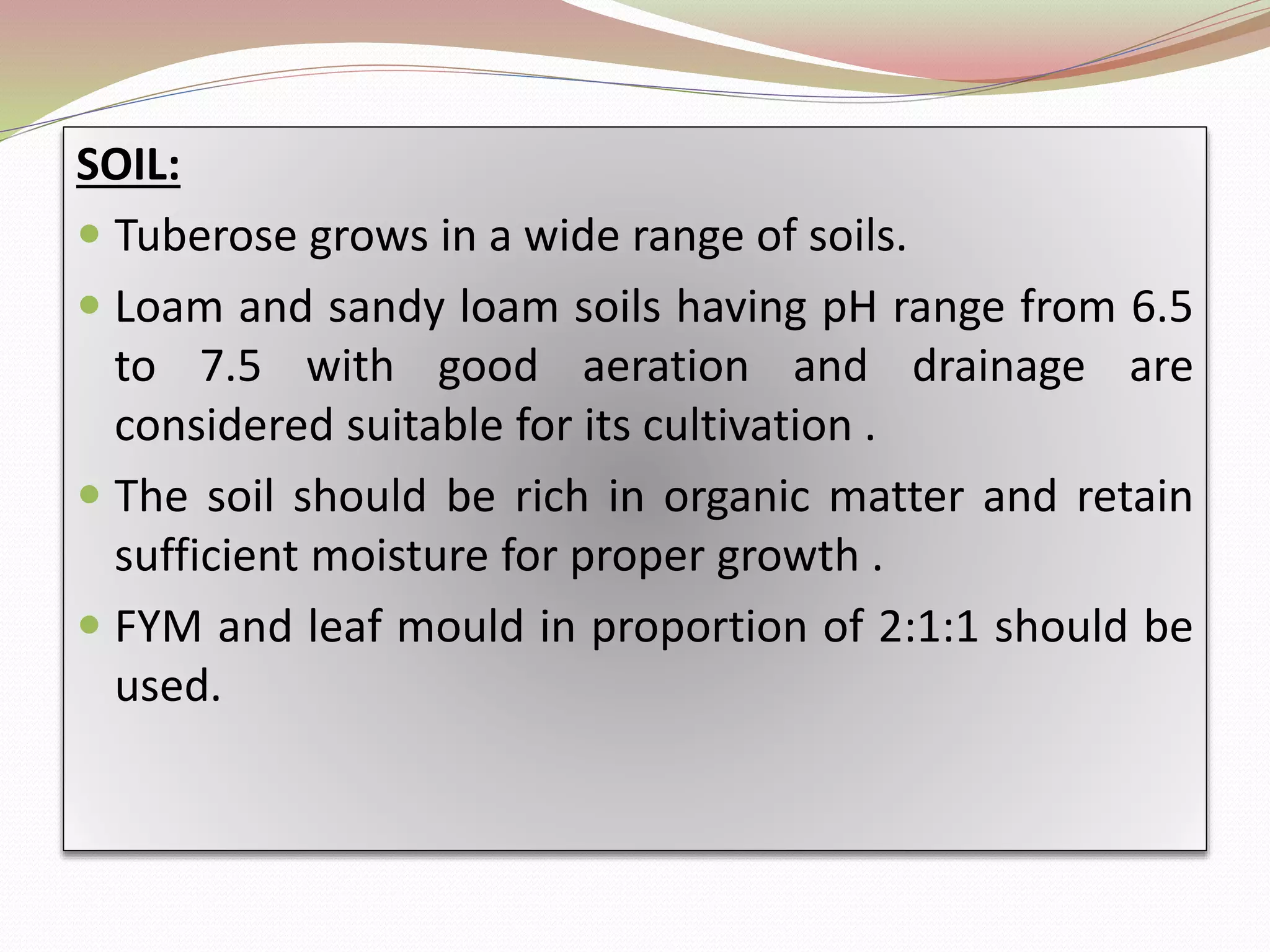
 Tuberose grows in a wide range of soils.
 Loam and sandy loam soils having pH range from 6.5
to 7.5 with good aeration and drainage are
considered suitable for its cultivation .
 The soil should be rich in organic matter and retain
sufficient moisture for proper growth .
 FYM and leaf mould in proportion of 2:1:1 should be
used.
PROPAGATION :-
 Propagated vegetatively by division of bulb.
 To get virus free material or for a very rapid multiplication
, the propagation is done through tissue culture.
BULB SELECTION: Generally bulbs having diameter
2.0-3.0cm are suitable for planting.
SPACING: 25 x 25cm ( flat beds), 15 x 15cm ( HDP )
IRRIGATION:- done at 10- 15 days interval in dry
weathers.
 During summer (april - june) – done at weekly
intervals.
 WEED CONTROL:
 Manual weeding is more effective if done frequently.
 MANURES AND FERTILIZERS:
 FYM – 10-15 tonnes / ha
 N:P:K- 100: 50: 50kg/ha
PLANT PROTECTION
Botriyis Blight Leaf spot
Diseases Caused by Symptom Control
Stem rot Sclerotium rolfsii Dropping of leaves.
Leaves become yellow and
dry up.
Removal of infected
plant.
Spraying of carbendazin
or copper oxychloride @
0.1 %
Botrytis spots
and blight
Botrytis elliptica Infected flowers show
dark brown spots and
slowly complete
inflorescence dries.
Spraying of mancozeb
@ 0.2 %.
Leaf spot Fusarium equiseti Initially water soaked
spot develop which later
on turned into elliptical
or round brown spots.
Spraying of mancozeb
@ 0.2 % is effective.
Flower bud rot Erwinia sp Drying of buds . Application of
streptocycline @
500ppm is effective
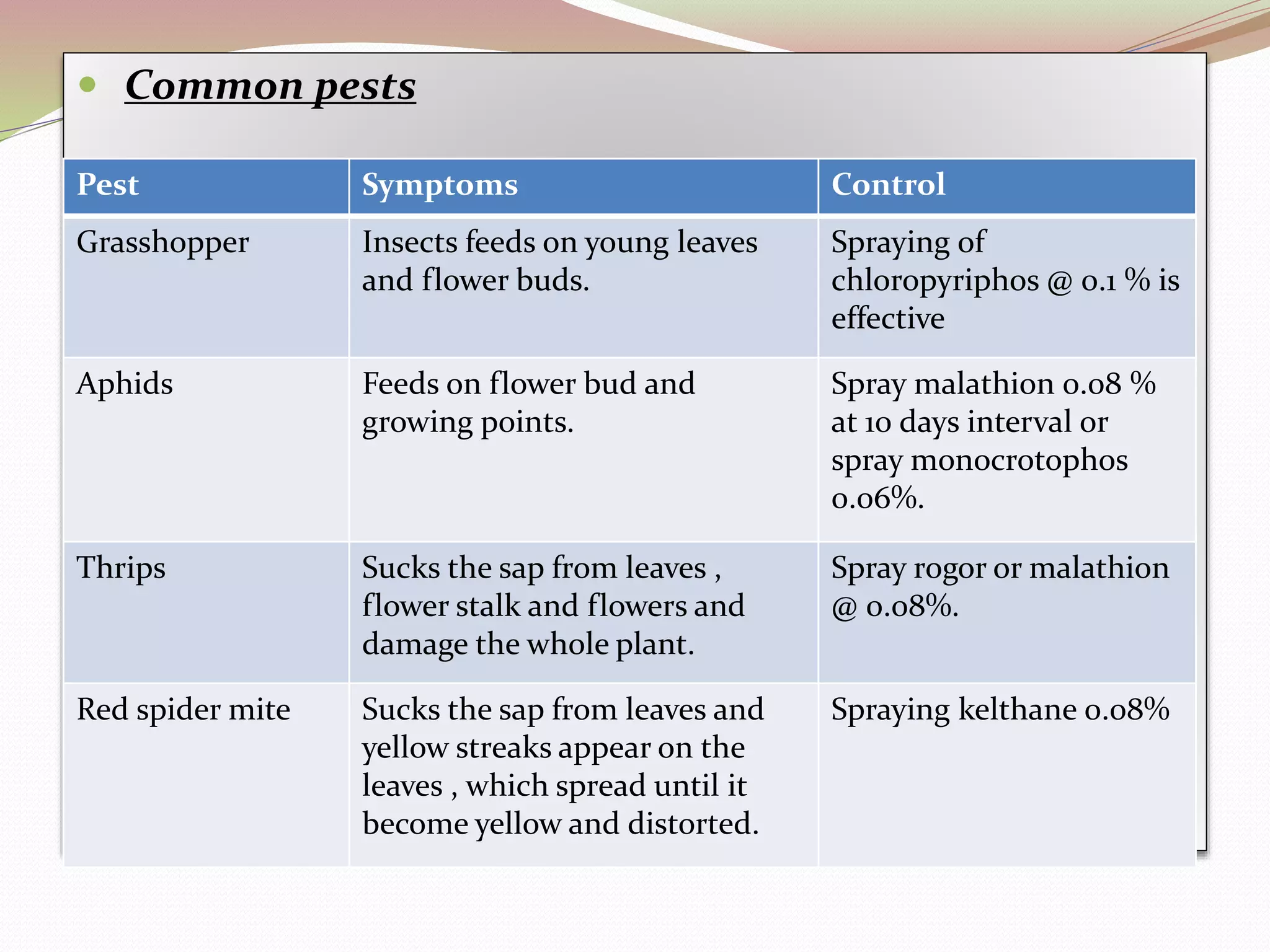
 Common pests
Pest Symptoms Control
Grasshopper Insects feeds on young leaves
and flower buds.
Spraying of
chloropyriphos @ 0.1 % is
effective
Aphids Feeds on flower bud and
growing points.
Spray malathion 0.08 %
at 10 days interval or
spray monocrotophos
0.06%.
Thrips Sucks the sap from leaves ,
flower stalk and flowers and
damage the whole plant.
Spray rogor or malathion
@ 0.08%.
Red spider mite Sucks the sap from leaves and
yellow streaks appear on the
leaves , which spread until it
become yellow and distorted.
Spraying kelthane 0.08%
HARVESTING
HARVESTING OF FLOWERS:
 Tuberose is harvested by cutting the spikes from the base for table
decoration or the individual flower is picked from the spike for
making garlands and other floral ornaments.
 Picking of flowers should be done in cool hours of the day either in
the morning or in the evening.
 Harvesting of flowers on the previous evening and marketing in the
next morning leads to a weight loss of about 40 per cent.
 The flowers spike for vases should be cut when the first pair of
flowers fully open, with a sharp knife and place immediately in
water.
HARVESTING OF BULBS :
 Harvesting of tuberose bulbs at proper stage
of maturity is important for storage of bulbs
and their subsequent growth after planting.
 The bulbs reach maturity when the flowering
is over and plant growth ceases, depending on
the environmental condition and soil moisture
Morphological characters, breeding method and production technology of tuberose

Morphological characters, breeding method and production technology of tuberose

  • 1.
    Presentation on fla-501 TOPIC: MorphologicalCharacters, Breeding Method and, Production Technological of Tuberose Presented to: Presented by: Dr. M.C. Talukdar Tara Bhuyan Professor and HoD 14- AMJ-91 Deptt. of Horticulture M.Sc. (Agri.) 1st year 2nd sem Faculty of Agriculture Assam Agricultural University, Jorhat-13
  • 2.
    INTRODUCTION :  Scientificname : Polyathes tuberosa  Family : Amaryllidaceae  It is native to Mexico and then it spread to different parts of the world  Tuberose occupies a very selective and special position among the ornamental bulbous plant for its beauty , elegance and sweet pleasant fragrance.  It has a great economic potential for cut flowers trade and essential oil industry.  Due to their great demand, it is currently cultivated in most of the tropical and sub-tropical countries of the world.  India has a long tradition of floriculture.
  • 3.
    CULTIVARS and varieties: There are three types of tuberose :- i. Single with one row of corolla segments- varieties are Calcutta Single, Shringar, Prajwal, Mexican single, Rajat Rekha(NBRI, Lucknow) ii. Semi-double bearing flower with 2-3 rows of corolla segment, iii.Double having more than three rows of corolla segment- varieties are Calcutta Double, Suvasini. Vyabhav , Swarna Rekha(NBRI, Lucknow)
  • 4.
    Shringar Suvasini SwarnaRekha Single Mexican Rajat Rekha
  • 5.
    MORPHOLGICAL CHARACTERS  Plant: Half – hardy ,bulbous perennial.  Bulb : Made up of scales.  Roots : adventitious and shallow.  Leaves : Long, narrow,linear, grass – like, light green and arise in rosette.  Flowers : Funnel shaped perianth and are fragnant, waxy type, single or double borne in spikes.  Stamens are 6 in number, anthers dorsifixed in the middle, ovary 3 locular, ovules numerous and fruits are capsule.
  • 6.
    BREEDING  Haploid chromosomenumber ,n = 30  Single cultivars are fertile , 2n=2x=60. Used in perfumery.  Double cultivars are also fertile, 2n=2x=50. Used as cut flowers. Methods of breeding:  Hybridization : 1st cross involving tuberose was reperted in 1911, as Polyanthes geminiflora x P. tuberosa  Mutation breeding: 2 gamma rays induced varieties are developed by NBRI, Lucknow. They are- Single type- Rajat Rekha Double type: Swarna Rekha.
  • 7.
    Production technology CLIMATE:  Tuberosegrows in mild climate without extremes of high and low temperature even though it can be grown under a wide range of climatic conditions .  In , India the commercial cultivation of tuberose is mainly confined in warm humid area with average temperature range from 200 to 350°C  Very low temperature and frost also damage the plant and flowers.  Tuberose grows well in sunny situation.
  • 8.
    SOIL:  Tuberose growsin a wide range of soils.  Loam and sandy loam soils having pH range from 6.5 to 7.5 with good aeration and drainage are considered suitable for its cultivation .  The soil should be rich in organic matter and retain sufficient moisture for proper growth .  FYM and leaf mould in proportion of 2:1:1 should be used.
  • 9.
    PROPAGATION :-  Propagatedvegetatively by division of bulb.  To get virus free material or for a very rapid multiplication , the propagation is done through tissue culture.
  • 10.
    BULB SELECTION: Generallybulbs having diameter 2.0-3.0cm are suitable for planting. SPACING: 25 x 25cm ( flat beds), 15 x 15cm ( HDP ) IRRIGATION:- done at 10- 15 days interval in dry weathers.  During summer (april - june) – done at weekly intervals.  WEED CONTROL:  Manual weeding is more effective if done frequently.  MANURES AND FERTILIZERS:  FYM – 10-15 tonnes / ha  N:P:K- 100: 50: 50kg/ha
  • 11.
    PLANT PROTECTION Botriyis BlightLeaf spot Diseases Caused by Symptom Control Stem rot Sclerotium rolfsii Dropping of leaves. Leaves become yellow and dry up. Removal of infected plant. Spraying of carbendazin or copper oxychloride @ 0.1 % Botrytis spots and blight Botrytis elliptica Infected flowers show dark brown spots and slowly complete inflorescence dries. Spraying of mancozeb @ 0.2 %. Leaf spot Fusarium equiseti Initially water soaked spot develop which later on turned into elliptical or round brown spots. Spraying of mancozeb @ 0.2 % is effective. Flower bud rot Erwinia sp Drying of buds . Application of streptocycline @ 500ppm is effective
  • 12.
     Common pests PestSymptoms Control Grasshopper Insects feeds on young leaves and flower buds. Spraying of chloropyriphos @ 0.1 % is effective Aphids Feeds on flower bud and growing points. Spray malathion 0.08 % at 10 days interval or spray monocrotophos 0.06%. Thrips Sucks the sap from leaves , flower stalk and flowers and damage the whole plant. Spray rogor or malathion @ 0.08%. Red spider mite Sucks the sap from leaves and yellow streaks appear on the leaves , which spread until it become yellow and distorted. Spraying kelthane 0.08%
  • 13.
    HARVESTING HARVESTING OF FLOWERS: Tuberose is harvested by cutting the spikes from the base for table decoration or the individual flower is picked from the spike for making garlands and other floral ornaments.  Picking of flowers should be done in cool hours of the day either in the morning or in the evening.  Harvesting of flowers on the previous evening and marketing in the next morning leads to a weight loss of about 40 per cent.  The flowers spike for vases should be cut when the first pair of flowers fully open, with a sharp knife and place immediately in water.
  • 14.
    HARVESTING OF BULBS:  Harvesting of tuberose bulbs at proper stage of maturity is important for storage of bulbs and their subsequent growth after planting.  The bulbs reach maturity when the flowering is over and plant growth ceases, depending on the environmental condition and soil moisture