BAKING & PASTRY
1-EXPLANATION OF BASIC INGREDIENT
IN BAKING & PASTRY
2-RULES & REGULATION RELATED TO PERSONNEL
HYGIENE,FOOD SAFETY & SANITATION
1-EXPLANATION THE FUNCTION OF FAT,SUGAR,
FLOUR,LEAVENING AGENT & EGG
1-FAT
-Fat can be devided into 2 big category which are saturated & unsaturated
fat;
*Saturated
-saturated fat contain many hydrogen atoms as it can
possibly hold
-Mostly come from animal fat
*Unsaturated
-unsaturated fat have empty space for hydrogen
-Mostly come from vegetable fat
-Under this 2 big categories,it can be devided into another type of fat:
1-Shortening
-100% fat & solid at roomtemperature
-Shortening is creamed with sugar to trap air
-For gluten stand & tenderize product
2-Butter
-Made from 80% fat & 20% water with some milk
-Available in salted & unsalted
-For salted,more perishable and have fresher,sweeter and preferred in
baking
-Unsalted butter have a salty taste and the recipe that use salted
butter should reduce the volume salt to be use
-Butter will give a fatty taste and melting qualities (melt In mouth and
smooth)
3-Margarine
-Hydrogened animal/vegetable fat with water,milk solid & salt with
ratio 80:20
-can be used interchangeably with butter & have good creaming ability.
4-Oil
-Oil is a liquid fat and commontly come from vegetable
-Oil is sometime use as shortening for some product such as cakes &
quick bread
-Oil is use for shortening,frying and greasing
5-Lard
-Lard is rendered fat of hogs
-It sold in solid
-Suitable for piecrust & biscuit
●All fat is very perishable,so it must be store in the right way.Eg,oil
should be kept in very close container and solid fat should be
stored in refrigerator
MAIN FUNCTION OF FAT;
 To add moistness
 To increase keeping quality
 To add flavor
 To assist leavening agent when use a creamingmethod
 To give flakiness
SHORTENING AVACADO OIL
MARGARINE LARD
2-Sugar
Sugar is belong to a group of substance called carbohydrates
which are function like starch.It have many type of sugar which
are :
●Invert sugar
-Sucrose + acid (sucrose breakdown) = Invert sugar
-30% more sweeter than plain sugar
-Hold moisture & keep cake fresh
-Resist crytalization & produce commercially
●Regular refined sugar
-Granulated sugar
-regular granulated sugar (table sugar) the common sugar
-ultrafine (caster sugar) present in cakes & cookies
-sandy sugar use for coating cookies,cake & other product
-pearl sugar (sugar nibs) is a type of sandy sugar & use for
decorating sweet dough product
-Confective sugar (icing sugar)
-ground sugar to a fine powder & mix with small amount of
stach to prevent craking the product
-Dehydrated fondant
-dried form of fondant icing
-sucroseinvert sugar = fondant
-Brown sugar
-mostly like sucrose & contain small amount of acid
-uncomplete refined cane sugar
-will give extra taste and brown color
●Syrup
-Molasses
-concentrated sugarcane juice (dark)
-more acidic than sugar
-give brown dark color & provide moisture
-Glucose corn syrup
-process that breaks cornstarch to glucose molecule
-use for give moistness & give caramalize to icing,candies &
sugar piece
-Honey
-honey is more sweeter than sugar
-it will give moistness to the product
-product may be too brown in case of too much use of honey
-Malt syrup
-extracted barley (dark colour)
-use primarly in yeast bread
-add flavor & crust color to product
Function of sugar;
 Add sweetness and flavor
 Create tenderness and fitness
 Give a crust color
 Retaining moisture
 Provide food for yeast
3-Flour
-Most of bakers will use wheat flour in their product but there also many
type of flour that also used br bakers.
-For the professional baker,each of flour have it own characteristics &
qualities.Below is many type of flour that are used:
●Bread flour
-hard wheat & contain 12% of protein
-used for yeast raised bread because the dough has more
gluten than dough made with other flour
-will produce light loaf with good volume of the bread
●Cake flour
-low gluten flour (7.5% of protein)
-it have soft,smooth texture & pure white color
-will make the product to have soft tender & more crumby
●All purpose flour
-blended,miling wheat flour to archive 10.5% of protein
-suitable for all baking & pastry purpose
-slightly weaker than bread flour
●High-gluten flour
-contain high in protein (14%)
-use for hard crusted bread (pizza dough & baggel)
●Whole wheat flour
-contain nutrious germ & bran as well endosperm of wheat
kernel
-substitute for part of the white flour in yeast & quick bread
recipe
●Wheat germ
-it’s not a flour but a part in recipe for flavor & fibre
-protein,vitamins,minerals,and polyunsaturated fats are concentrated in
the germ of grain kernels.
-rich in protein
●Self rising flour
-white flour that have been added with baking soda & salt
-can’t be used to all product because each recipe contain
different quantity of baking soda & salt
●Rye flour
-rye flour is milled much like wheat flour
-contain protein but go not form gluten
-Light rye flour can be successfully substituted for 40 percent of
wheat flour in a recipe without loss of volume
-use for make a rye bread
●Corn meal
-come from grind dried corn & the part is endosperm
-consist 7.8% of protein & no gluten foarming
-most popular type of cornmeal is yellow cornmeal and used
to add variety of baked goods
●Rice flour
-acceptable substitude for wheat ,barley,rye or oat flour
-contain 6.5-7% & doesn’t not form gluten
-commontly used in asian product
Function of flour;
 The most and the main ingredient in baking and pastry
 Provide bulk & structure.
4- Leavening Agent
 Gases expand greatly when they are heated
 To increase volume and to produce shape and texture
 3 main gases ; carbon dioxide, steam, and air .
-Leavening can be devide into 4 :
●Yeast
-leavening agent in bread,dinner rolls,danish &
similar product
-microscopic plant that produce enzyme
-work with simple sugar,carbon dioxide and alcohol
Yeast fermentation
 The process by which yeast acts on sugars and changes
them into carbon dioxide gas and alcohol.
 This release gas of gas produces the leavening action in
yeast products.
Types of
yeast :1. Fresh yeast
- Also called compressed yeast
- Moist and perishable and is preferred by professional bakers
2. Active dry yeast
- Dry , granular form of yeast
3. Instant dry yeast
- Much more quickly than active dry yeast
- Produces more gas
 Release gases produced by chemical reaction .
Chemical leaveners
1. Baking soda
- Sodium bicarbonate
- If moisture and an acid are present, soda release co2 gas which
leavens the product
- Heat is not necessary . Baked at once or gases will escape and
leavining power will be lost
- Acids that react with soda in a batter include ;
Honey,molasses,brown sugar,buttermilk,yogurt,sour cream
2. Baking powder
- Mixture of baking soda plus one or more acids to react with it
- Contain starch to prevent lumping
Types of chemical
leaveners :
3. Baking ammonia
- Mixture of ammonium carbonate, ammonium
bicarbonate, and ammonium carbamate.
- Decomposes rapidly during baking to form co2 gas ,
ammonia gas and water
STORAGE OF CHEMICAL LEAVENERS ;
 Keep tightly closed when not in use .
 If left open, they can absorb moisture from the air and lose
part of their leavening power .
 Stored at cool place, because heat also causes them to
deteriorate .
● Air
-incorperate with dough & batter
-to hold the leavening gases
-use in to creaming (beating fat+sugar) and foaming
(beating egg with or without sugar)
●Steam
-water turn to steam
-provide moisture
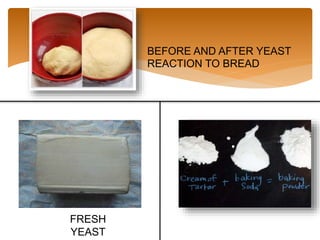
FRESH
YEAST
BEFORE AND AFTER YEAST
REACTION TO BREAD
Function of leavening agent
To increase volume of product
Produce shape and texture
Give some extra flavour
Give moisture
5.Egg
 Egg consist primaly Yolk
White
Shell
 It contains a membrane that lines the shell and forms an air cell
at the large and two white strands called ‘chalazae’ that hold
the yolk centered .
EGG COMPOSITION
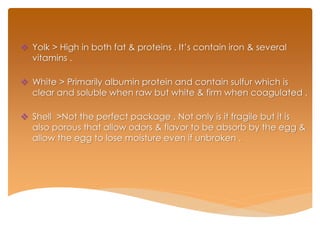
 Yolk > High in both fat & proteins . It’s contain iron & several
vitamins .
 White > Primarily albumin protein and contain sulfur which is
clear and soluble when raw but white & firm when coagulated .
 Shell >Not the perfect package . Not only is it fragile but it is
also porous that allow odors & flavor to be absorb by the egg &
allow the egg to lose moisture even if unbroken .
Maintain Quality
 Keep for weeks in refrigerator at 36F or 2C
 Avoid keep eggs at room temperature because it can lose
quality quickly
 Avoid keep eggs one day at warm kitchen temperature
because it can lose full grade
 Store away from foods that might pass on undesirable flavors or
odors .
SIZE
 Eggs are graded by size
 Most food service operation use large eggs
●Market form
1. Fresh eggs / Shell eggs
Most often used for breakfast cookery
2. Frozen eggs
Made from high-quality fresh eggs
Excellent use in scrambled eggs , omelets , french toast & baking
3. Dried eggs
Used primarily for baking
Not suggested for use in breakfast
Fresh egg Frozen egg Dried egg
Function of egg
 Give a structure to the product
 Also act as shortening
 Give moisture
 Add flavor
 Give a nice colour (egg yolk)
RULES AND REGULATION RELATED
TO PERSONNEL HYGIENE,FOOD
SAFETY & SANITATION
●PERSONNEL HYGIENE
-Wash hand before and after touch a food
-Wear complete uniform during work
-Make all nail has been cut appropriately.
●FOOD SAFETY
-Follow HACCP regulation
-Cook food throughly
-Prevent cross contamination
●Sanitation
-Never use a broken utensils/broken
-Choose utensils/equipment that don’t cause toxic to the food
-Make sure workplace is free from pesticide
THANK YOU
ANY QUESTION?

basic ingredient in baking & pastry

  • 1.
    BAKING & PASTRY 1-EXPLANATIONOF BASIC INGREDIENT IN BAKING & PASTRY 2-RULES & REGULATION RELATED TO PERSONNEL HYGIENE,FOOD SAFETY & SANITATION
  • 2.
    1-EXPLANATION THE FUNCTIONOF FAT,SUGAR, FLOUR,LEAVENING AGENT & EGG
  • 3.
    1-FAT -Fat can bedevided into 2 big category which are saturated & unsaturated fat; *Saturated -saturated fat contain many hydrogen atoms as it can possibly hold -Mostly come from animal fat *Unsaturated -unsaturated fat have empty space for hydrogen -Mostly come from vegetable fat -Under this 2 big categories,it can be devided into another type of fat: 1-Shortening -100% fat & solid at roomtemperature -Shortening is creamed with sugar to trap air -For gluten stand & tenderize product
  • 4.
    2-Butter -Made from 80%fat & 20% water with some milk -Available in salted & unsalted -For salted,more perishable and have fresher,sweeter and preferred in baking -Unsalted butter have a salty taste and the recipe that use salted butter should reduce the volume salt to be use -Butter will give a fatty taste and melting qualities (melt In mouth and smooth) 3-Margarine -Hydrogened animal/vegetable fat with water,milk solid & salt with ratio 80:20 -can be used interchangeably with butter & have good creaming ability.
  • 5.
    4-Oil -Oil is aliquid fat and commontly come from vegetable -Oil is sometime use as shortening for some product such as cakes & quick bread -Oil is use for shortening,frying and greasing 5-Lard -Lard is rendered fat of hogs -It sold in solid -Suitable for piecrust & biscuit ●All fat is very perishable,so it must be store in the right way.Eg,oil should be kept in very close container and solid fat should be stored in refrigerator
  • 6.
    MAIN FUNCTION OFFAT;  To add moistness  To increase keeping quality  To add flavor  To assist leavening agent when use a creamingmethod  To give flakiness
  • 7.
  • 8.
    2-Sugar Sugar is belongto a group of substance called carbohydrates which are function like starch.It have many type of sugar which are : ●Invert sugar -Sucrose + acid (sucrose breakdown) = Invert sugar -30% more sweeter than plain sugar -Hold moisture & keep cake fresh -Resist crytalization & produce commercially ●Regular refined sugar -Granulated sugar -regular granulated sugar (table sugar) the common sugar -ultrafine (caster sugar) present in cakes & cookies -sandy sugar use for coating cookies,cake & other product -pearl sugar (sugar nibs) is a type of sandy sugar & use for decorating sweet dough product
  • 9.
    -Confective sugar (icingsugar) -ground sugar to a fine powder & mix with small amount of stach to prevent craking the product -Dehydrated fondant -dried form of fondant icing -sucroseinvert sugar = fondant -Brown sugar -mostly like sucrose & contain small amount of acid -uncomplete refined cane sugar -will give extra taste and brown color
  • 10.
    ●Syrup -Molasses -concentrated sugarcane juice(dark) -more acidic than sugar -give brown dark color & provide moisture -Glucose corn syrup -process that breaks cornstarch to glucose molecule -use for give moistness & give caramalize to icing,candies & sugar piece -Honey -honey is more sweeter than sugar -it will give moistness to the product -product may be too brown in case of too much use of honey -Malt syrup -extracted barley (dark colour) -use primarly in yeast bread -add flavor & crust color to product
  • 11.
    Function of sugar; Add sweetness and flavor  Create tenderness and fitness  Give a crust color  Retaining moisture  Provide food for yeast
  • 13.
    3-Flour -Most of bakerswill use wheat flour in their product but there also many type of flour that also used br bakers. -For the professional baker,each of flour have it own characteristics & qualities.Below is many type of flour that are used: ●Bread flour -hard wheat & contain 12% of protein -used for yeast raised bread because the dough has more gluten than dough made with other flour -will produce light loaf with good volume of the bread ●Cake flour -low gluten flour (7.5% of protein) -it have soft,smooth texture & pure white color -will make the product to have soft tender & more crumby
  • 14.
    ●All purpose flour -blended,milingwheat flour to archive 10.5% of protein -suitable for all baking & pastry purpose -slightly weaker than bread flour ●High-gluten flour -contain high in protein (14%) -use for hard crusted bread (pizza dough & baggel) ●Whole wheat flour -contain nutrious germ & bran as well endosperm of wheat kernel -substitute for part of the white flour in yeast & quick bread recipe
  • 15.
    ●Wheat germ -it’s nota flour but a part in recipe for flavor & fibre -protein,vitamins,minerals,and polyunsaturated fats are concentrated in the germ of grain kernels. -rich in protein ●Self rising flour -white flour that have been added with baking soda & salt -can’t be used to all product because each recipe contain different quantity of baking soda & salt ●Rye flour -rye flour is milled much like wheat flour -contain protein but go not form gluten -Light rye flour can be successfully substituted for 40 percent of wheat flour in a recipe without loss of volume -use for make a rye bread
  • 16.
    ●Corn meal -come fromgrind dried corn & the part is endosperm -consist 7.8% of protein & no gluten foarming -most popular type of cornmeal is yellow cornmeal and used to add variety of baked goods ●Rice flour -acceptable substitude for wheat ,barley,rye or oat flour -contain 6.5-7% & doesn’t not form gluten -commontly used in asian product
  • 17.
    Function of flour; The most and the main ingredient in baking and pastry  Provide bulk & structure.
  • 18.
    4- Leavening Agent Gases expand greatly when they are heated  To increase volume and to produce shape and texture  3 main gases ; carbon dioxide, steam, and air . -Leavening can be devide into 4 : ●Yeast -leavening agent in bread,dinner rolls,danish & similar product -microscopic plant that produce enzyme -work with simple sugar,carbon dioxide and alcohol
  • 19.
    Yeast fermentation  Theprocess by which yeast acts on sugars and changes them into carbon dioxide gas and alcohol.  This release gas of gas produces the leavening action in yeast products. Types of yeast :1. Fresh yeast - Also called compressed yeast - Moist and perishable and is preferred by professional bakers 2. Active dry yeast - Dry , granular form of yeast 3. Instant dry yeast - Much more quickly than active dry yeast - Produces more gas
  • 20.
     Release gasesproduced by chemical reaction . Chemical leaveners 1. Baking soda - Sodium bicarbonate - If moisture and an acid are present, soda release co2 gas which leavens the product - Heat is not necessary . Baked at once or gases will escape and leavining power will be lost - Acids that react with soda in a batter include ; Honey,molasses,brown sugar,buttermilk,yogurt,sour cream 2. Baking powder - Mixture of baking soda plus one or more acids to react with it - Contain starch to prevent lumping Types of chemical leaveners :
  • 21.
    3. Baking ammonia -Mixture of ammonium carbonate, ammonium bicarbonate, and ammonium carbamate. - Decomposes rapidly during baking to form co2 gas , ammonia gas and water STORAGE OF CHEMICAL LEAVENERS ;  Keep tightly closed when not in use .  If left open, they can absorb moisture from the air and lose part of their leavening power .  Stored at cool place, because heat also causes them to deteriorate .
  • 22.
    ● Air -incorperate withdough & batter -to hold the leavening gases -use in to creaming (beating fat+sugar) and foaming (beating egg with or without sugar) ●Steam -water turn to steam -provide moisture
  • 23.
    FRESH YEAST BEFORE AND AFTERYEAST REACTION TO BREAD
  • 24.
    Function of leaveningagent To increase volume of product Produce shape and texture Give some extra flavour Give moisture
  • 25.
    5.Egg  Egg consistprimaly Yolk White Shell  It contains a membrane that lines the shell and forms an air cell at the large and two white strands called ‘chalazae’ that hold the yolk centered .
  • 26.
  • 27.
     Yolk >High in both fat & proteins . It’s contain iron & several vitamins .  White > Primarily albumin protein and contain sulfur which is clear and soluble when raw but white & firm when coagulated .  Shell >Not the perfect package . Not only is it fragile but it is also porous that allow odors & flavor to be absorb by the egg & allow the egg to lose moisture even if unbroken .
  • 28.
    Maintain Quality  Keepfor weeks in refrigerator at 36F or 2C  Avoid keep eggs at room temperature because it can lose quality quickly  Avoid keep eggs one day at warm kitchen temperature because it can lose full grade  Store away from foods that might pass on undesirable flavors or odors .
  • 29.
    SIZE  Eggs aregraded by size  Most food service operation use large eggs
  • 30.
    ●Market form 1. Fresheggs / Shell eggs Most often used for breakfast cookery 2. Frozen eggs Made from high-quality fresh eggs Excellent use in scrambled eggs , omelets , french toast & baking 3. Dried eggs Used primarily for baking Not suggested for use in breakfast Fresh egg Frozen egg Dried egg
  • 31.
    Function of egg Give a structure to the product  Also act as shortening  Give moisture  Add flavor  Give a nice colour (egg yolk)
  • 32.
    RULES AND REGULATIONRELATED TO PERSONNEL HYGIENE,FOOD SAFETY & SANITATION
  • 33.
    ●PERSONNEL HYGIENE -Wash handbefore and after touch a food -Wear complete uniform during work -Make all nail has been cut appropriately. ●FOOD SAFETY -Follow HACCP regulation -Cook food throughly -Prevent cross contamination ●Sanitation -Never use a broken utensils/broken -Choose utensils/equipment that don’t cause toxic to the food -Make sure workplace is free from pesticide
  • 34.