BAKING
TERMS
BATTER
- a pourable mixture of combined
ingredients such as flour, sugar, eggs
shortening, milk, etc.
BEAT
- To soften hard fats by
incorporating air into the mixture of dry
and wet ingredients, normally done with
a stand mixer.
BITE-SIZED - To cut or tear food into
small enough pieces to eat in one bite
BLEND - To thoroughly combine all
ingredients until very smooth and uniform.
BREAKING DOWN - over creaming of
ingredients, causing weakened products
which collapsed.
CARAMELIZE - To heat sugar until it
dissolves and turns into a golden syrup.
CHILL – to refrigerate until evenly cold.
CONSISTENCY (of batter) – fluidity of the
batter, closely related to viscosity. A batter of
low consistency is one which is quite fluid; one
of high consistency is stiff.
CRUMB
- refers to the interior of breads and
cakes as compared to the outer crust.
CREAM
- To beat together two or more
ingredients, such as butter and sugar, until
the mixture is smooth, creamy, uniform
consistency.
CRIMP- to use a fork to press the edges of
an unbaked piecrust against the rim of the
pie plate to seal in the filling and provide a
traditional decoration.
DECORATIING
- the art of putting fancy inscriptions or
design on cakes
CUT IN
- To mix a cold fat (such as butter)
with flour or dry ingredients by hand until
the mixture resembles coarse crumbs.
- This can be achieved by using a
pastry blender or two tableware knives.
DIP – To slowly, but briefly, lower food into a
melted mixture such as chocolate.
DROP – To place cookies by spoonful's onto a
cookie sheet.
DUST – To sprinkle a fine powder such as
icing sugar or cocoa on top of baked goods.
Normally done with a sifter.
FOLD/FOLD IN – To gently combine a light,
airy mixture( such as beaten egg whites) with a
heavier mixture.
GLAZE – To create a shiny surface on
top of baked goods.
GOLDEN BROWN – To visually test
for doneness of a light to medium
brown color on foods, such as cookies
and cakes.
GRADUALLY – the act o proceeding
by stages.
GREASING – application of
shortening to the inside of a pan with
a brush to prevent mixture from
adhering to the pan when baked.
GREASE AND FLOUR – Coat
baking pan with shortening before
lightly dusting with flour to prevent
food from sticking.
ICE/ICING – To cover a cake or
cookie with mixture, such as frosting.
KNEAD – To work dough by hand or
with a dough hook of an electric mixer,
into a smooth ball to develop the gluten
or structure of the dough.
LIGHT AND FIRM – the degree of
lightness and stability normally applied
to whipped eggs and creamed batters.
MELT – To apply heat to change a
food from a solid to a liquid, such as
butter or chocolate.
MIX – To use a whisk, spoon or fork to
combine two or more ingredients.
PREHEAT – To heat (an oven) before hand.
SCRAPE DOWN – To scrape the batter
from the sides of the kettle so that it may
blend with the batter uniformly.
SCALD – To heat cream or milk
almost to boiling.
SCORE – To make shallow cuts on
the surface of yeast bread to ensure
even rising and baking.
SIMMER – To heat a liquid until it
gently bubbles on the surface.
SIEVE – To strain dry or wet through
the holes of a strainer or sieve.
SIFT – To pass an ingredients, such as
powdered sugar, through a sieve or sifter
to makes smooth and separating course
particles in the ingredients like lumps.
SOFT PEAKS – To beat whipping cream or
egg whites until peaks curl over when beaters
are lifted out of the bowl.
SOGGY – presence of excess moisture
giving the product a very wet appearance.
STIFF PEAKS - To beat whipping cream or
egg whites until peaks stand up straight when
the beaters are lifted up out of the bowl.
SPREAD – To cover evenly.
SPRINKLE – To scatter lightly.
STEAMING – To cook on a rack above
boiling liquid in a tightly covered pan.
STIR – To use a spoon or whisk in a
circular motion to combine two or more
ingredients
WHIP
- To combine two or more
ingredients using a wire whisk
- To beat a liquid (such as cream)
briskly with a whisk to incorporate air
until soft or hard peaks form.
BAKING
INGREDIENTS
1.FLOUR
– is the primary
ingredients in
baking.
- provides the
structure in baked
goods.
WHEAT FLOUR
-Is the most important ingredients in the
bakeshop.
- Wheat flour contains proteins that
interact with each other when mixed
with water, forming gluten.
-Is best for cakes, pastries and breads.
Types of Flour
•Bread Flour
•All-Purpose Flour
•Cake Flour
BREAD FLOUR
• Hard wheat flour or Strong flour.
• Contain 12-14% protein.
• Bread flour feels slightly coarse when
rubbed between the fingers
• Its color is creamy white.
ALL-PURPOSE FLOUR
• Family flour or General flour.
• Referred to as pastry flour.
• Contain 10-12% protein.
• Feels smooth and fine like cake flour
and can also squeezed into a lump.
CAKE FLOUR
• Soft flour
• Lower gluten content.
• Contain 7-8% protein.
• Feels very smooth and fine. It stays in
a lump when squeezed in the hand.
• Its color is pure white.
OTHER TYPES OF FLOUR
• Straight flour – is flour made from
the entire endosperm.
• Patent flour – is milled from the
inner part of the endosperm, which
breaks into fine particles than the
part nearer the bran.
• Clear four – this flour comes from
the outer parts of the endosperm.
• High-gluten flour – flour that has
an especially high protein content is
sometimes used in hard-crusted
breads and in such specialty products
as pizza dough and bagels.
• Pastry Flour – is also a weak or
low-gluten flour, but it is slightly
stronger than cake flour.
In addition to flours:
• CORNSTARCH – has especially
property that makes it valuable for
certain purposes.
• WAXY MAIZE AND OTHER MODIFIED
STARCHES – have valuable properties.
• INSTANT STARCHES – are precooked
or pregelatinized so they thicken cold
liquids w/out further cooking.
SUGAR
-Sweetening ingredients.
a. Granulated sugar or
refined sugar.
b. Confectionary sugar or
powdered sugar.
c. Brown Sugar
FATS/SHORTENING
1. Fats – in the form of solid
shortening, margarine or butter or the
liquid form of oil contribute tenderness,
moistness and a smooth mouth feel to
baked goods.
2. SHORTENING
-Is 100 percent fat and is solid at
room temperature.
-Made from vegetable oils, animal
fats or both.
-Use the word shortening to mean
any of a group of solid fats, usually
white and tasteless.
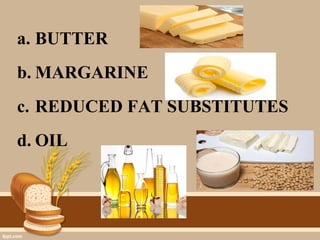
a. BUTTER
b. MARGARINE
c. REDUCED FAT SUBSTITUTES
d. OIL
BUTTER
• Fresh butter consist of about 80% fat,
about 15% water and about 5% milk
solids.
• Butter is available salted and unsalted.
- Unsalted butter is more perishable,
but it has a fresher, sweeter taste and is
thus preferred in baking.
- Salted butter , the salt in the formula
may have to be reduced
MARGARINE
• It contains 80-85% fat, 10-15%
moisture and about 5% salt, milk
solids and other components.
• Margarine is manufactured from
various hydrogenated animal and
vegetable fats, plus flavoring
ingredients, emulsifiers, coloring
agents and other ingredients.
OILS
• Oils are liquid fats.
• They are not often used as
shortenings in baking because
they spread through a batter or
dough too thoroughly and shorten
too much.
LARD
• Lard is the rendered fat of hogs.
Because of its plastic quality, it
was once highly valued for
making flaky pie crust.
EGGS
-Serve many functions in baked goods.
LIQUID
a.Water/Liquids
b.Milk
c.Juice
LEAVENING AGENT
1.Physical Leaveners
2.Biological Leaveners
- YEAST
3 . Chemical Leavening Agents
a. Baking Soda
b. Baking Powder
FLAVORING in BAKING
1.Salt
2.Flavor
3.Cocoa, chocolate and coffee
4.Seeds and spices, root crops,
fruits and other vegetables.
5. Alcohols
SALT
• Salt plays a very important role in
baking.
Functions:
- Salt strengthens gluten structure and
makes it more stretchable. Thus it
improves the texture of breads.
- Salt inhibits yeast growth
THANK YOU!!!
GOD BLESS…

Baking Terms and Ingredients!!!

  • 1.
  • 3.
    BATTER - a pourablemixture of combined ingredients such as flour, sugar, eggs shortening, milk, etc. BEAT - To soften hard fats by incorporating air into the mixture of dry and wet ingredients, normally done with a stand mixer.
  • 4.
    BITE-SIZED - Tocut or tear food into small enough pieces to eat in one bite BLEND - To thoroughly combine all ingredients until very smooth and uniform. BREAKING DOWN - over creaming of ingredients, causing weakened products which collapsed.
  • 5.
    CARAMELIZE - Toheat sugar until it dissolves and turns into a golden syrup. CHILL – to refrigerate until evenly cold. CONSISTENCY (of batter) – fluidity of the batter, closely related to viscosity. A batter of low consistency is one which is quite fluid; one of high consistency is stiff.
  • 6.
    CRUMB - refers tothe interior of breads and cakes as compared to the outer crust. CREAM - To beat together two or more ingredients, such as butter and sugar, until the mixture is smooth, creamy, uniform consistency.
  • 7.
    CRIMP- to usea fork to press the edges of an unbaked piecrust against the rim of the pie plate to seal in the filling and provide a traditional decoration. DECORATIING - the art of putting fancy inscriptions or design on cakes
  • 8.
    CUT IN - Tomix a cold fat (such as butter) with flour or dry ingredients by hand until the mixture resembles coarse crumbs. - This can be achieved by using a pastry blender or two tableware knives.
  • 9.
    DIP – Toslowly, but briefly, lower food into a melted mixture such as chocolate. DROP – To place cookies by spoonful's onto a cookie sheet. DUST – To sprinkle a fine powder such as icing sugar or cocoa on top of baked goods. Normally done with a sifter. FOLD/FOLD IN – To gently combine a light, airy mixture( such as beaten egg whites) with a heavier mixture.
  • 10.
    GLAZE – Tocreate a shiny surface on top of baked goods. GOLDEN BROWN – To visually test for doneness of a light to medium brown color on foods, such as cookies and cakes. GRADUALLY – the act o proceeding by stages.
  • 11.
    GREASING – applicationof shortening to the inside of a pan with a brush to prevent mixture from adhering to the pan when baked. GREASE AND FLOUR – Coat baking pan with shortening before lightly dusting with flour to prevent food from sticking.
  • 12.
    ICE/ICING – Tocover a cake or cookie with mixture, such as frosting. KNEAD – To work dough by hand or with a dough hook of an electric mixer, into a smooth ball to develop the gluten or structure of the dough.
  • 13.
    LIGHT AND FIRM– the degree of lightness and stability normally applied to whipped eggs and creamed batters. MELT – To apply heat to change a food from a solid to a liquid, such as butter or chocolate.
  • 14.
    MIX – Touse a whisk, spoon or fork to combine two or more ingredients. PREHEAT – To heat (an oven) before hand. SCRAPE DOWN – To scrape the batter from the sides of the kettle so that it may blend with the batter uniformly.
  • 15.
    SCALD – Toheat cream or milk almost to boiling. SCORE – To make shallow cuts on the surface of yeast bread to ensure even rising and baking. SIMMER – To heat a liquid until it gently bubbles on the surface.
  • 16.
    SIEVE – Tostrain dry or wet through the holes of a strainer or sieve. SIFT – To pass an ingredients, such as powdered sugar, through a sieve or sifter to makes smooth and separating course particles in the ingredients like lumps.
  • 17.
    SOFT PEAKS –To beat whipping cream or egg whites until peaks curl over when beaters are lifted out of the bowl. SOGGY – presence of excess moisture giving the product a very wet appearance. STIFF PEAKS - To beat whipping cream or egg whites until peaks stand up straight when the beaters are lifted up out of the bowl.
  • 18.
    SPREAD – Tocover evenly. SPRINKLE – To scatter lightly. STEAMING – To cook on a rack above boiling liquid in a tightly covered pan. STIR – To use a spoon or whisk in a circular motion to combine two or more ingredients
  • 19.
    WHIP - To combinetwo or more ingredients using a wire whisk - To beat a liquid (such as cream) briskly with a whisk to incorporate air until soft or hard peaks form.
  • 20.
  • 21.
    1.FLOUR – is theprimary ingredients in baking. - provides the structure in baked goods.
  • 22.
    WHEAT FLOUR -Is themost important ingredients in the bakeshop. - Wheat flour contains proteins that interact with each other when mixed with water, forming gluten. -Is best for cakes, pastries and breads.
  • 23.
    Types of Flour •BreadFlour •All-Purpose Flour •Cake Flour
  • 24.
    BREAD FLOUR • Hardwheat flour or Strong flour. • Contain 12-14% protein. • Bread flour feels slightly coarse when rubbed between the fingers • Its color is creamy white.
  • 25.
    ALL-PURPOSE FLOUR • Familyflour or General flour. • Referred to as pastry flour. • Contain 10-12% protein. • Feels smooth and fine like cake flour and can also squeezed into a lump.
  • 26.
    CAKE FLOUR • Softflour • Lower gluten content. • Contain 7-8% protein. • Feels very smooth and fine. It stays in a lump when squeezed in the hand. • Its color is pure white.
  • 28.
    OTHER TYPES OFFLOUR • Straight flour – is flour made from the entire endosperm. • Patent flour – is milled from the inner part of the endosperm, which breaks into fine particles than the part nearer the bran. • Clear four – this flour comes from the outer parts of the endosperm.
  • 29.
    • High-gluten flour– flour that has an especially high protein content is sometimes used in hard-crusted breads and in such specialty products as pizza dough and bagels. • Pastry Flour – is also a weak or low-gluten flour, but it is slightly stronger than cake flour.
  • 30.
    In addition toflours: • CORNSTARCH – has especially property that makes it valuable for certain purposes. • WAXY MAIZE AND OTHER MODIFIED STARCHES – have valuable properties. • INSTANT STARCHES – are precooked or pregelatinized so they thicken cold liquids w/out further cooking.
  • 31.
    SUGAR -Sweetening ingredients. a. Granulatedsugar or refined sugar. b. Confectionary sugar or powdered sugar. c. Brown Sugar
  • 32.
    FATS/SHORTENING 1. Fats –in the form of solid shortening, margarine or butter or the liquid form of oil contribute tenderness, moistness and a smooth mouth feel to baked goods.
  • 33.
    2. SHORTENING -Is 100percent fat and is solid at room temperature. -Made from vegetable oils, animal fats or both. -Use the word shortening to mean any of a group of solid fats, usually white and tasteless.
  • 34.
    a. BUTTER b. MARGARINE c.REDUCED FAT SUBSTITUTES d. OIL
  • 35.
    BUTTER • Fresh butterconsist of about 80% fat, about 15% water and about 5% milk solids. • Butter is available salted and unsalted. - Unsalted butter is more perishable, but it has a fresher, sweeter taste and is thus preferred in baking. - Salted butter , the salt in the formula may have to be reduced
  • 36.
    MARGARINE • It contains80-85% fat, 10-15% moisture and about 5% salt, milk solids and other components. • Margarine is manufactured from various hydrogenated animal and vegetable fats, plus flavoring ingredients, emulsifiers, coloring agents and other ingredients.
  • 37.
    OILS • Oils areliquid fats. • They are not often used as shortenings in baking because they spread through a batter or dough too thoroughly and shorten too much.
  • 38.
    LARD • Lard isthe rendered fat of hogs. Because of its plastic quality, it was once highly valued for making flaky pie crust.
  • 40.
  • 41.
  • 42.
    LEAVENING AGENT 1.Physical Leaveners 2.BiologicalLeaveners - YEAST 3 . Chemical Leavening Agents a. Baking Soda b. Baking Powder
  • 43.
    FLAVORING in BAKING 1.Salt 2.Flavor 3.Cocoa,chocolate and coffee 4.Seeds and spices, root crops, fruits and other vegetables. 5. Alcohols
  • 44.
    SALT • Salt playsa very important role in baking. Functions: - Salt strengthens gluten structure and makes it more stretchable. Thus it improves the texture of breads. - Salt inhibits yeast growth
  • 46.