Major Baking
Ingredients
Functions and Use
1st
QUARTER
Lesson 1
Major Baking Ingredients Functions and Use
-is the primary ingredient of most baked
products because it provides the
structure of the product
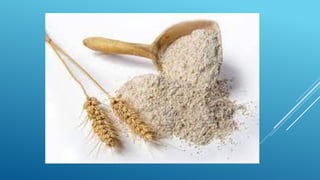
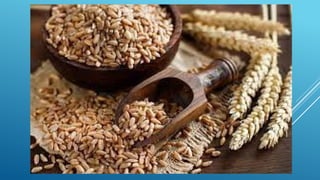
-The kind of flour that is commonly
used in baking comes from the
wheat grain.
1. Flour
Kinds of Flour
A. Whole wheat flour
-Comes from wheat grains, contains the whole
part of the grain including the bran (outer
part or cover of the grain), the endosperm
(the fruit) and the germ or the embryo (the
inner part of the whole grain).
-Best used in preparing
yeast breads like whole
wheat bread
Function and use
Kinds of Flour
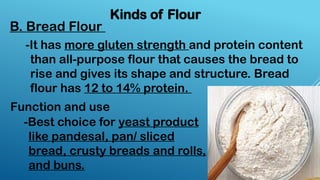
B. Bread Flour
-It has more gluten strength and protein content
than all-purpose flour that causes the bread to
rise and gives its shape and structure. Bread
flour has 12 to 14% protein.
-Best choice for yeast product
like pandesal, pan/ sliced
bread, crusty breads and rolls,
and buns.
Function and use
Kinds of Flour
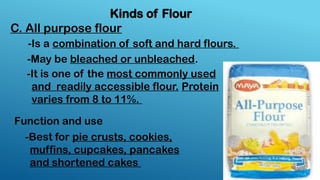
C. All purpose flour
-Is a combination of soft and hard flours.
-May be bleached or unbleached.
-It is one of the most commonly used
and readily accessible flour. Protein
varies from 8 to 11%.
-Best for pie crusts, cookies,
muffins, cupcakes, pancakes
and shortened cakes
Function and use
Kinds of Flour
D. Cake flour
-Is a fine-textured, soft-wheat flour with high
starch content.
-It has the lowest protein content of 7 to 9%.
-It is chlorinated (a bleaching process which
leaves the flour slightly acidic, sets a cake faster
and distributes fat more evenly through the
batter to improve texture).
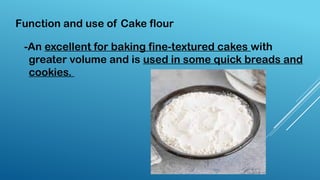
-An excellent for baking fine-textured cakes with
greater volume and is used in some quick breads and
cookies.
Function and use of Cake flour
Kinds of Flour
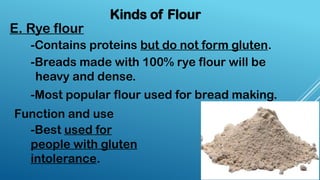
E. Rye flour
-Contains proteins but do not form gluten.
-Breads made with 100% rye flour will be
heavy and dense.
-Most popular flour used for bread making.
-Best used for
people with gluten
intolerance.
Function and use
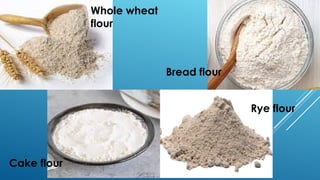
Whole wheat
flour
Bread flour
Cake flour
Rye flour
-Important for hydrating protein, starch and
leavening agents and bring together the flour
and other ingredients to make a dough.
2. Liquids
-contribute to the moistness and texture of
the products.
-also help in leavening the product because it
turns to steam and expands during baking.
Major Baking Ingredients Functions and Use
Kinds of Liquid Ingredients
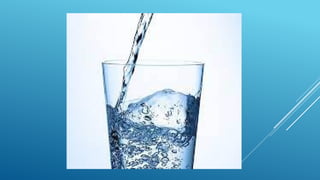
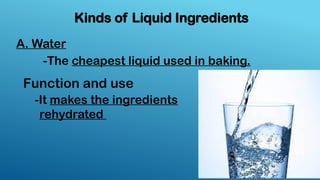
A. Water
-The cheapest liquid used in baking.
-It makes the ingredients
rehydrated
Function and use
Kinds of Liquid Ingredients
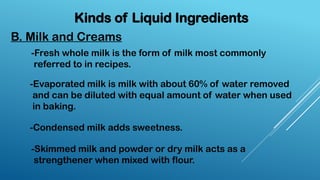
B. Milk and Creams
-Fresh whole milk is the form of milk most commonly
referred to in recipes.
-Evaporated milk is milk with about 60% of water removed
and can be diluted with equal amount of water when used
in baking.
-Condensed milk adds sweetness.
-Skimmed milk and powder or dry milk acts as a
strengthener when mixed with flour.
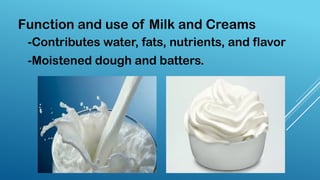
-Contributes water, fats, nutrients, and flavor
-Moistened dough and batters.
Function and use of Milk and Creams
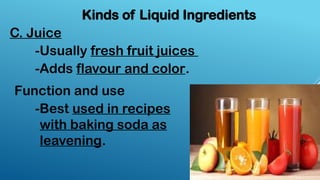
C. Juice
Kinds of Liquid Ingredients
-Usually fresh fruit juices
-Adds flavour and color.
-Best used in recipes
with baking soda as
leavening.
Function and use
3. Shortening
Major Baking Ingredients Functions and Use
-any fat which may come from animal or
vegetable. It can also be in liquid or solid form.
-It generally help to tenderize the product and
soften the structure, add moistness and
richness, increase keeping quality, add flavour,
assist in leavening when used as creaming
agents
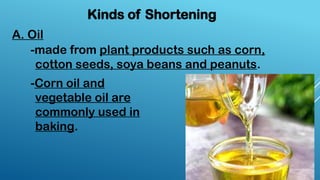
A. Oil
Kinds of Shortening
-made from plant products such as corn,
cotton seeds, soya beans and peanuts.
-Corn oil and
vegetable oil are
commonly used in
baking.
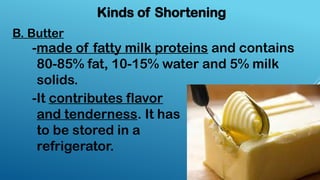
B. Butter
Kinds of Shortening
-made of fatty milk proteins and contains
80-85% fat, 10-15% water and 5% milk
solids.
-It contributes flavor
and tenderness. It has
to be stored in a
refrigerator.
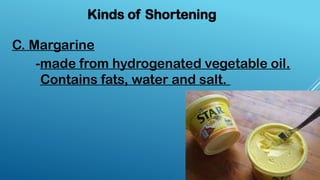
C. Margarine
Kinds of Shortening
-made from hydrogenated vegetable oil.
Contains fats, water and salt.
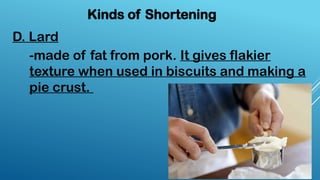
D. Lard
Kinds of Shortening
-made of fat from pork. It gives flakier
texture when used in biscuits and making a
pie crust.
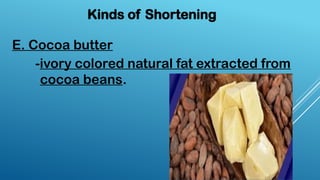
E. Cocoa butter
Kinds of Shortening
-ivory colored natural fat extracted from
cocoa beans.
4. Sugar
Major Baking Ingredients Functions and Use
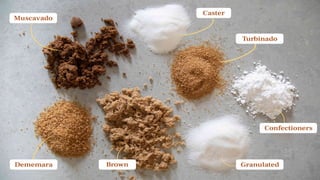
-or sweeteners have differing degrees of sweetness
and come in various forms from powder to crystals
to syrups.
-they generally add sweetness and flavour, create
tenderness and fineness of texture (partly by
weakening the gluten structure), give color to the
crust, increase keeping quality (by retaining
moisture), act as creaming agent with fats, and
provide food for yeast
Kinds of Sweeteners
-Regular white sugar also called table sugar.
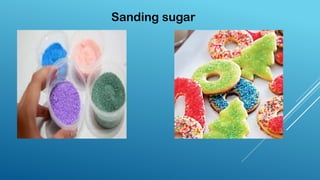
-Caster sugar has finer granules while sanding
sugar has coarser granules than regular white
sugar
A. Granulated or refine cane sugar
Sanding sugar
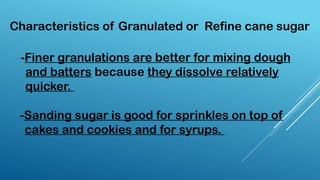
-Finer granulations are better for mixing dough
and batters because they dissolve relatively
quicker.
-Sanding sugar is good for sprinkles on top of
cakes and cookies and for syrups.
Characteristics of Granulated or Refine cane sugar
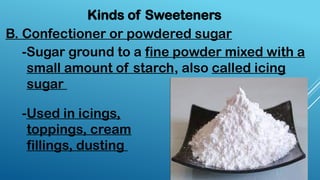
B. Confectioner or powdered sugar
Kinds of Sweeteners
-Sugar ground to a fine powder mixed with a
small amount of starch, also called icing
sugar
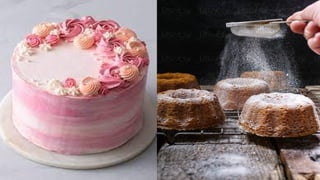
-Used in icings,
toppings, cream
fillings, dusting
C.Brown sugar (raw brown, light brown, medium
brown)
Kinds of Sweeteners
-Darker color has more impurities, it contains small
amount of glucose and fructose
-Contains a little amount of molasses and the natural
fibers of the sugar cane
-Used in place of white sugar when its flavour and
color is desired
-Contains a small amount of acid so it can be used
with baking soda to provide leavening
5. Leavening Agents
Major Baking Ingredients Functions and Use
-are responsible for the production and
incorporation of gases during the baking
process.
-This is what makes baked products rise.
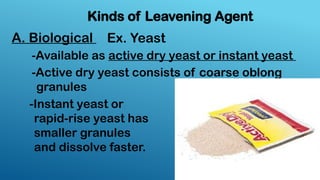
A. Biological
Kinds of Leavening Agent
Ex. Yeast
-Available as active dry yeast or instant yeast
-Active dry yeast consists of coarse oblong
granules
-Instant yeast or
rapid-rise yeast has
smaller granules
and dissolve faster.
 Fermentation of yeast is important in
the formation and stabilization of
gluten thus it is best used for breads
and other yeast products.
Functions and use of Yeast
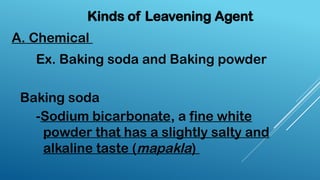
A. Chemical
Kinds of Leavening Agent
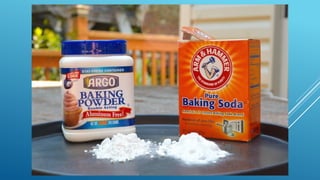
Ex. Baking soda and Baking powder
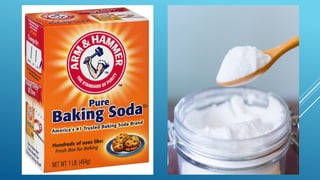
Baking soda
-Sodium bicarbonate, a fine white
powder that has a slightly salty and
alkaline taste (mapakla)
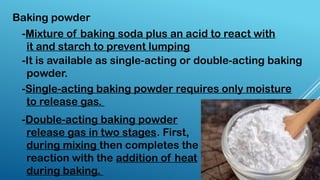
Baking powder
-Mixture of baking soda plus an acid to react with
it and starch to prevent lumping
-It is available as single-acting or double-acting baking
powder.
-Single-acting baking powder requires only moisture
to release gas.
-Double-acting baking powder
release gas in two stages. First,
during mixing then completes the
reaction with the addition of heat
during baking.
Functions and use of Baking powder and
Baking soda
-The fast action of chemical leaveners
makes them very good to use in
muffins, cakes, cookies, pastries.
C. Vaporous leavening agent
Kinds of Leavening Agent
Ex. Steam
-Steam gives the effect of leavening as baked
products expands when heated, though
minimal.
-It also contributes to the improvement of the
texture and volume of the dough
Functions and Use
-When baked at high temperatures, water
turns to steam, as like baking cream puffs
D. Air
Kinds of Leavening Agent
-Becomes a leavening agent when it is
incorporated in the mixture when
creaming butter and sugar.
Functions and Use
-Adds volume and softness as in angel
or sponge cake.
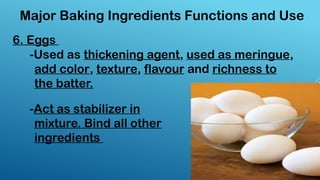
6. Eggs
Major Baking Ingredients Functions and Use
-Used as thickening agent, used as meringue,
add color, texture, flavour and richness to
the batter.
-Act as stabilizer in
mixture. Bind all other
ingredients
Characteristics of Eggs
Large and fresh white eggs are the
standards for baking
They should be clean, fresh-tasting,
free of bad odors, and tastes
Functions and Use of Egg
 Protein in eggs contributes to structure.
 Emulsifier (blending or combining of substances
that are difficult to blend like fats and liquid). This
contributes to volume and texture.
 Leavening when egg whites are beaten, air is
trapped in the foam bubbles and expand during
baking.
 Shortening due to the fat content of the egg yolk.
 Moisture due to the quantity of water in eggs.
 Flavour, color, nutritional value.
7. Flavorings
Major Baking Ingredients Functions and Use
these ingredients improves taste and
enhances flavour as well as add aroma to
bakery products.
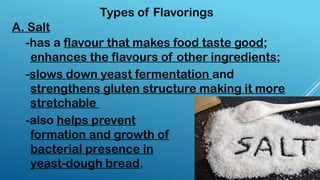
-has a flavour that makes food taste good;
enhances the flavours of other ingredients;
Types of Flavorings
A. Salt
-slows down yeast fermentation and
strengthens gluten structure making it more
stretchable
-also helps prevent
formation and growth of
bacterial presence in
yeast-dough bread.
Types of Flavorings
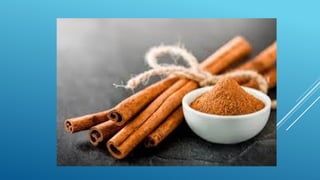
B. Spices and seeds
-are finely ground, aromatic vegetable products
used to improve quality of cooked food which
usually come from the bark of trees, vegetable
or fruit seeds or roots of various plans.
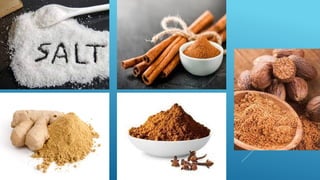
anise, ginger, cinnamon, cloves, mace and
nutmeg.
Examples of Spices and seeds
Types of Flavorings
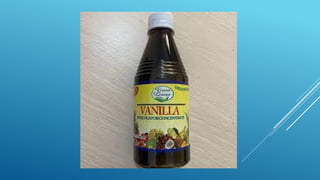
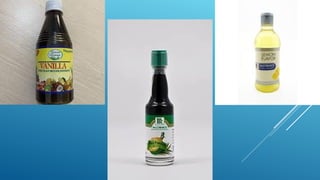
C. Flavor Extracts
-are flavourings that are extracted from fruits ,
pulps or beans wherein some are further
supplemented by artificial flavour and coloring
-vanilla extracts banana essence, pandan flavoring,
lemon extract.
Examples of Flavor Extracts
Types of Flavorings
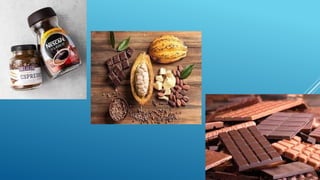
D. Other flavorings
-such as wine, coffee, chocolate and cocoa-
unsweetened, bittersweet and milk chocolate
which add zest to the baked product.
1. What are the 2
commonly used oil in
baking?
2. Cake flour has _________
of protein?
3. Types of flour that is best
in baking pandesal, sliced
bread, crusty bread and
roll and buns.
4. Flour that is fine-textures,
soft-wheat flour with high
starch content.
5. Flour that has a
combination of soft and hard
flours and best for pie crust,
cookies, muffins, cupcakes
and pancakes.
6. Shortening that is made of
fat from pork and gives
flakier texture when used in
biscuits and making pie
crust.
7. Types of sugar that is
used in icings, toppings,
cream fillings and
dusting.
8. Leavening agent that is
sodium bicarbonate, a fine
white powder that has a
slightly and alkaline taste
(mapakla)
9. Ingredients that improves
the taste and enhances
flavor as well as add aroma
to bakery products.
10. It is important for hydrating
protein, starch and leavening
agents and bring together the
flour and other ingredients to
make a dough.
11. Flavorings that are
finely ground, aromatic
vegetable products used
to improve quality of
cooked food.
12. Act as stabilizer in
mixture. Bind all other
ingredients
13. Baking ingredients that
is responsible for the
production and
incorporation of gases
during the baking process.
14. The primary ingredient
of most baked products
because it provides the
structure of the product.
15. Mixture of baking
soda plus an acid to
react with it and starch
to prevent lumping
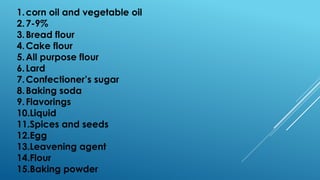
1.corn oil and vegetable oil
2.7-9%
3.Bread flour
4.Cake flour
5.All purpose flour
6.Lard
7.Confectioner’s sugar
8.Baking soda
9.Flavorings
10.Liquid
11.Spices and seeds
12.Egg
13.Leavening agent
14.Flour
15.Baking powder
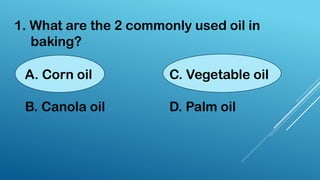
1. What are the 2 commonly used oil in
baking?
A. Corn oil C. Vegetable oil
B. Canola oil D. Palm oil
2. What is the function of flour in baking?
A. Provides moistness to baked products
B. Provides tenderness to baked products
C. Provides structure to baked products
D. Provides flavor to baked products
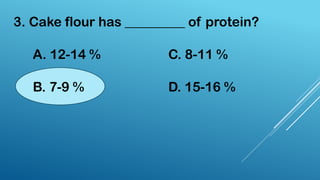
3. Cake flour has _________ of protein?
A. 12-14 %
B. 7-9 %
C. 8-11 %
D. 15-16 %
4. Types of flour that is best in baking
pandesal, sliced bread, crusty bread
and roll and buns.
A. Cake flour
B. Rye flour
C. Bread flour
D. All purpose flour
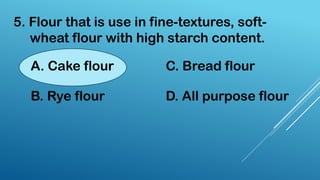
5. Flour that is use in fine-textures, soft-
wheat flour with high starch content.
A. Cake flour
B. Rye flour
C. Bread flour
D. All purpose flour
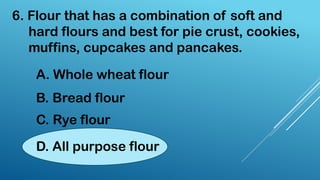
6. Flour that has a combination of soft and
hard flours and best for pie crust, cookies,
muffins, cupcakes and pancakes.
A. Whole wheat flour
B. Bread flour
C. Rye flour
D. All purpose flour
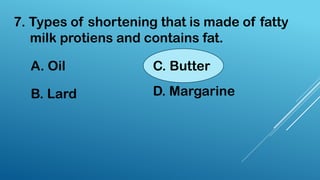
7. Types of shortening that is made of fatty
milk protiens and contains fat.
A. Oil
B. Lard
C. Butter
D. Margarine
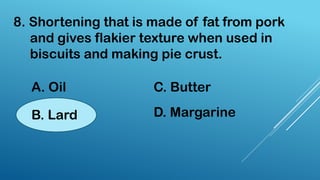
8. Shortening that is made of fat from pork
and gives flakier texture when used in
biscuits and making pie crust.
A. Oil
B. Lard
C. Butter
D. Margarine
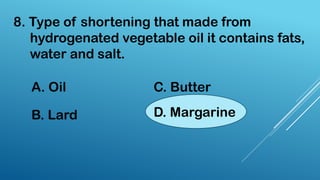
8. Type of shortening that made from
hydrogenated vegetable oil it contains fats,
water and salt.
A. Oil
B. Lard
C. Butter
D. Margarine
9. What is the function of milk and creams?
A. Makes the ingredients rehydrated
B. Adds flavor and color
C. Moistened dough and batters
10. Sugar that is good for sprinkles on top of
cakes and cookies and for syrups.
A. Sanding sugar
B. Caster sugar
C. White sugar
D. Brown sugar
11. Types of sugar that is used in icings,
toppings, cream fillings and dusting.
A. White sugar
B. Brown sugar
C. Confectioner sugar
D. Brown sugar
12. Leavening agent that is sodium
bicarbonate, a fine white powder that has a
slightly and alkaline taste (mapakla)
A. Baking soda
B. Baking powder
C. Yeast
D. Air
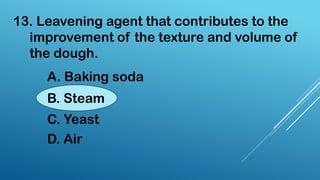
13. Leavening agent that contributes to the
improvement of the texture and volume of
the dough.
A. Baking soda
B. Steam
C. Yeast
D. Air
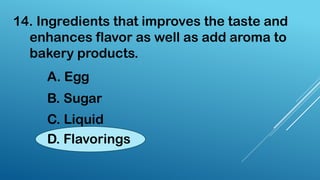
14. Ingredients that improves the taste and
enhances flavor as well as add aroma to
bakery products.
A. Egg
B. Sugar
C. Liquid
D. Flavorings
15. Flavorings that are finely ground,
aromatic vegetable products used to
improve quality of cooked food.
A. Salt
B. Spices and seeds
C. Flavor extract
D. Other flavorings
16. What is the cheapest liquid ingredients?
Answer: Water
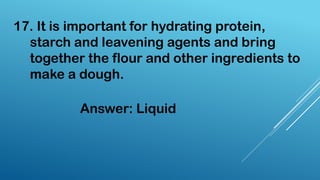
17. It is important for hydrating protein,
starch and leavening agents and bring
together the flour and other ingredients to
make a dough.
Answer: Liquid
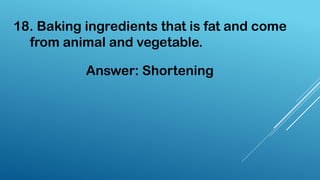
18. Baking ingredients that is fat and come
from animal and vegetable.
Answer: Shortening
19. Sweeteners that come from various forms
from powder to crystals to syrups.
Answer: Sugar

BAKING-INGREDIENTS.pptxjskdndjkwndjdjjsjdjsjjd

  • 1.
  • 9.
    Major Baking IngredientsFunctions and Use -is the primary ingredient of most baked products because it provides the structure of the product -The kind of flour that is commonly used in baking comes from the wheat grain. 1. Flour
  • 11.
    Kinds of Flour A.Whole wheat flour -Comes from wheat grains, contains the whole part of the grain including the bran (outer part or cover of the grain), the endosperm (the fruit) and the germ or the embryo (the inner part of the whole grain). -Best used in preparing yeast breads like whole wheat bread Function and use
  • 12.
    Kinds of Flour B.Bread Flour -It has more gluten strength and protein content than all-purpose flour that causes the bread to rise and gives its shape and structure. Bread flour has 12 to 14% protein. -Best choice for yeast product like pandesal, pan/ sliced bread, crusty breads and rolls, and buns. Function and use
  • 13.
    Kinds of Flour C.All purpose flour -Is a combination of soft and hard flours. -May be bleached or unbleached. -It is one of the most commonly used and readily accessible flour. Protein varies from 8 to 11%. -Best for pie crusts, cookies, muffins, cupcakes, pancakes and shortened cakes Function and use
  • 14.
    Kinds of Flour D.Cake flour -Is a fine-textured, soft-wheat flour with high starch content. -It has the lowest protein content of 7 to 9%. -It is chlorinated (a bleaching process which leaves the flour slightly acidic, sets a cake faster and distributes fat more evenly through the batter to improve texture).
  • 15.
    -An excellent forbaking fine-textured cakes with greater volume and is used in some quick breads and cookies. Function and use of Cake flour
  • 16.
    Kinds of Flour E.Rye flour -Contains proteins but do not form gluten. -Breads made with 100% rye flour will be heavy and dense. -Most popular flour used for bread making. -Best used for people with gluten intolerance. Function and use
  • 17.
  • 18.
    -Important for hydratingprotein, starch and leavening agents and bring together the flour and other ingredients to make a dough. 2. Liquids -contribute to the moistness and texture of the products. -also help in leavening the product because it turns to steam and expands during baking. Major Baking Ingredients Functions and Use
  • 19.
    Kinds of LiquidIngredients A. Water -The cheapest liquid used in baking. -It makes the ingredients rehydrated Function and use
  • 20.
    Kinds of LiquidIngredients B. Milk and Creams -Fresh whole milk is the form of milk most commonly referred to in recipes. -Evaporated milk is milk with about 60% of water removed and can be diluted with equal amount of water when used in baking. -Condensed milk adds sweetness. -Skimmed milk and powder or dry milk acts as a strengthener when mixed with flour.
  • 21.
    -Contributes water, fats,nutrients, and flavor -Moistened dough and batters. Function and use of Milk and Creams
  • 22.
    C. Juice Kinds ofLiquid Ingredients -Usually fresh fruit juices -Adds flavour and color. -Best used in recipes with baking soda as leavening. Function and use
  • 23.
    3. Shortening Major BakingIngredients Functions and Use -any fat which may come from animal or vegetable. It can also be in liquid or solid form. -It generally help to tenderize the product and soften the structure, add moistness and richness, increase keeping quality, add flavour, assist in leavening when used as creaming agents
  • 24.
    A. Oil Kinds ofShortening -made from plant products such as corn, cotton seeds, soya beans and peanuts. -Corn oil and vegetable oil are commonly used in baking.
  • 25.
    B. Butter Kinds ofShortening -made of fatty milk proteins and contains 80-85% fat, 10-15% water and 5% milk solids. -It contributes flavor and tenderness. It has to be stored in a refrigerator.
  • 26.
    C. Margarine Kinds ofShortening -made from hydrogenated vegetable oil. Contains fats, water and salt.
  • 27.
    D. Lard Kinds ofShortening -made of fat from pork. It gives flakier texture when used in biscuits and making a pie crust.
  • 28.
    E. Cocoa butter Kindsof Shortening -ivory colored natural fat extracted from cocoa beans.
  • 29.
    4. Sugar Major BakingIngredients Functions and Use -or sweeteners have differing degrees of sweetness and come in various forms from powder to crystals to syrups. -they generally add sweetness and flavour, create tenderness and fineness of texture (partly by weakening the gluten structure), give color to the crust, increase keeping quality (by retaining moisture), act as creaming agent with fats, and provide food for yeast
  • 30.
    Kinds of Sweeteners -Regularwhite sugar also called table sugar. -Caster sugar has finer granules while sanding sugar has coarser granules than regular white sugar A. Granulated or refine cane sugar
  • 31.
  • 33.
    -Finer granulations arebetter for mixing dough and batters because they dissolve relatively quicker. -Sanding sugar is good for sprinkles on top of cakes and cookies and for syrups. Characteristics of Granulated or Refine cane sugar
  • 34.
    B. Confectioner orpowdered sugar Kinds of Sweeteners -Sugar ground to a fine powder mixed with a small amount of starch, also called icing sugar -Used in icings, toppings, cream fillings, dusting
  • 36.
    C.Brown sugar (rawbrown, light brown, medium brown) Kinds of Sweeteners -Darker color has more impurities, it contains small amount of glucose and fructose -Contains a little amount of molasses and the natural fibers of the sugar cane -Used in place of white sugar when its flavour and color is desired -Contains a small amount of acid so it can be used with baking soda to provide leavening
  • 37.
    5. Leavening Agents MajorBaking Ingredients Functions and Use -are responsible for the production and incorporation of gases during the baking process. -This is what makes baked products rise.
  • 38.
    A. Biological Kinds ofLeavening Agent Ex. Yeast -Available as active dry yeast or instant yeast -Active dry yeast consists of coarse oblong granules -Instant yeast or rapid-rise yeast has smaller granules and dissolve faster.
  • 39.
     Fermentation ofyeast is important in the formation and stabilization of gluten thus it is best used for breads and other yeast products. Functions and use of Yeast
  • 40.
    A. Chemical Kinds ofLeavening Agent Ex. Baking soda and Baking powder Baking soda -Sodium bicarbonate, a fine white powder that has a slightly salty and alkaline taste (mapakla)
  • 42.
    Baking powder -Mixture ofbaking soda plus an acid to react with it and starch to prevent lumping -It is available as single-acting or double-acting baking powder. -Single-acting baking powder requires only moisture to release gas. -Double-acting baking powder release gas in two stages. First, during mixing then completes the reaction with the addition of heat during baking.
  • 44.
    Functions and useof Baking powder and Baking soda -The fast action of chemical leaveners makes them very good to use in muffins, cakes, cookies, pastries.
  • 45.
    C. Vaporous leaveningagent Kinds of Leavening Agent Ex. Steam -Steam gives the effect of leavening as baked products expands when heated, though minimal. -It also contributes to the improvement of the texture and volume of the dough Functions and Use -When baked at high temperatures, water turns to steam, as like baking cream puffs
  • 46.
    D. Air Kinds ofLeavening Agent -Becomes a leavening agent when it is incorporated in the mixture when creaming butter and sugar. Functions and Use -Adds volume and softness as in angel or sponge cake.
  • 47.
    6. Eggs Major BakingIngredients Functions and Use -Used as thickening agent, used as meringue, add color, texture, flavour and richness to the batter. -Act as stabilizer in mixture. Bind all other ingredients
  • 48.
    Characteristics of Eggs Largeand fresh white eggs are the standards for baking They should be clean, fresh-tasting, free of bad odors, and tastes
  • 49.
    Functions and Useof Egg  Protein in eggs contributes to structure.  Emulsifier (blending or combining of substances that are difficult to blend like fats and liquid). This contributes to volume and texture.  Leavening when egg whites are beaten, air is trapped in the foam bubbles and expand during baking.  Shortening due to the fat content of the egg yolk.  Moisture due to the quantity of water in eggs.  Flavour, color, nutritional value.
  • 50.
    7. Flavorings Major BakingIngredients Functions and Use these ingredients improves taste and enhances flavour as well as add aroma to bakery products.
  • 51.
    -has a flavourthat makes food taste good; enhances the flavours of other ingredients; Types of Flavorings A. Salt -slows down yeast fermentation and strengthens gluten structure making it more stretchable -also helps prevent formation and growth of bacterial presence in yeast-dough bread.
  • 52.
    Types of Flavorings B.Spices and seeds -are finely ground, aromatic vegetable products used to improve quality of cooked food which usually come from the bark of trees, vegetable or fruit seeds or roots of various plans. anise, ginger, cinnamon, cloves, mace and nutmeg. Examples of Spices and seeds
  • 54.
    Types of Flavorings C.Flavor Extracts -are flavourings that are extracted from fruits , pulps or beans wherein some are further supplemented by artificial flavour and coloring -vanilla extracts banana essence, pandan flavoring, lemon extract. Examples of Flavor Extracts
  • 56.
    Types of Flavorings D.Other flavorings -such as wine, coffee, chocolate and cocoa- unsweetened, bittersweet and milk chocolate which add zest to the baked product.
  • 58.
    1. What arethe 2 commonly used oil in baking?
  • 59.
    2. Cake flourhas _________ of protein?
  • 60.
    3. Types offlour that is best in baking pandesal, sliced bread, crusty bread and roll and buns.
  • 61.
    4. Flour thatis fine-textures, soft-wheat flour with high starch content.
  • 62.
    5. Flour thathas a combination of soft and hard flours and best for pie crust, cookies, muffins, cupcakes and pancakes.
  • 63.
    6. Shortening thatis made of fat from pork and gives flakier texture when used in biscuits and making pie crust.
  • 64.
    7. Types ofsugar that is used in icings, toppings, cream fillings and dusting.
  • 65.
    8. Leavening agentthat is sodium bicarbonate, a fine white powder that has a slightly and alkaline taste (mapakla)
  • 66.
    9. Ingredients thatimproves the taste and enhances flavor as well as add aroma to bakery products.
  • 67.
    10. It isimportant for hydrating protein, starch and leavening agents and bring together the flour and other ingredients to make a dough.
  • 68.
    11. Flavorings thatare finely ground, aromatic vegetable products used to improve quality of cooked food.
  • 69.
    12. Act asstabilizer in mixture. Bind all other ingredients
  • 70.
    13. Baking ingredientsthat is responsible for the production and incorporation of gases during the baking process.
  • 71.
    14. The primaryingredient of most baked products because it provides the structure of the product.
  • 72.
    15. Mixture ofbaking soda plus an acid to react with it and starch to prevent lumping
  • 73.
    1.corn oil andvegetable oil 2.7-9% 3.Bread flour 4.Cake flour 5.All purpose flour 6.Lard 7.Confectioner’s sugar 8.Baking soda 9.Flavorings 10.Liquid 11.Spices and seeds 12.Egg 13.Leavening agent 14.Flour 15.Baking powder
  • 74.
    1. What arethe 2 commonly used oil in baking? A. Corn oil C. Vegetable oil B. Canola oil D. Palm oil
  • 75.
    2. What isthe function of flour in baking? A. Provides moistness to baked products B. Provides tenderness to baked products C. Provides structure to baked products D. Provides flavor to baked products
  • 76.
    3. Cake flourhas _________ of protein? A. 12-14 % B. 7-9 % C. 8-11 % D. 15-16 %
  • 77.
    4. Types offlour that is best in baking pandesal, sliced bread, crusty bread and roll and buns. A. Cake flour B. Rye flour C. Bread flour D. All purpose flour
  • 78.
    5. Flour thatis use in fine-textures, soft- wheat flour with high starch content. A. Cake flour B. Rye flour C. Bread flour D. All purpose flour
  • 79.
    6. Flour thathas a combination of soft and hard flours and best for pie crust, cookies, muffins, cupcakes and pancakes. A. Whole wheat flour B. Bread flour C. Rye flour D. All purpose flour
  • 80.
    7. Types ofshortening that is made of fatty milk protiens and contains fat. A. Oil B. Lard C. Butter D. Margarine
  • 81.
    8. Shortening thatis made of fat from pork and gives flakier texture when used in biscuits and making pie crust. A. Oil B. Lard C. Butter D. Margarine
  • 82.
    8. Type ofshortening that made from hydrogenated vegetable oil it contains fats, water and salt. A. Oil B. Lard C. Butter D. Margarine
  • 83.
    9. What isthe function of milk and creams? A. Makes the ingredients rehydrated B. Adds flavor and color C. Moistened dough and batters
  • 84.
    10. Sugar thatis good for sprinkles on top of cakes and cookies and for syrups. A. Sanding sugar B. Caster sugar C. White sugar D. Brown sugar
  • 85.
    11. Types ofsugar that is used in icings, toppings, cream fillings and dusting. A. White sugar B. Brown sugar C. Confectioner sugar D. Brown sugar
  • 86.
    12. Leavening agentthat is sodium bicarbonate, a fine white powder that has a slightly and alkaline taste (mapakla) A. Baking soda B. Baking powder C. Yeast D. Air
  • 87.
    13. Leavening agentthat contributes to the improvement of the texture and volume of the dough. A. Baking soda B. Steam C. Yeast D. Air
  • 88.
    14. Ingredients thatimproves the taste and enhances flavor as well as add aroma to bakery products. A. Egg B. Sugar C. Liquid D. Flavorings
  • 89.
    15. Flavorings thatare finely ground, aromatic vegetable products used to improve quality of cooked food. A. Salt B. Spices and seeds C. Flavor extract D. Other flavorings
  • 90.
    16. What isthe cheapest liquid ingredients? Answer: Water
  • 91.
    17. It isimportant for hydrating protein, starch and leavening agents and bring together the flour and other ingredients to make a dough. Answer: Liquid
  • 92.
    18. Baking ingredientsthat is fat and come from animal and vegetable. Answer: Shortening
  • 93.
    19. Sweeteners thatcome from various forms from powder to crystals to syrups. Answer: Sugar