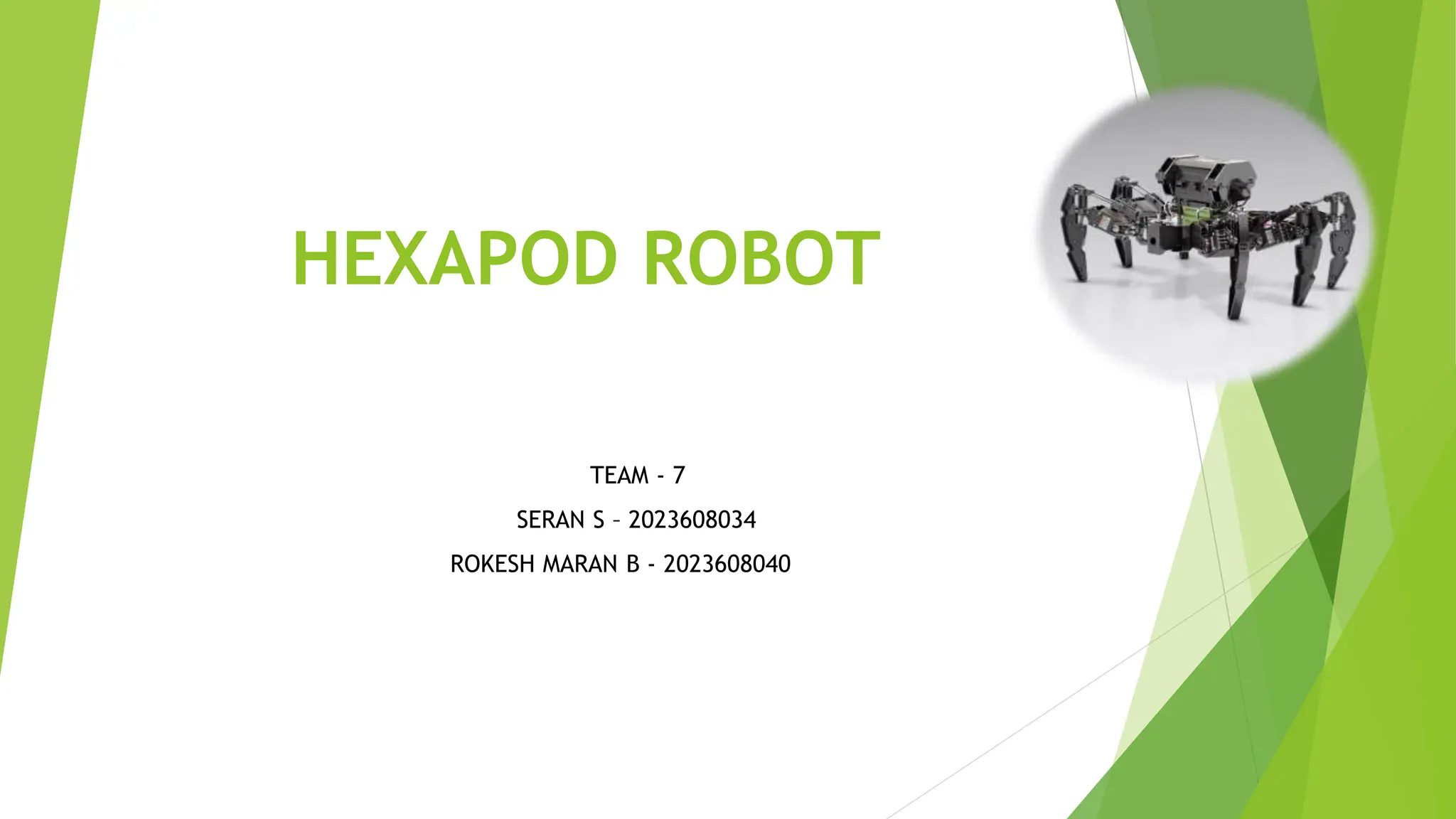
HEXAPOD ROBOT
TEAM - 7
SERAN S – 2023608034
ROKESH MARAN B - 2023608040
TABLE OF CONTENTS
 INTRODUCTION
 WORKING PRINCIPLE
 OBJECTIVE OF THE PROJECT
 FLOW CHART
 ARCHITECTURE DIAGRAM
 REFERENCES
INTRODUCTION
A hexapod is a six-legged robotic platform designed to replicate the locomotion of insects,
offering enhanced stability and adaptability in various terrains. These versatile robots
employ sophisticated control algorithms, sensory systems, and mechanical structures to
achieve precise leg movements, enabling them to navigate challenging environments,
perform tasks, and even carry payloads. Hexapods find applications in fields such as search
and rescue, agriculture, exploration, and research, where their ability to move over rough
terrain and maintain balance makes them invaluable tools.
WORKING PRINCPLE
 Hexapod robot is a mechanical vehicle that walks on six legs.
 Hexapods are substantially stiffer than conventional positioning tools, more
dynamic , precise and greater in terms of flexibility.
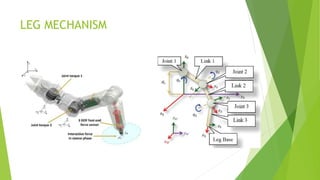
 Each segments has three degree of freedom, Hence the total number of
degree of freedom enjoyed by a hexapod is 24 DOF.
 The robot is capable of achieving planar legged walking by rapidly abducting
and adducting its legs.
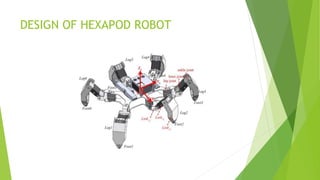
DESIGN OF HEXAPOD ROBOT
LEG MECHANISM
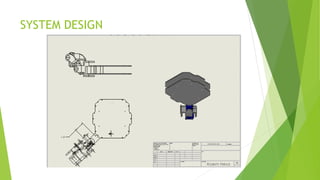
SYSTEM DESIGN
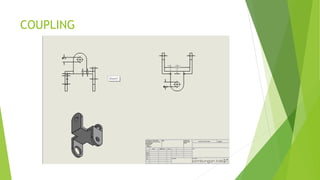
COUPLING
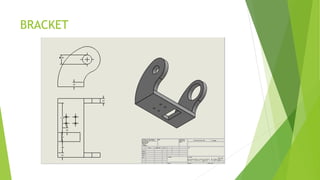
BRACKET
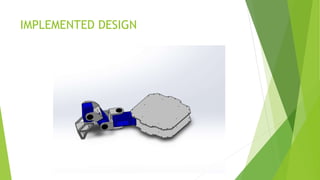
IMPLEMENTED DESIGN
OBJECTIVE OF THE PROJECT
 Research on Biomimetic Hexapod
 Identification of key features and main design characteristics of Hexapod
model.
 Building a solid 3d model of the robot using Solid works software
 Assembling hexapod in line with the 3d model
 Kinematic and Dynamic Simulation
APPLICATION
 Search and Rescue
 Industrial Inspection
 Military and Defence
 Agriculture
 Space Exploration

HEXAPOD ROBOT WITH AUTOMATED CONTROLLER.pptx

  • 1.
    HEXAPOD ROBOT TEAM -7 SERAN S – 2023608034 ROKESH MARAN B - 2023608040
  • 2.
    TABLE OF CONTENTS INTRODUCTION  WORKING PRINCIPLE  OBJECTIVE OF THE PROJECT  FLOW CHART  ARCHITECTURE DIAGRAM  REFERENCES
  • 3.
    INTRODUCTION A hexapod isa six-legged robotic platform designed to replicate the locomotion of insects, offering enhanced stability and adaptability in various terrains. These versatile robots employ sophisticated control algorithms, sensory systems, and mechanical structures to achieve precise leg movements, enabling them to navigate challenging environments, perform tasks, and even carry payloads. Hexapods find applications in fields such as search and rescue, agriculture, exploration, and research, where their ability to move over rough terrain and maintain balance makes them invaluable tools.
  • 4.
    WORKING PRINCPLE  Hexapodrobot is a mechanical vehicle that walks on six legs.  Hexapods are substantially stiffer than conventional positioning tools, more dynamic , precise and greater in terms of flexibility.  Each segments has three degree of freedom, Hence the total number of degree of freedom enjoyed by a hexapod is 24 DOF.  The robot is capable of achieving planar legged walking by rapidly abducting and adducting its legs.
  • 5.
  • 6.
  • 7.
  • 8.
  • 9.
  • 10.
  • 11.
    OBJECTIVE OF THEPROJECT  Research on Biomimetic Hexapod  Identification of key features and main design characteristics of Hexapod model.  Building a solid 3d model of the robot using Solid works software  Assembling hexapod in line with the 3d model  Kinematic and Dynamic Simulation
  • 12.
    APPLICATION  Search andRescue  Industrial Inspection  Military and Defence  Agriculture  Space Exploration