


ServiceVirtualization
Kalpna Gulati
About Me…
• Around 15 years of rich technical experience
• SeniorTechnical Architect with Pitney Bowes
• Extensive experience in Software Architecture, Design, Development and
PerformanceTesting and Optimization
• Several forums, conferences and lectures at universities including Delhi University
• Gold Medalist in Graduate and Post Graduate Courses both from Delhi University
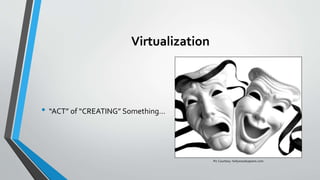
Virtualization
• “ACT” of “CREATING” Something…
Pic Courtesy: hollywoodsapiens.com
3 ‘W’ and 1 ‘H’
• “W”HAT to virtualize
• “W”HY to virtualize
• “W”HEN to virtualize
• “H”OW to virtualize
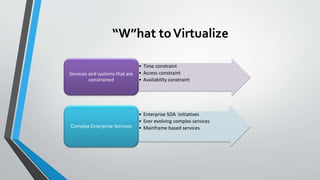
“W”hat toVirtualize
• Time constraint
• Access constraint
• Availability constraint
Services and systems that are
constrained
• Enterprise SOA initiatives
• Ever evolving complex services
• Mainframe based servicesComplex Enterprise Services
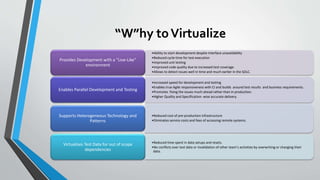
“W”hy toVirtualize
•Ability to start development despite interface unavailability
•Reduced cycle time for test execution
•Improved unit testing
•Improved code quality due to increased test coverage.
•Allows to detect issues well in time and much earlier in the SDLC.
Provides Development with a "Live-Like"
environment
•Increased speed for development and testing
•Enables true Agile responsiveness with CI and builds around test results and business requirements.
•Promotes fixing the issues much ahead rather than in production.
•Higher Quality and Specification- wise accurate delivery.
Enables Parallel Development and Testing
•Reduced cost of pre-production infrastructure
•Eliminates service costs and fees of accessing remote systems.
Supports Heterogeneous Technology and
Patterns
•Reduced time spent in data setups and resets.
•No conflicts over test data or invalidation of other team’s activities by overwriting or changing their
data.
Virtualizes Test Data for out of scope
dependencies
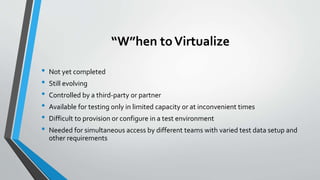
“W”hen toVirtualize
• Not yet completed
• Still evolving
• Controlled by a third-party or partner
• Available for testing only in limited capacity or at inconvenient times
• Difficult to provision or configure in a test environment
• Needed for simultaneous access by different teams with varied test data setup and
other requirements
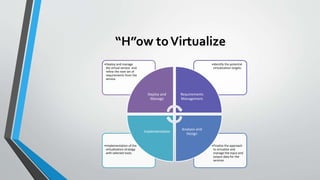
“H”ow toVirtualize
•Finalize the approach
to virtualize and
manage the input and
output data for the
services
•Implementation of the
virtualization strategy
with selected tools.
•Identify the potential
virtualization targets
•Deploy and manage
the virtual service and
refine the next set of
requirements from the
service.
Deploy and
Manage
Requirements
Management
Analysis and
Design
Implementation
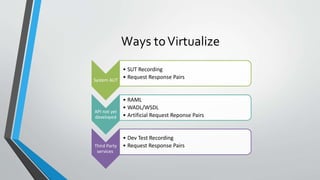
Ways toVirtualize
System AUT
• SUT Recording
• Request Response Pairs
API not yet
developed
• RAML
• WADL/WSDL
• Artificial Request Reponse Pairs
Third Party
services
• Dev Test Recording
• Request Response Pairs
Tools
• CA ServiceVirtualization (formerlyCA LISA)
• Parasoft
• IBM RationalTestVirtualization Server
• HP ServiceVirtualization
•e-COMM-ERCIAL….
Net Result!!!!
• “Pretotype” + “ServiceVirtualization” = “Innovation”
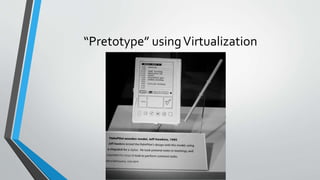
“Pretotype” usingVirtualization
Conclusion!!!
Questions???

Service Virtualization - Kalpna

  • 1.
  • 2.
    About Me… • Around15 years of rich technical experience • SeniorTechnical Architect with Pitney Bowes • Extensive experience in Software Architecture, Design, Development and PerformanceTesting and Optimization • Several forums, conferences and lectures at universities including Delhi University • Gold Medalist in Graduate and Post Graduate Courses both from Delhi University
  • 3.
    Virtualization • “ACT” of“CREATING” Something… Pic Courtesy: hollywoodsapiens.com
  • 4.
    3 ‘W’ and1 ‘H’ • “W”HAT to virtualize • “W”HY to virtualize • “W”HEN to virtualize • “H”OW to virtualize
  • 5.
    “W”hat toVirtualize • Timeconstraint • Access constraint • Availability constraint Services and systems that are constrained • Enterprise SOA initiatives • Ever evolving complex services • Mainframe based servicesComplex Enterprise Services
  • 6.
    “W”hy toVirtualize •Ability tostart development despite interface unavailability •Reduced cycle time for test execution •Improved unit testing •Improved code quality due to increased test coverage. •Allows to detect issues well in time and much earlier in the SDLC. Provides Development with a "Live-Like" environment •Increased speed for development and testing •Enables true Agile responsiveness with CI and builds around test results and business requirements. •Promotes fixing the issues much ahead rather than in production. •Higher Quality and Specification- wise accurate delivery. Enables Parallel Development and Testing •Reduced cost of pre-production infrastructure •Eliminates service costs and fees of accessing remote systems. Supports Heterogeneous Technology and Patterns •Reduced time spent in data setups and resets. •No conflicts over test data or invalidation of other team’s activities by overwriting or changing their data. Virtualizes Test Data for out of scope dependencies
  • 7.
    “W”hen toVirtualize • Notyet completed • Still evolving • Controlled by a third-party or partner • Available for testing only in limited capacity or at inconvenient times • Difficult to provision or configure in a test environment • Needed for simultaneous access by different teams with varied test data setup and other requirements
  • 8.
    “H”ow toVirtualize •Finalize theapproach to virtualize and manage the input and output data for the services •Implementation of the virtualization strategy with selected tools. •Identify the potential virtualization targets •Deploy and manage the virtual service and refine the next set of requirements from the service. Deploy and Manage Requirements Management Analysis and Design Implementation
  • 9.
    Ways toVirtualize System AUT •SUT Recording • Request Response Pairs API not yet developed • RAML • WADL/WSDL • Artificial Request Reponse Pairs Third Party services • Dev Test Recording • Request Response Pairs
  • 10.
    Tools • CA ServiceVirtualization(formerlyCA LISA) • Parasoft • IBM RationalTestVirtualization Server • HP ServiceVirtualization
  • 11.
  • 12.
    Net Result!!!! • “Pretotype”+ “ServiceVirtualization” = “Innovation”
  • 13.
  • 14.
  • 15.