Fueled with HPE ALM Octane
Introducing the Next Generation of Application
Lifecycle Management
Brochure
Goal Approach Governance culture
Emerging Mode 2 Practices in Bimodal Governance, Gartner, January 2016
Cycle Times
Mode 1
Mode 2
Reliability
Waterfall, V-model,
high-ceremony
frameworks
IT-centric,
removed from
customer
Longer cycle times
(months+)
Plan-driven,
approval-based
Agility
Lean, Agile,
low-ceremony
frameworks
Empirical,
continuous
Business-centric,
close to customer
Short cycle times
(days, weeks)
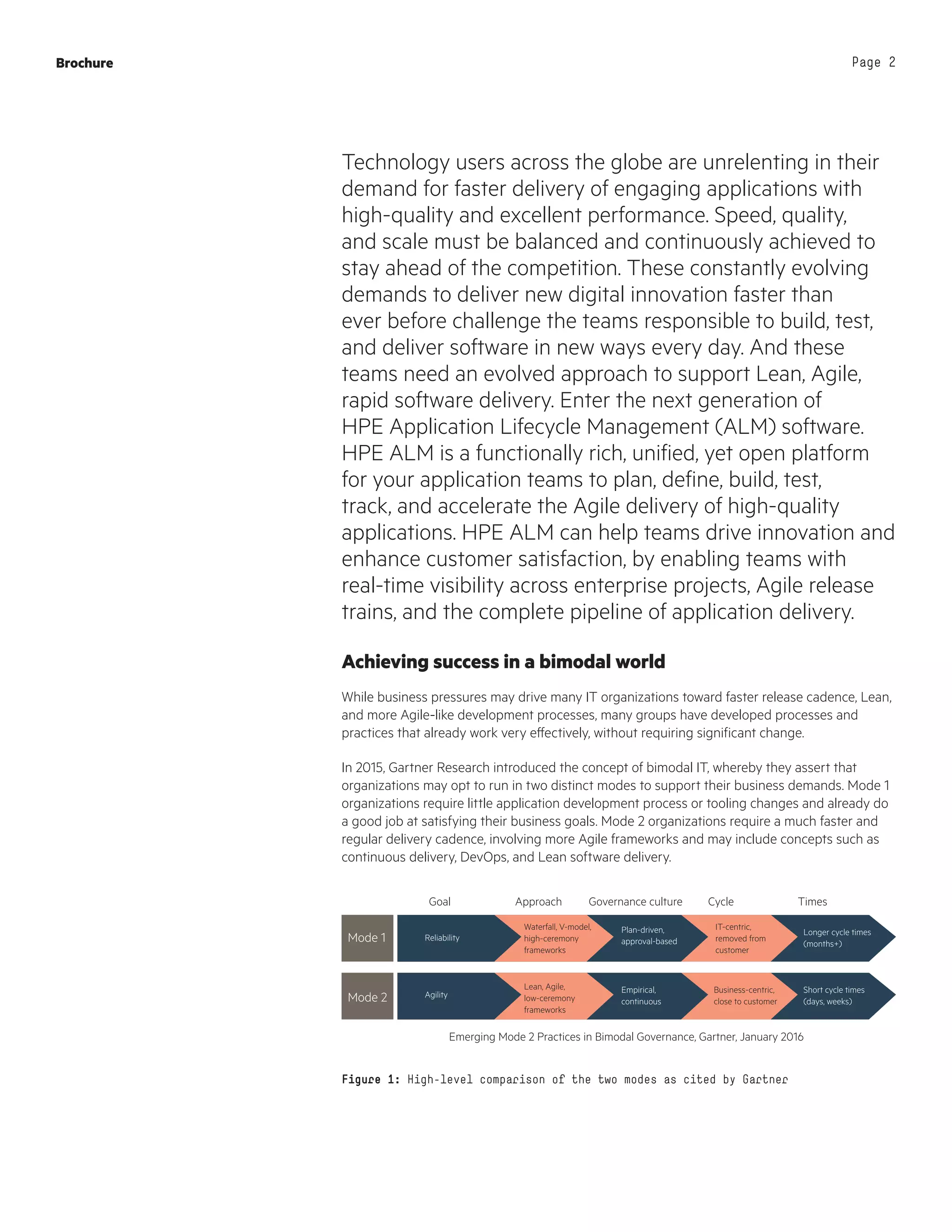
Figure 1: High-level comparison of the two modes as cited by Gartner
Achieving success in a bimodal world
While business pressures may drive many IT organizations toward faster release cadence, Lean,
and more Agile-like development processes, many groups have developed processes and
practices that already work very effectively, without requiring significant change.
In 2015, Gartner Research introduced the concept of bimodal IT, whereby they assert that
organizations may opt to run in two distinct modes to support their business demands. Mode 1
organizations require little application development process or tooling changes and already do
a good job at satisfying their business goals. Mode 2 organizations require a much faster and
regular delivery cadence, involving more Agile frameworks and may include concepts such as
continuous delivery, DevOps, and Lean software delivery.
Technology users across the globe are unrelenting in their
demand for faster delivery of engaging applications with
high-quality and excellent performance. Speed, quality,
and scale must be balanced and continuously achieved to
stay ahead of the competition. These constantly evolving
demands to deliver new digital innovation faster than
ever before challenge the teams responsible to build, test,
and deliver software in new ways every day. And these
teams need an evolved approach to support Lean, Agile,
rapid software delivery. Enter the next generation of
HPE Application Lifecycle Management (ALM) software.
HPE ALM is a functionally rich, unified, yet open platform
for your application teams to plan, define, build, test,
track, and accelerate the Agile delivery of high-quality
applications. HPE ALM can help teams drive innovation and
enhance customer satisfaction, by enabling teams with
real-time visibility across enterprise projects, Agile release
trains, and the complete pipeline of application delivery.
Brochure Page 2
HPE ALM software has been a trusted and market-leading ALM platform supporting ALM
for over a decade, and continues to support Mode 1 clients in their delivery activities across
the globe.
Now, with this new release, HPE Software expands the ALM experience with a new set of
HPE ALM capabilities, which embody next generation. This HPE ALM experience, part of the
overall HPE ALM software product, helps organizations to not only support Mode 2 activities
and processes but also aid organizations as they adopt Mode 2 processes and practices such as
Agile development and continuous integration. This new set of software lifecycle management
capabilities are optimized for the speed, quality, and scale challenges of organizations adopting
Lean and Agile delivery practices, as well as delivering software through DevOps pipelines.
About HPE ALM software
HPE ALM is a unified platform for defining, managing, and automating activities,
gaining insight, and sharing assets to deliver applications from ideation to production.
ALM manages the process and assets from requirements definition through software
development, manual and automated testing, quality, and defects, leading to an assessment
of readiness for delivery. HPE ALM integrates with upstream project portfolio management
software and downstream application release automation, continuous deployment, monitoring,
and incident management software to drive complete visibility and management of applications
from inception to retirement.
HPE ALM is ideal at improving visibility across local, distributed, and outsourced teams, and at
managing the moving parts of today’s applications. It promotes consistency across processes,
drives best practices, encourages asset sharing, and improves interactive communication
among executive management, project managers, business analysts, development, and testing
teams. Built on a standards-based, easily extensible architecture, and centralized repository,
HPE ALM is an open, technology-agnostic application delivery system uniquely scaled for the
enterprise from small teams to large organizations with thousands of projects.
Brochure Page 3
Figure 2: HPE ALM, supporting both Mode 1 and Mode 2 teams
In support of the bimodal nature of many customers today, Hewlett Packard Enterprise has
expanded the ALM experience by introducing HPE ALM Octane, as a separate platform that
is tuned and designed for high-velocity, Lean and Agile teams. ALM Octane is an included
part of the HPE ALM product, and integrates with both HPE Agile Manager and the traditional
HPE ALM.NET platform to allow teams to easily share assets and report across projects.
Brochure Page 4
Testing products
ALM.NET
Common platform
Plan Define TrackTest
ALM.Octane
Common platform
TrackTestPlan Define Build
Analyze Analyze
Responsive, streamlined user experience: HPE ALM Octane is designed with a user
interface providing a targeted and simplified user flow and architected using responsive design.
Accessible in any HTML5 supported Web browser, or operating system, including many tablet
devices, HPE ALM Octane ensures users get access to what they want, when they want, and
where they want.
Open, integrated, and extensible: With many out-of-the-box integrations to common
industry and other HPE Software technologies, HPE ALM Octane platform boasts an extensive
REST API, documented with Swagger, to allow users to work within the environment they’re
most comfortable in, without sacrificing collaboration, governance, and process guidance.
Align and integrate quality with the application deliver pipeline: HPE ALM Octane platform
easily integrates with the team’s existing Jenkins/CI system for visibility into the release pipeline,
as well as into source code control systems like GIT, allowing for stronger collaboration, and
supporting a faster path from manual testing to test automation. HPE ALM Octane also
provides a foundation for common terminology across the application development lifecycle
facilitating more closely connected teams.
Unmatched enterprise scalability and support: Leveraging over a decade of industry
leadership supporting the enterprise with HPE ALM and HPE Quality Center, we have
architected scalability, enterprise credential support, cross-project sharing and visibility, and
flexible methodology support to the ALM Octane platform. Teams can start small and know
that as they grow, the underlying technology will support them along the way.
HPE ALM Octane features
Plan: Predictable application delivery requires awareness of progress and alignment with
goals and milestones, as well as the ability to access updated information without relying on
error-prone manual data gathering. HPE ALM Octane platform allows teams to assess the
status quickly within their context and access the right data to make the correct decisions.
Define: Understanding business needs is the most critical piece of data any project team can
have. HPE ALM Octane has integrated Agile user stories and backlog management directly into
the ALM software platform. Through this, teams can quickly document business needs and map
them to supporting artifacts in the software development lifecycle, such as defects or tests.
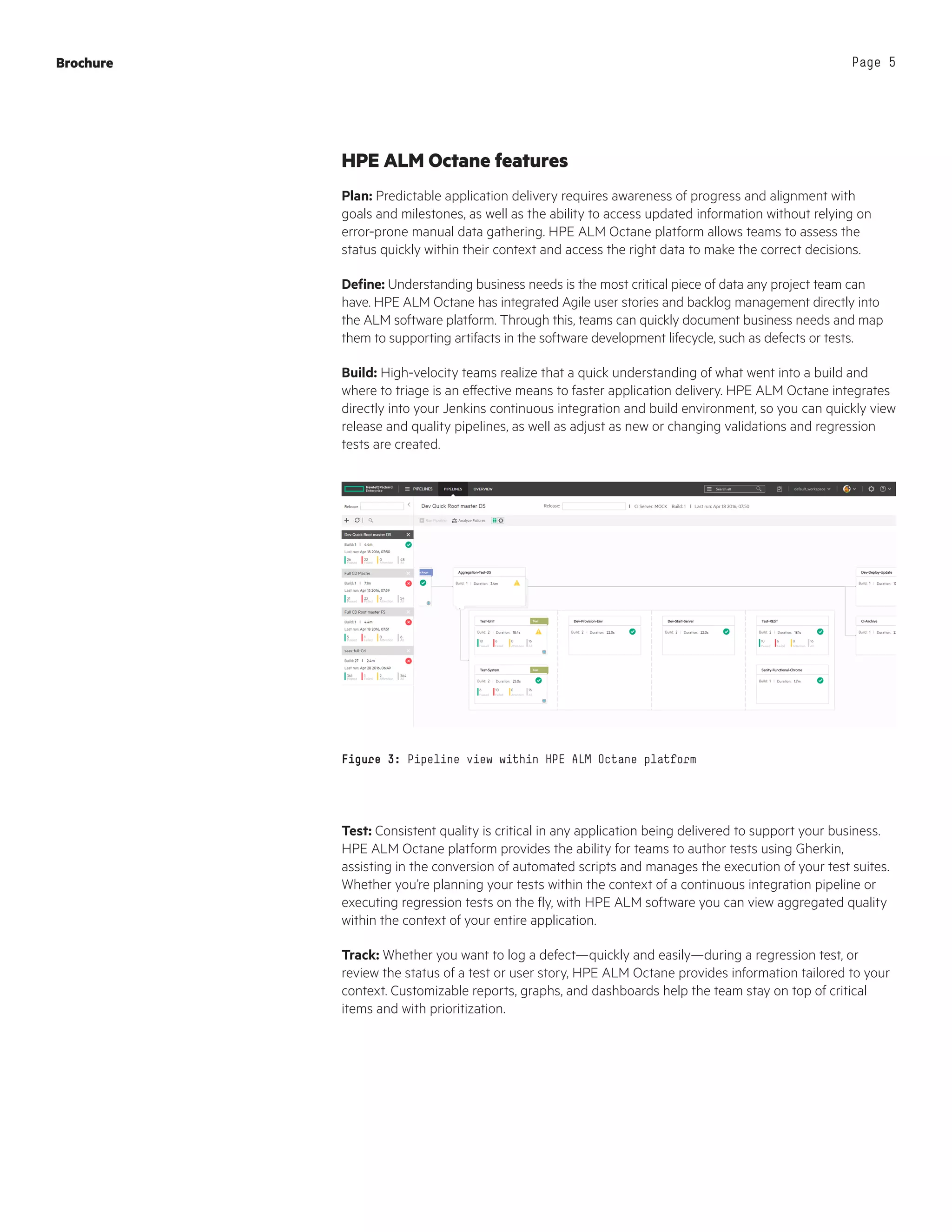
Build: High-velocity teams realize that a quick understanding of what went into a build and
where to triage is an effective means to faster application delivery. HPE ALM Octane integrates
directly into your Jenkins continuous integration and build environment, so you can quickly view
release and quality pipelines, as well as adjust as new or changing validations and regression
tests are created.
Test: Consistent quality is critical in any application being delivered to support your business.
HPE ALM Octane platform provides the ability for teams to author tests using Gherkin,
assisting in the conversion of automated scripts and manages the execution of your test suites.
Whether you’re planning your tests within the context of a continuous integration pipeline or
executing regression tests on the fly, with HPE ALM software you can view aggregated quality
within the context of your entire application.
Track: Whether you want to log a defect—quickly and easily—during a regression test, or
review the status of a test or user story, HPE ALM Octane provides information tailored to your
context. Customizable reports, graphs, and dashboards help the team stay on top of critical
items and with prioritization.
Brochure Page 5
Figure 3: Pipeline view within HPE ALM Octane platform
Embracing open source: HPE ALM software continues to embrace open source standards and
tools within the framework. With the beta release, you can author tests using Gherkin, support
test automation management of Selenium scripts, which is based on a GIT architected back-end
platform, and tightly integrate with your team’s Jenkins build environment.
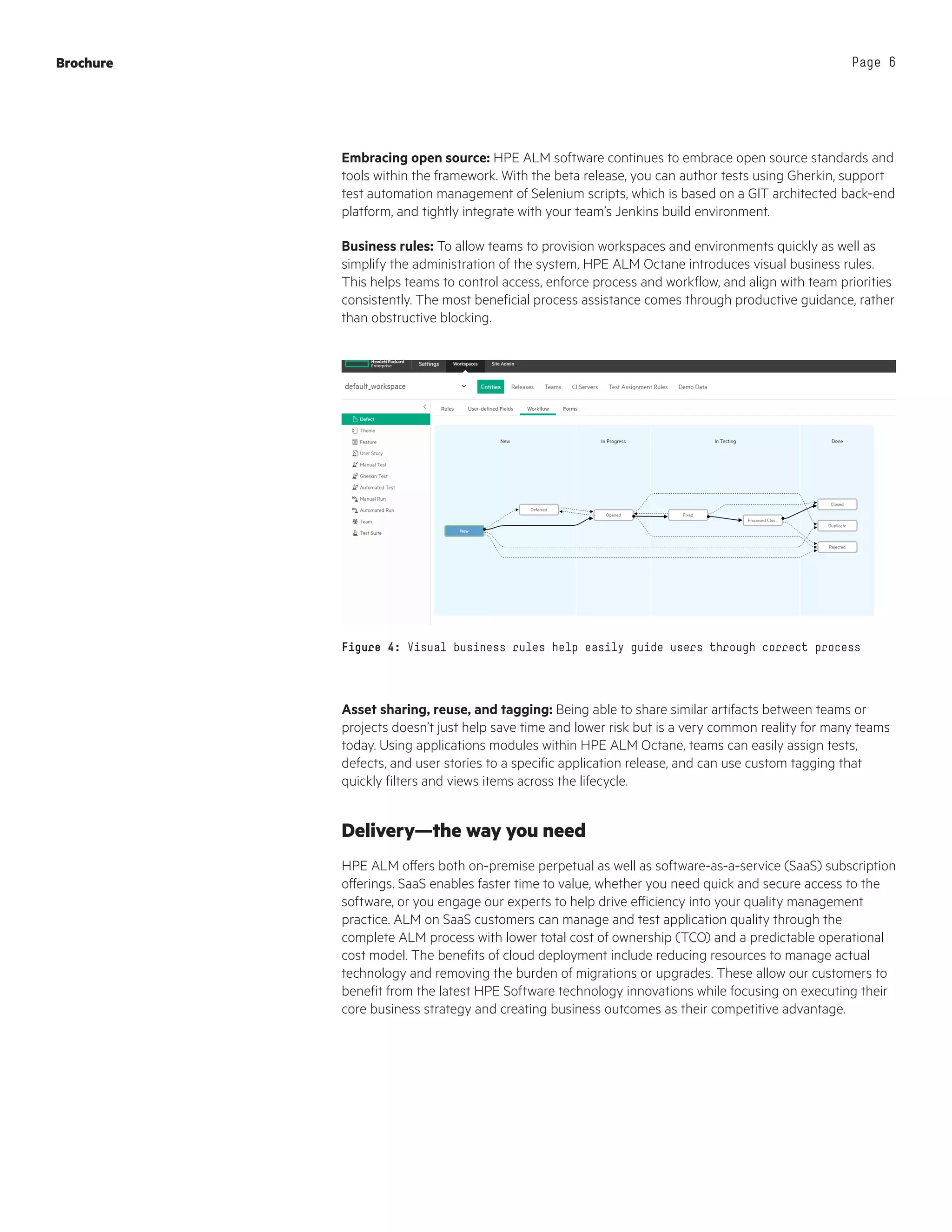
Business rules: To allow teams to provision workspaces and environments quickly as well as
simplify the administration of the system, HPE ALM Octane introduces visual business rules.
This helps teams to control access, enforce process and workflow, and align with team priorities
consistently. The most beneficial process assistance comes through productive guidance, rather
than obstructive blocking.
Brochure Page 6
Asset sharing, reuse, and tagging: Being able to share similar artifacts between teams or
projects doesn’t just help save time and lower risk but is a very common reality for many teams
today. Using applications modules within HPE ALM Octane, teams can easily assign tests,
defects, and user stories to a specific application release, and can use custom tagging that
quickly filters and views items across the lifecycle.
Delivery—the way you need
HPE ALM offers both on-premise perpetual as well as software-as-a-service (SaaS) subscription
offerings. SaaS enables faster time to value, whether you need quick and secure access to the
software, or you engage our experts to help drive efficiency into your quality management
practice. ALM on SaaS customers can manage and test application quality through the
complete ALM process with lower total cost of ownership (TCO) and a predictable operational
cost model. The benefits of cloud deployment include reducing resources to manage actual
technology and removing the burden of migrations or upgrades. These allow our customers to
benefit from the latest HPE Software technology innovations while focusing on executing their
core business strategy and creating business outcomes as their competitive advantage.
Figure 4: Visual business rules help easily guide users through correct process
HPE ALM Professional Services
HPE ALM Professional Services focus on innovative solutions for lifecycle management of
modern-era enterprise applications. Services include:
•	Enterprise agility solutions for scaling Agile and Lean practices at different levels of the
enterprise—from large Agile teams up to Agile portfolio management
•	DevOps solutions for driving agility across the IT value chain (requirements to deployment)
•	HPE Enterprise Mobility solutions for supporting DevOps solutions specific to “extreme Agile”
mobile applications
•	HPE ALM Optimization solutions for helping our customers accelerate value and return on
investment (ROI) using HPE ALM technologies based on our library of best practices and
prebuild accelerator utilities
•	Cloud ALM solutions that exploit on-demand infrastructure and platform capabilities to
deliver services on a consumption-based model
•	Enterprise Centers of Excellence (COE) solutions for ALM functions such as testing, service
virtualization, Agile, and requirements management
We offer outcome-based services geared toward generating specific outcomes that are enabled
through SLAs.
Brochure Page 7
Rate this document
Sign up for updates
Learn more, HPE ALM Education and Community
HPE Software offers a number of formal and informal ways to engage with ALM experts, peers,
and like-minded individuals
•	HPE Software customer education offers a variety of instructor-led, customized, and online
education opportunities.
•	HPE Live Network offers a community site to engage with HPE ALM technical and partner
content and best practices.
•	Engage with the ALM community through the HPE Apps Insiders and follow us at
@HPE_ALM
Learn more at
hpe.com/software/alm
© Copyright 2016 Hewlett Packard Enterprise Development LP. The information contained herein is subject to change without
notice. The only warranties for Hewlett Packard Enterprise products and services are set forth in the express warranty statements
accompanying such products and services. Nothing herein should be construed as constituting an additional warranty.
Hewlett Packard Enterprise shall not be liable for technical or editorial errors or omissions contained herein.
4AA6-5393ENW, May 2016
Brochure

[Brochure] HPE ALM Octane

  • 1.
    Fueled with HPEALM Octane Introducing the Next Generation of Application Lifecycle Management Brochure
  • 2.
    Goal Approach Governanceculture Emerging Mode 2 Practices in Bimodal Governance, Gartner, January 2016 Cycle Times Mode 1 Mode 2 Reliability Waterfall, V-model, high-ceremony frameworks IT-centric, removed from customer Longer cycle times (months+) Plan-driven, approval-based Agility Lean, Agile, low-ceremony frameworks Empirical, continuous Business-centric, close to customer Short cycle times (days, weeks) Figure 1: High-level comparison of the two modes as cited by Gartner Achieving success in a bimodal world While business pressures may drive many IT organizations toward faster release cadence, Lean, and more Agile-like development processes, many groups have developed processes and practices that already work very effectively, without requiring significant change. In 2015, Gartner Research introduced the concept of bimodal IT, whereby they assert that organizations may opt to run in two distinct modes to support their business demands. Mode 1 organizations require little application development process or tooling changes and already do a good job at satisfying their business goals. Mode 2 organizations require a much faster and regular delivery cadence, involving more Agile frameworks and may include concepts such as continuous delivery, DevOps, and Lean software delivery. Technology users across the globe are unrelenting in their demand for faster delivery of engaging applications with high-quality and excellent performance. Speed, quality, and scale must be balanced and continuously achieved to stay ahead of the competition. These constantly evolving demands to deliver new digital innovation faster than ever before challenge the teams responsible to build, test, and deliver software in new ways every day. And these teams need an evolved approach to support Lean, Agile, rapid software delivery. Enter the next generation of HPE Application Lifecycle Management (ALM) software. HPE ALM is a functionally rich, unified, yet open platform for your application teams to plan, define, build, test, track, and accelerate the Agile delivery of high-quality applications. HPE ALM can help teams drive innovation and enhance customer satisfaction, by enabling teams with real-time visibility across enterprise projects, Agile release trains, and the complete pipeline of application delivery. Brochure Page 2
  • 3.
    HPE ALM softwarehas been a trusted and market-leading ALM platform supporting ALM for over a decade, and continues to support Mode 1 clients in their delivery activities across the globe. Now, with this new release, HPE Software expands the ALM experience with a new set of HPE ALM capabilities, which embody next generation. This HPE ALM experience, part of the overall HPE ALM software product, helps organizations to not only support Mode 2 activities and processes but also aid organizations as they adopt Mode 2 processes and practices such as Agile development and continuous integration. This new set of software lifecycle management capabilities are optimized for the speed, quality, and scale challenges of organizations adopting Lean and Agile delivery practices, as well as delivering software through DevOps pipelines. About HPE ALM software HPE ALM is a unified platform for defining, managing, and automating activities, gaining insight, and sharing assets to deliver applications from ideation to production. ALM manages the process and assets from requirements definition through software development, manual and automated testing, quality, and defects, leading to an assessment of readiness for delivery. HPE ALM integrates with upstream project portfolio management software and downstream application release automation, continuous deployment, monitoring, and incident management software to drive complete visibility and management of applications from inception to retirement. HPE ALM is ideal at improving visibility across local, distributed, and outsourced teams, and at managing the moving parts of today’s applications. It promotes consistency across processes, drives best practices, encourages asset sharing, and improves interactive communication among executive management, project managers, business analysts, development, and testing teams. Built on a standards-based, easily extensible architecture, and centralized repository, HPE ALM is an open, technology-agnostic application delivery system uniquely scaled for the enterprise from small teams to large organizations with thousands of projects. Brochure Page 3
  • 4.
    Figure 2: HPEALM, supporting both Mode 1 and Mode 2 teams In support of the bimodal nature of many customers today, Hewlett Packard Enterprise has expanded the ALM experience by introducing HPE ALM Octane, as a separate platform that is tuned and designed for high-velocity, Lean and Agile teams. ALM Octane is an included part of the HPE ALM product, and integrates with both HPE Agile Manager and the traditional HPE ALM.NET platform to allow teams to easily share assets and report across projects. Brochure Page 4 Testing products ALM.NET Common platform Plan Define TrackTest ALM.Octane Common platform TrackTestPlan Define Build Analyze Analyze Responsive, streamlined user experience: HPE ALM Octane is designed with a user interface providing a targeted and simplified user flow and architected using responsive design. Accessible in any HTML5 supported Web browser, or operating system, including many tablet devices, HPE ALM Octane ensures users get access to what they want, when they want, and where they want. Open, integrated, and extensible: With many out-of-the-box integrations to common industry and other HPE Software technologies, HPE ALM Octane platform boasts an extensive REST API, documented with Swagger, to allow users to work within the environment they’re most comfortable in, without sacrificing collaboration, governance, and process guidance. Align and integrate quality with the application deliver pipeline: HPE ALM Octane platform easily integrates with the team’s existing Jenkins/CI system for visibility into the release pipeline, as well as into source code control systems like GIT, allowing for stronger collaboration, and supporting a faster path from manual testing to test automation. HPE ALM Octane also provides a foundation for common terminology across the application development lifecycle facilitating more closely connected teams. Unmatched enterprise scalability and support: Leveraging over a decade of industry leadership supporting the enterprise with HPE ALM and HPE Quality Center, we have architected scalability, enterprise credential support, cross-project sharing and visibility, and flexible methodology support to the ALM Octane platform. Teams can start small and know that as they grow, the underlying technology will support them along the way.
  • 5.
    HPE ALM Octanefeatures Plan: Predictable application delivery requires awareness of progress and alignment with goals and milestones, as well as the ability to access updated information without relying on error-prone manual data gathering. HPE ALM Octane platform allows teams to assess the status quickly within their context and access the right data to make the correct decisions. Define: Understanding business needs is the most critical piece of data any project team can have. HPE ALM Octane has integrated Agile user stories and backlog management directly into the ALM software platform. Through this, teams can quickly document business needs and map them to supporting artifacts in the software development lifecycle, such as defects or tests. Build: High-velocity teams realize that a quick understanding of what went into a build and where to triage is an effective means to faster application delivery. HPE ALM Octane integrates directly into your Jenkins continuous integration and build environment, so you can quickly view release and quality pipelines, as well as adjust as new or changing validations and regression tests are created. Test: Consistent quality is critical in any application being delivered to support your business. HPE ALM Octane platform provides the ability for teams to author tests using Gherkin, assisting in the conversion of automated scripts and manages the execution of your test suites. Whether you’re planning your tests within the context of a continuous integration pipeline or executing regression tests on the fly, with HPE ALM software you can view aggregated quality within the context of your entire application. Track: Whether you want to log a defect—quickly and easily—during a regression test, or review the status of a test or user story, HPE ALM Octane provides information tailored to your context. Customizable reports, graphs, and dashboards help the team stay on top of critical items and with prioritization. Brochure Page 5 Figure 3: Pipeline view within HPE ALM Octane platform
  • 6.
    Embracing open source:HPE ALM software continues to embrace open source standards and tools within the framework. With the beta release, you can author tests using Gherkin, support test automation management of Selenium scripts, which is based on a GIT architected back-end platform, and tightly integrate with your team’s Jenkins build environment. Business rules: To allow teams to provision workspaces and environments quickly as well as simplify the administration of the system, HPE ALM Octane introduces visual business rules. This helps teams to control access, enforce process and workflow, and align with team priorities consistently. The most beneficial process assistance comes through productive guidance, rather than obstructive blocking. Brochure Page 6 Asset sharing, reuse, and tagging: Being able to share similar artifacts between teams or projects doesn’t just help save time and lower risk but is a very common reality for many teams today. Using applications modules within HPE ALM Octane, teams can easily assign tests, defects, and user stories to a specific application release, and can use custom tagging that quickly filters and views items across the lifecycle. Delivery—the way you need HPE ALM offers both on-premise perpetual as well as software-as-a-service (SaaS) subscription offerings. SaaS enables faster time to value, whether you need quick and secure access to the software, or you engage our experts to help drive efficiency into your quality management practice. ALM on SaaS customers can manage and test application quality through the complete ALM process with lower total cost of ownership (TCO) and a predictable operational cost model. The benefits of cloud deployment include reducing resources to manage actual technology and removing the burden of migrations or upgrades. These allow our customers to benefit from the latest HPE Software technology innovations while focusing on executing their core business strategy and creating business outcomes as their competitive advantage. Figure 4: Visual business rules help easily guide users through correct process
  • 7.
    HPE ALM ProfessionalServices HPE ALM Professional Services focus on innovative solutions for lifecycle management of modern-era enterprise applications. Services include: • Enterprise agility solutions for scaling Agile and Lean practices at different levels of the enterprise—from large Agile teams up to Agile portfolio management • DevOps solutions for driving agility across the IT value chain (requirements to deployment) • HPE Enterprise Mobility solutions for supporting DevOps solutions specific to “extreme Agile” mobile applications • HPE ALM Optimization solutions for helping our customers accelerate value and return on investment (ROI) using HPE ALM technologies based on our library of best practices and prebuild accelerator utilities • Cloud ALM solutions that exploit on-demand infrastructure and platform capabilities to deliver services on a consumption-based model • Enterprise Centers of Excellence (COE) solutions for ALM functions such as testing, service virtualization, Agile, and requirements management We offer outcome-based services geared toward generating specific outcomes that are enabled through SLAs. Brochure Page 7
  • 8.
    Rate this document Signup for updates Learn more, HPE ALM Education and Community HPE Software offers a number of formal and informal ways to engage with ALM experts, peers, and like-minded individuals • HPE Software customer education offers a variety of instructor-led, customized, and online education opportunities. • HPE Live Network offers a community site to engage with HPE ALM technical and partner content and best practices. • Engage with the ALM community through the HPE Apps Insiders and follow us at @HPE_ALM Learn more at hpe.com/software/alm © Copyright 2016 Hewlett Packard Enterprise Development LP. The information contained herein is subject to change without notice. The only warranties for Hewlett Packard Enterprise products and services are set forth in the express warranty statements accompanying such products and services. Nothing herein should be construed as constituting an additional warranty. Hewlett Packard Enterprise shall not be liable for technical or editorial errors or omissions contained herein. 4AA6-5393ENW, May 2016 Brochure