Con-way Case Study: Optimizing Application
Integration Software Development Lifecycle
Ram Vittal
DOX05S @ramgvittal #CAWorld
Con-way
Principal Enterprise Architect
DevOps
Optimizing Application
Integration SDLC
Presented by – Ram Vittal
Principal Enterprise Architect
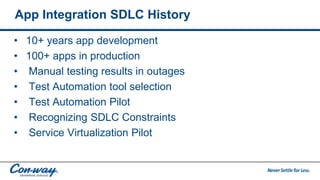
App Integration SDLC History
• 10+ years app development
• 100+ apps in production
• Manual testing results in outages
• Test Automation tool selection
• Test Automation Pilot
• Recognizing SDLC Constraints
• Service Virtualization Pilot
Agenda
• About Con-way
• IT App Overview
• IT App Integration Overview
• App Layers and SDLC
• App Dev/Test Constraints
• Pilot Project Use Case
• Pilot Project Benefits
• Q & A
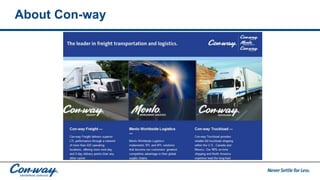
About Con-way
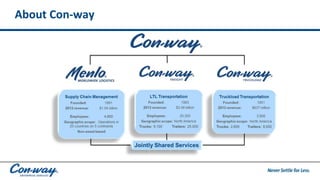
About Con-way
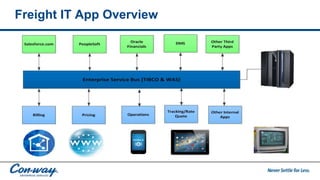
Freight IT App Overview
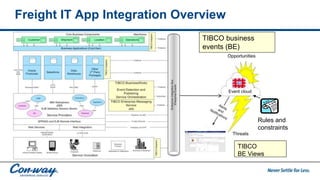
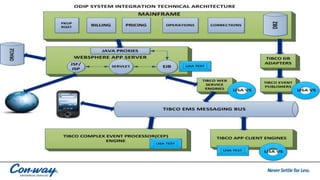
Freight IT App Integration Overview
Rules and
constraints
TIBCO business
events (BE)
Event cloud
TIBCO
BE Views
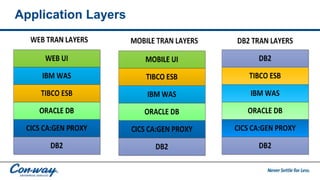
Application Layers
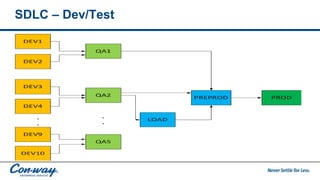
SDLC – Dev/Test
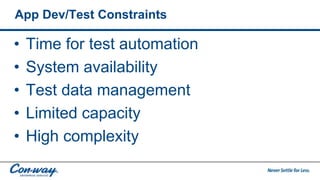
App Dev/Test Constraints
• Time for test automation
• System availability
• Test data management
• Limited capacity
• High complexity
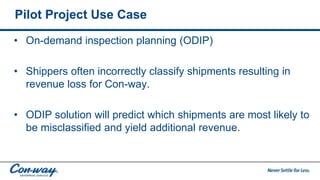
Pilot Project Use Case
• On-demand inspection planning (ODIP)
• Shippers often incorrectly classify shipments resulting in
revenue loss for Con-way.
• ODIP solution will predict which shipments are most likely to
be misclassified and yield additional revenue.
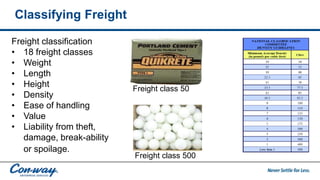
Classifying Freight
Freight classification
• 18 freight classes
• Weight
• Length
• Height
• Density
• Ease of handling
• Value
• Liability from theft,
damage, break-ability
or spoilage.
Freight class 50
Freight class 500
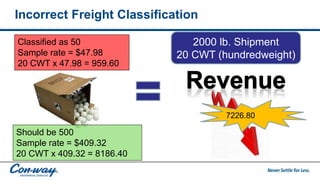
Incorrect Freight Classification
Classified as 50
Sample rate = $47.98
20 CWT x 47.98 = 959.60
Should be 500
Sample rate = $409.32
20 CWT x 409.32 = 8186.40
2000 lb. Shipment
20 CWT (hundredweight)
7226.80
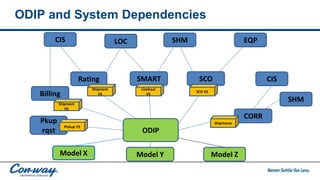
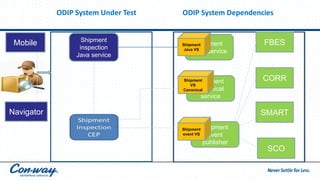
ODIP and System Dependencies
ODIP
CIS LOC
Rating SCOSMART
CORR
Billing
Shipment
VS
SCO VS
Shipments
SHM EQP
Shipment
VS
Linehaul
VS
Model X Model Y Model Z
Pkup
rqst
Pickup VS
CIS
SHM
Shipment
Java Service
Shipment
inspection
Java service
FBES
CORR
SMART
SCO
Shipment
canonical
service
Shipment
event
publisher
Navigator
Mobile
Shipment
event VS
Shipment
VS
Canonical
Shipment
Java VS
ODIP System Under Test ODIP System Dependencies
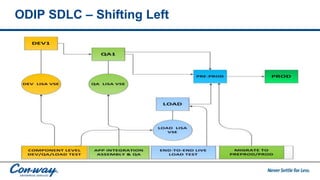
ODIP SDLC – Shifting Left
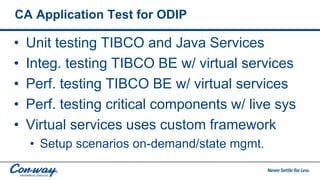
CA Application Test for ODIP
• Unit testing TIBCO and Java Services
• Integ. testing TIBCO BE w/ virtual services
• Perf. testing TIBCO BE w/ virtual services
• Perf. testing critical components w/ live sys
• Virtual services uses custom framework
• Setup scenarios on-demand/state mgmt.
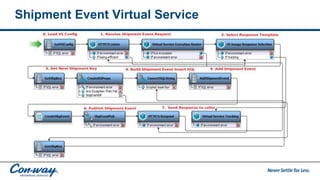
Shipment Event Virtual Service
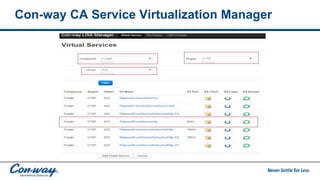
Con-way CA Service Virtualization Manager
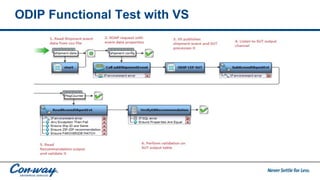
ODIP Functional Test with VS
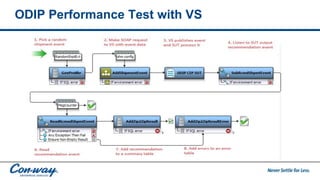
ODIP Performance Test with VS
Benefits
 Saved two months of development/testing
 Reduced complexity for development/testing
 Identifying and fixing bugs became easier
 Provided high-availability for constrained services
 Achieved component level performance testing
 Eliminated capacity constraints for performance testing
 Identified performance issues earlier in SDLC
 Repeated performance test several times
 Reusable virtual services for other projects
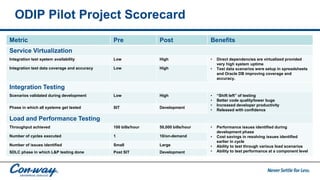
ODIP Pilot Project Scorecard
Metric Pre Post Benefits
Service Virtualization
Integration test system availability Low High • Direct dependencies are virtualized provided
very high system uptime
• Test data scenarios were setup in spreadsheets
and Oracle DB improving coverage and
accuracy.
Integration test data coverage and accuracy Low High
Integration Testing
Scenarios validated during development Low High • “Shift left” of testing
• Better code quality/lower bugs
• Increased developer productivity
• Released with confidence
Phase in which all systems get tested SIT Development
Load and Performance Testing
Throughput achieved 100 bills/hour 50,000 bills/hour • Performance issues identified during
development phase
• Cost savings in resolving issues identified
earlier in cycle
• Ability to test through various load scenarios
• Ability to test performance at a component level
Number of cycles executed 1 10/on-demand
Number of issues identified Small Large
SDLC phase in which L&P testing done Post SIT Development
Service
Virtualization
CA Technologies
DevOps
Simulation
Experience
CA Technologies
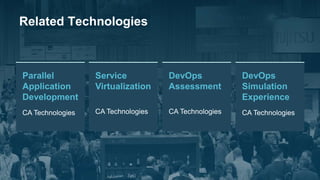
Related Technologies
Parallel
Application
Development
CA Technologies
DevOps
Assessment
CA Technologies
For More Information
To learn more about DevOps, please visit:
http://bit.ly/1wbjjqX
Insert appropriate screenshot and text overlay
from following “More Info Graphics” slide here;
ensure it links to correct page
DevOps
30
For Informational Purposes Only
This presentation provided at CA World 2014 is intended for information purposes only and does not form any type of warranty.
Content provided in this presentation has not been reviewed for accuracy and is based on information provided by CA Partners
and Customers.
Terms of this Presentation

Con-way Case Study: Optimizing Application Integration Software Development Lifecycle

  • 1.
    Con-way Case Study:Optimizing Application Integration Software Development Lifecycle Ram Vittal DOX05S @ramgvittal #CAWorld Con-way Principal Enterprise Architect DevOps
  • 2.
    Optimizing Application Integration SDLC Presentedby – Ram Vittal Principal Enterprise Architect
  • 3.
    App Integration SDLCHistory • 10+ years app development • 100+ apps in production • Manual testing results in outages • Test Automation tool selection • Test Automation Pilot • Recognizing SDLC Constraints • Service Virtualization Pilot
  • 4.
    Agenda • About Con-way •IT App Overview • IT App Integration Overview • App Layers and SDLC • App Dev/Test Constraints • Pilot Project Use Case • Pilot Project Benefits • Q & A
  • 5.
  • 6.
  • 7.
  • 8.
    Freight IT AppIntegration Overview Rules and constraints TIBCO business events (BE) Event cloud TIBCO BE Views
  • 9.
  • 10.
  • 11.
    App Dev/Test Constraints •Time for test automation • System availability • Test data management • Limited capacity • High complexity
  • 12.
    Pilot Project UseCase • On-demand inspection planning (ODIP) • Shippers often incorrectly classify shipments resulting in revenue loss for Con-way. • ODIP solution will predict which shipments are most likely to be misclassified and yield additional revenue.
  • 13.
    Classifying Freight Freight classification •18 freight classes • Weight • Length • Height • Density • Ease of handling • Value • Liability from theft, damage, break-ability or spoilage. Freight class 50 Freight class 500
  • 14.
    Incorrect Freight Classification Classifiedas 50 Sample rate = $47.98 20 CWT x 47.98 = 959.60 Should be 500 Sample rate = $409.32 20 CWT x 409.32 = 8186.40 2000 lb. Shipment 20 CWT (hundredweight) 7226.80
  • 15.
    ODIP and SystemDependencies ODIP CIS LOC Rating SCOSMART CORR Billing Shipment VS SCO VS Shipments SHM EQP Shipment VS Linehaul VS Model X Model Y Model Z Pkup rqst Pickup VS CIS SHM
  • 16.
  • 18.
    ODIP SDLC –Shifting Left
  • 19.
    CA Application Testfor ODIP • Unit testing TIBCO and Java Services • Integ. testing TIBCO BE w/ virtual services • Perf. testing TIBCO BE w/ virtual services • Perf. testing critical components w/ live sys • Virtual services uses custom framework • Setup scenarios on-demand/state mgmt.
  • 20.
  • 21.
    Con-way CA ServiceVirtualization Manager
  • 22.
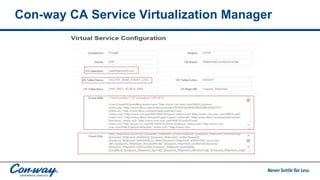
    Con-way CA ServiceVirtualization Manager
  • 23.
  • 24.
  • 25.
    Benefits  Saved twomonths of development/testing  Reduced complexity for development/testing  Identifying and fixing bugs became easier  Provided high-availability for constrained services  Achieved component level performance testing  Eliminated capacity constraints for performance testing  Identified performance issues earlier in SDLC  Repeated performance test several times  Reusable virtual services for other projects
  • 26.
    ODIP Pilot ProjectScorecard Metric Pre Post Benefits Service Virtualization Integration test system availability Low High • Direct dependencies are virtualized provided very high system uptime • Test data scenarios were setup in spreadsheets and Oracle DB improving coverage and accuracy. Integration test data coverage and accuracy Low High Integration Testing Scenarios validated during development Low High • “Shift left” of testing • Better code quality/lower bugs • Increased developer productivity • Released with confidence Phase in which all systems get tested SIT Development Load and Performance Testing Throughput achieved 100 bills/hour 50,000 bills/hour • Performance issues identified during development phase • Cost savings in resolving issues identified earlier in cycle • Ability to test through various load scenarios • Ability to test performance at a component level Number of cycles executed 1 10/on-demand Number of issues identified Small Large SDLC phase in which L&P testing done Post SIT Development
  • 27.
    Service Virtualization CA Technologies DevOps Simulation Experience CA Technologies RelatedTechnologies Parallel Application Development CA Technologies DevOps Assessment CA Technologies
  • 28.
    For More Information Tolearn more about DevOps, please visit: http://bit.ly/1wbjjqX Insert appropriate screenshot and text overlay from following “More Info Graphics” slide here; ensure it links to correct page DevOps
  • 29.
    30 For Informational PurposesOnly This presentation provided at CA World 2014 is intended for information purposes only and does not form any type of warranty. Content provided in this presentation has not been reviewed for accuracy and is based on information provided by CA Partners and Customers. Terms of this Presentation