The NoSQL Ecosystem


        Adam Marcus
         MIT CSAIL
marcua@csail.mit.edu / @marcua
About Me
     ●
         Social Computing + Database Systems
     ●
         Easily Distracted: Wrote The NoSQL Ecosystem in
         The Architecture of Open Source Applications   1


1
    http://www.aosabook.org/en/nosql.html
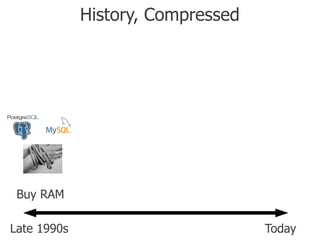
History, Compressed


Late 1990s                         Today
History, Compressed


 Buy RAM

Late 1990s                         Today
History, Compressed


 Buy RAM Wrap RDBMSs

Late 1990s                         Today
History, Compressed


 Buy RAM Wrap RDBMSs   NoSQL

Late 1990s                         Today
History, Compressed


                          Not Only SQL


 Buy RAM Wrap RDBMSs   NoSQL

Late 1990s                          Today
History, Compressed


 Buy RAM Wrap RDBMSs   NoSQL   Commercialize

Late 1990s                            Today
History, Compressed


 Buy RAM Wrap RDBMSs   NoSQL   Commercialize

Late 1990s                            Today
The List, So You Don't Yell at Me

                HBase                  CouchDB
                               Neo4j
     Cassandra          Riak            InfoGrid
BerkeleyDB      Voldemort      HyperTable
       Redis
                         MongoDB        Sones
AllegroGraph HyperGraphDB
                                 DEX    FlockDB
             VertexDB
                                    Oracle NoSQL
Tokyo Cabinet       MemcacheDB
The List, So You Don't Yell at Me
      Marcus' Law of Databases:
           HBase             CouchDB
                             Neo4j
     Cassandra        Riak           InfoGrid
       The number of persistence
                      HyperTable
BerkeleyDB doubles every 1.5 years
            Voldemort
    options
       Redis
                       MongoDB       Sones
AllegroGraph HyperGraphDB
                               DEX   FlockDB
           VertexDB
                                 Oracle NoSQL
Tokyo Cabinet    MemcacheDB
The List, So You Don't Yell at Me
      Marcus' Law of Databases:
           HBase             CouchDB
                           Neo4j
     Cassandra      Riak           InfoGrid
       The number of persistence
                      HyperTable
BerkeleyDB doubles every 1.5 years
            Voldemort
    options
        Redis
                     MongoDB       Sones
                  Corollary:
AllegroGraph HyperGraphDB
          I'm sorry I missedDEX FlockDB
                             your
             persistence optionOracle NoSQL
            VertexDB
Tokyo Cabinet    MemcacheDB
interesting properties
  real-world usage
     takeaways
      questions
interesting properties
  real-world usage
     takeaways
      questions
Conventional Wisdom on NoSQL
●
    Key-based data model
●
    Sloppy schema
●
    Single-key transactions
●
    In-app joins
●
    Eventually consistent
Exceptions are More Interesting
●
    Data Model
●
    Query Model
●
    Transactions
●
    Consistency
Data Model
●
    Usually key-based...
    ●
        Column-families
    ●
        Documents
    ●
        Data structures
Data Model
●
    Usually key-based...
    ●
        Column-families
    ●
        Documents
    ●
        Data structures
●
    ...but not always
    ●
        Graph stores
Query Model
●
    Redis: data structure-specific operations
●
    CouchDB, Riak: MapReduce
●
    Cassandra, MongoDB: SQL-like languages, no
    joins or transactions
Query Model
●
    Redis: data structure-specific operations
●
    CouchDB, Riak: MapReduce
●
    Cassandra, MongoDB: SQL-like languages, no
    joins or transactions
●
    Third-party
    ●
        High-level: PigLatin, HiveQL
    ●
        Library: Cascading, Crunch
    ●
        Streaming: Flume, Kafka, S4, Scribe
Transactions
●
    Full ACID for single key
●
    Redis: multi-key single-node transactions
Consistency
●   Strong: Appears that all replicas see all writes
●   Eventual: Replicas may have different, divergent versions
Consistency
●   Strong: Appears that all replicas see all writes
●   Eventual: Replicas may have different, divergent versions

●   Dynamo: strong or eventual (quorum size)
Consistency
  ●   Strong: Appears that all replicas see all writes
  ●   Eventual: Replicas may have different, divergent versions

  ●   Dynamo: strong or eventual (quorum size)


  ●   PNUTs: Timeline consistency
  ●   ...many consistency models!


See: http://www.allthingsdistributed.com/2007/12/eventually_consistent.html
interesting properties
  real-world usage
     takeaways
      questions
NoSQL Use-cases
●
    Cassandra
●
    HBase
●
    MongoDB
Cassandra
●
    BigTable data model: key   column family
●
    Dynamo sharding model: consistent hashing
●
    Eventual or strong consistency
Cassandra at Netflix
  ●
      Transitioned from Oracle
  ●
      Store customer profiles, customer:movie watch
      log, and detailed usage logging
         Note: no multi-record locking (e.g., bank transfer)
      In-datacenter: 3 replicas, per-app consistency
         read/write quorum = 1, ~1ms latency
         read/write quorum = 2, ~3ms latency


“Replicating Datacenter Oracle with Global Apache Cassandra on AWS” by Adrian Cockcroft
http://www.slideshare.net/adrianco/migrating-netflix-from-oracle-to-global-cassandra
Cassandra at Netflix
  ●
      Transitioned from Oracle
  ●
      Store customer profiles, customer:movie watch
      log, and detailed usage logging
      ●
          Note: no multi-record locking (e.g., bank transfer)
      In-datacenter: 3 replicas, per-app consistency
          read/write quorum = 1, ~1ms latency
          read/write quorum = 2, ~3ms latency


“Replicating Datacenter Oracle with Global Apache Cassandra on AWS” by Adrian Cockcroft
http://www.slideshare.net/adrianco/migrating-netflix-from-oracle-to-global-cassandra
Cassandra at Netflix
  ●
      Transitioned from Oracle
  ●
      Store customer profiles, customer:movie watch
      log, and detailed usage logging
      ●
          Note: no multi-record locking (e.g., bank transfer)
  ●
      In-datacenter: 3 replicas, per-app consistency


“Replicating Datacenter Oracle with Global Apache Cassandra on AWS” by Adrian Cockcroft
http://www.slideshare.net/adrianco/migrating-netflix-from-oracle-to-global-cassandra
Cassandra at Netflix (cont'd)
●
    Benefit: async inter-datacenter replication
●
    Benefit: no downtime for schema changes
●
    Benefit: hooks for live backups
HBase
●
    Data model: key       column family
●
    Sharding model: range partitioning
●
    Strong consistency


    Applications
      Logging events/crawls, storing analytics
      Twitter: replicate data from MySQL, Hadoop analytics
      Facebook Messages
HBase
●
    Data model: key         column family
●
    Sharding model: range partitioning
●
    Strong consistency


●
    Applications
    ●
        Logging events/crawls, storing analytics
    ●
        Twitter: replicate data from MySQL, Hadoop analytics
    ●
        Facebook Messages
HBase for Facebook Messages
●
    Cassandra/Dynamo eventual consistency was
    difficult to program against


    Benefit: simple consistency model
    Benefit: flexible data model
    Benefit: simple sharding, load balancing,
    replication
HBase for Facebook Messages
●
    Cassandra/Dynamo eventual consistency was
    difficult to program against


●
    Benefit: simple consistency model
●
    Benefit: flexible data model
●
    Benefit: simple sharding, load balancing,
    replication
MongoDB
●
    Document-based data model
●
    Range-based partitioning
●
    Consistency depends on how you use it
MongoDB: Two use-cases
●
    Archiving at Craigslist
    ●
        2.2B historical posts, semi-structured
    ●
        Relatively large blobs: avg 2KB, max > 4 MB
MongoDB: Two use-cases
●
    Archiving at Craigslist
    ●
        2.2B historical posts, semi-structured
    ●
        Relatively large blobs: avg 2KB, max > 4 MB
●
    Checkins at Foursquare
    ●
        Geospatial indexing
    ●
        Small location-based updates, sharded on user
interesting properties
  real-world usage
     takeaways
      questions
Takeaways
●
    Developer accessibility
●
    Ecosystem of reuse
●
    Soft spot
Developer Accessibility
    devops


@DEVOPS_BORAT
Developer Accessibility
    devops          self-taught dev


@DEVOPS_BORAT
A Different Five-Minute Rule


What does a first-time user of your system
experience in their first five minutes?
(idea credit: Justin Sheehy, Basho)
Redis
http://simonwillison.net/2009/Oct/22/redis/
PostgreSQL
http://www.postgresql.org/docs/9.1/interactive/sql-createtable.html
Cassandra
http://www.datastax.com/docs/0.7/getting_started/using_cli
Accessibility is Forever
Beyond five minutes:
●
    changing schemas
●
    scaling up
●
    modifying topology
Accessibility is Forever
Beyond five minutes:
●
    changing schemas
●
    scaling up
●
    modifying topology


       An accessible data store will ease
        first-time users in, and support
       experienced users as they expand
Ecosystem of Reuse
Spectrum of Reusability


Monolithic System         System Kernel
Spectrum of Reusability


Monolithic System            System Kernel


MongoDB
 Redis


 Use as
provided
Spectrum of Reusability


Monolithic System            System Kernel


MongoDB      Cassandra
 Redis       Voldemort


 Use as     Pick between
provided    components
Spectrum of Reusability


Monolithic System                System Kernel


MongoDB      Cassandra   ZooKeeper
 Redis       Voldemort    LevelDB


 Use as     Pick between Reusable
provided    components components
Spectrum of Reusability


Monolithic System                System Kernel


MongoDB      Cassandra   ZooKeeper
 Redis       Voldemort    LevelDB     riak_core


 Use as     Pick between Reusable     Build your
provided    components components    own system
And finally, a soft spot
polyglot persistence
            =
right tool for right task
Polyglot persistence: Where's the data?


“HBase at Mendeley,” Dan Harvey
http://www.slideshare.net/danharvey/hbase-at-mendeley
Polyglot persistence: Where's the data?


“HBase at Mendeley,” Dan Harvey
http://www.slideshare.net/danharvey/hbase-at-mendeley
Polyglot persistence: Where's the data?


Aid developers in reasoning about data consistency
          across multiple storage engines
“HBase at Mendeley,” Dan Harvey
http://www.slideshare.net/danharvey/hbase-at-mendeley
interesting properties
  real-world usage
     takeaways
      questions
●
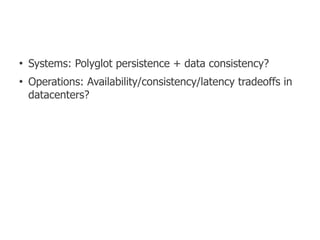
    Systems: Polyglot persistence + data consistency?
●
    Systems: Polyglot persistence + data consistency?
●
    Operations: Availability/consistency/latency tradeoffs in
    datacenters?
●
    Systems: Polyglot persistence + data consistency?
●
    Operations: Availability/consistency/latency tradeoffs in
    datacenters?
●
    Accessibility: RDBMS five-minute usability?
●
    Systems: Polyglot persistence + data consistency?
●
    Operations: Availability/consistency/latency tradeoffs in
    datacenters?
●
    Accessibility: RDBMS five-minute usability?
●
    Accessibility: Scale-up wizard for storage systems?
●
    Systems: Polyglot persistence + data consistency?
●
    Operations: Availability/consistency/latency tradeoffs in
    datacenters?
●
    Accessibility: RDBMS five-minute usability?
●
    Accessibility: Scale-up wizard for storage systems?
●
    Comparisons: Design or implementation?
●
    Systems: Polyglot persistence + data consistency?
●
    Operations: Availability/consistency/latency tradeoffs in
    datacenters?
●
    Accessibility: RDBMS five-minute usability?
●
    Accessibility: Scale-up wizard for storage systems?
●
    Comparisons: Design or implementation?
●
    Future: Next-generation NoSQL stores?
Thank You!
●
    Systems: Polyglot persistence + data consistency?
●
    Operations: Availability/consistency/latency tradeoffs in
    datacenters?
●
    Accessibility: RDBMS five-minute usability?
●
    Accessibility: Scale-up wizard for storage systems?
●
    Comparisons: Design or implementation?
●
    Future: Next-generation NoSQL stores?

                    Adam Marcus
            marcua@csail.mit.edu / @marcua
Photo Credits
http://www.flickr.com/photos/dhannah/457765
7955/
http://www.flickr.com/photos/27316226@N02/3
000888100/sizes/m/in/photostream/
http://www.texample.net/tikz/examples/valenti
ne-heart/
http://voltdb.com/sites/default/files/VCE_button
.png

HPTS 2011: The NoSQL Ecosystem

  • 1.
    The NoSQL Ecosystem Adam Marcus MIT CSAIL marcua@csail.mit.edu / @marcua
  • 2.
    About Me ● Social Computing + Database Systems ● Easily Distracted: Wrote The NoSQL Ecosystem in The Architecture of Open Source Applications 1 1 http://www.aosabook.org/en/nosql.html
  • 3.
  • 4.
    History, Compressed BuyRAM Late 1990s Today
  • 5.
    History, Compressed BuyRAM Wrap RDBMSs Late 1990s Today
  • 6.
    History, Compressed BuyRAM Wrap RDBMSs NoSQL Late 1990s Today
  • 7.
    History, Compressed Not Only SQL Buy RAM Wrap RDBMSs NoSQL Late 1990s Today
  • 8.
    History, Compressed BuyRAM Wrap RDBMSs NoSQL Commercialize Late 1990s Today
  • 9.
    History, Compressed BuyRAM Wrap RDBMSs NoSQL Commercialize Late 1990s Today
  • 10.
    The List, SoYou Don't Yell at Me HBase CouchDB Neo4j Cassandra Riak InfoGrid BerkeleyDB Voldemort HyperTable Redis MongoDB Sones AllegroGraph HyperGraphDB DEX FlockDB VertexDB Oracle NoSQL Tokyo Cabinet MemcacheDB
  • 11.
    The List, SoYou Don't Yell at Me Marcus' Law of Databases: HBase CouchDB Neo4j Cassandra Riak InfoGrid The number of persistence HyperTable BerkeleyDB doubles every 1.5 years Voldemort options Redis MongoDB Sones AllegroGraph HyperGraphDB DEX FlockDB VertexDB Oracle NoSQL Tokyo Cabinet MemcacheDB
  • 12.
    The List, SoYou Don't Yell at Me Marcus' Law of Databases: HBase CouchDB Neo4j Cassandra Riak InfoGrid The number of persistence HyperTable BerkeleyDB doubles every 1.5 years Voldemort options Redis MongoDB Sones Corollary: AllegroGraph HyperGraphDB I'm sorry I missedDEX FlockDB your persistence optionOracle NoSQL VertexDB Tokyo Cabinet MemcacheDB
  • 13.
    interesting properties real-world usage takeaways questions
  • 14.
    interesting properties real-world usage takeaways questions
  • 15.
    Conventional Wisdom onNoSQL ● Key-based data model ● Sloppy schema ● Single-key transactions ● In-app joins ● Eventually consistent
  • 16.
    Exceptions are MoreInteresting ● Data Model ● Query Model ● Transactions ● Consistency
  • 17.
    Data Model ● Usually key-based... ● Column-families ● Documents ● Data structures
  • 18.
    Data Model ● Usually key-based... ● Column-families ● Documents ● Data structures ● ...but not always ● Graph stores
  • 19.
    Query Model ● Redis: data structure-specific operations ● CouchDB, Riak: MapReduce ● Cassandra, MongoDB: SQL-like languages, no joins or transactions
  • 20.
    Query Model ● Redis: data structure-specific operations ● CouchDB, Riak: MapReduce ● Cassandra, MongoDB: SQL-like languages, no joins or transactions ● Third-party ● High-level: PigLatin, HiveQL ● Library: Cascading, Crunch ● Streaming: Flume, Kafka, S4, Scribe
  • 21.
    Transactions ● Full ACID for single key ● Redis: multi-key single-node transactions
  • 22.
    Consistency ● Strong: Appears that all replicas see all writes ● Eventual: Replicas may have different, divergent versions
  • 23.
    Consistency ● Strong: Appears that all replicas see all writes ● Eventual: Replicas may have different, divergent versions ● Dynamo: strong or eventual (quorum size)
  • 24.
    Consistency ● Strong: Appears that all replicas see all writes ● Eventual: Replicas may have different, divergent versions ● Dynamo: strong or eventual (quorum size) ● PNUTs: Timeline consistency ● ...many consistency models! See: http://www.allthingsdistributed.com/2007/12/eventually_consistent.html
  • 25.
    interesting properties real-world usage takeaways questions
  • 26.
    NoSQL Use-cases ● Cassandra ● HBase ● MongoDB
  • 27.
    Cassandra ● BigTable data model: key column family ● Dynamo sharding model: consistent hashing ● Eventual or strong consistency
  • 28.
    Cassandra at Netflix ● Transitioned from Oracle ● Store customer profiles, customer:movie watch log, and detailed usage logging Note: no multi-record locking (e.g., bank transfer) In-datacenter: 3 replicas, per-app consistency read/write quorum = 1, ~1ms latency read/write quorum = 2, ~3ms latency “Replicating Datacenter Oracle with Global Apache Cassandra on AWS” by Adrian Cockcroft http://www.slideshare.net/adrianco/migrating-netflix-from-oracle-to-global-cassandra
  • 29.
    Cassandra at Netflix ● Transitioned from Oracle ● Store customer profiles, customer:movie watch log, and detailed usage logging ● Note: no multi-record locking (e.g., bank transfer) In-datacenter: 3 replicas, per-app consistency read/write quorum = 1, ~1ms latency read/write quorum = 2, ~3ms latency “Replicating Datacenter Oracle with Global Apache Cassandra on AWS” by Adrian Cockcroft http://www.slideshare.net/adrianco/migrating-netflix-from-oracle-to-global-cassandra
  • 30.
    Cassandra at Netflix ● Transitioned from Oracle ● Store customer profiles, customer:movie watch log, and detailed usage logging ● Note: no multi-record locking (e.g., bank transfer) ● In-datacenter: 3 replicas, per-app consistency “Replicating Datacenter Oracle with Global Apache Cassandra on AWS” by Adrian Cockcroft http://www.slideshare.net/adrianco/migrating-netflix-from-oracle-to-global-cassandra
  • 31.
    Cassandra at Netflix(cont'd) ● Benefit: async inter-datacenter replication ● Benefit: no downtime for schema changes ● Benefit: hooks for live backups
  • 32.
    HBase ● Data model: key column family ● Sharding model: range partitioning ● Strong consistency Applications Logging events/crawls, storing analytics Twitter: replicate data from MySQL, Hadoop analytics Facebook Messages
  • 33.
    HBase ● Data model: key column family ● Sharding model: range partitioning ● Strong consistency ● Applications ● Logging events/crawls, storing analytics ● Twitter: replicate data from MySQL, Hadoop analytics ● Facebook Messages
  • 34.
    HBase for FacebookMessages ● Cassandra/Dynamo eventual consistency was difficult to program against Benefit: simple consistency model Benefit: flexible data model Benefit: simple sharding, load balancing, replication
  • 35.
    HBase for FacebookMessages ● Cassandra/Dynamo eventual consistency was difficult to program against ● Benefit: simple consistency model ● Benefit: flexible data model ● Benefit: simple sharding, load balancing, replication
  • 36.
    MongoDB ● Document-based data model ● Range-based partitioning ● Consistency depends on how you use it
  • 37.
    MongoDB: Two use-cases ● Archiving at Craigslist ● 2.2B historical posts, semi-structured ● Relatively large blobs: avg 2KB, max > 4 MB
  • 38.
    MongoDB: Two use-cases ● Archiving at Craigslist ● 2.2B historical posts, semi-structured ● Relatively large blobs: avg 2KB, max > 4 MB ● Checkins at Foursquare ● Geospatial indexing ● Small location-based updates, sharded on user
  • 39.
    interesting properties real-world usage takeaways questions
  • 40.
    Takeaways ● Developer accessibility ● Ecosystem of reuse ● Soft spot
  • 41.
  • 42.
    Developer Accessibility devops @DEVOPS_BORAT
  • 43.
    Developer Accessibility devops self-taught dev @DEVOPS_BORAT
  • 44.
    A Different Five-MinuteRule What does a first-time user of your system experience in their first five minutes? (idea credit: Justin Sheehy, Basho)
  • 45.
  • 46.
  • 47.
  • 48.
    Accessibility is Forever Beyondfive minutes: ● changing schemas ● scaling up ● modifying topology
  • 49.
    Accessibility is Forever Beyondfive minutes: ● changing schemas ● scaling up ● modifying topology An accessible data store will ease first-time users in, and support experienced users as they expand
  • 50.
  • 51.
  • 52.
    Spectrum of Reusability MonolithicSystem System Kernel MongoDB Redis Use as provided
  • 53.
    Spectrum of Reusability MonolithicSystem System Kernel MongoDB Cassandra Redis Voldemort Use as Pick between provided components
  • 54.
    Spectrum of Reusability MonolithicSystem System Kernel MongoDB Cassandra ZooKeeper Redis Voldemort LevelDB Use as Pick between Reusable provided components components
  • 55.
    Spectrum of Reusability MonolithicSystem System Kernel MongoDB Cassandra ZooKeeper Redis Voldemort LevelDB riak_core Use as Pick between Reusable Build your provided components components own system
  • 56.
    And finally, asoft spot
  • 57.
    polyglot persistence = right tool for right task
  • 58.
    Polyglot persistence: Where'sthe data? “HBase at Mendeley,” Dan Harvey http://www.slideshare.net/danharvey/hbase-at-mendeley
  • 59.
    Polyglot persistence: Where'sthe data? “HBase at Mendeley,” Dan Harvey http://www.slideshare.net/danharvey/hbase-at-mendeley
  • 60.
    Polyglot persistence: Where'sthe data? Aid developers in reasoning about data consistency across multiple storage engines “HBase at Mendeley,” Dan Harvey http://www.slideshare.net/danharvey/hbase-at-mendeley
  • 61.
    interesting properties real-world usage takeaways questions
  • 62.
    Systems: Polyglot persistence + data consistency?
  • 63.
    Systems: Polyglot persistence + data consistency? ● Operations: Availability/consistency/latency tradeoffs in datacenters?
  • 64.
    Systems: Polyglot persistence + data consistency? ● Operations: Availability/consistency/latency tradeoffs in datacenters? ● Accessibility: RDBMS five-minute usability?
  • 65.
    Systems: Polyglot persistence + data consistency? ● Operations: Availability/consistency/latency tradeoffs in datacenters? ● Accessibility: RDBMS five-minute usability? ● Accessibility: Scale-up wizard for storage systems?
  • 66.
    Systems: Polyglot persistence + data consistency? ● Operations: Availability/consistency/latency tradeoffs in datacenters? ● Accessibility: RDBMS five-minute usability? ● Accessibility: Scale-up wizard for storage systems? ● Comparisons: Design or implementation?
  • 67.
    Systems: Polyglot persistence + data consistency? ● Operations: Availability/consistency/latency tradeoffs in datacenters? ● Accessibility: RDBMS five-minute usability? ● Accessibility: Scale-up wizard for storage systems? ● Comparisons: Design or implementation? ● Future: Next-generation NoSQL stores?
  • 68.
    Thank You! ● Systems: Polyglot persistence + data consistency? ● Operations: Availability/consistency/latency tradeoffs in datacenters? ● Accessibility: RDBMS five-minute usability? ● Accessibility: Scale-up wizard for storage systems? ● Comparisons: Design or implementation? ● Future: Next-generation NoSQL stores? Adam Marcus marcua@csail.mit.edu / @marcua
  • 69.