In Memory Databases
An Overview
By John Sullivan
john@inmemory.net
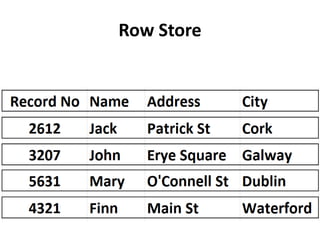
Row Store
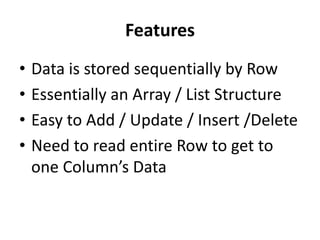
Features
• Data is stored sequentially by Row
• Essentially an Array / List Structure
• Easy to Add / Update / Insert /Delete
• Need to read entire Row to get to
one Column’s Data
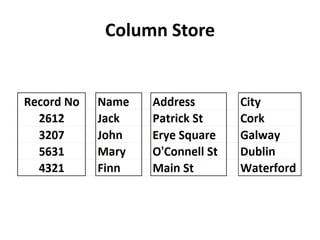
Column Store
Features
• Data is stored by Column
• Faster to Read a few Columns
• Very Hard to Update / Insert
• Reading Data Sequentially from
Column, CPU Cache Friendly
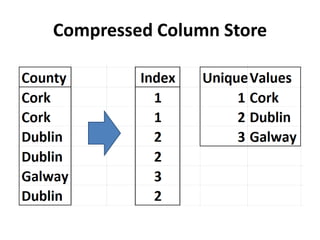
Compressed Column Store
• Column Array is converted into 2 arrays
–One array contains a list of sorted
Unique Values
–Another array containing an integer
index to the values
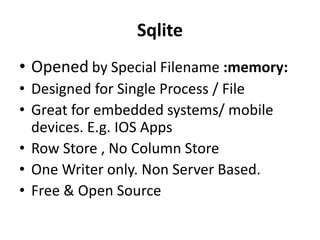
Sqlite
• Opened by Special Filename :memory:
• Designed for Single Process / File
• Great for embedded systems/ mobile
devices. E.g. IOS Apps
• Row Store , No Column Store
• One Writer only. Non Server Based.
• Free & Open Source
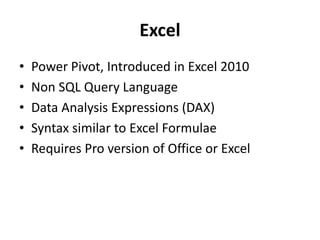
Excel
• Power Pivot, Introduced in Excel 2010
• Non SQL Query Language
• Data Analysis Expressions (DAX)
• Syntax similar to Excel Formulae
• Requires Pro version of Office or Excel
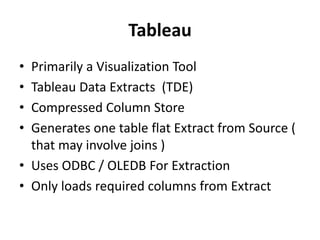
Tableau
• Primarily a Visualization Tool
• Tableau Data Extracts (TDE)
• Compressed Column Store
• Generates one table flat Extract from Source (
that may involve joins )
• Uses ODBC / OLEDB For Extraction
• Only loads required columns from Extract
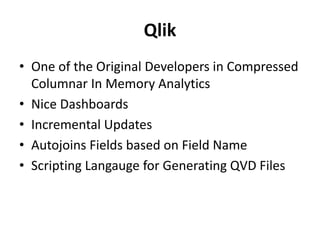
Qlik
• One of the Original Developers in Compressed
Columnar In Memory Analytics
• Nice Dashboards
• Incremental Updates
• Autojoins Fields based on Field Name
• Scripting Langauge for Generating QVD Files
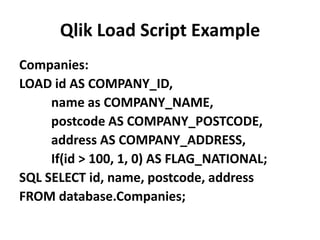
Qlik Load Script Example
Companies:
LOAD id AS COMPANY_ID,
name as COMPANY_NAME,
postcode AS COMPANY_POSTCODE,
address AS COMPANY_ADDRESS,
If(id > 100, 1, 0) AS FLAG_NATIONAL;
SQL SELECT id, name, postcode, address
FROM database.Companies;
Monet DB
• Pioneer in Columnar Databases
• Research Focussed out of the Netherlands
• Open Source
• Can Cache Expensive Computations and Reuse
• Early versions was used by Data Distilleries,
which got bought out by SPSS
• R Integration
SQL Server Enterprise
• ColumnStore Indexes
–Data is stored by column.
–Blocks of 1,048,576 Values
• InMemory OLTP
(MEMORY_OPTIMIZED=ON) after Create Table
Data/Delta files of 128 MB
Oracle
• TimesTen
– Works with Oracle Database as a Cache
– Telecoms and Financial Companies
• Oracle 12 Enterprise
– Row & Column Formats
– In Memory Columnstore
• Exalytics
SAP Hana
• Pure In Memory Database
• In Memory OLTP Rowstore
• In Memory Columnstore
– Up to 2^31 rows per block
• Cluster Large Fact tables across nodes
• Hana One Available on EC2 & IBM
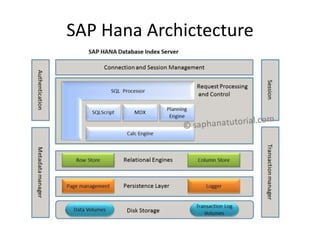
SAP Hana Archictecture
Memsql
• Pure In Memory Database
• Mysql Wire Protocol Compatible
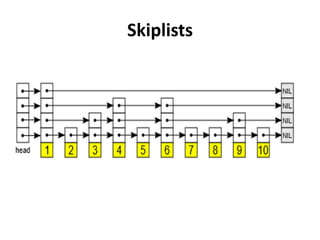
• Lockfree Linked Lists and Skiplists
• SQL Queries compiled into C++
• Split Large Tables Across Nodes
• Column Store Aimed at Analytics
• Apache Spark Integration
Skiplists
Clustered Databases
• Amazon Redshift
• EMC Greenplum
• IBM Netezza
• HP Vertica
• Teradata
Other In Memory Players
• Sisense BI Focussed
• Parstream Cisco Owned
• Domo SAAS BI Company. Omniture Founder
• Iri
• InsightSquared BI Focussed
• VoltDB Java Stored Procedure Unit of Exec
• Infobright Open Sourced based on Mysql
• KDB Focussed on HFT / Terse
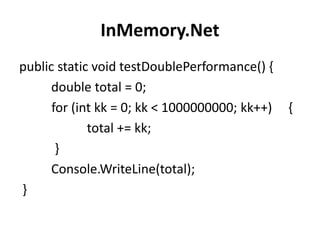
InMemory.Net
public static void testDoublePerformance() {
double total = 0;
for (int kk = 0; kk < 1000000000; kk++) {
total += kk;
}
Console.WriteLine(total);
}
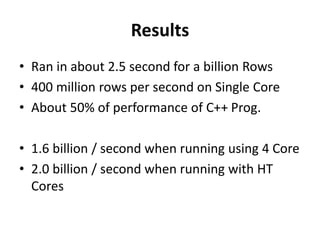
Results
• Ran in about 2.5 second for a billion Rows
• 400 million rows per second on Single Core
• About 50% of performance of C++ Prog.
• 1.6 billion / second when running using 4 Core
• 2.0 billion / second when running with HT
Cores
Initial Version
• InMemoryColumn<T> {
Dictionary <T,int> initialValuesDict;
List <int> initialIndexes;
T [] finalValues;
int [] finalIndexes;
• }
Next Version
• InMemoryColumn<T> {
Dictionary <T,int> initialValuesDict;
int [][] initialIndexes;
T [] finalValues;
int [] finalIndexes;
• }
Final Version
• InMemoryColumn<T> {
Dictionary <T,int> initialValuesDict;
byte/ushort/int [][] initialIndexes;
T [] finalValues;
byte/ushort/int [] finalIndexes;
• }
ANLTR to Parse Queries
grammar Expr;
prog: (expr NEWLINE)* ;
expr: expr ('*'|'/') expr |
expr ('+'|'-') expr |
INT | '(' expr ')' ;
NEWLINE : [rn]+ ;
INT : [0-9]+ ;
Example Rule from Grammer
mainquery [ImpVars vars] returns [InMemoryQuery query ] :
{ $query = new InMemoryQuery(); }
SELECT1
(CACHE {$query.setCache();} )?
(NOCACHE {$query.setNoCache();} )?
(DISTINCT {$query.setDistinct();} )?
fieldclause [$query,$vars]
(
(INTO label { $query.setInto ($label.text2 ) ;})?
FROM tableclause [$query,$vars]
( (COMMA|CROSS JOIN ) tableclause [$query,$vars] ) *
(WHERE whereclause [$query,$vars])?
(GROUP BY groupclause [$query,$vars])?
(HAVING havingclause [$query,$vars])?
(ORDER BY orderclause [$query,$vars])?
(LIMIT limitclause [$query,$vars])?
)? ;
Code Generation
• Generate C# To Evaluate Query
• Compiled Code undergoes JIT for fast exec
• Parameterize Constants
– Simplify complex Constant Expressions
• Generic Table / Column Naming
• Reuse Generated Code
Detail Queries
• Detail Query
–Initial List Algorithm
–Improved by using Arrays of Arrays
–Only one thread works on one
Array
SELECT customerid FROM Orders
for (int tab1_counter = rowStart; tab1_counter < rowEnd; tab1_counter++,)
{ groupRowD1 = groupRowCount >> 14;
groupRowD2 = groupRowCount & 16383;
if (groupRowD2 == 0)
{
if (groupRowD1 > 0)
{
blockCounts[groupRowD1 - 1] = 16384;
}
lock (lock_newBlockObject)
{
groupRowCount = nextRecordD1 << 14;
nextRecordD1++;
}
groupRowD1 = groupRowCount >> 14;
t_total0[groupRowD1] = new byte[16384];
total0 = t_total0[groupRowD1];
};
total0[groupRowD2] = val_t1_c1[tab1_counter];
groupRowCount++;
if ((groupRowCount & 16383) == 0)
{
blockCounts[groupRowD1] = 16384;
}
}
Aggregative Queries
• Group Cardinality =1
• Group Cardinality < 500k
– Use Arrays of Arrays,
– Lookup Key being Group Index
• Group Cardinality > 500k
– Use Dictionaries to Correlate Group Index ->
Storage
– Arrays of Arrays
SELECT customer, SUM(1) FROM orders
WHERE employee=1 GROUP BY customer
for (int tab1_counter = rowStart; tab1_counter < rowEnd;
tab1_counter++, newRow = false) {
if ((val_t1_c2[tab1_counter] == const_0_t1_c2)) {
rowIndex = val_t1_c1[tab1_counter];
if (groupRowExists[rowIndex] == 0) newRow = true;
groupRowExists[rowIndex] = 1;
total1[rowIndex] += const_0;
if (newRow) {
total0[rowIndex]=val_t1_c1[tab1_counter];
}
}
}
COUNT DISTINCT
• Initial Algorithm used Byte []
• Used lots of Memory on Large Cores
• Upgraded to 1 [] across all Cores
• Interlocked.CompareExchange to set Bit
• Hashmap for initial Values
• Then switch to byte []
Subqueries
• Subquery in Table clause can be materialized
into temp table ( CACHE )
• Simplify Subquery ( NOCACHE)
Only Fields Parent SELECT Requires
Pass Through Parent WHERE Clause
JOINS
• LEFT & INNER JOIN SUPPORT
• Merge Parent & Child Column Values
• Parent Value -> Child Indexes
• ONE to ONE
– Join becomes an Array Lookup
• ONE to Many
– Join Becomes for Loop
Query Simplification
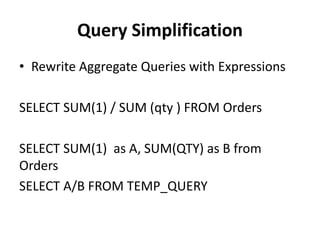
• Rewrite Aggregate Queries with Expressions
SELECT SUM(1) / SUM (qty ) FROM Orders
SELECT SUM(1) as A, SUM(QTY) as B from
Orders
SELECT A/B FROM TEMP_QUERY
More Simplifications
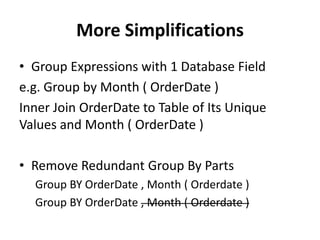
• Group Expressions with 1 Database Field
e.g. Group by Month ( OrderDate )
Inner Join OrderDate to Table of Its Unique
Values and Month ( OrderDate )
• Remove Redundant Group By Parts
Group BY OrderDate , Month ( Orderdate )
HAVING Clause
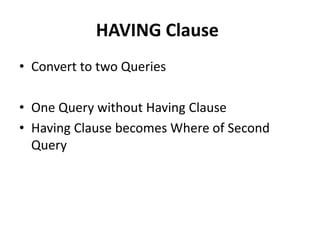
• Convert to two Queries
• One Query without Having Clause
• Having Clause becomes Where of Second
Query
Function List
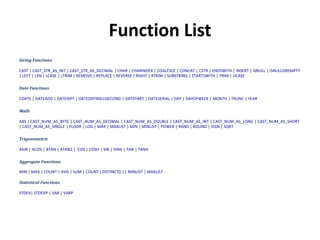
String Functions
CAST | CAST_STR_AS_INT | CAST_STR_AS_DECIMAL | CHAR | CHARINDEX | COALESCE | CONCAT | CSTR | ENDSWITH | INSERT | ISNULL | ISNULLOREMPTY
| LEFT | LEN | LCASE | LTRIM | REMOVE | REPLACE | REVERSE | RIGHT | RTRIM | SUBSTRING | STARTSWITH | TRIM | UCASE
Date Functions
CDATE | DATEADD | DATEDIFF | DATEDIFFMILLISECOND | DATEPART | DATESERIAL | DAY | DAYOFWEEK | MONTH | TRUNC | YEAR
Math
ABS | CAST_NUM_AS_BYTE | CAST_NUM_AS_DECIMAL | CAST_NUM_AS_DOUBLE | CAST_NUM_AS_INT | CAST_NUM_AS_LONG | CAST_NUM_AS_SHORT
| CAST_NUM_AS_SINGLE | FLOOR | LOG | MAX | MAXLIST | MIN | MINLIST | POWER | RAND | ROUND | SIGN | SQRT
Trigonometric
ASIN | ACOS | ATAN | ATAN2 | COS | COSH | SIN | SINH | TAN | TANH
Aggregate Functions
MIN | MAX | COUNT | AVG | SUM | COUNT ( DISTINCT() ) | MINLIST | MAXLIST
Statistical Functions
STDEV| STDEVP | VAR | VARP
Special Cases
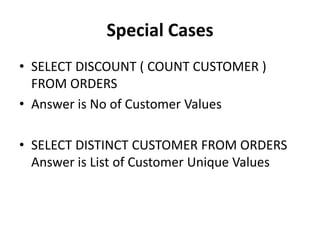
• SELECT DISCOUNT ( COUNT CUSTOMER )
FROM ORDERS
• Answer is No of Customer Values
• SELECT DISTINCT CUSTOMER FROM ORDERS
Answer is List of Customer Unique Values
Importing Data
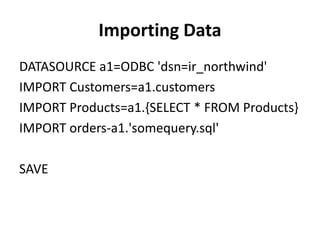
DATASOURCE a1=ODBC 'dsn=ir_northwind'
IMPORT Customers=a1.customers
IMPORT Products=a1.{SELECT * FROM Products}
IMPORT orders-a1.'somequery.sql'
SAVE
Importing Data II
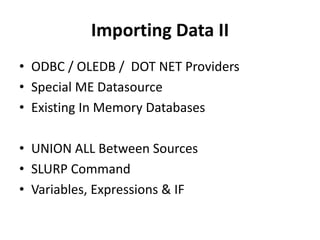
• ODBC / OLEDB / DOT NET Providers
• Special ME Datasource
• Existing In Memory Databases
• UNION ALL Between Sources
• SLURP Command
• Variables, Expressions & IF
Interfacing to the Database
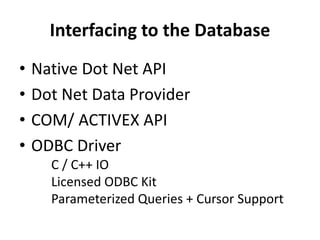
• Native Dot Net API
• Dot Net Data Provider
• COM/ ACTIVEX API
• ODBC Driver
C / C++ IO
Licensed ODBC Kit
Parameterized Queries + Cursor Support
Hard Learned Lessons
• Allocated and Store Variables Relating to One
Thread Sequentially. Don’t intermix
• Xeon Servers with Maxed out memory can
have slower memory access speed
– 1 Rank 1,866 Mhz
– 2 Ranks 1,600 Mhz
– 3 Ranks 1,333 Mhz
Bitcoin Mining / HFT
• CPUS
• GPUs
• FPGAs
• Dedicated Mining Chip
GPU & InMemory Databases
• GPUDB, MAPD
– Good for Visualising Billions of Points
– GPUs can run thousands of Cores on Data
– GPU to Main Memory Bottleneck
– Potentially more Data Reduction
• Blazegraph, Graphsql
Fast Graph Database that can use GPU
FPGA Potential
• Field-Programmable Gate Array
– is an integrated circuit designed to be configured
by a customer or a designer after manufacturing
– Programmable Integrated Circuit
• Could be used to enhanced In Memory DBs
• Intel bought Altera back in June 2015
– Will roll technology out into Data Center
Hardware Transaction Memory
• Simplifies Concurrent Programming
– Group of Load & Store Instructions
– Can Execute Atomically
• Hardware of Software Transactional Memory
• Intel TSX
– Transaction Synchronization Extensions
– Available in some Skylake Processors
– Added to Haswell/Broadwell but Disabled
3D XPoint Memory
• Announced by Intel & Micron June 2015
• 1000 times more Durable than Flash
• Like DRAM that has Permanence
• Latency 10 times faster than NAND SSD
• 4-6 Times slower than DRAM
Thanks for help with Market Research
• Dan Khasis
• Niall Dalton
• Jeff Cordova – Wavefront
• SapHanaTutorial.com

In memory databases presentation

  • 1.
    In Memory Databases AnOverview By John Sullivan john@inmemory.net
  • 2.
  • 3.
    Features • Data isstored sequentially by Row • Essentially an Array / List Structure • Easy to Add / Update / Insert /Delete • Need to read entire Row to get to one Column’s Data
  • 4.
  • 5.
    Features • Data isstored by Column • Faster to Read a few Columns • Very Hard to Update / Insert • Reading Data Sequentially from Column, CPU Cache Friendly
  • 6.
  • 7.
    Compressed Column Store •Column Array is converted into 2 arrays –One array contains a list of sorted Unique Values –Another array containing an integer index to the values
  • 8.
    Sqlite • Opened bySpecial Filename :memory: • Designed for Single Process / File • Great for embedded systems/ mobile devices. E.g. IOS Apps • Row Store , No Column Store • One Writer only. Non Server Based. • Free & Open Source
  • 9.
    Excel • Power Pivot,Introduced in Excel 2010 • Non SQL Query Language • Data Analysis Expressions (DAX) • Syntax similar to Excel Formulae • Requires Pro version of Office or Excel
  • 10.
    Tableau • Primarily aVisualization Tool • Tableau Data Extracts (TDE) • Compressed Column Store • Generates one table flat Extract from Source ( that may involve joins ) • Uses ODBC / OLEDB For Extraction • Only loads required columns from Extract
  • 11.
    Qlik • One ofthe Original Developers in Compressed Columnar In Memory Analytics • Nice Dashboards • Incremental Updates • Autojoins Fields based on Field Name • Scripting Langauge for Generating QVD Files
  • 12.
    Qlik Load ScriptExample Companies: LOAD id AS COMPANY_ID, name as COMPANY_NAME, postcode AS COMPANY_POSTCODE, address AS COMPANY_ADDRESS, If(id > 100, 1, 0) AS FLAG_NATIONAL; SQL SELECT id, name, postcode, address FROM database.Companies;
  • 13.
    Monet DB • Pioneerin Columnar Databases • Research Focussed out of the Netherlands • Open Source • Can Cache Expensive Computations and Reuse • Early versions was used by Data Distilleries, which got bought out by SPSS • R Integration
  • 14.
    SQL Server Enterprise •ColumnStore Indexes –Data is stored by column. –Blocks of 1,048,576 Values • InMemory OLTP (MEMORY_OPTIMIZED=ON) after Create Table Data/Delta files of 128 MB
  • 15.
    Oracle • TimesTen – Workswith Oracle Database as a Cache – Telecoms and Financial Companies • Oracle 12 Enterprise – Row & Column Formats – In Memory Columnstore • Exalytics
  • 16.
    SAP Hana • PureIn Memory Database • In Memory OLTP Rowstore • In Memory Columnstore – Up to 2^31 rows per block • Cluster Large Fact tables across nodes • Hana One Available on EC2 & IBM
  • 17.
  • 18.
    Memsql • Pure InMemory Database • Mysql Wire Protocol Compatible • Lockfree Linked Lists and Skiplists • SQL Queries compiled into C++ • Split Large Tables Across Nodes • Column Store Aimed at Analytics • Apache Spark Integration
  • 19.
  • 20.
    Clustered Databases • AmazonRedshift • EMC Greenplum • IBM Netezza • HP Vertica • Teradata
  • 21.
    Other In MemoryPlayers • Sisense BI Focussed • Parstream Cisco Owned • Domo SAAS BI Company. Omniture Founder • Iri • InsightSquared BI Focussed • VoltDB Java Stored Procedure Unit of Exec • Infobright Open Sourced based on Mysql • KDB Focussed on HFT / Terse
  • 22.
    InMemory.Net public static voidtestDoublePerformance() { double total = 0; for (int kk = 0; kk < 1000000000; kk++) { total += kk; } Console.WriteLine(total); }
  • 23.
    Results • Ran inabout 2.5 second for a billion Rows • 400 million rows per second on Single Core • About 50% of performance of C++ Prog. • 1.6 billion / second when running using 4 Core • 2.0 billion / second when running with HT Cores
  • 24.
    Initial Version • InMemoryColumn<T>{ Dictionary <T,int> initialValuesDict; List <int> initialIndexes; T [] finalValues; int [] finalIndexes; • }
  • 25.
    Next Version • InMemoryColumn<T>{ Dictionary <T,int> initialValuesDict; int [][] initialIndexes; T [] finalValues; int [] finalIndexes; • }
  • 26.
    Final Version • InMemoryColumn<T>{ Dictionary <T,int> initialValuesDict; byte/ushort/int [][] initialIndexes; T [] finalValues; byte/ushort/int [] finalIndexes; • }
  • 27.
    ANLTR to ParseQueries grammar Expr; prog: (expr NEWLINE)* ; expr: expr ('*'|'/') expr | expr ('+'|'-') expr | INT | '(' expr ')' ; NEWLINE : [rn]+ ; INT : [0-9]+ ;
  • 28.
    Example Rule fromGrammer mainquery [ImpVars vars] returns [InMemoryQuery query ] : { $query = new InMemoryQuery(); } SELECT1 (CACHE {$query.setCache();} )? (NOCACHE {$query.setNoCache();} )? (DISTINCT {$query.setDistinct();} )? fieldclause [$query,$vars] ( (INTO label { $query.setInto ($label.text2 ) ;})? FROM tableclause [$query,$vars] ( (COMMA|CROSS JOIN ) tableclause [$query,$vars] ) * (WHERE whereclause [$query,$vars])? (GROUP BY groupclause [$query,$vars])? (HAVING havingclause [$query,$vars])? (ORDER BY orderclause [$query,$vars])? (LIMIT limitclause [$query,$vars])? )? ;
  • 29.
    Code Generation • GenerateC# To Evaluate Query • Compiled Code undergoes JIT for fast exec • Parameterize Constants – Simplify complex Constant Expressions • Generic Table / Column Naming • Reuse Generated Code
  • 30.
    Detail Queries • DetailQuery –Initial List Algorithm –Improved by using Arrays of Arrays –Only one thread works on one Array
  • 31.
    SELECT customerid FROMOrders for (int tab1_counter = rowStart; tab1_counter < rowEnd; tab1_counter++,) { groupRowD1 = groupRowCount >> 14; groupRowD2 = groupRowCount & 16383; if (groupRowD2 == 0) { if (groupRowD1 > 0) { blockCounts[groupRowD1 - 1] = 16384; } lock (lock_newBlockObject) { groupRowCount = nextRecordD1 << 14; nextRecordD1++; } groupRowD1 = groupRowCount >> 14; t_total0[groupRowD1] = new byte[16384]; total0 = t_total0[groupRowD1]; }; total0[groupRowD2] = val_t1_c1[tab1_counter]; groupRowCount++; if ((groupRowCount & 16383) == 0) { blockCounts[groupRowD1] = 16384; } }
  • 32.
    Aggregative Queries • GroupCardinality =1 • Group Cardinality < 500k – Use Arrays of Arrays, – Lookup Key being Group Index • Group Cardinality > 500k – Use Dictionaries to Correlate Group Index -> Storage – Arrays of Arrays
  • 33.
    SELECT customer, SUM(1)FROM orders WHERE employee=1 GROUP BY customer for (int tab1_counter = rowStart; tab1_counter < rowEnd; tab1_counter++, newRow = false) { if ((val_t1_c2[tab1_counter] == const_0_t1_c2)) { rowIndex = val_t1_c1[tab1_counter]; if (groupRowExists[rowIndex] == 0) newRow = true; groupRowExists[rowIndex] = 1; total1[rowIndex] += const_0; if (newRow) { total0[rowIndex]=val_t1_c1[tab1_counter]; } } }
  • 34.
    COUNT DISTINCT • InitialAlgorithm used Byte [] • Used lots of Memory on Large Cores • Upgraded to 1 [] across all Cores • Interlocked.CompareExchange to set Bit • Hashmap for initial Values • Then switch to byte []
  • 35.
    Subqueries • Subquery inTable clause can be materialized into temp table ( CACHE ) • Simplify Subquery ( NOCACHE) Only Fields Parent SELECT Requires Pass Through Parent WHERE Clause
  • 36.
    JOINS • LEFT &INNER JOIN SUPPORT • Merge Parent & Child Column Values • Parent Value -> Child Indexes • ONE to ONE – Join becomes an Array Lookup • ONE to Many – Join Becomes for Loop
  • 37.
    Query Simplification • RewriteAggregate Queries with Expressions SELECT SUM(1) / SUM (qty ) FROM Orders SELECT SUM(1) as A, SUM(QTY) as B from Orders SELECT A/B FROM TEMP_QUERY
  • 38.
    More Simplifications • GroupExpressions with 1 Database Field e.g. Group by Month ( OrderDate ) Inner Join OrderDate to Table of Its Unique Values and Month ( OrderDate ) • Remove Redundant Group By Parts Group BY OrderDate , Month ( Orderdate ) Group BY OrderDate , Month ( Orderdate )
  • 39.
    HAVING Clause • Convertto two Queries • One Query without Having Clause • Having Clause becomes Where of Second Query
  • 40.
    Function List String Functions CAST| CAST_STR_AS_INT | CAST_STR_AS_DECIMAL | CHAR | CHARINDEX | COALESCE | CONCAT | CSTR | ENDSWITH | INSERT | ISNULL | ISNULLOREMPTY | LEFT | LEN | LCASE | LTRIM | REMOVE | REPLACE | REVERSE | RIGHT | RTRIM | SUBSTRING | STARTSWITH | TRIM | UCASE Date Functions CDATE | DATEADD | DATEDIFF | DATEDIFFMILLISECOND | DATEPART | DATESERIAL | DAY | DAYOFWEEK | MONTH | TRUNC | YEAR Math ABS | CAST_NUM_AS_BYTE | CAST_NUM_AS_DECIMAL | CAST_NUM_AS_DOUBLE | CAST_NUM_AS_INT | CAST_NUM_AS_LONG | CAST_NUM_AS_SHORT | CAST_NUM_AS_SINGLE | FLOOR | LOG | MAX | MAXLIST | MIN | MINLIST | POWER | RAND | ROUND | SIGN | SQRT Trigonometric ASIN | ACOS | ATAN | ATAN2 | COS | COSH | SIN | SINH | TAN | TANH Aggregate Functions MIN | MAX | COUNT | AVG | SUM | COUNT ( DISTINCT() ) | MINLIST | MAXLIST Statistical Functions STDEV| STDEVP | VAR | VARP
  • 41.
    Special Cases • SELECTDISCOUNT ( COUNT CUSTOMER ) FROM ORDERS • Answer is No of Customer Values • SELECT DISTINCT CUSTOMER FROM ORDERS Answer is List of Customer Unique Values
  • 42.
    Importing Data DATASOURCE a1=ODBC'dsn=ir_northwind' IMPORT Customers=a1.customers IMPORT Products=a1.{SELECT * FROM Products} IMPORT orders-a1.'somequery.sql' SAVE
  • 43.
    Importing Data II •ODBC / OLEDB / DOT NET Providers • Special ME Datasource • Existing In Memory Databases • UNION ALL Between Sources • SLURP Command • Variables, Expressions & IF
  • 44.
    Interfacing to theDatabase • Native Dot Net API • Dot Net Data Provider • COM/ ACTIVEX API • ODBC Driver C / C++ IO Licensed ODBC Kit Parameterized Queries + Cursor Support
  • 45.
    Hard Learned Lessons •Allocated and Store Variables Relating to One Thread Sequentially. Don’t intermix • Xeon Servers with Maxed out memory can have slower memory access speed – 1 Rank 1,866 Mhz – 2 Ranks 1,600 Mhz – 3 Ranks 1,333 Mhz
  • 46.
    Bitcoin Mining /HFT • CPUS • GPUs • FPGAs • Dedicated Mining Chip
  • 47.
    GPU & InMemoryDatabases • GPUDB, MAPD – Good for Visualising Billions of Points – GPUs can run thousands of Cores on Data – GPU to Main Memory Bottleneck – Potentially more Data Reduction • Blazegraph, Graphsql Fast Graph Database that can use GPU
  • 48.
    FPGA Potential • Field-ProgrammableGate Array – is an integrated circuit designed to be configured by a customer or a designer after manufacturing – Programmable Integrated Circuit • Could be used to enhanced In Memory DBs • Intel bought Altera back in June 2015 – Will roll technology out into Data Center
  • 49.
    Hardware Transaction Memory •Simplifies Concurrent Programming – Group of Load & Store Instructions – Can Execute Atomically • Hardware of Software Transactional Memory • Intel TSX – Transaction Synchronization Extensions – Available in some Skylake Processors – Added to Haswell/Broadwell but Disabled
  • 50.
    3D XPoint Memory •Announced by Intel & Micron June 2015 • 1000 times more Durable than Flash • Like DRAM that has Permanence • Latency 10 times faster than NAND SSD • 4-6 Times slower than DRAM
  • 51.
    Thanks for helpwith Market Research • Dan Khasis • Niall Dalton • Jeff Cordova – Wavefront • SapHanaTutorial.com