World Heritage
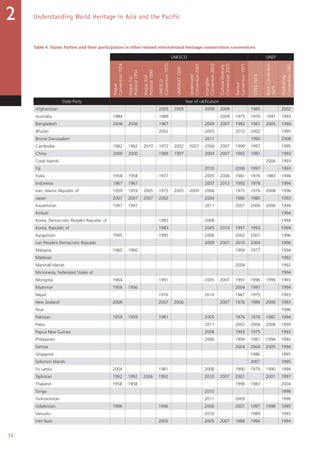
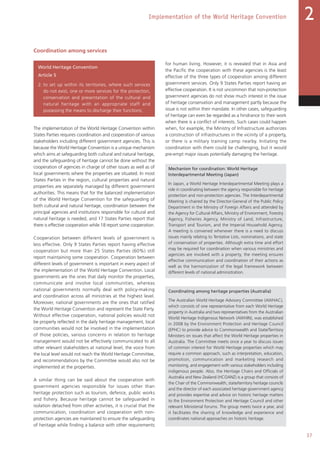
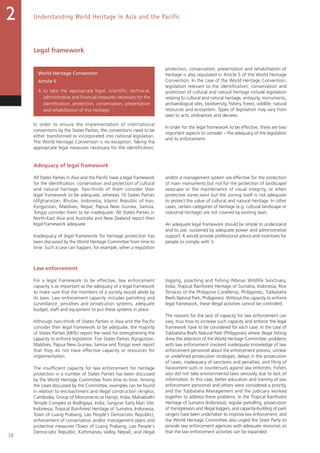
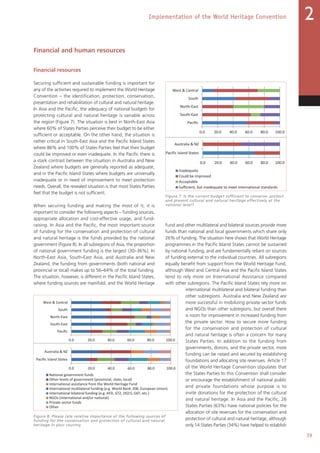
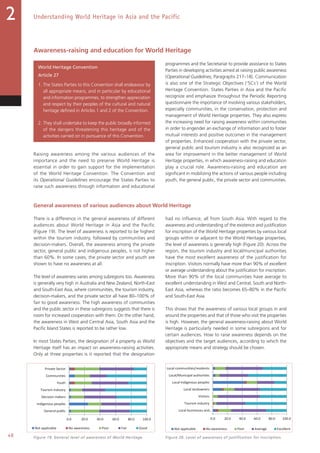
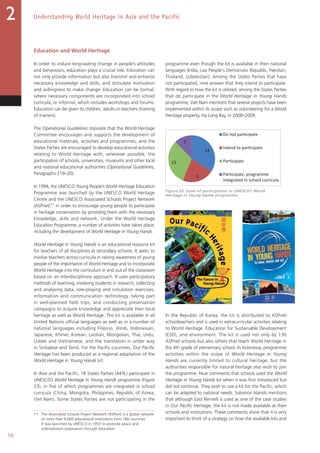
Understanding World Heritage
in Asia and the Pacific
The Second Cycle of Periodic Reporting 2010-2012
For more information contact:
UNESCO World Heritage Centre
7, place Fontenoy
75352 Paris 07 SP France
Tel: 33 (0)1 45 68 18 76
Fax: 33 (0)1 45 68 55 70
E-mail: wh-info@unesc.org
http://whc.unesco.org
papersWorld Heritage
WorldHeritagepapersUnderstandingWorldHeritageinAsiaandthePacific
35
35papers
Supported by
Japanese Funds-in-Trust
to UNESCO
Supported by
Japanese Funds-in-Trust
to UNESCO
Understanding World Heritage
in Asia and the Pacific
The Second Cycle of Periodic Reporting 2010-2012
Published in 2012 by the United Nations Educational, Scientific and Cultural Organization
7, place de Fontenoy, 75352 Paris 07 SP, France
© UNESCO 2012
All rights reserved
ISBN 978-92-3-001110-9
Original title: Understanding World Heritage in Asia and the Pacific: The Second Cycle of Periodic Reporting 2010-2012
Published in 2012 by the United Nations Educational, Scientific and Cultural Organization
The designations employed and the presentation of material throughout this publication do not imply the expression
of any opinion whatsoever on the part of UNESCO concerning the legal status of any country, territory, city or area or
of its authorities, or concerning the delimitation of its frontiers or boundaries.
The ideas and opinions expressed in this publication are those of the authors; they are not necessarily those of UNESCO
and do not commit the Organization.
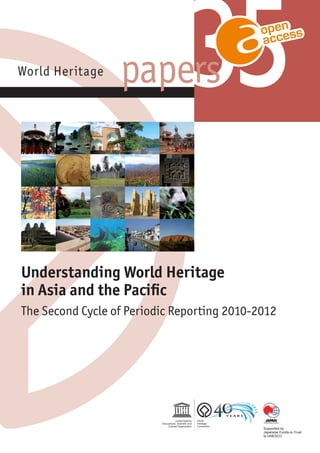
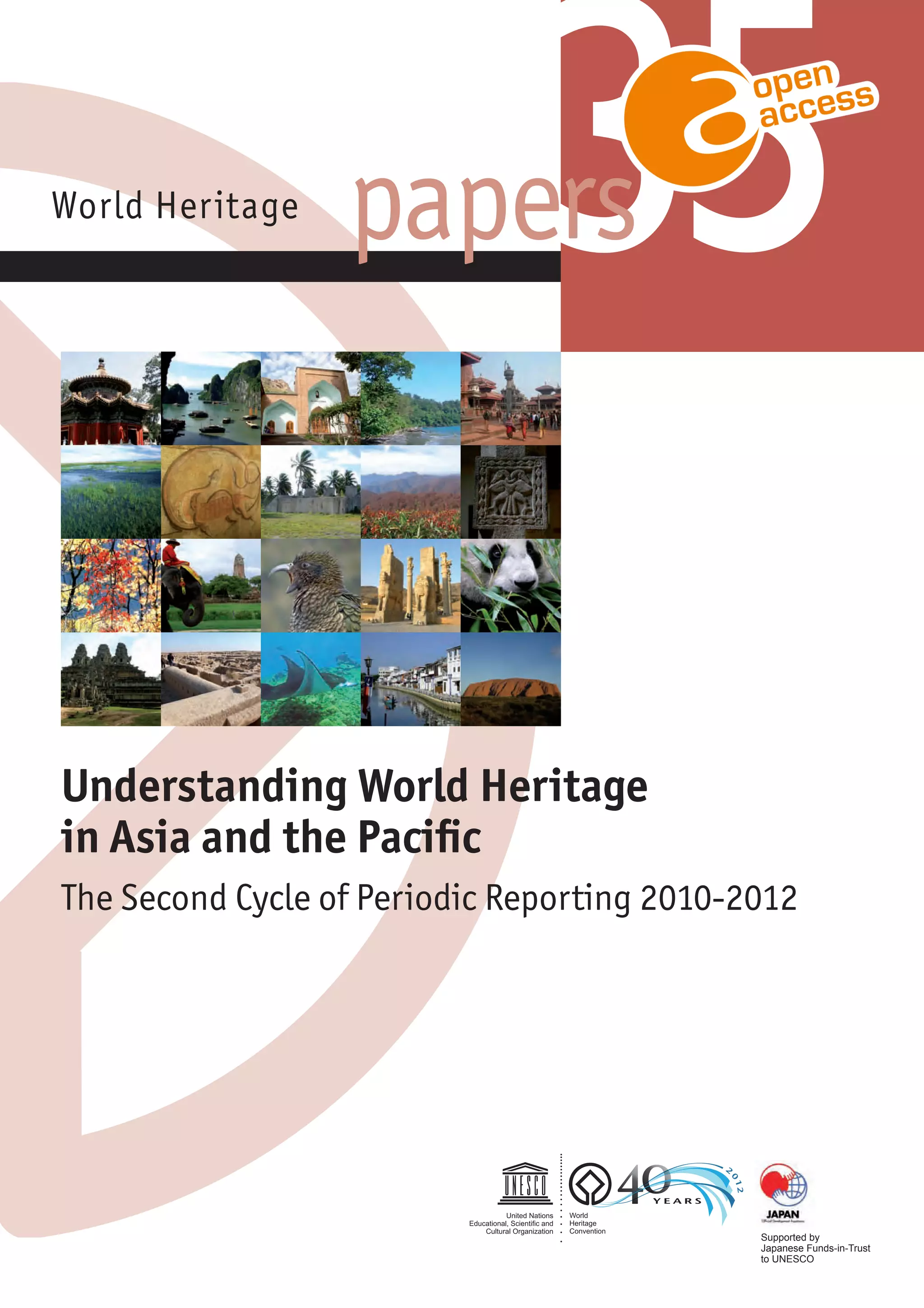
Cover photos (from left to right):
Row 1:	Imperial Palaces of the Ming and Qing Dynasties in Beijing and Shenyang, China © Juan Frias-Velatti
Ha Long Bay, Viet Nam © B. Doucin
Sulaiman-Too Sacred Mountain, Kyrgystan © UNESCO/Nomination file
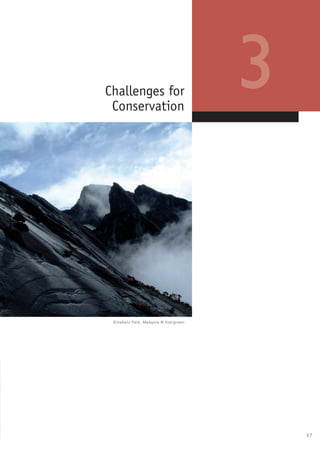
Ujung Kulon National Park, Indonesia © Evergreen
Kathmandu Valley, Nepal © UNESCO/Francesco Bandarin
Row 2:	 Uvs Nuur Basin, Mongolia and the Russian Federation © WWF/Anton Vorauer
Complex of Koguryo Tombs, Democratic People's Republic of Korea © OUR PLACE The World Heritage Collection
Bikini Atoll Nuclear Test Site, Marshall Islands © UNESCO/Ron Van Oers
Shirakami-Sanchi, Japan © Evergreen
Sacred City of Kandy, Sri Lanka © OUR PLACE The World Heritage Collection
Row 3:	 Nanda Devi and Valley of Flowers National Parks, India © UNESCO/Nomination file
Historic City of Ayutthaya, Thailand © OUR PLACE The World Heritage Collection
Te Wahipounamu – South West New Zealand, New Zealand © OUR PLACE The World Heritage Collection
Persepolis, Islamic Republic of Iran © UNESCO/Francesco Bandarin
Sichuan Giant Panda Sanctuaries – Wolong, Mt Siguniang and Jiajin Mountains, China © OUR PLACE The World Heritage Collection
Row 4:	 Angkor, Cambodia © UNESCO/Francesco Bandarin
State Historical and Cultural Park “Ancient Merv”, Turkmenistan © Chahryar Adle
Phoenix Islands Protected Area, Kiribati © UNESCO/Ron Van Oers
Melaka and George Town, Historic Cities of the Straits of Malacca, Malaysia © OUR PLACE The World Heritage Collection
Uluru-Kata Tjuta National Park, Australia © Gilles Brehm
Supervision, editing and coordination:
Kaori Kawakami, UNESCO World Heritage Centre
Drafting:
Kaori Kawakami, Kai Weise, Paul Dingwall
Copyediting and proofreading:
Caroline Lawrence
Coordination of the World Heritage Paper Series:
Vesna Vujicic-Lugassy
Graphic design: Recto Verso – realization by UNESCO/MSS/CLD
Cover design: Recto Verso – realization by UNESCO/MSS/CLD
Printed by: Composed and printed in the workshops of UNESCO.
The printer is certified Imprim’Vert®, the French printing industry’s environmental initiative.
Printed in France
This publication was made possible thanks to the support of the UNESCO/Japan Funds-in-Trust.
Table of Contents
Foreword
Kishore Rao, Director of the UNESCO World Heritage Centre
Page 5
Introduction Page 6
Acknowledgements Page 9
Background Page 11
Introduction to cultural and natural heritage in Asia and the Pacific Page 12
World Heritage Convention in Asia and the Pacific
States Parties / World Heritage Committee /
World Heritage Fund and International Assistance
Page 16
World Heritage properties in Asia and the Pacific
Outstanding Universal Value / World Heritage List / List of World Heritage
in Danger / Reactive Monitoring on the state of conservation
of World Heritage properties / Reinforced Monitoring Mechanism
Page 20
Periodic Reporting
First cycle of Periodic Reporting in Asia and the Pacific /
Second cycle of Periodic Reporting in Asia and the Pacific
Page 24
Implementation of the World Heritage Convention
2
Page 27
Inventories and Tentative Lists Page 28
Nominations Page 30
General policy and services for protection, conservation and presentation Page 32
Legal framework Page 38
Financial and human resources Page 39
Scientific and technical studies and research Page 42
Capacity-building Page 44
Awareness-raising and education for World Heritage Page 48
Partnership with the private sector and local non-profit organizations Page 52
International cooperation Page 54
Challenges for Conservation
3
Page 57
Summary of trends Page 58
Factors affecting the properties
Local conditions affecting physical fabric / Invasive or
hyper-abundant species / Natural disasters / Climate change /
Infrastructure development / Service facilities / Pollution /
Biological resource use and modification / Physical resource extraction /
Unfavourable human activities / Tourism /
Interaction with society / Management activities
Page 60
Resources for site managers Page 86
Protection and Management
4
Page 89
Management system/management plan Page 90
Boundaries and buffer zones Page 92
Protective measures Page 93
Financial and human resources Page 94
Visitor management Page 96
Monitoring Page 97
Community involvement Page 98
Conclusion
5
Page 101
Annex
6
Page 105
5
Since its adoption in 1972, the World Heritage Convention has become the most universal international legal instrument for
the conservation and protection of cultural and natural heritage sites of Outstanding Universal Value. Forty years have passed,
and the Convention is now ratified by 190 States Parties, with 962 properties located in 157 countries inscribed on the World
Heritage List. Asia and the Pacific has been an active partner in implementing the Convention, with all 43 States Parties in the
region working towards the identification, protection, conservation, preservation and transmission to future generations of the
rich cultural and natural heritage in their countries.
Asia and the Pacific is a vast and diverse region, and its historical, social, geological, ecological and climatic diversity is reflected
in its 213 World Heritage properties. Governments, site managers and community members are all responsible for protecting the
sites so that their values will continue to endure. This is also the fastest-growing economic region in the world which, combined
with the fact that it is also prone to frequent natural disasters, creates unique challenges for the management and conservation
of heritage sites. These factors make effective day-to-day management all the more essential if these sites are to be safeguarded
for the long term.
In this respect, the Periodic Reporting exercise provides all the States Parties with an excellent opportunity to use a self-
assessment tool to review and evaluate the implementation status of the Convention and the state of conservation of all the
properties. The second cycle of Periodic Reporting for Asia and the Pacific from 2010 to 2012 benefited from the full participation
of all the States Parties in the region, as a result of which the implementation of the Convention and the state of conservation of
all the World Heritage sites in the region were thoroughly examined for the first time. The results, reported to the World Heritage
Committee at its 36th session in 2012, highlighted a number of key issues identified by the States Parties themselves, such as the
importance of improved management plans/systems, sustainable financing mechanisms, community involvement and benefit
sharing, and more regional cooperation. Periodic Reporting also served as a catalyst for regional cooperation and the exchange
of information and experience among States Parties and site managers, helping to further strengthen the commitment of those
who are involved in management of World Heritage properties.
This publication offers the complete results of the Periodic Reporting exercise and includes an interactive DVD with a database of
information concerning all the World Heritage properties in the Asia and Pacific region. I hope that these materials will be used to
improve understanding of the challenges of these World Heritage properties, and to follow up with appropriate action to ensure
the efficient implementation of the Convention and the effective management of sites for the future.
Kishore Rao
Director of the UNESCO World Heritage Centre
Foreword
6
The World Heritage Convention aims to protect the most
outstanding cultural and natural heritage places on Earth.
Countries (States Parties) that have adhered to the World
Heritage Convention accept an obligation to manage World
Heritage properties on their territory to the highest standards
of protection, and periodically report on what action they
have taken to fulfil this task. Officially, Periodic Reporting
is the procedure by which the States Parties submit, in
accordance with Article 29 of the World Heritage Convention,
to the UNESCO General Conference through the World
Heritage Committee, reports on the status of implementation
of the Convention. This follows the decisions of the 11th
General Assembly of the States Parties to the World Heritage
Convention and the 29th General Conference of UNESCO to
invite the States Parties to submit reports ‘on the legislative
and administrative provisions they have adopted and
other actions which they have taken for the application
of the Convention, including information on the state of
conservation of the World Heritage properties located on
their territories’.1
In order to implement Periodic Reporting, the World Heritage
Committee has adopted a reporting procedure and format.
This requires that States Parties should submit periodic
reports every six years, and these reports should be examined
by region (Arab States; Africa; Asia and the Pacific; Latin
America and the Caribbean; Europe and North America). The
result of the first cycle of Periodic Reporting in Asia and the
Pacific was reported to the Committee in 2003, and the second
cycle was launched by the World Heritage Committee at its
34th session in 2010. The results of the second cycle were
reported to the Committee at its 36th session in 2012.
The second cycle of Periodic Reporting covered two major
issues – implementation of the World Heritage Convention
at national level for the States Parties that had ratified the
Convention until 2010; and the state of conservation of each
World Heritage property inscribed from 1978 to 2010. All 41
1 Implementation of the 1972 Convention for the Protection of the
World Cultural and Natural Heritage, Resolution of the 29th session
of the UNESCO General Conference.
States Parties to the Convention in Asia and the Pacific region
participated in the process,2 which covered the 198 World
Heritage properties in those countries. Information was
collected through an online questionnaire and the exercise
achieved a remarkable 100% reporting rate.
This publication has been prepared based on the outcome of
the second cycle of Periodic Reporting in Asia and the Pacific.
Its main purpose is to present the current situation relating
to the implementation of the World Heritage Convention
as well as the state of conservation of the World Heritage
properties in the region. It has been prepared particularly
with policy-makers and site managers in mind, who are
responsible for day-to-day management of World Heritage
properties, in the hope of providing some insights into their
daily management roles.
Methodology
Periodic Reporting was coordinated by the World Heritage
Centre in close cooperation with national focal points, site
managers, international resource persons (mentors), the 14
UNESCO Field Offices in Asia and the Pacific, and the three
Advisory Bodies – International Centre for the Study of the
Preservation and Restoration of Cultural Property (ICCROM),
International Council on Monuments and Sites (ICOMOS), and
International Union for Conservation of Nature (IUCN).
Each of the States Parties designated one or two national focal
point(s) responsible for coordinating the exercise. In addition
to the assistance provided by UNESCO, five mentors appointed
by UNESCO assisted the focal points and site managers
throughout the process with technical support and advice.
2 Brunei Darussalam ratified the World Heritage Convention on
12 August 2011 and Singapore on 19 June 2012, which entered into
force on 12 November 2011 and 19 September 2012 respectively.
Therefore they did not participate in the second cycle of Periodic
Reporting.
Introduction
7
Many workshops were organized at regional, subregional
and national levels from 2009 to 2011. For practical reasons
and in line with the first cycle, the region was divided broadly
between Asia on the one hand and the Pacific on the other,
and Asia was further divided into four subregions – West and
Central, South, North-East, South-East. The exercise started
with three subregional workshops in Maupiti (French Polynesia)
for the Pacific, Taiyuan (China) for North-East and South-East
Asia, and Dehradun (India) for West, Central and South Asia,
where guidance was provided to national focal points. These
were followed by various national workshops (Bangladesh,
India, Indonesia, Islamic Republic of Iran, Nepal, Philippines,
Sri Lanka, Thailand, Viet Nam) and subregional workshops
(Central, South, South-East Asia, the Pacific) for national focal
points and site managers. Other informal working sessions
among focal points, site managers, mentors and UNESCO staff
members also played an important role. All the States Parties
then submitted their reports through an online questionnaire
by July 2011. The exercise concluded with two final regional
meetings in Apia (Samoa) for the Pacific and Suwon (Republic
of Korea) for Asia, where regional Action Plans were adopted
based on the outcome of the Periodic Reporting exercise. The
Periodic Report of Asia and the Pacific was compiled based
on analysis of the individual reports submitted by each State
Party and submitted to the World Heritage Committee at its
36th session in 2012 together with two separate Action Plans.
This publication largely uses the data collected from 41
States Parties that participated in the Periodic Reporting
exercise although it is not limited to this. The data, such as
the implementation status of the World Heritage Convention,
factors affecting the properties, and their protection and
management, reflect the situation in the 41 States Parties
and their 198 World Heritage properties. The basic factual
information available at the World Heritage Centre, such as
the number of States Parties that have submitted Tentative
Lists, has however been updated to reflect the most current
situation. The data are analysed by subregion, and/or by
type of heritage when the issues are particularly relevant
to subregional characteristics and/or heritage types, so that
the analysis can lead to appropriate strategies. Wherever
appropriate, the Pacific data are further analysed separately
for Australia and New Zealand and for the Pacific Island
States. This is to take into account the difference in the
implementation status of the World Heritage Convention.
There are many more properties on the World Heritage List
in Australia and New Zealand, some of which have been
listed for over 20 years, whereas there are only six from the
Pacific Island States, five of which were inscribed as recently
as 2008, 2010 and 2012, and most of the Pacific Island States
are in the process of preparing inventories and nominations.
Moreover, there is a difference in the state of development of
the protected area systems and their governance, as well as
a contrast in legal land ownership and use between Western
types in Australia and New Zealand and traditional customary
types in the Pacific Island States.
Approach
Although both this publication and the Periodic Report
of Asia and the Pacific submitted to the World Heritage
Committee discuss the same issue of Periodic Reporting and
use the same data provided by the States Parties, there are
some important differences between these documents. In
the Periodic Report, statistical analysis of the questionnaire
is presented question by question with various tables and
graphs. It reports to readers – mainly those who participate in
the World Heritage Committee – the regional and subregional
situation and the trend of issues covered in the Periodic
Reporting questionnaire. The format used for the Periodic
Report is the same as that used for the Arab States and Africa,
which completed the Periodic Reporting exercise previously, so
that the results would be comparable. On the other hand, this
publication presents the outcome to readers – policy-makers
and site managers in the region who are daily involved in
implementing the World Heritage Convention and managing
World Heritage properties – in a more practical way. Through
close communication with focal points and site managers, we
realized that they, site managers in particular, have difficulty
in fully comprehending some basic but important concepts
and information about the Convention. They may also feel
isolated and seek further information from other States Parties
and site managers, often without success. At the same time,
many of them have told us that the Periodic Reporting exercise
and the subregional workshops are very useful for their work.
Given that this second cycle of Periodic Reporting involved full
collaboration with focal points and site managers, we believe
it is extremely important that the results are shared with them
in a constructive and useful manner. To this end, we have
tried to make this publication reader-friendly. It is less focused
on data and statistics and provides a summary of the current
situation along with examples and case studies wherever
possible. The order of presentation is slightly different to the
Periodic Report for ease of understanding, especially by those
who are not familiar with the questionnaire. Two important
issues – partnership with the private sector and local non-
profit organizations, and community involvement – have been
highlighted in two separate sections. Also some supplementary
information has been included to help readers understand the
issues discussed in the questionnaire and motivate them to
take further action.
Structure
This publication largely follows the structure of the Periodic
Reporting questionnaire. It is divided into five chapters.
Chapter  1  provides background information on the
World Heritage Convention and the cultural and natural
heritage in Asia and the Pacific, which will help readers to
understand the rest of the content. Chapter 2 discusses the
implementation of the World Heritage Convention in the
region, and corresponds to Section I of the questionnaire.
It includes information on inventories, nominations, general
policy, financial and human resources, capacity-building and
partnership, which are of interest to policy-makers at national
level. Chapter 3 presents the factors affecting World Heritage
properties, and corresponds to the first half of Section II of
the questionnaire. The information provided here focuses on
issues at the property level, so will be useful for site managers.
Chapter 4 discusses the protection and management of the
World Heritage properties in the region, corresponding to
the second half of Section II of the questionnaire. This will be
useful for both policy-makers and site managers. Chapter 5
is the conclusion, focusing on four key issues for the region
that emerged through the second cycle of Periodic Reporting.
The interactive DVD supplied with this publication gives full
information on factors affecting the properties in Asia and the
Pacific. It provides readers, especially site managers, with a tool
to search properties that are affected by the same factors. It
also allows readers to search properties by subject (chrono-
regional, thematic, biophysical landscape/seascape, and the
types of material used), and find information on properties and
site managers. The DVD also provides some basic documents
including the text of the World Heritage Convention, the
Operational Guidelines for the Implementation of the World
Heritage Convention, and the Periodic Report of Asia and
the Pacific as submitted to the World Heritage Committee.
We hope that both the book and the DVD will provide useful
information for those involved in the implementation of the
World Heritage Convention and the management of World
Heritage properties in Asia and the Pacific region, as well as
others interested in World Heritage.
9
The second cycle of Periodic Reporting in Asia and the Pacific, which is the basis of this publication, was made possible by the
invaluable contribution and the great teamwork of the many people involved in this exercise in the region.
First and foremost, our thanks go to the States Parties of Asia and the Pacific, the focal points and site managers in particular,
for their diligent efforts, hard work, and strong commitment to successful implementation of the Periodic Reporting exercise. We
also would like to thank the Advisory Bodies to the World Heritage Committee, ICCROM, ICOMOS and IUCN, for their continuing
assistance and contributions, the five international resource persons – Chahryar Adle, Paul Dingwall, Richard Engelhardt, Vinod
Mathur and Kai Weise – for advising and accompanying the focal points and site managers throughout the exercise, and the 14
UNESCO Field Offices in Asia and the Pacific for their support and follow-up.
Preparation of this publication was coordinated by Kaori Kawakami of the World Heritage Centre Asia Pacific Unit who, together
with Kai Weise and Paul Dingwall, took the leading role in analysis and authorship, while Cecilia Barradas, Peizhi Chen, Xiang Li,
Constance von Briskorn and Chao Yang helped in presentation of the data. The drafting team would like to thank the members
of the Editorial Board, Chahryar Adle, Richard Engelhardt, Jane Harrington, Feng Jing, Yukio Nishimura, Gamini Wijesuriya and
Kumiko Yoneda, for their advice and comments on the drafts of this publication.
The World Heritage Centre wishes to express its gratitude to the UNESCO/Japan Funds-in-Trust cooperation for the financial
contribution to this publication.
Acknowledgements
11
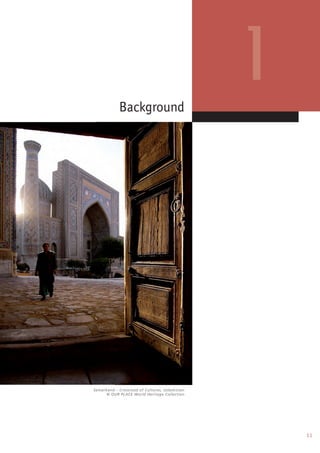
Background
Samarkand – Crossroad of Cultures, Uzbekistan
© OUR PLACE World Heritage Collection
12
Understanding World Heritage in Asia and the Pacific
Introduction to cultural and natural heritage in Asia and the Pacific
Asia and the Pacific is a diverse region. It stretches across both
global hemispheres from the southern margins of Siberia to
the sub-Antarctic islands of the Southern Ocean surrounding
the continent of Antarctica, and from western Asia to French
Polynesia in the eastern Pacific Ocean. It encompasses a
vast array of climates, landscapes and ecosystems: from the
deserts of west-central Asia to the tropical rainforests of
South-East Asia, Australia and the western Pacific; from the
world’s highest alpine summits in the Himalayan mountains
to the deepest ocean trenches in the Pacific; and from the
huge continental landmass of Asia, and island continent of
Australia, to the myriad of tiny remote atolls scattered across
the Pacific Ocean, which spans an area of about one third of
the Earth’s surface. Notoriously, the region also contains some
of the most active and unstable parts of the Earth’s crust and
is prone to damaging earthquakes and tsunamis, while the
South-East Asian archipelagos occupy the most active volcanic
region on Earth. Extreme climatic events, including destructive
cyclones and hurricanes, are common, and global sea level rise
is impacting along many thousands of kilometres of low-lying
coastline and on the oceanic islands of the Pacific, many of
which are elevated barely above sea level.
Asia and the Pacific is also a culturally, socially and historically
diverse region. The region was home to some of the major
civilizations in the world from 5000 BC to 1800 BC, various
empires, dynasties and kingdoms. There was a long interaction
of cultures, goods and people between East and West through
the Silk Roads and seaborne trade. Some countries in the
region experienced the history of colonization by European
and American powers, which influenced local cultures
and modes of living, whereas other countries remained
independent. Asia and the Pacific also saw a number of wars
including the Second World War, which left scars and lessons
for future generations. The region encompasses four major
religions – Buddhism, Christianity, Hinduism and Islam – along
with other religions and indigenous belief systems. People in
the region have had different modes of living, from nomadism
to settlement.
Such rich geographical, geological, biological, cultural, social
and historical diversity is reflected in natural and cultural
heritage, captured within the existing World Heritage
network.
Mountainous regions with snow-covered peaks, glaciers, deeply
eroded valleys, rivers and lakes are numerous. Sagarmatha
National Park (Nepal) has the world’s highest mountain, Mount
Everest, just one of more than seven peaks in the park above
7,000 m, and mountains are a central feature of Nanda Devi
and Valley of Flowers National Parks in the high Himalayas
of India, Kinabalu Park (Malaysia) and in several properties
in China, including Huanglong Scenic and Historic Interest
Area, Jiuzhaigou Valley Scenic and Historic Interest Area, and
Three Parallel Rivers of Yunnan Protected Areas. Indonesia’s
Lorentz National Park in Papua incorporates a full transect
from snow-capped peaks to tropical coastline. Volcanoes are
well represented by New Zealand’s Tongariro National Park and
Korea’s Jeju Volcanic Island and Lava Tubes, while Indonesia
has the volcanic islands of Komodo National Park and in Ujung
Kulon National Park there is the volcanic centre of Krakatau,
the site of a catastrophic eruption 1,500 years ago. Spectacular
limestone cave and karst terrain occurs in two Vietnamese
sites – Ha Long Bay and Phong Nha-Ke Bang National Park,
as well as in Guning Mulu National Park (Malaysia), which
12
13
Background
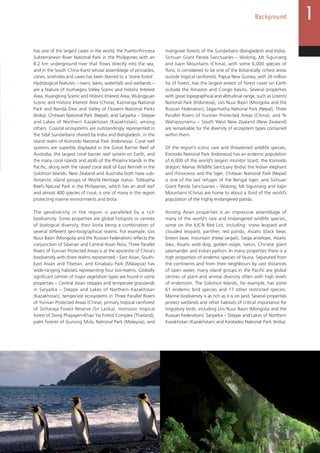
has one of the largest caves in the world, the Puerto-Princesa
Subterranean River National Park in the Philippines with an
8.2 km underground river that flows directly into the sea,
and in the South China Karst whose assemblage of pinnacles,
cones, sinkholes and caves has been likened to a ‘stone forest’.
Hydrological features – rivers, lakes, waterfalls and wetlands –
are a feature of Jiuzhaigou Valley Scenic and Historic Interest
Area, Huanglong Scenic and Historic Interest Area, Wulingyuan
Scenic and Historic Interest Area (China); Kaziranga National
Park and Nanda Devi and Valley of Flowers National Parks
(India); Chitwan National Park (Nepal); and Saryarka – Steppe
and Lakes of Northern Kazakhstan (Kazakhstan), among
others. Coastal ecosystems are outstandingly represented in
the tidal Sundarbans shared by India and Bangladesh, in the
island realm of Komodo National Park (Indonesia). Coral reef
systems are superbly displayed in the Great Barrier Reef of
Australia, the largest coral barrier reef system on Earth, and
the many coral islands and atolls of the Phoenix Islands in the
Pacific, along with the raised coral atoll of East Rennell in the
Solomon Islands. New Zealand and Australia both have sub-
Antarctic island groups of World Heritage status. Tubbatha
Reefs Natural Park in the Philippines, which has an atoll reef
and almost 400 species of coral, is one of many in the region
protecting marine environments and biota.
The geodiversity in the region is paralleled by a rich
biodiversity. Some properties are global hotspots or centres
of biological diversity, their biota being a combination of
several different geo-biographical realms. For example, Uvs
Nuur Basin (Mongolia and the Russian Federation) reflects the
conjunction of Siberian and Central Asian flora, Three Parallel
Rivers of Yunnan Protected Areas is at the epicentre of China’s
biodiversity with three realms represented – East Asian, South-
East Asian and Tibetan, and Kinabalu Park (Malaysia) has
wide-ranging habitats representing four bio-realms. Globally
significant centres of major vegetation types are found in some
properties – Central Asian steppes and temperate grasslands
in Saryarka – Steppe and Lakes of Northern Kazakhstan
(Kazakhstan), temperate ecosystems in Three Parallel Rivers
of Yunnan Protected Areas (China), primary tropical rainforest
of Sinharaja Forest Reserve (Sri Lanka), monsoon tropical
forest of Dong Phayayen-Khao Yai Forest Complex (Thailand),
palm forests of Gunung Mulu National Park (Malaysia), and
mangrove forests of the Sundarbans (Bangladesh and India).
Sichuan Giant Panda Sanctuaries – Wolong, Mt Siguniang
and Jiajin Mountains (China), with some 6,000 species of
flora, is considered to be one of the botanically richest areas
outside tropical rainforests. Papua New Guinea, with 26 million
ha of forest, has the largest extent of forest cover on Earth
outside the Amazon and Congo basins. Several properties
with great topographical and altitudinal range, such as Lorentz
National Park (Indonesia), Uvs Nuur Basin (Mongolia and the
Russian Federation), Sagarmatha National Park (Nepal), Three
Parallel Rivers of Yunnan Protected Areas (China), and Te
Wahipounamu – South West New Zealand (New Zealand)
are remarkable for the diversity of ecosystem types contained
within them.
Of the region’s iconic rare and threatened wildlife species,
Komodo National Park (Indonesia) has an endemic population
of 6,000 of the world’s largest monitor lizard, the Komodo
dragon; Manas Wildlife Sanctuary (India) the Indian elephant
and rhinoceros and the tiger; Chitwan National Park (Nepal)
is one of the last refuges of the Bengal tiger; and Sichuan
Giant Panda Sanctuaries – Wolong, Mt Siguniang and Jiajin
Mountains (China) are home to about a third of the world’s
population of the highly endangered panda.
Among Asian properties is an impressive assemblage of
many of the world’s rare and endangered wildlife species,
some on the IUCN Red List, including: snow leopard and
clouded leopard, panther, red panda, Asiatic black bear,
brown bear, mountain sheep (argali), Saiga antelope, Asiatic
ibex, Asiatic wild dog, golden eagle, taikin, Chinese giant
salamander and Indian python. In many properties there is a
high proportion of endemic species of fauna. Separated from
the continents and from their neighbours by vast distances
of open water, many island groups in the Pacific are global
centres of plant and animal diversity often with high levels
of endemism. The Solomon Islands, for example, has some
61 endemic bird species and 17 other restricted species.
Marine biodiversity is as rich as it is on land. Several properties
protect wetlands and other habitats of critical importance for
migratory birds, including Uvs Nuur Basin (Mongolia and the
Russian Federation), Saryarka – Steppe and Lakes of Northern
Kazakhstan (Kazakhstan) and Keoladeo National Park (India).
14
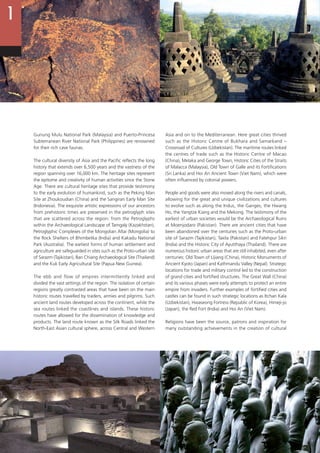
Gunung Mulu National Park (Malaysia) and Puerto-Princesa
Subterranean River National Park (Philippines) are renowned
for their rich cave faunas.
The cultural diversity of Asia and the Pacific reflects the long
history that extends over 6,500 years and the vastness of the
region spanning over 16,000 km. The heritage sites represent
the epitome and creativity of human activities since the Stone
Age. There are cultural heritage sites that provide testimony
to the early evolution of humankind, such as the Peking Man
Site at Zhoukoudian (China) and the Sangiran Early Man Site
(Indonesia). The exquisite artistic expressions of our ancestors
from prehistoric times are preserved in the petroglyph sites
that are scattered across the region: from the Petroglyphs
within the Archaeological Landscape of Tamgaly (Kazakhstan),
Petroglyphic Complexes of the Mongolian Altai (Mongolia) to
the Rock Shelters of Bhimbetka (India) and Kakadu National
Park (Australia). The earliest forms of human settlement and
agriculture are safeguarded in sites such as the Proto-urban site
of Sarazm (Tajikistan), Ban Chiang Archaeological Site (Thailand)
and the Kuk Early Agricultural Site (Papua New Guinea).
The ebb and flow of empires intermittently linked and
divided the vast settings of the region. The isolation of certain
regions greatly contrasted areas that have been on the main
historic routes travelled by traders, armies and pilgrims. Such
ancient land routes developed across the continent, while the
sea routes linked the coastlines and islands. These historic
routes have allowed for the dissemination of knowledge and
products. The land route known as the Silk Roads linked the
North-East Asian cultural sphere, across Central and Western
Asia and on to the Mediterranean. Here great cities thrived
such as the Historic Centre of Bukhara and Samarkand –
Crossroad of Cultures (Uzbekistan). The maritime routes linked
the centres of trade such as the Historic Centre of Macao
(China), Melaka and George Town, Historic Cities of the Straits
of Malacca (Malaysia), Old Town of Galle and its Fortifications
(Sri Lanka) and Hoi An Ancient Town (Viet Nam), which were
often influenced by colonial powers.
People and goods were also moved along the rivers and canals,
allowing for the great and unique civilizations and cultures
to evolve such as along the Indus, the Ganges, the Hwang
Ho, the Yangtze Kiang and the Mekong. The testimony of the
earliest of urban societies would be the Archaeological Ruins
at Moenjodaro (Pakistan). There are ancient cities that have
been abandoned over the centuries such as the Proto-urban
site of Sarazm (Tajikistan), Taxila (Pakistan) and Fatehpur Sikri
(India) and the Historic City of Ayutthaya (Thailand). There are
numerous historic urban areas that are still inhabited, even after
centuries: Old Town of Lijiang (China), Historic Monuments of
Ancient Kyoto (Japan) and Kathmandu Valley (Nepal). Strategic
locations for trade and military control led to the construction
of grand cities and fortified structures. The Great Wall (China)
and its various phases were early attempts to protect an entire
empire from invaders. Further examples of fortified cities and
castles can be found in such strategic locations as Itchan Kala
(Uzbekistan), Hwaseong Fortress (Republic of Korea), Himeji-jo
(Japan), the Red Fort (India) and Hoi An (Viet Nam).
Religions have been the source, patrons and inspiration for
many outstanding achievements in the creation of cultural
15
heritage. Religions and philosophies originated in Asia and
the Pacific such as Buddhism, Hinduism, Confucianism, Taoism
and Shinto and Zoroastrianism, and Islam and Christianity
that originally came from other regions have equally provided
their great contributions to the life and culture of the region.
The history of the establishment and spread of Buddhism is
reflected in temples, shrines, places of pilgrimage, grottoes
and archaeological sites such as Lumbini, the Birthplace of
the Lord Buddha (Nepal), Buddhist Monuments at Sanchi
(India), Cultural Landscape and Archaeological Remains of
the Bamiyan Valley (Afghanistan), Longmen Grottoes (China),
Buddhist Monuments in the Horyu-ji Area (Japan), Angkor
(Cambodia) and Borobudur Temple Compounds (Indonesia).
Exquisite examples of Hindu temples and shrines can be found
in India such as the Khajuraho Group of Monuments, Great
Living Chola Temples and Sun Temple, Konârak (India), and as
far away as the Prambanan Temple Compounds (Indonesia).
Islamic influence on architecture can be found in some of the
most superb architectural achievements such as Samarkand
– Crossroad of Cultures (Uzbekistan), Mausoleum of Khoja
Ahmed Yasawi (Kazakhstan), Soltaniyeh (Islamic Republic of
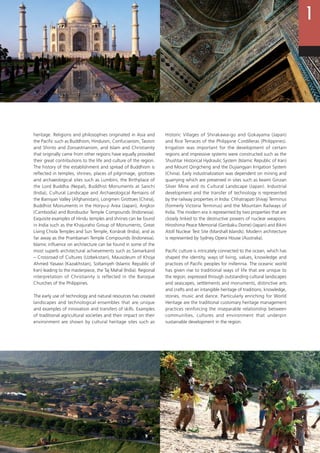
Iran) leading to the masterpiece, the Taj Mahal (India). Regional
interpretation of Christianity is reflected in the Baroque
Churches of the Philippines.
The early use of technology and natural resources has created
landscapes and technological ensembles that are unique
and examples of innovation and transfers of skills. Examples
of traditional agricultural societies and their impact on their
environment are shown by cultural heritage sites such as
Historic Villages of Shirakawa-go and Gokayama (Japan)
and Rice Terraces of the Philippine Cordilleras (Philippines).
Irrigation was important for the development of certain
regions and impressive systems were constructed such as the
Shushtar Historical Hydraulic System (Islamic Republic of Iran)
and Mount Qingcheng and the Dujiangyan Irrigation System
(China). Early industrialization was dependent on mining and
quarrying which are preserved in sites such as Iwami Ginzan
Silver Mine and its Cultural Landscape (Japan). Industrial
development and the transfer of technology is represented
by the railway properties in India: Chhatrapati Shivaji Terminus
(formerly Victoria Terminus) and the Mountain Railways of
India. The modern era is represented by two properties that are
closely linked to the destructive powers of nuclear weapons:
Hiroshima Peace Memorial (Genbaku Dome) (Japan) and Bikini
Atoll Nuclear Test Site (Marshall Islands). Modern architecture
is represented by Sydney Opera House (Australia).
Pacific culture is intricately connected to the ocean, which has
shaped the identity, ways of living, values, knowledge and
practices of Pacific peoples for millennia. The oceanic world
has given rise to traditional ways of life that are unique to
the region, expressed through outstanding cultural landscapes
and seascapes, settlements and monuments, distinctive arts
and crafts and an intangible heritage of traditions, knowledge,
stories, music and dance. Particularly enriching for World
Heritage are the traditional customary heritage management
practices reinforcing the inseparable relationship between
communities, cultures and environment that underpin
sustainable development in the region.
Longitude East
MeridianofGreenwich
EQUATOR
TROPIC OF CANCER
TROPIC OF CAPRICORN
ARCTIC CIRCLE
0° 30° 60° 90° 120° 150°
0°
30°N
30°S
60°
60°
W
Y
4
3 2
3
1
4
2 4
3
1
4
3
2
1
6
6
7
2
3
2
1
1
1
3
8
76
5
3
21
1
4
2
1
1
7
6
5
32
1
5
3
8
2
7
10
9
8
6
5
4
2 1
5
3
2
6
5
4
3
2
1
1
3
21 4
2
1
4
1
1
2
4
2
1
2
5
4
32 1
2
2
1
3
4
2
3
1
9
8
14
7
6
52 1
7
6
5
4
3
2
1
8
9
10
12
13
11
3
5
3
41
6
5
4
2
1
21
7
9
6
5
8
4
3
2
6
5
4
3
2
2
1
1
6
5
4
3
2
1
1
1
1
2
1
1
2
1
12
7
6
5 4
3
1
2
1
12
16
11
10
26
25
24
23
22
22
21
20
28
27
19
16
15
14
13
12
11
10
31
36
34
35
30
28
27
2640
41
25
37
2432
33
23
39
2120
19
18
17
1514
13
12
11
16
4
2
7
1
38
7
4
3
1
2
22
16
1
8
1
5
4
3
2
1
1
1
5
26
7
5
5
4
3
1
2
1
5
3
4
8
7
6
1
1
2
1
3
32
9
4
1
2
3
1
3
1
2
1
12
1
2
1
4
3
7
6
1
1
3
2
9
7
7
9
8
1
1
3
9
8
1
31
6
5
2
16
12
11
10
21
13
15
18
17
29
10
15
19
14 17
18
13
12
11
11
10
3
3
2
4
1 2
C O C E A N
I N D I A N
O C E A N
P A C I F I C
O C E A N
R U S S I A N F E D E R A T I O N
C H I N A
I N D I A
IRAN (ISLAMIC
REPUBLIC OF)
S U D A N
A L G E R I A
L I B YA
K A Z A K H S T A N
I
A U S T R A L I A
C H A D
N I G E R
M O N G O L I A
A N G O L A
SAUDI
ARABIA
ETHIOPIANIGERIA
SOUTH
AFRICA
NAMIBIA
PAKISTAN
Z A M B I A
UNITED REP.
OF TANZANIA
KENYA
MYANMAR
DEMOCRATIC
REPUBLIC
OF THE CONGO
THAILAND
AFGHANISTAN
I N D O N E S I A
MADAGASCAR
JAPAN
VIET
NAM
PA P U A N E W G U I N E A
M A L A Y S I A
ZEALAND
NEW
PHILIPPINES
SRI
LANKA
FIJI
VANUATU
SOLOMON
ISLANDS
MARSHALL
ISLANDS
MALDIVES
YEMEN
BOTSWANA
OMAN
CAMEROON
LAO P.D.R.
UZBEKISTAN
TURKMENISTAN
ZIMBABWE
NEPAL
UGANDA
CENTRAL
AFRICAN REPUBLIC
TUNISIA
BENIN
A FASO
KYRGYZSTAN
ERITREA
CAMBODIA
TAJIKISTAN
MALAWI
BANGLADESH
TOGO
AZERBAIJAN
BHUTAN
REPUBLIC
OF KOREA
UNITED
ARAB
EMIRATES
LESOTHO
SWAZILAND
DEMOCRATIC PEOPLE'S
REPUBLIC OF KOREA
RWANDA
BURUNDI
KUWAIT
QATAR
DJIBOUTI
EGYPT
IRAQ
MAURITIUS
COMOROS
BAHRAIN
PALAU
MICRONESIA
(FEDERATED STATES OF)
MOZA
M
B
IQ
U
E
ANA
GABON
CONGO
KIRIBATI
S
E
Y
C
H
E L L E S
SAO TOME
AND PRINCIPE
EQUATORIAL
GUINEA
(Yemen)
(Australia)
(Australia)
(Australia)
(New Zealand)
(Philippines)
(France)
(France)
Area enlarged
at top right
A F R I C A
A U S T R A L I A
A S I A
E U R O P E
9
8
5
4
27
9
40
8
3
2
2
1
4
2
1
9
8
6
5
4
3
21
9 8
7
6
5
4
3
2
1
4
3
2
1 5
3
4
2
1
1
7
6
5
4
3
3
8
7
6
5
43
2
9 11
8
7
6
5
4
3 21
5
4
3
2
1
5
3
1
3 2
1
2
1
1
9
8
7
6
5
42
1
2
1
1
2
6
5
4
2
1
9
7
6
3
2
1
9
8
6
5
4
3
2
9
833
7
6
5
4
3
2
1
5
4
3
2
1
1
3
21
8
7 6
5
2
5
4
2
1
9
6
5
4 2
11
8
7
4 2
2
1
76
5
2
1
2
1
17
24
23
22
21
19
17
16
14
13
1210
12
11
10
37
36
35
38
33
32
3128
27
26
25
24
23
22
20
19
18
17
16X
15
14 12 11
41
10
11
10
10
39
37
38
40
36U
35
34
33
31
30
29
43
1
28
27
26
25
24
23
22
21
20
41
19
18
17
16
15
14
13
12
11
10
1615
14
1312
11
810
28
29
27
26
31
25
24
23
22
19
30
17
15
14
13
12
11
10
28
27
26
2529
34
30
24
23
22
21 20
19
18
17
16
15
13
12
11
6
10
1211
7
7
5
4
29
1
42
7
5
1
2
1
6
3
8
7
20
26
21 32
16
14
6
3
2
2
7
6
28
1
3
3 1
7
1
9
4
3
1
6
7
3
10
6
53
1
43
1
25
34
21 20
18
10
1
1
5
2
15
7
6
20
8
318
4
1 14
13 3
2
1
32
1
8
1
4
2
4
5
3
6
7
9
32
1
4
6
3
2
1
5
5
4
3 2
1
3
2
1
4
3
2
6
1
1
5
17
V
D
D
D
D
D
D
D
D
D
D
D
D
D
DDD
DD
D
D
D
D
D
D
D
D
D
D
D
D
DD
D
D
EN
P
O
B
QF
Q
C
T
S
L
R
K
U K R A I N E
T U R K E Y
SYRIAN
ARAB
REPUBLIC
FRANCE
ITALY
SWEDEN
SPAIN
POLAND
FINLAND
GERMANY
NORWAY
BELARUS
ROMANIA
REPUBLIC OF
MOLDOVA
GEORGIA
ARMENIA
CYPRUS
LEBANON
ISRAEL
JORDAN
BULGARIA
AUSTRIA
LATVIA
HUNGARY
IRELAND
ICELAND
LITHUANIA
CROATIA
ESTONIA
REPUBLIC
CZECH
UNITED
KINGDOM
G R E E C E
SLOVAKIA
PORTUGAL
ALBANIA
SERBIA
BELGIUM
SWITZ.
NETHERLANDS
DENMARK
SLOVENIA
F.Y.R.O.M.
BOSNIA

HERZEGOVINA
LUXEMBOURG
ANDORRA
MONACO
SAN
MARINO
HOLY SEE
MALTA
RUSSIAN
FEDERATION
MONTENEGRO(France)
(Italy)
(Spain)
(Italy)
laceWorldHeritageCollection
stienCailleux/Corbis
CO/AlexandrazuSayn-Wittgenstein
olloway
CO/RonVanOers
© 2011 UNESCO Printed October 2011
The World Heritage Sustainable Tourism
Programme helps visitors discover World
Heritage sites while encouraging respect of
the environment and local cultures and
enhancing community livelihoods.
rom the vast plains of the Serengeti to historic cities such
as Vienna, Lima and Kyoto; from the prehistoric rock art
on the Iberian Peninsula to the Statue of Liberty; from the
Kasbah of Algiers to the Imperial Palace in Beijing — all
of these places, as varied as they are, have one thing in common.
All are World Heritage sites of outstanding cultural or natural
value to humanity and are worthy of protection for future
generations to know and enjoy.
The Small Islands Programme focuses on
preserving heritage on the islands of the
Caribbean Sea and the Atlantic, Pacific
and Indian oceans.
Key
Number indicates site order by year of inscription
within each country.
See country index on back side of map for site listings.
Only States Parties to the World Heritage Convention
are labeled on this map.
United Nations (UN) country boundaries shown
as of October 2011
http://whc.unesco.org
http://www.nationalgeographic.com
Cultural property
Natural property
Mixed property (cultural and natural)
Transnational property
Property currently inscribed on the
List of World Heritage in Danger
A
1
1
1
1
The designations employed and the presentation
of material on this map do not imply the expres-
sion of any opinion whatsoever on the part of
UNESCO and National Geographic Society con-
cerning the legal status of any country, territory,
city or area or of its authorities, or concerning
the delimitation of its frontiers or boundaries.
Dotted line represents approximately the Line of
Control in Jammu and Kashmir agreed upon by
India and Pakistan. The final status of Jammu
and Kashmir has not yet been agreed upon by
the parties.
Final boundary between the Republic of Sudan
and the Republic of South Sudan has not yet
been determined.
A unique kind of medina (Islamic city), the Kasbah of Algiers stands
in one of the finest coastal sites on the Mediterranean. It has been
inhabited from at least the 6th century BC when a Phoenician trading
post was established. Several styles of traditional houses, palaces, ham-
mams, mosques and souks have been preserved.
The reduced scale of the maps and the cartographic
projections have resulted in approximate locations
of some properties.
Land cover data:
Tom Patterson, US National Park Service
Text: Shelley Sperry
Design and production by National Geographic Maps
Albers Conic Equal-Area Projection
0 mi 400
0 km 400
Robinson Projection
SCALE 1:43,720,000
0 mi 1000
0 km 1000
TROPIC OF CANCER
TROPIC OF CAPRICORN
ARCTIC CIRCLE
Longitude West
MeridianofGreenwich
ANTARCTIC CIRCLE
EQUATOR
0°
0°30°60°90°120°150°
30°N
30°S
60°
G
H
I
J
A
M
3
1
1
9
5
1
1
2
4
11
1
1
1
1
9
7
5
3
1
1
3
1
2
1 4
8
7
6
5
4
3
2
1
9
87
7
6
5
4
3
2
2
4
2
15
1
1
3
2
2
21
1
1
4
2
1
8
9
6
5
3
2
1
5
4
6
3
1
4
3
5
2
1
8
5
4
1
8
7
6
4
3
17
2
1
5
4
3
2
1
1
7
6
4
7
6
5 4
3
1
17
15
12
14
12
11
18
30
39
12
10
11
24
27
2328
29
22
21
20 19
18
17
26
16 15
14
13
1230
31
10
10
16
11
8
2
3
1
4
3
4
2
2
8
7
6
3
2
1
2
1
6
4
2
2
1
1
31
1
4
1
7
4
2
1
2
9
7
6
3
2
9
5
6
1
5
3
2
1
18
16
13
10
15
11
13
19
9
2511
11
13
15
14
13
12
10
2
19
1
A T L A N T I C
O C E A N
A R C T I C O C
P A C I F I C
O C E A N
B R A Z I L
C A N A D A
A L G E R I A
ARGENTINA
M A L I
MEXICO
P E R U
BOLIVIA
U N I T E D S T A T E S
O F A M E R I C A
CHILE
NI
COLOMBIA
MAURITANIA
VENEZUELA
MOROCCO
PARAGUAY
ECUADOR
GUYANA
CUBA
HONDURAS
NICARAGUA
HAITI
COSTA
RICA
URUGUAY
SENEGAL
COTE
D'IVOIRE
BENIN
BURKINA FASO
SURINAME
TOGO
GUATEMALA
PANAMA
BELIZE
DOMINICAN
REPUBLIC
EL SALVADOR
JAMAICA
TRINIDAD AND TOBAGO
CAPE VERDE
DOMINICA
BARBADOS
GRENADA
SAINT LUCIA
ST KITTS AND NEVIS
ANTIGUA
AND BARBUDA
ST VINCENT AND
THE GRENADINES
GHANA
GUINEA
SIERRA
LEONE
GAMBIA
GUINEA-
BISSAU
LIBERIA
ˆ
SAMOA
KIRIBATI
NIUE
TONGA
SAO TOM
AND PRINCIP
EQUATORIA
GUINE
COOK ISLANDS
(USA)
(Denmark)
GREENLAND
(UK)
(UK)
(Ecuador)
(Costa Rica)
(Colombia)
(Chile)
(USA)
(Netherlands
Antilles)
(UK)
(Portugal)
(Spain)
(Portugal)
(Brazil)
(Russian
Federation)
Area enlarged
at top right
N O R T H
A M E R I C A
S O U T H
A M E R I C A
OurPlaceWorldHeritageCollection
N.S.Dept.ofTourism,CultureandHeritage/WalleyHayes
OurPlaceWorldHeritageCollection
MeindertVanDijk
Worldwide, 104 World Heritage forests
protect more than 76 million hectares
of woodland. This accounts for 1.9
percent of the global forest cover and
about 13 percent of the surface area of
all protected forests on the planet.
World Heritage sites are inscribed on the
List on the basis of their merits as forming
a significant contribution to the cultural
and natural heritage of the world. Their
outstanding universal value is considered
to go beyond national boundaries and to
be of importance for future generations.
Conserving the diversity of life on Earth is
critical to global human welfare. With the
support of the World Heritage Convention,
the most important biodiversity sites
receive international recognition as well as
technical and financial assistance to deal
with threats such as agricultural encroach-
ment, alien species and poaching.
The Earthen Architecture Conservation
Programme works toward conserving and
revitalizing earthen architecture, which is
threatened by natural disasters and indus-
trialization. Currently, some one hundred
properties on the World Heritage List are
partially or totally built with earth.
The World Heritage Marine Programme
helps countries nominate marine sites and
manage them effectively to ensure that they
will thrive for future generations. There
are currently 45 marine sites on the World
Heritage List.
Cultural heritage refers to monuments,
buildings and sites with historical, aesthetic,
archaeological, scientific, ethnological or
anthropological value. Natural heritage
refers to outstanding physical, biological or
geological features and includes habitats of
threatened species, as well as areas with
scientific, environmental or aesthetic
value. Mixed sites have both cultural
and natural values.
The World Heritage emblem symbolizes
the interdependence of the world’s natural
and cultural diversity. The central square
represents the achievements of human skill
and inspiration, and the circle celebrates
the gifts of nature. The emblem is round,
like the world, a symbol of global protec-
tion for the heritage of all humankind.
The World Heritage Cities Programme seeks
to protect living historic city centres
and their cultural and architectural her-
itage from threats such as uncontrolled
development or inappropriate construction.
EXTRACTS
… parts of the cultural or natural heritage are of out-
standing interest and therefore need to be preserved as
part of the world heritage of humankind as a whole.
… [with] the magnitude and gravity of the new dan-
gers threatening… [the world’s heritage], it is incum-
bent on the international community as a whole to
participate in the protection of the cultural and natural
heritage of outstanding universal value…
An Intergovernmental Committee for the Protection
of the Cultural and Natural Heritage of Outstanding
Universal Value, called “the World Heritage
Committee”, is… established within UNESCO.
... the Committee shall establish… under the title
of “World Heritage List”, a list of the properties
forming part of the cultural heritage and natural
heritage... which it considers as having outstanding
universal value...
Convention concerning the Protection of the World Cultural and Natural Heritage, adopted by the
United Nations Educational, Scientific and Cultural Organization, at its General Conference, Paris, 16 November 1972.
Ecuador’s Sangay National Park, mainly uninhabited, encompasses glacial mountain peaks, low-lying
rainforests, and more than 300 lakes. The park’s rugged terrain, located near the meeting point of two
tectonic plates, includes two 5,000-meter active volcanoes.
Since the 17th century, the Dutch have depended on state-of-the-art engineering to
reclaim their land from the sea. The world’s largest steam-powered pumping station is the
Woudagemaal, built in 1920 and still able to drain 4 million litres of water per minute.
Each gateway to Madagascar’
once sealed with a massive c
the hill. The site’s royal city, its
and several sacred places sti
Powerful tides in Canada’s Bay of Fundy wash away layers of rock at
Joggins Fossil Cliffs to reveal a geological record more than 300 mil-
lion years old. The Coal Age rainforest supported some 200 species
here, including the world’s first reptiles.
The fortress town of Cartagena was founded in 1533 on the coast of
Colombia. Magnificent colonial stone churches, palaces and gardens
still testify to the wealth that flowed through the port in the form of
silver, gold and slaves.
The OUR PLACE World Heritage pho-
tobank is developed in partnership
with the UNESCO World Heritage
Centre. The OUR PLACE team
has now photographed more
than 350 World Heritage
sites in over 85 countries.
Visit: www.ourplace
worldheritage.com
Title photo: Committee for External Relations of
Saint-Petersburg
Saint Petersburg was the vision of Russian Tsar Peter the Great, who
began building his new capital along the Neva River in 1703.
Recruiting Europe’s greatest architects and an army of forced labor,
Peter erected a carefully planned city of ornate palaces, parks,
and monumental squares in just two decades. Today some
400 bridges cross its network of shimmering canals.
Commission of the
Russian Federation
for UNESCO
United Nations
Educational, Scientific and
Cultural Organization
16
Understanding World Heritage in Asia and the Pacific
World Heritage Convention in Asia and the Pacific
States Parties
The Convention Concerning the Protection of the World
Cultural and Natural Heritage (World Heritage Convention),
adopted in 1972, aims at the identification, protection,
conservation, presentation and transmission to future
generations of cultural and natural heritage of Outstanding
Universal Value. As of July 2012, there are 190 States Parties
to the World Heritage Convention, 43 of which are in Asia and
the Pacific (Table 1).
Table 1. Number of States Parties and properties by region/subregion as of July 2012
ASIA 29 States Parties
West and Central
7 States Parties
Afghanistan (2), Iran, Islamic Republic of (15), Kazakhstan (3), Kyrgyzstan (1), Tajikistan (1), Turkmenistan (3),
Uzbekistan (4)
South
7 States Parties
Bangladesh (3), Bhutan (0), India (29), Maldives (0), Nepal (4), Pakistan (6), Sri Lanka (8)
North-East
5 States Parties
China (43), Japan (16), Korea, Democratic People’s Republic of (1), Korea, Republic of (10), Mongolia (3)
South-East
10 States Parties
Brunei Darussalam (0), Cambodia (2), Indonesia (8), Lao People’s Democratic Republic (2), Malaysia (4),
Myanmar (0), Philippines (5), Singapore (0), Thailand (5), Viet Nam (7)
PACIFIC 14 States Parties
Australia (19), New Zealand (3)
Pacific Island States
12 States Parties
Cook Islands (0), Fiji (0), Kiribati (1), Marshall Islands (1), Micronesia, Federated States of (0), Niue (0), Palau (1),
Papua New Guinea (1), Samoa (0), Solomon Islands (1), Tonga (0), Vanuatu (1)
World Heritage Map. © UNESCO
() Number of World Heritage properties.
17
Background
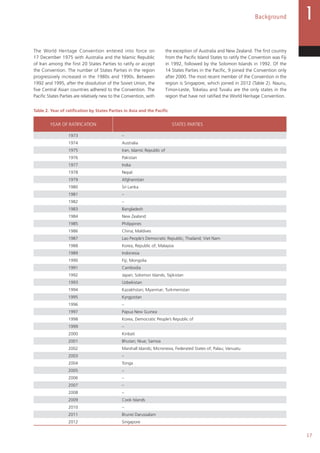
The World Heritage Convention entered into force on
17 December 1975 with Australia and the Islamic Republic
of Iran among the first 20 States Parties to ratify or accept
the Convention. The number of States Parties in the region
progressively increased in the 1980s and 1990s. Between
1992 and 1995, after the dissolution of the Soviet Union, the
five Central Asian countries adhered to the Convention. The
Pacific States Parties are relatively new to the Convention, with
the exception of Australia and New Zealand. The first country
from the Pacific Island States to ratify the Convention was Fiji
in 1992, followed by the Solomon Islands in 1992. Of the
14 States Parties in the Pacific, 9 joined the Convention only
after 2000. The most recent member of the Convention in the
region is Singapore, which joined in 2012 (Table 2). Nauru,
Timor-Leste, Tokelau and Tuvalu are the only states in the
region that have not ratified the World Heritage Convention.
Table 2. Year of ratification by States Parties in Asia and the Pacific
YEAR OF RATIFICATION STATES PARTIES
1973 –
1974 Australia
1975 Iran, Islamic Republic of
1976 Pakistan
1977 India
1978 Nepal
1979 Afghanistan
1980 Sri Lanka
1981 –
1982 –
1983 Bangladesh
1984 New Zealand
1985 Philippines
1986 China; Maldives
1987 Lao People’s Democratic Republic; Thailand; Viet Nam
1988 Korea, Republic of; Malaysia
1989 Indonesia
1990 Fiji; Mongolia
1991 Cambodia
1992 Japan; Solomon Islands; Tajikistan
1993 Uzbekistan
1994 Kazakhstan; Myanmar; Turkmenistan
1995 Kyrgyzstan
1996 –
1997 Papua New Guinea
1998 Korea, Democratic People’s Republic of
1999 –
2000 Kiribati
2001 Bhutan; Niue; Samoa
2002 Marshall Islands; Micronesia, Federated States of; Palau; Vanuatu
2003 –
2004 Tonga
2005 –
2006 –
2007 –
2008 –
2009 Cook Islands
2010 –
2011 Brunei Darussalam
2012 Singapore
18
Understanding World Heritage in Asia and the Pacific
World Heritage Committee
The World Heritage Committee is responsible for the
implementation of the World Heritage Convention and for
administering the World Heritage Fund. The Committee
consists of 21 States Parties and it meets once a year. The
term of office of Committee members is six years, but in order
to ensure equitable representation and rotation, States Parties
are invited to voluntarily reduce their term of office from six to
four years and not to seek consecutive terms of office. Among
43 States Parties in Asia and the Pacific, 14 have served as a
member of the World Heritage Committee (Table 3). Of these,
Australia, China, India, Japan, Republic of Korea, Pakistan and
Thailand has each served more than 10 years in total, several
of them re-joining the Committee regularly. The States Parties
that have served as Committee members are mostly from
North-East and South-East Asia. Pacific Island States have not
yet been Committee members. The General Assembly at its
13th session in 2001 decided that one seat of the Committee
should be reserved for States Parties with no property on the
World Heritage List (General Assembly Rules of Procedure Rule
14.1 (c)). So far, no such States Parties of Asia and the Pacific
have been elected to this seat.
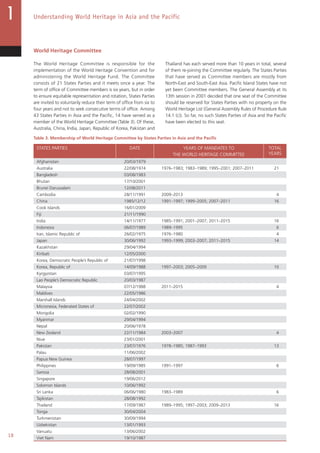
Table 3. Membership of World Heritage Committee by States Parties in Asia and the Pacific
STATES PARTIES DATE YEARS OF MANDATES TO
THE WORLD HERITAGE COMMITTEE
TOTAL
YEARS
Afghanistan 20/03/1979
Australia 22/08/1974 1976–1983; 1983–1989; 1995–2001; 2007–2011 21
Bangladesh 03/08/1983
Bhutan 17/10/2001
Brunei Darussalam 12/08/2011
Cambodia 28/11/1991 2009–2013 4
China 1985/12/12 1991–1997; 1999–2005; 2007–2011 16
Cook Islands 16/01/2009
Fiji 21/11/1990
India 14/11/1977 1985–1991; 2001–2007; 2011–2015 16
Indonesia 06/07/1989 1989–1995 6
Iran, Islamic Republic of 26/02/1975 1976–1980 4
Japan 30/06/1992 1993–1999; 2003–2007; 2011–2015 14
Kazakhstan 29/04/1994
Kiribati 12/05/2000
Korea, Democratic People’s Republic of 21/07/1998
Korea, Republic of 14/09/1988 1997–2003; 2005–2009 10
Kyrgyzstan 03/07/1995
Lao People’s Democratic Republic 20/03/1987
Malaysia 07/12/1988 2011–2015 4
Maldives 22/05/1986
Marshall Islands 24/04/2002
Micronesia, Federated States of 22/07/2002
Mongolia 02/02/1990
Myanmar 29/04/1994
Nepal 20/06/1978
New Zealand 22/11/1984 2003–2007 4
Niue 23/01/2001
Pakistan 23/07/1976 1978–1985; 1987–1993 13
Palau 11/06/2002
Papua New Guinea 28/07/1997
Philippines 19/09/1985 1991–1997 6
Samoa 28/08/2001
Singapore 19/06/2012
Solomon Islands 10/06/1992
Sri Lanka 06/06/1980 1983–1989 6
Tajikistan 28/08/1992
Thailand 17/09/1987 1989–1995; 1997–2003; 2009–2013 16
Tonga 30/04/2004
Turkmenistan 30/09/1994
Uzbekistan 13/01/1993
Vanuatu 13/06/2002
Viet Nam 19/10/1987
19
Background
World Heritage Fund and International Assistance
The World Heritage Fund is a trust fund established by the
Convention, which consists of compulsory and voluntary
contributions made by States Parties and other private
donations. The Fund provides about US$4 million annually
to support activities relating to the implementation of the
Convention. International Assistance is funding provided to
States Parties to help them to protect their cultural and natural
heritage on the World Heritage List or potentially suitable for
inscription. It is primarily sourced from the World Heritage
Fund as a supplement to national efforts when adequate
resources cannot be secured at national level. Priority is given
to the most threatened properties. There are three types of
assistance: emergency, preparatory, and conservation and
management. Emergency assistance is to address threats facing
properties on the World Heritage List which have suffered or
are in imminent danger of severe damage due to sudden,
unexpected phenomena. It can be requested to undertake
emergency measures or to draw up an emergency plan for the
property. Preparatory assistance is for activities relating to the
preparation of Tentative Lists and nominations. Conservation
and management assistance includes assistance for training
and research, technical cooperation, and promotion and
education, and it can be requested, among other reasons, for
training of staff, scientific research and provision of experts.
States Parties in arrears of payment of their contributions to
the World Heritage Fund are not eligible for International
Assistance with the exception of emergency assistance.
In Asia and the Pacific, a total of US$8,780,889 has been
granted to the States Parties as International Assistance since
1979,3 60% of which is for conservation and management.
Emergency assistance constitutes 18% of the total amount
given to the region. Angkor (Cambodia), Manas Wildlife
Sanctuary (India), Bam and its Cultural Landscape (Islamic
Republic of Iran), Fort and Shalamar Gardens in Lahore
(Pakistan), and Rice Terraces of the Philippine Cordilleras
(Philippines) received emergency assistance while inscribed
3 The approval of International Assistance started in 1978 and requests
from Asia and the Pacific were first approved in 1979.
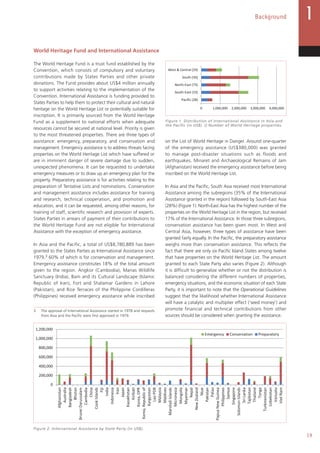
on the List of World Heritage in Danger. Around one-quarter
of the emergency assistance (US$380,000) was granted
to manage post-disaster situations such as floods and
earthquakes. Minaret and Archaeological Remains of Jam
(Afghanistan) received the emergency assistance before being
inscribed on the World Heritage List.
In Asia and the Pacific, South Asia received most International
Assistance among the subregions (35% of the International
Assistance granted in the region) followed by South-East Asia
(28%) (Figure 1). North-East Asia has the highest number of the
properties on the World Heritage List in the region, but received
17% of the International Assistance. In those three subregions,
conservation assistance has been given most. In West and
Central Asia, however, three types of assistance have been
granted fairly equally. In the Pacific, the preparatory assistance
weighs more than conservation assistance. This reflects the
fact that there are only six Pacific Island States among twelve
that have properties on the World Heritage List. The amount
granted to each State Party also varies (Figure 2). Although
it is difficult to generalize whether or not the distribution is
balanced considering the different numbers of properties,
emergency situations, and the economic situation of each State
Party, it is important to note that the Operational Guidelines
suggest that the likelihood whether International Assistance
will have a catalytic and multiplier effect (‘seed money’) and
promote financial and technical contributions from other
sources should be considered when granting the assistance.
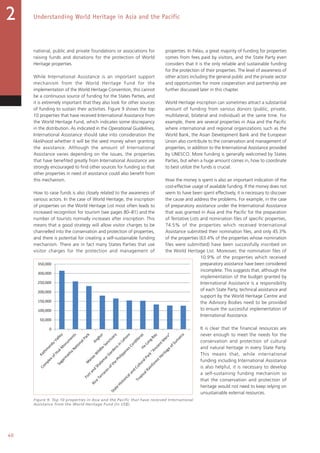
Figure 1. Distribution of International Assistance in Asia and
the Pacific (in US$). () Number of World Heritage properties.
Figure 2. International Assistance by State Party (in US$).
0 1,000,000 2,000,000 3,000,000 4,000,000
Pacific (28)
South-East (33)
North-East (73)
South (50)
West  Central (29)
Preparatory Conservation Emergency
0
200,000
400,000
600,000
800,000
1,000,000
1,200,000
Afghanistan
Australia
Bangladesh
Bhutan
BruneiDarussalam
Cambodia
China
CookIslands
Fiji
India
Indonesia
Iran
Japan
Kazakhstan
Kiribati
Korea,DPR
Korea,Republicof
Kyrgyzstan
LaoPDR
Malaysia
Maldives
MarshallIslands
Micronesia
Mongolia
Myanmar
Nepal
NewZealand
Niue
Pakistan
Palau
PapuaNewGuinea
Philippines
Samoa
Singapore
SolomonIslands
SriLanka
Tajikistan
Thailand
Tonga
Turkmenistan
Uzbekistan
Vanuatu
VietNam
Emergency Conservation Preparatory
20
Understanding World Heritage in Asia and the Pacific
World Heritage properties in Asia and the Pacific
Outstanding Universal Value
The World Heritage Convention aims at the identification,
protection, conservation, presentation and transmission
to future generations of cultural and natural heritage of
Outstanding Universal Value. Outstanding Universal Value
means ‘cultural and/or natural significance which is so
exceptional as to transcend national boundaries and to be of
common importance for present and future generations of all
humanity’ (Operational Guidelines, Paragraph 49). Outstanding
Universal Value is, therefore, the key reference for the effective
protection and management of the World Heritage properties.
Qualifying standards for this are set by a series of ten criteria
covering cultural and natural values (see page 21).
Outstanding Universal Value is expressed in World Heritage
properties through attributes. Attributes can be tangible or
intangible. Attributes that can convey Outstanding Universal
Value include form and design, materials and substance, use
and function, traditions, techniques and management system,
location and setting, language and other forms of intangible
heritage, and spirit and feeling (Operational Guidelines,
Paragraph 82). For natural properties, attributes are sometimes
called ‘features’ which include visual or aesthetic significance,
scale of the extent of physical features or natural habitats,
intactness of physical or ecological processes, naturalness and
intactness of natural systems, viability of populations of rare
species and rarity (Preparing World Heritage Nominations).
To be deemed of Outstanding Universal Value, a property
must also meet the conditions of integrity and/or authenticity
and must have an adequate protection and management
system to ensure its safeguarding (Operational Guidelines,
Paragraph 78).
Integrity is a measure of wholeness and intactness of the
natural and cultural heritage and its attributes. Wholeness
means that the property includes all elements necessary to
express its Outstanding Universal Value, and intactness means
that a property is of adequate size to ensure the complete
representation of the features and processes which convey
the property’s significance. The conditions of integrity are also
examined against the extent to which the property suffers
from adverse effects of development and/or neglect.
Authenticity relates to the ability of the attributes of a property
to express adequately its Outstanding Universal Value truthfully
and credibly. Authenticity is considered only for cultural and
mixed properties. A property is understood to meet the
conditions of authenticity if their cultural values are truthfully
and credibly expressed through a variety of attributes.
World Heritage List
World Heritage Convention
Article 11
2. On the basis of the inventories submitted by States in
accordance with paragraph 1, the Committee shall
establish, keep up to date and publish, under the title of
‘World Heritage List’, a list of properties forming part
of the cultural heritage and natural heritage, as defined
in Articles 1 and 2 of this Convention, which it considers
as having outstanding universal value in terms of such
criteria as it shall have established. An updated list shall
be distributed at least every two years.
The World Heritage List is a list of cultural and natural
properties which the World Heritage Committee considers as
having Outstanding Universal Value. As of 2012, there are 962
listed properties, of which 213 (22.1%) are located in 32 States
Parties in Asia and the Pacific. These 213 properties consist
of 148 cultural (69.5%), 55 natural (25.8%) and 10 mixed
(4.7%) properties. The World Heritage Committee considers a
property as having Outstanding Universal Value if the property
meets one or more of the criteria listed in Paragraph 77 of the
Operational Guidelines. These criteria have been applied as
follows in properties in Asia and the Pacific:
21
Background
Criterion (i) represent a masterpiece of human creative
genius
This criterion has been used for 54 properties out of 148
cultural and 10 mixed properties in the region (34.2%). Sydney
Opera House (Australia), Temple of Preah Vihear (Cambodia)
and Taj Mahal (India) are inscribed under only this criterion.
Criterion (ii) exhibit an important interchange of human
values, over a span of time or within a cultural area of the
world, on developments in architecture or technology,
monumental arts, town-planning or landscape design
This criterion has been used for 87 properties (55.1%). Royal
Exhibition Building and Carlton Gardens (Australia) and
Masjed-e Jāmé of Isfahan (Islamic Republic of Iran) are inscribed
under only this criterion.
Criterion (iii) bear a unique or at least exceptional
testimony to a cultural tradition or to a civilization which is
living or which has disappeared
This criterion has been applied for 104 properties (65.8%),
including 7 properties which are inscribed under only
this criterion – Agra Fort (India), Petroglyphs within the
Archaeological Landscape (Kazakhstan), Gochang, Hwasun
and Ganghwa Dolmen Sites (Republic of Korea), Petroglyphic
Complexes of the Mongolian Altai (Mongolia), Historical
Monuments at Makli, Thatta (Pakistan), Bang Chiang
Archaeological Site (Thailand), and Historic City of Ayutthaya
(Thailand).
Criterion (iv) be an outstanding example of a type of
building, architectural or technological ensemble or landscape
which illustrates (a) significant stage(s) in human history
This criterion has been used for 90 properties (57.0%), including
Historic Mosque City of Bagerhat (Bangladesh), Qutb Minar
and its Monuments, Delhi (India), Jongmyo Shrine (Republic of
Korea), Buddhist Ruins of Takht-i-Bahi and Neighbouring City
Remains at Sahr-i-Bahlol (Pakistan), Old Town of Galle and its
Fortifications (Sri Lanka) and Complex of Hué Monuments (Viet
Nam) which are inscribed under only this criterion.
Criterion (v) be an outstanding example of a traditional
human settlement, land-use, or sea-use which is representative
of a culture (or cultures), or human interaction with the
environment especially when it has become vulnerable under
the impact of irreversible change
This criterion has been used for 22 properties (13.9%) such
as Rice Terraces of the Philippines Cordilleras (Philippines) and
Chief Roi Mata’s Domain (Vanuatu). There are no properties in
the region which are inscribed under only this criterion.
Criterion (vi) be directly or tangibly associated with events
or living traditions, with ideas, or with beliefs, with artistic
and literary works of outstanding universal significance. (The
Committee considers that this criterion should preferably be
used in conjunction with other criteria)
This criterion has been applied for 66 properties (41.8%). The
only property that is inscribed under only this criterion in the
region is Hiroshima Peace Memorial (Genbaku Dome) (Japan).
Out of 10 mixed properties, 7 use this criterion.
Criterion (vii) contain superlative natural phenomena or
areas of exceptional natural beauty and aesthetic importance
This criterion has been used for 39 properties out of 55 natural
and 10 mixed properties in the region (60.0%). There are 5
properties inscribed under only this criterion – Huanglong
Scenic and Historic Interest Area (China), Jiuzhaigou Valley
Scenic and Historic Interest Area (China), Mount Sanqingshan
National Park (China), Wulingyuan Scenic and Historic Interest
Area (China) and Sagarmatha National Park (Nepal). Out of 10
properties, 7 use this criterion.
Criterion (viii) be outstanding examples representing
major stages of Earth’s history, including the record of life,
significant on-going geological processes in the development of
landforms, or significant geomorphic or physiographic features
This criterion has been applied for 23 properties (35.4%),
including Chengjiang Fossil Site (China) and Phong Nha-Ke
Bang National Park (Viet Nam) which are inscribed under only
this criterion.
Criterion (ix) be outstanding examples representing
significant on-going ecological and biological processes in the
evolution and development of terrestrial, fresh water, coastal
and marine ecosystems and communities of plants and animals
This criterion has been used for 36 properties (55.4%),
including Ogasawara Islands (Japan), Shirakami-Sanchi (Japan),
and East Rennell (Solomon Islands), which are inscribed under
only this criterion.
Criterion (x) contain the most important and significant
natural habitats for in-situ conservation of biological diversity,
including those containing threatened species of outstanding
universal value from the point of view of science or conservation
This criterion has been applied for 40 properties (61.5%),
including 3 properties inscribed under only this criterion, which
are Sichuan Giant Panda Sanctuaries – Wolong, Mt Siguniang
and Jiajin Mountains (China), Keoladeo National Park (India), and
Dong Phayayen-Khao Yai Forest Complex (Thailand).
22
Understanding World Heritage in Asia and the Pacific
List of World Heritage in Danger
World Heritage Convention
Article 11
4. The Committee shall establish, keep up to date and
publish, whenever circumstances shall so require, under
the title of ‘List of World Heritage in Danger’, a list
of the property appearing in the World Heritage List
for the conservation of which major operations are
necessary and for which assistance has been requested
under this Convention. … The list may include only
such property forming part of the cultural and natural
heritage as is threatened by serious and specific
dangers, such as the threat of disappearance caused by
accelerated deterioration, large-scale public or private
projects or rapid urban or tourist development projects;
destruction caused by changes in the use or ownership
of the land; major alterations due to unknown
causes; abandonment for any reason whatsoever; the
outbreak or the threat of an armed conflict; calamities
and cataclysms; serious fires, earthquakes, landslides;
volcanic eruptions; changes in water level, floods and
tidal waves. …
The List of World Heritage in Danger is a list of properties
that are on the World Heritage List, which are threatened
by serious and specific danger. Serious and specific dangers
would include threat of disappearance caused by accelerated
deterioration, large-scale public or private projects or rapid
urban or tourist development projects, destruction or major
alterations, abandonment, outbreak of an armed conflict,
and various disasters such as earthquakes, landslides and
volcanic eruptions. As of July 2012, there are four properties
in Asia and the Pacific inscribed on the List of World Heritage
in Danger – Minaret and Archaeological Remains of Jam
(Afghanistan), Cultural Landscape and Archaeological Remains
of the Bamiyan Valley (Afghanistan), Tropical Rain Forest
Heritage of Sumatra (Indonesia), and Bam and its Cultural
Landscape (Islamic Republic of Iran). Threats for which these
properties were inscribed on the List of World Heritage in
Danger are tourism, unfavourable human activities (civil unrest,
looting, illegal excavation), severe damage caused by natural
disasters (earthquake), and developmental pressures. Lack
of a management plan/system is also commonly identified
as a factor affecting these properties. During the 40 years
of history of the World Heritage Convention, 10 properties
in Asia and the Pacific were inscribed on the List of World
Heritage in Danger including four properties that are currently
on the List. Angkor (Cambodia) was inscribed on the List of
World Heritage in Danger at the same time as inscription
on the World Heritage List because of its political situation
at that time impacting the management and protection of
the property, as well as some urgent conservation problems
including establishment of monitoring and coordination of
international conservation efforts. It was removed from the
List of World Heritage in Danger 12 years later in 2004. Group
of Monuments at Hampi (India) was inscribed on the List of
World Heritage in Danger from 1999 to 2006 in relation to the
partial construction of two cable-suspended bridges within the
protected archaeological areas which impacted the integrity
and authenticity of the property, Manas Wildlife Sanctuary
(India) for 19 years in relation to encroachment by militants
that had caused considerable damage to the property, and
the Kathmandu Valley (Nepal) for five years in relation to the
loss of traditional elements of heritage as well as uncontrolled
development that affected the integrity and authenticity of
the property. Fort and Shalamar Gardens in Lahore (Pakistan)
was inscribed on the List of World Heritage in Danger in 2000
due to the damage to the external walls and demolition of
hydraulic works of the Shalamar Gardens and the serious
degradation of the historic monuments and garden complex,
while the Rice Terraces of the Philippine Cordilleras (Philippines)
was inscribed in 2001 for the abandonment of the terraces,
unregulated development, unaddressed tourism needs, and
lack of an effective management system. Both properties were
removed from the List of World Heritage in Danger in 2012.
When a property is inscribed on the List of World Heritage
in Danger, the World Heritage Committee develops, as far
as possible in consultation with the State Party concerned,
a programme of corrective measures and the state of
conservation of those properties are annually reviewed by the
Committee. The Committee also allocates a significant portion
of the World Heritage Fund to assistance for World Heritage
properties on the List of World Heritage in Danger, and priority
is given to these properties when examining International
Assistance requests.
23
Background
Reactive Monitoring on the state of conservation of World Heritage properties
Operational Guidelines
169. Reactive Monitoring is the reporting by the
Secretariat, other sectors of UNESCO and the
Advisory Bodies to the Committee on the state of
conservation of specific World Heritage properties
that are under threat. …
Reactive Monitoring is a process by which the state of
conservation of properties that are under threat is reported
to the World Heritage Committee. Through this process,
specific reports on the state of conservation of properties are
submitted by States Parties. Each year, the state of conservation
of around 20–30 properties in Asia and the Pacific is examined
by the World Heritage Committee. In 2012, the state of
conservation of 26 properties (11 natural, 14 cultural, 1 mixed)
was discussed. The issue most commonly shared by these
properties is lack or inadequacy of management plans/systems
(58.3%). The second commonly shared issue is infrastructure
development (54.2%) followed by unfavourable activities such
as illegal logging, poaching and encroachment (29.2%). The
trend was similar in 2011, when the state of conservation of
39 properties (13 natural and 26 cultural) was discussed. The
factor most commonly shared by these properties was lack or
inadequacy of the management plan/system (61.5%) followed
by infrastructure development (56.4%) and tourism (26%).
There were four properties which were affected by disasters
such as a flood and an earthquake. There are 25 properties
inscribed before 2000, the state of conservation of which was
never discussed by the World Heritage Committee. Some of
the properties were inscribed in the 1970s and early 1980s.
However, 22 properties inscribed between 1979 and 1994 in
Asia and the Pacific all participated in the first cycle of Periodic
Reporting, through which the state of conservation was noted.
All 198 properties inscribed between 1978 and 2010 in Asia
and the Pacific participated in the second cycle of Periodic
Reporting. The second cycle gave 68 properties in the region
the first opportunity to report on their state of conservation.
Further details on the state of conservation of the World
Heritage properties in Asia and the Pacific are given in
Chapter 3.
Reinforced Monitoring Mechanism
The Reinforced Monitoring Mechanism is designed to assist
properties only in exceptional and specific cases where the
Committee fears the loss of Outstanding Universal Value in
the short term. The mechanism can be activated by the World
Heritage Committee or by the Director-General of UNESCO
in the period between two sessions of the Committee if
information is received about critical issues in implementing a
decision of the Committee.
This facility, which was introduced by the World Heritage
Committee at its 31st session in 2007, has been applied to
two properties in Asia and the Pacific – Temple of Preah Vihear
(Cambodia, 2008 – present) and Samarkand – Crossroad of
Cultures (Uzbekistan, 2008). Temple of Preah Vihear was the
first case where the Reinforced Monitoring Mechanism was
applied by the Director-General outside a Committee session.
24
Understanding World Heritage in Asia and the Pacific
Periodic Reporting
World Heritage Convention
Article 29
1. The States Parties to this Convention shall, in the
reports which they submit to the General Conference
of the United Nations Educational, Scientific and
Cultural Organization on dates and in a manner to be
determined by it, give information on the legislative
and administrative provisions which they have adopted
and other action which they have taken for the
application of this Convention, together with details
of the experience acquired in this field.
2. These reports shall be brought to the attention of the
World Heritage Committee.
3. The Committee shall submit a report on its activities at
each of the ordinary sessions of the General Conference
of the United Nations Educational, Scientific and
Cultural Organization.
Periodic Reporting is a process whereby those countries that
have World Heritage properties within their territory assess and
report on the status of protection and management of those
properties to the World Heritage Committee.
The four main purposes of Periodic Reporting as stated in
Paragraph 201 of the Operational Guidelines are:
(a) To provide an assessment of the application of the World
Heritage Convention by the State Party.
(b) To provide an assessment as to whether the Outstanding
Universal Value of the properties inscribed on the World
Heritage List is being maintained over time.
(c) To provide updated information about the World Heritage
properties to record the changing circumstances and state
of conservation of the properties.
(d) To provide a mechanism for regional cooperation and
exchange of information and experiences among States
Parties concerning the implementation of the Convention
and World Heritage conservation.
The Periodic Reporting exercise takes place in a six-year cycle
per region.
The format of periodic reports by the States Parties consists
of two sections – Section I on the implementation of the
World Heritage Convention at national level including the
legislative and administrative provisions which States Parties
have adopted as well as other actions that they have taken for
the application of the Convention; and Section II on the state
of conservation of World Heritage properties located in the
territories of the States Parties concerned.
Once the reports are submitted by the States Parties, the
World Heritage Centre consolidates national reports into a
Periodic Report for the region, which is submitted to the World
Heritage Committee for review.
First cycle of Periodic Reporting in Asia and the Pacific
Asia and the Pacific was the third region to submit a Periodic
Report, after the Arab States and Africa in 2003. Section I
concerned 33 States Parties to the Convention at that time, and
Section II covered 88 properties (55 cultural, 26 natural, 7 mixed)
inscribed up to and including 1994 located in 16 States Parties.
The Periodic Report of the first cycle of Periodic Reporting
for Asia and the Pacific was submitted to the World Heritage
Committee at its 27th session in 2003 (UNESCO, 2003;
WHC-03/27.COM/6ARev). Subsequently, two subregional
programmes, Action-Asia 2003–2009 and World Heritage –
Pacific 2009, were adopted by the World Heritage Committee
in 2003 to strengthen the implementation of the World
Heritage Convention and to enhance the conservation process
at World Heritage properties in the region (http://whc.unesco.
org/archive/2003/whc03-27com-20be.pdf). The Periodic
Report as well as regional and subregional recommendations
were published in 2004 (World Heritage Paper Series, No. 12).
The subregional programmes were focused on the following
objectives: (a) capacity-building in the preparation of
nomination files and in the site management planning; (b)
poverty alleviation and community participation through
the preservation of heritage; (c) thematic studies for a more
representative World Heritage List; and (d) dissemination of
information on World Heritage in the region. In addition, in
order to facilitate the implementation of Action-Asia 2003–
2009, a series of prioritized action plans was developed by
the States Parties at subregional level for South, Central, and
North-East and South-East Asia. As a result, a number of
Tentative Lists were updated, thematic studies were carried out,
and some projects on the preparation of serial transboundary
nominations have been initiated.
Second cycle of Periodic Reporting in Asia and the Pacific
Background
Following the completion of the first cycle of Periodic Reporting
for all regions (2000–2006), and a two-year Periodic Reporting
Reflection Year that followed to reflect on the first cycle and to
develop the strategic direction of the second cycle, the World
Heritage Committee decided that the second cycle of Periodic
Reporting for Asia and the Pacific would be launched in 2010.
25
Background
This time, in parallel, the World Heritage Committee requested
all States Parties to carry out two other major tasks. One is
to prepare retrospective Statements of Outstanding Universal
Value for properties in their territory in case statements did
not exist according to the current format, and the other is to
provide cartographic information for Retrospective Inventory in
case the files contain some gaps. The preparation of Statements
of Outstanding Universal Value was important in the sense
that the Outstanding Universal Value, for which a property
was inscribed on the World Heritage List and which should
be safeguarded over time, is clearly indicated in a statement.
Statements of Outstanding Universal Value also specify the
conditions of integrity, authenticity, and the requirements for
protection and management in order to sustain Outstanding
Universal Value in the long term. Cartographic information
is also essential for the clarification of boundaries and buffer
zones of properties, whether or not they have buffer zones,
and their adequacy to safeguard the Outstanding Universal
Value of the properties.
The World Heritage Committee launched a second cycle of
Periodic Reporting for Asia and the Pacific at its 34th session
in 2010 and requested the States Parties in the region to
participate in the process. It also requested the World Heritage
Centre to submit a final report on the results of this exercise
to the World Heritage Committee for examination at its 36th
session in 2012.
Scope
The second cycle of Periodic Reporting covered the following
elements:
■   Preparation of the draft retrospective Statements of
Outstanding Universal Value (SOUVs) of the World
Heritage properties inscribed from 1978 to 2006;
■   Preparation of the responses to the Periodic Reporting
online questionnaire, which consists of Section I
(Implementation of the World Heritage Convention at
national level) for all the States Parties that ratified the
Convention by 2010 and Section II (State of conservation
of each World Heritage property) for the World Heritage
properties inscribed from 1978 to 2010; and
■   Preparation of the requested cartographic information on
the World Heritage properties inscribed from 1978 to 1998
for Retrospective Inventory.
This means that in Asia and the Pacific,
■   166 properties were requested to prepare draft
retrospective Statements of Outstanding Universal Value;
■   41 States Parties were requested to answer Section I and
198 properties in 31 States Parties (138 cultural, 51 natural,
9 mixed properties) were requested to answer Section II of
the Periodic Reporting online questionnaire; and
■   96 properties out of 106 properties inscribed from 1978 to
1998, which are located in 19 States Parties, were requested to
submit cartographic information for Retrospective Inventory.4
Outcome
The following was achieved by the States Parties of Asia and
the Pacific:
■   Of the 166 draft retrospective Statements of Outstanding
Universal Value, all 166 SOUVs were submitted, of which
165 SOUVs were considered as complete.
■   Of the 41 States Parties, all 41 States Parties submitted
the Periodic Reporting questionnaire Section I; of the 198
properties, all 198 properties submitted Section II.
■   Of the 96 properties, 68 properties submitted cartographic
information for Retrospective Inventory.
All the submitted Statements of Outstanding Universal Value
were reviewed by the Advisory Bodies, and 67 of them were
adopted by the World Heritage Committee in 2012. Other
SOUVs are currently under further review and discussion
between the States Parties concerned and the Advisory Bodies.
The cartographic information submitted for Retrospective
Inventory was checked by the World Heritage Centre and the
information from 30 properties which met the requirements
was submitted to and adopted by the World Heritage
Committee in 2012.
The responses to the Periodic Reporting online questionnaires
submitted by all the States Parties and the World Heritage
properties in the region were compiled into a Periodic Report
of Asia and the Pacific. After the submission of the reports
by individual States Parties, their representatives gathered in
two regional meetings (one for the Pacific in Apia, Samoa, in
September 2011 and the other for Asia in Suwon, Republic of
Korea, in December 2011) to discuss the outcome and jointly
develop Action Plans at regional and subregional levels. As a
result, the States Parties of Asia adopted the Suwon Action Plan
which outlined the priority actions for Asia and the subregions
of Asia. In the case of the Pacific, as the Pacific Action Plan
2010–2015 had already been developed before the launching
of Periodic Reporting, the States Parties reviewed the existing
Action Plan to reorient the efforts to regional priorities identified
as a result of the Periodic Reporting exercise. Together with
the regional Action Plans, the Periodic Report of Asia and the
Pacific was submitted to the World Heritage Committee for
examination and adoption at its 36th session in 2012.
The Periodic Report adopted by the World Heritage
Committee, which contains the detailed analysis of the
responses to the Periodic Reporting questionnaires provided
by the States Parties is available online on (http://whc.unesco.
org/archive/2012/whc12-36com-10A-en.pdf).4
4 Ten properties already had sufficient cartographic information.
27
2Implementation of the
World Heritage Convention
Huanglong Scenic and Historic Interest Area, China
© Paul Dingwall
Inventories and Tentative Lists
Inventories
An inventory is a management tool that is very important
in the process of the conservation of heritage properties. It
is a mechanism for identifying, recording and evaluating
properties of significance for conservation. An inventory is
usually prepared in the form of a list of heritage properties
accompanied by all the important information, attributes and
elements, and heritage values of that heritage property. A
simple list, however, is of limited use. The inventory becomes
more useful when it is combined with a database of detailed
information about each of the attributes backed up by the
relevant disciplinary research and data. This comprehensive level
of research can be used as an important tool for management
as it identifies why that property has heritage values, and what
attributes those values arise from. For example, it can assist
with decisions on the appropriate monitoring, maintenance
and restoration of individual attributes. In the absence of other
information and records, inventories can be vital for post-
disaster recovery and documentation.
Inventories can be prepared at national, regional and local levels.
Each inventory can identify properties of national, regional and
local significance. In Asia and the Pacific, the preparation of
inventories for both cultural and natural properties at national
level is reported to be most advanced (Figures 3 and 4). For
cultural properties 27 States Parties (65.9%) have either
completed or are well advanced in preparing national level
inventories. There are 11 States Parties that have begun the
process, while two States Parties with no process (Federated
States of Micronesia and Solomon Islands) and one State Party
did not answer (Lao People’s Democratic Republic). A similar
situation is found for natural properties, with 25 States Parties
(61%) completed or well advanced. Ten States Parties have
commenced the process of inventory, whereas six have indicated
that there is no process in place (Afghanistan, Federated States
of Micronesia, Kyrgyzstan, Maldives, Marshall Islands, Solomon
Islands). More than half of the States Parties which report
that the process has begun are in the Pacific Island States.
Considering that most of these States Parties also reported
during the first cycle of Periodic Reporting that the process was
ongoing, assistance needs to be provided.
There are no specific standards for the preparation of
inventories. The format, content and extent of information
for an inventory will depend on the type of heritage being
listed and the way in which the inventory will be used as a
management tool. Ideally, however, inventories should capture
the diversity of cultural and natural heritage in the State Party,
and have sufficient information to support the identified
heritage values of each property on the list. In that respect,
only 16 States Parties (39%) in the region report that their
inventories fully capture the diversity, and 19 States Parties
(46.3%) say that their inventories capture some diversity.
When inventories are developed or revised, the issue of
diversity should be further taken into account.
Inventories can be a useful tool for the protection of cultural
and natural heritage, which should be actively used. Currently
around 60% of the States Parties in the region use inventories
for the protection of cultural and natural heritage. Another
20% of the States Parties report that their inventories are
sometimes used. The usefulness of inventories also depends
on the information available in the inventories. It is therefore
recommended that detailed and comprehensive inventories
sustained by professional research and data collation are
compiled so that they will be a useful tool for the protection
and management of cultural and natural heritage.
Figure 3. Current status of inventories of cultural heritage. Figure 4. Current status of inventories of natural heritage.
Figure 3
Figure 4
0.0 20.0 40.0 60.0 80.0 100.0
Other
Local
Regional
National
No answers Not applicable
No process Process commenced
Process well advanced Process completed
National
Figure 3
Figure 4
0.0 20.0 40.0 60.0 80.0 100.0
Other
Local
Regional
National
No answers Not applicable
No process Process commenced
Process well advanced Process completed
0.0 20.0 40.0 60.0 80.0 100.0
Other
Local
Regional
National
No answers Not applicable
No process Process commenced
Process well advanced Process completed
Understanding World Heritage in Asia and the Pacific2
28
29
Implementation of the World Heritage Convention 2
Tentative Lists
Operational Guidelines
62. A Tentative List is an inventory of those properties
situated on its territory which each State Party
considers suitable for inscription on the World
Heritage List. States Parties should therefore include,
in their Tentative Lists, the names of those properties
which they consider to be cultural and/or natural
heritage of Outstanding Universal Value and which
they intend to nominate during the following years.
The submission of a Tentative List is the first step that a
State Party has to take to prepare for the nomination of a
property potentially to be inscribed on the World Heritage List.
A Tentative List is a planning and evaluation tool for States
Parties, the World Heritage Committee, Advisory Bodies and
the World Heritage Centre, providing an indication of future
nominations. States Parties need to submit Tentative Lists to
the Secretariat, at least one year prior to the submission of
any nomination. Of 43 States Parties in Asia and the Pacific,
5 States Parties (Brunei Darussalam, Cook Islands, Kiribati,
Niue, Singapore) do not have Tentative Lists.5 Since the first
cycle of Periodic Reporting, 11 States Parties which previously
did not have Tentative Lists have submitted them, 9 of which
are the Pacific Island States.
The Operational Guidelines encourage the States Parties to
re-examine and re-submit their Tentative Lists at least every 10
years. Apart from 11 States Parties that submitted Tentative
Lists for the first time, 22 States Parties have updated their
Tentative Lists during the last 10 years, while 6 States Parties
have not. Frequency of updates varies. Australia, China, India,
Indonesia and Japan update their Tentative Lists every two
to three years. All the States Parties in the region but four
(Kiribati, Marshall Islands, New Zealand, Papua New Guinea)
plan to update their Tentative Lists within the next six years.
A Tentative List is an inventory which is specific to the World
Heritage Convention. In most cases, however, it is in line
with national inventories, and 26 States Parties (63.4%)
report frequent use of inventories for the compilation of
Tentative Lists.
In Asia and the Pacific, the preparation of Tentative Lists is
carried out mainly by national government institutions and
experts, with involvement of site managers and National
Commissions for UNESCO. Few countries consult with local
communities, indigenous peoples, landowners and local
industries. The Operational Guidelines encourage States
Parties to prepare Tentative Lists with the participation of a
wide variety of stakeholders (Paragraph 64). The involvement
of local communities is particularly important to improve their
awareness and sense of stewardship of the properties, which
plays an important role in better protection and management.
5 Kiribati submitted a Tentative List in 2007, but the property
was inscribed on the World Heritage List. There is currently no
Tentative List.
Preparation of National Heritage List and the involvement
of stakeholders (Australia)
In Australia, nomination of heritage places for the inscription
on the National Heritage List, which is the basis of the Tentative
List, is open to the public and various stakeholders are consulted.
The general public can submit a nomination form to the
Department of Sustainability, Environment, Water, Population
and Communities. It will then be reviewed by the delegate for
the Minister for the Environment, Heritage and the Arts, who
decides whether the nomination complies with the regulations.
A nomination that passes this test will be assessed by the
Australian Heritage Council, which also invites public comments.
Owners of the places which might have heritage values are also
consulted during this process. Based on these assessments, the
Minister will make a final decision.
Since 1994, the World Heritage Committee has been seeking
to establish a representative, balanced and credible World
Heritage List. The Global Strategy for a Representative,
Balanced and Credible World Heritage List was designed to
that end to identify and fill major gaps in the World Heritage
List, and States Parties are encouraged to participate in its
implementation. Various tools are also provided by the World
Heritage Centre and the Advisory Bodies to assist States Parties
to prepare Tentative Lists and nominations. The Operational
Guidelines encourage the States Parties in two things in
particular: to consult thematic studies carried out by the
Advisory Bodies, and to harmonize their Tentative Lists both
at regional and thematic levels. Thematic studies are carried
out by ICOMOS and IUCN to evaluate properties proposed for
inscription on the World Heritage List in their regional, global,
or thematic context based on a review of Tentative Lists and
other studies. Harmonization of Tentative Lists is a process
which allows States Parties to jointly assess their Tentative
Lists to review gaps and identify common themes for improved
Tentative Lists and nominations.
There is a considerable discrepancy among the subregions
on the use of these tools. ICOMOS thematic studies, Global
Strategy, and meetings to harmonize Tentative Lists are
reported to be the most used. The thematic studies are
accessed by a considerable number of States Parties, compared
with other global analyses. Meetings to harmonize Tentative
Lists are most used in West and Central Asia. This probably
reflects the fact that there are some ongoing projects for the
preparation of transnational nominations in this subregion
such as the Silk Roads and Rock Art in Central Asia. Bhutan,
Kiribati, Maldives and Thailand report that no tools are used in
the preparation of the Tentative Lists.
ICOMOS thematic studies: http://www.icomos.org/en/what-
we-do/disseminating-knowledge/publicationall/thematic-
studies-for-the-world-heritage-convention
IUCN thematic studies: http://www.iucn.org/about/
work/programmes/wcpa_worldheritage/resources/
publications/#thematic
30
Understanding World Heritage in Asia and the Pacific2
Nominations
Nominations and inscription
While it is the duty of each State Party to do all it can to ensure
the identification, protection, conservation, presentation and
transmission to future generations of the cultural and natural
heritage, it is also the duty of the international community as
a whole to cooperate to protect the heritage of Outstanding
Universal Value. Identification of properties which possess
Outstanding Universal Value by nominating and inscribing
them on the World Heritage List is an important step for the
conservation and protection of cultural and natural heritage of
Outstanding Universal Value.
As of July 2012, there are 213 properties on the World
Heritage List from 32 States Parties in Asia and the Pacific.
At the time of the first cycle of Periodic Reporting (as of May
2003), there were 140 properties from 22 States Parties.
This means that 73 properties (53 cultural, 19 natural and 1
mixed) were inscribed from Asia and the Pacific over the last
ten years, and 10 States Parties which previously did not have
World Heritage properties now have them. Those States Parties
are the Democratic People's Republic of Korea, Kazakhstan,
Kiribati, Kyrgyzstan, Marshall Islands, Mongolia, Palau, Papua
New Guinea, Tajikistan and Vanuatu.
The World Heritage Committee started to inscribe properties
on the World Heritage List in 1978. From Asia and the Pacific,
the first five properties were inscribed on the World Heritage
List in 1979 (Tchogha Zanbil, Persepolis, and Meidan Emam,
Esfahan from the Islamic Republic of Iran, and Sagarmatha
National Park and Kathmandu Valley from Nepal). Since then,
properties are nominated and inscribed every year. The number
of nominations and inscriptions increased as more States Parties
joined the Convention. As Figure 5 shows, however, it is not
uncommon that the Committee decides to refer back, defer
or not inscribe nominated properties.6 In earlier years, reasons
6 The World Heritage Committee may decide to refer back
nominations to the States Parties for additional information, or defer
nominations for more in-depth assessment or study, or a substantial
revision.
for deferral included insufficient documentation and the lack
of information as well as the need for better management
plans or better delimitations. In recent years, incomplete files
are no longer examined by the World Heritage Committee
since the completeness check of the nomination files has
started to be conducted by the World Heritage Centre.7
The system of referral was also introduced for nominations
that need additional information before inscription. Some
common reasons for deferral in recent years are the need for
improvement of integrity of properties, such as redefinition
of boundaries to include significant attributes within the
boundaries, better protection and management including
strengthened protection status and a better management plan/
system and its effective implementation, and better research
and comparative analysis to further explore and justify the
Outstanding Universal Value of properties. Understanding
the Outstanding Universal Value, adequate boundaries and
buffer zones, protective measures and effective management
plans/systems are all important for the conservation and
management of World Heritage properties, and it is essential
that they are clearly defined when a property is inscribed on
the World Heritage List.
Since the completeness check of nomination files by the
Secretariat officially started in 2005, the average of 63.8%
of the files in Asia and the Pacific (50–86.7% depending on
the year) have been considered as complete each year and
submitted to the World Heritage Committee. Among the
files considered as incomplete since 1998, which include the
record from the unofficial incompleteness check before the
system was introduced in the Operational Guidelines, 36.3%
of the files were considered as complete in the second time,
19.7% were again incomplete, and 44% have never been
resubmitted. Interestingly, the States Parties whose nomination
files have been considered incomplete are not necessarily the
7 The completeness check of nomination files by the Secretariat was
officially introduced in the Operational Guidelines in 2005 but it had
started unofficially a few years earlier.
0	
  
2	
  
4	
  
6	
  
8	
  
10	
  
12	
  
14	
  
16	
  
1979	
  
1980	
  
1981	
  
1982	
  
1983	
  
1984	
  
1985	
  
1986	
  
1987	
  
1988	
  
1989	
  
1990	
  
1991	
  
1992	
  
1993	
  
1994	
  
1995	
  
1996	
  
1997	
  
1998	
  
1999	
  
2000	
  
2001	
  
2002	
  
2003	
  
2004	
  
2005	
  
2006	
  
2007	
  
2008	
  
2009	
  
2010	
  
2011	
  
2012	
  
Inscrip3on	
  
Referral,	
  deferral,	
  
and	
  non-­‐inscrip3on	
  
Figure 5. Number of inscription and referral, deferral, non-inscription of properties from Asia and the Pacific per year.
31
Implementation of the World Heritage Convention 2
States Parties which had not had a property on the World
Heritage List. This suggests that the requirement and the
standard of nomination files have become higher than in the
past and even States Parties with experience in submitting
nomination files also need to understand the most recent
requirements for nomination under the latest edition of the
Operational Guidelines. In order to help States Parties to
prepare good nomination files, a UNESCO Resource Manual,
Preparing World Heritage Nominations, has been published by
UNESCO and the Advisory Bodies (available online on http://
whc.unesco.org/en/activities/643/). The Operational Guidelines
emphasize the importance of involving various stakeholders
such as site managers, local communities and landowners
into the World Heritage process. The Resource Manual also
indicates the importance of developing a shared understanding
of the property and the shared responsibility for its future, for
which stakeholders need to be involved from the preparation
of a nomination to the management of the property. In Asia
and the Pacific, national institutions are well involved in the
preparation of nominations (70.7%) with assistance from
experts and consultants (61%), site managers (58.5%) and
local or regional authorities (46.3%). There is much greater
scope in all States Parties for more consultation with local
communities, indigenous peoples and landowners (Figure 6). It
should be noted that in the Pacific Island States virtually all land
is in traditional customary ownership, which makes it even
more significant to involve these stakeholders in consultations.
Transboundary/transnational properties
A transboundary property is a property that is on the territory
of two or more States Parties having adjacent borders. A
transnational property is a type of serial property whose
component parts exist within the territory of different States
Parties that are not necessarily contiguous. There are currently
25 transboundary/transnational properties on the World
Heritage List, one of which is located between Mongolia and
the Russian Federation – Uvs Nuur Basin. The Operational
Guidelines note that transboundary nominations should be
prepared and submitted by States Parties jointly wherever
possible, and recommend that the States Parties concerned
establish a joint management committee to oversee the
management of the whole property. A transboundary/
transnational property allows including all the attributes
that express Outstanding Universal Value within one
property regardless of current political borders, although
the harmonization of management of all component parts,
the identification of threats and their response, and the
coordination of monitoring can be a challenge. The preparation
and the management of a transboundary/transnational
property can also be a vehicle of international cooperation.
Some States Parties in Asia and the Pacific have started to
jointly prepare nominations of transnational serial properties
as a result of the first cycle of Periodic Reporting. Current
ongoing efforts include a serial transnational nomination of
the Silk Roads (Afghanistan, China, India, Islamic Republic of
Iran, Japan, Kazakhstan, Kyrgyzstan, Nepal, Republic of Korea,
Tajikistan, Turkmenistan, Uzbekistan), a serial nomination of
the Rock Art sites in Central Asia (Kazakhstan, Kyrgyzstan,
Tajikistan, Turkmenistan, Uzbekistan), and a transboundary
nomination of the Western Tien Shan (Kazakhstan, Kyrgyzstan,
Uzbekistan). Each of these nominations is prepared in
accordance with the Operational Guidelines and with different
strategies in order for a property to best reflect its potential
Outstanding Universal Value and to be best protected and
managed.
Benefit of inscription
Inscribing properties on the World Heritage List has benefits
within and beyond the scope of heritage conservation. Among
various benefits, the top five identified high benefits of World
Heritage inscription in the region are: improved presentation of
properties; enhanced honour and prestige; a catalyst for wider
community appreciation of heritage; increased recognition
for tourism and public use; and strengthened protection
of properties. This clearly shows that the identification
and protection of heritage are important, not only for the
strengthened protection and conservation of properties but
for wider purposes such as sustainable development through
tourism, social and educational value, and identity of the
community. For example, the Marshall Islands commented that
having Bikini Atoll Nuclear Test Site on the World Heritage List
is an opportunity for their people to come to terms with their
nuclear and colonial heritage, and a potential source of pride,
even though it is unlikely that the property brings economic
benefit. The significance of tourism and economic development
accompanying World Heritage listing of properties is highlighted
in many States Parties. Inscription of properties on the World
Heritage List could also have some consequent problems,
including tourism overuse and inappropriate infrastructure
developments such as housing, and hotel development and
roads, which need to be further examined.
Figure 6. Level of involvement of various stakeholders in
preparation of most recent nomination files.
0.0 20.0 40.0 60.0 80.0 100.0
Site manager(s)
Consultants/experts
NGO(s)
Local industries
Landowners
Indigenous peoples
Local communities
Local authorities
UNESCO National Commission
Other government departments
Local government(s)
Regional government(s)
National government institution(s)
No answers Not applicable No involvement Poor Fair Good
32
Understanding World Heritage in Asia and the Pacific2
General policy and services for protection, conservation and presentation
Coordination between comprehensive policies and policies for heritage protection
World Heritage Convention
Article 5
To ensure that effective and active measures are taken
for the protection, conservation and presentation of the
cultural and natural heritage situated on its territory, each
State Party to this Convention shall endeavour, in so far as
possible, and as appropriate for each country:
1. to adopt a general policy which aims to give the
cultural and natural heritage a function in the life of
the community and to integrate the protection of that
heritage into comprehensive planning programmes;
The States Parties to the World Heritage Convention have,
following Article 5 of the Convention, the responsibility to
adopt general policies to give the heritage a function in the
life of the community and to integrate heritage protection into
comprehensive planning programmes. This Article recognizes
that safeguarding of heritage is important not just for its
cultural, historical and aesthetic value but also for a much wider
value including social, economic, environmental, educational
and spiritual. Although the Convention does not use the word
‘sustainable development’, it implies that heritage has an
important role to play in it, which can benefit communities.
The Budapest Declaration adopted by the World Heritage
Committee at its 26th session in 2002 also says that we will
‘seek to ensure an appropriate and equitable balance between
conservation, sustainability and development, so that World
Heritage properties can be protected through appropriate
activities contributing to the social and economic development
and the quality of life of our communities’. The Operational
Guidelines clearly endorse this point in Paragraph 6: ‘Since
the adoption of the Convention in 1972, the international
community has embraced the concept of “sustainable
development”. The protection and conservation of natural and
cultural heritage are a significant contribution to sustainable
development.’ To that end and to ensure the effective and
active protection and conservation of cultural and natural
heritage, the Convention suggests that each State Party has
to have a general policy that gives heritage a function and a
meaning for the community and that the issue of heritage
protection has to be integrated into comprehensive planning
whose scope is not limited to heritage protection.
The World Heritage Convention raises this important point,
but in recognition of the individuality of communities and
their relationship to their heritage and traditions, it does not
specify what a function of heritage could be in the life of the
community, and what kind of policies could give the heritage
such a function. However, experience proves that heritage
contributes to the life of the community and such a function
is reflected in both tangible and intangible aspects. Heritage
can be an income-generating vehicle, attracting more tourists
and investments, generating employment opportunities for
local people. Or protecting heritage could also secure clean
water and air, or ensure the sustainable use of land and
resources. The construction of traditional buildings has most
often adapted to the local conditions over centuries and hence
they are generally more resilient against disasters than poorly
engineered new buildings, and conserving them adequately
eventually contributes to saving people’s lives. Heritage also
has a symbolic value, which plays an important role in people’s
identity. This can include traditional practices and uses of
places. Safeguarding heritage creates and enhances the feeling
of place and the sense of belonging to the community. Having
and implementing a policy that acknowledges and ensures
these multiple roles of heritage not only contributes to heritage
protection but also reinforces other significant community and
physical outcomes.
In Asia and the Pacific, only 10 States Parties consider that
there are policies that give cultural and natural heritage a
function in the life of communities and that they are effectively
implemented, while 23 report that there are policies but some
deficiencies in implementation.
In Japan, the Law on Promotion of Ecotourism was established
in 2008 in order to set a framework for ecotourism around
natural heritage and the involvement of local communities
in its implementation. Based on this law, local governments
organize a consultation meeting for the promotion of
ecotourism among various stakeholders including local
communities, non-profit organizations and landowners to
develop and implement an action plan which indicates how
the community should run the ecotourism. By this law and
framework, the national government acknowledges the
action plan so that the consultation meeting can safeguard
natural resources for tourism that are closely linked with the
environment, such as flora and fauna habitats and traditional
cultures. Similarly, activities are carried out by relevant
authorities who are responsible for safeguarding national
forests in cooperation with the local communities to promote
sustainable tourism by balancing the safeguarding and the
utilization of natural heritage.
The One Heritage One Guardian Programme in the Republic
of Korea encourages community involvement in heritage
conservation. This policy encourages, on the one hand,
companies and corporations to participate in heritage
conservation through donations, volunteer work and expertise,
and on the other hand, individuals and groups to participate
in activities as heritage guardians in their local areas. One
guardian is designated per heritage and they report on their
activities on a website, attend training programmes and
33
Implementation of the World Heritage Convention 2
participate in local networks. Outstanding participation in
guarding their heritage is awarded by the Cultural Heritage
Administration and groups with good performances receive
small subsidies to support their activities. Most of the World
Heritage properties in the Republic of Korea have guardians
from both the company and the individual sectors.
Effective measures for heritage protection require the
integration of heritage protection into comprehensive/larger-
scale planning programmes. It is a well-known fact that the
protection of heritage cannot be achieved by policies and
programmes on heritage alone. Care for heritage protection
should be taken in the development policy and programmes
so that the development will not undermine the conservation
and protection of heritage and heritage can also play a role
in sustainable development. Disaster risk reduction policy and
programmes need to take heritage expertise into consideration
so that they can exploit the full potential of their heritage in
disaster risk reduction and recovery from the disaster events. A
policy on security and police needs to integrate a component
of heritage protection so that they can play an important role
in taking measures against illegal activities in and around
heritage, also so that training and activities do not cause any
harm to cultural and natural heritage. It is important that
education programmes should integrate an understanding
of heritage so that students can learn their heritage and its
importance and meaning in their culture, history, environment
and identity. Indeed, the protection of heritage is interlinked
with various other areas.
In Asia and the Pacific, 11 States Parties consider that their
policies integrate the issue of the conservation and protection
of cultural and natural heritage into comprehensive/larger-scale
planning programmes and they are effectively implemented.
In most other States Parties, however, such policies do exist
but they understand that there are some deficiencies in
implementation.
In a number of States Parties, heritage-related policies are
closely integrated into a policy on sustainable development.
In Lao People’s Democratic Republic, the conservation and
protection of the Town of Luang Prabang is strongly integrated
into the policy of sustainable development. The increase in
economic benefits improves the conservation of the heritage
and the adequate conservation of the town attracts more
economic benefits from tourism. The benefits from a growing
tourism industry are being distributed to the local communities
rather than to foreign investors. In Kazakhstan, the cultural
heritage state programme Madeni Mura, which started in
2005, considers heritage as a key element for the sustainable
development strategy of the state. One of the objectives
of the programme is to bring to life historical, cultural and
architectural monuments that are of special importance for
national culture, through which it also develops tourism.
State and regional programmes for tourism development also
emphasize the importance of heritage as a potential resource
for tourism development and the necessity of adequate
preservation and presentation of heritage. Related laws are
currently being elaborated. In Turkmenistan, the National
Strategy of Economic, Political and Cultural Development until
2020 (2008) and the National Biodiversity Strategy and Action
Plan (2002) cover the aspect of the conservation and protection
of cultural and natural heritage. In Kiribati, the Kiribati
Development Plan 2007–2010 reflects an environmental policy
under which the conservation, protection and management of
cultural and natural heritage are specified. Palau is developing
a national policy for climate change, in which the management
of natural heritage and the involvement of communities in the
protection of natural heritage and resources will be included.
34
Understanding World Heritage in Asia and the Pacific2
Coordination with other conventions
All the States Parties to the World Heritage Convention in Asia
and the Pacific adhere to other international conventions for
the protection of cultural and natural heritage. The issue of
coordination between the World Heritage Convention and
other conventions has been discussed by the World Heritage
Committee from time to time.8 The World Heritage Committee
at its 7th extraordinary session in 2004 invited ‘States Parties
of the 1972 World Heritage Convention to consider adhering
to other international, regional and subregional instruments
relating to the protection of natural and cultural heritage’. It also
recalled that the ‘coordination between 1972 World Heritage
Convention and other conventions should apply at all levels’.
8 See for example, WHC-97/CONF.208/15 (World Heritage and the
Prevention of Illicit Traffic of Cultural Property) and WHC-04/7.
EXT.COM/9 (Cooperation and coordination between UNESCO
Conventions concerning heritage).
In Asia and the Pacific, 23 States Parties consider that
the implementation of these international conventions is
adequately coordinated and integrated into the development
of national policies for the conservation, protection and
presentation of cultural and natural heritage, whereas 18
States Parties think it is limited.
Table 4 lists States Parties and their participation in other
related international heritage conservation conventions.
Among various conventions relating to the protection of
cultural heritage, the Convention for the Safeguarding of the
Intangible Cultural Heritage is ratified by 29 States Parties
to the World Heritage Convention in the region. It is also
interesting to note that the Convention on Biological Diversity
is ratified or accessed by all States Parties to the World Heritage
Convention in Asia and the Pacific.
The Convention for the Protection of
Cultural Property in the Event of Armed
Conflict (The Hague Convention, 1954)
The Convention for the Protection of Cultural Property in the
Event of Armed Conflict (The Hague Convention) adopted
in 1954 is the first international convention that is dedicated
to the protection of cultural property – both movable and
immovable – in the event of armed conflict. It was made
as a result of a massive destruction of cultural heritage
during the Second World War. The States Parties to the
Convention prepare for the safeguarding of cultural property
against the foreseeable effects of an armed conflict, and
refrain from using cultural property for purposes which are
likely to expose it to destruction or damage in the event of
armed conflict. A limited number of properties of very great
importance can be registered in the International Register
of Cultural Property under Special Protection. A distinctive
emblem of the Convention is used to identify property under
protection. As of July 2012, there are 125 States Parties to
the Convention.
Protocol to the Convention for the Protection of
Cultural Property in the Event of Armed conflict (1954)
The First Protocol to the Hague Convention aims at
preventing the exportation of cultural property during an
armed conflict and returning such property if it is illicitly
exported. As of July 2012, there are 101 States Parties to
the First Protocol.
Second Protocol to the Hague Convention of 1954 for
the Protection of Cultural Property in the Event of
Armed Conflict (1999)
The Second Protocol intends to supplement the provisions
of the Hague Convention through measures which reinforce
their implementation. Cultural property which meets certain
conditions can be registered in the List of Cultural Property
under Enhanced Protection, and the Committee for the
Protection of Cultural Property in the Event of Armed
Conflict decides whether enhanced protection should be
granted. As of July 2012, there are 62 States Parties to the
Second Protocol.
Convention on the Means of Prohibiting
and Preventing the Illicit Import, Export and
Transfer of Ownership of Cultural Property
(1970)
This Convention aims at fighting against the illicit import,
export and transfer of ownership of cultural property
through international cooperation. To this end, the States
Parties to the Convention undertake preventive measures
such as formation of relevant laws, establishment of a
national inventory of protected property, and introduction
of a certificate which shows an authorization of the export
of the cultural property. It also covers some restitution
mechanisms for illicitly exported cultural objects. Under
this Convention, ‘cultural property’ includes products of
archaeological excavations, elements of artistic or historical
monuments or archaeological sites, antiquities, rare
manuscripts, archives, and specimens of flora and fauna.
Currently there are 122 States Parties to the Convention.
UNIDROIT Convention on Stolen or Illegally
Exported Cultural Objects (1995)
The UNIDROIT Convention is a complementary instrument
to the 1970 Convention. It sets uniform rules and conditions
for restitution of stolen cultural objects, which allow
restitution claims by private individuals, and for return
of illicitly exported cultural objects, both to be processed
35
Implementation of the World Heritage Convention 2
directly through national courts. Currently there are 32
States Parties to the Convention.
Convention on the Protection of the
Underwater Cultural Heritage (2001)
This Convention sets out basic principles for the protection
of underwater cultural heritage such as obligation to
preserve underwater cultural heritage, preservation as
first option, no commercial exploitation, and training and
information sharing. Currently there are 41 States Parties to
the Convention.
Convention for the Safeguarding of the
Intangible Cultural Heritage (2003)
This Convention intends to safeguard the intangible cultural
heritage such as practices, representations, expressions,
knowledge and skills that communities, groups and
individuals recognize as part of their cultural heritage.
The intangible cultural heritage is manifested in such
domains as oral traditions and expressions, performing
arts, social practices, rituals and festive events, knowledge
and practices concerning nature and the universe, and
traditional craftsmanship. The Intergovernmental Committee
establishes the Representative List of the Intangible
Cultural Heritage of Humanity to ensure better visibility
of the intangible cultural heritage and awareness of its
significance, and the List of Intangible Cultural Heritage in
Need of Urgent Safeguarding in order to take appropriate
safeguarding measures. Currently, there are 144 States
Parties to the Convention.
Convention on the Protection and Promotion of the
Diversity of Cultural Expressions (2005)
This Convention promotes the establishment of the system
of governance of culture in order to ensure that artists,
cultural professionals, practitioners and citizens worldwide
can create, produce, disseminate and enjoy a wide range of
cultural goods, services and activities, including their own. It
reaffirms the right of states to develop cultural policies and
highlights the importance of developing domestic cultural
industries for attaining sustainable development. Currently,
there are 123 Parties to the Convention.
Convention on Wetlands of International
Importance Especially as Waterfowl Habitat
(Ramsar Convention, 1971)
The Ramsar Convention on Wetlands is a global
intergovernmental treaty for the conservation and
sustainable use of wetlands signed in the Iranian town
of Ramsar in 1971. The Member States (also known as
“Contracting Parties”) undertake to protect and sustainably
use all the wetlands on their territory by implementing the
necessary local measures as well as through national and
international cooperation. The current 161 Contracting
Parties actively collaborate to maintain the ecological
characteristics of all wetlands, including through the
designation of at least one wetland site for inclusion in the
List of Wetlands of International Importance (Ramsar List).
Convention on International Trade in
Endangered Species of Wild Fauna and Flora
(CITES, 1973)
CITES aims at protecting certain species of wild fauna and
flora against over-exploitation through international trade so
that their survival will not be threatened. It uses a licensing
system, by which all import and export of species covered
by the Convention have to be authorized. Currently, there
are 175 Member Countries of CITES.
Convention on Migratory Species of Wild
Animals (Bonn Convention, 1979)
The Bonn Convention aims to conserve migratory species.
Under the Convention, two lists are established: Appendix I
for migratory species that are endangered, for which Parties
endeavour to conserve and restore habitats, and Appendix
II for migratory species which have an unfavourable
conservation status and which require international
agreements for their conservation and management, for
which Parties endeavour to conclude agreements to restore
the migratory species. Currently, there are 116 Parties to
the Convention.
Convention on Biological Diversity (1992)
This Convention aims for the conservation of biological
diversity, the sustainable use of its components, and
the fair and equitable sharing of the benefits arising out
of the utilization of genetic resources. To that end, each
Contracting Party develops national strategies for the
conservation and sustainable use of biological diversity
and needs to take appropriate measures including the
establishment of a system of protected areas to conserve
biological diversity, the regulation or management of
biological resources important for its conservation, and the
rehabilitation and restoration of degraded ecosystems and
the promotion of recovery of threatened species. There are
193 Parties to the Convention.
36
Understanding World Heritage in Asia and the Pacific2
Table 4. States Parties and their participation in other related international heritage conservation conventions
UNESCO UNEP
Hague
Convention1954
Hague1st
Protocol1954
Hague2nd
Protocol1999
UNESCO
Convention1970
UNIDROIT1995
Underwater
Convention2001
Intangible
Convention2003
CulturalDiversity
Convention2005
Ramsar
Convention1971
CITES1973
BonnConvention
1979
Biodiversity
Convention1992
State Party Year of ratification
Afghanistan 2005 2005 2009 2009 1985 2002
Australia 1984 1989 2009 1975 1976 1991 1993
Bangladesh 2006 2006 1987 2009 2007 1992 1981 2005 1994
Bhutan 2002 2005 2012 2002 1995
Brunei Darussalam 2011 1990 2008
Cambodia 1962 1962 2010 1972 2002 2007 2006 2007 1999 1997 1995
China 2000 2000 1989 1997 2004 2007 1992 1981 1993
Cook Islands 2006 1993
Fiji 2010 2006 1997 1993
India 1958 1958 1977 2005 2006 1981 1976 1983 1994
Indonesia 1967 1967 2007 2012 1992 1978 1994
Iran, Islamic Republic of 1959 1959 2005 1975 2005 2009 2006 1975 1976 2008 1996
Japan 2007 2007 2007 2002 2004 1980 1980 1993
Kazakhstan 1997 1997 2011 2007 2000 2006 1994
Kiribati 1994
Korea, Democratic People’s Republic of 1983 2008 1994
Korea, Republic of 1983 2005 2010 1997 1993 1994
Kyrgyzstan 1995 1995 2006 2002 2007 1996
Lao People’s Democratic Republic 2009 2007 2010 2004 1996
Malaysia 1960 1960 1994 1977 1994
Maldives 1992
Marshall Islands 2004 1992
Micronesia, Federated States of 1994
Mongolia 1964 1991 2005 2007 1997 1996 1999 1993
Myanmar 1956 1956 2004 1997 1994
Nepal 1976 2010 1987 1975 1993
New Zealand 2008 2007 2006 2007 1976 1989 2000 1993
Niue 1996
Pakistan 1959 1959 1981 2005 1976 1976 1987 1994
Palau 2011 2002 2004 2008 1999
Papua New Guinea 2008 1993 1975 1993
Philippines 2006 1994 1981 1994 1993
Samoa 2004 2004 2005 1994
Singapore 1986 1995
Solomon Islands 2007 1995
Sri Lanka 2004 1981 2008 1990 1979 1990 1994
Tajikistan 1992 1992 2006 1992 2010 2007 2001 2001 1997
Thailand 1958 1958 1998 1983 2004
Tonga 2010 1998
Turkmenistan 2011 2009 1996
Uzbekistan 1996 1996 2008 2001 1997 1998 1995
Vanuatu 2010 1989 1993
Viet Nam 2005 2005 2007 1988 1994 1994
37
Implementation of the World Heritage Convention 2
Coordination among services
World Heritage Convention
Article 5
2. to set up within its territories, where such services
do not exist, one or more services for the protection,
conservation and presentation of the cultural and
natural heritage with an appropriate staff and
possessing the means to discharge their functions;
The implementation of the World Heritage Convention within
States Parties requires coordination and cooperation of various
stakeholders including different government agencies. This is
because the World Heritage Convention is a unique mechanism
which aims at safeguarding both cultural and natural heritage,
and the safeguarding of heritage cannot be done without the
cooperation of agencies in charge of other issues as well as of
local governments where the properties are situated. In most
States Parties in the region, cultural properties and natural
properties are separately managed by different government
authorities. This means that for the balanced implementation
of the World Heritage Convention for the safeguarding of
both cultural and natural heritage, coordination between the
principal agencies and institutions responsible for cultural and
natural heritage is needed, and 17 States Parties report that
there is effective cooperation while 18 report some cooperation.
Cooperation between different levels of government is
less effective. Only 9 States Parties report having effective
cooperation but more than 25 States Parties (60%) still
report maintaining some cooperation. Cooperation between
different levels of government is important in every aspect of
the implementation of the World Heritage Convention. Local
governments are the ones that daily monitor the properties,
communicate and involve local communities, whereas
national governments normally deal with policy-making
and coordination across all ministries at the highest level.
Moreover, national governments are the ones that ratified
the World Heritage Convention and represent the State Party.
Without effective cooperation, national policies would not
be properly reflected in the daily heritage management, local
communities would not be involved in the implementation
of those policies, various concerns in relation to heritage
management would not be effectively communicated to all
other relevant stakeholders at national level, the voice from
the local level would not reach the World Heritage Committee,
and recommendations by the Committee would also not be
implemented at the properties.
A similar thing can be said about the cooperation with
government agencies responsible for issues other than
heritage protection such as tourism, defence, public works
and fishery. Because heritage cannot be safeguarded in
isolation detached from other activities, it is crucial that the
communication, coordination and cooperation with non-
protection agencies are maintained to ensure the safeguarding
of heritage while finding a balance with other requirements
for human living. However, it is revealed that in Asia and
the Pacific the cooperation with these agencies is the least
effective of the three types of cooperation among different
government services. Only 9 States Parties report having an
effective cooperation. It is not uncommon that non-protection
government agencies do not show much interest in the issue
of heritage conservation and management partly because the
issue is not within their mandate. In other cases, safeguarding
of heritage can even be regarded as a hindrance to their work
when there is a conflict of interests. Such cases could happen
when, for example, the Ministry of Infrastructure authorizes
a construction of infrastructures in the vicinity of a property,
or there is a military training camp nearby. Initiating the
coordination with them could be challenging, but it would
pre-empt major issues potentially damaging the heritage.
Mechanism for coordination: World Heritage
Interdepartmental Meeting (Japan)
In Japan, a World Heritage Interdepartmental Meeting plays a
role in coordinating between the agency responsible for heritage
protection and non-protection agencies. The Interdepartmental
Meeting is chaired by the Director-General of the Public Policy
Department in the Ministry of Foreign Affairs and attended by
the Agency for Cultural Affairs, Ministry of Environment, Forestry
Agency, Fisheries Agency, Ministry of Land, Infrastructure,
Transport and Tourism, and the Imperial Household Agency.
A meeting is convened whenever there is a need to discuss
issues mainly relating to Tentative Lists, nominations, and state
of conservation of properties. Although extra time and effort
may be required for coordination when various ministries and
agencies are involved with a property, the meeting ensures
effective communication and coordination of their actions as
well as the harmonization of the legal framework between
different levels of national administration.
Coordinating among heritage properties (Australia)
The Australian World Heritage Advisory Committee (AWHAC),
which consists of one representative from each World Heritage
property in Australia and two representatives from the Australian
World Heritage Indigenous Network (AWHIN), was established
in 2008 by the Environment Protection and Heritage Council
(EPHC) to provide advice to Commonwealth and State/Territory
Ministers on issues that affect the World Heritage properties in
Australia. The Committee meets once a year to discuss issues
of common interest for World Heritage properties which may
require a common approach, such as interpretation, education,
promotion, communication and marketing research and
monitoring, and engagement with various stakeholders including
indigenous people. Also, the Heritage Chairs and Officials of
Australia and New Zealand (HCOANZ) is a group that consists of
the Chair of the Commonwealth, state/territory heritage councils
and the director of each associated heritage government agency
and provides expertise and advice on historic heritage matters
to the Environment Protection and Heritage Council and other
relevant Ministerial forums. The group meets twice a year, and
it facilitates the sharing of knowledge and experience and
coordinates national approaches on historic heritage.
38
Understanding World Heritage in Asia and the Pacific2
Legal framework
World Heritage Convention
Article 5
4. to take the appropriate legal, scientific, technical,
administrative and financial measures necessary for the
identification, protection, conservation, presentation
and rehabilitation of this heritage;
In order to ensure the implementation of international
conventions by the States Parties, the conventions need to be
either transformed or incorporated into national legislation.
The World Heritage Convention is no exception. Taking the
appropriate legal measures necessary for the identification,
protection, conservation, presentation and rehabilitation of
heritage is also stipulated in Article 5 of the World Heritage
Convention. In the case of the World Heritage Convention,
legislation relevant to the identification, conservation and
protection of cultural and natural heritage include legislation
relating to cultural and natural heritage, antiquity, monuments,
archaeological sites, biodiversity, fishery, forest, wildlife, natural
resources and ecosystem. Types of legislation may vary from
laws to acts, ordinances and decrees.
In order for the legal framework to be effective, there are two
important aspects to consider – the adequacy of the legislation
and its enforcement.
Adequacy of legal framework
All States Parties in Asia and the Pacific have a legal framework
for the identification, conservation and protection of cultural
and natural heritage. Two-thirds of them consider their
legal framework to be adequate, whereas 10 States Parties
(Afghanistan, Bhutan, Indonesia, Islamic Republic of Iran,
Kyrgyzstan, Maldives, Nepal, Papua New Guinea, Samoa,
Tonga) consider them to be inadequate. All States Parties in
North-East Asia and Australia and New Zealand report their
legal framework adequate.
Inadequacy of legal framework for heritage protection has
been discussed by the World Heritage Committee from time to
time. Such a case can happen, for example, when a regulation
and/or a management system are effective for the protection
of main monuments but not for the protection of landscape/
seascape or the maintenance of visual integrity, or when
protective zones exist but the zoning itself is not adequate
to protect the value of cultural and natural heritage. In other
cases, certain categories of heritage (e.g. cultural landscape or
industrial heritage) are not covered by existing laws.
An adequate legal framework should be simple to understand
and to use, sustained by adequate power and administrative
support. It would provide professional advice and incentives for
people to comply with it.
Law enforcement
For a legal framework to be effective, law enforcement
capacity is as important as the adequacy of a legal framework
to make sure that the members of a society would abide by
its laws. Law enforcement capacity includes patrolling and
surveillance, penalties and prosecution systems, adequate
budget, staff and equipment to put these systems in place.
Although two-thirds of States Parties in Asia and the Pacific
consider their legal framework to be adequate, the majority
of States Parties (68%) report the need for strengthening the
capacity to enforce legislation. Five States Parties (Kyrgyzstan,
Maldives, Papua New Guinea, Samoa and Tonga) even report
that they do not have effective capacity or resources for
implementation.
The insufficient capacity for law enforcement for heritage
protection in a number of States Parties has been discussed
by the World Heritage Committee from time to time. Among
the cases discussed by the Committee, examples can be found
in relation to encroachment and illegal construction (Angkor,
Cambodia; Group of Monuments at Hampi, India; Mahabodhi
Temple Complex at Bodhgaya, India; Sangiran Early Man Site,
Indonesia; Tropical Rainforest Heritage of Sumatra, Indonesia;
Town of Luang Prabang, Lao People's Democratic Republic),
enforcement of conservation and/or management plans and
protective measures (Town of Luang Prabang, Lao People's
Democratic Republic; Kathmandu Valley, Nepal), and illegal
logging, poaching and fishing (Manas Wildlife Sanctuary,
India; Tropical Rainforest Heritage of Sumatra, Indonesia; Rice
Terraces of the Philippine Cordilleras, Philippines; Tubbataha
Reefs Natural Park, Philippines). Without the capacity to enforce
legal framework, these illegal activities cannot be controlled.
The reasons for the lack of capacity for law enforcement can
vary, thus how to increase such capacity and enforce the legal
framework have to be considered for each case. In the case of
Tubbataha Reefs Natural Park (Philippines) where illegal fishing
drew the attention of the World Heritage Committee, problems
with law enforcement involved inadequate knowledge of law
enforcement personnel about the enforcement process, unclear
or undefined prosecution strategies, delays in the prosecution
of cases, inadequacy of sanctions and penalties, and filing of
harassment suits or countersuits against law enforcers. Fishers
also did not take environmental laws seriously due to lack of
information. In this case, better education and training of law
enforcement personnel and others were considered a priority,
and the Tubbataha Management and the judiciary worked
together to address these problems. In the Tropical Rainforest
Heritage of Sumatra (Indonesia), regular patrolling, prosecution
of transgressors and illegal loggers, and capacity-building of park
rangers have been undertaken to improve law enforcement, and
the World Heritage Committee also urged the State Party to
provide law enforcement agencies with adequate resources so
that the law enforcement activities can be expanded.
39
Implementation of the World Heritage Convention 2
Financial and human resources
Financial resources
Securing sufficient and sustainable funding is important for
any of the activities required to implement the World Heritage
Convention – the identification, protection, conservation,
presentation and rehabilitation of cultural and natural heritage.
In Asia and the Pacific, the adequacy of national budgets for
protecting cultural and natural heritage is variable across
the region (Figure 7). The situation is best in North-East Asia
where 60% of States Parties perceive their budget to be either
sufficient or acceptable. On the other hand, the situation is
rather critical in South-East Asia and the Pacific Island States
where 86% and 100% of States Parties feel that their budget
could be improved or even inadequate. In the Pacific there is
a stark contrast between the situation in Australia and New
Zealand where budgets are generally reported as adequate,
and in the Pacific Island States where budgets are universally
inadequate or in need of improvement to meet protection
needs. Overall, the revealed situation is that most States Parties
feel that the budget is not sufficient.
When securing funding and making the most of it, it is
important to consider the following aspects – funding sources,
appropriate allocation and cost-effective usage, and fund-
raising. In Asia and the Pacific, the most important source
of funding for the conservation and protection of cultural
and natural heritage is the funds provided by the national
government (Figure 8). In all subregions of Asia, the proportion
of national government funding is the largest (30–36%). In
North-East Asia, South-East Asia, and Australia and New
Zealand, the funding from governments (both national and
provincial or local) makes up to 56–64% of the total funding.
The situation, however, is different in the Pacific Island States,
where funding sources are manifold, and the World Heritage
Fund and other multilateral and bilateral sources provide more
funds than national and local governments which share only
26% of funding. The situation here shows that World Heritage
programmes in the Pacific Island States cannot be sustained
by national funding, and are fundamentally reliant on sources
of funding external to the individual countries. All subregions
equally benefit from support from the World Heritage Fund,
although West and Central Asia and the Pacific Island States
tend to rely more on International Assistance compared
with other subregions. The Pacific Island States rely more on
international multilateral and bilateral funding than
other subregions. Australia and New Zealand are
more successful in mobilizing private sector funds
and NGOs than other subregions, but overall there
is room for improvement in increased funding from
the private sector. How to secure more funding
for the conservation and protection of cultural
and natural heritage is often a concern for many
States Parties. In addition to the funding from
governments, donors, and the private sector, more
funding can be raised and secured by establishing
foundations and allocating site revenues. Article 17
of the World Heritage Convention stipulates that
the States Parties to this Convention shall consider
or encourage the establishment of national public
and private foundations whose purpose is to
invite donations for the protection of the cultural
and natural heritage. In Asia and the Pacific, 26
States Parties (63%) have national policies for the
allocation of site revenues for the conservation and
protection of cultural and natural heritage, although
only 14 States Parties (34%) have helped to establish
Figure 7. Is the current budget sufficient to conserve, protect
and present cultural and natural heritage effectively at the
national level?
Figure 8. Please rate relative importance of the following sources of
funding for the conservation and protection of cultural and natural
heritage in your country.
Figure 7
Figure 8
0.0 20.0 40.0 60.0 80.0 100.0
Pacific
South-East
North-East
South
West  Central
Inadequate
0.0 20.0 40.0 60.0 80.0 100.0
Pacific Island States
Australia  NZ
Inadequate
Could be improved
Acceptable
Sufficient, but inadequate to meet international standards
0.0 20.0 40.0 60.0 80.0 100.0
Pacific
South-East
North-East
South
West  Central
0.0 20.0 40.0 60.0 80.0 100.0
Pacific Island States
Australia  NZ
National government funds
Other levels of government (provincial, state, local)
International assistance from the World Heritage Fund
International multilateral funding (e.g. World Bank, IDB, European Union)
International bilateral funding (e.g. AFD, GTZ, DGCS, GEF, etc.)
NGOs (international and/or national)
Private sector funds
Other
Figure 7
Figure 8
0.0 20.0 40.0 60.0 80.0 100.0
Pacific
South-East
North-East
South
West  Central
Inadequate
0.0 20.0 40.0 60.0 80.0 100.0
Pacific Island States
Australia  NZ
Inadequate
Could be improved
Acceptable
Sufficient, but inadequate to meet international standards
0.0 20.0 40.0 60.0 80.0 100.0
Pacific
South-East
North-East
South
West  Central
0.0 20.0 40.0 60.0 80.0 100.0
Pacific Island States
Australia  NZ
National government funds
Other levels of government (provincial, state, local)
International assistance from the World Heritage Fund
International multilateral funding (e.g. World Bank, IDB, European Union)
International bilateral funding (e.g. AFD, GTZ, DGCS, GEF, etc.)
NGOs (international and/ or national)
Private sector funds
Other
40
Understanding World Heritage in Asia and the Pacific2
national, public and private foundations or associations for
raising funds and donations for the protection of World
Heritage properties.
While International Assistance is an important support
mechanism from the World Heritage Fund for the
implementation of the World Heritage Convention, this cannot
be a continuous source of funding for the States Parties, and
it is extremely important that they also look for other sources
of funding to sustain their activities. Figure 9 shows the top
10 properties that have received International Assistance from
the World Heritage Fund, which indicates some discrepancy
in the distribution. As indicated in the Operational Guidelines,
International Assistance should take into consideration the
likelihood whether it will be the seed money when granting
the assistance. Although the amount of International
Assistance varies depending on the issues, the properties
that have benefited greatly from International Assistance are
strongly encouraged to find other sources for funding so that
other properties in need of assistance could also benefit from
this mechanism.
How to raise funds is also closely related to the awareness of
various actors. In the case of World Heritage, the inscription
of properties on the World Heritage List most often leads to
increased recognition for tourism (see pages 80–81) and the
number of tourists normally increases after inscription. This
means that a good strategy will allow visitor charges to be
channelled into the conservation and protection of properties,
and there is potential for creating a self-sustainable funding
mechanism. There are in fact many States Parties that use
visitor charges for the protection and management of
properties. In Palau, a great majority of funding for properties
comes from fees paid by visitors, and the State Party even
considers that it is the only reliable and sustainable funding
for the protection of their properties. The level of awareness of
other actors including the general public and the private sector
and opportunities for more cooperation and partnership are
further discussed later in this chapter.
World Heritage inscription can sometimes attract a substantial
amount of funding from various donors (public, private,
multilateral, bilateral and individual) at the same time. For
example, there are several properties in Asia and the Pacific
where international and regional organizations such as the
World Bank, the Asian Development Bank and the European
Union also contribute to the conservation and management of
properties, in addition to the International Assistance provided
by UNESCO. More funding is generally welcomed by States
Parties, but when a huge amount comes in, how to coordinate
to best utilize the funds is crucial.
How the money is spent is also an important indication of the
cost-effective usage of available funding. If the money does not
seem to have been spent effectively, it is necessary to discover
the cause and address the problems. For example, in the case
of preparatory assistance under the International Assistance
that was granted in Asia and the Pacific for the preparation
of Tentative Lists and nomination files of specific properties,
74.5% of the properties which received International
Assistance submitted their nomination files, and only 45.3%
of the properties (63.4% of the properties whose nomination
files were submitted) have been successfully inscribed on
the World Heritage List. Moreover, the nomination files of
10.9% of the properties which received
preparatory assistance have been considered
incomplete. This suggests that, although the
implementation of the budget granted by
International Assistance is a responsibility
of each State Party, technical assistance and
support by the World Heritage Centre and
the Advisory Bodies need to be provided
to ensure the successful implementation of
International Assistance.
It is clear that the financial resources are
never enough to meet the needs for the
conservation and protection of cultural
and natural heritage in every State Party.
This means that, while international
funding including International Assistance
is also helpful, it is necessary to develop
a self-sustaining funding mechanism so
that the conservation and protection of
heritage would not need to keep relying on
unsustainable external resources.
Figure 9. Top 10 properties in Asia and the Pacific that have received International
Assistance from the World Heritage Fund (in US$).
0
50,000
100,000
150,000
200,000
250,000
300,000
350,000
41
Implementation of the World Heritage Convention 2
Human resources
Adequate human resources are also a key, along with financial
resources, for the implementation of the World Hertiage
Convention. The trend of available human resources and their
adequacy for the conservation, protection and presentation
of cultural and natural heritage at national level is similar to
those of financial resources, although the situation with human
resources is perceived by States Parties to be slightly better than
the situation with financial resources (Figure 10). The condition
in North-East Asia is the best with 60% of States Parties having
adequate human resources, followed by South-East Asia with
50%. However, the available human resources are much less
adequate in meeting needs in West and Central Asia, South
Asia, and the Pacific Island States. In particular, more than 90%
of the Pacific Island States report that their human resources
are below optimum or inadequate. This highlights a vital need
in the Pacific Island States for recruitment of more staff to
service the needs of heritage protection. Having adequate
staffing is important but it is equally important that they
are equipped with good skills and techniques. The issue of
capacity-building is discussed further on pages 44–47.
How to secure human resources can be as great a concern
for States Parties as securing financial resources. One way
of gaining additional human resources and help for the
management of World Heritage properties is to increase
volunteers. As discussed in Chapter 4, currently only about
4–6% of the workforce is voluntary, but experience shows that
volunteers can provide very substantial additional management
capacity at little added cost. Involving volunteers benefits not
only the management of World Heritage properties but also
those who are involved in volunteering. Volunteering is a good
way of promoting World Heritage and raising awareness of
a larger public. Gaining hands-on experience enriches the
knowledge and understanding of World Heritage properties
and their management, and it would also provide participants
with a rewarding experience.
The World Heritage Volunteers campaign launched in 2008
and coordinated by the World Heritage Centre in cooperation
with the Coordinating Committee for International Voluntary
Service (CCIVS) is a project that could satisfy those who are
looking for help for property management and those who are
willing to offer such help as volunteers. The project provides
volunteers, as well as youth groups and heritage experts
involved in the protection of selected World Heritage properties,
an opportunity for dialogue through working together. Each
project is organized by a local youth organization or an NGO
which determines activities in cooperation with partners such
as site managers and local authorities.
Figure 10. Are available human resources adequate to
conserve, protect and present cultural and natural heritage
effectively at the national level?
Properties participating in the World Heritage Volunteers
campaign
2008: Prambanan Temple Compounds (Indonesia); Gochang,
Hwasun and Ganghwa Dolmen Sites (Republic of Korea);
Shirakami-Sanchi (Japan); Dong Phayayen-Khao Yai Forest
Complex (Thailand); Ha Long Bay (Viet Nam)
2009: Borobudur Temple Compounds, Prambanan Temple
Compounds (Indonesia); Jeju Volcanic Island and Lava
Tubes (Republic of Korea); Ha Long Bay (Viet Nam)
2010: Group of Monuments at Hampi (India); Borobudur Temple
Compounds, Prambanan Temple Compounds, Sangiran
Early Man Site (Indonesia); Iwami Ginzan Silver Mine and
its Cultural Landscape (Japan); Jeju Volcanic Island and
Lava Tubes (Republic of Korea); Ha Long Bay (Viet Nam)
2011: Group of Monuments at Hampi (India); Borobudur Temple
Compounds, Prambanan Temple Compounds (Indonesia);
Jeju Volcanic Island and Lava Tube (Republic of Korea);
Central Sector of the Imperial Citadel of Thang Long –
Hanoi (Viet Nam)
2012: The Great Wall, Mount Sanqingshan National Park, Temple
and Cemetery of Confucius and the Kong Family Mansion
in Qufu, Ancient City of Ping Yao (China); Borobudur
Temple Compounds, Prambanan Temple Compounds
(Indonesia); Iwami Ginzan Silver Mine and its Cultural
Landscape (Japan); Historic Village of Korea: Hahoe and
Yangdong, Gyeongju Historic Areas, Jeju Volcanic Island and
Lava Tubes (Republic of Korea), Ha Long Bay, Central Sector
of the Imperial Citadel of Thang Long – Hanoi (Viet Nam)
Figure 10
0.0 20.0 40.0 60.0 80.0 100.0
Pacific
South-East
North-East
South
West  Central
0.0 20.0 40.0 60.0 80.0 100.0
Pacific Island States
Australia  NZ
Inadequate
Below optimum
Adequate
Adequate, but additional staffing would be helping
42
Understanding World Heritage in Asia and the Pacific2
Scientific and technical studies and research
World Heritage Convention
Article 5
3. to develop scientific and technical studies and research
and to work out such operating methods as will make
the State capable of counteracting the dangers that
threaten its cultural or natural heritage;
The World Heritage Convention stipulates that the States
Parties should develop scientific and technical studies and
research and work out operating methods which will enable
the States Parties to counteract the dangers that threaten
cultural or natural heritage. Scientific and technical studies and
research contribute not only to finding appropriate methods
for the conservation and management of properties but
also provide knowledge and understanding of the values of
properties as well as their function in society. Furthermore,
scientific studies and research provide a fundamental basis
which supports training and educational activities. To that end,
the Operational Guidelines encourage States Parties to make
resources available to undertake research, and International
Assistance is also available as part of conservation and
management assistance (Paragraphs 215–16).
The reported status of scientific or traditional knowledge
shows that there is sufficient knowledge to support planning,
management, and decision-making to ensure the maintenance
of Outstanding Universal Value in the region (Figure 11). States
Parties report that in 79 properties (39.8%) knowledge about
the values of the World Heritage property is sufficient and in
108 properties (54.5%) it is sufficient for most key areas but
there are gaps. Only in 11 properties is insufficient knowledge
reported.
In order to ‘make the State capable of counteracting the
dangers that threaten its cultural or natural heritage’, research
support specifically for World Heritage properties requires
further development. Only seven of 41 States Parties report
comprehensive research for World Heritage, and 13 have no
research programme. Comments provided by the States Parties
also show a great difference in their attitude towards research.
For example, no research projects have been undertaken on
World Heritage in the Islamic Republic of Iran since the last
cycle of Periodic Reporting although each cultural property
has its own research centre, whereas the Wildlife Institute of
India is operating research projects in all five natural properties
in the country. However the overall understanding of States
Parties is that there is a need for improved research effort.
At the property level, the existence of comprehensive,
integrated research programmes that are directed towards
management needs is reported in 102 properties (51.5%)
(Figure 12). Considerable research programmes, which
are not directed specifically at management, are reported
in another 65 properties. It is worth noting that Chapter 4
shows that property managers have the best cooperation with
researchers among various stakeholders. Good cooperation
with researchers also benefits comprehensive research of
World Heritage properties. Six properties, however, report that
there is no research.
In order to make the most of the research results in the
management of properties, it is vital that the results are shared
with relevant actors (Figure 13). In Asia and the Pacific, the
Figure 11. Is there adequate knowledge (scientific or
traditional) about the values of the World Heritage
property to support planning, management and
decision-making to ensure that Outstanding Universal
Value is maintained?
Figure 12. Is there a planned programme of research
at the property which is directed towards management
needs and/or improving understanding of Outstanding
Universal Value?
Figure 13. Are results from research programmes
disseminated?
0	
  
11	
  
108	
  
79	
  
Li)le	
  or	
  no	
  knowledge	
  
Not	
  sufficient	
  
Sufficient	
  but	
  gaps	
  
Sufficient	
  
6	
  
25	
  
65	
  
102	
  
No	
  research	
  
Small	
  amount	
  
Considerable	
  but	
  not	
  
directed	
  
Comprehensive,	
  
integrated	
  
10	
  
23	
  
99	
  
66	
  
Not	
  shared	
  
Shared	
  with	
  local	
  partners	
  
Shared	
  with	
  local/na9onal	
  
par9cipants	
  
Shared	
  widely	
  
43
Implementation of the World Heritage Convention 2
dissemination of research results with national agencies and
local participants is reported in 99 properties and with wider
audiences, including international ones, in 66 properties.
Out of 198 properties in the region, research papers were
published since the first cycle of Periodic Reporting in 136
properties. The comments made by 103 properties provide a
good overview of ongoing research, including suggestions for
further research requirements. Some States Parties suggest the
need for documentation centres and utilization of information
for educational and site promotional purposes. The comments
further reveal two common issues in relation to research:
the lack of funding and the lack of local expertise. In some
States Parties, research is often carried out by international
experts, and in the Pacific Island States all research capability
is from outside the States Parties. Overall the value of science
and research is appreciated but there are also limitations in
implementation and application to property management due
to inadequate funds. Cambodia, however, reports progress in
the availability of local expertise, saying that the research is no
longer conducted only by international researchers but also by
young Cambodian researchers.
Scientific and technical studies and research of a generic
nature can benefit multiple World Heritage properties. For
example, research on climatic and environmental change,
the condition and trend of wildlife populations, the impacts
of alien species, human-induced modifications and impacts,
historical and cultural values of properties, condition of
fabric and the authenticity and integrity of properties can
contribute to the better management of properties. Research
associated with monitoring can be an invaluable aid for
guiding management intervention in both natural and cultural
properties. International Assistance is also granted for research
whose subject matter is of priority for better protection and
safeguarding of World Heritage properties and whose results
will be concrete and applicable widely within the World
Heritage system.
The lists of scientific and technical studies and research
provided by States Parties show that many of the studies
are focused on individual properties. While such research is
useful for the properties concerned and other properties which
might share similar traits, factors affecting the properties and/
or management issues, it is recommended that scientific and
technical studies of a generic nature be more supported so
that the outcome can be shared with various properties both
nationally and internationally. Such an approach would also
address the difficulties arising from the lack of funding and
local expertise.
A non-exhaustive list of scientific and technical studies and
research conducted and available in Asia and the Pacific
reported by the States Parties is attached in the Annex.
44
Understanding World Heritage in Asia and the Pacific2
Capacity-building
Capacity-building strategy
World Heritage Convention
Article 5
5. to foster the establishment or development of national
or regional centres for training in the protection,
conservation and presentation of the cultural and
natural heritage and to encourage scientific research
in this field.
Capacity-building of those who are involved in the conservation
and management of cultural and natural heritage is essential.
For this purpose, the World Heritage Committee adopted at
its 25th session in 2001 the Global Training Strategy for World
Cultural and Natural Heritage. Taking into account changes
since then – including a paradigm shift from training to
capacity-building, new emerging priority topics for capacity-
building, and entry of new capacity-building institutions, the
World Heritage Committee reviewed the strategy and adopted
the new World Heritage Capacity-Building Strategy at its 35th
session in 2011. Capacity-building is also one of the Strategic
Objectives ('5Cs') of the World Heritage Convention. Capacity-
building applies to all the stakeholders: from site managers,
government officials responsible for heritage conservation to
the youth and the members of communities. The methods
for capacity-building may vary depending on specific needs
and gaps. Training courses and workshops are often used in
various areas and at different levels, but other means such as
provision of manuals and guidelines, exchange of information
and experience, study tours and mentoring are also important
methods of capacity-building.
The World Heritage Capacity-Building Strategy provides
a framework for effective actions and programmes to
strengthen capacities of three main target audiences:
practitioners, institutions and communities and networks for
the conservation and management of World Heritage. It is
structured around five Strategic Objectives of the Convention
with 10 specific goals. The Strategy can be found on: WHC-
11/35.COM/9B, http://whc.unesco.org/archive/2011/whc11-
35com-9Be.pdf.
In order to implement capacity-building effectively, addressing
capacity gaps and allocating resources in an efficient manner,
it is recommended that States Parties have a national strategy
for capacity development. The Operational Guidelines also
encourage the States Parties to develop national capacity-
building strategies and include regional cooperation for
capacity-building as part of their strategies. In Asia and the
Pacific, only six States Parties (China, Japan, Malaysia, Republic
of Korea, Thailand, New Zealand) have a national training
and educational strategy for capacity-building in the field of
heritage conservation, protection and presentation that is
effectively implemented. Seven States Parties have no strategy,
while another ten do not have a strategy but training is carried
out on an ad hoc basis. In the Pacific, apart from Australia
and New Zealand, no country reports having an effectively
implemented strategy, and a quarter of the States Parties have
no such strategy.
To assist capacity-building, International Assistance also
provides financial support for training. In Asia and the Pacific,
a total amount of US$2,080,507 (23.7% of total amount of
International Assistance and 39.2% of conservation assistance
given to Asia and the Pacific) has been provided to 25 States
Parties for training under conservation assistance. Much of this
was used for the organization of capacity-building workshops
and/or participation in training workshops on conservation and
management of various types of heritage.
Capacity-building of local communities and indigenous people
to engage them in the management of properties is also
important.
Capacity-building need in risk preparedness is high in some
subregions.
45
Implementation of the World Heritage Convention 2
Capacity-building needs
The Strategy encourages each region to develop its own
regional capacity-building strategy and associated programmes
at the regional level, which will be different from one region
to another, in order to respond to the specific regional needs
and situations. Periodic Reporting provides an opportunity to
identify such specific needs. Across the region, conservation,
education, visitor management and risk preparedness
are generally perceived as top priorities. However, some
subregional differences are observed. These differences reflect
different subregional characteristics in terms of conservation
and management, issues affecting heritage, baseline capacity
and accessibility to resources, hence how best to address these
different needs for capacity-building may also be different.
West and Central Asia
In West and Central Asia, conservation, education,
interpretation, visitor management and risk preparedness are
areas where three out of seven States Parties in the subregion
consider capacity-building to be high priority (Figure 14). For
conservation, Kazakhstan and Turkmenistan expressed a strong
need for training in the conservation of earthen architecture
and structures. They propose that the exchange of information
and advanced techniques, as well as the establishment of a
subregional database, would be helpful.
In order to work on the training needs in conservation
and management of similar architectural types, a series of
workshops on the conservation and management of Persian,
Timurid and Mughal architecture was organized by the
Islamic Republic of Iran (2007), Uzbekistan (2008) and India
(2009). The workshops were not limited to West and Central
Asia and they brought together site managers and cultural
heritage authorities from Afghanistan, Bangladesh, India, Iran,
Kazakhstan, Kyrgyzstan, Pakistan, Tajikistan, Turkmenistan and
Uzbekistan. The workshops provided on-site training as well
as opportunities to discuss and identify conservation measures
and future training needs. This is one of the good examples
of jointly addressing common training needs and developing
a network for cooperation and exchange.
West and Central Asia is the subregion which has currently
only one natural property inscribed on the World Heritage List.
In that respect, Iran expresses an urgent need for capacity-
building of those who are involved in the conservation and
management of natural heritage, including government
institutions.
In West and Central Asia, the issue of language often poses
some difficulties in capacity-building. In the case of Central
Asia, many stakeholders including site managers, experts and
government officials prefer Russian to English among the six
official UN languages, but not all the training materials and/
or courses are accessible in Russian. The language barriers
sometimes limit the opportunities for people to be exposed to
the most up-to-date information of international standards in
various fields. For the same reason, those who can participate
in international training courses are rather limited, and it is also
difficult to build local expertise that could pass the knowledge
and skills on to other people. Therefore, in this subregion, the
translation of various materials and the provision of training
workshops in Russian or Persian will form one of the important
aspects of capacity-building.
South Asia
In South Asia, conservation and risk preparedness are the areas
where the training needs are highest, followed by education,
visitor management and interpretation (Figure 15). In this
subregion, there is a lack of conservation specialists to manage
a huge number of heritage properties. This is especially the
case for cultural properties. Visitor management has become
a major issue due to lack of expertise to establish tourism
management plans to deal with the rising number of visitors
to the World Heritage properties.
Figure 14. Capacity-building needs identified by the States
Parties in West and Central Asia.
Figure 15. Capacity-building needs identified by the States
Parties in South Asia.
West and Central
South
North-East
0.0 20.0 40.0 60.0 80.0 100.0
Other
Enforcement (custodians, police)
Risk preparedness
Community outreach
Visitor management
Administration
Interpretation
Promotion
Education
Conservation
No answers Not applicable Very low priority
Low priority Medium priority High priority
0.0 20.0 40.0 60.0 80.0 100.0
Other
Enforcement (custodians, police)
Risk preparedness
Community outreach
Visitor management
Administration
Interpretation
Promotion
Education
Conservation
No answers Not applicable Very low priority
Low priority Medium priority High priority
0.0 20.0 40.0 60.0 80.0 100.0
Other
Enforcement (custodians, police)
Risk preparedness
Community outreach
Visitor management
Administration
Interpretation
Promotion
Education
Conservation
No answers Not applicable Very low priority
Low priority Medium priority High priority
West and Central
South
North-East
0.0 20.0 40.0 60.0 80.0 100.0
Other
Enforcement (custodians, police)
Risk preparedness
Community outreach
Visitor management
Administration
Interpretation
Promotion
Education
Conservation
No answers Not applicable Very low priority
Low priority Medium priority High priority
0.0 20.0 40.0 60.0 80.0 100.0
Other
Enforcement (custodians, police)
Risk preparedness
Community outreach
Visitor management
Administration
Interpretation
Promotion
Education
Conservation
No answers Not applicable Very low priority
Low priority Medium priority High priority
Interpretation
Promotion
Education
Conservation
46
Understanding World Heritage in Asia and the Pacific2
In this subregion, there are training institutions such as the
Wildlife Institute of India for natural properties. For cultural
properties, however, there are no institutions geared
specifically for the context of South Asia. There are some
discussions on the establishment of a Category II Centre.9 With
such institutions providing training for the subregion, it would
be possible to establish a network of expertise to address
subregional specific issues and conditions of the conservation
of heritage in South Asia.
North-East Asia
In North-East Asia, the areas where capacity-building is most
needed are conservation, education and risk preparedness,
followed by interpretation and visitor management (Figure
16). It is interesting to note that although tourism is regarded
as one of the factors affecting the properties in this subregion
greatly (see Chapter 3 for more details), training in visitor
management is less needed than in conservation, education
and risk preparedness. This might suggest that despite the
impact of tourism, the capacity to deal with tourism in
this subregion is already relatively high. It might be of use
and interest for the States Parties and properties in other
subregions to exchange information in this regard with the
States Parties in North-East Asia.
Among the States Parties in North-East Asia, China, Japan
and the Republic of Korea have training centres and institutes
which offer courses on the conservation of cultural heritage.
These courses are mainly for national participants, but some
are open to international participants as well. For example,
the World Heritage Institute of Training and Research for the
Asia and the Pacific Region (WHITRAP) in China is a Category
II Centre, which offers training courses including an advanced
course on World Heritage conservation and management.
In Japan, the Research Centre for Disaster mitigation of
Urban Cultural Heritage in Ritsumeikan University which
holds a UNESCO Chair10 offers a training course on Disaster
Risk Management of Cultural Heritage every year which is
open for professionals. Those who are involved in heritage
conservation and management from other States Parties and
who are looking for training opportunities may wish to apply
for these courses.
South-East Asia
In South-East Asia, the top priority area where training is
needed most is education, followed by conservation and
visitor management (Figure 17). The Philippines feels that there
is a need for improved capacity for all stakeholders – from
government officials to NGOs, private sector and communities
– involved in the conservation of both cultural and natural
heritage. The Lao People's Democratic Republic mentions that
conservation and curatorial studies do not exist in the current
system and they need to be introduced in the curriculum in
the study of architecture. There is also a need for training in
sustainable tourism. Viet Nam expresses that training is needed
for those who are involved in property management as well
as local people living around the properties. Sending staff to
international meetings and research on site management in
other countries will also help to build their capacity. Cambodia
also comments that technical assistance by other countries
would be productive to build their capacity.910
Figure 17. Capacity-building needs identified by the States
Parties in South-East Asia.
Figure 16. Capacity-building needs identified by the States
Parties in North-East Asia.
10 UNESCO Chairs are part of UNITWIN (university education twinning
and networking scheme)/UNESCO Chairs programme, launched
in 1992 in accordance with a resolution adopted by the General
Conference at its 26th session in 1991, to advance research,
training and programme development in the Organization’s fields
of competence by building university networks and encouraging
cooperation among universities.
9 The Institutes and Centres under the Auspices of UNESCO (so called
Category II Centres) are not legally part of UNESCO but associated
with the Organization through formal arrangements approved by
the General Conference, which contribute to achieving UNESCO’s
Strategic Objectives.
South
North-East
0.0 20.0 40.0 60.0 80.0 100.0
Other
Enforcement (custodians, police)
Risk preparedness
Community outreach
Visitor management
Administration
Interpretation
Promotion
Education
Conservation
No answers Not applicable Very low priority
Low priority Medium priority High priority
0.0 20.0 40.0 60.0 80.0 100.0
Other
Enforcement (custodians, police)
Risk preparedness
Community outreach
Visitor management
Administration
Interpretation
Promotion
Education
Conservation
No answers Not applicable Very low priority
Low priority Medium priority High priority
South-East
The Pacific
0.0 20.0 40.0 60.0 80.0 100.0
Other
Enforcement (custodians, police)
Risk preparedness
Community outreach
Visitor management
Administration
Interpretation
Promotion
Education
Conservation
No answers Not applicable Very low priority
Low priority Medium priority High priority
0.0 20.0 40.0 60.0 80.0 100.0
Other
Enforcement (custodians, police)
Risk preparedness
Community outreach
Visitor management
Administration
Interpretation
Promotion
Education
Conservation
No answers Not applicable Very low priority
47
Implementation of the World Heritage Convention 2
Engaging various stakeholders including communities in the
conservation and management of World Heritage can be
done in various ways (see pages 48–51), but it needs special
skills. World Heritage managers need to be skilled in ways
of educating people about cultural and natural heritage.
Capacity-building on visitor management could be done
through training workshops, but it would also be beneficial
to exchange experiences with States Parties in North-East
Asia, where properties are greatly affected by tourism but it is
handled rather well.
The Pacific
The training needs in conservation and community outreach
are equally high across the Pacific, and the training in
community outreach is higher than in other subregions of
Asia (Figure 18). The training needs are different between
Australia and New Zealand and the Pacific Island States. The
Pacific Island States place more importance on training in
interpretation, administration and enforcement than Australia
and New Zealand. The different training needs reflect the
different current capacity of Australia and New Zealand and
the Pacific Island States.
In Australia and New Zealand there are a number of
universities and technical institutes that offer both university
degree courses and short-term professional courses on
the conservation and management of cultural and natural
heritage. The New Zealand Department of Conservation
offers online and field-based short courses at national level
for both cultural and natural heritage. Australia has a number
of universities which offer Bachelor’s and Master’s courses (for
more information, see Annex).
On the other hand, Pacific Island States are looking for more
opportunities for training and express the need for international
support in capacity-building. For example, Fiji mentions that
some officials had attended short courses on cultural heritage
management in Japan and Australia. Palau expresses the need
for training in information technology that would enhance
capacity in promotion and education, and Marshall Islands also
calls for international support for capacity-building.
Figure 18. Capacity-building needs identified by the States
Parties in the Pacific.
Asian Academy for Heritage Management and the Pacific
Heritage Hub
The Asian Academy for Heritage Management (AAHM) is a
network of institutions in Asia and the Pacific offering professional
training in the field of heritage management established in 2001
by UNESCO and ICCROM. The objective of the AAHM is to
strengthen professional capacity to sustainably manage heritage
resources by providing a regional platform for institutional
cooperation in capacity-building, research and exchange. It has
58 institutional members as well as other affiliates, with which it
organizes various activities such as field schools.
In the Pacific, in order to promote capacity-building in the region,
the Pacific Heritage Hub has been established with capacity-
building as one of the functional areas. The Pacific Heritage Hub
is still under development, its Interim Management Committee
currently developing the terms of reference for the Hub.
Specific activities of the Hub will be further determined but it is
expected to be the main vehicle for capacity-building in heritage
management for the Pacific Island States.
South-East
The Pacific
0.0 20.0 40.0 60.0 80.0 100.0
Other
Enforcement (custodians, police)
Risk preparedness
Community outreach
Visitor management
Administration
Interpretation
Promotion
Education
Conservation
No answers Not applicable Very low priority
Low priority Medium priority High priority
0.0 20.0 40.0 60.0 80.0 100.0
Other
Enforcement (custodians, police)
Risk preparedness
Community outreach
Visitor management
Administration
Interpretation
Promotion
Education
Conservation
No answers Not applicable Very low priority
Low priority Medium priority High priority
48
Understanding World Heritage in Asia and the Pacific2
Awareness-raising and education for World Heritage
World Heritage Convention
Article 27
1. The States Parties to this Convention shall endeavour by
all appropriate means, and in particular by educational
and information programmes, to strengthen appreciation
and respect by their peoples of the cultural and natural
heritage defined in Articles 1 and 2 of the Convention.
2. They shall undertake to keep the public broadly informed
of the dangers threatening this heritage and of the
activities carried on in pursuance of this Convention.
Raising awareness among the various audiences of the
importance and the need to preserve World Heritage is
essential in order to gain support for the implementation
of the World Heritage Convention. The Convention and
its Operational Guidelines encourage the States Parties to
raise such awareness through information and educational
programmes and the Secretariat to provide assistance to States
Parties in developing activities aimed at raising public awareness
(Operational Guidelines, Paragraphs 217–18). Communication
is also one of the Strategic Objectives (‘5Cs’) of the World
Heritage Convention. States Parties in Asia and the Pacific
recognize and emphasize throughout the Periodic Reporting
questionnaire the importance of involving various stakeholders,
especially communities, in the conservation, protection and
management of World Heritage properties. They also express
the increasing need for raising awareness within communities
in order to engender an exchange of information and to foster
mutual interests and positive outcomes in the management
of properties. Enhanced cooperation with the private sector,
general public and tourism industry is also recognized as an
area for improvement in the better management of World
Heritage properties, in which awareness-raising and education
play a crucial role. Awareness-raising and education are
significant in mobilizing the actions of various people including
youth, the general public, the private sector and communities.
General awareness of various audiences about World Heritage
There is a difference in the general awareness of different
audiences about World Heritage in Asia and the Pacific
(Figure 19). The level of awareness is reported to be highest
within the tourism industry, followed by communities and
decision-makers. Overall, the awareness among the private
sector, general public and indigenous peoples, is not higher
than 60%. In some cases, the private sector and youth are
shown to have no awareness at all.
The level of awareness varies among subregions too. Awareness
is generally very high in Australia and New Zealand, North-East
and South-East Asia, where communities, the tourism industry,
decision-makers, and the private sector all have 80–100% of
fair to good awareness. The high awareness of communities
and the public sector in these subregions suggests that there is
room for increased cooperation with them. On the other hand,
the awareness in West and Central Asia, South Asia and the
Pacific Island States is reported to be rather low.
In most States Parties, the designation of a property as World
Heritage itself has an impact on awareness-raising activities.
Only at three properties is it reported that the designation
had no influence, all from South Asia. With regard to the
awareness and understanding of the existence and justification
for inscription of the World Heritage properties by various local
groups within or adjacent to the World Heritage properties,
the level of awareness is generally high (Figure 20). Across the
region, the tourism industry and local/municipal authorities
have the most excellent awareness of the justification for
inscription. Visitors normally have more than 90% of excellent
or average understanding about the justification for inscription.
More than 90% of the local communities have average to
excellent understanding in West and Central, South and North-
East Asia, whereas the ratio becomes 65–80% in the Pacific
and South-East Asia.
This shows that the awareness of various local groups in and
around the properties and that of those who visit the properties
is high. However, the general awareness-raising about World
Heritage is particularly needed in some subregions and for
certain audiences. How to raise awareness depends on the
objectives and the target audiences, according to which the
appropriate means and strategy should be chosen.
Figure 19. General level of awareness of World Heritage. Figure 20. Level of awareness of justification for inscription.
0.0 20.0 40.0 60.0 80.0 100.0
General public
Indigenous peoples
Decision makers
Tourism industry
Youth
Communities
Private Sector
Not applicable No awareness Poor Fair Good
Figure 21
0.0 20.0 40.0 60.0 80.0 100.0
Local businesses and…
Tourism industry
Visitors
Local landowners
Local Indigenous peoples
Local/Municipal authorities
Local communities/residents
Not applicable No awareness Poor Average Excellent
0.0 20.0 40.0 60.0 80.0 100.0
General public
Indigenous peoples
Decision makers
Tourism industry
Youth
Communities
Private Sector
Not applicable No awareness Poor Fair Good
Figure 21
0.0 20.0 40.0 60.0 80.0 100.0
Local businesses and…
Tourism industry
Visitors
Local landowners
Local Indigenous peoples
Local/Municipal authorities
Local communities/residents
Not applicable No awareness Poor Average Excellent
49
Implementation of the World Heritage Convention 2
Means of promoting World Heritage
There are various ways to present, promote and raise awareness
of various audiences about World Heritage. Awareness can be
raised most typically by, for example, publications, films and TV
programmes, and media campaigns. Each means has its own
effectiveness and attractiveness. Television is highly visible and
it can reach a variety of audiences, whereas publications such as
books, newspapers and magazines can provide more in-depth
analysis. The internet is a means to allow a message to reach
a global audience within seconds, and it can also make the
communication interactive. Translation of publications allows
many people to access information in their own languages,
hence reaching more audiences. Postage stamps and medals
are not only collectable but also heighten awareness of the
importance of a subject and may also raise funds. Celebration
of World Heritage Day can be directly joined and enjoyed by
various people including communities.
Awareness-raising activities can be carried out at different
levels from international to national, regional and local. The
most effective means of awareness-raising can be chosen
depending on the target audience, messages that need to be
delivered, and cost-effectiveness. Also to be taken into account
are the availability of technologies such as internet connection,
and language barriers, in order to ensure that messages reach
the audience.
In Asia and the Pacific, the most used media are publications,
film and television, and the internet. Publications and the
internet are more often used at national and international
levels than regional or local levels. The internet is the most used
to address an international audience. Film and television and
media campaigns are a popular means at national and regional
levels. Postage stamps and medals are less used. Translation
and diffusion of publications by the World Heritage Centre are
done for national and local audiences in all the States Parties
in Central Asia, four out of five States Parties in North-East
Asia, and six out of eight States Parties in South-East Asia. This
indicates that the issue of language is a very important element
to be considered in the awareness-raising campaign. World
Heritage Day (16 November) is celebrated in 20 States Parties.
Most of the use of media is for awareness-raising and providing
information and to some degree for educational purposes. All
media are most used at national level.
A good awareness-raising strategy is essential to make sure
that the message is received and understood by the audience.
The strategy should normally take into account the message,
objectives, target audience, approaches, media used, and styles.
Only five States Parties in the region (Australia, Cambodia,
China, Republic of Korea and New Zealand) state that they
have an effectively implemented strategy for awareness-raising
among different stakeholders about conservation, protection
and presentation of World Heritage. Most that have strategies
report that they are deficient in implementation (Figure 21).
Despite some deficiencies in the implementation of an
awareness-raising strategy, many States Parties have planned
education and awareness-raising programmes at the property
level, which are linked to the values and management of
the World Heritage property. At 152 properties there are
programmes that are effective or at least partly meet the
needs. Only at 37 properties limited and ad hoc awareness
programmes are reported, and there are 9 properties where
no programmes exist even though the need is identified, 6 of
which are in South Asia (Figure 22).
Figure 21. Does the State Party have a strategy to raise awareness among different stakeholders about conservation, protection
and presentation of World Heritage?
Figure 22. Is there a planned education and awareness
programme linked to the values and management of the
World Heritage property?
0	
  
9	
  
37	
  
94	
  
58	
  
No	
  need	
  
No	
  programme	
  but	
  
needed	
  
Limited,	
  ad	
  hoc	
  
Partly	
  meeng	
  needs	
  
Planned	
  and	
  effecve	
  
0.0 20.0 40.0 60.0 80.0 100.0
General public
Indigenous peoples
Decision makers
Tourism industry
Youth
Communities
Private Sector
Not applicable No awareness Poor Fair Good
Figure 21
0.0 20.0 40.0 60.0 80.0 100.0
Pacific
South-East
North-East
South
West  Central
0.0 20.0 40.0 60.0 80.0 100.0
Pacific Island States
Australia  NZ
No strategy
No strategy, ad hoc basis
Strategy, deficiencies in implementation
Strategy, effectively implemented
0.0 20.0 40.0 60.0 80.0 100.0
Local businesses and…
Tourism industry
Visitors
Local landowners
Local Indigenous peoples
Local/Municipal authorities
Local communities/residents
Not applicable No awareness Poor Average Excellent
50
Understanding World Heritage in Asia and the Pacific2
Education and World Heritage
In order to induce long-lasting change in people’s attitudes
and behaviours, education plays a crucial role. Education can
not only provide information but also transmit and enhance
necessary knowledge and skills, and stimulate motivation
and willingness to make change. Education can be formal,
where necessary components are incorporated into school
curricula, or informal, which includes workshops and forums.
Education can be given to children, adults or teachers (training
of trainers).
The Operational Guidelines stipulate that the World Heritage
Committee encourages and supports the development of
educational materials, activities and programmes, and the
States Parties are encouraged to develop educational activities
relating to World Heritage with, wherever possible, the
participation of schools, universities, museums and other local
and national educational authorities (Operational Guidelines,
Paragraphs 219–20).
In 1994, the UNESCO Young People’s World Heritage Education
Programme was launched by the UNESCO World Heritage
Centre and the UNESCO Associated Schools Project Network
(ASPnet)11 in order to encourage young people to participate
in heritage conservation by providing them with the necessary
knowledge, skills and network. Under the World Heritage
Education Programme, a number of activities have taken place,
including the development of World Heritage in Young Hands.
World Heritage in Young Hands is an educational resource kit
for teachers of all disciplines at secondary schools. It seeks to
involve teachers across curricula in raising awareness of young
people of the importance of World Heritage and to incorporate
World Heritage into the curriculum in and out of the classroom
based on an interdisciplinary approach. It uses participatory
methods of teaching, involving students in research, collecting
and analysing data, role-playing and simulation exercises,
information and communication technology, taking part
in well-planned field trips, and conducting preservation
campaigns to acquire knowledge and appreciate their local
heritage as well as World Heritage. The kit is available in all
United Nations official languages as well as in a number of
national languages including Filipino, Hindi, Indonesian,
Japanese, Khmer, Korean, Laotian, Mongolian, Thai, Urdu,
Uzbek and Vietnamese, and the translation is under way
in Sinhalese and Tamil. For the Pacific countries, Our Pacific
Heritage has been produced as a regional adaptation of the
World Heritage in Young Hands kit.
In Asia and the Pacific, 18 States Parties (44%) participate in
UNESCO’s World Heritage in Young Hands programme (Figure
23), in five of which programmes are integrated in school
curricula (China, Mongolia, Philippines, Republic of Korea,
Viet Nam). Some States Parties are not participating in the
11 The Associated Schools Project Network (ASPnet) is a global network
of more than 9,000 educational institutions from 180 countries.
It was launched by UNESCO in 1953 to promote peace and
international cooperation through education.
programme even though the kit is available in their national
languages (India, Lao People's Democratic Republic, Pakistan,
Thailand, Uzbekistan). Among the States Parties that have
not participated, nine answer that they intend to participate.
With regard to how the kit is utilized, among the States Parties
that do participate in the World Heritage in Young Hands
programme, Viet Nam mentions that several projects have been
implemented within its scope such as volunteering for a World
Heritage property, Ha Long Bay, in 2008–2009.
In the Republic of Korea, the kit is distributed to ASPnet
schoolteachers and is used in extracurricular activities relating
to World Heritage, Education for Sustainable Development
(ESD), and environment. The kit is used not only by 130
ASPnet schools but also others that teach World Heritage in
the 4th grade of elementary school. In Indonesia, programme
activities within the scope of World Heritage in Young
Hands are currently limited to cultural heritage, but the
authorities responsible for natural heritage also wish to join
the programme. Niue comments that schools used the World
Heritage in Young Hands kit when it was first introduced but
did not continue. They wish to use a kit for the Pacific, which
can be adapted to national needs. Solomon Islands mentions
that although East Rennell is used as one of the case studies
in Our Pacific Heritage, the kit is not made available at their
schools and institutions. These comments show that it is very
important to think of a strategy on how the available kits and
Figure 23. Level of participation in UNESCO’s World
Heritage in Young Hands programme.
14
9
13
5
Do not participate
Intend to participate
Participate
Participate, programme
integrated in school curricula
TheUNESCOWorldHeritageEducationProgramme,initiatedasaspecialprojectin1994,givesyoungpeople
achancetovoicetheirconcernsandtobecomeinvolvedintheprotectionofourcommonculturalandnaturalheritage.
Itseekstoencourageandenabletomorrow’sdecisionmakerstoparticipateinheritageconservationandto
respondtothecontinuingthreatsfacingourWorldHeritage.
THEPROGRAMMEFEATURESCONCRETEPROJECTSANDVACTIVITIES:
WorldHeritageYouthForums
WorldHeritageinYoungHandsKit
Teacher-trainingseminars
Skills-developmentcoursesforyoungpeople;workshopsandconferences
WorldHeritageVolunteers
DevelopinginnovativeWorldHeritageeducationalmaterials
TheProgrammeisledbytheUNESCOWorldHeritageCentre(WHC)incoordinationwiththeUNESCOAssociatedSchools
(ASPnet)andincloseco-operationwithUNESCOFieldOffices,NationalCommissionsforUNESCOandotherpartners.
Pleasevisitourwebsite:http://whc.unesco.org/en/wheducation/
UNESCOWORLDHERITAGEEDUCATIONPROGRAMME
ONEOFUNESCO’SMOSTSUCCESSFULFLAGSHIPPROGRAMMEFORYOUNGPEOPLE
WORLD HERITAGE CENTRE
7, Place de Fontenoy
75352 Paris 07 SP, France
Telephone : +33 1 45 68 17 71 Fax : +33 1 45 68 55 70
Email : wh-info@unesco.org
Please visit our website: http://whc.unesco.org/en/wheducation/
THIS INTERACTIVE KIT HAS BEEN PREPARED AS A PEDAGOGICAL TOOL FOR USE BY:
Secondary-school classroom teachers
Educators, facilitators, trainers and youth leaders
Site managers
Local and national authorities
Partners and stakeholders
THE WHYH-DVD INCLUDES:
A COLLECTION OF 6 FLIPBOOKS:
- The WHYH-DVD includes:
- A collection of 6 flipbooks:
- Educational approaches to the World Heritage
- The World Heritage Convention
- World Heritage and Identity
- World Heritage and tourism
- World Heritage and environment
- World Heritage and culture of peace
DIGITAL RESOURCES:
- The World Heritage Convention
- Brief Description of World Heritage sites
- World Heritage Map
- Photo and Video gallery
- Patrimonito’s World Heritage Adventures cartoon series
And more…
We hope that World Heritage in Young Hands in this new format will prove useful and
that you will enjoy using this tool. We wish you every success in carrying out new and challenging activities.
THE WORLD HERITAGE IN YOUNG HANDS
IS A PROJECT OF THE WORLD HERITAGE EDUCATION PROGRAMME.
This DVD can be used on Microsoft Windows, Macintosh and Linux with the following minimum requirements:
Equipped with Adobe Flash player 9.1 or higher
Equipped with Adobe Acrobat 10
©UNESCO2012
Patrimonito was
created in 1995 by
a group of Spanish-
speaking students during
a workshop at the 1st World
Heritage Youth Forum held in Bergen,
Norway. The young students designed Patrimo-
nito on the basis of the World Heritage Emblem which symbo-
lizes the interdependence of cultural and natural sites: the cen-
tral square is a form created by people and the circle represents
nature, the two being intimately linked; the emblem is round
like the world and at the same time a symbol of protection.
Patrimonito means ‘small heritage’ in Spanish and
the character represents a young heritage guardian.
It has been widely adopted as
the international macotof
the Worl Heritage
Education Programme.
51
Implementation of the World Heritage Convention 2
resources can be best introduced and adapted in different
systems and address their different needs.
There are various educational activities within and outside
school programmes for both students and teachers. Of the
various activities, the highest participation is seen in school
visits to cultural and natural World Heritage properties, and
such school visits have been organized more than once in
22 States Parties (70.7%) in the region. There are occasional
courses and activities for students within school programmes,
youth forums, activities on heritage within the framework of
UNESCO Clubs and Associations, and they have been used
more than once in around 40% of States Parties. Skills-training
courses for students and courses for teachers for the use of the
World Heritage in Young Hands kit are rather few.
Different strategies for awareness-raising are taken by different
States Parties. For example, Australia has an interactive
education programme called Australia’s World Heritage
Places Education Program, including teacher resources and
information sheets developed for students in years five to ten,
focusing on eighteen World Heritage properties in Australia.
The programme aims to inspire students to explore their
unique World Heritage properties and develop an appreciation
of their values. In addition, a design competition for the
Australian World Heritage website was organized in 2010,
in which primary and secondary students participated. In the
Philippines several publications on the Historic Town of Vigan
have been made for the World Heritage education of primary
and secondary schoolchildren, including a Homeowners’
Manual. A private academic institution that offers primary
and secondary education also published a book about World
Heritage, integrating World Heritage instruction into its school
system. In Turkmenistan, courses of local heritage as well as the
World Heritage properties in the country have been introduced
into the school curriculum at all levels of education. In 2009,
the Democratic People’s Republic of Korea, with support from
the UNESCO Office in Beijing, produced a CD-ROM on the
general introduction to its World Heritage property, which
is now used in local schools around the site. In Viet Nam,
the Ministry of Culture, Sports and Tourism, in coordination
with the Ministry of Education and Training and other related
government agencies, initiated a programme called Child-
friendly School from 2010 to 2011, which contributed to
raising the awareness of students on safeguarding cultural
and natural properties.
Higher education is another important instrument which
not only trains current and future professionals of heritage
management but also produces scientific and technical
studies and research which are useful for the conservation
and management of cultural and natural heritage. Forum
UNESCO – University and Heritage (FUUH), jointly run by
the World Heritage Centre and the Polytechnic University of
Valencia (Spain), is an informal network of higher education
that was set up to mobilize universities with cultural or natural
heritage disciplines, to share knowledge and to reinforce
cooperation between universities and heritage professionals.
Both individuals (e.g. researchers, heritage professionals,
academic staff, students) and institutions can be affiliated
to the network, and affiliated universities could contribute
to research and knowledge of World Heritage. In Asia and
the Pacific, the Cultural Heritage Centre for Asia and the
Pacific at Deakin University (Australia) and the Faculty of
Architecture and Urban Planning at Shahid Beheshti University
(Islamic Republic of Iran) are the affiliated institutions through
Memoranda of Understanding. Universities that offer courses
on heritage studies can be found
in the list of training and
educational programmes
provided in the Annex.
52
Understanding World Heritage in Asia and the Pacific2
Partnership with the private sector and local non-profit organizations
Why partnership?
General awareness of World Heritage discussed in the previous
section shows that the awareness of the private sector and the
tourism industry is relatively high in some subregions in Asia
and the Pacific, and it is worth considering how to make the
most of this good awareness and expand the partnership with
them for the better conservation and promotion of World
Heritage. Establishing a partnership for the implementation
of the World Heritage Convention benefits both the World
Heritage community (e.g. government agencies responsible for
the implementation of the World Heritage Convention, National
Commission for UNESCO, and UNESCO itself) and the partners
from the private sector – the World Heritage community would
be able to gain more resources for the conservation of World
Heritage as well as raise awareness of World Heritage, whereas
the private sector could demonstrate social responsibility,
enhance reputation, and widen marketing in addition to
becoming a partner with UNESCO and to take part in global
action on World Heritage and sustainable development.
In 2002, the World Heritage Partnerships for Conservation
Initiative (PACT) was launched by the World Heritage
Committee for the establishment of partnerships. There are
two objectives for this Initiative: (1) to raise awareness of World
Heritage; (2) to mobilize sustainable resources for the long-
term conservation of World Heritage, addressing mutually
agreed issues and problems identified as priorities by the World
Heritage Committee. PACT is underpinned by the following
key principles: common purpose; transparency; bestowing
no unfair advantages upon any partner; mutual benefit and
mutual respect; accountability; respect for the modalities,
aims and principles of the United Nations; striving for
balanced representation of relevant partners from developed
and developing countries with economies in transition; and
maintaining the independence and neutrality of the United
Nations system.
How we could cooperate
A PACT regulatory framework (available on: http://whc.unesco.
org/uploads/pages/documents/document-339-2.pdf) adopted
by the World Heritage Committee at its 29th session provides
a basic guide in which partnerships are developed for the
implementation of the World Heritage Convention together
with other existing directives of UNESCO. UNESCO works with
the private sector within the common framework of the United
Nations Global Compact.
Partnership can be envisaged in various areas, which are in line
with the Strategic Objectives of the World Heritage Convention:
■   Conservation activities: This includes development and
implementation of projects as well as participation in the
preservation of sites.
■   Promotion of World Heritage: This type of activity
contributes to raising public awareness of World Heritage
by reaching out to a wider audience.
■   Mobilization of resources: Resources can be expertise or
technique and partnership activities could provide experts,
staff, equipment or training.
■   Financial support: Financial support can be made by
contributing directly to the World Heritage Fund, financing
activities, or fundraising by benefiting from the wide
business relations that a partner might have.
Partners from the private sector have strength and specialities
in one or more of these areas. For example, media and
publishing companies have excellent means and skills in
promotional activities, whereas IT and technology companies
have technologies that might be useful for the conservation
and management of World Heritage properties. Along with
financial contributions, various types of expertise are much
valued and appreciated in the implementation of the World
Heritage Convention and the conservation and management
of World Heritage properties.
To establish a partnership under the World Heritage PACT,
several modalities are used, including the following:
■   Letter of Intent: A non-binding letter which identifies
possibilities for cooperation on a specific subject.
■   Memorandum of Understanding: This sets out a
commitment to a process intended to result in a more
detailed Project Agreement, which sets out the terms and
conditions of the cooperation including specificities relating
to the use and flow of funds where appropriate and the use
of the UNESCO and/or World Heritage name and emblem.
■   Partnership Agreement: This provides a high level of
institutional commitment over the medium term of around
five years and under which specific Project Agreements may
be developed.
■   Funds-in-Trust Agreement: An agreement for extrabudgetary
contributions received from governments, organizations
(international, national or non-governmental), foundations,
private companies or other sources in order to enable
UNESCO to carry out on their behalf specific activities that
are in line with the aims and policies of UNESCO.
■   Fundraising Contract: This enables an entity to be engaged
to raise funds for a particular project, in UNESCO’s name.
An appropriate modality for each partnership should be
decided depending on the policy, legal, financial and technical
services involved.
53
Implementation of the World Heritage Convention 2
Partnership for environmental, natural and cultural
protection: Mercedes-Benz (China)
Area of cooperation: Conservation and management of World
Heritage properties in China.
Period: 2007–2013 (Phase 1: 2007–2010; Phase 2: 2010–2013).
Amount: US$3.4 million.
Modalities of partnership: UNESCO Funds-in-Trust.
Activities: The partnership finances a series of project activities
such as training and capacity-building, research, formulation
and implementation of conservation and management plans,
property-specific conservation actions, public awareness-raising
at selected World Heritage properties in China.
Property-specific activities include sustainable tourism
development such as planning, capacity-building and
improvement of site interpretation, environmental monitoring,
and production of outreach materials (Mount Sanqingshan
National Park); research on cultural landscape, research
and establishment of waste water treatment, development
of suitable historic building conservation methodology
(Lushan National Park); training workshops, establishment of
Geographical Information System (GIS) for monitoring and
management enhancement, biodiversity research, improvement
of site interpretations for visitors, production and distribution of
brochures and videos for awareness-raising (South China Karst);
training of staff, establishment of field monitoring stations,
development of a management plan, community awareness-
raising activities and youth education (Sichuan Giant Panda
Sanctuaries – Wolong, Mount Siguniang and Jiajin Mountains).
World Heritage properties benefiting from this
partnership: Mount Wuyi, Mount Sanqingshan National Park,
Lushan National Park, South China Karst (Shilin, Libo, Wulong),
Sichuan Giant Panda Sanctuaries - Wolong, Mount Siguniang
and Jiajin Mountains (Ya’an Conservation Area).
Lessons learned: Visibility of the projects to the media would
benefit both the partner and UNESCO. The recognition and
acknowledgement of key governmental partners as well as local
authorities are also important.
Partnership for promotion of World Heritage: Asiana
Airlines (Republic of Korea)
Area of cooperation: Promotion of World Heritage properties
in the Republic of Korea and Viet Nam.
Period: April 2012–March 2013.
Amount: US$60,000 and an additional US$60,000–80,000
which will be directly borne by Asiana Airlines.
Modalities of partnership: 1. Memorandum of Understanding
(between Korean National Commission for UNESCO and Asiana
Airlines); 2. Additional appropriation (between UNESCO Office in
Hanoi and Korean National Commission for UNESCO).
Activities foreseen: 1. Promotional activities of World Heritage
in Korea including the publication of the World Heritage Map
in Korean (30,000 copies); 2. Support for the publication of
promotional items (e.g. brochures, leaflets), instalment of
informational panels and renovation of tourism information
centres in three World Heritage properties in Viet Nam.
World Heritage properties benefiting from this partnership:
1. All World Heritage properties in Korea; 2. Complex of Hué
Monuments, Hoi An Ancient Town, My Son Sanctuary (Viet Nam).
54
Understanding World Heritage in Asia and the Pacific2
International cooperation
World Heritage Convention
Article 6
1. Whilst fully respecting the sovereignty of the States
on whose territory the cultural and natural heritage
mentioned in Articles 1 and 2 is situated, and without
prejudice to property right provided by national
legislation, the States Parties to this Convention
recognize that such heritage constitutes a world heritage
for whose protection it is the duty of the international
community as a whole to cooperate.
2. The States Parties undertake, in accordance with the
provisions of this Convention, to give their help in the
identification, protection, conservation and presentation
of the cultural and natural heritage referred to in
paragraphs 2 and 4 of Article 11 if the States on whose
territory it is situated so request.
3. Each State Party to this Convention undertakes not
to take any deliberate measures which might damage
directly or indirectly the cultural and natural heritage
referred to in Articles 1 and 2 situated on the territory of
other States Parties to this Convention.
Article 7
For the purpose of this Convention, international
protection of the world cultural and natural heritage shall
be understood to mean the establishment of a system
of international cooperation and assistance designed to
support States Parties to the Convention in their efforts to
conserve and identify that heritage.
International and regional cooperation for World Heritage
International cooperation is one of the very important
elements in the World Heritage Convention. The Convention
clearly stipulates that it is the duty of the international
community as a whole to cooperate for the protection of
World Heritage, and that the international protection of the
world cultural and natural heritage is a system of international
cooperation. International cooperation benefits States Parties
and their cultural and natural heritage. Not only does it provide
States Parties and site managers an opportunity to exchange
information and experience but it also allows them to jointly
tackle issues that are commonly shared and find solutions
together. It should also be recalled that one of the objectives
of Periodic Reporting is to provide a mechanism for regional
cooperation and exchange of information and experiences
between States Parties concerning the implementation of the
Convention and World Heritage conservation.
International cooperation can take various forms. It could be
done by establishing formal bilateral or multilateral agreements,
or it could take place without any formal agreements. It could
simply be done by exchange and/or distribution of information
or by attending international workshops or sharing expertise
in person. Or the cooperation could be made not only at
the technical but also at the financial level. Each form of
cooperation has its strengths and weaknesses, and the most
appropriate modality should be chosen depending on the
objectives of cooperation.
In Asia and the Pacific, 80% of the States Parties host and/
or attend international training courses and seminars. Sharing
expertise for capacity-building is used by 73% of the States
Parties, followed by distribution of material and information
(63%). The least used types of international cooperation are
contributions to private organizations (20%) and participation
in foundations for international cooperation (29%).
Participation in other UN programmes is also relatively low
(39%). Four States Parties state that they do not have any
international cooperation for the identification, protection,
conservation and preservation of World Heritage (Bhutan,
Cook Islands, Marshall Islands, Myanmar).
International cooperation can also be achieved through the
implementation of the World Heritage Convention itself. The
preparation of a nomination as well as the conservation and
management of transboundary/transnational properties, for
example, provide an opportunity for international cooperation.
The Uvs Nuur Basin was inscribed on the World Heritage List
jointly by Mongolia and the Russian Federation, and various
other serial transboundary nominations are currently being
prepared including the Silk Roads and the Rock Art sites in
Central Asia (see also pages 30–31). The implementation
of Periodic Reporting also provided the States Parties in the
region with a great opportunity to exchange information
and experience, not just on the Periodic Reporting exercise
but on various other issues relating to the implementation
of the World Heritage Convention and the conservation and
management of World Heritage properties.
55
Implementation of the World Heritage Convention 2
Twinning arrangement as international cooperation
Twinning programmes and arrangements are also a valuable
way of achieving international cooperation and improving
the management capacity of World Heritage properties.
A twinning arrangement can give site managers of both
properties joining the programme an opportunity to learn
from a similar case, exchange experiences and solutions to
problems that the others might have, plan and implement joint
activities for the benefit of both parties, and keep exchanging
information, updates and progress over time.
Currently there are nine States Parties with World Heritage
properties in Asia and the Pacific that report having been
twinned with others at national or international levels. These
are Australia, China, Democratic People’s Republic of Korea,
Malaysia, Indonesia, Mongolia, New Zealand, the Philippines
and Sri Lanka. For example, East Rennell (Solomon Islands)
is working on a formal twinning arrangement with the Wet
Tropics of Queensland (Australia). Fiji and Malaysia established
a twinning relationship between Levuka, Ovalau (Township and
Island), which is a property on the Tentative List and Melaka
and George Town, Historic Cities of the Straits of Melacca.
Sangiran Early Man Site (Indonesia) is twinned with Peking
Man Site at Zhoukoudian (China), and there is also a twinning
arrangement between Tongariro National Park (New Zealand)
and Jeju Volcanic Island and Lava Tubes (Republic of Korea).
Rice Terraces of the Philippine Cordilleras (Philippines) has
been twinned with Portovenere, Cinque Terre, and the Islands
(Palmaria, Tino and Tinetto) (Italy).
Twinning programme between Sangiran Early Man Site (Indonesia) and Peking Man Site at Zhoukoudian (China)
Criteria: Sangiran Early Man Site: (iii), (vi)
Peking Man Site at Zhoukoudian: (iii), (vi)
How it started: The twinning arrangement was initiated during
the UNESCO Training Seminar on Conservation, Preservation
and Management of Zhoukoudian and Sangiran World Cultural
Heritage Sites held in Indonesia in 2002, whose objective was to
share experiences and improve the knowledge on conservation
and management of world prehistoric sites particularly Sangiran
Early Man Site and Peking Man Site at Zhoukoudian.
The match: Both Sangiran Early Man Site and Peking Man
Site at Zhoukoudian are situated in the same geographical
region. The fossils unearthed in both properties are remnants
of the same species Homo erectus, the most important species
before human evolution. They are both important sites for the
understanding of the origins of humankind and the evolution
of man in East Asia.
Difference: Geologically speaking Sangiran Early Man Site is
older than Peking Man Site at Zhoukoudian. Sangiran also
contains a large amount of sediments whose details remain to
be discovered, whereas the Peking Man Site is fully excavated.
Activities: An agreement regarding the cooperation in
tangible and intangible culture between Indonesia and China
was signed between the Director General of History and
Archaeology (Indonesia) and the Director General of External
Cultural Relationship (China) in Jakarta in 2007, in which both
States Parties also agreed to manage the two World Heritage
properties (Sangiran Early Man Site and Peking Man Site at
Zhoukoudian) together. In 2010, the Indonesian Delegation
visited China to discuss several programmes between the two
countries which included the twinning arrangement between
the two properties. Both States Parties agreed to start the
twinning programme with a simple joint action in a working
group in the field of research, publication, exchange of experts,
and site management. No activities have been implemented yet.
Difficulties encountered: Both parties are aware of this
twinning arrangement but the frequent changes of officials
make it difficult to achieve substantial progress in the
implementation of activities.
Impact and lessons learned: As international cooperation
cannot be arranged at site level, the initiative and support of
the national authorities are essential in order to make progress
in the twinning programme.
56
Understanding World Heritage in Asia and the Pacific2
Twinning programme between Rice Terraces of the Philippine Cordilleras (Philippines) and Portovenere, Cinque
Terre, and the Islands (Palmaria, Tino and Tinetto) (Italy)
Criteria: Rice Terraces of the Philippine Cordilleras:
(iii), (iv), (v)
Portovenere, Cinque Terre, and the Islands
(Palmaria, Tino and Tinetto): (ii), (iv), (v)
How it started: The World Heritage Committee encouraged
the State Party of the Philippines in 2005, based on the
recommendation made by an ICOMOS/IUCN mission in
2001, to pursue the idea of a twinning programme.
The match: Both the Rice Terraces and Cinque Terre are
‘organically evolving cultural landscapes’, which represent
the ‘harmonious interaction between man and nature to
produce a landscape of exceptional scenic quality that
illustrates a traditional way of life that has existed for a
thousand years and continues to play an important socio-
economic role in the life of the community’ (ICOMOS,
1997). Both properties face similar risks and challenges
caused by socio-economic changes such as the flight of
younger generations to cities, and the abandonment of
agricultural activities by local communities which causes
increasing hydro-geological risks and landslides.
Difference: Rice Terraces of the Philippine Cordilleras and
Portovenere, Cinque Terre, and the Islands (Palmaria, Tino
and Tinetto) have different socio-economic conditions. In
the Philippine Cordilleras, economic sustainability is closely
linked with land use for agriculture and with the utilization
of natural and cultural resources, whereas the economy
is sustained more by tourism and less by agriculture and
traditional land use in Cinque Terre.
Activities: A study tour of the Philippine Delegation to the
Cinque Terre took place in May–June 2009, which identified
the areas for cooperation such as management framework,
sustainable tourism, agricultural and agro-industrial sector,
architectural and landscape conservation. A study tour
of the Italian Delegation to the Rice Terraces followed in
November 2009, where the Italian Delegation and the Ifugao
stakeholders discussed ideas and activities. These ideas
and activities were then incorporated into the Framework
of Action and adopted by both parties. During the study
tour, a formal agreement on the twinning programme was
signed between the Province of Ifugao and Province of La
Spezia, together with the Ifugao Cultural Heritage Office
and the Regional Directorate of Liguria for Cultural Heritage
and Landscape (MiBAC). Several meetings took place in
2011 between the UNESCO National Commission of the
Philippines and the Embassy of Italy, MiBAC, and the Asian
Development Bank, where possible projects were discussed.
An event planned for late 2012 on the anniversary of the
Philippine-Italian diplomatic relations, with a photographic
exhibition of the two properties, will also bring together
local experts for cooperation as defined in the Action Plan.
Difficulties encountered: Changes in managerial and
administrative members of staff, distance between the two
properties, and lack of sufficient funding inhibited the active
implementation of the Action Plan.
Impact and lessons learned: The case of Cinque Terre
provided the Rice Terraces with some insights and an
opportunity to exchange information on technological
skills (such as GIS), rehabilitation of traditional buildings,
cooperative systems, geo-techniques and hydrological
studies, and economic stability through tourism. It was also
noted that approaches to the conservation and management
of cultural traditions implemented by the Ifugao would be
worth replicating in Cinque Terre, where traditional values
have slowly disappeared due to the expansion of tourism.
It has been noted from this experience that continual
communication, as well as the engagement and support of
the national authorities, has been crucial in promoting the
twinning programmes in both countries and in exploring
partnerships with international organizations. The catalytic
role of the Embassies for the discussion of foreseen activities
has also been essential.
57
Challenges for
Conservation
Kinabalu Park, Malaysia © Evergreen
3
58
Understanding World Heritage in Asia and the Pacific3
West and Central Asia
West and Central
-50.0 -40.0 -30.0 -20.0 -10.0 0.0 10.0 20.0 30.0 40.0 50.0
Management activities
Interaction with society
Tourism
Unfavourable human activities
Physical resource extraction
Biological resource use and modification
Pollution
Service infrastructures
Infrastructure development
Climate change
Natural disasters
Invasive or hyper-abundant species
Local conditions affecting physical fabric Negative Positive
South Asia
Cultural
Natural
-60.0 -40.0 -20.0 0.0 20.0 40.0 60.0
Management activities
Interaction with society
Tourism
Unfavourable human activities
Physical resource extraction
Biological resource use and modification
Pollution
Service infrastructures
Infrastructure development
Climate change
Natural disasters
Invasive or hyper-abundant species
Local conditions affecting physical fabric Negative Positive
-60.0 -40.0 -20.0 0.0 20.0 40.0 60.0 80.0
Management activities
Interaction with society
Tourism
Unfavourable human activities
Physical resource extraction
Biological resource use and modification
Pollution
Service infrastructures
Infrastructure development
Climate change
Natural disasters
Invasive or hyper-abundant species
Local conditions affecting physical fabric Negative Positive
South Asia
Cultural
Natural
-60.0 -40.0 -20.0 0.0 20.0 40.0 60.0
Management activities
Interaction with society
Tourism
Unfavourable human activities
Physical resource extraction
Biological resource use and modification
Pollution
Service infrastructures
Infrastructure development
Climate change
Natural disasters
Invasive or hyper-abundant species
Local conditions affecting physical fabric Negative Positive
-60.0 -40.0 -20.0 0.0 20.0 40.0 60.0 80.0
Management activities
Interaction with society
Tourism
Unfavourable human activities
Physical resource extraction
Biological resource use and modification
Pollution
Service infrastructures
Infrastructure development
Climate change
Natural disasters
Invasive or hyper-abundant species
Local conditions affecting physical fabric Negative Positive
South Asia
Figure 25. Factors positively and negatively affecting cultural
properties in South Asia.
Figure 26. Factors positively and negatively affecting
natural properties in South Asia.
North-East Asia
Cultural
Natural
-30.0 -20.0 -10.0 0.0 10.0 20.0 30.0 40.0 50.0 60.0 70.0
Management activities
Interaction with society
Tourism
Unfavourable human activities
Physical resource extraction
Biological resource use and modification
Pollution
Service infrastructures
Infrastructure development
Climate change
Natural disasters
Invasive or hyper-abundant species
Local conditions affecting physical fabric Negative Positive
-40.0 -20.0 0.0 20.0 40.0 60.0 80.0
Management activities
Interaction with society
Tourism
Unfavourable human activities
Physical resource extraction
Biological resource use and modification
Pollution
Service infrastructures
Infrastructure development
Climate change
Natural disasters
Invasive or hyper-abundant species
Local conditions affecting physical fabric Negative Positive
Figure 27. Factors positively and negatively affecting
cultural properties in North-East Asia.
North-East Asia
Cultural
Natural
-30.0 -20.0 -10.0 0.0 10.0 20.0 30.0 40.0 50.0 60.0 70.0
Management activities
Interaction with society
Tourism
Unfavourable human activities
Physical resource extraction
Biological resource use and modification
Pollution
Service infrastructures
Infrastructure development
Climate change
Natural disasters
Invasive or hyper-abundant species
Local conditions affecting physical fabric Negative Positive
-40.0 -20.0 0.0 20.0 40.0 60.0 80.0
Management activities
Interaction with society
Tourism
Unfavourable human activities
Physical resource extraction
Biological resource use and modification
Pollution
Service infrastructures
Infrastructure development
Climate change
Natural disasters
Invasive or hyper-abundant species
Local conditions affecting physical fabric Negative Positive
Figure 28. Factors positively and negatively affecting
natural properties in North-East Asia.
Mixed
-80.0 -60.0 -40.0 -20.0 0.0 20.0 40.0 60.0 80.0 100.0
Management activities
Interaction with society
Tourism
Unfavourable human activities
Physical resource extraction
Biological resource use and modification
Pollution
Service infrastructures
Infrastructure development
Climate change
Natural disasters
Invasive or hyper-abundant species
Local conditions affecting physical fabric Negative Positive
Figure 29. Factors positively and negatively affecting
mixed properties in North-East Asia.
Figure 24. Factors positively and negatively affecting cultural
properties in West and Central Asia.
North-East Asia
Summary of trends
59
Challenges for Conservation 3
South-East Asia
Figure 30. Factors positively and negatively affecting
cultural properties in South-East Asia.
Figure 31. Factors positively and negatively affecting natural
properties in South-East Asia.
South-East Asia
Cultural
Natural
-30.0 -20.0 -10.0 0.0 10.0 20.0 30.0 40.0 50.0 60.0 70.0
Management activities
Interaction with society
Tourism
Unfavourable human activities
Physical resource extraction
Biological resource use and modification
Pollution
Service infrastructures
Infrastructure development
Climate change
Natural disasters
Invasive or hyper-abundant species
Local conditions affecting physical fabric Negative Positive
-40.0 -20.0 0.0 20.0 40.0 60.0 80.0 100.0
Management activities
Interaction with society
Tourism
Unfavourable human activities
Physical resource extraction
Biological resource use and modification
Pollution
Service infrastructures
Infrastructure development
Climate change
Natural disasters
Invasive or hyper-abundant species
Local conditions affecting physical fabric Negative Positive
Figure 32. Factors positively and negatively affecting
cultural properties in the Pacific.
The Pacific
Cultural
Natural
Mixed
-15.0 -10.0 -5.0 0.0 5.0 10.0 15.0 20.0 25.0 30.0 35.0 40.0
Management activities
Interaction with society
Tourism
Unfavourable human activities
Physical resource extraction
Biological resource use and modification
Pollution
Service infrastructures
Infrastructure development
Climate change
Natural disasters
Invasive or hyper-abundant species
Local conditions affecting physical fabric Negative Positive
-60.0 -40.0 -20.0 0.0 20.0 40.0 60.0 80.0
Management activities
Interaction with society
Tourism
Unfavourable human activities
Physical resource extraction
Biological resource use and modification
Pollution
Service infrastructures
Infrastructure development
Climate change
Natural disasters
Invasive or hyper-abundant species
Local conditions affecting physical fabric Negative Positive
South-East Asia
Cultural
Natural
-30.0 -20.0 -10.0 0.0 10.0 20.0 30.0 40.0 50.0 60.0 70.0
Management activities
Interaction with society
Tourism
Unfavourable human activities
Physical resource extraction
Biological resource use and modification
Pollution
Service infrastructures
Infrastructure development
Climate change
Natural disasters
Invasive or hyper-abundant species
Local conditions affecting physical fabric Negative Positive
-40.0 -20.0 0.0 20.0 40.0 60.0 80.0 100.0
Management activities
Interaction with society
Tourism
Unfavourable human activities
Physical resource extraction
Biological resource use and modification
Pollution
Service infrastructures
Infrastructure development
Climate change
Natural disasters
Invasive or hyper-abundant species
Local conditions affecting physical fabric Negative Positive
Figure 33. Factors positively and negatively affecting
natural properties in the Pacific.
The Pacific
Cultural
Natural
Mixed
-15.0 -10.0 -5.0 0.0 5.0 10.0 15.0 20.0 25.0 30.0 35.0 40.0
Management activities
Interaction with society
Tourism
Unfavourable human activities
Physical resource extraction
Biological resource use and modification
Pollution
Service infrastructures
Infrastructure development
Climate change
Natural disasters
Invasive or hyper-abundant species
Local conditions affecting physical fabric Negative Positive
-60.0 -40.0 -20.0 0.0 20.0 40.0 60.0 80.0
Management activities
Interaction with society
Tourism
Unfavourable human activities
Physical resource extraction
Biological resource use and modification
Pollution
Service infrastructures
Infrastructure development
Climate change
Natural disasters
Invasive or hyper-abundant species
Local conditions affecting physical fabric Negative Positive
Figure 34. Factors positively and negatively affecting mixed
properties in the Pacific.
-100.0 -80.0 -60.0 -40.0 -20.0 0.0 20.0 40.0 60.0 80.0 100.0
Management activities
Interaction with society
Tourism
Unfavourable human activities
Physical resource extraction
Biological resource use and modification
Pollution
Service infrastructures
Infrastructure development
Climate change
Natural disasters
Invasive or hyper-abundant species
Local conditions affecting physical fabric Negative Positive
Overall trends
Throughout the region, cultural properties seem to be affected
negatively by the local conditions and by tourism. In a few
cases interaction with society can also have an undesirable
impact. The factors with positive impact on cultural properties
are generally management activities, tourism and interaction
with society. Often service infrastructure and infrastructure
development are also considered to have a positive impact.
In the case of natural properties, the trends are somewhat
similar with negative impact being mainly from tourism, with
varying negative impact shown for pollution, invasive/alien
species and the use of biological resources. The factors showing
positive impact are clearly management activities, tourism and
interaction with society.
Mixed properties show a similar trend with negative factors
being mainly tourism; positive being management activities,
tourism and interaction with society.
The Pacific
60
Understanding World Heritage in Asia and the Pacific3
Factors affecting the properties
Local conditions affecting physical fabric
Description of factors included under this category
Environmental and biological factors promote or contribute to
the deterioration processes of the fabric of heritage properties.
The decay cannot be attributed to a single factor and is often
caused by a range of elements. The local condition of a World
Heritage property is determined by its geographical location.
However the impact of these factors on the World Heritage
property is determined by the site-specific conditions and the
type of attributes.
Factors considered under this category
■ Wind (erosion, vibration)
■ Relative humidity
■ Temperature
■ Radiation/light
■ Dust
■ Water
■ Erosion and siltation
■ Micro-organisms
Impact of local conditions on cultural properties
The local conditions of cultural properties usually have low
impact over a long duration. These factors have probably been
affecting the property right from its creation. The impact of
these factors is magnified with even the smallest of changes.
As the factors are closely interconnected, changes to one factor
will lead to changes in the delicate balance between the others.
For example, when wind works together with dust, it can
lead to heightened erosion of surfaces. This can especially
be a concern when important attributes are inscriptions,
painted surfaces or delicate ornamentation of monuments.
Erosion caused by wind and water can create havoc with
properties that have structures constructed of materials such
as earth, that can disintegrate into dust or dissolve in water.
Groundwater and humidity impact many historic structures,
especially when there are daily or seasonal fluctuations. The
construction materials absorb water and when the surface
dries, the water transports and deposits dissolved salts on the
surface – this is called efflorescence.
The impact of environmental factors is compounded by the
biological factors. The biological factors of micro-organisms
and any form of biological growth are closely associated
with the temperature, relative humidity, water and light. The
impact of the biological factors depends on the materials of
the heritage structures.
The excessive growth of vegetation such as trees, bushes and
larger plants on top of or near monuments and archaeological
remains can cause damage to the structure, especially by the
penetration of roots. The growth of mosses, lichens and algae
can affect the surfaces of materials. The growth of micro-
organisms such as algae, bacteria, fungi and moulds can
discolour and leave stains.
Impact of local conditions on natural properties
Under normal circumstances, natural properties have their
natural values and assets intact and their ecosystems are
functioning in dynamic equilibrium according to naturally
operating processes and controls. Any local changes to this
situation, whether they are the result of direct and deliberate
human actions (such as loss of vegetation through cutting
and clearing) or are an indirect result of such action (loss
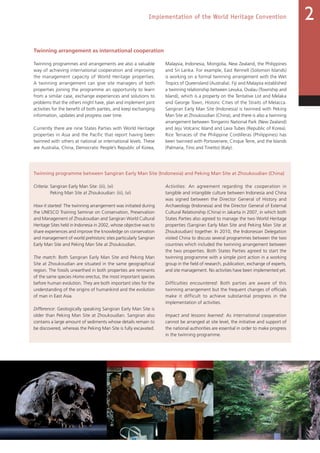
of vegetation through introduction of plant or animal pest
species) can have serious consequences for natural heritage.
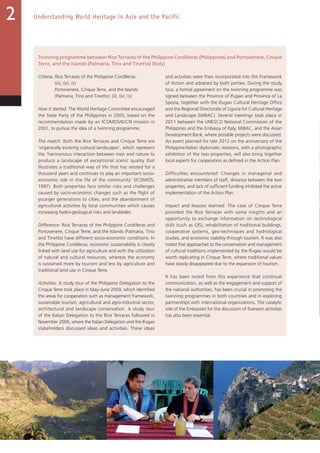
Some local impacts of temporary or limited effect may
be recoverable, such as the ability to eradicate the micro-
organisms, whereas others are permanent, as in the loss of
soil through accelerated erosion. Natural systems also generally
function within drainage basins (catchments) in which all
elements are interrelated and connected. Thus, actions in
the headwaters (e.g. mining or timber extraction) will have
impact further downstream (e.g. siltation, pollution, and loss
of riverine habitat and aquatic life). This can spread the extent
of a localized impact over much broader areas.
Many impacts felt locally may be the result of much more
widespread and generalized environmental changes. The
obvious case is human-induced climate change, creating
temperature and humidity regimes that are beyond the
tolerance limits of natural ecosystems and species. Climate
change impacts may be readily and immediately observable,
such as loss of snow and ice from mountainous areas, whereas
others are more subtle and operate over longer time spans,
such as changing regimes in natural fires and cyclones, spread
of diseases and pests, or changes in the feeding ecology and
breeding success of animals. The rise in global sea level from
atmospheric warming is perhaps the most insidious, serious
and widespread of all climate change impacts and the most
difficult to combat. It is already having major localized impact
Algae and lichen around seepage water.
61
Challenges for Conservation 3
on some low-lying coastal and island environments in the
region, especially in the Pacific Ocean where both natural and
cultural heritage is experiencing damage and loss and the
livelihood of some communities is threatened.
Several of these impacts are discussed in more detail later in
this chapter.
General response to local conditions
The local properties that affect the physical fabric of the
World Heritage properties cannot be controlled. However,
mitigation measures can be put in place to reduce the impact
of these factors. The approaches can be divided into two
main categories: the use of natural methods of protecting
the property or the use of technology to create artificial
environments.
There are numerous innovative methods that have been
employed to protect monuments through shelters and
plantations. The creation of natural or artificial ventilation of
structures controls temperature and humidity. Certain local
factors, especially micro-organisms and biological growth,
require regular cleaning and maintenance – either physical
removal or application of chemicals.
In respect to natural properties, there are many possible ways
of combating detrimental localized impacts. These range from
the more general improvements in catchment management that
recognize and accommodate the interconnections among natural
elements, to more specific actions such as controlling introduced
alien species through quarantine restrictions, use of herbicides
and pesticides, and eradication campaigns where conditions
permit. Impacts on waters – rivers, lakes, wetlands, estuaries or
near shore marine areas – can be the most difficult to address
because their effects often spread more rapidly and widely than
those affecting land, soil and terrestrial biota. Local impacts may
be the result of locally occurring phenomena or events, or they
may be a manifestation of external and much wider influences
such as changes in the atmosphere. Protecting and restoring
natural heritage from localized impacts due to global changes
in the atmosphere, weather and climate are much more difficult
and essentially rely on international cooperation and action.
Impact of local conditions in Asia and the Pacific
Local conditions affecting the physical fabric are considered
by the States Parties to negatively affect a large percentage
of cultural properties. This is especially the case in South Asia
(46.5%) and West and Central Asia (37.0%). In South-East
Asia, although almost a quarter (23.6%) consider the impact
of local conditions to have a negative impact, there are still
some who considered the impact to be positive (6.3%).
At Lumbini, the Birthplace of the Lord Buddha (Nepal) the
archaeological remains are being threatened by groundwater
and humidity, along with biological growth. Water and humidity
is also negatively affecting the Ruins of the Buddhist Vihara at
Paharpur (Bangladesh). The Historical Monuments of Makli,
Thatta (Pakistan) was included in the List of the 100 Most
Endangered Sites of the World Monuments Watch in 2005,
owing to the effects of the severe local climatic conditions (rain,
wind, etc.). The property also suffers from loss of groundwater
and topsoil erosion caused by the shift of the riverbed.
The Minaret and Archaeological Remains of Jam (Afghanistan)
is being affected by the erosion of the soil underneath the
minaret caused by the river currents. Due to the rising
groundwater and weathering (rain and frost), various structures
such as the Ak Sarai Palace are being threatened.
In South-East Asia various properties are affected by erosion,
particularly during the monsoons. This has been noted
in Sangiran Early Man Site (Indonesia), Complex of Hué
Monuments (Viet Nam) and Vat Phou and Associated Ancient
Settlements within the Champasak Cultural Landscape, and
the Town of Luang Prabang (Lao People’s Democratic Republic).
In North-East Asia the properties such as Historic Ensemble
of the Potala Palace, Lhasa (China) are affected by humidity.
The excavated caves of the Peking Man Site at Zhoukoudian
(China) are threatened by erosion and plant growth.
Natural properties are generally considered to be less affected
by the local conditions, with fewer than 20% of properties
affected (other than with the single property in West and
Central Asia). This is partly because in the case of natural
heritage, it is quite often difficult to localize these factors and
external factors that cause these impacts need to be addressed,
whereas in the case of cultural heritage, it is still possible to
address these impacts at the local level.
Figure 35. Impact of local conditions on cultural properties.
Figure 36. Impact of local conditions on natural properties.
Figure 37. Impact of local conditions on mixed properties.
* Only one property in this subregion.
Local conditions Invasive species
-50.0 -40.0 -30.0 -20.0 -10.0 0.0 10.0
Pacific
South-East
North-East
South
West  Central
Negative Postive
-40.0 -30.0 -20.0 -10.0 0.0 10.0
Pacific
North-East
Negative Positive
-60.0 -40.0 -20.0 0.0 20.0 40.0
Pacific
South-East
North-East
South
West  Central
Negative Positive
*
-12.0 -10
Pacific
South-East
North-East
South
West  Central
Negat
-40.0
Pacific
South-East
North-East
South
West  Central
Nega
*
-60.0 -50
Pacific
North-East
Negat
Local conditions Invasive species
-50.0 -40.0 -30.0 -20.0 -10.0 0.0 10.0
Pacific
South-East
North-East
South
West  Central
Negative Postive
-40.0 -30.0 -20.0 -10.0 0.0 10.0
Pacific
North-East
Negative Positive
-60.0 -40.0 -20.0 0.0 20.0 40.0
Pacific
South-East
North-East
South
West  Central
Negative Positive
*
-12.0 -10.
Pacific
South-East
North-East
South
West  Central
Negat
-40.0
Pacific
South-East
North-East
South
West  Central
Negat
*
-60.0 -50
Pacific
North-East
Negat
Local conditions Invasive species
-50.0 -40.0 -30.0 -20.0 -10.0 0.0 10.0
Pacific
South-East
North-East
South
West  Central
Negative Postive
-40.0 -30.0 -20.0 -10.0 0.0 10.0
Pacific
North-East
Negative Positive
-60.0 -40.0 -20.0 0.0 20.0 40.0
Pacific
South-East
North-East
South
West  Central
Negative Positive
*
-12.0 -10
Pacific
South-East
North-East
South
West  Central
Nega
-40.0
Pacific
South-East
North-East
South
West  Central
Nega
*
-60.0 -5
Pacific
North-East
Nega
62
Understanding World Heritage in Asia and the Pacific3
Invasive or hyper-abundant species
Description of factors included under this category
Invasive or hyper-abundant species impact the delicate balance
of ecosystems and are a major threat to indigenous biodiversity.
Very often invasive species are introduced unintentionally when
seeds, eggs, or sometimes plants and animals themselves are
transported to a new environment. If these plants and animals
are used to more extreme conditions of rainforests or deserts,
they might reproduce faster than the indigenous species. This
is often the case when the predators of that specific species
are not found in the new ecosystem. There have also been
many cases where particular species of plants and animals have
been intentionally introduced in efforts to provide benefits for
the ecosystem or society. This may be for the rehabilitation
of ecosystems, biological control of pests or introduction of
new species for harvesting or hunting. For example, Scottish
heather, which now dominates the vegetation of Tongariro
National Park in New Zealand, was introduced to provide
habitat for hunting of ground birds.
Factors considered under this category
■ Translocated species (fish stocking, inappropriate plantings,
introduced soil etc., dieback due to pathogens)
■ Invasive/alien terrestrial species (weeds, feral animals, rodents,
insect pests, bird pests, diseases/parasites, micro-organisms)
■ Invasive/alien freshwater species (weeds, invertebrate pests,
fish pests, diseases/parasites, micro-organisms)
■ Invasive/alien marine species (weeds, invertebrate pests, fish
pests, diseases/parasites, micro-organisms)
■ Hyper-abundant species (naturally occurring species impacting
ecosystem by virtue of ecological imbalance)
■ Modified genetic material
■ Pests
Impact of invasive or hyper-abundant species on
cultural properties
Invasive and hyper-abundant species of plants and animals
could have direct impact on cultural landscapes and mixed
World Heritage properties in the same way as they impact
natural heritage properties.
Invasive or hyper-abundant species could, however, also affect
cultural heritage properties and monuments if these species
of plants and animals lead to the physical deterioration of
the material used for historical structures and archaeological
vestiges. This is especially the case where plants with extensive
roots or vines grow near or on top of heritage structures. The
large abundance of pests such as rodents can clearly impact
not only the structures but also the use of historic buildings by
destroying artefacts and various construction materials. Major
detrimental forms of insects for cultural properties include
termites.
Impact of invasive or hyper-abundant species on
natural properties
The control or elimination of invasive alien species of plants and
animals are problems for management of natural properties
throughout the region. In World Heritage properties in New
Zealand, for example, problems relate mainly to introduced
rodents, mustelids, opossum, rabbits, deer, feral goats and
pigs, which destroy native vegetation and have serious impacts
for native birds and insects. Weed species affect native plant
communities, the most problematic being shrubs such as
gorse and broom, heather and climbing vines. In the Pacific
Islands, plant disease species are becoming more prevalent
and affecting crops such as taro, which is a component of the
natural ecosystem as well as a staple food. Many properties
in the region report problems with invasion of water weeds.
General response to invasive or hyper-abundant
species
The control and eradication of invasive species of plants and
animals remain matters of concern for sustained management
intervention by World Heritage site managers in the region.
Invasive or hyper-abundant species must first be identified
and decisions on response should be taken with the best
available knowledge. Early detection and response allow for
the best and the least expensive results. The invasive species
must be first contained and then eradicated. There are some
good examples of successful control and eradication. In
New Zealand the opossum is controlled through long-term
application of poisons and rats have been eliminated from
some island sanctuaries. Feral mammals have been shot or
live-captured and translocated. Many weed plant species
cannot be eradicated and must be subject to long-term
Damage on wooden structures caused by termites.
63
Challenges for Conservation 3
control measures. The introduction of new invasive species
must be prevented. Priority should be given to indigenous
species and ecosystems. The adverse effects of the possible
use of chemicals on beneficial species and the environment
must be accounted for. The approach and monitoring must
be coordinated with the community as well as enforcement
agencies backed by appropriate legislative frameworks.
Impact of invasive or hyper-abundant species in Asia
and the Pacific
Invasive or hyper-abundant species are shown to predominantly
affect natural properties and their impact is almost always
negative.
States Parties throughout the region report that less than
10% of their cultural properties are impacted by invasive or
hyper-abundant species, except in South Asia (10.6%). These
references would be mainly to do with pests that affect the
cultural heritage. There is, however, also an impact of alien
terrestrial species on various cultural properties. Compared
with other factors, there are few cultural properties affected
by invasive or hyper-abundant species.
The situation with natural properties looks very different. The
Pacific indicates a high percentage of natural properties being
negatively impacted by mainly invasive terrestrial species.
Macquarie Island (Australia) has been impacted by non-native
feral rabbits and rodents on the vegetation and wildlife. The
negative impacts of this overpopulation are in particular
the destruction of hillside vegetation such as tall tussock
(poafoliosa) and Macquarie Island cabbage (stilbocarpapolaris),
which in turn leads to more frequent and severe landslides and
erosion gullies. In the Wet Tropics of Queensland (Australia)
problems have been caused by exotic plant and animal species,
introduced for agricultural or domestic purposes, which have
now become weed, feral or invasive and threaten native
plant and animal communities. In East Rennell (Solomon
Islands) logging operations located close to the property have
introduced rats and invasive land snails that could present a
serious threat to native fauna in the property.
South Asia indicates that a substantial number of their
properties face the impact of invasive or hyper-abundant
species (24.3%). Keoladeo National Park (India) has been
tackling the impacts of various invasive species such as
paspalum distichum (knotgrass), water hyacinth and prosopis
juliflora, an invasive species of thorny bushes and small trees
of Central and South American origin. To control this threat,
a systematic plan for the regular monitoring and removal
of prosopis juliflora was formulated with the involvement
of local communities. In Manas Wildlife Sanctuary (India)
invasive plants and fires may be contributing to the siltation
and drying of the alluvial grasslands which are particularly
important for pygmy hog. In Chitwan National Park (Nepal)
habitat degradation is occurring through the spread of invasive
species such as water hyacinth, Mikenia and tall grasses.
Over 50% of the mixed properties in the Pacific have shown
negative impact of invasive or hyper-abundant species. Cane
toads, Bufo marinus, introduced to Australia for controlling
insect pests of sugar cane plantations in the State of
Queensland, have serious impacts on indigenous aquatic life
and small terrestrial wildlife. They embarked on a westward
invasion of northern Australia. They reached Kakadu National
Park and are threatening Purnululu National Park (Australia).Early stage of prosopis invasion.
Figure 38. Impact of invasive or hyper-abundant species on
cultural properties.
Figure 39. Impact of invasive or hyper-abundant species on
natural properties.
Figure 40. Impact of invasive or hyper-abundant species on
mixed properties.
* Only one property in this subregion.
Local conditions Invasive species
-50.0 -40.0 -30.0 -20.0 -10.0 0.0 10.0
Pacific
South-East
North-East
South
West  Central
Negative Postive
-40.0 -30.0 -20.0 -10.0 0.0 10.0
Pacific
North-East
Negative Positive
-60.0 -40.0 -20.0 0.0 20.0 40.0
Pacific
South-East
North-East
South
West  Central
Negative Positive
*
-12.0 -10.0 -8.0 -6.0 -4.0 -2.0 0.0 2.0 4.0
Pacific
South-East
North-East
South
West  Central
Negative Positive
-40.0 -30.0 -20.0 -10.0 0.0 10.0
Pacific
South-East
North-East
South
West  Central
Negative Positive
*
-60.0 -50.0 -40.0 -30.0 -20.0 -10.0 0.0 10.0
Pacific
North-East
Negative Positive
Local conditions Invasive species
-50.0 -40.0 -30.0 -20.0 -10.0 0.0 10.0
Pacific
South-East
North-East
South
West  Central
Negative Postive
-40.0 -30.0 -20.0 -10.0 0.0 10.0
Pacific
North-East
Negative Positive
-60.0 -40.0 -20.0 0.0 20.0 40.0
Pacific
South-East
North-East
South
West  Central
Negative Positive
*
-12.0 -10.0 -8.0 -6.0 -4.0 -2.0 0.0 2.0 4.0
Pacific
South-East
North-East
South
West  Central
Negative Positive
-40.0 -30.0 -20.0 -10.0 0.0 10.0
Pacific
South-East
North-East
South
West  Central
Negative Positive
*
-60.0 -50.0 -40.0 -30.0 -20.0 -10.0 0.0 10.0
Pacific
North-East
Negative Positive
Local	
  conditions	


Invasive	
  species	


-­‐50,0	
   -­‐40,0	
   -­‐30,0	
   -­‐20,0	
   -­‐10,0	
   0,0	
   10,0	
  
Pacific	
  
South-­‐East	
  
North-­‐East	
  	
  
South	
  
West	
  	
  Central	
  	
  
Nega?ve	
   Pos?ve	
  
-­‐40,0	
   -­‐30,0	
   -­‐20,0	
   -­‐10,0	
   0,0	
   10,0	
  
Pacific	
  
North-­‐East	
  	
  
Nega?ve	
   Posi?ve	
  
-­‐50,0	
   -­‐40,0	
   -­‐30,0	
   -­‐20,0	
   -­‐10,0	
   0,0	
   10,0	
   20,0	
   30,0	
  
Pacific	
  
South-­‐East	
  
North-­‐East	
  	
  
South	
  
West	
  	
  Central	
  	
  
Nega?ve	
   Posi?ve	
  
-­‐12,0	
   -­‐10,0	
   -­‐8,0	
   -­‐6,0	
   -­‐4,0	
   -­‐2,0	
   0,0	
   2,0	
   4,0	
  
Pacific	
  
South-­‐East	
  
North-­‐East	
  	
  
South	
  
West	
  	
  Central	
  	
  
Nega?ve	
   Posi?ve	
  
-­‐40,0	
  -­‐35,0	
  -­‐30,0	
  -­‐25,0	
  -­‐20,0	
  -­‐15,0	
  -­‐10,0	
   -­‐5,0	
   0,0	
   5,0	
  
Pacific	
  
South-­‐East	
  
North-­‐East	
  	
  
South	
  
West	
  	
  Central	
  	
  
Nega?ve	
   Posi?ve	
  
-­‐60,0	
   -­‐50,0	
   -­‐40,0	
   -­‐30,0	
   -­‐20,0	
   -­‐10,0	
   0,0	
   10,0	
  
Pacific	
  
North-­‐East	
  	
  
Nega?ve	
   Posi?ve	
  
64
Understanding World Heritage in Asia and the Pacific3
Natural disasters
Description of factors included under this category
Various forms of natural hazard can lead to disasters. These
hazards occur under extreme climatic or geological conditions.
Very often hazards are interlinked and can occur successively.
The relationship between earthquakes that occur below the
ocean and the resulting tsunamis is well known. Earthquakes
are often followed by fires, landslides and possibly even
flooding.
The magnitude of a disaster depends on the vulnerability of
the heritage property. Hazards are natural phenomena which
cannot be controlled by humans. However, the impact and
the degree of destruction can be mitigated to some degree,
depending on the level of preparedness.
Factors considered under this category
■ Earthquake
■ Storm (tornado, hurricane/cyclone, gale, hail damage,
lightning strike, river/stream overflow, extreme tides)
■ Flooding
■ Tsunami/tidal waves
■ Avalanche/landslide
■ Volcanic eruption
■ Fire (altered fire regimes, high-impact fire suppression
activities, lightning strikes, accidental fires, e.g. dropped
cigarettes, not ecological)
Impact of natural disasters on cultural properties
Natural hazards can have devastating effects on cultural
properties. Many cultural properties have been exposed to the
wrath of nature for centuries, leaving the scars. In some cases
the destruction has been so extreme that only traces of the
original monument or site remain. Some such sites might have
been destroyed and buried for centuries, only to be unearthed
as archaeological sites. Some cultural heritage has been victim
to recent disasters.
Earthquakes are one of the most destructive forces of nature
and many cultural properties are found in seismic active
areas. Various cultures have developed certain responses to
earthquakes, but in many cases, monuments and entire cities
have had to be reconstructed. In certain cases, cities have been
abandoned after being severely damaged.
Storms, flooding and extreme events such as tsunamis (tidal
waves) can destroy particular monuments or wash away entire
settlements. This can affect not only the physical structures
of historic buildings and archaeological sites, but also social
and intangible values based on functions, craftsmanship
and beliefs.
Avalanches and landslides can directly affect the physical
heritage structures. In many cases, these can dam rivers which
can then lead to flash-floods. Volcanic eruptions cause lava
flow but also great amounts of ash to be ejected into the
atmosphere. The falling ash can cover monuments and when
dissolved in water can create an acidic solution which corrodes
materials such as stone and lime.
Fires are sometimes caused by lightning, but very often
indirectly by human activities and vulnerabilities of properties.
Depending on the vulnerabilities of the cultural properties, fires
are very often ignited by other natural disasters.
Impact of natural disasters on natural properties
Extreme, high-magnitude natural events also impact on natural
properties. However, it must be appreciated that these are
essentially naturally occurring events and that functioning
ecosystems are normally attuned to them. For example, some
forest and grassland ecosystems are fire-climax communities
controlled by natural fire regimes, and riverine ecosystems may
be unaffected by (or indeed enhanced by) periodic flooding.
The influence of periodic avalanching on vegetation types and
plant growth can play an important role in the feeding ecology
of some alpine wildlife species.
Extreme events become hazards or disasters when they
threaten or destroy human life and property. The magnitude
and frequency of geological hazards such as earthquake,
tsunami and volcanic eruption, and of extreme weather events
such as cyclones, are for the most part still unpredictable and
therefore extremely difficult to guard against. Other weather-
related events such as avalanches can be better predicted and
controlled to minimize loss. A balance must be struck between
artificially controlling natural events and minimizing hazards
for residents and visitors in World Heritage areas.
There is mounting evidence that the changing climate has
increased the frequency and/or severity of extreme high-
magnitude weather events such as cyclones, and have
changed their geographical distribution, bringing new areas
under their influence. Oceanic islands of the Pacific are among
Damage to Bam and its Cultural Landscape (Islamic Republic
of Iran) caused by an earthquake.
65
Challenges for Conservation 3
the most prone to cyclones in the region and the least able to
recover from their destructive effects. Of particular concern is
a situation where cyclonic storms destroy the homes and food
crops of people living in and managing the World Heritage
properties, therefore threatening their livelihood and survival –
such as occurs on East Rennell in the Solomon Islands.
General response to natural disasters
As it is not always possible to control natural disasters, the
most effective response for World Heritage properties is
preparedness. This means that the probability and scale of
the hazards must be understood. The vulnerability of the
heritage property to the specific hazard must be studied to
ensure that the impact on the main attributes expressing the
Outstanding Universal Value of the property is mitigated as
much as possible. In extreme cases, it would be necessary to
consider the need for restoration or even reconstruction based
on detailed documentation.
Importantly, it is necessary to consider and weigh up the
realities of nature on the one hand and needs for safety
of people on the other. All World Heritage site managers
should institute a visitor hazard safety plan that recognizes all
threats to visitors from extreme events and provides measures
for monitoring and minimizing the associated dangers.
The Operational Guidelines also recommend that States
Parties include risk preparedness as an element in their site
management plans and training strategies (Paragraph 118).
For natural World Heritage properties there are situations
where conflicting views are held about the appropriateness
of controlling natural events. A good example is the volcanic
Tongariro National Park (New Zealand) where a controversial
but very effective early-warning system has been installed to
monitor critical changes in the water level of a summit crater
lake and massive rock barriers are constructed on the slopes
of the volcano to minimize the destructive effects of lahars
(volcanic mudflows). This interference with natural event,
and with cultural value, has been justified on the grounds of
preventing loss of life among skiers and other visitors to the
park and loss or damage to facilities, including public roads,
bridges and buildings outside the park.
Impact of natural disasters in Asia and the Pacific
The impact of most different kinds of natural disasters on
cultural properties has been indicated as highest in South-East
Asia (18.3%) followed by South Asia (12.5%). The catastrophic
impact of natural disasters on cultural properties has however
been seen throughout the region. For example, Bam and its
Cultural Landscape (Islamic Republic of Iran) was inscribed on
the List of World Heritage in Danger due to severe damage
to the property caused by the earthquake in December 2003,
and development pressures relating to the post-disaster
reconstruction process. At Prambanan Temple Compounds
(Indonesia), serious damage was done by the earthquake of
2006 to all six temples in the property, the worst affected
being the main temple of Siwa. Earthquake-related tsunamis
have also impacted on cultural properties. The 2004 Indian
Ocean tsunami affected many properties along the coastline,
such as the Tropical Rainforest Heritage of Sumatra (Indonesia),
Old Town of Galle and its Fortifications (Sri Lanka) and the
Group of Monuments at Mahabalipuram (India).
Flooding and erosion caused by rivers have impacted several
properties, such as the Archaeological Ruins at Moenjodaro
(Pakistan) and the Minaret and Archaeological Remains of
Jam (Afghanistan). In the case of the Archaeological Ruins
at Moenjodaro, an International Safeguarding Campaign was
organized by UNESCO from 1974 to 1997 to mobilize funds
for large-scale conservation measures to protect the property
from flooding. Kathmandu Valley (Nepal) is threatened by
earthquake, and lightning that struck and damaged the
Pratappur Temple in the property. There are various cases of
fire destroying monuments such as the Yuzhen Palace, part
of the Ancient Building Complex in the Wudang Mountains
(China). The volcanic eruption of Mount Merapi in 2010
blanketed the Borobudur Temple Compounds (Indonesia)
with volcanic ash.
Volcanic eruptions have also impacted the mixed World
Heritage of Tongariro National Park (New Zealand) where the
eruption of Mount Ruapehu from 1995 to 1996 caused a
large build-up of ash that blocked the outlet of the summit
Crater Lake. The Wenchuan earthquake in 2008 affected to
some degree the ecology of Sichuan Giant Panda Sanctuaries
– Wolong, Mt Siguniang and Jiajin Mountains (China). The
Sundarbans (Bangladesh) have periodically been impacted by
cyclones such as cyclone Sidr in 2007.
Figure 41. Impact of natural disasters on cultural properties.
Figure 42. Impact of natural disasters on natural properties.
Figure 43. Impact of natural disasters on mixed properties.
* Only one property in this subregion.
Natural disaster Climate change
-20.0 -15.0 -10.0 -5.0 0.0
Pacific
South-East
North-East
South
West  Central
Negative Positive
-50.0 -40.0 -30.0 -20.0 -10.0 0.0 10.0 20.0
Pacific
South-East
North-East
South
West  Central
Negative Positive
*
-50.0 -40.0 -30.0 -20.0 -10.0 0.0 10.0 20.0 30.0
Pacific
North-East
Negative Positive
-12.0 -
Pacific
South-East
North-East
South
West  Central
Ne
-80.0
Pacific
South-East
North-East
South
West  Central
Ne
*
-30.0
Pacific
North-East
Ne
Natural disaster Climate change
-20.0 -15.0 -10.0 -5.0 0.0
Pacific
South-East
North-East
South
West  Central
Negative Positive
-50.0 -40.0 -30.0 -20.0 -10.0 0.0 10.0 20.0
Pacific
South-East
North-East
South
West  Central
Negative Positive
*
-50.0 -40.0 -30.0 -20.0 -10.0 0.0 10.0 20.0 30.0
Pacific
North-East
Negative Positive
-12.0 -1
Pacific
South-East
North-East
South
West  Central
Neg
-80.0
Pacific
South-East
North-East
South
West  Central
Ne
*
-30.0
Pacific
North-East
Ne
Natural disaster Climate change
-20.0 -15.0 -10.0 -5.0 0.0
Pacific
South-East
North-East
South
West  Central
Negative Positive
-50.0 -40.0 -30.0 -20.0 -10.0 0.0 10.0 20.0
Pacific
South-East
North-East
South
West  Central
Negative Positive
*
-50.0 -40.0 -30.0 -20.0 -10.0 0.0 10.0 20.0 30.0
Pacific
North-East
Negative Positive
-12.0 -1
Pacific
South-East
North-East
South
West  Central
Neg
-80.0
Pacific
South-East
North-East
South
West  Central
Neg
*
-30.0
Pacific
North-East
Ne
66
Understanding World Heritage in Asia and the Pacific3
Climate change
Description of factors included under this category
Climate change takes into account the increased
transformation in global climatic conditions due to human
activities. The disruption of the climatic equilibrium has had
an impact on temperature and rainfall. This can lead to the
alteration of the local climatic conditions, whereby both
natural and cultural heritage properties are affected. Some of
the most dramatic impact is being caused by the melting of
the icecaps and glaciers which raises the level of oceans with
devastating impact on low-lying areas and island states.
Factors considered under this category
■ Drought
■ Desertification
■ Changes to oceanic waters (changes to water flow and
circulation patterns at local, regional or global scale, changes
to pH, changes to temperature)
■ Temperature change
■ Other climate change impacts
Impact of climate change on cultural properties
Climate change can have a direct impact on various types of
cultural properties. Some of the most directly impacted would
be the archaeological sites that have been preserved under
stable conditions. The archaeological vestiges become more
vulnerable with the increased fluctuation or change in the
hydrological, chemical and biological conditions.
Historic buildings and structures that have survived centuries
under specific climatic conditions can begin to deteriorate at
an accelerated pace once these climatic conditions begin to
fluctuate. This is especially the case with the water content of
the ground and air which can cause direct erosion or lead to
impacts through efflorescence. Changes in climate can also
lead to increased biological infestation and invasion of pests
that impact organic materials such as timber. The effect does
not restrict itself to the main structure, but also the finishes,
ornamentation and often the movable culture heritage
contained within the structure.
Climate change can also initiate flooding or storms that have
a direct physical impact on objects of cultural heritage. The
materials used to build historic structures and archaeological
vestiges are often vulnerable to prolonged immersion in water
caused by floods or storms, leading to erosion and related
biological attack. In contrast, desertification can lead to salt
weathering and erosion of cultural properties.
Impact of climate change on natural properties
Changes in the climate and in atmospheric carbon dioxide levels
have already had observable and widespread impacts on species
and ecosystems. While some are showing a capacity for natural
adaptation to change, others are displaying marked negative
impacts. The situation will worsen. Current atmospheric
warming, with a temperature increase of 0.75 °C in global
mean surface temperature relative to pre-industrial era levels,
is modest compared with future predicted increases of 2–5 °C.
The ecosystems most vulnerable to change are aquatic
freshwater habitats and wetlands, mangroves, coral reefs,
polar and alpine systems and cloud forests. Endemic species
of plants and animals are particularly vulnerable because they
normally have very narrow climatic and geographical ranges,
limited dispersal opportunities and many other pressures.
Climate change experts have suggested that approximately
10% of species will be at increasingly high risk of extinction
for every 1 °C rise in atmospheric temperature. Continued
climate change will have predominately adverse and often
irreversible impacts on many ecosystems and their services,
with significant negative social, cultural and economic
consequences. Although there is uncertainty about the extent
and speed at which climate change will affect biodiversity, and
determine the thresholds at which ecosystems will no longer
function normally, there is an urgent need to identify the most
vulnerable species and ecosystems, assess their risk to changing
climates and implement appropriate mitigation measures.
Among the many consequences of climate change, perhaps the
most insidious and problematic is global sea level rise, which
is already impacting low-lying coasts and islands in the region,
particularly the atolls of the Pacific Ocean, many of which
are only metres above sea level. Observable impacts include
inundation of land, die-off of vegetation and crops due to
rising groundwater levels and salt contamination of freshwater
systems. Higher sea levels may also exaggerate the impacts of
tsunamis and storms – and increased storminess appears to be
one of the many by-products of changing weather systems.
General response to climate change
Climate change is a global phenomenon but it has very specific
consequences at the local level for managers of World Heritage
properties. Consequently, the management and response need
Sagarmatha National Park (Nepal) has been greatly affected
by climate change.
67
Challenges for Conservation 3
to be planned at the international and national levels as well
as the local level.
Properties under threat from climate change must use their
management plan as a key tool to intervene and respond to
the threats, and to establish the required coordination of effort
at all levels of governance and management. There are various
management requirements and measures for ensuring an
effective response, and ongoing monitoring and maintenance
are critical components of an overall preparedness plan.
Management authorities for World Heritage properties should
be alert to impacts associated with changing climate and
associated environmental changes. This requires substantial
effort in monitoring the condition and trend of natural plant
and animal communities, physical processes and ecosystem
functioning. Appropriate education should be provided and
traditional skills must be enhanced using training programmes.
Local knowledge of the naturally functioning ecosystems and
the original condition of cultural attributes can allow for a
better adaptation response to the impacts on natural and
cultural heritage from changes in climate.
The case of fire management in Australia is a good illustration
of management adaptation to climate change impacts.
Increased temperatures and frequency of droughts are causing
changes in natural fire regimes, which have consequences
for the natural vegetation and wildlife adjusted to fire as a
controlling agent in the environment. Required changes in
fire management intervention include enhanced fire fighting
programmes, fire suppression measures and the ecological use
of deliberate fires.
Impact of climate change in Asia and the Pacific
The impact of climate change on cultural properties is
considered to be highest in South-East Asia, followed by South
Asia and West and Central Asia. At the Rice Terraces of the
Philippine Cordilleras (Philippines), where the abandonment
of terraces due to neglected irrigation systems had been an
issue, all major communal irrigation systems (CIS) in Ifugao
were rehabilitated using available traditional building materials.
They are now fully operational and yields from rice cultivation
have increased. However, it was noted that, due to climate
change, the upgraded runoff CIS to larger water-impounding
basins was necessary to have sufficient water supplies.
Even for natural properties the percentages are as high as
20% for the Pacific. (It must be noted that the single natural
property of West and Central Asia considered climate change
as a clear negative factor.) The natural properties in the Pacific
such as East Rennell (Solomon Islands) have been affected
by the rising water levels of the ocean, causing rising water
levels and salination of the large freshwater lake, a former
lagoon that remains connected to the sea. Climate change
is considered as a major negative factor affecting natural
properties in Australia, such as Gondwana Rainforests of
Australia, Great Barrier Reef and Wet Tropics of Queensland.
In South-East Asia, it is reported that 15% of natural proper-
ties are affected by climate change. Tubbataha Reefs Natural
Park (Philippines) has established a programme of ecological
monitoring, with emphasis on the effects of climate change on
sea surface temperature, coral bleaching, storm frequency and
other factors that could be related to climate change.
In South Asia, the impact of climate change is seen as negative
in both coastal and mountainous areas. In the Sundarbans
(Bangladesh) a five-year project was begun in 2011 Sundarbans
Environmental and Livelihoods Security (SEALS), which includes
logistic support for ecological monitoring and documenting
the impact of climate change on the Outstanding Universal
Value of the property such as through sea-level rise, increased
cyclone frequency and altered fresh-water flow into the
property. In Sagarmatha National Park (Nepal) the threats from
glacial lakes outbursts are recognized by the State Party and
local communities
The Outstanding Universal Value of Shiretoko (Japan) is related
closely to the presence of sea ice in the Northern Hemisphere
polar region and there are observable changes in the extent
and character of the polar sea ice cover.
Mixed properties indicate very high percentages of negative
impact due to climate change. The Pacific indicates 28% while
even North-East Asia shows 15%. In properties such as the
Tasmanian Wilderness (Australia) the risks of climate change to
the property were identified and assessed, and this information
is incorporated in an active monitoring programme and risk
management strategy.
Figure 44. Impact of climate change on cultural properties.
Figure 45. Impact of climate change on natural properties.
Figure 46. Impact of climate change on mixed properties.
Natural disaster Climate change
-20.0 -15.0 -10.0 -5.0 0.0
Pacific
South-East
North-East
South
West  Central
Negative Positive
-50.0 -40.0 -30.0 -20.0 -10.0 0.0 10.0 20.0
Pacific
South-East
North-East
South
West  Central
Negative Positive
*
-50.0 -40.0 -30.0 -20.0 -10.0 0.0 10.0 20.0 30.0
Pacific
North-East
Negative Positive
-12.0 -10.0 -8.0 -6.0 -4.0 -2.0 0.0 2.0 4.0
Pacific
South-East
North-East
South
West  Central
Negative Positive
-80.0 -60.0 -40.0 -20.0 0.0 20.0
Pacific
South-East
North-East
South
West  Central
Negative Positive
*
-30.0 -25.0 -20.0 -15.0 -10.0 -5.0 0.0
Pacific
North-East
Negative Positive
Natural disaster Climate change
-20.0 -15.0 -10.0 -5.0 0.0
Pacific
South-East
North-East
South
West  Central
Negative Positive
-50.0 -40.0 -30.0 -20.0 -10.0 0.0 10.0 20.0
Pacific
South-East
North-East
South
West  Central
Negative Positive
*
-50.0 -40.0 -30.0 -20.0 -10.0 0.0 10.0 20.0 30.0
Pacific
North-East
Negative Positive
-12.0 -10.0 -8.0 -6.0 -4.0 -2.0 0.0 2.0 4.0
Pacific
South-East
North-East
South
West  Central
Negative Positive
-80.0 -60.0 -40.0 -20.0 0.0 20.0
Pacific
South-East
North-East
South
West  Central
Negative Positive
*
-30.0 -25.0 -20.0 -15.0 -10.0 -5.0 0.0
Pacific
North-East
Negative Positive
Natural disaster Climate change
-20.0 -15.0 -10.0 -5.0 0.0
Pacific
South-East
North-East
South
West  Central
Negative Positive
-50.0 -40.0 -30.0 -20.0 -10.0 0.0 10.0 20.0
Pacific
South-East
North-East
South
West  Central
Negative Positive
*
-50.0 -40.0 -30.0 -20.0 -10.0 0.0 10.0 20.0 30.0
Pacific
North-East
Negative Positive
-12.0 -10.0 -8.0 -6.0 -4.0 -2.0 0.0 2.0 4.0
Pacific
South-East
North-East
South
West  Central
Negative Positive
-80.0 -60.0 -40.0 -20.0 0.0 20.0
Pacific
South-East
North-East
South
West  Central
Negative Positive
*
-30.0 -25.0 -20.0 -15.0 -10.0 -5.0 0.0
Pacific
North-East
Negative Positive
* Only one property in this subregion.
68
Understanding World Heritage in Asia and the Pacific3
Infrastructure development
Description of factors included under this category
The significance of World Heritage properties attracts investment
and development. Very often these developments are directly
related to improving the accessibility of the properties. The
construction of roads, bridges and tunnels have impacted
many World Heritage properties. Uncontrolled development
such as housing and industries (especially polluting industries)
can affect the heritage value. If there is a lack of understanding
and prioritization for conserving the property, new construction
and encroachments can destroy the natural environment and
the historic landscapes, leading to the deterioration and loss
of setting. Infrastructure development is closely related to
providing for visitors (see ‘Tourism’, pages 80–81).
Factors considered under this category
■ Housing (urban high-rise, encroachment)
■ Commercial development (skyscrapers, large shopping malls,
encroachment/changes to skyline, etc.)
■ Industrial areas (individual factories, industrial areas/parks,
encroachment/changes to skyline, etc.)
■ Ground transport infrastructure (roads, car parks, railways,
including easements, transport depots)
■ Air transport infrastructure (airports, airstrips)
■ Marine transport infrastructure (harbours)
■ Underground transport infrastructure
■ Effects arising from use of transportation infrastructure
(vehicle traffic on roadways, shipping traffic in shipping routes,
air traffic)
Impact of infrastructure development on cultural
properties
Infrastructure development has been one of the major threats
to cultural World Heritage properties. These activities can take
place within the boundaries, especially in cultural landscapes or
historic urban areas. The historic fabric and landscapes can be
threatened by new building construction and the introduction
or the widening of roads. There are often pressures for
commercial developments within the prominent areas of
historic towns.
The impact of infrastructure development is very often found
to be coming from outside the boundaries, either from the
buffer zone or even beyond. This is often the case with high-
rise buildings, industrial development or structures relating to
transportation such as bridges, parking garages and airports.
The impact might be visual or arising from the usage of these
facilities. The infrastructure development may lead to various
forms of pollution which can either have some bearing on the
context of the property or have a direct chemical effect on the
heritage structures.
Appropriate infrastructure development can of course have a
positive impact on World Heritage properties too, especially
when it comes to controlling and improving already existing
circumstances. There have been cases where the safeguarding
of a heritage property has been achieved through the
improvement of infrastructure. However, each component of
the design and implementation must consider the values of the
property and ensure that these values are not compromised.
Impact of infrastructure development on natural
properties
Inappropriate infrastructure development occurs in natural
properties in essentially the same way as in cultural properties.
The impacts, however, may be very different and less localized
as they are spread more widely by natural processes. Impacts
can occur at the clearing and construction phases when soils
may be exposed and subject to greater and more accelerated
erosion levels. Soil erosion can impact immediate land areas,
and can also be felt through the hydrological system and
affect coastal areas. Erosion impacts may be both physical and
biological, short-term or long-term and even permanent.
Impacts may also occur after construction. Structures
themselves may impede biota or interrupt natural processes
– for example restricting river flows, estuarine and coastal
currents and consequently the aquatic biota that depend on
them. A common impact of inappropriately sited roads is the
interference of movement of wildlife, including migration
routes, and this in turn may endanger the feeding ecology
and survival of some communities. Structures may also
be detrimental to the scenic and aesthetic values of the
property. Excessive noise can be associated with infrastructure
development, and this can impact both wildlife and people.
General response to infrastructure development
Infrastructure development is closely related to economic
activities that are taking place in and around the World
Heritage property. In many cases, development of infrastructure
is important to promote economic sustainability of the
properties; but this must take place without compromising
Infrastructure development has been one of the major issues
reported in the state of conservation of World Heritage properties.
69
Challenges for Conservation 3
the natural and cultural heritage values. Development should
take into account the elements of traditional infrastructure
that exist and the possibility that these can be restored and/or
augmented. The scale and design of the infrastructure must
be appropriate to the specific natural and cultural context
and measures are required to ensure that developments that
impact the Outstanding Universal Value of the World Heritage
properties are avoided.
In order to avoid irreversible negative impacts on the
Outstanding Universal Value of properties by infrastructure
development and to assist the States Parties in finding
appropriate solutions, Paragraph 172 of the Operational
Guidelines recommends that the States Parties inform the
World Heritage Committee before any major constructions
are undertaken.
Operational Guidelines
172. The World Heritage Committee invites the States
Parties to the Convention to inform the Committee,
through the Secretariat, of their intention to
undertake or to authorize in an area protected
under the Convention major restorations or new
constructions which may affect the Outstanding
Universal Value of the property. Notice should be
given as soon as possible (for example, before
drafting basic documents for specific projects) and
before making any decisions that would be difficult to
reverse, so that the Committee may assist in seeking
appropriate solutions to ensure that the Outstanding
Universal Value of the property is fully preserved.
Impact of infrastructure development in Asia
and the Pacific
There is a general understanding throughout the region that
infrastructure development can be both negative and positive.
States Parties in South Asia report that 20.2% of cultural
properties are negatively impacted. They report the lower
positive impact (14.7%) of this factor. In contrast, South-East
Asia reports a negative impact of 11.8% and a positive impact
of 21.5%.
Old Town of Galle and its Fortifications (Sri Lanka) has been
impacted by intrusive and illegal constructions within the Galle
cricket ground and is threatened by planned developments
for the port area. In India, the Taj Heritage Corridor Project
was suspended as it was going to impact the World Heritage
properties of Taj Mahal and Agra Fort. The new bridge was
constructed some 2 km from the property boundary and
has supposedly improved tourist access to the important
monuments in Agra. The Group of Monuments at Hampi
(India) was greatly impacted by the illegal construction of the
Anegundi bridge.
The Historic Monuments of Ancient Nara (Japan) was faced
with the potential negative impact of a proposed highway in
the vicinity of the property. At the Historic Ensemble of the
Potala Palace, Lhasa (China) the main threats were identified
as uncontrolled urban development and expansion of
tourism-related facilities in and adjacent to the boundary of
the property. The Complex of Hué Monuments (Viet Nam) is
impacted by the development of the road infrastructure and
modern constructions in and around the Citadel as well as the
urban infrastructure of Hué and its surroundings.
The situation with natural properties is slightly different.
Other than in North-East Asia, the impact of infrastructure
development is considered more negative than positive. The
contrast is especially large in South Asia where 18.8% of the
properties regard infrastructure development to be negative
and 2.5% to be positive. Sagamartha National Park (Nepal)
is impacted by the growing need for visitor accommodation
and facilities, but the proposed Syangboche airstrip extension
plan was abandoned in consideration of its negative impacts.
Ha Long Bay (Viet Nam) has had to deal with excessive tourist
boat traffic and high numbers of other sea traffic in transit
through the property. At the Great Barrier Reef (Australia) there
have been reports on loss of coastal and littoral habitats due
to developments such as harbours, wharves, land conversion,
housing and associated services and industrial development.
Shiretoko (Japan) has reported the impact from river
constructions, including dams, on salmon migration.
The situation with mixed properties seems to be rather equal,
with infrastructure development being considered only slightly
more negative. Impacts, both negative and positive, are
considered to be rather high in the Pacific (37.5% and 30.0%
respectively).
Figure 47. Impact of infrastructure development on cultural
properties.
Figure 48. Impact of infrastructure development on natural
properties.
Figure 49. Impact of infrastructure development on mixed
properties.
Infrastructure development Service infrastructure
-30.0 -20.0 -10.0 0.0 10.0 20.0 30.0
Pacific
South-East
North-East
South
West  Central
Negative Positive
-60.0 -40.0 -20.0 0.0 20.0 40.0
Pacific
North-East
Negative Positive
-20.0
Pacific
South-East
North-East
South
West  Central
N
-60.0
Pacific
North-East
N
-30.0 -20.0 -10.0 0.0 10.0 20.0
Pacific
South-East
North-East
South
West  Central
Negative Positive
*
-40.0
Pacific
South-East
North-East
South
West  Central
N
*
Infrastructure development Service infrastructure
-30.0 -20.0 -10.0 0.0 10.0 20.0 30.0
Pacific
South-East
North-East
South
West  Central
Negative Positive
-60.0 -40.0 -20.0 0.0 20.0 40.0
Pacific
North-East
Negative Positive
-20.0
Pacific
South-East
North-East
South
West  Central
Ne
-60.0
Pacific
North-East
N
-30.0 -20.0 -10.0 0.0 10.0 20.0
Pacific
South-East
North-East
South
West  Central
Negative Positive
*
-40.0
Pacific
South-East
North-East
South
West  Central
Ne
*
Infrastructure development Service infrastructur
-30.0 -20.0 -10.0 0.0 10.0 20.0 30.0
Pacific
South-East
North-East
South
West  Central
Negative Positive
-60.0 -40.0 -20.0 0.0 20.0 40.0
Pacific
North-East
Negative Positive
-20.0
Pacific
South-East
North-East
South
West  Central
N
-60.0
Pacific
North-East
-30.0 -20.0 -10.0 0.0 10.0 20.0
Pacific
South-East
North-East
South
West  Central
Negative Positive
*
-40.0
Pacific
South-East
North-East
South
West  Central
N
*
* Only one property in this subregion.
70
Understanding World Heritage in Asia and the Pacific3
Service facilities
Description of factors included under this category
Basic services are a necessity which cannot be denied to
people even if they are living in historic buildings or zones.
This means that the appropriate integration of service facilities
becomes part of the process of conserving historic buildings,
cities and facilities within protected areas. Such services
include electricity, communications, water, sewage and waste
disposal. Each of these services, however, can be provided in
many ways with great variations in their impact. For example,
changes from non-renewable to renewable sources in energy
supply are to be applauded. Service facilities that often have a
major impact are dams and various forms of power plant (e.g.
nuclear, fossil fuel, renewable energy). Transmission lines and
underground piping can impact the integrity of both natural
and cultural heritage properties.
Factors considered under this category
■ Water infrastructure (dams, water tanks, locks, pumping
stations, introduction of new systems/infrastructure)
■ Renewable energy facilities (thermal, wave, solar, wind)
■ Non-renewable energy facilities (nuclear power plants, oil/gas
facilities)
■ Localized utilities (cell-phone towers, radio towers)
■ Major linear utilities (power lines, pipelines)
Impact of service facilities on cultural properties
Living cultural properties require constant upgrading of service
facilities and utility lines. This becomes a critical issue especially
for historic cities where it is often necessary to introduce
entirely new services systems. However, where possible, the
traditional systems as part of the heritage need to be revived
and possibly augmented. Power cables, water and sewage
pipes and possibly communication and TV cables must be laid
along the ancient streets. This requires special care to ensure
minimum impact on the historic fabric. These cables and pipes
should ideally be concealed under the streets or pavements,
although at the same time it should be ensured that the
possible archaeological finds are safeguarded.
Communication towers are commonly found near heritage
properties, often seriously impacting the visual integrity of the
site. Especially in urban settings, utility poles and street lighting
can be a necessity but impacts the character of the streets and
squares.
Both renewable and non-renewable energy facilities can
impact heritage properties if they are located within or near
the properties. There is an overall threat to the visual integrity
due to the size of these facilities. Non-renewable facilities can
also pose a threat by producing various forms of pollutants
which can affect the property. This is especially the case when
fossil fuels are burnt. There is also the potential threat of a
nuclear power plant releasing radioactive waste.
Dams can inundate large areas of land where there is human
habitation, but also specific heritage buildings. This requires
the relocation of such heritage objects, which impacts the
integrity and destroys the authentic context. Dams can also
be potential threats when considered together with natural
hazards. Should a dam be damaged through an earthquake
or landslide, the subsequent flash-flood could impact heritage
properties further down the river.
Impact of service facilities on natural properties
Installation of services and related facilities can impact physical,
biological and aesthetic values in natural properties. They can
also affect land areas, water bodies or air space. Those such
as dams and pumping stations that interfere with waterways
can have the greatest and most widespread impacts. These
impacts may be felt through extraction of water, influx of
water, restrictions or other changes in the flow of water, or
the content of water. Aquatic biota are usually intimately and
delicately ecosystem-dependent, and even a small perturbation
may have profound, immediate and long-lasting effects. For
example, the feeding and breeding ecology of fish may be
finely tuned to natural water-flow regimes and sedimentation
conditions, and their survival could be threatened by any
major changes in natural conditions. Energy plants can have
impacts on the availability and condition of natural resources.
Localized utilities such as radio and cell-phone towers can
affect scenic and aesthetic values, while major facilities such
as transmission lines and pipelines can have both physical and
aesthetic impacts.
Service facilities are often associated with high noise levels,
where there are motors or machinery for example. Even the
use of wind-powered turbines for electricity generation is
known to create noise problems.
It is important to recognize that provision of service facilities
outside the World Heritage property, even located a great
distance from the boundary, may impact on protected natural
resources and values inside the property. Thus, the construction
Basic services are a necessity but care should be taken to
ensure minimum impact on properties.
71
Challenges for Conservation 3
of dams in headwaters of rivers whose catchments are not
completely contained in the property may have significant
downstream impacts through changes in water flow
and sedimentation within the property. Similarly, major
constructions associated with service provision in buffer zones
and beyond may be readily visible from the property.
General response to service facilities
Electricity, communications, water, sewage and waste disposal
are requirements for any human habitation. It is critical that
the most appropriate means of providing these services is
understood and the impact on the World Heritage property
is minimized. Wherever possible, the introduction of such
facilities should be provided outside the boundaries of the
heritage property, and even in these cases, care should be
taken to ensure no, or minimal, detrimental impact, both
physically and visually.
Impact of service facilities in Asia and the Pacific
In most cultural properties in the region, service facilities are
considered to be more positive than negative. North-East Asia
shows 20.4% positive and only 10.4% negative, whereas
South-East Asia shows 21.1% positive and 10% negative. In
the Pacific, only a positive impact is indicated (10%). It is only
in South Asia that service facilities are considered to be only
7.2% positive and 15.9% negative. This shows that service
facilities are required, although installation must be carried out
ensuring the least impact on the heritage.
In Kathmandu Valley (Nepal) it was reported that there were
obtrusive public utilities within the monument zones, such as
electricity transformers and floodlights fixed on, or immediately
adjacent to, monuments. It was considered that these could
be made less conspicuous by placing cabling underground,
but by paying due regard to archaeological cultural levels. In
the Historic Centre of Bukhara (Uzbekistan) water and sewage
pipelines were considered to be in poor and deteriorating
condition with inadequate drainage systems, resulting
in increasing negative impacts of rising groundwater on
foundations of earthen buildings. In Samarkand – Crossroad
of Cultures (Uzbekistan) water supply and sewage systems
were being developed, thus considered to be improving the
environmental and ecological conditions in the old city.
At the Historic Ensemble of the Potala Palace, Lhasa (China)
improvements to the water supply and drainage system within
the buffer zone of Jokhang Temple were planned. At the
Complex of Hué Monuments (Viet Nam) while the construction
of upstream dams was under way, the rehabilitation of the
traditional water network within and around the Citadel was
considered a means to reduce the impact of floods in the
heritage area. Here we see that the projects that provide service
facilities have potential to be both negative and positive.
The situation is slightly different for natural properties. Even
though North-East Asia and South-East Asia consider the
factor more positive, in both South Asia and the Pacific the
impact is considered to be more negative. In the Pacific the
positive figure is 12% while the negative figure is as high
as 29.3%. Service facilities are less a need in the parks and
natural settings, and where they are provided, the negative
impact outweighs the necessity for services.
In Three Parallel Rivers of Yunnan Protected Areas (China),
it was indicated that proposed dams could lead to more
frequent mudslides, especially because this is an active fault
zone. At Sichuan Giant Panda Sanctuaries – Wolong, Mt
Siguniang and Jiajin Mountains (China), special approvals were
required for reconstruction of dams after the 2008 Wenchuan
earthquake. Potential dam construction has also threatened
properties in South-East Asia such as Dong Phayayen-Khao
Yai Forest Complex (Thailand) and Gunung Mulu National Park
(Malaysia). Chitwan National Park (Nepal) planned to lay an
electricity supply cable, 6 km of which would pass through the
property. A success story, however, can be found in Chitwan
National Park (Nepal), where the Rapti River Diversion project,
which would have threatened the riparian habitat critical to the
one-horned rhinoceros, was abandoned.
The situation with mixed properties is more balanced, although
the overall number of these properties is small. In the North-
East Asia the impact of service facilities is considered slightly
more positive (40% positive to 30% negative). In the Pacific
the factor is considered more negative (20% positive to 48%
negative). In the mixed property of the Tasmanian Wilderness
(Australia) the power scheme on the Gordon River required
monitoring of riverbank erosion and the health of the
meromictic lakes that are key features of this World Heritage
property.
Figure 50. Impact of service facilities on cultural properties.
Figure 51. Impact of service facilities on natural properties.
Figure 52. Impact of service facilities on mixed properties.
Infrastructure development Service infrastructure
-30.0 -20.0 -10.0 0.0 10.0 20.0 30.0
Pacific
South-East
North-East
South
West  Central
Negative Positive
-60.0 -40.0 -20.0 0.0 20.0 40.0
Pacific
North-East
Negative Positive
-20.0 -10.0 0.0 10.0 20.0 30.0
Pacific
South-East
North-East
South
West  Central
Negative Positive
-60.0 -40.0 -20.0 0.0 20.0 40.0 60.0
Pacific
North-East
Negative Positive
-30.0 -20.0 -10.0 0.0 10.0 20.0
Pacific
South-East
North-East
South
West  Central
Negative Positive
*
-40.0 -20.0 0.0 20.0 40.0 60.0
Pacific
South-East
North-East
South
West  Central
Negative Positive
*
Infrastructure development Service infrastructure
-30.0 -20.0 -10.0 0.0 10.0 20.0 30.0
Pacific
South-East
North-East
South
West  Central
Negative Positive
-60.0 -40.0 -20.0 0.0 20.0 40.0
Pacific
North-East
Negative Positive
-20.0 -10.0 0.0 10.0 20.0 30.0
Pacific
South-East
North-East
South
West  Central
Negative Positive
-60.0 -40.0 -20.0 0.0 20.0 40.0 60.0
Pacific
North-East
Negative Positive
-30.0 -20.0 -10.0 0.0 10.0 20.0
Pacific
South-East
North-East
South
West  Central
Negative Positive
*
-40.0 -20.0 0.0 20.0 40.0 60.0
Pacific
South-East
North-East
South
West  Central
Negative Positive
*
Infrastructure development Service infrastructure
-30.0 -20.0 -10.0 0.0 10.0 20.0 30.0
Pacific
South-East
North-East
South
West  Central
Negative Positive
-60.0 -40.0 -20.0 0.0 20.0 40.0
Pacific
North-East
Negative Positive
-20.0 -10.0 0.0 10.0 20.0 30.0
Pacific
South-East
North-East
South
West  Central
Negative Positive
-60.0 -40.0 -20.0 0.0 20.0 40.0 60.0
Pacific
North-East
Negative Positive
-30.0 -20.0 -10.0 0.0 10.0 20.0
Pacific
South-East
North-East
South
West  Central
Negative Positive
*
-40.0 -20.0 0.0 20.0 40.0 60.0
Pacific
South-East
North-East
South
West  Central
Negative Positive
*
* Only one property in this subregion.
72
Understanding World Heritage in Asia and the Pacific3
Pollution
Description of factors included under this category
Heritage properties are closely integrated within their context
and environment and are therefore susceptible to all forms of
pollution. Pollution can affect all realms of the environment.
Water pollution can affect the sea, lakes, rivers and ponds.
Air pollution is mainly produced by the burning of fossil
fuels, but can also be caused by the discharge of dust and
particles into the air. Certain forms of air pollution can produce
corrosive acid rain and mix with the surface water. Solid waste
can come from industries, household rubbish and rubble
from demolitions. All these forms of pollution can impact
the integrity of the heritage properties. With certain forms
of heritage, light, heat and sound, which are normally not
considered as pollutants, can have a negative impact.
Factors considered under this category
■ Pollution of marine waters (ocean dumping, bilge water
discharge, solid debris in marine environments)
■ Groundwater pollution (oil/chemical spills, industrial effluent,
agricultural runoff, household sewage/waste, acid sulphate
soils, effluent discharge, mine/tailings runoff)
■ Surface water pollution (acid rain, mine/tailings runoff,
agricultural runoff)
■ Air pollution (excessive smoke or other airborne particulates,
dust, local effects of emissions from use of fossil fuels)
■ Solid waste (mine tailings, litter, industrial waste, household
rubbish)
■ Input of excess energy (any inputs of heat and light that
disturb ecosystems including inappropriate urban lighting,
heat pollution, etc.)
Impact of pollution on cultural properties
All forms of pollution will affect cultural properties. Some
forms of pollution might only remain superficial and can easily
be cleaned before irreversible damage is caused to the site and
monuments. For example, littering is a problem which can be
dealt with through awareness and management before causing
serious damage to the properties. Littering also depends on the
types of activity that are allowed in and around the heritage
property. With the identification of areas where food and drink
can be consumed, negative impacts caused by littering can
be managed. The provision of toilets which are connected to
appropriate sewage treatment and disposal systems becomes
extremely important to ensure a clean environment within and
around heritage properties.
However there are certain forms of pollutants that can
lead to the erosion and corrosion of materials and cause
changes to the monuments and artefacts that are irreversible.
Corrosive chemicals and compounds in the air and water
can be extremely destructive. There are many cases of urban
monuments that are greatly impacted by the highly toxic air
and the associated acid rain.
Impact of pollution on natural properties
Pollution is a problem for land, water and air in natural
properties. Commonly reported problems are: accelerated
soil erosion and consequent excessive sedimentation in water
bodies; physical and toxic contaminants due to runoff from
mining waste; eutrophication of rivers and lakes from chemical
pollutants; infestation of freshwater and marine areas by algal
blooms; and air pollution. Sources of pollution are many and
varied: waste discharge from mining and industrial sites;
deliberate and illegal dumping of waste; accidental spills of
chemicals, fuels and other materials; effluent discharge from
agricultural and industrial lands; fossil fuel emissions; and
acid rain.
World Heritage areas may be vulnerable to pollution from
regional sources well beyond their boundaries.
Pollution of natural areas leads to disruption and possible loss
of species and ecosystems. Such disturbance is often easily,
widely and immediately felt but it may be difficult or even
impossible to avoid or remedy.
General response to pollution
It is possible to control pollution created within the heritage
property with strict planning and monitoring. One of the main
sources of pollution is in the production of energy with the
burning of fossil fuels. This can be greatly reduced by using
renewable energy. Heritage properties have begun to use
alternative sources of energy, although care must be taken
to ensure that the required service facilities do not impact the
integrity of the heritage site. There is a trend of introducing
electrical vehicles for transporting tourists and servicing the
heritage properties.
Heritage properties are susceptible to all forms of pollution.
73
Challenges for Conservation 3
Due to the large number of visitors, heritage properties usually
have to deal with littering. Certain provisions can be made
to reduce littering with the distribution of rubbish bins, but
quite often these become eyesores and affect the integrity
of the property. Visitors also require toilets and the sewage
system and disposal can become an issue. There are various
means of dealing with sewage disposal in an environmentally
appropriate manner.
Air and water pollution originating outside the heritage
property is often difficult to regulate. Depending on the
direction of flow of water and the location of the heritage
property, water pollution can also have a major impact.
Industrial development many kilometres away can have a
direct impact on the air quality at the site. The source of the
pollution needs to be controlled, even if it is a great distance
from the property.
Impact of pollution in Asia and the Pacific
Pollution is clearly considered to cause a negative impact on
all types of World Heritage properties. Cultural properties in
South Asia are reported to be most negatively affected by
pollution (21.4%), followed by South-East Asia (12%), West
and Central Asia (10.7%) and North-East Asia (10.3%).
Lumbini, the Birthplace of the Lord Buddha (Nepal) has
reported the effects of pollution created by industrialization
along the main road connecting the property to the nearby
city of Bhairahawa. Concern was also shown towards the
impact of enlarging the existing airport. Industrial pollution
has also been considered a factor affecting the Peking Man
Site at Zhoukoudian (China). In Meidan Emam, Esfahan (Islamic
Republic of Iran), there existed the possibility of environmental
disturbances such as creation of noise, dust, vibration and air
pollution along the proposed metro line if mitigation measures
were not put in place.
At the Complex of Hué Monuments (Viet Nam) trees were
planted in order to mitigate the negative effects of noise and
unsightliness at the Minh Mang and Khai Dinh Tombs, in
particular for the south-west bypass route. In the Town of Luang
Prabang (Lao People’s Democratic Republic) necessary measures
were required to reduce vehicular traffic and noise pollution that
impacted the property. At the Borobudur Temple Compounds
(Indonesia) sound environmental control of pollution and the
microclimate has been considered the only feasible long-term
solution to control the degradation of the monument’s surface.
The surrounding areas suffer from overcrowding, solid waste
pollution, and increase in both temperature and air-borne 
pollutants.
Pollution is reported to have a greater negative impact on
natural properties. South Asia indicates 30% followed by the
Pacific (16.7%), South-East Asia (15.3%) and North-East Asia
(9%). Park management at Sagarmatha National Park (Nepal)
collaborates with various stakeholders and conservation
partners to minimize pollution from the solid waste within
the property and its buffer zone. The establishment of micro-
hydropower has also contributed to reduce air pollution. At
Chitwan National Park (Nepal) concern has been shown over
the pollution in the Narayani River induced by a number of
adjacent industries.
At Ha Long Bay (Viet Nam) the coastal waters, particularly
around large cities and towns, have been reported to be
affected by pollution from waste disposal from residential
areas, industrial activities and transportation. Plastic debris
are a source of concern. Dead wildlife has been found with
ingested plastic. These materials are likely to be a combination
of land-based pollutants washing into the sea and also from
the heavy vessel traffic passing through the Sulu Sea. The land-
use activities affect the water quality in the Great Barrier Reef
(Australia). End-of-river pollution targets have been set for all
26 catchments according to the ecological risk presented to
the reef, and minimum targets established for pollutant loads
that would halt the decline in water quality entering the reef.
The negative impact of pollution on mixed properties is also
considered to be relatively high, with the Pacific indicating
30% and North-East Asia indicating 16.7%. For example at
Kakadu National Park (Australia) there was a uranium mine
spillage incident, although it showed no repercussions on the
health of people emanating from the consumption of food or
water from the creek or billabongs downstream from the mine.
Figure 53. Impact of pollution on cultural properties.
Figure 54. Impact of pollution on natural properties.
Figure 55. Impact of pollution on mixed properties.
Pollution Biological resource u
-25.0 -20.0 -15.0 -10.0 -5.0 0.0 5.0
Pacific
South-East
North-East
South
West  Central
Negative Positive
-40.0 -30.0 -20.0 -10.0 0.0 10.0
Pacific
South-East
North-East
South
West  Central
Negative Positive
*
-40.0 -30.0 -20.0 -10.0 0.0
Pacific
North-East
Negative Positive
-10.0
Pacific
South-East
North-East
South
West  Central
Ne
-40.0
Pacific
South-East
North-East
South
West  Central
Ne
*
-20.0
Pacific
North-East
Ne
Pollution Biological resource us
-25.0 -20.0 -15.0 -10.0 -5.0 0.0 5.0
Pacific
South-East
North-East
South
West  Central
Negative Positive
-40.0 -30.0 -20.0 -10.0 0.0 10.0
Pacific
South-East
North-East
South
West  Central
Negative Positive
*
-40.0 -30.0 -20.0 -10.0 0.0
Pacific
North-East
Negative Positive
-10.0
Pacific
South-East
North-East
South
West  Central
Ne
-40.0
Pacific
South-East
North-East
South
West  Central
Ne
*
-20.0
Pacific
North-East
Ne
Pollution Biological resource u
-25.0 -20.0 -15.0 -10.0 -5.0 0.0 5.0
Pacific
South-East
North-East
South
West  Central
Negative Positive
-40.0 -30.0 -20.0 -10.0 0.0 10.0
Pacific
South-East
North-East
South
West  Central
Negative Positive
*
-40.0 -30.0 -20.0 -10.0 0.0
Pacific
North-East
Negative Positive
-10.0
Pacific
South-East
North-East
South
West  Central
Ne
-40.0
Pacific
South-East
North-East
South
West  Central
Ne
*
-20.0
Pacific
North-East
N
* Only one property in this subregion.
74
Understanding World Heritage in Asia and the Pacific3
Biological resource use and modification
Description of factors included under this category
The term biological resource use and modification refers mainly
to natural and mixed heritage properties. Biological resource
use in the wild would include fishing, hunting and gathering.
These are very often based on subsistence of indigenous
communities and are part of the value system of the heritage
property. However, these natural resources are sometimes
used for profit, which can lead to overuse and inappropriate
practices. This can have a negative impact on the property. The
environment can also be converted for establishing production
systems. Aquaculture, livestock farming and agriculture can
completely transform the environment.
Factors considered under this category
■ Fishing/collecting aquatic resources (trawling, netting, line
fishing, game fishing, collection/harvest fisheries, spear-
fishing, by-catch/incidental take issues)
■ Aquaculture (marine, freshwater aquaculture)
■ Commercial hunting (bush-meat trade, guided game hunting)
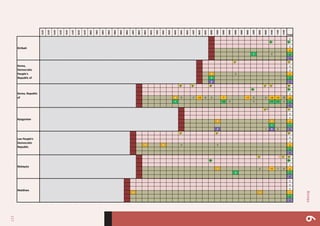
■ Subsistence hunting (i.e. not for economic benefit)
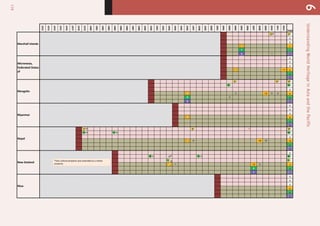
■ Livestock farming/grazing of domesticated animals (grazing on
farms or by pastoral groups)
■ Land conversion (agriculture – crops and livestock, rural,
forestry)
■ Crop production (deep ploughing, new crops, intensification
of planted agriculture, traditional crops, traditional systems,
gardening)
■ Commercial wild plant collection (pharmaceutical trade,
medicinal plants, fodder collection, thatching, mushrooms,
bulbs, etc.)
■ Subsistence wild plant collection (indigenous subsistence
hunting, gathering and collecting, i.e. not for economic
benefit, for example: food plants, medicinal plants, fodder
collection, thatching, mushrooms, bulbs, etc.)
■ Forestry/wood production (logging, pulp production, all
silvicultural operations, restoration/regeneration, sustainable
wood harvesting)
Impact of biological resource use and modification on
cultural properties
The use and modification of biological resources are a factor
that mainly affects natural and possibly mixed heritage
properties. There are, however, many cultural properties that
include land without built structures. These include smaller
plots, gardens and parks within monument ensembles or
historic cities. There are cultural properties with forested areas
that might have significance for nearby monuments and
shrines.
One category of cultural properties that could be impacted
by the use and modification of biological resources is cultural
landscapes. As per the Operational Guidelines, cultural
landscapes are cultural properties that represent the ‘combined
works of nature and of man’. This is very often associated with
people's dependence on the possibilities and constraints of
their environment and how they utilize and give meaning to
their surroundings.
Impact of biological resource use and modification on
natural properties
Natural properties are storehouses of resources required to
sustain the livelihoods and ensure the survival of those who
live in and around them. It should be an accepted premise
in the protection and management of natural properties
that rural populations, in particular, must be able to derive
sustainable benefit from biological resource use both from the
property and its buffer zone. The buffer zone can provide the
opportunity for people to continue to obtain access to natural
resources and to be compensated if required for any loss of
access to resources.
Natural resources and products can provide a host of benefits
and uses including: food, fuel, construction materials, shelter,
clothing, medicines, arts and craft materials and cash crops
(especially low-impact activities such as beekeeping).
In some properties indigenous people may live in harmonious
balance with the natural environment – they may even be said
to be part of the natural ecosystem. Traditional harvesting and
hunting or gathering may be permitted, especially where they
are conducted on a sustained yield basis. These activities may
be conducted on land, sea and freshwater environments.
Problems arise, however, when these resources are harvested
or otherwise stressed beyond their natural capacity and
recuperative powers. Where the harmony between people
and ecosystem conservation breaks down, the ensuing
problems may require solutions through properly integrated
and regulated regional planning.
Generally the smaller, low-impact activities are favoured,
but some larger-scale activities may be permissible. For
example, livestock grazing and browsing can be a beneficial
management tool in both natural and cultural properties
provided it is controlled within ecological tolerance limits.
Large-scale commercial production based on natural resources
is normally incompatible with World Heritage protection and
management objectives.
A good example of traditional management and use of
natural resources is provided by East Rennell (Solomon
Islands), which was the first property under local customary
ownership to attain World Heritage status. Traditional gardens
for subsistence food supplies are cultivated using seasonal
cropping and fallow techniques. Some cash crops are grown
and coconut is produced for sale. Thirteen species of birds are
taken for food and villagers harvest marine and lake resources
on both a regular and opportunistic basis. The natural forests
are a storehouse for the local inhabitants – providing building
75
Challenges for Conservation 3
timber, ropes, firewood, food, medicine, bark and tapa cloth,
canoe wood and carving wood and tools for fishing, hunting
and crafts.
Orchids, butterflies and small animals are sometimes taken to
be sold. Customary hunting, gathering and fishing methods
and practices are still largely in use, but there is evidence of
a gradual move away from these to the use of more modern
techniques. Already, there are signs of overharvesting of
some resources such as coconut crab, which faces the
potential of localized extinction, and marine resources such
as crayfish, trochus, beche-de-mer and clamshells whose
stocks are suffering from localized decline. These problems
and proposed solutions are highlighted in the management
plan for the property.
General response to biological resource use and
modification
The traditional utilization of biological resources by indigenous
communities is usually considered part of the heritage
system. The delicate balance between the rate of utilization
and the natural renewal needs to be monitored to ensure
its sustainability. The threat of large-scale land conversion,
establishment of large-scale agricultural production
systems and the commercial over-use of resources need to
be controlled.
Impact of biological resource use and modification in
Asia and the Pacific
Biological resource use and modification in cultural properties
are generally considered to be positive, especially in South-East
Asia (11.1% positive impact to 4.4% negative) and the Pacific
(10% positive impact to 1.7% negative). Only for the cultural
properties in South Asia is this factor considered slightly more
negative (4.4% positive to 6.4% negative).
The situation with natural properties is rather different. There is
a clear indication that biological resource use and modification
are considered to have a negative impact. South-East Asia
indicates 28.3% negative to 3.3% positive, whereas South
Asia indicates 26% negative to 1% positive. This is presumably
because of excessive use of the biological resources.
At Lorentz National Park (Indonesia) it has been noted that in
the mainland of the property, traditional hunting and fishing
for subsistence of local communities occur while there are also
reports of illegal poaching. In the Tubbataha Reefs Natural Park
(Philippines) a statistically significant positive trend in total fish
biomass, including commercial fish species as well as trends in
large marine species, indicates a healthy reef system. A drop in
tuna and mackerel numbers may be attributed to the impacts
of fishing in the wider region. Gunung Mulu National Park
(Malaysia) notes that there are community rights pertaining
to hunting, fishing and the collection of non-timber forest
products that were accorded at the time of the original creation
of the National Park. It is positive that the same community is
involved in the management and conservation of the park.
In the Tropical Rainforest Heritage of Sumatra (Indonesia) there
have been reports of continued hunting and sale of songbirds,
along with mining exploration and poaching of Sumatran
tigers. In Sundarbans National Park (India) the unsustainable
harvest of tiger prawn seed is reported to pose a serious
threat to the ecosystem of the Sundarbans as a whole, and
has implications for the sustainability of the fisheries in the
region. In Shiretoko (Japan) management is required of fishing
in consultation with local fishers as well as fishing activities
in the wider Sea of Okhotsk. Effective measures were also
considered to be required to minimize conflicts between fishers
and the conservation of the threatened Steller sea lion as well
as providing for unimpeded movement of salmon species
between the marine and riverine habitats. In East Rennell
(Solomon Islands) more than 800 residents in the property rely
for their survival on access to the resources of land, freshwater
and sea; however, over-exploitation of coconut crab, fisheries,
logging and mining are potential threats to the property.
The situation with mixed properties seems to be slightly more
balanced. In the Pacific, biological use and modification seem
to be an important factor but with equal positive and negative
impact (18%). In North-East Asia the balance tips slightly
towards the negative impact – 17.5% compared with 12.5%
positive. This suggests a balance between the traditional use
and the conservation of biological resources.
Figure 56. Impact of biological resource use and modification
on cultural properties.
Figure 57. Impact of biological resource use and modification
on natural properties.
Figure 58. Impact of biological resource use and modification
on mixed properties.
Pollution Biological resource use/modification
-25.0 -20.0 -15.0 -10.0 -5.0 0.0 5.0
Pacific
South-East
North-East
South
West  Central
Negative Positive
-40.0 -30.0 -20.0 -10.0 0.0 10.0
Pacific
South-East
North-East
South
West  Central
Negative Positive
*
-40.0 -30.0 -20.0 -10.0 0.0
Pacific
North-East
Negative Positive
-10.0 -5.0 0.0 5.0 10.0 15.0
Pacific
South-East
North-East
South
West  Central
Negative Positive
-40.0 -30.0 -20.0 -10.0 0.0 10.0 20.0
Pacific
South-East
North-East
South
West  Central
Negative Positive
*
-20.0 -10.0 0.0 10.0 20.0
Pacific
North-East
Negative Positive
Pollution Biological resource use/modification
-25.0 -20.0 -15.0 -10.0 -5.0 0.0 5.0
Pacific
South-East
North-East
South
West  Central
Negative Positive
-40.0 -30.0 -20.0 -10.0 0.0 10.0
Pacific
South-East
North-East
South
West  Central
Negative Positive
*
-40.0 -30.0 -20.0 -10.0 0.0
Pacific
North-East
Negative Positive
-10.0 -5.0 0.0 5.0 10.0 15.0
Pacific
South-East
North-East
South
West  Central
Negative Positive
-40.0 -30.0 -20.0 -10.0 0.0 10.0 20.0
Pacific
South-East
North-East
South
West  Central
Negative Positive
*
-20.0 -10.0 0.0 10.0 20.0
Pacific
North-East
Negative Positive
Pollution Biological resource use/modification
-25.0 -20.0 -15.0 -10.0 -5.0 0.0 5.0
Pacific
South-East
North-East
South
West  Central
Negative Positive
-40.0 -30.0 -20.0 -10.0 0.0 10.0
Pacific
South-East
North-East
South
West  Central
Negative Positive
*
-40.0 -30.0 -20.0 -10.0 0.0
Pacific
North-East
Negative Positive
-10.0 -5.0 0.0 5.0 10.0 15.0
Pacific
South-East
North-East
South
West  Central
Negative Positive
-40.0 -30.0 -20.0 -10.0 0.0 10.0 20.0
Pacific
South-East
North-East
South
West  Central
Negative Positive
*
-20.0 -10.0 0.0 10.0 20.0
Pacific
North-East
Negative Positive
* Only one property in this subregion.
76
Understanding World Heritage in Asia and the Pacific3
Physical resource extraction
Description of factors included under this category
Mining sites whose associated values are considered to be
universal and outstanding have been inscribed on the World
Heritage List as industrial heritage. Mining and quarrying are
industries that have existed since at least Neolithic times,
5,000 years ago. However, it must be clearly understood that
most forms of physical resource extraction will have dramatic
effects on the environment. Surface mining and quarrying can
physically change the entire topography of the area. There are
various forms of subsurface mining that would have less direct
impact on the environment; however the related infrastructure
could affect the integrity of the heritage property.
Factors considered under this category
■ Quarrying (rock, sand, aggregates)
■ Mining
■ Oil and gas
■ Water
Impact of physical resource extraction on cultural
properties
There are various cultural properties that have been inscribed
as industrial heritage or sites with related mining activities.
These values would need to be safeguarded.
Mining and quarrying activities along with extraction of oil,
gas and water are usually considered to be unfavourable
to heritage properties. Most of these activities themselves
can threaten the environment, as can the infrastructure
development that accompanies them, even when they take
place outside the boundaries of cultural properties. This is
especially the case with cultural landscapes and properties
that are closely linked to the surrounding environment with
potential physical resources.
Large-scale extraction of water can lower groundwater levels
and lead to the drying up of aquifers. This can have the effect
of inducing settlement of the ground which can cause severe
damage to monuments, historic buildings and even entire
cities.
Impact of physical resource extraction on natural
properties
Large-scale extraction or exploitation of physical resources,
such as soil, rock, minerals and water, is essentially
incompatible with the protection and management objectives
of World Heritage properties because of the destructive
impact. As such they are generally not permissible activities.
They need not necessarily be totally prohibited, however. For
example, it is possible to drill for oil beneath natural areas
without significantly disturbing the ecosystem components
or processes, but careful safeguards need to be put in place.
Restoration of exploited and damaged sites is possible and
techniques are improving, but restoration is nowhere near
capable of returning natural ecosystems and environments to
their original condition.
Resource extraction in buffer zones may be permissible
provided that it is planned and conducted in ways that ensure
no impact on the values or integrity of the World Heritage
property.
General response to physical resource extraction
It is clearly understood within the Convention that mining is
incompatible with World Heritage status, as recognized by the
International Council on Mining and Metals and other industry-
led bodies, and endorsed by the World Heritage Committee.
Where quarrying and mining are part of the heritage of the
property, these activities need to be continued in a sustainable
manner. However, the properties that are listed under industrial
heritage are not necessarily still operational.
Care should be taken to ensure that ongoing or newly
introduced extraction facilities do not impact the integrity of
the heritage property. All forms of physical resource extraction
will impact the environment. In most cases, this should not
be taking place within the heritage boundaries. Should such
Most forms of physical resource extraction have dramatic
effects on cultural and natural properties.
77
Challenges for Conservation 3
activities be carried out near the heritage property, the impact
on the values of the property and the environment must be
assessed, monitored and adequately regulated.
Impact of physical resource extraction in Asia and the
Pacific
For cultural properties physical resource extraction is generally
considered to be slightly more positive, with West and Central
Asia indicating 8% positive and 5% negative, North-East
Asia indicating 4.5% positive and 4% negative, whereas
South-East Asia indicates 5.6% positive to 2.8% negative.
This is slightly different with South Asia where the impact
of physical resource extraction on cultural properties is
considered more negative (5.1% positive to 10.9% negative).
The cultural properties in the Pacific do not consider this to
be a factor at all.
The trend is very different for natural properties. The properties
in the Pacific indicate a clear negative impact with 20% in
contrast to 1.7% positive. In South Asia the impact of physical
resource extraction on natural properties is not considered
positive in any way with indications of it being only negative
(15%). The trend is slightly different in North-East Asia (5.8%
negative to 7.7% positive) and South-East Asia (4.2% negative
to 6.3% positive). All positive impacts are reported to be
related to water. No impact is indicated on the single natural
property in West and Central Asia.
In Sagarmatha National Park (Nepal) mining of rock, sand and
turf is regulated with set times and dates during which natural
resource exploitation and collection is permitted within the
property. Building material extraction is allowed once a year for
a month, and sand and turf exploitation is permitted all year
round. At the Three Parallel Rivers of Yunnan Protected Area
(China) it has been reported that there are no existing mining
operations within the property. Mining operations adjacent to
the property are considered a significant threat. However, no
new mining operations are to be approved within the property
or its buffer zone, and the authorities will enforce strict control
of existing mining operations in the buffer zone and areas
adjacent to the property.
In the Tropical Rainforest Heritage of Sumatra (Indonesia)
there are reports of small-scale sand mining and plans for
coal mining development in the hill forests adjacent to the
property. Increased patrols are used to combat illegal sand
mining activities and the authorities have been urged to ensure
that no mining licences are granted inside the property. Lorentz
National Park (Indonesia) reported threats from mining, timber
collection, poaching and road construction. Concern was also
expressed about the reported oil and gas exploration within
the World Heritage property, which is supported by licences
and permits. In addition a large landslide was reported in
and near the property, which is suggested to be the result
of underground mining. In Purnululu National Park (Australia)
concern was shown that a company had applied for mining
rights and proposed to develop an opencast coal mine 6 km
from the property.
The situation for mixed properties shows that in North-East
Asia physical resource extraction is not an impact. In the Pacific,
the mixed properties indicate the impact to be 15% negative
and 10% positive. In Kakadu National Park (Australia), for
many years prior to its inscription as World Heritage, plans for
mining were the subject of public controversy.
Figure 59. Impact of physical resource extraction on cultural
properties.
Figure 60. Impact of physical resource extraction on natural
properties.
Figure 61. Impact of physical resource extraction on mixed
properties.
Physical resource extraction Unfavourable huma
-15.0 -10.0 -5.0 0.0 5.0 10.0
Pacific
South-East
North-East
South
West  Central
Negative Positive
-25.0 -20.0 -15.0 -10.0 -5.0 0.0 5.0 10.0
Pacific
South-East
North-East
South
West  Central
Negative Positive
*
-20.0 -15.0 -10.0 -5.0 0.0 5.0 10.0 15.0
Pacific
North-East
Negative Positive
-20.0
Pacific
South-East
North-East
South
West  Central
N
-25.0
Pacific
South-East
North-East
South
West  Central
N
*
-25.0
Pacific
North-East
N
Physical resource extraction Unfavourable huma
-15.0 -10.0 -5.0 0.0 5.0 10.0
Pacific
South-East
North-East
South
West  Central
Negative Positive
-25.0 -20.0 -15.0 -10.0 -5.0 0.0 5.0 10.0
Pacific
South-East
North-East
South
West  Central
Negative Positive
*
-20.0 -15.0 -10.0 -5.0 0.0 5.0 10.0 15.0
Pacific
North-East
Negative Positive
-20.0
Pacific
South-East
North-East
South
West  Central
N
-25.0
Pacific
South-East
North-East
South
West  Central
N
*
-25.0
Pacific
North-East
N
Physical resource extraction Unfavourable huma
-15.0 -10.0 -5.0 0.0 5.0 10.0
Pacific
South-East
North-East
South
West  Central
Negative Positive
-25.0 -20.0 -15.0 -10.0 -5.0 0.0 5.0 10.0
Pacific
South-East
North-East
South
West  Central
Negative Positive
*
-20.0 -15.0 -10.0 -5.0 0.0 5.0 10.0 15.0
Pacific
North-East
Negative Positive
-20.0
Pacific
South-East
North-East
South
West  Central
N
-25.0
Pacific
South-East
North-East
South
West  Central
N
*
-25.0
Pacific
North-East
N
* Only one property in this subregion.
78
Understanding World Heritage in Asia and the Pacific3
Unfavourable human activities
Description of factors included under this category
There have been many unfavourable human activities that have
had major negative impact on heritage properties. These can
be categorized under illegal activities carried out by individuals
or small groups for personal gain by means of illegally
obtaining resources that are part of a heritage site. Individuals
and small groups have also been known to deliberately harm
or destroy heritage for ideological, political or psychological
reasons. Heritage can be caught up in the middle of larger
conflicts and be destroyed or damaged because it has a certain
symbolic value, is used as a protective shield or is just in the
way.
Factors considered under this category
■ Illegal activities (illegal extraction of biological resources, i.e.
poaching), blast fishing, cyanide fishing, illegal extraction
of geological resources (mining/fossils), illegal trade, illegal
occupation of space, illegal excavations, illegal construction,
looting, theft, treasure hunting, ghost nets (discarded fishing gear)
■ Deliberate destruction of heritage (vandalism, graffiti,
politically motivated acts, arson)
■ Military training
■ War
■ Terrorism
■ Civil unrest
Impact of unfavourable human activities on cultural
properties
There are many cultural heritage properties that have suffered
from unfavourable human activities. As cultural heritage
properties often have great symbolic or religious value,
they become targets for those who want to attack or send
a message to opposing communities. Unfavourable human
activities for cultural properties can be limited to individuals
who illegally excavate, take pieces from historic structures
or loot artefacts. Graffiti can damage the surfaces of historic
structures and especially murals, paintings and ornamentation.
There have been numerous cases of vandalism and arson.
In some cases these acts have been carried out to attract
attention, as important heritage sites are covered by the media.
Sometimes such actions are carried out without proper
awareness of their impact. There are unfavourable human
activities in the form of religious rituals or for personal pleasure.
Even if there is a lack of awareness, it is still illegal, for example,
for a pilgrim to break away parts of archaeological structures,
no matter how much religious value these might have.
As recently as over the last decade, there have been cases
where significant cultural properties have been destroyed or
damaged due to terrorism, civil unrest and outright war. These
forms of conflict are often fought over a large area and with
the involvement of entire populations. This makes it difficult
to control. However there have been some bold steps taken
to formulate international conventions to prepare for the
protection of cultural heritage properties during armed conflict.
Impact of unfavourable human activities on natural
properties
Unfavourable and illegal activities can have a negative impact
on natural properties too. Poaching of rare and endangered
animals is the most commonly reported illegal activity. Site
managers are well aware of the problems and are taking
measures to combat them, but lack of staff and finance
hinders their efforts.
Illegal taking and trading in rare and endangered species of
plants and animals are ongoing problems for some properties.
In the Solomon Islands this is associated with logging activities.
In New Zealand there have been particular cases involving the
tuatara, a small, primitive and truly unique reptile somewhat
akin to the long-extinct dinosaurs. Unauthorized taking and
excessive collecting of fossils are a problem reported by the
Australian Fossil Mammal Sites (Riversleigh/Naracoorte). Civil
unrest in the Solomon Islands two years after East Rennell
was inscribed as World Heritage led to a situation where
the government was unable to attend to its World Heritage
responsibilities. There was little or no contact by government
with the property and no direct assistance was provided to
the customary owners. Regrettably, financial aid and technical
support for the property from international sources were also
unavailable during this time. This situation has improved in
recent years but is still less than satisfactory.
The Cultural Landscape and Archaeological Remains of the
Bamiyan Valley (Afghanistan) is a victim of war.
79
Challenges for Conservation 3
General response to unfavourable human activities
The need for control of illegal activities can be reduced
by employing methods of awareness-raising and law
enforcement. The awareness of the communities and visitors
must be built on the negative impact of illegal activities. Clear
simple reasoning must be provided on why certain activities are
not allowed. This must however be carried out hand in hand
with a clear security plan with guards watching over the most
important aspects of the heritage property.
The Convention for the Protection of Cultural Property in the
Event of Armed Conflict (the Hague Convention) of 1954
along with its first and second Protocols addresses the threat
of armed conflict on cultural heritage properties. Based on
the Convention the Blue Shield was established, which is
often described as equivalent to the Red Cross for cultural
properties. The Blue Shield network consists of organizations
that deal with the protection of cultural sites in the event of
armed conflict including museums, archives and libraries, as
well as monuments and sites. The Convention on the Means
of Prohibiting and Preventing the Illicit Import, Export and
Transfer of Ownership of Cultural Property was made in 1970
to fight against illicit import and export of cultural property.
The Convention for the International Trade in Endangered
Species of Fauna and Flora (CITES) is the principal international
instrument for controlling illegal taking and trading of rare
and endangered species of biota. (For more detail, see
pages 34–35, Coordination with other conventions.)
Impact of unfavourable human activities in Asia and
the Pacific
Unfavourable human activities were predominantly considered
to be negative for all categories of properties. For cultural
properties, the negative impact of this factor seems to be
highest for the properties in South Asia (17.5%) followed by
South-East Asia (8.3%), West and Central Asia (5.3%), North-
East Asia (3.3%) and the Pacific (2.8%).
The Mahabodhi Temple Complex at Bodhgaya (India) raised
concern over development pressures, vandalism and theft.
In the Historical Monuments at Makli, Thatta (Pakistan),
observations were made that during the flood the property
had been subject to looting, vandalism, destruction and
degradation of various elements, as well as occupation by
internally displaced persons.
The Cultural Landscape and Archaeological Remains of the
Bamiyan Valley (Afghanistan) was inscribed on the List of
World Heritage in Danger in 2003 due to risks such as looting,
illicit traffic and illegal excavations of cultural heritage assets,
as well as continued use of certain heritage areas for military
posts. Similarly, the Minaret and Archaeological Remains
of Jam (Afghanistan) was inscribed on the List of World
Heritage in Danger in 2002 due to lack of protection from the
factors affecting the property such as political instability, illicit
excavations and looting.
Armed clashes around the Temple of Preah Vihear (Cambodia)
reportedly caused damage to the property. Angkor (Cambodia)
on the other hand is seen as a success story where the threat
of illicit excavation, pillaging and landmines has been fully
removed.
The trend for natural properties is similar, but considered to
have more of an impact in South-East Asia (19.4%) and the
Pacific (14.4%), followed by South Asia (13.3%) and North-
East Asia (2.6%).
In the Sundarbans (Bangladesh) there have been reports of
poaching of tigers and prey species. In Kaziranga National Park
(India), although illegal activities appear to be more or less
under control, the situation facing the one-horned rhinoceros
– the prime target for poaching – remains serious. Armed
confrontations between park staff and poachers occur from
time to time. Poaching of rhinos has also been a constant issue
for Chitwan National Park (Nepal).
In Lorentz National Park (Indonesia) the lowland areas of the
park have been affected by illegal logging and poaching taking
place along the rivers that provide access to the area. The
Tropical Rainforest Heritage of Sumatra (Indonesia) has faced
heavy pressure from illegal activities, including encroachment,
logging, poaching and the wildlife trade. Illegal fishing has also
been found to impact Komodo National Park (Indonesia) and
Tubbataha Reefs Natural Park (Philippines).
The situation for mixed properties shows that the impact of
unfavourable human activities is high in the Pacific (23.3%).
Figure 62. Impact of unfavourable human activities on cultural
properties.
Figure 63. Impact of unfavourable human activities on natural
properties.
Figure 64. Impact of unfavourable human activities on mixed
properties.
Physical resource extraction Unfavourable human activities
-15.0 -10.0 -5.0 0.0 5.0 10.0
Pacific
South-East
North-East
South
West  Central
Negative Positive
-25.0 -20.0 -15.0 -10.0 -5.0 0.0 5.0 10.0
Pacific
South-East
North-East
South
West  Central
Negative Positive
*
-20.0 -15.0 -10.0 -5.0 0.0 5.0 10.0 15.0
Pacific
North-East
Negative Positive
-20.0 -15.0 -10.0 -5.0 0.0 5.0
Pacific
South-East
North-East
South
West  Central
Negative Positive
-25.0 -20.0 -15.0 -10.0 -5.0 0.0 5.0
Pacific
South-East
North-East
South
West  Central
Negative Positive
*
-25.0 -20.0 -15.0 -10.0 -5.0 0.0
Pacific
North-East
Negative Positive
Physical resource extraction Unfavourable human activities
-15.0 -10.0 -5.0 0.0 5.0 10.0
Pacific
South-East
North-East
South
West  Central
Negative Positive
-25.0 -20.0 -15.0 -10.0 -5.0 0.0 5.0 10.0
Pacific
South-East
North-East
South
West  Central
Negative Positive
*
-20.0 -15.0 -10.0 -5.0 0.0 5.0 10.0 15.0
Pacific
North-East
Negative Positive
-20.0 -15.0 -10.0 -5.0 0.0 5.0
Pacific
South-East
North-East
South
West  Central
Negative Positive
-25.0 -20.0 -15.0 -10.0 -5.0 0.0 5.0
Pacific
South-East
North-East
South
West  Central
Negative Positive
*
-25.0 -20.0 -15.0 -10.0 -5.0 0.0
Pacific
North-East
Negative Positive
Physical resource extraction Unfavourable human activities
-15.0 -10.0 -5.0 0.0 5.0 10.0
Pacific
South-East
North-East
South
West  Central
Negative Positive
-25.0 -20.0 -15.0 -10.0 -5.0 0.0 5.0 10.0
Pacific
South-East
North-East
South
West  Central
Negative Positive
*
-20.0 -15.0 -10.0 -5.0 0.0 5.0 10.0 15.0
Pacific
North-East
Negative Positive
-20.0 -15.0 -10.0 -5.0 0.0 5.0
Pacific
South-East
North-East
South
West  Central
Negative Positive
-25.0 -20.0 -15.0 -10.0 -5.0 0.0 5.0
Pacific
South-East
North-East
South
West  Central
Negative Positive
*
-25.0 -20.0 -15.0 -10.0 -5.0 0.0
Pacific
North-East
Negative Positive
* Only one property in this subregion.
80
Understanding World Heritage in Asia and the Pacific3
Tourism
Description of factors included under this category
Tourism is known to play an important role in promoting and
sustaining heritage sites. Therefore people are encouraged to
visit places of significance to learn and to enjoy the experience.
This provides a source of income and develops the prestige
of the site. To cater for the tourists, heritage sites require
presentation and interpretation. There are, however, many
activities that arise from tourism pressure that can have a
negative impact on the heritage property. There can be physical
damage caused by heightened activities and constructions.
There can also be a loss of ambience, environment and context
of the property through inappropriate activities.
Factors considered under this category
■ Impacts of tourism/visitor/recreation (high levels of visitation,
vendors, building community support, sustainable livelihoods)
■ Major accommodation and associated infrastructure (hotels,
restaurants, golf courses, ski resorts, etc.), major/permanent
high-cost tourist facilities (pontoons, jetties, observatories,
cable cars, chalets, fully serviced camping areas, etc.)
■ Interpretative and visitor facilities (visitor interpretive facilities
(visitor centres, site museums, etc.), signage, trail hardening
(trail markers, etc.), information booths, picnic facilities,
camping areas, moorings/marker buoys)
Impact of tourism on cultural properties
Experience shows that tourism has both negative and positive
impacts on cultural properties. As the significance of the
heritage is acknowledged and promoted through inscription
on the World Heritage List, there is generally an increased
desire for people throughout the world to visit the property.
This demand creates a pressure that needs to be kept under
tight monitoring to ensure that it does not lead to activities
that negatively impact the very heritage that it is thriving on.
Many World Heritage properties see tourism as both a positive
and negative factor affecting the property.
There is a wide range of positive consequences of tourism
on cultural heritage properties. For many sites, tourism is an
important source of income. Depending on the type of tourism
that is promoted, visitors can come in organized groups to
ensure least impact on the property, but with high centralized
profits. These profits should be invested back into the
management of the heritage property, a pledge which is not
always fulfilled. Tourism can also be promoted to ensure that
there is maximum contact between the visitors and the local
community and entrepreneurs, so that a maximum number
of people can profit from tourism. Once the community is
dependent on the heritage for their livelihood, they develop
an interest to ensure that it is safeguarded. The community,
however, also safeguards the heritage which is an important
source of their history and identity.
The pressures of tourism can have serious effects on heritage
properties. The demand of a tourism industry which is not
geared towards sustainability can lead to major construction
activities for visitor facilities in and around the heritage property.
There is a tendency to try to develop hotels and accommodations
as close to the main heritage site as possible. Visitors demand a
certain level of utilities and services even within historic buildings
or near archaeological sites. Excessive use and inappropriate
behaviour can have long-lasting impact on cultural heritage
properties. This is especially the case in the heritage sites that
have religious or spiritual meaning to the community, where
spirituality and ambiance play an important role. Tourism can
also lead to vandalism, general disturbance and pollution.
Impact of tourism on natural properties
The principles and the issues relating to tourism are essentially
common to both cultural and natural properties. Inevitably
visitor numbers increase substantially once a property is
inscribed on the World Heritage List, often by many times over
the pre-inscription levels. Increase in tourism pressure can also
occur very rapidly and may be sustained over a long period,
and this requires careful management to minimize impact.
Among the most commonly reported problems for natural
properties are: overcrowding leading to environmental
disturbance and stress on wildlife, overdevelopment with
excessive construction of buildings and other facilities such
as power lines and cell-phone towers, causing environmental
damage; pollution of land, waterways and air, including
excessive levels of noise and artificial light, littering, damage
from vandalism and inappropriate activities, feeding of animals
leading to changes in their behaviour, disturbance and losses to
wildlife from recreational activities – excessive sport fishing and
hunting, and wildlife mortality from vehicle traffic on roads,
off-road vehicle use and powerboats; and inappropriate or
illegal souvenir collection. All the problems and impacts from
The popularity of certain properties leads to overcrowding of
visitors.
81
Challenges for Conservation 3
increased tourism can be minimized or completely avoided
through appropriate management intervention.
General response to tourism
All heritage properties need tourism management. This
should be based on a clear understanding of the negative
and positive impact of the visitors and an assessment of the
carrying capacity of the heritage property. Strategies need to
be developed to control the negative impact and to promote
the positive aspects of tourism. This requires detailed studies,
research, surveys and expertise to develop an overall tourism
plan for the heritage property.
The key to minimizing tourism impact is to promote
ecotourism – tourist operations with codes of conduct that
respect the need for environmental and ecological restraints.
This is especially important for natural properties to avoid
damaging or destroying the very features and values that
give the property its Outstanding Universal Value. The same
principles apply to respecting values in cultural properties. The
major problems come with mass tourism mounted on a totally
commercial foundation. This approach to tourism development
has no place inside World Heritage properties and should be
confined or diverted to areas outside the boundaries of the
property and its buffer zone.
It is important to recognize that, while tourism can be a great
stimulus for economic growth and the well-being of the
residents and communities within and around the heritage
property, it does not necessarily have to be conducted on a
large scale. The level and volume of tourist operations should
be consistent with the capacity of the property to sustain the
impact without unacceptable damage and the abilities and
needs of the property owners and managers. A case in point
is East Rennell in the Solomon Islands where to date efforts
to promote tourism have been almost totally unsuccessful
despite some ecolodges being built in the property. Turning
this situation around requires, first, recognition that only small-
scale operations are required to meet the needs of income
generation (e.g. occupancy of lodges of around 1,000 bed-
nights/year), secondly, that the local people are trained in the
required marketing and business skills and, thirdly, that the
local operations are fully integrated within a national tourism
plan that attends to matters such as tourism promotion and
provision of travel services and infrastructure. These principles
apply universally to linking tourism development and heritage
protection in ways that are mutually compatible and reinforcing.
Impact of tourism in Asia and the Pacific
Tourism is seen to have both a positive and a negative impact
on World Heritage properties. For cultural properties, on
average the positive impact is perceived as being about three
times that of the negative impact. South Asia (34.2%) indicates
the highest negative impact and South-East Asia (64.8%) the
highest positive impact.
A similar trend can be seen with natural properties. A higher
percentage of overall impact is shown. South Asia (46.7%)
indicates the highest negative impact and South-East Asia
(77.8%) the highest positive impact.
As an impact of tourism and the management response
to it, Historic Villages of Shirakawa-go and Gokayama
(Japan) mentioned that the increase of tourists has brought
intermittent problems with traffic congestion during the peak
tourist season. To address this issue, measures have been taken
to prohibit the entry of tour buses into the property area and
the restriction of access by other tourist vehicles. In addition,
parking facilities are being established outside the property
area in order to reduce the number of tourist vehicles entering.
Similarly, natural properties such as Tubbataha Reefs
Natural Park (Philippines) reported a lack of tourism impact
monitoring. Ha Long Bay (Viet Nam) reported the need to
reduce visitor pressure by dispersing visitors throughout the
property. Similarly in Dong Phayayen-Khao Yai Forest Complex
(Thailand), consideration has been given to sustainable
tourism, ecotourism including carrying capacity, and
community participation to manage high visitor levels. East
Rennell (Solomon Islands) initiated projects in ecotourism and
small business development along with an Ecotourism Plan.
Sagarmatha National Park (Nepal) reported illegal construction
of tourist lodges and footpaths. Purnululu National Park
(Australia) raised the need to address the concerns of
traditional landowners regarding unsuitable tourism access to
culturally significant sites.
Figure 65. Impact of tourism on cultural properties.
Figure 66. Impact of tourism on natural properties.
Figure 67. Impact of tourism on mixed properties.
Tourism Interaction with soci
-40.0 -20.0 0.0 20.0 40.0 60.0 80.0
Pacific
South-East
North-East
South
West  Central
Negative Positive
-100.0 -50.0 0.0 50.0 100.0
Pacific
North-East
Negative Positive
-40.0
Pacific
South-East
North-East
South
West  Central
N
-40.0
Pacific
South-East
North-East
South
West  Central
N
*
-60.0
Pacific
North-East
N
-60.0 -40.0 -20.0 0.0 20.0 40.0 60.0 80.0 100.0
Pacific
South-East
North-East
South
West  Central
Negative Positive
*
Tourism Interaction with soci
-40.0 -20.0 0.0 20.0 40.0 60.0 80.0
Pacific
South-East
North-East
South
West  Central
Negative Positive
-100.0 -50.0 0.0 50.0 100.0
Pacific
North-East
Negative Positive
-40.0
Pacific
South-East
North-East
South
West  Central
N
-40.0
Pacific
South-East
North-East
South
West  Central
N
*
-60.0
Pacific
North-East
N
-60.0 -40.0 -20.0 0.0 20.0 40.0 60.0 80.0 100.0
Pacific
South-East
North-East
South
West  Central
Negative Positive
*
Tourism Interaction with soc
-40.0 -20.0 0.0 20.0 40.0 60.0 80.0
Pacific
South-East
North-East
South
West  Central
Negative Positive
-100.0 -50.0 0.0 50.0 100.0
Pacific
North-East
Negative Positive
-40.0
Pacific
South-East
North-East
South
West  Central
N
-40.0
Pacific
South-East
North-East
South
West  Central
N
*
-60.0
Pacific
North-East
N
-60.0 -40.0 -20.0 0.0 20.0 40.0 60.0 80.0 100.0
Pacific
South-East
North-East
South
West  Central
Negative Positive
*
* Only one property in this subregion.
82
Understanding World Heritage in Asia and the Pacific3
Interaction with society
Description of factors included under this category
It is society that gives value to heritage. This is not always
straightforward, especially when the society or community that
produced some component of cultural heritage has moved
away or no longer exists. For example, abandonment that
happened in the Rice Terraces of the Philippine Cordilleras
(Philippines) was a negative factor for the property. Heritage
that is valued may also be subject to demands for use by a
society. Where indigenous people live within properties,
indigenous hunting, gathering and collecting of natural
resources happen as part of their lives. These uses can cause
deterioration of the fabric of heritage sites. Some forms of
use, such as rituals and festivals, can enhance certain values,
thus they could be considered to be a positive impact. These
activities could, however, cause the deterioration of the
heritage objects and artefacts at the same time, negatively
impacting the value of the heritage sites.
Factors considered under this category
■ Ritual/spiritual/religious and associative use festivals/
performances
■ Society’s valuing of heritage (change in values, abandonment
changes in values leading to new uses of heritage resources,
expansions of / additions to current uses of heritage resources,
conflicting values, abandonment)
■ Indigenous hunting, gathering and collecting
■ Changes in traditional ways of life and knowledge system (loss
of traditional knowledge and practices linked to heritage)
■ Identity, social cohesion, changes in local population and
community, changes in livelihoods, migration to or from site
Impact of interaction with society on cultural
properties
The values of cultural heritage properties are closely related
to how society perceives them. In many cases, these values
are associated with ritual, spiritual or religious usage of the
heritage property. In such cases, a conflict in perception can
arise between the material and the spiritual aspects of the
heritage. Objects used for rituals often require regular renewal.
The value lies in the usage and not the object. Should the
object being used for veneration have a value that exceeds
that for which it is being used, these activities would need to
be considered negative and thus might need to be halted. In
other cases, usage of heritage serves as the maintenance of
properties. This means that in order to maintain the value of
the property, it has to be used by the communities and neglect
or abandonment causes its deterioration. This shows that a
delicate balance between the use of heritage and its impact
on the property needs to be sought.
The relationship between the heritage value and society is
often so closely entwined that it is difficult to separate. The
impact on the tangible attributes must be monitored to ensure
that a balance is maintained between the activities carried out
by society for its own gain and the conservation of the heritage
objects.
Taking into account that often the heritage values have been
maintained by the community through traditional knowledge
and practices, it is essential that this form of involvement is
not lost through irreversible changes to society. Changes can
take place directly to the heritage site. When the values are
associated with the community, changes to the identity of the
society and to the population can have a far-reaching impact
on the heritage property itself.
Impact of interaction with society on natural properties
Impact issues for natural properties are in principle the same
as those for cultural properties. The ready availability of natural
materials for building, clothing and food can be considered a
positive effect of protection and conservation practices. Small-
scale timber milling may be an acceptable low-impact local
industry for providing cash income. However, social practices
associated with traditional customary uses of resources can
also detrimentally affect natural values and attributes. A case in
point is East Rennell (Solomon Islands) where the local residents
responsible for management of the property need to exploit its
natural resources for food and sustenance, and have harvested
coconut crab and some marine species to dangerously low
levels. The solution to this problem is not easily found, but it
involves raising awareness of species conservation needs, and
the provision of alternative food supplies.
General response to interaction with society
The first step in developing an approach to conserving heritage
is clarifying the related values. This is often closely related
to the values ascribed by society. The values and how they
are safeguarded also depend on how the heritage sites are
Society gives value to heritage and vice versa, but activities
carried out could have physical impacts on properties.
83
Challenges for Conservation 3
being used. This could be for religious or social purposes, but
very often the communities are economically dependent on
the heritage sites for their livelihoods. This interdependence
between the heritage and the community might be the very
attribute that determines the value of the heritage property.
The heritage must however also be protected from excessive
activities of the communities, which are often closely associated
with their understanding and value of the heritage. This means
that not all activities of the communities can be considered
to be positive for the conservation of the heritage. There are
sometimes conflicting values among the people, which lead to
the deterioration of the objects and resources that might be
gained from the heritage sites.
The involvement of the community has to be considered
and incorporated in the approach to conservation. This
means that the values and related activities connected with
the communities and society are important considerations
in defining the heritage value and conserving the respective
attributes of a heritage site.
Impact of interaction with society in Asia and the
Pacific
Interaction with society as a factor is considered positive
throughout all categories of World Heritage properties.
Overall, a large percentage of properties seem to be impacted
by this factor.
The trend with the impact of interaction with society on cultural
properties is clearly shown as positive. This is especially the
case with South-East Asia (45.6%) and North-East Asia (42%).
In South Asia, although the positive impact is considered
relatively high (30.3%), the negative impact is indicated as
comparatively high as well (27.2%). However in the Pacific the
impact is only considered to be positive (26.7%).
The Rice Terraces of the Philippine Cordilleras (Philippines) was
inscribed on the List of World Heritage in Danger in 2001 due
to abandonment of the terraces following neglected irrigation
systems and people leaving the area, among other reasons.
This was caused by the diminishing interest of Ifugao people
in their traditional culture, as well as by the fact that younger
generations opted to leave the rice terraces and find job
opportunities elsewhere. Efforts have been made to establish a
community-based programme to tackle the diminishing labour
in the conservation of terraces, and capacity-building has been
carried out to address the transfer of traditional knowledge to
younger generations.
Natural properties indicate a similar trend, although there is
a slightly higher average of negative impact. This is especially
the case in the Pacific, where interaction with society is
considered positive (32%) but with a high range of negative
impact (17.3%). The highest positive impact is related to the
society’s valuing of heritage, which leads to good levels of
collaboration with local communities and their involvement in
protection and management activities. The negative elements
are related to the changes in the traditional way of life and
knowledge system. This is probably related to cases of disputed
ownership and access to land and resources, particularly in
Australia and New Zealand. North-East Asia indicates a very
high positive impact (46.2%) in comparison with the negative
impact (10.8%).
In Sagarmatha National Park (Nepal) the importance of
the cultural and spiritual values of the property has been
recognized and community participation in the management
of the property has been ensured.
The Wet Tropics of Queensland (Australia) has reported that
the cultural values of the area for indigenous people should
be formally documented and there should be increased
indigenous involvement in management negotiated with
traditional owners and their representatives. Similarly, in
Purnululu National Park (Australia), steps have been taken
to support traditional aboriginal communities in the buffer
zone and due consideration has been given to the property’s
indigenous cultural values. There is an ongoing legal process
to determine native title and the involvement of indigenous
people in decisions about the management of the property.
Mixed properties present a similar situation, with the Pacific
indicating a very high level of impact with positive being 76%
and negative being 44%. The mixed properties in North-East
Asia indicate a lower impact however, with a similar ratio
between positive (40%) and negative (10%). For example,
at Kakadu National Park (Australia) the ability of Aboriginal
communities to continue their traditional relationships with the
land is considered essential, but threatened by mining proposals.
Figure 68. Impact of tourism on cultural properties.
Figure 69. Impact of tourism on natural properties.
Figure 70. Impact of tourism on mixed properties.
Tourism Interaction with society
-40.0 -20.0 0.0 20.0 40.0 60.0 80.0
Pacific
South-East
North-East
South
West  Central
Negative Positive
-100.0 -50.0 0.0 50.0 100.0
Pacific
North-East
Negative Positive
-40.0 -20.0 0.0 20.0 40.0 60.0
Pacific
South-East
North-East
South
West  Central
Negative Positive
-40.0 -20.0 0.0 20.0 40.0 60.0
Pacific
South-East
North-East
South
West  Central
Negative Positive
*
-60.0 -40.0 -20.0 0.0 20.0 40.0 60.0 80.0 100.0
Pacific
North-East
Negative Positive
-60.0 -40.0 -20.0 0.0 20.0 40.0 60.0 80.0 100.0
Pacific
South-East
North-East
South
West  Central
Negative Positive
*
Tourism Interaction with society
-40.0 -20.0 0.0 20.0 40.0 60.0 80.0
Pacific
South-East
North-East
South
West  Central
Negative Positive
-100.0 -50.0 0.0 50.0 100.0
Pacific
North-East
Negative Positive
-40.0 -20.0 0.0 20.0 40.0 60.0
Pacific
South-East
North-East
South
West  Central
Negative Positive
-40.0 -20.0 0.0 20.0 40.0 60.0
Pacific
South-East
North-East
South
West  Central
Negative Positive
*
-60.0 -40.0 -20.0 0.0 20.0 40.0 60.0 80.0 100.0
Pacific
North-East
Negative Positive
-60.0 -40.0 -20.0 0.0 20.0 40.0 60.0 80.0 100.0
Pacific
South-East
North-East
South
West  Central
Negative Positive
*
Tourism Interaction with society
-40.0 -20.0 0.0 20.0 40.0 60.0 80.0
Pacific
South-East
North-East
South
West  Central
Negative Positive
-100.0 -50.0 0.0 50.0 100.0
Pacific
North-East
Negative Positive
-40.0 -20.0 0.0 20.0 40.0 60.0
Pacific
South-East
North-East
South
West  Central
Negative Positive
-40.0 -20.0 0.0 20.0 40.0 60.0
Pacific
South-East
North-East
South
West  Central
Negative Positive
*
-60.0 -40.0 -20.0 0.0 20.0 40.0 60.0 80.0 100.0
Pacific
North-East
Negative Positive
-60.0 -40.0 -20.0 0.0 20.0 40.0 60.0 80.0 100.0
Pacific
South-East
North-East
South
West  Central
Negative Positive
*
* Only one property in this subregion.
84
Understanding World Heritage in Asia and the Pacific3
Management activities
Description of factors included under this category
Management is essential for the safeguarding of the
Outstanding Universal Value of World Heritage properties.
In many cases traditional management systems existed even
though the present conditions of these systems may vary
greatly. With changing circumstances, it is often necessary to
establish more contemporary forms of management which
would be part of the overall governance system of the State
Party. The management system must include maintenance and
monitoring procedures for the most significant attributes of
the heritage property. These procedures must be carried out
ensuring the least impact, especially activities that might have
negative effects on the integrity of the property.
Factors considered under this category
■ Management activities
■ Low-impact research/monitoring activities (visitor surveys,
water sampling, non-extractive surveys, In situ surveys)
■ High-impact research/monitoring activities (excavation,
sampling using destructive techniques, research involving
removal of features or species, i.e. extraction)
Impact of management activities on cultural properties
Management activities can have an extensive impact on
cultural heritage properties. An adequate management system
can ensure that the authenticity and integrity of the attributes
that express the value of the property are maintained. With
a lack of knowledge and awareness, management activities
can have the exact opposite impact of what was intended.
Protective structures have known to change the microclimatic
conditions which accelerate material degradation. For the
security of properties, there is often extensive fencing and
security equipment installed which impact the visual integrity
of the heritage site and in some cases have direct physical
impact on the heritage objects.
Generally, low-impact research and monitoring activities can be
seen as a positive means of safeguarding cultural properties.
These are often carried out on a regular basis to ensure
that the methods of site management have maintained the
required state of conservation. Low-impact research includes
mainly observations and surface analysis. Such activities are
included in daily routines which can be the basis for regular
maintenance and cleaning. Often such activities are carried out
by caretakers who do not necessarily need to be highly trained,
but should have sufficient awareness of the heritage property.
On the other hand, there are certain circumstances that
require high-impact research or monitoring activities. These
can generally be considered to have a negative impact, if
they are not carried out with clear justifications and by highly
trained experts. These kinds of activities are often connected
with extraction of samples from the heritage objects, from the
building structures or the archaeological sites. Such activities
are usually carried out only if more detailed information on
the site is required or there is a specific need for extensive
restoration works to be carried out.
Impact of management activities on natural properties
Impacts on natural properties are essentially the same as on
cultural properties, especially with regard to research activities.
Whether appropriate or not, management intervention may be
intrusive. An example is provided by Tongariro National Park
in New Zealand, where major physical structures have been
constructed on the lower slopes of the principal volcano as a
barrier against catastrophic lahars (ash flows) that are known
to be associated with eruptive events and have caused tragic
loss of life in the past. In this case the loss of natural values is
more than compensated by the heightened safety of people
and property. The lesson is that management intervention
may in some instances involve a necessary trade-off with
conservation in compromising natural (or cultural) values.
General response to management activities
The Operational Guidelines require all World Heritage properties
to ‘have adequate long-term legislative, regulatory, institutional
and/or traditional protection and management to ensure their
safeguarding’ (Paragraph 97). This means that all activities that
are part of this management system must ensure that the main
attributes of the World Heritage property are not impacted
in any negative manner. This is especially the case when
monitoring, maintenance and research are being carried out.
Many non-intrusive technologies have been developed
for research into elements of both natural and cultural
properties. For example, archaeological research does not
Management activities are essential for the safeguarding of the
Outstanding Universal Value of World Heritage properties.
85
Challenges for Conservation 3
require intrusive excavations to be carried out immediately,
as preliminary investigations can be made using equipment
such as Ground Penetrating Radar (GPR). With the help of
Geographic Information System (GIS) and satellite imagery,
much geographical information can be captured, managed
and analysed.
There are of course cases where intrusive methods cannot
be avoided. For more detailed testing of materials, it might
be necessary to extract samples from heritage structures and
archaeological sites. These samples provide more detailed
information on material composition and dating.
Impact of management activities in Asia and the Pacific
The impact of management activities is generally seen as
being positive throughout the region. With cultural properties
management is indicated as a positive impact with the highest
percentage in North-East Asia (62.7%), followed by South-
East Asia (59.3%), South Asia (54.7%) and West and Central
Asia (41.3%). West and Central Asia also indicates a negative
impact of 8%. In the Pacific, the impact is considered only
positive but comparatively low (33.3%) because in many cases
management is non-intrusive, relatively inconspicuous, and in
the Pacific Islands management activity may be minimal.
Lack of a proper management plan is quite often identified
as one of the factors affecting the properties by the World
Heritage Committee. For example, in Samarkand – Crossroad
of Cultures (Uzbekistan), factors affecting the property
were identified as the lack of strategic approach to urban
conservation and the lack of a proper management plan.
A similar situation was identified for the Historic Centre of
Bukhara (Uzbekistan), where there was a lack of a proper
conservation and management plan. Management plans are
being prepared for both these properties. The importance
of efforts to promote sustainable development through
conservation of traditional urban fabric for the benefit of local
populations was also noted.
Kathmandu Valley (Nepal) was placed on the List of World
Heritage in Danger in 2003 due to uncontrolled urban
development resulting in the loss of traditional urban fabric,
and this should be addressed through a management plan.
An Integrated Management Plan was prepared after two
and a half years of work, addressing the social, political and
economic complexities and challenges of the multi-component
property. It developed constituent instruments (such as the
Integrated Management Framework for adjusting structural
relations among stakeholders) and the commitment to build
from the ground up a planning approach which involved
all those who would be responsible for its implementation.
With the new integrated management plan, it allowed site
managers to monitor the activities of stakeholders and better
control the changes taking place within the urban setting.
The Archaeological Ruins at Moenjodaro (Pakistan) was to
develop an archaeological research strategy, using non-invasive
methods of investigation, and refrain from undertaking any
major archaeological interventions until this strategy is in place.
The positive impact of management on natural properties
seems to be even greater and throughout the region it is
indicated as 60% and above. It is only in the Pacific that a
substantial negative impact is indicated (15.6%).
Mixed properties show a similar situation, with the North-East
indicating only positive impact (50%). The Pacific indicates a
positive impact of 86.7%, with however a negative component
of 33.3%.
Figure 71. Impact of unfavourable human activities on cultural
properties.
Figure 72. Impact of unfavourable human activities on natural
properties.
Figure 73. Impact of unfavourable human activities on mixed
properties.
Management activities
-20.0 0.0 20.0 40.0 60.0 80.0
Pacific
South-East
North-East
South
West  Central
Negative Positive
-20.0 0.0 20.0 40.0 60.0 80.0
Pacific
South-East
North-East
South
West  Central
Negative Positive
*
-40.0 -20.0 0.0 20.0 40.0 60.0 80.0 100.0
Pacific
North-East
Negative Positive
Management activities
-20.0 0.0 20.0 40.0 60.0 80.0
Pacific
South-East
North-East
South
West  Central
Negative Positive
-20.0 0.0 20.0 40.0 60.0 80.0
Pacific
South-East
North-East
South
West  Central
Negative Positive
*
-40.0 -20.0 0.0 20.0 40.0 60.0 80.0 100.0
Pacific
North-East
Negative Positive
Management activities
-20.0 0.0 20.0 40.0 60.0 80.0
Pacific
South-East
North-East
South
West  Central
Negative Positive
-20.0 0.0 20.0 40.0 60.0 80.0
Pacific
South-East
North-East
South
West  Central
Negative Positive
*
-40.0 -20.0 0.0 20.0 40.0 60.0 80.0 100.0
Pacific
North-East
Negative Positive
* Only one property in this subregion.
86
Understanding World Heritage in Asia and the Pacific3
Resources for site managers
The following references might be of interest to site
managers, in particular in relation to factors affecting
properties. Copies of many of these materials as well as
other resources are included in the DVD supplied with
this publication.
Natural disasters
Feilden, B. M. 1987. Between Two Earthquakes: Cultural
Prosperity in Seismic Zones. Rome, International Centre
for the Study of the Preservation and Restoration of
Cultural Property.
Jigyasu, R. 2006. Integrated Framework for Cultural Heritage Risk
Management. Rome, International Centre for the Study of
the Preservation and Restoration of Cultural Property.
Secretariat of Japan ICOMOS National Committee (ed.). 2011.
The Great East Japan Earthquake, Report on the Damage
to the Cultural Heritage. Tokyo, ICOMOS National
Committee c/o Japan Cultural Heritage Consultancy.
Stovel, H. 1998. Risk Preparedness: A Management Manual for
World Cultural Heritage. Rome, International Centre for
the Study of the Preservation and Restoration of Cultural
Property. http://www.iccrom.org/pdf/ICCROM_17_
RiskPreparedness_en.pdf
WHC/IUCN/ICOMOS/ICCROM. 2010. Managing Disaster
Risks for World Heritage. Paris, UNESCO World Heritage
Centre. http://whc.unesco.org/en/activities/630/
Climate change
ACJP/CANA/FEA. 2008. State Parties Responsibilities under
the World Heritage Convention in the Context of Climate
Change – Absolute Minimum Temperature Rise Necessary
for Compliance with the World Heritage Convention.
Paris, UNESCO World Heritage Centre. http://whc.unesco.
org/uploads/activities/documents/activity-393-3.pdf
EarthJustice/ACJP. 2009. Petition to the World Heritage
Committee: The Role of Black Carbon in Endangering
World Heritage Sites Threatened by Glacial Melt and
Sea Level Rise. Paris, UNESCO World Heritage Centre.
http://whc.unesco.org/uploads/activities/documents/
activity-3934.pdf
WHC. 2005. Decision 29COM 7B.a: Threats to World Heritage
Properties, World Heritage Committee Decisions. Paris,
UNESCO World Heritage Centre. http://whc.unesco.org/
en/decisions/351/
WHC. 2006. Decision 30COM 7.1: Issues Related to the
State of Conservation of World Heritage Properties:
the Impacts of Climate Change on World Heritage
Properties, World Heritage Committee Decisions. Paris,
UNESCO World Heritage Centre. http://whc.unesco.org/
en/decisions/1046/
WHC. 2007. Case Studies on Climate Change and World
Heritage. Paris, UNESCO World Heritage Centre.
http://whc.unesco.org/uploads/activities/documents/
activity-473-1.pdf
WHC. 2008. Policy Document on the Impacts of Climate
Change on World Heritage Properties. Paris, UNESCO
World Heritage Centre. http://whc.unesco.org/uploads/
activities/documents/activity-393-2.pdf
WHC. 2008. Decision 32COM 7A.32: Impact of Climate
Change on World Heritage Properties, World Heritage
Committee Decisions. Paris, UNESCO World Heritage
Centre. http://whc.unesco.org/en/decisions/1605/
Unfavourable human activity
Stanley-Price, N. 2007. Cultural Heritage in Post-war
Re-covery. Rome, International Centre for the Study
of the Preservation and Restoration of Cultural
Property. http://www.iccrom.org /pdf/ICCROM_ICS06_
CulturalHeritagePostwar_en.pdf
UNESCO. 2011. Convention for the Protection of Cultural
Property in the Event of Armed Conflict adopted at The
Hague, 14 May 1954. Paris, UNESCO. http:// portal.
unesco.org/en/ev.php-URL_ID=13637URL_DO= DO_
TOPICURL_SECTION=201.html
UNESCO. 2011. Convention on the Means of Prohibiting
and Preventing the Illicit Import, Export and Transfer of
Ownership of Cultural Property 1970. Paris, UNESCO.
http://portal.unesco.org/en/ev.php-URL_ID=13039URL_
DO=DO_TOPICURL_SECTION=201.html
Tourism
Borges, M. A., Carbone, G., Bushell, R. and Jaeger, T. 2011.
Sustainable Tourism and Natural World Heritage: Priorities
for Action. Gland, Switzerland, International Union for
Conservation of Nature. http://data.iucn.org/dbtw-wpd/
edocs/2011-002.pdf
Comler, D. C. 2012. Tourism and Archaeological Heritage
Management at Petra, Driver to Development or
Destruction? New York, Springer.
ICOMOS. 1999. International Cultural Tourism Charter. Paris,
International Council on Monuments and Sites. http://
www.international.icomos.org/charters/tourism_e.pdf
Pedersen, A. 2002. World Heritage Manuals 1: Managing
Tourism at World Heritage Sites: a Practical Manual
for World Heritage Site Managers. Paris, UNESCO
World Heritage Centre. http://whc.unesco.org/uploads/
activities/documents/activity-113-2.pdf
Interaction with society
Turgeon, L. (ed.). 2009. Spirit of Place: Between Tangible and
Intangible Heritage. Québec, Les Presses de L’Université
Laval.
WHC. 2004. Linking Universal and Local Values. Paris,
UNESCO World Heritage Centre. http://whc.unesco.org/
documents/publi_wh_papers_13_en.pdf
Management activities
IUCN. 2008. Management Planning for Natural World Heritage
Properties: A Resource Manual for Practitioners. Gland,
Switzerland, International Union for Conservation of
Nature. http://data.iucn.org/dbtw-wpd/edocs/2008-077.pdf
87
Challenges for Conservation 3
Japan Environment Agency/WHC/IUCN. 2000. Regional
Workshop on Nature And Biodiversity as World
Heritage: Implications for national nature conservation
and protected area management policies in East and
Southeast Asia. Paris, UNESCO World Heritage Centre.
WHC. 2009. World Heritage and Buffer Zones. Paris,
UNESCO World Heritage Centre. http://whc.unesco.org/
documents/publi_wh_papers_25_en.pdf
ICCROM
Stanley-Price, N. and King, J. 2009. Conserving the Authentic:
Essays in Honour of Jukka Jokilehto. Rome, International
Centre for the Study of the Preservation and Restoration
of Cultural Property. http://www.iccrom.org/pdf/
ICCROM_ICS10_JukkaFestchrift_en.pdf
Stovel, H., Stanley-Price, N. and Killick, R. 2005. Conservation
of Living Religious Heritage. Rome, International Centre
for the Study of the Preservation and Restoration of
Cultural Property. http://www.iccrom.org/pdf/ICCROM_
ICS03_ReligiousHeritage_en.pdf
ICOMOS
Barr, S. and Chaplin, P. (eds). 2010. Polar Settlements: Location,
Techniques and Conservation. Sydney/Paris, International
Council on Monuments and Sites–International
Committee for Polar Heritage (ICOMOS–ICPH).
Gorbatenko, S. 2011. World Heritage – the Historical
Landscape of the Saint Petersburg Agglomeration. Saint
Petersburg, Russian Federation, Architect.
ICOMOS. 2011. Charters Adopted by the General Assembly of
ICOMOS. http://icomos.org/en/charters-and-texts
ICOMOS Ireland. 2009. Sustaining our Built Environment:
Review of the state of conservation education and
training in Ireland. Dublin, ICOMOS Ireland.
Sinding-Larsen, A. (ed.). 2009. World Heritage and Human
Rights: Conflicts or Cooperation? Seminar on the
UNESCO 1972 World Heritage Convention. Oslo,
ICOMOS Norway.
Vergès-Belmin, V. (ed.). 2010. Illustrated Glossary on
Stone Deterioration Patterns / Illustriertes Glossar der
Verwitterungsformen von Naturstein. Paris, International
Council on Monuments and Sites–International Scientific
Committee for Stone (ICOMOS-ISCS).
IUCN
Badman, T. and Bomhard, B. 2008. World Heritage and
Protected Areas: An initial analysis of the contribution of
the World Heritage Convention to the global network of
protected areas. Gland, Switzerland, International Union
for Conservation of Nature. http://data.iucn.org/dbtw-
wpd/edocs/2008-006.pdf
Badman, T., Bomhard, B., Fincke, A., Langley, J., Rosabal, P.
and Sheppard, D. 2008. Outstanding Universal Value:
Standards for Natural World Heritage. Gland, Switzerland,
International Union for Conservation of Nature. http://
data.iucn.org/dbtw-wpd/edocs/2008-036.pdf
Badman, T., Bomhard, B., Fincke, A., Langley, J., Rosabal, P. and
Sheppard, D. 2009. World Heritage in Danger. Gland,
Switzerland, International Union for Conservation of
Nature. http://data.iucn.org/dbtw-wpd/edocs/2009-066.pdf
Engels, B., Koch, P. and Badman, T. 2009. Serial Natural World
Heritage Properties. Gland, Switzerland, International
Union for Conservation of Nature. http://data.iucn.org/
dbtw-wpd/edocs/2009-064.pdf
Goudie, A. and Seely, M. 2011. World Heritage Desert
Landscapes. Gland, Switzerland, International Union for
Conservation of Nature. http://data.iucn.org/dbtw-wpd/
edocs/2011-006.pdf
Thorsell, J. and Hamilton, L. 2002. A Global Overview of
Mountain Protected Areas on the World Heritage List.
Gland, Switzerland, International Union for Conservation
of Nature. http://data.iucn.org/dbtw-wpd/ edocs/
WH-WP-006.pdf
Thorsell, J., Levy, F. and Sigaty, T. 1997. A Global Overview
of Wetland and Marine Protected Areas on the World
Heritage List. Gland, Switzerland, International Union for
Conservation of Nature. http://data.iucn.org/dbtw-wpd/
edocs/WH-WP-002.pdf
Thorsell, J. and Sigaty, T. 1997. A Global Overview of Forest
Protected Areas on the World Heritage List. Gland,
Switzerland, International Union for Conservation of
Nature. http://data.iucn.org/dbtw-wpd/edocs/WH-WP-
003.pdf
UNEP/WCMC/WHC/IUCN. 2000. A Global Overview of
Protected Areas on the World Heritage List of Particular
Importance for Biodiversity. Gland, Switzerland,
International Union for Conservation of Nature. http://
data.iucn.org/dbtw-wpd/edocs/WH-WP-005.pdf
Williams, P. 2008. World Heritage Caves and Karst. Gland,
Switzerland, International Union for Conservation of
Nature. http://data.iucn.org/dbtw-wpd/edocs/2008-037.pdf
Wood, C. 2009. World Heritage Volcanoes. Gland, Switzerland,
International Union for Conservation of Nature. http://
data.iucn.org/dbtw-wpd/edocs/2009-065.pdf
UNESCO World Heritage Centre
WHC. 1972. Convention concerning the Protection of the
World Cultural and Natural Heritage. Paris, UNESCO
World Heritage Centre. http://whc.unesco.org/archive/
convention-en.pdf
WHC. 2001. World Heritage Capacity Building Strategy. Paris,
UNESCO World Heritage Centre. http://whc.unesco.org/
archive/2011/whc11-35com-9Be.pdf
WHC. 2012. Operational Guidelines for the Implementation
of the World Heritage Convention. Paris, UNESCO
World Heritage Centre. http://whc.unesco.org/archive/
opguide12-en.pdf
WHC/ICCROM. 2004. Monitoring World Heritage. Paris,
UNESCO World Heritage Centre. http://whc.unesco.org/
documents/publi_wh_papers_10_en.pdf
WHC/ICOMOS/IUCN. 2011. Preparing World Heritage
Nominations. Paris, UNESCO World Heritage Centre.
http://whc.unesco.org/uploads/activities/documents/
activity-643-1.pdf
WHC/ICOMOS/IUCN. 2012. Managing Natural World Heritage.
Paris, UNESCO World Heritage Centre. http://unesdoc.
unesco.org/images/0021/002167/216735e.pdf
89
4
Archaeological Ruins at Moenjodaro, Pakistan © Pascal Maitre
Protection and
Management
90
Understanding World Heritage in Asia and the Pacific4
Management system/management plan
Requirements
Operational Guidelines
108. Each nominated property should have an
appropriate management plan or other documented
management system which must specify how the
Outstanding Universal Value of a property should be
preserved, preferably through participatory means.
109. The purpose of a management system is to ensure
the effective protection of the nominated property
for present and future generations.
For the Outstanding Universal Value of a property to be
sustained over time, the property must meet the required
standards of protection and management and have an
adequate management system or plan. The appropriate
management plan or other documented management
system must specify how the Outstanding Universal Value
of the property will be preserved, and must be designed to
effectively safeguard the attributes which express this value.
The purpose of a management system is to ensure the
effective protection of the property for present and future
generations. An effective management system depends on
the type of property, its cultural and natural context and the
resources available. Management systems may vary according
to different cultural perspectives, the resources available and
other factors. They may incorporate traditional practices,
existing urban or regional planning instruments, and other
planning control mechanisms, both formal and informal
(Operational Guidelines, Paragraphs 78, 108–10).
Common elements of an effective management system include
the involvement and shared understanding of the property by
partners and stakeholders; a cycle of planning, implementation,
monitoring, evaluation and feedback; and assessment of the
impacts of trends, changes, and of proposed interventions.
The management system should also specify the allocation of
necessary resources, capacity-building, and an accountable,
transparent description of management processes. Effective
management involves a cycle of short-, medium- and
long-term actions to protect, conserve and present the
heritage property. An integrated approach to planning and
management is essential to guide the evolution of properties
over time and to ensure maintenance of all aspects of their
Outstanding Universal Value. This approach goes beyond the
property to include any buffer zone(s), as well as the broader
setting (Operational Guidelines, Paragraphs 111–12).
States Parties are responsible for implementing effective
management activities for a World Heritage property. They
should do so in close collaboration with site managers, the
agency with management authorities and other partners, and
stakeholders in property management. For serial properties,
a management system for ensuring the coordinated
management of the separate components is essential.
The World Heritage Committee recommends that States
Parties include risk preparedness as an element in their site
management plans, along with sustainable development
principles and training strategies (Operational Guidelines,
Paragraphs  82, 114, 117–18). There is the need for a
management system to be sustainable over the long-term,
with community by-in, cooperation, participation, sustainable
financing, etc. This is especially important for World Heritage
properties as the point is to safeguard them in the very long
term as assets of the global community.
Properties with special characteristics require management
systems that are able to address these specific issues. Special
management requirements would be needed for transboundary
properties such as the Uvs Nuur Basin (Mongolia and the
Russian Federation). The special provisions would be required
to ensure coordination spanning the governance systems of
separate States Parties. Similar coordination issues can arise
with serial nominations, such as with the Mountain Railways
of India. The three components are located in different parts
of the enormous country, under different railway zones and in
different states, but under the main authority of the Ministry of
Railways. With mixed World Heritage properties, the question
of coordination arises between authorities dealing with culture
and those dealing with natural aspects.
Situation in Asia and the Pacific
It has been revealed through Periodic Reporting that some type
of management system is in place in most properties. In some
cases, however, there is confusion between management
plans and master plans, guidelines, and laws and regulations.
Even when States Parties and property managers report that
there is a management plan, it does not necessarily refer to a
management plan of the World Heritage property itself. The
management plan is sometimes of a wider reserve, or covers
only some components of the World Heritage property and
not the entire property. For example, Te Wahipounamu – South
West New Zealand (New Zealand) mentions that there is no
single management plan that covers the whole property, but
the management consistency and coordination are provided
through a management planning framework with the
hierarchy of plans as well as the management structure and
plan approval process.
For effective management of the World Heritage properties,
coordination among the various levels of administration (i.e.
national/federal; regional/provincial/state; local/municipal
etc.) is essential, as each level has its own responsibilities and
decision-making powers. Less than half of the properties in the
region (89 properties or 44.9%) consider the coordination to be
excellent, whereas most others feel that it could be improved.
The management plan or system must be adequate to maintain
the Outstanding Universal Value of a property. In this respect,
only two-thirds of properties consider their management plans
91
Protection and Management 4
or systems to be fully adequate, and three do not have any
management plans/systems. The situation varies between
subregions with nearly 90% of properties in North-East Asia and
the Pacific having fully adequate management plans/systems,
whereas there is room for improvement in other parts of the
region.
It is important that these management systems and plans
address the factors affecting the properties identified in
Chapter 3 so that the management system addresses the
specific needs of the property. The Philippines realizes that
tourism can have both positive and negative impacts on
Puerto-Princesa Subterranean River National Park. Tourism can
bring an opportunity to present a clear conservation message
to the public and to raise revenue that can be used for the
management of the property, but inappropriate tourism could
also damage the park or degrade the ecological stability. With
a goal of maximizing the tourism benefits, the management
plan of the property sets out objectives to develop a sound
framework for low-impact visitor access.
There are 119 properties (60.1%) where management systems
are fully implemented and 75 properties (37.9%) where they
are partially implemented. One property reports that the
management system is not being implemented. The difference
among subregions is also similar to that of the adequacy of
management systems/plans. In the case of the Pacific Island
States, however, although their management systems are
largely considered to be adequate, 80% of them are only
partially implemented.
Management takes place through specific processes or
actions within predetermined frameworks. For example,
activities relating to an annual work or action plan are largely
implemented in most properties (171 properties or 86.3%).
Only 14 properties (7%) state that they do not have any annual
work/action plan, although 4 of them recognize the need.
Among properties without an annual work or action plan,
at Thungyai-Huai Kha Khaeng Wildlife Sanctuaries (Thailand)
routine activities are specified in the annual budget plan.
Management of World Heritage is usually dependent on the
activities of numerous planning and development sectors
working in and around the property, such as the authorities
responsible for services and infrastructure. It is, therefore,
important that good cooperation is maintained with these
sectors. It is reported that the cooperation and relationship
between the World Heritage property managers and such
sectors are in most cases fair to good. However many
properties claim that relationships with indigenous peoples,
industry and landowners are not applicable. Cooperation is
reportedly poor or non-existent with the following: industries
(14.6%), landowners (10.1%), tourism industry (9.6%) and
indigenous people (7.6%). Cooperation with researchers is
reported to be the best.
Many States Parties recognize the importance of involving
stakeholders in the management of properties. In order to
increase the role of local communities, Keoladeo National Park
(India), for example, has initiated ecodevelopment programmes
in the surrounding villages as suggested in the management
plan. The Ancient City of Polonnaruwa (Sri Lanka) mentions
the need for coordination of relevant stakeholders under one
entity. The need for closer cooperation with the communities
is discussed in more detail on pages 98–99.
Only about half of the properties in the region have indigenous
peoples that live in or regularly use the World Heritage
property. Of these 92 properties, in only 16 properties
(17.3%) do indigenous peoples participate in all decisions
and in 9 properties (9.7%) there is no input from indigenous
peoples. In respect to cooperation with industry, such as
forestry, mining and agriculture, the picture revealed is mixed.
There is regular contact and substantial cooperation in about
one-third of all properties but little or no cooperation in about
10% of properties. In Australia, for example, the Federal
Court made a consent determination in 2007 recognizing
the Githabul People’s native title rights and interests over
1,120 km2 including several reserves within the Gondwana
Rainforests of Australia, which led to an Indigenous Land Use
Agreement between the Government of New South Wales and
the Githabul people. In the Pacific, Chief Roi Mata’s Domain
(Vanuatu) reports that significant progress has been made by
the government in acquiring the lease on Artok Island. This is
an attempt by the central government to assume title to land
held in customary title in order to implement management
arrangements for World Heritage protection.
Suggested follow-up
All the States Parties agreed that the development or
improvement of management plans/systems is an utmost
priority for all the properties.
It was revealed that there is some discrepancy in
the understanding of States Parties regarding what
management means and what the management system
should be. Some provided information on the laws at
national level, whereas others focused on day-to-day
management.
A management system/plan provides the frameworks
and processes which ensure that the attributes that carry
the Outstanding Universal Value of the property are
safeguarded. Management is an ongoing process whereas
master plans and conservation plans are presentations of
static images of possible ideal situations or targets that
are to be achieved in the future. These ideal situations,
however, can only be achieved if there is an efficient and
clear management system in place.
Management plans/systems need to focus on the
Outstanding Universal Value of the properties. Considering
that all properties have now prepared a Statement of
Outstanding Universal Value, the link between Outstanding
Universal Value and their management plan or system
needs to be clearly articulated.
It is important that management plans/systems are endorsed
by the governments and implemented with a time-bound
action plan and together with all the stakeholders. It is
recommended that the difficulties in implementation be
identified and addressed. There is a need for considerable
improvement in the involvement of indigenous peoples,
where present, in the decision-making process.
States Parties are also encouraged to share the updated
information on management documents with the World
Heritage Centre.
92
Understanding World Heritage in Asia and the Pacific4
Boundaries and buffer zones
Requirements
Operational Guidelines
99. The delineation of boundaries is an essential
requirement in the establishment of effective protection
of nominated properties. Boundaries should be drawn
to ensure the full expression of the Outstanding
Universal Value and the integrity and/or authenticity of
the property.
Adequate boundaries of a property are essential in order
to ensure that its Outstanding Universal Value is protected.
For cultural World Heritage properties, boundaries should
be drawn to include all those areas and attributes which are
direct tangible expressions of the Outstanding Universal Value
of the property, as well as those areas which in the light of
future research possibilities offer potential to contribute to
and enhance such understanding. For natural World Heritage
properties, boundaries should reflect the spatial requirements of
habitats, species, processes or phenomena that provide the basis
for their inscription on the World Heritage List. The boundaries
should include sufficient areas immediately adjacent to the area
of Outstanding Universal Value in order to protect the property’s
heritage values from direct effect of human encroachments and
impacts of resource use outside the property area (Operational
Guidelines, Paragraphs 99–101).
A buffer zone is an area surrounding the property which has
complementary legal and/or customary restrictions placed on its
use and development to give an added layer of protection. This
should include the immediate setting of the property and other
areas or attributes that are functionally and visually important
as a support to the property and its protection. There needs to
be a clear understanding of how the buffer zone protects the
property. Although buffer zones are not part of the property,
any modifications to or creation of buffer zones should be
approved by the World Heritage Committee. The creation of
buffer zones or any modifications are normally considered to
be a minor boundary modification (Operational Guidelines,
Paragraphs 104–07).
Situation in Asia and the Pacific
For the effective protection of properties, the issue of boundaries
and buffer zones should be examined largely from two aspects:
their adequacy, and the degree of knowledge of concerned
management authorities and local community regarding these
areas.
Regarding the adequacy of the boundaries to maintain the
Outstanding Universal Value, 156 properties (78.8%) consider
them to be adequate, whereas 35 properties (17.6% – 24
cultural, 10 natural and 1 mixed) consider that they can
be improved. The remaining seven properties, all cultural,
consider their boundaries inadequate. In 161 (81.3%) of the
World Heritage properties in the region, the boundaries are
considered to be known by the management authorities and
the local community. In 30 properties (15.2%) the boundaries
are considered to be known by the management authorities
but not by the local community. There are 7 cultural properties
which report that the boundaries are known by neither the
management authorities nor the local community, for which
awareness-raising is recommended.
Out of 198 World Heritage properties, 136 (68.6%) have buffer
zones. Thirty-two properties report that they need buffer zones
but still do not have any, 25 of which are cultural properties.
Thirty properties, most of which are natural and mixed properties,
answer that they do not have a buffer zone and do not need
one. Again, cultural properties are reported as having more
adequate buffer zones than natural and mixed properties. A large
number of natural and mixed properties had no buffer zone at
inscription, and their adequacy should be further examined. At
around 70–80% of the properties that have buffer zones, they
are known to the management authority and local community.
States Parties are conscious of the need for specific buffer zones
for World Heritage properties. A number of properties have buffer
zones at national level, although those buffer zones have not
been reported to and adopted by the World Heritage Committee.
For example a buffer zone for Tubbataha Reefs Natural Park
(Philippines) was established by a national law passed in 2010,
but this has never been reported to the Committee. There are
also properties, many of which natural, which do not have buffer
zones for World Heritage properties, but which are protected
by other types of zones at national level. For example Gunung
Mulu National Park (Malaysia) is surrounded by National Parks
(e.g. Gunung Buda National Park and Labi Forest Reserve, Brunei
Darussalam) and other protected areas that serve as a buffer
zone. Some of these properties surrounded by other types of
zones report that a buffer zone is not needed for this reason.
Additionally, there are a few cases where extensions to World
Heritage properties are being considered that would require
renomination of the property.
Suggested follow-up
As sometimes reported in the state of conservation
of properties, lack of clearly defined boundaries and
awareness by the local population can be one of the causes
of the destruction and degradation of various elements of
properties. Therefore it is very important to ensure that
a property has clearly defined boundaries and that all
stakeholders are aware of this.
This was a major issue identified in the first cycle of Periodic
Reporting and not fully followed up. Now it is time to
review the boundaries of all properties, and to make sure
these boundaries are clearly defined and underpinned
by legal provisions. Furthermore, the boundaries must
mean something; they must denote zones of differential
management, and different rules should apply inside the
boundaries than outside. They should not be abstract lines
on a map or in virtual space, as with boundaries defined
by an arbitrary measure of distances irrespective of the
attributes, setting and requirements of each property.
93
Protection and Management 4
Protective measures
Requirements
Operational Guidelines
98. Legislative and regulatory measures at national and
local levels should assure the survival of the property
and its protection against development and change
that might negatively impact the Outstanding Universal
Value, or the integrity and/or authenticity of the
property. States Parties should also assure the full and
effective implementation of such measures.
Protective measures at national and local levels should assure the
survival of the property and its protection against development
and change that might negatively impact the Outstanding
Universal Value, or the integrity and/or authenticity of the
property. These could include legislative, regulatory, contractual,
planning, institutional and/or traditional measures most relevant
to the protection of the property.
States Parties should also assure the full and effective
implementation of such measures. A detailed analysis is
required of the way in which this protection actually operates
(Operational Guidelines, Paragraph 98).
Situation in Asia and the Pacific
The second cycle of Periodic Reporting revealed that the
information on protective designation of each property
available at the World Heritage Centre is not the most up to
date: be it legal, regulatory, contractual, planning, institutional,
or traditional. This reflects changes that have occurred since
inscription but not reported to the World Heritage Centre. It
also suggests that Periodic Reporting is invaluable for providing
accurate and current data on properties. Two out of five
properties in the Pacific Island States provided information on
customary laws and practices (East Rennell, Solomon Islands;
Chief Roi Mata’s Domain, Vanuatu).
For the safeguarding of a property, adequate protective
measures should be provided to the property, its buffer zone
and the area surrounding the property and the buffer. The legal
frameworks to maintain Outstanding Universal Value, integrity
and authenticity of the cultural properties, 89 (64.5%) out of
138 cultural properties are considered to have adequate legal
frameworks within the boundaries, 80 (58%) within the buffer
zone and 90 (65.2%) in the surrounding area. Three cultural
properties consider their legal frameworks inadequate. Legal
frameworks are revealed to be less adequate in the buffer
zones than in the area surrounding World Heritage properties
and buffer zones.
Protective legislation is reported to be tighter within the
boundaries of natural properties than those of cultural
properties. Nearly 80% of natural properties (40 out of 51) are
considered to have adequate legal frameworks. Within buffer
zones, around 40% have adequate legal frameworks; while
around half of natural properties do not have buffer zones. The
protective designation within the area surrounding the natural
properties and buffer zones turned out to be much tighter than
that within buffer zones. This is probably due to the fact that a
number of natural properties are surrounded by other types of
protective areas even if they do not have buffer zones for the
World Heritage properties as such.
The situation of mixed properties is similar to that of natural
properties. Nearly 90% of properties are considered to have
adequate legal frameworks within the boundaries, and around
80% within the areas surrounding the World Heritage properties
and buffer zones. Of 9 mixed properties, only 3 have adequate
legal frameworks within the buffer zones, whereas five
properties do not have buffer zones themselves.
In addition to the existence and adequacy of a legal framework,
the enforcement of this framework is also important for it to be
effective. Around 90% of the properties consider the capacity and
resources for enforcement to be either excellent or acceptable.
However, major deficiencies are found in 10 cultural and 5 natural
properties. Two cultural properties report the unavailability of
capacity and resources for the enforcement of legislation or
regulations (Fort and Shalamar Gardens in Lahore, Pakistan; Kuk
Early Agricultural Site, Papua New Guinea).
The reasons for deficiency in enforcement vary. For example,
the Minaret and Archaeological Remains of Jam (Afghanistan)
reports that legislative frameworks are adequate within the
property and its buffer zone but there are deficiencies in
enforcement and major deficiencies in capacity for enforcement
due to political instability. In the Pacific Island States, monitoring
and surveillance to enforce legislation is a major problem due to
the remoteness of the properties. Marshall Islands reports that
there are adequate laws in place to protect Bikini Atoll Nuclear
Test Site, but some deficiencies exist in the ability to constantly
monitor the property due to its remoteness and size, as well as
limited resources. Other causes of deficiencies in enforcement
include coordination of various legislation. The Sacred City
of Kandy (Sri Lanka) mentions that there are enough legal
frameworks to protect the property and its values, but there
is a need to bring them together under the umbrella of one
organization to improve the enforcement of legal frameworks.
Suggested follow-up
Most World Heritage properties in Asia and the Pacific appear
to have adequate legal frameworks. However such protective
measures need to be reviewed to see whether they are
effective in enforcement.
It would also be necessary to ensure that conservation
strategies focus on prevention rather than response to
threats. The problems need to be anticipated and the cause
fixed before the damage is done.
Information on the protective measures of the properties,
including regulatory measures and traditional systems,
should be properly documented and submitted to the
World Heritage Centre.
94
Understanding World Heritage in Asia and the Pacific4
Financial and human resources
Requirements
Adequate financial and human resources are one of the
basic factors for ensuring the management and protection of
properties. In order to have adequate resources, all properties
first should have a clear understanding of the sources and levels
of finance which are available to the property on an annual
basis, estimate of the adequacy of resources available, any gaps
or deficiencies or any areas where assistance may be required.
The Convention provides support to States Parties through
International Assistance for the protection of the world cultural
and natural heritage as supplementary to national efforts for
conservation and management. International Assistance is
primarily financed from the World Heritage Fund, established
under the World Heritage Convention. The World Heritage
Committee determines the budget for International Assistance
on a biennial basis (Operational Guidelines, Paragraphs 233–34).
It is also necessary to understand the staffing levels along with
their expertise, skills and qualifications (professional, technical
and maintenance). The availability and need of staffing and
expertise must be understood for good management of the
property, along with future training needs.
Situation in Asia and the Pacific
Funding sources for the conservation of World Heritage
properties come largely from national/federal government
funding across subregions (between 28.9% and 74.3%). The
situation is, however, slightly different in North-East Asia,
where the greatest funding source is individual visitor charges
(34.6%), and funding from local governments is also substantial
(18.2%). When the information is analysed with the level of
general awareness of various audiences about World Heritage,
it is noted that awareness is very high in North-East Asia. This
is an indication that the higher the awareness on the part of
the general public, the more it becomes possible to channel
funding from them to conservation and management. The
individual visitor charges have been identified as one of the
major financial sources in this subregion since the first cycle
of Periodic Reporting, and it was also recommended in North-
East Asia as a result of the first cycle that revenue from tourism
activities should be used for conservation and management of
the properties. In this respect, the result shows that the outcome
of this recommendation has been successful. In the case of the
Pacific Island States, the funding comes in equally from various
sources including multilateral funding, government funding
(national, regional and local), donations (both international
and in-country). They, however, do not have any funding from
individual visitor charges and commercial operator payments.
On the other hand, Australia and New Zealand receive most
funding from commercial operator payments in the region.
In all the subregions there are World Heritage properties that
have inadequate budgets to manage the property effectively.
South Asia has 13 such properties and one property without
a budget. West and Central Asia, North-East Asia and South-
East Asia each have six properties with inadequate budgets. The
Pacific has two properties with an inadequate budget and one
property with no budget. The situation looks least favourable in
the Pacific Island States.
Most of the existing funding is secure. There are, however,
between 3% (North-East Asia) and 23.3% (South-East Asia) of
properties reporting their funding to be insecure. The situation
in the Pacific Island States is critical with 60% of the properties
without secure funds.
Conservation and management of heritage are not simply a
costly exercise, but when managed well, they bring economic
benefits to local communities in the form of income and
employment. A large number of properties in the region report
having a major, or at least some, flow of economic benefits
to local communities. Five properties report that there are
no benefits delivered, whereas 20 properties recognize the
potential benefits and are working towards their realization. In
the properties of the Pacific Island States, however, no major
flow of economic benefits is seen.
The adequacy of resources for management such as equipment,
facilities and infrastructure, has a similar picture across all
categories of property. Generally some 75–90% of properties
report having adequate available resources; around half of
cases with some constraints and in very few cases are resources
unavailable. Around one-fourth of the properties report that
their equipment is inadequate, and five cultural properties report
that they have little or no equipment despite an identified need.
The reported situation regarding maintenance of resources
is not as good as the availability of resources. In all property
categories there are resources that have little or no ongoing
maintenance. The equipment, facilities and infrastructure are
few or not maintained in 6 properties with ad hoc maintenance
in 19 properties, totalling about 12.6% of the properties in the
region.
Many States Parties mentioned the need for improved finance
and infrastructure for the management of their properties.
East Rennell (Solomon Islands) reports that there is no
infrastructure and/or working budget provided, an example
in which the national government gives no direct support for
management of the World Heritage property. Some States
Parties introduce examples of how the properties are securing
funding. For example, the Historic Centre of Macao (China)
explains that the revenue collected from the tourism industry,
including taxes relating to the local gaming sector, is reinvested
into various community programmes with a special focus on
heritage conservation works. There is a yearly budget and
corresponding heritage protection agenda that enable an
appropriate allocation of financial resources. In New Zealand,
the Department of Conservation established a Commercial
Business Unit to investigate opportunities for securing funding
for Te Wahipounamu – South West New Zealand from sources
such as sponsorship or investment from businesses, as the
95
Protection and Management 4
property has many attributes attractive to the tourism industry
that could serve as a source of income for management of the
property.
Regarding human resources, the general distribution of
employees across all properties is similar, with properties having
more than 80% of their staff permanent full time and more than
90% of staff being paid. Only about 4–6% of the workforce
are voluntary.
Generally fewer than half of properties have adequate human
resources for management needs. The greater number of
properties report that human resources are below optimum
or inadequate. A few properties commented on the causes of
the difficulty of sustaining human resources and the transfer of
knowledge and expertise. The causes vary from aging of staff,
the need to recruit and train the younger generation (Tasmanian
Wilderness, Australia) to the seasonal nature of work (Buddhist
Monuments at Sanchi, Khajuraho Group of Monuments, India).
The situation is more severe in the Pacific Island States, and East
Rennell (Solomon Islands) reports having no dedicated human
resources.
Management requires trained people to carry out the required
processes which include research, awareness-raising, monitoring,
implementing and enforcement. Regarding the availability
of professionals in relation to management needs, 37% of
properties on average report the availability of good expertise
across various disciplines such as conservation, administration,
visitor management, enforcement, and research and monitoring.
There are 14.5% of the properties on average reporting that
professionals are non-existent or poorly available. Among the
disciplines, conservation and administrative professionals are
most readily available. The least available professionals are in the
fields of community outreach, education and risk preparedness.
Training opportunities for the management of properties within
the region are reported as generally favourable in all disciplines.
Remarkably, the opportunities appear to be evenly spread across
all these disciplines. Training opportunities in these disciplines
are on average good in 16.2–37.4% of properties. There are
21.2–39.9% of properties that have no or low opportunities for
training. Community outreach and risk preparedness are the two
disciplines with the lowest availability of training opportunities
in general, although some subregional differences are found.
From the reported results it appears that there is good
development of local expertise deriving from management and
conservation programmes at World Heritage properties. More
than 80% of properties (174) either fully or partially implement
capacity-development plans, through which technical skills
are being transferred to local expertise. There are no capacity-
development plans in 14 properties (7.1%) and in 10 properties
(5.1%) such plans have been drafted but not implemented.
Several site managers also commented that training local
communities and indigenous people to engage them in the
management of properties is a challenge. Properties such as
East Rennell (Solomon Islands), owned and managed by local
people based on traditional use of resources, recognize a major
need for formally recruited and properly trained staff to address
management needs. The Sacred City of Kandy (Sri Lanka) also
notes the limit of knowledge transfer to the local authorities and
traditional custodians. There is a need for an effective method of
transferring the expertise to the local community.
Examples of addressing challenges of human resources and
expertise are provided by some properties. Kakadu National
Park (Australia) reports that the park implements training and
business development programmes to support indigenous
employees and non-employees. The park also has a flexible,
project-based employment programme providing a range
of different employment pathways such as apprenticeships,
traineeships and contractual and ongoing employment. In Te
Wahipounamu – South West New Zealand (New Zealand), the
department responsible with skilled staff works with community
programmes, through which it engages with local communities,
schools and interest groups to foster a greater understanding
and commitment to conservation and provides advice and
resources to assist these groups in delivering conservation
outcomes in their areas of interest.
Suggested follow-up
There is clearly much room for improvement in expanding
financial resources and establishing a sustainable funding
mechanism by involving individuals and the private sector.
Most funding is still reported to be coming from the
government with some support from international funding.
An overall sustainable business plan would ensure funding
from various sources.
Provision of the necessary personnel is also a matter
requiring considerable attention and should be a priority
for future planning. There is considerable scope for
increasing the voluntary component in managing World
Heritage properties. Experience shows that volunteers can
provide very substantial additional management capacity
at little added cost. Additionally, there is clear potential for
realizing greater benefits in the form of employment and
income, and sharing these benefits with local residents and
communities.
Volunteers can provide very substantial additional management
capacity.
96
Understanding World Heritage in Asia and the Pacific4
Visitor management
Requirements
A very important component of the management plan or system
is the management of visitors. Visitors are one of the factors
that affect both positively and negatively most World Heritage
properties. The States Parties must therefore collect information
on the status of visitation to the property. The properties must
define their carrying capacity and how their management could
be enhanced to meet the current or expected visitor numbers
and related development pressure without adverse effects.
Possible forms of deterioration of the property due to visitor
pressure and behaviour need to be considered, including those
affecting its intangible attributes.
Attention should also be given to measures concerning visitor
management and promotion. States Parties are encouraged to
provide statistical information, if possible on an annual basis, on
income, visitor numbers, staff and other items such as facilities,
visitor centres, site museums, trails, guides, information material,
special events and exhibitions that are made available to visitors.
Situation in Asia and the Pacific
As reported in the factors affecting the properties (Chapter 3),
the impact of tourism and visitors is a concern for most of
the subregions. Tourism can have both positive and negative
impacts. All properties report a general pattern of increase in
annual visitation over the past five years. This increasing trend
is consistent throughout this period and across the region. Over
these years more than half of the properties in the region (121
properties or 61%) have experienced a minor increase in annual
visitation. A major increase in annual visitation is reported in 22
properties (11%). These results reveal that inscription of World
Heritage properties brings with it a marked increase in public
interest and visitor use. These visitor statistics are collected to
a large extent from entry tickets and registries, but also from
visitor surveys, tour operators, accommodation establishments
and transportation services. Facing an increased amount of
visitors, visitor management becomes one of the most important
issues in property management.
There are 62 properties, around half of which are from North-
East Asia, that report the existence of an appropriate visitor use
management plan and the effective management of visitor use
to ensure that their Outstanding Universal Value is not impacted,
while 102 (51.5%) properties report that their visitor use is
managed but requires improvement. There are, however, 11
(5.6%) properties distributed throughout the subregions that
have no active management of visitors.
In order to allow visitors to correctly understand the value of
properties, it is important that information on Outstanding
Universal Value is presented and interpreted. Approximately
two-thirds of the properties in the region report the need for
improvement in this regard.
Regarding various visitor facilities and services for education
and awareness-raising such as visitor centres, site museums,
information booths and guided tours, States Parties report a
high degree of adequacy. Only in about 10–20% of cases is
the service provision rated as poor. Among these facilities and
services, the provision of information materials and guided tours
are reported to be the most effective mechanisms. Good use
is made of the World Heritage emblem at properties too. In
143 properties (72.2%), the emblem is used at many locations
although is not always clearly visible.
Several measures are being taken in various World Heritage
properties in Asia and the Pacific to manage visitors and their
needs. For example, the mixed property of Willandra Lakes
Region (Australia) mentions that visitor use is steadily increasing
despite the remoteness and fragility of the landscape, which
limit potential visitor numbers. Tourism management focuses
on improving the visitor experience for those who come to the
property. The Kuk Early Agricultural Site (Papua New Guinea)
mentions that, as the site is small and buried, Outstanding
Universal Value is not visible to visitors. There are currently no
visitor facilities provided at the property, but a policy on visitor
use and facilities will be developed through a management
planning process.
The tourism industry can play an important role in improving
visitor experience and maintaining the values of the World
Heritage properties. In only 41% of properties is there excellent
cooperation and in all other cases, cooperation is rated as
limited in scope and in contact.
As discussed in the previous section on financial resources, visitor
charges can be a good source of income for the conservation
and management of properties. Fees are collected in virtually
all properties in the region, but only in 148 properties (75%) is
there either some or a substantial contribution to management
of the property. In 27 properties (14%) fees are either non-
existent or not collected. In relation to fee collection, the
Mahabodhi Temple Complex at Bodh Gaya (India) comments
that the property is a living Buddhist temple and most visitors are
pilgrims and not tourists for sightseeing. Although entry to the
property is free, maintenance, conservation and management
are financially supported by the donations of these visitors.
Suggested follow-up
Throughout the region there is room for improvement in visitor
management. Tourism does have a great impact on heritage:
on both tangible and intangible qualities.
Efforts are required to improve the quality of tourism to minimize
impact. Collection of user fees in World Heritage properties
could be improved along with the direct application of these
revenues to the costs of management. There is considerable
room for further development of contact between commercial
tour operators and the World Heritage site managers.
Most importantly, the management strategy needs to respond
to the visitor capacity of the properties. Once the maximum
bearing capacity has been reached it would be unsustainable,
irresponsible and unethical for the management strategy to
continue focusing on increasing the number of visitors.
97
Protection and Management 4
Monitoring
Requirements
Monitoring is one of the main activities in the process of
managing a World Heritage property. Monitoring is the regular
observation of the property to assess any possible negative or
positive changes that might have taken place. The Operational
Guidelines also put processes in place for monitoring the
state of conservation of World Heritage properties. Reactive
Monitoring allows the Secretariat, other sectors of UNESCO
and the Advisory Bodies to report to the Committee on the
state of conservation of specific World Heritage properties
that are under threat. Reactive Monitoring is also foreseen in
reference to properties inscribed, or to be inscribed, on the
List of World Heritage in Danger and the procedures for the
eventual deletion of properties from the World Heritage List
(Operational Guidelines, Paragraphs 177–98). Additionally,
Periodic Reporting, which takes place approximately every
six years, provides an opportunity to assess the state of
implementation of the World Heritage Convention (Operational
Guidelines, Paragraphs 199–210).
Monitoring of the properties must however be carried out on
a regular basis. States Parties are requested to determine key
indicators to measure and assess the state of conservation of the
property, the factors affecting it, conservation measures at the
property, the periodicity of their examination, and the identity
of the responsible authorities. Up-to-date information should
be provided in respect of each of the key indicators (which can
be quantitative and qualitative attributes). Care should be taken
to ensure that this information is as accurate and reliable as
possible, for example by carrying out observations in the same
way, using similar equipment and methods at the same time
of the year and day. It should also indicate which partners, if
any, are involved in monitoring and describe what improvement
the State Party foresees or considers desirable in improving the
monitoring system.
Situation in Asia and the Pacific
In 113 of the 198 properties in the region, it is reported that
there is a comprehensive monitoring programme directed
towards management needs, and in a further 54 properties
the level of monitoring is regarded as considerable but not
necessarily directed towards management needs. The situation
is similar in all property types, but in 5 cultural properties there
is no monitoring reported.
In order to have effective monitoring of the properties, key
indicators for measuring its state of conservation need to be
defined, which should be underpinned by the information on
the values of the properties. 167 properties (84.3%) have key
monitoring indicators, but of these only 65 properties (38.9%)
find the information on the values of the property sufficient
for defining and monitoring key indicators to see how the
Outstanding Universal Value is maintained, while 102 properties
(61.1%) think that the key indicators could be improved. 70%
of the properties with sufficient indicators are cultural properties.
In 18 properties key indicators have not been defined despite
sufficient information, while in 6 properties there is little or no
information available on their values.
Monitoring is mainly carried out by the World Heritage site
managers and staff. Their involvement is excellent or at least
average in 187 properties (94.5%). However there are three
properties which state that the involvement of the World
Heritage site managers and staff is poor, six properties non-
existent and two properties not applicable, together making
5.5% of the properties in the region. The local authorities, local
communities and NGOs are also involved in monitoring to a
certain degree. The involvement of indigenous peoples is not
applicable in 47% of the properties, and their involvement in
the remaining 53% of properties is rather low.
Each time the World Heritage Committee examines the state
of conservation of a property through Reactive Monitoring, it
provides recommendations based on the assessment. There are
134 properties (67.7%) that have received recommendations
from the World Heritage Committee. Of these, 33 properties
(24.6%) answer that they have completed the implementation
of the recommendations, while 93 properties (69.4%) are
in the process of implementing them. Eight properties have
not begun implementation. There are 79 properties that
provided comments regarding the implementation of the
recommendations by the World Heritage Committee, many of
which reported the progress made. Some reported a positive
impact of the implementation of recommendations to the
properties. Others pointed out the importance as well as the
challenge of involving local communities in the process of
implementation.
Comments on monitoring have been provided by 84
properties, many of which indicate the importance of using the
monitoring outcome for the management of the properties.
Some commented that it is also important to involve local
communities, NGOs and industries. Others mentioned that the
monitoring should be included in a management plan. Natural
properties appear to have clearer monitoring indicators.
Suggested follow-up
Ideally all properties should carry out comprehensive
management-oriented monitoring, covering all elements
of Outstanding Universal Value. Monitoring must be
embedded in continuing community-led action and not
something that is done once in a while by an expert.
Monitoring must also be linked to planning and response
to the outcome of the monitoring.
For many properties key indicators for monitoring need to
be identified and put in place. Further training, capacity-
building and relevant funding are also required. The
following document can be referred to: Monitoring World
Heritage, 2004, UNESCO World Heritage Centre (World
Heritage Paper No. 10).
98
Understanding World Heritage in Asia and the Pacific4
Community involvement
Requirements
Operational Guidelines
117. States Parties are responsible for implementing
effective management activities for a World Heritage
property. States Parties should do so in close
collaboration with property managers, the agency
with management authority and other partners, and
stakeholders in property management.
States Parties have the responsibility to adopt general policies to
give heritage a function in the life of the community (Article 5
of the World Heritage Convention and Operational Guidelines,
Paragraph 15.b).
Community is one of the five Strategic Objectives of the World
Heritage Convention along with Credibility, Conservation,
Capacity-building and Communication (‘5Cs’) identified by the
World Heritage Committee.
The Nara Document on Authenticity also addresses the close link
between heritage and community in Article 8. ‘It is important
to underline a fundamental principle of UNESCO, to the effect
that the cultural heritage of each is the cultural heritage of all.
Responsibility for cultural heritage and the management of
it belongs, in the first place, to the cultural community that
has generated it, and subsequently to that which cares for
it. However, in addition to these responsibilities, adherence
to the international charters and conventions developed for
conservation of cultural heritage also obliges consideration of
the principles and responsibilities flowing from them. Balancing
their own requirements with those of other cultural communities
is, for each community, highly desirable, provided achieving this
balance does not undermine their fundamental cultural values.’
It is therefore of the utmost importance that communities are
fully involved in the management of the properties.
Situation in Asia and the Pacific
About half of the region’s properties are reported to have some
input from local communities in management decisions. A few
properties have much closer cooperation with local communities
as in the 25 properties (12.6%) where communities participate
in all decisions.
The key point about the Asia and the Pacific region is that, for
the most part, heritage is still living and is in the hands of its
creators and users (not in the hands of absent caretakers). This
gives the region an immense advantage, if community-based
management structures are maintained and not undermined by
imported alien models.
In Sangiran Early Man Site (Indonesia), where there are more
than 200,000 residents living in the property and the land is
privately owned, community involvement is a crucial issue. As
an archaeological site, industrial methods for agriculture cannot
be used to increase the production to sustain their income and
livelihood, as it could negatively impact the conservation of
fossil remains. There are also some problems with sand mining
within the property. In order to compensate this unavailability of
industrial land-use and to address the mining problem, a number
of programmes have been initiated to develop tourism ventures
and local handicrafts. In order to involve the community in the
management of the property, awareness-raising and training of
the local community, as well as a study on the role of women in
the preservation of the property and development, have been
carried out.
In Prambanan Temple Compounds (Indonesia), prior to the
2006 earthquake, a management development strategy
was being elaborated. This strategy included extending the
management of the Prambanan temples to the cultural heritage
located on the nearby hills. It also envisioned the creation of a
planning and management body in the area, the introduction
of environmental impact controls, and the revision of current
regulations to enable improved community participation in
cultural and environmental conservation activities.
In Borobudur Temple Compounds (Indonesia) there is
great concern regarding the physical deterioration of the
monuments. Training sessions were organized for the local
population, including tour guides and craftsmen, to promote
the development of local activities for income generation and
community participation in heritage conservation.
Communities can help to monitor the state of conservation of
properties without any formal procedures. For example, in the
Historic Centre of Macao (China) concerns were expressed by
the community on possible negative impacts of development
projects on the visual integrity of the World Heritage property.
The involvement of the community is essential for implementing
development controls. In the Old Town of Galle and its
Fortifications (Sri Lanka), repairs to a number of buildings in
the Old Town have been completed while other significant
buildings continue to decay and inappropriate illegal alterations
and constructions are taking place. It is understood that the
conservation objectives need to be accepted by the local
community and residents and property owners need to be
educated in this respect.
The Rice Terraces of the Philippine Cordilleras (Philippines) is
mapping the five cluster sites with regard to community-based
land use and zoning plans. This would allow putting into place
zoning and land-use plans responding to community-based
activities and traditional value systems. Regulations are required
for tourism and infrastructure development to encourage
community-based tourism.
The Cultural Landscape and Archaeological Remains of the
Bamiyan Valley (Afghanistan) needs the support of the local
community, and the Bamiyan Council leaders (Shura). In order
to gain the support of the local community, there was a general
consensus that it was necessary to move from studies and
consolidation to more visible activities.
99
Protection and Management 4
Communities are better positioned to be directly involved in
addressing critical issues because they know the site conditions
best. For example, in Keoladeo National Park (India) a plan was
formulated for regular monitoring and removal of prosopis by
involving the local community.
The Tropical Rainforest Heritage of Sumatra (Indonesia)
gives several examples of the successes achieved, such as
the establishment of a community group to assist park
rangers in monitoring illegal activities and the relocation of
political refugees to South Sumatra Province. It was noted
that community development programmes were conducted
in all three components of the property, with the objective
of improving livelihoods, decreasing dependence on and
raising awareness of the property’s biodiversity. Illegal logging
has decreased as a result of anti-logging activities and the
deployment of independent community-based Forest Protection
System units.
In Gunung Mulu National Park (Malaysia), local communities
are involved in the management of the property through
both governance arrangements and within the staffing of
the property. In this property, 84% of the staff and 72% of
the park guides are from local communities. Leaders of local
communities are members of the Special Park Committee,
by which local communities are participating in decision-
making regarding the management of the property. A joint
management committee also involves various stakeholders,
monitoring the park management and its budget. In addition,
direct and indirect mechanisms were put in place for the local
communities to participate in economic activities and to share
benefits of tourism income such as through participation in park
guiding, employment opportunities inside and outside the park,
and provision of services and amenities such as treated water at
no cost. Such economic opportunities contribute to reducing the
local community’s dependency on natural resources collected
from the park. This community involvement was welcomed by
the World Heritage Committee.
In East Rennell (Solomon Islands), while a management plan has
been approved and administered by a community organization,
the property is still not protected under national law as there
is no national legislation for protected areas in the country.
However, East Rennell is protected under customary law. It was
noted that there were unrealistic expectations among members
of the local community with regard to rural development.
It was anticipated that World Heritage status would bring
immediate benefits, especially financial, to all the people. It was
also expected that there would be substantial improvements
to schools, medical centres, transport infrastructure, housing
and enhanced tourism. The absence of such benefits has led to
disappointment, confusion, suspicion, division and anger within
the community.
Dong Phayayen-Khao Yai Forest Complex (Thailand) reports that
large-scale encroachment along the northern boundary has
significantly increased as a result of local community efforts to
prevent this land, for which they claim ownership, from being
designated as a National Park.
In Sagarmatha National Park (Nepal), observations have been
made of deforestation and land degradation, mainly in the
buffer zone and a number of enclaves within the park, due to the
extensive use of wood for domestic purposes. There is potential
for the use of alternative energy sources, such as electricity and
gas, and a potential role for the community groups, such as
Community Forest User Committees and Community Forest
User Groups in the promotion of these sources.
In Lorentz National Park (Indonesia) various activities have
been initiated in cooperation with the community. Institutional
capacity was strengthened of three local NGOs to develop
skills in Participatory Rural Appraisals (PRA), project planning
and monitoring, identification and development of alternative
income sources, community organization, advocacy and
communications. Community-based approaches to natural
resources management was promoted by documenting
traditional practices of the three main ethnic groups using the
park’s resources. Alternative sources of income were identified in
order to minimize community dependence on forest resources.
The recognition of community rights and knowledge was
encouraged along with enhancing community participation in
site management.
Suggested follow-up
Encouraging community participation in all stages of the
World Heritage process, conservation and management of
the properties in particular, is identified as one of the most
important issues both in the Suwon Action Plan and the
Pacific Action Plan 2010–2015.
Ensuring long-term management is closely linked to the
involvement of local communities, which are the owners
and guardians of the properties. Awareness-raising,
education and capacity-building will ensure that the
communities have the adequate knowledge and skills to
engage in various activities.
Benefit sharing with communities is also indicated in two
Action Plans. This will foster the sense of ownership and
encourage stewardship in communities.
In order to encourage community participation in the
conservation and management of properties, an appropriate
mechanism for involving communities should be developed.
Discussion with the members of the community in East Rennell
(Solomon Islands)
101
Conclusion
5
East Rennell, Solomon Islands © Paul Dingwall
Understanding World Heritage in Asia and the Pacific5
102
Introduction
The second cycle of Periodic Reporting gave all States Parties
in Asia and the Pacific an opportunity to comprehensively
examine the situation related to the implementation of the
World Heritage Convention in their country and the state of
conservation of 198 World Heritage properties. Many States
Parties, especially site managers, found this exercise useful for
their daily work, and some expressed their wishes to update
the information regularly. Not only was Periodic Reporting
an opportunity for assessment and information update, but
also it gathered focal points and site managers on several
occasions, providing them with an invaluable opportunity
to share information and experience, gradually developing
a mechanism for regional cooperation. In this respect, Asia
and the Pacific has successfully achieved all four objectives of
Periodic Reporting.
Key issues for Asia and the Pacific as a result of the second cycle of Periodic Reporting
Through the second cycle of the Periodic Reporting exercise,
four key issues for the region have emerged:
■   Management plans/systems
■   Sustainable funding mechanism
■   Community involvement and benefit sharing
■   Regional cooperation
Management plans/systems
All the States Parties in Asia and the Pacific unanimously agreed
on the importance of the development or improvement of
management plans/systems. This is a significant change from
the first cycle, when the issue of inventories and nominations
still received considerable attention. By ‘development or
improvement of management plans/systems’, the following
points have been stressed by States Parties:
■   A management plan/system needs to focus on the
Outstanding Universal Value of a property, and it needs
to be officially endorsed or legalized by the national
government.
■   Both human and non-human factors affecting the properties
should be systematically addressed through a management
plan/system. In particular, this includes visitor management
and disaster risk reduction, which are rated as being among
the top priorities and concerns in the region.
■   A management plan/system needs to be implemented with
a time-bound action plan and monitoring of the plan should
be strengthened, through which management needs are
addressed in a pre-emptive manner.
States Parties also consider management activities to have a
positive impact on the properties. Accordingly, management
plans/systems should be actively and effectively implemented
in all properties.
Sustainable funding mechanism
Throughout the region, a large portion of the funding comes
from national governments, and international funding also
plays an important role in some subregions. It has become clear,
however, that funding is never sufficient. Funding from the
governments can never meet the growing financial demands
in the conservation and management of properties, and it is
also not realistic to keep relying on international funding. This
means that the establishment of a more sustainable funding
mechanism for properties is urgently needed, and available
funding needs to be effectively allocated to priority needs.
There are some windows of opportunity to this end:
■   Considering the high level of awareness of various sectors
(e.g. communities, private sector, tourism industries), more
cooperation and partnership with these sectors should be
sought.
■   Visitor charges can be more widely introduced and better
used for the conservation and management of properties.
In Asia and the Pacific, the general awareness of various sectors
about World Heritage is reported to be very high, especially in
North-East and South-East Asia as well as Australia and New
Zealand. The high awareness of the private sector and the
tourism industry suggests that there are opportunities for
more cooperation with them. World Heritage properties are
invariably popular tourist destinations too. Coupled with the
high awareness of the tourism industry and the general public,
the income from visitors can be better used for the conservation
and management of properties. In this respect, North-East Asia
has already been successful. Here it was recommended as a
result of the first cycle that revenue from tourism activities
should be used for conservation and management, and now
visitor charges constitute the subregion's greatest financial
Conclusion
103
5
resource. A strengthened partnership with the private sector
and the effective use of financial returns from tourism should
be further explored in the entire region.
Community involvement and benefit sharing
The importance of community – one of the ‘5Cs’ of the World
Heritage Convention – was directly and indirectly discussed
throughout the Periodic Reporting exercise. Four issues in
relation to community should be highlighted:
■   It is essential that the local community is involved in every
aspect of the implementation of the World Heritage
Convention, to ensure adequate conservation and
management of the World Heritage properties.
■   Heritage has an important role to play in the life of
communities.
■   In order to encourage communities to be engaged in the
conservation and management of properties, an appropriate
mechanism for involving communities should be developed.
■   The social benefits arising from heritage management
should be shared equitably with community members.
Communities should be involved in all areas of activity for the
implementation of the World Heritage Convention – from
the preparation of inventories, Tentative Lists and nomination
files, to the conservation and management activities of World
Heritage properties. Awareness-raising, education and capacity-
building are essential in order to give adequate knowledge and
skills to communities, and to engage them in various activities.
The higher their awareness, the more they will contribute to
the management of properties. Communities could also be
involved in monitoring of properties, complementing the
available human resources, which are commonly in deficit.
Indeed, communities are crucial in all aspects of activities
discussed throughout the Periodic Reporting exercise.
It is not just that communities are important for the
implementation of the World Heritage Convention. As Article
5 of the Convention says, heritage also has a function in
the life of communities. Heritage has multiple roles to play
in various fields – from social and economic to educational
and symbolic. Moreover, communities, which are in effect
the owners of properties, should be able to make the most
of their full potential by being actively involved in heritage
management.
Benefit sharing would enhance the sense of ownership and
encourage stewardship in communities. This would further
lead to heightened awareness and better conservation and
management of properties. This virtuous circle would benefit
both heritage and the community, which is a step forward to
sustainable development.
Regional cooperation
Through the implementation of Periodic Reporting, national
focal points and site managers gathered in various workshops.
These workshops provided them with an opportunity to
exchange information and experience on various issues relating
to the implementation of the World Heritage Convention and
the conservation and management of properties. Everyone, site
managers in particular, found this exchange useful. Meeting
together several times facilitated the gradual development of
a network of focal points and site managers in Asia and the
Pacific. Many States Parties expressed their wish to maintain
this network, which could enhance their day-to-day work
on the conservation and management of World Heritage
properties.
The following points regarding regional cooperation have been
recognized through Periodic Reporting:
■   Exchange of information and experience is useful in
addressing factors affecting properties. Some of the
factors, especially non-human factors, quite often do not
have immediate solutions. The exchange of information,
experience and research results is encouraged to find
measures against common threats.
■   Areas of cooperation can also be found in common types
of heritage. Establishment of databases on studies and
conservation will be useful, as well as the development of a
network of focal points and site managers.
In the past, a series of workshops on the conservation of
Persian, Timurid and Mogul architectures was carried out
among some States Parties from West, Central and South Asia.
This exchange of experience can be expanded to other types
of heritage too.
In order to encourage more direct contacts among site
managers and the maintenance of the regional network that
has been established through the Periodic Reporting exercise,
an interactive DVD is supplied with this publication. The DVD
will allow users to search information on properties according
to chrono-regional, thematic, material and biophysical
landscape/seascape types, the factors affecting the properties,
and contact details of site managers, as well as other basic
Understanding World Heritage in Asia and the Pacific5
104
information including criteria and year of inscription. It is
hoped that this DVD will serve as a first step towards the
development of enhanced regional cooperation for the better
implementation of the World Heritage Convention.
Follow-up to Periodic Reporting
The key issues identified as a result of, or in conjunction with,
the Periodic Reporting exercise are reflected in the two Action
Plans (Suwon Action Plan and Pacific Action Plan 2010–
2015) and translated into some actions by subregion. It is
recommended that these common issues be addressed jointly
by all the States Parties in the region. At the same time, it is
important that these regional Action Plans are also reflected
in national action plans, so that each State Party and its site
managers will work towards the common goals. National
action plans can also integrate specific national needs, which
can be better addressed by an individual State Party.
For the implementation of Action Plans, the lack of resources
can be a challenge. There are, however, some States Parties
that have pledged to organize subregional workshops on
different topics; other States Parties have already organized
national workshops or developed national action plans. While
the issue of resources cannot be underestimated, it should
also be stressed that in taking action every small step counts
as important progress.
In order to make a concerted effort as a region, all the States
Parties are encouraged to send the World Heritage Centre any
information, updates, questions and suggestions for continuing
follow-up to Periodic Reporting. This would allow the World
Heritage Centre to keep all the States Parties adequately
informed, all the information updated, and coordinate various
efforts that are being taken across the region in the most
effective manner.
Periodic Reporting provided us with a great opportunity
to assimilate the most up-to-date information on what is
happening with the implementation of the World Heritage
Convention and the state of conservation of all the properties
in Asia and the Pacific. Periodic Reporting is, however, not just
a formal process that happens every six years. What is most
important is how to take action based on what was found
through this exercise. That will determine the true success and
achievement of Periodic Reporting.
105
Annex
6
Kaziranga National Park, India © M  G Therin-Weise
106
Understanding World Heritage in Asia and the Pacific6
Selected scientific and technical studies and research in Asia and the Pacific
State Party Name Date Scope Type Website
Australia Cooperative Research Facility for Tropical Rainforest
Ecology and Management (Rainforest CRC)
1993-2006 National,
regional
Natural http://www.rrrc.org.
au/rfcrc/downloads/
rainforestcrc_library.pdf
Marine and Tropical Science Research Facility
(MTSRF)
2006- National,
regional
Natural
Implications of climate change for Australia’s World
Heritage properties: a preliminary assessment
2006-2009 National,
regional,
local
Cultural,
Natural
http://www.
environment.gov.au/
heritage/publications/
climatechange/
Economic activity of Australia’s World Heritage areas 2008 National,
regional,
local
Cultural,
Natural
http://www.environment.
gov.au/heritage/
publications/report/index.
html
World Heritage, World Futures: a sustainable
conservation project for the Royal Exhibition
Building
Ongoing Local Cultural http://136.154.202.7/reb/
about-us/world-heritage-
world-futures/
Bangladesh Excavation on Khan Jahan’s residence, Bagerhat
Mosque city
2007-2008,
2008-2009
Local Cultural
Cambodia Recherche archéologique sur l’urbanisme de la cité
d’Angkor Thom
2004 International Cultural www.autoriteapsara.org
China Research on the monitoring system of World
Cultural Heritage
2010 National Cultural www.sach.gov.cn
Research on post-earthquake restoration of Sichuan
Giant Panda Sanctuaries
2008 Regional Natural www.scjst.gov.cn
Taiwanensis rejuvenation and vegetation restoration 2010 Local Natural www.chinahuangshan.
gov.cn
Research on World Heritage protection of Sichuan
Province
2010 Regional Cultural,
Natural
www.scjst.gov.cn
Effect of World Heritage on social development 2010 National Cultural www.sach.gov.cn
Fiji Conservation study of heritage buildings in Levuka,
Ovalau, Fiji
1994 Local Cultural www.true local.com.au
Maritime archaeological Investigation of the Port of
Levuka
1998 Local Cultural,
Natural
www.anmm.gov.au
Comparative analysis of Levuka Historical Port Town
to other ports on World Heritage List
2004 National Cultural,
Natural
www.deakin.edu.au
Artefact identification of archaeological sites in
Levuka and Levuka Cultural Landscape GIS mapping
2005,
2008, 2009
Local Cultural,
Natural
www.sonoma.edu/
Integrated Approaches to Participatory Development
(IAPAD)
2005, 2007 National Cultural,
Natural
http://www.iapad.org/
applications/plup/ovalau.
htm
India Building partnerships to support UNESCO’s World
Heritage Programme: India
Ongoing National Natural http://www.knpwhs.org/;
http://www.ndwhs.org/
Indonesia Research on the impact of volcanic ashes of Merapi
Volcano eruption in Borobudur Temple
2010 National Cultural
Research on the role of Sangiran community in
gender perspective economic development
2010 National Cultural
Research study of structure Siva Temple in
Prambanan Temple
2009 National Cultural
Research on forest dieback as the impact of harsh
forest in Lorentz National Park
National Natural
Research on invasive species in Bukit Barisan Selatan
National Park at Tropical Heritage Rainforest of
Sumatra
National Cultural
107
Annex 6
State Party Name Date Scope Type Website
Kazakhstan Database of information on cultural heritage
properties in the Tentative List of Kazakhstan
2009 - National Cultural
Project for protection zones of the Ancient
Turkestan archaeological site and heritage properties
of the old Turkestan city
2010 National Cultural
Kiribati Assessment of environmental effect of pest
eradication in the Phoenix Islands
2008 National Cultural,
Natural
Atoll restoration in the Phoenix Islands, Kiribati
survey results November to December 2009
2011 National Cultural,
Natural
Korea,
Republic of
World Heritage in-depth monitoring project 2003-2008 National Cultural,
Natural
www.cha.go.kr
World Heritage promotion activities research project 2008 National Cultural,
Natural
www.cha.go.kr
Research on the revision of buffer zones of World
Heritage properties
2010 National Cultural,
Natural
www.cha.go.kr
World Heritage interpretation research project 2011 National Cultural,
Natural
www.cha.go.kr
Malaysia Preliminary findings on mammals survey at Gunung
Mulu National Park
2009 Local Natural
Amphibians of Mulu National Park 2009 Local Natural
Ichthyofauna survey of Sayap, Kinabalu Park, Sabah 2007 Local Natural
Observation of the rare Agamid lizard
Caloteskinabaluensis de Grijs
2007 Local Natural
Notes on Zingiberaceae in Serinsim northern part of
Mount Kinabalu
2007 Local Natural
Myanmar Research project for Pyu Ancient Cities 2003 - National Cultural http://www.myanmar.com/
Ministry/culture/
Nepal Species research and conservation – rhino 2008 National Natural www.dnpwc.gov.np
Research and conservation – tiger 2011 National Natural www.dnpwc.gov.np
Tiger – GPS collaring 2011 National Natural www.dnpwc.gov.np
Species research and conservation – elephant 2004 National Natural www.dnpwc.gov.np
Genetic study of vulture 2011 - National Natural www.dnpwc.gov.np
New Zealand Campbell Island teal reintroduction plan 2003 Local Natural
Effects of pest control on forest invertebrates in
Tongariro National Park
2006 Local Natural
Caring for archaeological sites 2007 National Cultural,
Natural
New Zealand’s remaining indigenous cover: recent
changes and biodiversity protection needs
2008 National Natural
Pakistan Archaeological research work at Jinan wali Dheri,
Taxila
2006 Regional,
local
Cultural
Archaeological research work at Badalpur, Taxila 2007 Regional,
local
Cultural
Archaeological research at Moenjodaro 2007 Regional,
local
Cultural
Excavation at Buddhist site of Takht-i-Bahi, Mardan 2005 Regional,
local
Cultural
Conservation, preservation and restoration at Shish
Mahel, Lahore Fort
2008 National,
regional,
local
Cultural
108
Understanding World Heritage in Asia and the Pacific6
State Party Name Date Scope Type Website
Palau Research on the Yapese quarry sites in Airai 2006 National Cultural
Research on coral reefs and coastal areas Ongoing National Natural
Traditional Imeong cultural village 2010 National Cultural
Earthwork and terraces 2009 National Cultural
Papua New
Guinea
Kokoda Track and Owen Stanley ranges, including
Mt Victoria, Kosipe and Mt Albert Edward
2009-2011 National,
local
Cultural,
Natural
Philippines Nurturing Indigenous Knowledge Education (NIKE) 2006- Regional Cultural www.nikeprogramme.org
Integrated Coastal Enhancement Coastal Research,
Evaluation and Adaptive Management for Climate
Change Program (ICE-CREAM)
2009- Local Natural www.tubbatahareef.org
Heritage Homeowner’s Preservation Manual, Vigan,
Philippines
2010 Local Cultural
Maximizing the value of ecological and socio-
economic data in support of conservation, planning
for key understory bird species in Palawan,
Philippines
2009 Local Natural
Developing infrastructure guidelines for the Rice
Terraces of the Philippine Cordilleras
2009 Local Cultural
Cetaceans, sharks, turtles, fish and benthos, Crown
of Thorns, invertebrates and seabirds
2010 Local Natural www.tubbatahareef.org
Tonga Langi Tombs Ongoing Local Cultural
Turkmenistan National training on the conservation of earthen
structures
2007 Regional Cultural
Uzbekistan Documentation of cultural heritage using GIS in
condition assessment of urban fabric of Historic
Centre of Bukhara
2005-2011 National Cultural
Vanuatu Development and World Heritage in Chief Roi
Mata’s Domain (CRMD)
2008- Local Cultural
Nominating CRMD for World Heritage listing, an
assessment of costs and benefits
2009 Local Cultural
Unseen monuments, managing Melanesian Cultural
landscapes
2011 Regional Cultural
CRMD, challenges for a World Heritage property in
Vanuatu
2009 Local Cultural
Artok biodiversity and traditional knowledge survey 2010 Local Cultural
Viet Nam Project: plan for preserving and promoting the
values of Complex of Hué monuments for the
period 1996-2010 and Project: amendment to the
plan for preserving and promoting the values of
Complex of Hué monuments for the period 2010-
2020
1996-2010,
2010-2012
National Cultural www.huedisan.com.vn
Integrated culture and tourism strategy toward
sustainable development in Quang Nam (home to
two World Heritage sites)
2009-2011 Local Cultural www.hoianheritage.net
109
Annex 6
Selected training and educational programmes in heritage conservation and
management in Asia and the Pacific
State Party Organization Scope Type Programme Level Website
Australia Deakin University International,
national,
regional,
local
Cultural Cultural heritage (e.g.
heritage and sustainable
cultural tourism, cultural
landscapes, conservation
management planning,
heritage law, planning
and property market)
Master’s, one-
year graduate
certificate (part
time), one-year
graduate diploma
www.deakin.
edu.au/arts-ed/
chcap
Australian National
University Institute
for Professional
Practice in Heritage
and the Arts
International,
national,
regional,
local
Cultural
and natural
(emphasis
on cultural)
Professional development
courses (e.g. physical
conservation of buildings,
cultural landscape,
communities and place,
disaster planning for
heritage sites); or as part
of a graduate programme
in the Research School of
Humanities Liberal Arts
programme
Graduate
certificate,
graduate
diploma,
professional
development
training (five or
more days)
http://ippha.anu.
edu.au/; http://
rsha.anu.edu.au/
liberal-arts
University of
Queensland
International,
national,
regional,
local
Primarily
cultural
Museum studies,
international heritage
protection
Graduate
certificate,
graduate
diploma,
professional
development
training (five
days)
http://www.
emsah.uq.edu.
au/index-new.
html?page=
37084pid
=114407
Donald Horne
Institute for Cultural
Heritage, University
of Canberra
International,
national,
regional,
local
Cultural Cultural heritage
conservation (e.g. Ethics
and professional practice,
issues in cultural heritage
management, indigenous
society and heritage)
Bachelor’s,
professional
training (short
courses)
http://www.
canberra.edu.au/
centres/donald-
horne
Centre for
Cultural Materials
Conservation,
University of
Melbourne
International Cultural Cultural materials
conservation (coursework
and minor theories)
Postgraduate
diploma, Master’s
http://cultural-
conservation.
unimelb.edu.au/
University of
Tasmania Faculty of
Science, Engineering
and Technology
National,
regional,
local
Predomin-
antly natural
Environment and
wilderness studies,
Wilderness and protected
area management
Bachelor’s,
Master’s and
higher degree,
professional
training courses
http://fcms.its.
utas.edu.au/
scieng/scieng/
Bhutan Institute of
Language and
Cultural Studies,
Royal University
National Cultural Cultural studies Degrees www.rub.edu.bt
Cambodia Département
des Etudes
Francophones,
Université Royale de
Phnom Penh
National Cultural and
natural
Programme de
Valorisation du Patrimoine
aux Etudiants en Tourisme
www.urpp.org
110
Understanding World Heritage in Asia and the Pacific6
State Party Organization Scope Type Programme Level Website
China World Heritage
Institute of Training
and Research for
Asia and Pacific
Region
International Cultural and
natural
Advanced Course
in World Heritage
Conservation and
Management (e.g. World
Heritage conservation and
Operational Guidelines,
nomination of sites
to the World Heritage
List, World Heritage
site interpretation and
presentation); risk
management workshop
Professional
training, five-
month certificate
programme, ten-
month diploma
programme
http://www.
whitrap.org/
World Heritage
Research Centre,
College of Urban
and Environment
Sciences, Peking
University
National Cultural
School of Tourism
Management, Sun
Yat-sen University
National Cultural and
natural
Tourism management Bachelor’s,
Master’s
http://stm.sysu.
edu.cn/index.
html
Institute for Tourism
Studies (Macao),
Tourism and Hotel
School
Regional,
local
Cultural and
natural
Cultural heritage
specialist guide training
Professional
training (240
hours) certificates
http://www.
ift.edu.mo/EN/
Specialist_Guide/
Home/Index/271
Hong Kong
University, Faculty of
Architecture
International Cultural Architectural conservation
programme
Master’s (one year
full-time, or two
years part-time)
http://acp.arch.
hku.hk/
Fiji University of the
South Pacific
Regional Natural and
natural
Community Conservation,
Cultural Heritage 100
level history units (e.g.
2009 Pacific Islands
community-based
conservation course)
Pacific Island
certificate
www.usp.ac.fj
India Wildlife Institute of
India
National Natural Wildlife sciences,
advanced wildlife
management (e.g.
capsule courses in
wildlife management,
interpretation and
conservation education,
endangered species and
zoo management, control
of illegal wildlife trade in
India)
Master’s,
postgraduate
diploma, short-
term courses,
certificate courses
http://www.wii.
gov.in/; wii@wii.
gov.in
National Research
Laboratory for
Conservation of
Cultural Property
International Cultural Training in conservation
(e.g. care of artefacts,
orientation workshop on
care and maintenance
of museum objects,
conservation of audio-
visual heritage)
Short courses
(one to two
weeks),
professional
training
http://nrlc.gov.in/
english/training.
htm
School of Planning
and Architecture
International Cultural Architecture conservation,
landscape architecture
Master’s http://www.spa.
ac.in/courses.
aspx
Indonesia Faculty of Landscape
Architecture and
Environmental
Technology (Jakarta),
Trisakti University
National Cultural Landscape architecture Master’s http://www.
trisakti.ac.id/faltl/
lansekap/
111
Annex 6
State Party Organization Scope Type Programme Level Website
Japan National Research
Institutes for
Cultural Properties,
Tokyo
National Cultural Programmes offered
by Japan Centre for
International Cooperation
in Conservation
(e.g. conference on
international cooperation
on conservation,
workshop on public
systems for protection of
cultural property)
Conferences,
seminars and
workshops
http://www.
tobunken.go.jp/
index_e.html
Nara National
Research Institute
for Cultural
Properties
National Cultural International academic
exchanges relating
to cultural property
conservation: a variety
of international projects
including joint research,
exchanges of research
personnel, technical
training, restoration and
preservation projects
International
academic
exchanges
http://www.
nabunken.go.jp/
english/index.
html
Cultural Heritage
Protection
Cooperation Office,
Asia-Pacific Cultural
Centre for UNESCO
National Cultural Human Resources
Development Programme,
international conference,
invitation programme for
international educational
exchange of teachers
and professions, regional
activity (e.g. survey and
restoration of historic
monuments, conservation
of wooden structures,
research, analysis
and preservation of
archaeological sites)
Conferences,
human resources
development
programme,
international
academic
exchanges
http://www.
nara.accu.or.jp/
english/index.
html
University of
Tsukuba
International,
national
Cultural World Heritage studies
(World Heritage
Convention, cultural
tourism, evaluation and
conservation of buildings)
Master’s, Ph.D.,
professional
training
http://www.
heritage.
tsukuba.ac.jp/
eng/index.html
Research Center
for Disaster
Mitigation of Urban
Cultural Heritage,
Ritsumeikan
University
International,
national
Cultural Training course on
disaster risk management
of cultural heritage
(e.g. theory and
methodology of disaster
risk management, case
studies, team projects)
Professional
training
http://www.
ritsumei-gcoe.jp/
heritagerisknet.
dmuch/;
dmuchitc@
st.ritsumei.ac.jp
Korea,
Republic of
Training Centre for
Traditional Culture
National Cultural and
natural
Natural heritage site
managers’ course, on-site
training, Buddhist
heritage site managers’
course, heritage and
school education (e.g.
cultural properties law,
theories on cultural
properties management,
cultural properties
administration, cultural
heritage survey methods)
Professional
training for
natural site
managers
www.nuch.ac.kr
Lao People’s
Democratic
Republic
National University
of Laos
National Cultural B.A. in archaeology
and cultural resource
management, started in
2009
Bachelor’s www.nuol.
edu.la
112
Understanding World Heritage in Asia and the Pacific6
State Party Organization Scope Type Programme Level Website
Malaysia Sarawak Forests
Department
Local Natural Park Guide training,
required for Park Guides
as stated in the National
Parks and Nature Reserves
Ordinance 1998
Professional
training
Faculty of Built
Environment,
Universiti Teknologi
Malaysia
National Cultural and
natural
Tourism planning Master’s http://fab.utm.
my/academic-
programmes/
postgraduate-
programmes/
master-of-
science-tourism-
planning/
Faculty of
Architecture,
Planning and
Surveying, Universiti
Teknologi MARA
National Cultural and
natural
Heritage and conservation
management (e.g.
conservation principles
and theory, community-
based heritage
conservation, economics
of heritage and
conservation)
Master’s (one year
full-time, or two
years part-time)
http://fspu.uitm.
edu.my/v1/
Maldives Maldives National
University Faculty of
Education
National Natural Environment
management
Bachelor’s mnu.gov.mv
Myanmar Field School of
Archaeology, Pyay
National Cultural Applied archaeology Postgraduate
diploma (one
year)
http://www.
myanmar.com/
Ministry/culture/
New Zealand Department of
Conservation and
Nelson Marlborough
Institute of
Technology
National Cultural and
natural
One-year certificate in
conservation ranger
training: field and track
maintenance, historic
heritage, biodiversity
(e.g. animal pest control
methods, ongoing
track inspection, plant
identification, historic
heritage basic principles)
One-year
certificate
www.nmit.ac.nz
Department of
Conservation
National Cultural and
natural
Short courses in
conservation (e.g. natural
heritage, field skills,
animal ecology, bird
identification, principles
of historic heritage)
Short courses
(online and field-
based)
www.doc.govt.
nz
School of Art
History, Classics and
Religious Studies,
Victoria University of
Wellington
National Cultural Museum and heritage
studies
Master’s,
graduate
diplomas,
graduate
certificates
http://www.
victoria.ac.nz/
sacr/about/
overview-intros/
museum-and-
heritage-studies
University of
Auckland
National Cultural Museums and cultural
heritage
Bachelor’s,
Master’s
http://www.
arts.auckland.
ac.nz/uoa/home/
about/subjects-
and-courses/
museums-and-
cultural-heritage/
postgraduates-
tudy-42
Lincoln University National Natural Degree and diploma
courses
Bachelor’s,
Master’s and
higher degree
www.lincoln.
ac.nz
Massey University National Cultural and
natural
Degree and diploma
courses
Bachelor’s,
Master’s and
higher degree
www.massey.
ac.nz
113
Annex 6
State Party Organization Scope Type Programme Level Website
Pakistan Pakistan Institute
of Archaeological
Training and
Research Institute,
Lahore
National and
Regional
Cultural Certificates are awarded
by the Institute
under the auspices
of the Department
of Archaeology and
Museums, Government
of Pakistan
Certificates
National College of
Arts
National Cultural Architecture Bachelor’s http://www.
nca.edu.pk/
architecture.htm
Papua New
Guinea
James Cook
University
Regional Cultural and
natural
Bachelor/Master of Social
Sciences (environment
and heritage)
Bachelor’s,
Master’s
www.jcu.edu.au
Philippines Graduate School,
University of Santo
Tomas
National Cultural Architecture historic
preservation (e.g. heritage
and cultural tourism,
heritage research and
documentation)
Master’s http://
graduateschool.
ust.edu.ph/
University of the
Philippines
National Cultural Archaeological
studies programme
(e.g. foundations of
archaeology, scientific
archaeological studies,
field methods in
archaeology)
Diplomas,
Master’s, Ph.D.
http://asp.upd.
edu.ph/program.
html
Sri Lanka Postgraduate
Institute of
Archaeology,
University of
Kelaniya
National Cultural Heritage studies,
museology, archaeology
Master’s, Ph.D.,
professional
training
http://www.
pgiar.lk/
Department of
Architecture,
University of
Moratuwa
National Cultural Architectural
conservation and heritage
management
Bachelor’s http://www.mrt.
ac.lk/archi/index.
html
Solomon
Islands
Solomon Islands
College of Higher
Education (SICHE)
National Natural Environmental studies Certificates www.siche.edu.
sb;
University of the
South Pacific (USP-
Honiara campus)
Regional Cultural and
natural
Environmental studies Bachelor’s www.usp.ac.fj;
Thailand Asian Centre for
Tourism Planning
and Poverty
Reduction
National Cultural and
natural
Community-based
tourism planning and
management
http://www.
tu.ac.th/org/
socadm/actppr/
about.htm
Tonga Tonga Institute of
Education
National Cultural and
natural
Courses
Turkmenistan Academy of Arts of
Turkmenistan
National Cultural Architect, restorer, site
manager
Turkmen State
University
National Cultural and
natural
Archaeology, biology and
botany
National Institute of
sports and tourism
National Cultural and
natural
Tourism development,
tourist industry, tourism
management
Institute of Culture
of Turkmenistan
National Cultural and
natural
Museum management,
exhibitions, conservation
and restoration of
artefacts
Turkmen Agriculture
University
National Natural Forestry, pedology
Institute of
archaeology and
ethnography of
the Turkmenistan
Academy of Sciences
Regional Cultural Doctorates of
science, archaeology,
conservation, history
Ph.D.
114
Understanding World Heritage in Asia and the Pacific6
State Party Organization Scope Type Programme Level Website
Viet Nam Heritage guide
training
National Cultural and
natural
http://www.hoi
anworldheritage.
org.vn
Department of
Cultural Heritage in
coordination with
Asia/Pacific Cultural
Centre for UNESCO
National Cultural Training on researching
and documenting
wooden structures
Professional
training
http://www.hoi
anworldheritage.
org.vn
Asian Academy
for Heritage
Management
International Cultural and
natural
Field School Programme
(In collaboration with
various institutions for
heritage conservation
study in real-life
situations), Cultural
Heritage Specialist Guide
Programme, Museum
Capacity Building
Programme, Training-of-
Trainers Programme
Professional
training (short
term)
http://www.
asian
academy.
org/network-
activities.html
United Nations
Institute for Training
and Research
International Cultural and
natural
World Heritage
management
Professional
training
http://www.
unitar.org/
hiroshima/
management-
and-
conservation-of-
world-heritage-
sites
115
Annex6
Inscription of World Heritage properties and submission of Tentative Lists in Asia and the Pacific
1972
1973
1974
1975
1976
1977
1978
1979
1980
1981
1982
1983
1984
1985
1986
1987
1988
1989
1990
1991
1992
1993
1994
1995
1996
1997
1998
1999
2000
2001
2002
2003
2004
2005
2006
2007
2008
2009
2010
2011
2012
Total
0
0
1 +2 +1 3 3
1 1
0
+M
e e e e +E
b b
e e
e
+E +E +E +E +M +M +M
1 +1 2 +1 3 2 1 0 0
5 3 2 0 +1 1 +2 2 2
0 +1 0 +1 1 0 0
e
7 5 5
0
0
0
0
0
4 4
3 3
1 1
0
0
0
0
0
0
0
0
11 10 9 9
0
0
e a +2E
f
+E +E +2E a
eg +M
e +2M
10 +4 +19 29 +10 35 +2 34 29 +5 +5 +1
h 37 36 35 34 33 32 31 30 29 29
8 7 7 7 +4 11 10 +1 +3 13 12 11 10 +4 13 12 12
2 1 0 +1 0 +10 10 10 9 9
Afghanistan
Australia
Bangladesh
Bhutan
Cambodia
China
Brunei	
  
Darussalam
1	
  
1	
   1	
   1	
  
1	
  
1	
   1	
   1	
   1	
   2	
   1	
   1	
   1	
  
2	
   1	
   1	
  
1	
  
2	
  
1	
  
1	
   1	
  
5	
   4	
   1	
   3	
   1	
   4	
   1	
   1	
   1	
   1	
   1	
   1	
   1	
   1	
   1	
   1	
  
3	
   1	
   1	
   1	
   1	
   1	
   1	
  
1	
   1	
   1	
   1	
  
1	
  1	
  
2	
  
2	
  
3	
  
12	
  
4	
  
1	
  
2	
  
2	
  
30	
  
9	
  
4	
  
116
UnderstandingWorldHeritageinAsiaandthePacific6
1972
1973
1974
1975
1976
1977
1978
1979
1980
1981
1982
1983
1984
1985
1986
1987
1988
1989
1990
1991
1992
1993
1994
1995
1996
1997
1998
1999
2000
2001
2002
2003
2004
2005
2006
2007
2008
2009
2010
2011
2012
Total
0
0
0
0
0
0
0
0
0
3 3
1 1
0
+E +E +E +M
e +E
0
25 21 19 15 12 11 9 +13 21 +1 22 +13 12 +2 +2 +1 +1 15 +5 +5 +1 +2 27
9 8 7 0 +1
h 0 +4 4 +4 8 7 7
0
1
0
17 16 +1 -1 +3 19 18 18
1 +1 +6 7 +1 8 8
0
e a +M
0
0
16 +1 14 13 +27 +7 45 43 42 40 40
8 +4 12 12
1 0 +2 2
+M
0
10 8 7 +1 5 4 3 2 +3 5 4 +5 8 +3 +2 12 +1 13
2 0 +1 0 +1 1 0 0
0
a
0
4 3 +1 4
4 3 +1 4 4
6 5 5
Indonesia
Cook	
  Islands
Japan
Iran,	
  Islamic	
  
Republic	
  of
India
Fiji
Kazakhstan
2	
  
1	
  1	
  3	
   1	
  
1	
  1	
  1	
  2	
  1	
  3	
  4	
  2	
  4	
   1	
   1	
  
2	
   2	
   2	
  
2	
   2	
  
1	
   1	
  
1	
   1	
   1	
   1	
   1	
   1	
  
1	
   1	
   1	
   1	
   1	
   1	
   1	
  
1	
   1	
  
1	
   1	
  
1	
   1	
  
1	
  
2	
  
3	
  
2	
  
2	
  
1	
  
23	
  
6	
  
4	
  
4	
  
15	
  
12	
  
4	
  
2	
  
1	
  
117
Annex6
1972
1973
1974
1975
1976
1977
1978
1979
1980
1981
1982
1983
1984
1985
1986
1987
1988
1989
1990
1991
1992
1993
1994
1995
1996
1997
1998
1999
2000
2001
2002
2003
2004
2005
2006
2007
2008
2009
2010
2011
2012
Total
0
0
0
1 0 0
0
0
0
3 2 2
2 2
2 2
0
8 5 3 +3 6 4 1 +1 5 4 +4 +3 10 10
1 +2 3 2 +1 +1 4 4
0
a
0
0
4 2 2
1 1
2 1 0 0 0
0
0
7 4 3 2 2
0
0
+M
0
1 0 +1 1 0 0
2 2
0
0
0
0
5 1 1
0
0
Kyrgyzstan
Korea,	
  Republic	
  
of
Korea,	
  
Democratic	
  
People's	
  
Republic	
  of
Kiribati
Malaysia
Maldives
Lao	
  People’s	
  
Democratic	
  
Republic
2	
   2	
  
1	
  
1	
   1	
  
1	
  
1	
  
1	
   1	
  
1	
  
1	
  
2	
  
3	
  
1	
  
1	
  
1	
  
9	
  
1	
  
1	
  
2	
  
2	
  
2	
  
118
UnderstandingWorldHeritageinAsiaandthePacific6
1972
1973
1974
1975
1976
1977
1978
1979
1980
1981
1982
1983
1984
1985
1986
1987
1988
1989
1990
1991
1992
1993
1994
1995
1996
1997
1998
1999
2000
2001
2002
2003
2004
2005
2006
2007
2008
2009
2010
2011
2012
Total
a
0
0
1 1
1 1
2 1 1
0
0
0
1 +1 2
0
0
0
4 3 +2 5 4 4
3 2 2
2 2
0
0
0
8 8
0
0
e +M
e e
0
7 6 +9 15 15
0
0
0
e -1* e


d
2* 1 +2 3 3
4 4
1 1
0
0
0
0
0
0
New	
  Zealand
Micronesia,	
  
Federated	
  States	
  
of
Myanmar
Niue
Marshall	
  Islands
Nepal
Mongolia
1	
  
1	
   1	
  
1	
  
1	
  
2	
  
1	
  
1	
   1	
  
1	
  
1	
  
1	
  
2	
  
1	
  
2	
  
2	
  
2	
  
1	
  *One	
  cultural	
  property	
  was	
  extended	
  as	
  a	
  mixed	
  
property.	
  
119
Annex6
1972
1973
1974
1975
1976
1977
1978
1979
1980
1981
1982
1983
1984
1985
1986
1987
1988
1989
1990
1991
1992
1993
1994
1995
1996
1997
1998
1999
2000
2001
2002
2003
2004
2005
2006
2007
2008
2009
2010
2011
2012
Total
f
0
0
14 +1* 8 +1 9 9 8 +10 18 18
0
0
0
0
3 3
0
1 +1 2 1 1
0
0
1 0 0
0
7 7
c


  e 	


  e +E
0
4 7 7 6 +1 6 +7 13 13
1 5 +9 14
+1
h +1 15 15
1 1
0
0
0
1 1
0
1 1
0
0
0
0
0
0
0
0
0
1 1
1 1
Singapore
Philippines
Papua	
  New	
  
Guinea
Palau
Samoa
Solomon	
  Islands
Pakistan
2	
  
1	
  
1	
  
1	
  1	
  1	
  
1	
   1	
  
3	
   2	
  
1	
  
3	
  
1	
  
1	
  
1	
  
6	
  
1	
  
1	
  
3	
  
2	
  
1	
  
6	
  
*	
  One	
  property	
  
was	
  divided	
  into	
  
two	
  proper1es.	
  
120
UnderstandingWorldHeritageinAsiaandthePacific6
1972
1973
1974
1975
1976
1977
1978
1979
1980
1981
1982
1983
1984
1985
1986
1987
1988
1989
1990
1991
1992
1993
1994
1995
1996
1997
1998
1999
2000
2001
2002
2003
2004
2005
2006
2007
2008
2009
2010
2011
2012
Total
	
  e
b
0
3 1 0 +1 1 +1 2 2
0
1 0 0
0
0
10 +1 11 10 10
5 5
1 1
1
0
4 2 1 2 +1 3
3 2 0 +1 0 +1 1 1
0
0
0
0
2 2
0
0
1 1 1
0
0
4 3 2 1 +1 2 2
6 6
0
e e
0
0
24 23 12* +11 23 +1 24 24
4 4
3 3
0
0
3 +1 4 3 3
2 2
1 -1 0 0
Tajikistan
Thailand
Tonga
Sri	
  Lanka
Uzbekistan
Vanuatu
Turkmenistan
2	
  
2	
  
1	
  
1	
  
1	
   1	
   1	
  
1	
  1	
  1	
  
1	
  
1	
   1	
   1	
  
1	
  1	
  
1	
  
3	
   1	
  
2	
  
1	
  
1	
   1	
  
6	
  
2	
  
1	
  
3	
  
2	
  
3	
  
4	
  
1	
  
5	
  
One	
  property	
  was	
  inscribed	
  during	
  the	
  USSR	
  period.	


*	
  11	
  cultural	
  proper;es	
  were	
  inscribed	
  as	
  one	
  property.	
  
121
Annex6
1972
1973
1974
1975
1976
1977
1978
1979
1980
1981
1982
1983
1984
1985
1986
1987
1988
1989
1990
1991
1992
1993
1994
1995
1996
1997
1998
1999
2000
2001
2002
2003
2004
2005
2006
2007
2008
2009
2010
2011
2012
Total
+E
0
1 0 +2 2 0 +3 3 2 1 1
1 0 +2 2 1 +1 2 +1 3
1 +1 2 +1 3 3
Viet	
  Nam
2	
  1	
   1	
   1	
  
1	
  1	
  
5	
  
2	
  
Ratification	
  of	
  the	
  World	
  Heritage	
  Convention
Inscription	
  of	
  properties:	
  Cultural	
  
Inscription	
  of	
  properties:	
  Natural
Y Inscription	
  of	
  properties:	
  Mixed
+E Extension
+M Minor	
  boundary	
  modification
1 Submission	
  of	
  a	
  whole Tentative	
  List:	
  Cultural
1 Submission	
  of	
  a	
  whole	
  Tentative	
  List:	
  Natural
1 Submission	
  of	
  a	
  whole	
  Tentative	
  List:	
  Mixed
+/-1 Addition/Deletion	
  of	
  properties	
  on/from	
  the	
  Tentative	
  List:	
  Cultural
+/-1 Addition/Deletion	
  of	
  properties	
  on/from	
  the	
  Tentative	
  List:	
  Natural
+/-1 Addition/Deletion	
  of	
  properties	
  on/from	
  the	
  Tentative	
  List:	
  Mixed
1 The	
  number	
  of	
  properties	
  on	
  the	
  Tentative	
  List
a Listed	
  as	
  a	
  mixed	
  property	
  on	
  the	
  Tentative	
  List	
  but	
  inscribed	
  as	
  a	
  cultural	
  property
b Listed	
  as	
  a	
  mixed	
  property	
  on	
  the	
  Tentative	
  List	
  but	
  inscribed	
  as	
  a	
  natural	
  property
c Listed	
  as	
  a	
  natural	
  property	
  on	
  the	
  Tentative	
  List	
  but	
  inscribed	
  as	
  a	
  cultural	
  property
d Listed	
  as	
  a	
  cultural	
  property	
  on	
  the	
  Tentative	
  List	
  but	
  inscribed	
  as	
  a	
  mixed	
  property
e Properties	
  never	
  included	
  on	
  the	
  Tentative	
  List	
  before	
  inscription
f Several	
  properties	
  on	
  the	
  Tentative	
  List	
  inscribed	
  as	
  one	
  property
g One	
  property	
  on	
  the	
  Tentative	
  List	
  inscribed	
  as	
  several	
  properties	
  
h A	
  property	
  inscribed	
  later	
  as	
  an	
  extension	
  
1
1
1
122
UnderstandingWorldHeritageinAsiaandthePacific6
State of conservation reports in Asia and the Pacific
1972
1973
1974
1975
1976
1977
1978
1979
1980
1981
1982
1983
1984
1985
1986
1987
1988
1989
1990
1991
1993
1994
1995
1996
1997
1998
2005
2010
1 Afghanistan Minaret	
  and	
  Archaeological	
  Remains	
  of	
  Jam	
  
2 Afghanistan Cultural	
  Landscape	
  and	
  Archaeological	
  Remains	
  of	
  the	
  Bamiyan	
  Valley
3 Australia Kakadu	
  National	
  Park
4 Australia Great	
  Barrier	
  Reef *
5 Australia Willandra	
  Lakes	
  Region
6 Australia Tasmanian	
  Wilderness
7 Australia Lord	
  Howe	
  Island	
  Group
8 Australia Gondwana	
  Rainforests	
  of	
  Australia	
  
9 Australia Uluru-­‐Kata	
  Tjuta	
  National	
  Park
10 Australia Wet	
  Tropics	
  of	
  Queensland
11 Australia Shark	
  Bay,	
  Western	
  Australia	
  
12 Australia Fraser	
  Island
13 Australia Australian	
  Fossil	
  Mammal	
  Sites	
  (Riversleigh/Naracoorte)
14 Australia Heard	
  and	
  McDonald	
  Islands
15 Australia Macquarie	
  Island
16 Australia Greater	
  Blue	
  Mountains	
  Area
17 Australia Purnululu	
  National	
  Park
18 Australia Royal	
  Exhibition	
  Building	
  and	
  Carlton	
  Gardens
19 Australia Sydney	
  Opera	
  House
20 Australia Australian	
  Convict	
  Sites
21 Australia Ningaloo	
  Coast
22 Bangladesh Historic	
  Mosque	
  City	
  of	
  Bagerhat
23 Bangladesh Ruins	
  of	
  the	
  Buddhist	
  Vihara	
  at	
  Paharpur
24 Bangladesh The	
  Sundarbans
25 Cambodia Angkor
26 Cambodia Temple	
  of	
  Preah	
  Vihear
27 China Mount	
  Taishan
28 China The	
  Great	
  Wall	
  
29 China Imperial	
  Palaces	
  of	
  the	
  Ming	
  and	
  Qing	
  Dynasties	
  in	
  Beijing	
  and	
  Shenyang
30 China Mogao	
  Caves	
  
31 China Mausoleum	
  of	
  the	
  First	
  Qin	
  Emperor
32 China Peking	
  Man	
  Site	
  at	
  Zhoukoudian
33 China Mount	
  Huangshan
34 China Jiuzhaigou	
  Valley	
  Scenic	
  and	
  Historic	
  Interest	
  Area
35 China Huanglong	
  Scenic	
  and	
  Historic	
  Interest	
  Area
36 China Wulingyuan	
  Scenic	
  and	
  Historic	
  Interest	
  Area
37 China Mountain	
  Resort	
  and	
  its	
  Outlying	
  Temples,	
  Chengde
38 China Temple	
  and	
  Cemetery	
  of	
  Confucius,	
  and	
  the	
  Kong	
  Family	
  Mansion	
  in	
  Qufu	
  
39 China Ancient	
  Building	
  Complex	
  in	
  the	
  Wudang	
  Mountains
40 China Historic	
  Ensemble	
  of	
  the	
  Potala	
  Palace,	
  Lhasa
41 China Lushan	
  National	
  Park
42 China Mount	
  Emei	
  Scenic	
  Area,	
  including	
  Leshan	
  Giant	
  Buddha	
  Scenic	
  Area
43 China Old	
  Town	
  of	
  Lijiang
44 China Ancient	
  City	
  of	
  Ping	
  Yao
45 China Classical	
  Gardens	
  of	
  Suzhou
46 China Summer	
  Palace,	
  an	
  Imperial	
  Garden	
  in	
  Beijing
2012
2011
2009
2008
2007
2006
2001
2000
1999
2004
1992
2003
2002
123
Annex6
	
  
1972
1973
1974
1975
1976
1977
1978
1979
1980
1981
1982
1983
1984
1985
1986
1987
1988
1989
1990
1991
1993
1994
1995
1996
1997
1998
2005
2010
47 China Temple	
  of	
  Heaven:	
  an	
  Imperial	
  Sacrificial	
  Altar	
  in	
  Beijing
48 China Mount	
  Wuyi	
  
49 China Dazu	
  Rock	
  Carvings	
  
50 China Mount	
  Qincheng	
  and	
  the	
  Dujiangyan	
  Irrigation	
  System
51 China Ancient	
  Villages	
  in	
  Southern	
  Anhui	
  –	
  Xidi	
  and	
  Hongcun
52 China Longmen	
  Grottoes
53 China Imperial	
  Tombs	
  of	
  the	
  Ming	
  and	
  Qing	
  Dynasties
54 China Yungang	
  Grottoes
55 China Three	
  Parallel	
  Rivers	
  of	
  Yunnan	
  Protected	
  Areas
56 China Capital	
  Cities	
  and	
  Tombs	
  of	
  the	
  Ancient	
  Koguryo	
  Kingdom
57 China Historic	
  Centre	
  of	
  Macao
58 China Yin	
  Xu
59 China
60 China Kaiping	
  Diaolou	
  and	
  Villages
61 China South	
  China	
  Karst
62 China Fujian	
  Tulou
63 China Mount	
  Sanqingshan	
  National	
  Park
64 China Mount	
  Wutai
65 China Historic	
  Monuments	
  of	
  Dengfeng	
  in	
  “The	
  Centre	
  of	
  Heaven	
  and	
  Earth”
66 China China	
  Danxia
67 China West	
  Lake	
  Cultural	
  Landscape	
  of	
  Hangzhou
68 China Chengjiang	
  Fossil	
  Site
69 China Site	
  of	
  Xanadu
70 India Ajanta	
  Caves
71 India Ellora	
  Caves
72 India Agra	
  Fort
73 India Taj	
  Mahal
74 India Sun	
  Temple,	
  Konârak
75 India Group	
  of	
  Monuments	
  at	
  Mahabalipuram
76 India Kaziranga	
  National	
  Park
77 India Manas	
  Wildlife	
  Sanctuary
78 India Keoladeo	
  National	
  Park
79 India Churches	
  and	
  Convents	
  of	
  Goa
80 India Khajuraho	
  Group	
  of	
  Monuments
81 India Group	
  of	
  Monuments	
  at	
  Hampi
82 India Fatehpur	
  Sikri
83 India Group	
  of	
  Monuments	
  at	
  Pattadakal
84 India Elephanta	
  Caves
85 India Great	
  Living	
  Chola	
  Temples
86 India Sundarbans	
  National	
  Park
87 India Nanda	
  Devi	
  and	
  Valley	
  of	
  Flowers	
  National	
  Parks
88 India Buddhist	
  Monuments	
  at	
  Sanchi	
  
89 India Humayun's	
  Tomb,	
  Delhi
90 India Qutb	
  Minar	
  and	
  its	
  Monuments,	
  Delhi
91 India Mountain	
  Railways	
  of	
  India
92 India Mahabodhi	
  Temple	
  Complex	
  at	
  Bodh	
  Gaya
93 India Rock	
  Shelters	
  of	
  Bhimbetka
2007
2008
2009
2011
2012
2006
2001
2000
1999
2004
1992
2003
2002
Sichuan	
  Giant	
  Panda	
  Sanctuaries-­‐	
  Wolong,	
  Mt	
  Siguniang	
  and	
  Jiajin	
  Mountains	
  
124
UnderstandingWorldHeritageinAsiaandthePacific6
	
  
1972
1973
1974
1975
1976
1977
1978
1979
1980
1981
1982
1983
1984
1985
1986
1987
1988
1989
1990
1991
1993
1994
1995
1996
1997
1998
2005
2010
94 India Chhatrapati	
  Shivaji	
  Terminus	
  (formerly	
  Victoria	
  Terminus)
95 India Champaner-­‐Pavagadh	
  Archaeological	
  Park
96 India Red	
  Fort	
  Complex
97 India The	
  Jantar	
  Mantar,	
  Jaipur
98 India Western	
  Ghats
99 Indonesia Borobudur	
  Temple	
  Compounds
100 Indonesia Ujung	
  Kulon	
  National	
  Park
101 Indonesia Komodo	
  National	
  Park
102 Indonesia Prambanan	
  Temple	
  Compounds
103 Indonesia Sangiran	
  Early	
  Man	
  Site
104 Indonesia Lorentz	
  National	
  Park
105 Indonesia Tropical	
  Rainforest	
  Heritage	
  of	
  Sumatra
106 Indonesia Cultural	
  Landscape	
  of	
  Bali	
  Province:	
  the	
  Subak	
  System	
  as	
  a	
  Manifestation	
  of	
  the	
  Tri	
  Hita	
  Karana	
  Philosophy
107 Iran,	
  Islamic	
  Republic	
  of Tchogha	
  Zanbil
108 Iran,	
  Islamic	
  Republic	
  of Persepolis
109 Iran,	
  Islamic	
  Republic	
  of Meidan	
  Emam,	
  Esfahan
110 Iran,	
  Islamic	
  Republic	
  of Takht-­‐e	
  Soleyman
111 Iran,	
  Islamic	
  Republic	
  of Pasargadae
112 Iran,	
  Islamic	
  Republic	
  of Bam	
  and	
  its	
  Cultural	
  Landscape
113 Iran,	
  Islamic	
  Republic	
  of Soltaniyeh	
  
114 Iran,	
  Islamic	
  Republic	
  of Bisotun
115 Iran,	
  Islamic	
  Republic	
  of Armenian	
  Monastic	
  Ensembles	
  of	
  Iran
116 Iran,	
  Islamic	
  Republic	
  of Shushtar	
  Historical	
  Hydraulic	
  System
117 Iran,	
  Islamic	
  Republic	
  of Sheikh	
  Safi	
  al-­‐din	
  Khānegāh	
  and	
  Shrine	
  Ensemble	
  in	
  Ardabil
118 Iran,	
  Islamic	
  Republic	
  of Tabriz	
  Historic	
  Bazaar	
  Complex
119 Iran,	
  Islamic	
  Republic	
  of The	
  Persian	
  Garden
120 Iran,	
  Islamic	
  Republic	
  of Gonbad-­‐e	
  Qābus
121 Iran,	
  Islamic	
  Republic	
  of Masjed-­‐e	
  Jāmé	
  of	
  Isfahan
122 Japan Buddhist	
  Monuments	
  in	
  the	
  Horyu-­‐ji	
  Area
123 Japan Himeji-­‐jo
124 Japan Yakushima
125 Japan Shirakami-­‐Sanchi
126 Japan Historic	
  Monuments	
  of	
  Ancient	
  Kyoto	
  (Kyoto,	
  Uji	
  and	
  Otsu	
  Cities)
127 Japan Historic	
  Villages	
  of	
  Shirakawa-­‐go	
  and	
  Gokayama
128 Japan Hiroshima	
  Peace	
  Memorial	
  (Genbaku	
  Dome)
129 Japan Itsukushima	
  Shinto	
  Shrine
130 Japan Historic	
  Monuments	
  of	
  Ancient	
  Nara
131 Japan Shrines	
  and	
  Temples	
  of	
  Nikko	
  
132 Japan Gusuku	
  Sites	
  and	
  Related	
  Properties	
  of	
  the	
  Kingdom	
  of	
  Ryukyu
133 Japan Sacred	
  Sites	
  and	
  Pilgrimage	
  Routes	
  in	
  the	
  Kii	
  Mountain	
  Range
134 Japan Shiretoko
135 Japan Iwami	
  Ginzan	
  Silver	
  Mine	
  and	
  its	
  Cultural	
  Landscape
136 Japan Hiraizumi	
  –	
  Temples,	
  Gardens	
  and	
  Archaeological	
  Sites	
  Representing	
  the	
  Buddhist	
  Pure	
  Land
137 Japan Ogasawara	
  Islands
138 Kazakhstan Mausoleum	
  of	
  Khoja	
  Ahmed	
  Yasawi
139 Kazakhstan Petroglyphs	
  within	
  the	
  Archaeological	
  Landscape	
  of	
  Tamgaly
140 Kazakhstan Saryarka	
  –	
  Steppe	
  and	
  Lakes	
  of	
  Northern	
  Kazakhstan
141 Kiribati Phoenix	
  Islands	
  Protected	
  Area
142 Korea,	
  DPR Complex	
  of	
  Koguryo	
  Tombs
2006
2007
2008
2009
2011
2012
1992
1999
2000
2001
2002
2004
2003
125
Annex6
	
  
1972
1973
1974
1975
1976
1977
1978
1979
1980
1981
1982
1983
1984
1985
1986
1987
1988
1989
1990
1991
1993
1994
1995
1996
1997
1998
2005
2010
143 Korea,	
  Republic	
  of Seokguram	
  Grotto	
  and	
  Bulguksa	
  Temple
144 Korea,	
  Republic	
  of Haeinsa	
  Temple	
  Janggyeong	
  Pangeon,	
  the	
  Depositories	
  for	
  the	
  Tripitaka	
  Koreana	
  Woodblocks
145 Korea,	
  Republic	
  of Jongmyo	
  Shrine
146 Korea,	
  Republic	
  of Changdeokgung	
  Palace	
  Complex
147 Korea,	
  Republic	
  of Hwaseong	
  Fortress
148 Korea,	
  Republic	
  of Gyeongju	
  Historic	
  Areas
149 Korea,	
  Republic	
  of Gochang,	
  Hwasun	
  and	
  Ganghwa	
  Dolmen	
  Sites
150 Korea,	
  Republic	
  of Jeju	
  Volcanic	
  Island	
  and	
  Lava	
  Tubes
151 Korea,	
  Republic	
  of Royal	
  Tombs	
  of	
  the	
  Joseon	
  Dynasty
152 Korea,	
  Republic	
  of Historic	
  Villages	
  of	
  Korea:	
  Hahoe	
  and	
  Yangdong
153 Kyrgyzstan Sulaiman-­‐Too	
  Sacred	
  Mountain
154 Lao	
  PDR Town	
  of	
  Luang	
  Prabang
155 Lao	
  PDR Vat	
  Phou	
  and	
  Associated	
  Ancient	
  Settlements	
  within	
  the	
  Champasak	
  Cultural	
  Landscape
156 Malaysia Kinabalu	
  Park
157 Malaysia Gunung	
  Mulu	
  National	
  Park
158 Malaysia Melaka	
  and	
  George	
  Town,	
  Historic	
  Cities	
  of	
  the	
  Straits	
  of	
  Malacca
159 Malaysia Archaeological	
  Heritage	
  of	
  the	
  Lenggong	
  Valley
160 Marshall	
  Islands Bikini	
  Atoll,	
  Nuclear	
  Tests	
  Site
161 Mongolia	
  and	
  Russia Uvs	
  Nuur	
  Basin
162 Mongolia Orkhon	
  Valley	
  Cultural	
  Landscape
163 Mongolia Petroglyphic	
  Complexes	
  of	
  the	
  Mongolian	
  Altai
164 Nepal Sagarmatha	
  National	
  Park * * * * * * * * * *
165 Nepal Kathmandu	
  Valley
166 Nepal Chitwan	
  National	
  Park
167 Nepal Lumbini,	
  the	
  Birthplace	
  of	
  the	
  Lord	
  Buddha
168 New	
  Zealand Te	
  Wahipounamu	
  –	
  South	
  West	
  New	
  Zealand	
   **
169 New	
  Zealand Tongariro	
  National	
  Park
170 New	
  Zealand New	
  Zealand	
  Sub-­‐Antarctic	
  Islands
171 Palau Rock	
  Islands	
  Southern	
  Lagoon
172 Pakistan Archaeological	
  Ruins	
  at	
  Moenjodaro
173 Pakistan Taxila
174 Pakistan Buddhist	
  Ruins	
  of	
  Takht-­‐i-­‐Bahi	
  and	
  Neighbouring	
  City	
  Remains	
  at	
  Sahr-­‐i-­‐Bahlol
175 Pakistan Historical	
  Monuments	
  of	
  Makli,	
  Thatta
176 Pakistan Fort	
  and	
  Shalamar	
  Gardens	
  in	
  Lahore
177 Pakistan Rohtas	
  Fort
178 Papua	
  New	
  Guinea Kuk	
  Early	
  Agricultural	
  Site
179 Philippines Tubbataha	
  Reefs	
  Natural	
  Park
180 Philippines Baroque	
  Churches	
  of	
  the	
  Philippines
181 Philippines Rice	
  Terraces	
  of	
  the	
  Philippine	
  Cordilleras	
  
182 Philippines Historic	
  Town	
  of	
  Vigan
183 Philippines Puerto-­‐Princesa	
  Subterranean	
  River	
  National	
  Park
184 Solomon	
  Islands East	
  Rennell
185 Sri	
  Lanka Sacred	
  City	
  of	
  Anuradhapura
186 Sri	
  Lanka Ancient	
  City	
  of	
  Polonnaruwa
187 Sri	
  Lanka Ancient	
  City	
  of	
  Sigiriya
188 Sri	
  Lanka Sinharaja	
  Forest	
  Reserve
189 Sri	
  Lanka Sacred	
  City	
  of	
  Kandy
190 Sri	
  Lanka Old	
  Town	
  of	
  Galle	
  and	
  its	
  Fortifications
2006
2007
2008
2009
2011
2012
1999
2000
2001
2002
2003
2004
1992
Mongolia  Russian Federation
126
UnderstandingWorldHeritageinAsiaandthePacific6
	
  
1972
1973
1974
1975
1976
1977
1978
1979
1980
1981
1982
1983
1984
1985
1986
1987
1988
1989
1990
1991
1993
1994
1995
1996
1997
1998
2005
2010
191 Sri	
  Lanka Golden	
  Temple	
  of	
  Dambulla
192 Sri	
  Lanka Central	
  Highlands	
  of	
  Sri	
  Lanka
193 Tajikistan Proto-­‐urban	
  site	
  of	
  Sarazm
194 Thailand Historic	
  Town	
  of	
  Sukhothai	
  and	
  Associated	
  Historic	
  Towns
195 Thailand Historic	
  City	
  of	
  Ayutthaya
196 Thailand Thungyai-­‐Huai	
  Kha	
  Khaeng	
  Wildlife	
  Sanctuaries
197 Thailand Ban	
  Chiang	
  Archaeological	
  Site
198 Thailand Dong	
  Phayayen-­‐Khao	
  Yai	
  Forest	
  Complex
199 Turkmenistan State	
  Historical	
  and	
  Cultural	
  Park	
  “Ancient	
  Merv”
200 Turkmenistan Kunya-­‐Urgench
201 Turkmenistan Parthian	
  Fortresses	
  of	
  Nisa
202 Uzbekistan Itchan	
  Kala
203 Uzbekistan Historic	
  Centre	
  of	
  Bukhara
204 Uzbekistan Historic	
  Centre	
  of	
  Shakhrisyabz
205 Uzbekistan Samarkand	
  –	
  Crossroads	
  of	
  Cultures
206 Vanuatu Chief	
  Roi	
  Mata’s	
  Domain
207 Viet	
  Nam Complex	
  of	
  Hué	
  Monuments
208 Viet	
  Nam Ha	
  Long	
  Bay
209 Viet	
  Nam Hoi	
  An	
  Ancient	
  Town
210 Viet	
  Nam My	
  Son	
  Sanctuary
211 Viet	
  Nam Phong	
  Nha-­‐Ke	
  Bang	
  National	
  Park
212 Viet	
  Nam Central	
  Sector	
  of	
  the	
  Imperial	
  Citadel	
  of	
  Thang	
  Long	
  -­‐	
  Hanoi
213 Viet	
  Nam Citadel	
  of	
  the	
  Ho	
  Dynasty
2012
2011
2009
2008
2007
2006
2001
2000
1999
2004
1992
2003
2002
Notes on the table:
* State of conservation reported by the State Party, but not discussed by the World Heritage Committee.
** State of conservation of the Fiordland National Park (inscribed in 1986, integrated into Te Wahipounamu – South West New Zealand in 1990) was discussed.
Inscription	
  on	
  the	
  World	
  Heritage	
  List
Inscription	
  on	
  the	
  List	
  of	
  World	
  Heritage	
  in	
  Danger
State	
  of	
  conservation	
  discussed	
  by	
  the	
  World	
  Heritage	
  Committee
Under	
  the	
  Reinforced	
  Monitoring	
  Mechanism
127
Annex6
National focal points for Periodic Reporting in Asia and the Pacific
State Party Name Title E-mail Telephone Fax Address
Afghanistan Abdul Ahad Abassi Director of the Historical
Monuments, Ministry of
Information and Culture
ahad.abassi@yahoo.com +93.20.21.03.287 Mausoleum of King Abdulrahman,
Zarnegar Park, Kabul – Afghanistan
Ghayor Ahmadyar Ministry of Agriculture ghayor@gmail.com, ghayor.
ahmadyar@mail.gov.af
The Ministry of Agriculture Kabul,
Afghanistan
Australia Samantha Burt Assistant Director
International Heritage Section
Department of Sustainability,
Environment, Water, Population
and Communities
AustraliaWorldHeritage@
environment.gov.au
+61.2.6274.1635 +61.2.6274.2095 Department of Sustainability,
Environment, Water, Population
and Communities
GPO Box 787, Canberra ACT 2601,
Australia
Bangladesh Rakhi Roy Assistant Director, Publication
Section, Department of
Archaeology
Fingerishi@yahoo.com
darchaeologybd@yahoo.com
+880.29.11.84.76 +880.29.11.46.89 Department of Archaeology, F-4/A,
Agargaon, Sher-e-Banglanagar,
Dhaka, Bangladesh
Imran Ahmed Deputy Conservator of Forests,
Forest Management Wing,
Dhaka
imranforest@live.com +880.17.11.44.52.47 Bon Bhaban, Agargaon, Dhaka,
Bangladesh
Bhutan Sangay Kinga Division for Conservation of
Heritage Sites
s.kinga@live.com +975.2.322.694 /
325.118
+975.2.321.285 Division for Conservation of
Heritage Sites Department of
Culture Ministry of Home and
Cultural Affairs
PO Box 233, Thimpu, Bhutan
Sonam Wangchuk
Imran Ahmed
Chief of Forestry, Department
Forests, Ministry of Agriculture
 Forestry
sonamwangchuck@gmail.com +975.232.5042 +975.233.5806 Wildlife Conservation Division,
Department of Forest  Park
Services
Brunei Darussalam Rasidah Hidup Head of Resserch, Ministry of
Culture, Youth and Sports
Rasidah.Hidup@egc.gov.bn +673.238.2911 +673. 238.0235 Ministry of Culture, Youth and
Sports, Jln Kebangsaan, Bandar Seri
Begawan, BA 1210, Brunei
Aminah Haji Majid Archaeology Officer, Brunei
Museum Department
aminah.majid188@gmail.com +673.114.0053 +673.238.1686 Muzium Maritim Brunei
Darussalam, Jln Kota Batu, Bandar
Seri Begawan, BD 1510
Cambodia Kérya Chau Sun Advisor, APSARA National
Authority, Council of Ministers
apsara.ddta@online.com.kh +855.16.83.15.20 +855.23.99.01.83 APSARA National Authority, No. 187,
Rue Pasteur, Phnom Penh,
Cambodia
Peou Hang Assistant Director-General
Head of Department of Water
Management
hangpeou@yahoo.com +855.12.69.86.23 +855.23.99.01.83 APSARA National Authority, No. 187,
Rue Pasteur, Phnom Penh,
Cambodia
129
Annex6
State Party Name Title E-mail Telephone Fax Address
Indonesia Gatot Ghautama Head of Sub-Directorate of
Protection,
Directorat of Underwater
Cultural Heritage,
Directorat of History and
Archaeology
letoye2001@yahoo.com +62.21.572.5531 +62.21.572.5531 Builiding E, 11th floor, Depdiknas,
Jalan Jenderal Sudirman-Senayan
Jakarta10270, Indonesia
Sonny Partono Director of Protected Area and
Protection Forest Management
subdit.kpatb@gmail.com +62.21.572.0229 Ministry of Forestry Republic of
Indonesia
Manggala Wanabakti Building,
Block VII, 7th floor
Jalan Jenderal Gatot Subroto,
Jakarta 10270
Iran, Islamic Republic of Atusa Momeni Director General for Registration
and Preservation and
Rehabilitation of Intangible and
Natural Heritage
atusa.momeni@yahoo.com’
f_mehr273@yahoo.com.au
+98.21.33.95.30.00 Iranian Cultural Heritage,
Handicrafts and Tourism
Organization (ICHHTO), Emarat-e
Ali, Golestan Palace, Paanzdah-e
Khordaad Sq, Tehran, Iran (Islamic
Republic of)
Hajar Askari Chavardi Expert for Registration ,
Preservation and Rehabilitation
of Natural Heritage
askari_hajar@yahoo.com +98.71.12.27.92.54
Japan Maki Sakamoto Unit Chief, Office for World
Cultural Heritage
Monuments and Sites Division,
Cultural Properties Department
Agency for Cultural Affairs-
Japan
m-sakamo@bunka.go.jp +81.3.6734.2877 +81.6734.3822 3-2-2 Kasumigaseki, Chiyoda-ku,
Tokyo 100-8959, Japan
Kazuhiko Nishi Cultural Properties Senior
Specialist, Agency for Cultural
Affairs
kinen@bunka.go.jp +81.3.6734.2794 3-2-2 Kasumigaseki, Chiyoda-ko
Tokyo 100-8959
Yasuko Miyazawa Technical Official, Biodiversity
Planning Division, Ministry of
the Environment, Japan
yasuko_miyazawa@env.go.jp +81.3.3581.2794 1-2-2 Kasumigaseki
Chiyoda-ku
Tokyo 100-8975
Kazakhstan Natalya Turekulova President of ICOMOS/
Kazakhstan, Invited Specialist
of 'Kazrestavratziya' of the
Ministry of Culture
icomos@kumbez.kz,,
n.turekulova@gmail.com
+7.727.27.30.767 +7.727.27.30.767 77, Furmanov Str., 136, 050004
Almaty, Kazakhstan
Rystay Kulbaevna
Tuleubaeva
Chief Specialist of the Ministry
of the Environment Protection
of the Republic of Kazakhstan
r_tuleubaeva@moos.kz +7.317.27.41.253 /
7.40.846
+7.317.27.40.878 Ministries’ Building, entrance 14,
Astana 010000, Kazakhstan
Kiribati Manikaoti Timeon Secretary of Environment and
Conservation Division Ministry
of Environment, Lands and
Agricultural Development
mtimeon650128@gmail.com +686.28.211 +686.23.234 Ministry of Environment, Lands and
Agricultural Development, PO Box
234, Bikenibeu Tarawa, Kiribati
130
UnderstandingWorldHeritageinAsiaandthePacific6
State Party Name Title E-mail Telephone Fax Address
Korea, Democratic
People’s Republic of
Jong Min Yun Senior staff for external affairs,
National Bureau for Cultural
Property
Conservation (NBCPC)
NBCPC@co.chesin.com +850.2.381.4410 / 16 Oesongdong, Central District,
Pyongyang, DPRK
Park Myong Il Researcher and translator
Korean Cultural Preservation
Centre
nbcpc@co.chesin.com +850.2.17111(ext.
381-6146)
+850.2.381.4410 Thongil-dong, Rangnang District,
Pyongyang City
Korea, Republic of Park Jeong-eun World Heritage Coordinator,
International Affairs Division
jeongeun07@korea.kr +82.42.481.4735 +82.42.481.4759 Cultural Heritage Administration
139 Seonsa-ro, Seo-gu, Daejeon,
Republic of Korea 302-701
Park Hee-ung Deputy Director of the
International Affair Division
Cultural Heritage Administration
hwpark63@korea.kr 139 Seonsa-ro, Seo-gu, Daejeon,
Republic of Korea 302-701
Kyrgyzstan Elnura Korchueva Secretary General, Commission
of Kyrgyz Republic for UNESCO
under State Ministry Foreign
Affairs
natcomunesco@totel.kg +996.312.62.67.61 +996.312.62.67.61 54, Erkindik Str., Bishkek 720040,
Kyrgyzstan
Lao People’s
Democratic Republic Thongsa
Sayavongkhamdy
Director General, Department of
Heritage
Ministry of Information and
Culture
thongsas@gmail.com +856.21.21.2423 +856.21.21.2423 Ministry of Information and Culture
Setthathirath Road, PO Box 122,
Vientiane, Lao PDR
Khankham Keneboutta
Director of Management Office
for World Heritage Site of
Vat Phou and its associated
settlements within the cultural
landscape of Champassak
khankham55@hotmail.com +856.20.55.45.85.45 +856.30.95.65.325 Champassak District,
Champassak Province
Lao PDR
Malaysia Paulus A/K Meleng paulusm@sarawaknet.gov.my Sarawak Forestry Department
Wisma Sumber Alam
Jalan Stadium, Petra Jaya
93660 Kuching
Sarawak, Malaysia
Nor Azimah Supa’at Department of National
Heritage Ministry of
Information, Communications
and Culture Malaysia
norazimah@warisan.gov.my +60.32.167.5100 +60.32.171.6039 10th floor, Chulan Tower
Jalan Conlay
50450 Kuala Lumpur, Malaysia
Maldives Shamiya Latheef Director General at the
Department of Heritage
shamiya@tourism.gov.mv Department of Heritage
2nd floor, The National Museum
Chandani Magu
Male, Maldives
Mohamed Zahir Director General, Ministry of
Housing and Environment
mohamed.zahir@mhe.gov.mv +960.332.3224 +960.332.2512 Ghazee Building, 1st floor, Ameer
Ahmed Magu, Male, Maldives
Marshall Islands Kino S. Kabua Secretary, Ministry of Foreigh
Affairs
kinokabua@gmail.com +692.625.3181/3012 +692.625.4979
131
Annex6
State Party Name Title E-mail Telephone Fax Address
Micronesia, Federated
States of
Rufino Mauricio Secretary, FSM Department of
Education
rufino.mauricio@fsmed.fm +691.320.2609 / 2647 PO Box PS 87
Palikir, FSM 96941
Augustine Kohler Acting Director, Office of
National Archives, Culture and
Historic Preservation
FSM National Historic
Preservation Officer
kusgoose@hotmail.com +691.320.2343 / 6922 PO Box PS 175
Palikir, FSM 96941
Mongolia Purev Dashdorj Specialist, External Cooperation
Division
Ministry of Education, Culture
and Science
dashdorj@mecs.gov.mn +976.51.260.367 Ministry of Education, Culture and
Science room 415, 210620a Baga
Toiruu 44, Zasgiin gazriin III bair,
Sukhbaatar duureg, Ulaanbaatar,
Mongolia
Jamiyan Batsuuri Director
Management Office of Orkhon
Valley Cultural Landscape,
World Heritage Site
j_batsuuri@yahoo.com +976.9911.5774 Songino Khairhan District ,
Horoolol-1, Subdistrict-15,
Building-20, Apart-308 ,
Ulaanbaatar, Mongolia
Myanmar Daw Nanda Hmun Rectore, National University of
Arts and Culture (Yangon)
nandahmun21683@gmail.com +95.67.408.382 +95.67.408.384 Department of Historical Research,
Ministry of Culture, Building 35,
Nay Pyi Taw, Myanmar
Kyaw Oo Lwin Deputy Director-General
Department of Archaeology,
National MuseumLibrary
kyawoolwin.arch@gmail.com +95.67.408.217 +95.67.408.039
Nepal Devendra Bhattarai Epigraphy Officer, Department
Of Archaeology, Government
of Nepal
archaeologicalworld@yahoo.
com +977.1.425.0685 /
86 / 87
+977.1.426.2856 Department of Archaeology
World Heritage Conservation
Section
Ramshahpath, Kathmandu, Nepal.
Saraswati Sapkota Assistant Ecologist, Department
of National Parks and Wildlife
Conservation
info@dnwc.gov.np
+977.1.422.0912 /
0850 / 7926
+977.1.422.7675
Department of National Parks and
Wildlife Conservation
Babarmahal, Kathmandu,
Nepal
PO Box 860
New Zealand Paul Green Conservator
Tongariro-Taupo Conservancy
pgreen@doc.govt.nz +64.7.386.8607 +64.7.386.7086
Niue Moira Enetama
Robin Hekau
Manager of Taoga Niue Office rmhekau.taoganiue@niue.nu +683.46.56 PO Box 77, Alofi, Niue Island
Pakistan Fazal Dad Kakar Director General Department of
Archaeology  Museums
fazaldadkakar@hotmail.com Department of Archaeology and
Museums, Government of Pakistan,
Block No.2, Plot No.4, G-7 Markaz,
Sitara Market, Islamabad
Palau Dwight G. Alexander Director/HPO, Bureau of Arts
 Culture/Historic Preservation
Office
Secretary General, Palau
National Commission for
UNESCO
delbochel@gmail.com;
histpres@palaunet.com
+680.488.3594 +680.488.2657 PO Box 1526, Koror, Palau 96940
Faustina Rehuher
Marugg
Minister of Community and
Cultural Affairs
imuul@palaunet.com +680.767.1126./.2452 +680.767.3354 PO Box 2060, Koror, Palau 96940
132
UnderstandingWorldHeritageinAsiaandthePacific6
State Party Name Title E-mail Telephone Fax Address
Papua New Guinea Warilea Iamo Secretary (Departmental Head)
State Party,
Department of Environment 
Conservation
wiamo@dec.gov.pg +675.323.1035 / 1045 +675.325.0182 PO Box 6601, BOROKO, Papua
New Guinea
Philippines Ma. Joycelyn
Bolhayon-Mananghaya
Commissioner member,
Culture Committee of the
UNESCO
National Commission of the
Philippines
jbmananghaya@yahoo.com
unescophilippines@yahoo.com.
ph
+63.2.834.4818 /
834.3447
+63.2.831.8873 Department of Foreign Affairs
Building,
2330 Roxas Boulevard,
Pasay City 1300 Philippines
Samoa Elisaia Talouli Assistant CEO – Corporate
Services Ministry of Natural
Resources  Environment
elisaia.talouli@mnre.gov.ws +685.23.800 +685.23.176 MNRE, Private Bag, Apia, Samoa
Tuiolo Schuster Principal Capacity Building
Officer, Ministry of Natural
Resources  Environment
tuiolo.schuster@mnre.gov.ws +685.23.800 +685.23.176 Private Bag, Apia, Samoa
Sina Ah Poe Malietoa Assistant CEO Culture, Ministry
of Education, Sports and
Culture
s.ahpoe@mesc.gov.ws +685.64.600 / 63.201 +685.21.917 / 23.639 Private Bag, Apia, Samoa
Singapore To be appointed
Solomon Islands Joe Horokou Director for Environment and
Conservations, Ministry of
Environment, Climate Change,
Disaster Management 
Meteorology
horokoujoe@gmail.com +677.28.054 PO Box G21
Honiara,
Solomon Islands
John Tahinao Director for Culture, Ministry of
Culture and Tourism
kalsa.solomons@gmail.com +677.26.848 / 28.603 PO Box G26
Honiara,
Solomon Islands
Aseri Yalangono Deputy Secretary-General
Solomon Islands National
Commission for UNESCO
yalangono@gmail.com +677.28.807 Ministry of Education  Human
resource Development
PO Box G28
Honiara, Solomon Islands
Sri Lanka Senarath Dissanayake Director General senarathdi@yahoo.com +94.11.269.5255 +94.11.269.6250 Department of Archaeology
Sir Marcus Fernando Mawatha
Colombo 07
Sri Lanka
B.M.U.D. Basnayake Secretary, Ministry of
Environment
secoffice@menr.lk +94.11.287.7290 +94.11.287.7292 82, Rajamal Watta Road
Battaramulla, Sri Lanka
Sugath Dharmakeerthi Director (Natural Resources)
Ministry of Environment
sugath2@gmail.com +94.11.287.7287 +94.11.286.8072 82, Rajamal Watta Road
Battaramulla, Sri Lanka
133
Annex6
State Party Name Title E-mail Telephone Fax Address
Tajikistan Rakhmatov Asliddin Second Secretary
Tajikistan National Commission
for UNESCO
unesco@mfa.tj +992.37.221.6001 12, Bokhtar Str., Dushanbe,
Tajikistan
Nurali Saidov Director of State Agency of
Natural Protected Areas of
Committee for Environment
Protection
nurali_saidov@hotmail.com
nsaidov70@yahoo.com
+992.37.222.1467 62, Drujba Narodov Str., 734025,
Dushanbe, Tajikistan
Thailand Chote Trachu Permanent Secretary, Ministry
of Natural Resources and
Environment
thailandworldheritage@gmail.
com
sawanitko@hotmail.com
+66.2.265.6585 +66.2.265.6586 60/1 Soi Phibulwattana 7, RamaVI
Road, Sam-saen-nai, Phayathai,
Bangkok 10400, Thailand
Tharapong Srisuchat Director of Archaeology, Fine
Arts Department, Ministry of
Culture
fad05@yahoo.com 81/1 Si Ayutthaya Rd. Dusit
BKK 10300, Thailand
Korapin Phayakprakarn Officer, Network Coordinating
and Organisation Development
Sub-Division
kphayak@yahoo.com Office of Natural Resources and
Environmental Policy and Planning
60/1 Soi Pibulwattana 7, Rama VI
Rd., Phayatai, Bangkok 10400,
Thailand
Tonga Tu’ilokamana Tuita. tuitaf.tuilokamana@yahoo.com +676.21.588 +676.25.750
Turkmenistan Kuvandyk Poladov Secretary General,
Turkmenistan National
Commission for UNESCO
poladov@mail.ru
kpoladov@yahoo.com
+93.12.93.08.67 +93.12.93.08.67 15, Bitarap Turkmenistan ave.,
Ashgabat, 744000, Turkmenistan
Uzbekistan Abdusafikhon
Rakhmanov
Deputy Head of the Principal
Department for Preservation
and Utilization of Cultural
Monuments
merosuz@mail.ru +998.71.227.09.93 /
227.08.21.
+998.71.227.09.93 /
227.08.21.
Ministry of Culture and Sports
18, Uzgarish Street, Tashkent,
100027, Uzbekistan
Gulshad
Shagiakhmetova
Leading specialist of the
State BioControl of the State
Committee of the Republic
of Uzbekistan for Nature
Protection
gosbiocontrol-uz@mail.ru +998.71.215.79.36 /
215.79.35
+998.71.215.79.36 /
215.79.35
21a, Choshtepa Street, Tashkent,
100149, Uzbekistan
Vanuatu Ralph Regenvanu Director, Vanuatu National
Cultural Council
ralph.regenvanu@
vanuatuculture.org
+678.774.5001
Brigitte Kalmary
Laboukly
Manager, Vanuatu National
Heritage Registry
laboukly@gmail.com +678.22.129 PO Box 6601, BOROKO, Papua
New Guinea
Viet Nam Nguyen Viet Cuong Department of Cultural
Heritage, Ministry of Culture,
Sports and Tourism of Viet Nam
cuongbvhtt@gmail.com +84.4.3943.4443 +84.4.3943.9929 51 Ngo Quyen, Ha Noi, Vietnam
Nguyen Quoc Hung Deputy Director General
of Department of Cultural
Heritage, Ministry of Culture,
Sports and Tourism of Viet Nam
nqhung@dsvh.gov.vn +84.4.3943.3787 +84.4.3943.9929 51 Ngo Quyen, Ha Noi, Vietnam
134
Understanding World Heritage in Asia and the Pacific6
World Heritage properties and managers in Asia and the Pacific
Afghanistan
Cultural Landscape and Archaeological Remains of the
Bamiyan Valley
Australia
Ningaloo Coast
2003 (i)(ii)(iii)(iv)(vi) 2011 (vii)(x)
Abdul Ahad Abassi Peter Sharp
ahad.abassi@yahoo.com peter.sharp@dec.wa.gov.au
Minaret and Archaeological Remains of Jam Purnululu National Park
2002 (ii)(iii)(iv) 2003 (vii)(viii)
Abdul Ahad Abassi Peter Sharp
ahad.abassi@yahoo.com peter.sharp@dec.wa.gov.au
Australia
Australian Convicts Site Royal Exhibition Building and Carlton Gardens
1994 (viii)(ix) 2004 (2010) (ii)
Olwen Beazley J Patrick Greene
olwen.beazley@environment.nsw.gov.au jpgreene@museum.vic.gov.au
Australian Fossil Mammal Sites (Riversleigh/Naracoorte) Shark Bay, Western Australia
1994 (viii)(ix) 1991 (vii)(viii)(ix)(x)
Ross Macleod John Schutz Peter Sharp
ross.macleod@
derm.qld.gov.au
john.schutz@
sa.gov.au
peter.sharp@dec.wa.gov.au
Fraser Island Sydney Opera House
1992 (vii)(viii)(ix) 2007 (i)
Ross Macleod Greg McTaggart
Ross.MacLeod@derm.qld.gov.au gmctaggart@sydneyoperahouse.com
Gondwana Rainforests of Australia Tasmanian Wilderness
1986-1994 (viii)(ix)(x) 1982-1989 (2010) (iii)(iv)(vi)(vii)(viii)
(ix)(x)
Bob Conroy Peter Mooney
Bob.Conroy@environment.nsw.gov.au peter.mooney@parks.tas.gov.au
Great Barrier Reef Uluru-Kata Tjuta National Park
1981 (vii)(viii)(ix)(x) 1987-1994 (v)(vi)(vii)(viii)
Russell Reichelt Peter Cochrane
russell.reichelt@gbrmpa.gov.au peter.cochrane@environment.gov.au
Greater Blue Mountains Area Wet Tropics of Queensland
2000 (ix)(x) 1988 (vii)(viii)(ix)(x)
Bob Conroy Andrew MacLean
Bob.Conroy@environment.nsw.gov.au andrew.maclean@derm.qld.gov.au
Heard and McDonald Islands Willandra Lakes Region
1997 (viii)(ix) 1981 (iii)(viii)
Tony Fleming Bob Conroy
tony.fleming@aad.gov.au Bob.Conroy@environment.nsw.gov.au
Kakadu National Park
Bangladesh
Historic Mosque City of Bagerhat
1981-1987-1992 (i)(vi)(vii)(ix)(x) 1985 (iv)
Peter Cochrane Lovely Yasmin
peter.cochrane@environment.gov.au yasminlovely70@yahoo.com
Lord Howe Island Group Ruins of the Buddhist Vihara at Paharpur
1982 (vii)(x) 1985 (i)(ii)(vi)
Bob Conroy Mahabub-ul-Alam
Bob.Conroy@environment.nsw.gov.au alam.mahabub0@gmail.com
Macquarie Island The Sundarbans
1997 (vii)(viii) 1997 (ix)(x)
Peter Mooney Tapan Kumar Dey
peter.mooney@parks.tas.gov.au deytkcfwild@gmail.com
135
Annex 6
Cambodia
Angkor
China
Historic Centre of Macao
1992 (i)(ii)(iii)(iv) 2005 (ii)(iii)(iv)(vi)
Kérya Chau Sun Patrick Choi
cskacacya@gmail.com klchoi@icm.gov.mo
Temple of Preah Vihear Historic Ensemble of the Potala Palace, Lhasa
2008 (i) 1994-2000-2001 (i)(iv)(vi)
Peou Hang Qiong Da Nimadanzeng
Hangpeou@yahoo.com 1305182820@qq.com
China
Ancient Building Complex in the Wudang Mountains Historic Monuments of Dengfeng in “The Centre of
Heaven and Earth”
1994 (i)(ii)(vi) 2010 (iii)(vi)
Shu Tao Yin Yindong
zhm6008@163.com lixinzhao2011@163.com
Ancient City of Ping Yao Huanglong Scenic and Historic Interest Area
1997 (ii)(iii)(iv) 1992 (vii)
Jia Zhongzhao Tang Siyuan
pywwj@126.com Andejun.618hL@126.com
Ancient Villages in Southern Anhui – Xidi and Hongcun Imperial Palaces of the Ming and Qing Dynasties in
Beijing and Shenyang
2000 (iii)(iv)(v) 1987-2004 (i)(ii)(iii)(iv)
Zheng Xiufa Zheng Xinmiao Sun Qiren
yxychb@126.com palacemuseum@
yahoo.com.cn
qirensun@
163.com
Capital Cities and Tombs of the Ancient Koguryo
Kingdom
Imperial Tombs of the Ming and Qing Dynasties
2004 (i)(ii)(iii)(iv)(v) 2000-2003-2004 (i)(ii)(iii)(iv)(vi)
Cui Ming Jin Wenlian Li Bin Li Wanggui
jljawwj@163.com Hrwhj8822621@
163.com
bjsslwwk@
sina.com
qingdongling@
163.com
Zhang Yong
zxmxlglc@163.com
Chengjiang Fossil Site Jiuzhaigou Valley Scenic and Historic Interest Area
2012 (viii) 1992 (vii)
Li Kang Feng Gang
dwq177@126.com 449249464@qq.com
China Danxia Kaiping Diaolou and Villages
2010 (vii)(viii) 2007 (ii)(iii)(iv)
Wang Zhiguang Li Jiacai
hnjst1003@126.com Diaolouban@kaiping.gov.cn
Classical Gardens of Suzhou Longmen Grottoes
1997-2000 (i)(ii)(iii)(iv)(v) 2000 (i)(ii)(iii)
Yi Xueling, Xue Zhijian Ma Chaolong
whcgc@yahoo.cn mcl323@126.com
Dazu Rock Carvings Lushan National Park
1999 (i)(ii)(iii) 1996 (ii)(iii)(iv)(vi)
Li Fangyin Zheng Xiang
dazurock@sina.com redaipaomo@21cn.com
Fujian Tulou Mausoleum of the First Qin Emperor
2008 (iii)(iv)(v) 1987 (i)(iii)(iv)(vi)
Tang Zhusong Wu Yongqi
wshasyb@163.com
Wang Huayang
67987835@qq.com
Lai Xiaodong
YDWWJSYG@163.COM
Shengtao_ma@163.com
136
Understanding World Heritage in Asia and the Pacific6
China
Mogao Caves
China
Sites of Xanadu
1987 (i)(ii)(iii)(iv)(v)(vi) 2012 (ii)(iii)(iv)(vi)
Fan Jinshi Gao Hua
cgq312@163.com ysd-sy@163.com
Mount Emei Scenic Area, including Leshan Giant Buddha
Scenic Area
South China Karst
1996 (iv)(vi)(x) 2007 (vii)(viii)
Li Wenfei Yuliang Fu Huang Jianwei
scfjyL@sina.com gzyl0048@163.com Lbhjwei@163.com
Li Zheng Ping Zhang Xiaoning
Ynshilin@126.com Wlfgc_1995@163.com
Mount Huangshan Summer Palace, an Imperial Garden in Beijing
1990 (ii)(vii)(x) 1998 (i)(ii)(iii)
Xu Jiwei Kan Yue
chinahsgeopark@163.com Bj_yhy@sohu.com
Mount Qingcheng and the Dujiangyan Irrigation System Temple and Cemetery of Confucius and the Kong Family
Mansion in Qufu
2000 (ii)(iv)(vi) 1994 (i)(iv)(vi)
Lu Hongbing Kong Deping
147855392@qq.com qfwwlyj@sina.com
Mount Sanqingshan National Park Temple of Heaven: an Imperial Sacrificial Altar in Beijing
2008 (vii) 1998 (i)(ii)(iii)
Yang Sha’ou Yang Xiaodong Duan Chao 
Sqszwj2008@126.com Wenwuke2005@
yahoo.com.cn
duanchao0828@
163.com
Mount Taishan The Great Wall
1987 (i)(ii)(iii)(iv)(v)(vi)
(vii)
1987 (i)(ii)(iii)(iv)(vi)
Tan Yegang Liu Shuguang
Tsniujian@163.com Changcheng1403@163.com
Mount Wutai Three Parallel Rivers of Yunnan Protected Areas
2009 (ii)(iii)(iv)(vi) 2003 (2010) (vii)(viii)(ix)(x)
Zheng Binxiu Liu Wen
hrjwts@126.com Sjbl2000@21cn.com
Mount Wuyi West Lake Cultural Landscape of Hangzhou
1999 (iii)(vi)(vii)(x) 2011 (ii)(iii)(vi)
Chen Xianzhen Wang Shuifa
jczx422@126.com ywj@hz.gov.cn
Mountain Resort and its Outlying Temples, Chengde Wulingyuan Scenic and Historic Interest Area
1994 (ii)(iv) 1992 (vii)
Lang Zunshan Tian Huayu
chdwenwuke@163.com 846056035@qq.com
Old Town of Lijiang Yin Xu
1997 (ii)(iv)(v) 2006 (ii)(iii)(iv)(vi)
He Shiyong Du Jiuming
Redrose4321@163.com ayyxbgs@126.com
Peking Man Site at Zhoukoudian Yungang Grottoes
1987 (iii)(vi) 2001 (i)(ii)(iii)(iv)
Yang Haifeng Zhang Zhuo
Liyan_800128@126.com Yg8123@126.com
Sichuan Giant Panda Sanctuaries - Wolong, Mt Siguniang
and Jiajin Mountains
India
Agra Fort
2006 (x) 1983 (iii)
Zhang Hu Superintending Archaeologist
Zhanghu318sc@163.com circleagr.asi@gmail.com
137
Annex 6
India
Ajanta Caves
India
Humayun’s Tomb, Delhi
1983 (i)(ii)(iii)(vi) 1993 (ii)(iv)
Superintending Archaeologist Superintending Archaeologist
circleaur.asi@gmail.com circledel.asi@gmail.com
Buddhist Monuments at Sanchi Kaziranga National Park
1989 (i)(ii)(iii)(iv)(vi) 1985 (ix)(x)
Superintending Archaeologist Surajit Dutta
circlebho.asi@gmail.com sduttaguw@yahoo.com
Champaner-Pavagadh Archaeological Park Keoladeo National Park
2004 (iii)(iv)(v)(vi) 1985 (x)
Superintending Archaeologist Anoop
circlevad.asi@gmail.com dirkeoladeo@gmail.com
Chhatrapati Shivaji Terminus (formerly Victoria Terminus) Khajuraho Group of Monuments
2004 (ii)(iv) 1986 (i)(iii)
A. K. Pandey Superintending Archaeologist
anooppandey64@gmail.com circlebho.asi@gmail.com
Churches and Convents of Goa Mahabodhi Temple Complex at Bodh Gaya
1986 (ii)(iv)(vi) 2002 (i)(ii)(iii)(iv)(vi)
Superintending Archaeologist Nangzey Dorjee
circlegoa.asi@gmail.com mahabodhi@hotmail.com
Elephanta Caves Manas Wildlife Sanctuary
1987 (i)(iii) 1985 (vii)(ix)(x)
Superintending Archaeologist Anindya Swargowary
circlemum.asi@gmail.com anindyaswargowari@yahoo.in
Ellora Caves Mountain Railways of India
1983 (i)(iii)(vi) 1999-2005-2008 (ii)(iv)
Superintending Archaeologist P. P. Roy
circleaur.asi@gmail.com director.dhr@gmail.com
Fatehpur Sikri Nanda Devi and Valley of Flowers National Parks
1986 (ii)(iii)(iv) 1988-2005 (vii)(x)
Superintending Archaeologist B. K. Gangte
circleagr.asi@gmail.com director.ndbr@yahoo.com
Great Living Chola Temples Qutb Minar and its Monuments, Delhi
1987-2004 (ii)(iii) 1993 (iv)
Superintending Archaeologist Superintending Archaeologist
circleche.asi@gmail.com circledel.asi@gmail.com
Group of Monuments at Hampi Red Fort Complex
1986 (i)(iii)(iv) 2007 (ii)(iii)(vi)
Superintending Archaeologist Superintending Archaeologist
circleban.asi@gmail.com circledel.asi@gmail.com
Group of Monuments at Mahabalipuram Rock Shelters of Bhimbetka
1984 (i)(ii)(iii)(vi) 2003 (iii)(v)
Superintending Archaeologist Superintending Archaeologist
circleche.asi@gmail.com circlebho.asi@gmail.com
Group of Monuments at Pattadakal Sun Temple, Konârak
1987 (iii)(iv) 1984 (i)(iii)(vi)
Superintending Archaeologist Superintending Archaeologist
circledha.asi@gmail.com janhwij.asi@gmail.com
138
Understanding World Heritage in Asia and the Pacific6
India
Sundarbans National Park
Iran,IslamicRepublicof
Armenian Monastic Ensembles of Iran
1987 (ix)(x) 2008 (ii)(iii)(vi)
Subrat Mukherjee Sherly Avedian
sundarbantiger@gmail.com avediansher@yahoo.com
Taj Mahal Bam and its Cultural Landscape
1983 (i) 2004 (2007) (ii)(iii)(iv)(v)
Superintending Archaeologist Ebrahimi
circleagr.asi@gmail.com Ebrahimi.researcher@yahoo.com
The Jantar Mantar, Jaipur Bisotun
2010 (iii)(iv) 2006 (ii)(iii)
S. P. Singh Hosein Raei
dirarch_raj@rediffmail.com hoseinraie@gmail.com
Western Ghats Gonbad-e Qābus
2012 (ix)(x) 2012 (i)(ii)(iii)(iv)
S. K. Khanduri Jibreil Nokakdeh
igfwl-mef@nic.in jnokandeh@yahoo.com
Indonesia
Borobudur Temple Compounds Masjed-e Jāmé of Isfahan
1991 (i)(ii)(vi) 2012 (ii)
Marsis Sutopo Farhad Nazari
marsissutopo@yahoo.com fnazari54@yahoo.com
Cultural Landscape of Bali Province: the Subak System as
a Manifestation of the Tri Hita Karana Philosophy
Meidan Emam, Esfahan
2012 (ii)(iii)(v)(vi) 1979 (i)(v)(vi)
Etty Indriati Ketut Suastika Fariba Saeidi Anaraki
ettykurtz@gmail.
com
bagiasih@yahoo.
com
Isfahan_hc@yahoo.com
Komodo National Park Pasargadae
1991 (vii)(x) 2004 (i)(ii)(iii)(iv)
Sustyo Iriono Mohammad Hasan Talebian
tn_komodo@yahoo.com mh.talebian@gmail.com
Lorentz National Park Persepolis
1999 (viii)(ix)(x) 1979 (i)(iii)(vi)
Yunus Rumbarar Mohammad Hasan Talebian
lorentz.btn@gmail.com mh.talebian@gmail.com
Prambanan Temple Compounds Sheikh Safi al-din Khānegāh and Shrine Ensemble in
Ardabil
1991 (i)(iv) 2010 (i)(ii)(iv)
Herni Pramastuti Nedaie
bp3diy@yahoo.com behrooznedie@yahoo.com
Sangiran Early Man Site Shushtar Historical Hydraulic System
1996 (iii)(vi) 2009 (i)(ii)(v)
Harry Widianto Amin Mahmoudzadeh
h-widianto@indo.net.id aminmh77@yahoo.com
Tropical Rainforest Heritage of Sumatra Soltaniyeh
2004 (vii)(ix)(x) 2005 (ii)(iii)(iv)
Gatot Subiantoro and Munawir Alireza Razeghi
whs.trhs@gmail.com ar_razeghi@yahoo.com
Ujung Kulon National Park Tabriz Historical Bazaar Complex
1991 (vii)(x) 2010 (ii)(iii)(iv)
Agus Priambudi Esmaeili Sangari
balai_tnuk@yahoo.com f_esmaeeli_s@yahoo.com
139
Annex 6
Iran,IslamicRepublicof
Takht-e Soleyman
Japan
Itsukushima Shinto Shrine
2003 (i)(ii)(iii)(iv)(vi) 1996 (i)(ii)(iv)(vi)
Farhad Azizi Zalani Nobuyuki Kimura
Farhadazizi79@gmail.com n-kimura60128@pref.hiroshima.lg.jp
Tchogha Zanbil Iwami Ginzan Silver Mine and its Cultural Landscape
1979 (iii)(iv) 2007 (2010) (ii)(iii)(v)
Mozaffar FarhadPour Daisuke Mano
farhadpoorm@yahoo.com sekaiisan@pref.shimane.lg.jp
The Persian Garden Ogasawara Islands
2011 (i)(ii)(iii)(iv)(vi) 2011 (ix)
Mohammad Hasan Talebian Yoko Oki
mh.talebian@gmail.com YOKO_OKI@env.go.jp
Japan
Buddhist Monuments in the Horyu-ji Area Sacred Sites and Pilgrimage Routes in the Kii Mountain
Range
1993 (i)(ii)(iv)(vi) 2004 (ii)(iii)(iv)(vi)
Tsuneki Koide Seitaro Oda
koide-tsuneki@office.pref.nara.lg.jp oda_s0002@pref.wakayama.lg.jp
Gusuku Sites and Related Properties of the Kingdom of
Ryukyu
Shirakami-Sanchi
2000 (ii)(iii)(vi) 1993 (ix)
Jun Miyazato Sota Fukuchi
miyazaju@pref.okinawa.lg.jp SOTA_FUKUCHI@env.go.jp
Himeji-jo Shiretoko
1993 (i)(iv) 2005 (ix)(x)
Yasumichi Murakami Mariko Kimura
Yasumichi_Murakami@pref.hyogo.lg.jp MARIKO_KIMURA@env.go.jp
Hiraizumi – Temples, Gardens and Archaeological Sites
Representing the Buddhist Pure Land
Shrines and Temples of Nikko
2011 (ii)(vi) 1999 (i)(iv)(vi)
Yoshihiro Sato Hidetsugu Sekitsuka
yoshi-satou@pref.iwate.jp sekitsukah01@pref.tochigi.lg.jp
Hiroshima Peace Memorial (Genbaku Dome) Yakushima
1996 (vi) 1993 (vii)(ix)
Nobuyuki Kimura Toru Tsukamoto
n-kimura60128@pref.hiroshima.lg.jp TORU_TSUKAMOTO@env.go.jp
Historic Monuments of Ancient Kyoto (Kyoto, Uji and
Otsu Cities)
Kazakhstan
Mausoleum of Khoja Ahmed Yasawi
1994 (ii)(iv) 2003 (i)(iii)(iv)
Tadashi Mori Maulen Sadykbekov
t-mori71@pref.kyoto.lg.jp azret_sultan@mail.ru
Historic Monuments of Ancient Nara Petroglyphs within the Archaeological Landscape of
Tamgaly
1998 (ii)(iii)(iv)(vi) 2004 (iii)
Tsuneki Koide Eleusiz Zhanpeisov
koide-tsuneki@office.pref.nara.lg.jp tamgaly@mail.ru
Historic Villages of Shirakawa-go and Gokayama Saryarka – Steppe and Lakes of Northern Kazakhstan
1995 (iv)(v) 2008 (ix)(x)
Ryogo Tachi Murat Aytzhanov Alexej Koshkin
tachi-ryogo@pref.gifu.lg.jp korg@mal.ru olga.koshkina@
mail.ru
Myrsabek
Shanbosynov
naurzum@mail.ru
140
Understanding World Heritage in Asia and the Pacific6
Kiribati
Phoenix Islands Protected Area
Korea
Seokguram Grotto and Bulguksa Temple
2010 (vii)(ix) 1995 (i)(iv)
Tukabu Teroroko Sang Min Kwon
tukabut@gmail.com kwon3517@korea.kr
Korea,DPR
Complex of Koguryo Tombs
Kyrgyzstan
Sulaiman-Too Sacred Mountain
2004 (i)(ii)(iii)(iv) 2009 (iii)(vi)
Beatrice Kaldun Nurumbetov Baltagul Attokurovich
b.kaldun@unesco.org sulaimanto2010@yandex.ru
Korea,Republicof
Changdeokgung Palace Complex
LaoPDR
Town of Luang Prabang
1997 (ii)(iii)(iv) 1995 (ii)(iv)(v)
Sook Yoon Bounnhang Phongphichit
yoongain11@hanmail.net bounnhang_ph@hotmail.com
Gochang, Hwasun and Ganghwa Dolmen Sites Vat Phou and Associated Ancient Settlements within the
Champasak Cultural Landscape
2000 (iii) 2001 (iii)(iv)(vi)
Jae Hoon Jeong Hongn Seop Sim Khankham Kenbouta
aop33@korea.kr shs2851@korea.kr khankham55@hotmail.com
Seung Hui Youn
for141@korea.kr
Gyeongju Historic Areas
Malaysia
Gunung Mulu National Park
2000 (ii)(iii) 2000 (vii)(viii)(ix)(x)
Sang Min Kwon Engkamat Lading
kwon3517@korea.kr engkamal@sarawak.gov.my
Haeinsa Temple Janggyeong Panjeon, the Depositories
for the Tripitaka Koreana Woodblocks
Archaeological Heritage of the Lenggong Valley
1995 (iv)(vi) 2012 (iii)(iv)
Eun Sil Hwang Zuraina Majid
history117@korea.kr zuraina@heritage.gov.my
Historic Villages of Korea: Hahoe and Yangdong Kinabalu Park
2010 (iii)(iv) 2000 (ix)(x)
Mun Gyu Ryu Ludin Apin
kohistoria@korea.kr Ludi.Apin@sabah.gov.my
Hwaseong Fortress Melaka and George Town, Historic Cities of the Straits of
Malacca
1997 (ii)(iii) 2008 (ii)(iii)(iv)
Haun Su Kim Soon Ok Jung Erne Bt Hamsah
3335an@korea.kr shwgmfr@kore.kr erne_arch@yahoo.com.sg
Jeju Volcanic Island and Lava Tubes
MarshallI.
Bikini Atoll Nuclear Test Site
2007 (vii)(viii) 2010 (iv)(vi)
Eun Sil Yii Yong Mun Jeon July Note
unikes75@jeju.go.kr ymjeon@jeju.go.kr bikiniatolldivers@gmail.com
Jongmyo Shrine
Mongolia
Orkhon Valley Cultural Landscape
1995 (iv) 2004 (ii)(iii)(iv)
Young-Min Ahn Jamiyan Batsuuri
zero2022@korea.kr J_batsuuri@yahoo.com
Royal Tombs of the Joseon Dynasty Petroglyphic Complexes of the Mongolian Altai
2009 (iii)(iv)(vi) 2011 (iii)
Jae Hun Kang Ayatkhan Atai
tf773@korea.kr
141
Annex 6
Mongolia
Uvs Nuur Basin*
Pakistan
Rohtas Fort
2003 (ix)(x) 1997 (ii)(iv)
Munkhuu Ankhbayar Saleem-ul-Haq
m.ankhaa88@yahoo.com Saleemul_haq@yahoo.com
Nepal
Kathmandu Valley Taxila
1979 (2006) (iii)(iv)(vi) 1980 (iii)(vi)
Bhesh Narayan Dahal Muhammad Bahadar
bheshdahal@hotmail.com mbahadar@hotmail.com
Lumbini, the Birthplace of the Lord Buddha
Palau
Rock Islands Southern Lagoon
1997 (iii)(vi) 2012 (iii)(v)(vii)(ix)(x)
Acharya Karma Sangbo Sherpa Jose Ise Deborah
Toribiong-Fambro
lumbinidt@info.com.np coastalmgnt@
kororstate.org
debbie.scy@
kororstate.org
Chitwan National Park
PapuaN.G.
Kuk Early Agricultural Site
1984 (vii)(ix)(x) 2008 (iii)(iv)
Narendra Man Babu Pradhan Vagi Renagi Genorupa
npradhan@dnpwc.gov.np vgenorupa@dec.gov.pg
Sagarmatha National Park
Philippines
Baroque Churches of the Philippines
1979 (vii) 2003 (ii)(iv)
Bed Kumar Dhakal Malou Jacob Virgilio Cabacang
bedkumar@gmail.com Pedro Galende Emyjohn Domingo
Amadeo Escañan info@ncca.gov.ph
NewZealand
New Zealand Sub-Antarctic Islands Historic Town of Vigan
1998 (ix)(x) 1999 (ii)(iv)
Stuart Genery Eva Marie S. Medina
sgenery@doc.govt.nz admin@vigancity.gov.ph
Te Wahipounamu – South West New Zealand Puerto-Princesa Subterranean River National Park
1990 (vii)(viii)(ix)(x) 1999 (vii)(x)
Campbell Robertson James Albert A. Mendoza
crobertson@doc.govt.nz jamas@puerto-undergroundriver.com
Tongariro National Park Rice Terraces of the Philippine Cordilleras
1990-1993 (vi)(vii)(viii) 1995 (iii)(iv)(v)
Nicola Etheridge Renato Patacsil
netheridge@doc.govt.nz natopatacsil@yahoo.com
Pakistan
Archaeological Ruins at Moenjodaro Tubbataha Reefs Natural Park
1980 (ii)(iii) 1993-2009 (vii)(ix)(x)
Gulam Murtaza Khoso Angelique Songco
directormprct@gmail.com  tmo@tubbatahareef.org
Buddhist Ruins of Takht-i-Bahi and Neighbouring City
Remains at Sahr-i-Bahlol
SolomonI.
East Rennell
1980 (iv) 1998 (ix)
Arshad Mughal Greg Taieha
gold_mughal@yahoo.com gtaieha3@gmail.com
Fort and Shalamar Gardens in Lahore
SriLanka
Ancient City of Polonnaruwa
1981 (i)(ii)(iii) 1982 (i)(iii)(vi)
Director General Director General  Private Party
mafzalkh2002@yahoo.com dg@archaeology.gov.lk
Historical Monuments at Makli, Thatta Ancient City of Sigiriya
1981 (iii) 1982 (ii)(iii)(iv)
Fateh Ali Sheikh Director General  Private Party
fatahshaikh1979@gmail.com dg@archaeology.gov.lk
* Transboundary with the Russian Federation
142
Understanding World Heritage in Asia and the Pacific6
SriLanka
Central Highlands of Sri Lanka
Thailand
Thungyai-Huai Kha Khaeng Wildlife Sanctuaries
2010 (ix)(x) 1991 (vii)(ix)(x)
H.M.P. Hitisekara U. Wickramasinghe Damrong Phidet
conservatorgeneral@
yahoo.com
Director@dwc.
gov.lk
hkkty@dnp.go.th
Golden Temple of Dambulla
Turkmenistan
Kunya-Urgench
1991 (i)(vi) 2005 (ii)(iii)
Inamaluwe Sumangala Thero Meretgul Gurjieva
dg@rangiri.com monument@online.tm
Old Town of Galle and its Fortifications Parthian Fortresses of Nisa
1988 (iv) 2007 (ii)(iii)
Director General  Private Party Kurban Ballyev
dg@archaeology.gov.lk monument@online.tm
Sacred City of Anuradhapura State Historical and Cultural Park “Ancient Merv”
1982 (ii)(iii)(vi) 1999 (ii)(iii)
Director General  Private Party Redjep Jepbarov
dg@archaeology.gov.lk monument@online.tm
Sacred City of Kandy
Uzbekistan
Historic Centre of Bukhara
1988 (iv)(vi) 1993 (ii)(iv)(vi)
Director General  Private Party Babaev Tuygun Mukhiddinovich
dg@archaeology.gov.lk s.babaev@ya.ru
Sinharaja Forest Reserve Historic Centre of Shakhrisyabz
1988 (ix)(x) 2000 (iii)(iv)
H.M.P. Hitisekara Ravshan Qodirov
conservatorgeneral@yahoo.com keshoqsaroy.uz@inbox.uz
Tajikistan
Proto-urban site of Sarazm Itchan Kala
2010 (ii)(iii) 1990 (iii)(iv)(v)
Abdurauf Razzokov Sultonnazir Bobojonov
rauf_razzokov@mail.ru xivaobida@mail.ru
Thailand
Ban Chiang Archaeological Site Samarkand – Crossroad of Cultures
1992 (iii) 2001 (i)(ii)(iv)
Somsuda Leyavanija Naberaeva Maysara Ahmedjanovna
archaeo.fad@gmail.com sam_madaniymeros@mail.ru
Dong Phayayen-Khao Yai Forest Complex
Vanuatu
Chief Roi Mata’s Domain
2005 (x) 2008 (iii)(v)(vi)
Damrong Phidet Richard Matanik
dpky@dnp.go.th roimatadomain@gmail.com
Historic City of Ayutthaya
VietNam
Central Sector of the Imperial Citadel of Thang Long
– Hanoi
1991 (iii) 2010 (ii)(iii)(vi)
Somsuda Leyavanija Nguyen Van Son
archaeo.fad@gmail.com huuhoandao@yahoo.com
Historic Town of Sukhothai and Associated Historic Towns Citadel of the Ho Dynasty
1991 (i)(iii) 2011 (ii)(iv)
Somsuda Leyavanija Do Quang Trong
archaeo.fad@gmail.com trongdsthegioi@yahoo.com.vn
143
Annex 6
VietNam
Complex of Hué Monuments
1993 (iv)
Phung Phu
huedisan@gmail.com
Ha Long Bay
1994-2000 (vii)(viii)
Ngo Van Hung
btsthalong@hn.vnn.vn
Hoi An Ancient Town
1999 (ii)(v)
Nguyen Chi Trung
chitrunghoian@gmail.com
My Son Sanctuary
1999 (ii)(iii)
Nguyen Cong Huong
tanlap75@yahoo.com.vn
Phong Nha-Ke Bang National Park
2003 (viii)
Luu Minh Thanh
thanh_luuminh@
yahoo.com
Page 12
Top:  Rock Islands Southern Lagoon, Palau © Patrick L. Colin
Bottom (from left to right):  Sagarmatha National Park, Nepal
© UNESCO/Francesco Bandarin
Komodo National Park, Indonesia © OUR PLACE The World Heritage Collection
Page 13
From right to left:  Macquarie Island, Australia © M  G Therin-Weise
Gunung Mulu National Park, Malaysia © OUR PLACE The World Heritage
Collection
Page 14
Top (from left to right):  Petroglyphs within the Archaeological Landscape of
Tamgaly, Kazakhstan © UNESCO/Nomination file
Borobudur Temple Compounds, Indonesia © UNESCO/Giovanni Boccardi
Bottom (from left to right):  Archaeological Ruins at Moenjodaro, Pakistan
© Pascal Maitre
Mausoleum of the First Qin Emperor, China © OUR PLACE The World Heritage
Collection
Page 15
Top (from right to left):  Taj Mahal, India © Jan Fritz
Itchan Kala, Uzbekistan © OUR PLACE The World Heritage Collection
Bottom (from right to left):  Historic Villages of Korea: Hahoe and Yangdong,
Republic of Korea © UNESCO/Seong Joon Cho
Chief Roi Mata’s Domain, Vanuatu © Nomination file/Vanuatu Cultural Council
Page 20
From right to left:  Sydney Opera House, Australia. © UNESCO/Mario Santana
Royal Exhibition Building and Carlton Gardens, Australia
© UNESCO/Nomination file
Petroglyphic Complexes of the Mongolian Altai, Mongolia © UNESCO/
Nomination file/Institute of Archaeology, Mongolian Acadamy of Science
Qutb Minar and its Monuments, Delhi, India © UNESCO/Giovanni Boccardi
Cultural Landscape of Bali Province: the Subak System as a Manifestation
of the Tri Hita Karana Philosophy, Indonesia © Ministry of Education and
Culture of Indonesia
Page 21
From right to left:  Hiroshima Peace Memorial (Genbaku Dome), Japan
© Frederica Leone
Jiuzhaigou Valley Scenic and Historic Interest Area, China © OUR PLACE The
World Heritage Collection
Phong Nha-Ke Bang National Park, Viet Nam © Evergreen
East Rennell, Solomon Islands © UNESCO/S. A. Tabbasum
Dong Phayayen-Khao Yai Forest Complex, Thailand © OUR PLACE The World
Heritage Collection
Page 22
From right to left:  Bam and Its Cultural Landscape, Islamic Republic of Iran
© Martin Gray
Tropical Rainforest Heritage of Sumatra, Indonesia © UNESCO/Marc Patry
Cultural Landscape and Archaeological Remains of the Bamiyan Valley,
Afghanistan © UNESCO/Mario Santana
Minaret and Archaeological Remains of Jam, Afghanistan
© Margottini Claudio
Page 23
From right to left:  Town of Luang Prabang, Lao People’s Democratic Republic
© Jan Fritz
Keoladeo National Park, India © M  G Therin-Weise
Tasmanian Wilderness, Australia © M  G Therin-Weise
Old Town of Lijiang, China © Fiona Starr
Page 28
Temple of Heaven: an Imperial Sacrificial Altar in Beijing, China © Juan
Frias-Velatti
Page 33
Historic Monuments of Ancient Kyoto (Kyoto, Uji and Otsu Cities), Japan
© Josho Toga
Page 43
From right to left:  Tubbataha Reefs Natural Park, Philippines © UNESCO/
Nomination file
Angkor, Cambodia © UNESCO/Mario Santana
Te Wahipounamu – South West New Zealand, New Zealand © Evergreen
Page 44
Bottom right:  © UNESCO/Marc Patry
Bottom left:  © Jane Harrington
Page 49
Archaeological Ruins at Moenjodaro, Pakistan © Pascal Maitre
Page 50
Our Pacific Heritage © UNESCO
World Heritage in Young Hands © UNESCO
Page 51
Left:  Kuk Early Agricultural Site, Papua New Guinea
© UNESCO/Nomination file
Centre:  © UNESCO/IWO
Top right:  © UNESCO/Dejavato
Bottom right:  © UNESCO/Carmela Quin
Page 53
Top left:  Mercedes Benz © Mercedes Benz
Top right:  Asiana Airlines © Korean National Commission for UNESCO
Bottom (from left to right):  Seokguram Grotto and Bulguksa Temple,
Republic of Korea © OUR PLACE The World Heritage Collection
Lushan National Park, China © World Heritage Office of Mt. Lushan
Gyeongju Historic Areas, Republic of Korea © OUR PLACE The World Heritage
Collection
My Son Sanctuary, Viet Nam © B. Doucin Rock
Mount Sanquishan, China © Sanqingshan Management Committee
Page 55
From left to right:  Sangiran Early Man Site, Indonesia © OUR PLACE The
World Heritage Collection
© Museum of Peking Man Site at Zhoukoudian
Peking Man Site at Zhoukoudian, China © Museum of Peking Man Site
at Zhoukoudian
Page 56
From left to right:  Rice Terraces of the Philippine Cordilleras, Philippines
© UNESCO/Alexandra Sayn-Wittgenstein
© Joy Mananghaya
Portovenere, Cinque Terre, and the Islands (Palmaria, Tino and Tinetto), Italy
© OUR PLACE The World Heritage Collection
Page 60
© Constantino Meucci
Page 62
© Cultural Heritage Administration of the Republic of Korea
Page 63
© UNESCO/Marc Patry
Page 64
© UNESCO/Francesco Bandarin
Page 66
© Kai Weise
Page 68
© UNESCO/Francesco Bandarin
Page 70
© Kai Weise
Page 72
© Kai Weise
Page 76
© IUCN Photo Library/Jim Thorsell
Page 78
© UNESCO/Ron Van Oers
Page 80
© Paul Dingwall
Page82
© Kai Weise
Page 84
© Pascal Maitre
Page 95
© UNESCO/IIWC
Page 99
© Paul Dingwall
Page 134
Afghanistan
Cultural Landscape and Archaeological Remains of the Bamiyan Valley
© UNESCO/Alessandro Balsamo
Minaret and Archaeological Remains of Jam © Margottini Claudio
Australia
Australian Convict Sites © UNESCO/Nomination file
Australian Fossil Mammal Sites (Riversleigh/Naracoorte) © Steve Wray
Fraser Island © Roger Frank
Gondwana Rainforests of Australia © Steve Wray
Great Barrier Reef © Evergreen
Greater Blue Mountains Area © OUR PLACE The World Heritage Collection
Heard and McDonald Islands © Steve Wray
Kakadu National Park © OUR PLACE The World Heritage Collection
Lord Howe Island Group © OUR PLACE The World Heritage Collection
Macquarie Island © M  G Therin-Weise
Ningaloo Coast © Steve Wray
Purnululu National Park © Evergreen
Photo copyright:
Royal Exhibition Building and Carlton Gardens © UNESCO/Nomination file
Shark Bay, Western Australia © Evergreen
Sydney Opera House © Commonwealth of Australia/Andrew Merry/
Nomination file
Tasmanian Wilderness © M  G Therin-Weise
Uluru-Kata Tjuta National Park © Emmanuel Pivard
Wet Tropics of Queensland © Evergreen
Willandra Lakes Region © Steve Wray
Bangladesh
Historic Mosque City of Bagerhat © UNESCO/Photobank
Ruins of the Buddhist Vihara at Paharpur © OUR PLACE The World Heritage
Collection
The Sundarbans © UNESCO/Marc Patry
Page 135
Cambodia
Angkor © Jan Fritz
Temple of Preah Vihear © UNESCO/Nomination file
China
Ancient Building Complex in the Wudang Mountains © Shu Tao
Ancient City of Ping Yao © Federica Leone
Ancient Villages in Southern Anhui – Xidi and Hongcun © Chao Yang
Capital Cities and Tombs of the Ancient Koguryo Kingdom © UNESCO/
Nomination file
Chengjiang Fossil Site © Chengjiang Fauna Natural Preserved Area
Management Committee
China Danxia © UNESCO/Nomination file/Peng Hua
Classical Gardens of Suzhou © UNESCO/Giovanni Boccardi
Dazu Rock Carvings © OUR PLACE The World Heritage Collection
Fujian Tulou © UNESCO/Song Xiang Lin
Historic Centre of Macao © Serge Dos Santos
Historic Ensemble of the Potala Palace, Lhasa © Sacred Sites/Martin Gray
Historic Monuments of Dengfeng in “The Centre of Heaven and Earth”
© UNESCO/Nomination file
Huanglong Scenic and Historic Interest Area © Paul Dingwall
Imperial Palaces of the Ming and Qing Dynasties in Beijing and Shenyang
© Juan Frias-Velatti
Imperial Tombs of the Ming and Qing Dynasties © The Eastern Qing Tombs
Management Department of Cultural Relics
Jiuzhaigou Valley Scenic and Historic Interest Area © OUR PLACE The World
Heritage Collection
Kaiping Diaolou and Villages © UNESCO/Nomination file/Tan Weiqiang
Longmen Grottoes © OUR PLACE The World Heritage Collection
Lushan National Park © World Heritage Office of Mt. Lushan
Mausoleum of the First Qin Emperor © OUR PLACE The World Heritage
Collection
Page 136
China
Mogao Caves © Dunhuang Academy
Mount Emei Scenic Area, including Leshan Giant Buddha Scenic Area © OUR
PLACE The World Heritage Collection
Mount Huangshan © Chao Yang
Mount Qingcheng and the Dujiangyan Irrigation System © OUR PLACE The
World Heritage Collection
Mount Sanqingshan National Park © UNESCO/Nomination file/Sanqingshan
Management Committee
Mount Taishan © Sacred sites/Martin Gray
Mount Wutai © UNESCO/Nomination file/Liu Hao
Mount Wuyi © Dayon Liu
Mountain Resort and its Outlying Temples, Chengde © Pei Hongye
Old Town of Lijiang © Fiona Starr
Peking Man Site at Zhoukoudian © Museum of Peking Man Site
at Zhoukoudian
Sichuan Giant Panda Sanctuaries - Wolong, Mt Siguniang and Jiajin
Mountains © OUR PLACE The World Heritage Collection
Sites of Xanadu © Administration of Cultural Heritage at the Site of Xanadu
South China Karst © IUCN
Summer Palace, an Imperial Garden in Beijing © OUR PLACE The World
Heritage Collection
Temple and Cemetery of Confucius and the Kong Family Mansion in Qufu
© Qufu Cultural Relics and Tourism Bureau
Temple of Heaven: an Imperial Sacrificial Altar in Beijing © Jan Fritz
The Great Wall © Harry Few
Three Parallel Rivers of Yunnan Protected Areas © Protected Areas
Management Office
West Lake Cultural Landscape of Hangzhou © Yang Xiaoru
Wulingyuan Scenic and Historic Interest Area © Administrative Bureau of
Wulingyuan Scenic and Historic Interest Area in Zhangjiajie of Hunan
Yin Xu © UNESCO/Hongbin Yue
Yungang Grottoes © Zhang Zhuo
India
Agra Fort © OUR PLACE The World Heritage Collection
Page 137
India
Ajanta Caves © Bruno Poppe
Buddhist Monuments at Sanchi © UNESCO/Nomination file
Champaner-Pavagadh Archaeological Park © UNESCO/Nomination file
Chhatrapati Shivaji Terminus (formerly Victoria Terminus) © OUR PLACE The
World Heritage Collection
Churches and Convents of Goa © UNESCO/Francesco Bandarin
Elephanta Caves © UNESCO/Francesco Bandarin
Ellora Caves © Bruno Poppe
Fatehpur Sikri © Bruno Poppe
Great Living Chola Temples © UNESCO/Nomination file
Group of Monuments at Hampi © Janhwij Sharma
Group of Monuments at Mahabalipuram © UNESCO/ Nomination file
Group of Monuments at Pattadakal © UNESCO/Nomination file
Humayun›s Tomb, Delhi © OUR PLACE The World Heritage Collection
Kaziranga National Park © M  G Therin-Weise
Keoladeo National Park © M  G Therin-Weise
Khajuraho Group of Monuments © Archaeological Survey of India
Mahabodhi Temple Complex at Bodh Gaya © Jan Fritz
Manas Wildlife Sanctuary © Herve Lethier
Mountain Railways of India © OUR PLACE The World Heritage Collection
Nanda Devi and Valley of Flowers National Parks © UNESCO/Nomination file
Qutb Minar and its Monuments, Delhi © OUR PLACE The World Heritage
Collection
Red Fort Complex © OUR PLACE The World Heritage Collection
Rock Shelters of Bhimbetka © UNESCO/Nomination file
Sun Temple, Konârak © OUR PLACE The World Heritage Collection
Page 138
India
Sundarbans National Park © Pradeep Vyas
Taj Mahal © Jan Fritz
The Jantar Mantar, Jaipur © UNESCO/Nomination file/DRONAH
Western Ghats © S. Thangaraj Panneerselvam
Indonesia
Borobudur Temple Com- pounds © OUR PLACE The World Heritage Collection
Cultural Landscape of Bali Province: the Subak System as a Manifestation
of the Tri Hita Karana Philosophy © Ministry of Education and Culture of
Indonesia
Komodo National Park © OUR PLACE The World Heritage Collection
Lorentz National Park © Glaudy Perdanahardja
Prambanan Temple Compounds © OUR PLACE The World Heritage Collection
Sangiran Early Man Site © OUR PLACE The World Heritage Collection
Tropical Rainforest Heritage of Sumatra © UNESCO/Nomination file
Ujung Kulon National Park © Evergreen
Iran, Islamic Republic of
Armenian Monastic Ensembles of Iran © UNESCO/Nomination file
Bam and its Cultural Landscape © Sacred sites/Martin Gray
Bisotun © UNESCO/Babak Sedighi
Gonbad-e Qabus © Atusa Momeni
Masjed-e Jamé of Isfahan © Atusa Momeni
Meidan Emam, Esfahan © Chahryar Adle
Pasargadae © OUR PLACE The World Heritage Collection
Persepolis © UNESCO/Francesco Bandarin
Sheikh Safi al-din Khanegah and Shrine Ensemble in Ardabil © Chahryar Adle
Shushtar Historical Hydraulic System © UNESCO/Nomination file
Soltaniyeh © Chahryar Adle
Tabriz Historical Bazaar Complex © UNESCO/Photobank/Mohammad Tajik
Page 139
Iran, Islamic Republic of
Takht-e Soleyman © Sacred sites/Martin Gray
Tchogha Zanbil © Chahryar Adle  M.Mousavi
The Persian Garden© UNESCO/Nomination file/M. Ghadiri
Japan
Buddhist Monuments in the Horyu-ji Area © Kai Weise
Gusuku Sites and Related Properties of the Kingdom of Ryukyu © UNESCO/
Nomination file
Himeji-jo © OUR PLACE The World Heritage Collection
Hiraizumi - Temples, Gardens and Archaeological Sites Representing the
Buddhist Pure Land © UNESCO/Nomination file/Kawashima Printing Company
Hiroshima Peace Memorial (Genbaku Dome) © Federica Leone
Historic Monuments of Ancient Kyoto (Kyoto, Uji and Otsu Cities) © OUR
PLACE The World Heritage Collection
Historic Monu-ments of Ancient Nara © OUR PLACE The World Heritage
Collection
Historic Villages of Shirakawa-go and Gokayama © UNESCO/Nomination file
Itsukushima Shinto Shrine © UNESCO/Giovanni Boccardi
Iwami Ginzan Silver Mine and its Cultural Landscape © UNESCO/Nomination
file/Haruo Inoue
Ogasowara © UNESCO/Nomination file/Japan Wildlife Research Centre/Hideo
Maruoka
Sacred Sites and Pilgrimage Routes in the Kii Mountain Range © UNESCO/
Nomination file
Shirakami-Sanchi © Evergreen
Shiretoko © UNESCO/Eiichi Kurasawa
Shrines and Temples of Nikko © OUR PLACE The World Heritage Collection
Yakushima © Ministry of the Environment of Japan
Kazakhstan
Mausoleum of Khoja Ahmed Yasawi © OUR PLACE The World Heritage
Collection
Petroglyphs within the Archaeological Landscape of Tamgaly © UNESCO/
Nomination file
Saryarka – Steppe and Lakes of Northern Kazakhstan © UNESCO/Nomination
file
Page 140
Kiribati
Phoenix Islands Protected Area © Cat Holloway
Korea, Democratic People’s Republic of
Complex of Koguryo Tombs © OUR PLACE The World Heritage Collection
Korea, Republic of
Changdeokgung Palace Complex © OUR PLACE The World Heritage Collection
Gochang, Hwasun and Ganghwa Dolmen Sites © Cultural Heritage
Administration of the Republic of Korea
Gyeongju Historic Areas © OUR PLACE The World Heritage Collection
Haeinsa Temple Janggyeong Panjeon, the Depositories for the Tripitaka
Koreana Woodblocks © OUR PLACE The World Heritage Collection
Historic Villages of Korea: Hahoe and Yangdong © UNESCO/Photobank/Seong
Joon Cho
Hwaseong Fortress © Cultural Heritage Administration of the Republic of
Korea
Jeju Volcanic Island and Lava Tubes © IUCN
Jongmyo Shrine © Cultural Heritage Administration of the Republic of Korea
Royal Tombs of the Joseon Dynasty © UNESCO/Nomination file
Seokguram Grotto and Bulguksa Temple © OUR PLACE The World Heritage
Collection
Kyrgyzstan
Sulaiman-Too Sacred Mountain © UNESCO/Nomination file
Lao, People’s Democratic Republic
Town of Luang Prabang © UNESCO/Francesco Bandarin
Vat Phou and Associated Ancient Settlements within the Champasak Cultural
Landscape © UNESCO/Richard Engelhardt
Malaysia
Archaeological Heritage of the Lenggong Valley © Departament of National
Heritage
Gunung Mulu National Park © OUR PLACE The World Heritage Collection
Kinabalu Park © Evergreen
Melaka and George Town, Historic Cities of the Straits of Malacca © OUR
PLACE The World Heritage Collection
Marshall Islands
Bikini Atoll Nuclear Test Site © UNESCO/Ron Van Oers
Mongolia
Orkhon Valley Cultural Landscape © UNESCO/Nomination file/D. Dojnyam
Petroglyphic complexes of Mongol Altai © UNESCO/Nomination file/Institute
of Archaeology, Mongolian Academy of Science
Page 141
Mongolia
Uvs Nuur Basin © WWF Mongolia
Nepal
Kathmandu Valley © Kai Weise
Lumbini, the Birthplace of the Lord Buddha © Kai Weise
Chitwan National Park © Casper Tybjerg
Sagarmatha National Park © UNESCO/Francesco Bandarin
New Zealand
New Zealand Sub-Antarctic Islands © OUR PLACE The World Heritage
Collection
Te Wahipounamu – South West New Zealand © OUR PLACE The World Heritage
Collection
Tongariro National Park © OUR PLACE The World Heritage Collection
Pakistan
Archaeological Ruins at Moenjodaro © UNESCO/Junhi Han
Buddhist Ruins of Takht-i-Bahi and Neighbouring City Remains at Sahr-i-
Bahlol © UNESCO
Fort and Shalamar Gardens in Lahore © Sharif Shams Imon
Historical Monuments at Makli, Thatta © UNESCO/Alexandra Sayn-
Wittgenstein
Rohtas Fort © UNESCO/Nomination file
Taxila © UNESCO/Alexandra Sayn-Wittgenstein
Palau
Rock Islands Southern Lagoon © Patrick Colin
Papua New Guinea
Kuk Early Agricultural Site © UNESCO/Nomination file/Jack Golson
Philippines
Baroque Churches of the Philippines © OUR PLACE The World Heritage
Collection
Historic Town of Vigan © OUR PLACE The World Heritage Collection
Puerto-Princesa Subterranean River National Park © UNESCO/Ron Van Oers
Rice Terraces of the Philippine Cordilleras © UNESCO/Alexandra Sayn-
Wittgenstein
Tubbataha Reefs Natural Park © UNESCO/Ron Van Oers
Solomon Islands
East Rennell © Paul Dingwall
Sri Lanka
Ancient City of Polonnaruwa © Jan Fritz
Ancient City of Sigiriya © OUR PLACE The World Heritage Collection
Page 142
Sri Lanka
Central Highlands of Sri Lanka © UNESCO/Photobank/Namal Kamalgoda
Golden Temple of Dambulla © OUR PLACE The World Heritage Collection
Old Town of Galle and its Fortifications © Kai Weise
Sacred City of Anuradhapura © Kanthi Wijetunge
Sacred City of Kandy © OUR PLACE The World Heritage Collection
Sinharaja Forest Reserve © K.P. Ariyadasa
Tajikistan
Proto-urban site of Sarazm © UNESCO/Nomination file/CRA-Terre-ENSAG/
Thierry Joffroy
Thailand
Ban Chiang Archaeological Site © UNESCO/Nomination file
Dong Phayayen-Khao Yai Forest Complex © UNESCO/Nomination file
Historic City of Ayutthaya © OUR PLACE The World Heritage Collection
Historic Town of Sukhothai and Associated Historic Towns © OUR PLACE The
World Heritage Collection
Thungyai-Huai Kha Khaeng Wildlife Sanctuaries © UNESCO/Nomination file/
Wildlife Conservation Society
Turkmenistan
Kunya-Urgench © UNESCO/Nomination file
Parthian Fortresses of Nisa © Yuri Peshkov
State Historical and Cultural Park “Ancient Merv” © Chahryar Adle
Uzbekistan
Historic Centre of Bukhara © OUR PLACE The World Heritage Collection
Historic Centre of Shakhrisyabz © OUR PLACE The World Heritage Collection
Itchan Kala © OUR PLACE The World Heritage Collection
Samarkand – Crossroad of Cultures © UNESCO/Kaori Kawakami
Vanuatu
Chief Roi Mata’s Domain © UNESCO/Nomination file/Vanuatu Cultural Council
Viet Nam
Central Sector of the Imperial Citadel of Thang Long – Hanoi © UNESCO/
Nomination file/Bui Minh Tri
Citadel of the Ho Dynasty © UNESCO/Nomination file/Management board of
the Citadel of the Ho Dynasty
Page 143
Viet Nam
Complex of Hué Monuments © B.Doucin
Ha Long Bay © B.Doucin
Hoi An Ancient Town © OUR PLACE The World Heritage Collection
My Son Sanctuary © B.Doucin
Phong Nha-Ke Bang National Park © Evergreen
Published within the
World Heritage Series
World Heritage manualsmanuals
Managing Tourism at World Heritage Sites:
a Practical Manual for World Heritage Site Managers
Gestión del turismo en sitios del Patrimonio Mundial:
Manual práctico para administradores de sitios del Patrimonio Mundial
(In English) November 2002; (In Spanish) May 2005
World Heritage paperspapers2 Investing in World Heritage: Past Achievements, Future Ambitions
(In English) December 2002
World Heritage paperspapers3
Periodic Report Africa
Rapport périodique pour l’Afrique
(In English and French) April 2003
World Heritage paperspapers4
Proceedings of the World Heritage Marine Biodiversity Workshop,
Hanoi, Viet Nam. February 25–March 1, 2002
(In English) May 2003
World Heritage paperspapers5 Identification and Documentation of Modern Heritage
(In English with two papers in French) June 2003
World Heritage paperspapers6 World Heritage Cultural Landscapes 1992-2002
(In English) July 2004
World Heritage paperspapers7
Cultural Landscapes: the Challenges of Conservation
Proceedings from the Ferrara workshop, November 2002
(In English with conclusions and recommendations in French) August 2004
World Heritage paperspapers8
Mobilizing Young People for World Heritage
Proceedings from the Treviso workshop, November 2002
Mobiliser les jeunes pour le patrimoine mondial
Rapport de l’atelier de Trévise, novembre 2002
(In English and French) September 2003
World Heritage paperspapers9
Partnerships for World Heritage Cities – Culture as a Vector for Sustainable
Urban Development. Proceedings from the Urbino workshop, November 2002
(In English and French) August 2004
Published within the World Heritage Series
World Heritage paperspapers10
Monitoring World Heritage
roceedings from the Vicenza workshop, November 2002
(In English) September 2004
World Heritage paperspapers11
Periodic Report and Regional Programme – Arab States 2000–2003
Rapports périodiques et programme régional – Etats Arabes 2000–2003
(In English) September 2004
World Heritage paperspapers12
The State of World Heritage in the Asia-Pacific Region 2003
L’état du patrimoine mondial dans la région Asie-Pacifique 2003
(In English) October 2004; (In French) July 2005
World Heritage paperspapers13
Linking Universal and Local Values:
Managing a Sustainable Future for World Heritage
L’union des valeurs universelles et locales :
La gestion d’un avenir durable pour le patrimoine mondial
(In English with the introduction, four papers and the conclusions and recommendations in French)
October 2004
World Heritage paperspapers14
Archéologie de la Caraïbe et Convention du patrimoine mondial
Caribbean Archaeology and World Heritage Convention
Arqueología del Caribe y Convención del Patrimonio Mundial
(In French, English and Spanish) July 2005
World Heritage paperspapers15
Caribbean Wooden Treasures
Proceedings of the Thematic Expert Meeting on
Wooden Urban Heritage in the Caribbean Region
4–7 February 2003, Georgetown – Guyana
(In English) October 2005
World Heritage paperspapers16
World Heritage at the Vth IUCN World Parks Congress
Durban (South Africa), 8–17 September 2003
(In English) December 2005
World Heritage paperspapers17
Promouvoir et préserver le patrimoine congolais
Lier diversité biologique et culturelle
Promoting and Preserving Congolese Heritage
Linking biological and cultural diversity
(In French and English) December 2005
World Heritage paperspapers18
Periodic Report 2004 – Latin America and the Caribbean
Rapport périodique 2004 – Amérique Latine et les Caraïbes
Informe Periodico 2004 – América Latina y el Caribe
(In English, French and Spanish) March 2006
World Heritage paperspapers19
Fortificaciones Americanas y la Convención del Patrimonio Mundial
American Fortifications and the World Heritage Convention
(In Spanish with the foreword, editorial, programme, opening ceremony and seven papers in English)
December 2006
World Heritage paperspapers20papers20papers
Periodic Report and Action Plan – Europe 2005-2006
Rapport périodique et plan d’action – Europe 2005-2006
(In English and French) January 2007
Published within the World Heritage Series
World Heritage paperspapers21papers21papers
World Heritage Forests
Leveraging Conservation at the Landscape Level
(In English) May 2007
World Heritage paperspapers22papers22papers
Climate Change and World Heritage
Report on predicting and managing the impacts of climate change on World
Heritage and Strategy to assist States Parties to implement appropriate
management responses
Changement climatique et patrimoine mondial
Rapport sur la prévision et la gestion des effets du changement climatique sur le
patrimoine mondial et Stratégie pour aider les États parties à mettre en oeuvre
des réactions de gestion adaptées
(In English and French) May 2007
World Heritage paperspapers23papers23papers
Enhancing our Heritage Toolkit
Assessing management effectiveness of natural World Heritage sites
(In English) May 2008
World Heritage paperspapers24papers24papers
L’art rupestre dans les Caraïbes
Vers une inscription transnationale en série sur la Liste du patrimoine mondial
de l’UNESCO
Rock Art in the Caribbean
Towards a serial transnational nomination to the UNESCO World Heritage List
Arte Rupestre en el Caribe
Hacia una nominación transnacional seriada a la Lista del Patrimonio Mundial de
la UNESCO
(In French, English and Spanish) June 2008
World Heritage paperspapers25papers25papers
World Heritage and Buffer Zones
Patrimoine mondial et zones tampons
(In English and French) April 2009
World Heritage paperspapers26papers26papers
World Heritage Cultural Landscapes
A Handbook for Conservation and Management
(In English) December 2009
World Heritage paperspapers27papers27papers
Managing Historic Cities
Gérer les villes historiques
(In English) December 2009
World Heritage paperspapers28papers28papers
Navigating the Future of Marine World Heritage
Results from the first World Heritage Marine Site Managers Meeting
Honolulu, Hawaii, 1–3 December 2010
Navegando el Futuro del Patrimonio Mundial Marino
Resultados de la primera reunión de administradores de sitios marinos
del Patrimonio Mundial, Honolulu (Hawai), 1–3 de diciembre de 2010
Cap sur le futur du patrimoine mondial marin
Résultats de la première réunion des gestionnaires des sites marins
du patrimoine mondial, Honolulu (Hawaii), 1er–3 décembre 2010
(In English) May 2011; (In Spanish) December 2011; (In French) March 2012
World Heritage paperspapers29papers29papers
Human Evolution: Adaptations, Dispersals and Social Developments (HEADS)
World Heritage Thematic Programme
Evolución Humana: Adaptaciones, Migraciones y Desarrollos Sociales
Programa Temático de Patrimonio Mundial
(In English and Spanish) June 2011
Published within the World Heritage Series
World Heritage paperspapers30papers30papers
Adapting to Change
The State of Conservation of World Heritage Forests in 2011
(In English) October 2011
World Heritage paperspapers31papers31papers
Community development through World Heritage
(In English) May 2012
World Heritage paperspapers32papers32papers
Assessing Marine World Heritage from an Ecosystem Perspective:
the Western Indian Ocean
(In English) June 2012
World Heritage paperspapers33papers33papers
Human origin sites and the World Heritage Convention in Africa
(In English) August 2012
World Heritage paperspapers34papers34papers
World Heritage in a Sea of Islands Pacific 2009 Programme
(In English) Augsut 2012
World Heritage
Understanding World Heritage
in Asia and the Pacific
The Second Cycle of Periodic Reporting 2010-2012
For more information contact:
UNESCO World Heritage Centre
7, place Fontenoy
75352 Paris 07 SP France
Tel: 33 (0)1 45 68 18 76
Fax: 33 (0)1 45 68 55 70
E-mail: wh-info@unesc.org
http://whc.unesco.org
papersWorld Heritage
WorldHeritagepapersUnderstandingWorldHeritageinAsiaandthePacific
35
35papers
Supported by
Japanese Funds-in-Trust
to UNESCO
Supported by
Japanese Funds-in-Trust
to UNESCO

218275e

  • 1.
    World Heritage Understanding WorldHeritage in Asia and the Pacific The Second Cycle of Periodic Reporting 2010-2012 For more information contact: UNESCO World Heritage Centre 7, place Fontenoy 75352 Paris 07 SP France Tel: 33 (0)1 45 68 18 76 Fax: 33 (0)1 45 68 55 70 E-mail: wh-info@unesc.org http://whc.unesco.org papersWorld Heritage WorldHeritagepapersUnderstandingWorldHeritageinAsiaandthePacific 35 35papers Supported by Japanese Funds-in-Trust to UNESCO Supported by Japanese Funds-in-Trust to UNESCO
  • 2.
    Understanding World Heritage inAsia and the Pacific The Second Cycle of Periodic Reporting 2010-2012
  • 3.
    Published in 2012by the United Nations Educational, Scientific and Cultural Organization 7, place de Fontenoy, 75352 Paris 07 SP, France © UNESCO 2012 All rights reserved ISBN 978-92-3-001110-9 Original title: Understanding World Heritage in Asia and the Pacific: The Second Cycle of Periodic Reporting 2010-2012 Published in 2012 by the United Nations Educational, Scientific and Cultural Organization The designations employed and the presentation of material throughout this publication do not imply the expression of any opinion whatsoever on the part of UNESCO concerning the legal status of any country, territory, city or area or of its authorities, or concerning the delimitation of its frontiers or boundaries. The ideas and opinions expressed in this publication are those of the authors; they are not necessarily those of UNESCO and do not commit the Organization. Cover photos (from left to right): Row 1: Imperial Palaces of the Ming and Qing Dynasties in Beijing and Shenyang, China © Juan Frias-Velatti Ha Long Bay, Viet Nam © B. Doucin Sulaiman-Too Sacred Mountain, Kyrgystan © UNESCO/Nomination file Ujung Kulon National Park, Indonesia © Evergreen Kathmandu Valley, Nepal © UNESCO/Francesco Bandarin Row 2: Uvs Nuur Basin, Mongolia and the Russian Federation © WWF/Anton Vorauer Complex of Koguryo Tombs, Democratic People's Republic of Korea © OUR PLACE The World Heritage Collection Bikini Atoll Nuclear Test Site, Marshall Islands © UNESCO/Ron Van Oers Shirakami-Sanchi, Japan © Evergreen Sacred City of Kandy, Sri Lanka © OUR PLACE The World Heritage Collection Row 3: Nanda Devi and Valley of Flowers National Parks, India © UNESCO/Nomination file Historic City of Ayutthaya, Thailand © OUR PLACE The World Heritage Collection Te Wahipounamu – South West New Zealand, New Zealand © OUR PLACE The World Heritage Collection Persepolis, Islamic Republic of Iran © UNESCO/Francesco Bandarin Sichuan Giant Panda Sanctuaries – Wolong, Mt Siguniang and Jiajin Mountains, China © OUR PLACE The World Heritage Collection Row 4: Angkor, Cambodia © UNESCO/Francesco Bandarin State Historical and Cultural Park “Ancient Merv”, Turkmenistan © Chahryar Adle Phoenix Islands Protected Area, Kiribati © UNESCO/Ron Van Oers Melaka and George Town, Historic Cities of the Straits of Malacca, Malaysia © OUR PLACE The World Heritage Collection Uluru-Kata Tjuta National Park, Australia © Gilles Brehm Supervision, editing and coordination: Kaori Kawakami, UNESCO World Heritage Centre Drafting: Kaori Kawakami, Kai Weise, Paul Dingwall Copyediting and proofreading: Caroline Lawrence Coordination of the World Heritage Paper Series: Vesna Vujicic-Lugassy Graphic design: Recto Verso – realization by UNESCO/MSS/CLD Cover design: Recto Verso – realization by UNESCO/MSS/CLD Printed by: Composed and printed in the workshops of UNESCO. The printer is certified Imprim’Vert®, the French printing industry’s environmental initiative. Printed in France This publication was made possible thanks to the support of the UNESCO/Japan Funds-in-Trust.
  • 4.
    Table of Contents Foreword KishoreRao, Director of the UNESCO World Heritage Centre Page 5 Introduction Page 6 Acknowledgements Page 9 Background Page 11 Introduction to cultural and natural heritage in Asia and the Pacific Page 12 World Heritage Convention in Asia and the Pacific States Parties / World Heritage Committee / World Heritage Fund and International Assistance Page 16 World Heritage properties in Asia and the Pacific Outstanding Universal Value / World Heritage List / List of World Heritage in Danger / Reactive Monitoring on the state of conservation of World Heritage properties / Reinforced Monitoring Mechanism Page 20 Periodic Reporting First cycle of Periodic Reporting in Asia and the Pacific / Second cycle of Periodic Reporting in Asia and the Pacific Page 24 Implementation of the World Heritage Convention 2 Page 27 Inventories and Tentative Lists Page 28 Nominations Page 30 General policy and services for protection, conservation and presentation Page 32 Legal framework Page 38 Financial and human resources Page 39 Scientific and technical studies and research Page 42 Capacity-building Page 44
  • 5.
    Awareness-raising and educationfor World Heritage Page 48 Partnership with the private sector and local non-profit organizations Page 52 International cooperation Page 54 Challenges for Conservation 3 Page 57 Summary of trends Page 58 Factors affecting the properties Local conditions affecting physical fabric / Invasive or hyper-abundant species / Natural disasters / Climate change / Infrastructure development / Service facilities / Pollution / Biological resource use and modification / Physical resource extraction / Unfavourable human activities / Tourism / Interaction with society / Management activities Page 60 Resources for site managers Page 86 Protection and Management 4 Page 89 Management system/management plan Page 90 Boundaries and buffer zones Page 92 Protective measures Page 93 Financial and human resources Page 94 Visitor management Page 96 Monitoring Page 97 Community involvement Page 98 Conclusion 5 Page 101 Annex 6 Page 105
  • 6.
    5 Since its adoptionin 1972, the World Heritage Convention has become the most universal international legal instrument for the conservation and protection of cultural and natural heritage sites of Outstanding Universal Value. Forty years have passed, and the Convention is now ratified by 190 States Parties, with 962 properties located in 157 countries inscribed on the World Heritage List. Asia and the Pacific has been an active partner in implementing the Convention, with all 43 States Parties in the region working towards the identification, protection, conservation, preservation and transmission to future generations of the rich cultural and natural heritage in their countries. Asia and the Pacific is a vast and diverse region, and its historical, social, geological, ecological and climatic diversity is reflected in its 213 World Heritage properties. Governments, site managers and community members are all responsible for protecting the sites so that their values will continue to endure. This is also the fastest-growing economic region in the world which, combined with the fact that it is also prone to frequent natural disasters, creates unique challenges for the management and conservation of heritage sites. These factors make effective day-to-day management all the more essential if these sites are to be safeguarded for the long term. In this respect, the Periodic Reporting exercise provides all the States Parties with an excellent opportunity to use a self- assessment tool to review and evaluate the implementation status of the Convention and the state of conservation of all the properties. The second cycle of Periodic Reporting for Asia and the Pacific from 2010 to 2012 benefited from the full participation of all the States Parties in the region, as a result of which the implementation of the Convention and the state of conservation of all the World Heritage sites in the region were thoroughly examined for the first time. The results, reported to the World Heritage Committee at its 36th session in 2012, highlighted a number of key issues identified by the States Parties themselves, such as the importance of improved management plans/systems, sustainable financing mechanisms, community involvement and benefit sharing, and more regional cooperation. Periodic Reporting also served as a catalyst for regional cooperation and the exchange of information and experience among States Parties and site managers, helping to further strengthen the commitment of those who are involved in management of World Heritage properties. This publication offers the complete results of the Periodic Reporting exercise and includes an interactive DVD with a database of information concerning all the World Heritage properties in the Asia and Pacific region. I hope that these materials will be used to improve understanding of the challenges of these World Heritage properties, and to follow up with appropriate action to ensure the efficient implementation of the Convention and the effective management of sites for the future. Kishore Rao Director of the UNESCO World Heritage Centre Foreword
  • 7.
    6 The World HeritageConvention aims to protect the most outstanding cultural and natural heritage places on Earth. Countries (States Parties) that have adhered to the World Heritage Convention accept an obligation to manage World Heritage properties on their territory to the highest standards of protection, and periodically report on what action they have taken to fulfil this task. Officially, Periodic Reporting is the procedure by which the States Parties submit, in accordance with Article 29 of the World Heritage Convention, to the UNESCO General Conference through the World Heritage Committee, reports on the status of implementation of the Convention. This follows the decisions of the 11th General Assembly of the States Parties to the World Heritage Convention and the 29th General Conference of UNESCO to invite the States Parties to submit reports ‘on the legislative and administrative provisions they have adopted and other actions which they have taken for the application of the Convention, including information on the state of conservation of the World Heritage properties located on their territories’.1 In order to implement Periodic Reporting, the World Heritage Committee has adopted a reporting procedure and format. This requires that States Parties should submit periodic reports every six years, and these reports should be examined by region (Arab States; Africa; Asia and the Pacific; Latin America and the Caribbean; Europe and North America). The result of the first cycle of Periodic Reporting in Asia and the Pacific was reported to the Committee in 2003, and the second cycle was launched by the World Heritage Committee at its 34th session in 2010. The results of the second cycle were reported to the Committee at its 36th session in 2012. The second cycle of Periodic Reporting covered two major issues – implementation of the World Heritage Convention at national level for the States Parties that had ratified the Convention until 2010; and the state of conservation of each World Heritage property inscribed from 1978 to 2010. All 41 1 Implementation of the 1972 Convention for the Protection of the World Cultural and Natural Heritage, Resolution of the 29th session of the UNESCO General Conference. States Parties to the Convention in Asia and the Pacific region participated in the process,2 which covered the 198 World Heritage properties in those countries. Information was collected through an online questionnaire and the exercise achieved a remarkable 100% reporting rate. This publication has been prepared based on the outcome of the second cycle of Periodic Reporting in Asia and the Pacific. Its main purpose is to present the current situation relating to the implementation of the World Heritage Convention as well as the state of conservation of the World Heritage properties in the region. It has been prepared particularly with policy-makers and site managers in mind, who are responsible for day-to-day management of World Heritage properties, in the hope of providing some insights into their daily management roles. Methodology Periodic Reporting was coordinated by the World Heritage Centre in close cooperation with national focal points, site managers, international resource persons (mentors), the 14 UNESCO Field Offices in Asia and the Pacific, and the three Advisory Bodies – International Centre for the Study of the Preservation and Restoration of Cultural Property (ICCROM), International Council on Monuments and Sites (ICOMOS), and International Union for Conservation of Nature (IUCN). Each of the States Parties designated one or two national focal point(s) responsible for coordinating the exercise. In addition to the assistance provided by UNESCO, five mentors appointed by UNESCO assisted the focal points and site managers throughout the process with technical support and advice. 2 Brunei Darussalam ratified the World Heritage Convention on 12 August 2011 and Singapore on 19 June 2012, which entered into force on 12 November 2011 and 19 September 2012 respectively. Therefore they did not participate in the second cycle of Periodic Reporting. Introduction
  • 8.
    7 Many workshops wereorganized at regional, subregional and national levels from 2009 to 2011. For practical reasons and in line with the first cycle, the region was divided broadly between Asia on the one hand and the Pacific on the other, and Asia was further divided into four subregions – West and Central, South, North-East, South-East. The exercise started with three subregional workshops in Maupiti (French Polynesia) for the Pacific, Taiyuan (China) for North-East and South-East Asia, and Dehradun (India) for West, Central and South Asia, where guidance was provided to national focal points. These were followed by various national workshops (Bangladesh, India, Indonesia, Islamic Republic of Iran, Nepal, Philippines, Sri Lanka, Thailand, Viet Nam) and subregional workshops (Central, South, South-East Asia, the Pacific) for national focal points and site managers. Other informal working sessions among focal points, site managers, mentors and UNESCO staff members also played an important role. All the States Parties then submitted their reports through an online questionnaire by July 2011. The exercise concluded with two final regional meetings in Apia (Samoa) for the Pacific and Suwon (Republic of Korea) for Asia, where regional Action Plans were adopted based on the outcome of the Periodic Reporting exercise. The Periodic Report of Asia and the Pacific was compiled based on analysis of the individual reports submitted by each State Party and submitted to the World Heritage Committee at its 36th session in 2012 together with two separate Action Plans. This publication largely uses the data collected from 41 States Parties that participated in the Periodic Reporting exercise although it is not limited to this. The data, such as the implementation status of the World Heritage Convention, factors affecting the properties, and their protection and management, reflect the situation in the 41 States Parties and their 198 World Heritage properties. The basic factual information available at the World Heritage Centre, such as the number of States Parties that have submitted Tentative Lists, has however been updated to reflect the most current situation. The data are analysed by subregion, and/or by type of heritage when the issues are particularly relevant to subregional characteristics and/or heritage types, so that the analysis can lead to appropriate strategies. Wherever appropriate, the Pacific data are further analysed separately for Australia and New Zealand and for the Pacific Island States. This is to take into account the difference in the implementation status of the World Heritage Convention. There are many more properties on the World Heritage List in Australia and New Zealand, some of which have been listed for over 20 years, whereas there are only six from the Pacific Island States, five of which were inscribed as recently as 2008, 2010 and 2012, and most of the Pacific Island States are in the process of preparing inventories and nominations. Moreover, there is a difference in the state of development of the protected area systems and their governance, as well as a contrast in legal land ownership and use between Western types in Australia and New Zealand and traditional customary types in the Pacific Island States. Approach Although both this publication and the Periodic Report of Asia and the Pacific submitted to the World Heritage Committee discuss the same issue of Periodic Reporting and use the same data provided by the States Parties, there are some important differences between these documents. In the Periodic Report, statistical analysis of the questionnaire is presented question by question with various tables and graphs. It reports to readers – mainly those who participate in the World Heritage Committee – the regional and subregional situation and the trend of issues covered in the Periodic Reporting questionnaire. The format used for the Periodic Report is the same as that used for the Arab States and Africa, which completed the Periodic Reporting exercise previously, so that the results would be comparable. On the other hand, this publication presents the outcome to readers – policy-makers and site managers in the region who are daily involved in implementing the World Heritage Convention and managing World Heritage properties – in a more practical way. Through close communication with focal points and site managers, we realized that they, site managers in particular, have difficulty in fully comprehending some basic but important concepts and information about the Convention. They may also feel isolated and seek further information from other States Parties and site managers, often without success. At the same time,
  • 9.
    many of themhave told us that the Periodic Reporting exercise and the subregional workshops are very useful for their work. Given that this second cycle of Periodic Reporting involved full collaboration with focal points and site managers, we believe it is extremely important that the results are shared with them in a constructive and useful manner. To this end, we have tried to make this publication reader-friendly. It is less focused on data and statistics and provides a summary of the current situation along with examples and case studies wherever possible. The order of presentation is slightly different to the Periodic Report for ease of understanding, especially by those who are not familiar with the questionnaire. Two important issues – partnership with the private sector and local non- profit organizations, and community involvement – have been highlighted in two separate sections. Also some supplementary information has been included to help readers understand the issues discussed in the questionnaire and motivate them to take further action. Structure This publication largely follows the structure of the Periodic Reporting questionnaire. It is divided into five chapters. Chapter  1  provides background information on the World Heritage Convention and the cultural and natural heritage in Asia and the Pacific, which will help readers to understand the rest of the content. Chapter 2 discusses the implementation of the World Heritage Convention in the region, and corresponds to Section I of the questionnaire. It includes information on inventories, nominations, general policy, financial and human resources, capacity-building and partnership, which are of interest to policy-makers at national level. Chapter 3 presents the factors affecting World Heritage properties, and corresponds to the first half of Section II of the questionnaire. The information provided here focuses on issues at the property level, so will be useful for site managers. Chapter 4 discusses the protection and management of the World Heritage properties in the region, corresponding to the second half of Section II of the questionnaire. This will be useful for both policy-makers and site managers. Chapter 5 is the conclusion, focusing on four key issues for the region that emerged through the second cycle of Periodic Reporting. The interactive DVD supplied with this publication gives full information on factors affecting the properties in Asia and the Pacific. It provides readers, especially site managers, with a tool to search properties that are affected by the same factors. It also allows readers to search properties by subject (chrono- regional, thematic, biophysical landscape/seascape, and the types of material used), and find information on properties and site managers. The DVD also provides some basic documents including the text of the World Heritage Convention, the Operational Guidelines for the Implementation of the World Heritage Convention, and the Periodic Report of Asia and the Pacific as submitted to the World Heritage Committee. We hope that both the book and the DVD will provide useful information for those involved in the implementation of the World Heritage Convention and the management of World Heritage properties in Asia and the Pacific region, as well as others interested in World Heritage.
  • 10.
    9 The second cycleof Periodic Reporting in Asia and the Pacific, which is the basis of this publication, was made possible by the invaluable contribution and the great teamwork of the many people involved in this exercise in the region. First and foremost, our thanks go to the States Parties of Asia and the Pacific, the focal points and site managers in particular, for their diligent efforts, hard work, and strong commitment to successful implementation of the Periodic Reporting exercise. We also would like to thank the Advisory Bodies to the World Heritage Committee, ICCROM, ICOMOS and IUCN, for their continuing assistance and contributions, the five international resource persons – Chahryar Adle, Paul Dingwall, Richard Engelhardt, Vinod Mathur and Kai Weise – for advising and accompanying the focal points and site managers throughout the exercise, and the 14 UNESCO Field Offices in Asia and the Pacific for their support and follow-up. Preparation of this publication was coordinated by Kaori Kawakami of the World Heritage Centre Asia Pacific Unit who, together with Kai Weise and Paul Dingwall, took the leading role in analysis and authorship, while Cecilia Barradas, Peizhi Chen, Xiang Li, Constance von Briskorn and Chao Yang helped in presentation of the data. The drafting team would like to thank the members of the Editorial Board, Chahryar Adle, Richard Engelhardt, Jane Harrington, Feng Jing, Yukio Nishimura, Gamini Wijesuriya and Kumiko Yoneda, for their advice and comments on the drafts of this publication. The World Heritage Centre wishes to express its gratitude to the UNESCO/Japan Funds-in-Trust cooperation for the financial contribution to this publication. Acknowledgements
  • 11.
    11 Background Samarkand – Crossroadof Cultures, Uzbekistan © OUR PLACE World Heritage Collection
  • 12.
    12 Understanding World Heritagein Asia and the Pacific Introduction to cultural and natural heritage in Asia and the Pacific Asia and the Pacific is a diverse region. It stretches across both global hemispheres from the southern margins of Siberia to the sub-Antarctic islands of the Southern Ocean surrounding the continent of Antarctica, and from western Asia to French Polynesia in the eastern Pacific Ocean. It encompasses a vast array of climates, landscapes and ecosystems: from the deserts of west-central Asia to the tropical rainforests of South-East Asia, Australia and the western Pacific; from the world’s highest alpine summits in the Himalayan mountains to the deepest ocean trenches in the Pacific; and from the huge continental landmass of Asia, and island continent of Australia, to the myriad of tiny remote atolls scattered across the Pacific Ocean, which spans an area of about one third of the Earth’s surface. Notoriously, the region also contains some of the most active and unstable parts of the Earth’s crust and is prone to damaging earthquakes and tsunamis, while the South-East Asian archipelagos occupy the most active volcanic region on Earth. Extreme climatic events, including destructive cyclones and hurricanes, are common, and global sea level rise is impacting along many thousands of kilometres of low-lying coastline and on the oceanic islands of the Pacific, many of which are elevated barely above sea level. Asia and the Pacific is also a culturally, socially and historically diverse region. The region was home to some of the major civilizations in the world from 5000 BC to 1800 BC, various empires, dynasties and kingdoms. There was a long interaction of cultures, goods and people between East and West through the Silk Roads and seaborne trade. Some countries in the region experienced the history of colonization by European and American powers, which influenced local cultures and modes of living, whereas other countries remained independent. Asia and the Pacific also saw a number of wars including the Second World War, which left scars and lessons for future generations. The region encompasses four major religions – Buddhism, Christianity, Hinduism and Islam – along with other religions and indigenous belief systems. People in the region have had different modes of living, from nomadism to settlement. Such rich geographical, geological, biological, cultural, social and historical diversity is reflected in natural and cultural heritage, captured within the existing World Heritage network. Mountainous regions with snow-covered peaks, glaciers, deeply eroded valleys, rivers and lakes are numerous. Sagarmatha National Park (Nepal) has the world’s highest mountain, Mount Everest, just one of more than seven peaks in the park above 7,000 m, and mountains are a central feature of Nanda Devi and Valley of Flowers National Parks in the high Himalayas of India, Kinabalu Park (Malaysia) and in several properties in China, including Huanglong Scenic and Historic Interest Area, Jiuzhaigou Valley Scenic and Historic Interest Area, and Three Parallel Rivers of Yunnan Protected Areas. Indonesia’s Lorentz National Park in Papua incorporates a full transect from snow-capped peaks to tropical coastline. Volcanoes are well represented by New Zealand’s Tongariro National Park and Korea’s Jeju Volcanic Island and Lava Tubes, while Indonesia has the volcanic islands of Komodo National Park and in Ujung Kulon National Park there is the volcanic centre of Krakatau, the site of a catastrophic eruption 1,500 years ago. Spectacular limestone cave and karst terrain occurs in two Vietnamese sites – Ha Long Bay and Phong Nha-Ke Bang National Park, as well as in Guning Mulu National Park (Malaysia), which 12
  • 13.
    13 Background has one ofthe largest caves in the world, the Puerto-Princesa Subterranean River National Park in the Philippines with an 8.2 km underground river that flows directly into the sea, and in the South China Karst whose assemblage of pinnacles, cones, sinkholes and caves has been likened to a ‘stone forest’. Hydrological features – rivers, lakes, waterfalls and wetlands – are a feature of Jiuzhaigou Valley Scenic and Historic Interest Area, Huanglong Scenic and Historic Interest Area, Wulingyuan Scenic and Historic Interest Area (China); Kaziranga National Park and Nanda Devi and Valley of Flowers National Parks (India); Chitwan National Park (Nepal); and Saryarka – Steppe and Lakes of Northern Kazakhstan (Kazakhstan), among others. Coastal ecosystems are outstandingly represented in the tidal Sundarbans shared by India and Bangladesh, in the island realm of Komodo National Park (Indonesia). Coral reef systems are superbly displayed in the Great Barrier Reef of Australia, the largest coral barrier reef system on Earth, and the many coral islands and atolls of the Phoenix Islands in the Pacific, along with the raised coral atoll of East Rennell in the Solomon Islands. New Zealand and Australia both have sub- Antarctic island groups of World Heritage status. Tubbatha Reefs Natural Park in the Philippines, which has an atoll reef and almost 400 species of coral, is one of many in the region protecting marine environments and biota. The geodiversity in the region is paralleled by a rich biodiversity. Some properties are global hotspots or centres of biological diversity, their biota being a combination of several different geo-biographical realms. For example, Uvs Nuur Basin (Mongolia and the Russian Federation) reflects the conjunction of Siberian and Central Asian flora, Three Parallel Rivers of Yunnan Protected Areas is at the epicentre of China’s biodiversity with three realms represented – East Asian, South- East Asian and Tibetan, and Kinabalu Park (Malaysia) has wide-ranging habitats representing four bio-realms. Globally significant centres of major vegetation types are found in some properties – Central Asian steppes and temperate grasslands in Saryarka – Steppe and Lakes of Northern Kazakhstan (Kazakhstan), temperate ecosystems in Three Parallel Rivers of Yunnan Protected Areas (China), primary tropical rainforest of Sinharaja Forest Reserve (Sri Lanka), monsoon tropical forest of Dong Phayayen-Khao Yai Forest Complex (Thailand), palm forests of Gunung Mulu National Park (Malaysia), and mangrove forests of the Sundarbans (Bangladesh and India). Sichuan Giant Panda Sanctuaries – Wolong, Mt Siguniang and Jiajin Mountains (China), with some 6,000 species of flora, is considered to be one of the botanically richest areas outside tropical rainforests. Papua New Guinea, with 26 million ha of forest, has the largest extent of forest cover on Earth outside the Amazon and Congo basins. Several properties with great topographical and altitudinal range, such as Lorentz National Park (Indonesia), Uvs Nuur Basin (Mongolia and the Russian Federation), Sagarmatha National Park (Nepal), Three Parallel Rivers of Yunnan Protected Areas (China), and Te Wahipounamu – South West New Zealand (New Zealand) are remarkable for the diversity of ecosystem types contained within them. Of the region’s iconic rare and threatened wildlife species, Komodo National Park (Indonesia) has an endemic population of 6,000 of the world’s largest monitor lizard, the Komodo dragon; Manas Wildlife Sanctuary (India) the Indian elephant and rhinoceros and the tiger; Chitwan National Park (Nepal) is one of the last refuges of the Bengal tiger; and Sichuan Giant Panda Sanctuaries – Wolong, Mt Siguniang and Jiajin Mountains (China) are home to about a third of the world’s population of the highly endangered panda. Among Asian properties is an impressive assemblage of many of the world’s rare and endangered wildlife species, some on the IUCN Red List, including: snow leopard and clouded leopard, panther, red panda, Asiatic black bear, brown bear, mountain sheep (argali), Saiga antelope, Asiatic ibex, Asiatic wild dog, golden eagle, taikin, Chinese giant salamander and Indian python. In many properties there is a high proportion of endemic species of fauna. Separated from the continents and from their neighbours by vast distances of open water, many island groups in the Pacific are global centres of plant and animal diversity often with high levels of endemism. The Solomon Islands, for example, has some 61 endemic bird species and 17 other restricted species. Marine biodiversity is as rich as it is on land. Several properties protect wetlands and other habitats of critical importance for migratory birds, including Uvs Nuur Basin (Mongolia and the Russian Federation), Saryarka – Steppe and Lakes of Northern Kazakhstan (Kazakhstan) and Keoladeo National Park (India).
  • 14.
    14 Gunung Mulu NationalPark (Malaysia) and Puerto-Princesa Subterranean River National Park (Philippines) are renowned for their rich cave faunas. The cultural diversity of Asia and the Pacific reflects the long history that extends over 6,500 years and the vastness of the region spanning over 16,000 km. The heritage sites represent the epitome and creativity of human activities since the Stone Age. There are cultural heritage sites that provide testimony to the early evolution of humankind, such as the Peking Man Site at Zhoukoudian (China) and the Sangiran Early Man Site (Indonesia). The exquisite artistic expressions of our ancestors from prehistoric times are preserved in the petroglyph sites that are scattered across the region: from the Petroglyphs within the Archaeological Landscape of Tamgaly (Kazakhstan), Petroglyphic Complexes of the Mongolian Altai (Mongolia) to the Rock Shelters of Bhimbetka (India) and Kakadu National Park (Australia). The earliest forms of human settlement and agriculture are safeguarded in sites such as the Proto-urban site of Sarazm (Tajikistan), Ban Chiang Archaeological Site (Thailand) and the Kuk Early Agricultural Site (Papua New Guinea). The ebb and flow of empires intermittently linked and divided the vast settings of the region. The isolation of certain regions greatly contrasted areas that have been on the main historic routes travelled by traders, armies and pilgrims. Such ancient land routes developed across the continent, while the sea routes linked the coastlines and islands. These historic routes have allowed for the dissemination of knowledge and products. The land route known as the Silk Roads linked the North-East Asian cultural sphere, across Central and Western Asia and on to the Mediterranean. Here great cities thrived such as the Historic Centre of Bukhara and Samarkand – Crossroad of Cultures (Uzbekistan). The maritime routes linked the centres of trade such as the Historic Centre of Macao (China), Melaka and George Town, Historic Cities of the Straits of Malacca (Malaysia), Old Town of Galle and its Fortifications (Sri Lanka) and Hoi An Ancient Town (Viet Nam), which were often influenced by colonial powers. People and goods were also moved along the rivers and canals, allowing for the great and unique civilizations and cultures to evolve such as along the Indus, the Ganges, the Hwang Ho, the Yangtze Kiang and the Mekong. The testimony of the earliest of urban societies would be the Archaeological Ruins at Moenjodaro (Pakistan). There are ancient cities that have been abandoned over the centuries such as the Proto-urban site of Sarazm (Tajikistan), Taxila (Pakistan) and Fatehpur Sikri (India) and the Historic City of Ayutthaya (Thailand). There are numerous historic urban areas that are still inhabited, even after centuries: Old Town of Lijiang (China), Historic Monuments of Ancient Kyoto (Japan) and Kathmandu Valley (Nepal). Strategic locations for trade and military control led to the construction of grand cities and fortified structures. The Great Wall (China) and its various phases were early attempts to protect an entire empire from invaders. Further examples of fortified cities and castles can be found in such strategic locations as Itchan Kala (Uzbekistan), Hwaseong Fortress (Republic of Korea), Himeji-jo (Japan), the Red Fort (India) and Hoi An (Viet Nam). Religions have been the source, patrons and inspiration for many outstanding achievements in the creation of cultural
  • 15.
    15 heritage. Religions andphilosophies originated in Asia and the Pacific such as Buddhism, Hinduism, Confucianism, Taoism and Shinto and Zoroastrianism, and Islam and Christianity that originally came from other regions have equally provided their great contributions to the life and culture of the region. The history of the establishment and spread of Buddhism is reflected in temples, shrines, places of pilgrimage, grottoes and archaeological sites such as Lumbini, the Birthplace of the Lord Buddha (Nepal), Buddhist Monuments at Sanchi (India), Cultural Landscape and Archaeological Remains of the Bamiyan Valley (Afghanistan), Longmen Grottoes (China), Buddhist Monuments in the Horyu-ji Area (Japan), Angkor (Cambodia) and Borobudur Temple Compounds (Indonesia). Exquisite examples of Hindu temples and shrines can be found in India such as the Khajuraho Group of Monuments, Great Living Chola Temples and Sun Temple, Konârak (India), and as far away as the Prambanan Temple Compounds (Indonesia). Islamic influence on architecture can be found in some of the most superb architectural achievements such as Samarkand – Crossroad of Cultures (Uzbekistan), Mausoleum of Khoja Ahmed Yasawi (Kazakhstan), Soltaniyeh (Islamic Republic of Iran) leading to the masterpiece, the Taj Mahal (India). Regional interpretation of Christianity is reflected in the Baroque Churches of the Philippines. The early use of technology and natural resources has created landscapes and technological ensembles that are unique and examples of innovation and transfers of skills. Examples of traditional agricultural societies and their impact on their environment are shown by cultural heritage sites such as Historic Villages of Shirakawa-go and Gokayama (Japan) and Rice Terraces of the Philippine Cordilleras (Philippines). Irrigation was important for the development of certain regions and impressive systems were constructed such as the Shushtar Historical Hydraulic System (Islamic Republic of Iran) and Mount Qingcheng and the Dujiangyan Irrigation System (China). Early industrialization was dependent on mining and quarrying which are preserved in sites such as Iwami Ginzan Silver Mine and its Cultural Landscape (Japan). Industrial development and the transfer of technology is represented by the railway properties in India: Chhatrapati Shivaji Terminus (formerly Victoria Terminus) and the Mountain Railways of India. The modern era is represented by two properties that are closely linked to the destructive powers of nuclear weapons: Hiroshima Peace Memorial (Genbaku Dome) (Japan) and Bikini Atoll Nuclear Test Site (Marshall Islands). Modern architecture is represented by Sydney Opera House (Australia). Pacific culture is intricately connected to the ocean, which has shaped the identity, ways of living, values, knowledge and practices of Pacific peoples for millennia. The oceanic world has given rise to traditional ways of life that are unique to the region, expressed through outstanding cultural landscapes and seascapes, settlements and monuments, distinctive arts and crafts and an intangible heritage of traditions, knowledge, stories, music and dance. Particularly enriching for World Heritage are the traditional customary heritage management practices reinforcing the inseparable relationship between communities, cultures and environment that underpin sustainable development in the region.
  • 16.
    Longitude East MeridianofGreenwich EQUATOR TROPIC OFCANCER TROPIC OF CAPRICORN ARCTIC CIRCLE 0° 30° 60° 90° 120° 150° 0° 30°N 30°S 60° 60° W Y 4 3 2 3 1 4 2 4 3 1 4 3 2 1 6 6 7 2 3 2 1 1 1 3 8 76 5 3 21 1 4 2 1 1 7 6 5 32 1 5 3 8 2 7 10 9 8 6 5 4 2 1 5 3 2 6 5 4 3 2 1 1 3 21 4 2 1 4 1 1 2 4 2 1 2 5 4 32 1 2 2 1 3 4 2 3 1 9 8 14 7 6 52 1 7 6 5 4 3 2 1 8 9 10 12 13 11 3 5 3 41 6 5 4 2 1 21 7 9 6 5 8 4 3 2 6 5 4 3 2 2 1 1 6 5 4 3 2 1 1 1 1 2 1 1 2 1 12 7 6 5 4 3 1 2 1 12 16 11 10 26 25 24 23 22 22 21 20 28 27 19 16 15 14 13 12 11 10 31 36 34 35 30 28 27 2640 41 25 37 2432 33 23 39 2120 19 18 17 1514 13 12 11 16 4 2 7 1 38 7 4 3 1 2 22 16 1 8 1 5 4 3 2 1 1 1 5 26 7 5 5 4 3 1 2 1 5 3 4 8 7 6 1 1 2 1 3 32 9 4 1 2 3 1 3 1 2 1 12 1 2 1 4 3 7 6 1 1 3 2 9 7 7 9 8 1 1 3 9 8 1 31 6 5 2 16 12 11 10 21 13 15 18 17 29 10 15 19 14 17 18 13 12 11 11 10 3 3 2 4 1 2 C O C E A N I N D I A N O C E A N P A C I F I C O C E A N R U S S I A N F E D E R A T I O N C H I N A I N D I A IRAN (ISLAMIC REPUBLIC OF) S U D A N A L G E R I A L I B YA K A Z A K H S T A N I A U S T R A L I A C H A D N I G E R M O N G O L I A A N G O L A SAUDI ARABIA ETHIOPIANIGERIA SOUTH AFRICA NAMIBIA PAKISTAN Z A M B I A UNITED REP. OF TANZANIA KENYA MYANMAR DEMOCRATIC REPUBLIC OF THE CONGO THAILAND AFGHANISTAN I N D O N E S I A MADAGASCAR JAPAN VIET NAM PA P U A N E W G U I N E A M A L A Y S I A ZEALAND NEW PHILIPPINES SRI LANKA FIJI VANUATU SOLOMON ISLANDS MARSHALL ISLANDS MALDIVES YEMEN BOTSWANA OMAN CAMEROON LAO P.D.R. UZBEKISTAN TURKMENISTAN ZIMBABWE NEPAL UGANDA CENTRAL AFRICAN REPUBLIC TUNISIA BENIN A FASO KYRGYZSTAN ERITREA CAMBODIA TAJIKISTAN MALAWI BANGLADESH TOGO AZERBAIJAN BHUTAN REPUBLIC OF KOREA UNITED ARAB EMIRATES LESOTHO SWAZILAND DEMOCRATIC PEOPLE'S REPUBLIC OF KOREA RWANDA BURUNDI KUWAIT QATAR DJIBOUTI EGYPT IRAQ MAURITIUS COMOROS BAHRAIN PALAU MICRONESIA (FEDERATED STATES OF) MOZA M B IQ U E ANA GABON CONGO KIRIBATI S E Y C H E L L E S SAO TOME AND PRINCIPE EQUATORIAL GUINEA (Yemen) (Australia) (Australia) (Australia) (New Zealand) (Philippines) (France) (France) Area enlarged at top right A F R I C A A U S T R A L I A A S I A E U R O P E 9 8 5 4 27 9 40 8 3 2 2 1 4 2 1 9 8 6 5 4 3 21 9 8 7 6 5 4 3 2 1 4 3 2 1 5 3 4 2 1 1 7 6 5 4 3 3 8 7 6 5 43 2 9 11 8 7 6 5 4 3 21 5 4 3 2 1 5 3 1 3 2 1 2 1 1 9 8 7 6 5 42 1 2 1 1 2 6 5 4 2 1 9 7 6 3 2 1 9 8 6 5 4 3 2 9 833 7 6 5 4 3 2 1 5 4 3 2 1 1 3 21 8 7 6 5 2 5 4 2 1 9 6 5 4 2 11 8 7 4 2 2 1 76 5 2 1 2 1 17 24 23 22 21 19 17 16 14 13 1210 12 11 10 37 36 35 38 33 32 3128 27 26 25 24 23 22 20 19 18 17 16X 15 14 12 11 41 10 11 10 10 39 37 38 40 36U 35 34 33 31 30 29 43 1 28 27 26 25 24 23 22 21 20 41 19 18 17 16 15 14 13 12 11 10 1615 14 1312 11 810 28 29 27 26 31 25 24 23 22 19 30 17 15 14 13 12 11 10 28 27 26 2529 34 30 24 23 22 21 20 19 18 17 16 15 13 12 11 6 10 1211 7 7 5 4 29 1 42 7 5 1 2 1 6 3 8 7 20 26 21 32 16 14 6 3 2 2 7 6 28 1 3 3 1 7 1 9 4 3 1 6 7 3 10 6 53 1 43 1 25 34 21 20 18 10 1 1 5 2 15 7 6 20 8 318 4 1 14 13 3 2 1 32 1 8 1 4 2 4 5 3 6 7 9 32 1 4 6 3 2 1 5 5 4 3 2 1 3 2 1 4 3 2 6 1 1 5 17 V D D D D D D D D D D D D D DDD DD D D D D D D D D D D D D DD D D EN P O B QF Q C T S L R K U K R A I N E T U R K E Y SYRIAN ARAB REPUBLIC FRANCE ITALY SWEDEN SPAIN POLAND FINLAND GERMANY NORWAY BELARUS ROMANIA REPUBLIC OF MOLDOVA GEORGIA ARMENIA CYPRUS LEBANON ISRAEL JORDAN BULGARIA AUSTRIA LATVIA HUNGARY IRELAND ICELAND LITHUANIA CROATIA ESTONIA REPUBLIC CZECH UNITED KINGDOM G R E E C E SLOVAKIA PORTUGAL ALBANIA SERBIA BELGIUM SWITZ. NETHERLANDS DENMARK SLOVENIA F.Y.R.O.M. BOSNIA HERZEGOVINA LUXEMBOURG ANDORRA MONACO SAN MARINO HOLY SEE MALTA RUSSIAN FEDERATION MONTENEGRO(France) (Italy) (Spain) (Italy) laceWorldHeritageCollection stienCailleux/Corbis CO/AlexandrazuSayn-Wittgenstein olloway CO/RonVanOers © 2011 UNESCO Printed October 2011 The World Heritage Sustainable Tourism Programme helps visitors discover World Heritage sites while encouraging respect of the environment and local cultures and enhancing community livelihoods. rom the vast plains of the Serengeti to historic cities such as Vienna, Lima and Kyoto; from the prehistoric rock art on the Iberian Peninsula to the Statue of Liberty; from the Kasbah of Algiers to the Imperial Palace in Beijing — all of these places, as varied as they are, have one thing in common. All are World Heritage sites of outstanding cultural or natural value to humanity and are worthy of protection for future generations to know and enjoy. The Small Islands Programme focuses on preserving heritage on the islands of the Caribbean Sea and the Atlantic, Pacific and Indian oceans. Key Number indicates site order by year of inscription within each country. See country index on back side of map for site listings. Only States Parties to the World Heritage Convention are labeled on this map. United Nations (UN) country boundaries shown as of October 2011 http://whc.unesco.org http://www.nationalgeographic.com Cultural property Natural property Mixed property (cultural and natural) Transnational property Property currently inscribed on the List of World Heritage in Danger A 1 1 1 1 The designations employed and the presentation of material on this map do not imply the expres- sion of any opinion whatsoever on the part of UNESCO and National Geographic Society con- cerning the legal status of any country, territory, city or area or of its authorities, or concerning the delimitation of its frontiers or boundaries. Dotted line represents approximately the Line of Control in Jammu and Kashmir agreed upon by India and Pakistan. The final status of Jammu and Kashmir has not yet been agreed upon by the parties. Final boundary between the Republic of Sudan and the Republic of South Sudan has not yet been determined. A unique kind of medina (Islamic city), the Kasbah of Algiers stands in one of the finest coastal sites on the Mediterranean. It has been inhabited from at least the 6th century BC when a Phoenician trading post was established. Several styles of traditional houses, palaces, ham- mams, mosques and souks have been preserved. The reduced scale of the maps and the cartographic projections have resulted in approximate locations of some properties. Land cover data: Tom Patterson, US National Park Service Text: Shelley Sperry Design and production by National Geographic Maps Albers Conic Equal-Area Projection 0 mi 400 0 km 400 Robinson Projection SCALE 1:43,720,000 0 mi 1000 0 km 1000 TROPIC OF CANCER TROPIC OF CAPRICORN ARCTIC CIRCLE Longitude West MeridianofGreenwich ANTARCTIC CIRCLE EQUATOR 0° 0°30°60°90°120°150° 30°N 30°S 60° G H I J A M 3 1 1 9 5 1 1 2 4 11 1 1 1 1 9 7 5 3 1 1 3 1 2 1 4 8 7 6 5 4 3 2 1 9 87 7 6 5 4 3 2 2 4 2 15 1 1 3 2 2 21 1 1 4 2 1 8 9 6 5 3 2 1 5 4 6 3 1 4 3 5 2 1 8 5 4 1 8 7 6 4 3 17 2 1 5 4 3 2 1 1 7 6 4 7 6 5 4 3 1 17 15 12 14 12 11 18 30 39 12 10 11 24 27 2328 29 22 21 20 19 18 17 26 16 15 14 13 1230 31 10 10 16 11 8 2 3 1 4 3 4 2 2 8 7 6 3 2 1 2 1 6 4 2 2 1 1 31 1 4 1 7 4 2 1 2 9 7 6 3 2 9 5 6 1 5 3 2 1 18 16 13 10 15 11 13 19 9 2511 11 13 15 14 13 12 10 2 19 1 A T L A N T I C O C E A N A R C T I C O C P A C I F I C O C E A N B R A Z I L C A N A D A A L G E R I A ARGENTINA M A L I MEXICO P E R U BOLIVIA U N I T E D S T A T E S O F A M E R I C A CHILE NI COLOMBIA MAURITANIA VENEZUELA MOROCCO PARAGUAY ECUADOR GUYANA CUBA HONDURAS NICARAGUA HAITI COSTA RICA URUGUAY SENEGAL COTE D'IVOIRE BENIN BURKINA FASO SURINAME TOGO GUATEMALA PANAMA BELIZE DOMINICAN REPUBLIC EL SALVADOR JAMAICA TRINIDAD AND TOBAGO CAPE VERDE DOMINICA BARBADOS GRENADA SAINT LUCIA ST KITTS AND NEVIS ANTIGUA AND BARBUDA ST VINCENT AND THE GRENADINES GHANA GUINEA SIERRA LEONE GAMBIA GUINEA- BISSAU LIBERIA ˆ SAMOA KIRIBATI NIUE TONGA SAO TOM AND PRINCIP EQUATORIA GUINE COOK ISLANDS (USA) (Denmark) GREENLAND (UK) (UK) (Ecuador) (Costa Rica) (Colombia) (Chile) (USA) (Netherlands Antilles) (UK) (Portugal) (Spain) (Portugal) (Brazil) (Russian Federation) Area enlarged at top right N O R T H A M E R I C A S O U T H A M E R I C A OurPlaceWorldHeritageCollection N.S.Dept.ofTourism,CultureandHeritage/WalleyHayes OurPlaceWorldHeritageCollection MeindertVanDijk Worldwide, 104 World Heritage forests protect more than 76 million hectares of woodland. This accounts for 1.9 percent of the global forest cover and about 13 percent of the surface area of all protected forests on the planet. World Heritage sites are inscribed on the List on the basis of their merits as forming a significant contribution to the cultural and natural heritage of the world. Their outstanding universal value is considered to go beyond national boundaries and to be of importance for future generations. Conserving the diversity of life on Earth is critical to global human welfare. With the support of the World Heritage Convention, the most important biodiversity sites receive international recognition as well as technical and financial assistance to deal with threats such as agricultural encroach- ment, alien species and poaching. The Earthen Architecture Conservation Programme works toward conserving and revitalizing earthen architecture, which is threatened by natural disasters and indus- trialization. Currently, some one hundred properties on the World Heritage List are partially or totally built with earth. The World Heritage Marine Programme helps countries nominate marine sites and manage them effectively to ensure that they will thrive for future generations. There are currently 45 marine sites on the World Heritage List. Cultural heritage refers to monuments, buildings and sites with historical, aesthetic, archaeological, scientific, ethnological or anthropological value. Natural heritage refers to outstanding physical, biological or geological features and includes habitats of threatened species, as well as areas with scientific, environmental or aesthetic value. Mixed sites have both cultural and natural values. The World Heritage emblem symbolizes the interdependence of the world’s natural and cultural diversity. The central square represents the achievements of human skill and inspiration, and the circle celebrates the gifts of nature. The emblem is round, like the world, a symbol of global protec- tion for the heritage of all humankind. The World Heritage Cities Programme seeks to protect living historic city centres and their cultural and architectural her- itage from threats such as uncontrolled development or inappropriate construction. EXTRACTS … parts of the cultural or natural heritage are of out- standing interest and therefore need to be preserved as part of the world heritage of humankind as a whole. … [with] the magnitude and gravity of the new dan- gers threatening… [the world’s heritage], it is incum- bent on the international community as a whole to participate in the protection of the cultural and natural heritage of outstanding universal value… An Intergovernmental Committee for the Protection of the Cultural and Natural Heritage of Outstanding Universal Value, called “the World Heritage Committee”, is… established within UNESCO. ... the Committee shall establish… under the title of “World Heritage List”, a list of the properties forming part of the cultural heritage and natural heritage... which it considers as having outstanding universal value... Convention concerning the Protection of the World Cultural and Natural Heritage, adopted by the United Nations Educational, Scientific and Cultural Organization, at its General Conference, Paris, 16 November 1972. Ecuador’s Sangay National Park, mainly uninhabited, encompasses glacial mountain peaks, low-lying rainforests, and more than 300 lakes. The park’s rugged terrain, located near the meeting point of two tectonic plates, includes two 5,000-meter active volcanoes. Since the 17th century, the Dutch have depended on state-of-the-art engineering to reclaim their land from the sea. The world’s largest steam-powered pumping station is the Woudagemaal, built in 1920 and still able to drain 4 million litres of water per minute. Each gateway to Madagascar’ once sealed with a massive c the hill. The site’s royal city, its and several sacred places sti Powerful tides in Canada’s Bay of Fundy wash away layers of rock at Joggins Fossil Cliffs to reveal a geological record more than 300 mil- lion years old. The Coal Age rainforest supported some 200 species here, including the world’s first reptiles. The fortress town of Cartagena was founded in 1533 on the coast of Colombia. Magnificent colonial stone churches, palaces and gardens still testify to the wealth that flowed through the port in the form of silver, gold and slaves. The OUR PLACE World Heritage pho- tobank is developed in partnership with the UNESCO World Heritage Centre. The OUR PLACE team has now photographed more than 350 World Heritage sites in over 85 countries. Visit: www.ourplace worldheritage.com Title photo: Committee for External Relations of Saint-Petersburg Saint Petersburg was the vision of Russian Tsar Peter the Great, who began building his new capital along the Neva River in 1703. Recruiting Europe’s greatest architects and an army of forced labor, Peter erected a carefully planned city of ornate palaces, parks, and monumental squares in just two decades. Today some 400 bridges cross its network of shimmering canals. Commission of the Russian Federation for UNESCO United Nations Educational, Scientific and Cultural Organization 16 Understanding World Heritage in Asia and the Pacific World Heritage Convention in Asia and the Pacific States Parties The Convention Concerning the Protection of the World Cultural and Natural Heritage (World Heritage Convention), adopted in 1972, aims at the identification, protection, conservation, presentation and transmission to future generations of cultural and natural heritage of Outstanding Universal Value. As of July 2012, there are 190 States Parties to the World Heritage Convention, 43 of which are in Asia and the Pacific (Table 1). Table 1. Number of States Parties and properties by region/subregion as of July 2012 ASIA 29 States Parties West and Central 7 States Parties Afghanistan (2), Iran, Islamic Republic of (15), Kazakhstan (3), Kyrgyzstan (1), Tajikistan (1), Turkmenistan (3), Uzbekistan (4) South 7 States Parties Bangladesh (3), Bhutan (0), India (29), Maldives (0), Nepal (4), Pakistan (6), Sri Lanka (8) North-East 5 States Parties China (43), Japan (16), Korea, Democratic People’s Republic of (1), Korea, Republic of (10), Mongolia (3) South-East 10 States Parties Brunei Darussalam (0), Cambodia (2), Indonesia (8), Lao People’s Democratic Republic (2), Malaysia (4), Myanmar (0), Philippines (5), Singapore (0), Thailand (5), Viet Nam (7) PACIFIC 14 States Parties Australia (19), New Zealand (3) Pacific Island States 12 States Parties Cook Islands (0), Fiji (0), Kiribati (1), Marshall Islands (1), Micronesia, Federated States of (0), Niue (0), Palau (1), Papua New Guinea (1), Samoa (0), Solomon Islands (1), Tonga (0), Vanuatu (1) World Heritage Map. © UNESCO () Number of World Heritage properties.
  • 17.
    17 Background The World HeritageConvention entered into force on 17 December 1975 with Australia and the Islamic Republic of Iran among the first 20 States Parties to ratify or accept the Convention. The number of States Parties in the region progressively increased in the 1980s and 1990s. Between 1992 and 1995, after the dissolution of the Soviet Union, the five Central Asian countries adhered to the Convention. The Pacific States Parties are relatively new to the Convention, with the exception of Australia and New Zealand. The first country from the Pacific Island States to ratify the Convention was Fiji in 1992, followed by the Solomon Islands in 1992. Of the 14 States Parties in the Pacific, 9 joined the Convention only after 2000. The most recent member of the Convention in the region is Singapore, which joined in 2012 (Table 2). Nauru, Timor-Leste, Tokelau and Tuvalu are the only states in the region that have not ratified the World Heritage Convention. Table 2. Year of ratification by States Parties in Asia and the Pacific YEAR OF RATIFICATION STATES PARTIES 1973 – 1974 Australia 1975 Iran, Islamic Republic of 1976 Pakistan 1977 India 1978 Nepal 1979 Afghanistan 1980 Sri Lanka 1981 – 1982 – 1983 Bangladesh 1984 New Zealand 1985 Philippines 1986 China; Maldives 1987 Lao People’s Democratic Republic; Thailand; Viet Nam 1988 Korea, Republic of; Malaysia 1989 Indonesia 1990 Fiji; Mongolia 1991 Cambodia 1992 Japan; Solomon Islands; Tajikistan 1993 Uzbekistan 1994 Kazakhstan; Myanmar; Turkmenistan 1995 Kyrgyzstan 1996 – 1997 Papua New Guinea 1998 Korea, Democratic People’s Republic of 1999 – 2000 Kiribati 2001 Bhutan; Niue; Samoa 2002 Marshall Islands; Micronesia, Federated States of; Palau; Vanuatu 2003 – 2004 Tonga 2005 – 2006 – 2007 – 2008 – 2009 Cook Islands 2010 – 2011 Brunei Darussalam 2012 Singapore
  • 18.
    18 Understanding World Heritagein Asia and the Pacific World Heritage Committee The World Heritage Committee is responsible for the implementation of the World Heritage Convention and for administering the World Heritage Fund. The Committee consists of 21 States Parties and it meets once a year. The term of office of Committee members is six years, but in order to ensure equitable representation and rotation, States Parties are invited to voluntarily reduce their term of office from six to four years and not to seek consecutive terms of office. Among 43 States Parties in Asia and the Pacific, 14 have served as a member of the World Heritage Committee (Table 3). Of these, Australia, China, India, Japan, Republic of Korea, Pakistan and Thailand has each served more than 10 years in total, several of them re-joining the Committee regularly. The States Parties that have served as Committee members are mostly from North-East and South-East Asia. Pacific Island States have not yet been Committee members. The General Assembly at its 13th session in 2001 decided that one seat of the Committee should be reserved for States Parties with no property on the World Heritage List (General Assembly Rules of Procedure Rule 14.1 (c)). So far, no such States Parties of Asia and the Pacific have been elected to this seat. Table 3. Membership of World Heritage Committee by States Parties in Asia and the Pacific STATES PARTIES DATE YEARS OF MANDATES TO THE WORLD HERITAGE COMMITTEE TOTAL YEARS Afghanistan 20/03/1979 Australia 22/08/1974 1976–1983; 1983–1989; 1995–2001; 2007–2011 21 Bangladesh 03/08/1983 Bhutan 17/10/2001 Brunei Darussalam 12/08/2011 Cambodia 28/11/1991 2009–2013 4 China 1985/12/12 1991–1997; 1999–2005; 2007–2011 16 Cook Islands 16/01/2009 Fiji 21/11/1990 India 14/11/1977 1985–1991; 2001–2007; 2011–2015 16 Indonesia 06/07/1989 1989–1995 6 Iran, Islamic Republic of 26/02/1975 1976–1980 4 Japan 30/06/1992 1993–1999; 2003–2007; 2011–2015 14 Kazakhstan 29/04/1994 Kiribati 12/05/2000 Korea, Democratic People’s Republic of 21/07/1998 Korea, Republic of 14/09/1988 1997–2003; 2005–2009 10 Kyrgyzstan 03/07/1995 Lao People’s Democratic Republic 20/03/1987 Malaysia 07/12/1988 2011–2015 4 Maldives 22/05/1986 Marshall Islands 24/04/2002 Micronesia, Federated States of 22/07/2002 Mongolia 02/02/1990 Myanmar 29/04/1994 Nepal 20/06/1978 New Zealand 22/11/1984 2003–2007 4 Niue 23/01/2001 Pakistan 23/07/1976 1978–1985; 1987–1993 13 Palau 11/06/2002 Papua New Guinea 28/07/1997 Philippines 19/09/1985 1991–1997 6 Samoa 28/08/2001 Singapore 19/06/2012 Solomon Islands 10/06/1992 Sri Lanka 06/06/1980 1983–1989 6 Tajikistan 28/08/1992 Thailand 17/09/1987 1989–1995; 1997–2003; 2009–2013 16 Tonga 30/04/2004 Turkmenistan 30/09/1994 Uzbekistan 13/01/1993 Vanuatu 13/06/2002 Viet Nam 19/10/1987
  • 19.
    19 Background World Heritage Fundand International Assistance The World Heritage Fund is a trust fund established by the Convention, which consists of compulsory and voluntary contributions made by States Parties and other private donations. The Fund provides about US$4 million annually to support activities relating to the implementation of the Convention. International Assistance is funding provided to States Parties to help them to protect their cultural and natural heritage on the World Heritage List or potentially suitable for inscription. It is primarily sourced from the World Heritage Fund as a supplement to national efforts when adequate resources cannot be secured at national level. Priority is given to the most threatened properties. There are three types of assistance: emergency, preparatory, and conservation and management. Emergency assistance is to address threats facing properties on the World Heritage List which have suffered or are in imminent danger of severe damage due to sudden, unexpected phenomena. It can be requested to undertake emergency measures or to draw up an emergency plan for the property. Preparatory assistance is for activities relating to the preparation of Tentative Lists and nominations. Conservation and management assistance includes assistance for training and research, technical cooperation, and promotion and education, and it can be requested, among other reasons, for training of staff, scientific research and provision of experts. States Parties in arrears of payment of their contributions to the World Heritage Fund are not eligible for International Assistance with the exception of emergency assistance. In Asia and the Pacific, a total of US$8,780,889 has been granted to the States Parties as International Assistance since 1979,3 60% of which is for conservation and management. Emergency assistance constitutes 18% of the total amount given to the region. Angkor (Cambodia), Manas Wildlife Sanctuary (India), Bam and its Cultural Landscape (Islamic Republic of Iran), Fort and Shalamar Gardens in Lahore (Pakistan), and Rice Terraces of the Philippine Cordilleras (Philippines) received emergency assistance while inscribed 3 The approval of International Assistance started in 1978 and requests from Asia and the Pacific were first approved in 1979. on the List of World Heritage in Danger. Around one-quarter of the emergency assistance (US$380,000) was granted to manage post-disaster situations such as floods and earthquakes. Minaret and Archaeological Remains of Jam (Afghanistan) received the emergency assistance before being inscribed on the World Heritage List. In Asia and the Pacific, South Asia received most International Assistance among the subregions (35% of the International Assistance granted in the region) followed by South-East Asia (28%) (Figure 1). North-East Asia has the highest number of the properties on the World Heritage List in the region, but received 17% of the International Assistance. In those three subregions, conservation assistance has been given most. In West and Central Asia, however, three types of assistance have been granted fairly equally. In the Pacific, the preparatory assistance weighs more than conservation assistance. This reflects the fact that there are only six Pacific Island States among twelve that have properties on the World Heritage List. The amount granted to each State Party also varies (Figure 2). Although it is difficult to generalize whether or not the distribution is balanced considering the different numbers of properties, emergency situations, and the economic situation of each State Party, it is important to note that the Operational Guidelines suggest that the likelihood whether International Assistance will have a catalytic and multiplier effect (‘seed money’) and promote financial and technical contributions from other sources should be considered when granting the assistance. Figure 1. Distribution of International Assistance in Asia and the Pacific (in US$). () Number of World Heritage properties. Figure 2. International Assistance by State Party (in US$). 0 1,000,000 2,000,000 3,000,000 4,000,000 Pacific (28) South-East (33) North-East (73) South (50) West Central (29) Preparatory Conservation Emergency 0 200,000 400,000 600,000 800,000 1,000,000 1,200,000 Afghanistan Australia Bangladesh Bhutan BruneiDarussalam Cambodia China CookIslands Fiji India Indonesia Iran Japan Kazakhstan Kiribati Korea,DPR Korea,Republicof Kyrgyzstan LaoPDR Malaysia Maldives MarshallIslands Micronesia Mongolia Myanmar Nepal NewZealand Niue Pakistan Palau PapuaNewGuinea Philippines Samoa Singapore SolomonIslands SriLanka Tajikistan Thailand Tonga Turkmenistan Uzbekistan Vanuatu VietNam Emergency Conservation Preparatory
  • 20.
    20 Understanding World Heritagein Asia and the Pacific World Heritage properties in Asia and the Pacific Outstanding Universal Value The World Heritage Convention aims at the identification, protection, conservation, presentation and transmission to future generations of cultural and natural heritage of Outstanding Universal Value. Outstanding Universal Value means ‘cultural and/or natural significance which is so exceptional as to transcend national boundaries and to be of common importance for present and future generations of all humanity’ (Operational Guidelines, Paragraph 49). Outstanding Universal Value is, therefore, the key reference for the effective protection and management of the World Heritage properties. Qualifying standards for this are set by a series of ten criteria covering cultural and natural values (see page 21). Outstanding Universal Value is expressed in World Heritage properties through attributes. Attributes can be tangible or intangible. Attributes that can convey Outstanding Universal Value include form and design, materials and substance, use and function, traditions, techniques and management system, location and setting, language and other forms of intangible heritage, and spirit and feeling (Operational Guidelines, Paragraph 82). For natural properties, attributes are sometimes called ‘features’ which include visual or aesthetic significance, scale of the extent of physical features or natural habitats, intactness of physical or ecological processes, naturalness and intactness of natural systems, viability of populations of rare species and rarity (Preparing World Heritage Nominations). To be deemed of Outstanding Universal Value, a property must also meet the conditions of integrity and/or authenticity and must have an adequate protection and management system to ensure its safeguarding (Operational Guidelines, Paragraph 78). Integrity is a measure of wholeness and intactness of the natural and cultural heritage and its attributes. Wholeness means that the property includes all elements necessary to express its Outstanding Universal Value, and intactness means that a property is of adequate size to ensure the complete representation of the features and processes which convey the property’s significance. The conditions of integrity are also examined against the extent to which the property suffers from adverse effects of development and/or neglect. Authenticity relates to the ability of the attributes of a property to express adequately its Outstanding Universal Value truthfully and credibly. Authenticity is considered only for cultural and mixed properties. A property is understood to meet the conditions of authenticity if their cultural values are truthfully and credibly expressed through a variety of attributes. World Heritage List World Heritage Convention Article 11 2. On the basis of the inventories submitted by States in accordance with paragraph 1, the Committee shall establish, keep up to date and publish, under the title of ‘World Heritage List’, a list of properties forming part of the cultural heritage and natural heritage, as defined in Articles 1 and 2 of this Convention, which it considers as having outstanding universal value in terms of such criteria as it shall have established. An updated list shall be distributed at least every two years. The World Heritage List is a list of cultural and natural properties which the World Heritage Committee considers as having Outstanding Universal Value. As of 2012, there are 962 listed properties, of which 213 (22.1%) are located in 32 States Parties in Asia and the Pacific. These 213 properties consist of 148 cultural (69.5%), 55 natural (25.8%) and 10 mixed (4.7%) properties. The World Heritage Committee considers a property as having Outstanding Universal Value if the property meets one or more of the criteria listed in Paragraph 77 of the Operational Guidelines. These criteria have been applied as follows in properties in Asia and the Pacific:
  • 21.
    21 Background Criterion (i) representa masterpiece of human creative genius This criterion has been used for 54 properties out of 148 cultural and 10 mixed properties in the region (34.2%). Sydney Opera House (Australia), Temple of Preah Vihear (Cambodia) and Taj Mahal (India) are inscribed under only this criterion. Criterion (ii) exhibit an important interchange of human values, over a span of time or within a cultural area of the world, on developments in architecture or technology, monumental arts, town-planning or landscape design This criterion has been used for 87 properties (55.1%). Royal Exhibition Building and Carlton Gardens (Australia) and Masjed-e Jāmé of Isfahan (Islamic Republic of Iran) are inscribed under only this criterion. Criterion (iii) bear a unique or at least exceptional testimony to a cultural tradition or to a civilization which is living or which has disappeared This criterion has been applied for 104 properties (65.8%), including 7 properties which are inscribed under only this criterion – Agra Fort (India), Petroglyphs within the Archaeological Landscape (Kazakhstan), Gochang, Hwasun and Ganghwa Dolmen Sites (Republic of Korea), Petroglyphic Complexes of the Mongolian Altai (Mongolia), Historical Monuments at Makli, Thatta (Pakistan), Bang Chiang Archaeological Site (Thailand), and Historic City of Ayutthaya (Thailand). Criterion (iv) be an outstanding example of a type of building, architectural or technological ensemble or landscape which illustrates (a) significant stage(s) in human history This criterion has been used for 90 properties (57.0%), including Historic Mosque City of Bagerhat (Bangladesh), Qutb Minar and its Monuments, Delhi (India), Jongmyo Shrine (Republic of Korea), Buddhist Ruins of Takht-i-Bahi and Neighbouring City Remains at Sahr-i-Bahlol (Pakistan), Old Town of Galle and its Fortifications (Sri Lanka) and Complex of Hué Monuments (Viet Nam) which are inscribed under only this criterion. Criterion (v) be an outstanding example of a traditional human settlement, land-use, or sea-use which is representative of a culture (or cultures), or human interaction with the environment especially when it has become vulnerable under the impact of irreversible change This criterion has been used for 22 properties (13.9%) such as Rice Terraces of the Philippines Cordilleras (Philippines) and Chief Roi Mata’s Domain (Vanuatu). There are no properties in the region which are inscribed under only this criterion. Criterion (vi) be directly or tangibly associated with events or living traditions, with ideas, or with beliefs, with artistic and literary works of outstanding universal significance. (The Committee considers that this criterion should preferably be used in conjunction with other criteria) This criterion has been applied for 66 properties (41.8%). The only property that is inscribed under only this criterion in the region is Hiroshima Peace Memorial (Genbaku Dome) (Japan). Out of 10 mixed properties, 7 use this criterion. Criterion (vii) contain superlative natural phenomena or areas of exceptional natural beauty and aesthetic importance This criterion has been used for 39 properties out of 55 natural and 10 mixed properties in the region (60.0%). There are 5 properties inscribed under only this criterion – Huanglong Scenic and Historic Interest Area (China), Jiuzhaigou Valley Scenic and Historic Interest Area (China), Mount Sanqingshan National Park (China), Wulingyuan Scenic and Historic Interest Area (China) and Sagarmatha National Park (Nepal). Out of 10 properties, 7 use this criterion. Criterion (viii) be outstanding examples representing major stages of Earth’s history, including the record of life, significant on-going geological processes in the development of landforms, or significant geomorphic or physiographic features This criterion has been applied for 23 properties (35.4%), including Chengjiang Fossil Site (China) and Phong Nha-Ke Bang National Park (Viet Nam) which are inscribed under only this criterion. Criterion (ix) be outstanding examples representing significant on-going ecological and biological processes in the evolution and development of terrestrial, fresh water, coastal and marine ecosystems and communities of plants and animals This criterion has been used for 36 properties (55.4%), including Ogasawara Islands (Japan), Shirakami-Sanchi (Japan), and East Rennell (Solomon Islands), which are inscribed under only this criterion. Criterion (x) contain the most important and significant natural habitats for in-situ conservation of biological diversity, including those containing threatened species of outstanding universal value from the point of view of science or conservation This criterion has been applied for 40 properties (61.5%), including 3 properties inscribed under only this criterion, which are Sichuan Giant Panda Sanctuaries – Wolong, Mt Siguniang and Jiajin Mountains (China), Keoladeo National Park (India), and Dong Phayayen-Khao Yai Forest Complex (Thailand).
  • 22.
    22 Understanding World Heritagein Asia and the Pacific List of World Heritage in Danger World Heritage Convention Article 11 4. The Committee shall establish, keep up to date and publish, whenever circumstances shall so require, under the title of ‘List of World Heritage in Danger’, a list of the property appearing in the World Heritage List for the conservation of which major operations are necessary and for which assistance has been requested under this Convention. … The list may include only such property forming part of the cultural and natural heritage as is threatened by serious and specific dangers, such as the threat of disappearance caused by accelerated deterioration, large-scale public or private projects or rapid urban or tourist development projects; destruction caused by changes in the use or ownership of the land; major alterations due to unknown causes; abandonment for any reason whatsoever; the outbreak or the threat of an armed conflict; calamities and cataclysms; serious fires, earthquakes, landslides; volcanic eruptions; changes in water level, floods and tidal waves. … The List of World Heritage in Danger is a list of properties that are on the World Heritage List, which are threatened by serious and specific danger. Serious and specific dangers would include threat of disappearance caused by accelerated deterioration, large-scale public or private projects or rapid urban or tourist development projects, destruction or major alterations, abandonment, outbreak of an armed conflict, and various disasters such as earthquakes, landslides and volcanic eruptions. As of July 2012, there are four properties in Asia and the Pacific inscribed on the List of World Heritage in Danger – Minaret and Archaeological Remains of Jam (Afghanistan), Cultural Landscape and Archaeological Remains of the Bamiyan Valley (Afghanistan), Tropical Rain Forest Heritage of Sumatra (Indonesia), and Bam and its Cultural Landscape (Islamic Republic of Iran). Threats for which these properties were inscribed on the List of World Heritage in Danger are tourism, unfavourable human activities (civil unrest, looting, illegal excavation), severe damage caused by natural disasters (earthquake), and developmental pressures. Lack of a management plan/system is also commonly identified as a factor affecting these properties. During the 40 years of history of the World Heritage Convention, 10 properties in Asia and the Pacific were inscribed on the List of World Heritage in Danger including four properties that are currently on the List. Angkor (Cambodia) was inscribed on the List of World Heritage in Danger at the same time as inscription on the World Heritage List because of its political situation at that time impacting the management and protection of the property, as well as some urgent conservation problems including establishment of monitoring and coordination of international conservation efforts. It was removed from the List of World Heritage in Danger 12 years later in 2004. Group of Monuments at Hampi (India) was inscribed on the List of World Heritage in Danger from 1999 to 2006 in relation to the partial construction of two cable-suspended bridges within the protected archaeological areas which impacted the integrity and authenticity of the property, Manas Wildlife Sanctuary (India) for 19 years in relation to encroachment by militants that had caused considerable damage to the property, and the Kathmandu Valley (Nepal) for five years in relation to the loss of traditional elements of heritage as well as uncontrolled development that affected the integrity and authenticity of the property. Fort and Shalamar Gardens in Lahore (Pakistan) was inscribed on the List of World Heritage in Danger in 2000 due to the damage to the external walls and demolition of hydraulic works of the Shalamar Gardens and the serious degradation of the historic monuments and garden complex, while the Rice Terraces of the Philippine Cordilleras (Philippines) was inscribed in 2001 for the abandonment of the terraces, unregulated development, unaddressed tourism needs, and lack of an effective management system. Both properties were removed from the List of World Heritage in Danger in 2012. When a property is inscribed on the List of World Heritage in Danger, the World Heritage Committee develops, as far as possible in consultation with the State Party concerned, a programme of corrective measures and the state of conservation of those properties are annually reviewed by the Committee. The Committee also allocates a significant portion of the World Heritage Fund to assistance for World Heritage properties on the List of World Heritage in Danger, and priority is given to these properties when examining International Assistance requests.
  • 23.
    23 Background Reactive Monitoring onthe state of conservation of World Heritage properties Operational Guidelines 169. Reactive Monitoring is the reporting by the Secretariat, other sectors of UNESCO and the Advisory Bodies to the Committee on the state of conservation of specific World Heritage properties that are under threat. … Reactive Monitoring is a process by which the state of conservation of properties that are under threat is reported to the World Heritage Committee. Through this process, specific reports on the state of conservation of properties are submitted by States Parties. Each year, the state of conservation of around 20–30 properties in Asia and the Pacific is examined by the World Heritage Committee. In 2012, the state of conservation of 26 properties (11 natural, 14 cultural, 1 mixed) was discussed. The issue most commonly shared by these properties is lack or inadequacy of management plans/systems (58.3%). The second commonly shared issue is infrastructure development (54.2%) followed by unfavourable activities such as illegal logging, poaching and encroachment (29.2%). The trend was similar in 2011, when the state of conservation of 39 properties (13 natural and 26 cultural) was discussed. The factor most commonly shared by these properties was lack or inadequacy of the management plan/system (61.5%) followed by infrastructure development (56.4%) and tourism (26%). There were four properties which were affected by disasters such as a flood and an earthquake. There are 25 properties inscribed before 2000, the state of conservation of which was never discussed by the World Heritage Committee. Some of the properties were inscribed in the 1970s and early 1980s. However, 22 properties inscribed between 1979 and 1994 in Asia and the Pacific all participated in the first cycle of Periodic Reporting, through which the state of conservation was noted. All 198 properties inscribed between 1978 and 2010 in Asia and the Pacific participated in the second cycle of Periodic Reporting. The second cycle gave 68 properties in the region the first opportunity to report on their state of conservation. Further details on the state of conservation of the World Heritage properties in Asia and the Pacific are given in Chapter 3. Reinforced Monitoring Mechanism The Reinforced Monitoring Mechanism is designed to assist properties only in exceptional and specific cases where the Committee fears the loss of Outstanding Universal Value in the short term. The mechanism can be activated by the World Heritage Committee or by the Director-General of UNESCO in the period between two sessions of the Committee if information is received about critical issues in implementing a decision of the Committee. This facility, which was introduced by the World Heritage Committee at its 31st session in 2007, has been applied to two properties in Asia and the Pacific – Temple of Preah Vihear (Cambodia, 2008 – present) and Samarkand – Crossroad of Cultures (Uzbekistan, 2008). Temple of Preah Vihear was the first case where the Reinforced Monitoring Mechanism was applied by the Director-General outside a Committee session.
  • 24.
    24 Understanding World Heritagein Asia and the Pacific Periodic Reporting World Heritage Convention Article 29 1. The States Parties to this Convention shall, in the reports which they submit to the General Conference of the United Nations Educational, Scientific and Cultural Organization on dates and in a manner to be determined by it, give information on the legislative and administrative provisions which they have adopted and other action which they have taken for the application of this Convention, together with details of the experience acquired in this field. 2. These reports shall be brought to the attention of the World Heritage Committee. 3. The Committee shall submit a report on its activities at each of the ordinary sessions of the General Conference of the United Nations Educational, Scientific and Cultural Organization. Periodic Reporting is a process whereby those countries that have World Heritage properties within their territory assess and report on the status of protection and management of those properties to the World Heritage Committee. The four main purposes of Periodic Reporting as stated in Paragraph 201 of the Operational Guidelines are: (a) To provide an assessment of the application of the World Heritage Convention by the State Party. (b) To provide an assessment as to whether the Outstanding Universal Value of the properties inscribed on the World Heritage List is being maintained over time. (c) To provide updated information about the World Heritage properties to record the changing circumstances and state of conservation of the properties. (d) To provide a mechanism for regional cooperation and exchange of information and experiences among States Parties concerning the implementation of the Convention and World Heritage conservation. The Periodic Reporting exercise takes place in a six-year cycle per region. The format of periodic reports by the States Parties consists of two sections – Section I on the implementation of the World Heritage Convention at national level including the legislative and administrative provisions which States Parties have adopted as well as other actions that they have taken for the application of the Convention; and Section II on the state of conservation of World Heritage properties located in the territories of the States Parties concerned. Once the reports are submitted by the States Parties, the World Heritage Centre consolidates national reports into a Periodic Report for the region, which is submitted to the World Heritage Committee for review. First cycle of Periodic Reporting in Asia and the Pacific Asia and the Pacific was the third region to submit a Periodic Report, after the Arab States and Africa in 2003. Section I concerned 33 States Parties to the Convention at that time, and Section II covered 88 properties (55 cultural, 26 natural, 7 mixed) inscribed up to and including 1994 located in 16 States Parties. The Periodic Report of the first cycle of Periodic Reporting for Asia and the Pacific was submitted to the World Heritage Committee at its 27th session in 2003 (UNESCO, 2003; WHC-03/27.COM/6ARev). Subsequently, two subregional programmes, Action-Asia 2003–2009 and World Heritage – Pacific 2009, were adopted by the World Heritage Committee in 2003 to strengthen the implementation of the World Heritage Convention and to enhance the conservation process at World Heritage properties in the region (http://whc.unesco. org/archive/2003/whc03-27com-20be.pdf). The Periodic Report as well as regional and subregional recommendations were published in 2004 (World Heritage Paper Series, No. 12). The subregional programmes were focused on the following objectives: (a) capacity-building in the preparation of nomination files and in the site management planning; (b) poverty alleviation and community participation through the preservation of heritage; (c) thematic studies for a more representative World Heritage List; and (d) dissemination of information on World Heritage in the region. In addition, in order to facilitate the implementation of Action-Asia 2003– 2009, a series of prioritized action plans was developed by the States Parties at subregional level for South, Central, and North-East and South-East Asia. As a result, a number of Tentative Lists were updated, thematic studies were carried out, and some projects on the preparation of serial transboundary nominations have been initiated. Second cycle of Periodic Reporting in Asia and the Pacific Background Following the completion of the first cycle of Periodic Reporting for all regions (2000–2006), and a two-year Periodic Reporting Reflection Year that followed to reflect on the first cycle and to develop the strategic direction of the second cycle, the World Heritage Committee decided that the second cycle of Periodic Reporting for Asia and the Pacific would be launched in 2010.
  • 25.
    25 Background This time, inparallel, the World Heritage Committee requested all States Parties to carry out two other major tasks. One is to prepare retrospective Statements of Outstanding Universal Value for properties in their territory in case statements did not exist according to the current format, and the other is to provide cartographic information for Retrospective Inventory in case the files contain some gaps. The preparation of Statements of Outstanding Universal Value was important in the sense that the Outstanding Universal Value, for which a property was inscribed on the World Heritage List and which should be safeguarded over time, is clearly indicated in a statement. Statements of Outstanding Universal Value also specify the conditions of integrity, authenticity, and the requirements for protection and management in order to sustain Outstanding Universal Value in the long term. Cartographic information is also essential for the clarification of boundaries and buffer zones of properties, whether or not they have buffer zones, and their adequacy to safeguard the Outstanding Universal Value of the properties. The World Heritage Committee launched a second cycle of Periodic Reporting for Asia and the Pacific at its 34th session in 2010 and requested the States Parties in the region to participate in the process. It also requested the World Heritage Centre to submit a final report on the results of this exercise to the World Heritage Committee for examination at its 36th session in 2012. Scope The second cycle of Periodic Reporting covered the following elements: ■   Preparation of the draft retrospective Statements of Outstanding Universal Value (SOUVs) of the World Heritage properties inscribed from 1978 to 2006; ■   Preparation of the responses to the Periodic Reporting online questionnaire, which consists of Section I (Implementation of the World Heritage Convention at national level) for all the States Parties that ratified the Convention by 2010 and Section II (State of conservation of each World Heritage property) for the World Heritage properties inscribed from 1978 to 2010; and ■   Preparation of the requested cartographic information on the World Heritage properties inscribed from 1978 to 1998 for Retrospective Inventory. This means that in Asia and the Pacific, ■   166 properties were requested to prepare draft retrospective Statements of Outstanding Universal Value; ■   41 States Parties were requested to answer Section I and 198 properties in 31 States Parties (138 cultural, 51 natural, 9 mixed properties) were requested to answer Section II of the Periodic Reporting online questionnaire; and ■   96 properties out of 106 properties inscribed from 1978 to 1998, which are located in 19 States Parties, were requested to submit cartographic information for Retrospective Inventory.4 Outcome The following was achieved by the States Parties of Asia and the Pacific: ■   Of the 166 draft retrospective Statements of Outstanding Universal Value, all 166 SOUVs were submitted, of which 165 SOUVs were considered as complete. ■   Of the 41 States Parties, all 41 States Parties submitted the Periodic Reporting questionnaire Section I; of the 198 properties, all 198 properties submitted Section II. ■   Of the 96 properties, 68 properties submitted cartographic information for Retrospective Inventory. All the submitted Statements of Outstanding Universal Value were reviewed by the Advisory Bodies, and 67 of them were adopted by the World Heritage Committee in 2012. Other SOUVs are currently under further review and discussion between the States Parties concerned and the Advisory Bodies. The cartographic information submitted for Retrospective Inventory was checked by the World Heritage Centre and the information from 30 properties which met the requirements was submitted to and adopted by the World Heritage Committee in 2012. The responses to the Periodic Reporting online questionnaires submitted by all the States Parties and the World Heritage properties in the region were compiled into a Periodic Report of Asia and the Pacific. After the submission of the reports by individual States Parties, their representatives gathered in two regional meetings (one for the Pacific in Apia, Samoa, in September 2011 and the other for Asia in Suwon, Republic of Korea, in December 2011) to discuss the outcome and jointly develop Action Plans at regional and subregional levels. As a result, the States Parties of Asia adopted the Suwon Action Plan which outlined the priority actions for Asia and the subregions of Asia. In the case of the Pacific, as the Pacific Action Plan 2010–2015 had already been developed before the launching of Periodic Reporting, the States Parties reviewed the existing Action Plan to reorient the efforts to regional priorities identified as a result of the Periodic Reporting exercise. Together with the regional Action Plans, the Periodic Report of Asia and the Pacific was submitted to the World Heritage Committee for examination and adoption at its 36th session in 2012. The Periodic Report adopted by the World Heritage Committee, which contains the detailed analysis of the responses to the Periodic Reporting questionnaires provided by the States Parties is available online on (http://whc.unesco. org/archive/2012/whc12-36com-10A-en.pdf).4 4 Ten properties already had sufficient cartographic information.
  • 26.
    27 2Implementation of the WorldHeritage Convention Huanglong Scenic and Historic Interest Area, China © Paul Dingwall
  • 27.
    Inventories and TentativeLists Inventories An inventory is a management tool that is very important in the process of the conservation of heritage properties. It is a mechanism for identifying, recording and evaluating properties of significance for conservation. An inventory is usually prepared in the form of a list of heritage properties accompanied by all the important information, attributes and elements, and heritage values of that heritage property. A simple list, however, is of limited use. The inventory becomes more useful when it is combined with a database of detailed information about each of the attributes backed up by the relevant disciplinary research and data. This comprehensive level of research can be used as an important tool for management as it identifies why that property has heritage values, and what attributes those values arise from. For example, it can assist with decisions on the appropriate monitoring, maintenance and restoration of individual attributes. In the absence of other information and records, inventories can be vital for post- disaster recovery and documentation. Inventories can be prepared at national, regional and local levels. Each inventory can identify properties of national, regional and local significance. In Asia and the Pacific, the preparation of inventories for both cultural and natural properties at national level is reported to be most advanced (Figures 3 and 4). For cultural properties 27 States Parties (65.9%) have either completed or are well advanced in preparing national level inventories. There are 11 States Parties that have begun the process, while two States Parties with no process (Federated States of Micronesia and Solomon Islands) and one State Party did not answer (Lao People’s Democratic Republic). A similar situation is found for natural properties, with 25 States Parties (61%) completed or well advanced. Ten States Parties have commenced the process of inventory, whereas six have indicated that there is no process in place (Afghanistan, Federated States of Micronesia, Kyrgyzstan, Maldives, Marshall Islands, Solomon Islands). More than half of the States Parties which report that the process has begun are in the Pacific Island States. Considering that most of these States Parties also reported during the first cycle of Periodic Reporting that the process was ongoing, assistance needs to be provided. There are no specific standards for the preparation of inventories. The format, content and extent of information for an inventory will depend on the type of heritage being listed and the way in which the inventory will be used as a management tool. Ideally, however, inventories should capture the diversity of cultural and natural heritage in the State Party, and have sufficient information to support the identified heritage values of each property on the list. In that respect, only 16 States Parties (39%) in the region report that their inventories fully capture the diversity, and 19 States Parties (46.3%) say that their inventories capture some diversity. When inventories are developed or revised, the issue of diversity should be further taken into account. Inventories can be a useful tool for the protection of cultural and natural heritage, which should be actively used. Currently around 60% of the States Parties in the region use inventories for the protection of cultural and natural heritage. Another 20% of the States Parties report that their inventories are sometimes used. The usefulness of inventories also depends on the information available in the inventories. It is therefore recommended that detailed and comprehensive inventories sustained by professional research and data collation are compiled so that they will be a useful tool for the protection and management of cultural and natural heritage. Figure 3. Current status of inventories of cultural heritage. Figure 4. Current status of inventories of natural heritage. Figure 3 Figure 4 0.0 20.0 40.0 60.0 80.0 100.0 Other Local Regional National No answers Not applicable No process Process commenced Process well advanced Process completed National Figure 3 Figure 4 0.0 20.0 40.0 60.0 80.0 100.0 Other Local Regional National No answers Not applicable No process Process commenced Process well advanced Process completed 0.0 20.0 40.0 60.0 80.0 100.0 Other Local Regional National No answers Not applicable No process Process commenced Process well advanced Process completed Understanding World Heritage in Asia and the Pacific2 28
  • 28.
    29 Implementation of theWorld Heritage Convention 2 Tentative Lists Operational Guidelines 62. A Tentative List is an inventory of those properties situated on its territory which each State Party considers suitable for inscription on the World Heritage List. States Parties should therefore include, in their Tentative Lists, the names of those properties which they consider to be cultural and/or natural heritage of Outstanding Universal Value and which they intend to nominate during the following years. The submission of a Tentative List is the first step that a State Party has to take to prepare for the nomination of a property potentially to be inscribed on the World Heritage List. A Tentative List is a planning and evaluation tool for States Parties, the World Heritage Committee, Advisory Bodies and the World Heritage Centre, providing an indication of future nominations. States Parties need to submit Tentative Lists to the Secretariat, at least one year prior to the submission of any nomination. Of 43 States Parties in Asia and the Pacific, 5 States Parties (Brunei Darussalam, Cook Islands, Kiribati, Niue, Singapore) do not have Tentative Lists.5 Since the first cycle of Periodic Reporting, 11 States Parties which previously did not have Tentative Lists have submitted them, 9 of which are the Pacific Island States. The Operational Guidelines encourage the States Parties to re-examine and re-submit their Tentative Lists at least every 10 years. Apart from 11 States Parties that submitted Tentative Lists for the first time, 22 States Parties have updated their Tentative Lists during the last 10 years, while 6 States Parties have not. Frequency of updates varies. Australia, China, India, Indonesia and Japan update their Tentative Lists every two to three years. All the States Parties in the region but four (Kiribati, Marshall Islands, New Zealand, Papua New Guinea) plan to update their Tentative Lists within the next six years. A Tentative List is an inventory which is specific to the World Heritage Convention. In most cases, however, it is in line with national inventories, and 26 States Parties (63.4%) report frequent use of inventories for the compilation of Tentative Lists. In Asia and the Pacific, the preparation of Tentative Lists is carried out mainly by national government institutions and experts, with involvement of site managers and National Commissions for UNESCO. Few countries consult with local communities, indigenous peoples, landowners and local industries. The Operational Guidelines encourage States Parties to prepare Tentative Lists with the participation of a wide variety of stakeholders (Paragraph 64). The involvement of local communities is particularly important to improve their awareness and sense of stewardship of the properties, which plays an important role in better protection and management. 5 Kiribati submitted a Tentative List in 2007, but the property was inscribed on the World Heritage List. There is currently no Tentative List. Preparation of National Heritage List and the involvement of stakeholders (Australia) In Australia, nomination of heritage places for the inscription on the National Heritage List, which is the basis of the Tentative List, is open to the public and various stakeholders are consulted. The general public can submit a nomination form to the Department of Sustainability, Environment, Water, Population and Communities. It will then be reviewed by the delegate for the Minister for the Environment, Heritage and the Arts, who decides whether the nomination complies with the regulations. A nomination that passes this test will be assessed by the Australian Heritage Council, which also invites public comments. Owners of the places which might have heritage values are also consulted during this process. Based on these assessments, the Minister will make a final decision. Since 1994, the World Heritage Committee has been seeking to establish a representative, balanced and credible World Heritage List. The Global Strategy for a Representative, Balanced and Credible World Heritage List was designed to that end to identify and fill major gaps in the World Heritage List, and States Parties are encouraged to participate in its implementation. Various tools are also provided by the World Heritage Centre and the Advisory Bodies to assist States Parties to prepare Tentative Lists and nominations. The Operational Guidelines encourage the States Parties in two things in particular: to consult thematic studies carried out by the Advisory Bodies, and to harmonize their Tentative Lists both at regional and thematic levels. Thematic studies are carried out by ICOMOS and IUCN to evaluate properties proposed for inscription on the World Heritage List in their regional, global, or thematic context based on a review of Tentative Lists and other studies. Harmonization of Tentative Lists is a process which allows States Parties to jointly assess their Tentative Lists to review gaps and identify common themes for improved Tentative Lists and nominations. There is a considerable discrepancy among the subregions on the use of these tools. ICOMOS thematic studies, Global Strategy, and meetings to harmonize Tentative Lists are reported to be the most used. The thematic studies are accessed by a considerable number of States Parties, compared with other global analyses. Meetings to harmonize Tentative Lists are most used in West and Central Asia. This probably reflects the fact that there are some ongoing projects for the preparation of transnational nominations in this subregion such as the Silk Roads and Rock Art in Central Asia. Bhutan, Kiribati, Maldives and Thailand report that no tools are used in the preparation of the Tentative Lists. ICOMOS thematic studies: http://www.icomos.org/en/what- we-do/disseminating-knowledge/publicationall/thematic- studies-for-the-world-heritage-convention IUCN thematic studies: http://www.iucn.org/about/ work/programmes/wcpa_worldheritage/resources/ publications/#thematic
  • 29.
    30 Understanding World Heritagein Asia and the Pacific2 Nominations Nominations and inscription While it is the duty of each State Party to do all it can to ensure the identification, protection, conservation, presentation and transmission to future generations of the cultural and natural heritage, it is also the duty of the international community as a whole to cooperate to protect the heritage of Outstanding Universal Value. Identification of properties which possess Outstanding Universal Value by nominating and inscribing them on the World Heritage List is an important step for the conservation and protection of cultural and natural heritage of Outstanding Universal Value. As of July 2012, there are 213 properties on the World Heritage List from 32 States Parties in Asia and the Pacific. At the time of the first cycle of Periodic Reporting (as of May 2003), there were 140 properties from 22 States Parties. This means that 73 properties (53 cultural, 19 natural and 1 mixed) were inscribed from Asia and the Pacific over the last ten years, and 10 States Parties which previously did not have World Heritage properties now have them. Those States Parties are the Democratic People's Republic of Korea, Kazakhstan, Kiribati, Kyrgyzstan, Marshall Islands, Mongolia, Palau, Papua New Guinea, Tajikistan and Vanuatu. The World Heritage Committee started to inscribe properties on the World Heritage List in 1978. From Asia and the Pacific, the first five properties were inscribed on the World Heritage List in 1979 (Tchogha Zanbil, Persepolis, and Meidan Emam, Esfahan from the Islamic Republic of Iran, and Sagarmatha National Park and Kathmandu Valley from Nepal). Since then, properties are nominated and inscribed every year. The number of nominations and inscriptions increased as more States Parties joined the Convention. As Figure 5 shows, however, it is not uncommon that the Committee decides to refer back, defer or not inscribe nominated properties.6 In earlier years, reasons 6 The World Heritage Committee may decide to refer back nominations to the States Parties for additional information, or defer nominations for more in-depth assessment or study, or a substantial revision. for deferral included insufficient documentation and the lack of information as well as the need for better management plans or better delimitations. In recent years, incomplete files are no longer examined by the World Heritage Committee since the completeness check of the nomination files has started to be conducted by the World Heritage Centre.7 The system of referral was also introduced for nominations that need additional information before inscription. Some common reasons for deferral in recent years are the need for improvement of integrity of properties, such as redefinition of boundaries to include significant attributes within the boundaries, better protection and management including strengthened protection status and a better management plan/ system and its effective implementation, and better research and comparative analysis to further explore and justify the Outstanding Universal Value of properties. Understanding the Outstanding Universal Value, adequate boundaries and buffer zones, protective measures and effective management plans/systems are all important for the conservation and management of World Heritage properties, and it is essential that they are clearly defined when a property is inscribed on the World Heritage List. Since the completeness check of nomination files by the Secretariat officially started in 2005, the average of 63.8% of the files in Asia and the Pacific (50–86.7% depending on the year) have been considered as complete each year and submitted to the World Heritage Committee. Among the files considered as incomplete since 1998, which include the record from the unofficial incompleteness check before the system was introduced in the Operational Guidelines, 36.3% of the files were considered as complete in the second time, 19.7% were again incomplete, and 44% have never been resubmitted. Interestingly, the States Parties whose nomination files have been considered incomplete are not necessarily the 7 The completeness check of nomination files by the Secretariat was officially introduced in the Operational Guidelines in 2005 but it had started unofficially a few years earlier. 0   2   4   6   8   10   12   14   16   1979   1980   1981   1982   1983   1984   1985   1986   1987   1988   1989   1990   1991   1992   1993   1994   1995   1996   1997   1998   1999   2000   2001   2002   2003   2004   2005   2006   2007   2008   2009   2010   2011   2012   Inscrip3on   Referral,  deferral,   and  non-­‐inscrip3on   Figure 5. Number of inscription and referral, deferral, non-inscription of properties from Asia and the Pacific per year.
  • 30.
    31 Implementation of theWorld Heritage Convention 2 States Parties which had not had a property on the World Heritage List. This suggests that the requirement and the standard of nomination files have become higher than in the past and even States Parties with experience in submitting nomination files also need to understand the most recent requirements for nomination under the latest edition of the Operational Guidelines. In order to help States Parties to prepare good nomination files, a UNESCO Resource Manual, Preparing World Heritage Nominations, has been published by UNESCO and the Advisory Bodies (available online on http:// whc.unesco.org/en/activities/643/). The Operational Guidelines emphasize the importance of involving various stakeholders such as site managers, local communities and landowners into the World Heritage process. The Resource Manual also indicates the importance of developing a shared understanding of the property and the shared responsibility for its future, for which stakeholders need to be involved from the preparation of a nomination to the management of the property. In Asia and the Pacific, national institutions are well involved in the preparation of nominations (70.7%) with assistance from experts and consultants (61%), site managers (58.5%) and local or regional authorities (46.3%). There is much greater scope in all States Parties for more consultation with local communities, indigenous peoples and landowners (Figure 6). It should be noted that in the Pacific Island States virtually all land is in traditional customary ownership, which makes it even more significant to involve these stakeholders in consultations. Transboundary/transnational properties A transboundary property is a property that is on the territory of two or more States Parties having adjacent borders. A transnational property is a type of serial property whose component parts exist within the territory of different States Parties that are not necessarily contiguous. There are currently 25 transboundary/transnational properties on the World Heritage List, one of which is located between Mongolia and the Russian Federation – Uvs Nuur Basin. The Operational Guidelines note that transboundary nominations should be prepared and submitted by States Parties jointly wherever possible, and recommend that the States Parties concerned establish a joint management committee to oversee the management of the whole property. A transboundary/ transnational property allows including all the attributes that express Outstanding Universal Value within one property regardless of current political borders, although the harmonization of management of all component parts, the identification of threats and their response, and the coordination of monitoring can be a challenge. The preparation and the management of a transboundary/transnational property can also be a vehicle of international cooperation. Some States Parties in Asia and the Pacific have started to jointly prepare nominations of transnational serial properties as a result of the first cycle of Periodic Reporting. Current ongoing efforts include a serial transnational nomination of the Silk Roads (Afghanistan, China, India, Islamic Republic of Iran, Japan, Kazakhstan, Kyrgyzstan, Nepal, Republic of Korea, Tajikistan, Turkmenistan, Uzbekistan), a serial nomination of the Rock Art sites in Central Asia (Kazakhstan, Kyrgyzstan, Tajikistan, Turkmenistan, Uzbekistan), and a transboundary nomination of the Western Tien Shan (Kazakhstan, Kyrgyzstan, Uzbekistan). Each of these nominations is prepared in accordance with the Operational Guidelines and with different strategies in order for a property to best reflect its potential Outstanding Universal Value and to be best protected and managed. Benefit of inscription Inscribing properties on the World Heritage List has benefits within and beyond the scope of heritage conservation. Among various benefits, the top five identified high benefits of World Heritage inscription in the region are: improved presentation of properties; enhanced honour and prestige; a catalyst for wider community appreciation of heritage; increased recognition for tourism and public use; and strengthened protection of properties. This clearly shows that the identification and protection of heritage are important, not only for the strengthened protection and conservation of properties but for wider purposes such as sustainable development through tourism, social and educational value, and identity of the community. For example, the Marshall Islands commented that having Bikini Atoll Nuclear Test Site on the World Heritage List is an opportunity for their people to come to terms with their nuclear and colonial heritage, and a potential source of pride, even though it is unlikely that the property brings economic benefit. The significance of tourism and economic development accompanying World Heritage listing of properties is highlighted in many States Parties. Inscription of properties on the World Heritage List could also have some consequent problems, including tourism overuse and inappropriate infrastructure developments such as housing, and hotel development and roads, which need to be further examined. Figure 6. Level of involvement of various stakeholders in preparation of most recent nomination files. 0.0 20.0 40.0 60.0 80.0 100.0 Site manager(s) Consultants/experts NGO(s) Local industries Landowners Indigenous peoples Local communities Local authorities UNESCO National Commission Other government departments Local government(s) Regional government(s) National government institution(s) No answers Not applicable No involvement Poor Fair Good
  • 31.
    32 Understanding World Heritagein Asia and the Pacific2 General policy and services for protection, conservation and presentation Coordination between comprehensive policies and policies for heritage protection World Heritage Convention Article 5 To ensure that effective and active measures are taken for the protection, conservation and presentation of the cultural and natural heritage situated on its territory, each State Party to this Convention shall endeavour, in so far as possible, and as appropriate for each country: 1. to adopt a general policy which aims to give the cultural and natural heritage a function in the life of the community and to integrate the protection of that heritage into comprehensive planning programmes; The States Parties to the World Heritage Convention have, following Article 5 of the Convention, the responsibility to adopt general policies to give the heritage a function in the life of the community and to integrate heritage protection into comprehensive planning programmes. This Article recognizes that safeguarding of heritage is important not just for its cultural, historical and aesthetic value but also for a much wider value including social, economic, environmental, educational and spiritual. Although the Convention does not use the word ‘sustainable development’, it implies that heritage has an important role to play in it, which can benefit communities. The Budapest Declaration adopted by the World Heritage Committee at its 26th session in 2002 also says that we will ‘seek to ensure an appropriate and equitable balance between conservation, sustainability and development, so that World Heritage properties can be protected through appropriate activities contributing to the social and economic development and the quality of life of our communities’. The Operational Guidelines clearly endorse this point in Paragraph 6: ‘Since the adoption of the Convention in 1972, the international community has embraced the concept of “sustainable development”. The protection and conservation of natural and cultural heritage are a significant contribution to sustainable development.’ To that end and to ensure the effective and active protection and conservation of cultural and natural heritage, the Convention suggests that each State Party has to have a general policy that gives heritage a function and a meaning for the community and that the issue of heritage protection has to be integrated into comprehensive planning whose scope is not limited to heritage protection. The World Heritage Convention raises this important point, but in recognition of the individuality of communities and their relationship to their heritage and traditions, it does not specify what a function of heritage could be in the life of the community, and what kind of policies could give the heritage such a function. However, experience proves that heritage contributes to the life of the community and such a function is reflected in both tangible and intangible aspects. Heritage can be an income-generating vehicle, attracting more tourists and investments, generating employment opportunities for local people. Or protecting heritage could also secure clean water and air, or ensure the sustainable use of land and resources. The construction of traditional buildings has most often adapted to the local conditions over centuries and hence they are generally more resilient against disasters than poorly engineered new buildings, and conserving them adequately eventually contributes to saving people’s lives. Heritage also has a symbolic value, which plays an important role in people’s identity. This can include traditional practices and uses of places. Safeguarding heritage creates and enhances the feeling of place and the sense of belonging to the community. Having and implementing a policy that acknowledges and ensures these multiple roles of heritage not only contributes to heritage protection but also reinforces other significant community and physical outcomes. In Asia and the Pacific, only 10 States Parties consider that there are policies that give cultural and natural heritage a function in the life of communities and that they are effectively implemented, while 23 report that there are policies but some deficiencies in implementation. In Japan, the Law on Promotion of Ecotourism was established in 2008 in order to set a framework for ecotourism around natural heritage and the involvement of local communities in its implementation. Based on this law, local governments organize a consultation meeting for the promotion of ecotourism among various stakeholders including local communities, non-profit organizations and landowners to develop and implement an action plan which indicates how the community should run the ecotourism. By this law and framework, the national government acknowledges the action plan so that the consultation meeting can safeguard natural resources for tourism that are closely linked with the environment, such as flora and fauna habitats and traditional cultures. Similarly, activities are carried out by relevant authorities who are responsible for safeguarding national forests in cooperation with the local communities to promote sustainable tourism by balancing the safeguarding and the utilization of natural heritage. The One Heritage One Guardian Programme in the Republic of Korea encourages community involvement in heritage conservation. This policy encourages, on the one hand, companies and corporations to participate in heritage conservation through donations, volunteer work and expertise, and on the other hand, individuals and groups to participate in activities as heritage guardians in their local areas. One guardian is designated per heritage and they report on their activities on a website, attend training programmes and
  • 32.
    33 Implementation of theWorld Heritage Convention 2 participate in local networks. Outstanding participation in guarding their heritage is awarded by the Cultural Heritage Administration and groups with good performances receive small subsidies to support their activities. Most of the World Heritage properties in the Republic of Korea have guardians from both the company and the individual sectors. Effective measures for heritage protection require the integration of heritage protection into comprehensive/larger- scale planning programmes. It is a well-known fact that the protection of heritage cannot be achieved by policies and programmes on heritage alone. Care for heritage protection should be taken in the development policy and programmes so that the development will not undermine the conservation and protection of heritage and heritage can also play a role in sustainable development. Disaster risk reduction policy and programmes need to take heritage expertise into consideration so that they can exploit the full potential of their heritage in disaster risk reduction and recovery from the disaster events. A policy on security and police needs to integrate a component of heritage protection so that they can play an important role in taking measures against illegal activities in and around heritage, also so that training and activities do not cause any harm to cultural and natural heritage. It is important that education programmes should integrate an understanding of heritage so that students can learn their heritage and its importance and meaning in their culture, history, environment and identity. Indeed, the protection of heritage is interlinked with various other areas. In Asia and the Pacific, 11 States Parties consider that their policies integrate the issue of the conservation and protection of cultural and natural heritage into comprehensive/larger-scale planning programmes and they are effectively implemented. In most other States Parties, however, such policies do exist but they understand that there are some deficiencies in implementation. In a number of States Parties, heritage-related policies are closely integrated into a policy on sustainable development. In Lao People’s Democratic Republic, the conservation and protection of the Town of Luang Prabang is strongly integrated into the policy of sustainable development. The increase in economic benefits improves the conservation of the heritage and the adequate conservation of the town attracts more economic benefits from tourism. The benefits from a growing tourism industry are being distributed to the local communities rather than to foreign investors. In Kazakhstan, the cultural heritage state programme Madeni Mura, which started in 2005, considers heritage as a key element for the sustainable development strategy of the state. One of the objectives of the programme is to bring to life historical, cultural and architectural monuments that are of special importance for national culture, through which it also develops tourism. State and regional programmes for tourism development also emphasize the importance of heritage as a potential resource for tourism development and the necessity of adequate preservation and presentation of heritage. Related laws are currently being elaborated. In Turkmenistan, the National Strategy of Economic, Political and Cultural Development until 2020 (2008) and the National Biodiversity Strategy and Action Plan (2002) cover the aspect of the conservation and protection of cultural and natural heritage. In Kiribati, the Kiribati Development Plan 2007–2010 reflects an environmental policy under which the conservation, protection and management of cultural and natural heritage are specified. Palau is developing a national policy for climate change, in which the management of natural heritage and the involvement of communities in the protection of natural heritage and resources will be included.
  • 33.
    34 Understanding World Heritagein Asia and the Pacific2 Coordination with other conventions All the States Parties to the World Heritage Convention in Asia and the Pacific adhere to other international conventions for the protection of cultural and natural heritage. The issue of coordination between the World Heritage Convention and other conventions has been discussed by the World Heritage Committee from time to time.8 The World Heritage Committee at its 7th extraordinary session in 2004 invited ‘States Parties of the 1972 World Heritage Convention to consider adhering to other international, regional and subregional instruments relating to the protection of natural and cultural heritage’. It also recalled that the ‘coordination between 1972 World Heritage Convention and other conventions should apply at all levels’. 8 See for example, WHC-97/CONF.208/15 (World Heritage and the Prevention of Illicit Traffic of Cultural Property) and WHC-04/7. EXT.COM/9 (Cooperation and coordination between UNESCO Conventions concerning heritage). In Asia and the Pacific, 23 States Parties consider that the implementation of these international conventions is adequately coordinated and integrated into the development of national policies for the conservation, protection and presentation of cultural and natural heritage, whereas 18 States Parties think it is limited. Table 4 lists States Parties and their participation in other related international heritage conservation conventions. Among various conventions relating to the protection of cultural heritage, the Convention for the Safeguarding of the Intangible Cultural Heritage is ratified by 29 States Parties to the World Heritage Convention in the region. It is also interesting to note that the Convention on Biological Diversity is ratified or accessed by all States Parties to the World Heritage Convention in Asia and the Pacific. The Convention for the Protection of Cultural Property in the Event of Armed Conflict (The Hague Convention, 1954) The Convention for the Protection of Cultural Property in the Event of Armed Conflict (The Hague Convention) adopted in 1954 is the first international convention that is dedicated to the protection of cultural property – both movable and immovable – in the event of armed conflict. It was made as a result of a massive destruction of cultural heritage during the Second World War. The States Parties to the Convention prepare for the safeguarding of cultural property against the foreseeable effects of an armed conflict, and refrain from using cultural property for purposes which are likely to expose it to destruction or damage in the event of armed conflict. A limited number of properties of very great importance can be registered in the International Register of Cultural Property under Special Protection. A distinctive emblem of the Convention is used to identify property under protection. As of July 2012, there are 125 States Parties to the Convention. Protocol to the Convention for the Protection of Cultural Property in the Event of Armed conflict (1954) The First Protocol to the Hague Convention aims at preventing the exportation of cultural property during an armed conflict and returning such property if it is illicitly exported. As of July 2012, there are 101 States Parties to the First Protocol. Second Protocol to the Hague Convention of 1954 for the Protection of Cultural Property in the Event of Armed Conflict (1999) The Second Protocol intends to supplement the provisions of the Hague Convention through measures which reinforce their implementation. Cultural property which meets certain conditions can be registered in the List of Cultural Property under Enhanced Protection, and the Committee for the Protection of Cultural Property in the Event of Armed Conflict decides whether enhanced protection should be granted. As of July 2012, there are 62 States Parties to the Second Protocol. Convention on the Means of Prohibiting and Preventing the Illicit Import, Export and Transfer of Ownership of Cultural Property (1970) This Convention aims at fighting against the illicit import, export and transfer of ownership of cultural property through international cooperation. To this end, the States Parties to the Convention undertake preventive measures such as formation of relevant laws, establishment of a national inventory of protected property, and introduction of a certificate which shows an authorization of the export of the cultural property. It also covers some restitution mechanisms for illicitly exported cultural objects. Under this Convention, ‘cultural property’ includes products of archaeological excavations, elements of artistic or historical monuments or archaeological sites, antiquities, rare manuscripts, archives, and specimens of flora and fauna. Currently there are 122 States Parties to the Convention. UNIDROIT Convention on Stolen or Illegally Exported Cultural Objects (1995) The UNIDROIT Convention is a complementary instrument to the 1970 Convention. It sets uniform rules and conditions for restitution of stolen cultural objects, which allow restitution claims by private individuals, and for return of illicitly exported cultural objects, both to be processed
  • 34.
    35 Implementation of theWorld Heritage Convention 2 directly through national courts. Currently there are 32 States Parties to the Convention. Convention on the Protection of the Underwater Cultural Heritage (2001) This Convention sets out basic principles for the protection of underwater cultural heritage such as obligation to preserve underwater cultural heritage, preservation as first option, no commercial exploitation, and training and information sharing. Currently there are 41 States Parties to the Convention. Convention for the Safeguarding of the Intangible Cultural Heritage (2003) This Convention intends to safeguard the intangible cultural heritage such as practices, representations, expressions, knowledge and skills that communities, groups and individuals recognize as part of their cultural heritage. The intangible cultural heritage is manifested in such domains as oral traditions and expressions, performing arts, social practices, rituals and festive events, knowledge and practices concerning nature and the universe, and traditional craftsmanship. The Intergovernmental Committee establishes the Representative List of the Intangible Cultural Heritage of Humanity to ensure better visibility of the intangible cultural heritage and awareness of its significance, and the List of Intangible Cultural Heritage in Need of Urgent Safeguarding in order to take appropriate safeguarding measures. Currently, there are 144 States Parties to the Convention. Convention on the Protection and Promotion of the Diversity of Cultural Expressions (2005) This Convention promotes the establishment of the system of governance of culture in order to ensure that artists, cultural professionals, practitioners and citizens worldwide can create, produce, disseminate and enjoy a wide range of cultural goods, services and activities, including their own. It reaffirms the right of states to develop cultural policies and highlights the importance of developing domestic cultural industries for attaining sustainable development. Currently, there are 123 Parties to the Convention. Convention on Wetlands of International Importance Especially as Waterfowl Habitat (Ramsar Convention, 1971) The Ramsar Convention on Wetlands is a global intergovernmental treaty for the conservation and sustainable use of wetlands signed in the Iranian town of Ramsar in 1971. The Member States (also known as “Contracting Parties”) undertake to protect and sustainably use all the wetlands on their territory by implementing the necessary local measures as well as through national and international cooperation. The current 161 Contracting Parties actively collaborate to maintain the ecological characteristics of all wetlands, including through the designation of at least one wetland site for inclusion in the List of Wetlands of International Importance (Ramsar List). Convention on International Trade in Endangered Species of Wild Fauna and Flora (CITES, 1973) CITES aims at protecting certain species of wild fauna and flora against over-exploitation through international trade so that their survival will not be threatened. It uses a licensing system, by which all import and export of species covered by the Convention have to be authorized. Currently, there are 175 Member Countries of CITES. Convention on Migratory Species of Wild Animals (Bonn Convention, 1979) The Bonn Convention aims to conserve migratory species. Under the Convention, two lists are established: Appendix I for migratory species that are endangered, for which Parties endeavour to conserve and restore habitats, and Appendix II for migratory species which have an unfavourable conservation status and which require international agreements for their conservation and management, for which Parties endeavour to conclude agreements to restore the migratory species. Currently, there are 116 Parties to the Convention. Convention on Biological Diversity (1992) This Convention aims for the conservation of biological diversity, the sustainable use of its components, and the fair and equitable sharing of the benefits arising out of the utilization of genetic resources. To that end, each Contracting Party develops national strategies for the conservation and sustainable use of biological diversity and needs to take appropriate measures including the establishment of a system of protected areas to conserve biological diversity, the regulation or management of biological resources important for its conservation, and the rehabilitation and restoration of degraded ecosystems and the promotion of recovery of threatened species. There are 193 Parties to the Convention.
  • 35.
    36 Understanding World Heritagein Asia and the Pacific2 Table 4. States Parties and their participation in other related international heritage conservation conventions UNESCO UNEP Hague Convention1954 Hague1st Protocol1954 Hague2nd Protocol1999 UNESCO Convention1970 UNIDROIT1995 Underwater Convention2001 Intangible Convention2003 CulturalDiversity Convention2005 Ramsar Convention1971 CITES1973 BonnConvention 1979 Biodiversity Convention1992 State Party Year of ratification Afghanistan 2005 2005 2009 2009 1985 2002 Australia 1984 1989 2009 1975 1976 1991 1993 Bangladesh 2006 2006 1987 2009 2007 1992 1981 2005 1994 Bhutan 2002 2005 2012 2002 1995 Brunei Darussalam 2011 1990 2008 Cambodia 1962 1962 2010 1972 2002 2007 2006 2007 1999 1997 1995 China 2000 2000 1989 1997 2004 2007 1992 1981 1993 Cook Islands 2006 1993 Fiji 2010 2006 1997 1993 India 1958 1958 1977 2005 2006 1981 1976 1983 1994 Indonesia 1967 1967 2007 2012 1992 1978 1994 Iran, Islamic Republic of 1959 1959 2005 1975 2005 2009 2006 1975 1976 2008 1996 Japan 2007 2007 2007 2002 2004 1980 1980 1993 Kazakhstan 1997 1997 2011 2007 2000 2006 1994 Kiribati 1994 Korea, Democratic People’s Republic of 1983 2008 1994 Korea, Republic of 1983 2005 2010 1997 1993 1994 Kyrgyzstan 1995 1995 2006 2002 2007 1996 Lao People’s Democratic Republic 2009 2007 2010 2004 1996 Malaysia 1960 1960 1994 1977 1994 Maldives 1992 Marshall Islands 2004 1992 Micronesia, Federated States of 1994 Mongolia 1964 1991 2005 2007 1997 1996 1999 1993 Myanmar 1956 1956 2004 1997 1994 Nepal 1976 2010 1987 1975 1993 New Zealand 2008 2007 2006 2007 1976 1989 2000 1993 Niue 1996 Pakistan 1959 1959 1981 2005 1976 1976 1987 1994 Palau 2011 2002 2004 2008 1999 Papua New Guinea 2008 1993 1975 1993 Philippines 2006 1994 1981 1994 1993 Samoa 2004 2004 2005 1994 Singapore 1986 1995 Solomon Islands 2007 1995 Sri Lanka 2004 1981 2008 1990 1979 1990 1994 Tajikistan 1992 1992 2006 1992 2010 2007 2001 2001 1997 Thailand 1958 1958 1998 1983 2004 Tonga 2010 1998 Turkmenistan 2011 2009 1996 Uzbekistan 1996 1996 2008 2001 1997 1998 1995 Vanuatu 2010 1989 1993 Viet Nam 2005 2005 2007 1988 1994 1994
  • 36.
    37 Implementation of theWorld Heritage Convention 2 Coordination among services World Heritage Convention Article 5 2. to set up within its territories, where such services do not exist, one or more services for the protection, conservation and presentation of the cultural and natural heritage with an appropriate staff and possessing the means to discharge their functions; The implementation of the World Heritage Convention within States Parties requires coordination and cooperation of various stakeholders including different government agencies. This is because the World Heritage Convention is a unique mechanism which aims at safeguarding both cultural and natural heritage, and the safeguarding of heritage cannot be done without the cooperation of agencies in charge of other issues as well as of local governments where the properties are situated. In most States Parties in the region, cultural properties and natural properties are separately managed by different government authorities. This means that for the balanced implementation of the World Heritage Convention for the safeguarding of both cultural and natural heritage, coordination between the principal agencies and institutions responsible for cultural and natural heritage is needed, and 17 States Parties report that there is effective cooperation while 18 report some cooperation. Cooperation between different levels of government is less effective. Only 9 States Parties report having effective cooperation but more than 25 States Parties (60%) still report maintaining some cooperation. Cooperation between different levels of government is important in every aspect of the implementation of the World Heritage Convention. Local governments are the ones that daily monitor the properties, communicate and involve local communities, whereas national governments normally deal with policy-making and coordination across all ministries at the highest level. Moreover, national governments are the ones that ratified the World Heritage Convention and represent the State Party. Without effective cooperation, national policies would not be properly reflected in the daily heritage management, local communities would not be involved in the implementation of those policies, various concerns in relation to heritage management would not be effectively communicated to all other relevant stakeholders at national level, the voice from the local level would not reach the World Heritage Committee, and recommendations by the Committee would also not be implemented at the properties. A similar thing can be said about the cooperation with government agencies responsible for issues other than heritage protection such as tourism, defence, public works and fishery. Because heritage cannot be safeguarded in isolation detached from other activities, it is crucial that the communication, coordination and cooperation with non- protection agencies are maintained to ensure the safeguarding of heritage while finding a balance with other requirements for human living. However, it is revealed that in Asia and the Pacific the cooperation with these agencies is the least effective of the three types of cooperation among different government services. Only 9 States Parties report having an effective cooperation. It is not uncommon that non-protection government agencies do not show much interest in the issue of heritage conservation and management partly because the issue is not within their mandate. In other cases, safeguarding of heritage can even be regarded as a hindrance to their work when there is a conflict of interests. Such cases could happen when, for example, the Ministry of Infrastructure authorizes a construction of infrastructures in the vicinity of a property, or there is a military training camp nearby. Initiating the coordination with them could be challenging, but it would pre-empt major issues potentially damaging the heritage. Mechanism for coordination: World Heritage Interdepartmental Meeting (Japan) In Japan, a World Heritage Interdepartmental Meeting plays a role in coordinating between the agency responsible for heritage protection and non-protection agencies. The Interdepartmental Meeting is chaired by the Director-General of the Public Policy Department in the Ministry of Foreign Affairs and attended by the Agency for Cultural Affairs, Ministry of Environment, Forestry Agency, Fisheries Agency, Ministry of Land, Infrastructure, Transport and Tourism, and the Imperial Household Agency. A meeting is convened whenever there is a need to discuss issues mainly relating to Tentative Lists, nominations, and state of conservation of properties. Although extra time and effort may be required for coordination when various ministries and agencies are involved with a property, the meeting ensures effective communication and coordination of their actions as well as the harmonization of the legal framework between different levels of national administration. Coordinating among heritage properties (Australia) The Australian World Heritage Advisory Committee (AWHAC), which consists of one representative from each World Heritage property in Australia and two representatives from the Australian World Heritage Indigenous Network (AWHIN), was established in 2008 by the Environment Protection and Heritage Council (EPHC) to provide advice to Commonwealth and State/Territory Ministers on issues that affect the World Heritage properties in Australia. The Committee meets once a year to discuss issues of common interest for World Heritage properties which may require a common approach, such as interpretation, education, promotion, communication and marketing research and monitoring, and engagement with various stakeholders including indigenous people. Also, the Heritage Chairs and Officials of Australia and New Zealand (HCOANZ) is a group that consists of the Chair of the Commonwealth, state/territory heritage councils and the director of each associated heritage government agency and provides expertise and advice on historic heritage matters to the Environment Protection and Heritage Council and other relevant Ministerial forums. The group meets twice a year, and it facilitates the sharing of knowledge and experience and coordinates national approaches on historic heritage.
  • 37.
    38 Understanding World Heritagein Asia and the Pacific2 Legal framework World Heritage Convention Article 5 4. to take the appropriate legal, scientific, technical, administrative and financial measures necessary for the identification, protection, conservation, presentation and rehabilitation of this heritage; In order to ensure the implementation of international conventions by the States Parties, the conventions need to be either transformed or incorporated into national legislation. The World Heritage Convention is no exception. Taking the appropriate legal measures necessary for the identification, protection, conservation, presentation and rehabilitation of heritage is also stipulated in Article 5 of the World Heritage Convention. In the case of the World Heritage Convention, legislation relevant to the identification, conservation and protection of cultural and natural heritage include legislation relating to cultural and natural heritage, antiquity, monuments, archaeological sites, biodiversity, fishery, forest, wildlife, natural resources and ecosystem. Types of legislation may vary from laws to acts, ordinances and decrees. In order for the legal framework to be effective, there are two important aspects to consider – the adequacy of the legislation and its enforcement. Adequacy of legal framework All States Parties in Asia and the Pacific have a legal framework for the identification, conservation and protection of cultural and natural heritage. Two-thirds of them consider their legal framework to be adequate, whereas 10 States Parties (Afghanistan, Bhutan, Indonesia, Islamic Republic of Iran, Kyrgyzstan, Maldives, Nepal, Papua New Guinea, Samoa, Tonga) consider them to be inadequate. All States Parties in North-East Asia and Australia and New Zealand report their legal framework adequate. Inadequacy of legal framework for heritage protection has been discussed by the World Heritage Committee from time to time. Such a case can happen, for example, when a regulation and/or a management system are effective for the protection of main monuments but not for the protection of landscape/ seascape or the maintenance of visual integrity, or when protective zones exist but the zoning itself is not adequate to protect the value of cultural and natural heritage. In other cases, certain categories of heritage (e.g. cultural landscape or industrial heritage) are not covered by existing laws. An adequate legal framework should be simple to understand and to use, sustained by adequate power and administrative support. It would provide professional advice and incentives for people to comply with it. Law enforcement For a legal framework to be effective, law enforcement capacity is as important as the adequacy of a legal framework to make sure that the members of a society would abide by its laws. Law enforcement capacity includes patrolling and surveillance, penalties and prosecution systems, adequate budget, staff and equipment to put these systems in place. Although two-thirds of States Parties in Asia and the Pacific consider their legal framework to be adequate, the majority of States Parties (68%) report the need for strengthening the capacity to enforce legislation. Five States Parties (Kyrgyzstan, Maldives, Papua New Guinea, Samoa and Tonga) even report that they do not have effective capacity or resources for implementation. The insufficient capacity for law enforcement for heritage protection in a number of States Parties has been discussed by the World Heritage Committee from time to time. Among the cases discussed by the Committee, examples can be found in relation to encroachment and illegal construction (Angkor, Cambodia; Group of Monuments at Hampi, India; Mahabodhi Temple Complex at Bodhgaya, India; Sangiran Early Man Site, Indonesia; Tropical Rainforest Heritage of Sumatra, Indonesia; Town of Luang Prabang, Lao People's Democratic Republic), enforcement of conservation and/or management plans and protective measures (Town of Luang Prabang, Lao People's Democratic Republic; Kathmandu Valley, Nepal), and illegal logging, poaching and fishing (Manas Wildlife Sanctuary, India; Tropical Rainforest Heritage of Sumatra, Indonesia; Rice Terraces of the Philippine Cordilleras, Philippines; Tubbataha Reefs Natural Park, Philippines). Without the capacity to enforce legal framework, these illegal activities cannot be controlled. The reasons for the lack of capacity for law enforcement can vary, thus how to increase such capacity and enforce the legal framework have to be considered for each case. In the case of Tubbataha Reefs Natural Park (Philippines) where illegal fishing drew the attention of the World Heritage Committee, problems with law enforcement involved inadequate knowledge of law enforcement personnel about the enforcement process, unclear or undefined prosecution strategies, delays in the prosecution of cases, inadequacy of sanctions and penalties, and filing of harassment suits or countersuits against law enforcers. Fishers also did not take environmental laws seriously due to lack of information. In this case, better education and training of law enforcement personnel and others were considered a priority, and the Tubbataha Management and the judiciary worked together to address these problems. In the Tropical Rainforest Heritage of Sumatra (Indonesia), regular patrolling, prosecution of transgressors and illegal loggers, and capacity-building of park rangers have been undertaken to improve law enforcement, and the World Heritage Committee also urged the State Party to provide law enforcement agencies with adequate resources so that the law enforcement activities can be expanded.
  • 38.
    39 Implementation of theWorld Heritage Convention 2 Financial and human resources Financial resources Securing sufficient and sustainable funding is important for any of the activities required to implement the World Heritage Convention – the identification, protection, conservation, presentation and rehabilitation of cultural and natural heritage. In Asia and the Pacific, the adequacy of national budgets for protecting cultural and natural heritage is variable across the region (Figure 7). The situation is best in North-East Asia where 60% of States Parties perceive their budget to be either sufficient or acceptable. On the other hand, the situation is rather critical in South-East Asia and the Pacific Island States where 86% and 100% of States Parties feel that their budget could be improved or even inadequate. In the Pacific there is a stark contrast between the situation in Australia and New Zealand where budgets are generally reported as adequate, and in the Pacific Island States where budgets are universally inadequate or in need of improvement to meet protection needs. Overall, the revealed situation is that most States Parties feel that the budget is not sufficient. When securing funding and making the most of it, it is important to consider the following aspects – funding sources, appropriate allocation and cost-effective usage, and fund- raising. In Asia and the Pacific, the most important source of funding for the conservation and protection of cultural and natural heritage is the funds provided by the national government (Figure 8). In all subregions of Asia, the proportion of national government funding is the largest (30–36%). In North-East Asia, South-East Asia, and Australia and New Zealand, the funding from governments (both national and provincial or local) makes up to 56–64% of the total funding. The situation, however, is different in the Pacific Island States, where funding sources are manifold, and the World Heritage Fund and other multilateral and bilateral sources provide more funds than national and local governments which share only 26% of funding. The situation here shows that World Heritage programmes in the Pacific Island States cannot be sustained by national funding, and are fundamentally reliant on sources of funding external to the individual countries. All subregions equally benefit from support from the World Heritage Fund, although West and Central Asia and the Pacific Island States tend to rely more on International Assistance compared with other subregions. The Pacific Island States rely more on international multilateral and bilateral funding than other subregions. Australia and New Zealand are more successful in mobilizing private sector funds and NGOs than other subregions, but overall there is room for improvement in increased funding from the private sector. How to secure more funding for the conservation and protection of cultural and natural heritage is often a concern for many States Parties. In addition to the funding from governments, donors, and the private sector, more funding can be raised and secured by establishing foundations and allocating site revenues. Article 17 of the World Heritage Convention stipulates that the States Parties to this Convention shall consider or encourage the establishment of national public and private foundations whose purpose is to invite donations for the protection of the cultural and natural heritage. In Asia and the Pacific, 26 States Parties (63%) have national policies for the allocation of site revenues for the conservation and protection of cultural and natural heritage, although only 14 States Parties (34%) have helped to establish Figure 7. Is the current budget sufficient to conserve, protect and present cultural and natural heritage effectively at the national level? Figure 8. Please rate relative importance of the following sources of funding for the conservation and protection of cultural and natural heritage in your country. Figure 7 Figure 8 0.0 20.0 40.0 60.0 80.0 100.0 Pacific South-East North-East South West Central Inadequate 0.0 20.0 40.0 60.0 80.0 100.0 Pacific Island States Australia NZ Inadequate Could be improved Acceptable Sufficient, but inadequate to meet international standards 0.0 20.0 40.0 60.0 80.0 100.0 Pacific South-East North-East South West Central 0.0 20.0 40.0 60.0 80.0 100.0 Pacific Island States Australia NZ National government funds Other levels of government (provincial, state, local) International assistance from the World Heritage Fund International multilateral funding (e.g. World Bank, IDB, European Union) International bilateral funding (e.g. AFD, GTZ, DGCS, GEF, etc.) NGOs (international and/or national) Private sector funds Other Figure 7 Figure 8 0.0 20.0 40.0 60.0 80.0 100.0 Pacific South-East North-East South West Central Inadequate 0.0 20.0 40.0 60.0 80.0 100.0 Pacific Island States Australia NZ Inadequate Could be improved Acceptable Sufficient, but inadequate to meet international standards 0.0 20.0 40.0 60.0 80.0 100.0 Pacific South-East North-East South West Central 0.0 20.0 40.0 60.0 80.0 100.0 Pacific Island States Australia NZ National government funds Other levels of government (provincial, state, local) International assistance from the World Heritage Fund International multilateral funding (e.g. World Bank, IDB, European Union) International bilateral funding (e.g. AFD, GTZ, DGCS, GEF, etc.) NGOs (international and/ or national) Private sector funds Other
  • 39.
    40 Understanding World Heritagein Asia and the Pacific2 national, public and private foundations or associations for raising funds and donations for the protection of World Heritage properties. While International Assistance is an important support mechanism from the World Heritage Fund for the implementation of the World Heritage Convention, this cannot be a continuous source of funding for the States Parties, and it is extremely important that they also look for other sources of funding to sustain their activities. Figure 9 shows the top 10 properties that have received International Assistance from the World Heritage Fund, which indicates some discrepancy in the distribution. As indicated in the Operational Guidelines, International Assistance should take into consideration the likelihood whether it will be the seed money when granting the assistance. Although the amount of International Assistance varies depending on the issues, the properties that have benefited greatly from International Assistance are strongly encouraged to find other sources for funding so that other properties in need of assistance could also benefit from this mechanism. How to raise funds is also closely related to the awareness of various actors. In the case of World Heritage, the inscription of properties on the World Heritage List most often leads to increased recognition for tourism (see pages 80–81) and the number of tourists normally increases after inscription. This means that a good strategy will allow visitor charges to be channelled into the conservation and protection of properties, and there is potential for creating a self-sustainable funding mechanism. There are in fact many States Parties that use visitor charges for the protection and management of properties. In Palau, a great majority of funding for properties comes from fees paid by visitors, and the State Party even considers that it is the only reliable and sustainable funding for the protection of their properties. The level of awareness of other actors including the general public and the private sector and opportunities for more cooperation and partnership are further discussed later in this chapter. World Heritage inscription can sometimes attract a substantial amount of funding from various donors (public, private, multilateral, bilateral and individual) at the same time. For example, there are several properties in Asia and the Pacific where international and regional organizations such as the World Bank, the Asian Development Bank and the European Union also contribute to the conservation and management of properties, in addition to the International Assistance provided by UNESCO. More funding is generally welcomed by States Parties, but when a huge amount comes in, how to coordinate to best utilize the funds is crucial. How the money is spent is also an important indication of the cost-effective usage of available funding. If the money does not seem to have been spent effectively, it is necessary to discover the cause and address the problems. For example, in the case of preparatory assistance under the International Assistance that was granted in Asia and the Pacific for the preparation of Tentative Lists and nomination files of specific properties, 74.5% of the properties which received International Assistance submitted their nomination files, and only 45.3% of the properties (63.4% of the properties whose nomination files were submitted) have been successfully inscribed on the World Heritage List. Moreover, the nomination files of 10.9% of the properties which received preparatory assistance have been considered incomplete. This suggests that, although the implementation of the budget granted by International Assistance is a responsibility of each State Party, technical assistance and support by the World Heritage Centre and the Advisory Bodies need to be provided to ensure the successful implementation of International Assistance. It is clear that the financial resources are never enough to meet the needs for the conservation and protection of cultural and natural heritage in every State Party. This means that, while international funding including International Assistance is also helpful, it is necessary to develop a self-sustaining funding mechanism so that the conservation and protection of heritage would not need to keep relying on unsustainable external resources. Figure 9. Top 10 properties in Asia and the Pacific that have received International Assistance from the World Heritage Fund (in US$). 0 50,000 100,000 150,000 200,000 250,000 300,000 350,000
  • 40.
    41 Implementation of theWorld Heritage Convention 2 Human resources Adequate human resources are also a key, along with financial resources, for the implementation of the World Hertiage Convention. The trend of available human resources and their adequacy for the conservation, protection and presentation of cultural and natural heritage at national level is similar to those of financial resources, although the situation with human resources is perceived by States Parties to be slightly better than the situation with financial resources (Figure 10). The condition in North-East Asia is the best with 60% of States Parties having adequate human resources, followed by South-East Asia with 50%. However, the available human resources are much less adequate in meeting needs in West and Central Asia, South Asia, and the Pacific Island States. In particular, more than 90% of the Pacific Island States report that their human resources are below optimum or inadequate. This highlights a vital need in the Pacific Island States for recruitment of more staff to service the needs of heritage protection. Having adequate staffing is important but it is equally important that they are equipped with good skills and techniques. The issue of capacity-building is discussed further on pages 44–47. How to secure human resources can be as great a concern for States Parties as securing financial resources. One way of gaining additional human resources and help for the management of World Heritage properties is to increase volunteers. As discussed in Chapter 4, currently only about 4–6% of the workforce is voluntary, but experience shows that volunteers can provide very substantial additional management capacity at little added cost. Involving volunteers benefits not only the management of World Heritage properties but also those who are involved in volunteering. Volunteering is a good way of promoting World Heritage and raising awareness of a larger public. Gaining hands-on experience enriches the knowledge and understanding of World Heritage properties and their management, and it would also provide participants with a rewarding experience. The World Heritage Volunteers campaign launched in 2008 and coordinated by the World Heritage Centre in cooperation with the Coordinating Committee for International Voluntary Service (CCIVS) is a project that could satisfy those who are looking for help for property management and those who are willing to offer such help as volunteers. The project provides volunteers, as well as youth groups and heritage experts involved in the protection of selected World Heritage properties, an opportunity for dialogue through working together. Each project is organized by a local youth organization or an NGO which determines activities in cooperation with partners such as site managers and local authorities. Figure 10. Are available human resources adequate to conserve, protect and present cultural and natural heritage effectively at the national level? Properties participating in the World Heritage Volunteers campaign 2008: Prambanan Temple Compounds (Indonesia); Gochang, Hwasun and Ganghwa Dolmen Sites (Republic of Korea); Shirakami-Sanchi (Japan); Dong Phayayen-Khao Yai Forest Complex (Thailand); Ha Long Bay (Viet Nam) 2009: Borobudur Temple Compounds, Prambanan Temple Compounds (Indonesia); Jeju Volcanic Island and Lava Tubes (Republic of Korea); Ha Long Bay (Viet Nam) 2010: Group of Monuments at Hampi (India); Borobudur Temple Compounds, Prambanan Temple Compounds, Sangiran Early Man Site (Indonesia); Iwami Ginzan Silver Mine and its Cultural Landscape (Japan); Jeju Volcanic Island and Lava Tubes (Republic of Korea); Ha Long Bay (Viet Nam) 2011: Group of Monuments at Hampi (India); Borobudur Temple Compounds, Prambanan Temple Compounds (Indonesia); Jeju Volcanic Island and Lava Tube (Republic of Korea); Central Sector of the Imperial Citadel of Thang Long – Hanoi (Viet Nam) 2012: The Great Wall, Mount Sanqingshan National Park, Temple and Cemetery of Confucius and the Kong Family Mansion in Qufu, Ancient City of Ping Yao (China); Borobudur Temple Compounds, Prambanan Temple Compounds (Indonesia); Iwami Ginzan Silver Mine and its Cultural Landscape (Japan); Historic Village of Korea: Hahoe and Yangdong, Gyeongju Historic Areas, Jeju Volcanic Island and Lava Tubes (Republic of Korea), Ha Long Bay, Central Sector of the Imperial Citadel of Thang Long – Hanoi (Viet Nam) Figure 10 0.0 20.0 40.0 60.0 80.0 100.0 Pacific South-East North-East South West Central 0.0 20.0 40.0 60.0 80.0 100.0 Pacific Island States Australia NZ Inadequate Below optimum Adequate Adequate, but additional staffing would be helping
  • 41.
    42 Understanding World Heritagein Asia and the Pacific2 Scientific and technical studies and research World Heritage Convention Article 5 3. to develop scientific and technical studies and research and to work out such operating methods as will make the State capable of counteracting the dangers that threaten its cultural or natural heritage; The World Heritage Convention stipulates that the States Parties should develop scientific and technical studies and research and work out operating methods which will enable the States Parties to counteract the dangers that threaten cultural or natural heritage. Scientific and technical studies and research contribute not only to finding appropriate methods for the conservation and management of properties but also provide knowledge and understanding of the values of properties as well as their function in society. Furthermore, scientific studies and research provide a fundamental basis which supports training and educational activities. To that end, the Operational Guidelines encourage States Parties to make resources available to undertake research, and International Assistance is also available as part of conservation and management assistance (Paragraphs 215–16). The reported status of scientific or traditional knowledge shows that there is sufficient knowledge to support planning, management, and decision-making to ensure the maintenance of Outstanding Universal Value in the region (Figure 11). States Parties report that in 79 properties (39.8%) knowledge about the values of the World Heritage property is sufficient and in 108 properties (54.5%) it is sufficient for most key areas but there are gaps. Only in 11 properties is insufficient knowledge reported. In order to ‘make the State capable of counteracting the dangers that threaten its cultural or natural heritage’, research support specifically for World Heritage properties requires further development. Only seven of 41 States Parties report comprehensive research for World Heritage, and 13 have no research programme. Comments provided by the States Parties also show a great difference in their attitude towards research. For example, no research projects have been undertaken on World Heritage in the Islamic Republic of Iran since the last cycle of Periodic Reporting although each cultural property has its own research centre, whereas the Wildlife Institute of India is operating research projects in all five natural properties in the country. However the overall understanding of States Parties is that there is a need for improved research effort. At the property level, the existence of comprehensive, integrated research programmes that are directed towards management needs is reported in 102 properties (51.5%) (Figure 12). Considerable research programmes, which are not directed specifically at management, are reported in another 65 properties. It is worth noting that Chapter 4 shows that property managers have the best cooperation with researchers among various stakeholders. Good cooperation with researchers also benefits comprehensive research of World Heritage properties. Six properties, however, report that there is no research. In order to make the most of the research results in the management of properties, it is vital that the results are shared with relevant actors (Figure 13). In Asia and the Pacific, the Figure 11. Is there adequate knowledge (scientific or traditional) about the values of the World Heritage property to support planning, management and decision-making to ensure that Outstanding Universal Value is maintained? Figure 12. Is there a planned programme of research at the property which is directed towards management needs and/or improving understanding of Outstanding Universal Value? Figure 13. Are results from research programmes disseminated? 0   11   108   79   Li)le  or  no  knowledge   Not  sufficient   Sufficient  but  gaps   Sufficient   6   25   65   102   No  research   Small  amount   Considerable  but  not   directed   Comprehensive,   integrated   10   23   99   66   Not  shared   Shared  with  local  partners   Shared  with  local/na9onal   par9cipants   Shared  widely  
  • 42.
    43 Implementation of theWorld Heritage Convention 2 dissemination of research results with national agencies and local participants is reported in 99 properties and with wider audiences, including international ones, in 66 properties. Out of 198 properties in the region, research papers were published since the first cycle of Periodic Reporting in 136 properties. The comments made by 103 properties provide a good overview of ongoing research, including suggestions for further research requirements. Some States Parties suggest the need for documentation centres and utilization of information for educational and site promotional purposes. The comments further reveal two common issues in relation to research: the lack of funding and the lack of local expertise. In some States Parties, research is often carried out by international experts, and in the Pacific Island States all research capability is from outside the States Parties. Overall the value of science and research is appreciated but there are also limitations in implementation and application to property management due to inadequate funds. Cambodia, however, reports progress in the availability of local expertise, saying that the research is no longer conducted only by international researchers but also by young Cambodian researchers. Scientific and technical studies and research of a generic nature can benefit multiple World Heritage properties. For example, research on climatic and environmental change, the condition and trend of wildlife populations, the impacts of alien species, human-induced modifications and impacts, historical and cultural values of properties, condition of fabric and the authenticity and integrity of properties can contribute to the better management of properties. Research associated with monitoring can be an invaluable aid for guiding management intervention in both natural and cultural properties. International Assistance is also granted for research whose subject matter is of priority for better protection and safeguarding of World Heritage properties and whose results will be concrete and applicable widely within the World Heritage system. The lists of scientific and technical studies and research provided by States Parties show that many of the studies are focused on individual properties. While such research is useful for the properties concerned and other properties which might share similar traits, factors affecting the properties and/ or management issues, it is recommended that scientific and technical studies of a generic nature be more supported so that the outcome can be shared with various properties both nationally and internationally. Such an approach would also address the difficulties arising from the lack of funding and local expertise. A non-exhaustive list of scientific and technical studies and research conducted and available in Asia and the Pacific reported by the States Parties is attached in the Annex.
  • 43.
    44 Understanding World Heritagein Asia and the Pacific2 Capacity-building Capacity-building strategy World Heritage Convention Article 5 5. to foster the establishment or development of national or regional centres for training in the protection, conservation and presentation of the cultural and natural heritage and to encourage scientific research in this field. Capacity-building of those who are involved in the conservation and management of cultural and natural heritage is essential. For this purpose, the World Heritage Committee adopted at its 25th session in 2001 the Global Training Strategy for World Cultural and Natural Heritage. Taking into account changes since then – including a paradigm shift from training to capacity-building, new emerging priority topics for capacity- building, and entry of new capacity-building institutions, the World Heritage Committee reviewed the strategy and adopted the new World Heritage Capacity-Building Strategy at its 35th session in 2011. Capacity-building is also one of the Strategic Objectives ('5Cs') of the World Heritage Convention. Capacity- building applies to all the stakeholders: from site managers, government officials responsible for heritage conservation to the youth and the members of communities. The methods for capacity-building may vary depending on specific needs and gaps. Training courses and workshops are often used in various areas and at different levels, but other means such as provision of manuals and guidelines, exchange of information and experience, study tours and mentoring are also important methods of capacity-building. The World Heritage Capacity-Building Strategy provides a framework for effective actions and programmes to strengthen capacities of three main target audiences: practitioners, institutions and communities and networks for the conservation and management of World Heritage. It is structured around five Strategic Objectives of the Convention with 10 specific goals. The Strategy can be found on: WHC- 11/35.COM/9B, http://whc.unesco.org/archive/2011/whc11- 35com-9Be.pdf. In order to implement capacity-building effectively, addressing capacity gaps and allocating resources in an efficient manner, it is recommended that States Parties have a national strategy for capacity development. The Operational Guidelines also encourage the States Parties to develop national capacity- building strategies and include regional cooperation for capacity-building as part of their strategies. In Asia and the Pacific, only six States Parties (China, Japan, Malaysia, Republic of Korea, Thailand, New Zealand) have a national training and educational strategy for capacity-building in the field of heritage conservation, protection and presentation that is effectively implemented. Seven States Parties have no strategy, while another ten do not have a strategy but training is carried out on an ad hoc basis. In the Pacific, apart from Australia and New Zealand, no country reports having an effectively implemented strategy, and a quarter of the States Parties have no such strategy. To assist capacity-building, International Assistance also provides financial support for training. In Asia and the Pacific, a total amount of US$2,080,507 (23.7% of total amount of International Assistance and 39.2% of conservation assistance given to Asia and the Pacific) has been provided to 25 States Parties for training under conservation assistance. Much of this was used for the organization of capacity-building workshops and/or participation in training workshops on conservation and management of various types of heritage. Capacity-building of local communities and indigenous people to engage them in the management of properties is also important. Capacity-building need in risk preparedness is high in some subregions.
  • 44.
    45 Implementation of theWorld Heritage Convention 2 Capacity-building needs The Strategy encourages each region to develop its own regional capacity-building strategy and associated programmes at the regional level, which will be different from one region to another, in order to respond to the specific regional needs and situations. Periodic Reporting provides an opportunity to identify such specific needs. Across the region, conservation, education, visitor management and risk preparedness are generally perceived as top priorities. However, some subregional differences are observed. These differences reflect different subregional characteristics in terms of conservation and management, issues affecting heritage, baseline capacity and accessibility to resources, hence how best to address these different needs for capacity-building may also be different. West and Central Asia In West and Central Asia, conservation, education, interpretation, visitor management and risk preparedness are areas where three out of seven States Parties in the subregion consider capacity-building to be high priority (Figure 14). For conservation, Kazakhstan and Turkmenistan expressed a strong need for training in the conservation of earthen architecture and structures. They propose that the exchange of information and advanced techniques, as well as the establishment of a subregional database, would be helpful. In order to work on the training needs in conservation and management of similar architectural types, a series of workshops on the conservation and management of Persian, Timurid and Mughal architecture was organized by the Islamic Republic of Iran (2007), Uzbekistan (2008) and India (2009). The workshops were not limited to West and Central Asia and they brought together site managers and cultural heritage authorities from Afghanistan, Bangladesh, India, Iran, Kazakhstan, Kyrgyzstan, Pakistan, Tajikistan, Turkmenistan and Uzbekistan. The workshops provided on-site training as well as opportunities to discuss and identify conservation measures and future training needs. This is one of the good examples of jointly addressing common training needs and developing a network for cooperation and exchange. West and Central Asia is the subregion which has currently only one natural property inscribed on the World Heritage List. In that respect, Iran expresses an urgent need for capacity- building of those who are involved in the conservation and management of natural heritage, including government institutions. In West and Central Asia, the issue of language often poses some difficulties in capacity-building. In the case of Central Asia, many stakeholders including site managers, experts and government officials prefer Russian to English among the six official UN languages, but not all the training materials and/ or courses are accessible in Russian. The language barriers sometimes limit the opportunities for people to be exposed to the most up-to-date information of international standards in various fields. For the same reason, those who can participate in international training courses are rather limited, and it is also difficult to build local expertise that could pass the knowledge and skills on to other people. Therefore, in this subregion, the translation of various materials and the provision of training workshops in Russian or Persian will form one of the important aspects of capacity-building. South Asia In South Asia, conservation and risk preparedness are the areas where the training needs are highest, followed by education, visitor management and interpretation (Figure 15). In this subregion, there is a lack of conservation specialists to manage a huge number of heritage properties. This is especially the case for cultural properties. Visitor management has become a major issue due to lack of expertise to establish tourism management plans to deal with the rising number of visitors to the World Heritage properties. Figure 14. Capacity-building needs identified by the States Parties in West and Central Asia. Figure 15. Capacity-building needs identified by the States Parties in South Asia. West and Central South North-East 0.0 20.0 40.0 60.0 80.0 100.0 Other Enforcement (custodians, police) Risk preparedness Community outreach Visitor management Administration Interpretation Promotion Education Conservation No answers Not applicable Very low priority Low priority Medium priority High priority 0.0 20.0 40.0 60.0 80.0 100.0 Other Enforcement (custodians, police) Risk preparedness Community outreach Visitor management Administration Interpretation Promotion Education Conservation No answers Not applicable Very low priority Low priority Medium priority High priority 0.0 20.0 40.0 60.0 80.0 100.0 Other Enforcement (custodians, police) Risk preparedness Community outreach Visitor management Administration Interpretation Promotion Education Conservation No answers Not applicable Very low priority Low priority Medium priority High priority West and Central South North-East 0.0 20.0 40.0 60.0 80.0 100.0 Other Enforcement (custodians, police) Risk preparedness Community outreach Visitor management Administration Interpretation Promotion Education Conservation No answers Not applicable Very low priority Low priority Medium priority High priority 0.0 20.0 40.0 60.0 80.0 100.0 Other Enforcement (custodians, police) Risk preparedness Community outreach Visitor management Administration Interpretation Promotion Education Conservation No answers Not applicable Very low priority Low priority Medium priority High priority Interpretation Promotion Education Conservation
  • 45.
    46 Understanding World Heritagein Asia and the Pacific2 In this subregion, there are training institutions such as the Wildlife Institute of India for natural properties. For cultural properties, however, there are no institutions geared specifically for the context of South Asia. There are some discussions on the establishment of a Category II Centre.9 With such institutions providing training for the subregion, it would be possible to establish a network of expertise to address subregional specific issues and conditions of the conservation of heritage in South Asia. North-East Asia In North-East Asia, the areas where capacity-building is most needed are conservation, education and risk preparedness, followed by interpretation and visitor management (Figure 16). It is interesting to note that although tourism is regarded as one of the factors affecting the properties in this subregion greatly (see Chapter 3 for more details), training in visitor management is less needed than in conservation, education and risk preparedness. This might suggest that despite the impact of tourism, the capacity to deal with tourism in this subregion is already relatively high. It might be of use and interest for the States Parties and properties in other subregions to exchange information in this regard with the States Parties in North-East Asia. Among the States Parties in North-East Asia, China, Japan and the Republic of Korea have training centres and institutes which offer courses on the conservation of cultural heritage. These courses are mainly for national participants, but some are open to international participants as well. For example, the World Heritage Institute of Training and Research for the Asia and the Pacific Region (WHITRAP) in China is a Category II Centre, which offers training courses including an advanced course on World Heritage conservation and management. In Japan, the Research Centre for Disaster mitigation of Urban Cultural Heritage in Ritsumeikan University which holds a UNESCO Chair10 offers a training course on Disaster Risk Management of Cultural Heritage every year which is open for professionals. Those who are involved in heritage conservation and management from other States Parties and who are looking for training opportunities may wish to apply for these courses. South-East Asia In South-East Asia, the top priority area where training is needed most is education, followed by conservation and visitor management (Figure 17). The Philippines feels that there is a need for improved capacity for all stakeholders – from government officials to NGOs, private sector and communities – involved in the conservation of both cultural and natural heritage. The Lao People's Democratic Republic mentions that conservation and curatorial studies do not exist in the current system and they need to be introduced in the curriculum in the study of architecture. There is also a need for training in sustainable tourism. Viet Nam expresses that training is needed for those who are involved in property management as well as local people living around the properties. Sending staff to international meetings and research on site management in other countries will also help to build their capacity. Cambodia also comments that technical assistance by other countries would be productive to build their capacity.910 Figure 17. Capacity-building needs identified by the States Parties in South-East Asia. Figure 16. Capacity-building needs identified by the States Parties in North-East Asia. 10 UNESCO Chairs are part of UNITWIN (university education twinning and networking scheme)/UNESCO Chairs programme, launched in 1992 in accordance with a resolution adopted by the General Conference at its 26th session in 1991, to advance research, training and programme development in the Organization’s fields of competence by building university networks and encouraging cooperation among universities. 9 The Institutes and Centres under the Auspices of UNESCO (so called Category II Centres) are not legally part of UNESCO but associated with the Organization through formal arrangements approved by the General Conference, which contribute to achieving UNESCO’s Strategic Objectives. South North-East 0.0 20.0 40.0 60.0 80.0 100.0 Other Enforcement (custodians, police) Risk preparedness Community outreach Visitor management Administration Interpretation Promotion Education Conservation No answers Not applicable Very low priority Low priority Medium priority High priority 0.0 20.0 40.0 60.0 80.0 100.0 Other Enforcement (custodians, police) Risk preparedness Community outreach Visitor management Administration Interpretation Promotion Education Conservation No answers Not applicable Very low priority Low priority Medium priority High priority South-East The Pacific 0.0 20.0 40.0 60.0 80.0 100.0 Other Enforcement (custodians, police) Risk preparedness Community outreach Visitor management Administration Interpretation Promotion Education Conservation No answers Not applicable Very low priority Low priority Medium priority High priority 0.0 20.0 40.0 60.0 80.0 100.0 Other Enforcement (custodians, police) Risk preparedness Community outreach Visitor management Administration Interpretation Promotion Education Conservation No answers Not applicable Very low priority
  • 46.
    47 Implementation of theWorld Heritage Convention 2 Engaging various stakeholders including communities in the conservation and management of World Heritage can be done in various ways (see pages 48–51), but it needs special skills. World Heritage managers need to be skilled in ways of educating people about cultural and natural heritage. Capacity-building on visitor management could be done through training workshops, but it would also be beneficial to exchange experiences with States Parties in North-East Asia, where properties are greatly affected by tourism but it is handled rather well. The Pacific The training needs in conservation and community outreach are equally high across the Pacific, and the training in community outreach is higher than in other subregions of Asia (Figure 18). The training needs are different between Australia and New Zealand and the Pacific Island States. The Pacific Island States place more importance on training in interpretation, administration and enforcement than Australia and New Zealand. The different training needs reflect the different current capacity of Australia and New Zealand and the Pacific Island States. In Australia and New Zealand there are a number of universities and technical institutes that offer both university degree courses and short-term professional courses on the conservation and management of cultural and natural heritage. The New Zealand Department of Conservation offers online and field-based short courses at national level for both cultural and natural heritage. Australia has a number of universities which offer Bachelor’s and Master’s courses (for more information, see Annex). On the other hand, Pacific Island States are looking for more opportunities for training and express the need for international support in capacity-building. For example, Fiji mentions that some officials had attended short courses on cultural heritage management in Japan and Australia. Palau expresses the need for training in information technology that would enhance capacity in promotion and education, and Marshall Islands also calls for international support for capacity-building. Figure 18. Capacity-building needs identified by the States Parties in the Pacific. Asian Academy for Heritage Management and the Pacific Heritage Hub The Asian Academy for Heritage Management (AAHM) is a network of institutions in Asia and the Pacific offering professional training in the field of heritage management established in 2001 by UNESCO and ICCROM. The objective of the AAHM is to strengthen professional capacity to sustainably manage heritage resources by providing a regional platform for institutional cooperation in capacity-building, research and exchange. It has 58 institutional members as well as other affiliates, with which it organizes various activities such as field schools. In the Pacific, in order to promote capacity-building in the region, the Pacific Heritage Hub has been established with capacity- building as one of the functional areas. The Pacific Heritage Hub is still under development, its Interim Management Committee currently developing the terms of reference for the Hub. Specific activities of the Hub will be further determined but it is expected to be the main vehicle for capacity-building in heritage management for the Pacific Island States. South-East The Pacific 0.0 20.0 40.0 60.0 80.0 100.0 Other Enforcement (custodians, police) Risk preparedness Community outreach Visitor management Administration Interpretation Promotion Education Conservation No answers Not applicable Very low priority Low priority Medium priority High priority 0.0 20.0 40.0 60.0 80.0 100.0 Other Enforcement (custodians, police) Risk preparedness Community outreach Visitor management Administration Interpretation Promotion Education Conservation No answers Not applicable Very low priority Low priority Medium priority High priority
  • 47.
    48 Understanding World Heritagein Asia and the Pacific2 Awareness-raising and education for World Heritage World Heritage Convention Article 27 1. The States Parties to this Convention shall endeavour by all appropriate means, and in particular by educational and information programmes, to strengthen appreciation and respect by their peoples of the cultural and natural heritage defined in Articles 1 and 2 of the Convention. 2. They shall undertake to keep the public broadly informed of the dangers threatening this heritage and of the activities carried on in pursuance of this Convention. Raising awareness among the various audiences of the importance and the need to preserve World Heritage is essential in order to gain support for the implementation of the World Heritage Convention. The Convention and its Operational Guidelines encourage the States Parties to raise such awareness through information and educational programmes and the Secretariat to provide assistance to States Parties in developing activities aimed at raising public awareness (Operational Guidelines, Paragraphs 217–18). Communication is also one of the Strategic Objectives (‘5Cs’) of the World Heritage Convention. States Parties in Asia and the Pacific recognize and emphasize throughout the Periodic Reporting questionnaire the importance of involving various stakeholders, especially communities, in the conservation, protection and management of World Heritage properties. They also express the increasing need for raising awareness within communities in order to engender an exchange of information and to foster mutual interests and positive outcomes in the management of properties. Enhanced cooperation with the private sector, general public and tourism industry is also recognized as an area for improvement in the better management of World Heritage properties, in which awareness-raising and education play a crucial role. Awareness-raising and education are significant in mobilizing the actions of various people including youth, the general public, the private sector and communities. General awareness of various audiences about World Heritage There is a difference in the general awareness of different audiences about World Heritage in Asia and the Pacific (Figure 19). The level of awareness is reported to be highest within the tourism industry, followed by communities and decision-makers. Overall, the awareness among the private sector, general public and indigenous peoples, is not higher than 60%. In some cases, the private sector and youth are shown to have no awareness at all. The level of awareness varies among subregions too. Awareness is generally very high in Australia and New Zealand, North-East and South-East Asia, where communities, the tourism industry, decision-makers, and the private sector all have 80–100% of fair to good awareness. The high awareness of communities and the public sector in these subregions suggests that there is room for increased cooperation with them. On the other hand, the awareness in West and Central Asia, South Asia and the Pacific Island States is reported to be rather low. In most States Parties, the designation of a property as World Heritage itself has an impact on awareness-raising activities. Only at three properties is it reported that the designation had no influence, all from South Asia. With regard to the awareness and understanding of the existence and justification for inscription of the World Heritage properties by various local groups within or adjacent to the World Heritage properties, the level of awareness is generally high (Figure 20). Across the region, the tourism industry and local/municipal authorities have the most excellent awareness of the justification for inscription. Visitors normally have more than 90% of excellent or average understanding about the justification for inscription. More than 90% of the local communities have average to excellent understanding in West and Central, South and North- East Asia, whereas the ratio becomes 65–80% in the Pacific and South-East Asia. This shows that the awareness of various local groups in and around the properties and that of those who visit the properties is high. However, the general awareness-raising about World Heritage is particularly needed in some subregions and for certain audiences. How to raise awareness depends on the objectives and the target audiences, according to which the appropriate means and strategy should be chosen. Figure 19. General level of awareness of World Heritage. Figure 20. Level of awareness of justification for inscription. 0.0 20.0 40.0 60.0 80.0 100.0 General public Indigenous peoples Decision makers Tourism industry Youth Communities Private Sector Not applicable No awareness Poor Fair Good Figure 21 0.0 20.0 40.0 60.0 80.0 100.0 Local businesses and… Tourism industry Visitors Local landowners Local Indigenous peoples Local/Municipal authorities Local communities/residents Not applicable No awareness Poor Average Excellent 0.0 20.0 40.0 60.0 80.0 100.0 General public Indigenous peoples Decision makers Tourism industry Youth Communities Private Sector Not applicable No awareness Poor Fair Good Figure 21 0.0 20.0 40.0 60.0 80.0 100.0 Local businesses and… Tourism industry Visitors Local landowners Local Indigenous peoples Local/Municipal authorities Local communities/residents Not applicable No awareness Poor Average Excellent
  • 48.
    49 Implementation of theWorld Heritage Convention 2 Means of promoting World Heritage There are various ways to present, promote and raise awareness of various audiences about World Heritage. Awareness can be raised most typically by, for example, publications, films and TV programmes, and media campaigns. Each means has its own effectiveness and attractiveness. Television is highly visible and it can reach a variety of audiences, whereas publications such as books, newspapers and magazines can provide more in-depth analysis. The internet is a means to allow a message to reach a global audience within seconds, and it can also make the communication interactive. Translation of publications allows many people to access information in their own languages, hence reaching more audiences. Postage stamps and medals are not only collectable but also heighten awareness of the importance of a subject and may also raise funds. Celebration of World Heritage Day can be directly joined and enjoyed by various people including communities. Awareness-raising activities can be carried out at different levels from international to national, regional and local. The most effective means of awareness-raising can be chosen depending on the target audience, messages that need to be delivered, and cost-effectiveness. Also to be taken into account are the availability of technologies such as internet connection, and language barriers, in order to ensure that messages reach the audience. In Asia and the Pacific, the most used media are publications, film and television, and the internet. Publications and the internet are more often used at national and international levels than regional or local levels. The internet is the most used to address an international audience. Film and television and media campaigns are a popular means at national and regional levels. Postage stamps and medals are less used. Translation and diffusion of publications by the World Heritage Centre are done for national and local audiences in all the States Parties in Central Asia, four out of five States Parties in North-East Asia, and six out of eight States Parties in South-East Asia. This indicates that the issue of language is a very important element to be considered in the awareness-raising campaign. World Heritage Day (16 November) is celebrated in 20 States Parties. Most of the use of media is for awareness-raising and providing information and to some degree for educational purposes. All media are most used at national level. A good awareness-raising strategy is essential to make sure that the message is received and understood by the audience. The strategy should normally take into account the message, objectives, target audience, approaches, media used, and styles. Only five States Parties in the region (Australia, Cambodia, China, Republic of Korea and New Zealand) state that they have an effectively implemented strategy for awareness-raising among different stakeholders about conservation, protection and presentation of World Heritage. Most that have strategies report that they are deficient in implementation (Figure 21). Despite some deficiencies in the implementation of an awareness-raising strategy, many States Parties have planned education and awareness-raising programmes at the property level, which are linked to the values and management of the World Heritage property. At 152 properties there are programmes that are effective or at least partly meet the needs. Only at 37 properties limited and ad hoc awareness programmes are reported, and there are 9 properties where no programmes exist even though the need is identified, 6 of which are in South Asia (Figure 22). Figure 21. Does the State Party have a strategy to raise awareness among different stakeholders about conservation, protection and presentation of World Heritage? Figure 22. Is there a planned education and awareness programme linked to the values and management of the World Heritage property? 0   9   37   94   58   No  need   No  programme  but   needed   Limited,  ad  hoc   Partly  meeng  needs   Planned  and  effecve   0.0 20.0 40.0 60.0 80.0 100.0 General public Indigenous peoples Decision makers Tourism industry Youth Communities Private Sector Not applicable No awareness Poor Fair Good Figure 21 0.0 20.0 40.0 60.0 80.0 100.0 Pacific South-East North-East South West Central 0.0 20.0 40.0 60.0 80.0 100.0 Pacific Island States Australia NZ No strategy No strategy, ad hoc basis Strategy, deficiencies in implementation Strategy, effectively implemented 0.0 20.0 40.0 60.0 80.0 100.0 Local businesses and… Tourism industry Visitors Local landowners Local Indigenous peoples Local/Municipal authorities Local communities/residents Not applicable No awareness Poor Average Excellent
  • 49.
    50 Understanding World Heritagein Asia and the Pacific2 Education and World Heritage In order to induce long-lasting change in people’s attitudes and behaviours, education plays a crucial role. Education can not only provide information but also transmit and enhance necessary knowledge and skills, and stimulate motivation and willingness to make change. Education can be formal, where necessary components are incorporated into school curricula, or informal, which includes workshops and forums. Education can be given to children, adults or teachers (training of trainers). The Operational Guidelines stipulate that the World Heritage Committee encourages and supports the development of educational materials, activities and programmes, and the States Parties are encouraged to develop educational activities relating to World Heritage with, wherever possible, the participation of schools, universities, museums and other local and national educational authorities (Operational Guidelines, Paragraphs 219–20). In 1994, the UNESCO Young People’s World Heritage Education Programme was launched by the UNESCO World Heritage Centre and the UNESCO Associated Schools Project Network (ASPnet)11 in order to encourage young people to participate in heritage conservation by providing them with the necessary knowledge, skills and network. Under the World Heritage Education Programme, a number of activities have taken place, including the development of World Heritage in Young Hands. World Heritage in Young Hands is an educational resource kit for teachers of all disciplines at secondary schools. It seeks to involve teachers across curricula in raising awareness of young people of the importance of World Heritage and to incorporate World Heritage into the curriculum in and out of the classroom based on an interdisciplinary approach. It uses participatory methods of teaching, involving students in research, collecting and analysing data, role-playing and simulation exercises, information and communication technology, taking part in well-planned field trips, and conducting preservation campaigns to acquire knowledge and appreciate their local heritage as well as World Heritage. The kit is available in all United Nations official languages as well as in a number of national languages including Filipino, Hindi, Indonesian, Japanese, Khmer, Korean, Laotian, Mongolian, Thai, Urdu, Uzbek and Vietnamese, and the translation is under way in Sinhalese and Tamil. For the Pacific countries, Our Pacific Heritage has been produced as a regional adaptation of the World Heritage in Young Hands kit. In Asia and the Pacific, 18 States Parties (44%) participate in UNESCO’s World Heritage in Young Hands programme (Figure 23), in five of which programmes are integrated in school curricula (China, Mongolia, Philippines, Republic of Korea, Viet Nam). Some States Parties are not participating in the 11 The Associated Schools Project Network (ASPnet) is a global network of more than 9,000 educational institutions from 180 countries. It was launched by UNESCO in 1953 to promote peace and international cooperation through education. programme even though the kit is available in their national languages (India, Lao People's Democratic Republic, Pakistan, Thailand, Uzbekistan). Among the States Parties that have not participated, nine answer that they intend to participate. With regard to how the kit is utilized, among the States Parties that do participate in the World Heritage in Young Hands programme, Viet Nam mentions that several projects have been implemented within its scope such as volunteering for a World Heritage property, Ha Long Bay, in 2008–2009. In the Republic of Korea, the kit is distributed to ASPnet schoolteachers and is used in extracurricular activities relating to World Heritage, Education for Sustainable Development (ESD), and environment. The kit is used not only by 130 ASPnet schools but also others that teach World Heritage in the 4th grade of elementary school. In Indonesia, programme activities within the scope of World Heritage in Young Hands are currently limited to cultural heritage, but the authorities responsible for natural heritage also wish to join the programme. Niue comments that schools used the World Heritage in Young Hands kit when it was first introduced but did not continue. They wish to use a kit for the Pacific, which can be adapted to national needs. Solomon Islands mentions that although East Rennell is used as one of the case studies in Our Pacific Heritage, the kit is not made available at their schools and institutions. These comments show that it is very important to think of a strategy on how the available kits and Figure 23. Level of participation in UNESCO’s World Heritage in Young Hands programme. 14 9 13 5 Do not participate Intend to participate Participate Participate, programme integrated in school curricula TheUNESCOWorldHeritageEducationProgramme,initiatedasaspecialprojectin1994,givesyoungpeople achancetovoicetheirconcernsandtobecomeinvolvedintheprotectionofourcommonculturalandnaturalheritage. Itseekstoencourageandenabletomorrow’sdecisionmakerstoparticipateinheritageconservationandto respondtothecontinuingthreatsfacingourWorldHeritage. THEPROGRAMMEFEATURESCONCRETEPROJECTSANDVACTIVITIES: WorldHeritageYouthForums WorldHeritageinYoungHandsKit Teacher-trainingseminars Skills-developmentcoursesforyoungpeople;workshopsandconferences WorldHeritageVolunteers DevelopinginnovativeWorldHeritageeducationalmaterials TheProgrammeisledbytheUNESCOWorldHeritageCentre(WHC)incoordinationwiththeUNESCOAssociatedSchools (ASPnet)andincloseco-operationwithUNESCOFieldOffices,NationalCommissionsforUNESCOandotherpartners. Pleasevisitourwebsite:http://whc.unesco.org/en/wheducation/ UNESCOWORLDHERITAGEEDUCATIONPROGRAMME ONEOFUNESCO’SMOSTSUCCESSFULFLAGSHIPPROGRAMMEFORYOUNGPEOPLE WORLD HERITAGE CENTRE 7, Place de Fontenoy 75352 Paris 07 SP, France Telephone : +33 1 45 68 17 71 Fax : +33 1 45 68 55 70 Email : wh-info@unesco.org Please visit our website: http://whc.unesco.org/en/wheducation/ THIS INTERACTIVE KIT HAS BEEN PREPARED AS A PEDAGOGICAL TOOL FOR USE BY: Secondary-school classroom teachers Educators, facilitators, trainers and youth leaders Site managers Local and national authorities Partners and stakeholders THE WHYH-DVD INCLUDES: A COLLECTION OF 6 FLIPBOOKS: - The WHYH-DVD includes: - A collection of 6 flipbooks: - Educational approaches to the World Heritage - The World Heritage Convention - World Heritage and Identity - World Heritage and tourism - World Heritage and environment - World Heritage and culture of peace DIGITAL RESOURCES: - The World Heritage Convention - Brief Description of World Heritage sites - World Heritage Map - Photo and Video gallery - Patrimonito’s World Heritage Adventures cartoon series And more… We hope that World Heritage in Young Hands in this new format will prove useful and that you will enjoy using this tool. We wish you every success in carrying out new and challenging activities. THE WORLD HERITAGE IN YOUNG HANDS IS A PROJECT OF THE WORLD HERITAGE EDUCATION PROGRAMME. This DVD can be used on Microsoft Windows, Macintosh and Linux with the following minimum requirements: Equipped with Adobe Flash player 9.1 or higher Equipped with Adobe Acrobat 10 ©UNESCO2012 Patrimonito was created in 1995 by a group of Spanish- speaking students during a workshop at the 1st World Heritage Youth Forum held in Bergen, Norway. The young students designed Patrimo- nito on the basis of the World Heritage Emblem which symbo- lizes the interdependence of cultural and natural sites: the cen- tral square is a form created by people and the circle represents nature, the two being intimately linked; the emblem is round like the world and at the same time a symbol of protection. Patrimonito means ‘small heritage’ in Spanish and the character represents a young heritage guardian. It has been widely adopted as the international macotof the Worl Heritage Education Programme.
  • 50.
    51 Implementation of theWorld Heritage Convention 2 resources can be best introduced and adapted in different systems and address their different needs. There are various educational activities within and outside school programmes for both students and teachers. Of the various activities, the highest participation is seen in school visits to cultural and natural World Heritage properties, and such school visits have been organized more than once in 22 States Parties (70.7%) in the region. There are occasional courses and activities for students within school programmes, youth forums, activities on heritage within the framework of UNESCO Clubs and Associations, and they have been used more than once in around 40% of States Parties. Skills-training courses for students and courses for teachers for the use of the World Heritage in Young Hands kit are rather few. Different strategies for awareness-raising are taken by different States Parties. For example, Australia has an interactive education programme called Australia’s World Heritage Places Education Program, including teacher resources and information sheets developed for students in years five to ten, focusing on eighteen World Heritage properties in Australia. The programme aims to inspire students to explore their unique World Heritage properties and develop an appreciation of their values. In addition, a design competition for the Australian World Heritage website was organized in 2010, in which primary and secondary students participated. In the Philippines several publications on the Historic Town of Vigan have been made for the World Heritage education of primary and secondary schoolchildren, including a Homeowners’ Manual. A private academic institution that offers primary and secondary education also published a book about World Heritage, integrating World Heritage instruction into its school system. In Turkmenistan, courses of local heritage as well as the World Heritage properties in the country have been introduced into the school curriculum at all levels of education. In 2009, the Democratic People’s Republic of Korea, with support from the UNESCO Office in Beijing, produced a CD-ROM on the general introduction to its World Heritage property, which is now used in local schools around the site. In Viet Nam, the Ministry of Culture, Sports and Tourism, in coordination with the Ministry of Education and Training and other related government agencies, initiated a programme called Child- friendly School from 2010 to 2011, which contributed to raising the awareness of students on safeguarding cultural and natural properties. Higher education is another important instrument which not only trains current and future professionals of heritage management but also produces scientific and technical studies and research which are useful for the conservation and management of cultural and natural heritage. Forum UNESCO – University and Heritage (FUUH), jointly run by the World Heritage Centre and the Polytechnic University of Valencia (Spain), is an informal network of higher education that was set up to mobilize universities with cultural or natural heritage disciplines, to share knowledge and to reinforce cooperation between universities and heritage professionals. Both individuals (e.g. researchers, heritage professionals, academic staff, students) and institutions can be affiliated to the network, and affiliated universities could contribute to research and knowledge of World Heritage. In Asia and the Pacific, the Cultural Heritage Centre for Asia and the Pacific at Deakin University (Australia) and the Faculty of Architecture and Urban Planning at Shahid Beheshti University (Islamic Republic of Iran) are the affiliated institutions through Memoranda of Understanding. Universities that offer courses on heritage studies can be found in the list of training and educational programmes provided in the Annex.
  • 51.
    52 Understanding World Heritagein Asia and the Pacific2 Partnership with the private sector and local non-profit organizations Why partnership? General awareness of World Heritage discussed in the previous section shows that the awareness of the private sector and the tourism industry is relatively high in some subregions in Asia and the Pacific, and it is worth considering how to make the most of this good awareness and expand the partnership with them for the better conservation and promotion of World Heritage. Establishing a partnership for the implementation of the World Heritage Convention benefits both the World Heritage community (e.g. government agencies responsible for the implementation of the World Heritage Convention, National Commission for UNESCO, and UNESCO itself) and the partners from the private sector – the World Heritage community would be able to gain more resources for the conservation of World Heritage as well as raise awareness of World Heritage, whereas the private sector could demonstrate social responsibility, enhance reputation, and widen marketing in addition to becoming a partner with UNESCO and to take part in global action on World Heritage and sustainable development. In 2002, the World Heritage Partnerships for Conservation Initiative (PACT) was launched by the World Heritage Committee for the establishment of partnerships. There are two objectives for this Initiative: (1) to raise awareness of World Heritage; (2) to mobilize sustainable resources for the long- term conservation of World Heritage, addressing mutually agreed issues and problems identified as priorities by the World Heritage Committee. PACT is underpinned by the following key principles: common purpose; transparency; bestowing no unfair advantages upon any partner; mutual benefit and mutual respect; accountability; respect for the modalities, aims and principles of the United Nations; striving for balanced representation of relevant partners from developed and developing countries with economies in transition; and maintaining the independence and neutrality of the United Nations system. How we could cooperate A PACT regulatory framework (available on: http://whc.unesco. org/uploads/pages/documents/document-339-2.pdf) adopted by the World Heritage Committee at its 29th session provides a basic guide in which partnerships are developed for the implementation of the World Heritage Convention together with other existing directives of UNESCO. UNESCO works with the private sector within the common framework of the United Nations Global Compact. Partnership can be envisaged in various areas, which are in line with the Strategic Objectives of the World Heritage Convention: ■   Conservation activities: This includes development and implementation of projects as well as participation in the preservation of sites. ■   Promotion of World Heritage: This type of activity contributes to raising public awareness of World Heritage by reaching out to a wider audience. ■   Mobilization of resources: Resources can be expertise or technique and partnership activities could provide experts, staff, equipment or training. ■   Financial support: Financial support can be made by contributing directly to the World Heritage Fund, financing activities, or fundraising by benefiting from the wide business relations that a partner might have. Partners from the private sector have strength and specialities in one or more of these areas. For example, media and publishing companies have excellent means and skills in promotional activities, whereas IT and technology companies have technologies that might be useful for the conservation and management of World Heritage properties. Along with financial contributions, various types of expertise are much valued and appreciated in the implementation of the World Heritage Convention and the conservation and management of World Heritage properties. To establish a partnership under the World Heritage PACT, several modalities are used, including the following: ■   Letter of Intent: A non-binding letter which identifies possibilities for cooperation on a specific subject. ■   Memorandum of Understanding: This sets out a commitment to a process intended to result in a more detailed Project Agreement, which sets out the terms and conditions of the cooperation including specificities relating to the use and flow of funds where appropriate and the use of the UNESCO and/or World Heritage name and emblem. ■   Partnership Agreement: This provides a high level of institutional commitment over the medium term of around five years and under which specific Project Agreements may be developed. ■   Funds-in-Trust Agreement: An agreement for extrabudgetary contributions received from governments, organizations (international, national or non-governmental), foundations, private companies or other sources in order to enable UNESCO to carry out on their behalf specific activities that are in line with the aims and policies of UNESCO. ■   Fundraising Contract: This enables an entity to be engaged to raise funds for a particular project, in UNESCO’s name. An appropriate modality for each partnership should be decided depending on the policy, legal, financial and technical services involved.
  • 52.
    53 Implementation of theWorld Heritage Convention 2 Partnership for environmental, natural and cultural protection: Mercedes-Benz (China) Area of cooperation: Conservation and management of World Heritage properties in China. Period: 2007–2013 (Phase 1: 2007–2010; Phase 2: 2010–2013). Amount: US$3.4 million. Modalities of partnership: UNESCO Funds-in-Trust. Activities: The partnership finances a series of project activities such as training and capacity-building, research, formulation and implementation of conservation and management plans, property-specific conservation actions, public awareness-raising at selected World Heritage properties in China. Property-specific activities include sustainable tourism development such as planning, capacity-building and improvement of site interpretation, environmental monitoring, and production of outreach materials (Mount Sanqingshan National Park); research on cultural landscape, research and establishment of waste water treatment, development of suitable historic building conservation methodology (Lushan National Park); training workshops, establishment of Geographical Information System (GIS) for monitoring and management enhancement, biodiversity research, improvement of site interpretations for visitors, production and distribution of brochures and videos for awareness-raising (South China Karst); training of staff, establishment of field monitoring stations, development of a management plan, community awareness- raising activities and youth education (Sichuan Giant Panda Sanctuaries – Wolong, Mount Siguniang and Jiajin Mountains). World Heritage properties benefiting from this partnership: Mount Wuyi, Mount Sanqingshan National Park, Lushan National Park, South China Karst (Shilin, Libo, Wulong), Sichuan Giant Panda Sanctuaries - Wolong, Mount Siguniang and Jiajin Mountains (Ya’an Conservation Area). Lessons learned: Visibility of the projects to the media would benefit both the partner and UNESCO. The recognition and acknowledgement of key governmental partners as well as local authorities are also important. Partnership for promotion of World Heritage: Asiana Airlines (Republic of Korea) Area of cooperation: Promotion of World Heritage properties in the Republic of Korea and Viet Nam. Period: April 2012–March 2013. Amount: US$60,000 and an additional US$60,000–80,000 which will be directly borne by Asiana Airlines. Modalities of partnership: 1. Memorandum of Understanding (between Korean National Commission for UNESCO and Asiana Airlines); 2. Additional appropriation (between UNESCO Office in Hanoi and Korean National Commission for UNESCO). Activities foreseen: 1. Promotional activities of World Heritage in Korea including the publication of the World Heritage Map in Korean (30,000 copies); 2. Support for the publication of promotional items (e.g. brochures, leaflets), instalment of informational panels and renovation of tourism information centres in three World Heritage properties in Viet Nam. World Heritage properties benefiting from this partnership: 1. All World Heritage properties in Korea; 2. Complex of Hué Monuments, Hoi An Ancient Town, My Son Sanctuary (Viet Nam).
  • 53.
    54 Understanding World Heritagein Asia and the Pacific2 International cooperation World Heritage Convention Article 6 1. Whilst fully respecting the sovereignty of the States on whose territory the cultural and natural heritage mentioned in Articles 1 and 2 is situated, and without prejudice to property right provided by national legislation, the States Parties to this Convention recognize that such heritage constitutes a world heritage for whose protection it is the duty of the international community as a whole to cooperate. 2. The States Parties undertake, in accordance with the provisions of this Convention, to give their help in the identification, protection, conservation and presentation of the cultural and natural heritage referred to in paragraphs 2 and 4 of Article 11 if the States on whose territory it is situated so request. 3. Each State Party to this Convention undertakes not to take any deliberate measures which might damage directly or indirectly the cultural and natural heritage referred to in Articles 1 and 2 situated on the territory of other States Parties to this Convention. Article 7 For the purpose of this Convention, international protection of the world cultural and natural heritage shall be understood to mean the establishment of a system of international cooperation and assistance designed to support States Parties to the Convention in their efforts to conserve and identify that heritage. International and regional cooperation for World Heritage International cooperation is one of the very important elements in the World Heritage Convention. The Convention clearly stipulates that it is the duty of the international community as a whole to cooperate for the protection of World Heritage, and that the international protection of the world cultural and natural heritage is a system of international cooperation. International cooperation benefits States Parties and their cultural and natural heritage. Not only does it provide States Parties and site managers an opportunity to exchange information and experience but it also allows them to jointly tackle issues that are commonly shared and find solutions together. It should also be recalled that one of the objectives of Periodic Reporting is to provide a mechanism for regional cooperation and exchange of information and experiences between States Parties concerning the implementation of the Convention and World Heritage conservation. International cooperation can take various forms. It could be done by establishing formal bilateral or multilateral agreements, or it could take place without any formal agreements. It could simply be done by exchange and/or distribution of information or by attending international workshops or sharing expertise in person. Or the cooperation could be made not only at the technical but also at the financial level. Each form of cooperation has its strengths and weaknesses, and the most appropriate modality should be chosen depending on the objectives of cooperation. In Asia and the Pacific, 80% of the States Parties host and/ or attend international training courses and seminars. Sharing expertise for capacity-building is used by 73% of the States Parties, followed by distribution of material and information (63%). The least used types of international cooperation are contributions to private organizations (20%) and participation in foundations for international cooperation (29%). Participation in other UN programmes is also relatively low (39%). Four States Parties state that they do not have any international cooperation for the identification, protection, conservation and preservation of World Heritage (Bhutan, Cook Islands, Marshall Islands, Myanmar). International cooperation can also be achieved through the implementation of the World Heritage Convention itself. The preparation of a nomination as well as the conservation and management of transboundary/transnational properties, for example, provide an opportunity for international cooperation. The Uvs Nuur Basin was inscribed on the World Heritage List jointly by Mongolia and the Russian Federation, and various other serial transboundary nominations are currently being prepared including the Silk Roads and the Rock Art sites in Central Asia (see also pages 30–31). The implementation of Periodic Reporting also provided the States Parties in the region with a great opportunity to exchange information and experience, not just on the Periodic Reporting exercise but on various other issues relating to the implementation of the World Heritage Convention and the conservation and management of World Heritage properties.
  • 54.
    55 Implementation of theWorld Heritage Convention 2 Twinning arrangement as international cooperation Twinning programmes and arrangements are also a valuable way of achieving international cooperation and improving the management capacity of World Heritage properties. A twinning arrangement can give site managers of both properties joining the programme an opportunity to learn from a similar case, exchange experiences and solutions to problems that the others might have, plan and implement joint activities for the benefit of both parties, and keep exchanging information, updates and progress over time. Currently there are nine States Parties with World Heritage properties in Asia and the Pacific that report having been twinned with others at national or international levels. These are Australia, China, Democratic People’s Republic of Korea, Malaysia, Indonesia, Mongolia, New Zealand, the Philippines and Sri Lanka. For example, East Rennell (Solomon Islands) is working on a formal twinning arrangement with the Wet Tropics of Queensland (Australia). Fiji and Malaysia established a twinning relationship between Levuka, Ovalau (Township and Island), which is a property on the Tentative List and Melaka and George Town, Historic Cities of the Straits of Melacca. Sangiran Early Man Site (Indonesia) is twinned with Peking Man Site at Zhoukoudian (China), and there is also a twinning arrangement between Tongariro National Park (New Zealand) and Jeju Volcanic Island and Lava Tubes (Republic of Korea). Rice Terraces of the Philippine Cordilleras (Philippines) has been twinned with Portovenere, Cinque Terre, and the Islands (Palmaria, Tino and Tinetto) (Italy). Twinning programme between Sangiran Early Man Site (Indonesia) and Peking Man Site at Zhoukoudian (China) Criteria: Sangiran Early Man Site: (iii), (vi) Peking Man Site at Zhoukoudian: (iii), (vi) How it started: The twinning arrangement was initiated during the UNESCO Training Seminar on Conservation, Preservation and Management of Zhoukoudian and Sangiran World Cultural Heritage Sites held in Indonesia in 2002, whose objective was to share experiences and improve the knowledge on conservation and management of world prehistoric sites particularly Sangiran Early Man Site and Peking Man Site at Zhoukoudian. The match: Both Sangiran Early Man Site and Peking Man Site at Zhoukoudian are situated in the same geographical region. The fossils unearthed in both properties are remnants of the same species Homo erectus, the most important species before human evolution. They are both important sites for the understanding of the origins of humankind and the evolution of man in East Asia. Difference: Geologically speaking Sangiran Early Man Site is older than Peking Man Site at Zhoukoudian. Sangiran also contains a large amount of sediments whose details remain to be discovered, whereas the Peking Man Site is fully excavated. Activities: An agreement regarding the cooperation in tangible and intangible culture between Indonesia and China was signed between the Director General of History and Archaeology (Indonesia) and the Director General of External Cultural Relationship (China) in Jakarta in 2007, in which both States Parties also agreed to manage the two World Heritage properties (Sangiran Early Man Site and Peking Man Site at Zhoukoudian) together. In 2010, the Indonesian Delegation visited China to discuss several programmes between the two countries which included the twinning arrangement between the two properties. Both States Parties agreed to start the twinning programme with a simple joint action in a working group in the field of research, publication, exchange of experts, and site management. No activities have been implemented yet. Difficulties encountered: Both parties are aware of this twinning arrangement but the frequent changes of officials make it difficult to achieve substantial progress in the implementation of activities. Impact and lessons learned: As international cooperation cannot be arranged at site level, the initiative and support of the national authorities are essential in order to make progress in the twinning programme.
  • 55.
    56 Understanding World Heritagein Asia and the Pacific2 Twinning programme between Rice Terraces of the Philippine Cordilleras (Philippines) and Portovenere, Cinque Terre, and the Islands (Palmaria, Tino and Tinetto) (Italy) Criteria: Rice Terraces of the Philippine Cordilleras: (iii), (iv), (v) Portovenere, Cinque Terre, and the Islands (Palmaria, Tino and Tinetto): (ii), (iv), (v) How it started: The World Heritage Committee encouraged the State Party of the Philippines in 2005, based on the recommendation made by an ICOMOS/IUCN mission in 2001, to pursue the idea of a twinning programme. The match: Both the Rice Terraces and Cinque Terre are ‘organically evolving cultural landscapes’, which represent the ‘harmonious interaction between man and nature to produce a landscape of exceptional scenic quality that illustrates a traditional way of life that has existed for a thousand years and continues to play an important socio- economic role in the life of the community’ (ICOMOS, 1997). Both properties face similar risks and challenges caused by socio-economic changes such as the flight of younger generations to cities, and the abandonment of agricultural activities by local communities which causes increasing hydro-geological risks and landslides. Difference: Rice Terraces of the Philippine Cordilleras and Portovenere, Cinque Terre, and the Islands (Palmaria, Tino and Tinetto) have different socio-economic conditions. In the Philippine Cordilleras, economic sustainability is closely linked with land use for agriculture and with the utilization of natural and cultural resources, whereas the economy is sustained more by tourism and less by agriculture and traditional land use in Cinque Terre. Activities: A study tour of the Philippine Delegation to the Cinque Terre took place in May–June 2009, which identified the areas for cooperation such as management framework, sustainable tourism, agricultural and agro-industrial sector, architectural and landscape conservation. A study tour of the Italian Delegation to the Rice Terraces followed in November 2009, where the Italian Delegation and the Ifugao stakeholders discussed ideas and activities. These ideas and activities were then incorporated into the Framework of Action and adopted by both parties. During the study tour, a formal agreement on the twinning programme was signed between the Province of Ifugao and Province of La Spezia, together with the Ifugao Cultural Heritage Office and the Regional Directorate of Liguria for Cultural Heritage and Landscape (MiBAC). Several meetings took place in 2011 between the UNESCO National Commission of the Philippines and the Embassy of Italy, MiBAC, and the Asian Development Bank, where possible projects were discussed. An event planned for late 2012 on the anniversary of the Philippine-Italian diplomatic relations, with a photographic exhibition of the two properties, will also bring together local experts for cooperation as defined in the Action Plan. Difficulties encountered: Changes in managerial and administrative members of staff, distance between the two properties, and lack of sufficient funding inhibited the active implementation of the Action Plan. Impact and lessons learned: The case of Cinque Terre provided the Rice Terraces with some insights and an opportunity to exchange information on technological skills (such as GIS), rehabilitation of traditional buildings, cooperative systems, geo-techniques and hydrological studies, and economic stability through tourism. It was also noted that approaches to the conservation and management of cultural traditions implemented by the Ifugao would be worth replicating in Cinque Terre, where traditional values have slowly disappeared due to the expansion of tourism. It has been noted from this experience that continual communication, as well as the engagement and support of the national authorities, has been crucial in promoting the twinning programmes in both countries and in exploring partnerships with international organizations. The catalytic role of the Embassies for the discussion of foreseen activities has also been essential.
  • 56.
  • 57.
    58 Understanding World Heritagein Asia and the Pacific3 West and Central Asia West and Central -50.0 -40.0 -30.0 -20.0 -10.0 0.0 10.0 20.0 30.0 40.0 50.0 Management activities Interaction with society Tourism Unfavourable human activities Physical resource extraction Biological resource use and modification Pollution Service infrastructures Infrastructure development Climate change Natural disasters Invasive or hyper-abundant species Local conditions affecting physical fabric Negative Positive South Asia Cultural Natural -60.0 -40.0 -20.0 0.0 20.0 40.0 60.0 Management activities Interaction with society Tourism Unfavourable human activities Physical resource extraction Biological resource use and modification Pollution Service infrastructures Infrastructure development Climate change Natural disasters Invasive or hyper-abundant species Local conditions affecting physical fabric Negative Positive -60.0 -40.0 -20.0 0.0 20.0 40.0 60.0 80.0 Management activities Interaction with society Tourism Unfavourable human activities Physical resource extraction Biological resource use and modification Pollution Service infrastructures Infrastructure development Climate change Natural disasters Invasive or hyper-abundant species Local conditions affecting physical fabric Negative Positive South Asia Cultural Natural -60.0 -40.0 -20.0 0.0 20.0 40.0 60.0 Management activities Interaction with society Tourism Unfavourable human activities Physical resource extraction Biological resource use and modification Pollution Service infrastructures Infrastructure development Climate change Natural disasters Invasive or hyper-abundant species Local conditions affecting physical fabric Negative Positive -60.0 -40.0 -20.0 0.0 20.0 40.0 60.0 80.0 Management activities Interaction with society Tourism Unfavourable human activities Physical resource extraction Biological resource use and modification Pollution Service infrastructures Infrastructure development Climate change Natural disasters Invasive or hyper-abundant species Local conditions affecting physical fabric Negative Positive South Asia Figure 25. Factors positively and negatively affecting cultural properties in South Asia. Figure 26. Factors positively and negatively affecting natural properties in South Asia. North-East Asia Cultural Natural -30.0 -20.0 -10.0 0.0 10.0 20.0 30.0 40.0 50.0 60.0 70.0 Management activities Interaction with society Tourism Unfavourable human activities Physical resource extraction Biological resource use and modification Pollution Service infrastructures Infrastructure development Climate change Natural disasters Invasive or hyper-abundant species Local conditions affecting physical fabric Negative Positive -40.0 -20.0 0.0 20.0 40.0 60.0 80.0 Management activities Interaction with society Tourism Unfavourable human activities Physical resource extraction Biological resource use and modification Pollution Service infrastructures Infrastructure development Climate change Natural disasters Invasive or hyper-abundant species Local conditions affecting physical fabric Negative Positive Figure 27. Factors positively and negatively affecting cultural properties in North-East Asia. North-East Asia Cultural Natural -30.0 -20.0 -10.0 0.0 10.0 20.0 30.0 40.0 50.0 60.0 70.0 Management activities Interaction with society Tourism Unfavourable human activities Physical resource extraction Biological resource use and modification Pollution Service infrastructures Infrastructure development Climate change Natural disasters Invasive or hyper-abundant species Local conditions affecting physical fabric Negative Positive -40.0 -20.0 0.0 20.0 40.0 60.0 80.0 Management activities Interaction with society Tourism Unfavourable human activities Physical resource extraction Biological resource use and modification Pollution Service infrastructures Infrastructure development Climate change Natural disasters Invasive or hyper-abundant species Local conditions affecting physical fabric Negative Positive Figure 28. Factors positively and negatively affecting natural properties in North-East Asia. Mixed -80.0 -60.0 -40.0 -20.0 0.0 20.0 40.0 60.0 80.0 100.0 Management activities Interaction with society Tourism Unfavourable human activities Physical resource extraction Biological resource use and modification Pollution Service infrastructures Infrastructure development Climate change Natural disasters Invasive or hyper-abundant species Local conditions affecting physical fabric Negative Positive Figure 29. Factors positively and negatively affecting mixed properties in North-East Asia. Figure 24. Factors positively and negatively affecting cultural properties in West and Central Asia. North-East Asia Summary of trends
  • 58.
    59 Challenges for Conservation3 South-East Asia Figure 30. Factors positively and negatively affecting cultural properties in South-East Asia. Figure 31. Factors positively and negatively affecting natural properties in South-East Asia. South-East Asia Cultural Natural -30.0 -20.0 -10.0 0.0 10.0 20.0 30.0 40.0 50.0 60.0 70.0 Management activities Interaction with society Tourism Unfavourable human activities Physical resource extraction Biological resource use and modification Pollution Service infrastructures Infrastructure development Climate change Natural disasters Invasive or hyper-abundant species Local conditions affecting physical fabric Negative Positive -40.0 -20.0 0.0 20.0 40.0 60.0 80.0 100.0 Management activities Interaction with society Tourism Unfavourable human activities Physical resource extraction Biological resource use and modification Pollution Service infrastructures Infrastructure development Climate change Natural disasters Invasive or hyper-abundant species Local conditions affecting physical fabric Negative Positive Figure 32. Factors positively and negatively affecting cultural properties in the Pacific. The Pacific Cultural Natural Mixed -15.0 -10.0 -5.0 0.0 5.0 10.0 15.0 20.0 25.0 30.0 35.0 40.0 Management activities Interaction with society Tourism Unfavourable human activities Physical resource extraction Biological resource use and modification Pollution Service infrastructures Infrastructure development Climate change Natural disasters Invasive or hyper-abundant species Local conditions affecting physical fabric Negative Positive -60.0 -40.0 -20.0 0.0 20.0 40.0 60.0 80.0 Management activities Interaction with society Tourism Unfavourable human activities Physical resource extraction Biological resource use and modification Pollution Service infrastructures Infrastructure development Climate change Natural disasters Invasive or hyper-abundant species Local conditions affecting physical fabric Negative Positive South-East Asia Cultural Natural -30.0 -20.0 -10.0 0.0 10.0 20.0 30.0 40.0 50.0 60.0 70.0 Management activities Interaction with society Tourism Unfavourable human activities Physical resource extraction Biological resource use and modification Pollution Service infrastructures Infrastructure development Climate change Natural disasters Invasive or hyper-abundant species Local conditions affecting physical fabric Negative Positive -40.0 -20.0 0.0 20.0 40.0 60.0 80.0 100.0 Management activities Interaction with society Tourism Unfavourable human activities Physical resource extraction Biological resource use and modification Pollution Service infrastructures Infrastructure development Climate change Natural disasters Invasive or hyper-abundant species Local conditions affecting physical fabric Negative Positive Figure 33. Factors positively and negatively affecting natural properties in the Pacific. The Pacific Cultural Natural Mixed -15.0 -10.0 -5.0 0.0 5.0 10.0 15.0 20.0 25.0 30.0 35.0 40.0 Management activities Interaction with society Tourism Unfavourable human activities Physical resource extraction Biological resource use and modification Pollution Service infrastructures Infrastructure development Climate change Natural disasters Invasive or hyper-abundant species Local conditions affecting physical fabric Negative Positive -60.0 -40.0 -20.0 0.0 20.0 40.0 60.0 80.0 Management activities Interaction with society Tourism Unfavourable human activities Physical resource extraction Biological resource use and modification Pollution Service infrastructures Infrastructure development Climate change Natural disasters Invasive or hyper-abundant species Local conditions affecting physical fabric Negative Positive Figure 34. Factors positively and negatively affecting mixed properties in the Pacific. -100.0 -80.0 -60.0 -40.0 -20.0 0.0 20.0 40.0 60.0 80.0 100.0 Management activities Interaction with society Tourism Unfavourable human activities Physical resource extraction Biological resource use and modification Pollution Service infrastructures Infrastructure development Climate change Natural disasters Invasive or hyper-abundant species Local conditions affecting physical fabric Negative Positive Overall trends Throughout the region, cultural properties seem to be affected negatively by the local conditions and by tourism. In a few cases interaction with society can also have an undesirable impact. The factors with positive impact on cultural properties are generally management activities, tourism and interaction with society. Often service infrastructure and infrastructure development are also considered to have a positive impact. In the case of natural properties, the trends are somewhat similar with negative impact being mainly from tourism, with varying negative impact shown for pollution, invasive/alien species and the use of biological resources. The factors showing positive impact are clearly management activities, tourism and interaction with society. Mixed properties show a similar trend with negative factors being mainly tourism; positive being management activities, tourism and interaction with society. The Pacific
  • 59.
    60 Understanding World Heritagein Asia and the Pacific3 Factors affecting the properties Local conditions affecting physical fabric Description of factors included under this category Environmental and biological factors promote or contribute to the deterioration processes of the fabric of heritage properties. The decay cannot be attributed to a single factor and is often caused by a range of elements. The local condition of a World Heritage property is determined by its geographical location. However the impact of these factors on the World Heritage property is determined by the site-specific conditions and the type of attributes. Factors considered under this category ■ Wind (erosion, vibration) ■ Relative humidity ■ Temperature ■ Radiation/light ■ Dust ■ Water ■ Erosion and siltation ■ Micro-organisms Impact of local conditions on cultural properties The local conditions of cultural properties usually have low impact over a long duration. These factors have probably been affecting the property right from its creation. The impact of these factors is magnified with even the smallest of changes. As the factors are closely interconnected, changes to one factor will lead to changes in the delicate balance between the others. For example, when wind works together with dust, it can lead to heightened erosion of surfaces. This can especially be a concern when important attributes are inscriptions, painted surfaces or delicate ornamentation of monuments. Erosion caused by wind and water can create havoc with properties that have structures constructed of materials such as earth, that can disintegrate into dust or dissolve in water. Groundwater and humidity impact many historic structures, especially when there are daily or seasonal fluctuations. The construction materials absorb water and when the surface dries, the water transports and deposits dissolved salts on the surface – this is called efflorescence. The impact of environmental factors is compounded by the biological factors. The biological factors of micro-organisms and any form of biological growth are closely associated with the temperature, relative humidity, water and light. The impact of the biological factors depends on the materials of the heritage structures. The excessive growth of vegetation such as trees, bushes and larger plants on top of or near monuments and archaeological remains can cause damage to the structure, especially by the penetration of roots. The growth of mosses, lichens and algae can affect the surfaces of materials. The growth of micro- organisms such as algae, bacteria, fungi and moulds can discolour and leave stains. Impact of local conditions on natural properties Under normal circumstances, natural properties have their natural values and assets intact and their ecosystems are functioning in dynamic equilibrium according to naturally operating processes and controls. Any local changes to this situation, whether they are the result of direct and deliberate human actions (such as loss of vegetation through cutting and clearing) or are an indirect result of such action (loss of vegetation through introduction of plant or animal pest species) can have serious consequences for natural heritage. Some local impacts of temporary or limited effect may be recoverable, such as the ability to eradicate the micro- organisms, whereas others are permanent, as in the loss of soil through accelerated erosion. Natural systems also generally function within drainage basins (catchments) in which all elements are interrelated and connected. Thus, actions in the headwaters (e.g. mining or timber extraction) will have impact further downstream (e.g. siltation, pollution, and loss of riverine habitat and aquatic life). This can spread the extent of a localized impact over much broader areas. Many impacts felt locally may be the result of much more widespread and generalized environmental changes. The obvious case is human-induced climate change, creating temperature and humidity regimes that are beyond the tolerance limits of natural ecosystems and species. Climate change impacts may be readily and immediately observable, such as loss of snow and ice from mountainous areas, whereas others are more subtle and operate over longer time spans, such as changing regimes in natural fires and cyclones, spread of diseases and pests, or changes in the feeding ecology and breeding success of animals. The rise in global sea level from atmospheric warming is perhaps the most insidious, serious and widespread of all climate change impacts and the most difficult to combat. It is already having major localized impact Algae and lichen around seepage water.
  • 60.
    61 Challenges for Conservation3 on some low-lying coastal and island environments in the region, especially in the Pacific Ocean where both natural and cultural heritage is experiencing damage and loss and the livelihood of some communities is threatened. Several of these impacts are discussed in more detail later in this chapter. General response to local conditions The local properties that affect the physical fabric of the World Heritage properties cannot be controlled. However, mitigation measures can be put in place to reduce the impact of these factors. The approaches can be divided into two main categories: the use of natural methods of protecting the property or the use of technology to create artificial environments. There are numerous innovative methods that have been employed to protect monuments through shelters and plantations. The creation of natural or artificial ventilation of structures controls temperature and humidity. Certain local factors, especially micro-organisms and biological growth, require regular cleaning and maintenance – either physical removal or application of chemicals. In respect to natural properties, there are many possible ways of combating detrimental localized impacts. These range from the more general improvements in catchment management that recognize and accommodate the interconnections among natural elements, to more specific actions such as controlling introduced alien species through quarantine restrictions, use of herbicides and pesticides, and eradication campaigns where conditions permit. Impacts on waters – rivers, lakes, wetlands, estuaries or near shore marine areas – can be the most difficult to address because their effects often spread more rapidly and widely than those affecting land, soil and terrestrial biota. Local impacts may be the result of locally occurring phenomena or events, or they may be a manifestation of external and much wider influences such as changes in the atmosphere. Protecting and restoring natural heritage from localized impacts due to global changes in the atmosphere, weather and climate are much more difficult and essentially rely on international cooperation and action. Impact of local conditions in Asia and the Pacific Local conditions affecting the physical fabric are considered by the States Parties to negatively affect a large percentage of cultural properties. This is especially the case in South Asia (46.5%) and West and Central Asia (37.0%). In South-East Asia, although almost a quarter (23.6%) consider the impact of local conditions to have a negative impact, there are still some who considered the impact to be positive (6.3%). At Lumbini, the Birthplace of the Lord Buddha (Nepal) the archaeological remains are being threatened by groundwater and humidity, along with biological growth. Water and humidity is also negatively affecting the Ruins of the Buddhist Vihara at Paharpur (Bangladesh). The Historical Monuments of Makli, Thatta (Pakistan) was included in the List of the 100 Most Endangered Sites of the World Monuments Watch in 2005, owing to the effects of the severe local climatic conditions (rain, wind, etc.). The property also suffers from loss of groundwater and topsoil erosion caused by the shift of the riverbed. The Minaret and Archaeological Remains of Jam (Afghanistan) is being affected by the erosion of the soil underneath the minaret caused by the river currents. Due to the rising groundwater and weathering (rain and frost), various structures such as the Ak Sarai Palace are being threatened. In South-East Asia various properties are affected by erosion, particularly during the monsoons. This has been noted in Sangiran Early Man Site (Indonesia), Complex of Hué Monuments (Viet Nam) and Vat Phou and Associated Ancient Settlements within the Champasak Cultural Landscape, and the Town of Luang Prabang (Lao People’s Democratic Republic). In North-East Asia the properties such as Historic Ensemble of the Potala Palace, Lhasa (China) are affected by humidity. The excavated caves of the Peking Man Site at Zhoukoudian (China) are threatened by erosion and plant growth. Natural properties are generally considered to be less affected by the local conditions, with fewer than 20% of properties affected (other than with the single property in West and Central Asia). This is partly because in the case of natural heritage, it is quite often difficult to localize these factors and external factors that cause these impacts need to be addressed, whereas in the case of cultural heritage, it is still possible to address these impacts at the local level. Figure 35. Impact of local conditions on cultural properties. Figure 36. Impact of local conditions on natural properties. Figure 37. Impact of local conditions on mixed properties. * Only one property in this subregion. Local conditions Invasive species -50.0 -40.0 -30.0 -20.0 -10.0 0.0 10.0 Pacific South-East North-East South West Central Negative Postive -40.0 -30.0 -20.0 -10.0 0.0 10.0 Pacific North-East Negative Positive -60.0 -40.0 -20.0 0.0 20.0 40.0 Pacific South-East North-East South West Central Negative Positive * -12.0 -10 Pacific South-East North-East South West Central Negat -40.0 Pacific South-East North-East South West Central Nega * -60.0 -50 Pacific North-East Negat Local conditions Invasive species -50.0 -40.0 -30.0 -20.0 -10.0 0.0 10.0 Pacific South-East North-East South West Central Negative Postive -40.0 -30.0 -20.0 -10.0 0.0 10.0 Pacific North-East Negative Positive -60.0 -40.0 -20.0 0.0 20.0 40.0 Pacific South-East North-East South West Central Negative Positive * -12.0 -10. Pacific South-East North-East South West Central Negat -40.0 Pacific South-East North-East South West Central Negat * -60.0 -50 Pacific North-East Negat Local conditions Invasive species -50.0 -40.0 -30.0 -20.0 -10.0 0.0 10.0 Pacific South-East North-East South West Central Negative Postive -40.0 -30.0 -20.0 -10.0 0.0 10.0 Pacific North-East Negative Positive -60.0 -40.0 -20.0 0.0 20.0 40.0 Pacific South-East North-East South West Central Negative Positive * -12.0 -10 Pacific South-East North-East South West Central Nega -40.0 Pacific South-East North-East South West Central Nega * -60.0 -5 Pacific North-East Nega
  • 61.
    62 Understanding World Heritagein Asia and the Pacific3 Invasive or hyper-abundant species Description of factors included under this category Invasive or hyper-abundant species impact the delicate balance of ecosystems and are a major threat to indigenous biodiversity. Very often invasive species are introduced unintentionally when seeds, eggs, or sometimes plants and animals themselves are transported to a new environment. If these plants and animals are used to more extreme conditions of rainforests or deserts, they might reproduce faster than the indigenous species. This is often the case when the predators of that specific species are not found in the new ecosystem. There have also been many cases where particular species of plants and animals have been intentionally introduced in efforts to provide benefits for the ecosystem or society. This may be for the rehabilitation of ecosystems, biological control of pests or introduction of new species for harvesting or hunting. For example, Scottish heather, which now dominates the vegetation of Tongariro National Park in New Zealand, was introduced to provide habitat for hunting of ground birds. Factors considered under this category ■ Translocated species (fish stocking, inappropriate plantings, introduced soil etc., dieback due to pathogens) ■ Invasive/alien terrestrial species (weeds, feral animals, rodents, insect pests, bird pests, diseases/parasites, micro-organisms) ■ Invasive/alien freshwater species (weeds, invertebrate pests, fish pests, diseases/parasites, micro-organisms) ■ Invasive/alien marine species (weeds, invertebrate pests, fish pests, diseases/parasites, micro-organisms) ■ Hyper-abundant species (naturally occurring species impacting ecosystem by virtue of ecological imbalance) ■ Modified genetic material ■ Pests Impact of invasive or hyper-abundant species on cultural properties Invasive and hyper-abundant species of plants and animals could have direct impact on cultural landscapes and mixed World Heritage properties in the same way as they impact natural heritage properties. Invasive or hyper-abundant species could, however, also affect cultural heritage properties and monuments if these species of plants and animals lead to the physical deterioration of the material used for historical structures and archaeological vestiges. This is especially the case where plants with extensive roots or vines grow near or on top of heritage structures. The large abundance of pests such as rodents can clearly impact not only the structures but also the use of historic buildings by destroying artefacts and various construction materials. Major detrimental forms of insects for cultural properties include termites. Impact of invasive or hyper-abundant species on natural properties The control or elimination of invasive alien species of plants and animals are problems for management of natural properties throughout the region. In World Heritage properties in New Zealand, for example, problems relate mainly to introduced rodents, mustelids, opossum, rabbits, deer, feral goats and pigs, which destroy native vegetation and have serious impacts for native birds and insects. Weed species affect native plant communities, the most problematic being shrubs such as gorse and broom, heather and climbing vines. In the Pacific Islands, plant disease species are becoming more prevalent and affecting crops such as taro, which is a component of the natural ecosystem as well as a staple food. Many properties in the region report problems with invasion of water weeds. General response to invasive or hyper-abundant species The control and eradication of invasive species of plants and animals remain matters of concern for sustained management intervention by World Heritage site managers in the region. Invasive or hyper-abundant species must first be identified and decisions on response should be taken with the best available knowledge. Early detection and response allow for the best and the least expensive results. The invasive species must be first contained and then eradicated. There are some good examples of successful control and eradication. In New Zealand the opossum is controlled through long-term application of poisons and rats have been eliminated from some island sanctuaries. Feral mammals have been shot or live-captured and translocated. Many weed plant species cannot be eradicated and must be subject to long-term Damage on wooden structures caused by termites.
  • 62.
    63 Challenges for Conservation3 control measures. The introduction of new invasive species must be prevented. Priority should be given to indigenous species and ecosystems. The adverse effects of the possible use of chemicals on beneficial species and the environment must be accounted for. The approach and monitoring must be coordinated with the community as well as enforcement agencies backed by appropriate legislative frameworks. Impact of invasive or hyper-abundant species in Asia and the Pacific Invasive or hyper-abundant species are shown to predominantly affect natural properties and their impact is almost always negative. States Parties throughout the region report that less than 10% of their cultural properties are impacted by invasive or hyper-abundant species, except in South Asia (10.6%). These references would be mainly to do with pests that affect the cultural heritage. There is, however, also an impact of alien terrestrial species on various cultural properties. Compared with other factors, there are few cultural properties affected by invasive or hyper-abundant species. The situation with natural properties looks very different. The Pacific indicates a high percentage of natural properties being negatively impacted by mainly invasive terrestrial species. Macquarie Island (Australia) has been impacted by non-native feral rabbits and rodents on the vegetation and wildlife. The negative impacts of this overpopulation are in particular the destruction of hillside vegetation such as tall tussock (poafoliosa) and Macquarie Island cabbage (stilbocarpapolaris), which in turn leads to more frequent and severe landslides and erosion gullies. In the Wet Tropics of Queensland (Australia) problems have been caused by exotic plant and animal species, introduced for agricultural or domestic purposes, which have now become weed, feral or invasive and threaten native plant and animal communities. In East Rennell (Solomon Islands) logging operations located close to the property have introduced rats and invasive land snails that could present a serious threat to native fauna in the property. South Asia indicates that a substantial number of their properties face the impact of invasive or hyper-abundant species (24.3%). Keoladeo National Park (India) has been tackling the impacts of various invasive species such as paspalum distichum (knotgrass), water hyacinth and prosopis juliflora, an invasive species of thorny bushes and small trees of Central and South American origin. To control this threat, a systematic plan for the regular monitoring and removal of prosopis juliflora was formulated with the involvement of local communities. In Manas Wildlife Sanctuary (India) invasive plants and fires may be contributing to the siltation and drying of the alluvial grasslands which are particularly important for pygmy hog. In Chitwan National Park (Nepal) habitat degradation is occurring through the spread of invasive species such as water hyacinth, Mikenia and tall grasses. Over 50% of the mixed properties in the Pacific have shown negative impact of invasive or hyper-abundant species. Cane toads, Bufo marinus, introduced to Australia for controlling insect pests of sugar cane plantations in the State of Queensland, have serious impacts on indigenous aquatic life and small terrestrial wildlife. They embarked on a westward invasion of northern Australia. They reached Kakadu National Park and are threatening Purnululu National Park (Australia).Early stage of prosopis invasion. Figure 38. Impact of invasive or hyper-abundant species on cultural properties. Figure 39. Impact of invasive or hyper-abundant species on natural properties. Figure 40. Impact of invasive or hyper-abundant species on mixed properties. * Only one property in this subregion. Local conditions Invasive species -50.0 -40.0 -30.0 -20.0 -10.0 0.0 10.0 Pacific South-East North-East South West Central Negative Postive -40.0 -30.0 -20.0 -10.0 0.0 10.0 Pacific North-East Negative Positive -60.0 -40.0 -20.0 0.0 20.0 40.0 Pacific South-East North-East South West Central Negative Positive * -12.0 -10.0 -8.0 -6.0 -4.0 -2.0 0.0 2.0 4.0 Pacific South-East North-East South West Central Negative Positive -40.0 -30.0 -20.0 -10.0 0.0 10.0 Pacific South-East North-East South West Central Negative Positive * -60.0 -50.0 -40.0 -30.0 -20.0 -10.0 0.0 10.0 Pacific North-East Negative Positive Local conditions Invasive species -50.0 -40.0 -30.0 -20.0 -10.0 0.0 10.0 Pacific South-East North-East South West Central Negative Postive -40.0 -30.0 -20.0 -10.0 0.0 10.0 Pacific North-East Negative Positive -60.0 -40.0 -20.0 0.0 20.0 40.0 Pacific South-East North-East South West Central Negative Positive * -12.0 -10.0 -8.0 -6.0 -4.0 -2.0 0.0 2.0 4.0 Pacific South-East North-East South West Central Negative Positive -40.0 -30.0 -20.0 -10.0 0.0 10.0 Pacific South-East North-East South West Central Negative Positive * -60.0 -50.0 -40.0 -30.0 -20.0 -10.0 0.0 10.0 Pacific North-East Negative Positive Local  conditions                                       Invasive  species                                         -­‐50,0   -­‐40,0   -­‐30,0   -­‐20,0   -­‐10,0   0,0   10,0   Pacific   South-­‐East   North-­‐East     South   West    Central     Nega?ve   Pos?ve   -­‐40,0   -­‐30,0   -­‐20,0   -­‐10,0   0,0   10,0   Pacific   North-­‐East     Nega?ve   Posi?ve   -­‐50,0   -­‐40,0   -­‐30,0   -­‐20,0   -­‐10,0   0,0   10,0   20,0   30,0   Pacific   South-­‐East   North-­‐East     South   West    Central     Nega?ve   Posi?ve   -­‐12,0   -­‐10,0   -­‐8,0   -­‐6,0   -­‐4,0   -­‐2,0   0,0   2,0   4,0   Pacific   South-­‐East   North-­‐East     South   West    Central     Nega?ve   Posi?ve   -­‐40,0  -­‐35,0  -­‐30,0  -­‐25,0  -­‐20,0  -­‐15,0  -­‐10,0   -­‐5,0   0,0   5,0   Pacific   South-­‐East   North-­‐East     South   West    Central     Nega?ve   Posi?ve   -­‐60,0   -­‐50,0   -­‐40,0   -­‐30,0   -­‐20,0   -­‐10,0   0,0   10,0   Pacific   North-­‐East     Nega?ve   Posi?ve  
  • 63.
    64 Understanding World Heritagein Asia and the Pacific3 Natural disasters Description of factors included under this category Various forms of natural hazard can lead to disasters. These hazards occur under extreme climatic or geological conditions. Very often hazards are interlinked and can occur successively. The relationship between earthquakes that occur below the ocean and the resulting tsunamis is well known. Earthquakes are often followed by fires, landslides and possibly even flooding. The magnitude of a disaster depends on the vulnerability of the heritage property. Hazards are natural phenomena which cannot be controlled by humans. However, the impact and the degree of destruction can be mitigated to some degree, depending on the level of preparedness. Factors considered under this category ■ Earthquake ■ Storm (tornado, hurricane/cyclone, gale, hail damage, lightning strike, river/stream overflow, extreme tides) ■ Flooding ■ Tsunami/tidal waves ■ Avalanche/landslide ■ Volcanic eruption ■ Fire (altered fire regimes, high-impact fire suppression activities, lightning strikes, accidental fires, e.g. dropped cigarettes, not ecological) Impact of natural disasters on cultural properties Natural hazards can have devastating effects on cultural properties. Many cultural properties have been exposed to the wrath of nature for centuries, leaving the scars. In some cases the destruction has been so extreme that only traces of the original monument or site remain. Some such sites might have been destroyed and buried for centuries, only to be unearthed as archaeological sites. Some cultural heritage has been victim to recent disasters. Earthquakes are one of the most destructive forces of nature and many cultural properties are found in seismic active areas. Various cultures have developed certain responses to earthquakes, but in many cases, monuments and entire cities have had to be reconstructed. In certain cases, cities have been abandoned after being severely damaged. Storms, flooding and extreme events such as tsunamis (tidal waves) can destroy particular monuments or wash away entire settlements. This can affect not only the physical structures of historic buildings and archaeological sites, but also social and intangible values based on functions, craftsmanship and beliefs. Avalanches and landslides can directly affect the physical heritage structures. In many cases, these can dam rivers which can then lead to flash-floods. Volcanic eruptions cause lava flow but also great amounts of ash to be ejected into the atmosphere. The falling ash can cover monuments and when dissolved in water can create an acidic solution which corrodes materials such as stone and lime. Fires are sometimes caused by lightning, but very often indirectly by human activities and vulnerabilities of properties. Depending on the vulnerabilities of the cultural properties, fires are very often ignited by other natural disasters. Impact of natural disasters on natural properties Extreme, high-magnitude natural events also impact on natural properties. However, it must be appreciated that these are essentially naturally occurring events and that functioning ecosystems are normally attuned to them. For example, some forest and grassland ecosystems are fire-climax communities controlled by natural fire regimes, and riverine ecosystems may be unaffected by (or indeed enhanced by) periodic flooding. The influence of periodic avalanching on vegetation types and plant growth can play an important role in the feeding ecology of some alpine wildlife species. Extreme events become hazards or disasters when they threaten or destroy human life and property. The magnitude and frequency of geological hazards such as earthquake, tsunami and volcanic eruption, and of extreme weather events such as cyclones, are for the most part still unpredictable and therefore extremely difficult to guard against. Other weather- related events such as avalanches can be better predicted and controlled to minimize loss. A balance must be struck between artificially controlling natural events and minimizing hazards for residents and visitors in World Heritage areas. There is mounting evidence that the changing climate has increased the frequency and/or severity of extreme high- magnitude weather events such as cyclones, and have changed their geographical distribution, bringing new areas under their influence. Oceanic islands of the Pacific are among Damage to Bam and its Cultural Landscape (Islamic Republic of Iran) caused by an earthquake.
  • 64.
    65 Challenges for Conservation3 the most prone to cyclones in the region and the least able to recover from their destructive effects. Of particular concern is a situation where cyclonic storms destroy the homes and food crops of people living in and managing the World Heritage properties, therefore threatening their livelihood and survival – such as occurs on East Rennell in the Solomon Islands. General response to natural disasters As it is not always possible to control natural disasters, the most effective response for World Heritage properties is preparedness. This means that the probability and scale of the hazards must be understood. The vulnerability of the heritage property to the specific hazard must be studied to ensure that the impact on the main attributes expressing the Outstanding Universal Value of the property is mitigated as much as possible. In extreme cases, it would be necessary to consider the need for restoration or even reconstruction based on detailed documentation. Importantly, it is necessary to consider and weigh up the realities of nature on the one hand and needs for safety of people on the other. All World Heritage site managers should institute a visitor hazard safety plan that recognizes all threats to visitors from extreme events and provides measures for monitoring and minimizing the associated dangers. The Operational Guidelines also recommend that States Parties include risk preparedness as an element in their site management plans and training strategies (Paragraph 118). For natural World Heritage properties there are situations where conflicting views are held about the appropriateness of controlling natural events. A good example is the volcanic Tongariro National Park (New Zealand) where a controversial but very effective early-warning system has been installed to monitor critical changes in the water level of a summit crater lake and massive rock barriers are constructed on the slopes of the volcano to minimize the destructive effects of lahars (volcanic mudflows). This interference with natural event, and with cultural value, has been justified on the grounds of preventing loss of life among skiers and other visitors to the park and loss or damage to facilities, including public roads, bridges and buildings outside the park. Impact of natural disasters in Asia and the Pacific The impact of most different kinds of natural disasters on cultural properties has been indicated as highest in South-East Asia (18.3%) followed by South Asia (12.5%). The catastrophic impact of natural disasters on cultural properties has however been seen throughout the region. For example, Bam and its Cultural Landscape (Islamic Republic of Iran) was inscribed on the List of World Heritage in Danger due to severe damage to the property caused by the earthquake in December 2003, and development pressures relating to the post-disaster reconstruction process. At Prambanan Temple Compounds (Indonesia), serious damage was done by the earthquake of 2006 to all six temples in the property, the worst affected being the main temple of Siwa. Earthquake-related tsunamis have also impacted on cultural properties. The 2004 Indian Ocean tsunami affected many properties along the coastline, such as the Tropical Rainforest Heritage of Sumatra (Indonesia), Old Town of Galle and its Fortifications (Sri Lanka) and the Group of Monuments at Mahabalipuram (India). Flooding and erosion caused by rivers have impacted several properties, such as the Archaeological Ruins at Moenjodaro (Pakistan) and the Minaret and Archaeological Remains of Jam (Afghanistan). In the case of the Archaeological Ruins at Moenjodaro, an International Safeguarding Campaign was organized by UNESCO from 1974 to 1997 to mobilize funds for large-scale conservation measures to protect the property from flooding. Kathmandu Valley (Nepal) is threatened by earthquake, and lightning that struck and damaged the Pratappur Temple in the property. There are various cases of fire destroying monuments such as the Yuzhen Palace, part of the Ancient Building Complex in the Wudang Mountains (China). The volcanic eruption of Mount Merapi in 2010 blanketed the Borobudur Temple Compounds (Indonesia) with volcanic ash. Volcanic eruptions have also impacted the mixed World Heritage of Tongariro National Park (New Zealand) where the eruption of Mount Ruapehu from 1995 to 1996 caused a large build-up of ash that blocked the outlet of the summit Crater Lake. The Wenchuan earthquake in 2008 affected to some degree the ecology of Sichuan Giant Panda Sanctuaries – Wolong, Mt Siguniang and Jiajin Mountains (China). The Sundarbans (Bangladesh) have periodically been impacted by cyclones such as cyclone Sidr in 2007. Figure 41. Impact of natural disasters on cultural properties. Figure 42. Impact of natural disasters on natural properties. Figure 43. Impact of natural disasters on mixed properties. * Only one property in this subregion. Natural disaster Climate change -20.0 -15.0 -10.0 -5.0 0.0 Pacific South-East North-East South West Central Negative Positive -50.0 -40.0 -30.0 -20.0 -10.0 0.0 10.0 20.0 Pacific South-East North-East South West Central Negative Positive * -50.0 -40.0 -30.0 -20.0 -10.0 0.0 10.0 20.0 30.0 Pacific North-East Negative Positive -12.0 - Pacific South-East North-East South West Central Ne -80.0 Pacific South-East North-East South West Central Ne * -30.0 Pacific North-East Ne Natural disaster Climate change -20.0 -15.0 -10.0 -5.0 0.0 Pacific South-East North-East South West Central Negative Positive -50.0 -40.0 -30.0 -20.0 -10.0 0.0 10.0 20.0 Pacific South-East North-East South West Central Negative Positive * -50.0 -40.0 -30.0 -20.0 -10.0 0.0 10.0 20.0 30.0 Pacific North-East Negative Positive -12.0 -1 Pacific South-East North-East South West Central Neg -80.0 Pacific South-East North-East South West Central Ne * -30.0 Pacific North-East Ne Natural disaster Climate change -20.0 -15.0 -10.0 -5.0 0.0 Pacific South-East North-East South West Central Negative Positive -50.0 -40.0 -30.0 -20.0 -10.0 0.0 10.0 20.0 Pacific South-East North-East South West Central Negative Positive * -50.0 -40.0 -30.0 -20.0 -10.0 0.0 10.0 20.0 30.0 Pacific North-East Negative Positive -12.0 -1 Pacific South-East North-East South West Central Neg -80.0 Pacific South-East North-East South West Central Neg * -30.0 Pacific North-East Ne
  • 65.
    66 Understanding World Heritagein Asia and the Pacific3 Climate change Description of factors included under this category Climate change takes into account the increased transformation in global climatic conditions due to human activities. The disruption of the climatic equilibrium has had an impact on temperature and rainfall. This can lead to the alteration of the local climatic conditions, whereby both natural and cultural heritage properties are affected. Some of the most dramatic impact is being caused by the melting of the icecaps and glaciers which raises the level of oceans with devastating impact on low-lying areas and island states. Factors considered under this category ■ Drought ■ Desertification ■ Changes to oceanic waters (changes to water flow and circulation patterns at local, regional or global scale, changes to pH, changes to temperature) ■ Temperature change ■ Other climate change impacts Impact of climate change on cultural properties Climate change can have a direct impact on various types of cultural properties. Some of the most directly impacted would be the archaeological sites that have been preserved under stable conditions. The archaeological vestiges become more vulnerable with the increased fluctuation or change in the hydrological, chemical and biological conditions. Historic buildings and structures that have survived centuries under specific climatic conditions can begin to deteriorate at an accelerated pace once these climatic conditions begin to fluctuate. This is especially the case with the water content of the ground and air which can cause direct erosion or lead to impacts through efflorescence. Changes in climate can also lead to increased biological infestation and invasion of pests that impact organic materials such as timber. The effect does not restrict itself to the main structure, but also the finishes, ornamentation and often the movable culture heritage contained within the structure. Climate change can also initiate flooding or storms that have a direct physical impact on objects of cultural heritage. The materials used to build historic structures and archaeological vestiges are often vulnerable to prolonged immersion in water caused by floods or storms, leading to erosion and related biological attack. In contrast, desertification can lead to salt weathering and erosion of cultural properties. Impact of climate change on natural properties Changes in the climate and in atmospheric carbon dioxide levels have already had observable and widespread impacts on species and ecosystems. While some are showing a capacity for natural adaptation to change, others are displaying marked negative impacts. The situation will worsen. Current atmospheric warming, with a temperature increase of 0.75 °C in global mean surface temperature relative to pre-industrial era levels, is modest compared with future predicted increases of 2–5 °C. The ecosystems most vulnerable to change are aquatic freshwater habitats and wetlands, mangroves, coral reefs, polar and alpine systems and cloud forests. Endemic species of plants and animals are particularly vulnerable because they normally have very narrow climatic and geographical ranges, limited dispersal opportunities and many other pressures. Climate change experts have suggested that approximately 10% of species will be at increasingly high risk of extinction for every 1 °C rise in atmospheric temperature. Continued climate change will have predominately adverse and often irreversible impacts on many ecosystems and their services, with significant negative social, cultural and economic consequences. Although there is uncertainty about the extent and speed at which climate change will affect biodiversity, and determine the thresholds at which ecosystems will no longer function normally, there is an urgent need to identify the most vulnerable species and ecosystems, assess their risk to changing climates and implement appropriate mitigation measures. Among the many consequences of climate change, perhaps the most insidious and problematic is global sea level rise, which is already impacting low-lying coasts and islands in the region, particularly the atolls of the Pacific Ocean, many of which are only metres above sea level. Observable impacts include inundation of land, die-off of vegetation and crops due to rising groundwater levels and salt contamination of freshwater systems. Higher sea levels may also exaggerate the impacts of tsunamis and storms – and increased storminess appears to be one of the many by-products of changing weather systems. General response to climate change Climate change is a global phenomenon but it has very specific consequences at the local level for managers of World Heritage properties. Consequently, the management and response need Sagarmatha National Park (Nepal) has been greatly affected by climate change.
  • 66.
    67 Challenges for Conservation3 to be planned at the international and national levels as well as the local level. Properties under threat from climate change must use their management plan as a key tool to intervene and respond to the threats, and to establish the required coordination of effort at all levels of governance and management. There are various management requirements and measures for ensuring an effective response, and ongoing monitoring and maintenance are critical components of an overall preparedness plan. Management authorities for World Heritage properties should be alert to impacts associated with changing climate and associated environmental changes. This requires substantial effort in monitoring the condition and trend of natural plant and animal communities, physical processes and ecosystem functioning. Appropriate education should be provided and traditional skills must be enhanced using training programmes. Local knowledge of the naturally functioning ecosystems and the original condition of cultural attributes can allow for a better adaptation response to the impacts on natural and cultural heritage from changes in climate. The case of fire management in Australia is a good illustration of management adaptation to climate change impacts. Increased temperatures and frequency of droughts are causing changes in natural fire regimes, which have consequences for the natural vegetation and wildlife adjusted to fire as a controlling agent in the environment. Required changes in fire management intervention include enhanced fire fighting programmes, fire suppression measures and the ecological use of deliberate fires. Impact of climate change in Asia and the Pacific The impact of climate change on cultural properties is considered to be highest in South-East Asia, followed by South Asia and West and Central Asia. At the Rice Terraces of the Philippine Cordilleras (Philippines), where the abandonment of terraces due to neglected irrigation systems had been an issue, all major communal irrigation systems (CIS) in Ifugao were rehabilitated using available traditional building materials. They are now fully operational and yields from rice cultivation have increased. However, it was noted that, due to climate change, the upgraded runoff CIS to larger water-impounding basins was necessary to have sufficient water supplies. Even for natural properties the percentages are as high as 20% for the Pacific. (It must be noted that the single natural property of West and Central Asia considered climate change as a clear negative factor.) The natural properties in the Pacific such as East Rennell (Solomon Islands) have been affected by the rising water levels of the ocean, causing rising water levels and salination of the large freshwater lake, a former lagoon that remains connected to the sea. Climate change is considered as a major negative factor affecting natural properties in Australia, such as Gondwana Rainforests of Australia, Great Barrier Reef and Wet Tropics of Queensland. In South-East Asia, it is reported that 15% of natural proper- ties are affected by climate change. Tubbataha Reefs Natural Park (Philippines) has established a programme of ecological monitoring, with emphasis on the effects of climate change on sea surface temperature, coral bleaching, storm frequency and other factors that could be related to climate change. In South Asia, the impact of climate change is seen as negative in both coastal and mountainous areas. In the Sundarbans (Bangladesh) a five-year project was begun in 2011 Sundarbans Environmental and Livelihoods Security (SEALS), which includes logistic support for ecological monitoring and documenting the impact of climate change on the Outstanding Universal Value of the property such as through sea-level rise, increased cyclone frequency and altered fresh-water flow into the property. In Sagarmatha National Park (Nepal) the threats from glacial lakes outbursts are recognized by the State Party and local communities The Outstanding Universal Value of Shiretoko (Japan) is related closely to the presence of sea ice in the Northern Hemisphere polar region and there are observable changes in the extent and character of the polar sea ice cover. Mixed properties indicate very high percentages of negative impact due to climate change. The Pacific indicates 28% while even North-East Asia shows 15%. In properties such as the Tasmanian Wilderness (Australia) the risks of climate change to the property were identified and assessed, and this information is incorporated in an active monitoring programme and risk management strategy. Figure 44. Impact of climate change on cultural properties. Figure 45. Impact of climate change on natural properties. Figure 46. Impact of climate change on mixed properties. Natural disaster Climate change -20.0 -15.0 -10.0 -5.0 0.0 Pacific South-East North-East South West Central Negative Positive -50.0 -40.0 -30.0 -20.0 -10.0 0.0 10.0 20.0 Pacific South-East North-East South West Central Negative Positive * -50.0 -40.0 -30.0 -20.0 -10.0 0.0 10.0 20.0 30.0 Pacific North-East Negative Positive -12.0 -10.0 -8.0 -6.0 -4.0 -2.0 0.0 2.0 4.0 Pacific South-East North-East South West Central Negative Positive -80.0 -60.0 -40.0 -20.0 0.0 20.0 Pacific South-East North-East South West Central Negative Positive * -30.0 -25.0 -20.0 -15.0 -10.0 -5.0 0.0 Pacific North-East Negative Positive Natural disaster Climate change -20.0 -15.0 -10.0 -5.0 0.0 Pacific South-East North-East South West Central Negative Positive -50.0 -40.0 -30.0 -20.0 -10.0 0.0 10.0 20.0 Pacific South-East North-East South West Central Negative Positive * -50.0 -40.0 -30.0 -20.0 -10.0 0.0 10.0 20.0 30.0 Pacific North-East Negative Positive -12.0 -10.0 -8.0 -6.0 -4.0 -2.0 0.0 2.0 4.0 Pacific South-East North-East South West Central Negative Positive -80.0 -60.0 -40.0 -20.0 0.0 20.0 Pacific South-East North-East South West Central Negative Positive * -30.0 -25.0 -20.0 -15.0 -10.0 -5.0 0.0 Pacific North-East Negative Positive Natural disaster Climate change -20.0 -15.0 -10.0 -5.0 0.0 Pacific South-East North-East South West Central Negative Positive -50.0 -40.0 -30.0 -20.0 -10.0 0.0 10.0 20.0 Pacific South-East North-East South West Central Negative Positive * -50.0 -40.0 -30.0 -20.0 -10.0 0.0 10.0 20.0 30.0 Pacific North-East Negative Positive -12.0 -10.0 -8.0 -6.0 -4.0 -2.0 0.0 2.0 4.0 Pacific South-East North-East South West Central Negative Positive -80.0 -60.0 -40.0 -20.0 0.0 20.0 Pacific South-East North-East South West Central Negative Positive * -30.0 -25.0 -20.0 -15.0 -10.0 -5.0 0.0 Pacific North-East Negative Positive * Only one property in this subregion.
  • 67.
    68 Understanding World Heritagein Asia and the Pacific3 Infrastructure development Description of factors included under this category The significance of World Heritage properties attracts investment and development. Very often these developments are directly related to improving the accessibility of the properties. The construction of roads, bridges and tunnels have impacted many World Heritage properties. Uncontrolled development such as housing and industries (especially polluting industries) can affect the heritage value. If there is a lack of understanding and prioritization for conserving the property, new construction and encroachments can destroy the natural environment and the historic landscapes, leading to the deterioration and loss of setting. Infrastructure development is closely related to providing for visitors (see ‘Tourism’, pages 80–81). Factors considered under this category ■ Housing (urban high-rise, encroachment) ■ Commercial development (skyscrapers, large shopping malls, encroachment/changes to skyline, etc.) ■ Industrial areas (individual factories, industrial areas/parks, encroachment/changes to skyline, etc.) ■ Ground transport infrastructure (roads, car parks, railways, including easements, transport depots) ■ Air transport infrastructure (airports, airstrips) ■ Marine transport infrastructure (harbours) ■ Underground transport infrastructure ■ Effects arising from use of transportation infrastructure (vehicle traffic on roadways, shipping traffic in shipping routes, air traffic) Impact of infrastructure development on cultural properties Infrastructure development has been one of the major threats to cultural World Heritage properties. These activities can take place within the boundaries, especially in cultural landscapes or historic urban areas. The historic fabric and landscapes can be threatened by new building construction and the introduction or the widening of roads. There are often pressures for commercial developments within the prominent areas of historic towns. The impact of infrastructure development is very often found to be coming from outside the boundaries, either from the buffer zone or even beyond. This is often the case with high- rise buildings, industrial development or structures relating to transportation such as bridges, parking garages and airports. The impact might be visual or arising from the usage of these facilities. The infrastructure development may lead to various forms of pollution which can either have some bearing on the context of the property or have a direct chemical effect on the heritage structures. Appropriate infrastructure development can of course have a positive impact on World Heritage properties too, especially when it comes to controlling and improving already existing circumstances. There have been cases where the safeguarding of a heritage property has been achieved through the improvement of infrastructure. However, each component of the design and implementation must consider the values of the property and ensure that these values are not compromised. Impact of infrastructure development on natural properties Inappropriate infrastructure development occurs in natural properties in essentially the same way as in cultural properties. The impacts, however, may be very different and less localized as they are spread more widely by natural processes. Impacts can occur at the clearing and construction phases when soils may be exposed and subject to greater and more accelerated erosion levels. Soil erosion can impact immediate land areas, and can also be felt through the hydrological system and affect coastal areas. Erosion impacts may be both physical and biological, short-term or long-term and even permanent. Impacts may also occur after construction. Structures themselves may impede biota or interrupt natural processes – for example restricting river flows, estuarine and coastal currents and consequently the aquatic biota that depend on them. A common impact of inappropriately sited roads is the interference of movement of wildlife, including migration routes, and this in turn may endanger the feeding ecology and survival of some communities. Structures may also be detrimental to the scenic and aesthetic values of the property. Excessive noise can be associated with infrastructure development, and this can impact both wildlife and people. General response to infrastructure development Infrastructure development is closely related to economic activities that are taking place in and around the World Heritage property. In many cases, development of infrastructure is important to promote economic sustainability of the properties; but this must take place without compromising Infrastructure development has been one of the major issues reported in the state of conservation of World Heritage properties.
  • 68.
    69 Challenges for Conservation3 the natural and cultural heritage values. Development should take into account the elements of traditional infrastructure that exist and the possibility that these can be restored and/or augmented. The scale and design of the infrastructure must be appropriate to the specific natural and cultural context and measures are required to ensure that developments that impact the Outstanding Universal Value of the World Heritage properties are avoided. In order to avoid irreversible negative impacts on the Outstanding Universal Value of properties by infrastructure development and to assist the States Parties in finding appropriate solutions, Paragraph 172 of the Operational Guidelines recommends that the States Parties inform the World Heritage Committee before any major constructions are undertaken. Operational Guidelines 172. The World Heritage Committee invites the States Parties to the Convention to inform the Committee, through the Secretariat, of their intention to undertake or to authorize in an area protected under the Convention major restorations or new constructions which may affect the Outstanding Universal Value of the property. Notice should be given as soon as possible (for example, before drafting basic documents for specific projects) and before making any decisions that would be difficult to reverse, so that the Committee may assist in seeking appropriate solutions to ensure that the Outstanding Universal Value of the property is fully preserved. Impact of infrastructure development in Asia and the Pacific There is a general understanding throughout the region that infrastructure development can be both negative and positive. States Parties in South Asia report that 20.2% of cultural properties are negatively impacted. They report the lower positive impact (14.7%) of this factor. In contrast, South-East Asia reports a negative impact of 11.8% and a positive impact of 21.5%. Old Town of Galle and its Fortifications (Sri Lanka) has been impacted by intrusive and illegal constructions within the Galle cricket ground and is threatened by planned developments for the port area. In India, the Taj Heritage Corridor Project was suspended as it was going to impact the World Heritage properties of Taj Mahal and Agra Fort. The new bridge was constructed some 2 km from the property boundary and has supposedly improved tourist access to the important monuments in Agra. The Group of Monuments at Hampi (India) was greatly impacted by the illegal construction of the Anegundi bridge. The Historic Monuments of Ancient Nara (Japan) was faced with the potential negative impact of a proposed highway in the vicinity of the property. At the Historic Ensemble of the Potala Palace, Lhasa (China) the main threats were identified as uncontrolled urban development and expansion of tourism-related facilities in and adjacent to the boundary of the property. The Complex of Hué Monuments (Viet Nam) is impacted by the development of the road infrastructure and modern constructions in and around the Citadel as well as the urban infrastructure of Hué and its surroundings. The situation with natural properties is slightly different. Other than in North-East Asia, the impact of infrastructure development is considered more negative than positive. The contrast is especially large in South Asia where 18.8% of the properties regard infrastructure development to be negative and 2.5% to be positive. Sagamartha National Park (Nepal) is impacted by the growing need for visitor accommodation and facilities, but the proposed Syangboche airstrip extension plan was abandoned in consideration of its negative impacts. Ha Long Bay (Viet Nam) has had to deal with excessive tourist boat traffic and high numbers of other sea traffic in transit through the property. At the Great Barrier Reef (Australia) there have been reports on loss of coastal and littoral habitats due to developments such as harbours, wharves, land conversion, housing and associated services and industrial development. Shiretoko (Japan) has reported the impact from river constructions, including dams, on salmon migration. The situation with mixed properties seems to be rather equal, with infrastructure development being considered only slightly more negative. Impacts, both negative and positive, are considered to be rather high in the Pacific (37.5% and 30.0% respectively). Figure 47. Impact of infrastructure development on cultural properties. Figure 48. Impact of infrastructure development on natural properties. Figure 49. Impact of infrastructure development on mixed properties. Infrastructure development Service infrastructure -30.0 -20.0 -10.0 0.0 10.0 20.0 30.0 Pacific South-East North-East South West Central Negative Positive -60.0 -40.0 -20.0 0.0 20.0 40.0 Pacific North-East Negative Positive -20.0 Pacific South-East North-East South West Central N -60.0 Pacific North-East N -30.0 -20.0 -10.0 0.0 10.0 20.0 Pacific South-East North-East South West Central Negative Positive * -40.0 Pacific South-East North-East South West Central N * Infrastructure development Service infrastructure -30.0 -20.0 -10.0 0.0 10.0 20.0 30.0 Pacific South-East North-East South West Central Negative Positive -60.0 -40.0 -20.0 0.0 20.0 40.0 Pacific North-East Negative Positive -20.0 Pacific South-East North-East South West Central Ne -60.0 Pacific North-East N -30.0 -20.0 -10.0 0.0 10.0 20.0 Pacific South-East North-East South West Central Negative Positive * -40.0 Pacific South-East North-East South West Central Ne * Infrastructure development Service infrastructur -30.0 -20.0 -10.0 0.0 10.0 20.0 30.0 Pacific South-East North-East South West Central Negative Positive -60.0 -40.0 -20.0 0.0 20.0 40.0 Pacific North-East Negative Positive -20.0 Pacific South-East North-East South West Central N -60.0 Pacific North-East -30.0 -20.0 -10.0 0.0 10.0 20.0 Pacific South-East North-East South West Central Negative Positive * -40.0 Pacific South-East North-East South West Central N * * Only one property in this subregion.
  • 69.
    70 Understanding World Heritagein Asia and the Pacific3 Service facilities Description of factors included under this category Basic services are a necessity which cannot be denied to people even if they are living in historic buildings or zones. This means that the appropriate integration of service facilities becomes part of the process of conserving historic buildings, cities and facilities within protected areas. Such services include electricity, communications, water, sewage and waste disposal. Each of these services, however, can be provided in many ways with great variations in their impact. For example, changes from non-renewable to renewable sources in energy supply are to be applauded. Service facilities that often have a major impact are dams and various forms of power plant (e.g. nuclear, fossil fuel, renewable energy). Transmission lines and underground piping can impact the integrity of both natural and cultural heritage properties. Factors considered under this category ■ Water infrastructure (dams, water tanks, locks, pumping stations, introduction of new systems/infrastructure) ■ Renewable energy facilities (thermal, wave, solar, wind) ■ Non-renewable energy facilities (nuclear power plants, oil/gas facilities) ■ Localized utilities (cell-phone towers, radio towers) ■ Major linear utilities (power lines, pipelines) Impact of service facilities on cultural properties Living cultural properties require constant upgrading of service facilities and utility lines. This becomes a critical issue especially for historic cities where it is often necessary to introduce entirely new services systems. However, where possible, the traditional systems as part of the heritage need to be revived and possibly augmented. Power cables, water and sewage pipes and possibly communication and TV cables must be laid along the ancient streets. This requires special care to ensure minimum impact on the historic fabric. These cables and pipes should ideally be concealed under the streets or pavements, although at the same time it should be ensured that the possible archaeological finds are safeguarded. Communication towers are commonly found near heritage properties, often seriously impacting the visual integrity of the site. Especially in urban settings, utility poles and street lighting can be a necessity but impacts the character of the streets and squares. Both renewable and non-renewable energy facilities can impact heritage properties if they are located within or near the properties. There is an overall threat to the visual integrity due to the size of these facilities. Non-renewable facilities can also pose a threat by producing various forms of pollutants which can affect the property. This is especially the case when fossil fuels are burnt. There is also the potential threat of a nuclear power plant releasing radioactive waste. Dams can inundate large areas of land where there is human habitation, but also specific heritage buildings. This requires the relocation of such heritage objects, which impacts the integrity and destroys the authentic context. Dams can also be potential threats when considered together with natural hazards. Should a dam be damaged through an earthquake or landslide, the subsequent flash-flood could impact heritage properties further down the river. Impact of service facilities on natural properties Installation of services and related facilities can impact physical, biological and aesthetic values in natural properties. They can also affect land areas, water bodies or air space. Those such as dams and pumping stations that interfere with waterways can have the greatest and most widespread impacts. These impacts may be felt through extraction of water, influx of water, restrictions or other changes in the flow of water, or the content of water. Aquatic biota are usually intimately and delicately ecosystem-dependent, and even a small perturbation may have profound, immediate and long-lasting effects. For example, the feeding and breeding ecology of fish may be finely tuned to natural water-flow regimes and sedimentation conditions, and their survival could be threatened by any major changes in natural conditions. Energy plants can have impacts on the availability and condition of natural resources. Localized utilities such as radio and cell-phone towers can affect scenic and aesthetic values, while major facilities such as transmission lines and pipelines can have both physical and aesthetic impacts. Service facilities are often associated with high noise levels, where there are motors or machinery for example. Even the use of wind-powered turbines for electricity generation is known to create noise problems. It is important to recognize that provision of service facilities outside the World Heritage property, even located a great distance from the boundary, may impact on protected natural resources and values inside the property. Thus, the construction Basic services are a necessity but care should be taken to ensure minimum impact on properties.
  • 70.
    71 Challenges for Conservation3 of dams in headwaters of rivers whose catchments are not completely contained in the property may have significant downstream impacts through changes in water flow and sedimentation within the property. Similarly, major constructions associated with service provision in buffer zones and beyond may be readily visible from the property. General response to service facilities Electricity, communications, water, sewage and waste disposal are requirements for any human habitation. It is critical that the most appropriate means of providing these services is understood and the impact on the World Heritage property is minimized. Wherever possible, the introduction of such facilities should be provided outside the boundaries of the heritage property, and even in these cases, care should be taken to ensure no, or minimal, detrimental impact, both physically and visually. Impact of service facilities in Asia and the Pacific In most cultural properties in the region, service facilities are considered to be more positive than negative. North-East Asia shows 20.4% positive and only 10.4% negative, whereas South-East Asia shows 21.1% positive and 10% negative. In the Pacific, only a positive impact is indicated (10%). It is only in South Asia that service facilities are considered to be only 7.2% positive and 15.9% negative. This shows that service facilities are required, although installation must be carried out ensuring the least impact on the heritage. In Kathmandu Valley (Nepal) it was reported that there were obtrusive public utilities within the monument zones, such as electricity transformers and floodlights fixed on, or immediately adjacent to, monuments. It was considered that these could be made less conspicuous by placing cabling underground, but by paying due regard to archaeological cultural levels. In the Historic Centre of Bukhara (Uzbekistan) water and sewage pipelines were considered to be in poor and deteriorating condition with inadequate drainage systems, resulting in increasing negative impacts of rising groundwater on foundations of earthen buildings. In Samarkand – Crossroad of Cultures (Uzbekistan) water supply and sewage systems were being developed, thus considered to be improving the environmental and ecological conditions in the old city. At the Historic Ensemble of the Potala Palace, Lhasa (China) improvements to the water supply and drainage system within the buffer zone of Jokhang Temple were planned. At the Complex of Hué Monuments (Viet Nam) while the construction of upstream dams was under way, the rehabilitation of the traditional water network within and around the Citadel was considered a means to reduce the impact of floods in the heritage area. Here we see that the projects that provide service facilities have potential to be both negative and positive. The situation is slightly different for natural properties. Even though North-East Asia and South-East Asia consider the factor more positive, in both South Asia and the Pacific the impact is considered to be more negative. In the Pacific the positive figure is 12% while the negative figure is as high as 29.3%. Service facilities are less a need in the parks and natural settings, and where they are provided, the negative impact outweighs the necessity for services. In Three Parallel Rivers of Yunnan Protected Areas (China), it was indicated that proposed dams could lead to more frequent mudslides, especially because this is an active fault zone. At Sichuan Giant Panda Sanctuaries – Wolong, Mt Siguniang and Jiajin Mountains (China), special approvals were required for reconstruction of dams after the 2008 Wenchuan earthquake. Potential dam construction has also threatened properties in South-East Asia such as Dong Phayayen-Khao Yai Forest Complex (Thailand) and Gunung Mulu National Park (Malaysia). Chitwan National Park (Nepal) planned to lay an electricity supply cable, 6 km of which would pass through the property. A success story, however, can be found in Chitwan National Park (Nepal), where the Rapti River Diversion project, which would have threatened the riparian habitat critical to the one-horned rhinoceros, was abandoned. The situation with mixed properties is more balanced, although the overall number of these properties is small. In the North- East Asia the impact of service facilities is considered slightly more positive (40% positive to 30% negative). In the Pacific the factor is considered more negative (20% positive to 48% negative). In the mixed property of the Tasmanian Wilderness (Australia) the power scheme on the Gordon River required monitoring of riverbank erosion and the health of the meromictic lakes that are key features of this World Heritage property. Figure 50. Impact of service facilities on cultural properties. Figure 51. Impact of service facilities on natural properties. Figure 52. Impact of service facilities on mixed properties. Infrastructure development Service infrastructure -30.0 -20.0 -10.0 0.0 10.0 20.0 30.0 Pacific South-East North-East South West Central Negative Positive -60.0 -40.0 -20.0 0.0 20.0 40.0 Pacific North-East Negative Positive -20.0 -10.0 0.0 10.0 20.0 30.0 Pacific South-East North-East South West Central Negative Positive -60.0 -40.0 -20.0 0.0 20.0 40.0 60.0 Pacific North-East Negative Positive -30.0 -20.0 -10.0 0.0 10.0 20.0 Pacific South-East North-East South West Central Negative Positive * -40.0 -20.0 0.0 20.0 40.0 60.0 Pacific South-East North-East South West Central Negative Positive * Infrastructure development Service infrastructure -30.0 -20.0 -10.0 0.0 10.0 20.0 30.0 Pacific South-East North-East South West Central Negative Positive -60.0 -40.0 -20.0 0.0 20.0 40.0 Pacific North-East Negative Positive -20.0 -10.0 0.0 10.0 20.0 30.0 Pacific South-East North-East South West Central Negative Positive -60.0 -40.0 -20.0 0.0 20.0 40.0 60.0 Pacific North-East Negative Positive -30.0 -20.0 -10.0 0.0 10.0 20.0 Pacific South-East North-East South West Central Negative Positive * -40.0 -20.0 0.0 20.0 40.0 60.0 Pacific South-East North-East South West Central Negative Positive * Infrastructure development Service infrastructure -30.0 -20.0 -10.0 0.0 10.0 20.0 30.0 Pacific South-East North-East South West Central Negative Positive -60.0 -40.0 -20.0 0.0 20.0 40.0 Pacific North-East Negative Positive -20.0 -10.0 0.0 10.0 20.0 30.0 Pacific South-East North-East South West Central Negative Positive -60.0 -40.0 -20.0 0.0 20.0 40.0 60.0 Pacific North-East Negative Positive -30.0 -20.0 -10.0 0.0 10.0 20.0 Pacific South-East North-East South West Central Negative Positive * -40.0 -20.0 0.0 20.0 40.0 60.0 Pacific South-East North-East South West Central Negative Positive * * Only one property in this subregion.
  • 71.
    72 Understanding World Heritagein Asia and the Pacific3 Pollution Description of factors included under this category Heritage properties are closely integrated within their context and environment and are therefore susceptible to all forms of pollution. Pollution can affect all realms of the environment. Water pollution can affect the sea, lakes, rivers and ponds. Air pollution is mainly produced by the burning of fossil fuels, but can also be caused by the discharge of dust and particles into the air. Certain forms of air pollution can produce corrosive acid rain and mix with the surface water. Solid waste can come from industries, household rubbish and rubble from demolitions. All these forms of pollution can impact the integrity of the heritage properties. With certain forms of heritage, light, heat and sound, which are normally not considered as pollutants, can have a negative impact. Factors considered under this category ■ Pollution of marine waters (ocean dumping, bilge water discharge, solid debris in marine environments) ■ Groundwater pollution (oil/chemical spills, industrial effluent, agricultural runoff, household sewage/waste, acid sulphate soils, effluent discharge, mine/tailings runoff) ■ Surface water pollution (acid rain, mine/tailings runoff, agricultural runoff) ■ Air pollution (excessive smoke or other airborne particulates, dust, local effects of emissions from use of fossil fuels) ■ Solid waste (mine tailings, litter, industrial waste, household rubbish) ■ Input of excess energy (any inputs of heat and light that disturb ecosystems including inappropriate urban lighting, heat pollution, etc.) Impact of pollution on cultural properties All forms of pollution will affect cultural properties. Some forms of pollution might only remain superficial and can easily be cleaned before irreversible damage is caused to the site and monuments. For example, littering is a problem which can be dealt with through awareness and management before causing serious damage to the properties. Littering also depends on the types of activity that are allowed in and around the heritage property. With the identification of areas where food and drink can be consumed, negative impacts caused by littering can be managed. The provision of toilets which are connected to appropriate sewage treatment and disposal systems becomes extremely important to ensure a clean environment within and around heritage properties. However there are certain forms of pollutants that can lead to the erosion and corrosion of materials and cause changes to the monuments and artefacts that are irreversible. Corrosive chemicals and compounds in the air and water can be extremely destructive. There are many cases of urban monuments that are greatly impacted by the highly toxic air and the associated acid rain. Impact of pollution on natural properties Pollution is a problem for land, water and air in natural properties. Commonly reported problems are: accelerated soil erosion and consequent excessive sedimentation in water bodies; physical and toxic contaminants due to runoff from mining waste; eutrophication of rivers and lakes from chemical pollutants; infestation of freshwater and marine areas by algal blooms; and air pollution. Sources of pollution are many and varied: waste discharge from mining and industrial sites; deliberate and illegal dumping of waste; accidental spills of chemicals, fuels and other materials; effluent discharge from agricultural and industrial lands; fossil fuel emissions; and acid rain. World Heritage areas may be vulnerable to pollution from regional sources well beyond their boundaries. Pollution of natural areas leads to disruption and possible loss of species and ecosystems. Such disturbance is often easily, widely and immediately felt but it may be difficult or even impossible to avoid or remedy. General response to pollution It is possible to control pollution created within the heritage property with strict planning and monitoring. One of the main sources of pollution is in the production of energy with the burning of fossil fuels. This can be greatly reduced by using renewable energy. Heritage properties have begun to use alternative sources of energy, although care must be taken to ensure that the required service facilities do not impact the integrity of the heritage site. There is a trend of introducing electrical vehicles for transporting tourists and servicing the heritage properties. Heritage properties are susceptible to all forms of pollution.
  • 72.
    73 Challenges for Conservation3 Due to the large number of visitors, heritage properties usually have to deal with littering. Certain provisions can be made to reduce littering with the distribution of rubbish bins, but quite often these become eyesores and affect the integrity of the property. Visitors also require toilets and the sewage system and disposal can become an issue. There are various means of dealing with sewage disposal in an environmentally appropriate manner. Air and water pollution originating outside the heritage property is often difficult to regulate. Depending on the direction of flow of water and the location of the heritage property, water pollution can also have a major impact. Industrial development many kilometres away can have a direct impact on the air quality at the site. The source of the pollution needs to be controlled, even if it is a great distance from the property. Impact of pollution in Asia and the Pacific Pollution is clearly considered to cause a negative impact on all types of World Heritage properties. Cultural properties in South Asia are reported to be most negatively affected by pollution (21.4%), followed by South-East Asia (12%), West and Central Asia (10.7%) and North-East Asia (10.3%). Lumbini, the Birthplace of the Lord Buddha (Nepal) has reported the effects of pollution created by industrialization along the main road connecting the property to the nearby city of Bhairahawa. Concern was also shown towards the impact of enlarging the existing airport. Industrial pollution has also been considered a factor affecting the Peking Man Site at Zhoukoudian (China). In Meidan Emam, Esfahan (Islamic Republic of Iran), there existed the possibility of environmental disturbances such as creation of noise, dust, vibration and air pollution along the proposed metro line if mitigation measures were not put in place. At the Complex of Hué Monuments (Viet Nam) trees were planted in order to mitigate the negative effects of noise and unsightliness at the Minh Mang and Khai Dinh Tombs, in particular for the south-west bypass route. In the Town of Luang Prabang (Lao People’s Democratic Republic) necessary measures were required to reduce vehicular traffic and noise pollution that impacted the property. At the Borobudur Temple Compounds (Indonesia) sound environmental control of pollution and the microclimate has been considered the only feasible long-term solution to control the degradation of the monument’s surface. The surrounding areas suffer from overcrowding, solid waste pollution, and increase in both temperature and air-borne  pollutants. Pollution is reported to have a greater negative impact on natural properties. South Asia indicates 30% followed by the Pacific (16.7%), South-East Asia (15.3%) and North-East Asia (9%). Park management at Sagarmatha National Park (Nepal) collaborates with various stakeholders and conservation partners to minimize pollution from the solid waste within the property and its buffer zone. The establishment of micro- hydropower has also contributed to reduce air pollution. At Chitwan National Park (Nepal) concern has been shown over the pollution in the Narayani River induced by a number of adjacent industries. At Ha Long Bay (Viet Nam) the coastal waters, particularly around large cities and towns, have been reported to be affected by pollution from waste disposal from residential areas, industrial activities and transportation. Plastic debris are a source of concern. Dead wildlife has been found with ingested plastic. These materials are likely to be a combination of land-based pollutants washing into the sea and also from the heavy vessel traffic passing through the Sulu Sea. The land- use activities affect the water quality in the Great Barrier Reef (Australia). End-of-river pollution targets have been set for all 26 catchments according to the ecological risk presented to the reef, and minimum targets established for pollutant loads that would halt the decline in water quality entering the reef. The negative impact of pollution on mixed properties is also considered to be relatively high, with the Pacific indicating 30% and North-East Asia indicating 16.7%. For example at Kakadu National Park (Australia) there was a uranium mine spillage incident, although it showed no repercussions on the health of people emanating from the consumption of food or water from the creek or billabongs downstream from the mine. Figure 53. Impact of pollution on cultural properties. Figure 54. Impact of pollution on natural properties. Figure 55. Impact of pollution on mixed properties. Pollution Biological resource u -25.0 -20.0 -15.0 -10.0 -5.0 0.0 5.0 Pacific South-East North-East South West Central Negative Positive -40.0 -30.0 -20.0 -10.0 0.0 10.0 Pacific South-East North-East South West Central Negative Positive * -40.0 -30.0 -20.0 -10.0 0.0 Pacific North-East Negative Positive -10.0 Pacific South-East North-East South West Central Ne -40.0 Pacific South-East North-East South West Central Ne * -20.0 Pacific North-East Ne Pollution Biological resource us -25.0 -20.0 -15.0 -10.0 -5.0 0.0 5.0 Pacific South-East North-East South West Central Negative Positive -40.0 -30.0 -20.0 -10.0 0.0 10.0 Pacific South-East North-East South West Central Negative Positive * -40.0 -30.0 -20.0 -10.0 0.0 Pacific North-East Negative Positive -10.0 Pacific South-East North-East South West Central Ne -40.0 Pacific South-East North-East South West Central Ne * -20.0 Pacific North-East Ne Pollution Biological resource u -25.0 -20.0 -15.0 -10.0 -5.0 0.0 5.0 Pacific South-East North-East South West Central Negative Positive -40.0 -30.0 -20.0 -10.0 0.0 10.0 Pacific South-East North-East South West Central Negative Positive * -40.0 -30.0 -20.0 -10.0 0.0 Pacific North-East Negative Positive -10.0 Pacific South-East North-East South West Central Ne -40.0 Pacific South-East North-East South West Central Ne * -20.0 Pacific North-East N * Only one property in this subregion.
  • 73.
    74 Understanding World Heritagein Asia and the Pacific3 Biological resource use and modification Description of factors included under this category The term biological resource use and modification refers mainly to natural and mixed heritage properties. Biological resource use in the wild would include fishing, hunting and gathering. These are very often based on subsistence of indigenous communities and are part of the value system of the heritage property. However, these natural resources are sometimes used for profit, which can lead to overuse and inappropriate practices. This can have a negative impact on the property. The environment can also be converted for establishing production systems. Aquaculture, livestock farming and agriculture can completely transform the environment. Factors considered under this category ■ Fishing/collecting aquatic resources (trawling, netting, line fishing, game fishing, collection/harvest fisheries, spear- fishing, by-catch/incidental take issues) ■ Aquaculture (marine, freshwater aquaculture) ■ Commercial hunting (bush-meat trade, guided game hunting) ■ Subsistence hunting (i.e. not for economic benefit) ■ Livestock farming/grazing of domesticated animals (grazing on farms or by pastoral groups) ■ Land conversion (agriculture – crops and livestock, rural, forestry) ■ Crop production (deep ploughing, new crops, intensification of planted agriculture, traditional crops, traditional systems, gardening) ■ Commercial wild plant collection (pharmaceutical trade, medicinal plants, fodder collection, thatching, mushrooms, bulbs, etc.) ■ Subsistence wild plant collection (indigenous subsistence hunting, gathering and collecting, i.e. not for economic benefit, for example: food plants, medicinal plants, fodder collection, thatching, mushrooms, bulbs, etc.) ■ Forestry/wood production (logging, pulp production, all silvicultural operations, restoration/regeneration, sustainable wood harvesting) Impact of biological resource use and modification on cultural properties The use and modification of biological resources are a factor that mainly affects natural and possibly mixed heritage properties. There are, however, many cultural properties that include land without built structures. These include smaller plots, gardens and parks within monument ensembles or historic cities. There are cultural properties with forested areas that might have significance for nearby monuments and shrines. One category of cultural properties that could be impacted by the use and modification of biological resources is cultural landscapes. As per the Operational Guidelines, cultural landscapes are cultural properties that represent the ‘combined works of nature and of man’. This is very often associated with people's dependence on the possibilities and constraints of their environment and how they utilize and give meaning to their surroundings. Impact of biological resource use and modification on natural properties Natural properties are storehouses of resources required to sustain the livelihoods and ensure the survival of those who live in and around them. It should be an accepted premise in the protection and management of natural properties that rural populations, in particular, must be able to derive sustainable benefit from biological resource use both from the property and its buffer zone. The buffer zone can provide the opportunity for people to continue to obtain access to natural resources and to be compensated if required for any loss of access to resources. Natural resources and products can provide a host of benefits and uses including: food, fuel, construction materials, shelter, clothing, medicines, arts and craft materials and cash crops (especially low-impact activities such as beekeeping). In some properties indigenous people may live in harmonious balance with the natural environment – they may even be said to be part of the natural ecosystem. Traditional harvesting and hunting or gathering may be permitted, especially where they are conducted on a sustained yield basis. These activities may be conducted on land, sea and freshwater environments. Problems arise, however, when these resources are harvested or otherwise stressed beyond their natural capacity and recuperative powers. Where the harmony between people and ecosystem conservation breaks down, the ensuing problems may require solutions through properly integrated and regulated regional planning. Generally the smaller, low-impact activities are favoured, but some larger-scale activities may be permissible. For example, livestock grazing and browsing can be a beneficial management tool in both natural and cultural properties provided it is controlled within ecological tolerance limits. Large-scale commercial production based on natural resources is normally incompatible with World Heritage protection and management objectives. A good example of traditional management and use of natural resources is provided by East Rennell (Solomon Islands), which was the first property under local customary ownership to attain World Heritage status. Traditional gardens for subsistence food supplies are cultivated using seasonal cropping and fallow techniques. Some cash crops are grown and coconut is produced for sale. Thirteen species of birds are taken for food and villagers harvest marine and lake resources on both a regular and opportunistic basis. The natural forests are a storehouse for the local inhabitants – providing building
  • 74.
    75 Challenges for Conservation3 timber, ropes, firewood, food, medicine, bark and tapa cloth, canoe wood and carving wood and tools for fishing, hunting and crafts. Orchids, butterflies and small animals are sometimes taken to be sold. Customary hunting, gathering and fishing methods and practices are still largely in use, but there is evidence of a gradual move away from these to the use of more modern techniques. Already, there are signs of overharvesting of some resources such as coconut crab, which faces the potential of localized extinction, and marine resources such as crayfish, trochus, beche-de-mer and clamshells whose stocks are suffering from localized decline. These problems and proposed solutions are highlighted in the management plan for the property. General response to biological resource use and modification The traditional utilization of biological resources by indigenous communities is usually considered part of the heritage system. The delicate balance between the rate of utilization and the natural renewal needs to be monitored to ensure its sustainability. The threat of large-scale land conversion, establishment of large-scale agricultural production systems and the commercial over-use of resources need to be controlled. Impact of biological resource use and modification in Asia and the Pacific Biological resource use and modification in cultural properties are generally considered to be positive, especially in South-East Asia (11.1% positive impact to 4.4% negative) and the Pacific (10% positive impact to 1.7% negative). Only for the cultural properties in South Asia is this factor considered slightly more negative (4.4% positive to 6.4% negative). The situation with natural properties is rather different. There is a clear indication that biological resource use and modification are considered to have a negative impact. South-East Asia indicates 28.3% negative to 3.3% positive, whereas South Asia indicates 26% negative to 1% positive. This is presumably because of excessive use of the biological resources. At Lorentz National Park (Indonesia) it has been noted that in the mainland of the property, traditional hunting and fishing for subsistence of local communities occur while there are also reports of illegal poaching. In the Tubbataha Reefs Natural Park (Philippines) a statistically significant positive trend in total fish biomass, including commercial fish species as well as trends in large marine species, indicates a healthy reef system. A drop in tuna and mackerel numbers may be attributed to the impacts of fishing in the wider region. Gunung Mulu National Park (Malaysia) notes that there are community rights pertaining to hunting, fishing and the collection of non-timber forest products that were accorded at the time of the original creation of the National Park. It is positive that the same community is involved in the management and conservation of the park. In the Tropical Rainforest Heritage of Sumatra (Indonesia) there have been reports of continued hunting and sale of songbirds, along with mining exploration and poaching of Sumatran tigers. In Sundarbans National Park (India) the unsustainable harvest of tiger prawn seed is reported to pose a serious threat to the ecosystem of the Sundarbans as a whole, and has implications for the sustainability of the fisheries in the region. In Shiretoko (Japan) management is required of fishing in consultation with local fishers as well as fishing activities in the wider Sea of Okhotsk. Effective measures were also considered to be required to minimize conflicts between fishers and the conservation of the threatened Steller sea lion as well as providing for unimpeded movement of salmon species between the marine and riverine habitats. In East Rennell (Solomon Islands) more than 800 residents in the property rely for their survival on access to the resources of land, freshwater and sea; however, over-exploitation of coconut crab, fisheries, logging and mining are potential threats to the property. The situation with mixed properties seems to be slightly more balanced. In the Pacific, biological use and modification seem to be an important factor but with equal positive and negative impact (18%). In North-East Asia the balance tips slightly towards the negative impact – 17.5% compared with 12.5% positive. This suggests a balance between the traditional use and the conservation of biological resources. Figure 56. Impact of biological resource use and modification on cultural properties. Figure 57. Impact of biological resource use and modification on natural properties. Figure 58. Impact of biological resource use and modification on mixed properties. Pollution Biological resource use/modification -25.0 -20.0 -15.0 -10.0 -5.0 0.0 5.0 Pacific South-East North-East South West Central Negative Positive -40.0 -30.0 -20.0 -10.0 0.0 10.0 Pacific South-East North-East South West Central Negative Positive * -40.0 -30.0 -20.0 -10.0 0.0 Pacific North-East Negative Positive -10.0 -5.0 0.0 5.0 10.0 15.0 Pacific South-East North-East South West Central Negative Positive -40.0 -30.0 -20.0 -10.0 0.0 10.0 20.0 Pacific South-East North-East South West Central Negative Positive * -20.0 -10.0 0.0 10.0 20.0 Pacific North-East Negative Positive Pollution Biological resource use/modification -25.0 -20.0 -15.0 -10.0 -5.0 0.0 5.0 Pacific South-East North-East South West Central Negative Positive -40.0 -30.0 -20.0 -10.0 0.0 10.0 Pacific South-East North-East South West Central Negative Positive * -40.0 -30.0 -20.0 -10.0 0.0 Pacific North-East Negative Positive -10.0 -5.0 0.0 5.0 10.0 15.0 Pacific South-East North-East South West Central Negative Positive -40.0 -30.0 -20.0 -10.0 0.0 10.0 20.0 Pacific South-East North-East South West Central Negative Positive * -20.0 -10.0 0.0 10.0 20.0 Pacific North-East Negative Positive Pollution Biological resource use/modification -25.0 -20.0 -15.0 -10.0 -5.0 0.0 5.0 Pacific South-East North-East South West Central Negative Positive -40.0 -30.0 -20.0 -10.0 0.0 10.0 Pacific South-East North-East South West Central Negative Positive * -40.0 -30.0 -20.0 -10.0 0.0 Pacific North-East Negative Positive -10.0 -5.0 0.0 5.0 10.0 15.0 Pacific South-East North-East South West Central Negative Positive -40.0 -30.0 -20.0 -10.0 0.0 10.0 20.0 Pacific South-East North-East South West Central Negative Positive * -20.0 -10.0 0.0 10.0 20.0 Pacific North-East Negative Positive * Only one property in this subregion.
  • 75.
    76 Understanding World Heritagein Asia and the Pacific3 Physical resource extraction Description of factors included under this category Mining sites whose associated values are considered to be universal and outstanding have been inscribed on the World Heritage List as industrial heritage. Mining and quarrying are industries that have existed since at least Neolithic times, 5,000 years ago. However, it must be clearly understood that most forms of physical resource extraction will have dramatic effects on the environment. Surface mining and quarrying can physically change the entire topography of the area. There are various forms of subsurface mining that would have less direct impact on the environment; however the related infrastructure could affect the integrity of the heritage property. Factors considered under this category ■ Quarrying (rock, sand, aggregates) ■ Mining ■ Oil and gas ■ Water Impact of physical resource extraction on cultural properties There are various cultural properties that have been inscribed as industrial heritage or sites with related mining activities. These values would need to be safeguarded. Mining and quarrying activities along with extraction of oil, gas and water are usually considered to be unfavourable to heritage properties. Most of these activities themselves can threaten the environment, as can the infrastructure development that accompanies them, even when they take place outside the boundaries of cultural properties. This is especially the case with cultural landscapes and properties that are closely linked to the surrounding environment with potential physical resources. Large-scale extraction of water can lower groundwater levels and lead to the drying up of aquifers. This can have the effect of inducing settlement of the ground which can cause severe damage to monuments, historic buildings and even entire cities. Impact of physical resource extraction on natural properties Large-scale extraction or exploitation of physical resources, such as soil, rock, minerals and water, is essentially incompatible with the protection and management objectives of World Heritage properties because of the destructive impact. As such they are generally not permissible activities. They need not necessarily be totally prohibited, however. For example, it is possible to drill for oil beneath natural areas without significantly disturbing the ecosystem components or processes, but careful safeguards need to be put in place. Restoration of exploited and damaged sites is possible and techniques are improving, but restoration is nowhere near capable of returning natural ecosystems and environments to their original condition. Resource extraction in buffer zones may be permissible provided that it is planned and conducted in ways that ensure no impact on the values or integrity of the World Heritage property. General response to physical resource extraction It is clearly understood within the Convention that mining is incompatible with World Heritage status, as recognized by the International Council on Mining and Metals and other industry- led bodies, and endorsed by the World Heritage Committee. Where quarrying and mining are part of the heritage of the property, these activities need to be continued in a sustainable manner. However, the properties that are listed under industrial heritage are not necessarily still operational. Care should be taken to ensure that ongoing or newly introduced extraction facilities do not impact the integrity of the heritage property. All forms of physical resource extraction will impact the environment. In most cases, this should not be taking place within the heritage boundaries. Should such Most forms of physical resource extraction have dramatic effects on cultural and natural properties.
  • 76.
    77 Challenges for Conservation3 activities be carried out near the heritage property, the impact on the values of the property and the environment must be assessed, monitored and adequately regulated. Impact of physical resource extraction in Asia and the Pacific For cultural properties physical resource extraction is generally considered to be slightly more positive, with West and Central Asia indicating 8% positive and 5% negative, North-East Asia indicating 4.5% positive and 4% negative, whereas South-East Asia indicates 5.6% positive to 2.8% negative. This is slightly different with South Asia where the impact of physical resource extraction on cultural properties is considered more negative (5.1% positive to 10.9% negative). The cultural properties in the Pacific do not consider this to be a factor at all. The trend is very different for natural properties. The properties in the Pacific indicate a clear negative impact with 20% in contrast to 1.7% positive. In South Asia the impact of physical resource extraction on natural properties is not considered positive in any way with indications of it being only negative (15%). The trend is slightly different in North-East Asia (5.8% negative to 7.7% positive) and South-East Asia (4.2% negative to 6.3% positive). All positive impacts are reported to be related to water. No impact is indicated on the single natural property in West and Central Asia. In Sagarmatha National Park (Nepal) mining of rock, sand and turf is regulated with set times and dates during which natural resource exploitation and collection is permitted within the property. Building material extraction is allowed once a year for a month, and sand and turf exploitation is permitted all year round. At the Three Parallel Rivers of Yunnan Protected Area (China) it has been reported that there are no existing mining operations within the property. Mining operations adjacent to the property are considered a significant threat. However, no new mining operations are to be approved within the property or its buffer zone, and the authorities will enforce strict control of existing mining operations in the buffer zone and areas adjacent to the property. In the Tropical Rainforest Heritage of Sumatra (Indonesia) there are reports of small-scale sand mining and plans for coal mining development in the hill forests adjacent to the property. Increased patrols are used to combat illegal sand mining activities and the authorities have been urged to ensure that no mining licences are granted inside the property. Lorentz National Park (Indonesia) reported threats from mining, timber collection, poaching and road construction. Concern was also expressed about the reported oil and gas exploration within the World Heritage property, which is supported by licences and permits. In addition a large landslide was reported in and near the property, which is suggested to be the result of underground mining. In Purnululu National Park (Australia) concern was shown that a company had applied for mining rights and proposed to develop an opencast coal mine 6 km from the property. The situation for mixed properties shows that in North-East Asia physical resource extraction is not an impact. In the Pacific, the mixed properties indicate the impact to be 15% negative and 10% positive. In Kakadu National Park (Australia), for many years prior to its inscription as World Heritage, plans for mining were the subject of public controversy. Figure 59. Impact of physical resource extraction on cultural properties. Figure 60. Impact of physical resource extraction on natural properties. Figure 61. Impact of physical resource extraction on mixed properties. Physical resource extraction Unfavourable huma -15.0 -10.0 -5.0 0.0 5.0 10.0 Pacific South-East North-East South West Central Negative Positive -25.0 -20.0 -15.0 -10.0 -5.0 0.0 5.0 10.0 Pacific South-East North-East South West Central Negative Positive * -20.0 -15.0 -10.0 -5.0 0.0 5.0 10.0 15.0 Pacific North-East Negative Positive -20.0 Pacific South-East North-East South West Central N -25.0 Pacific South-East North-East South West Central N * -25.0 Pacific North-East N Physical resource extraction Unfavourable huma -15.0 -10.0 -5.0 0.0 5.0 10.0 Pacific South-East North-East South West Central Negative Positive -25.0 -20.0 -15.0 -10.0 -5.0 0.0 5.0 10.0 Pacific South-East North-East South West Central Negative Positive * -20.0 -15.0 -10.0 -5.0 0.0 5.0 10.0 15.0 Pacific North-East Negative Positive -20.0 Pacific South-East North-East South West Central N -25.0 Pacific South-East North-East South West Central N * -25.0 Pacific North-East N Physical resource extraction Unfavourable huma -15.0 -10.0 -5.0 0.0 5.0 10.0 Pacific South-East North-East South West Central Negative Positive -25.0 -20.0 -15.0 -10.0 -5.0 0.0 5.0 10.0 Pacific South-East North-East South West Central Negative Positive * -20.0 -15.0 -10.0 -5.0 0.0 5.0 10.0 15.0 Pacific North-East Negative Positive -20.0 Pacific South-East North-East South West Central N -25.0 Pacific South-East North-East South West Central N * -25.0 Pacific North-East N * Only one property in this subregion.
  • 77.
    78 Understanding World Heritagein Asia and the Pacific3 Unfavourable human activities Description of factors included under this category There have been many unfavourable human activities that have had major negative impact on heritage properties. These can be categorized under illegal activities carried out by individuals or small groups for personal gain by means of illegally obtaining resources that are part of a heritage site. Individuals and small groups have also been known to deliberately harm or destroy heritage for ideological, political or psychological reasons. Heritage can be caught up in the middle of larger conflicts and be destroyed or damaged because it has a certain symbolic value, is used as a protective shield or is just in the way. Factors considered under this category ■ Illegal activities (illegal extraction of biological resources, i.e. poaching), blast fishing, cyanide fishing, illegal extraction of geological resources (mining/fossils), illegal trade, illegal occupation of space, illegal excavations, illegal construction, looting, theft, treasure hunting, ghost nets (discarded fishing gear) ■ Deliberate destruction of heritage (vandalism, graffiti, politically motivated acts, arson) ■ Military training ■ War ■ Terrorism ■ Civil unrest Impact of unfavourable human activities on cultural properties There are many cultural heritage properties that have suffered from unfavourable human activities. As cultural heritage properties often have great symbolic or religious value, they become targets for those who want to attack or send a message to opposing communities. Unfavourable human activities for cultural properties can be limited to individuals who illegally excavate, take pieces from historic structures or loot artefacts. Graffiti can damage the surfaces of historic structures and especially murals, paintings and ornamentation. There have been numerous cases of vandalism and arson. In some cases these acts have been carried out to attract attention, as important heritage sites are covered by the media. Sometimes such actions are carried out without proper awareness of their impact. There are unfavourable human activities in the form of religious rituals or for personal pleasure. Even if there is a lack of awareness, it is still illegal, for example, for a pilgrim to break away parts of archaeological structures, no matter how much religious value these might have. As recently as over the last decade, there have been cases where significant cultural properties have been destroyed or damaged due to terrorism, civil unrest and outright war. These forms of conflict are often fought over a large area and with the involvement of entire populations. This makes it difficult to control. However there have been some bold steps taken to formulate international conventions to prepare for the protection of cultural heritage properties during armed conflict. Impact of unfavourable human activities on natural properties Unfavourable and illegal activities can have a negative impact on natural properties too. Poaching of rare and endangered animals is the most commonly reported illegal activity. Site managers are well aware of the problems and are taking measures to combat them, but lack of staff and finance hinders their efforts. Illegal taking and trading in rare and endangered species of plants and animals are ongoing problems for some properties. In the Solomon Islands this is associated with logging activities. In New Zealand there have been particular cases involving the tuatara, a small, primitive and truly unique reptile somewhat akin to the long-extinct dinosaurs. Unauthorized taking and excessive collecting of fossils are a problem reported by the Australian Fossil Mammal Sites (Riversleigh/Naracoorte). Civil unrest in the Solomon Islands two years after East Rennell was inscribed as World Heritage led to a situation where the government was unable to attend to its World Heritage responsibilities. There was little or no contact by government with the property and no direct assistance was provided to the customary owners. Regrettably, financial aid and technical support for the property from international sources were also unavailable during this time. This situation has improved in recent years but is still less than satisfactory. The Cultural Landscape and Archaeological Remains of the Bamiyan Valley (Afghanistan) is a victim of war.
  • 78.
    79 Challenges for Conservation3 General response to unfavourable human activities The need for control of illegal activities can be reduced by employing methods of awareness-raising and law enforcement. The awareness of the communities and visitors must be built on the negative impact of illegal activities. Clear simple reasoning must be provided on why certain activities are not allowed. This must however be carried out hand in hand with a clear security plan with guards watching over the most important aspects of the heritage property. The Convention for the Protection of Cultural Property in the Event of Armed Conflict (the Hague Convention) of 1954 along with its first and second Protocols addresses the threat of armed conflict on cultural heritage properties. Based on the Convention the Blue Shield was established, which is often described as equivalent to the Red Cross for cultural properties. The Blue Shield network consists of organizations that deal with the protection of cultural sites in the event of armed conflict including museums, archives and libraries, as well as monuments and sites. The Convention on the Means of Prohibiting and Preventing the Illicit Import, Export and Transfer of Ownership of Cultural Property was made in 1970 to fight against illicit import and export of cultural property. The Convention for the International Trade in Endangered Species of Fauna and Flora (CITES) is the principal international instrument for controlling illegal taking and trading of rare and endangered species of biota. (For more detail, see pages 34–35, Coordination with other conventions.) Impact of unfavourable human activities in Asia and the Pacific Unfavourable human activities were predominantly considered to be negative for all categories of properties. For cultural properties, the negative impact of this factor seems to be highest for the properties in South Asia (17.5%) followed by South-East Asia (8.3%), West and Central Asia (5.3%), North- East Asia (3.3%) and the Pacific (2.8%). The Mahabodhi Temple Complex at Bodhgaya (India) raised concern over development pressures, vandalism and theft. In the Historical Monuments at Makli, Thatta (Pakistan), observations were made that during the flood the property had been subject to looting, vandalism, destruction and degradation of various elements, as well as occupation by internally displaced persons. The Cultural Landscape and Archaeological Remains of the Bamiyan Valley (Afghanistan) was inscribed on the List of World Heritage in Danger in 2003 due to risks such as looting, illicit traffic and illegal excavations of cultural heritage assets, as well as continued use of certain heritage areas for military posts. Similarly, the Minaret and Archaeological Remains of Jam (Afghanistan) was inscribed on the List of World Heritage in Danger in 2002 due to lack of protection from the factors affecting the property such as political instability, illicit excavations and looting. Armed clashes around the Temple of Preah Vihear (Cambodia) reportedly caused damage to the property. Angkor (Cambodia) on the other hand is seen as a success story where the threat of illicit excavation, pillaging and landmines has been fully removed. The trend for natural properties is similar, but considered to have more of an impact in South-East Asia (19.4%) and the Pacific (14.4%), followed by South Asia (13.3%) and North- East Asia (2.6%). In the Sundarbans (Bangladesh) there have been reports of poaching of tigers and prey species. In Kaziranga National Park (India), although illegal activities appear to be more or less under control, the situation facing the one-horned rhinoceros – the prime target for poaching – remains serious. Armed confrontations between park staff and poachers occur from time to time. Poaching of rhinos has also been a constant issue for Chitwan National Park (Nepal). In Lorentz National Park (Indonesia) the lowland areas of the park have been affected by illegal logging and poaching taking place along the rivers that provide access to the area. The Tropical Rainforest Heritage of Sumatra (Indonesia) has faced heavy pressure from illegal activities, including encroachment, logging, poaching and the wildlife trade. Illegal fishing has also been found to impact Komodo National Park (Indonesia) and Tubbataha Reefs Natural Park (Philippines). The situation for mixed properties shows that the impact of unfavourable human activities is high in the Pacific (23.3%). Figure 62. Impact of unfavourable human activities on cultural properties. Figure 63. Impact of unfavourable human activities on natural properties. Figure 64. Impact of unfavourable human activities on mixed properties. Physical resource extraction Unfavourable human activities -15.0 -10.0 -5.0 0.0 5.0 10.0 Pacific South-East North-East South West Central Negative Positive -25.0 -20.0 -15.0 -10.0 -5.0 0.0 5.0 10.0 Pacific South-East North-East South West Central Negative Positive * -20.0 -15.0 -10.0 -5.0 0.0 5.0 10.0 15.0 Pacific North-East Negative Positive -20.0 -15.0 -10.0 -5.0 0.0 5.0 Pacific South-East North-East South West Central Negative Positive -25.0 -20.0 -15.0 -10.0 -5.0 0.0 5.0 Pacific South-East North-East South West Central Negative Positive * -25.0 -20.0 -15.0 -10.0 -5.0 0.0 Pacific North-East Negative Positive Physical resource extraction Unfavourable human activities -15.0 -10.0 -5.0 0.0 5.0 10.0 Pacific South-East North-East South West Central Negative Positive -25.0 -20.0 -15.0 -10.0 -5.0 0.0 5.0 10.0 Pacific South-East North-East South West Central Negative Positive * -20.0 -15.0 -10.0 -5.0 0.0 5.0 10.0 15.0 Pacific North-East Negative Positive -20.0 -15.0 -10.0 -5.0 0.0 5.0 Pacific South-East North-East South West Central Negative Positive -25.0 -20.0 -15.0 -10.0 -5.0 0.0 5.0 Pacific South-East North-East South West Central Negative Positive * -25.0 -20.0 -15.0 -10.0 -5.0 0.0 Pacific North-East Negative Positive Physical resource extraction Unfavourable human activities -15.0 -10.0 -5.0 0.0 5.0 10.0 Pacific South-East North-East South West Central Negative Positive -25.0 -20.0 -15.0 -10.0 -5.0 0.0 5.0 10.0 Pacific South-East North-East South West Central Negative Positive * -20.0 -15.0 -10.0 -5.0 0.0 5.0 10.0 15.0 Pacific North-East Negative Positive -20.0 -15.0 -10.0 -5.0 0.0 5.0 Pacific South-East North-East South West Central Negative Positive -25.0 -20.0 -15.0 -10.0 -5.0 0.0 5.0 Pacific South-East North-East South West Central Negative Positive * -25.0 -20.0 -15.0 -10.0 -5.0 0.0 Pacific North-East Negative Positive * Only one property in this subregion.
  • 79.
    80 Understanding World Heritagein Asia and the Pacific3 Tourism Description of factors included under this category Tourism is known to play an important role in promoting and sustaining heritage sites. Therefore people are encouraged to visit places of significance to learn and to enjoy the experience. This provides a source of income and develops the prestige of the site. To cater for the tourists, heritage sites require presentation and interpretation. There are, however, many activities that arise from tourism pressure that can have a negative impact on the heritage property. There can be physical damage caused by heightened activities and constructions. There can also be a loss of ambience, environment and context of the property through inappropriate activities. Factors considered under this category ■ Impacts of tourism/visitor/recreation (high levels of visitation, vendors, building community support, sustainable livelihoods) ■ Major accommodation and associated infrastructure (hotels, restaurants, golf courses, ski resorts, etc.), major/permanent high-cost tourist facilities (pontoons, jetties, observatories, cable cars, chalets, fully serviced camping areas, etc.) ■ Interpretative and visitor facilities (visitor interpretive facilities (visitor centres, site museums, etc.), signage, trail hardening (trail markers, etc.), information booths, picnic facilities, camping areas, moorings/marker buoys) Impact of tourism on cultural properties Experience shows that tourism has both negative and positive impacts on cultural properties. As the significance of the heritage is acknowledged and promoted through inscription on the World Heritage List, there is generally an increased desire for people throughout the world to visit the property. This demand creates a pressure that needs to be kept under tight monitoring to ensure that it does not lead to activities that negatively impact the very heritage that it is thriving on. Many World Heritage properties see tourism as both a positive and negative factor affecting the property. There is a wide range of positive consequences of tourism on cultural heritage properties. For many sites, tourism is an important source of income. Depending on the type of tourism that is promoted, visitors can come in organized groups to ensure least impact on the property, but with high centralized profits. These profits should be invested back into the management of the heritage property, a pledge which is not always fulfilled. Tourism can also be promoted to ensure that there is maximum contact between the visitors and the local community and entrepreneurs, so that a maximum number of people can profit from tourism. Once the community is dependent on the heritage for their livelihood, they develop an interest to ensure that it is safeguarded. The community, however, also safeguards the heritage which is an important source of their history and identity. The pressures of tourism can have serious effects on heritage properties. The demand of a tourism industry which is not geared towards sustainability can lead to major construction activities for visitor facilities in and around the heritage property. There is a tendency to try to develop hotels and accommodations as close to the main heritage site as possible. Visitors demand a certain level of utilities and services even within historic buildings or near archaeological sites. Excessive use and inappropriate behaviour can have long-lasting impact on cultural heritage properties. This is especially the case in the heritage sites that have religious or spiritual meaning to the community, where spirituality and ambiance play an important role. Tourism can also lead to vandalism, general disturbance and pollution. Impact of tourism on natural properties The principles and the issues relating to tourism are essentially common to both cultural and natural properties. Inevitably visitor numbers increase substantially once a property is inscribed on the World Heritage List, often by many times over the pre-inscription levels. Increase in tourism pressure can also occur very rapidly and may be sustained over a long period, and this requires careful management to minimize impact. Among the most commonly reported problems for natural properties are: overcrowding leading to environmental disturbance and stress on wildlife, overdevelopment with excessive construction of buildings and other facilities such as power lines and cell-phone towers, causing environmental damage; pollution of land, waterways and air, including excessive levels of noise and artificial light, littering, damage from vandalism and inappropriate activities, feeding of animals leading to changes in their behaviour, disturbance and losses to wildlife from recreational activities – excessive sport fishing and hunting, and wildlife mortality from vehicle traffic on roads, off-road vehicle use and powerboats; and inappropriate or illegal souvenir collection. All the problems and impacts from The popularity of certain properties leads to overcrowding of visitors.
  • 80.
    81 Challenges for Conservation3 increased tourism can be minimized or completely avoided through appropriate management intervention. General response to tourism All heritage properties need tourism management. This should be based on a clear understanding of the negative and positive impact of the visitors and an assessment of the carrying capacity of the heritage property. Strategies need to be developed to control the negative impact and to promote the positive aspects of tourism. This requires detailed studies, research, surveys and expertise to develop an overall tourism plan for the heritage property. The key to minimizing tourism impact is to promote ecotourism – tourist operations with codes of conduct that respect the need for environmental and ecological restraints. This is especially important for natural properties to avoid damaging or destroying the very features and values that give the property its Outstanding Universal Value. The same principles apply to respecting values in cultural properties. The major problems come with mass tourism mounted on a totally commercial foundation. This approach to tourism development has no place inside World Heritage properties and should be confined or diverted to areas outside the boundaries of the property and its buffer zone. It is important to recognize that, while tourism can be a great stimulus for economic growth and the well-being of the residents and communities within and around the heritage property, it does not necessarily have to be conducted on a large scale. The level and volume of tourist operations should be consistent with the capacity of the property to sustain the impact without unacceptable damage and the abilities and needs of the property owners and managers. A case in point is East Rennell in the Solomon Islands where to date efforts to promote tourism have been almost totally unsuccessful despite some ecolodges being built in the property. Turning this situation around requires, first, recognition that only small- scale operations are required to meet the needs of income generation (e.g. occupancy of lodges of around 1,000 bed- nights/year), secondly, that the local people are trained in the required marketing and business skills and, thirdly, that the local operations are fully integrated within a national tourism plan that attends to matters such as tourism promotion and provision of travel services and infrastructure. These principles apply universally to linking tourism development and heritage protection in ways that are mutually compatible and reinforcing. Impact of tourism in Asia and the Pacific Tourism is seen to have both a positive and a negative impact on World Heritage properties. For cultural properties, on average the positive impact is perceived as being about three times that of the negative impact. South Asia (34.2%) indicates the highest negative impact and South-East Asia (64.8%) the highest positive impact. A similar trend can be seen with natural properties. A higher percentage of overall impact is shown. South Asia (46.7%) indicates the highest negative impact and South-East Asia (77.8%) the highest positive impact. As an impact of tourism and the management response to it, Historic Villages of Shirakawa-go and Gokayama (Japan) mentioned that the increase of tourists has brought intermittent problems with traffic congestion during the peak tourist season. To address this issue, measures have been taken to prohibit the entry of tour buses into the property area and the restriction of access by other tourist vehicles. In addition, parking facilities are being established outside the property area in order to reduce the number of tourist vehicles entering. Similarly, natural properties such as Tubbataha Reefs Natural Park (Philippines) reported a lack of tourism impact monitoring. Ha Long Bay (Viet Nam) reported the need to reduce visitor pressure by dispersing visitors throughout the property. Similarly in Dong Phayayen-Khao Yai Forest Complex (Thailand), consideration has been given to sustainable tourism, ecotourism including carrying capacity, and community participation to manage high visitor levels. East Rennell (Solomon Islands) initiated projects in ecotourism and small business development along with an Ecotourism Plan. Sagarmatha National Park (Nepal) reported illegal construction of tourist lodges and footpaths. Purnululu National Park (Australia) raised the need to address the concerns of traditional landowners regarding unsuitable tourism access to culturally significant sites. Figure 65. Impact of tourism on cultural properties. Figure 66. Impact of tourism on natural properties. Figure 67. Impact of tourism on mixed properties. Tourism Interaction with soci -40.0 -20.0 0.0 20.0 40.0 60.0 80.0 Pacific South-East North-East South West Central Negative Positive -100.0 -50.0 0.0 50.0 100.0 Pacific North-East Negative Positive -40.0 Pacific South-East North-East South West Central N -40.0 Pacific South-East North-East South West Central N * -60.0 Pacific North-East N -60.0 -40.0 -20.0 0.0 20.0 40.0 60.0 80.0 100.0 Pacific South-East North-East South West Central Negative Positive * Tourism Interaction with soci -40.0 -20.0 0.0 20.0 40.0 60.0 80.0 Pacific South-East North-East South West Central Negative Positive -100.0 -50.0 0.0 50.0 100.0 Pacific North-East Negative Positive -40.0 Pacific South-East North-East South West Central N -40.0 Pacific South-East North-East South West Central N * -60.0 Pacific North-East N -60.0 -40.0 -20.0 0.0 20.0 40.0 60.0 80.0 100.0 Pacific South-East North-East South West Central Negative Positive * Tourism Interaction with soc -40.0 -20.0 0.0 20.0 40.0 60.0 80.0 Pacific South-East North-East South West Central Negative Positive -100.0 -50.0 0.0 50.0 100.0 Pacific North-East Negative Positive -40.0 Pacific South-East North-East South West Central N -40.0 Pacific South-East North-East South West Central N * -60.0 Pacific North-East N -60.0 -40.0 -20.0 0.0 20.0 40.0 60.0 80.0 100.0 Pacific South-East North-East South West Central Negative Positive * * Only one property in this subregion.
  • 81.
    82 Understanding World Heritagein Asia and the Pacific3 Interaction with society Description of factors included under this category It is society that gives value to heritage. This is not always straightforward, especially when the society or community that produced some component of cultural heritage has moved away or no longer exists. For example, abandonment that happened in the Rice Terraces of the Philippine Cordilleras (Philippines) was a negative factor for the property. Heritage that is valued may also be subject to demands for use by a society. Where indigenous people live within properties, indigenous hunting, gathering and collecting of natural resources happen as part of their lives. These uses can cause deterioration of the fabric of heritage sites. Some forms of use, such as rituals and festivals, can enhance certain values, thus they could be considered to be a positive impact. These activities could, however, cause the deterioration of the heritage objects and artefacts at the same time, negatively impacting the value of the heritage sites. Factors considered under this category ■ Ritual/spiritual/religious and associative use festivals/ performances ■ Society’s valuing of heritage (change in values, abandonment changes in values leading to new uses of heritage resources, expansions of / additions to current uses of heritage resources, conflicting values, abandonment) ■ Indigenous hunting, gathering and collecting ■ Changes in traditional ways of life and knowledge system (loss of traditional knowledge and practices linked to heritage) ■ Identity, social cohesion, changes in local population and community, changes in livelihoods, migration to or from site Impact of interaction with society on cultural properties The values of cultural heritage properties are closely related to how society perceives them. In many cases, these values are associated with ritual, spiritual or religious usage of the heritage property. In such cases, a conflict in perception can arise between the material and the spiritual aspects of the heritage. Objects used for rituals often require regular renewal. The value lies in the usage and not the object. Should the object being used for veneration have a value that exceeds that for which it is being used, these activities would need to be considered negative and thus might need to be halted. In other cases, usage of heritage serves as the maintenance of properties. This means that in order to maintain the value of the property, it has to be used by the communities and neglect or abandonment causes its deterioration. This shows that a delicate balance between the use of heritage and its impact on the property needs to be sought. The relationship between the heritage value and society is often so closely entwined that it is difficult to separate. The impact on the tangible attributes must be monitored to ensure that a balance is maintained between the activities carried out by society for its own gain and the conservation of the heritage objects. Taking into account that often the heritage values have been maintained by the community through traditional knowledge and practices, it is essential that this form of involvement is not lost through irreversible changes to society. Changes can take place directly to the heritage site. When the values are associated with the community, changes to the identity of the society and to the population can have a far-reaching impact on the heritage property itself. Impact of interaction with society on natural properties Impact issues for natural properties are in principle the same as those for cultural properties. The ready availability of natural materials for building, clothing and food can be considered a positive effect of protection and conservation practices. Small- scale timber milling may be an acceptable low-impact local industry for providing cash income. However, social practices associated with traditional customary uses of resources can also detrimentally affect natural values and attributes. A case in point is East Rennell (Solomon Islands) where the local residents responsible for management of the property need to exploit its natural resources for food and sustenance, and have harvested coconut crab and some marine species to dangerously low levels. The solution to this problem is not easily found, but it involves raising awareness of species conservation needs, and the provision of alternative food supplies. General response to interaction with society The first step in developing an approach to conserving heritage is clarifying the related values. This is often closely related to the values ascribed by society. The values and how they are safeguarded also depend on how the heritage sites are Society gives value to heritage and vice versa, but activities carried out could have physical impacts on properties.
  • 82.
    83 Challenges for Conservation3 being used. This could be for religious or social purposes, but very often the communities are economically dependent on the heritage sites for their livelihoods. This interdependence between the heritage and the community might be the very attribute that determines the value of the heritage property. The heritage must however also be protected from excessive activities of the communities, which are often closely associated with their understanding and value of the heritage. This means that not all activities of the communities can be considered to be positive for the conservation of the heritage. There are sometimes conflicting values among the people, which lead to the deterioration of the objects and resources that might be gained from the heritage sites. The involvement of the community has to be considered and incorporated in the approach to conservation. This means that the values and related activities connected with the communities and society are important considerations in defining the heritage value and conserving the respective attributes of a heritage site. Impact of interaction with society in Asia and the Pacific Interaction with society as a factor is considered positive throughout all categories of World Heritage properties. Overall, a large percentage of properties seem to be impacted by this factor. The trend with the impact of interaction with society on cultural properties is clearly shown as positive. This is especially the case with South-East Asia (45.6%) and North-East Asia (42%). In South Asia, although the positive impact is considered relatively high (30.3%), the negative impact is indicated as comparatively high as well (27.2%). However in the Pacific the impact is only considered to be positive (26.7%). The Rice Terraces of the Philippine Cordilleras (Philippines) was inscribed on the List of World Heritage in Danger in 2001 due to abandonment of the terraces following neglected irrigation systems and people leaving the area, among other reasons. This was caused by the diminishing interest of Ifugao people in their traditional culture, as well as by the fact that younger generations opted to leave the rice terraces and find job opportunities elsewhere. Efforts have been made to establish a community-based programme to tackle the diminishing labour in the conservation of terraces, and capacity-building has been carried out to address the transfer of traditional knowledge to younger generations. Natural properties indicate a similar trend, although there is a slightly higher average of negative impact. This is especially the case in the Pacific, where interaction with society is considered positive (32%) but with a high range of negative impact (17.3%). The highest positive impact is related to the society’s valuing of heritage, which leads to good levels of collaboration with local communities and their involvement in protection and management activities. The negative elements are related to the changes in the traditional way of life and knowledge system. This is probably related to cases of disputed ownership and access to land and resources, particularly in Australia and New Zealand. North-East Asia indicates a very high positive impact (46.2%) in comparison with the negative impact (10.8%). In Sagarmatha National Park (Nepal) the importance of the cultural and spiritual values of the property has been recognized and community participation in the management of the property has been ensured. The Wet Tropics of Queensland (Australia) has reported that the cultural values of the area for indigenous people should be formally documented and there should be increased indigenous involvement in management negotiated with traditional owners and their representatives. Similarly, in Purnululu National Park (Australia), steps have been taken to support traditional aboriginal communities in the buffer zone and due consideration has been given to the property’s indigenous cultural values. There is an ongoing legal process to determine native title and the involvement of indigenous people in decisions about the management of the property. Mixed properties present a similar situation, with the Pacific indicating a very high level of impact with positive being 76% and negative being 44%. The mixed properties in North-East Asia indicate a lower impact however, with a similar ratio between positive (40%) and negative (10%). For example, at Kakadu National Park (Australia) the ability of Aboriginal communities to continue their traditional relationships with the land is considered essential, but threatened by mining proposals. Figure 68. Impact of tourism on cultural properties. Figure 69. Impact of tourism on natural properties. Figure 70. Impact of tourism on mixed properties. Tourism Interaction with society -40.0 -20.0 0.0 20.0 40.0 60.0 80.0 Pacific South-East North-East South West Central Negative Positive -100.0 -50.0 0.0 50.0 100.0 Pacific North-East Negative Positive -40.0 -20.0 0.0 20.0 40.0 60.0 Pacific South-East North-East South West Central Negative Positive -40.0 -20.0 0.0 20.0 40.0 60.0 Pacific South-East North-East South West Central Negative Positive * -60.0 -40.0 -20.0 0.0 20.0 40.0 60.0 80.0 100.0 Pacific North-East Negative Positive -60.0 -40.0 -20.0 0.0 20.0 40.0 60.0 80.0 100.0 Pacific South-East North-East South West Central Negative Positive * Tourism Interaction with society -40.0 -20.0 0.0 20.0 40.0 60.0 80.0 Pacific South-East North-East South West Central Negative Positive -100.0 -50.0 0.0 50.0 100.0 Pacific North-East Negative Positive -40.0 -20.0 0.0 20.0 40.0 60.0 Pacific South-East North-East South West Central Negative Positive -40.0 -20.0 0.0 20.0 40.0 60.0 Pacific South-East North-East South West Central Negative Positive * -60.0 -40.0 -20.0 0.0 20.0 40.0 60.0 80.0 100.0 Pacific North-East Negative Positive -60.0 -40.0 -20.0 0.0 20.0 40.0 60.0 80.0 100.0 Pacific South-East North-East South West Central Negative Positive * Tourism Interaction with society -40.0 -20.0 0.0 20.0 40.0 60.0 80.0 Pacific South-East North-East South West Central Negative Positive -100.0 -50.0 0.0 50.0 100.0 Pacific North-East Negative Positive -40.0 -20.0 0.0 20.0 40.0 60.0 Pacific South-East North-East South West Central Negative Positive -40.0 -20.0 0.0 20.0 40.0 60.0 Pacific South-East North-East South West Central Negative Positive * -60.0 -40.0 -20.0 0.0 20.0 40.0 60.0 80.0 100.0 Pacific North-East Negative Positive -60.0 -40.0 -20.0 0.0 20.0 40.0 60.0 80.0 100.0 Pacific South-East North-East South West Central Negative Positive * * Only one property in this subregion.
  • 83.
    84 Understanding World Heritagein Asia and the Pacific3 Management activities Description of factors included under this category Management is essential for the safeguarding of the Outstanding Universal Value of World Heritage properties. In many cases traditional management systems existed even though the present conditions of these systems may vary greatly. With changing circumstances, it is often necessary to establish more contemporary forms of management which would be part of the overall governance system of the State Party. The management system must include maintenance and monitoring procedures for the most significant attributes of the heritage property. These procedures must be carried out ensuring the least impact, especially activities that might have negative effects on the integrity of the property. Factors considered under this category ■ Management activities ■ Low-impact research/monitoring activities (visitor surveys, water sampling, non-extractive surveys, In situ surveys) ■ High-impact research/monitoring activities (excavation, sampling using destructive techniques, research involving removal of features or species, i.e. extraction) Impact of management activities on cultural properties Management activities can have an extensive impact on cultural heritage properties. An adequate management system can ensure that the authenticity and integrity of the attributes that express the value of the property are maintained. With a lack of knowledge and awareness, management activities can have the exact opposite impact of what was intended. Protective structures have known to change the microclimatic conditions which accelerate material degradation. For the security of properties, there is often extensive fencing and security equipment installed which impact the visual integrity of the heritage site and in some cases have direct physical impact on the heritage objects. Generally, low-impact research and monitoring activities can be seen as a positive means of safeguarding cultural properties. These are often carried out on a regular basis to ensure that the methods of site management have maintained the required state of conservation. Low-impact research includes mainly observations and surface analysis. Such activities are included in daily routines which can be the basis for regular maintenance and cleaning. Often such activities are carried out by caretakers who do not necessarily need to be highly trained, but should have sufficient awareness of the heritage property. On the other hand, there are certain circumstances that require high-impact research or monitoring activities. These can generally be considered to have a negative impact, if they are not carried out with clear justifications and by highly trained experts. These kinds of activities are often connected with extraction of samples from the heritage objects, from the building structures or the archaeological sites. Such activities are usually carried out only if more detailed information on the site is required or there is a specific need for extensive restoration works to be carried out. Impact of management activities on natural properties Impacts on natural properties are essentially the same as on cultural properties, especially with regard to research activities. Whether appropriate or not, management intervention may be intrusive. An example is provided by Tongariro National Park in New Zealand, where major physical structures have been constructed on the lower slopes of the principal volcano as a barrier against catastrophic lahars (ash flows) that are known to be associated with eruptive events and have caused tragic loss of life in the past. In this case the loss of natural values is more than compensated by the heightened safety of people and property. The lesson is that management intervention may in some instances involve a necessary trade-off with conservation in compromising natural (or cultural) values. General response to management activities The Operational Guidelines require all World Heritage properties to ‘have adequate long-term legislative, regulatory, institutional and/or traditional protection and management to ensure their safeguarding’ (Paragraph 97). This means that all activities that are part of this management system must ensure that the main attributes of the World Heritage property are not impacted in any negative manner. This is especially the case when monitoring, maintenance and research are being carried out. Many non-intrusive technologies have been developed for research into elements of both natural and cultural properties. For example, archaeological research does not Management activities are essential for the safeguarding of the Outstanding Universal Value of World Heritage properties.
  • 84.
    85 Challenges for Conservation3 require intrusive excavations to be carried out immediately, as preliminary investigations can be made using equipment such as Ground Penetrating Radar (GPR). With the help of Geographic Information System (GIS) and satellite imagery, much geographical information can be captured, managed and analysed. There are of course cases where intrusive methods cannot be avoided. For more detailed testing of materials, it might be necessary to extract samples from heritage structures and archaeological sites. These samples provide more detailed information on material composition and dating. Impact of management activities in Asia and the Pacific The impact of management activities is generally seen as being positive throughout the region. With cultural properties management is indicated as a positive impact with the highest percentage in North-East Asia (62.7%), followed by South- East Asia (59.3%), South Asia (54.7%) and West and Central Asia (41.3%). West and Central Asia also indicates a negative impact of 8%. In the Pacific, the impact is considered only positive but comparatively low (33.3%) because in many cases management is non-intrusive, relatively inconspicuous, and in the Pacific Islands management activity may be minimal. Lack of a proper management plan is quite often identified as one of the factors affecting the properties by the World Heritage Committee. For example, in Samarkand – Crossroad of Cultures (Uzbekistan), factors affecting the property were identified as the lack of strategic approach to urban conservation and the lack of a proper management plan. A similar situation was identified for the Historic Centre of Bukhara (Uzbekistan), where there was a lack of a proper conservation and management plan. Management plans are being prepared for both these properties. The importance of efforts to promote sustainable development through conservation of traditional urban fabric for the benefit of local populations was also noted. Kathmandu Valley (Nepal) was placed on the List of World Heritage in Danger in 2003 due to uncontrolled urban development resulting in the loss of traditional urban fabric, and this should be addressed through a management plan. An Integrated Management Plan was prepared after two and a half years of work, addressing the social, political and economic complexities and challenges of the multi-component property. It developed constituent instruments (such as the Integrated Management Framework for adjusting structural relations among stakeholders) and the commitment to build from the ground up a planning approach which involved all those who would be responsible for its implementation. With the new integrated management plan, it allowed site managers to monitor the activities of stakeholders and better control the changes taking place within the urban setting. The Archaeological Ruins at Moenjodaro (Pakistan) was to develop an archaeological research strategy, using non-invasive methods of investigation, and refrain from undertaking any major archaeological interventions until this strategy is in place. The positive impact of management on natural properties seems to be even greater and throughout the region it is indicated as 60% and above. It is only in the Pacific that a substantial negative impact is indicated (15.6%). Mixed properties show a similar situation, with the North-East indicating only positive impact (50%). The Pacific indicates a positive impact of 86.7%, with however a negative component of 33.3%. Figure 71. Impact of unfavourable human activities on cultural properties. Figure 72. Impact of unfavourable human activities on natural properties. Figure 73. Impact of unfavourable human activities on mixed properties. Management activities -20.0 0.0 20.0 40.0 60.0 80.0 Pacific South-East North-East South West Central Negative Positive -20.0 0.0 20.0 40.0 60.0 80.0 Pacific South-East North-East South West Central Negative Positive * -40.0 -20.0 0.0 20.0 40.0 60.0 80.0 100.0 Pacific North-East Negative Positive Management activities -20.0 0.0 20.0 40.0 60.0 80.0 Pacific South-East North-East South West Central Negative Positive -20.0 0.0 20.0 40.0 60.0 80.0 Pacific South-East North-East South West Central Negative Positive * -40.0 -20.0 0.0 20.0 40.0 60.0 80.0 100.0 Pacific North-East Negative Positive Management activities -20.0 0.0 20.0 40.0 60.0 80.0 Pacific South-East North-East South West Central Negative Positive -20.0 0.0 20.0 40.0 60.0 80.0 Pacific South-East North-East South West Central Negative Positive * -40.0 -20.0 0.0 20.0 40.0 60.0 80.0 100.0 Pacific North-East Negative Positive * Only one property in this subregion.
  • 85.
    86 Understanding World Heritagein Asia and the Pacific3 Resources for site managers The following references might be of interest to site managers, in particular in relation to factors affecting properties. Copies of many of these materials as well as other resources are included in the DVD supplied with this publication. Natural disasters Feilden, B. M. 1987. Between Two Earthquakes: Cultural Prosperity in Seismic Zones. Rome, International Centre for the Study of the Preservation and Restoration of Cultural Property. Jigyasu, R. 2006. Integrated Framework for Cultural Heritage Risk Management. Rome, International Centre for the Study of the Preservation and Restoration of Cultural Property. Secretariat of Japan ICOMOS National Committee (ed.). 2011. The Great East Japan Earthquake, Report on the Damage to the Cultural Heritage. Tokyo, ICOMOS National Committee c/o Japan Cultural Heritage Consultancy. Stovel, H. 1998. Risk Preparedness: A Management Manual for World Cultural Heritage. Rome, International Centre for the Study of the Preservation and Restoration of Cultural Property. http://www.iccrom.org/pdf/ICCROM_17_ RiskPreparedness_en.pdf WHC/IUCN/ICOMOS/ICCROM. 2010. Managing Disaster Risks for World Heritage. Paris, UNESCO World Heritage Centre. http://whc.unesco.org/en/activities/630/ Climate change ACJP/CANA/FEA. 2008. State Parties Responsibilities under the World Heritage Convention in the Context of Climate Change – Absolute Minimum Temperature Rise Necessary for Compliance with the World Heritage Convention. Paris, UNESCO World Heritage Centre. http://whc.unesco. org/uploads/activities/documents/activity-393-3.pdf EarthJustice/ACJP. 2009. Petition to the World Heritage Committee: The Role of Black Carbon in Endangering World Heritage Sites Threatened by Glacial Melt and Sea Level Rise. Paris, UNESCO World Heritage Centre. http://whc.unesco.org/uploads/activities/documents/ activity-3934.pdf WHC. 2005. Decision 29COM 7B.a: Threats to World Heritage Properties, World Heritage Committee Decisions. Paris, UNESCO World Heritage Centre. http://whc.unesco.org/ en/decisions/351/ WHC. 2006. Decision 30COM 7.1: Issues Related to the State of Conservation of World Heritage Properties: the Impacts of Climate Change on World Heritage Properties, World Heritage Committee Decisions. Paris, UNESCO World Heritage Centre. http://whc.unesco.org/ en/decisions/1046/ WHC. 2007. Case Studies on Climate Change and World Heritage. Paris, UNESCO World Heritage Centre. http://whc.unesco.org/uploads/activities/documents/ activity-473-1.pdf WHC. 2008. Policy Document on the Impacts of Climate Change on World Heritage Properties. Paris, UNESCO World Heritage Centre. http://whc.unesco.org/uploads/ activities/documents/activity-393-2.pdf WHC. 2008. Decision 32COM 7A.32: Impact of Climate Change on World Heritage Properties, World Heritage Committee Decisions. Paris, UNESCO World Heritage Centre. http://whc.unesco.org/en/decisions/1605/ Unfavourable human activity Stanley-Price, N. 2007. Cultural Heritage in Post-war Re-covery. Rome, International Centre for the Study of the Preservation and Restoration of Cultural Property. http://www.iccrom.org /pdf/ICCROM_ICS06_ CulturalHeritagePostwar_en.pdf UNESCO. 2011. Convention for the Protection of Cultural Property in the Event of Armed Conflict adopted at The Hague, 14 May 1954. Paris, UNESCO. http:// portal. unesco.org/en/ev.php-URL_ID=13637URL_DO= DO_ TOPICURL_SECTION=201.html UNESCO. 2011. Convention on the Means of Prohibiting and Preventing the Illicit Import, Export and Transfer of Ownership of Cultural Property 1970. Paris, UNESCO. http://portal.unesco.org/en/ev.php-URL_ID=13039URL_ DO=DO_TOPICURL_SECTION=201.html Tourism Borges, M. A., Carbone, G., Bushell, R. and Jaeger, T. 2011. Sustainable Tourism and Natural World Heritage: Priorities for Action. Gland, Switzerland, International Union for Conservation of Nature. http://data.iucn.org/dbtw-wpd/ edocs/2011-002.pdf Comler, D. C. 2012. Tourism and Archaeological Heritage Management at Petra, Driver to Development or Destruction? New York, Springer. ICOMOS. 1999. International Cultural Tourism Charter. Paris, International Council on Monuments and Sites. http:// www.international.icomos.org/charters/tourism_e.pdf Pedersen, A. 2002. World Heritage Manuals 1: Managing Tourism at World Heritage Sites: a Practical Manual for World Heritage Site Managers. Paris, UNESCO World Heritage Centre. http://whc.unesco.org/uploads/ activities/documents/activity-113-2.pdf Interaction with society Turgeon, L. (ed.). 2009. Spirit of Place: Between Tangible and Intangible Heritage. Québec, Les Presses de L’Université Laval. WHC. 2004. Linking Universal and Local Values. Paris, UNESCO World Heritage Centre. http://whc.unesco.org/ documents/publi_wh_papers_13_en.pdf Management activities IUCN. 2008. Management Planning for Natural World Heritage Properties: A Resource Manual for Practitioners. Gland, Switzerland, International Union for Conservation of Nature. http://data.iucn.org/dbtw-wpd/edocs/2008-077.pdf
  • 86.
    87 Challenges for Conservation3 Japan Environment Agency/WHC/IUCN. 2000. Regional Workshop on Nature And Biodiversity as World Heritage: Implications for national nature conservation and protected area management policies in East and Southeast Asia. Paris, UNESCO World Heritage Centre. WHC. 2009. World Heritage and Buffer Zones. Paris, UNESCO World Heritage Centre. http://whc.unesco.org/ documents/publi_wh_papers_25_en.pdf ICCROM Stanley-Price, N. and King, J. 2009. Conserving the Authentic: Essays in Honour of Jukka Jokilehto. Rome, International Centre for the Study of the Preservation and Restoration of Cultural Property. http://www.iccrom.org/pdf/ ICCROM_ICS10_JukkaFestchrift_en.pdf Stovel, H., Stanley-Price, N. and Killick, R. 2005. Conservation of Living Religious Heritage. Rome, International Centre for the Study of the Preservation and Restoration of Cultural Property. http://www.iccrom.org/pdf/ICCROM_ ICS03_ReligiousHeritage_en.pdf ICOMOS Barr, S. and Chaplin, P. (eds). 2010. Polar Settlements: Location, Techniques and Conservation. Sydney/Paris, International Council on Monuments and Sites–International Committee for Polar Heritage (ICOMOS–ICPH). Gorbatenko, S. 2011. World Heritage – the Historical Landscape of the Saint Petersburg Agglomeration. Saint Petersburg, Russian Federation, Architect. ICOMOS. 2011. Charters Adopted by the General Assembly of ICOMOS. http://icomos.org/en/charters-and-texts ICOMOS Ireland. 2009. Sustaining our Built Environment: Review of the state of conservation education and training in Ireland. Dublin, ICOMOS Ireland. Sinding-Larsen, A. (ed.). 2009. World Heritage and Human Rights: Conflicts or Cooperation? Seminar on the UNESCO 1972 World Heritage Convention. Oslo, ICOMOS Norway. Vergès-Belmin, V. (ed.). 2010. Illustrated Glossary on Stone Deterioration Patterns / Illustriertes Glossar der Verwitterungsformen von Naturstein. Paris, International Council on Monuments and Sites–International Scientific Committee for Stone (ICOMOS-ISCS). IUCN Badman, T. and Bomhard, B. 2008. World Heritage and Protected Areas: An initial analysis of the contribution of the World Heritage Convention to the global network of protected areas. Gland, Switzerland, International Union for Conservation of Nature. http://data.iucn.org/dbtw- wpd/edocs/2008-006.pdf Badman, T., Bomhard, B., Fincke, A., Langley, J., Rosabal, P. and Sheppard, D. 2008. Outstanding Universal Value: Standards for Natural World Heritage. Gland, Switzerland, International Union for Conservation of Nature. http:// data.iucn.org/dbtw-wpd/edocs/2008-036.pdf Badman, T., Bomhard, B., Fincke, A., Langley, J., Rosabal, P. and Sheppard, D. 2009. World Heritage in Danger. Gland, Switzerland, International Union for Conservation of Nature. http://data.iucn.org/dbtw-wpd/edocs/2009-066.pdf Engels, B., Koch, P. and Badman, T. 2009. Serial Natural World Heritage Properties. Gland, Switzerland, International Union for Conservation of Nature. http://data.iucn.org/ dbtw-wpd/edocs/2009-064.pdf Goudie, A. and Seely, M. 2011. World Heritage Desert Landscapes. Gland, Switzerland, International Union for Conservation of Nature. http://data.iucn.org/dbtw-wpd/ edocs/2011-006.pdf Thorsell, J. and Hamilton, L. 2002. A Global Overview of Mountain Protected Areas on the World Heritage List. Gland, Switzerland, International Union for Conservation of Nature. http://data.iucn.org/dbtw-wpd/ edocs/ WH-WP-006.pdf Thorsell, J., Levy, F. and Sigaty, T. 1997. A Global Overview of Wetland and Marine Protected Areas on the World Heritage List. Gland, Switzerland, International Union for Conservation of Nature. http://data.iucn.org/dbtw-wpd/ edocs/WH-WP-002.pdf Thorsell, J. and Sigaty, T. 1997. A Global Overview of Forest Protected Areas on the World Heritage List. Gland, Switzerland, International Union for Conservation of Nature. http://data.iucn.org/dbtw-wpd/edocs/WH-WP- 003.pdf UNEP/WCMC/WHC/IUCN. 2000. A Global Overview of Protected Areas on the World Heritage List of Particular Importance for Biodiversity. Gland, Switzerland, International Union for Conservation of Nature. http:// data.iucn.org/dbtw-wpd/edocs/WH-WP-005.pdf Williams, P. 2008. World Heritage Caves and Karst. Gland, Switzerland, International Union for Conservation of Nature. http://data.iucn.org/dbtw-wpd/edocs/2008-037.pdf Wood, C. 2009. World Heritage Volcanoes. Gland, Switzerland, International Union for Conservation of Nature. http:// data.iucn.org/dbtw-wpd/edocs/2009-065.pdf UNESCO World Heritage Centre WHC. 1972. Convention concerning the Protection of the World Cultural and Natural Heritage. Paris, UNESCO World Heritage Centre. http://whc.unesco.org/archive/ convention-en.pdf WHC. 2001. World Heritage Capacity Building Strategy. Paris, UNESCO World Heritage Centre. http://whc.unesco.org/ archive/2011/whc11-35com-9Be.pdf WHC. 2012. Operational Guidelines for the Implementation of the World Heritage Convention. Paris, UNESCO World Heritage Centre. http://whc.unesco.org/archive/ opguide12-en.pdf WHC/ICCROM. 2004. Monitoring World Heritage. Paris, UNESCO World Heritage Centre. http://whc.unesco.org/ documents/publi_wh_papers_10_en.pdf WHC/ICOMOS/IUCN. 2011. Preparing World Heritage Nominations. Paris, UNESCO World Heritage Centre. http://whc.unesco.org/uploads/activities/documents/ activity-643-1.pdf WHC/ICOMOS/IUCN. 2012. Managing Natural World Heritage. Paris, UNESCO World Heritage Centre. http://unesdoc. unesco.org/images/0021/002167/216735e.pdf
  • 87.
    89 4 Archaeological Ruins atMoenjodaro, Pakistan © Pascal Maitre Protection and Management
  • 88.
    90 Understanding World Heritagein Asia and the Pacific4 Management system/management plan Requirements Operational Guidelines 108. Each nominated property should have an appropriate management plan or other documented management system which must specify how the Outstanding Universal Value of a property should be preserved, preferably through participatory means. 109. The purpose of a management system is to ensure the effective protection of the nominated property for present and future generations. For the Outstanding Universal Value of a property to be sustained over time, the property must meet the required standards of protection and management and have an adequate management system or plan. The appropriate management plan or other documented management system must specify how the Outstanding Universal Value of the property will be preserved, and must be designed to effectively safeguard the attributes which express this value. The purpose of a management system is to ensure the effective protection of the property for present and future generations. An effective management system depends on the type of property, its cultural and natural context and the resources available. Management systems may vary according to different cultural perspectives, the resources available and other factors. They may incorporate traditional practices, existing urban or regional planning instruments, and other planning control mechanisms, both formal and informal (Operational Guidelines, Paragraphs 78, 108–10). Common elements of an effective management system include the involvement and shared understanding of the property by partners and stakeholders; a cycle of planning, implementation, monitoring, evaluation and feedback; and assessment of the impacts of trends, changes, and of proposed interventions. The management system should also specify the allocation of necessary resources, capacity-building, and an accountable, transparent description of management processes. Effective management involves a cycle of short-, medium- and long-term actions to protect, conserve and present the heritage property. An integrated approach to planning and management is essential to guide the evolution of properties over time and to ensure maintenance of all aspects of their Outstanding Universal Value. This approach goes beyond the property to include any buffer zone(s), as well as the broader setting (Operational Guidelines, Paragraphs 111–12). States Parties are responsible for implementing effective management activities for a World Heritage property. They should do so in close collaboration with site managers, the agency with management authorities and other partners, and stakeholders in property management. For serial properties, a management system for ensuring the coordinated management of the separate components is essential. The World Heritage Committee recommends that States Parties include risk preparedness as an element in their site management plans, along with sustainable development principles and training strategies (Operational Guidelines, Paragraphs  82, 114, 117–18). There is the need for a management system to be sustainable over the long-term, with community by-in, cooperation, participation, sustainable financing, etc. This is especially important for World Heritage properties as the point is to safeguard them in the very long term as assets of the global community. Properties with special characteristics require management systems that are able to address these specific issues. Special management requirements would be needed for transboundary properties such as the Uvs Nuur Basin (Mongolia and the Russian Federation). The special provisions would be required to ensure coordination spanning the governance systems of separate States Parties. Similar coordination issues can arise with serial nominations, such as with the Mountain Railways of India. The three components are located in different parts of the enormous country, under different railway zones and in different states, but under the main authority of the Ministry of Railways. With mixed World Heritage properties, the question of coordination arises between authorities dealing with culture and those dealing with natural aspects. Situation in Asia and the Pacific It has been revealed through Periodic Reporting that some type of management system is in place in most properties. In some cases, however, there is confusion between management plans and master plans, guidelines, and laws and regulations. Even when States Parties and property managers report that there is a management plan, it does not necessarily refer to a management plan of the World Heritage property itself. The management plan is sometimes of a wider reserve, or covers only some components of the World Heritage property and not the entire property. For example, Te Wahipounamu – South West New Zealand (New Zealand) mentions that there is no single management plan that covers the whole property, but the management consistency and coordination are provided through a management planning framework with the hierarchy of plans as well as the management structure and plan approval process. For effective management of the World Heritage properties, coordination among the various levels of administration (i.e. national/federal; regional/provincial/state; local/municipal etc.) is essential, as each level has its own responsibilities and decision-making powers. Less than half of the properties in the region (89 properties or 44.9%) consider the coordination to be excellent, whereas most others feel that it could be improved. The management plan or system must be adequate to maintain the Outstanding Universal Value of a property. In this respect, only two-thirds of properties consider their management plans
  • 89.
    91 Protection and Management4 or systems to be fully adequate, and three do not have any management plans/systems. The situation varies between subregions with nearly 90% of properties in North-East Asia and the Pacific having fully adequate management plans/systems, whereas there is room for improvement in other parts of the region. It is important that these management systems and plans address the factors affecting the properties identified in Chapter 3 so that the management system addresses the specific needs of the property. The Philippines realizes that tourism can have both positive and negative impacts on Puerto-Princesa Subterranean River National Park. Tourism can bring an opportunity to present a clear conservation message to the public and to raise revenue that can be used for the management of the property, but inappropriate tourism could also damage the park or degrade the ecological stability. With a goal of maximizing the tourism benefits, the management plan of the property sets out objectives to develop a sound framework for low-impact visitor access. There are 119 properties (60.1%) where management systems are fully implemented and 75 properties (37.9%) where they are partially implemented. One property reports that the management system is not being implemented. The difference among subregions is also similar to that of the adequacy of management systems/plans. In the case of the Pacific Island States, however, although their management systems are largely considered to be adequate, 80% of them are only partially implemented. Management takes place through specific processes or actions within predetermined frameworks. For example, activities relating to an annual work or action plan are largely implemented in most properties (171 properties or 86.3%). Only 14 properties (7%) state that they do not have any annual work/action plan, although 4 of them recognize the need. Among properties without an annual work or action plan, at Thungyai-Huai Kha Khaeng Wildlife Sanctuaries (Thailand) routine activities are specified in the annual budget plan. Management of World Heritage is usually dependent on the activities of numerous planning and development sectors working in and around the property, such as the authorities responsible for services and infrastructure. It is, therefore, important that good cooperation is maintained with these sectors. It is reported that the cooperation and relationship between the World Heritage property managers and such sectors are in most cases fair to good. However many properties claim that relationships with indigenous peoples, industry and landowners are not applicable. Cooperation is reportedly poor or non-existent with the following: industries (14.6%), landowners (10.1%), tourism industry (9.6%) and indigenous people (7.6%). Cooperation with researchers is reported to be the best. Many States Parties recognize the importance of involving stakeholders in the management of properties. In order to increase the role of local communities, Keoladeo National Park (India), for example, has initiated ecodevelopment programmes in the surrounding villages as suggested in the management plan. The Ancient City of Polonnaruwa (Sri Lanka) mentions the need for coordination of relevant stakeholders under one entity. The need for closer cooperation with the communities is discussed in more detail on pages 98–99. Only about half of the properties in the region have indigenous peoples that live in or regularly use the World Heritage property. Of these 92 properties, in only 16 properties (17.3%) do indigenous peoples participate in all decisions and in 9 properties (9.7%) there is no input from indigenous peoples. In respect to cooperation with industry, such as forestry, mining and agriculture, the picture revealed is mixed. There is regular contact and substantial cooperation in about one-third of all properties but little or no cooperation in about 10% of properties. In Australia, for example, the Federal Court made a consent determination in 2007 recognizing the Githabul People’s native title rights and interests over 1,120 km2 including several reserves within the Gondwana Rainforests of Australia, which led to an Indigenous Land Use Agreement between the Government of New South Wales and the Githabul people. In the Pacific, Chief Roi Mata’s Domain (Vanuatu) reports that significant progress has been made by the government in acquiring the lease on Artok Island. This is an attempt by the central government to assume title to land held in customary title in order to implement management arrangements for World Heritage protection. Suggested follow-up All the States Parties agreed that the development or improvement of management plans/systems is an utmost priority for all the properties. It was revealed that there is some discrepancy in the understanding of States Parties regarding what management means and what the management system should be. Some provided information on the laws at national level, whereas others focused on day-to-day management. A management system/plan provides the frameworks and processes which ensure that the attributes that carry the Outstanding Universal Value of the property are safeguarded. Management is an ongoing process whereas master plans and conservation plans are presentations of static images of possible ideal situations or targets that are to be achieved in the future. These ideal situations, however, can only be achieved if there is an efficient and clear management system in place. Management plans/systems need to focus on the Outstanding Universal Value of the properties. Considering that all properties have now prepared a Statement of Outstanding Universal Value, the link between Outstanding Universal Value and their management plan or system needs to be clearly articulated. It is important that management plans/systems are endorsed by the governments and implemented with a time-bound action plan and together with all the stakeholders. It is recommended that the difficulties in implementation be identified and addressed. There is a need for considerable improvement in the involvement of indigenous peoples, where present, in the decision-making process. States Parties are also encouraged to share the updated information on management documents with the World Heritage Centre.
  • 90.
    92 Understanding World Heritagein Asia and the Pacific4 Boundaries and buffer zones Requirements Operational Guidelines 99. The delineation of boundaries is an essential requirement in the establishment of effective protection of nominated properties. Boundaries should be drawn to ensure the full expression of the Outstanding Universal Value and the integrity and/or authenticity of the property. Adequate boundaries of a property are essential in order to ensure that its Outstanding Universal Value is protected. For cultural World Heritage properties, boundaries should be drawn to include all those areas and attributes which are direct tangible expressions of the Outstanding Universal Value of the property, as well as those areas which in the light of future research possibilities offer potential to contribute to and enhance such understanding. For natural World Heritage properties, boundaries should reflect the spatial requirements of habitats, species, processes or phenomena that provide the basis for their inscription on the World Heritage List. The boundaries should include sufficient areas immediately adjacent to the area of Outstanding Universal Value in order to protect the property’s heritage values from direct effect of human encroachments and impacts of resource use outside the property area (Operational Guidelines, Paragraphs 99–101). A buffer zone is an area surrounding the property which has complementary legal and/or customary restrictions placed on its use and development to give an added layer of protection. This should include the immediate setting of the property and other areas or attributes that are functionally and visually important as a support to the property and its protection. There needs to be a clear understanding of how the buffer zone protects the property. Although buffer zones are not part of the property, any modifications to or creation of buffer zones should be approved by the World Heritage Committee. The creation of buffer zones or any modifications are normally considered to be a minor boundary modification (Operational Guidelines, Paragraphs 104–07). Situation in Asia and the Pacific For the effective protection of properties, the issue of boundaries and buffer zones should be examined largely from two aspects: their adequacy, and the degree of knowledge of concerned management authorities and local community regarding these areas. Regarding the adequacy of the boundaries to maintain the Outstanding Universal Value, 156 properties (78.8%) consider them to be adequate, whereas 35 properties (17.6% – 24 cultural, 10 natural and 1 mixed) consider that they can be improved. The remaining seven properties, all cultural, consider their boundaries inadequate. In 161 (81.3%) of the World Heritage properties in the region, the boundaries are considered to be known by the management authorities and the local community. In 30 properties (15.2%) the boundaries are considered to be known by the management authorities but not by the local community. There are 7 cultural properties which report that the boundaries are known by neither the management authorities nor the local community, for which awareness-raising is recommended. Out of 198 World Heritage properties, 136 (68.6%) have buffer zones. Thirty-two properties report that they need buffer zones but still do not have any, 25 of which are cultural properties. Thirty properties, most of which are natural and mixed properties, answer that they do not have a buffer zone and do not need one. Again, cultural properties are reported as having more adequate buffer zones than natural and mixed properties. A large number of natural and mixed properties had no buffer zone at inscription, and their adequacy should be further examined. At around 70–80% of the properties that have buffer zones, they are known to the management authority and local community. States Parties are conscious of the need for specific buffer zones for World Heritage properties. A number of properties have buffer zones at national level, although those buffer zones have not been reported to and adopted by the World Heritage Committee. For example a buffer zone for Tubbataha Reefs Natural Park (Philippines) was established by a national law passed in 2010, but this has never been reported to the Committee. There are also properties, many of which natural, which do not have buffer zones for World Heritage properties, but which are protected by other types of zones at national level. For example Gunung Mulu National Park (Malaysia) is surrounded by National Parks (e.g. Gunung Buda National Park and Labi Forest Reserve, Brunei Darussalam) and other protected areas that serve as a buffer zone. Some of these properties surrounded by other types of zones report that a buffer zone is not needed for this reason. Additionally, there are a few cases where extensions to World Heritage properties are being considered that would require renomination of the property. Suggested follow-up As sometimes reported in the state of conservation of properties, lack of clearly defined boundaries and awareness by the local population can be one of the causes of the destruction and degradation of various elements of properties. Therefore it is very important to ensure that a property has clearly defined boundaries and that all stakeholders are aware of this. This was a major issue identified in the first cycle of Periodic Reporting and not fully followed up. Now it is time to review the boundaries of all properties, and to make sure these boundaries are clearly defined and underpinned by legal provisions. Furthermore, the boundaries must mean something; they must denote zones of differential management, and different rules should apply inside the boundaries than outside. They should not be abstract lines on a map or in virtual space, as with boundaries defined by an arbitrary measure of distances irrespective of the attributes, setting and requirements of each property.
  • 91.
    93 Protection and Management4 Protective measures Requirements Operational Guidelines 98. Legislative and regulatory measures at national and local levels should assure the survival of the property and its protection against development and change that might negatively impact the Outstanding Universal Value, or the integrity and/or authenticity of the property. States Parties should also assure the full and effective implementation of such measures. Protective measures at national and local levels should assure the survival of the property and its protection against development and change that might negatively impact the Outstanding Universal Value, or the integrity and/or authenticity of the property. These could include legislative, regulatory, contractual, planning, institutional and/or traditional measures most relevant to the protection of the property. States Parties should also assure the full and effective implementation of such measures. A detailed analysis is required of the way in which this protection actually operates (Operational Guidelines, Paragraph 98). Situation in Asia and the Pacific The second cycle of Periodic Reporting revealed that the information on protective designation of each property available at the World Heritage Centre is not the most up to date: be it legal, regulatory, contractual, planning, institutional, or traditional. This reflects changes that have occurred since inscription but not reported to the World Heritage Centre. It also suggests that Periodic Reporting is invaluable for providing accurate and current data on properties. Two out of five properties in the Pacific Island States provided information on customary laws and practices (East Rennell, Solomon Islands; Chief Roi Mata’s Domain, Vanuatu). For the safeguarding of a property, adequate protective measures should be provided to the property, its buffer zone and the area surrounding the property and the buffer. The legal frameworks to maintain Outstanding Universal Value, integrity and authenticity of the cultural properties, 89 (64.5%) out of 138 cultural properties are considered to have adequate legal frameworks within the boundaries, 80 (58%) within the buffer zone and 90 (65.2%) in the surrounding area. Three cultural properties consider their legal frameworks inadequate. Legal frameworks are revealed to be less adequate in the buffer zones than in the area surrounding World Heritage properties and buffer zones. Protective legislation is reported to be tighter within the boundaries of natural properties than those of cultural properties. Nearly 80% of natural properties (40 out of 51) are considered to have adequate legal frameworks. Within buffer zones, around 40% have adequate legal frameworks; while around half of natural properties do not have buffer zones. The protective designation within the area surrounding the natural properties and buffer zones turned out to be much tighter than that within buffer zones. This is probably due to the fact that a number of natural properties are surrounded by other types of protective areas even if they do not have buffer zones for the World Heritage properties as such. The situation of mixed properties is similar to that of natural properties. Nearly 90% of properties are considered to have adequate legal frameworks within the boundaries, and around 80% within the areas surrounding the World Heritage properties and buffer zones. Of 9 mixed properties, only 3 have adequate legal frameworks within the buffer zones, whereas five properties do not have buffer zones themselves. In addition to the existence and adequacy of a legal framework, the enforcement of this framework is also important for it to be effective. Around 90% of the properties consider the capacity and resources for enforcement to be either excellent or acceptable. However, major deficiencies are found in 10 cultural and 5 natural properties. Two cultural properties report the unavailability of capacity and resources for the enforcement of legislation or regulations (Fort and Shalamar Gardens in Lahore, Pakistan; Kuk Early Agricultural Site, Papua New Guinea). The reasons for deficiency in enforcement vary. For example, the Minaret and Archaeological Remains of Jam (Afghanistan) reports that legislative frameworks are adequate within the property and its buffer zone but there are deficiencies in enforcement and major deficiencies in capacity for enforcement due to political instability. In the Pacific Island States, monitoring and surveillance to enforce legislation is a major problem due to the remoteness of the properties. Marshall Islands reports that there are adequate laws in place to protect Bikini Atoll Nuclear Test Site, but some deficiencies exist in the ability to constantly monitor the property due to its remoteness and size, as well as limited resources. Other causes of deficiencies in enforcement include coordination of various legislation. The Sacred City of Kandy (Sri Lanka) mentions that there are enough legal frameworks to protect the property and its values, but there is a need to bring them together under the umbrella of one organization to improve the enforcement of legal frameworks. Suggested follow-up Most World Heritage properties in Asia and the Pacific appear to have adequate legal frameworks. However such protective measures need to be reviewed to see whether they are effective in enforcement. It would also be necessary to ensure that conservation strategies focus on prevention rather than response to threats. The problems need to be anticipated and the cause fixed before the damage is done. Information on the protective measures of the properties, including regulatory measures and traditional systems, should be properly documented and submitted to the World Heritage Centre.
  • 92.
    94 Understanding World Heritagein Asia and the Pacific4 Financial and human resources Requirements Adequate financial and human resources are one of the basic factors for ensuring the management and protection of properties. In order to have adequate resources, all properties first should have a clear understanding of the sources and levels of finance which are available to the property on an annual basis, estimate of the adequacy of resources available, any gaps or deficiencies or any areas where assistance may be required. The Convention provides support to States Parties through International Assistance for the protection of the world cultural and natural heritage as supplementary to national efforts for conservation and management. International Assistance is primarily financed from the World Heritage Fund, established under the World Heritage Convention. The World Heritage Committee determines the budget for International Assistance on a biennial basis (Operational Guidelines, Paragraphs 233–34). It is also necessary to understand the staffing levels along with their expertise, skills and qualifications (professional, technical and maintenance). The availability and need of staffing and expertise must be understood for good management of the property, along with future training needs. Situation in Asia and the Pacific Funding sources for the conservation of World Heritage properties come largely from national/federal government funding across subregions (between 28.9% and 74.3%). The situation is, however, slightly different in North-East Asia, where the greatest funding source is individual visitor charges (34.6%), and funding from local governments is also substantial (18.2%). When the information is analysed with the level of general awareness of various audiences about World Heritage, it is noted that awareness is very high in North-East Asia. This is an indication that the higher the awareness on the part of the general public, the more it becomes possible to channel funding from them to conservation and management. The individual visitor charges have been identified as one of the major financial sources in this subregion since the first cycle of Periodic Reporting, and it was also recommended in North- East Asia as a result of the first cycle that revenue from tourism activities should be used for conservation and management of the properties. In this respect, the result shows that the outcome of this recommendation has been successful. In the case of the Pacific Island States, the funding comes in equally from various sources including multilateral funding, government funding (national, regional and local), donations (both international and in-country). They, however, do not have any funding from individual visitor charges and commercial operator payments. On the other hand, Australia and New Zealand receive most funding from commercial operator payments in the region. In all the subregions there are World Heritage properties that have inadequate budgets to manage the property effectively. South Asia has 13 such properties and one property without a budget. West and Central Asia, North-East Asia and South- East Asia each have six properties with inadequate budgets. The Pacific has two properties with an inadequate budget and one property with no budget. The situation looks least favourable in the Pacific Island States. Most of the existing funding is secure. There are, however, between 3% (North-East Asia) and 23.3% (South-East Asia) of properties reporting their funding to be insecure. The situation in the Pacific Island States is critical with 60% of the properties without secure funds. Conservation and management of heritage are not simply a costly exercise, but when managed well, they bring economic benefits to local communities in the form of income and employment. A large number of properties in the region report having a major, or at least some, flow of economic benefits to local communities. Five properties report that there are no benefits delivered, whereas 20 properties recognize the potential benefits and are working towards their realization. In the properties of the Pacific Island States, however, no major flow of economic benefits is seen. The adequacy of resources for management such as equipment, facilities and infrastructure, has a similar picture across all categories of property. Generally some 75–90% of properties report having adequate available resources; around half of cases with some constraints and in very few cases are resources unavailable. Around one-fourth of the properties report that their equipment is inadequate, and five cultural properties report that they have little or no equipment despite an identified need. The reported situation regarding maintenance of resources is not as good as the availability of resources. In all property categories there are resources that have little or no ongoing maintenance. The equipment, facilities and infrastructure are few or not maintained in 6 properties with ad hoc maintenance in 19 properties, totalling about 12.6% of the properties in the region. Many States Parties mentioned the need for improved finance and infrastructure for the management of their properties. East Rennell (Solomon Islands) reports that there is no infrastructure and/or working budget provided, an example in which the national government gives no direct support for management of the World Heritage property. Some States Parties introduce examples of how the properties are securing funding. For example, the Historic Centre of Macao (China) explains that the revenue collected from the tourism industry, including taxes relating to the local gaming sector, is reinvested into various community programmes with a special focus on heritage conservation works. There is a yearly budget and corresponding heritage protection agenda that enable an appropriate allocation of financial resources. In New Zealand, the Department of Conservation established a Commercial Business Unit to investigate opportunities for securing funding for Te Wahipounamu – South West New Zealand from sources such as sponsorship or investment from businesses, as the
  • 93.
    95 Protection and Management4 property has many attributes attractive to the tourism industry that could serve as a source of income for management of the property. Regarding human resources, the general distribution of employees across all properties is similar, with properties having more than 80% of their staff permanent full time and more than 90% of staff being paid. Only about 4–6% of the workforce are voluntary. Generally fewer than half of properties have adequate human resources for management needs. The greater number of properties report that human resources are below optimum or inadequate. A few properties commented on the causes of the difficulty of sustaining human resources and the transfer of knowledge and expertise. The causes vary from aging of staff, the need to recruit and train the younger generation (Tasmanian Wilderness, Australia) to the seasonal nature of work (Buddhist Monuments at Sanchi, Khajuraho Group of Monuments, India). The situation is more severe in the Pacific Island States, and East Rennell (Solomon Islands) reports having no dedicated human resources. Management requires trained people to carry out the required processes which include research, awareness-raising, monitoring, implementing and enforcement. Regarding the availability of professionals in relation to management needs, 37% of properties on average report the availability of good expertise across various disciplines such as conservation, administration, visitor management, enforcement, and research and monitoring. There are 14.5% of the properties on average reporting that professionals are non-existent or poorly available. Among the disciplines, conservation and administrative professionals are most readily available. The least available professionals are in the fields of community outreach, education and risk preparedness. Training opportunities for the management of properties within the region are reported as generally favourable in all disciplines. Remarkably, the opportunities appear to be evenly spread across all these disciplines. Training opportunities in these disciplines are on average good in 16.2–37.4% of properties. There are 21.2–39.9% of properties that have no or low opportunities for training. Community outreach and risk preparedness are the two disciplines with the lowest availability of training opportunities in general, although some subregional differences are found. From the reported results it appears that there is good development of local expertise deriving from management and conservation programmes at World Heritage properties. More than 80% of properties (174) either fully or partially implement capacity-development plans, through which technical skills are being transferred to local expertise. There are no capacity- development plans in 14 properties (7.1%) and in 10 properties (5.1%) such plans have been drafted but not implemented. Several site managers also commented that training local communities and indigenous people to engage them in the management of properties is a challenge. Properties such as East Rennell (Solomon Islands), owned and managed by local people based on traditional use of resources, recognize a major need for formally recruited and properly trained staff to address management needs. The Sacred City of Kandy (Sri Lanka) also notes the limit of knowledge transfer to the local authorities and traditional custodians. There is a need for an effective method of transferring the expertise to the local community. Examples of addressing challenges of human resources and expertise are provided by some properties. Kakadu National Park (Australia) reports that the park implements training and business development programmes to support indigenous employees and non-employees. The park also has a flexible, project-based employment programme providing a range of different employment pathways such as apprenticeships, traineeships and contractual and ongoing employment. In Te Wahipounamu – South West New Zealand (New Zealand), the department responsible with skilled staff works with community programmes, through which it engages with local communities, schools and interest groups to foster a greater understanding and commitment to conservation and provides advice and resources to assist these groups in delivering conservation outcomes in their areas of interest. Suggested follow-up There is clearly much room for improvement in expanding financial resources and establishing a sustainable funding mechanism by involving individuals and the private sector. Most funding is still reported to be coming from the government with some support from international funding. An overall sustainable business plan would ensure funding from various sources. Provision of the necessary personnel is also a matter requiring considerable attention and should be a priority for future planning. There is considerable scope for increasing the voluntary component in managing World Heritage properties. Experience shows that volunteers can provide very substantial additional management capacity at little added cost. Additionally, there is clear potential for realizing greater benefits in the form of employment and income, and sharing these benefits with local residents and communities. Volunteers can provide very substantial additional management capacity.
  • 94.
    96 Understanding World Heritagein Asia and the Pacific4 Visitor management Requirements A very important component of the management plan or system is the management of visitors. Visitors are one of the factors that affect both positively and negatively most World Heritage properties. The States Parties must therefore collect information on the status of visitation to the property. The properties must define their carrying capacity and how their management could be enhanced to meet the current or expected visitor numbers and related development pressure without adverse effects. Possible forms of deterioration of the property due to visitor pressure and behaviour need to be considered, including those affecting its intangible attributes. Attention should also be given to measures concerning visitor management and promotion. States Parties are encouraged to provide statistical information, if possible on an annual basis, on income, visitor numbers, staff and other items such as facilities, visitor centres, site museums, trails, guides, information material, special events and exhibitions that are made available to visitors. Situation in Asia and the Pacific As reported in the factors affecting the properties (Chapter 3), the impact of tourism and visitors is a concern for most of the subregions. Tourism can have both positive and negative impacts. All properties report a general pattern of increase in annual visitation over the past five years. This increasing trend is consistent throughout this period and across the region. Over these years more than half of the properties in the region (121 properties or 61%) have experienced a minor increase in annual visitation. A major increase in annual visitation is reported in 22 properties (11%). These results reveal that inscription of World Heritage properties brings with it a marked increase in public interest and visitor use. These visitor statistics are collected to a large extent from entry tickets and registries, but also from visitor surveys, tour operators, accommodation establishments and transportation services. Facing an increased amount of visitors, visitor management becomes one of the most important issues in property management. There are 62 properties, around half of which are from North- East Asia, that report the existence of an appropriate visitor use management plan and the effective management of visitor use to ensure that their Outstanding Universal Value is not impacted, while 102 (51.5%) properties report that their visitor use is managed but requires improvement. There are, however, 11 (5.6%) properties distributed throughout the subregions that have no active management of visitors. In order to allow visitors to correctly understand the value of properties, it is important that information on Outstanding Universal Value is presented and interpreted. Approximately two-thirds of the properties in the region report the need for improvement in this regard. Regarding various visitor facilities and services for education and awareness-raising such as visitor centres, site museums, information booths and guided tours, States Parties report a high degree of adequacy. Only in about 10–20% of cases is the service provision rated as poor. Among these facilities and services, the provision of information materials and guided tours are reported to be the most effective mechanisms. Good use is made of the World Heritage emblem at properties too. In 143 properties (72.2%), the emblem is used at many locations although is not always clearly visible. Several measures are being taken in various World Heritage properties in Asia and the Pacific to manage visitors and their needs. For example, the mixed property of Willandra Lakes Region (Australia) mentions that visitor use is steadily increasing despite the remoteness and fragility of the landscape, which limit potential visitor numbers. Tourism management focuses on improving the visitor experience for those who come to the property. The Kuk Early Agricultural Site (Papua New Guinea) mentions that, as the site is small and buried, Outstanding Universal Value is not visible to visitors. There are currently no visitor facilities provided at the property, but a policy on visitor use and facilities will be developed through a management planning process. The tourism industry can play an important role in improving visitor experience and maintaining the values of the World Heritage properties. In only 41% of properties is there excellent cooperation and in all other cases, cooperation is rated as limited in scope and in contact. As discussed in the previous section on financial resources, visitor charges can be a good source of income for the conservation and management of properties. Fees are collected in virtually all properties in the region, but only in 148 properties (75%) is there either some or a substantial contribution to management of the property. In 27 properties (14%) fees are either non- existent or not collected. In relation to fee collection, the Mahabodhi Temple Complex at Bodh Gaya (India) comments that the property is a living Buddhist temple and most visitors are pilgrims and not tourists for sightseeing. Although entry to the property is free, maintenance, conservation and management are financially supported by the donations of these visitors. Suggested follow-up Throughout the region there is room for improvement in visitor management. Tourism does have a great impact on heritage: on both tangible and intangible qualities. Efforts are required to improve the quality of tourism to minimize impact. Collection of user fees in World Heritage properties could be improved along with the direct application of these revenues to the costs of management. There is considerable room for further development of contact between commercial tour operators and the World Heritage site managers. Most importantly, the management strategy needs to respond to the visitor capacity of the properties. Once the maximum bearing capacity has been reached it would be unsustainable, irresponsible and unethical for the management strategy to continue focusing on increasing the number of visitors.
  • 95.
    97 Protection and Management4 Monitoring Requirements Monitoring is one of the main activities in the process of managing a World Heritage property. Monitoring is the regular observation of the property to assess any possible negative or positive changes that might have taken place. The Operational Guidelines also put processes in place for monitoring the state of conservation of World Heritage properties. Reactive Monitoring allows the Secretariat, other sectors of UNESCO and the Advisory Bodies to report to the Committee on the state of conservation of specific World Heritage properties that are under threat. Reactive Monitoring is also foreseen in reference to properties inscribed, or to be inscribed, on the List of World Heritage in Danger and the procedures for the eventual deletion of properties from the World Heritage List (Operational Guidelines, Paragraphs 177–98). Additionally, Periodic Reporting, which takes place approximately every six years, provides an opportunity to assess the state of implementation of the World Heritage Convention (Operational Guidelines, Paragraphs 199–210). Monitoring of the properties must however be carried out on a regular basis. States Parties are requested to determine key indicators to measure and assess the state of conservation of the property, the factors affecting it, conservation measures at the property, the periodicity of their examination, and the identity of the responsible authorities. Up-to-date information should be provided in respect of each of the key indicators (which can be quantitative and qualitative attributes). Care should be taken to ensure that this information is as accurate and reliable as possible, for example by carrying out observations in the same way, using similar equipment and methods at the same time of the year and day. It should also indicate which partners, if any, are involved in monitoring and describe what improvement the State Party foresees or considers desirable in improving the monitoring system. Situation in Asia and the Pacific In 113 of the 198 properties in the region, it is reported that there is a comprehensive monitoring programme directed towards management needs, and in a further 54 properties the level of monitoring is regarded as considerable but not necessarily directed towards management needs. The situation is similar in all property types, but in 5 cultural properties there is no monitoring reported. In order to have effective monitoring of the properties, key indicators for measuring its state of conservation need to be defined, which should be underpinned by the information on the values of the properties. 167 properties (84.3%) have key monitoring indicators, but of these only 65 properties (38.9%) find the information on the values of the property sufficient for defining and monitoring key indicators to see how the Outstanding Universal Value is maintained, while 102 properties (61.1%) think that the key indicators could be improved. 70% of the properties with sufficient indicators are cultural properties. In 18 properties key indicators have not been defined despite sufficient information, while in 6 properties there is little or no information available on their values. Monitoring is mainly carried out by the World Heritage site managers and staff. Their involvement is excellent or at least average in 187 properties (94.5%). However there are three properties which state that the involvement of the World Heritage site managers and staff is poor, six properties non- existent and two properties not applicable, together making 5.5% of the properties in the region. The local authorities, local communities and NGOs are also involved in monitoring to a certain degree. The involvement of indigenous peoples is not applicable in 47% of the properties, and their involvement in the remaining 53% of properties is rather low. Each time the World Heritage Committee examines the state of conservation of a property through Reactive Monitoring, it provides recommendations based on the assessment. There are 134 properties (67.7%) that have received recommendations from the World Heritage Committee. Of these, 33 properties (24.6%) answer that they have completed the implementation of the recommendations, while 93 properties (69.4%) are in the process of implementing them. Eight properties have not begun implementation. There are 79 properties that provided comments regarding the implementation of the recommendations by the World Heritage Committee, many of which reported the progress made. Some reported a positive impact of the implementation of recommendations to the properties. Others pointed out the importance as well as the challenge of involving local communities in the process of implementation. Comments on monitoring have been provided by 84 properties, many of which indicate the importance of using the monitoring outcome for the management of the properties. Some commented that it is also important to involve local communities, NGOs and industries. Others mentioned that the monitoring should be included in a management plan. Natural properties appear to have clearer monitoring indicators. Suggested follow-up Ideally all properties should carry out comprehensive management-oriented monitoring, covering all elements of Outstanding Universal Value. Monitoring must be embedded in continuing community-led action and not something that is done once in a while by an expert. Monitoring must also be linked to planning and response to the outcome of the monitoring. For many properties key indicators for monitoring need to be identified and put in place. Further training, capacity- building and relevant funding are also required. The following document can be referred to: Monitoring World Heritage, 2004, UNESCO World Heritage Centre (World Heritage Paper No. 10).
  • 96.
    98 Understanding World Heritagein Asia and the Pacific4 Community involvement Requirements Operational Guidelines 117. States Parties are responsible for implementing effective management activities for a World Heritage property. States Parties should do so in close collaboration with property managers, the agency with management authority and other partners, and stakeholders in property management. States Parties have the responsibility to adopt general policies to give heritage a function in the life of the community (Article 5 of the World Heritage Convention and Operational Guidelines, Paragraph 15.b). Community is one of the five Strategic Objectives of the World Heritage Convention along with Credibility, Conservation, Capacity-building and Communication (‘5Cs’) identified by the World Heritage Committee. The Nara Document on Authenticity also addresses the close link between heritage and community in Article 8. ‘It is important to underline a fundamental principle of UNESCO, to the effect that the cultural heritage of each is the cultural heritage of all. Responsibility for cultural heritage and the management of it belongs, in the first place, to the cultural community that has generated it, and subsequently to that which cares for it. However, in addition to these responsibilities, adherence to the international charters and conventions developed for conservation of cultural heritage also obliges consideration of the principles and responsibilities flowing from them. Balancing their own requirements with those of other cultural communities is, for each community, highly desirable, provided achieving this balance does not undermine their fundamental cultural values.’ It is therefore of the utmost importance that communities are fully involved in the management of the properties. Situation in Asia and the Pacific About half of the region’s properties are reported to have some input from local communities in management decisions. A few properties have much closer cooperation with local communities as in the 25 properties (12.6%) where communities participate in all decisions. The key point about the Asia and the Pacific region is that, for the most part, heritage is still living and is in the hands of its creators and users (not in the hands of absent caretakers). This gives the region an immense advantage, if community-based management structures are maintained and not undermined by imported alien models. In Sangiran Early Man Site (Indonesia), where there are more than 200,000 residents living in the property and the land is privately owned, community involvement is a crucial issue. As an archaeological site, industrial methods for agriculture cannot be used to increase the production to sustain their income and livelihood, as it could negatively impact the conservation of fossil remains. There are also some problems with sand mining within the property. In order to compensate this unavailability of industrial land-use and to address the mining problem, a number of programmes have been initiated to develop tourism ventures and local handicrafts. In order to involve the community in the management of the property, awareness-raising and training of the local community, as well as a study on the role of women in the preservation of the property and development, have been carried out. In Prambanan Temple Compounds (Indonesia), prior to the 2006 earthquake, a management development strategy was being elaborated. This strategy included extending the management of the Prambanan temples to the cultural heritage located on the nearby hills. It also envisioned the creation of a planning and management body in the area, the introduction of environmental impact controls, and the revision of current regulations to enable improved community participation in cultural and environmental conservation activities. In Borobudur Temple Compounds (Indonesia) there is great concern regarding the physical deterioration of the monuments. Training sessions were organized for the local population, including tour guides and craftsmen, to promote the development of local activities for income generation and community participation in heritage conservation. Communities can help to monitor the state of conservation of properties without any formal procedures. For example, in the Historic Centre of Macao (China) concerns were expressed by the community on possible negative impacts of development projects on the visual integrity of the World Heritage property. The involvement of the community is essential for implementing development controls. In the Old Town of Galle and its Fortifications (Sri Lanka), repairs to a number of buildings in the Old Town have been completed while other significant buildings continue to decay and inappropriate illegal alterations and constructions are taking place. It is understood that the conservation objectives need to be accepted by the local community and residents and property owners need to be educated in this respect. The Rice Terraces of the Philippine Cordilleras (Philippines) is mapping the five cluster sites with regard to community-based land use and zoning plans. This would allow putting into place zoning and land-use plans responding to community-based activities and traditional value systems. Regulations are required for tourism and infrastructure development to encourage community-based tourism. The Cultural Landscape and Archaeological Remains of the Bamiyan Valley (Afghanistan) needs the support of the local community, and the Bamiyan Council leaders (Shura). In order to gain the support of the local community, there was a general consensus that it was necessary to move from studies and consolidation to more visible activities.
  • 97.
    99 Protection and Management4 Communities are better positioned to be directly involved in addressing critical issues because they know the site conditions best. For example, in Keoladeo National Park (India) a plan was formulated for regular monitoring and removal of prosopis by involving the local community. The Tropical Rainforest Heritage of Sumatra (Indonesia) gives several examples of the successes achieved, such as the establishment of a community group to assist park rangers in monitoring illegal activities and the relocation of political refugees to South Sumatra Province. It was noted that community development programmes were conducted in all three components of the property, with the objective of improving livelihoods, decreasing dependence on and raising awareness of the property’s biodiversity. Illegal logging has decreased as a result of anti-logging activities and the deployment of independent community-based Forest Protection System units. In Gunung Mulu National Park (Malaysia), local communities are involved in the management of the property through both governance arrangements and within the staffing of the property. In this property, 84% of the staff and 72% of the park guides are from local communities. Leaders of local communities are members of the Special Park Committee, by which local communities are participating in decision- making regarding the management of the property. A joint management committee also involves various stakeholders, monitoring the park management and its budget. In addition, direct and indirect mechanisms were put in place for the local communities to participate in economic activities and to share benefits of tourism income such as through participation in park guiding, employment opportunities inside and outside the park, and provision of services and amenities such as treated water at no cost. Such economic opportunities contribute to reducing the local community’s dependency on natural resources collected from the park. This community involvement was welcomed by the World Heritage Committee. In East Rennell (Solomon Islands), while a management plan has been approved and administered by a community organization, the property is still not protected under national law as there is no national legislation for protected areas in the country. However, East Rennell is protected under customary law. It was noted that there were unrealistic expectations among members of the local community with regard to rural development. It was anticipated that World Heritage status would bring immediate benefits, especially financial, to all the people. It was also expected that there would be substantial improvements to schools, medical centres, transport infrastructure, housing and enhanced tourism. The absence of such benefits has led to disappointment, confusion, suspicion, division and anger within the community. Dong Phayayen-Khao Yai Forest Complex (Thailand) reports that large-scale encroachment along the northern boundary has significantly increased as a result of local community efforts to prevent this land, for which they claim ownership, from being designated as a National Park. In Sagarmatha National Park (Nepal), observations have been made of deforestation and land degradation, mainly in the buffer zone and a number of enclaves within the park, due to the extensive use of wood for domestic purposes. There is potential for the use of alternative energy sources, such as electricity and gas, and a potential role for the community groups, such as Community Forest User Committees and Community Forest User Groups in the promotion of these sources. In Lorentz National Park (Indonesia) various activities have been initiated in cooperation with the community. Institutional capacity was strengthened of three local NGOs to develop skills in Participatory Rural Appraisals (PRA), project planning and monitoring, identification and development of alternative income sources, community organization, advocacy and communications. Community-based approaches to natural resources management was promoted by documenting traditional practices of the three main ethnic groups using the park’s resources. Alternative sources of income were identified in order to minimize community dependence on forest resources. The recognition of community rights and knowledge was encouraged along with enhancing community participation in site management. Suggested follow-up Encouraging community participation in all stages of the World Heritage process, conservation and management of the properties in particular, is identified as one of the most important issues both in the Suwon Action Plan and the Pacific Action Plan 2010–2015. Ensuring long-term management is closely linked to the involvement of local communities, which are the owners and guardians of the properties. Awareness-raising, education and capacity-building will ensure that the communities have the adequate knowledge and skills to engage in various activities. Benefit sharing with communities is also indicated in two Action Plans. This will foster the sense of ownership and encourage stewardship in communities. In order to encourage community participation in the conservation and management of properties, an appropriate mechanism for involving communities should be developed. Discussion with the members of the community in East Rennell (Solomon Islands)
  • 98.
  • 99.
    Understanding World Heritagein Asia and the Pacific5 102 Introduction The second cycle of Periodic Reporting gave all States Parties in Asia and the Pacific an opportunity to comprehensively examine the situation related to the implementation of the World Heritage Convention in their country and the state of conservation of 198 World Heritage properties. Many States Parties, especially site managers, found this exercise useful for their daily work, and some expressed their wishes to update the information regularly. Not only was Periodic Reporting an opportunity for assessment and information update, but also it gathered focal points and site managers on several occasions, providing them with an invaluable opportunity to share information and experience, gradually developing a mechanism for regional cooperation. In this respect, Asia and the Pacific has successfully achieved all four objectives of Periodic Reporting. Key issues for Asia and the Pacific as a result of the second cycle of Periodic Reporting Through the second cycle of the Periodic Reporting exercise, four key issues for the region have emerged: ■   Management plans/systems ■   Sustainable funding mechanism ■   Community involvement and benefit sharing ■   Regional cooperation Management plans/systems All the States Parties in Asia and the Pacific unanimously agreed on the importance of the development or improvement of management plans/systems. This is a significant change from the first cycle, when the issue of inventories and nominations still received considerable attention. By ‘development or improvement of management plans/systems’, the following points have been stressed by States Parties: ■   A management plan/system needs to focus on the Outstanding Universal Value of a property, and it needs to be officially endorsed or legalized by the national government. ■   Both human and non-human factors affecting the properties should be systematically addressed through a management plan/system. In particular, this includes visitor management and disaster risk reduction, which are rated as being among the top priorities and concerns in the region. ■   A management plan/system needs to be implemented with a time-bound action plan and monitoring of the plan should be strengthened, through which management needs are addressed in a pre-emptive manner. States Parties also consider management activities to have a positive impact on the properties. Accordingly, management plans/systems should be actively and effectively implemented in all properties. Sustainable funding mechanism Throughout the region, a large portion of the funding comes from national governments, and international funding also plays an important role in some subregions. It has become clear, however, that funding is never sufficient. Funding from the governments can never meet the growing financial demands in the conservation and management of properties, and it is also not realistic to keep relying on international funding. This means that the establishment of a more sustainable funding mechanism for properties is urgently needed, and available funding needs to be effectively allocated to priority needs. There are some windows of opportunity to this end: ■   Considering the high level of awareness of various sectors (e.g. communities, private sector, tourism industries), more cooperation and partnership with these sectors should be sought. ■   Visitor charges can be more widely introduced and better used for the conservation and management of properties. In Asia and the Pacific, the general awareness of various sectors about World Heritage is reported to be very high, especially in North-East and South-East Asia as well as Australia and New Zealand. The high awareness of the private sector and the tourism industry suggests that there are opportunities for more cooperation with them. World Heritage properties are invariably popular tourist destinations too. Coupled with the high awareness of the tourism industry and the general public, the income from visitors can be better used for the conservation and management of properties. In this respect, North-East Asia has already been successful. Here it was recommended as a result of the first cycle that revenue from tourism activities should be used for conservation and management, and now visitor charges constitute the subregion's greatest financial
  • 100.
    Conclusion 103 5 resource. A strengthenedpartnership with the private sector and the effective use of financial returns from tourism should be further explored in the entire region. Community involvement and benefit sharing The importance of community – one of the ‘5Cs’ of the World Heritage Convention – was directly and indirectly discussed throughout the Periodic Reporting exercise. Four issues in relation to community should be highlighted: ■   It is essential that the local community is involved in every aspect of the implementation of the World Heritage Convention, to ensure adequate conservation and management of the World Heritage properties. ■   Heritage has an important role to play in the life of communities. ■   In order to encourage communities to be engaged in the conservation and management of properties, an appropriate mechanism for involving communities should be developed. ■   The social benefits arising from heritage management should be shared equitably with community members. Communities should be involved in all areas of activity for the implementation of the World Heritage Convention – from the preparation of inventories, Tentative Lists and nomination files, to the conservation and management activities of World Heritage properties. Awareness-raising, education and capacity- building are essential in order to give adequate knowledge and skills to communities, and to engage them in various activities. The higher their awareness, the more they will contribute to the management of properties. Communities could also be involved in monitoring of properties, complementing the available human resources, which are commonly in deficit. Indeed, communities are crucial in all aspects of activities discussed throughout the Periodic Reporting exercise. It is not just that communities are important for the implementation of the World Heritage Convention. As Article 5 of the Convention says, heritage also has a function in the life of communities. Heritage has multiple roles to play in various fields – from social and economic to educational and symbolic. Moreover, communities, which are in effect the owners of properties, should be able to make the most of their full potential by being actively involved in heritage management. Benefit sharing would enhance the sense of ownership and encourage stewardship in communities. This would further lead to heightened awareness and better conservation and management of properties. This virtuous circle would benefit both heritage and the community, which is a step forward to sustainable development. Regional cooperation Through the implementation of Periodic Reporting, national focal points and site managers gathered in various workshops. These workshops provided them with an opportunity to exchange information and experience on various issues relating to the implementation of the World Heritage Convention and the conservation and management of properties. Everyone, site managers in particular, found this exchange useful. Meeting together several times facilitated the gradual development of a network of focal points and site managers in Asia and the Pacific. Many States Parties expressed their wish to maintain this network, which could enhance their day-to-day work on the conservation and management of World Heritage properties. The following points regarding regional cooperation have been recognized through Periodic Reporting: ■   Exchange of information and experience is useful in addressing factors affecting properties. Some of the factors, especially non-human factors, quite often do not have immediate solutions. The exchange of information, experience and research results is encouraged to find measures against common threats. ■   Areas of cooperation can also be found in common types of heritage. Establishment of databases on studies and conservation will be useful, as well as the development of a network of focal points and site managers. In the past, a series of workshops on the conservation of Persian, Timurid and Mogul architectures was carried out among some States Parties from West, Central and South Asia. This exchange of experience can be expanded to other types of heritage too. In order to encourage more direct contacts among site managers and the maintenance of the regional network that has been established through the Periodic Reporting exercise, an interactive DVD is supplied with this publication. The DVD will allow users to search information on properties according to chrono-regional, thematic, material and biophysical landscape/seascape types, the factors affecting the properties, and contact details of site managers, as well as other basic
  • 101.
    Understanding World Heritagein Asia and the Pacific5 104 information including criteria and year of inscription. It is hoped that this DVD will serve as a first step towards the development of enhanced regional cooperation for the better implementation of the World Heritage Convention. Follow-up to Periodic Reporting The key issues identified as a result of, or in conjunction with, the Periodic Reporting exercise are reflected in the two Action Plans (Suwon Action Plan and Pacific Action Plan 2010– 2015) and translated into some actions by subregion. It is recommended that these common issues be addressed jointly by all the States Parties in the region. At the same time, it is important that these regional Action Plans are also reflected in national action plans, so that each State Party and its site managers will work towards the common goals. National action plans can also integrate specific national needs, which can be better addressed by an individual State Party. For the implementation of Action Plans, the lack of resources can be a challenge. There are, however, some States Parties that have pledged to organize subregional workshops on different topics; other States Parties have already organized national workshops or developed national action plans. While the issue of resources cannot be underestimated, it should also be stressed that in taking action every small step counts as important progress. In order to make a concerted effort as a region, all the States Parties are encouraged to send the World Heritage Centre any information, updates, questions and suggestions for continuing follow-up to Periodic Reporting. This would allow the World Heritage Centre to keep all the States Parties adequately informed, all the information updated, and coordinate various efforts that are being taken across the region in the most effective manner. Periodic Reporting provided us with a great opportunity to assimilate the most up-to-date information on what is happening with the implementation of the World Heritage Convention and the state of conservation of all the properties in Asia and the Pacific. Periodic Reporting is, however, not just a formal process that happens every six years. What is most important is how to take action based on what was found through this exercise. That will determine the true success and achievement of Periodic Reporting.
  • 102.
    105 Annex 6 Kaziranga National Park,India © M G Therin-Weise
  • 103.
    106 Understanding World Heritagein Asia and the Pacific6 Selected scientific and technical studies and research in Asia and the Pacific State Party Name Date Scope Type Website Australia Cooperative Research Facility for Tropical Rainforest Ecology and Management (Rainforest CRC) 1993-2006 National, regional Natural http://www.rrrc.org. au/rfcrc/downloads/ rainforestcrc_library.pdf Marine and Tropical Science Research Facility (MTSRF) 2006- National, regional Natural Implications of climate change for Australia’s World Heritage properties: a preliminary assessment 2006-2009 National, regional, local Cultural, Natural http://www. environment.gov.au/ heritage/publications/ climatechange/ Economic activity of Australia’s World Heritage areas 2008 National, regional, local Cultural, Natural http://www.environment. gov.au/heritage/ publications/report/index. html World Heritage, World Futures: a sustainable conservation project for the Royal Exhibition Building Ongoing Local Cultural http://136.154.202.7/reb/ about-us/world-heritage- world-futures/ Bangladesh Excavation on Khan Jahan’s residence, Bagerhat Mosque city 2007-2008, 2008-2009 Local Cultural Cambodia Recherche archéologique sur l’urbanisme de la cité d’Angkor Thom 2004 International Cultural www.autoriteapsara.org China Research on the monitoring system of World Cultural Heritage 2010 National Cultural www.sach.gov.cn Research on post-earthquake restoration of Sichuan Giant Panda Sanctuaries 2008 Regional Natural www.scjst.gov.cn Taiwanensis rejuvenation and vegetation restoration 2010 Local Natural www.chinahuangshan. gov.cn Research on World Heritage protection of Sichuan Province 2010 Regional Cultural, Natural www.scjst.gov.cn Effect of World Heritage on social development 2010 National Cultural www.sach.gov.cn Fiji Conservation study of heritage buildings in Levuka, Ovalau, Fiji 1994 Local Cultural www.true local.com.au Maritime archaeological Investigation of the Port of Levuka 1998 Local Cultural, Natural www.anmm.gov.au Comparative analysis of Levuka Historical Port Town to other ports on World Heritage List 2004 National Cultural, Natural www.deakin.edu.au Artefact identification of archaeological sites in Levuka and Levuka Cultural Landscape GIS mapping 2005, 2008, 2009 Local Cultural, Natural www.sonoma.edu/ Integrated Approaches to Participatory Development (IAPAD) 2005, 2007 National Cultural, Natural http://www.iapad.org/ applications/plup/ovalau. htm India Building partnerships to support UNESCO’s World Heritage Programme: India Ongoing National Natural http://www.knpwhs.org/; http://www.ndwhs.org/ Indonesia Research on the impact of volcanic ashes of Merapi Volcano eruption in Borobudur Temple 2010 National Cultural Research on the role of Sangiran community in gender perspective economic development 2010 National Cultural Research study of structure Siva Temple in Prambanan Temple 2009 National Cultural Research on forest dieback as the impact of harsh forest in Lorentz National Park National Natural Research on invasive species in Bukit Barisan Selatan National Park at Tropical Heritage Rainforest of Sumatra National Cultural
  • 104.
    107 Annex 6 State PartyName Date Scope Type Website Kazakhstan Database of information on cultural heritage properties in the Tentative List of Kazakhstan 2009 - National Cultural Project for protection zones of the Ancient Turkestan archaeological site and heritage properties of the old Turkestan city 2010 National Cultural Kiribati Assessment of environmental effect of pest eradication in the Phoenix Islands 2008 National Cultural, Natural Atoll restoration in the Phoenix Islands, Kiribati survey results November to December 2009 2011 National Cultural, Natural Korea, Republic of World Heritage in-depth monitoring project 2003-2008 National Cultural, Natural www.cha.go.kr World Heritage promotion activities research project 2008 National Cultural, Natural www.cha.go.kr Research on the revision of buffer zones of World Heritage properties 2010 National Cultural, Natural www.cha.go.kr World Heritage interpretation research project 2011 National Cultural, Natural www.cha.go.kr Malaysia Preliminary findings on mammals survey at Gunung Mulu National Park 2009 Local Natural Amphibians of Mulu National Park 2009 Local Natural Ichthyofauna survey of Sayap, Kinabalu Park, Sabah 2007 Local Natural Observation of the rare Agamid lizard Caloteskinabaluensis de Grijs 2007 Local Natural Notes on Zingiberaceae in Serinsim northern part of Mount Kinabalu 2007 Local Natural Myanmar Research project for Pyu Ancient Cities 2003 - National Cultural http://www.myanmar.com/ Ministry/culture/ Nepal Species research and conservation – rhino 2008 National Natural www.dnpwc.gov.np Research and conservation – tiger 2011 National Natural www.dnpwc.gov.np Tiger – GPS collaring 2011 National Natural www.dnpwc.gov.np Species research and conservation – elephant 2004 National Natural www.dnpwc.gov.np Genetic study of vulture 2011 - National Natural www.dnpwc.gov.np New Zealand Campbell Island teal reintroduction plan 2003 Local Natural Effects of pest control on forest invertebrates in Tongariro National Park 2006 Local Natural Caring for archaeological sites 2007 National Cultural, Natural New Zealand’s remaining indigenous cover: recent changes and biodiversity protection needs 2008 National Natural Pakistan Archaeological research work at Jinan wali Dheri, Taxila 2006 Regional, local Cultural Archaeological research work at Badalpur, Taxila 2007 Regional, local Cultural Archaeological research at Moenjodaro 2007 Regional, local Cultural Excavation at Buddhist site of Takht-i-Bahi, Mardan 2005 Regional, local Cultural Conservation, preservation and restoration at Shish Mahel, Lahore Fort 2008 National, regional, local Cultural
  • 105.
    108 Understanding World Heritagein Asia and the Pacific6 State Party Name Date Scope Type Website Palau Research on the Yapese quarry sites in Airai 2006 National Cultural Research on coral reefs and coastal areas Ongoing National Natural Traditional Imeong cultural village 2010 National Cultural Earthwork and terraces 2009 National Cultural Papua New Guinea Kokoda Track and Owen Stanley ranges, including Mt Victoria, Kosipe and Mt Albert Edward 2009-2011 National, local Cultural, Natural Philippines Nurturing Indigenous Knowledge Education (NIKE) 2006- Regional Cultural www.nikeprogramme.org Integrated Coastal Enhancement Coastal Research, Evaluation and Adaptive Management for Climate Change Program (ICE-CREAM) 2009- Local Natural www.tubbatahareef.org Heritage Homeowner’s Preservation Manual, Vigan, Philippines 2010 Local Cultural Maximizing the value of ecological and socio- economic data in support of conservation, planning for key understory bird species in Palawan, Philippines 2009 Local Natural Developing infrastructure guidelines for the Rice Terraces of the Philippine Cordilleras 2009 Local Cultural Cetaceans, sharks, turtles, fish and benthos, Crown of Thorns, invertebrates and seabirds 2010 Local Natural www.tubbatahareef.org Tonga Langi Tombs Ongoing Local Cultural Turkmenistan National training on the conservation of earthen structures 2007 Regional Cultural Uzbekistan Documentation of cultural heritage using GIS in condition assessment of urban fabric of Historic Centre of Bukhara 2005-2011 National Cultural Vanuatu Development and World Heritage in Chief Roi Mata’s Domain (CRMD) 2008- Local Cultural Nominating CRMD for World Heritage listing, an assessment of costs and benefits 2009 Local Cultural Unseen monuments, managing Melanesian Cultural landscapes 2011 Regional Cultural CRMD, challenges for a World Heritage property in Vanuatu 2009 Local Cultural Artok biodiversity and traditional knowledge survey 2010 Local Cultural Viet Nam Project: plan for preserving and promoting the values of Complex of Hué monuments for the period 1996-2010 and Project: amendment to the plan for preserving and promoting the values of Complex of Hué monuments for the period 2010- 2020 1996-2010, 2010-2012 National Cultural www.huedisan.com.vn Integrated culture and tourism strategy toward sustainable development in Quang Nam (home to two World Heritage sites) 2009-2011 Local Cultural www.hoianheritage.net
  • 106.
    109 Annex 6 Selected trainingand educational programmes in heritage conservation and management in Asia and the Pacific State Party Organization Scope Type Programme Level Website Australia Deakin University International, national, regional, local Cultural Cultural heritage (e.g. heritage and sustainable cultural tourism, cultural landscapes, conservation management planning, heritage law, planning and property market) Master’s, one- year graduate certificate (part time), one-year graduate diploma www.deakin. edu.au/arts-ed/ chcap Australian National University Institute for Professional Practice in Heritage and the Arts International, national, regional, local Cultural and natural (emphasis on cultural) Professional development courses (e.g. physical conservation of buildings, cultural landscape, communities and place, disaster planning for heritage sites); or as part of a graduate programme in the Research School of Humanities Liberal Arts programme Graduate certificate, graduate diploma, professional development training (five or more days) http://ippha.anu. edu.au/; http:// rsha.anu.edu.au/ liberal-arts University of Queensland International, national, regional, local Primarily cultural Museum studies, international heritage protection Graduate certificate, graduate diploma, professional development training (five days) http://www. emsah.uq.edu. au/index-new. html?page= 37084pid =114407 Donald Horne Institute for Cultural Heritage, University of Canberra International, national, regional, local Cultural Cultural heritage conservation (e.g. Ethics and professional practice, issues in cultural heritage management, indigenous society and heritage) Bachelor’s, professional training (short courses) http://www. canberra.edu.au/ centres/donald- horne Centre for Cultural Materials Conservation, University of Melbourne International Cultural Cultural materials conservation (coursework and minor theories) Postgraduate diploma, Master’s http://cultural- conservation. unimelb.edu.au/ University of Tasmania Faculty of Science, Engineering and Technology National, regional, local Predomin- antly natural Environment and wilderness studies, Wilderness and protected area management Bachelor’s, Master’s and higher degree, professional training courses http://fcms.its. utas.edu.au/ scieng/scieng/ Bhutan Institute of Language and Cultural Studies, Royal University National Cultural Cultural studies Degrees www.rub.edu.bt Cambodia Département des Etudes Francophones, Université Royale de Phnom Penh National Cultural and natural Programme de Valorisation du Patrimoine aux Etudiants en Tourisme www.urpp.org
  • 107.
    110 Understanding World Heritagein Asia and the Pacific6 State Party Organization Scope Type Programme Level Website China World Heritage Institute of Training and Research for Asia and Pacific Region International Cultural and natural Advanced Course in World Heritage Conservation and Management (e.g. World Heritage conservation and Operational Guidelines, nomination of sites to the World Heritage List, World Heritage site interpretation and presentation); risk management workshop Professional training, five- month certificate programme, ten- month diploma programme http://www. whitrap.org/ World Heritage Research Centre, College of Urban and Environment Sciences, Peking University National Cultural School of Tourism Management, Sun Yat-sen University National Cultural and natural Tourism management Bachelor’s, Master’s http://stm.sysu. edu.cn/index. html Institute for Tourism Studies (Macao), Tourism and Hotel School Regional, local Cultural and natural Cultural heritage specialist guide training Professional training (240 hours) certificates http://www. ift.edu.mo/EN/ Specialist_Guide/ Home/Index/271 Hong Kong University, Faculty of Architecture International Cultural Architectural conservation programme Master’s (one year full-time, or two years part-time) http://acp.arch. hku.hk/ Fiji University of the South Pacific Regional Natural and natural Community Conservation, Cultural Heritage 100 level history units (e.g. 2009 Pacific Islands community-based conservation course) Pacific Island certificate www.usp.ac.fj India Wildlife Institute of India National Natural Wildlife sciences, advanced wildlife management (e.g. capsule courses in wildlife management, interpretation and conservation education, endangered species and zoo management, control of illegal wildlife trade in India) Master’s, postgraduate diploma, short- term courses, certificate courses http://www.wii. gov.in/; wii@wii. gov.in National Research Laboratory for Conservation of Cultural Property International Cultural Training in conservation (e.g. care of artefacts, orientation workshop on care and maintenance of museum objects, conservation of audio- visual heritage) Short courses (one to two weeks), professional training http://nrlc.gov.in/ english/training. htm School of Planning and Architecture International Cultural Architecture conservation, landscape architecture Master’s http://www.spa. ac.in/courses. aspx Indonesia Faculty of Landscape Architecture and Environmental Technology (Jakarta), Trisakti University National Cultural Landscape architecture Master’s http://www. trisakti.ac.id/faltl/ lansekap/
  • 108.
    111 Annex 6 State PartyOrganization Scope Type Programme Level Website Japan National Research Institutes for Cultural Properties, Tokyo National Cultural Programmes offered by Japan Centre for International Cooperation in Conservation (e.g. conference on international cooperation on conservation, workshop on public systems for protection of cultural property) Conferences, seminars and workshops http://www. tobunken.go.jp/ index_e.html Nara National Research Institute for Cultural Properties National Cultural International academic exchanges relating to cultural property conservation: a variety of international projects including joint research, exchanges of research personnel, technical training, restoration and preservation projects International academic exchanges http://www. nabunken.go.jp/ english/index. html Cultural Heritage Protection Cooperation Office, Asia-Pacific Cultural Centre for UNESCO National Cultural Human Resources Development Programme, international conference, invitation programme for international educational exchange of teachers and professions, regional activity (e.g. survey and restoration of historic monuments, conservation of wooden structures, research, analysis and preservation of archaeological sites) Conferences, human resources development programme, international academic exchanges http://www. nara.accu.or.jp/ english/index. html University of Tsukuba International, national Cultural World Heritage studies (World Heritage Convention, cultural tourism, evaluation and conservation of buildings) Master’s, Ph.D., professional training http://www. heritage. tsukuba.ac.jp/ eng/index.html Research Center for Disaster Mitigation of Urban Cultural Heritage, Ritsumeikan University International, national Cultural Training course on disaster risk management of cultural heritage (e.g. theory and methodology of disaster risk management, case studies, team projects) Professional training http://www. ritsumei-gcoe.jp/ heritagerisknet. dmuch/; dmuchitc@ st.ritsumei.ac.jp Korea, Republic of Training Centre for Traditional Culture National Cultural and natural Natural heritage site managers’ course, on-site training, Buddhist heritage site managers’ course, heritage and school education (e.g. cultural properties law, theories on cultural properties management, cultural properties administration, cultural heritage survey methods) Professional training for natural site managers www.nuch.ac.kr Lao People’s Democratic Republic National University of Laos National Cultural B.A. in archaeology and cultural resource management, started in 2009 Bachelor’s www.nuol. edu.la
  • 109.
    112 Understanding World Heritagein Asia and the Pacific6 State Party Organization Scope Type Programme Level Website Malaysia Sarawak Forests Department Local Natural Park Guide training, required for Park Guides as stated in the National Parks and Nature Reserves Ordinance 1998 Professional training Faculty of Built Environment, Universiti Teknologi Malaysia National Cultural and natural Tourism planning Master’s http://fab.utm. my/academic- programmes/ postgraduate- programmes/ master-of- science-tourism- planning/ Faculty of Architecture, Planning and Surveying, Universiti Teknologi MARA National Cultural and natural Heritage and conservation management (e.g. conservation principles and theory, community- based heritage conservation, economics of heritage and conservation) Master’s (one year full-time, or two years part-time) http://fspu.uitm. edu.my/v1/ Maldives Maldives National University Faculty of Education National Natural Environment management Bachelor’s mnu.gov.mv Myanmar Field School of Archaeology, Pyay National Cultural Applied archaeology Postgraduate diploma (one year) http://www. myanmar.com/ Ministry/culture/ New Zealand Department of Conservation and Nelson Marlborough Institute of Technology National Cultural and natural One-year certificate in conservation ranger training: field and track maintenance, historic heritage, biodiversity (e.g. animal pest control methods, ongoing track inspection, plant identification, historic heritage basic principles) One-year certificate www.nmit.ac.nz Department of Conservation National Cultural and natural Short courses in conservation (e.g. natural heritage, field skills, animal ecology, bird identification, principles of historic heritage) Short courses (online and field- based) www.doc.govt. nz School of Art History, Classics and Religious Studies, Victoria University of Wellington National Cultural Museum and heritage studies Master’s, graduate diplomas, graduate certificates http://www. victoria.ac.nz/ sacr/about/ overview-intros/ museum-and- heritage-studies University of Auckland National Cultural Museums and cultural heritage Bachelor’s, Master’s http://www. arts.auckland. ac.nz/uoa/home/ about/subjects- and-courses/ museums-and- cultural-heritage/ postgraduates- tudy-42 Lincoln University National Natural Degree and diploma courses Bachelor’s, Master’s and higher degree www.lincoln. ac.nz Massey University National Cultural and natural Degree and diploma courses Bachelor’s, Master’s and higher degree www.massey. ac.nz
  • 110.
    113 Annex 6 State PartyOrganization Scope Type Programme Level Website Pakistan Pakistan Institute of Archaeological Training and Research Institute, Lahore National and Regional Cultural Certificates are awarded by the Institute under the auspices of the Department of Archaeology and Museums, Government of Pakistan Certificates National College of Arts National Cultural Architecture Bachelor’s http://www. nca.edu.pk/ architecture.htm Papua New Guinea James Cook University Regional Cultural and natural Bachelor/Master of Social Sciences (environment and heritage) Bachelor’s, Master’s www.jcu.edu.au Philippines Graduate School, University of Santo Tomas National Cultural Architecture historic preservation (e.g. heritage and cultural tourism, heritage research and documentation) Master’s http:// graduateschool. ust.edu.ph/ University of the Philippines National Cultural Archaeological studies programme (e.g. foundations of archaeology, scientific archaeological studies, field methods in archaeology) Diplomas, Master’s, Ph.D. http://asp.upd. edu.ph/program. html Sri Lanka Postgraduate Institute of Archaeology, University of Kelaniya National Cultural Heritage studies, museology, archaeology Master’s, Ph.D., professional training http://www. pgiar.lk/ Department of Architecture, University of Moratuwa National Cultural Architectural conservation and heritage management Bachelor’s http://www.mrt. ac.lk/archi/index. html Solomon Islands Solomon Islands College of Higher Education (SICHE) National Natural Environmental studies Certificates www.siche.edu. sb; University of the South Pacific (USP- Honiara campus) Regional Cultural and natural Environmental studies Bachelor’s www.usp.ac.fj; Thailand Asian Centre for Tourism Planning and Poverty Reduction National Cultural and natural Community-based tourism planning and management http://www. tu.ac.th/org/ socadm/actppr/ about.htm Tonga Tonga Institute of Education National Cultural and natural Courses Turkmenistan Academy of Arts of Turkmenistan National Cultural Architect, restorer, site manager Turkmen State University National Cultural and natural Archaeology, biology and botany National Institute of sports and tourism National Cultural and natural Tourism development, tourist industry, tourism management Institute of Culture of Turkmenistan National Cultural and natural Museum management, exhibitions, conservation and restoration of artefacts Turkmen Agriculture University National Natural Forestry, pedology Institute of archaeology and ethnography of the Turkmenistan Academy of Sciences Regional Cultural Doctorates of science, archaeology, conservation, history Ph.D.
  • 111.
    114 Understanding World Heritagein Asia and the Pacific6 State Party Organization Scope Type Programme Level Website Viet Nam Heritage guide training National Cultural and natural http://www.hoi anworldheritage. org.vn Department of Cultural Heritage in coordination with Asia/Pacific Cultural Centre for UNESCO National Cultural Training on researching and documenting wooden structures Professional training http://www.hoi anworldheritage. org.vn Asian Academy for Heritage Management International Cultural and natural Field School Programme (In collaboration with various institutions for heritage conservation study in real-life situations), Cultural Heritage Specialist Guide Programme, Museum Capacity Building Programme, Training-of- Trainers Programme Professional training (short term) http://www. asian academy. org/network- activities.html United Nations Institute for Training and Research International Cultural and natural World Heritage management Professional training http://www. unitar.org/ hiroshima/ management- and- conservation-of- world-heritage- sites
  • 112.
    115 Annex6 Inscription of WorldHeritage properties and submission of Tentative Lists in Asia and the Pacific 1972 1973 1974 1975 1976 1977 1978 1979 1980 1981 1982 1983 1984 1985 1986 1987 1988 1989 1990 1991 1992 1993 1994 1995 1996 1997 1998 1999 2000 2001 2002 2003 2004 2005 2006 2007 2008 2009 2010 2011 2012 Total 0 0 1 +2 +1 3 3 1 1 0 +M e e e e +E b b e e e +E +E +E +E +M +M +M 1 +1 2 +1 3 2 1 0 0 5 3 2 0 +1 1 +2 2 2 0 +1 0 +1 1 0 0 e 7 5 5 0 0 0 0 0 4 4 3 3 1 1 0 0 0 0 0 0 0 0 11 10 9 9 0 0 e a +2E f +E +E +2E a eg +M e +2M 10 +4 +19 29 +10 35 +2 34 29 +5 +5 +1 h 37 36 35 34 33 32 31 30 29 29 8 7 7 7 +4 11 10 +1 +3 13 12 11 10 +4 13 12 12 2 1 0 +1 0 +10 10 10 9 9 Afghanistan Australia Bangladesh Bhutan Cambodia China Brunei   Darussalam 1   1   1   1   1   1   1   1   1   2   1   1   1   2   1   1   1   2   1   1   1   5   4   1   3   1   4   1   1   1   1   1   1   1   1   1   1   3   1   1   1   1   1   1   1   1   1   1   1  1   2   2   3   12   4   1   2   2   30   9   4  
  • 113.
    116 UnderstandingWorldHeritageinAsiaandthePacific6 1972 1973 1974 1975 1976 1977 1978 1979 1980 1981 1982 1983 1984 1985 1986 1987 1988 1989 1990 1991 1992 1993 1994 1995 1996 1997 1998 1999 2000 2001 2002 2003 2004 2005 2006 2007 2008 2009 2010 2011 2012 Total 0 0 0 0 0 0 0 0 0 3 3 1 1 0 +E+E +E +M e +E 0 25 21 19 15 12 11 9 +13 21 +1 22 +13 12 +2 +2 +1 +1 15 +5 +5 +1 +2 27 9 8 7 0 +1 h 0 +4 4 +4 8 7 7 0 1 0 17 16 +1 -1 +3 19 18 18 1 +1 +6 7 +1 8 8 0 e a +M 0 0 16 +1 14 13 +27 +7 45 43 42 40 40 8 +4 12 12 1 0 +2 2 +M 0 10 8 7 +1 5 4 3 2 +3 5 4 +5 8 +3 +2 12 +1 13 2 0 +1 0 +1 1 0 0 0 a 0 4 3 +1 4 4 3 +1 4 4 6 5 5 Indonesia Cook  Islands Japan Iran,  Islamic   Republic  of India Fiji Kazakhstan 2   1  1  3   1   1  1  1  2  1  3  4  2  4   1   1   2   2   2   2   2   1   1   1   1   1   1   1   1   1   1   1   1   1   1   1   1   1   1   1   1   1   1   2   3   2   2   1   23   6   4   4   15   12   4   2   1  
  • 114.
    117 Annex6 1972 1973 1974 1975 1976 1977 1978 1979 1980 1981 1982 1983 1984 1985 1986 1987 1988 1989 1990 1991 1992 1993 1994 1995 1996 1997 1998 1999 2000 2001 2002 2003 2004 2005 2006 2007 2008 2009 2010 2011 2012 Total 0 0 0 1 0 0 0 0 0 32 2 2 2 2 2 0 8 5 3 +3 6 4 1 +1 5 4 +4 +3 10 10 1 +2 3 2 +1 +1 4 4 0 a 0 0 4 2 2 1 1 2 1 0 0 0 0 0 7 4 3 2 2 0 0 +M 0 1 0 +1 1 0 0 2 2 0 0 0 0 5 1 1 0 0 Kyrgyzstan Korea,  Republic   of Korea,   Democratic   People's   Republic  of Kiribati Malaysia Maldives Lao  People’s   Democratic   Republic 2   2   1   1   1   1   1   1   1   1   1   2   3   1   1   1   9   1   1   2   2   2  
  • 115.
    118 UnderstandingWorldHeritageinAsiaandthePacific6 1972 1973 1974 1975 1976 1977 1978 1979 1980 1981 1982 1983 1984 1985 1986 1987 1988 1989 1990 1991 1992 1993 1994 1995 1996 1997 1998 1999 2000 2001 2002 2003 2004 2005 2006 2007 2008 2009 2010 2011 2012 Total a 0 0 1 1 1 1 21 1 0 0 0 1 +1 2 0 0 0 4 3 +2 5 4 4 3 2 2 2 2 0 0 0 8 8 0 0 e +M e e 0 7 6 +9 15 15 0 0 0 e -1* e     d 2* 1 +2 3 3 4 4 1 1 0 0 0 0 0 0 New  Zealand Micronesia,   Federated  States   of Myanmar Niue Marshall  Islands Nepal Mongolia 1   1   1   1   1   2   1   1   1   1   1   1   2   1   2   2   2   1  *One  cultural  property  was  extended  as  a  mixed   property.  
  • 116.
    119 Annex6 1972 1973 1974 1975 1976 1977 1978 1979 1980 1981 1982 1983 1984 1985 1986 1987 1988 1989 1990 1991 1992 1993 1994 1995 1996 1997 1998 1999 2000 2001 2002 2003 2004 2005 2006 2007 2008 2009 2010 2011 2012 Total f 0 0 14 +1* 8+1 9 9 8 +10 18 18 0 0 0 0 3 3 0 1 +1 2 1 1 0 0 1 0 0 0 7 7 c        e        e +E 0 4 7 7 6 +1 6 +7 13 13 1 5 +9 14 +1 h +1 15 15 1 1 0 0 0 1 1 0 1 1 0 0 0 0 0 0 0 0 0 1 1 1 1 Singapore Philippines Papua  New   Guinea Palau Samoa Solomon  Islands Pakistan 2   1   1   1  1  1   1   1   3   2   1   3   1   1   1   6   1   1   3   2   1   6   *  One  property   was  divided  into   two  proper1es.  
  • 117.
    120 UnderstandingWorldHeritageinAsiaandthePacific6 1972 1973 1974 1975 1976 1977 1978 1979 1980 1981 1982 1983 1984 1985 1986 1987 1988 1989 1990 1991 1992 1993 1994 1995 1996 1997 1998 1999 2000 2001 2002 2003 2004 2005 2006 2007 2008 2009 2010 2011 2012 Total  e b 0 3 10 +1 1 +1 2 2 0 1 0 0 0 0 10 +1 11 10 10 5 5 1 1 1 0 4 2 1 2 +1 3 3 2 0 +1 0 +1 1 1 0 0 0 0 2 2 0 0 1 1 1 0 0 4 3 2 1 +1 2 2 6 6 0 e e 0 0 24 23 12* +11 23 +1 24 24 4 4 3 3 0 0 3 +1 4 3 3 2 2 1 -1 0 0 Tajikistan Thailand Tonga Sri  Lanka Uzbekistan Vanuatu Turkmenistan 2   2   1   1   1   1   1   1  1  1   1   1   1   1   1  1   1   3   1   2   1   1   1   6   2   1   3   2   3   4   1   5   One  property  was  inscribed  during  the  USSR  period.     *  11  cultural  proper;es  were  inscribed  as  one  property.  
  • 118.
    121 Annex6 1972 1973 1974 1975 1976 1977 1978 1979 1980 1981 1982 1983 1984 1985 1986 1987 1988 1989 1990 1991 1992 1993 1994 1995 1996 1997 1998 1999 2000 2001 2002 2003 2004 2005 2006 2007 2008 2009 2010 2011 2012 Total +E 0 1 0 +22 0 +3 3 2 1 1 1 0 +2 2 1 +1 2 +1 3 1 +1 2 +1 3 3 Viet  Nam 2  1   1   1   1  1   5   2   Ratification  of  the  World  Heritage  Convention Inscription  of  properties:  Cultural   Inscription  of  properties:  Natural Y Inscription  of  properties:  Mixed +E Extension +M Minor  boundary  modification 1 Submission  of  a  whole Tentative  List:  Cultural 1 Submission  of  a  whole  Tentative  List:  Natural 1 Submission  of  a  whole  Tentative  List:  Mixed +/-1 Addition/Deletion  of  properties  on/from  the  Tentative  List:  Cultural +/-1 Addition/Deletion  of  properties  on/from  the  Tentative  List:  Natural +/-1 Addition/Deletion  of  properties  on/from  the  Tentative  List:  Mixed 1 The  number  of  properties  on  the  Tentative  List a Listed  as  a  mixed  property  on  the  Tentative  List  but  inscribed  as  a  cultural  property b Listed  as  a  mixed  property  on  the  Tentative  List  but  inscribed  as  a  natural  property c Listed  as  a  natural  property  on  the  Tentative  List  but  inscribed  as  a  cultural  property d Listed  as  a  cultural  property  on  the  Tentative  List  but  inscribed  as  a  mixed  property e Properties  never  included  on  the  Tentative  List  before  inscription f Several  properties  on  the  Tentative  List  inscribed  as  one  property g One  property  on  the  Tentative  List  inscribed  as  several  properties   h A  property  inscribed  later  as  an  extension   1 1 1
  • 119.
    122 UnderstandingWorldHeritageinAsiaandthePacific6 State of conservationreports in Asia and the Pacific 1972 1973 1974 1975 1976 1977 1978 1979 1980 1981 1982 1983 1984 1985 1986 1987 1988 1989 1990 1991 1993 1994 1995 1996 1997 1998 2005 2010 1 Afghanistan Minaret  and  Archaeological  Remains  of  Jam   2 Afghanistan Cultural  Landscape  and  Archaeological  Remains  of  the  Bamiyan  Valley 3 Australia Kakadu  National  Park 4 Australia Great  Barrier  Reef * 5 Australia Willandra  Lakes  Region 6 Australia Tasmanian  Wilderness 7 Australia Lord  Howe  Island  Group 8 Australia Gondwana  Rainforests  of  Australia   9 Australia Uluru-­‐Kata  Tjuta  National  Park 10 Australia Wet  Tropics  of  Queensland 11 Australia Shark  Bay,  Western  Australia   12 Australia Fraser  Island 13 Australia Australian  Fossil  Mammal  Sites  (Riversleigh/Naracoorte) 14 Australia Heard  and  McDonald  Islands 15 Australia Macquarie  Island 16 Australia Greater  Blue  Mountains  Area 17 Australia Purnululu  National  Park 18 Australia Royal  Exhibition  Building  and  Carlton  Gardens 19 Australia Sydney  Opera  House 20 Australia Australian  Convict  Sites 21 Australia Ningaloo  Coast 22 Bangladesh Historic  Mosque  City  of  Bagerhat 23 Bangladesh Ruins  of  the  Buddhist  Vihara  at  Paharpur 24 Bangladesh The  Sundarbans 25 Cambodia Angkor 26 Cambodia Temple  of  Preah  Vihear 27 China Mount  Taishan 28 China The  Great  Wall   29 China Imperial  Palaces  of  the  Ming  and  Qing  Dynasties  in  Beijing  and  Shenyang 30 China Mogao  Caves   31 China Mausoleum  of  the  First  Qin  Emperor 32 China Peking  Man  Site  at  Zhoukoudian 33 China Mount  Huangshan 34 China Jiuzhaigou  Valley  Scenic  and  Historic  Interest  Area 35 China Huanglong  Scenic  and  Historic  Interest  Area 36 China Wulingyuan  Scenic  and  Historic  Interest  Area 37 China Mountain  Resort  and  its  Outlying  Temples,  Chengde 38 China Temple  and  Cemetery  of  Confucius,  and  the  Kong  Family  Mansion  in  Qufu   39 China Ancient  Building  Complex  in  the  Wudang  Mountains 40 China Historic  Ensemble  of  the  Potala  Palace,  Lhasa 41 China Lushan  National  Park 42 China Mount  Emei  Scenic  Area,  including  Leshan  Giant  Buddha  Scenic  Area 43 China Old  Town  of  Lijiang 44 China Ancient  City  of  Ping  Yao 45 China Classical  Gardens  of  Suzhou 46 China Summer  Palace,  an  Imperial  Garden  in  Beijing 2012 2011 2009 2008 2007 2006 2001 2000 1999 2004 1992 2003 2002
  • 120.
    123 Annex6   1972 1973 1974 1975 1976 1977 1978 1979 1980 1981 1982 1983 1984 1985 1986 1987 1988 1989 1990 1991 1993 1994 1995 1996 1997 1998 2005 2010 47 ChinaTemple  of  Heaven:  an  Imperial  Sacrificial  Altar  in  Beijing 48 China Mount  Wuyi   49 China Dazu  Rock  Carvings   50 China Mount  Qincheng  and  the  Dujiangyan  Irrigation  System 51 China Ancient  Villages  in  Southern  Anhui  –  Xidi  and  Hongcun 52 China Longmen  Grottoes 53 China Imperial  Tombs  of  the  Ming  and  Qing  Dynasties 54 China Yungang  Grottoes 55 China Three  Parallel  Rivers  of  Yunnan  Protected  Areas 56 China Capital  Cities  and  Tombs  of  the  Ancient  Koguryo  Kingdom 57 China Historic  Centre  of  Macao 58 China Yin  Xu 59 China 60 China Kaiping  Diaolou  and  Villages 61 China South  China  Karst 62 China Fujian  Tulou 63 China Mount  Sanqingshan  National  Park 64 China Mount  Wutai 65 China Historic  Monuments  of  Dengfeng  in  “The  Centre  of  Heaven  and  Earth” 66 China China  Danxia 67 China West  Lake  Cultural  Landscape  of  Hangzhou 68 China Chengjiang  Fossil  Site 69 China Site  of  Xanadu 70 India Ajanta  Caves 71 India Ellora  Caves 72 India Agra  Fort 73 India Taj  Mahal 74 India Sun  Temple,  Konârak 75 India Group  of  Monuments  at  Mahabalipuram 76 India Kaziranga  National  Park 77 India Manas  Wildlife  Sanctuary 78 India Keoladeo  National  Park 79 India Churches  and  Convents  of  Goa 80 India Khajuraho  Group  of  Monuments 81 India Group  of  Monuments  at  Hampi 82 India Fatehpur  Sikri 83 India Group  of  Monuments  at  Pattadakal 84 India Elephanta  Caves 85 India Great  Living  Chola  Temples 86 India Sundarbans  National  Park 87 India Nanda  Devi  and  Valley  of  Flowers  National  Parks 88 India Buddhist  Monuments  at  Sanchi   89 India Humayun's  Tomb,  Delhi 90 India Qutb  Minar  and  its  Monuments,  Delhi 91 India Mountain  Railways  of  India 92 India Mahabodhi  Temple  Complex  at  Bodh  Gaya 93 India Rock  Shelters  of  Bhimbetka 2007 2008 2009 2011 2012 2006 2001 2000 1999 2004 1992 2003 2002 Sichuan  Giant  Panda  Sanctuaries-­‐  Wolong,  Mt  Siguniang  and  Jiajin  Mountains  
  • 121.
    124 UnderstandingWorldHeritageinAsiaandthePacific6   1972 1973 1974 1975 1976 1977 1978 1979 1980 1981 1982 1983 1984 1985 1986 1987 1988 1989 1990 1991 1993 1994 1995 1996 1997 1998 2005 2010 94 IndiaChhatrapati  Shivaji  Terminus  (formerly  Victoria  Terminus) 95 India Champaner-­‐Pavagadh  Archaeological  Park 96 India Red  Fort  Complex 97 India The  Jantar  Mantar,  Jaipur 98 India Western  Ghats 99 Indonesia Borobudur  Temple  Compounds 100 Indonesia Ujung  Kulon  National  Park 101 Indonesia Komodo  National  Park 102 Indonesia Prambanan  Temple  Compounds 103 Indonesia Sangiran  Early  Man  Site 104 Indonesia Lorentz  National  Park 105 Indonesia Tropical  Rainforest  Heritage  of  Sumatra 106 Indonesia Cultural  Landscape  of  Bali  Province:  the  Subak  System  as  a  Manifestation  of  the  Tri  Hita  Karana  Philosophy 107 Iran,  Islamic  Republic  of Tchogha  Zanbil 108 Iran,  Islamic  Republic  of Persepolis 109 Iran,  Islamic  Republic  of Meidan  Emam,  Esfahan 110 Iran,  Islamic  Republic  of Takht-­‐e  Soleyman 111 Iran,  Islamic  Republic  of Pasargadae 112 Iran,  Islamic  Republic  of Bam  and  its  Cultural  Landscape 113 Iran,  Islamic  Republic  of Soltaniyeh   114 Iran,  Islamic  Republic  of Bisotun 115 Iran,  Islamic  Republic  of Armenian  Monastic  Ensembles  of  Iran 116 Iran,  Islamic  Republic  of Shushtar  Historical  Hydraulic  System 117 Iran,  Islamic  Republic  of Sheikh  Safi  al-­‐din  Khānegāh  and  Shrine  Ensemble  in  Ardabil 118 Iran,  Islamic  Republic  of Tabriz  Historic  Bazaar  Complex 119 Iran,  Islamic  Republic  of The  Persian  Garden 120 Iran,  Islamic  Republic  of Gonbad-­‐e  Qābus 121 Iran,  Islamic  Republic  of Masjed-­‐e  Jāmé  of  Isfahan 122 Japan Buddhist  Monuments  in  the  Horyu-­‐ji  Area 123 Japan Himeji-­‐jo 124 Japan Yakushima 125 Japan Shirakami-­‐Sanchi 126 Japan Historic  Monuments  of  Ancient  Kyoto  (Kyoto,  Uji  and  Otsu  Cities) 127 Japan Historic  Villages  of  Shirakawa-­‐go  and  Gokayama 128 Japan Hiroshima  Peace  Memorial  (Genbaku  Dome) 129 Japan Itsukushima  Shinto  Shrine 130 Japan Historic  Monuments  of  Ancient  Nara 131 Japan Shrines  and  Temples  of  Nikko   132 Japan Gusuku  Sites  and  Related  Properties  of  the  Kingdom  of  Ryukyu 133 Japan Sacred  Sites  and  Pilgrimage  Routes  in  the  Kii  Mountain  Range 134 Japan Shiretoko 135 Japan Iwami  Ginzan  Silver  Mine  and  its  Cultural  Landscape 136 Japan Hiraizumi  –  Temples,  Gardens  and  Archaeological  Sites  Representing  the  Buddhist  Pure  Land 137 Japan Ogasawara  Islands 138 Kazakhstan Mausoleum  of  Khoja  Ahmed  Yasawi 139 Kazakhstan Petroglyphs  within  the  Archaeological  Landscape  of  Tamgaly 140 Kazakhstan Saryarka  –  Steppe  and  Lakes  of  Northern  Kazakhstan 141 Kiribati Phoenix  Islands  Protected  Area 142 Korea,  DPR Complex  of  Koguryo  Tombs 2006 2007 2008 2009 2011 2012 1992 1999 2000 2001 2002 2004 2003
  • 122.
    125 Annex6   1972 1973 1974 1975 1976 1977 1978 1979 1980 1981 1982 1983 1984 1985 1986 1987 1988 1989 1990 1991 1993 1994 1995 1996 1997 1998 2005 2010 143 Korea,  Republic  of Seokguram  Grotto  and  Bulguksa  Temple 144 Korea,  Republic  of Haeinsa  Temple  Janggyeong  Pangeon,  the  Depositories  for  the  Tripitaka  Koreana  Woodblocks 145 Korea,  Republic  of Jongmyo  Shrine 146 Korea,  Republic  of Changdeokgung  Palace  Complex 147 Korea,  Republic  of Hwaseong  Fortress 148 Korea,  Republic  of Gyeongju  Historic  Areas 149 Korea,  Republic  of Gochang,  Hwasun  and  Ganghwa  Dolmen  Sites 150 Korea,  Republic  of Jeju  Volcanic  Island  and  Lava  Tubes 151 Korea,  Republic  of Royal  Tombs  of  the  Joseon  Dynasty 152 Korea,  Republic  of Historic  Villages  of  Korea:  Hahoe  and  Yangdong 153 Kyrgyzstan Sulaiman-­‐Too  Sacred  Mountain 154 Lao  PDR Town  of  Luang  Prabang 155 Lao  PDR Vat  Phou  and  Associated  Ancient  Settlements  within  the  Champasak  Cultural  Landscape 156 Malaysia Kinabalu  Park 157 Malaysia Gunung  Mulu  National  Park 158 Malaysia Melaka  and  George  Town,  Historic  Cities  of  the  Straits  of  Malacca 159 Malaysia Archaeological  Heritage  of  the  Lenggong  Valley 160 Marshall  Islands Bikini  Atoll,  Nuclear  Tests  Site 161 Mongolia  and  Russia Uvs  Nuur  Basin 162 Mongolia Orkhon  Valley  Cultural  Landscape 163 Mongolia Petroglyphic  Complexes  of  the  Mongolian  Altai 164 Nepal Sagarmatha  National  Park * * * * * * * * * * 165 Nepal Kathmandu  Valley 166 Nepal Chitwan  National  Park 167 Nepal Lumbini,  the  Birthplace  of  the  Lord  Buddha 168 New  Zealand Te  Wahipounamu  –  South  West  New  Zealand   ** 169 New  Zealand Tongariro  National  Park 170 New  Zealand New  Zealand  Sub-­‐Antarctic  Islands 171 Palau Rock  Islands  Southern  Lagoon 172 Pakistan Archaeological  Ruins  at  Moenjodaro 173 Pakistan Taxila 174 Pakistan Buddhist  Ruins  of  Takht-­‐i-­‐Bahi  and  Neighbouring  City  Remains  at  Sahr-­‐i-­‐Bahlol 175 Pakistan Historical  Monuments  of  Makli,  Thatta 176 Pakistan Fort  and  Shalamar  Gardens  in  Lahore 177 Pakistan Rohtas  Fort 178 Papua  New  Guinea Kuk  Early  Agricultural  Site 179 Philippines Tubbataha  Reefs  Natural  Park 180 Philippines Baroque  Churches  of  the  Philippines 181 Philippines Rice  Terraces  of  the  Philippine  Cordilleras   182 Philippines Historic  Town  of  Vigan 183 Philippines Puerto-­‐Princesa  Subterranean  River  National  Park 184 Solomon  Islands East  Rennell 185 Sri  Lanka Sacred  City  of  Anuradhapura 186 Sri  Lanka Ancient  City  of  Polonnaruwa 187 Sri  Lanka Ancient  City  of  Sigiriya 188 Sri  Lanka Sinharaja  Forest  Reserve 189 Sri  Lanka Sacred  City  of  Kandy 190 Sri  Lanka Old  Town  of  Galle  and  its  Fortifications 2006 2007 2008 2009 2011 2012 1999 2000 2001 2002 2003 2004 1992 Mongolia Russian Federation
  • 123.
    126 UnderstandingWorldHeritageinAsiaandthePacific6   1972 1973 1974 1975 1976 1977 1978 1979 1980 1981 1982 1983 1984 1985 1986 1987 1988 1989 1990 1991 1993 1994 1995 1996 1997 1998 2005 2010 191 Sri  Lanka Golden  Temple  of  Dambulla 192 Sri  Lanka Central  Highlands  of  Sri  Lanka 193 Tajikistan Proto-­‐urban  site  of  Sarazm 194 Thailand Historic  Town  of  Sukhothai  and  Associated  Historic  Towns 195 Thailand Historic  City  of  Ayutthaya 196 Thailand Thungyai-­‐Huai  Kha  Khaeng  Wildlife  Sanctuaries 197 Thailand Ban  Chiang  Archaeological  Site 198 Thailand Dong  Phayayen-­‐Khao  Yai  Forest  Complex 199 Turkmenistan State  Historical  and  Cultural  Park  “Ancient  Merv” 200 Turkmenistan Kunya-­‐Urgench 201 Turkmenistan Parthian  Fortresses  of  Nisa 202 Uzbekistan Itchan  Kala 203 Uzbekistan Historic  Centre  of  Bukhara 204 Uzbekistan Historic  Centre  of  Shakhrisyabz 205 Uzbekistan Samarkand  –  Crossroads  of  Cultures 206 Vanuatu Chief  Roi  Mata’s  Domain 207 Viet  Nam Complex  of  Hué  Monuments 208 Viet  Nam Ha  Long  Bay 209 Viet  Nam Hoi  An  Ancient  Town 210 Viet  Nam My  Son  Sanctuary 211 Viet  Nam Phong  Nha-­‐Ke  Bang  National  Park 212 Viet  Nam Central  Sector  of  the  Imperial  Citadel  of  Thang  Long  -­‐  Hanoi 213 Viet  Nam Citadel  of  the  Ho  Dynasty 2012 2011 2009 2008 2007 2006 2001 2000 1999 2004 1992 2003 2002 Notes on the table: * State of conservation reported by the State Party, but not discussed by the World Heritage Committee. ** State of conservation of the Fiordland National Park (inscribed in 1986, integrated into Te Wahipounamu – South West New Zealand in 1990) was discussed. Inscription  on  the  World  Heritage  List Inscription  on  the  List  of  World  Heritage  in  Danger State  of  conservation  discussed  by  the  World  Heritage  Committee Under  the  Reinforced  Monitoring  Mechanism
  • 124.
    127 Annex6 National focal pointsfor Periodic Reporting in Asia and the Pacific State Party Name Title E-mail Telephone Fax Address Afghanistan Abdul Ahad Abassi Director of the Historical Monuments, Ministry of Information and Culture ahad.abassi@yahoo.com +93.20.21.03.287 Mausoleum of King Abdulrahman, Zarnegar Park, Kabul – Afghanistan Ghayor Ahmadyar Ministry of Agriculture ghayor@gmail.com, ghayor. ahmadyar@mail.gov.af The Ministry of Agriculture Kabul, Afghanistan Australia Samantha Burt Assistant Director International Heritage Section Department of Sustainability, Environment, Water, Population and Communities AustraliaWorldHeritage@ environment.gov.au +61.2.6274.1635 +61.2.6274.2095 Department of Sustainability, Environment, Water, Population and Communities GPO Box 787, Canberra ACT 2601, Australia Bangladesh Rakhi Roy Assistant Director, Publication Section, Department of Archaeology Fingerishi@yahoo.com darchaeologybd@yahoo.com +880.29.11.84.76 +880.29.11.46.89 Department of Archaeology, F-4/A, Agargaon, Sher-e-Banglanagar, Dhaka, Bangladesh Imran Ahmed Deputy Conservator of Forests, Forest Management Wing, Dhaka imranforest@live.com +880.17.11.44.52.47 Bon Bhaban, Agargaon, Dhaka, Bangladesh Bhutan Sangay Kinga Division for Conservation of Heritage Sites s.kinga@live.com +975.2.322.694 / 325.118 +975.2.321.285 Division for Conservation of Heritage Sites Department of Culture Ministry of Home and Cultural Affairs PO Box 233, Thimpu, Bhutan Sonam Wangchuk Imran Ahmed Chief of Forestry, Department Forests, Ministry of Agriculture Forestry sonamwangchuck@gmail.com +975.232.5042 +975.233.5806 Wildlife Conservation Division, Department of Forest Park Services Brunei Darussalam Rasidah Hidup Head of Resserch, Ministry of Culture, Youth and Sports Rasidah.Hidup@egc.gov.bn +673.238.2911 +673. 238.0235 Ministry of Culture, Youth and Sports, Jln Kebangsaan, Bandar Seri Begawan, BA 1210, Brunei Aminah Haji Majid Archaeology Officer, Brunei Museum Department aminah.majid188@gmail.com +673.114.0053 +673.238.1686 Muzium Maritim Brunei Darussalam, Jln Kota Batu, Bandar Seri Begawan, BD 1510 Cambodia Kérya Chau Sun Advisor, APSARA National Authority, Council of Ministers apsara.ddta@online.com.kh +855.16.83.15.20 +855.23.99.01.83 APSARA National Authority, No. 187, Rue Pasteur, Phnom Penh, Cambodia Peou Hang Assistant Director-General Head of Department of Water Management hangpeou@yahoo.com +855.12.69.86.23 +855.23.99.01.83 APSARA National Authority, No. 187, Rue Pasteur, Phnom Penh, Cambodia
  • 125.
    129 Annex6 State Party NameTitle E-mail Telephone Fax Address Indonesia Gatot Ghautama Head of Sub-Directorate of Protection, Directorat of Underwater Cultural Heritage, Directorat of History and Archaeology letoye2001@yahoo.com +62.21.572.5531 +62.21.572.5531 Builiding E, 11th floor, Depdiknas, Jalan Jenderal Sudirman-Senayan Jakarta10270, Indonesia Sonny Partono Director of Protected Area and Protection Forest Management subdit.kpatb@gmail.com +62.21.572.0229 Ministry of Forestry Republic of Indonesia Manggala Wanabakti Building, Block VII, 7th floor Jalan Jenderal Gatot Subroto, Jakarta 10270 Iran, Islamic Republic of Atusa Momeni Director General for Registration and Preservation and Rehabilitation of Intangible and Natural Heritage atusa.momeni@yahoo.com’ f_mehr273@yahoo.com.au +98.21.33.95.30.00 Iranian Cultural Heritage, Handicrafts and Tourism Organization (ICHHTO), Emarat-e Ali, Golestan Palace, Paanzdah-e Khordaad Sq, Tehran, Iran (Islamic Republic of) Hajar Askari Chavardi Expert for Registration , Preservation and Rehabilitation of Natural Heritage askari_hajar@yahoo.com +98.71.12.27.92.54 Japan Maki Sakamoto Unit Chief, Office for World Cultural Heritage Monuments and Sites Division, Cultural Properties Department Agency for Cultural Affairs- Japan m-sakamo@bunka.go.jp +81.3.6734.2877 +81.6734.3822 3-2-2 Kasumigaseki, Chiyoda-ku, Tokyo 100-8959, Japan Kazuhiko Nishi Cultural Properties Senior Specialist, Agency for Cultural Affairs kinen@bunka.go.jp +81.3.6734.2794 3-2-2 Kasumigaseki, Chiyoda-ko Tokyo 100-8959 Yasuko Miyazawa Technical Official, Biodiversity Planning Division, Ministry of the Environment, Japan yasuko_miyazawa@env.go.jp +81.3.3581.2794 1-2-2 Kasumigaseki Chiyoda-ku Tokyo 100-8975 Kazakhstan Natalya Turekulova President of ICOMOS/ Kazakhstan, Invited Specialist of 'Kazrestavratziya' of the Ministry of Culture icomos@kumbez.kz,, n.turekulova@gmail.com +7.727.27.30.767 +7.727.27.30.767 77, Furmanov Str., 136, 050004 Almaty, Kazakhstan Rystay Kulbaevna Tuleubaeva Chief Specialist of the Ministry of the Environment Protection of the Republic of Kazakhstan r_tuleubaeva@moos.kz +7.317.27.41.253 / 7.40.846 +7.317.27.40.878 Ministries’ Building, entrance 14, Astana 010000, Kazakhstan Kiribati Manikaoti Timeon Secretary of Environment and Conservation Division Ministry of Environment, Lands and Agricultural Development mtimeon650128@gmail.com +686.28.211 +686.23.234 Ministry of Environment, Lands and Agricultural Development, PO Box 234, Bikenibeu Tarawa, Kiribati
  • 126.
    130 UnderstandingWorldHeritageinAsiaandthePacific6 State Party NameTitle E-mail Telephone Fax Address Korea, Democratic People’s Republic of Jong Min Yun Senior staff for external affairs, National Bureau for Cultural Property Conservation (NBCPC) NBCPC@co.chesin.com +850.2.381.4410 / 16 Oesongdong, Central District, Pyongyang, DPRK Park Myong Il Researcher and translator Korean Cultural Preservation Centre nbcpc@co.chesin.com +850.2.17111(ext. 381-6146) +850.2.381.4410 Thongil-dong, Rangnang District, Pyongyang City Korea, Republic of Park Jeong-eun World Heritage Coordinator, International Affairs Division jeongeun07@korea.kr +82.42.481.4735 +82.42.481.4759 Cultural Heritage Administration 139 Seonsa-ro, Seo-gu, Daejeon, Republic of Korea 302-701 Park Hee-ung Deputy Director of the International Affair Division Cultural Heritage Administration hwpark63@korea.kr 139 Seonsa-ro, Seo-gu, Daejeon, Republic of Korea 302-701 Kyrgyzstan Elnura Korchueva Secretary General, Commission of Kyrgyz Republic for UNESCO under State Ministry Foreign Affairs natcomunesco@totel.kg +996.312.62.67.61 +996.312.62.67.61 54, Erkindik Str., Bishkek 720040, Kyrgyzstan Lao People’s Democratic Republic Thongsa Sayavongkhamdy Director General, Department of Heritage Ministry of Information and Culture thongsas@gmail.com +856.21.21.2423 +856.21.21.2423 Ministry of Information and Culture Setthathirath Road, PO Box 122, Vientiane, Lao PDR Khankham Keneboutta Director of Management Office for World Heritage Site of Vat Phou and its associated settlements within the cultural landscape of Champassak khankham55@hotmail.com +856.20.55.45.85.45 +856.30.95.65.325 Champassak District, Champassak Province Lao PDR Malaysia Paulus A/K Meleng paulusm@sarawaknet.gov.my Sarawak Forestry Department Wisma Sumber Alam Jalan Stadium, Petra Jaya 93660 Kuching Sarawak, Malaysia Nor Azimah Supa’at Department of National Heritage Ministry of Information, Communications and Culture Malaysia norazimah@warisan.gov.my +60.32.167.5100 +60.32.171.6039 10th floor, Chulan Tower Jalan Conlay 50450 Kuala Lumpur, Malaysia Maldives Shamiya Latheef Director General at the Department of Heritage shamiya@tourism.gov.mv Department of Heritage 2nd floor, The National Museum Chandani Magu Male, Maldives Mohamed Zahir Director General, Ministry of Housing and Environment mohamed.zahir@mhe.gov.mv +960.332.3224 +960.332.2512 Ghazee Building, 1st floor, Ameer Ahmed Magu, Male, Maldives Marshall Islands Kino S. Kabua Secretary, Ministry of Foreigh Affairs kinokabua@gmail.com +692.625.3181/3012 +692.625.4979
  • 127.
    131 Annex6 State Party NameTitle E-mail Telephone Fax Address Micronesia, Federated States of Rufino Mauricio Secretary, FSM Department of Education rufino.mauricio@fsmed.fm +691.320.2609 / 2647 PO Box PS 87 Palikir, FSM 96941 Augustine Kohler Acting Director, Office of National Archives, Culture and Historic Preservation FSM National Historic Preservation Officer kusgoose@hotmail.com +691.320.2343 / 6922 PO Box PS 175 Palikir, FSM 96941 Mongolia Purev Dashdorj Specialist, External Cooperation Division Ministry of Education, Culture and Science dashdorj@mecs.gov.mn +976.51.260.367 Ministry of Education, Culture and Science room 415, 210620a Baga Toiruu 44, Zasgiin gazriin III bair, Sukhbaatar duureg, Ulaanbaatar, Mongolia Jamiyan Batsuuri Director Management Office of Orkhon Valley Cultural Landscape, World Heritage Site j_batsuuri@yahoo.com +976.9911.5774 Songino Khairhan District , Horoolol-1, Subdistrict-15, Building-20, Apart-308 , Ulaanbaatar, Mongolia Myanmar Daw Nanda Hmun Rectore, National University of Arts and Culture (Yangon) nandahmun21683@gmail.com +95.67.408.382 +95.67.408.384 Department of Historical Research, Ministry of Culture, Building 35, Nay Pyi Taw, Myanmar Kyaw Oo Lwin Deputy Director-General Department of Archaeology, National MuseumLibrary kyawoolwin.arch@gmail.com +95.67.408.217 +95.67.408.039 Nepal Devendra Bhattarai Epigraphy Officer, Department Of Archaeology, Government of Nepal archaeologicalworld@yahoo. com +977.1.425.0685 / 86 / 87 +977.1.426.2856 Department of Archaeology World Heritage Conservation Section Ramshahpath, Kathmandu, Nepal. Saraswati Sapkota Assistant Ecologist, Department of National Parks and Wildlife Conservation info@dnwc.gov.np +977.1.422.0912 / 0850 / 7926 +977.1.422.7675 Department of National Parks and Wildlife Conservation Babarmahal, Kathmandu, Nepal PO Box 860 New Zealand Paul Green Conservator Tongariro-Taupo Conservancy pgreen@doc.govt.nz +64.7.386.8607 +64.7.386.7086 Niue Moira Enetama Robin Hekau Manager of Taoga Niue Office rmhekau.taoganiue@niue.nu +683.46.56 PO Box 77, Alofi, Niue Island Pakistan Fazal Dad Kakar Director General Department of Archaeology Museums fazaldadkakar@hotmail.com Department of Archaeology and Museums, Government of Pakistan, Block No.2, Plot No.4, G-7 Markaz, Sitara Market, Islamabad Palau Dwight G. Alexander Director/HPO, Bureau of Arts Culture/Historic Preservation Office Secretary General, Palau National Commission for UNESCO delbochel@gmail.com; histpres@palaunet.com +680.488.3594 +680.488.2657 PO Box 1526, Koror, Palau 96940 Faustina Rehuher Marugg Minister of Community and Cultural Affairs imuul@palaunet.com +680.767.1126./.2452 +680.767.3354 PO Box 2060, Koror, Palau 96940
  • 128.
    132 UnderstandingWorldHeritageinAsiaandthePacific6 State Party NameTitle E-mail Telephone Fax Address Papua New Guinea Warilea Iamo Secretary (Departmental Head) State Party, Department of Environment Conservation wiamo@dec.gov.pg +675.323.1035 / 1045 +675.325.0182 PO Box 6601, BOROKO, Papua New Guinea Philippines Ma. Joycelyn Bolhayon-Mananghaya Commissioner member, Culture Committee of the UNESCO National Commission of the Philippines jbmananghaya@yahoo.com unescophilippines@yahoo.com. ph +63.2.834.4818 / 834.3447 +63.2.831.8873 Department of Foreign Affairs Building, 2330 Roxas Boulevard, Pasay City 1300 Philippines Samoa Elisaia Talouli Assistant CEO – Corporate Services Ministry of Natural Resources Environment elisaia.talouli@mnre.gov.ws +685.23.800 +685.23.176 MNRE, Private Bag, Apia, Samoa Tuiolo Schuster Principal Capacity Building Officer, Ministry of Natural Resources Environment tuiolo.schuster@mnre.gov.ws +685.23.800 +685.23.176 Private Bag, Apia, Samoa Sina Ah Poe Malietoa Assistant CEO Culture, Ministry of Education, Sports and Culture s.ahpoe@mesc.gov.ws +685.64.600 / 63.201 +685.21.917 / 23.639 Private Bag, Apia, Samoa Singapore To be appointed Solomon Islands Joe Horokou Director for Environment and Conservations, Ministry of Environment, Climate Change, Disaster Management Meteorology horokoujoe@gmail.com +677.28.054 PO Box G21 Honiara, Solomon Islands John Tahinao Director for Culture, Ministry of Culture and Tourism kalsa.solomons@gmail.com +677.26.848 / 28.603 PO Box G26 Honiara, Solomon Islands Aseri Yalangono Deputy Secretary-General Solomon Islands National Commission for UNESCO yalangono@gmail.com +677.28.807 Ministry of Education Human resource Development PO Box G28 Honiara, Solomon Islands Sri Lanka Senarath Dissanayake Director General senarathdi@yahoo.com +94.11.269.5255 +94.11.269.6250 Department of Archaeology Sir Marcus Fernando Mawatha Colombo 07 Sri Lanka B.M.U.D. Basnayake Secretary, Ministry of Environment secoffice@menr.lk +94.11.287.7290 +94.11.287.7292 82, Rajamal Watta Road Battaramulla, Sri Lanka Sugath Dharmakeerthi Director (Natural Resources) Ministry of Environment sugath2@gmail.com +94.11.287.7287 +94.11.286.8072 82, Rajamal Watta Road Battaramulla, Sri Lanka
  • 129.
    133 Annex6 State Party NameTitle E-mail Telephone Fax Address Tajikistan Rakhmatov Asliddin Second Secretary Tajikistan National Commission for UNESCO unesco@mfa.tj +992.37.221.6001 12, Bokhtar Str., Dushanbe, Tajikistan Nurali Saidov Director of State Agency of Natural Protected Areas of Committee for Environment Protection nurali_saidov@hotmail.com nsaidov70@yahoo.com +992.37.222.1467 62, Drujba Narodov Str., 734025, Dushanbe, Tajikistan Thailand Chote Trachu Permanent Secretary, Ministry of Natural Resources and Environment thailandworldheritage@gmail. com sawanitko@hotmail.com +66.2.265.6585 +66.2.265.6586 60/1 Soi Phibulwattana 7, RamaVI Road, Sam-saen-nai, Phayathai, Bangkok 10400, Thailand Tharapong Srisuchat Director of Archaeology, Fine Arts Department, Ministry of Culture fad05@yahoo.com 81/1 Si Ayutthaya Rd. Dusit BKK 10300, Thailand Korapin Phayakprakarn Officer, Network Coordinating and Organisation Development Sub-Division kphayak@yahoo.com Office of Natural Resources and Environmental Policy and Planning 60/1 Soi Pibulwattana 7, Rama VI Rd., Phayatai, Bangkok 10400, Thailand Tonga Tu’ilokamana Tuita. tuitaf.tuilokamana@yahoo.com +676.21.588 +676.25.750 Turkmenistan Kuvandyk Poladov Secretary General, Turkmenistan National Commission for UNESCO poladov@mail.ru kpoladov@yahoo.com +93.12.93.08.67 +93.12.93.08.67 15, Bitarap Turkmenistan ave., Ashgabat, 744000, Turkmenistan Uzbekistan Abdusafikhon Rakhmanov Deputy Head of the Principal Department for Preservation and Utilization of Cultural Monuments merosuz@mail.ru +998.71.227.09.93 / 227.08.21. +998.71.227.09.93 / 227.08.21. Ministry of Culture and Sports 18, Uzgarish Street, Tashkent, 100027, Uzbekistan Gulshad Shagiakhmetova Leading specialist of the State BioControl of the State Committee of the Republic of Uzbekistan for Nature Protection gosbiocontrol-uz@mail.ru +998.71.215.79.36 / 215.79.35 +998.71.215.79.36 / 215.79.35 21a, Choshtepa Street, Tashkent, 100149, Uzbekistan Vanuatu Ralph Regenvanu Director, Vanuatu National Cultural Council ralph.regenvanu@ vanuatuculture.org +678.774.5001 Brigitte Kalmary Laboukly Manager, Vanuatu National Heritage Registry laboukly@gmail.com +678.22.129 PO Box 6601, BOROKO, Papua New Guinea Viet Nam Nguyen Viet Cuong Department of Cultural Heritage, Ministry of Culture, Sports and Tourism of Viet Nam cuongbvhtt@gmail.com +84.4.3943.4443 +84.4.3943.9929 51 Ngo Quyen, Ha Noi, Vietnam Nguyen Quoc Hung Deputy Director General of Department of Cultural Heritage, Ministry of Culture, Sports and Tourism of Viet Nam nqhung@dsvh.gov.vn +84.4.3943.3787 +84.4.3943.9929 51 Ngo Quyen, Ha Noi, Vietnam
  • 130.
    134 Understanding World Heritagein Asia and the Pacific6 World Heritage properties and managers in Asia and the Pacific Afghanistan Cultural Landscape and Archaeological Remains of the Bamiyan Valley Australia Ningaloo Coast 2003 (i)(ii)(iii)(iv)(vi) 2011 (vii)(x) Abdul Ahad Abassi Peter Sharp ahad.abassi@yahoo.com peter.sharp@dec.wa.gov.au Minaret and Archaeological Remains of Jam Purnululu National Park 2002 (ii)(iii)(iv) 2003 (vii)(viii) Abdul Ahad Abassi Peter Sharp ahad.abassi@yahoo.com peter.sharp@dec.wa.gov.au Australia Australian Convicts Site Royal Exhibition Building and Carlton Gardens 1994 (viii)(ix) 2004 (2010) (ii) Olwen Beazley J Patrick Greene olwen.beazley@environment.nsw.gov.au jpgreene@museum.vic.gov.au Australian Fossil Mammal Sites (Riversleigh/Naracoorte) Shark Bay, Western Australia 1994 (viii)(ix) 1991 (vii)(viii)(ix)(x) Ross Macleod John Schutz Peter Sharp ross.macleod@ derm.qld.gov.au john.schutz@ sa.gov.au peter.sharp@dec.wa.gov.au Fraser Island Sydney Opera House 1992 (vii)(viii)(ix) 2007 (i) Ross Macleod Greg McTaggart Ross.MacLeod@derm.qld.gov.au gmctaggart@sydneyoperahouse.com Gondwana Rainforests of Australia Tasmanian Wilderness 1986-1994 (viii)(ix)(x) 1982-1989 (2010) (iii)(iv)(vi)(vii)(viii) (ix)(x) Bob Conroy Peter Mooney Bob.Conroy@environment.nsw.gov.au peter.mooney@parks.tas.gov.au Great Barrier Reef Uluru-Kata Tjuta National Park 1981 (vii)(viii)(ix)(x) 1987-1994 (v)(vi)(vii)(viii) Russell Reichelt Peter Cochrane russell.reichelt@gbrmpa.gov.au peter.cochrane@environment.gov.au Greater Blue Mountains Area Wet Tropics of Queensland 2000 (ix)(x) 1988 (vii)(viii)(ix)(x) Bob Conroy Andrew MacLean Bob.Conroy@environment.nsw.gov.au andrew.maclean@derm.qld.gov.au Heard and McDonald Islands Willandra Lakes Region 1997 (viii)(ix) 1981 (iii)(viii) Tony Fleming Bob Conroy tony.fleming@aad.gov.au Bob.Conroy@environment.nsw.gov.au Kakadu National Park Bangladesh Historic Mosque City of Bagerhat 1981-1987-1992 (i)(vi)(vii)(ix)(x) 1985 (iv) Peter Cochrane Lovely Yasmin peter.cochrane@environment.gov.au yasminlovely70@yahoo.com Lord Howe Island Group Ruins of the Buddhist Vihara at Paharpur 1982 (vii)(x) 1985 (i)(ii)(vi) Bob Conroy Mahabub-ul-Alam Bob.Conroy@environment.nsw.gov.au alam.mahabub0@gmail.com Macquarie Island The Sundarbans 1997 (vii)(viii) 1997 (ix)(x) Peter Mooney Tapan Kumar Dey peter.mooney@parks.tas.gov.au deytkcfwild@gmail.com
  • 131.
    135 Annex 6 Cambodia Angkor China Historic Centreof Macao 1992 (i)(ii)(iii)(iv) 2005 (ii)(iii)(iv)(vi) Kérya Chau Sun Patrick Choi cskacacya@gmail.com klchoi@icm.gov.mo Temple of Preah Vihear Historic Ensemble of the Potala Palace, Lhasa 2008 (i) 1994-2000-2001 (i)(iv)(vi) Peou Hang Qiong Da Nimadanzeng Hangpeou@yahoo.com 1305182820@qq.com China Ancient Building Complex in the Wudang Mountains Historic Monuments of Dengfeng in “The Centre of Heaven and Earth” 1994 (i)(ii)(vi) 2010 (iii)(vi) Shu Tao Yin Yindong zhm6008@163.com lixinzhao2011@163.com Ancient City of Ping Yao Huanglong Scenic and Historic Interest Area 1997 (ii)(iii)(iv) 1992 (vii) Jia Zhongzhao Tang Siyuan pywwj@126.com Andejun.618hL@126.com Ancient Villages in Southern Anhui – Xidi and Hongcun Imperial Palaces of the Ming and Qing Dynasties in Beijing and Shenyang 2000 (iii)(iv)(v) 1987-2004 (i)(ii)(iii)(iv) Zheng Xiufa Zheng Xinmiao Sun Qiren yxychb@126.com palacemuseum@ yahoo.com.cn qirensun@ 163.com Capital Cities and Tombs of the Ancient Koguryo Kingdom Imperial Tombs of the Ming and Qing Dynasties 2004 (i)(ii)(iii)(iv)(v) 2000-2003-2004 (i)(ii)(iii)(iv)(vi) Cui Ming Jin Wenlian Li Bin Li Wanggui jljawwj@163.com Hrwhj8822621@ 163.com bjsslwwk@ sina.com qingdongling@ 163.com Zhang Yong zxmxlglc@163.com Chengjiang Fossil Site Jiuzhaigou Valley Scenic and Historic Interest Area 2012 (viii) 1992 (vii) Li Kang Feng Gang dwq177@126.com 449249464@qq.com China Danxia Kaiping Diaolou and Villages 2010 (vii)(viii) 2007 (ii)(iii)(iv) Wang Zhiguang Li Jiacai hnjst1003@126.com Diaolouban@kaiping.gov.cn Classical Gardens of Suzhou Longmen Grottoes 1997-2000 (i)(ii)(iii)(iv)(v) 2000 (i)(ii)(iii) Yi Xueling, Xue Zhijian Ma Chaolong whcgc@yahoo.cn mcl323@126.com Dazu Rock Carvings Lushan National Park 1999 (i)(ii)(iii) 1996 (ii)(iii)(iv)(vi) Li Fangyin Zheng Xiang dazurock@sina.com redaipaomo@21cn.com Fujian Tulou Mausoleum of the First Qin Emperor 2008 (iii)(iv)(v) 1987 (i)(iii)(iv)(vi) Tang Zhusong Wu Yongqi wshasyb@163.com Wang Huayang 67987835@qq.com Lai Xiaodong YDWWJSYG@163.COM Shengtao_ma@163.com
  • 132.
    136 Understanding World Heritagein Asia and the Pacific6 China Mogao Caves China Sites of Xanadu 1987 (i)(ii)(iii)(iv)(v)(vi) 2012 (ii)(iii)(iv)(vi) Fan Jinshi Gao Hua cgq312@163.com ysd-sy@163.com Mount Emei Scenic Area, including Leshan Giant Buddha Scenic Area South China Karst 1996 (iv)(vi)(x) 2007 (vii)(viii) Li Wenfei Yuliang Fu Huang Jianwei scfjyL@sina.com gzyl0048@163.com Lbhjwei@163.com Li Zheng Ping Zhang Xiaoning Ynshilin@126.com Wlfgc_1995@163.com Mount Huangshan Summer Palace, an Imperial Garden in Beijing 1990 (ii)(vii)(x) 1998 (i)(ii)(iii) Xu Jiwei Kan Yue chinahsgeopark@163.com Bj_yhy@sohu.com Mount Qingcheng and the Dujiangyan Irrigation System Temple and Cemetery of Confucius and the Kong Family Mansion in Qufu 2000 (ii)(iv)(vi) 1994 (i)(iv)(vi) Lu Hongbing Kong Deping 147855392@qq.com qfwwlyj@sina.com Mount Sanqingshan National Park Temple of Heaven: an Imperial Sacrificial Altar in Beijing 2008 (vii) 1998 (i)(ii)(iii) Yang Sha’ou Yang Xiaodong Duan Chao  Sqszwj2008@126.com Wenwuke2005@ yahoo.com.cn duanchao0828@ 163.com Mount Taishan The Great Wall 1987 (i)(ii)(iii)(iv)(v)(vi) (vii) 1987 (i)(ii)(iii)(iv)(vi) Tan Yegang Liu Shuguang Tsniujian@163.com Changcheng1403@163.com Mount Wutai Three Parallel Rivers of Yunnan Protected Areas 2009 (ii)(iii)(iv)(vi) 2003 (2010) (vii)(viii)(ix)(x) Zheng Binxiu Liu Wen hrjwts@126.com Sjbl2000@21cn.com Mount Wuyi West Lake Cultural Landscape of Hangzhou 1999 (iii)(vi)(vii)(x) 2011 (ii)(iii)(vi) Chen Xianzhen Wang Shuifa jczx422@126.com ywj@hz.gov.cn Mountain Resort and its Outlying Temples, Chengde Wulingyuan Scenic and Historic Interest Area 1994 (ii)(iv) 1992 (vii) Lang Zunshan Tian Huayu chdwenwuke@163.com 846056035@qq.com Old Town of Lijiang Yin Xu 1997 (ii)(iv)(v) 2006 (ii)(iii)(iv)(vi) He Shiyong Du Jiuming Redrose4321@163.com ayyxbgs@126.com Peking Man Site at Zhoukoudian Yungang Grottoes 1987 (iii)(vi) 2001 (i)(ii)(iii)(iv) Yang Haifeng Zhang Zhuo Liyan_800128@126.com Yg8123@126.com Sichuan Giant Panda Sanctuaries - Wolong, Mt Siguniang and Jiajin Mountains India Agra Fort 2006 (x) 1983 (iii) Zhang Hu Superintending Archaeologist Zhanghu318sc@163.com circleagr.asi@gmail.com
  • 133.
    137 Annex 6 India Ajanta Caves India Humayun’sTomb, Delhi 1983 (i)(ii)(iii)(vi) 1993 (ii)(iv) Superintending Archaeologist Superintending Archaeologist circleaur.asi@gmail.com circledel.asi@gmail.com Buddhist Monuments at Sanchi Kaziranga National Park 1989 (i)(ii)(iii)(iv)(vi) 1985 (ix)(x) Superintending Archaeologist Surajit Dutta circlebho.asi@gmail.com sduttaguw@yahoo.com Champaner-Pavagadh Archaeological Park Keoladeo National Park 2004 (iii)(iv)(v)(vi) 1985 (x) Superintending Archaeologist Anoop circlevad.asi@gmail.com dirkeoladeo@gmail.com Chhatrapati Shivaji Terminus (formerly Victoria Terminus) Khajuraho Group of Monuments 2004 (ii)(iv) 1986 (i)(iii) A. K. Pandey Superintending Archaeologist anooppandey64@gmail.com circlebho.asi@gmail.com Churches and Convents of Goa Mahabodhi Temple Complex at Bodh Gaya 1986 (ii)(iv)(vi) 2002 (i)(ii)(iii)(iv)(vi) Superintending Archaeologist Nangzey Dorjee circlegoa.asi@gmail.com mahabodhi@hotmail.com Elephanta Caves Manas Wildlife Sanctuary 1987 (i)(iii) 1985 (vii)(ix)(x) Superintending Archaeologist Anindya Swargowary circlemum.asi@gmail.com anindyaswargowari@yahoo.in Ellora Caves Mountain Railways of India 1983 (i)(iii)(vi) 1999-2005-2008 (ii)(iv) Superintending Archaeologist P. P. Roy circleaur.asi@gmail.com director.dhr@gmail.com Fatehpur Sikri Nanda Devi and Valley of Flowers National Parks 1986 (ii)(iii)(iv) 1988-2005 (vii)(x) Superintending Archaeologist B. K. Gangte circleagr.asi@gmail.com director.ndbr@yahoo.com Great Living Chola Temples Qutb Minar and its Monuments, Delhi 1987-2004 (ii)(iii) 1993 (iv) Superintending Archaeologist Superintending Archaeologist circleche.asi@gmail.com circledel.asi@gmail.com Group of Monuments at Hampi Red Fort Complex 1986 (i)(iii)(iv) 2007 (ii)(iii)(vi) Superintending Archaeologist Superintending Archaeologist circleban.asi@gmail.com circledel.asi@gmail.com Group of Monuments at Mahabalipuram Rock Shelters of Bhimbetka 1984 (i)(ii)(iii)(vi) 2003 (iii)(v) Superintending Archaeologist Superintending Archaeologist circleche.asi@gmail.com circlebho.asi@gmail.com Group of Monuments at Pattadakal Sun Temple, Konârak 1987 (iii)(iv) 1984 (i)(iii)(vi) Superintending Archaeologist Superintending Archaeologist circledha.asi@gmail.com janhwij.asi@gmail.com
  • 134.
    138 Understanding World Heritagein Asia and the Pacific6 India Sundarbans National Park Iran,IslamicRepublicof Armenian Monastic Ensembles of Iran 1987 (ix)(x) 2008 (ii)(iii)(vi) Subrat Mukherjee Sherly Avedian sundarbantiger@gmail.com avediansher@yahoo.com Taj Mahal Bam and its Cultural Landscape 1983 (i) 2004 (2007) (ii)(iii)(iv)(v) Superintending Archaeologist Ebrahimi circleagr.asi@gmail.com Ebrahimi.researcher@yahoo.com The Jantar Mantar, Jaipur Bisotun 2010 (iii)(iv) 2006 (ii)(iii) S. P. Singh Hosein Raei dirarch_raj@rediffmail.com hoseinraie@gmail.com Western Ghats Gonbad-e Qābus 2012 (ix)(x) 2012 (i)(ii)(iii)(iv) S. K. Khanduri Jibreil Nokakdeh igfwl-mef@nic.in jnokandeh@yahoo.com Indonesia Borobudur Temple Compounds Masjed-e Jāmé of Isfahan 1991 (i)(ii)(vi) 2012 (ii) Marsis Sutopo Farhad Nazari marsissutopo@yahoo.com fnazari54@yahoo.com Cultural Landscape of Bali Province: the Subak System as a Manifestation of the Tri Hita Karana Philosophy Meidan Emam, Esfahan 2012 (ii)(iii)(v)(vi) 1979 (i)(v)(vi) Etty Indriati Ketut Suastika Fariba Saeidi Anaraki ettykurtz@gmail. com bagiasih@yahoo. com Isfahan_hc@yahoo.com Komodo National Park Pasargadae 1991 (vii)(x) 2004 (i)(ii)(iii)(iv) Sustyo Iriono Mohammad Hasan Talebian tn_komodo@yahoo.com mh.talebian@gmail.com Lorentz National Park Persepolis 1999 (viii)(ix)(x) 1979 (i)(iii)(vi) Yunus Rumbarar Mohammad Hasan Talebian lorentz.btn@gmail.com mh.talebian@gmail.com Prambanan Temple Compounds Sheikh Safi al-din Khānegāh and Shrine Ensemble in Ardabil 1991 (i)(iv) 2010 (i)(ii)(iv) Herni Pramastuti Nedaie bp3diy@yahoo.com behrooznedie@yahoo.com Sangiran Early Man Site Shushtar Historical Hydraulic System 1996 (iii)(vi) 2009 (i)(ii)(v) Harry Widianto Amin Mahmoudzadeh h-widianto@indo.net.id aminmh77@yahoo.com Tropical Rainforest Heritage of Sumatra Soltaniyeh 2004 (vii)(ix)(x) 2005 (ii)(iii)(iv) Gatot Subiantoro and Munawir Alireza Razeghi whs.trhs@gmail.com ar_razeghi@yahoo.com Ujung Kulon National Park Tabriz Historical Bazaar Complex 1991 (vii)(x) 2010 (ii)(iii)(iv) Agus Priambudi Esmaeili Sangari balai_tnuk@yahoo.com f_esmaeeli_s@yahoo.com
  • 135.
    139 Annex 6 Iran,IslamicRepublicof Takht-e Soleyman Japan ItsukushimaShinto Shrine 2003 (i)(ii)(iii)(iv)(vi) 1996 (i)(ii)(iv)(vi) Farhad Azizi Zalani Nobuyuki Kimura Farhadazizi79@gmail.com n-kimura60128@pref.hiroshima.lg.jp Tchogha Zanbil Iwami Ginzan Silver Mine and its Cultural Landscape 1979 (iii)(iv) 2007 (2010) (ii)(iii)(v) Mozaffar FarhadPour Daisuke Mano farhadpoorm@yahoo.com sekaiisan@pref.shimane.lg.jp The Persian Garden Ogasawara Islands 2011 (i)(ii)(iii)(iv)(vi) 2011 (ix) Mohammad Hasan Talebian Yoko Oki mh.talebian@gmail.com YOKO_OKI@env.go.jp Japan Buddhist Monuments in the Horyu-ji Area Sacred Sites and Pilgrimage Routes in the Kii Mountain Range 1993 (i)(ii)(iv)(vi) 2004 (ii)(iii)(iv)(vi) Tsuneki Koide Seitaro Oda koide-tsuneki@office.pref.nara.lg.jp oda_s0002@pref.wakayama.lg.jp Gusuku Sites and Related Properties of the Kingdom of Ryukyu Shirakami-Sanchi 2000 (ii)(iii)(vi) 1993 (ix) Jun Miyazato Sota Fukuchi miyazaju@pref.okinawa.lg.jp SOTA_FUKUCHI@env.go.jp Himeji-jo Shiretoko 1993 (i)(iv) 2005 (ix)(x) Yasumichi Murakami Mariko Kimura Yasumichi_Murakami@pref.hyogo.lg.jp MARIKO_KIMURA@env.go.jp Hiraizumi – Temples, Gardens and Archaeological Sites Representing the Buddhist Pure Land Shrines and Temples of Nikko 2011 (ii)(vi) 1999 (i)(iv)(vi) Yoshihiro Sato Hidetsugu Sekitsuka yoshi-satou@pref.iwate.jp sekitsukah01@pref.tochigi.lg.jp Hiroshima Peace Memorial (Genbaku Dome) Yakushima 1996 (vi) 1993 (vii)(ix) Nobuyuki Kimura Toru Tsukamoto n-kimura60128@pref.hiroshima.lg.jp TORU_TSUKAMOTO@env.go.jp Historic Monuments of Ancient Kyoto (Kyoto, Uji and Otsu Cities) Kazakhstan Mausoleum of Khoja Ahmed Yasawi 1994 (ii)(iv) 2003 (i)(iii)(iv) Tadashi Mori Maulen Sadykbekov t-mori71@pref.kyoto.lg.jp azret_sultan@mail.ru Historic Monuments of Ancient Nara Petroglyphs within the Archaeological Landscape of Tamgaly 1998 (ii)(iii)(iv)(vi) 2004 (iii) Tsuneki Koide Eleusiz Zhanpeisov koide-tsuneki@office.pref.nara.lg.jp tamgaly@mail.ru Historic Villages of Shirakawa-go and Gokayama Saryarka – Steppe and Lakes of Northern Kazakhstan 1995 (iv)(v) 2008 (ix)(x) Ryogo Tachi Murat Aytzhanov Alexej Koshkin tachi-ryogo@pref.gifu.lg.jp korg@mal.ru olga.koshkina@ mail.ru Myrsabek Shanbosynov naurzum@mail.ru
  • 136.
    140 Understanding World Heritagein Asia and the Pacific6 Kiribati Phoenix Islands Protected Area Korea Seokguram Grotto and Bulguksa Temple 2010 (vii)(ix) 1995 (i)(iv) Tukabu Teroroko Sang Min Kwon tukabut@gmail.com kwon3517@korea.kr Korea,DPR Complex of Koguryo Tombs Kyrgyzstan Sulaiman-Too Sacred Mountain 2004 (i)(ii)(iii)(iv) 2009 (iii)(vi) Beatrice Kaldun Nurumbetov Baltagul Attokurovich b.kaldun@unesco.org sulaimanto2010@yandex.ru Korea,Republicof Changdeokgung Palace Complex LaoPDR Town of Luang Prabang 1997 (ii)(iii)(iv) 1995 (ii)(iv)(v) Sook Yoon Bounnhang Phongphichit yoongain11@hanmail.net bounnhang_ph@hotmail.com Gochang, Hwasun and Ganghwa Dolmen Sites Vat Phou and Associated Ancient Settlements within the Champasak Cultural Landscape 2000 (iii) 2001 (iii)(iv)(vi) Jae Hoon Jeong Hongn Seop Sim Khankham Kenbouta aop33@korea.kr shs2851@korea.kr khankham55@hotmail.com Seung Hui Youn for141@korea.kr Gyeongju Historic Areas Malaysia Gunung Mulu National Park 2000 (ii)(iii) 2000 (vii)(viii)(ix)(x) Sang Min Kwon Engkamat Lading kwon3517@korea.kr engkamal@sarawak.gov.my Haeinsa Temple Janggyeong Panjeon, the Depositories for the Tripitaka Koreana Woodblocks Archaeological Heritage of the Lenggong Valley 1995 (iv)(vi) 2012 (iii)(iv) Eun Sil Hwang Zuraina Majid history117@korea.kr zuraina@heritage.gov.my Historic Villages of Korea: Hahoe and Yangdong Kinabalu Park 2010 (iii)(iv) 2000 (ix)(x) Mun Gyu Ryu Ludin Apin kohistoria@korea.kr Ludi.Apin@sabah.gov.my Hwaseong Fortress Melaka and George Town, Historic Cities of the Straits of Malacca 1997 (ii)(iii) 2008 (ii)(iii)(iv) Haun Su Kim Soon Ok Jung Erne Bt Hamsah 3335an@korea.kr shwgmfr@kore.kr erne_arch@yahoo.com.sg Jeju Volcanic Island and Lava Tubes MarshallI. Bikini Atoll Nuclear Test Site 2007 (vii)(viii) 2010 (iv)(vi) Eun Sil Yii Yong Mun Jeon July Note unikes75@jeju.go.kr ymjeon@jeju.go.kr bikiniatolldivers@gmail.com Jongmyo Shrine Mongolia Orkhon Valley Cultural Landscape 1995 (iv) 2004 (ii)(iii)(iv) Young-Min Ahn Jamiyan Batsuuri zero2022@korea.kr J_batsuuri@yahoo.com Royal Tombs of the Joseon Dynasty Petroglyphic Complexes of the Mongolian Altai 2009 (iii)(iv)(vi) 2011 (iii) Jae Hun Kang Ayatkhan Atai tf773@korea.kr
  • 137.
    141 Annex 6 Mongolia Uvs NuurBasin* Pakistan Rohtas Fort 2003 (ix)(x) 1997 (ii)(iv) Munkhuu Ankhbayar Saleem-ul-Haq m.ankhaa88@yahoo.com Saleemul_haq@yahoo.com Nepal Kathmandu Valley Taxila 1979 (2006) (iii)(iv)(vi) 1980 (iii)(vi) Bhesh Narayan Dahal Muhammad Bahadar bheshdahal@hotmail.com mbahadar@hotmail.com Lumbini, the Birthplace of the Lord Buddha Palau Rock Islands Southern Lagoon 1997 (iii)(vi) 2012 (iii)(v)(vii)(ix)(x) Acharya Karma Sangbo Sherpa Jose Ise Deborah Toribiong-Fambro lumbinidt@info.com.np coastalmgnt@ kororstate.org debbie.scy@ kororstate.org Chitwan National Park PapuaN.G. Kuk Early Agricultural Site 1984 (vii)(ix)(x) 2008 (iii)(iv) Narendra Man Babu Pradhan Vagi Renagi Genorupa npradhan@dnpwc.gov.np vgenorupa@dec.gov.pg Sagarmatha National Park Philippines Baroque Churches of the Philippines 1979 (vii) 2003 (ii)(iv) Bed Kumar Dhakal Malou Jacob Virgilio Cabacang bedkumar@gmail.com Pedro Galende Emyjohn Domingo Amadeo Escañan info@ncca.gov.ph NewZealand New Zealand Sub-Antarctic Islands Historic Town of Vigan 1998 (ix)(x) 1999 (ii)(iv) Stuart Genery Eva Marie S. Medina sgenery@doc.govt.nz admin@vigancity.gov.ph Te Wahipounamu – South West New Zealand Puerto-Princesa Subterranean River National Park 1990 (vii)(viii)(ix)(x) 1999 (vii)(x) Campbell Robertson James Albert A. Mendoza crobertson@doc.govt.nz jamas@puerto-undergroundriver.com Tongariro National Park Rice Terraces of the Philippine Cordilleras 1990-1993 (vi)(vii)(viii) 1995 (iii)(iv)(v) Nicola Etheridge Renato Patacsil netheridge@doc.govt.nz natopatacsil@yahoo.com Pakistan Archaeological Ruins at Moenjodaro Tubbataha Reefs Natural Park 1980 (ii)(iii) 1993-2009 (vii)(ix)(x) Gulam Murtaza Khoso Angelique Songco directormprct@gmail.com  tmo@tubbatahareef.org Buddhist Ruins of Takht-i-Bahi and Neighbouring City Remains at Sahr-i-Bahlol SolomonI. East Rennell 1980 (iv) 1998 (ix) Arshad Mughal Greg Taieha gold_mughal@yahoo.com gtaieha3@gmail.com Fort and Shalamar Gardens in Lahore SriLanka Ancient City of Polonnaruwa 1981 (i)(ii)(iii) 1982 (i)(iii)(vi) Director General Director General Private Party mafzalkh2002@yahoo.com dg@archaeology.gov.lk Historical Monuments at Makli, Thatta Ancient City of Sigiriya 1981 (iii) 1982 (ii)(iii)(iv) Fateh Ali Sheikh Director General Private Party fatahshaikh1979@gmail.com dg@archaeology.gov.lk * Transboundary with the Russian Federation
  • 138.
    142 Understanding World Heritagein Asia and the Pacific6 SriLanka Central Highlands of Sri Lanka Thailand Thungyai-Huai Kha Khaeng Wildlife Sanctuaries 2010 (ix)(x) 1991 (vii)(ix)(x) H.M.P. Hitisekara U. Wickramasinghe Damrong Phidet conservatorgeneral@ yahoo.com Director@dwc. gov.lk hkkty@dnp.go.th Golden Temple of Dambulla Turkmenistan Kunya-Urgench 1991 (i)(vi) 2005 (ii)(iii) Inamaluwe Sumangala Thero Meretgul Gurjieva dg@rangiri.com monument@online.tm Old Town of Galle and its Fortifications Parthian Fortresses of Nisa 1988 (iv) 2007 (ii)(iii) Director General Private Party Kurban Ballyev dg@archaeology.gov.lk monument@online.tm Sacred City of Anuradhapura State Historical and Cultural Park “Ancient Merv” 1982 (ii)(iii)(vi) 1999 (ii)(iii) Director General Private Party Redjep Jepbarov dg@archaeology.gov.lk monument@online.tm Sacred City of Kandy Uzbekistan Historic Centre of Bukhara 1988 (iv)(vi) 1993 (ii)(iv)(vi) Director General Private Party Babaev Tuygun Mukhiddinovich dg@archaeology.gov.lk s.babaev@ya.ru Sinharaja Forest Reserve Historic Centre of Shakhrisyabz 1988 (ix)(x) 2000 (iii)(iv) H.M.P. Hitisekara Ravshan Qodirov conservatorgeneral@yahoo.com keshoqsaroy.uz@inbox.uz Tajikistan Proto-urban site of Sarazm Itchan Kala 2010 (ii)(iii) 1990 (iii)(iv)(v) Abdurauf Razzokov Sultonnazir Bobojonov rauf_razzokov@mail.ru xivaobida@mail.ru Thailand Ban Chiang Archaeological Site Samarkand – Crossroad of Cultures 1992 (iii) 2001 (i)(ii)(iv) Somsuda Leyavanija Naberaeva Maysara Ahmedjanovna archaeo.fad@gmail.com sam_madaniymeros@mail.ru Dong Phayayen-Khao Yai Forest Complex Vanuatu Chief Roi Mata’s Domain 2005 (x) 2008 (iii)(v)(vi) Damrong Phidet Richard Matanik dpky@dnp.go.th roimatadomain@gmail.com Historic City of Ayutthaya VietNam Central Sector of the Imperial Citadel of Thang Long – Hanoi 1991 (iii) 2010 (ii)(iii)(vi) Somsuda Leyavanija Nguyen Van Son archaeo.fad@gmail.com huuhoandao@yahoo.com Historic Town of Sukhothai and Associated Historic Towns Citadel of the Ho Dynasty 1991 (i)(iii) 2011 (ii)(iv) Somsuda Leyavanija Do Quang Trong archaeo.fad@gmail.com trongdsthegioi@yahoo.com.vn
  • 139.
    143 Annex 6 VietNam Complex ofHué Monuments 1993 (iv) Phung Phu huedisan@gmail.com Ha Long Bay 1994-2000 (vii)(viii) Ngo Van Hung btsthalong@hn.vnn.vn Hoi An Ancient Town 1999 (ii)(v) Nguyen Chi Trung chitrunghoian@gmail.com My Son Sanctuary 1999 (ii)(iii) Nguyen Cong Huong tanlap75@yahoo.com.vn Phong Nha-Ke Bang National Park 2003 (viii) Luu Minh Thanh thanh_luuminh@ yahoo.com
  • 140.
    Page 12 Top:  RockIslands Southern Lagoon, Palau © Patrick L. Colin Bottom (from left to right):  Sagarmatha National Park, Nepal © UNESCO/Francesco Bandarin Komodo National Park, Indonesia © OUR PLACE The World Heritage Collection Page 13 From right to left:  Macquarie Island, Australia © M G Therin-Weise Gunung Mulu National Park, Malaysia © OUR PLACE The World Heritage Collection Page 14 Top (from left to right):  Petroglyphs within the Archaeological Landscape of Tamgaly, Kazakhstan © UNESCO/Nomination file Borobudur Temple Compounds, Indonesia © UNESCO/Giovanni Boccardi Bottom (from left to right):  Archaeological Ruins at Moenjodaro, Pakistan © Pascal Maitre Mausoleum of the First Qin Emperor, China © OUR PLACE The World Heritage Collection Page 15 Top (from right to left):  Taj Mahal, India © Jan Fritz Itchan Kala, Uzbekistan © OUR PLACE The World Heritage Collection Bottom (from right to left):  Historic Villages of Korea: Hahoe and Yangdong, Republic of Korea © UNESCO/Seong Joon Cho Chief Roi Mata’s Domain, Vanuatu © Nomination file/Vanuatu Cultural Council Page 20 From right to left:  Sydney Opera House, Australia. © UNESCO/Mario Santana Royal Exhibition Building and Carlton Gardens, Australia © UNESCO/Nomination file Petroglyphic Complexes of the Mongolian Altai, Mongolia © UNESCO/ Nomination file/Institute of Archaeology, Mongolian Acadamy of Science Qutb Minar and its Monuments, Delhi, India © UNESCO/Giovanni Boccardi Cultural Landscape of Bali Province: the Subak System as a Manifestation of the Tri Hita Karana Philosophy, Indonesia © Ministry of Education and Culture of Indonesia Page 21 From right to left:  Hiroshima Peace Memorial (Genbaku Dome), Japan © Frederica Leone Jiuzhaigou Valley Scenic and Historic Interest Area, China © OUR PLACE The World Heritage Collection Phong Nha-Ke Bang National Park, Viet Nam © Evergreen East Rennell, Solomon Islands © UNESCO/S. A. Tabbasum Dong Phayayen-Khao Yai Forest Complex, Thailand © OUR PLACE The World Heritage Collection Page 22 From right to left:  Bam and Its Cultural Landscape, Islamic Republic of Iran © Martin Gray Tropical Rainforest Heritage of Sumatra, Indonesia © UNESCO/Marc Patry Cultural Landscape and Archaeological Remains of the Bamiyan Valley, Afghanistan © UNESCO/Mario Santana Minaret and Archaeological Remains of Jam, Afghanistan © Margottini Claudio Page 23 From right to left:  Town of Luang Prabang, Lao People’s Democratic Republic © Jan Fritz Keoladeo National Park, India © M G Therin-Weise Tasmanian Wilderness, Australia © M G Therin-Weise Old Town of Lijiang, China © Fiona Starr Page 28 Temple of Heaven: an Imperial Sacrificial Altar in Beijing, China © Juan Frias-Velatti Page 33 Historic Monuments of Ancient Kyoto (Kyoto, Uji and Otsu Cities), Japan © Josho Toga Page 43 From right to left:  Tubbataha Reefs Natural Park, Philippines © UNESCO/ Nomination file Angkor, Cambodia © UNESCO/Mario Santana Te Wahipounamu – South West New Zealand, New Zealand © Evergreen Page 44 Bottom right:  © UNESCO/Marc Patry Bottom left:  © Jane Harrington Page 49 Archaeological Ruins at Moenjodaro, Pakistan © Pascal Maitre Page 50 Our Pacific Heritage © UNESCO World Heritage in Young Hands © UNESCO Page 51 Left:  Kuk Early Agricultural Site, Papua New Guinea © UNESCO/Nomination file Centre:  © UNESCO/IWO Top right:  © UNESCO/Dejavato Bottom right:  © UNESCO/Carmela Quin Page 53 Top left:  Mercedes Benz © Mercedes Benz Top right:  Asiana Airlines © Korean National Commission for UNESCO Bottom (from left to right):  Seokguram Grotto and Bulguksa Temple, Republic of Korea © OUR PLACE The World Heritage Collection Lushan National Park, China © World Heritage Office of Mt. Lushan Gyeongju Historic Areas, Republic of Korea © OUR PLACE The World Heritage Collection My Son Sanctuary, Viet Nam © B. Doucin Rock Mount Sanquishan, China © Sanqingshan Management Committee Page 55 From left to right:  Sangiran Early Man Site, Indonesia © OUR PLACE The World Heritage Collection © Museum of Peking Man Site at Zhoukoudian Peking Man Site at Zhoukoudian, China © Museum of Peking Man Site at Zhoukoudian Page 56 From left to right:  Rice Terraces of the Philippine Cordilleras, Philippines © UNESCO/Alexandra Sayn-Wittgenstein © Joy Mananghaya Portovenere, Cinque Terre, and the Islands (Palmaria, Tino and Tinetto), Italy © OUR PLACE The World Heritage Collection Page 60 © Constantino Meucci Page 62 © Cultural Heritage Administration of the Republic of Korea Page 63 © UNESCO/Marc Patry Page 64 © UNESCO/Francesco Bandarin Page 66 © Kai Weise Page 68 © UNESCO/Francesco Bandarin Page 70 © Kai Weise Page 72 © Kai Weise Page 76 © IUCN Photo Library/Jim Thorsell Page 78 © UNESCO/Ron Van Oers Page 80 © Paul Dingwall Page82 © Kai Weise Page 84 © Pascal Maitre Page 95 © UNESCO/IIWC Page 99 © Paul Dingwall Page 134 Afghanistan Cultural Landscape and Archaeological Remains of the Bamiyan Valley © UNESCO/Alessandro Balsamo Minaret and Archaeological Remains of Jam © Margottini Claudio Australia Australian Convict Sites © UNESCO/Nomination file Australian Fossil Mammal Sites (Riversleigh/Naracoorte) © Steve Wray Fraser Island © Roger Frank Gondwana Rainforests of Australia © Steve Wray Great Barrier Reef © Evergreen Greater Blue Mountains Area © OUR PLACE The World Heritage Collection Heard and McDonald Islands © Steve Wray Kakadu National Park © OUR PLACE The World Heritage Collection Lord Howe Island Group © OUR PLACE The World Heritage Collection Macquarie Island © M G Therin-Weise Ningaloo Coast © Steve Wray Purnululu National Park © Evergreen Photo copyright:
  • 141.
    Royal Exhibition Buildingand Carlton Gardens © UNESCO/Nomination file Shark Bay, Western Australia © Evergreen Sydney Opera House © Commonwealth of Australia/Andrew Merry/ Nomination file Tasmanian Wilderness © M G Therin-Weise Uluru-Kata Tjuta National Park © Emmanuel Pivard Wet Tropics of Queensland © Evergreen Willandra Lakes Region © Steve Wray Bangladesh Historic Mosque City of Bagerhat © UNESCO/Photobank Ruins of the Buddhist Vihara at Paharpur © OUR PLACE The World Heritage Collection The Sundarbans © UNESCO/Marc Patry Page 135 Cambodia Angkor © Jan Fritz Temple of Preah Vihear © UNESCO/Nomination file China Ancient Building Complex in the Wudang Mountains © Shu Tao Ancient City of Ping Yao © Federica Leone Ancient Villages in Southern Anhui – Xidi and Hongcun © Chao Yang Capital Cities and Tombs of the Ancient Koguryo Kingdom © UNESCO/ Nomination file Chengjiang Fossil Site © Chengjiang Fauna Natural Preserved Area Management Committee China Danxia © UNESCO/Nomination file/Peng Hua Classical Gardens of Suzhou © UNESCO/Giovanni Boccardi Dazu Rock Carvings © OUR PLACE The World Heritage Collection Fujian Tulou © UNESCO/Song Xiang Lin Historic Centre of Macao © Serge Dos Santos Historic Ensemble of the Potala Palace, Lhasa © Sacred Sites/Martin Gray Historic Monuments of Dengfeng in “The Centre of Heaven and Earth” © UNESCO/Nomination file Huanglong Scenic and Historic Interest Area © Paul Dingwall Imperial Palaces of the Ming and Qing Dynasties in Beijing and Shenyang © Juan Frias-Velatti Imperial Tombs of the Ming and Qing Dynasties © The Eastern Qing Tombs Management Department of Cultural Relics Jiuzhaigou Valley Scenic and Historic Interest Area © OUR PLACE The World Heritage Collection Kaiping Diaolou and Villages © UNESCO/Nomination file/Tan Weiqiang Longmen Grottoes © OUR PLACE The World Heritage Collection Lushan National Park © World Heritage Office of Mt. Lushan Mausoleum of the First Qin Emperor © OUR PLACE The World Heritage Collection Page 136 China Mogao Caves © Dunhuang Academy Mount Emei Scenic Area, including Leshan Giant Buddha Scenic Area © OUR PLACE The World Heritage Collection Mount Huangshan © Chao Yang Mount Qingcheng and the Dujiangyan Irrigation System © OUR PLACE The World Heritage Collection Mount Sanqingshan National Park © UNESCO/Nomination file/Sanqingshan Management Committee Mount Taishan © Sacred sites/Martin Gray Mount Wutai © UNESCO/Nomination file/Liu Hao Mount Wuyi © Dayon Liu Mountain Resort and its Outlying Temples, Chengde © Pei Hongye Old Town of Lijiang © Fiona Starr Peking Man Site at Zhoukoudian © Museum of Peking Man Site at Zhoukoudian Sichuan Giant Panda Sanctuaries - Wolong, Mt Siguniang and Jiajin Mountains © OUR PLACE The World Heritage Collection Sites of Xanadu © Administration of Cultural Heritage at the Site of Xanadu South China Karst © IUCN Summer Palace, an Imperial Garden in Beijing © OUR PLACE The World Heritage Collection Temple and Cemetery of Confucius and the Kong Family Mansion in Qufu © Qufu Cultural Relics and Tourism Bureau Temple of Heaven: an Imperial Sacrificial Altar in Beijing © Jan Fritz The Great Wall © Harry Few Three Parallel Rivers of Yunnan Protected Areas © Protected Areas Management Office West Lake Cultural Landscape of Hangzhou © Yang Xiaoru Wulingyuan Scenic and Historic Interest Area © Administrative Bureau of Wulingyuan Scenic and Historic Interest Area in Zhangjiajie of Hunan Yin Xu © UNESCO/Hongbin Yue Yungang Grottoes © Zhang Zhuo India Agra Fort © OUR PLACE The World Heritage Collection Page 137 India Ajanta Caves © Bruno Poppe Buddhist Monuments at Sanchi © UNESCO/Nomination file Champaner-Pavagadh Archaeological Park © UNESCO/Nomination file Chhatrapati Shivaji Terminus (formerly Victoria Terminus) © OUR PLACE The World Heritage Collection Churches and Convents of Goa © UNESCO/Francesco Bandarin Elephanta Caves © UNESCO/Francesco Bandarin Ellora Caves © Bruno Poppe Fatehpur Sikri © Bruno Poppe Great Living Chola Temples © UNESCO/Nomination file Group of Monuments at Hampi © Janhwij Sharma Group of Monuments at Mahabalipuram © UNESCO/ Nomination file Group of Monuments at Pattadakal © UNESCO/Nomination file Humayun›s Tomb, Delhi © OUR PLACE The World Heritage Collection Kaziranga National Park © M G Therin-Weise Keoladeo National Park © M G Therin-Weise Khajuraho Group of Monuments © Archaeological Survey of India Mahabodhi Temple Complex at Bodh Gaya © Jan Fritz Manas Wildlife Sanctuary © Herve Lethier Mountain Railways of India © OUR PLACE The World Heritage Collection Nanda Devi and Valley of Flowers National Parks © UNESCO/Nomination file Qutb Minar and its Monuments, Delhi © OUR PLACE The World Heritage Collection Red Fort Complex © OUR PLACE The World Heritage Collection Rock Shelters of Bhimbetka © UNESCO/Nomination file Sun Temple, Konârak © OUR PLACE The World Heritage Collection Page 138 India Sundarbans National Park © Pradeep Vyas Taj Mahal © Jan Fritz The Jantar Mantar, Jaipur © UNESCO/Nomination file/DRONAH Western Ghats © S. Thangaraj Panneerselvam Indonesia Borobudur Temple Com- pounds © OUR PLACE The World Heritage Collection Cultural Landscape of Bali Province: the Subak System as a Manifestation of the Tri Hita Karana Philosophy © Ministry of Education and Culture of Indonesia Komodo National Park © OUR PLACE The World Heritage Collection Lorentz National Park © Glaudy Perdanahardja Prambanan Temple Compounds © OUR PLACE The World Heritage Collection Sangiran Early Man Site © OUR PLACE The World Heritage Collection Tropical Rainforest Heritage of Sumatra © UNESCO/Nomination file Ujung Kulon National Park © Evergreen Iran, Islamic Republic of Armenian Monastic Ensembles of Iran © UNESCO/Nomination file Bam and its Cultural Landscape © Sacred sites/Martin Gray Bisotun © UNESCO/Babak Sedighi Gonbad-e Qabus © Atusa Momeni Masjed-e Jamé of Isfahan © Atusa Momeni Meidan Emam, Esfahan © Chahryar Adle Pasargadae © OUR PLACE The World Heritage Collection Persepolis © UNESCO/Francesco Bandarin Sheikh Safi al-din Khanegah and Shrine Ensemble in Ardabil © Chahryar Adle Shushtar Historical Hydraulic System © UNESCO/Nomination file Soltaniyeh © Chahryar Adle Tabriz Historical Bazaar Complex © UNESCO/Photobank/Mohammad Tajik Page 139 Iran, Islamic Republic of Takht-e Soleyman © Sacred sites/Martin Gray Tchogha Zanbil © Chahryar Adle M.Mousavi The Persian Garden© UNESCO/Nomination file/M. Ghadiri Japan Buddhist Monuments in the Horyu-ji Area © Kai Weise Gusuku Sites and Related Properties of the Kingdom of Ryukyu © UNESCO/ Nomination file Himeji-jo © OUR PLACE The World Heritage Collection Hiraizumi - Temples, Gardens and Archaeological Sites Representing the Buddhist Pure Land © UNESCO/Nomination file/Kawashima Printing Company Hiroshima Peace Memorial (Genbaku Dome) © Federica Leone Historic Monuments of Ancient Kyoto (Kyoto, Uji and Otsu Cities) © OUR PLACE The World Heritage Collection
  • 142.
    Historic Monu-ments ofAncient Nara © OUR PLACE The World Heritage Collection Historic Villages of Shirakawa-go and Gokayama © UNESCO/Nomination file Itsukushima Shinto Shrine © UNESCO/Giovanni Boccardi Iwami Ginzan Silver Mine and its Cultural Landscape © UNESCO/Nomination file/Haruo Inoue Ogasowara © UNESCO/Nomination file/Japan Wildlife Research Centre/Hideo Maruoka Sacred Sites and Pilgrimage Routes in the Kii Mountain Range © UNESCO/ Nomination file Shirakami-Sanchi © Evergreen Shiretoko © UNESCO/Eiichi Kurasawa Shrines and Temples of Nikko © OUR PLACE The World Heritage Collection Yakushima © Ministry of the Environment of Japan Kazakhstan Mausoleum of Khoja Ahmed Yasawi © OUR PLACE The World Heritage Collection Petroglyphs within the Archaeological Landscape of Tamgaly © UNESCO/ Nomination file Saryarka – Steppe and Lakes of Northern Kazakhstan © UNESCO/Nomination file Page 140 Kiribati Phoenix Islands Protected Area © Cat Holloway Korea, Democratic People’s Republic of Complex of Koguryo Tombs © OUR PLACE The World Heritage Collection Korea, Republic of Changdeokgung Palace Complex © OUR PLACE The World Heritage Collection Gochang, Hwasun and Ganghwa Dolmen Sites © Cultural Heritage Administration of the Republic of Korea Gyeongju Historic Areas © OUR PLACE The World Heritage Collection Haeinsa Temple Janggyeong Panjeon, the Depositories for the Tripitaka Koreana Woodblocks © OUR PLACE The World Heritage Collection Historic Villages of Korea: Hahoe and Yangdong © UNESCO/Photobank/Seong Joon Cho Hwaseong Fortress © Cultural Heritage Administration of the Republic of Korea Jeju Volcanic Island and Lava Tubes © IUCN Jongmyo Shrine © Cultural Heritage Administration of the Republic of Korea Royal Tombs of the Joseon Dynasty © UNESCO/Nomination file Seokguram Grotto and Bulguksa Temple © OUR PLACE The World Heritage Collection Kyrgyzstan Sulaiman-Too Sacred Mountain © UNESCO/Nomination file Lao, People’s Democratic Republic Town of Luang Prabang © UNESCO/Francesco Bandarin Vat Phou and Associated Ancient Settlements within the Champasak Cultural Landscape © UNESCO/Richard Engelhardt Malaysia Archaeological Heritage of the Lenggong Valley © Departament of National Heritage Gunung Mulu National Park © OUR PLACE The World Heritage Collection Kinabalu Park © Evergreen Melaka and George Town, Historic Cities of the Straits of Malacca © OUR PLACE The World Heritage Collection Marshall Islands Bikini Atoll Nuclear Test Site © UNESCO/Ron Van Oers Mongolia Orkhon Valley Cultural Landscape © UNESCO/Nomination file/D. Dojnyam Petroglyphic complexes of Mongol Altai © UNESCO/Nomination file/Institute of Archaeology, Mongolian Academy of Science Page 141 Mongolia Uvs Nuur Basin © WWF Mongolia Nepal Kathmandu Valley © Kai Weise Lumbini, the Birthplace of the Lord Buddha © Kai Weise Chitwan National Park © Casper Tybjerg Sagarmatha National Park © UNESCO/Francesco Bandarin New Zealand New Zealand Sub-Antarctic Islands © OUR PLACE The World Heritage Collection Te Wahipounamu – South West New Zealand © OUR PLACE The World Heritage Collection Tongariro National Park © OUR PLACE The World Heritage Collection Pakistan Archaeological Ruins at Moenjodaro © UNESCO/Junhi Han Buddhist Ruins of Takht-i-Bahi and Neighbouring City Remains at Sahr-i- Bahlol © UNESCO Fort and Shalamar Gardens in Lahore © Sharif Shams Imon Historical Monuments at Makli, Thatta © UNESCO/Alexandra Sayn- Wittgenstein Rohtas Fort © UNESCO/Nomination file Taxila © UNESCO/Alexandra Sayn-Wittgenstein Palau Rock Islands Southern Lagoon © Patrick Colin Papua New Guinea Kuk Early Agricultural Site © UNESCO/Nomination file/Jack Golson Philippines Baroque Churches of the Philippines © OUR PLACE The World Heritage Collection Historic Town of Vigan © OUR PLACE The World Heritage Collection Puerto-Princesa Subterranean River National Park © UNESCO/Ron Van Oers Rice Terraces of the Philippine Cordilleras © UNESCO/Alexandra Sayn- Wittgenstein Tubbataha Reefs Natural Park © UNESCO/Ron Van Oers Solomon Islands East Rennell © Paul Dingwall Sri Lanka Ancient City of Polonnaruwa © Jan Fritz Ancient City of Sigiriya © OUR PLACE The World Heritage Collection Page 142 Sri Lanka Central Highlands of Sri Lanka © UNESCO/Photobank/Namal Kamalgoda Golden Temple of Dambulla © OUR PLACE The World Heritage Collection Old Town of Galle and its Fortifications © Kai Weise Sacred City of Anuradhapura © Kanthi Wijetunge Sacred City of Kandy © OUR PLACE The World Heritage Collection Sinharaja Forest Reserve © K.P. Ariyadasa Tajikistan Proto-urban site of Sarazm © UNESCO/Nomination file/CRA-Terre-ENSAG/ Thierry Joffroy Thailand Ban Chiang Archaeological Site © UNESCO/Nomination file Dong Phayayen-Khao Yai Forest Complex © UNESCO/Nomination file Historic City of Ayutthaya © OUR PLACE The World Heritage Collection Historic Town of Sukhothai and Associated Historic Towns © OUR PLACE The World Heritage Collection Thungyai-Huai Kha Khaeng Wildlife Sanctuaries © UNESCO/Nomination file/ Wildlife Conservation Society Turkmenistan Kunya-Urgench © UNESCO/Nomination file Parthian Fortresses of Nisa © Yuri Peshkov State Historical and Cultural Park “Ancient Merv” © Chahryar Adle Uzbekistan Historic Centre of Bukhara © OUR PLACE The World Heritage Collection Historic Centre of Shakhrisyabz © OUR PLACE The World Heritage Collection Itchan Kala © OUR PLACE The World Heritage Collection Samarkand – Crossroad of Cultures © UNESCO/Kaori Kawakami Vanuatu Chief Roi Mata’s Domain © UNESCO/Nomination file/Vanuatu Cultural Council Viet Nam Central Sector of the Imperial Citadel of Thang Long – Hanoi © UNESCO/ Nomination file/Bui Minh Tri Citadel of the Ho Dynasty © UNESCO/Nomination file/Management board of the Citadel of the Ho Dynasty Page 143 Viet Nam Complex of Hué Monuments © B.Doucin Ha Long Bay © B.Doucin Hoi An Ancient Town © OUR PLACE The World Heritage Collection My Son Sanctuary © B.Doucin Phong Nha-Ke Bang National Park © Evergreen
  • 143.
    Published within the WorldHeritage Series World Heritage manualsmanuals Managing Tourism at World Heritage Sites: a Practical Manual for World Heritage Site Managers Gestión del turismo en sitios del Patrimonio Mundial: Manual práctico para administradores de sitios del Patrimonio Mundial (In English) November 2002; (In Spanish) May 2005 World Heritage paperspapers2 Investing in World Heritage: Past Achievements, Future Ambitions (In English) December 2002 World Heritage paperspapers3 Periodic Report Africa Rapport périodique pour l’Afrique (In English and French) April 2003 World Heritage paperspapers4 Proceedings of the World Heritage Marine Biodiversity Workshop, Hanoi, Viet Nam. February 25–March 1, 2002 (In English) May 2003 World Heritage paperspapers5 Identification and Documentation of Modern Heritage (In English with two papers in French) June 2003 World Heritage paperspapers6 World Heritage Cultural Landscapes 1992-2002 (In English) July 2004 World Heritage paperspapers7 Cultural Landscapes: the Challenges of Conservation Proceedings from the Ferrara workshop, November 2002 (In English with conclusions and recommendations in French) August 2004 World Heritage paperspapers8 Mobilizing Young People for World Heritage Proceedings from the Treviso workshop, November 2002 Mobiliser les jeunes pour le patrimoine mondial Rapport de l’atelier de Trévise, novembre 2002 (In English and French) September 2003 World Heritage paperspapers9 Partnerships for World Heritage Cities – Culture as a Vector for Sustainable Urban Development. Proceedings from the Urbino workshop, November 2002 (In English and French) August 2004
  • 144.
    Published within theWorld Heritage Series World Heritage paperspapers10 Monitoring World Heritage roceedings from the Vicenza workshop, November 2002 (In English) September 2004 World Heritage paperspapers11 Periodic Report and Regional Programme – Arab States 2000–2003 Rapports périodiques et programme régional – Etats Arabes 2000–2003 (In English) September 2004 World Heritage paperspapers12 The State of World Heritage in the Asia-Pacific Region 2003 L’état du patrimoine mondial dans la région Asie-Pacifique 2003 (In English) October 2004; (In French) July 2005 World Heritage paperspapers13 Linking Universal and Local Values: Managing a Sustainable Future for World Heritage L’union des valeurs universelles et locales : La gestion d’un avenir durable pour le patrimoine mondial (In English with the introduction, four papers and the conclusions and recommendations in French) October 2004 World Heritage paperspapers14 Archéologie de la Caraïbe et Convention du patrimoine mondial Caribbean Archaeology and World Heritage Convention Arqueología del Caribe y Convención del Patrimonio Mundial (In French, English and Spanish) July 2005 World Heritage paperspapers15 Caribbean Wooden Treasures Proceedings of the Thematic Expert Meeting on Wooden Urban Heritage in the Caribbean Region 4–7 February 2003, Georgetown – Guyana (In English) October 2005 World Heritage paperspapers16 World Heritage at the Vth IUCN World Parks Congress Durban (South Africa), 8–17 September 2003 (In English) December 2005 World Heritage paperspapers17 Promouvoir et préserver le patrimoine congolais Lier diversité biologique et culturelle Promoting and Preserving Congolese Heritage Linking biological and cultural diversity (In French and English) December 2005 World Heritage paperspapers18 Periodic Report 2004 – Latin America and the Caribbean Rapport périodique 2004 – Amérique Latine et les Caraïbes Informe Periodico 2004 – América Latina y el Caribe (In English, French and Spanish) March 2006 World Heritage paperspapers19 Fortificaciones Americanas y la Convención del Patrimonio Mundial American Fortifications and the World Heritage Convention (In Spanish with the foreword, editorial, programme, opening ceremony and seven papers in English) December 2006 World Heritage paperspapers20papers20papers Periodic Report and Action Plan – Europe 2005-2006 Rapport périodique et plan d’action – Europe 2005-2006 (In English and French) January 2007
  • 145.
    Published within theWorld Heritage Series World Heritage paperspapers21papers21papers World Heritage Forests Leveraging Conservation at the Landscape Level (In English) May 2007 World Heritage paperspapers22papers22papers Climate Change and World Heritage Report on predicting and managing the impacts of climate change on World Heritage and Strategy to assist States Parties to implement appropriate management responses Changement climatique et patrimoine mondial Rapport sur la prévision et la gestion des effets du changement climatique sur le patrimoine mondial et Stratégie pour aider les États parties à mettre en oeuvre des réactions de gestion adaptées (In English and French) May 2007 World Heritage paperspapers23papers23papers Enhancing our Heritage Toolkit Assessing management effectiveness of natural World Heritage sites (In English) May 2008 World Heritage paperspapers24papers24papers L’art rupestre dans les Caraïbes Vers une inscription transnationale en série sur la Liste du patrimoine mondial de l’UNESCO Rock Art in the Caribbean Towards a serial transnational nomination to the UNESCO World Heritage List Arte Rupestre en el Caribe Hacia una nominación transnacional seriada a la Lista del Patrimonio Mundial de la UNESCO (In French, English and Spanish) June 2008 World Heritage paperspapers25papers25papers World Heritage and Buffer Zones Patrimoine mondial et zones tampons (In English and French) April 2009 World Heritage paperspapers26papers26papers World Heritage Cultural Landscapes A Handbook for Conservation and Management (In English) December 2009 World Heritage paperspapers27papers27papers Managing Historic Cities Gérer les villes historiques (In English) December 2009 World Heritage paperspapers28papers28papers Navigating the Future of Marine World Heritage Results from the first World Heritage Marine Site Managers Meeting Honolulu, Hawaii, 1–3 December 2010 Navegando el Futuro del Patrimonio Mundial Marino Resultados de la primera reunión de administradores de sitios marinos del Patrimonio Mundial, Honolulu (Hawai), 1–3 de diciembre de 2010 Cap sur le futur du patrimoine mondial marin Résultats de la première réunion des gestionnaires des sites marins du patrimoine mondial, Honolulu (Hawaii), 1er–3 décembre 2010 (In English) May 2011; (In Spanish) December 2011; (In French) March 2012 World Heritage paperspapers29papers29papers Human Evolution: Adaptations, Dispersals and Social Developments (HEADS) World Heritage Thematic Programme Evolución Humana: Adaptaciones, Migraciones y Desarrollos Sociales Programa Temático de Patrimonio Mundial (In English and Spanish) June 2011
  • 146.
    Published within theWorld Heritage Series World Heritage paperspapers30papers30papers Adapting to Change The State of Conservation of World Heritage Forests in 2011 (In English) October 2011 World Heritage paperspapers31papers31papers Community development through World Heritage (In English) May 2012 World Heritage paperspapers32papers32papers Assessing Marine World Heritage from an Ecosystem Perspective: the Western Indian Ocean (In English) June 2012 World Heritage paperspapers33papers33papers Human origin sites and the World Heritage Convention in Africa (In English) August 2012 World Heritage paperspapers34papers34papers World Heritage in a Sea of Islands Pacific 2009 Programme (In English) Augsut 2012
  • 147.
    World Heritage Understanding WorldHeritage in Asia and the Pacific The Second Cycle of Periodic Reporting 2010-2012 For more information contact: UNESCO World Heritage Centre 7, place Fontenoy 75352 Paris 07 SP France Tel: 33 (0)1 45 68 18 76 Fax: 33 (0)1 45 68 55 70 E-mail: wh-info@unesc.org http://whc.unesco.org papersWorld Heritage WorldHeritagepapersUnderstandingWorldHeritageinAsiaandthePacific 35 35papers Supported by Japanese Funds-in-Trust to UNESCO Supported by Japanese Funds-in-Trust to UNESCO