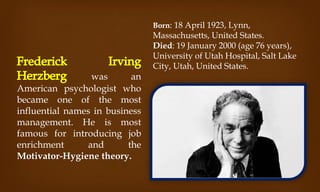
was an
American psychologist who
became one of the most
influential names in business
management. He is most
famous for introducing job
enrichment and the
Motivator-Hygiene theory.
Born: 18 April 1923, Lynn,
Massachusetts, United States.
Died: 19 January 2000 (age 76 years),
University of Utah Hospital, Salt Lake
City, Utah, United States.

In 1959, Herzberg proposed his Two Factor theory. It was derived from
Maslow’s Hierarchy of Needs and states that human needs are arranged
in a series of levels in a hierarchy of importance which causes motivation.
Frederick’s theory was first published in his book ‘The Motivation to
Work’ in 1959. Even though he focused on individuals at the workplace,
the theory has been popular with managers who recognized the
importance of management knowledge and expertise.
In 1967, Frederick Herzberg’s publication One More Time, How Do You
Motivate Employees? has sold more than one million reprints by 1987
and it was the most requested article from the Harvard Business Review.

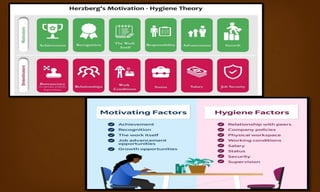
Motivation factors: factors
that are related to workplace
satisfaction. They cover
intrinsic needs such as
achievement, recognition, and
advancement. Motivation
factors allow employees to be
content in their jobs and
promote growth.
Hygiene factors: factors that
are not related to workplace
satisfaction but must be
present in the workplace in
order to prevent
dissatisfaction. Hygiene
factors cover extrinsic needs
such as pay grade, workplace
policy and relationships with
their peers.

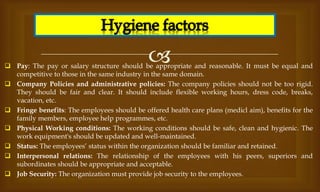
 Pay: The pay or salary structure should be appropriate and reasonable. It must be equal and
competitive to those in the same industry in the same domain.
 Company Policies and administrative policies: The company policies should not be too rigid.
They should be fair and clear. It should include flexible working hours, dress code, breaks,
vacation, etc.
 Fringe benefits: The employees should be offered health care plans (medicl aim), benefits for the
family members, employee help programmes, etc.
 Physical Working conditions: The working conditions should be safe, clean and hygienic. The
work equipment's should be updated and well-maintained.
 Status: The employees’ status within the organization should be familiar and retained.
 Interpersonal relations: The relationship of the employees with his peers, superiors and
subordinates should be appropriate and acceptable.
 Job Security: The organization must provide job security to the employees.

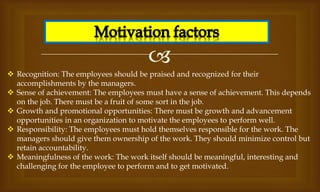
 Recognition: The employees should be praised and recognized for their
accomplishments by the managers.
 Sense of achievement: The employees must have a sense of achievement. This depends
on the job. There must be a fruit of some sort in the job.
 Growth and promotional opportunities: There must be growth and advancement
opportunities in an organization to motivate the employees to perform well.
 Responsibility: The employees must hold themselves responsible for the work. The
managers should give them ownership of the work. They should minimize control but
retain accountability.
 Meaningfulness of the work: The work itself should be meaningful, interesting and
challenging for the employee to perform and to get motivated.

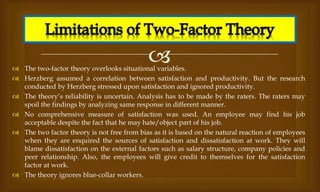
 The two-factor theory overlooks situational variables.
 Herzberg assumed a correlation between satisfaction and productivity. But the research
conducted by Herzberg stressed upon satisfaction and ignored productivity.
 The theory’s reliability is uncertain. Analysis has to be made by the raters. The raters may
spoil the findings by analyzing same response in different manner.
 No comprehensive measure of satisfaction was used. An employee may find his job
acceptable despite the fact that he may hate/object part of his job.
 The two factor theory is not free from bias as it is based on the natural reaction of employees
when they are enquired the sources of satisfaction and dissatisfaction at work. They will
blame dissatisfaction on the external factors such as salary structure, company policies and
peer relationship. Also, the employees will give credit to themselves for the satisfaction
factor at work.
 The theory ignores blue-collar workers.
Frederick Herzberg (Two Factor Theory)  Public Administration.

Frederick Herzberg (Two Factor Theory) Public Administration.

  • 2.
    was an American psychologistwho became one of the most influential names in business management. He is most famous for introducing job enrichment and the Motivator-Hygiene theory. Born: 18 April 1923, Lynn, Massachusetts, United States. Died: 19 January 2000 (age 76 years), University of Utah Hospital, Salt Lake City, Utah, United States.
  • 3.
     In 1959, Herzbergproposed his Two Factor theory. It was derived from Maslow’s Hierarchy of Needs and states that human needs are arranged in a series of levels in a hierarchy of importance which causes motivation. Frederick’s theory was first published in his book ‘The Motivation to Work’ in 1959. Even though he focused on individuals at the workplace, the theory has been popular with managers who recognized the importance of management knowledge and expertise. In 1967, Frederick Herzberg’s publication One More Time, How Do You Motivate Employees? has sold more than one million reprints by 1987 and it was the most requested article from the Harvard Business Review.
  • 4.
     Motivation factors: factors thatare related to workplace satisfaction. They cover intrinsic needs such as achievement, recognition, and advancement. Motivation factors allow employees to be content in their jobs and promote growth. Hygiene factors: factors that are not related to workplace satisfaction but must be present in the workplace in order to prevent dissatisfaction. Hygiene factors cover extrinsic needs such as pay grade, workplace policy and relationships with their peers.
  • 5.
      Pay: Thepay or salary structure should be appropriate and reasonable. It must be equal and competitive to those in the same industry in the same domain.  Company Policies and administrative policies: The company policies should not be too rigid. They should be fair and clear. It should include flexible working hours, dress code, breaks, vacation, etc.  Fringe benefits: The employees should be offered health care plans (medicl aim), benefits for the family members, employee help programmes, etc.  Physical Working conditions: The working conditions should be safe, clean and hygienic. The work equipment's should be updated and well-maintained.  Status: The employees’ status within the organization should be familiar and retained.  Interpersonal relations: The relationship of the employees with his peers, superiors and subordinates should be appropriate and acceptable.  Job Security: The organization must provide job security to the employees.
  • 6.
      Recognition: Theemployees should be praised and recognized for their accomplishments by the managers.  Sense of achievement: The employees must have a sense of achievement. This depends on the job. There must be a fruit of some sort in the job.  Growth and promotional opportunities: There must be growth and advancement opportunities in an organization to motivate the employees to perform well.  Responsibility: The employees must hold themselves responsible for the work. The managers should give them ownership of the work. They should minimize control but retain accountability.  Meaningfulness of the work: The work itself should be meaningful, interesting and challenging for the employee to perform and to get motivated.
  • 8.
      The two-factortheory overlooks situational variables.  Herzberg assumed a correlation between satisfaction and productivity. But the research conducted by Herzberg stressed upon satisfaction and ignored productivity.  The theory’s reliability is uncertain. Analysis has to be made by the raters. The raters may spoil the findings by analyzing same response in different manner.  No comprehensive measure of satisfaction was used. An employee may find his job acceptable despite the fact that he may hate/object part of his job.  The two factor theory is not free from bias as it is based on the natural reaction of employees when they are enquired the sources of satisfaction and dissatisfaction at work. They will blame dissatisfaction on the external factors such as salary structure, company policies and peer relationship. Also, the employees will give credit to themselves for the satisfaction factor at work.  The theory ignores blue-collar workers.