Administrative Behaviour
Understanding HerbertA. Simon's Revolutionary
Approach to Public Administration
Prof. (Dr.) Ashish Jorasia
School of Arts and Humanities
Career Point University, Kota, Rajasthan
2.
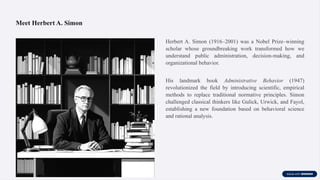
Meet Herbert A.Simon
Herbert A. Simon (1916–2001) was a Nobel Prize–winning
scholar whose groundbreaking work transformed how we
understand public administration, decision-making, and
organizational behavior.
His landmark book Administrative Behavior (1947)
revolutionized the field by introducing scientific, empirical
methods to replace traditional normative principles. Simon
challenged classical thinkers like Gulick, Urwick, and Fayol,
establishing a new foundation based on behavioral science
and rational analysis.
3.
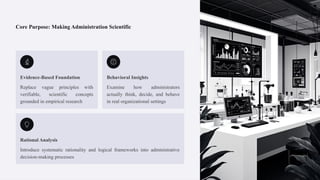
Core Purpose: MakingAdministration Scientific
Evidence-Based Foundation
Replace vague principles with
verifiable, scientific concepts
grounded in empirical research
Behavioral Insights
Examine how administrators
actually think, decide, and behave
in real organizational settings
Rational Analysis
Introduce systematic rationality and logical frameworks into administrative
decision-making processes
4.
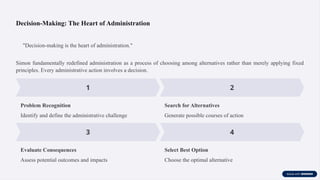
Decision-Making: The Heartof Administration
"Decision-making is the heart of administration."
Simon fundamentally redefined administration as a process of choosing among alternatives rather than merely applying fixed
principles. Every administrative action involves a decision.
Problem Recognition
Identify and define the administrative challenge
Search for Alternatives
Generate possible courses of action
Evaluate Consequences
Assess potential outcomes and impacts
Select Best Option
Choose the optimal alternative
5.
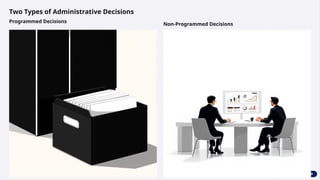
Two Types ofAdministrative Decisions
Programmed Decisions
Non-Programmed Decisions
6.
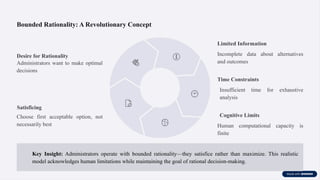
Bounded Rationality: ARevolutionary Concept
Desire for Rationality
Administrators want to make optimal
decisions
Limited Information
Incomplete data about alternatives
and outcomes
Time Constraints
Insufficient time for exhaustive
analysis
Cognitive Limits
Human computational capacity is
finite
Satisficing
Choose first acceptable option, not
necessarily best
Key Insight: Administrators operate with bounded rationality—they satisfice rather than maximize. This realistic
model acknowledges human limitations while maintaining the goal of rational decision-making.
7.
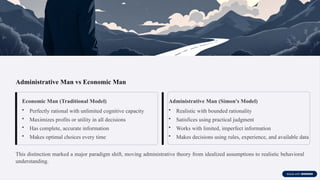
Administrative Man vsEconomic Man
Economic Man (Traditional Model)
• Perfectly rational with unlimited cognitive capacity
• Maximizes profits or utility in all decisions
• Has complete, accurate information
• Makes optimal choices every time
Administrative Man (Simon's Model)
• Realistic with bounded rationality
• Satisfices using practical judgment
• Works with limited, imperfect information
• Makes decisions using rules, experience, and available data
This distinction marked a major paradigm shift, moving administrative theory from idealized assumptions to realistic behavioral
understanding.
8.
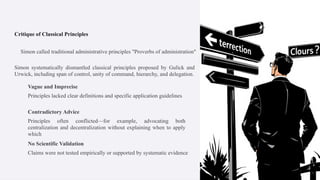
Critique of ClassicalPrinciples
Simon called traditional administrative principles "Proverbs of administration"
Simon systematically dismantled classical principles proposed by Gulick and
Urwick, including span of control, unity of command, hierarchy, and delegation.
Vague and Imprecise
Principles lacked clear definitions and specific application guidelines
Contradictory Advice
Principles often conflicted—for example, advocating both
centralization and decentralization without explaining when to apply
which
No Scientific Validation
Claims were not tested empirically or supported by systematic evidence
9.
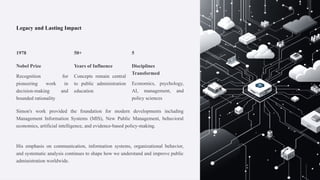
Legacy and LastingImpact
1978
Nobel Prize
Recognition for
pioneering work in
decision-making and
bounded rationality
50+
Years of Influence
Concepts remain central
to public administration
education
5
Disciplines
Transformed
Economics, psychology,
AI, management, and
policy sciences
Simon's work provided the foundation for modern developments including
Management Information Systems (MIS), New Public Management, behavioral
economics, artificial intelligence, and evidence-based policy-making.
His emphasis on communication, information systems, organizational behavior,
and systematic analysis continues to shape how we understand and improve public
administration worldwide.
10.
Key Takeaways
Scientific Revolution
Transformedpublic administration
from art to science through
empirical research and behavioral
analysis
Realistic Framework
Introduced bounded rationality and
satisficing as accurate models of
administrative behavior
Decision-Focused
Established decision-making as the
core of administration, creating
systematic frameworks still used
today
Herbert Simon's Administrative Behavior remains a cornerstone of modern administrative theory. By replacing idealized
principles with realistic behavioral models, Simon created a more practical, evidence-based approach to understanding how
organizations and administrators actually function—a legacy that continues to guide governance, policy, and management
practice today.