Operations
             Management
               Module A –
               Decision-Making Tools

                             PowerPoint presentation to accompany
                             Heizer/Render
                             Principles of Operations Management, 7e
                             Operations Management, 9e
© 2008 Prentice Hall, Inc.                                             A–1
Outline
                 The Decision Process in
                  Operations
                 Fundamentals of Decision Making
                 Decision Tables


© 2008 Prentice Hall, Inc.                          A–2
Outline – Continued
                 Types of Decision-Making
                  Environments
                              Decision Making Under Uncertainty
                              Decision Making Under Risk
                              Decision Making Under Certainty
                              Expected Value of Perfect
                               Information (EVPI)


© 2008 Prentice Hall, Inc.                                         A–3
Outline – Continued
                 Decision Trees
                              A More Complex Decision Tree
                              Using Decision Trees in Ethical
                               Decision Making


© 2008 Prentice Hall, Inc.                                       A–4
Learning Objectives
               When you complete this module you
               should be able to:

                      1. Create a simple decision tree
                      2. Build a decision table
                      3. Explain when to use each of the three
                         types of decision-making
                         environments
                      4. Calculate an expected monetary
                         value (EMV)
© 2008 Prentice Hall, Inc.                                       A–5
Learning Objectives
               When you complete this module you
               should be able to:

                      5. Compute the expected value of
                         perfect information (EVPI)
                      6. Evaluate the nodes in a decision tree
                      7. Create a decision tree with sequential
                         decisions


© 2008 Prentice Hall, Inc.                                        A–6
The Decision Process in
                              Operations
                     1. Clearly define the problems and the
                        factors that influence it
                     2. Develop specific and measurable
                        objectives
                     3. Develop a model
                     4. Evaluate each alternative solution
                     5. Select the best alternative
                     6. Implement the decision and set a
                        timetable for completion
© 2008 Prentice Hall, Inc.                                    A–7
Fundamentals of
                                Decision Making
                1. Terms:
                             a. Alternative – a course of action or
                                strategy that may be chosen by the
                                decision maker
                             b. State of nature – an occurrence or
                                a situation over which the decision
                                maker has little or no control


© 2008 Prentice Hall, Inc.                                            A–8
Fundamentals of
                                Decision Making
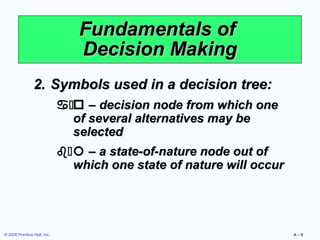
                2. Symbols used in a decision tree:
                             a . – decision node from which one
                                of several alternatives may be
                                selected
                             b .  – a state-of-nature node out of
                                 which one state of nature will occur


© 2008 Prentice Hall, Inc.                                              A–9
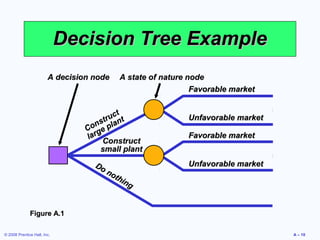
Decision Tree Example
                        A decision node    A state of nature node
                                                              Favorable market

                                           t
                                       truc t               Unfavorable market
                                    ns plan
                                 Co ge
                                  lar                       Favorable market
                                      Construct
                                      small plant
                                   Do                       Unfavorable market
                                      no
                                         thi
                                             ng


              Figure A.1

© 2008 Prentice Hall, Inc.                                                       A – 10
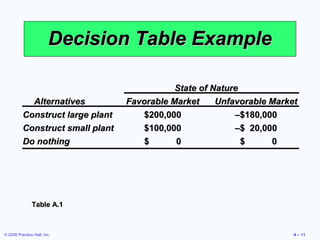
Decision Table Example

                                             State of Nature
            Alternatives          Favorable Market     Unfavorable Market
          Construct large plant      $200,000              –$180,000
          Construct small plant      $100,000              –$ 20,000
          Do nothing                  $      0               $     0


               Table A.1


© 2008 Prentice Hall, Inc.                                              A – 11
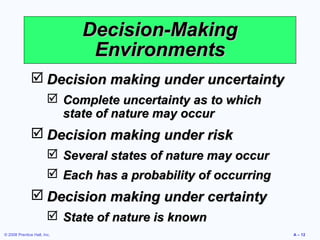
Decision-Making
                              Environments
                Decision making under uncertainty
                         Complete uncertainty as to which
                          state of nature may occur
                Decision making under risk
                         Several states of nature may occur
                         Each has a probability of occurring
                Decision making under certainty
                         State of nature is known
© 2008 Prentice Hall, Inc.                                      A – 12
Uncertainty
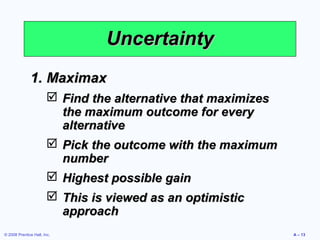
              1. Maximax
                         Find the alternative that maximizes
                          the maximum outcome for every
                          alternative
                         Pick the outcome with the maximum
                          number
                         Highest possible gain
                         This is viewed as an optimistic
                          approach
© 2008 Prentice Hall, Inc.                                      A – 13
Uncertainty
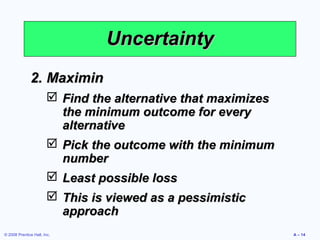
              2. Maximin
                         Find the alternative that maximizes
                          the minimum outcome for every
                          alternative
                         Pick the outcome with the minimum
                          number
                         Least possible loss
                         This is viewed as a pessimistic
                          approach
© 2008 Prentice Hall, Inc.                                      A – 14
Uncertainty
              3. Equally likely
                         Find the alternative with the highest
                          average outcome
                         Pick the outcome with the maximum
                          number
                         Assumes each state of nature is
                          equally likely to occur


© 2008 Prentice Hall, Inc.                                        A – 15
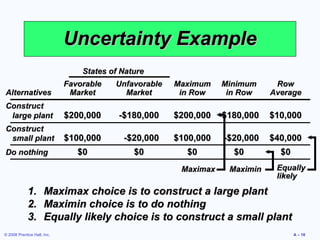
Uncertainty Example
                                 States of Nature
                             Favorable   Unfavorable   Maximum    Minimum     Row
Alternatives                  Market       Market       in Row     in Row    Average
Construct
 large plant                 $200,000     -$180,000    $200,000 -$180,000    $10,000
Construct
 small plant                 $100,000      -$20,000    $100,000   -$20,000   $40,000
Do nothing                      $0            $0         $0         $0         $0
                                                        Maximax    Maximin    Equally
                                                                              likely

             1.       Maximax choice is to construct a large plant
             2.       Maximin choice is to do nothing
             3.       Equally likely choice is to construct a small plant
© 2008 Prentice Hall, Inc.                                                          A – 16
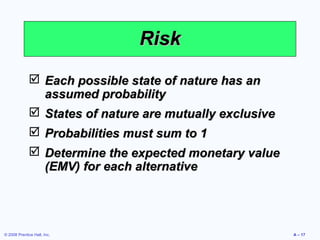
Risk
              Each possible state of nature has an
               assumed probability
              States of nature are mutually exclusive
              Probabilities must sum to 1
              Determine the expected monetary value
               (EMV) for each alternative


© 2008 Prentice Hall, Inc.                               A – 17
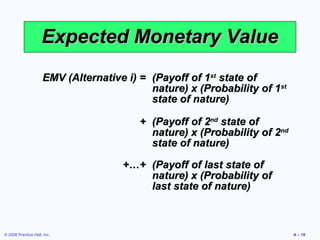
Expected Monetary Value
                     EMV (Alternative i) = (Payoff of 1st state of
                                           nature) x (Probability of 1st
                                           state of nature)

                                         + (Payoff of 2nd state of
                                           nature) x (Probability of 2nd
                                           state of nature)

                                     +…+ (Payoff of last state of
                                         nature) x (Probability of
                                         last state of nature)


© 2008 Prentice Hall, Inc.                                                 A – 18
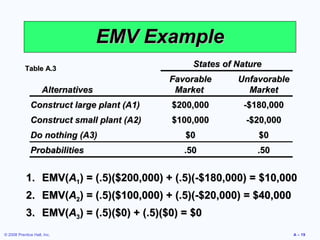
EMV Example
           Table A.3
                                                States of Nature
                                           Favorable      Unfavorable
                     Alternatives           Market          Market
              Construct large plant (A1)   $200,000        -$180,000
              Construct small plant (A2)   $100,000         -$20,000
              Do nothing (A3)                 $0               $0
              Probabilities                   .50              .50


            1. EMV(A1) = (.5)($200,000) + (.5)(-$180,000) = $10,000
            2. EMV(A2) = (.5)($100,000) + (.5)(-$20,000) = $40,000
            3. EMV(A3) = (.5)($0) + (.5)($0) = $0
© 2008 Prentice Hall, Inc.                                              A – 19
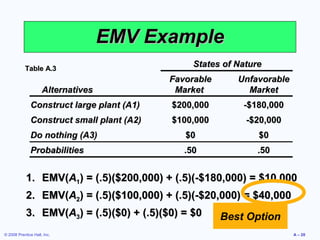
EMV Example
           Table A.3
                                                States of Nature
                                           Favorable      Unfavorable
                     Alternatives           Market          Market
              Construct large plant (A1)   $200,000        -$180,000
              Construct small plant (A2)   $100,000         -$20,000
              Do nothing (A3)                 $0               $0
              Probabilities                   .50              .50


            1. EMV(A1) = (.5)($200,000) + (.5)(-$180,000) = $10,000
            2. EMV(A2) = (.5)($100,000) + (.5)(-$20,000) = $40,000
            3. EMV(A3) = (.5)($0) + (.5)($0) = $0      Best Option
© 2008 Prentice Hall, Inc.                                              A – 20
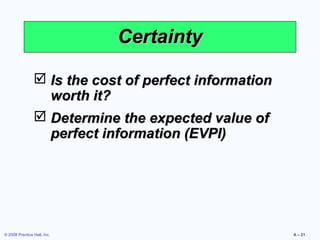
Certainty

                 Is the cost of perfect information
                  worth it?
                 Determine the expected value of
                  perfect information (EVPI)


© 2008 Prentice Hall, Inc.                             A – 21
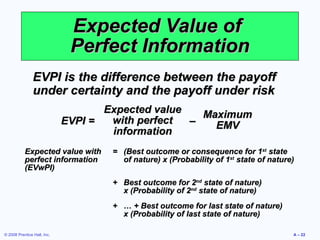
Expected Value of
                              Perfect Information
                EVPI is the difference between the payoff
                under certainty and the payoff under risk
                                    Expected value   Maximum
                             EVPI =  with perfect  –   EMV
                                     information
           Expected value with       = (Best outcome or consequence for 1st state
           perfect information         of nature) x (Probability of 1st state of nature)
           (EVwPI)
                                     + Best outcome for 2nd state of nature)
                                       x (Probability of 2nd state of nature)
                                     + … + Best outcome for last state of nature)
                                       x (Probability of last state of nature)

© 2008 Prentice Hall, Inc.                                                             A – 22
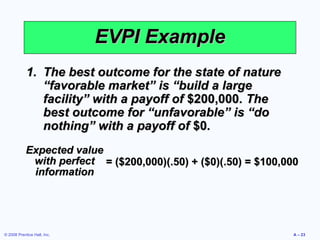
EVPI Example
            1. The best outcome for the state of nature
               “favorable market” is “build a large
               facility” with a payoff of $200,000. The
               best outcome for “unfavorable” is “do
               nothing” with a payoff of $0.
            Expected value
             with perfect = ($200,000)(.50) + ($0)(.50) = $100,000
             information


© 2008 Prentice Hall, Inc.                                      A – 23
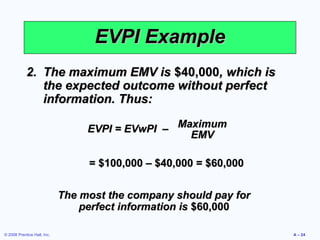
EVPI Example
            2. The maximum EMV is $40,000, which is
               the expected outcome without perfect
               information. Thus:

                                  EVPI = EVwPI – Maximum
                                                   EMV

                                  = $100,000 – $40,000 = $60,000


                             The most the company should pay for
                                 perfect information is $60,000

© 2008 Prentice Hall, Inc.                                         A – 24
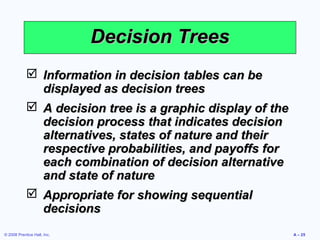
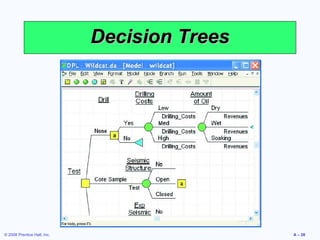
Decision Trees
             Information in decision tables can be
              displayed as decision trees
             A decision tree is a graphic display of the
              decision process that indicates decision
              alternatives, states of nature and their
              respective probabilities, and payoffs for
              each combination of decision alternative
              and state of nature
             Appropriate for showing sequential
              decisions
© 2008 Prentice Hall, Inc.                                  A – 25
Decision Trees


© 2008 Prentice Hall, Inc.                    A – 26
Decision Trees
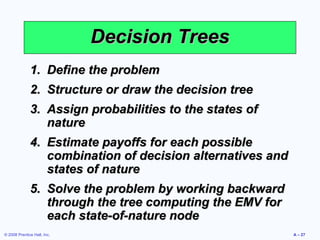
              1. Define the problem
              2. Structure or draw the decision tree
              3. Assign probabilities to the states of
                 nature
              4. Estimate payoffs for each possible
                 combination of decision alternatives and
                 states of nature
              5. Solve the problem by working backward
                 through the tree computing the EMV for
                 each state-of-nature node
© 2008 Prentice Hall, Inc.                                  A – 27
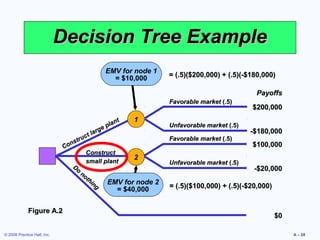
Decision Tree Example
                                            EMV for node 1
                                              = $10,000             = (.5)($200,000) + (.5)(-$180,000)

                                                                                               Payoffs
                                                                    Favorable market (.5)
                                                                                              $200,000

                                                       nt 1
                                                   pla              Unfavorable market (.5)
                                              rg e                                            -$180,000
                                         t la
                                      uc                            Favorable market (.5)
                               n st r
                             Co                                                               $100,000
                                        Construct
                                        small plant
                                                          2
                                                                    Unfavorable market (.5)
                                Do                                                             -$20,000
                                     no
                                       th
                                          in       EMV for node 2
                                            g
                                                 = $40,000          = (.5)($100,000) + (.5)(-$20,000)


             Figure A.2
                                                                                                        $0

© 2008 Prentice Hall, Inc.                                                                                   A – 28
Complex
            Decision
              Tree
            Example


                     Figure A.3

© 2008 Prentice Hall, Inc.        A – 29
Complex Example
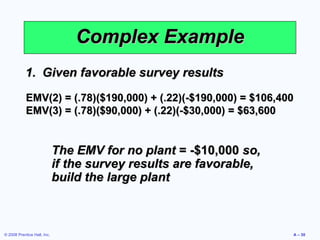
            1. Given favorable survey results
            EMV(2) = (.78)($190,000) + (.22)(-$190,000) = $106,400
            EMV(3) = (.78)($90,000) + (.22)(-$30,000) = $63,600


                             The EMV for no plant = -$10,000 so,
                             if the survey results are favorable,
                             build the large plant


© 2008 Prentice Hall, Inc.                                          A – 30
Complex Example
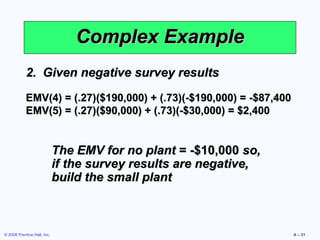
            2. Given negative survey results
            EMV(4) = (.27)($190,000) + (.73)(-$190,000) = -$87,400
            EMV(5) = (.27)($90,000) + (.73)(-$30,000) = $2,400


                             The EMV for no plant = -$10,000 so,
                             if the survey results are negative,
                             build the small plant


© 2008 Prentice Hall, Inc.                                           A – 31
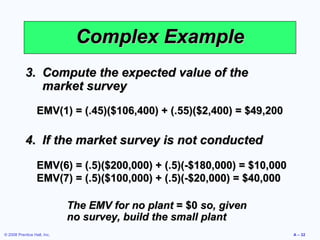
Complex Example
            3. Compute the expected value of the
               market survey
                  EMV(1) = (.45)($106,400) + (.55)($2,400) = $49,200

            4. If the market survey is not conducted
                  EMV(6) = (.5)($200,000) + (.5)(-$180,000) = $10,000
                  EMV(7) = (.5)($100,000) + (.5)(-$20,000) = $40,000

                             The EMV for no plant = $0 so, given
                             no survey, build the small plant
© 2008 Prentice Hall, Inc.                                              A – 32
Decision Trees in Ethical
                          Decision Making

                Maximize shareholder value and
                 behave ethically
                Technique can be applied to any
                 action a company contemplates


© 2008 Prentice Hall, Inc.                         A – 33
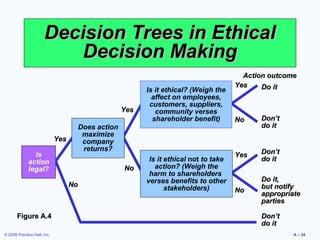
Decision Trees in Ethical
                          Decision Making
                                                                                       Action outcome
                                                                                     Yes    Do it
                                                        Is it ethical? (Weigh the
                                                          affect on employees,
                                                         customers, suppliers,
                                                  Yes      community verses
                                                          shareholder benefit)       No    Don’t
                                    Does action                                            do it
                                     maximize
                             Yes     company
                                     returns?                                              Don’t
               Is                                                                    Yes
             action                                      Is it ethical not to take         do it
             legal?                               No       action? (Weigh the
                                                         harm to shareholders
                                                        verses benefits to other           Do it,
                                   No                                                      but notify
                                                               stakeholders)         No    appropriate
                                                                                           parties

       Figure A.4                                                                          Don’t
                                                                                           do it
© 2008 Prentice Hall, Inc.                                                                          A – 34

Heizer mod a

  • 1.
    Operations Management Module A – Decision-Making Tools PowerPoint presentation to accompany Heizer/Render Principles of Operations Management, 7e Operations Management, 9e © 2008 Prentice Hall, Inc. A–1
  • 2.
    Outline  The Decision Process in Operations  Fundamentals of Decision Making  Decision Tables © 2008 Prentice Hall, Inc. A–2
  • 3.
    Outline – Continued  Types of Decision-Making Environments  Decision Making Under Uncertainty  Decision Making Under Risk  Decision Making Under Certainty  Expected Value of Perfect Information (EVPI) © 2008 Prentice Hall, Inc. A–3
  • 4.
    Outline – Continued  Decision Trees  A More Complex Decision Tree  Using Decision Trees in Ethical Decision Making © 2008 Prentice Hall, Inc. A–4
  • 5.
    Learning Objectives When you complete this module you should be able to: 1. Create a simple decision tree 2. Build a decision table 3. Explain when to use each of the three types of decision-making environments 4. Calculate an expected monetary value (EMV) © 2008 Prentice Hall, Inc. A–5
  • 6.
    Learning Objectives When you complete this module you should be able to: 5. Compute the expected value of perfect information (EVPI) 6. Evaluate the nodes in a decision tree 7. Create a decision tree with sequential decisions © 2008 Prentice Hall, Inc. A–6
  • 7.
    The Decision Processin Operations 1. Clearly define the problems and the factors that influence it 2. Develop specific and measurable objectives 3. Develop a model 4. Evaluate each alternative solution 5. Select the best alternative 6. Implement the decision and set a timetable for completion © 2008 Prentice Hall, Inc. A–7
  • 8.
    Fundamentals of Decision Making 1. Terms: a. Alternative – a course of action or strategy that may be chosen by the decision maker b. State of nature – an occurrence or a situation over which the decision maker has little or no control © 2008 Prentice Hall, Inc. A–8
  • 9.
    Fundamentals of Decision Making 2. Symbols used in a decision tree: a . – decision node from which one of several alternatives may be selected b .  – a state-of-nature node out of which one state of nature will occur © 2008 Prentice Hall, Inc. A–9
  • 10.
    Decision Tree Example A decision node A state of nature node Favorable market t truc t Unfavorable market ns plan Co ge lar Favorable market Construct small plant Do Unfavorable market no thi ng Figure A.1 © 2008 Prentice Hall, Inc. A – 10
  • 11.
    Decision Table Example State of Nature Alternatives Favorable Market Unfavorable Market Construct large plant $200,000 –$180,000 Construct small plant $100,000 –$ 20,000 Do nothing $ 0 $ 0 Table A.1 © 2008 Prentice Hall, Inc. A – 11
  • 12.
    Decision-Making Environments  Decision making under uncertainty  Complete uncertainty as to which state of nature may occur  Decision making under risk  Several states of nature may occur  Each has a probability of occurring  Decision making under certainty  State of nature is known © 2008 Prentice Hall, Inc. A – 12
  • 13.
    Uncertainty 1. Maximax  Find the alternative that maximizes the maximum outcome for every alternative  Pick the outcome with the maximum number  Highest possible gain  This is viewed as an optimistic approach © 2008 Prentice Hall, Inc. A – 13
  • 14.
    Uncertainty 2. Maximin  Find the alternative that maximizes the minimum outcome for every alternative  Pick the outcome with the minimum number  Least possible loss  This is viewed as a pessimistic approach © 2008 Prentice Hall, Inc. A – 14
  • 15.
    Uncertainty 3. Equally likely  Find the alternative with the highest average outcome  Pick the outcome with the maximum number  Assumes each state of nature is equally likely to occur © 2008 Prentice Hall, Inc. A – 15
  • 16.
    Uncertainty Example States of Nature Favorable Unfavorable Maximum Minimum Row Alternatives Market Market in Row in Row Average Construct large plant $200,000 -$180,000 $200,000 -$180,000 $10,000 Construct small plant $100,000 -$20,000 $100,000 -$20,000 $40,000 Do nothing $0 $0 $0 $0 $0 Maximax Maximin Equally likely 1. Maximax choice is to construct a large plant 2. Maximin choice is to do nothing 3. Equally likely choice is to construct a small plant © 2008 Prentice Hall, Inc. A – 16
  • 17.
    Risk  Each possible state of nature has an assumed probability  States of nature are mutually exclusive  Probabilities must sum to 1  Determine the expected monetary value (EMV) for each alternative © 2008 Prentice Hall, Inc. A – 17
  • 18.
    Expected Monetary Value EMV (Alternative i) = (Payoff of 1st state of nature) x (Probability of 1st state of nature) + (Payoff of 2nd state of nature) x (Probability of 2nd state of nature) +…+ (Payoff of last state of nature) x (Probability of last state of nature) © 2008 Prentice Hall, Inc. A – 18
  • 19.
    EMV Example Table A.3 States of Nature Favorable Unfavorable Alternatives Market Market Construct large plant (A1) $200,000 -$180,000 Construct small plant (A2) $100,000 -$20,000 Do nothing (A3) $0 $0 Probabilities .50 .50 1. EMV(A1) = (.5)($200,000) + (.5)(-$180,000) = $10,000 2. EMV(A2) = (.5)($100,000) + (.5)(-$20,000) = $40,000 3. EMV(A3) = (.5)($0) + (.5)($0) = $0 © 2008 Prentice Hall, Inc. A – 19
  • 20.
    EMV Example Table A.3 States of Nature Favorable Unfavorable Alternatives Market Market Construct large plant (A1) $200,000 -$180,000 Construct small plant (A2) $100,000 -$20,000 Do nothing (A3) $0 $0 Probabilities .50 .50 1. EMV(A1) = (.5)($200,000) + (.5)(-$180,000) = $10,000 2. EMV(A2) = (.5)($100,000) + (.5)(-$20,000) = $40,000 3. EMV(A3) = (.5)($0) + (.5)($0) = $0 Best Option © 2008 Prentice Hall, Inc. A – 20
  • 21.
    Certainty  Is the cost of perfect information worth it?  Determine the expected value of perfect information (EVPI) © 2008 Prentice Hall, Inc. A – 21
  • 22.
    Expected Value of Perfect Information EVPI is the difference between the payoff under certainty and the payoff under risk Expected value Maximum EVPI = with perfect – EMV information Expected value with = (Best outcome or consequence for 1st state perfect information of nature) x (Probability of 1st state of nature) (EVwPI) + Best outcome for 2nd state of nature) x (Probability of 2nd state of nature) + … + Best outcome for last state of nature) x (Probability of last state of nature) © 2008 Prentice Hall, Inc. A – 22
  • 23.
    EVPI Example 1. The best outcome for the state of nature “favorable market” is “build a large facility” with a payoff of $200,000. The best outcome for “unfavorable” is “do nothing” with a payoff of $0. Expected value with perfect = ($200,000)(.50) + ($0)(.50) = $100,000 information © 2008 Prentice Hall, Inc. A – 23
  • 24.
    EVPI Example 2. The maximum EMV is $40,000, which is the expected outcome without perfect information. Thus: EVPI = EVwPI – Maximum EMV = $100,000 – $40,000 = $60,000 The most the company should pay for perfect information is $60,000 © 2008 Prentice Hall, Inc. A – 24
  • 25.
    Decision Trees  Information in decision tables can be displayed as decision trees  A decision tree is a graphic display of the decision process that indicates decision alternatives, states of nature and their respective probabilities, and payoffs for each combination of decision alternative and state of nature  Appropriate for showing sequential decisions © 2008 Prentice Hall, Inc. A – 25
  • 26.
    Decision Trees © 2008Prentice Hall, Inc. A – 26
  • 27.
    Decision Trees 1. Define the problem 2. Structure or draw the decision tree 3. Assign probabilities to the states of nature 4. Estimate payoffs for each possible combination of decision alternatives and states of nature 5. Solve the problem by working backward through the tree computing the EMV for each state-of-nature node © 2008 Prentice Hall, Inc. A – 27
  • 28.
    Decision Tree Example EMV for node 1 = $10,000 = (.5)($200,000) + (.5)(-$180,000) Payoffs Favorable market (.5) $200,000 nt 1 pla Unfavorable market (.5) rg e -$180,000 t la uc Favorable market (.5) n st r Co $100,000 Construct small plant 2 Unfavorable market (.5) Do -$20,000 no th in EMV for node 2 g = $40,000 = (.5)($100,000) + (.5)(-$20,000) Figure A.2 $0 © 2008 Prentice Hall, Inc. A – 28
  • 29.
    Complex Decision Tree Example Figure A.3 © 2008 Prentice Hall, Inc. A – 29
  • 30.
    Complex Example 1. Given favorable survey results EMV(2) = (.78)($190,000) + (.22)(-$190,000) = $106,400 EMV(3) = (.78)($90,000) + (.22)(-$30,000) = $63,600 The EMV for no plant = -$10,000 so, if the survey results are favorable, build the large plant © 2008 Prentice Hall, Inc. A – 30
  • 31.
    Complex Example 2. Given negative survey results EMV(4) = (.27)($190,000) + (.73)(-$190,000) = -$87,400 EMV(5) = (.27)($90,000) + (.73)(-$30,000) = $2,400 The EMV for no plant = -$10,000 so, if the survey results are negative, build the small plant © 2008 Prentice Hall, Inc. A – 31
  • 32.
    Complex Example 3. Compute the expected value of the market survey EMV(1) = (.45)($106,400) + (.55)($2,400) = $49,200 4. If the market survey is not conducted EMV(6) = (.5)($200,000) + (.5)(-$180,000) = $10,000 EMV(7) = (.5)($100,000) + (.5)(-$20,000) = $40,000 The EMV for no plant = $0 so, given no survey, build the small plant © 2008 Prentice Hall, Inc. A – 32
  • 33.
    Decision Trees inEthical Decision Making  Maximize shareholder value and behave ethically  Technique can be applied to any action a company contemplates © 2008 Prentice Hall, Inc. A – 33
  • 34.
    Decision Trees inEthical Decision Making Action outcome Yes Do it Is it ethical? (Weigh the affect on employees, customers, suppliers, Yes community verses shareholder benefit) No Don’t Does action do it maximize Yes company returns? Don’t Is Yes action Is it ethical not to take do it legal? No action? (Weigh the harm to shareholders verses benefits to other Do it, No but notify stakeholders) No appropriate parties Figure A.4 Don’t do it © 2008 Prentice Hall, Inc. A – 34

Editor's Notes

  • #8 This slide provides some reasons that capacity is an issue. The following slides guide a discussion of capacity.
  • #9 This slide can be used to frame a discussion of capacity. Points to be made might include: - capacity definition and measurement is necessary if we are to develop a production schedule - while a process may have “maximum” capacity, many factors prevent us from achieving that capacity on a continuous basis. Students should be asked to suggest factors which might prevent one from achieving maximum capacity.
  • #10 This slide can be used to frame a discussion of capacity. Points to be made might include: - capacity definition and measurement is necessary if we are to develop a production schedule - while a process may have “maximum” capacity, many factors prevent us from achieving that capacity on a continuous basis. Students should be asked to suggest factors which might prevent one from achieving maximum capacity.
  • #19 It might be useful at this point to discuss typical equipment utilization rates for different process strategies if you have not done so before.
  • #20 It might be useful at this point to discuss typical equipment utilization rates for different process strategies if you have not done so before.
  • #21 It might be useful at this point to discuss typical equipment utilization rates for different process strategies if you have not done so before.
  • #22 It might be useful at this point to discuss typical equipment utilization rates for different process strategies if you have not done so before.