Heel pain
Mr Derek Park
Consultant Orthopaedic Surgeon (Foot & Ankle)
NHS: Barnet & Chase Farm Hospital (Royal Free
London NHS Foundation Trust)
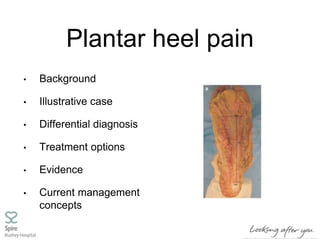
Plantar heel pain
• Background
• Illustrative case
• Differential diagnosis
• Treatment options
• Evidence
• Current management
concepts
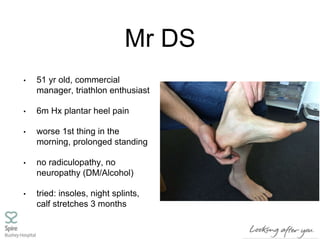
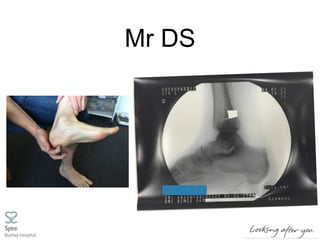
Mr DS
• 51 yr old, commercial
manager, triathlon enthusiast
• 6m Hx plantar heel pain
• worse 1st thing in the
morning, prolonged standing
• no radiculopathy, no
neuropathy (DM/Alcohol)
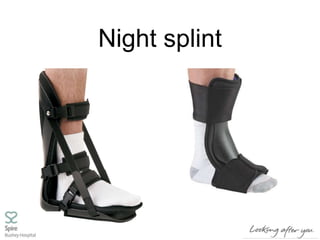
• tried: insoles, night splints,
calf stretches 3 months
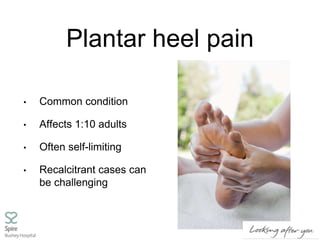
Plantar heel pain
• Common condition
• Affects 1:10 adults
• Often self-limiting
• Recalcitrant cases can
be challenging
Anatomy
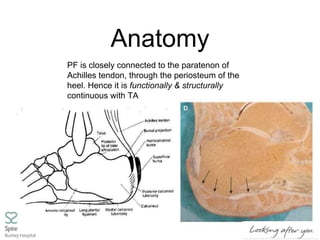
PF is closely connected to the paratenon of
Achilles tendon, through the periosteum of the
heel. Hence it is functionally & structurally
continuous with TA
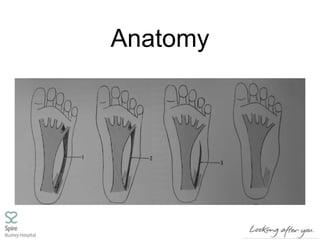
Anatomy
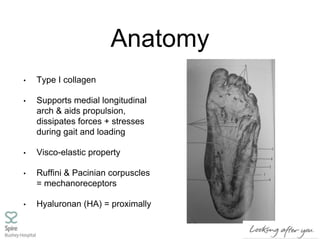
• Type I collagen
• Supports medial longitudinal
arch & aids propulsion,
dissipates forces + stresses
during gait and loading
• Visco-elastic property
• Ruffini & Pacinian corpuscles
= mechanoreceptors
• Hyaluronan (HA) = proximally
Anatomy
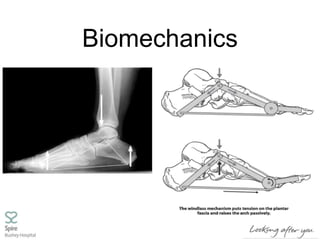
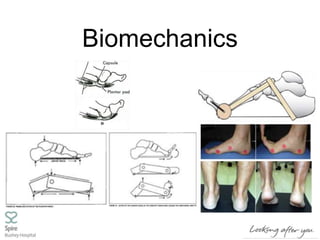
Biomechanics
Biomechanics
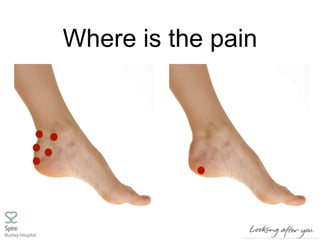
Where is the pain
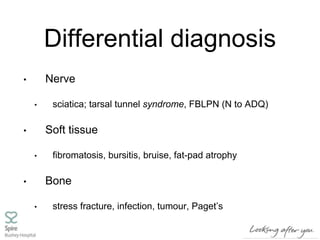
Differential diagnosis
• Nerve
• sciatica; tarsal tunnel syndrome, FBLPN (N to ADQ)
• Soft tissue
• fibromatosis, bursitis, bruise, fat-pad atrophy
• Bone
• stress fracture, infection, tumour, Paget’s
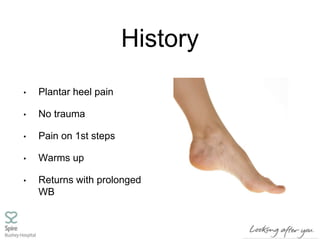
History
• Plantar heel pain
• No trauma
• Pain on 1st steps
• Warms up
• Returns with prolonged
WB
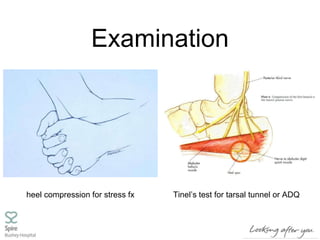
Examination
heel compression for stress fx Tinel’s test for tarsal tunnel or ADQ
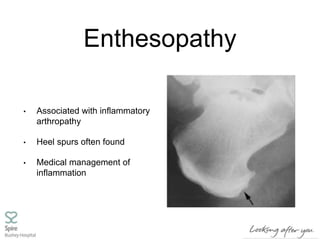
Enthesopathy
• Associated with inflammatory
arthropathy
• Heel spurs often found
• Medical management of
inflammation
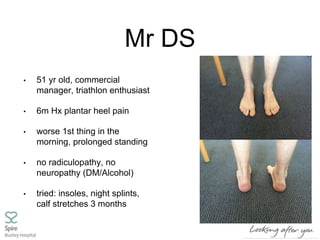
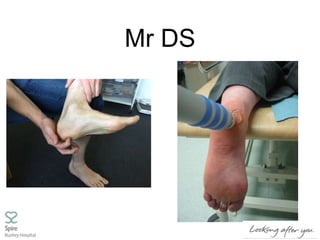
Mr DS
• 51 yr old, commercial
manager, triathlon enthusiast
• 6m Hx plantar heel pain
• worse 1st thing in the
morning, prolonged standing
• no radiculopathy, no
neuropathy (DM/Alcohol)
• tried: insoles, night splints,
calf stretches 3 months
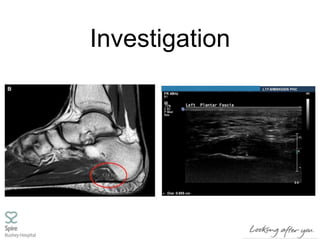
Investigation
Night splint
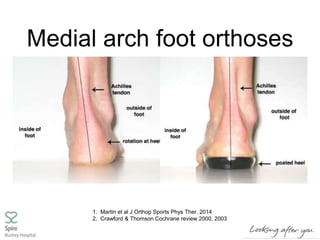
Medial arch foot orthoses
1. Martin et al J Orthop Sports Phys Ther. 2014
2. Crawford & Thomson Cochrane review 2000, 2003
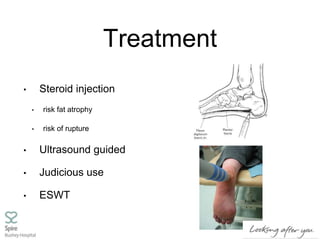
Treatment
• Steroid injection
• risk fat atrophy
• risk of rupture
• Ultrasound guided
• Judicious use
• ESWT
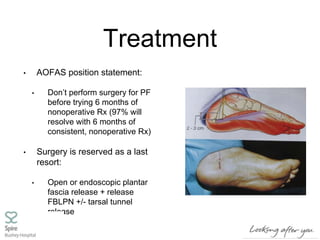
Treatment
• AOFAS position statement:
• Don’t perform surgery for PF
before trying 6 months of
nonoperative Rx (97% will
resolve with 6 months of
consistent, nonoperative Rx)
• Surgery is reserved as a last
resort:
• Open or endoscopic plantar
fascia release + release
FBLPN +/- tarsal tunnel
release
Mr DS
Evidence
• Marginal gains only
• steroid injection - short term & small degree
• orthoses - prolonged standing
• limited evidence that stretching & heel pads are
better than custom-made orthoses
• ESWT +ve but small effect
1. Crawford & Thomson Cochrane 2000, 2003
2. Thomson & Crawford BMC 2005
Treatment
• GP - Physio - stretches - US - insoles - NSAIDS -
taping - GP - MSK Triage - Acupuncture -
Orthopaedic F&A surgeon
• Ortho F&A clinic - more physio - gastroc/PF
stretches - imaging - review - desperate measures
- pain clinic - CBT ….
Mr DS
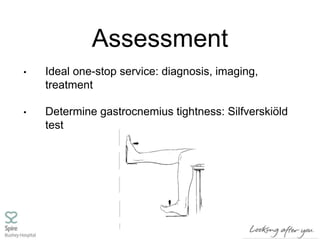
Assessment
• Ideal one-stop service: diagnosis, imaging,
treatment
• Determine gastrocnemius tightness: Silfverskiöld
test
Gastrocnemius contracture
• Restricted ankle dorsiflexion associated with
• chronic TA tendinopathy
• plantar heel pain
• acquired flat foot deformity
• midfoot OA
• metatarsalgia 1. Digiovanni et al 2002 JBJSAm
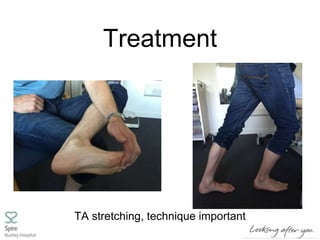
Treatment
TA stretching, technique important
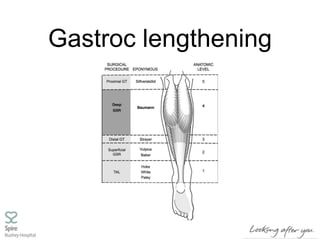
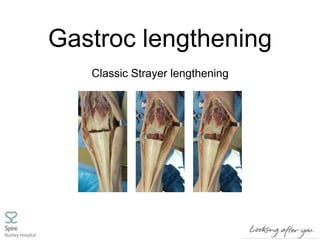
Gastroc lengthening
Gastroc lengthening
Classic Strayer lengthening
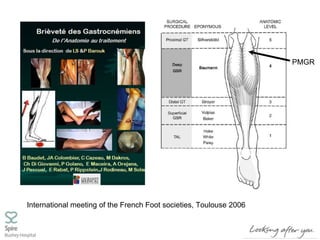
PMGR
International meeting of the French Foot societies, Toulouse 2006
The role of gastrocnemius
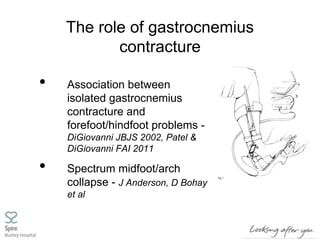
contracture
• Association between
isolated gastrocnemius
contracture and
forefoot/hindfoot problems -
DiGiovanni JBJS 2002, Patel &
DiGiovanni FAI 2011
• Spectrum midfoot/arch
collapse - J Anderson, D Bohay
et al
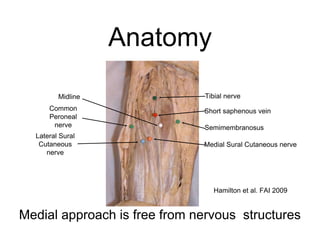
Tibial nerve
Semimembranosus
Short saphenous vein
Midline
Medial Sural Cutaneous nerve
Common
Peroneal
nerve
Lateral Sural
Cutaneous
nerve
Anatomy
Hamilton et al. FAI 2009
Medial approach is free from nervous structures
Anatomy
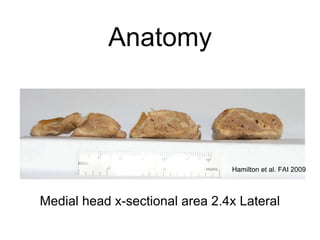
Hamilton et al. FAI 2009
Medial head x-sectional area 2.4x Lateral
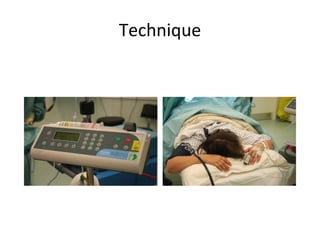
Technique
Technique
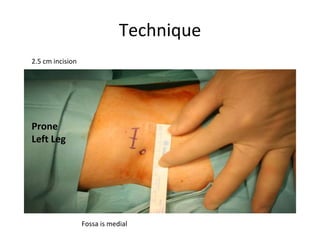
Fossa is medial
2.5 cm incision
Prone
Left Leg
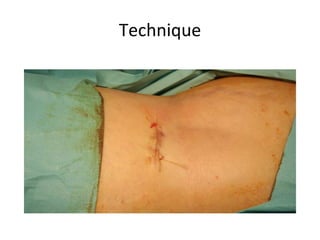
Technique
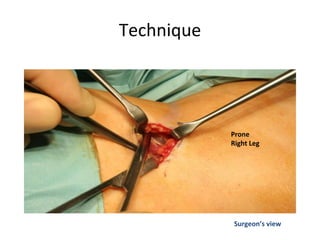
Surgeon’s view
Prone
Right Leg
Technique
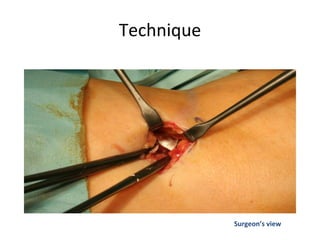
Surgeon’s view
Technique
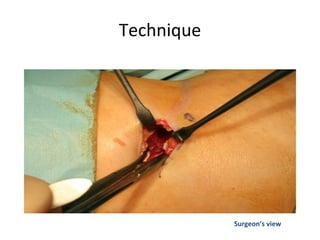
Surgeon’s view
Technique
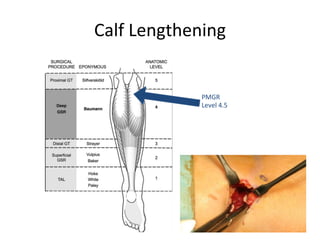
Calf Lengthening
PMGR
Level 4.5
PMGR
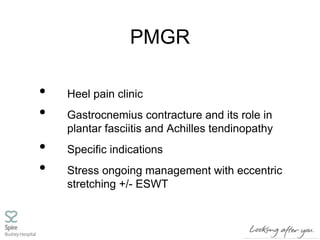
• Heel pain clinic
• Gastrocnemius contracture and its role in
plantar fasciitis and Achilles tendinopathy
• Specific indications
• Stress ongoing management with eccentric
stretching +/- ESWT
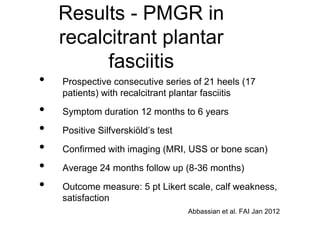
• Prospective consecutive series of 21 heels (17
patients) with recalcitrant plantar fasciitis
• Symptom duration 12 months to 6 years
• Positive Silfverskiöld’s test
• Confirmed with imaging (MRI, USS or bone scan)
• Average 24 months follow up (8-36 months)
• Outcome measure: 5 pt Likert scale, calf weakness,
satisfaction
Results - PMGR in
recalcitrant plantar
fasciitis
Abbassian et al. FAI Jan 2012
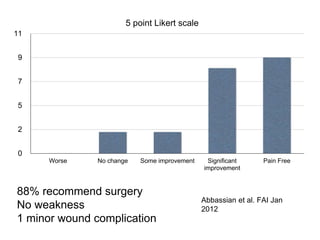
0
2
5
7
9
11
Worse No change Some improvement Significant
improvement
Pain Free
5 point Likert scale
88% recommend surgery
No weakness
1 minor wound complication
Abbassian et al. FAI Jan
2012
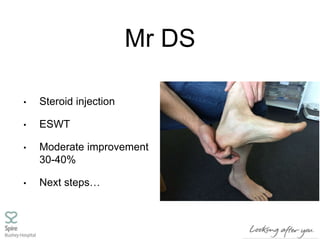
Mr DS
• Steroid injection
• ESWT
• Moderate improvement
30-40%
• Next steps…
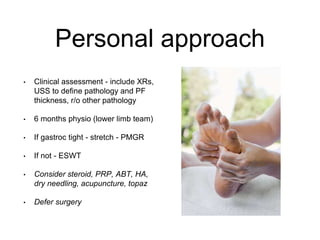
Personal approach
• Clinical assessment - include XRs,
USS to define pathology and PF
thickness, r/o other pathology
• 6 months physio (lower limb team)
• If gastroc tight - stretch - PMGR
• If not - ESWT
• Consider steroid, PRP, ABT, HA,
dry needling, acupuncture, topaz
• Defer surgery
Summary
• Aim for logical approach,
step-wise management,
and one-stop model
• Think of tight calves
• Consider non-operative
measures always
• Evidence
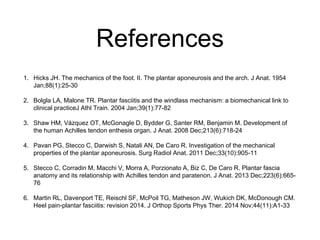
References
1. Hicks JH. The mechanics of the foot. II. The plantar aponeurosis and the arch. J Anat. 1954
Jan;88(1):25-30
2. Bolgla LA, Malone TR. Plantar fasciitis and the windlass mechanism: a biomechanical link to
clinical practiceJ Athl Train. 2004 Jan;39(1):77-82
3. Shaw HM, Vázquez OT, McGonagle D, Bydder G, Santer RM, Benjamin M. Development of
the human Achilles tendon enthesis organ. J Anat. 2008 Dec;213(6):718-24
4. Pavan PG, Stecco C, Darwish S, Natali AN, De Caro R. Investigation of the mechanical
properties of the plantar aponeurosis. Surg Radiol Anat. 2011 Dec;33(10):905-11
5. Stecco C, Corradin M, Macchi V, Morra A, Porzionato A, Biz C, De Caro R. Plantar fascia
anatomy and its relationship with Achilles tendon and paratenon. J Anat. 2013 Dec;223(6):665-
76
6. Martin RL, Davenport TE, Reischl SF, McPoil TG, Matheson JW, Wukich DK, McDonough CM.
Heel pain-plantar fasciitis: revision 2014. J Orthop Sports Phys Ther. 2014 Nov;44(11):A1-33

Heel pain Spire Bushey

  • 1.
    Heel pain Mr DerekPark Consultant Orthopaedic Surgeon (Foot & Ankle) NHS: Barnet & Chase Farm Hospital (Royal Free London NHS Foundation Trust)
  • 2.
    Plantar heel pain •Background • Illustrative case • Differential diagnosis • Treatment options • Evidence • Current management concepts
  • 3.
    Mr DS • 51yr old, commercial manager, triathlon enthusiast • 6m Hx plantar heel pain • worse 1st thing in the morning, prolonged standing • no radiculopathy, no neuropathy (DM/Alcohol) • tried: insoles, night splints, calf stretches 3 months
  • 4.
    Plantar heel pain •Common condition • Affects 1:10 adults • Often self-limiting • Recalcitrant cases can be challenging
  • 5.
    Anatomy PF is closelyconnected to the paratenon of Achilles tendon, through the periosteum of the heel. Hence it is functionally & structurally continuous with TA
  • 6.
    Anatomy • Type Icollagen • Supports medial longitudinal arch & aids propulsion, dissipates forces + stresses during gait and loading • Visco-elastic property • Ruffini & Pacinian corpuscles = mechanoreceptors • Hyaluronan (HA) = proximally
  • 7.
  • 8.
  • 9.
  • 10.
  • 11.
    Differential diagnosis • Nerve •sciatica; tarsal tunnel syndrome, FBLPN (N to ADQ) • Soft tissue • fibromatosis, bursitis, bruise, fat-pad atrophy • Bone • stress fracture, infection, tumour, Paget’s
  • 12.
    History • Plantar heelpain • No trauma • Pain on 1st steps • Warms up • Returns with prolonged WB
  • 13.
    Examination heel compression forstress fx Tinel’s test for tarsal tunnel or ADQ
  • 14.
    Enthesopathy • Associated withinflammatory arthropathy • Heel spurs often found • Medical management of inflammation
  • 15.
    Mr DS • 51yr old, commercial manager, triathlon enthusiast • 6m Hx plantar heel pain • worse 1st thing in the morning, prolonged standing • no radiculopathy, no neuropathy (DM/Alcohol) • tried: insoles, night splints, calf stretches 3 months
  • 16.
  • 17.
  • 18.
    Medial arch footorthoses 1. Martin et al J Orthop Sports Phys Ther. 2014 2. Crawford & Thomson Cochrane review 2000, 2003
  • 19.
    Treatment • Steroid injection •risk fat atrophy • risk of rupture • Ultrasound guided • Judicious use • ESWT
  • 20.
    Treatment • AOFAS positionstatement: • Don’t perform surgery for PF before trying 6 months of nonoperative Rx (97% will resolve with 6 months of consistent, nonoperative Rx) • Surgery is reserved as a last resort: • Open or endoscopic plantar fascia release + release FBLPN +/- tarsal tunnel release
  • 21.
  • 22.
    Evidence • Marginal gainsonly • steroid injection - short term & small degree • orthoses - prolonged standing • limited evidence that stretching & heel pads are better than custom-made orthoses • ESWT +ve but small effect 1. Crawford & Thomson Cochrane 2000, 2003 2. Thomson & Crawford BMC 2005
  • 23.
    Treatment • GP -Physio - stretches - US - insoles - NSAIDS - taping - GP - MSK Triage - Acupuncture - Orthopaedic F&A surgeon • Ortho F&A clinic - more physio - gastroc/PF stretches - imaging - review - desperate measures - pain clinic - CBT ….
  • 24.
  • 25.
    Assessment • Ideal one-stopservice: diagnosis, imaging, treatment • Determine gastrocnemius tightness: Silfverskiöld test
  • 26.
    Gastrocnemius contracture • Restrictedankle dorsiflexion associated with • chronic TA tendinopathy • plantar heel pain • acquired flat foot deformity • midfoot OA • metatarsalgia 1. Digiovanni et al 2002 JBJSAm
  • 27.
  • 28.
  • 29.
  • 30.
    PMGR International meeting ofthe French Foot societies, Toulouse 2006
  • 31.
    The role ofgastrocnemius contracture • Association between isolated gastrocnemius contracture and forefoot/hindfoot problems - DiGiovanni JBJS 2002, Patel & DiGiovanni FAI 2011 • Spectrum midfoot/arch collapse - J Anderson, D Bohay et al
  • 32.
    Tibial nerve Semimembranosus Short saphenousvein Midline Medial Sural Cutaneous nerve Common Peroneal nerve Lateral Sural Cutaneous nerve Anatomy Hamilton et al. FAI 2009 Medial approach is free from nervous structures
  • 33.
    Anatomy Hamilton et al.FAI 2009 Medial head x-sectional area 2.4x Lateral
  • 34.
  • 35.
    Technique Fossa is medial 2.5cm incision Prone Left Leg
  • 36.
  • 37.
  • 38.
  • 39.
  • 40.
  • 41.
    PMGR • Heel painclinic • Gastrocnemius contracture and its role in plantar fasciitis and Achilles tendinopathy • Specific indications • Stress ongoing management with eccentric stretching +/- ESWT
  • 42.
    • Prospective consecutiveseries of 21 heels (17 patients) with recalcitrant plantar fasciitis • Symptom duration 12 months to 6 years • Positive Silfverskiöld’s test • Confirmed with imaging (MRI, USS or bone scan) • Average 24 months follow up (8-36 months) • Outcome measure: 5 pt Likert scale, calf weakness, satisfaction Results - PMGR in recalcitrant plantar fasciitis Abbassian et al. FAI Jan 2012
  • 43.
    0 2 5 7 9 11 Worse No changeSome improvement Significant improvement Pain Free 5 point Likert scale 88% recommend surgery No weakness 1 minor wound complication Abbassian et al. FAI Jan 2012
  • 44.
    Mr DS • Steroidinjection • ESWT • Moderate improvement 30-40% • Next steps…
  • 45.
    Personal approach • Clinicalassessment - include XRs, USS to define pathology and PF thickness, r/o other pathology • 6 months physio (lower limb team) • If gastroc tight - stretch - PMGR • If not - ESWT • Consider steroid, PRP, ABT, HA, dry needling, acupuncture, topaz • Defer surgery
  • 46.
    Summary • Aim forlogical approach, step-wise management, and one-stop model • Think of tight calves • Consider non-operative measures always • Evidence
  • 47.
    References 1. Hicks JH.The mechanics of the foot. II. The plantar aponeurosis and the arch. J Anat. 1954 Jan;88(1):25-30 2. Bolgla LA, Malone TR. Plantar fasciitis and the windlass mechanism: a biomechanical link to clinical practiceJ Athl Train. 2004 Jan;39(1):77-82 3. Shaw HM, Vázquez OT, McGonagle D, Bydder G, Santer RM, Benjamin M. Development of the human Achilles tendon enthesis organ. J Anat. 2008 Dec;213(6):718-24 4. Pavan PG, Stecco C, Darwish S, Natali AN, De Caro R. Investigation of the mechanical properties of the plantar aponeurosis. Surg Radiol Anat. 2011 Dec;33(10):905-11 5. Stecco C, Corradin M, Macchi V, Morra A, Porzionato A, Biz C, De Caro R. Plantar fascia anatomy and its relationship with Achilles tendon and paratenon. J Anat. 2013 Dec;223(6):665- 76 6. Martin RL, Davenport TE, Reischl SF, McPoil TG, Matheson JW, Wukich DK, McDonough CM. Heel pain-plantar fasciitis: revision 2014. J Orthop Sports Phys Ther. 2014 Nov;44(11):A1-33