Heat, Light and Sound =
Energy
First let’s talk about energy.
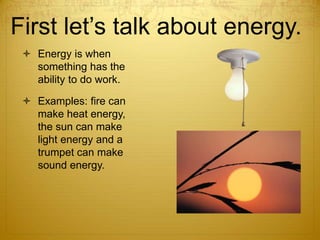
 Energy is when
something has the
ability to do work.
 Examples: fire can
make heat energy,
the sun can make
light energy and a
trumpet can make
sound energy.
Forms of energy waves
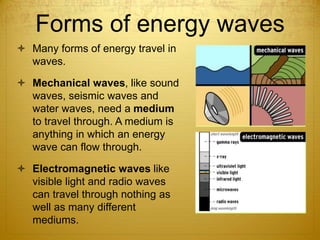
 Many forms of energy travel in
waves.
 Mechanical waves, like sound
waves, seismic waves and
water waves, need a medium
to travel through. A medium is
anything in which an energy
wave can flow through.
 Electromagnetic waves like
visible light and radio waves
can travel through nothing as
well as many different
mediums.
Waves
 Energy often travels in waves
and the strength of the energy
depends on how high the wave
is or how close the waves are
together.
 Transverse waves move at a
right angle to the energy flow.
 The highest point of a
transverse waves is called a
crest and the lowest point is
called a trough.
Wavelength
 Wavelength is the
distance between
two crests of a wave
or two troughs.
Amplitude
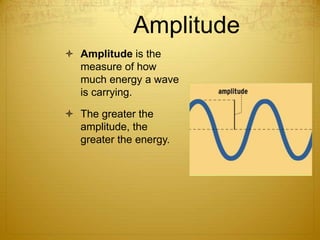
 Amplitude is the
measure of how
much energy a wave
is carrying.
 The greater the
amplitude, the
greater the energy.
Frequency
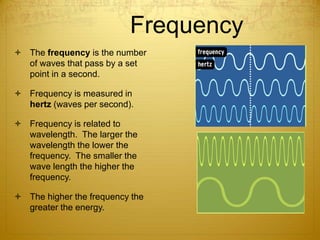
 The frequency is the number
of waves that pass by a set
point in a second.
 Frequency is measured in
hertz (waves per second).
 Frequency is related to
wavelength. The larger the
wavelength the lower the
frequency. The smaller the
wave length the higher the
frequency.
 The higher the frequency the
greater the energy.
What do you think?
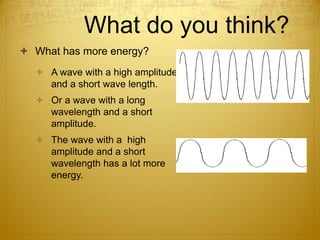
 What has more energy?
 A wave with a high amplitude
and a short wave length.
 Or a wave with a long
wavelength and a short
amplitude.
 The wave with a high
amplitude and a short
wavelength has a lot more
energy.
Heat
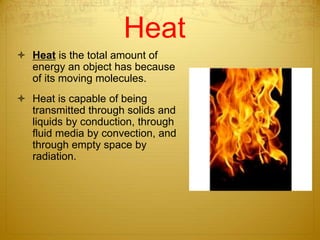
 Heat is the total amount of
energy an object has because
of its moving molecules.
 Heat is capable of being
transmitted through solids and
liquids by conduction, through
fluid media by convection, and
through empty space by
radiation.
Temperature vs. Heat
Heat is the total amount of energy
in a system
Temperature is a measure of the
average kinetic energy of each
atom in that system.
Example:
Both glasses have the same
temperature (molecules are
moving at same speed) but a
different heat because the glass
with more water has more
molecules moving around to
transfer the energy.
Consider each glass to be a system
Same temperature
Higher heat
Lower heat
Conduction
 Conductor- remember a conductor is
an object that allows energy (like heat
and electricity) to travel through it
easily.
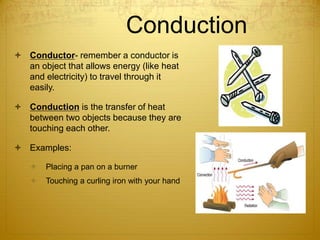
 Conduction is the transfer of heat
between two objects because they are
touching each other.
 Examples:
 Placing a pan on a burner
 Touching a curling iron with your hand
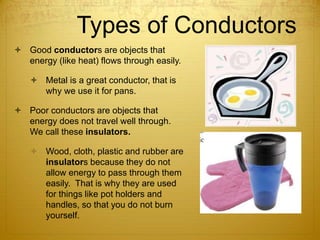
Types of Conductors
 Good conductors are objects that
energy (like heat) flows through easily.
 Metal is a great conductor, that is
why we use it for pans.
 Poor conductors are objects that
energy does not travel well through.
We call these insulators.
 Wood, cloth, plastic and rubber are
insulators because they do not
allow energy to pass through them
easily. That is why they are used
for things like pot holders and
handles, so that you do not burn
yourself.
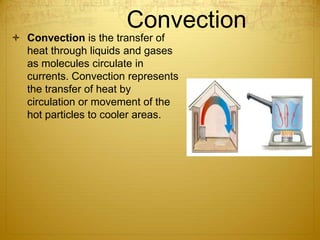
Convection
 Convection is the transfer of
heat through liquids and gases
as molecules circulate in
currents. Convection represents
the transfer of heat by
circulation or movement of the
hot particles to cooler areas.
Convection through liquids.
Convection through liquids
(water)
* A pan full of water heats up
on a stove. First the water
on the bottom heats up. The
hot water then is pushed out
of the way by the cooler
water on top (because cool
water sinks) and this water
warms up. This will go on
until all of the water is the
same temperature. If the
water continues to heat up it
will evaporate. This
circulation of heat is called
convection.
Convection through gases.
Convection through gas (air)
* As the hot ground warms
the cool air above it, the air
starts to rise. Warm air
always rises because it is
less dense. Cool air
always sinks because it is
more dense. As the air
warms up, cooler air sinks
and pushes the warm air
up and out of the way. This
movement of heat energy
through the air is called
convection.
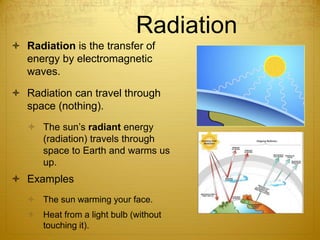
Radiation
 Radiation is the transfer of
energy by electromagnetic
waves.
 Radiation can travel through
space (nothing).
 The sun’s radiant energy
(radiation) travels through
space to Earth and warms us
up.
 Examples
 The sun warming your face.
 Heat from a light bulb (without
touching it).
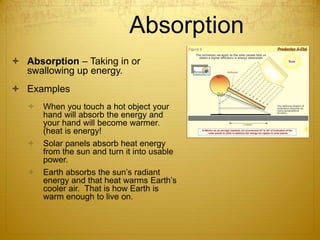
Absorption
 Absorption – Taking in or
swallowing up energy.
 Examples
 When you touch a hot object your
hand will absorb the energy and
your hand will become warmer.
(heat is energy!
 Solar panels absorb heat energy
from the sun and turn it into usable
power.
 Earth absorbs the sun’s radiant
energy and that heat warms Earth’s
cooler air. That is how Earth is
warm enough to live on.
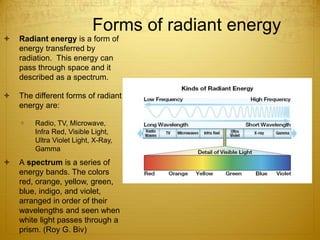
Forms of radiant energy
 Radiant energy is a form of
energy transferred by
radiation. This energy can
pass through space and it
described as a spectrum.
 The different forms of radiant
energy are:
 Radio, TV, Microwave,
Infra Red, Visible Light,
Ultra Violet Light, X-Ray,
Gamma
 A spectrum is a series of
energy bands. The colors
red, orange, yellow, green,
blue, indigo, and violet,
arranged in order of their
wavelengths and seen when
white light passes through a
prism. (Roy G. Biv)
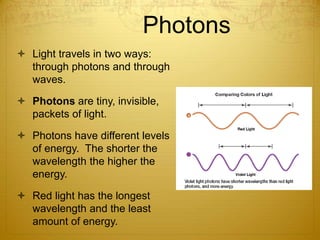
Photons
 Light travels in two ways:
through photons and through
waves.
 Photons are tiny, invisible,
packets of light.
 Photons have different levels
of energy. The shorter the
wavelength the higher the
energy.
 Red light has the longest
wavelength and the least
amount of energy.
Waves
 Light moves in waves also.
 Waves are measured by their
frequency, or how closely
they travel together.
 High frequency waves travel
closer together and have a
higher energy.
 Low frequency waves travel
farther apart and have a lower
energy.
 Wavelength is the distance
between the peaks of two
different waves.
Refraction
 Normally light travels in a straight
path, but when it hits an object of a
different density the light will bend
this is called refraction.
 Refraction – When light bends as
it travels from one medium to
another.
 A medium is any substance
through which a wave is
transmitted (sent through).
 Light does not need a medium in
order to travel, it can travel through
space where there are not air
particles to carry it. This is useful
otherwise we would not be able to
use the sun’s energy.
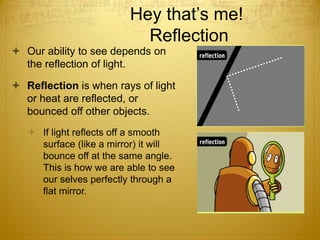
Hey that’s me!
Reflection
 Our ability to see depends on
the reflection of light.
 Reflection is when rays of light
or heat are reflected, or
bounced off other objects.
 If light reflects off a smooth
surface (like a mirror) it will
bounce off at the same angle.
This is how we are able to see
our selves perfectly through a
flat mirror.
Hit Me!!
 Light hits objects at certain
angles.
 Angle of incidence – The
angle at which light strikes
a surface.
 Angle of reflection – The
angle at which light
bounces off a surface
Mathresources.com
sol.sci.uop.edu
Color in light
 Visible light is made up of
many different colors.
 White light is the combination
of all colors.
 Blackness is the absence of all
light.
 We see colors when a
particular color is reflected off
the surface of an object. The
other colors are absorbed.
 Colored light can be combined
to create different colors.
Prisms
 We can see the different colors of
light when white light enters a prism
and refracts (bends).
 Remember a prism is a 3D shape
with two bases that are the same
shape.
 The prism refracts the light and
separates the colors. Each color of
light bends slightly differently than
the others.
 A rainbow occurs because raindrops
act as prisms. The sunlight enters
the raindrop and is refracted,
creating a rainbow.
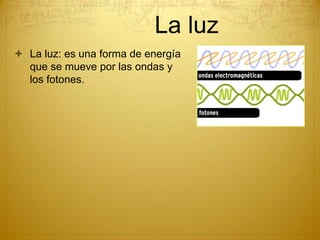
La luz
 La luz: es una forma de energía
que se mueve por las ondas y
los fotones.
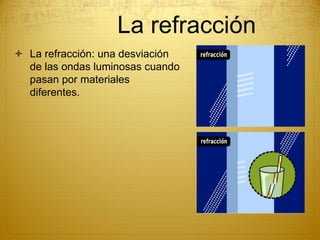
La refracción
 La refracción: una desviación
de las ondas luminosas cuando
pasan por materiales
diferentes.
Sound
 Sound, like heat and light, is a form of
energy.
 Sound is heard because it makes air
particles vibrate (rapid back and forth
movement).
 Sound travels through air as sound
waves. Sound waves travel in all
directions from the source of the wave.
 Sound waves are different from
electromagnetic waves, because sound
waves need a medium to pass through.
If sound waves don’t have something to
pass through, they don’t go anywhere.
 Sound can also travel through water,
metal and other things.
Pitch
 Pitch is how high or low a
sounds is.
 Pitch depends on how close
together the waves are in a
sound wave or high the
frequency is.
 The closer the waves are the
higher the pitch.
 Waves with a lower
frequency, or waves that are
farther apart, have a lower
pitch.
Loudness or Volume
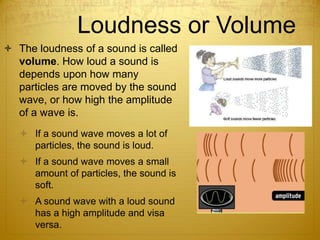
 The loudness of a sound is called
volume. How loud a sound is
depends upon how many
particles are moved by the sound
wave, or how high the amplitude
of a wave is.
 If a sound wave moves a lot of
particles, the sound is loud.
 If a sound wave moves a small
amount of particles, the sound is
soft.
 A sound wave with a loud sound
has a high amplitude and visa
versa.
Decibels
 The loudness of a sound
is measured in decibels.
 The higher the decibel the
louder the sound is.
 What object has the
loudest sound?
Sound travels
 Sound waves don’t only travel
through air (gas).
 Sounds travels farther through
solids and liquids because the
particles in solids and liquids are
closer together than they are in
gases.
What happens to sound waves?
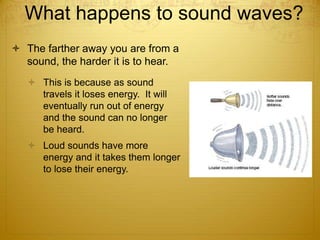
 The farther away you are from a
sound, the harder it is to hear.
 This is because as sound
travels it loses energy. It will
eventually run out of energy
and the sound can no longer
be heard.
 Loud sounds have more
energy and it takes them longer
to lose their energy.

Heat, Light, Sound.ppt

  • 1.
    Heat, Light andSound = Energy
  • 2.
    First let’s talkabout energy.  Energy is when something has the ability to do work.  Examples: fire can make heat energy, the sun can make light energy and a trumpet can make sound energy.
  • 3.
    Forms of energywaves  Many forms of energy travel in waves.  Mechanical waves, like sound waves, seismic waves and water waves, need a medium to travel through. A medium is anything in which an energy wave can flow through.  Electromagnetic waves like visible light and radio waves can travel through nothing as well as many different mediums.
  • 4.
    Waves  Energy oftentravels in waves and the strength of the energy depends on how high the wave is or how close the waves are together.  Transverse waves move at a right angle to the energy flow.  The highest point of a transverse waves is called a crest and the lowest point is called a trough.
  • 5.
    Wavelength  Wavelength isthe distance between two crests of a wave or two troughs.
  • 6.
    Amplitude  Amplitude isthe measure of how much energy a wave is carrying.  The greater the amplitude, the greater the energy.
  • 7.
    Frequency  The frequencyis the number of waves that pass by a set point in a second.  Frequency is measured in hertz (waves per second).  Frequency is related to wavelength. The larger the wavelength the lower the frequency. The smaller the wave length the higher the frequency.  The higher the frequency the greater the energy.
  • 8.
    What do youthink?  What has more energy?  A wave with a high amplitude and a short wave length.  Or a wave with a long wavelength and a short amplitude.  The wave with a high amplitude and a short wavelength has a lot more energy.
  • 9.
    Heat  Heat isthe total amount of energy an object has because of its moving molecules.  Heat is capable of being transmitted through solids and liquids by conduction, through fluid media by convection, and through empty space by radiation.
  • 10.
    Temperature vs. Heat Heatis the total amount of energy in a system Temperature is a measure of the average kinetic energy of each atom in that system. Example: Both glasses have the same temperature (molecules are moving at same speed) but a different heat because the glass with more water has more molecules moving around to transfer the energy. Consider each glass to be a system Same temperature Higher heat Lower heat
  • 11.
    Conduction  Conductor- remembera conductor is an object that allows energy (like heat and electricity) to travel through it easily.  Conduction is the transfer of heat between two objects because they are touching each other.  Examples:  Placing a pan on a burner  Touching a curling iron with your hand
  • 12.
    Types of Conductors Good conductors are objects that energy (like heat) flows through easily.  Metal is a great conductor, that is why we use it for pans.  Poor conductors are objects that energy does not travel well through. We call these insulators.  Wood, cloth, plastic and rubber are insulators because they do not allow energy to pass through them easily. That is why they are used for things like pot holders and handles, so that you do not burn yourself.
  • 13.
    Convection  Convection isthe transfer of heat through liquids and gases as molecules circulate in currents. Convection represents the transfer of heat by circulation or movement of the hot particles to cooler areas.
  • 14.
    Convection through liquids. Convectionthrough liquids (water) * A pan full of water heats up on a stove. First the water on the bottom heats up. The hot water then is pushed out of the way by the cooler water on top (because cool water sinks) and this water warms up. This will go on until all of the water is the same temperature. If the water continues to heat up it will evaporate. This circulation of heat is called convection.
  • 15.
    Convection through gases. Convectionthrough gas (air) * As the hot ground warms the cool air above it, the air starts to rise. Warm air always rises because it is less dense. Cool air always sinks because it is more dense. As the air warms up, cooler air sinks and pushes the warm air up and out of the way. This movement of heat energy through the air is called convection.
  • 16.
    Radiation  Radiation isthe transfer of energy by electromagnetic waves.  Radiation can travel through space (nothing).  The sun’s radiant energy (radiation) travels through space to Earth and warms us up.  Examples  The sun warming your face.  Heat from a light bulb (without touching it).
  • 17.
    Absorption  Absorption –Taking in or swallowing up energy.  Examples  When you touch a hot object your hand will absorb the energy and your hand will become warmer. (heat is energy!  Solar panels absorb heat energy from the sun and turn it into usable power.  Earth absorbs the sun’s radiant energy and that heat warms Earth’s cooler air. That is how Earth is warm enough to live on.
  • 18.
    Forms of radiantenergy  Radiant energy is a form of energy transferred by radiation. This energy can pass through space and it described as a spectrum.  The different forms of radiant energy are:  Radio, TV, Microwave, Infra Red, Visible Light, Ultra Violet Light, X-Ray, Gamma  A spectrum is a series of energy bands. The colors red, orange, yellow, green, blue, indigo, and violet, arranged in order of their wavelengths and seen when white light passes through a prism. (Roy G. Biv)
  • 19.
    Photons  Light travelsin two ways: through photons and through waves.  Photons are tiny, invisible, packets of light.  Photons have different levels of energy. The shorter the wavelength the higher the energy.  Red light has the longest wavelength and the least amount of energy.
  • 20.
    Waves  Light movesin waves also.  Waves are measured by their frequency, or how closely they travel together.  High frequency waves travel closer together and have a higher energy.  Low frequency waves travel farther apart and have a lower energy.  Wavelength is the distance between the peaks of two different waves.
  • 21.
    Refraction  Normally lighttravels in a straight path, but when it hits an object of a different density the light will bend this is called refraction.  Refraction – When light bends as it travels from one medium to another.  A medium is any substance through which a wave is transmitted (sent through).  Light does not need a medium in order to travel, it can travel through space where there are not air particles to carry it. This is useful otherwise we would not be able to use the sun’s energy.
  • 22.
    Hey that’s me! Reflection Our ability to see depends on the reflection of light.  Reflection is when rays of light or heat are reflected, or bounced off other objects.  If light reflects off a smooth surface (like a mirror) it will bounce off at the same angle. This is how we are able to see our selves perfectly through a flat mirror.
  • 23.
    Hit Me!!  Lighthits objects at certain angles.  Angle of incidence – The angle at which light strikes a surface.  Angle of reflection – The angle at which light bounces off a surface Mathresources.com sol.sci.uop.edu
  • 24.
    Color in light Visible light is made up of many different colors.  White light is the combination of all colors.  Blackness is the absence of all light.  We see colors when a particular color is reflected off the surface of an object. The other colors are absorbed.  Colored light can be combined to create different colors.
  • 25.
    Prisms  We cansee the different colors of light when white light enters a prism and refracts (bends).  Remember a prism is a 3D shape with two bases that are the same shape.  The prism refracts the light and separates the colors. Each color of light bends slightly differently than the others.  A rainbow occurs because raindrops act as prisms. The sunlight enters the raindrop and is refracted, creating a rainbow.
  • 26.
    La luz  Laluz: es una forma de energía que se mueve por las ondas y los fotones.
  • 27.
    La refracción  Larefracción: una desviación de las ondas luminosas cuando pasan por materiales diferentes.
  • 28.
    Sound  Sound, likeheat and light, is a form of energy.  Sound is heard because it makes air particles vibrate (rapid back and forth movement).  Sound travels through air as sound waves. Sound waves travel in all directions from the source of the wave.  Sound waves are different from electromagnetic waves, because sound waves need a medium to pass through. If sound waves don’t have something to pass through, they don’t go anywhere.  Sound can also travel through water, metal and other things.
  • 29.
    Pitch  Pitch ishow high or low a sounds is.  Pitch depends on how close together the waves are in a sound wave or high the frequency is.  The closer the waves are the higher the pitch.  Waves with a lower frequency, or waves that are farther apart, have a lower pitch.
  • 30.
    Loudness or Volume The loudness of a sound is called volume. How loud a sound is depends upon how many particles are moved by the sound wave, or how high the amplitude of a wave is.  If a sound wave moves a lot of particles, the sound is loud.  If a sound wave moves a small amount of particles, the sound is soft.  A sound wave with a loud sound has a high amplitude and visa versa.
  • 31.
    Decibels  The loudnessof a sound is measured in decibels.  The higher the decibel the louder the sound is.  What object has the loudest sound?
  • 32.
    Sound travels  Soundwaves don’t only travel through air (gas).  Sounds travels farther through solids and liquids because the particles in solids and liquids are closer together than they are in gases.
  • 33.
    What happens tosound waves?  The farther away you are from a sound, the harder it is to hear.  This is because as sound travels it loses energy. It will eventually run out of energy and the sound can no longer be heard.  Loud sounds have more energy and it takes them longer to lose their energy.