Heart Failure
Dr Vinu Sugathan
Congestive heart failure (heart failure)
•
•
•
•
•
Heart failure is defined as the condition in which a heart cannot
pump blood to adequately meet the metabolic demands of
peripheral tissues, or can do so only at elevated filling pressures.
It is the common end stage of many forms of chronic heart disease
like in valve disease or hypertension or IHD ,myocardial infarction [MI]
. However, acute hemodynamic stresses, such as fluid overload,
abrupt valvular dysfunction, or myocardial infarction, can all
precipitate sudden CHF.
types – systolic dysfunction
_ diastolic dysfunction
systolic dysfunction
•
•
Heart failure can result from progressive deterioration of myocardial
contractile function reflected as a decrease in ejection fraction
(EF, the percentage of blood volume ejected from the ventricle during
systole; normal is approximately 45% to 65%).
Causes –
- ischemic injury,
-inadequate adaptation to pressure or volume overload due to
hypertension or valvular disease,
- ventricular dilation
Diastolic dysfunction
•
•
•
•
•
•
inability of the heart chamber to expand and fill sufficiently
during diastole
Causes-
due to left ventricular hypertrophy,
myocardial fibrosis,
constrictive pericarditis,
or amyloid deposition
Cardiac hypertrophy-pathophysiology
•
•
•
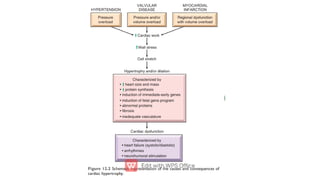
Sustained increase in mechanical work of either ventricle due to
pressure overload, volume overload, or trophic signals (e.g.,
those mediated through the activation of β-adrenergic receptors)
causes myocytes to increase in size (cellular hypertrophy);
cumulatively, this increases the size and weight of the heart
In pressure-overload hypertrophy (e.g., due to hypertension or
aortic stenosis) causing a concentric increase in wall thickness.
• In contrast, volume-overload hypertrophy (e.g., due to valvular
regurgitation) leading primarily to ventricular dilation.
•
•
. Patients with systemic hypertension, IHD, aortic stenosis,
mitral regurgitation, or dilated cardiomyopathy frequently have
heart weights double or triple the average,
aortic regurgitation or hypertrophic cardiomyopathy can
produce heart weights threefold to fourfold greater than normal.
Left sided heart failure
•
•
•
•
•
Left-sided heart failure is most often caused by the following:
• IHD
• Hypertension
• Aortic and mitral valvular diseases
• Primary myocardial diseases
•
•
•
The clinical and morphologic effects of left-sided CHF are a
consequence of passive congestion (blood backing up in the
pulmonary circulation),
stasis of blood in the left-sided chambers, and
inadequate perfusion of downstream tissues leading to organ
dysfunction.
heart failure.pdf

heart failure.pdf

  • 1.
  • 2.
    Congestive heart failure(heart failure) • • • • • Heart failure is defined as the condition in which a heart cannot pump blood to adequately meet the metabolic demands of peripheral tissues, or can do so only at elevated filling pressures. It is the common end stage of many forms of chronic heart disease like in valve disease or hypertension or IHD ,myocardial infarction [MI] . However, acute hemodynamic stresses, such as fluid overload, abrupt valvular dysfunction, or myocardial infarction, can all precipitate sudden CHF. types – systolic dysfunction _ diastolic dysfunction
  • 3.
    systolic dysfunction • • Heart failurecan result from progressive deterioration of myocardial contractile function reflected as a decrease in ejection fraction (EF, the percentage of blood volume ejected from the ventricle during systole; normal is approximately 45% to 65%). Causes – - ischemic injury, -inadequate adaptation to pressure or volume overload due to hypertension or valvular disease, - ventricular dilation
  • 4.
    Diastolic dysfunction • • • • • • inability ofthe heart chamber to expand and fill sufficiently during diastole Causes- due to left ventricular hypertrophy, myocardial fibrosis, constrictive pericarditis, or amyloid deposition
  • 5.
    Cardiac hypertrophy-pathophysiology • • • Sustained increasein mechanical work of either ventricle due to pressure overload, volume overload, or trophic signals (e.g., those mediated through the activation of β-adrenergic receptors) causes myocytes to increase in size (cellular hypertrophy); cumulatively, this increases the size and weight of the heart In pressure-overload hypertrophy (e.g., due to hypertension or aortic stenosis) causing a concentric increase in wall thickness. • In contrast, volume-overload hypertrophy (e.g., due to valvular regurgitation) leading primarily to ventricular dilation.
  • 6.
    • • . Patients withsystemic hypertension, IHD, aortic stenosis, mitral regurgitation, or dilated cardiomyopathy frequently have heart weights double or triple the average, aortic regurgitation or hypertrophic cardiomyopathy can produce heart weights threefold to fourfold greater than normal.
  • 8.
    Left sided heartfailure • • • • • Left-sided heart failure is most often caused by the following: • IHD • Hypertension • Aortic and mitral valvular diseases • Primary myocardial diseases
  • 9.
    • • • The clinical andmorphologic effects of left-sided CHF are a consequence of passive congestion (blood backing up in the pulmonary circulation), stasis of blood in the left-sided chambers, and inadequate perfusion of downstream tissues leading to organ dysfunction.