Healthy Food Access:
Lessons from the Field
Betsy Black & Bonnie Hudspeth
CCMA Conference // June 7, 2013
1
Overview
• Why Bother?
• Introductions
• Context
• Food Co-ops & Healthy Food Access
• Next Steps
• Questions?
• Discussion
2
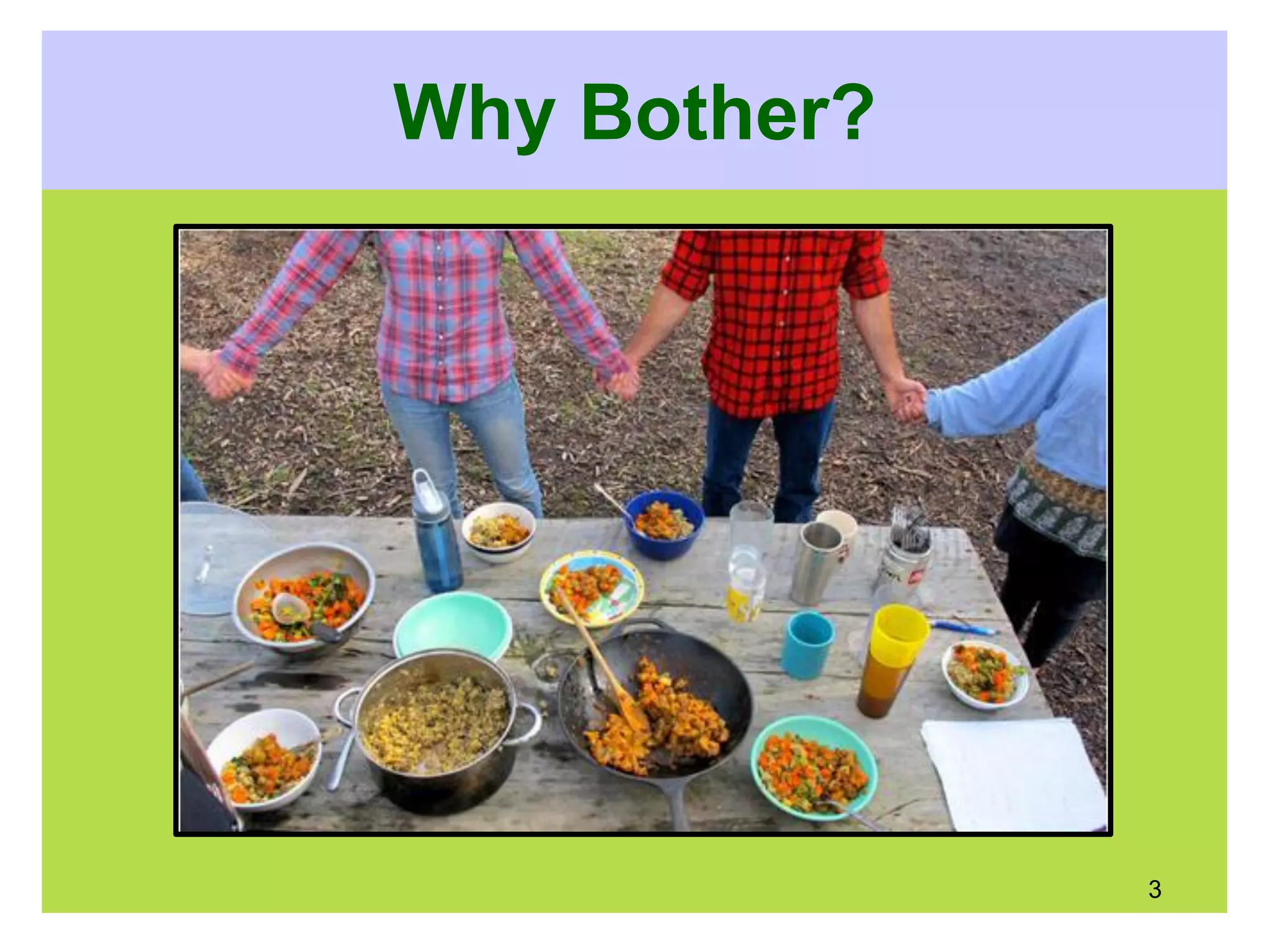
Why Bother?
3
Healthy Food Access Context:
New England Demographics
• In the US, 23.5 million Americans (including
6.5 million children) live in areas with limited
access to affordable and nutritious food
• This need is spread through urban, rural, and
increasingly suburban communities
• A majority of New England food co-ops are
not in densely-populated cities
4
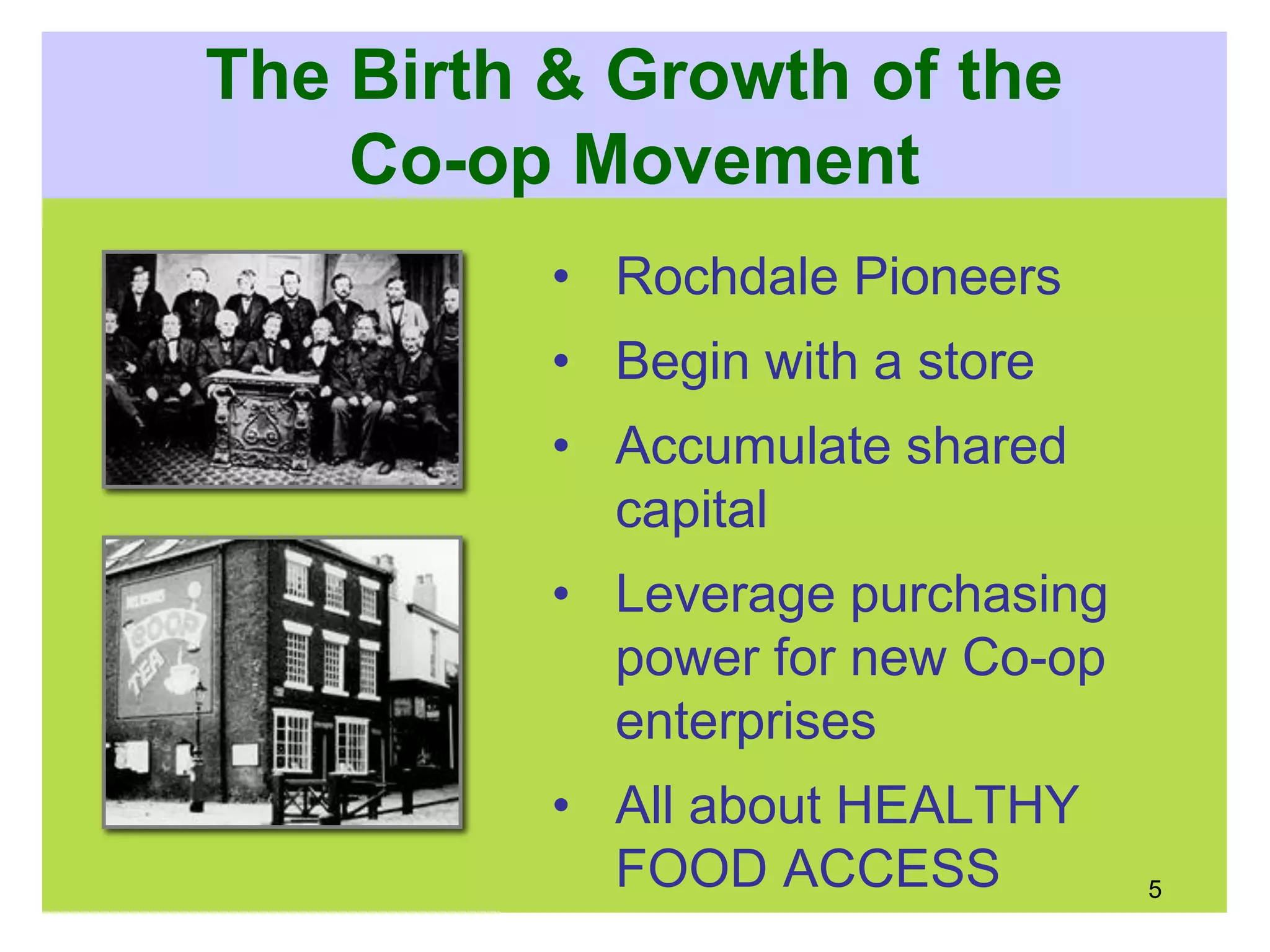
The Birth & Growth of the
Co-op Movement
• Rochdale Pioneers
• Begin with a store
• Accumulate shared
capital
• Leverage purchasing
power for new Co-op
enterprises
• All about HEALTHY
FOOD ACCESS 5
“User” Focused
• User-Owned: The people who use the co-op’s
services also own it.
• User-Controlled: The people who use the
co-op control it on a democratic basis (one-
member, one-vote).
• User-Benefit: The people who use the co-op
receive benefits such as patronage dividends,
improved price, goods and services &
employment. 6
Co-ops & Resilience
Community ownership & control
+ Focus on service, meeting needs before profit
+ Development of local skills & assets
+ Regional economic efficiencies
+ Ability to assemble limited resources
+ Difficult to move or buy-out
+ Root wealth in communities, not markets
+ Member, customer loyalty
+ Low business failure rate & are long-lived
------------------------------------------------------------------
= More stable local food systems, infrastructure,
employment, services & economy
7
Co-ops Today
Are more common than we think
• 1 billion members worldwide (1 in 4 in the US)
• More people than own stock in privately traded corporations
• Majority of US farmers are co-op members
Are innovative
• Healthy food, organic agriculture, Fair Trade, re-localization, regional
aggregation & distribution
Are successful
• 30,000 co-ops in all sectors of US economy
Are resilient
• Survived and grew during the global recession
8
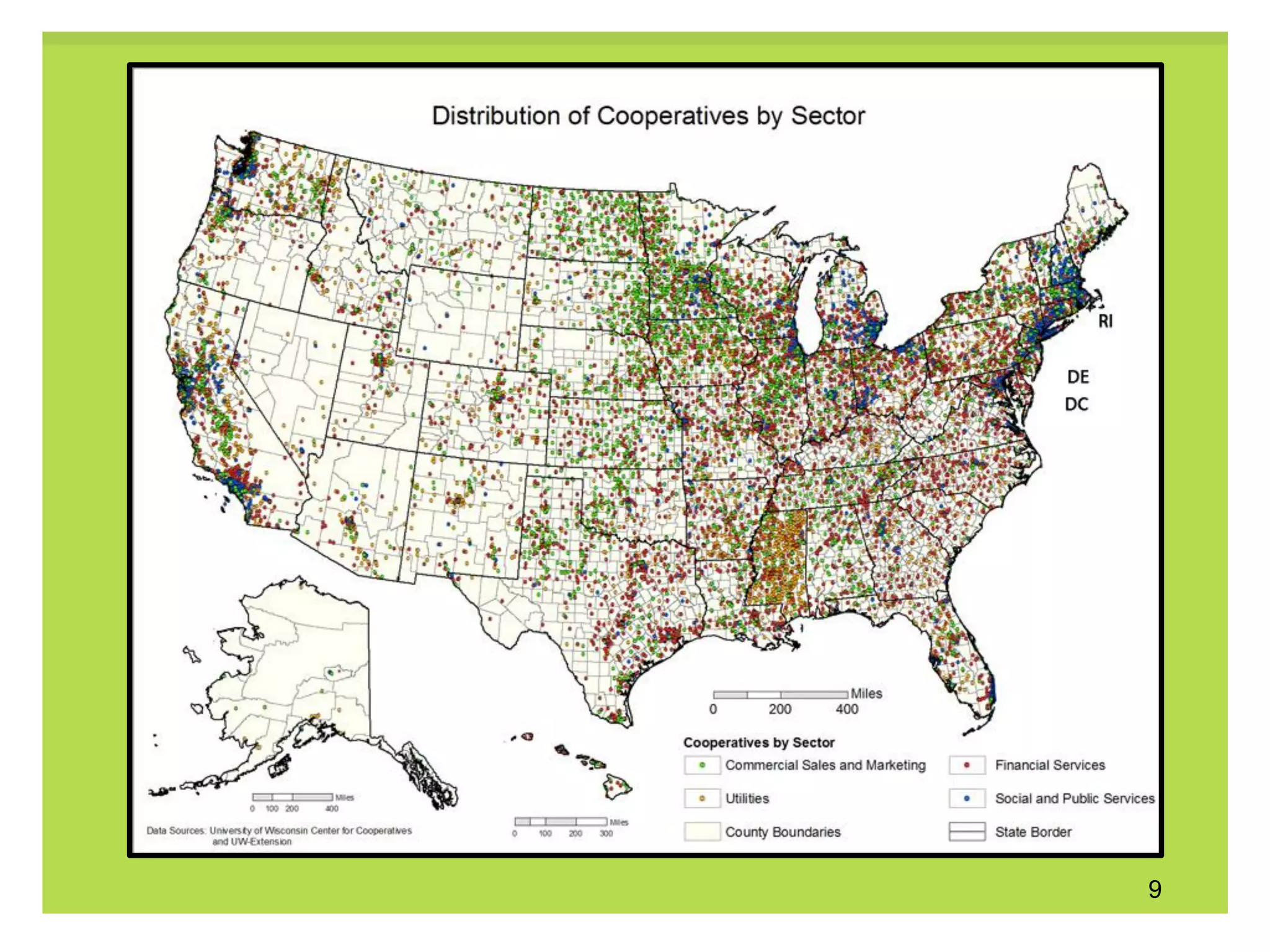
9
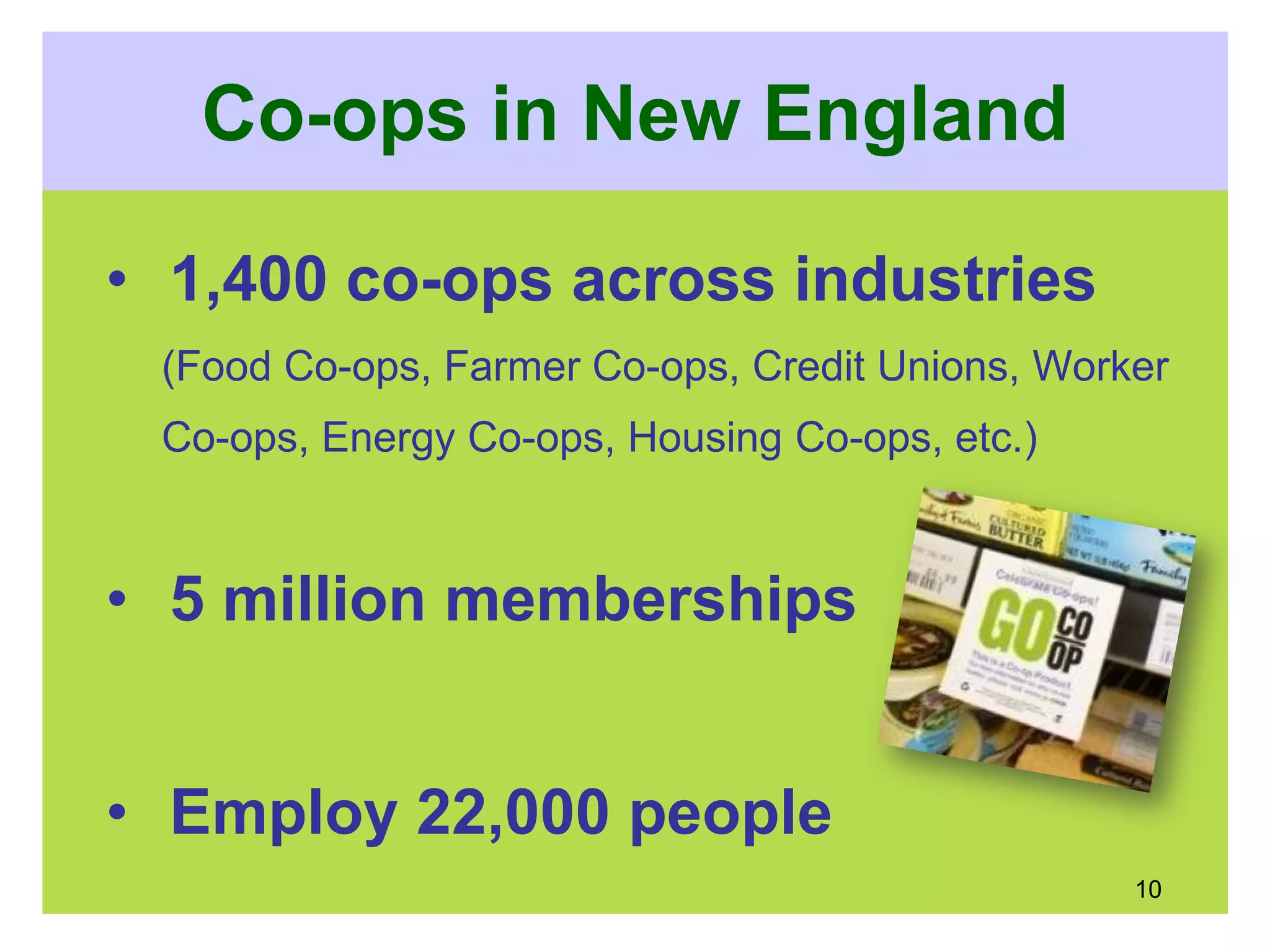
Co-ops in New England
• 1,400 co-ops across industries
(Food Co-ops, Farmer Co-ops, Credit Unions, Worker
Co-ops, Energy Co-ops, Housing Co-ops, etc.)
• 5 million memberships
• Employ 22,000 people
10
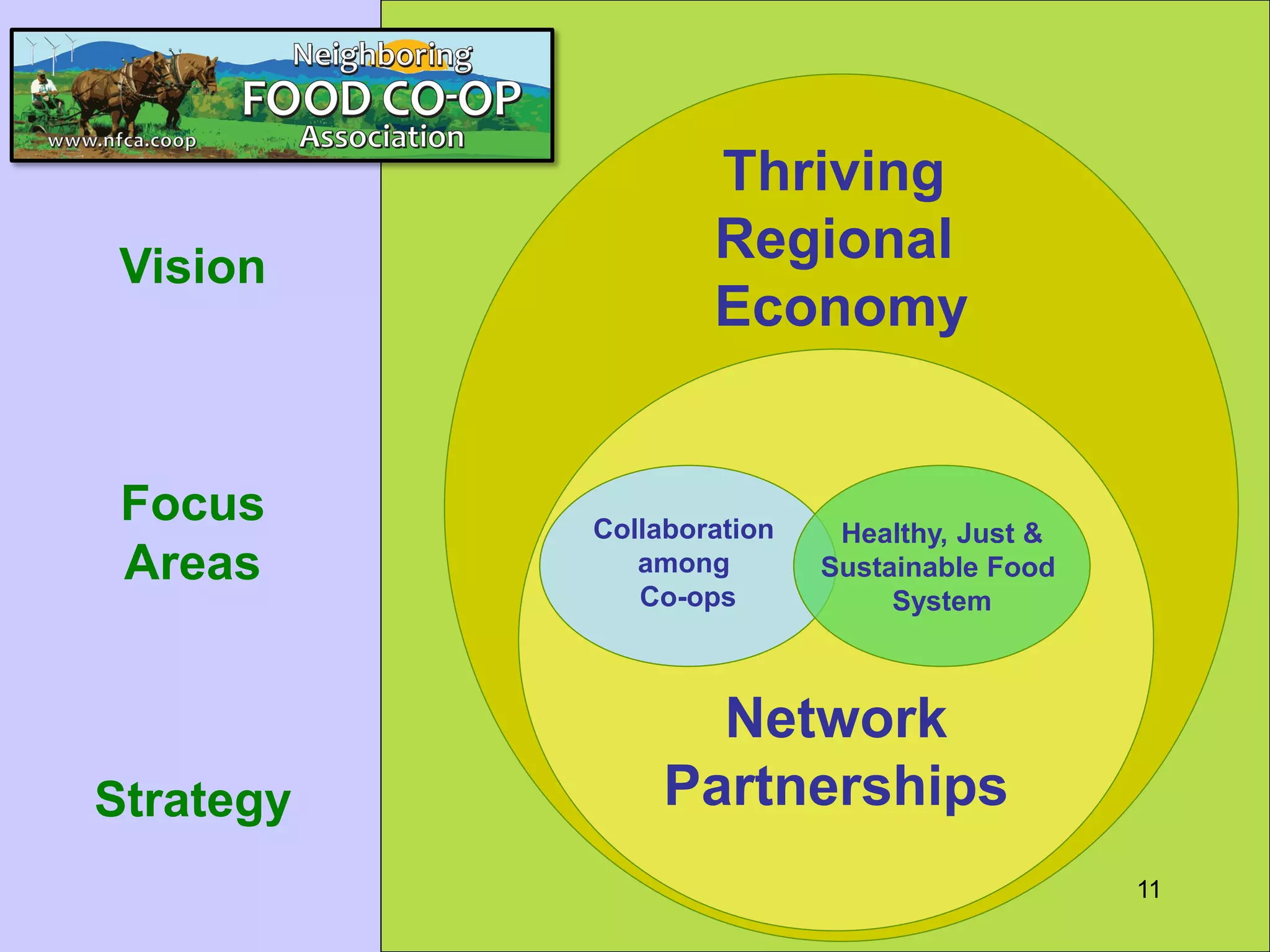
Vision
Focus
Areas
Strategy
Thriving
Regional
Economy
Network
Partnerships
Collaboration
among
Co-ops
Healthy, Just &
Sustainable Food
System
11
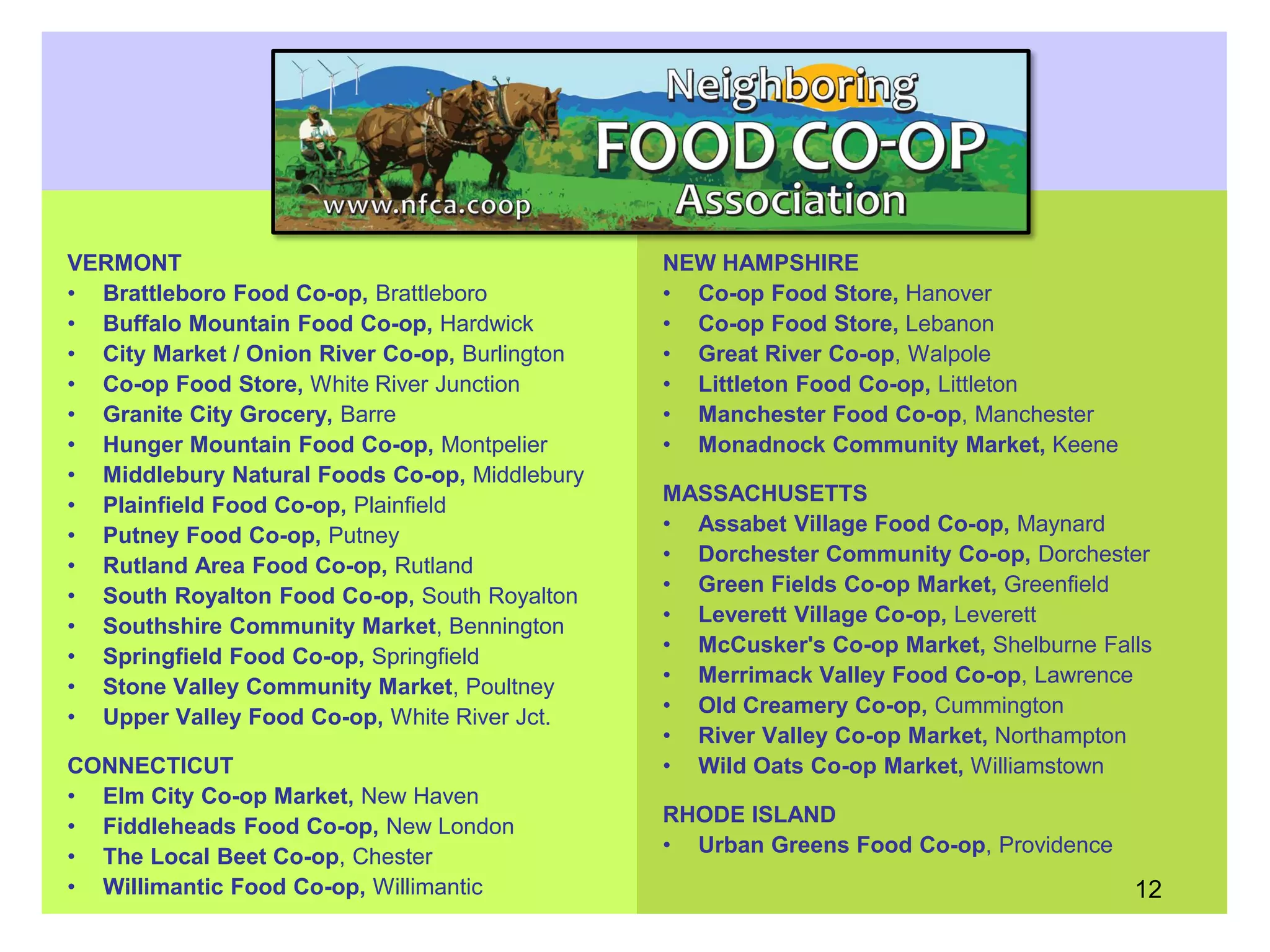
VERMONT
• Brattleboro Food Co-op, Brattleboro
• Buffalo Mountain Food Co-op, Hardwick
• City Market / Onion River Co-op, Burlington
• Co-op Food Store, White River Junction
• Granite City Grocery, Barre
• Hunger Mountain Food Co-op, Montpelier
• Middlebury Natural Foods Co-op, Middlebury
• Plainfield Food Co-op, Plainfield
• Putney Food Co-op, Putney
• Rutland Area Food Co-op, Rutland
• South Royalton Food Co-op, South Royalton
• Southshire Community Market, Bennington
• Springfield Food Co-op, Springfield
• Stone Valley Community Market, Poultney
• Upper Valley Food Co-op, White River Jct.
CONNECTICUT
• Elm City Co-op Market, New Haven
• Fiddleheads Food Co-op, New London
• The Local Beet Co-op, Chester
• Willimantic Food Co-op, Willimantic
NEW HAMPSHIRE
• Co-op Food Store, Hanover
• Co-op Food Store, Lebanon
• Great River Co-op, Walpole
• Littleton Food Co-op, Littleton
• Manchester Food Co-op, Manchester
• Monadnock Community Market, Keene
MASSACHUSETTS
• Assabet Village Food Co-op, Maynard
• Dorchester Community Co-op, Dorchester
• Green Fields Co-op Market, Greenfield
• Leverett Village Co-op, Leverett
• McCusker's Co-op Market, Shelburne Falls
• Merrimack Valley Food Co-op, Lawrence
• Old Creamery Co-op, Cummington
• River Valley Co-op Market, Northampton
• Wild Oats Co-op Market, Williamstown
RHODE ISLAND
• Urban Greens Food Co-op, Providence
12
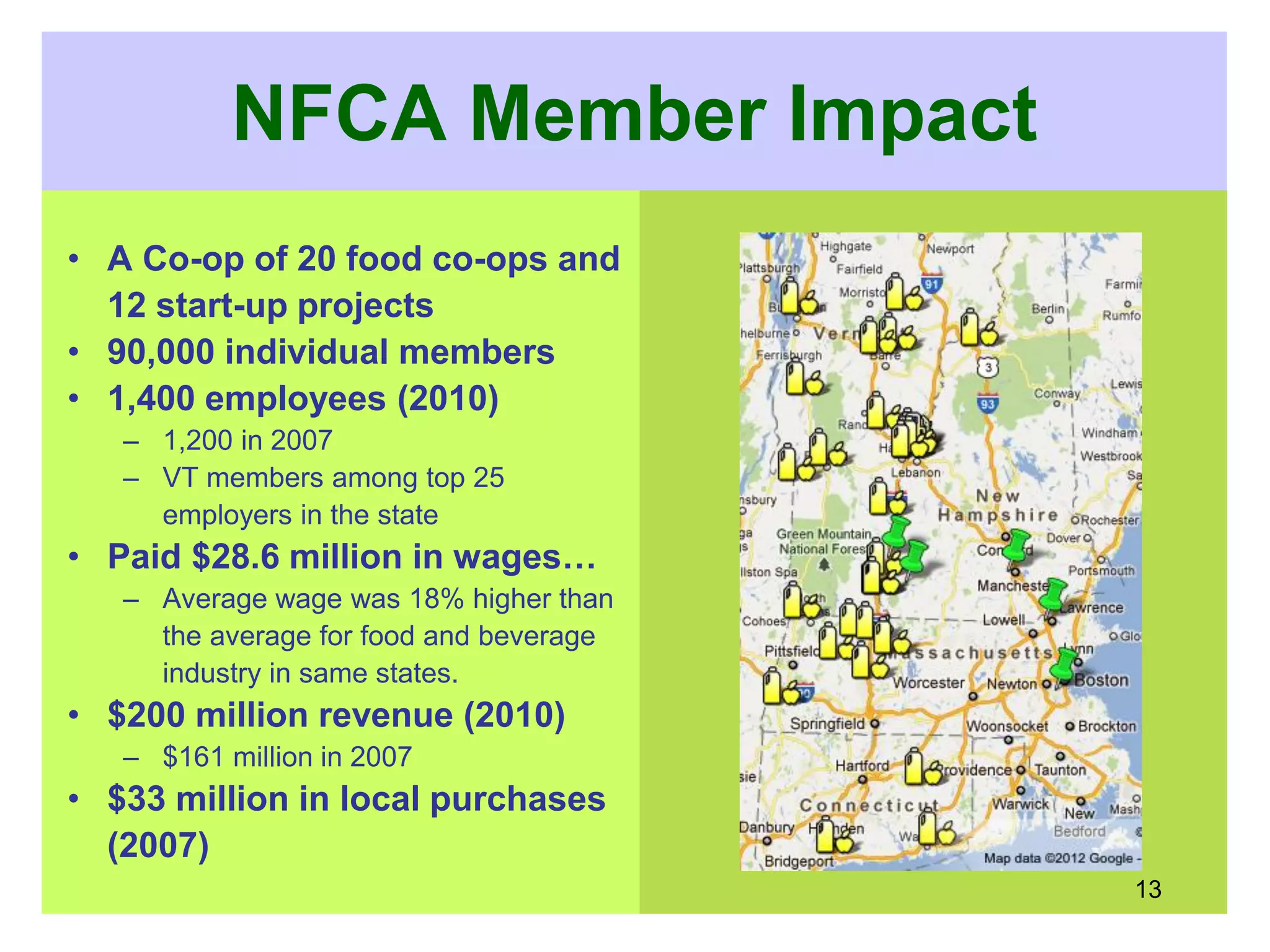
NFCA Member Impact
• A Co-op of 20 food co-ops and
12 start-up projects
• 90,000 individual members
• 1,400 employees (2010)
– 1,200 in 2007
– VT members among top 25
employers in the state
• Paid $28.6 million in wages…
– Average wage was 18% higher than
the average for food and beverage
industry in same states.
• $200 million revenue (2010)
– $161 million in 2007
• $33 million in local purchases
(2007)
13
• Non-profit mission based lending institution
• Started by food co-ops in 1975 to
– To provide investment opportunities, debt financing
and technical assistance
– To advance co-ops and community-based nonprofits
– In New England and eastern upstate New York
14
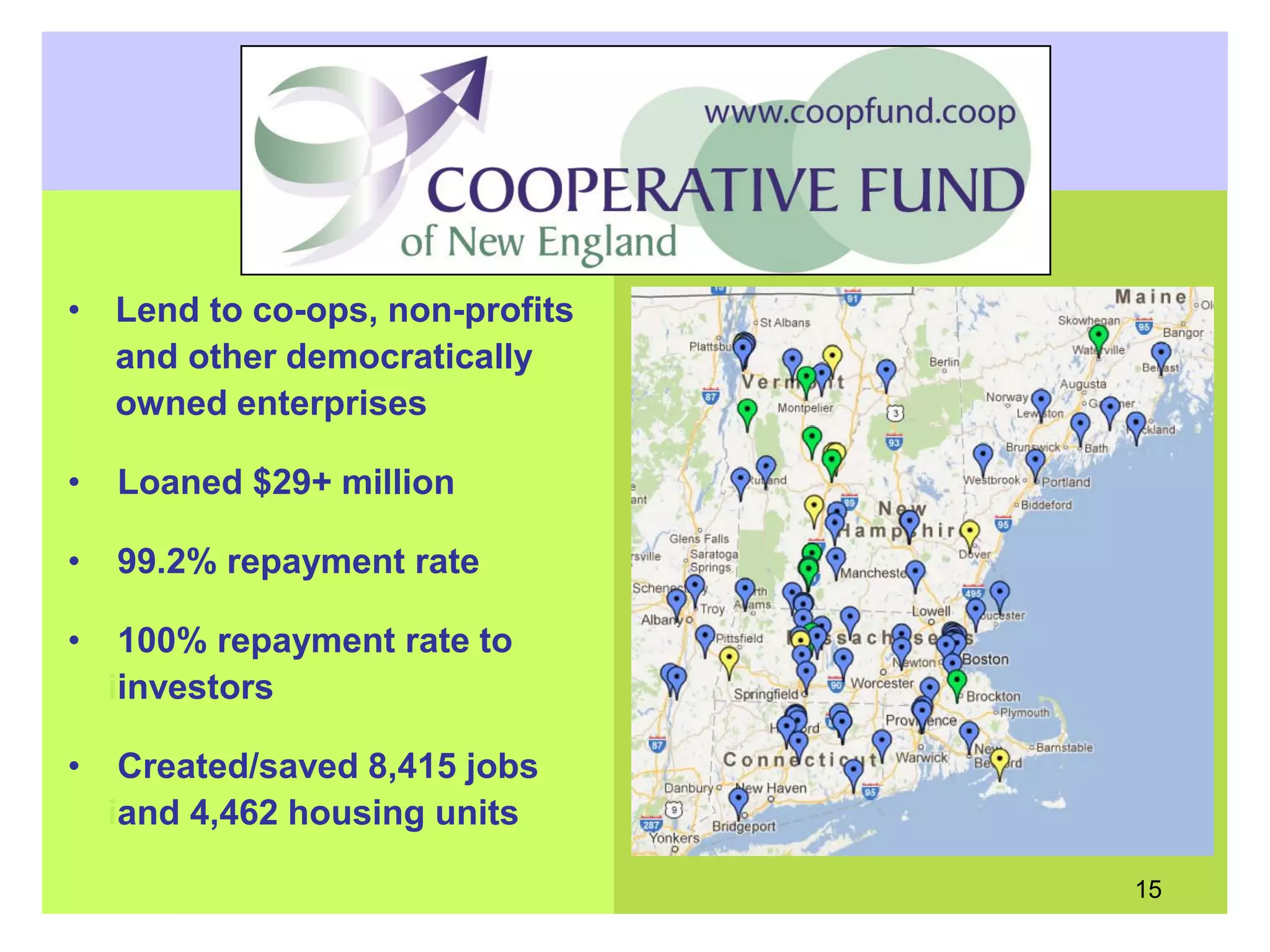
• Lend to co-ops, non-profits
and other democratically
owned enterprises
• Loaned $29+ million
• 99.2% repayment rate
• 100% repayment rate to
iinvestors
• Created/saved 8,415 jobs
iand 4,462 housing units
15
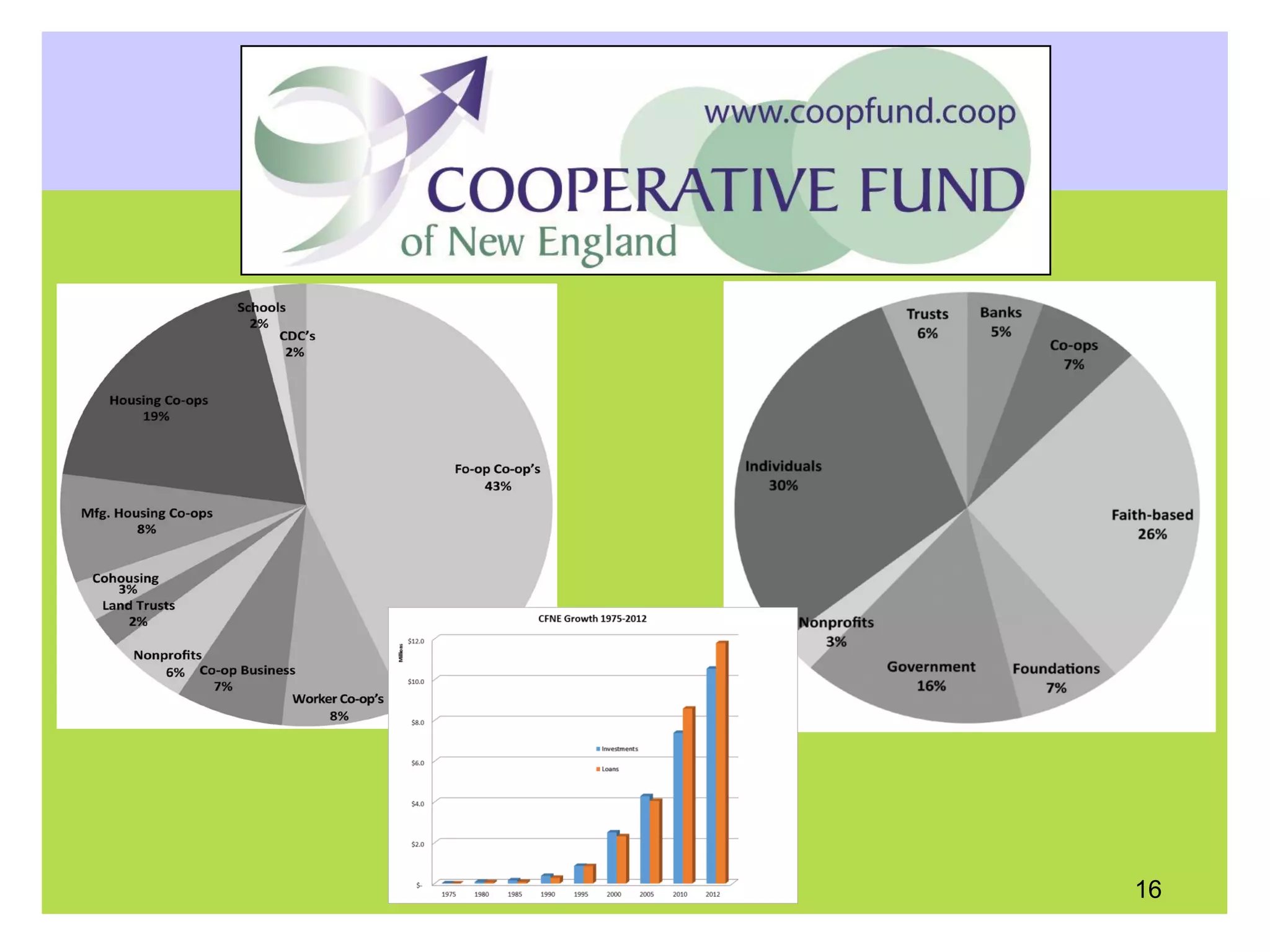
CFNE Impact
16
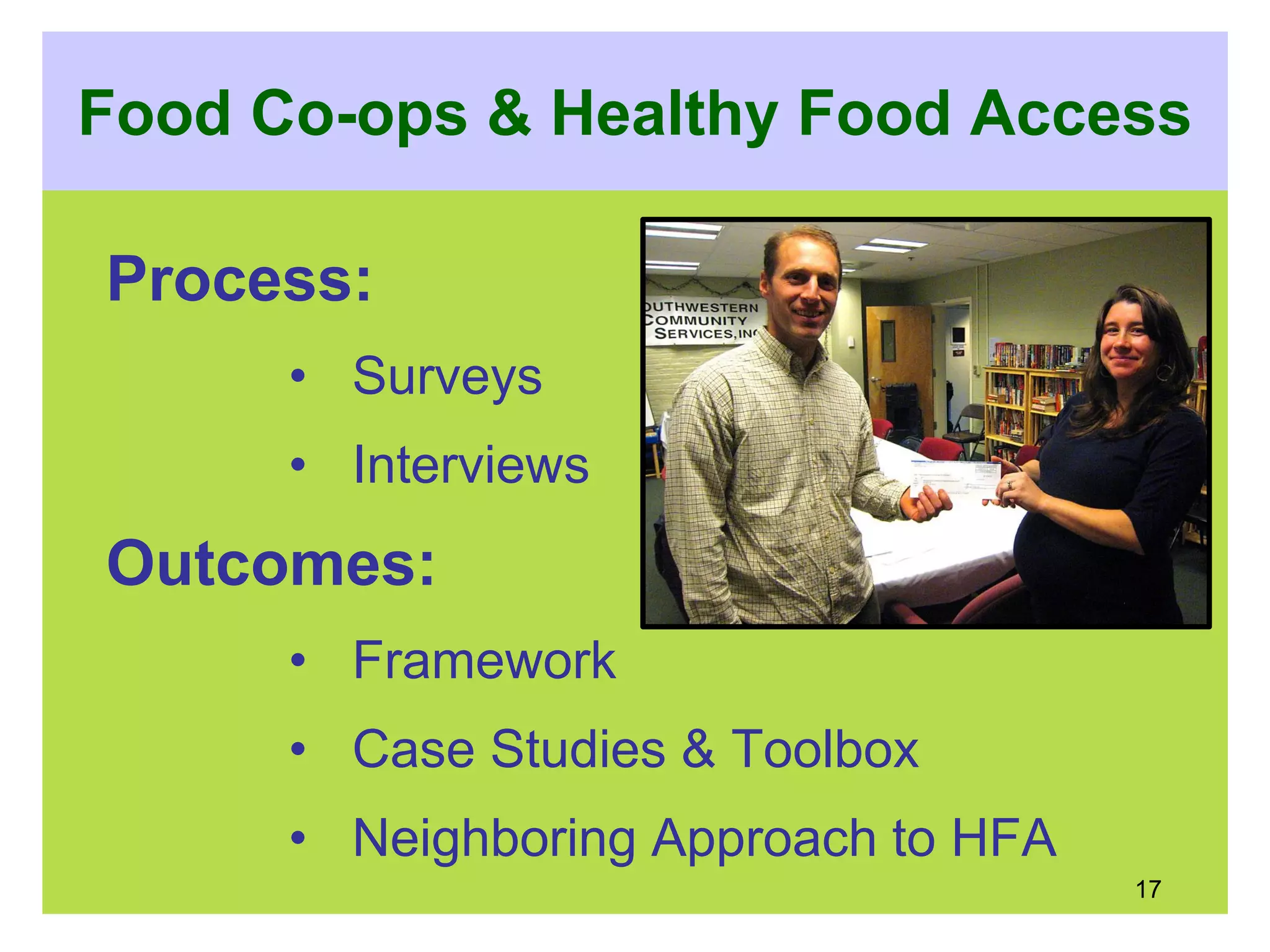
Food Co-ops & Healthy Food Access
Process:
• Surveys
• Interviews
Outcomes:
• Framework
• Case Studies & Toolbox
• Neighboring Approach to HFA
17
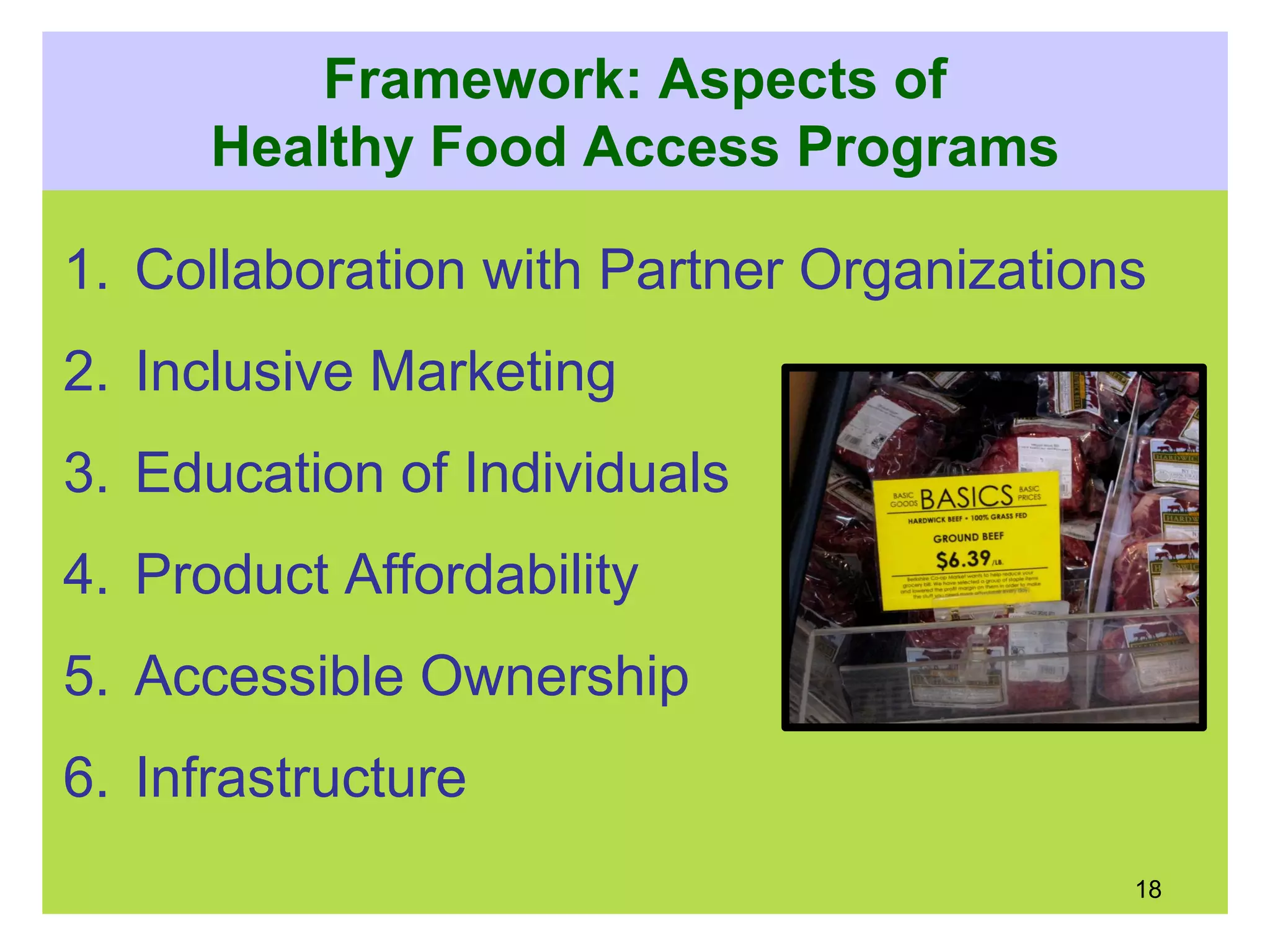
Framework: Aspects of
Healthy Food Access Programs
1. Collaboration with Partner Organizations
2. Inclusive Marketing
3. Education of Individuals
4. Product Affordability
5. Accessible Ownership
6. Infrastructure
18
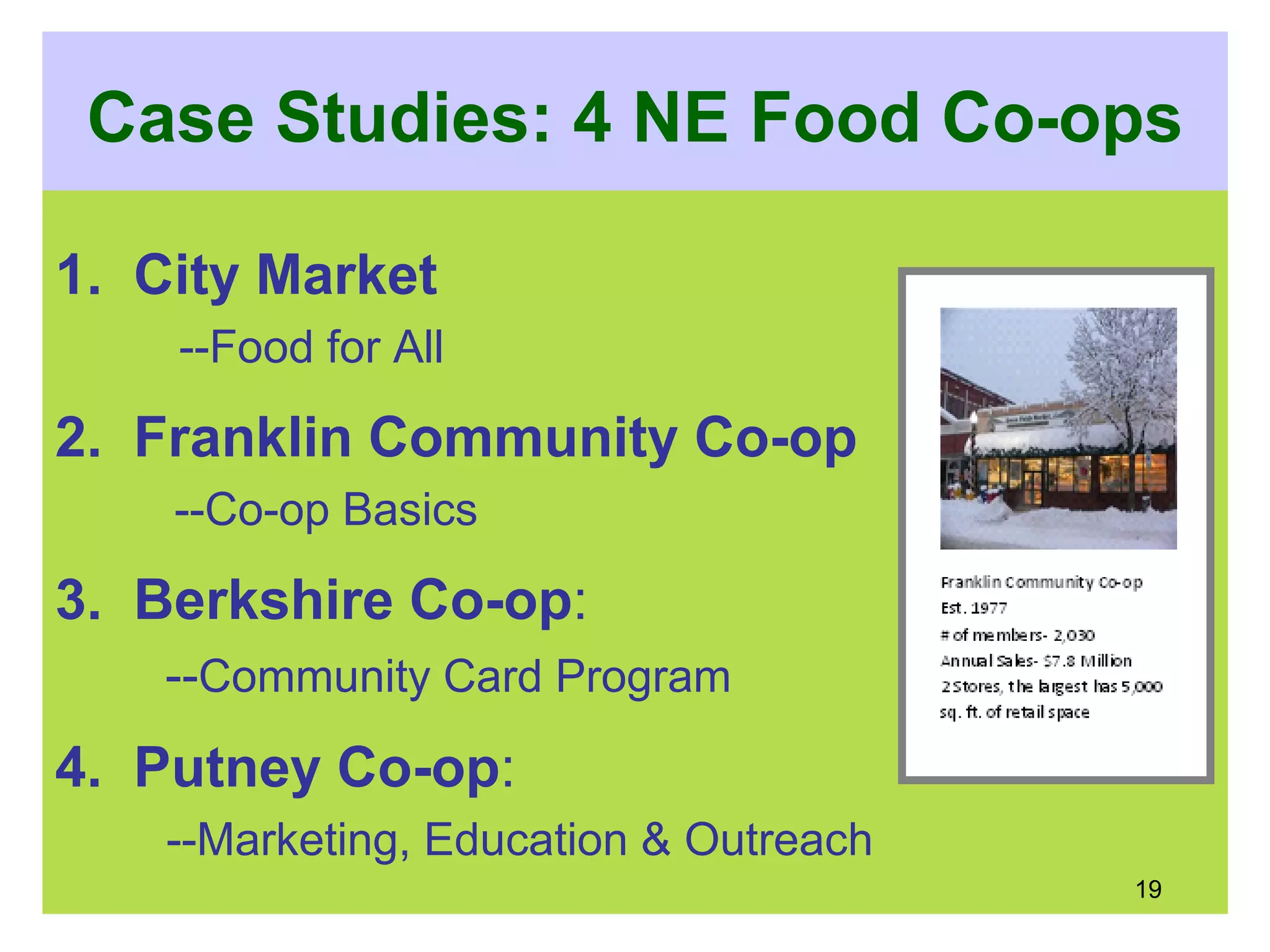
Case Studies: 4 NE Food Co-ops
1. City Market
--Food for All
2. Franklin Community Co-op
--Co-op Basics
3. Berkshire Co-op:
--Community Card Program
4. Putney Co-op:
--Marketing, Education & Outreach
19
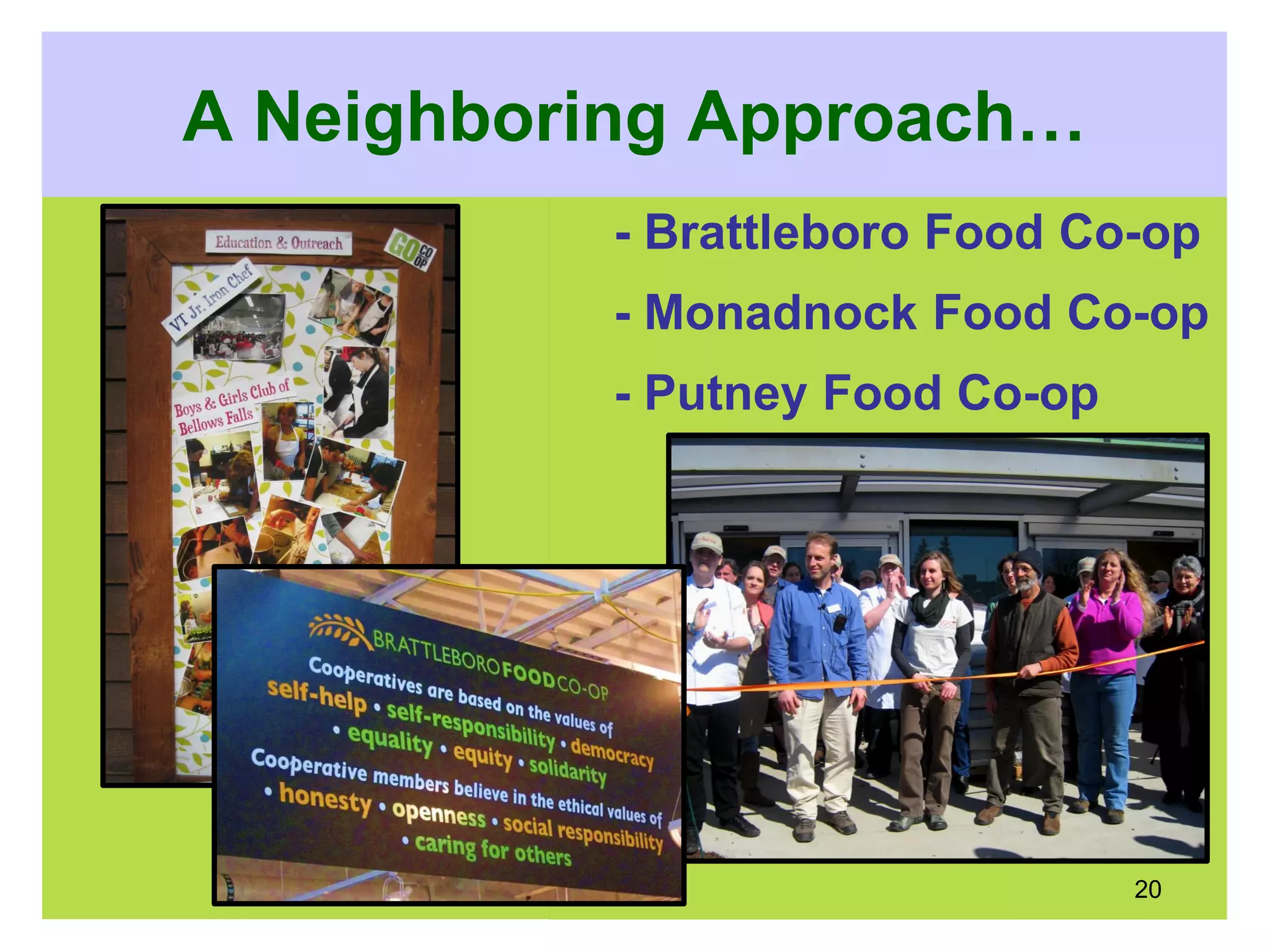
- Brattleboro Food Co-op
- Monadnock Food Co-op
- Putney Food Co-op
20
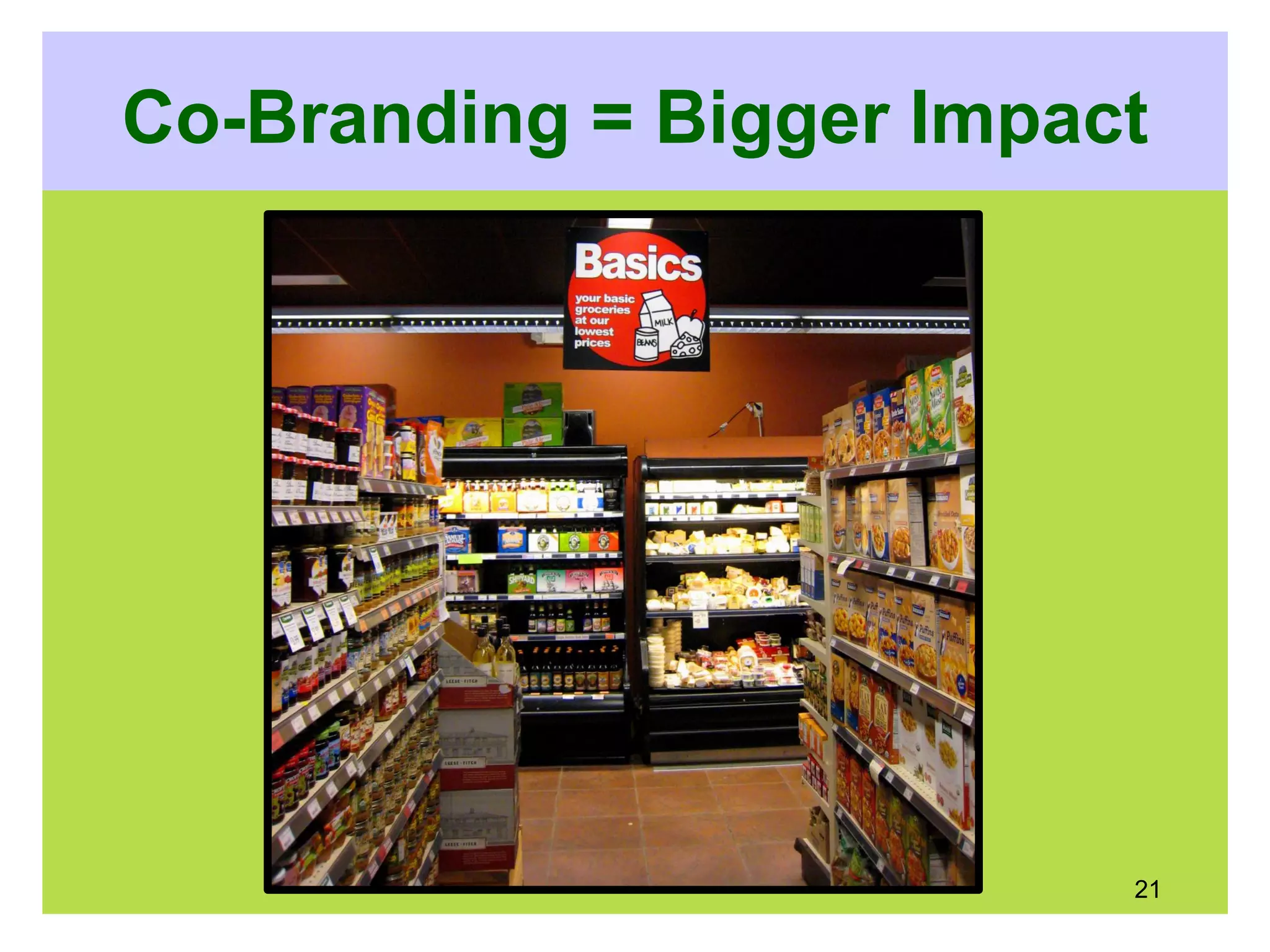
A Neighboring Approach…
Co-Branding = Bigger Impact
21
Challenges & Responses
Challenges:
• Reaching prospective
co-operators
• Pricing
• Perception re: co-ops
as expensive
• Cost of implementing
affordability programs
for new or small co-ops
Responses:
• Smart partnering
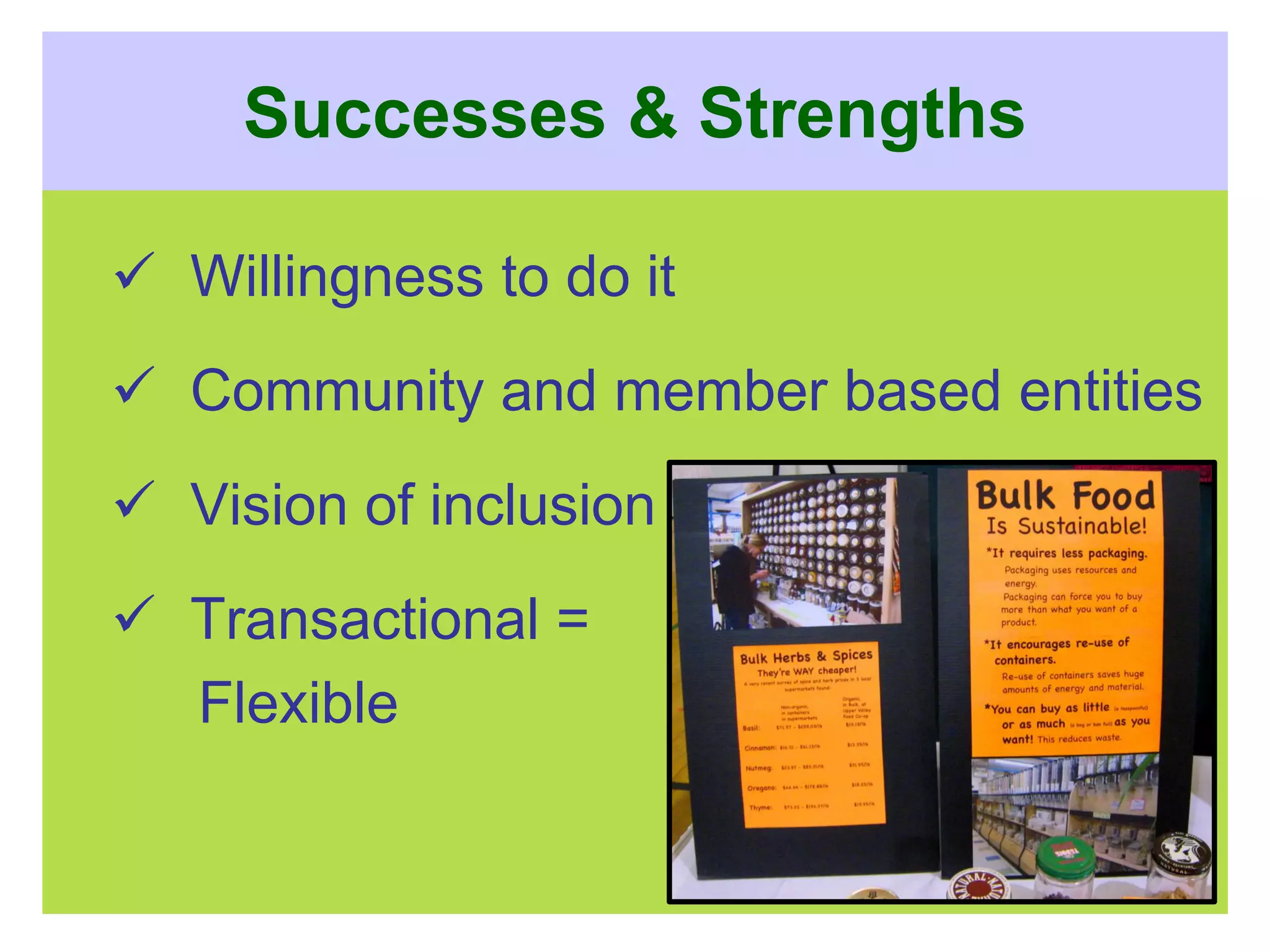
• Basics, bulk, education
re: cooking.
• Education re: variety &
value
• Grants, loans, shared
program among several
co-ops
22
Successes & Strengths
 Willingness to do it
 Community and member based entities
 Vision of inclusion
 Transactional =
Flexible
23
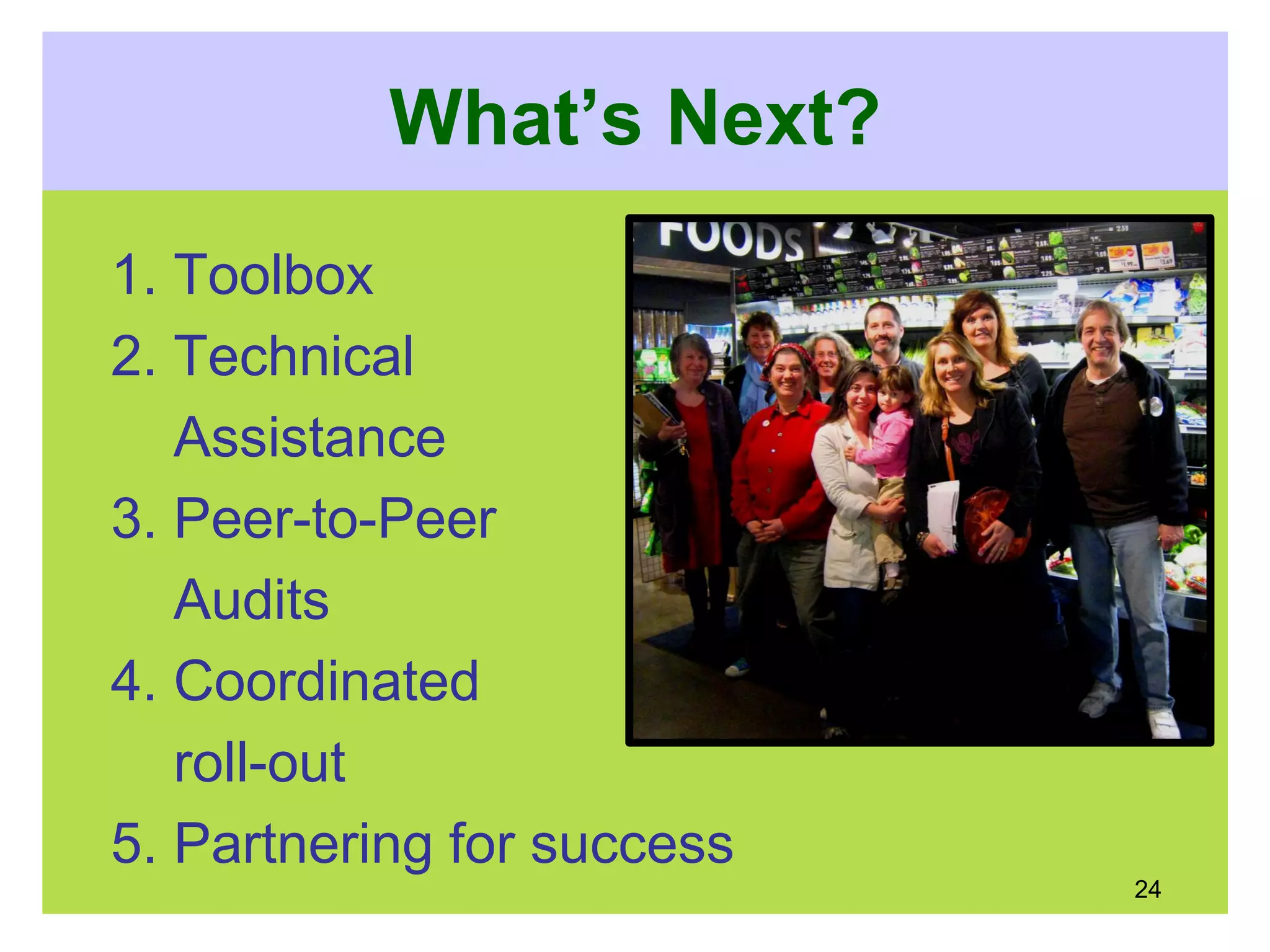
What’s Next?
1. Toolbox
2. Technical
Assistance
3. Peer-to-Peer
Audits
4. Coordinated
roll-out
5. Partnering for success
24
Discussion
• What innovations has your co-op
come up with to make healthy
food more accessible to all?
• What could we accomplish
together, as a movement of food
co-ops across the country?
25
Contact Us
Betsy Black, Northwest Loan and Outreach Officer
Cooperative Fund of New England
betsy@coopfund.coop // www.coopfund.coop
Bonnie Hudspeth, Outreach Coordinator
Neighboring Food Co-op Association
bonnie@nfca.coop // www.nfca.coop
www.facebook.com/neighboring
26

Healthy Food Access: Lessons From The Field, CCMA 2013

  • 1.
    Healthy Food Access: Lessonsfrom the Field Betsy Black & Bonnie Hudspeth CCMA Conference // June 7, 2013 1
  • 2.
    Overview • Why Bother? •Introductions • Context • Food Co-ops & Healthy Food Access • Next Steps • Questions? • Discussion 2
  • 3.
  • 4.
    Healthy Food AccessContext: New England Demographics • In the US, 23.5 million Americans (including 6.5 million children) live in areas with limited access to affordable and nutritious food • This need is spread through urban, rural, and increasingly suburban communities • A majority of New England food co-ops are not in densely-populated cities 4
  • 5.
    The Birth &Growth of the Co-op Movement • Rochdale Pioneers • Begin with a store • Accumulate shared capital • Leverage purchasing power for new Co-op enterprises • All about HEALTHY FOOD ACCESS 5
  • 6.
    “User” Focused • User-Owned:The people who use the co-op’s services also own it. • User-Controlled: The people who use the co-op control it on a democratic basis (one- member, one-vote). • User-Benefit: The people who use the co-op receive benefits such as patronage dividends, improved price, goods and services & employment. 6
  • 7.
    Co-ops & Resilience Communityownership & control + Focus on service, meeting needs before profit + Development of local skills & assets + Regional economic efficiencies + Ability to assemble limited resources + Difficult to move or buy-out + Root wealth in communities, not markets + Member, customer loyalty + Low business failure rate & are long-lived ------------------------------------------------------------------ = More stable local food systems, infrastructure, employment, services & economy 7
  • 8.
    Co-ops Today Are morecommon than we think • 1 billion members worldwide (1 in 4 in the US) • More people than own stock in privately traded corporations • Majority of US farmers are co-op members Are innovative • Healthy food, organic agriculture, Fair Trade, re-localization, regional aggregation & distribution Are successful • 30,000 co-ops in all sectors of US economy Are resilient • Survived and grew during the global recession 8
  • 9.
  • 10.
    Co-ops in NewEngland • 1,400 co-ops across industries (Food Co-ops, Farmer Co-ops, Credit Unions, Worker Co-ops, Energy Co-ops, Housing Co-ops, etc.) • 5 million memberships • Employ 22,000 people 10
  • 11.
  • 12.
    VERMONT • Brattleboro FoodCo-op, Brattleboro • Buffalo Mountain Food Co-op, Hardwick • City Market / Onion River Co-op, Burlington • Co-op Food Store, White River Junction • Granite City Grocery, Barre • Hunger Mountain Food Co-op, Montpelier • Middlebury Natural Foods Co-op, Middlebury • Plainfield Food Co-op, Plainfield • Putney Food Co-op, Putney • Rutland Area Food Co-op, Rutland • South Royalton Food Co-op, South Royalton • Southshire Community Market, Bennington • Springfield Food Co-op, Springfield • Stone Valley Community Market, Poultney • Upper Valley Food Co-op, White River Jct. CONNECTICUT • Elm City Co-op Market, New Haven • Fiddleheads Food Co-op, New London • The Local Beet Co-op, Chester • Willimantic Food Co-op, Willimantic NEW HAMPSHIRE • Co-op Food Store, Hanover • Co-op Food Store, Lebanon • Great River Co-op, Walpole • Littleton Food Co-op, Littleton • Manchester Food Co-op, Manchester • Monadnock Community Market, Keene MASSACHUSETTS • Assabet Village Food Co-op, Maynard • Dorchester Community Co-op, Dorchester • Green Fields Co-op Market, Greenfield • Leverett Village Co-op, Leverett • McCusker's Co-op Market, Shelburne Falls • Merrimack Valley Food Co-op, Lawrence • Old Creamery Co-op, Cummington • River Valley Co-op Market, Northampton • Wild Oats Co-op Market, Williamstown RHODE ISLAND • Urban Greens Food Co-op, Providence 12
  • 13.
    NFCA Member Impact •A Co-op of 20 food co-ops and 12 start-up projects • 90,000 individual members • 1,400 employees (2010) – 1,200 in 2007 – VT members among top 25 employers in the state • Paid $28.6 million in wages… – Average wage was 18% higher than the average for food and beverage industry in same states. • $200 million revenue (2010) – $161 million in 2007 • $33 million in local purchases (2007) 13
  • 14.
    • Non-profit missionbased lending institution • Started by food co-ops in 1975 to – To provide investment opportunities, debt financing and technical assistance – To advance co-ops and community-based nonprofits – In New England and eastern upstate New York 14
  • 15.
    • Lend toco-ops, non-profits and other democratically owned enterprises • Loaned $29+ million • 99.2% repayment rate • 100% repayment rate to iinvestors • Created/saved 8,415 jobs iand 4,462 housing units 15 CFNE Impact
  • 16.
  • 17.
    Food Co-ops &Healthy Food Access Process: • Surveys • Interviews Outcomes: • Framework • Case Studies & Toolbox • Neighboring Approach to HFA 17
  • 18.
    Framework: Aspects of HealthyFood Access Programs 1. Collaboration with Partner Organizations 2. Inclusive Marketing 3. Education of Individuals 4. Product Affordability 5. Accessible Ownership 6. Infrastructure 18
  • 19.
    Case Studies: 4NE Food Co-ops 1. City Market --Food for All 2. Franklin Community Co-op --Co-op Basics 3. Berkshire Co-op: --Community Card Program 4. Putney Co-op: --Marketing, Education & Outreach 19
  • 20.
    - Brattleboro FoodCo-op - Monadnock Food Co-op - Putney Food Co-op 20 A Neighboring Approach…
  • 21.
  • 22.
    Challenges & Responses Challenges: •Reaching prospective co-operators • Pricing • Perception re: co-ops as expensive • Cost of implementing affordability programs for new or small co-ops Responses: • Smart partnering • Basics, bulk, education re: cooking. • Education re: variety & value • Grants, loans, shared program among several co-ops 22
  • 23.
    Successes & Strengths Willingness to do it  Community and member based entities  Vision of inclusion  Transactional = Flexible 23
  • 24.
    What’s Next? 1. Toolbox 2.Technical Assistance 3. Peer-to-Peer Audits 4. Coordinated roll-out 5. Partnering for success 24
  • 25.
    Discussion • What innovationshas your co-op come up with to make healthy food more accessible to all? • What could we accomplish together, as a movement of food co-ops across the country? 25
  • 26.
    Contact Us Betsy Black,Northwest Loan and Outreach Officer Cooperative Fund of New England betsy@coopfund.coop // www.coopfund.coop Bonnie Hudspeth, Outreach Coordinator Neighboring Food Co-op Association bonnie@nfca.coop // www.nfca.coop www.facebook.com/neighboring 26