Co-operatives and CED Presenters: Sonia Balepa Melanie Bellamy  Adrian Egbers Nicole Rosenow-Redhead
Introduction Just Some Sectors: Retail: Consumer/Worker Agriculture Health Financial Housing Insurance Seven Principles:  1)  Voluntary and open membership  2)  Democratic member control  3)  Member economic participation  4)  Autonomy and independence  5)  Education, training, and information  6)  Co-operation among co-operatives  7)  Concern for community  “ Co-operatives and credit unions are driven by both economic and social concerns” Types of Co-operatives: 1)  Producer co-operatives 2)  Worker co-operatives 3)  Consumer co-operatives 4)  Multi-stakeholder co-operatives 5)  Worker-Shareholder co-operatives A Different Purpose A Different Control Structure A Different Allocation of Profit What is a co-operative and how can they impact the everyday lives of Canadians?
Co-op Skit: At The Pearly Gates
Co-operatives and Development at the National and International Level
Policy and Legislation Legislation Canadian Co-operatives Act, 1970 (revised 1999) Policy and Programs  Agriculture and Agri-Foods Canada
National Associations Canadian Co-operative Association (CCA), 1909 Represents: 9 million members/3000 Co-ops Counseil Canadian de la Co-opération (CCC), 1947 Represents: 8 million members/3484 Co-ops
Co-operative Development Initiative (CDI) In operation for six years: $4 million  Innovation & Research Advisory Services Ag-CDI Co-operative Development Foundation (CDF) Associate Members/Friends of CCA
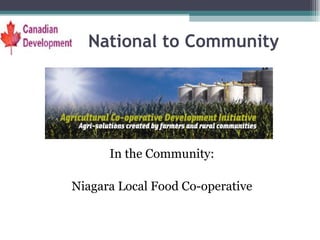
National to Community In the Community: Niagara Local Food Co-operative
Mountain Equipment Co-op National in scope $225,000,000 million in revenues 2.5 million members 12 locations across Canada We all vote for the Board of Directors Environmental mandate
Co-operatives and International Development  International Co-operative Alliance (ICA) Founded in 1895 – 220 member organizations in 86 countries that represent 800 million members. Geneva, Switzerland  Canadian Co-operative Association ID Projects with co-ops and credit unions in Africa, Americas, Asia CDF and CIDA: $1 = $3  Develops co-ops in over 20 countries
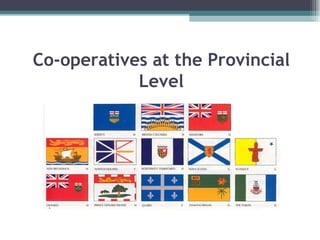
Co-operatives at the Provincial Level
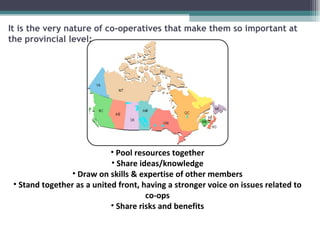
It is the very nature of co-operatives that make them so important at the provincial level: Pool resources together Share ideas/knowledge Draw on skills & expertise of other members Stand together as a united front, having a stronger voice on issues related to co-ops Share risks and benefits
Provincial Distribution  For a country as vast as Canada, where there are many small and isolated rural communities, co-ops and credit unions can be the economic backbone of entire communities The co-operative movement is thriving in Quebec, largely due to the fact that the Government of Quebec has taken an active role in supporting co-ops, working in a long-term partnership, with continued investment, to ensure that new co-ops can emerge and existing ones can survive and thrive. Newfoundland/Labrador   PEI  70 + Co-ops 340 + Co-ops  57,000 members 60,000 + members 1,400 employees 250 (+) employees (ADLtd) $132 million in sales/assets $105 million in sales/assets  (Amalgamated DiariesLtd)
Case Study #1 – Co-op Atlantic Largest wholesale agri-food operation in the Atlantic region Listed as one of the top 10 Businesses in Atlantic Canada More than 100 member-owned food and farm supply retailers and co-operatives throughout the Atlantic provinces that purchase goods and services from Co-op Atlantic Atlantic Canada’s only grower-to-grocer food provider
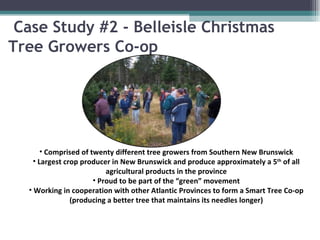
Case Study #2 - Belleisle Christmas Tree Growers Co-op Comprised of twenty different tree growers from Southern New Brunswick Largest crop producer in New Brunswick and produce approximately a 5 th  of all agricultural products in the province Proud to be part of the “green” movement Working in cooperation with other Atlantic Provinces to form a Smart Tree Co-op (producing a better tree that maintains its needles longer)
Co-op Security A recent study in Quebec showed  64%  of co-ops were still in existence after  5 years  of operation compared with  36%  of other businesses Co-ops have also demonstrated a higher level of growth than the Canadian economy in general.  Between 1984 and 1997, the number of jobs in the co-op sector increased by  50%  compared to a national average of  20%  over the same time period
THE HEALTH SECTOR AND COOPERATIVES IN CANADA
Health Sector and Co-operatives The first one was created in 1940 by Doctor Jacques Tremblay in the Province of Quebec Saskatchewan has been using this model of community clinics since 1962 Different services: medical consultations, dental surgery, medical consultation at home, emergency consultations, etc.
  HEALTH COOPERATIVES AND THE YOUTH INVOLVMENT Enable their beneficiaries to grasp the advantages of working in a cooperative Youth can work in French and keep their Francophone identity
HOW TO START A COOPERATIVE IN THE HEALTH SECTOR 1. THE STAGES OF THE CREATION OF A COOPERATIVE 2. FEASIBILITY STUDIES 3. VIABILITY TEST 4. LEGAL TOOLS 5. RECRUITMENT AND MEMBERS TRAINING 6. THE ELABORATION OF THE INTERNAL REGULATIONS 7. GENERAL ASSEMBLY
Community Economic Development: North End Halifax The Grainery Food Co-op Case Study Community Economic Development: North End Halifax
“ We strive for self-management on the part of our workers, and value all work undertaken, including the work of Producers”
“ We recognize the importance of education, especially on issues of food sustainability, health, and community activism”
We value the active participation of the broader community, with whom we wish to codetermine our collective future We seek a membership policy free of barriers We aim for a culturally and economically diverse membership
“ We value all people involved in the co-op. We respect all of our members and customers; - appreciating the diversity of our cultures and views - giving equal value to the contributions of men and women”
Through healthy practices we will work to ensure the sustainability of the co-op. We seek to promote community health by: - Hiring locally - Maintaining accessibility - Avoiding authoritarian language and structures - Linking with other elements of the local community
Conclusion 1) Name one of the seven principles of the co-operative business model. 2) How are co-operatives different than ordinary businesses or social enterprises? (Name at least one) 3) What, in your opinion, is the benefit of having a co-op? CDI Renewal Campaign

Co-operatives and CED 2

  • 1.
    Co-operatives and CEDPresenters: Sonia Balepa Melanie Bellamy Adrian Egbers Nicole Rosenow-Redhead
  • 2.
    Introduction Just SomeSectors: Retail: Consumer/Worker Agriculture Health Financial Housing Insurance Seven Principles: 1) Voluntary and open membership 2) Democratic member control 3) Member economic participation 4) Autonomy and independence 5) Education, training, and information 6) Co-operation among co-operatives 7) Concern for community “ Co-operatives and credit unions are driven by both economic and social concerns” Types of Co-operatives: 1) Producer co-operatives 2) Worker co-operatives 3) Consumer co-operatives 4) Multi-stakeholder co-operatives 5) Worker-Shareholder co-operatives A Different Purpose A Different Control Structure A Different Allocation of Profit What is a co-operative and how can they impact the everyday lives of Canadians?
  • 3.
    Co-op Skit: AtThe Pearly Gates
  • 4.
    Co-operatives and Developmentat the National and International Level
  • 5.
    Policy and LegislationLegislation Canadian Co-operatives Act, 1970 (revised 1999) Policy and Programs Agriculture and Agri-Foods Canada
  • 6.
    National Associations CanadianCo-operative Association (CCA), 1909 Represents: 9 million members/3000 Co-ops Counseil Canadian de la Co-opération (CCC), 1947 Represents: 8 million members/3484 Co-ops
  • 7.
    Co-operative Development Initiative(CDI) In operation for six years: $4 million Innovation & Research Advisory Services Ag-CDI Co-operative Development Foundation (CDF) Associate Members/Friends of CCA
  • 8.
    National to CommunityIn the Community: Niagara Local Food Co-operative
  • 9.
    Mountain Equipment Co-opNational in scope $225,000,000 million in revenues 2.5 million members 12 locations across Canada We all vote for the Board of Directors Environmental mandate
  • 10.
    Co-operatives and InternationalDevelopment International Co-operative Alliance (ICA) Founded in 1895 – 220 member organizations in 86 countries that represent 800 million members. Geneva, Switzerland Canadian Co-operative Association ID Projects with co-ops and credit unions in Africa, Americas, Asia CDF and CIDA: $1 = $3 Develops co-ops in over 20 countries
  • 11.
    Co-operatives at theProvincial Level
  • 12.
    It is thevery nature of co-operatives that make them so important at the provincial level: Pool resources together Share ideas/knowledge Draw on skills & expertise of other members Stand together as a united front, having a stronger voice on issues related to co-ops Share risks and benefits
  • 13.
    Provincial Distribution For a country as vast as Canada, where there are many small and isolated rural communities, co-ops and credit unions can be the economic backbone of entire communities The co-operative movement is thriving in Quebec, largely due to the fact that the Government of Quebec has taken an active role in supporting co-ops, working in a long-term partnership, with continued investment, to ensure that new co-ops can emerge and existing ones can survive and thrive. Newfoundland/Labrador PEI 70 + Co-ops 340 + Co-ops 57,000 members 60,000 + members 1,400 employees 250 (+) employees (ADLtd) $132 million in sales/assets $105 million in sales/assets (Amalgamated DiariesLtd)
  • 14.
    Case Study #1– Co-op Atlantic Largest wholesale agri-food operation in the Atlantic region Listed as one of the top 10 Businesses in Atlantic Canada More than 100 member-owned food and farm supply retailers and co-operatives throughout the Atlantic provinces that purchase goods and services from Co-op Atlantic Atlantic Canada’s only grower-to-grocer food provider
  • 15.
    Case Study #2- Belleisle Christmas Tree Growers Co-op Comprised of twenty different tree growers from Southern New Brunswick Largest crop producer in New Brunswick and produce approximately a 5 th of all agricultural products in the province Proud to be part of the “green” movement Working in cooperation with other Atlantic Provinces to form a Smart Tree Co-op (producing a better tree that maintains its needles longer)
  • 16.
    Co-op Security Arecent study in Quebec showed 64% of co-ops were still in existence after 5 years of operation compared with 36% of other businesses Co-ops have also demonstrated a higher level of growth than the Canadian economy in general. Between 1984 and 1997, the number of jobs in the co-op sector increased by 50% compared to a national average of 20% over the same time period
  • 17.
    THE HEALTH SECTORAND COOPERATIVES IN CANADA
  • 18.
    Health Sector andCo-operatives The first one was created in 1940 by Doctor Jacques Tremblay in the Province of Quebec Saskatchewan has been using this model of community clinics since 1962 Different services: medical consultations, dental surgery, medical consultation at home, emergency consultations, etc.
  • 19.
      HEALTH COOPERATIVESAND THE YOUTH INVOLVMENT Enable their beneficiaries to grasp the advantages of working in a cooperative Youth can work in French and keep their Francophone identity
  • 20.
    HOW TO STARTA COOPERATIVE IN THE HEALTH SECTOR 1. THE STAGES OF THE CREATION OF A COOPERATIVE 2. FEASIBILITY STUDIES 3. VIABILITY TEST 4. LEGAL TOOLS 5. RECRUITMENT AND MEMBERS TRAINING 6. THE ELABORATION OF THE INTERNAL REGULATIONS 7. GENERAL ASSEMBLY
  • 21.
    Community Economic Development:North End Halifax The Grainery Food Co-op Case Study Community Economic Development: North End Halifax
  • 22.
    “ We strivefor self-management on the part of our workers, and value all work undertaken, including the work of Producers”
  • 23.
    “ We recognizethe importance of education, especially on issues of food sustainability, health, and community activism”
  • 24.
    We value theactive participation of the broader community, with whom we wish to codetermine our collective future We seek a membership policy free of barriers We aim for a culturally and economically diverse membership
  • 25.
    “ We valueall people involved in the co-op. We respect all of our members and customers; - appreciating the diversity of our cultures and views - giving equal value to the contributions of men and women”
  • 26.
    Through healthy practiceswe will work to ensure the sustainability of the co-op. We seek to promote community health by: - Hiring locally - Maintaining accessibility - Avoiding authoritarian language and structures - Linking with other elements of the local community
  • 27.
    Conclusion 1) Nameone of the seven principles of the co-operative business model. 2) How are co-operatives different than ordinary businesses or social enterprises? (Name at least one) 3) What, in your opinion, is the benefit of having a co-op? CDI Renewal Campaign