NW Co-op Development Center
Co-ops 101
Peoples Food Co-op
Mar. 13th
, 2013
Eric Bowman, Cooperative Development Specialist
eric@nwcdc.coop
1063 S Capitol Way # 211
Olympia, WA 98501
360.943.4241
Presentation: Co-ops 101
1. Intro
2. Overview and History
3. Co-op Economy and Models
4. Development Process
5. Resources
6. Q&A
NWCDC
The Center
a 501(c)3 nonprofit which provides development services
for new and existing co-ops
Our mission
to foster community economic development through the
co-op business model
We’re
a team of co-op developers with skills specific to start-up
and organizational business development
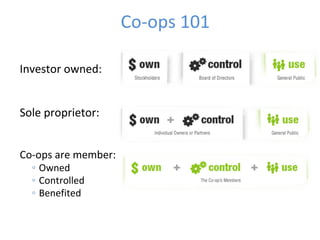
Co-ops 101
Investor owned:
Sole proprietor:
Co-ops are member:
◦ Owned
◦ Controlled
◦ Benefited
Corporate Structure
Co-op Role
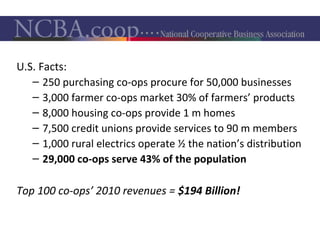
U.S. Facts:
– 250 purchasing co-ops procure for 50,000 businesses
– 3,000 farmer co-ops market 30% of farmers’ products
– 8,000 housing co-ops provide 1 m homes
– 7,500 credit unions provide services to 90 m members
– 1,000 rural electrics operate ½ the nation’s distribution
– 29,000 co-ops serve 43% of the population
Top 100 co-ops’ 2010 revenues = $194 Billion!
Internationally Recognized Principles
1. Voluntary and Open Membership
2. Democratic Member Control
3. Member Economic Participation
4. Autonomy and Independence
5. Education, Training and Information
6. Co-operation among Co-operatives
7. Concern for Community
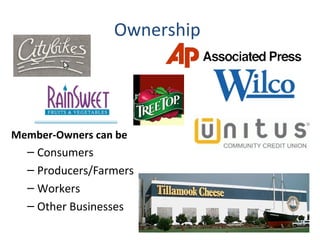
Ownership
Member-Owners can be
– Consumers
– Producers/Farmers
– Workers
– Other Businesses
Distributionism
Consumer
◦ Credit Unions
◦ Housing
◦ Retail (e.g. food co-ops)
◦ Farm Supply
Two Schools
Producer
◦ Worker
◦ Farmer
◦ Artisan
Distributionism cont.
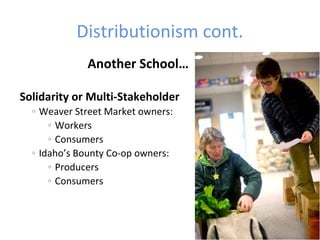
Another School…
Solidarity or Multi-Stakeholder
◦ Weaver Street Market owners:
◦ Workers
◦ Consumers
◦ Idaho’s Bounty Co-op owners:
◦ Producers
◦ Consumers
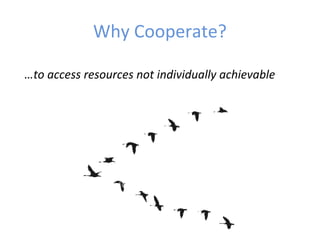
Why Cooperate?
…to access resources not individually achievable
Why form an entity?
Creating:
• Something bigger and beyond oneself
• Economy of scale
• Solid foundation for growth
• Legitimacy
• Commitment
• Limited liability
• Formal structure to work together
When not to form…
• Too small to cover admin
• Dependant on volunteer and/or grant
• Less than 3 members
• Don’t need structure
• No compelling economic need
Estimated Timeline
• 6 to 12 months (or more for each):
1. Organizing
2. Planning
3. Implementation
• Total of 1 ½ to 3 years
Co-op Development Stages
• Identify a need a co-op could
meet
• Form Steering Committee
• Research Feasibility
• Review Findings (Go/No Go)
• Membership Drive
• Planning and Financing
• Begin Operations (Go/No Go)
Project LifecycleProject Lifecycle
Co-op Development Stages
• Identify a need a co-op could
meet
• Form Steering Committee
• Research Feasibility
• Review Findings (Go/No Go)
• Membership Drive
• Planning and Financing
• Begin Operations (Go/No Go)
How We Assist
• Facilitate identifying mission and
goals
• Train founding Board members
• Market and feasibility research
• Assist with organizing
• Professional, 3rd
party perspective
• General business consulting
Project LifecycleProject Lifecycle
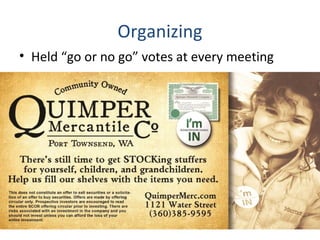
Organizing
• Held “go or no go” votes at every meeting
Organizing
• Form committee
– A “proto board”
– May or may not be potential members
– Role is:
• Advisory
• Exploratory
• Planning
• Networking
• Visionary
• Fundraising
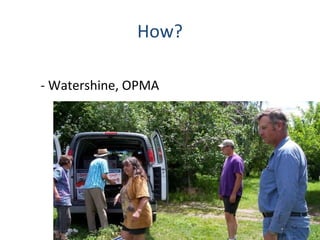
How?
- Watershine, OPMA
How?
“…hold about 500 meetings.”
- Watershine, OPMA
Planning & Feasibility
• Studying:
– Technical
• Location, management, etc.
– Economic/financial
• Projections on profit and loss, cash flow, start up
– Market
• Competition, sales, etc.
Feasibility
• More risk = more complex research
• Industry specific
– e.g. food co-ops: market analysis
• Who wants it?
– Potential members may
– Lenders
– Member lenders/investors
What you’re not:
What you are:
…is spending your neighbor’s money!
Membership Drive Phases
1. Highly motivated early adopters
2. Friends, family and fools are super easy
3. Tap out networks
4. Community organizing and it’s uphill
– It’s P.R., outreach, communications, etc.
– Need a plan
– “Political campaign without an election”
Resources
1. How to Start a Food Co-op; CGIN
2. How to Start a Cooperative; USDA
3. The Worker Cooperative Toolbox; NCDF
• Resources/toolboxes
– Food Co-op Initiative
– US Federation of Worker Co-ops
• Magazines
– Cooperative Grocer
– The Cooperator; Co-op and Condo monthly
Thank You!
Eric Bowman
eric@nwcdc.coop
Northwest Cooperative Development Center
1063 Capitol Way S # 211
Olympia, WA 98501
360.943.4241 | www.nwcdc.coop
Fostering community economic development through the
cooperative business model

2013 03 13 pfc - co-ops 101

  • 1.
    NW Co-op DevelopmentCenter Co-ops 101 Peoples Food Co-op Mar. 13th , 2013 Eric Bowman, Cooperative Development Specialist eric@nwcdc.coop 1063 S Capitol Way # 211 Olympia, WA 98501 360.943.4241
  • 2.
    Presentation: Co-ops 101 1.Intro 2. Overview and History 3. Co-op Economy and Models 4. Development Process 5. Resources 6. Q&A
  • 3.
    NWCDC The Center a 501(c)3nonprofit which provides development services for new and existing co-ops Our mission to foster community economic development through the co-op business model We’re a team of co-op developers with skills specific to start-up and organizational business development
  • 4.
    Co-ops 101 Investor owned: Soleproprietor: Co-ops are member: ◦ Owned ◦ Controlled ◦ Benefited
  • 5.
  • 6.
    Co-op Role U.S. Facts: –250 purchasing co-ops procure for 50,000 businesses – 3,000 farmer co-ops market 30% of farmers’ products – 8,000 housing co-ops provide 1 m homes – 7,500 credit unions provide services to 90 m members – 1,000 rural electrics operate ½ the nation’s distribution – 29,000 co-ops serve 43% of the population Top 100 co-ops’ 2010 revenues = $194 Billion!
  • 7.
    Internationally Recognized Principles 1.Voluntary and Open Membership 2. Democratic Member Control 3. Member Economic Participation 4. Autonomy and Independence 5. Education, Training and Information 6. Co-operation among Co-operatives 7. Concern for Community
  • 8.
    Ownership Member-Owners can be –Consumers – Producers/Farmers – Workers – Other Businesses
  • 9.
    Distributionism Consumer ◦ Credit Unions ◦Housing ◦ Retail (e.g. food co-ops) ◦ Farm Supply Two Schools Producer ◦ Worker ◦ Farmer ◦ Artisan
  • 10.
    Distributionism cont. Another School… Solidarityor Multi-Stakeholder ◦ Weaver Street Market owners: ◦ Workers ◦ Consumers ◦ Idaho’s Bounty Co-op owners: ◦ Producers ◦ Consumers
  • 11.
    Why Cooperate? …to accessresources not individually achievable
  • 12.
    Why form anentity? Creating: • Something bigger and beyond oneself • Economy of scale • Solid foundation for growth • Legitimacy • Commitment • Limited liability • Formal structure to work together
  • 13.
    When not toform… • Too small to cover admin • Dependant on volunteer and/or grant • Less than 3 members • Don’t need structure • No compelling economic need
  • 15.
    Estimated Timeline • 6to 12 months (or more for each): 1. Organizing 2. Planning 3. Implementation • Total of 1 ½ to 3 years
  • 16.
    Co-op Development Stages •Identify a need a co-op could meet • Form Steering Committee • Research Feasibility • Review Findings (Go/No Go) • Membership Drive • Planning and Financing • Begin Operations (Go/No Go) Project LifecycleProject Lifecycle
  • 17.
    Co-op Development Stages •Identify a need a co-op could meet • Form Steering Committee • Research Feasibility • Review Findings (Go/No Go) • Membership Drive • Planning and Financing • Begin Operations (Go/No Go) How We Assist • Facilitate identifying mission and goals • Train founding Board members • Market and feasibility research • Assist with organizing • Professional, 3rd party perspective • General business consulting Project LifecycleProject Lifecycle
  • 18.
    Organizing • Held “goor no go” votes at every meeting
  • 19.
    Organizing • Form committee –A “proto board” – May or may not be potential members – Role is: • Advisory • Exploratory • Planning • Networking • Visionary • Fundraising
  • 20.
  • 21.
    How? “…hold about 500meetings.” - Watershine, OPMA
  • 22.
    Planning & Feasibility •Studying: – Technical • Location, management, etc. – Economic/financial • Projections on profit and loss, cash flow, start up – Market • Competition, sales, etc.
  • 23.
    Feasibility • More risk= more complex research • Industry specific – e.g. food co-ops: market analysis • Who wants it? – Potential members may – Lenders – Member lenders/investors
  • 24.
  • 25.
    What you are: …isspending your neighbor’s money!
  • 26.
    Membership Drive Phases 1.Highly motivated early adopters 2. Friends, family and fools are super easy 3. Tap out networks 4. Community organizing and it’s uphill – It’s P.R., outreach, communications, etc. – Need a plan – “Political campaign without an election”
  • 29.
    Resources 1. How toStart a Food Co-op; CGIN 2. How to Start a Cooperative; USDA 3. The Worker Cooperative Toolbox; NCDF • Resources/toolboxes – Food Co-op Initiative – US Federation of Worker Co-ops • Magazines – Cooperative Grocer – The Cooperator; Co-op and Condo monthly
  • 30.
    Thank You! Eric Bowman eric@nwcdc.coop NorthwestCooperative Development Center 1063 Capitol Way S # 211 Olympia, WA 98501 360.943.4241 | www.nwcdc.coop Fostering community economic development through the cooperative business model

Editor's Notes

  • #2 <Remember: slooooooowwww and be natural> I appreciate the opportunity to be here… Very timely event!
  • #3 <Go slow>
  • #4 <…slowly…> Intro self and sectors
  • #5 What does this mean: the equity owners of a co-op are the same people who: - democratically govern the business thru 1-member = 1-vote - are the beneficiaries of the services provided
  • #6 Building blocks of economic cooperation Authority: - basic authority and responsibility imposed by law, in other words the incorporating statute - Bylaws and policy provide guidance and clarify authority Ultimate authority from 2 places: Comes from members and this overall system The co-op is theirs and without their desire to create and perpetuate co-op, the board wouldn’t exist Members place their needs, trust and Board of their choosing.
  • #7 <ehm, breath> Co-ops are dynamic and relevant in today’s economy
  • #9 <are you going slowly enough> Co-ops are defined by ownership In this collection of cooperative business’s logo’s, I see groups of people who had a need: - they could not meet individually and - which was unfulfilled by the traditional investor-owned private sector
  • #12 <S.L.O.W.> Because co-op businesses are: - comprised of the community - they are representative of the community - and they are a part of the community Co-ops: - Keep profits, ownership and control local - Are less vulnerable to take-over and closure by outside decision-makers ; often stay long after others leave - Are trusted business partners; people like to deal with the producer Co-ops have an innate edge on investor-owned corporations and they have an opportunity to sell it!