Farmer Co-ops for
Efficient Production &
Marketing
Northeast Organic Farming Association
(NOFA)
Summer Conference // 15 Aug 2015
UMASS Amherst // Amherst, MA
Presenters
Roger Noonan
•  President, New England
Farmers Union
•  Organic Farmer, Middle
Branch Farm
•  Member, Local Harvest
CSA Co-op
Erbin Crowell
•  Vice President, New
England Farmers Union
•  Executive Director,
Neighboring Food Co-op
Association
•  Board Member, National
Cooperative Business
Association
2
Workshop Description
Co-operatives benefit their member-owners,
farmers, consumers, and the food system.
Learn about how your operation could
benefit by being part of a producer or
marketing co-operative, and discover the
steps involved in setting one up.
3
New England Farmers Union
NEFU is a six-state membership organization
that advocates for federal policy that benefits
family farmers. We are a chapter of National
Farmers Union, the second-largest agriculture
organization in the country.
Co-operative development has been a priority
for Farmers Union since its founding in 1902.
www.newenglandfarmersunion.org
4
NEFU Co-operative Heritage
•  Officially known as the “Farmers' Educational and
Cooperative Union of America” (1902)
•  Key role in passage of Capper Volstead Act in
1922 & Cooperative Marketing Act of 1926
•  Founded Farmers Union Central Exchange in
1931; merged with Harvest States Co-operative to
form CHS:
–  Largest US-based co-op by revenue (2012)
–  69th on Fortune 500 list by revenue (2012)
–  25th largest convenience store chain in US
5
Neighboring Food Co-op
Association
NFCA is a network of 35 food co-ops and start-ups in
New England that are working together toward a
shared vision of a thriving regional economy, rooted
in a healthy, sustainable food system, and a vibrant
community of co-operative enterprise.
As an affiliate member of NEFU, the NFCA partners
with our region’s family farmers and fishermen to
support a more sustainable food system, grow the
co-operative economy and influence food policy.
www.nfca.coop
6
What is a Co-operative?
“A co-operative is an autonomous
association of persons united voluntarily to
meet their common economic, social, and
cultural needs and aspirations through a
jointly-owned and democratically-controlled
enterprise.”
International Co-operative Alliance
www.ica.coop
7
What is a Co-operative?
“Co-ops are producer- and user-owned
businesses that are controlled by — and
operate for the benefit of — their members,
rather than outside investors.”
United States Department of Agriculture
www.usda.gov
8
In Other Words…
A co-op is a business that is equitably owned
and democratically controlled by its members
for their common good, the good of the
community or to accomplish a shared goal or
purpose.
Any surplus (profit) after expenses is distributed
among members in proportion to their use of
the business (purchases, labor, or supply), as a
discount on purchases, or is reinvested in the
enterprise for the mutual benefit of members.
9
Co-operatives…
…are more common than
we think
•  Majority of US farmers
are co-op members
•  1 billion members
worldwide (1 in 3 in the
US)
•  More people are
members than directly
own stock in corporations
…are innovative
•  Co-operatives are
pioneers in organic
agriculture, healthy food,
Fair Trade, relocalization,
regional aggregation and
distribution
…are successful
•  30,000 co-ops in all
sectors of US economy
10
Co-operative Business
Principles
•  Voluntary & Open Membership
•  Democratic Member Control
•  Member Economic Participation
•  Autonomy & Independence
•  Education, Training & Information
•  Co-operation among Co-operatives
•  Concern for Community
11
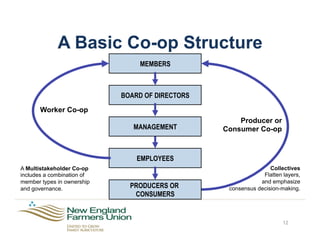
A Basic Co-op Structure
12
MEMBERS
BOARD OF DIRECTORS
EMPLOYEES
Elect
Hire
Hire
MANAGEMENT
Worker Co-op
PRODUCERS OR
CONSUMERS
Producer or
Consumer Co-op
Product or Service
A Multistakeholder Co-op
includes a combination of
member types in ownership
and governance.
Collectives
Flatten layers,
and emphasize
consensus decision-making.
A Flexible Business Model
•  Purchase needed inputs, equipment,
products or services as a group.
•  Produce a product or service together.
•  Process and add value to raw materials
produced by members.
•  Market products produced by members or
by the co-op.
•  Provide employment and a livelihood.
13
Co-op Sectors Benefit the
Regional Food System
•  Farmer-owned co-ops help members
market and process their crops and livestock,
and secure needed supplies and services.
•  Rural utility co-ops provide electrical power
and telecommunications services.
•  Financial co-ops and credit unions provide
credit and financial services.
•  Food co-ops provide community owned
retail outlets for producers, etc.
14
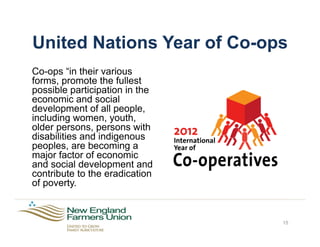
United Nations Year of Co-ops
Co-ops “in their various
forms, promote the fullest
possible participation in the
economic and social
development of all people,
including women, youth,
older persons, persons with
disabilities and indigenous
peoples, are becoming a
major factor of economic
and social development and
contribute to the eradication
of poverty.
15
UN Year of Family Farming
“The importance of
agricultural co-
operatives in improving
the lives of millions of
smallholder farmers and
their families cannot be
overstated.”
16
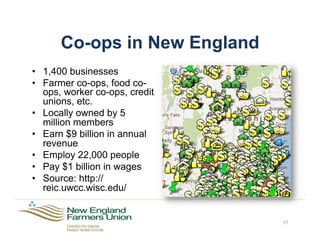
Co-ops in New England
•  1,400 businesses
•  Farmer co-ops, food co-
ops, worker co-ops, credit
unions, etc.
•  Locally owned by 5
million members
•  Earn $9 billion in annual
revenue
•  Employ 22,000 people
•  Pay $1 billion in wages
•  Source: http://
reic.uwcc.wisc.edu/
17
Case Study: Organic Valley /
CROPP Co-operative
18
•  Founded 1985
•  1,800 members in US,
Canada & Australia
•  Dairy, eggs, soy,
produce, feed, and
meat
•  Avg dairy herd is 80
•  13% of US organic
farmers are members
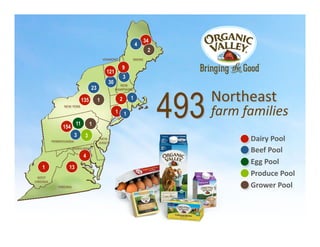
Dairy	
  Pool	
  
Beef	
  Pool	
  
Egg	
  Pool	
  
Produce	
  Pool	
  
Grower	
  Pool	
  
493 Northeast	
  
farm	
  families	
  
13
4
2
34
11
1
1
1
3
4
9
23
135
30
1
1
2
3
121
154
3
1
NEW	
  YORK	
  
PENNSYLVANIA	
  
WEST	
  
VIRGINIA	
  
VIRGINIA	
  
MARYLAND	
  
NEW	
  
JERSEY	
  
MAINE	
  VERMONT	
  
NEW	
  
HAMPSHIRE	
  
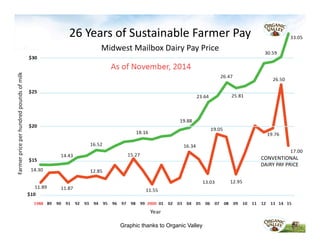
26	
  Years	
  of	
  Sustainable	
  Farmer	
  Pay	
  
Midwest	
  Mailbox	
  Dairy	
  Pay	
  Price	
  
CONVENTIONAL	
  
DAIRY	
  PAY	
  PRICE	
  
Graphic thanks to Organic Valley
Case Study:
Deep Root Organic Co-op
•  Founded 1986
•  22 members in VT &
Québec
•  85-100,000 cases of
produce annually
•  ±$2.5 million ann rev
•  Distribution across
Eastern US
•  Support specialization,
reduce competition,
access markets
21
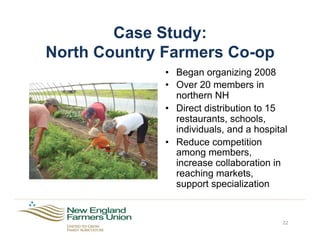
Case Study:
North Country Farmers Co-op
22
•  Began organizing 2008
•  Over 20 members in
northern NH
•  Direct distribution to 15
restaurants, schools,
individuals, and a hospital
•  Reduce competition
among members,
increase collaboration in
reaching markets,
support specialization
Case Study:
Local Harvest CSA Co-op
23
•  Established 2002
•  Six NH member organic
farms
•  Three season CSA
•  Members coordinate
production, enabling
specialization while
offering broad range of
produce to customers
Challenges for Co-operative
Enterprise
•  Democracy can both an asset and
challenge to the business
•  Limited business, legal and technical
support for co-ops
•  Lenders may be unfamiliar with model
•  Balancing individual and mutual interests
of members
24
Opportunities for Co-operative
Enterprise
•  Strengthen bargaining power of small producers in
the marketplace
•  Achieve scale while and efficiency while
supporting small family operations
•  Enable producers to specialize and increase
efficiency
•  Farmer members can focus on core business and
delegate services without giving up control
•  Root food system infrastructure in our region
•  Increased recognition of social, economic and
environmental benefits of co-ops
25
Some Suggestions
•  Before launching a new co-op, explore
whether an existing co-op can meet your
needs.
•  Is there an existing business that could be
converted to a co-operative? For example, a
farmer interested in sharing infrastructure or
an owner interested in retiring?
•  If a new co-operative is the answer,
collaborate with existing co-ops and learn
from their experiences.
26
Launching a Co-operative
Activities:
•  Define overall purpose or goal
•  Create steering committee
•  Raise pre-development funds
•  Hire a coordinator, if possible
•  Conduct feasibility study
•  Establish the founding board
•  Incorporate using appropriate co-op statute
•  Adopt by-laws
27
Launching a Co-operative
Activities, continued:
•  Develop a business plan
•  Create membership agreements
•  Recruit members and equity investment
•  Access necessary debt financing
•  Hire appropriate management
•  Open for business
28
Basic Development Process
Timeline
•  Allow for 12-18 months to incorporate (varies widely!)
•  Open doors – 2 to 10 years
•  Existing facility or business can be faster
Resources Needed
•  Committed, visionary leadership
•  Co-op business, legal, and financial support
•  Member equity investment
•  Start-up financing
•  Support & guidance from other co-ops
29
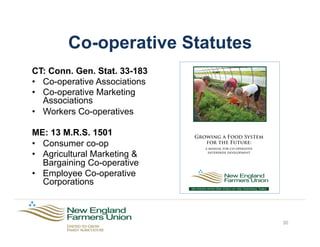
Co-operative Statutes
CT: Conn. Gen. Stat. 33-183
•  Co-operative Associations
•  Co-operative Marketing
Associations
•  Workers Co-operatives
ME: 13 M.R.S. 1501
•  Consumer co-op
•  Agricultural Marketing &
Bargaining Co-operative
•  Employee Co-operative
Corporations
30
Growing a Food System
for the Future:
a manual for co-operative
enterprise development
Six States with One Voice at the National Table
Co-operative Statutes
MA: ALM GL Ch. 157
•  Co-operative Corporations
•  Co-operatives without Stock
•  Employee Co-operative
Corporations (157-A)
NH: RSA Title XXVII, Ch. 301
•  Co-operative Marketing &
Rural Electrification
Associations
•  Consumers Co-operative
(Ch. 301-A)
31
RI: R.I. Gen Laws 7-7-1
•  Producers Co-operative
•  Consumers Co-operative
VT: 8 V.S.A. 31101
•  Marketing Co-operative
•  Consumers Co-operative
•  Worker Co-operative (Title
11, Ch. 8)
Other Options
•  Incorporate in a neighboring
state using appropriate co-
operative statute
Concerns for Co-operators
•  Engagement of members
•  Encourage and develop broad leadership
•  Ongoing training in:
– Co-operative values & principles
– Board leadership & accountability to members
– Fiscal oversight
– Project & strategic planning
– Communication, facilitation, conflict resolution
32
Some Guidelines for Success
•  Support strong, committed member leadership
•  Set realistic goals and focus on them
•  Base decisions on concrete market research and
business planning
•  Invest in member education and keep members
informed, engaged and involved
•  Use technical assistance from co-op networks and
reputable co-op developers
•  Join regional networks (such as NEFU) and seek
out peer support from other co-operatives
33
Why Co-operatives?
Co-operative enterprises…
•  …put service to members before profit,
•  …enable small producers to achieve scale,
•  …root infrastructure in our region,
•  …are accountable to their communities,
•  …are successful businesses,
•  …strengthen local economies,
•  …are more sustainable and resilient,
•  …are democratic,
•  …build a more sustainable food system.
34
Discussion
•  Questions
•  Feedback
•  Ideas for Future Workshops
35
Resources & Contact Info
Roger Noonan
president@newenglandfarmersunion.org
Erbin Crowell
erbin@nfca.coop
New England Farmers Union
www.newenglandfarmersunion.org
Neighboring Food Co-op Association
www.nfca.coop
36

Farmer Co-ops For Efficient Production & Marketing

  • 1.
    Farmer Co-ops for EfficientProduction & Marketing Northeast Organic Farming Association (NOFA) Summer Conference // 15 Aug 2015 UMASS Amherst // Amherst, MA
  • 2.
    Presenters Roger Noonan •  President,New England Farmers Union •  Organic Farmer, Middle Branch Farm •  Member, Local Harvest CSA Co-op Erbin Crowell •  Vice President, New England Farmers Union •  Executive Director, Neighboring Food Co-op Association •  Board Member, National Cooperative Business Association 2
  • 3.
    Workshop Description Co-operatives benefittheir member-owners, farmers, consumers, and the food system. Learn about how your operation could benefit by being part of a producer or marketing co-operative, and discover the steps involved in setting one up. 3
  • 4.
    New England FarmersUnion NEFU is a six-state membership organization that advocates for federal policy that benefits family farmers. We are a chapter of National Farmers Union, the second-largest agriculture organization in the country. Co-operative development has been a priority for Farmers Union since its founding in 1902. www.newenglandfarmersunion.org 4
  • 5.
    NEFU Co-operative Heritage • Officially known as the “Farmers' Educational and Cooperative Union of America” (1902) •  Key role in passage of Capper Volstead Act in 1922 & Cooperative Marketing Act of 1926 •  Founded Farmers Union Central Exchange in 1931; merged with Harvest States Co-operative to form CHS: –  Largest US-based co-op by revenue (2012) –  69th on Fortune 500 list by revenue (2012) –  25th largest convenience store chain in US 5
  • 6.
    Neighboring Food Co-op Association NFCAis a network of 35 food co-ops and start-ups in New England that are working together toward a shared vision of a thriving regional economy, rooted in a healthy, sustainable food system, and a vibrant community of co-operative enterprise. As an affiliate member of NEFU, the NFCA partners with our region’s family farmers and fishermen to support a more sustainable food system, grow the co-operative economy and influence food policy. www.nfca.coop 6
  • 7.
    What is aCo-operative? “A co-operative is an autonomous association of persons united voluntarily to meet their common economic, social, and cultural needs and aspirations through a jointly-owned and democratically-controlled enterprise.” International Co-operative Alliance www.ica.coop 7
  • 8.
    What is aCo-operative? “Co-ops are producer- and user-owned businesses that are controlled by — and operate for the benefit of — their members, rather than outside investors.” United States Department of Agriculture www.usda.gov 8
  • 9.
    In Other Words… Aco-op is a business that is equitably owned and democratically controlled by its members for their common good, the good of the community or to accomplish a shared goal or purpose. Any surplus (profit) after expenses is distributed among members in proportion to their use of the business (purchases, labor, or supply), as a discount on purchases, or is reinvested in the enterprise for the mutual benefit of members. 9
  • 10.
    Co-operatives… …are more commonthan we think •  Majority of US farmers are co-op members •  1 billion members worldwide (1 in 3 in the US) •  More people are members than directly own stock in corporations …are innovative •  Co-operatives are pioneers in organic agriculture, healthy food, Fair Trade, relocalization, regional aggregation and distribution …are successful •  30,000 co-ops in all sectors of US economy 10
  • 11.
    Co-operative Business Principles •  Voluntary& Open Membership •  Democratic Member Control •  Member Economic Participation •  Autonomy & Independence •  Education, Training & Information •  Co-operation among Co-operatives •  Concern for Community 11
  • 12.
    A Basic Co-opStructure 12 MEMBERS BOARD OF DIRECTORS EMPLOYEES Elect Hire Hire MANAGEMENT Worker Co-op PRODUCERS OR CONSUMERS Producer or Consumer Co-op Product or Service A Multistakeholder Co-op includes a combination of member types in ownership and governance. Collectives Flatten layers, and emphasize consensus decision-making.
  • 13.
    A Flexible BusinessModel •  Purchase needed inputs, equipment, products or services as a group. •  Produce a product or service together. •  Process and add value to raw materials produced by members. •  Market products produced by members or by the co-op. •  Provide employment and a livelihood. 13
  • 14.
    Co-op Sectors Benefitthe Regional Food System •  Farmer-owned co-ops help members market and process their crops and livestock, and secure needed supplies and services. •  Rural utility co-ops provide electrical power and telecommunications services. •  Financial co-ops and credit unions provide credit and financial services. •  Food co-ops provide community owned retail outlets for producers, etc. 14
  • 15.
    United Nations Yearof Co-ops Co-ops “in their various forms, promote the fullest possible participation in the economic and social development of all people, including women, youth, older persons, persons with disabilities and indigenous peoples, are becoming a major factor of economic and social development and contribute to the eradication of poverty. 15
  • 16.
    UN Year ofFamily Farming “The importance of agricultural co- operatives in improving the lives of millions of smallholder farmers and their families cannot be overstated.” 16
  • 17.
    Co-ops in NewEngland •  1,400 businesses •  Farmer co-ops, food co- ops, worker co-ops, credit unions, etc. •  Locally owned by 5 million members •  Earn $9 billion in annual revenue •  Employ 22,000 people •  Pay $1 billion in wages •  Source: http:// reic.uwcc.wisc.edu/ 17
  • 18.
    Case Study: OrganicValley / CROPP Co-operative 18 •  Founded 1985 •  1,800 members in US, Canada & Australia •  Dairy, eggs, soy, produce, feed, and meat •  Avg dairy herd is 80 •  13% of US organic farmers are members
  • 19.
    Dairy  Pool   Beef  Pool   Egg  Pool   Produce  Pool   Grower  Pool   493 Northeast   farm  families   13 4 2 34 11 1 1 1 3 4 9 23 135 30 1 1 2 3 121 154 3 1 NEW  YORK   PENNSYLVANIA   WEST   VIRGINIA   VIRGINIA   MARYLAND   NEW   JERSEY   MAINE  VERMONT   NEW   HAMPSHIRE  
  • 20.
    26  Years  of  Sustainable  Farmer  Pay   Midwest  Mailbox  Dairy  Pay  Price   CONVENTIONAL   DAIRY  PAY  PRICE   Graphic thanks to Organic Valley
  • 21.
    Case Study: Deep RootOrganic Co-op •  Founded 1986 •  22 members in VT & Québec •  85-100,000 cases of produce annually •  ±$2.5 million ann rev •  Distribution across Eastern US •  Support specialization, reduce competition, access markets 21
  • 22.
    Case Study: North CountryFarmers Co-op 22 •  Began organizing 2008 •  Over 20 members in northern NH •  Direct distribution to 15 restaurants, schools, individuals, and a hospital •  Reduce competition among members, increase collaboration in reaching markets, support specialization
  • 23.
    Case Study: Local HarvestCSA Co-op 23 •  Established 2002 •  Six NH member organic farms •  Three season CSA •  Members coordinate production, enabling specialization while offering broad range of produce to customers
  • 24.
    Challenges for Co-operative Enterprise • Democracy can both an asset and challenge to the business •  Limited business, legal and technical support for co-ops •  Lenders may be unfamiliar with model •  Balancing individual and mutual interests of members 24
  • 25.
    Opportunities for Co-operative Enterprise • Strengthen bargaining power of small producers in the marketplace •  Achieve scale while and efficiency while supporting small family operations •  Enable producers to specialize and increase efficiency •  Farmer members can focus on core business and delegate services without giving up control •  Root food system infrastructure in our region •  Increased recognition of social, economic and environmental benefits of co-ops 25
  • 26.
    Some Suggestions •  Beforelaunching a new co-op, explore whether an existing co-op can meet your needs. •  Is there an existing business that could be converted to a co-operative? For example, a farmer interested in sharing infrastructure or an owner interested in retiring? •  If a new co-operative is the answer, collaborate with existing co-ops and learn from their experiences. 26
  • 27.
    Launching a Co-operative Activities: • Define overall purpose or goal •  Create steering committee •  Raise pre-development funds •  Hire a coordinator, if possible •  Conduct feasibility study •  Establish the founding board •  Incorporate using appropriate co-op statute •  Adopt by-laws 27
  • 28.
    Launching a Co-operative Activities,continued: •  Develop a business plan •  Create membership agreements •  Recruit members and equity investment •  Access necessary debt financing •  Hire appropriate management •  Open for business 28
  • 29.
    Basic Development Process Timeline • Allow for 12-18 months to incorporate (varies widely!) •  Open doors – 2 to 10 years •  Existing facility or business can be faster Resources Needed •  Committed, visionary leadership •  Co-op business, legal, and financial support •  Member equity investment •  Start-up financing •  Support & guidance from other co-ops 29
  • 30.
    Co-operative Statutes CT: Conn.Gen. Stat. 33-183 •  Co-operative Associations •  Co-operative Marketing Associations •  Workers Co-operatives ME: 13 M.R.S. 1501 •  Consumer co-op •  Agricultural Marketing & Bargaining Co-operative •  Employee Co-operative Corporations 30 Growing a Food System for the Future: a manual for co-operative enterprise development Six States with One Voice at the National Table
  • 31.
    Co-operative Statutes MA: ALMGL Ch. 157 •  Co-operative Corporations •  Co-operatives without Stock •  Employee Co-operative Corporations (157-A) NH: RSA Title XXVII, Ch. 301 •  Co-operative Marketing & Rural Electrification Associations •  Consumers Co-operative (Ch. 301-A) 31 RI: R.I. Gen Laws 7-7-1 •  Producers Co-operative •  Consumers Co-operative VT: 8 V.S.A. 31101 •  Marketing Co-operative •  Consumers Co-operative •  Worker Co-operative (Title 11, Ch. 8) Other Options •  Incorporate in a neighboring state using appropriate co- operative statute
  • 32.
    Concerns for Co-operators • Engagement of members •  Encourage and develop broad leadership •  Ongoing training in: – Co-operative values & principles – Board leadership & accountability to members – Fiscal oversight – Project & strategic planning – Communication, facilitation, conflict resolution 32
  • 33.
    Some Guidelines forSuccess •  Support strong, committed member leadership •  Set realistic goals and focus on them •  Base decisions on concrete market research and business planning •  Invest in member education and keep members informed, engaged and involved •  Use technical assistance from co-op networks and reputable co-op developers •  Join regional networks (such as NEFU) and seek out peer support from other co-operatives 33
  • 34.
    Why Co-operatives? Co-operative enterprises… • …put service to members before profit, •  …enable small producers to achieve scale, •  …root infrastructure in our region, •  …are accountable to their communities, •  …are successful businesses, •  …strengthen local economies, •  …are more sustainable and resilient, •  …are democratic, •  …build a more sustainable food system. 34
  • 35.
  • 36.
    Resources & ContactInfo Roger Noonan president@newenglandfarmersunion.org Erbin Crowell erbin@nfca.coop New England Farmers Union www.newenglandfarmersunion.org Neighboring Food Co-op Association www.nfca.coop 36