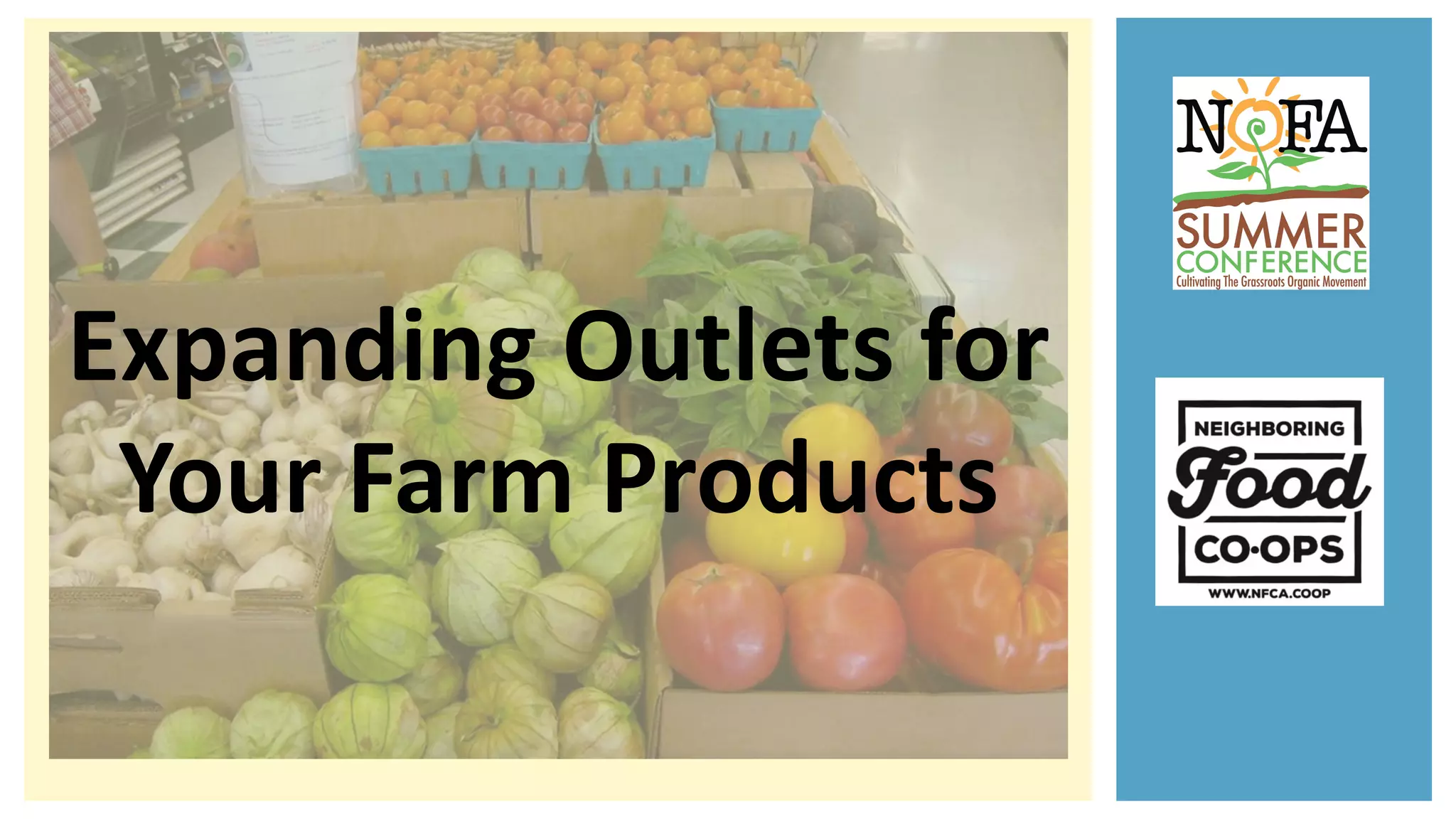
Expanding Outlets for
Your Farm Products
Introduction
¡ Welcome, who we are
¡ Who’s in the “Room”
Why & How: Co-op Outlets
¡ Why Co-ops
¡ Planning for Shared Success
¡ Co-op buyer perspectives
Digging Deeper
¡ Questions
¡ Discussion
¡ Resources
OUTLINE
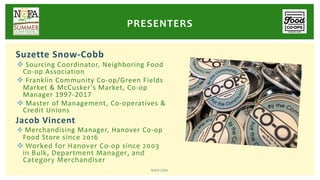
Suzette Snow-Cobb
v Sourcing Coordinator, Neighboring Food
Co-op Association
v Franklin Community Co-op/Green Fields
Market & McCusker’s Market, Co-op
Manager 1997-2017
v Master of Management, Co-operatives &
Credit Unions
Jacob Vincent
v Merchandising Manager, Hanover Co-op
Food Store since 2016
v Worked for Hanover Co-op since 2003
in Bulk, Department Manager, and
Category Merchandiser
PRESENTERS
NOFA 2020
Tell us who you are!
Ø Currently a grower/producer?
Ø Where are you zooming from?
Ø What’s your favorite summer food?
¡ Please use video if you are able.
¡ Use “mute” when you are not speaking.
¡ Use chat function for questions or when
you speak, please include Your Name
NOFA 2020 3
WHO’S IN THE “ROOM”
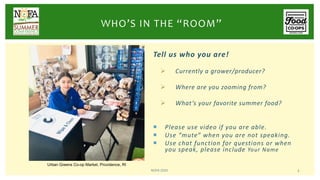
Urban Greens Co-op Market, Providence, RI
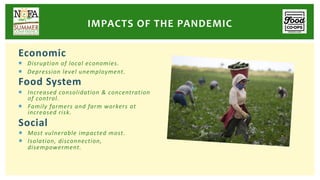
Economic
¡ Disruption of local economies.
¡ Depression level unemployment.
Food System
¡ Increased consolidation & concentration
of control.
¡ Family farmers and farm workers at
increased risk.
Social
¡ Most vulnerable impacted most.
¡ Isolation, disconnection,
disempowerment.
IMPACTS OF THE PANDEMIC
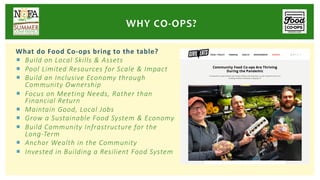
What do Food Co-ops bring to the table?
¡ Build on Local Skills & Assets
¡ Pool Limited Resources for Scale & Impact
¡ Build an Inclusive Economy through
Community Ownership
¡ Focus on Meeting Needs, Rather than
Financial Return
¡ Maintain Good, Local Jobs
¡ Grow a Sustainable Food System & Economy
¡ Build Community Infrastructure for the
Long-Term
¡ Anchor Wealth in the Community
¡ Invested in Building a Resilient Food System
WHY CO-OPS?
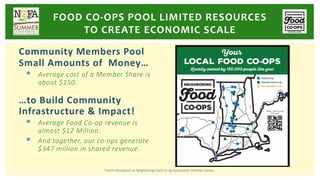
Community Members Pool
Small Amounts of Money…
§ Average cost of a Member Share is
about $150.
…to Build Community
Infrastructure & Impact!
§ Average Food Co-op revenue is
almost $12 Million.
§ And together, our co-ops generate
$347 million in shared revenue.
FOOD CO-OPS POOL LIMITED RESOURCES
TO CREATE ECONOMIC SCALE
*2019 data based on Neighboring Food Co-op Association member survey.
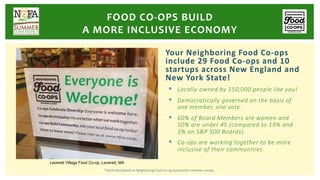
Your Neighboring Food Co-ops
include 29 Food Co-ops and 10
startups across New England and
New York State!
§ Locally-owned by 150,000 people like you!
§ Democratically governed on the basis of
one member, one vote.
§ 60% of Board Members are women and
50% are under 45 (compared to 19% and
3% on S&P 500 Boards).
§ Co-ops are working together to be more
inclusive of their communities.
*2019 data based on Neighboring Food Co-op Association member survey.
FOOD CO-OPS BUILD
A MORE INCLUSIVE ECONOMY
Leverett Village Food Co-op, Leverett, MA
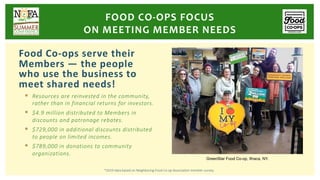
Food Co-ops serve their
Members — the people
who use the business to
meet shared needs!
§ Resources are reinvested in the community,
rather than in financial returns for investors.
§ $4.9 million distributed to Members in
discounts and patronage rebates.
§ $729,000 in additional discounts distributed
to people on limited incomes.
§ $789,000 in donations to community
organizations.
FOOD CO-OPS FOCUS
ON MEETING MEMBER NEEDS
GreenStar Food Co-op, Ithaca, NY.
*2019 data based on Neighboring Food Co-op Association member survey.
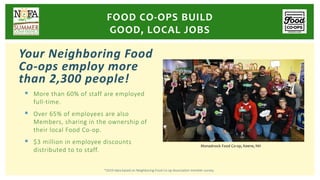
Your Neighboring Food
Co-ops employ more
than 2,300 people!
§ More than 60% of staff are employed
full-time.
§ Over 65% of employees are also
Members, sharing in the ownership of
their local Food Co-op.
§ $3 million in employee discounts
distributed to to staff.
FOOD CO-OPS BUILD
GOOD, LOCAL JOBS
Monadnock Food Co-op, Keene, NH
*2019 data based on Neighboring Food Co-op Association member survey.
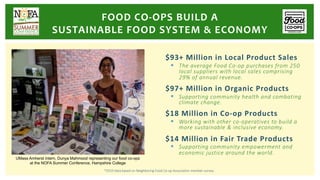
$93+ Million in Local Product Sales
§ The average Food Co-op purchases from 250
local suppliers with local sales comprising
29% of annual revenue.
$97+ Million in Organic Products
§ Supporting community health and combating
climate change.
$18 Million in Co-op Products
§ Working with other co-operatives to build a
more sustainable & inclusive economy.
$14 Million in Fair Trade Products
§ Supporting community empowerment and
economic justice around the world.
FOOD CO-OPS BUILD A
SUSTAINABLE FOOD SYSTEM & ECONOMY
UMass Amherst intern, Dunya Mahmood representing our food co-ops
at the NOFA Summer Conference, Hampshire College
*2019 data based on Neighboring Food Co-op Association member survey.
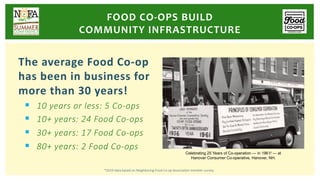
The average Food Co-op
has been in business for
more than 30 years!
§ 10 years or less: 5 Co-ops
§ 10+ years: 24 Food Co-ops
§ 30+ years: 17 Food Co-ops
§ 80+ years: 2 Food Co-ops
FOOD CO-OPS BUILD
COMMUNITY INFRASTRUCTURE
Celebrating 25 Years of Co-operation — in 1961! — at
Hanover Consumer Co-operative, Hanover, NH.
*2019 data based on Neighboring Food Co-op Association member survey.
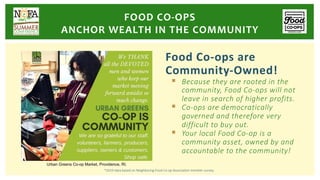
Food Co-ops are
Community-Owned!
§ Because they are rooted in the
community, Food Co-ops will not
leave in search of higher profits.
§ Co-ops are democratically
governed and therefore very
difficult to buy out.
§ Your local Food Co-op is a
community asset, owned by and
accountable to the community!
*2019 data based on Neighboring Food Co-op Association member survey.
FOOD CO-OPS
ANCHOR WEALTH IN THE COMMUNITY
Urban Greens Co-op Market, Providence, RI.
Planning
¡ Does the co-op already carry this type of
product?
¡ How is yours unique?
¡ Is it in-line with co-op’s mission?
¡ Packaging and Marketing Materials
Being Realistic
¡ Price what you need
¡ Are you prepared to have samples?
¡ Could you work with a regional distributor?
¡ Ordering, delivery and product availability
efficient and consistent for buyers?
Legal Needs
¡ Licensing needed? Relevant for federal, state
and/or local agencies?
¡ Liability insurance in place?
SO, YOU WANT TO SELL YOUR PRODUCT TO
THE CO-OP?
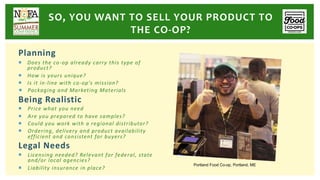
Portland Food Co-op, Portland, ME
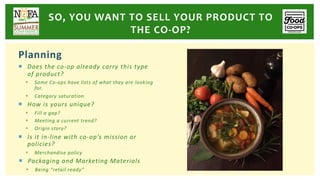
Planning
¡ Does the co-op already carry this type
of product?
§ Some Co-ops have lists of what they are looking
for.
§ Category saturation
¡ How is yours unique?
§ Fill a gap?
§ Meeting a current trend?
§ Origin story?
¡ Is it in-line with co-op’s mission or
policies?
§ Merchandise policy
¡ Packaging and Marketing Materials
§ Being “retail ready”
SO, YOU WANT TO SELL YOUR PRODUCT TO
THE CO-OP?
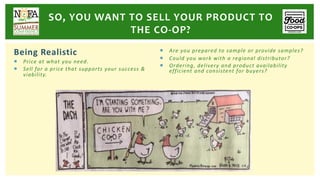
Being Realistic
¡ Price at what you need.
¡ Sell for a price that supports your success &
viability.
¡ Are you prepared to sample or provide samples?
¡ Could you work with a regional distributor?
¡ Ordering, delivery and product availability
efficient and consistent for buyers?
SO, YOU WANT TO SELL YOUR PRODUCT TO
THE CO-OP?
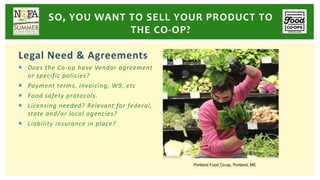
Legal Need & Agreements
¡ Does the Co-op have Vendor agreement
or specific policies?
¡ Payment terms, invoicing, W9, etc
¡ Food safety protocols.
¡ Licensing needed? Relevant for federal,
state and/or local agencies?
¡ Liability insurance in place?
SO, YOU WANT TO SELL YOUR PRODUCT TO
THE CO-OP?
Portland Food Co-op, Portland, ME
Clarifications?
Something you have a
question about that we
didn’t cover?
QUESTIONS & DISCUSSION
Portland Food Co-op, Portland, ME
Hanover new vendor submission form: www.coopfoodstore.com/new-vendor
City Market/Onion River Co-op: Local Food Gaps Listing
http://www.citymarket.coop/local-products-gap
Fiddleheads Food Co-op Product Buying Guidelines:
http://www.fiddleheadsfood.coop/
Food Safety www.foodsafety.gov
Food Processing Centers
Food Processing Center, Franklin County CDC www.fccdc.org
The Farm Bridge http://thefarmbridge.com/
Vermont Food Venture Center
RESOURCES & CONTACT INFORMATION
Suzette Snow-Cobb, Neighboring Food Co-op Association, suzette@nfca.coop
Jacob Vincent, Hanover Co-op Food Stores, jvincent@coopfoodstore.com

Expanding Outlets for Your Farm Products

  • 1.
  • 2.
    Introduction ¡ Welcome, whowe are ¡ Who’s in the “Room” Why & How: Co-op Outlets ¡ Why Co-ops ¡ Planning for Shared Success ¡ Co-op buyer perspectives Digging Deeper ¡ Questions ¡ Discussion ¡ Resources OUTLINE
  • 3.
    Suzette Snow-Cobb v SourcingCoordinator, Neighboring Food Co-op Association v Franklin Community Co-op/Green Fields Market & McCusker’s Market, Co-op Manager 1997-2017 v Master of Management, Co-operatives & Credit Unions Jacob Vincent v Merchandising Manager, Hanover Co-op Food Store since 2016 v Worked for Hanover Co-op since 2003 in Bulk, Department Manager, and Category Merchandiser PRESENTERS NOFA 2020
  • 4.
    Tell us whoyou are! Ø Currently a grower/producer? Ø Where are you zooming from? Ø What’s your favorite summer food? ¡ Please use video if you are able. ¡ Use “mute” when you are not speaking. ¡ Use chat function for questions or when you speak, please include Your Name NOFA 2020 3 WHO’S IN THE “ROOM” Urban Greens Co-op Market, Providence, RI
  • 5.
    Economic ¡ Disruption oflocal economies. ¡ Depression level unemployment. Food System ¡ Increased consolidation & concentration of control. ¡ Family farmers and farm workers at increased risk. Social ¡ Most vulnerable impacted most. ¡ Isolation, disconnection, disempowerment. IMPACTS OF THE PANDEMIC
  • 6.
    What do FoodCo-ops bring to the table? ¡ Build on Local Skills & Assets ¡ Pool Limited Resources for Scale & Impact ¡ Build an Inclusive Economy through Community Ownership ¡ Focus on Meeting Needs, Rather than Financial Return ¡ Maintain Good, Local Jobs ¡ Grow a Sustainable Food System & Economy ¡ Build Community Infrastructure for the Long-Term ¡ Anchor Wealth in the Community ¡ Invested in Building a Resilient Food System WHY CO-OPS?
  • 7.
    Community Members Pool SmallAmounts of Money… § Average cost of a Member Share is about $150. …to Build Community Infrastructure & Impact! § Average Food Co-op revenue is almost $12 Million. § And together, our co-ops generate $347 million in shared revenue. FOOD CO-OPS POOL LIMITED RESOURCES TO CREATE ECONOMIC SCALE *2019 data based on Neighboring Food Co-op Association member survey.
  • 8.
    Your Neighboring FoodCo-ops include 29 Food Co-ops and 10 startups across New England and New York State! § Locally-owned by 150,000 people like you! § Democratically governed on the basis of one member, one vote. § 60% of Board Members are women and 50% are under 45 (compared to 19% and 3% on S&P 500 Boards). § Co-ops are working together to be more inclusive of their communities. *2019 data based on Neighboring Food Co-op Association member survey. FOOD CO-OPS BUILD A MORE INCLUSIVE ECONOMY Leverett Village Food Co-op, Leverett, MA
  • 9.
    Food Co-ops servetheir Members — the people who use the business to meet shared needs! § Resources are reinvested in the community, rather than in financial returns for investors. § $4.9 million distributed to Members in discounts and patronage rebates. § $729,000 in additional discounts distributed to people on limited incomes. § $789,000 in donations to community organizations. FOOD CO-OPS FOCUS ON MEETING MEMBER NEEDS GreenStar Food Co-op, Ithaca, NY. *2019 data based on Neighboring Food Co-op Association member survey.
  • 10.
    Your Neighboring Food Co-opsemploy more than 2,300 people! § More than 60% of staff are employed full-time. § Over 65% of employees are also Members, sharing in the ownership of their local Food Co-op. § $3 million in employee discounts distributed to to staff. FOOD CO-OPS BUILD GOOD, LOCAL JOBS Monadnock Food Co-op, Keene, NH *2019 data based on Neighboring Food Co-op Association member survey.
  • 11.
    $93+ Million inLocal Product Sales § The average Food Co-op purchases from 250 local suppliers with local sales comprising 29% of annual revenue. $97+ Million in Organic Products § Supporting community health and combating climate change. $18 Million in Co-op Products § Working with other co-operatives to build a more sustainable & inclusive economy. $14 Million in Fair Trade Products § Supporting community empowerment and economic justice around the world. FOOD CO-OPS BUILD A SUSTAINABLE FOOD SYSTEM & ECONOMY UMass Amherst intern, Dunya Mahmood representing our food co-ops at the NOFA Summer Conference, Hampshire College *2019 data based on Neighboring Food Co-op Association member survey.
  • 12.
    The average FoodCo-op has been in business for more than 30 years! § 10 years or less: 5 Co-ops § 10+ years: 24 Food Co-ops § 30+ years: 17 Food Co-ops § 80+ years: 2 Food Co-ops FOOD CO-OPS BUILD COMMUNITY INFRASTRUCTURE Celebrating 25 Years of Co-operation — in 1961! — at Hanover Consumer Co-operative, Hanover, NH. *2019 data based on Neighboring Food Co-op Association member survey.
  • 13.
    Food Co-ops are Community-Owned! §Because they are rooted in the community, Food Co-ops will not leave in search of higher profits. § Co-ops are democratically governed and therefore very difficult to buy out. § Your local Food Co-op is a community asset, owned by and accountable to the community! *2019 data based on Neighboring Food Co-op Association member survey. FOOD CO-OPS ANCHOR WEALTH IN THE COMMUNITY Urban Greens Co-op Market, Providence, RI.
  • 14.
    Planning ¡ Does theco-op already carry this type of product? ¡ How is yours unique? ¡ Is it in-line with co-op’s mission? ¡ Packaging and Marketing Materials Being Realistic ¡ Price what you need ¡ Are you prepared to have samples? ¡ Could you work with a regional distributor? ¡ Ordering, delivery and product availability efficient and consistent for buyers? Legal Needs ¡ Licensing needed? Relevant for federal, state and/or local agencies? ¡ Liability insurance in place? SO, YOU WANT TO SELL YOUR PRODUCT TO THE CO-OP? Portland Food Co-op, Portland, ME
  • 15.
    Planning ¡ Does theco-op already carry this type of product? § Some Co-ops have lists of what they are looking for. § Category saturation ¡ How is yours unique? § Fill a gap? § Meeting a current trend? § Origin story? ¡ Is it in-line with co-op’s mission or policies? § Merchandise policy ¡ Packaging and Marketing Materials § Being “retail ready” SO, YOU WANT TO SELL YOUR PRODUCT TO THE CO-OP?
  • 16.
    Being Realistic ¡ Priceat what you need. ¡ Sell for a price that supports your success & viability. ¡ Are you prepared to sample or provide samples? ¡ Could you work with a regional distributor? ¡ Ordering, delivery and product availability efficient and consistent for buyers? SO, YOU WANT TO SELL YOUR PRODUCT TO THE CO-OP?
  • 17.
    Legal Need &Agreements ¡ Does the Co-op have Vendor agreement or specific policies? ¡ Payment terms, invoicing, W9, etc ¡ Food safety protocols. ¡ Licensing needed? Relevant for federal, state and/or local agencies? ¡ Liability insurance in place? SO, YOU WANT TO SELL YOUR PRODUCT TO THE CO-OP? Portland Food Co-op, Portland, ME
  • 18.
    Clarifications? Something you havea question about that we didn’t cover? QUESTIONS & DISCUSSION Portland Food Co-op, Portland, ME
  • 19.
    Hanover new vendorsubmission form: www.coopfoodstore.com/new-vendor City Market/Onion River Co-op: Local Food Gaps Listing http://www.citymarket.coop/local-products-gap Fiddleheads Food Co-op Product Buying Guidelines: http://www.fiddleheadsfood.coop/ Food Safety www.foodsafety.gov Food Processing Centers Food Processing Center, Franklin County CDC www.fccdc.org The Farm Bridge http://thefarmbridge.com/ Vermont Food Venture Center RESOURCES & CONTACT INFORMATION Suzette Snow-Cobb, Neighboring Food Co-op Association, suzette@nfca.coop Jacob Vincent, Hanover Co-op Food Stores, jvincent@coopfoodstore.com