PERTH 18th April 2012.   8.15am – 9.45am
Agenda
   Introduction                                 Danni Hocking    AON
                                                                  Hewitt

   Why Invest in Workplace Wellbeing?           Danni Hocking    AON
                                                                  Hewitt

   The impact of Stress & an Ageing Workforce   Joel Sheldrick   Sparke
    on Workers Compensation                                       Helmore

   Why is it Hard to Measure the ROI?           Mark Cassidy     2CRisk

   Survey Findings                              Nick Binns       2CRisk

   Open Discussion and Networking

   Close                                        09:45
Why Invest in Workplace
Wellbeing?

Employee Wellbeing has left behind its image as a “nice to have” and “the
right thing to do” – it has moved from being a welfare initiative to being a
central business strategy.

Employee Wellbeing is an ever-more important critical success factor for the
modern organisation. Concepts such as human capital development,
health risk management, disease management, and population health
management come together as coherent strategies when companies seek
to improve competitive edge and profitability by investing in their human
capital.

Australians are spending approximately 1/3rd of their life at work so it makes
sense that the workplace plays an important role in the physical, mental,
economic and social wellbeing of workers and their families.
How Healthy is Your Workforce?
   Inherent risks to your Employees include:
   Injury as a result of sedentary work
   Modifiable lifestyle diseases
       Heart disease / obesity / diabetes/ cancers
   Fatigue /Sleep deficiency -placing employees at risk
   Mental Illness – rapidly on the increase
       Depression / Anxiety / Substance Misuse / Suicide
   Workplace Injuries
   Workplace Stress
   Aging Workforce
   Increasing Absenteeism
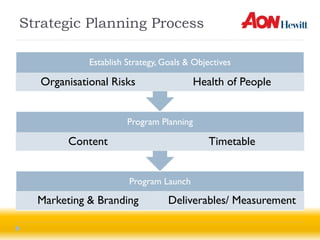
Strategic Planning Process

             Establish Strategy, Goals & Objectives

   Organisational Risks                   Health of People


                       Program Planning

        Content                              Timetable


                       Program Launch

  Marketing & Branding            Deliverables/ Measurement
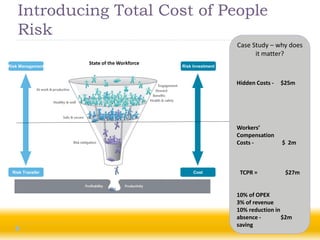
Introducing Total Cost of People
    Risk
                                                             Case Study – why does
                                                                   it matter?
                  State of the Workforce
Risk Management                            Risk Investment


                                                             Hidden Costs -   $25m


                                                             Workers’
                                                             Compensation
                                                             Costs -          $ 2m


 Risk Transfer                                  Cost          TCPR =           $27m


                                                             10% of OPEX
                                                             3% of revenue
                                                             10% reduction in
                                                             absence -        $2m
                                                             saving
                                                                   6
Workers’ Compensation


Topical Matters:


  1. Claims for stress and other
     psychological/psychiatric problems


  2. Ageing workforce
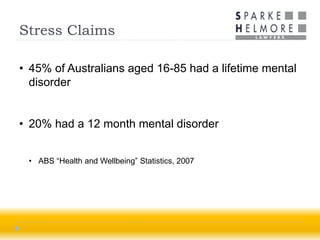
Stress Claims

• 45% of Australians aged 16-85 had a lifetime mental
  disorder


• 20% had a 12 month mental disorder


 • ABS “Health and Wellbeing” Statistics, 2007
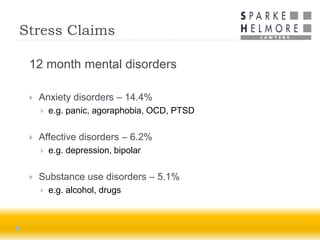
Stress Claims

 12 month mental disorders

    Anxiety disorders – 14.4%
        e.g. panic, agoraphobia, OCD, PTSD

    Affective disorders – 6.2%
        e.g. depression, bipolar

    Substance use disorders – 5.1%
        e.g. alcohol, drugs
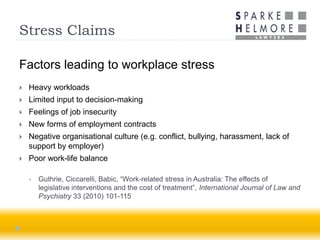
Stress Claims

Factors leading to workplace stress
   Heavy workloads
   Limited input to decision-making
   Feelings of job insecurity
   New forms of employment contracts
   Negative organisational culture (e.g. conflict, bullying, harassment, lack of
    support by employer)
   Poor work-life balance

       Guthrie, Ciccarelli, Babic, “Work-related stress in Australia: The effects of
        legislative interventions and the cost of treatment”, International Journal of Law and
        Psychiatry 33 (2010) 101-115
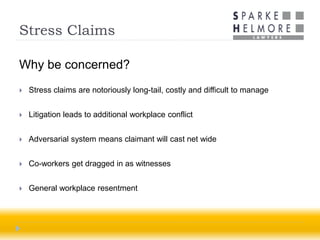
Stress Claims

Why be concerned?
   Stress claims are notoriously long-tail, costly and difficult to manage


   Litigation leads to additional workplace conflict


   Adversarial system means claimant will cast net wide


   Co-workers get dragged in as witnesses


   General workplace resentment
Stress Claims

Prevention:
   Primary interventions
       e.g. monitoring of workload, modifying workplace culture, forming health and safety
        committees

   Secondary interventions
       e.g. training in coping mechanisms, stress-management classes

   Tertiary interventions
       e.g. employee assistance programmes, return to work and rehabilitation programs

           Lamontagne, et al, “A Systematic Review of the Job-stress Intervention Evaluation
            Literature, 1990-2005”, International Journal of Occupational and Environmental Health,
            13(3) (2007) 268
Ageing Workforce


   Pension age increases to 67 from 2023

   Life expectancy continues to increase

   Fertility rates are decreasing
Ageing Workforce

Recent amendment to workers’ compensation
 system:

    Now, no age restriction on weekly payments

    Previously, workers aged 64 or greater only entitled to
     one years’ weekly payments

    Changes effective 1 October 2011
Ageing Workforce

 Positives:

      Greater stability – employees over 45 stay in jobs longer

      Reduces recruitment costs, loss of corporate knowledge

      Greater life skills

      Work with minimal supervision
Ageing Workforce

Workers’ compensation management issues

    Debateable whether older workforce leads to increased
     claims costs

    Obviously, standard pre-employment disclosures and
     medical examinations are useful tools

    Steps can be as beneficial to younger workforce as older
     workforce
Ageing Workforce

Claim prevention strategies:

 1.       Regular staff meetings focussing on health care issues

 2.       Involvement of health care professionals, such as occupational
          physicians

 3.       Ergonomic adjustments, e.g. installation of lifting devices

 4.       Mentoring relationships, e.g. younger person doing heavy work, older
          worker providing training

           “Attracting and retaining older workers: Challenger and opportunities for he Human
            Services Sector”, Business Work & Ageing, 2005
Measuring the Benefits
of Health & Wellbeing

Invariably, Health and Wellness programs are the first to go when
profitability is bought into questions.

Those that are retained tend to be more reactionary and protective. An
example of this would be EAP programs, which are used “after an event”.

Flu Vaccinations are a positive and pro-active wellness program with
research indicating a 43% reduction in absenteeism (74 fewer lost days per
100 employees).

If we can measure flu vaccinations and build a business case, why are we
not doing the same with other Health and Wellness programs?
Why is it hard to measure the ROI?

   71% of surveyed respondents indicated that they cannot measure a ROI on
    money spent on Health and Wellness programs. (2CRisk Health & Wellness
    Survey, April 2012)

   Are the barriers to providing Health and Wellness programs purely that we
    cannot show a ROI or business case as to why?

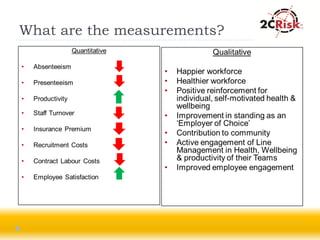
   What are the measurements we need to quantify in order that health and
    wellbeing can be linked to productivity and profitability.
What are the measurements?
Joining the Dots………..
   The parameters for measurement are there, but they are not
    being linked back to health and wellness.

   There is no closed loop process in place to implement,
    monitor, review and tailor health and wellness programs.
   Designing the closed loop process will ultimately lead to
    developing the return on investment and business case for
    continuation.
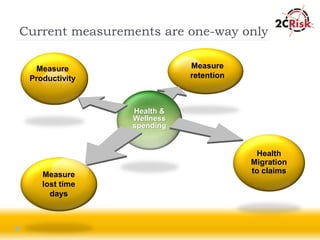
Current measurements are one-way only

  Measure                  Measure
 Productivity              retention


                Health &
                Wellness
                spending


                                        Health
                                       Migration
    Measure                            to claims
    lost time
      days
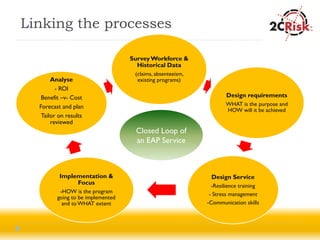
Linking the processes

                                   Survey Workforce &
                                     Historical Data
                                    (claims, absenteeism,
       Analyse                       existing programs)
         - ROI
   Benefit –v- Cost                                                 Design requirements
  Forecast and plan                                                WHAT is the purpose and
                                                                   HOW will it be achieved
   Tailor on results
       reviewed
                                    Closed Loop of
                                    an EAP Service


          Implementation &                                   Design Service
               Focus                                          -Resilience training
          -HOW is the program                                - Stress management
         going to be implemented
           and to WHAT extent                               -Communication skills
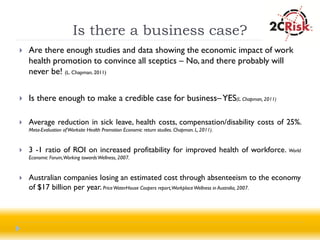
Is there a business case?
   Are there enough studies and data showing the economic impact of work
    health promotion to convince all sceptics – No, and there probably will
    never be! (L. Chapman, 2011)

   Is there enough to make a credible case for business– YES(L. Chapman, 2011)

   Average reduction in sick leave, health costs, compensation/disability costs of 25%.
    Meta-Evaluation of Worksite Health Promotion Economic return studies. Chapman. L, 2011).


   3 -1 ratio of ROI on increased profitability for improved health of workforce. World
    Economic Forum,Working towards Wellness, 2007.


   Australian companies losing an estimated cost through absenteeism to the economy
    of $17 billion per year. Price WaterHouse Coopers report,Workplace Wellness in Australia, 2007.
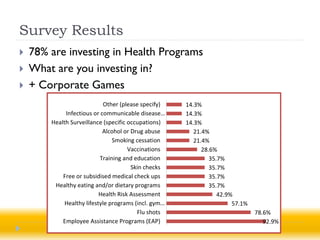
Survey Results
   78% are investing in Health Programs
   What are you investing in?
   + Corporate Games
                             Other (please specify)   14.3%
             Infectious or communicable disease…      14.3%
        Health Surveillance (specific occupations)    14.3%
                            Alcohol or Drug abuse        21.4%
                                Smoking cessation        21.4%
                                      Vaccinations          28.6%
                           Training and education              35.7%
                                       Skin checks             35.7%
            Free or subsidised medical check ups               35.7%
         Healthy eating and/or dietary programs                35.7%
                           Health Risk Assessment                 42.9%
             Healthy lifestyle programs (incl. gym…                    57.1%
                                          Flu shots                            78.6%
            Employee Assistance Programs (EAP)                                    92.9%
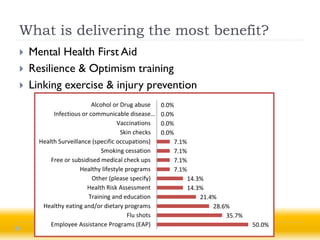
What is delivering the most benefit?
   Mental Health First Aid
   Resilience & Optimism training
   Linking exercise & injury prevention
                          Alcohol or Drug abuse      0.0%
           Infectious or communicable disease…       0.0%
                                    Vaccinations     0.0%
                                      Skin checks    0.0%
      Health Surveillance (specific occupations)         7.1%
                             Smoking cessation           7.1%
          Free or subsidised medical check ups           7.1%
                      Healthy lifestyle programs         7.1%
                          Other (please specify)                14.3%
                        Health Risk Assessment                  14.3%
                        Training and education                      21.4%
       Healthy eating and/or dietary programs                           28.6%
                                         Flu shots                          35.7%
          Employee Assistance Programs (EAP)                                        50.0%
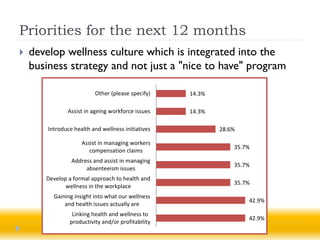
Priorities for the next 12 months
   develop wellness culture which is integrated into the
    business strategy and not just a "nice to have" program

                          Other (please specify)    14.3%

               Assist in ageing workforce issues    14.3%

        Introduce health and wellness initiatives           28.6%

                     Assist in managing workers
                                                                35.7%
                        compensation claims
                 Address and assist in managing
                                                                35.7%
                      absenteeism issues
       Develop a formal approach to health and
                                                                35.7%
              wellness in the workplace
          Gaining insight into what our wellness
                                                                    42.9%
              and health issues actually are
                 Linking health and wellness to
                                                                    42.9%
                productivity and/or profitability
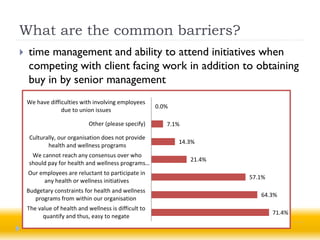
What are the common barriers?
   time management and ability to attend initiatives when
    competing with client facing work in addition to obtaining
    buy in by senior management
    We have difficulties with involving employees
                                                       0.0%
                 due to union issues

                             Other (please specify)       7.1%

     Culturally, our organisation does not provide
                                                              14.3%
            health and wellness programs
     We cannot reach any consensus over who
                                                                 21.4%
    should pay for health and wellness programs…
    Our employees are reluctant to participate in
                                                                         57.1%
         any health or wellness initiatives
    Budgetary constraints for health and wellness
                                                                            64.3%
       programs from within our organisation
    The value of health and wellness is difficult to
                                                                                 71.4%
          quantify and thus, easy to negate
Conclusions
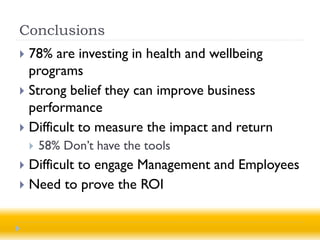
 78% are investing in health and wellbeing
  programs
 Strong belief they can improve business
  performance
 Difficult to measure the impact and return
       58% Don’t have the tools
 Difficult to engage Management and Employees
 Need to prove the ROI
Your tips
   Identify your high risk areas & focus there

   Ownership & Leadership must come from
    Senior Management – linked to strategy

   Engage your employees, make it fun (team
    competition) & provide feedback

   Figure out how to measure the benefits &
    measure them
Thank You


   Links to useful resources
       HAPIA
           http://www.hapia.com.au/


       Comcare - Creating Effective Health and Wellness Programs
           http://www.comcare.gov.au/__data/assets/pdf_file/0011/70220/Effectiv
            e_Health_and_Wellbeing_Programs_Pub_82.PDF

       Larry Chapman – economic benefits of WHP Programs
           http://healthpromotionjournal.com/index.php?com_route=view_video
            &vid=57

Health Productivity Profitability

  • 1.
    PERTH 18th April2012. 8.15am – 9.45am
  • 2.
    Agenda  Introduction Danni Hocking AON Hewitt  Why Invest in Workplace Wellbeing? Danni Hocking AON Hewitt  The impact of Stress & an Ageing Workforce Joel Sheldrick Sparke on Workers Compensation Helmore  Why is it Hard to Measure the ROI? Mark Cassidy 2CRisk  Survey Findings Nick Binns 2CRisk  Open Discussion and Networking  Close 09:45
  • 3.
    Why Invest inWorkplace Wellbeing? Employee Wellbeing has left behind its image as a “nice to have” and “the right thing to do” – it has moved from being a welfare initiative to being a central business strategy. Employee Wellbeing is an ever-more important critical success factor for the modern organisation. Concepts such as human capital development, health risk management, disease management, and population health management come together as coherent strategies when companies seek to improve competitive edge and profitability by investing in their human capital. Australians are spending approximately 1/3rd of their life at work so it makes sense that the workplace plays an important role in the physical, mental, economic and social wellbeing of workers and their families.
  • 4.
    How Healthy isYour Workforce?  Inherent risks to your Employees include:  Injury as a result of sedentary work  Modifiable lifestyle diseases  Heart disease / obesity / diabetes/ cancers  Fatigue /Sleep deficiency -placing employees at risk  Mental Illness – rapidly on the increase  Depression / Anxiety / Substance Misuse / Suicide  Workplace Injuries  Workplace Stress  Aging Workforce  Increasing Absenteeism
  • 5.
    Strategic Planning Process Establish Strategy, Goals & Objectives Organisational Risks Health of People Program Planning Content Timetable Program Launch Marketing & Branding Deliverables/ Measurement
  • 6.
    Introducing Total Costof People Risk Case Study – why does it matter? State of the Workforce Risk Management Risk Investment Hidden Costs - $25m Workers’ Compensation Costs - $ 2m Risk Transfer Cost TCPR = $27m 10% of OPEX 3% of revenue 10% reduction in absence - $2m saving 6
  • 7.
    Workers’ Compensation Topical Matters: 1. Claims for stress and other psychological/psychiatric problems 2. Ageing workforce
  • 8.
    Stress Claims • 45%of Australians aged 16-85 had a lifetime mental disorder • 20% had a 12 month mental disorder • ABS “Health and Wellbeing” Statistics, 2007
  • 9.
    Stress Claims 12month mental disorders  Anxiety disorders – 14.4%  e.g. panic, agoraphobia, OCD, PTSD  Affective disorders – 6.2%  e.g. depression, bipolar  Substance use disorders – 5.1%  e.g. alcohol, drugs
  • 10.
    Stress Claims Factors leadingto workplace stress  Heavy workloads  Limited input to decision-making  Feelings of job insecurity  New forms of employment contracts  Negative organisational culture (e.g. conflict, bullying, harassment, lack of support by employer)  Poor work-life balance  Guthrie, Ciccarelli, Babic, “Work-related stress in Australia: The effects of legislative interventions and the cost of treatment”, International Journal of Law and Psychiatry 33 (2010) 101-115
  • 11.
    Stress Claims Why beconcerned?  Stress claims are notoriously long-tail, costly and difficult to manage  Litigation leads to additional workplace conflict  Adversarial system means claimant will cast net wide  Co-workers get dragged in as witnesses  General workplace resentment
  • 12.
    Stress Claims Prevention:  Primary interventions  e.g. monitoring of workload, modifying workplace culture, forming health and safety committees  Secondary interventions  e.g. training in coping mechanisms, stress-management classes  Tertiary interventions  e.g. employee assistance programmes, return to work and rehabilitation programs  Lamontagne, et al, “A Systematic Review of the Job-stress Intervention Evaluation Literature, 1990-2005”, International Journal of Occupational and Environmental Health, 13(3) (2007) 268
  • 13.
    Ageing Workforce  Pension age increases to 67 from 2023  Life expectancy continues to increase  Fertility rates are decreasing
  • 14.
    Ageing Workforce Recent amendmentto workers’ compensation system:  Now, no age restriction on weekly payments  Previously, workers aged 64 or greater only entitled to one years’ weekly payments  Changes effective 1 October 2011
  • 15.
    Ageing Workforce Positives:  Greater stability – employees over 45 stay in jobs longer  Reduces recruitment costs, loss of corporate knowledge  Greater life skills  Work with minimal supervision
  • 16.
    Ageing Workforce Workers’ compensationmanagement issues  Debateable whether older workforce leads to increased claims costs  Obviously, standard pre-employment disclosures and medical examinations are useful tools  Steps can be as beneficial to younger workforce as older workforce
  • 17.
    Ageing Workforce Claim preventionstrategies: 1. Regular staff meetings focussing on health care issues 2. Involvement of health care professionals, such as occupational physicians 3. Ergonomic adjustments, e.g. installation of lifting devices 4. Mentoring relationships, e.g. younger person doing heavy work, older worker providing training  “Attracting and retaining older workers: Challenger and opportunities for he Human Services Sector”, Business Work & Ageing, 2005
  • 18.
    Measuring the Benefits ofHealth & Wellbeing Invariably, Health and Wellness programs are the first to go when profitability is bought into questions. Those that are retained tend to be more reactionary and protective. An example of this would be EAP programs, which are used “after an event”. Flu Vaccinations are a positive and pro-active wellness program with research indicating a 43% reduction in absenteeism (74 fewer lost days per 100 employees). If we can measure flu vaccinations and build a business case, why are we not doing the same with other Health and Wellness programs?
  • 19.
    Why is ithard to measure the ROI?  71% of surveyed respondents indicated that they cannot measure a ROI on money spent on Health and Wellness programs. (2CRisk Health & Wellness Survey, April 2012)  Are the barriers to providing Health and Wellness programs purely that we cannot show a ROI or business case as to why?  What are the measurements we need to quantify in order that health and wellbeing can be linked to productivity and profitability.
  • 20.
    What are themeasurements?
  • 21.
    Joining the Dots………..  The parameters for measurement are there, but they are not being linked back to health and wellness.  There is no closed loop process in place to implement, monitor, review and tailor health and wellness programs.  Designing the closed loop process will ultimately lead to developing the return on investment and business case for continuation.
  • 22.
    Current measurements areone-way only Measure Measure Productivity retention Health & Wellness spending Health Migration Measure to claims lost time days
  • 23.
    Linking the processes Survey Workforce & Historical Data (claims, absenteeism, Analyse existing programs) - ROI Benefit –v- Cost Design requirements Forecast and plan WHAT is the purpose and HOW will it be achieved Tailor on results reviewed Closed Loop of an EAP Service Implementation & Design Service Focus -Resilience training -HOW is the program - Stress management going to be implemented and to WHAT extent -Communication skills
  • 24.
    Is there abusiness case?  Are there enough studies and data showing the economic impact of work health promotion to convince all sceptics – No, and there probably will never be! (L. Chapman, 2011)  Is there enough to make a credible case for business– YES(L. Chapman, 2011)  Average reduction in sick leave, health costs, compensation/disability costs of 25%. Meta-Evaluation of Worksite Health Promotion Economic return studies. Chapman. L, 2011).  3 -1 ratio of ROI on increased profitability for improved health of workforce. World Economic Forum,Working towards Wellness, 2007.  Australian companies losing an estimated cost through absenteeism to the economy of $17 billion per year. Price WaterHouse Coopers report,Workplace Wellness in Australia, 2007.
  • 25.
    Survey Results  78% are investing in Health Programs  What are you investing in?  + Corporate Games Other (please specify) 14.3% Infectious or communicable disease… 14.3% Health Surveillance (specific occupations) 14.3% Alcohol or Drug abuse 21.4% Smoking cessation 21.4% Vaccinations 28.6% Training and education 35.7% Skin checks 35.7% Free or subsidised medical check ups 35.7% Healthy eating and/or dietary programs 35.7% Health Risk Assessment 42.9% Healthy lifestyle programs (incl. gym… 57.1% Flu shots 78.6% Employee Assistance Programs (EAP) 92.9%
  • 26.
    What is deliveringthe most benefit?  Mental Health First Aid  Resilience & Optimism training  Linking exercise & injury prevention Alcohol or Drug abuse 0.0% Infectious or communicable disease… 0.0% Vaccinations 0.0% Skin checks 0.0% Health Surveillance (specific occupations) 7.1% Smoking cessation 7.1% Free or subsidised medical check ups 7.1% Healthy lifestyle programs 7.1% Other (please specify) 14.3% Health Risk Assessment 14.3% Training and education 21.4% Healthy eating and/or dietary programs 28.6% Flu shots 35.7% Employee Assistance Programs (EAP) 50.0%
  • 27.
    Priorities for thenext 12 months  develop wellness culture which is integrated into the business strategy and not just a "nice to have" program Other (please specify) 14.3% Assist in ageing workforce issues 14.3% Introduce health and wellness initiatives 28.6% Assist in managing workers 35.7% compensation claims Address and assist in managing 35.7% absenteeism issues Develop a formal approach to health and 35.7% wellness in the workplace Gaining insight into what our wellness 42.9% and health issues actually are Linking health and wellness to 42.9% productivity and/or profitability
  • 28.
    What are thecommon barriers?  time management and ability to attend initiatives when competing with client facing work in addition to obtaining buy in by senior management We have difficulties with involving employees 0.0% due to union issues Other (please specify) 7.1% Culturally, our organisation does not provide 14.3% health and wellness programs We cannot reach any consensus over who 21.4% should pay for health and wellness programs… Our employees are reluctant to participate in 57.1% any health or wellness initiatives Budgetary constraints for health and wellness 64.3% programs from within our organisation The value of health and wellness is difficult to 71.4% quantify and thus, easy to negate
  • 29.
    Conclusions  78% areinvesting in health and wellbeing programs  Strong belief they can improve business performance  Difficult to measure the impact and return  58% Don’t have the tools  Difficult to engage Management and Employees  Need to prove the ROI
  • 30.
    Your tips  Identify your high risk areas & focus there  Ownership & Leadership must come from Senior Management – linked to strategy  Engage your employees, make it fun (team competition) & provide feedback  Figure out how to measure the benefits & measure them
  • 31.
    Thank You  Links to useful resources  HAPIA  http://www.hapia.com.au/  Comcare - Creating Effective Health and Wellness Programs  http://www.comcare.gov.au/__data/assets/pdf_file/0011/70220/Effectiv e_Health_and_Wellbeing_Programs_Pub_82.PDF  Larry Chapman – economic benefits of WHP Programs  http://healthpromotionjournal.com/index.php?com_route=view_video &vid=57