Dr Peter Sharman – MBBS FAFOEM FAICD
Consultant Occupational Physician
“Health First” in the
workplace
Evidence-based interventions to facilitate recovery and RTW for
employers
Abstract
 Over the last 10 years the evidence base about the factors that influence
recovery and RTW has grown substantially.
 The workplace is the single greatest influence on RTW outcomes. Workplace
factors are more influential than scheme factors, case/claims management
and individual factors.
 The evidence about modifiable psychosocial factors provides opportunities for
workplaces to improve outcomes for work injuries and reduce associated
costs.
About this workshop
This presentation covers:
1. The context of workplace interventions amongst overall
strategies to improve RTW outcomes
2. The evidence about workplace interventions
3. Evidence-based interventions in the workplace
1. The big picture - workplace
interventions within an overall
strategy
The Australasian Faculty of Occupational &
Environmental Medicine (AFOEM)
Occupational Medicine – a definition
……………..provides scientific understanding, knowledge and
skills essential to the development of evidence-based
systems to:
 manage workplace health and safety risks,
 promote worker health, and
 facilitate the recovery and rehabilitation of those whose
health is adversely affected by their work.
Tasmanian Foundation for Occupational
Medicine (TFOM)
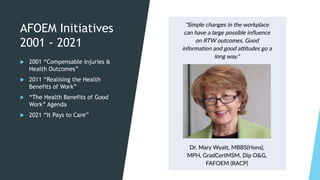
AFOEM Initiatives
2001 - 2021
 2001 “Compensable Injuries &
Health Outcomes”
 2011 “Realising the Health
Benefits of Work”
 “The Health Benefits of Good
Work” Agenda
 2021 “It Pays to Care”
The State of Play - 2001
“Although most people who have compensable
injuries recover well, a greater percentage of
these people have poorer health outcomes than
do those with similar but non-compensable
injuries.”
However
“Research into causes of poor health outcomes
for these people is fragmentary and
inconclusive. Not enough is known of the
effects of different types of compensation
schemes or different methods of management of
cases (by all practitioners involved) to allow the
development of a ‘best practice’ model.”
Health Benefits of Good Work - 2011
“prolonged work absence and worklessness are
associated with higher rates of isolation and
depression, reduced income and increased rates of
multiple health conditions”
“brought stakeholders together to better
understand how good work can be part of recovery
from injury and illness”
It Pays to Care
Principles of Healthy Injury Insurance Schemes *
1. Leadership
2. A culture of collaboration
3. Fairness
4. Health of workers is the priority
5. Active and responsive management of individual cases
6. Effective Communication
7. Long term thinking
* AFOEM “It Pays to care” Draft discussion paper 2021.
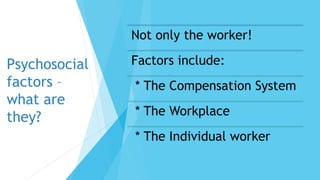
Psychosocial
factors –
what are
they?
Not only the worker!
Factors include:
* The Compensation System
* The Workplace
* The Individual worker
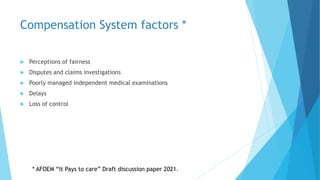
Compensation System factors *
 Perceptions of fairness
 Disputes and claims investigations
 Poorly managed independent medical examinations
 Delays
 Loss of control
* AFOEM “It Pays to care” Draft discussion paper 2021.
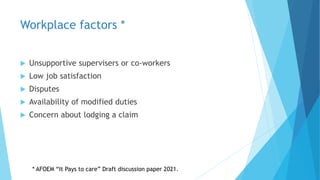
Workplace factors *
 Unsupportive supervisers or co-workers
 Low job satisfaction
 Disputes
 Availability of modified duties
 Concern about lodging a claim
* AFOEM “It Pays to care” Draft discussion paper 2021.
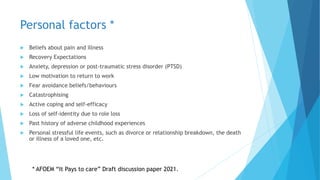
Personal factors *
 Beliefs about pain and illness
 Recovery Expectations
 Anxiety, depression or post-traumatic stress disorder (PTSD)
 Low motivation to return to work
 Fear avoidance beliefs/behaviours
 Catastrophising
 Active coping and self-efficacy
 Loss of self-identity due to role loss
 Past history of adverse childhood experiences
 Personal stressful life events, such as divorce or relationship breakdown, the death
or illness of a loved one, etc.
* AFOEM “It Pays to care” Draft discussion paper 2021.
1. Leadership
2. A culture of collaboration
3. Fairness
4. Health of workers is the priority
5. Active and responsive management of individual cases
6. Effective Communication
7. Long term thinking
Principles of Healthy Injury Insurance
Schemes
Leadership
 Regulators and insurers set the tone and standards for schemes
 Regulators & policy makers are seen to be independent from the insurer they are
regulating
 Scheme participants are actively engaged in shared goals of worker well-being and
RTW
 A consultative, open and transparent approach is adopted
Leadership (2)
 Scheme approaches that foster trust are actively pursued by scheme leaders,
including:
 Fair application of the rules
 Abuses of the scheme, whether by workers, employers or service providers, are
promptly identified and resolved to safeguard stakeholder trust in the integrity of
the scheme
 In the workplace, senior managers set the tone and culture and are in a
postion to lead in their organization to achieve better RTW results
Culture of Collaboration
 A high level of trust, or social capital, results in less disagreement and
disputes, streamlined communication, reduced requirements for written or
legal documents and a higher level of engagement
 Work injury schemes operate more smoothly and return to work is more likely
when parties have a level of trust in each other
 Case management systems underpinned by positive communication between
stakeholders improve RTW outcomes and reduce costs
 Collaboration in the workplace is equally, if not more, important
Fairness
 Quality decision-making
 Based on all relevant information
 Collaborative
 Worker input
 Emphatic and understandable decision communication
 Fair processes
 Transparent and understood processes
 Fairness across the scheme
 Not only workers, but
 Employers, treating practitioners and scheme participants generally
Health First
 Evidence-based treatment
 Identification of psychosocial barriers
 Access to range of providers to manage identified psychosocial barriers
 Treating practitioners have sufficient time to focus on advice and explanation
 GP’s have access to occupational medicine support for more complex cases
 Cultural factors and belief systems are taken into account
 Treating practitioners consider their role is clear and their opinion respected
Active and responsive management of
individual cases
 Case management:
 is procedurally fair, timely, proactive and supportive
 allows supportive early communication with the worker and employer
 Fairness in reviews, such as IME’s, decision making and communication with
scheme participants
 Attributes and skills of an effective case manager:
 Interpersonal skills to enable positive interactions with people in difficult
situations
 Ability to influence multiple scheme participants through verbal and written
communication
 RTW focus; facilitation, problem solving & conflict resolution skills
 Organisational and administrative skills
Active and responsive management of
individual cases (2)
 Support Structures to Enable Effective Case Management
 Manageable caseload
 Training, including “soft skills” – active listening and effective communication
 Low staff turnover to foster continuity of relationships
 Effective IT systems
 Access to subject matter experts
Effective Communication
 Timely access to clear and appropriately-presented information about
processes, rights and responsibilities
 Communication that is respectful, relevant and regular
 User-friendly written material in language that is clear for the worker’s
literacy or familiarity with English and culture
 Two-way communication
 Active listening, regular contact, responsive communication
Long Term Thinking
 Valuing a skilled workforce
 Case managers
 Supervisors
 RTW Co-ordinators
 Medical and treating practitioners
 Research
 Implementation research to identify how systems can be more effective and
efficient
“It Pays to Care” – Main Messages
TWO major reforms are required:
1. Systematically capture psychosocial information for individual claims and
proactively mange psychosocial risk by providing injured workers, workplaces
and treatment providers with timely support according to need
2. Ensure that scheme cultures, systems and processes do not create
unnecessary barriers to recovery, but instead encourage positive psychosocial
factors e.g self-efficacy, whilst reducing negative psychosocial factors e.g.
perceptions of unfairness
2. The evidence about
workplace interventions
Workplace Interventions – What is
the Evidence?
Key Research in Australia
• Analysis of RTW Survey – Wyatt & Lane 2017
• Public Health System Intervention (WISE Study) –
Nicholas et al 2019
• Multi-industry intervention – Iles et al 2012
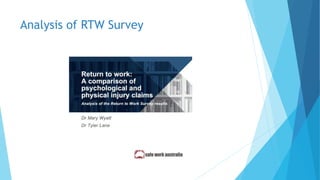
Analysis of RTW Survey
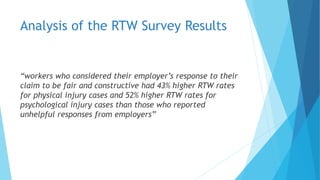
Analysis of the RTW Survey Results
“workers who considered their employer’s response to their
claim to be fair and constructive had 43% higher RTW rates
for physical injury cases and 52% higher RTW rates for
psychological injury cases than those who reported
unhelpful responses from employers”
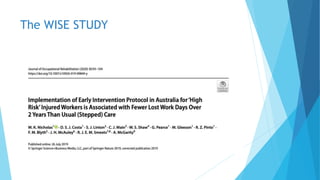
The WISE STUDY
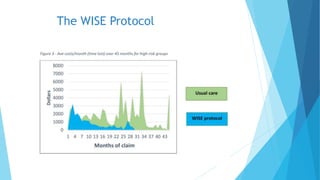
The WISE Protocol
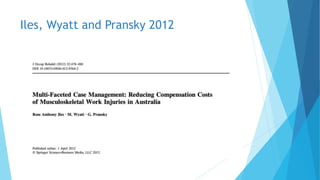
Iles, Wyatt and Pransky 2012
Overview
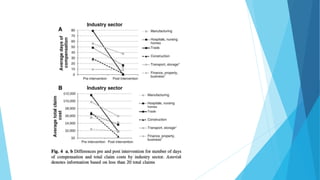
 Effect of providing professional case management support
across businesses and industry
 Over the course of the intervention, average days off work
dropped 58% amongst the workers who received
specialized case management support
3. Practical evidence-
based interventions in
the workplace
Key
workplace
elements of
evidence
informed
approaches
RTW planning and modified duties that
accommodate work restrictions;
The tone and timing of response to injury,
with clear benefits seen when there is early,
constructive contact with the worker;
Quality of interactions and relationships with
supervisors, RTW co-ordinators and
colleagues; and
Level of injury management knowledge,
reporting and leadership amongst senior
managers
Applying the
Principles in
the Workplace
 Understanding the Evidence relevant to
the workplace
 Leadership in the workplace
 Improvement in injury
management knowledge and
leadership for senior managers.
 Collaboration
 Fair processes
 Trained supervisors and RTW co-
ordinators
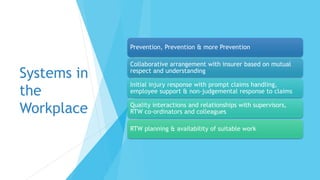
Systems in
the
Workplace
Prevention, Prevention & more Prevention
Collaborative arrangement with insurer based on mutual
respect and understanding
Initial injury response with prompt claims handling,
employee support & non-judgemental response to claims
Quality interactions and relationships with supervisors,
RTW co-ordinators and colleagues
RTW planning & availability of suitable work
A workplace scenario
Main Messages – GET ENGAGED!
 As an employer you can have a major influence on claims outcome
 The relationship with your insurer is critical; but that doesn’t mean you
“handball” everything to them even though the legal framework gives the
insurer ultimate control of a claim under their Policy
 Your organization bears the ultimate cost, whether:
 Future WC premiums
 Employee morale & turnover
 Future WHS performance
A “Health-first” Strategy
 Nearly Everything is governed by a legal framework
 You need to understand that framework – but don’t rely on that framework to
get the best outcome for you
 How you approach a problem has a major influence on the outcome
 Maintaining relationships within organizations is important
 Keep the impact on “health, well-being and relationships” at the forefront of
your thinking
Ackowledgements
 WorkSafe Tasmania & WorkCover Tasmania Board
 Mary Wyatt & AFOEM Colleagues
 Alex Collie, Malcolm Sim & Monash University colleagues
 Genevieve Grant
 Dr Barry Gilbert
Discussion
Over to you!

Health First In The Workplace

  • 1.
    Dr Peter Sharman– MBBS FAFOEM FAICD Consultant Occupational Physician “Health First” in the workplace Evidence-based interventions to facilitate recovery and RTW for employers
  • 2.
    Abstract  Over thelast 10 years the evidence base about the factors that influence recovery and RTW has grown substantially.  The workplace is the single greatest influence on RTW outcomes. Workplace factors are more influential than scheme factors, case/claims management and individual factors.  The evidence about modifiable psychosocial factors provides opportunities for workplaces to improve outcomes for work injuries and reduce associated costs.
  • 3.
    About this workshop Thispresentation covers: 1. The context of workplace interventions amongst overall strategies to improve RTW outcomes 2. The evidence about workplace interventions 3. Evidence-based interventions in the workplace
  • 4.
    1. The bigpicture - workplace interventions within an overall strategy
  • 5.
    The Australasian Facultyof Occupational & Environmental Medicine (AFOEM)
  • 6.
    Occupational Medicine –a definition ……………..provides scientific understanding, knowledge and skills essential to the development of evidence-based systems to:  manage workplace health and safety risks,  promote worker health, and  facilitate the recovery and rehabilitation of those whose health is adversely affected by their work.
  • 7.
    Tasmanian Foundation forOccupational Medicine (TFOM)
  • 8.
    AFOEM Initiatives 2001 -2021  2001 “Compensable Injuries & Health Outcomes”  2011 “Realising the Health Benefits of Work”  “The Health Benefits of Good Work” Agenda  2021 “It Pays to Care”
  • 9.
    The State ofPlay - 2001 “Although most people who have compensable injuries recover well, a greater percentage of these people have poorer health outcomes than do those with similar but non-compensable injuries.” However “Research into causes of poor health outcomes for these people is fragmentary and inconclusive. Not enough is known of the effects of different types of compensation schemes or different methods of management of cases (by all practitioners involved) to allow the development of a ‘best practice’ model.”
  • 10.
    Health Benefits ofGood Work - 2011 “prolonged work absence and worklessness are associated with higher rates of isolation and depression, reduced income and increased rates of multiple health conditions” “brought stakeholders together to better understand how good work can be part of recovery from injury and illness”
  • 11.
    It Pays toCare Principles of Healthy Injury Insurance Schemes * 1. Leadership 2. A culture of collaboration 3. Fairness 4. Health of workers is the priority 5. Active and responsive management of individual cases 6. Effective Communication 7. Long term thinking * AFOEM “It Pays to care” Draft discussion paper 2021.
  • 12.
    Psychosocial factors – what are they? Notonly the worker! Factors include: * The Compensation System * The Workplace * The Individual worker
  • 13.
    Compensation System factors*  Perceptions of fairness  Disputes and claims investigations  Poorly managed independent medical examinations  Delays  Loss of control * AFOEM “It Pays to care” Draft discussion paper 2021.
  • 14.
    Workplace factors * Unsupportive supervisers or co-workers  Low job satisfaction  Disputes  Availability of modified duties  Concern about lodging a claim * AFOEM “It Pays to care” Draft discussion paper 2021.
  • 15.
    Personal factors * Beliefs about pain and illness  Recovery Expectations  Anxiety, depression or post-traumatic stress disorder (PTSD)  Low motivation to return to work  Fear avoidance beliefs/behaviours  Catastrophising  Active coping and self-efficacy  Loss of self-identity due to role loss  Past history of adverse childhood experiences  Personal stressful life events, such as divorce or relationship breakdown, the death or illness of a loved one, etc. * AFOEM “It Pays to care” Draft discussion paper 2021.
  • 16.
    1. Leadership 2. Aculture of collaboration 3. Fairness 4. Health of workers is the priority 5. Active and responsive management of individual cases 6. Effective Communication 7. Long term thinking Principles of Healthy Injury Insurance Schemes
  • 17.
    Leadership  Regulators andinsurers set the tone and standards for schemes  Regulators & policy makers are seen to be independent from the insurer they are regulating  Scheme participants are actively engaged in shared goals of worker well-being and RTW  A consultative, open and transparent approach is adopted
  • 18.
    Leadership (2)  Schemeapproaches that foster trust are actively pursued by scheme leaders, including:  Fair application of the rules  Abuses of the scheme, whether by workers, employers or service providers, are promptly identified and resolved to safeguard stakeholder trust in the integrity of the scheme  In the workplace, senior managers set the tone and culture and are in a postion to lead in their organization to achieve better RTW results
  • 19.
    Culture of Collaboration A high level of trust, or social capital, results in less disagreement and disputes, streamlined communication, reduced requirements for written or legal documents and a higher level of engagement  Work injury schemes operate more smoothly and return to work is more likely when parties have a level of trust in each other  Case management systems underpinned by positive communication between stakeholders improve RTW outcomes and reduce costs  Collaboration in the workplace is equally, if not more, important
  • 20.
    Fairness  Quality decision-making Based on all relevant information  Collaborative  Worker input  Emphatic and understandable decision communication  Fair processes  Transparent and understood processes  Fairness across the scheme  Not only workers, but  Employers, treating practitioners and scheme participants generally
  • 21.
    Health First  Evidence-basedtreatment  Identification of psychosocial barriers  Access to range of providers to manage identified psychosocial barriers  Treating practitioners have sufficient time to focus on advice and explanation  GP’s have access to occupational medicine support for more complex cases  Cultural factors and belief systems are taken into account  Treating practitioners consider their role is clear and their opinion respected
  • 22.
    Active and responsivemanagement of individual cases  Case management:  is procedurally fair, timely, proactive and supportive  allows supportive early communication with the worker and employer  Fairness in reviews, such as IME’s, decision making and communication with scheme participants  Attributes and skills of an effective case manager:  Interpersonal skills to enable positive interactions with people in difficult situations  Ability to influence multiple scheme participants through verbal and written communication  RTW focus; facilitation, problem solving & conflict resolution skills  Organisational and administrative skills
  • 23.
    Active and responsivemanagement of individual cases (2)  Support Structures to Enable Effective Case Management  Manageable caseload  Training, including “soft skills” – active listening and effective communication  Low staff turnover to foster continuity of relationships  Effective IT systems  Access to subject matter experts
  • 24.
    Effective Communication  Timelyaccess to clear and appropriately-presented information about processes, rights and responsibilities  Communication that is respectful, relevant and regular  User-friendly written material in language that is clear for the worker’s literacy or familiarity with English and culture  Two-way communication  Active listening, regular contact, responsive communication
  • 25.
    Long Term Thinking Valuing a skilled workforce  Case managers  Supervisors  RTW Co-ordinators  Medical and treating practitioners  Research  Implementation research to identify how systems can be more effective and efficient
  • 26.
    “It Pays toCare” – Main Messages TWO major reforms are required: 1. Systematically capture psychosocial information for individual claims and proactively mange psychosocial risk by providing injured workers, workplaces and treatment providers with timely support according to need 2. Ensure that scheme cultures, systems and processes do not create unnecessary barriers to recovery, but instead encourage positive psychosocial factors e.g self-efficacy, whilst reducing negative psychosocial factors e.g. perceptions of unfairness
  • 27.
    2. The evidenceabout workplace interventions
  • 28.
    Workplace Interventions –What is the Evidence? Key Research in Australia • Analysis of RTW Survey – Wyatt & Lane 2017 • Public Health System Intervention (WISE Study) – Nicholas et al 2019 • Multi-industry intervention – Iles et al 2012
  • 29.
  • 30.
    Analysis of theRTW Survey Results “workers who considered their employer’s response to their claim to be fair and constructive had 43% higher RTW rates for physical injury cases and 52% higher RTW rates for psychological injury cases than those who reported unhelpful responses from employers”
  • 31.
  • 32.
  • 33.
    Iles, Wyatt andPransky 2012
  • 34.
    Overview  Effect ofproviding professional case management support across businesses and industry  Over the course of the intervention, average days off work dropped 58% amongst the workers who received specialized case management support
  • 36.
    3. Practical evidence- basedinterventions in the workplace
  • 37.
    Key workplace elements of evidence informed approaches RTW planningand modified duties that accommodate work restrictions; The tone and timing of response to injury, with clear benefits seen when there is early, constructive contact with the worker; Quality of interactions and relationships with supervisors, RTW co-ordinators and colleagues; and Level of injury management knowledge, reporting and leadership amongst senior managers
  • 38.
    Applying the Principles in theWorkplace  Understanding the Evidence relevant to the workplace  Leadership in the workplace  Improvement in injury management knowledge and leadership for senior managers.  Collaboration  Fair processes  Trained supervisors and RTW co- ordinators
  • 39.
    Systems in the Workplace Prevention, Prevention& more Prevention Collaborative arrangement with insurer based on mutual respect and understanding Initial injury response with prompt claims handling, employee support & non-judgemental response to claims Quality interactions and relationships with supervisors, RTW co-ordinators and colleagues RTW planning & availability of suitable work
  • 40.
  • 41.
    Main Messages –GET ENGAGED!  As an employer you can have a major influence on claims outcome  The relationship with your insurer is critical; but that doesn’t mean you “handball” everything to them even though the legal framework gives the insurer ultimate control of a claim under their Policy  Your organization bears the ultimate cost, whether:  Future WC premiums  Employee morale & turnover  Future WHS performance
  • 42.
    A “Health-first” Strategy Nearly Everything is governed by a legal framework  You need to understand that framework – but don’t rely on that framework to get the best outcome for you  How you approach a problem has a major influence on the outcome  Maintaining relationships within organizations is important  Keep the impact on “health, well-being and relationships” at the forefront of your thinking
  • 43.
    Ackowledgements  WorkSafe Tasmania& WorkCover Tasmania Board  Mary Wyatt & AFOEM Colleagues  Alex Collie, Malcolm Sim & Monash University colleagues  Genevieve Grant  Dr Barry Gilbert
  • 44.

Editor's Notes

  • #33 This diagram from Dr Mary Wyatt paper summarises the benefits in terms of claim duration and costs comparing the WISE protocol to usual care.