Health Information Management
Presented By
Dr. Nick Rouse
Drouse@Marymount.edu
Why Health Information Management?
• Graduates obtain a well-rounded yet focused skill set
integrating clinical, information technology, leadership, and
management skills.
• Health Information Management (HIM) professionals use
their knowledge of records management and technology to
form a vital link between patients, medical professionals,
administrators, and payers.
• HIM professionals serve patients and the medical
community by managing, analyzing, and utilizing health
information (Johns, 2006).
Career Prospects
• Evolving regulations and technologies are constantly driving
changes in healthcare.
• The demand for HIM professionals is rising at all levels of
education and credentialing (certification).
• Approximately 12,000 to 50,000 new jobs anticipated by 2017.
• Medical records and health information technicians is one of the
20 fastest growing occupations in the US according to the Bureau
of Labor Statistics
• HIM was named the #4 top major in a recent article by US News
and World report.
Competitive Salaries
• Over 50% of new health information graduates with bachelor's
degrees start with salaries in the $30,000 to $50,000 range.
• Within five years one can earn upwards of $50,000 to $75,000
annually.
• New health information graduates with associate's degrees jump
right in and earn $20,000 to $30,000 annually.
• At the baccalaureate level:
– 30.5 percent of RHIA-credentialed members reporting are
directors or managers
– 18.5 percent are coding professionals
– 2.2 percent of HIM (RHIA-credentialed) members with
baccalaureate degrees are in C-level administrator/CEO/COO)
roles.
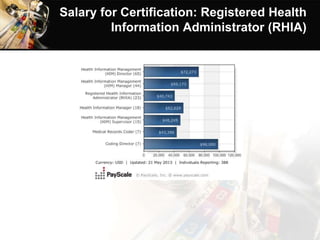
Salary for Certification: Registered Health
Information Administrator (RHIA)
Why Marymount?
• Marymount University is an independent Catholic institution
located in Arlington, VA, a thriving urban community just across
the Potomac River from downtown Washington, DC. Small class
sizes, talented faculty, and a 100% internship completion rate for
undergraduates make the Marymount experience truly unique.
Why Marymount?
• The HIM program incorporates the most current knowledge of
medicine, management, finance, information technology, and law
into one curriculum.
• This versatile blend of knowledge, health information graduates
can choose from a variety of work settings across a wide range of
healthcare environments.
• Health information encompasses a varied array of job functions
and settings. A sample includes medical records management,
privacy officer, risk management, medical coding, corporate
compliance, and data analysis and reporting.
Drivers of the HIM Curriculum
1. The laws that govern the exchange of health information (privacy &
security),
a) HIPAA
– In 1996, Congress passed legislation called Health Insurance
Portability and Accountability Act (HIPAA).
– The American Recovery and Reinvestment Act (ARRA) of 2009
provides changes to the original HIPPA provisions.
– Theses changes are located in the Health Information Technology
for Economic and Clinical Health Act (HITECH) of ARRA
b) Provides a federal floor, or minimum on privacy requirements.
c) Two Key Goals
i. Provide individuals with greater rights with respect to his or her
health information and
ii. Provide greater privacy protections for one’s health information,
which serves to limit access by others.
Drivers of the HIM Curriculum cont.
2. A major change in the classification system (ICD-9 to
ICD-10)
a) The first change since 1977.
b) ICD-9 is not adaptive to new technologies.
c) ICD-10 is currently used most other industrialized
nations.
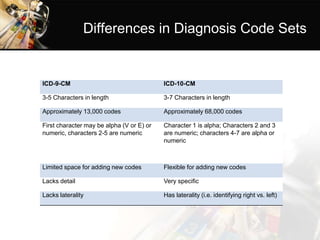
Differences in Diagnosis Code Sets
ICD-9-CM ICD-10-CM
3-5 Characters in length 3-7 Characters in length
Approximately 13,000 codes Approximately 68,000 codes
First character may be alpha (V or E) or
numeric, characters 2-5 are numeric
Character 1 is alpha; Characters 2 and 3
are numeric; characters 4-7 are alpha or
numeric
Limited space for adding new codes Flexible for adding new codes
Lacks detail Very specific
Lacks laterality Has laterality (i.e. identifying right vs. left)
Drivers of the HIM Curriculum cont.
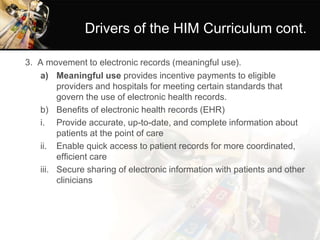
3. A movement to electronic records (meaningful use).
a) Meaningful use provides incentive payments to eligible
providers and hospitals for meeting certain standards that
govern the use of electronic health records.
b) Benefits of electronic health records (EHR)
i. Provide accurate, up-to-date, and complete information about
patients at the point of care
ii. Enable quick access to patient records for more coordinated,
efficient care
iii. Secure sharing of electronic information with patients and other
clinicians
Benefits of electronic health records
(EHR) cont.
iv. Improve patient and provider interaction and communication, as well
as health care convenience
v. Help providers more effectively diagnose patients, reduce medical
errors, and provide safer care
vi. Enable safer, more reliable prescribing
a. The ISMP points out that up to 7,000 Americans die each year due
to medication errors resulting in a cost of about $77 billion annually.
vii. Promote legible, complete documentation and accurate, streamlined
coding and billing
viii. Reduce costs through decreased paperwork, improved safety, reduced
duplication of testing, and improved health
Offerings
• Health Information Management (B.S.) - The program
combines knowledge of health care systems, information
technology, and medical information management techniques,
such as medical coding. You will get ample opportunity to practice
the knowledge gained through hands-on experiences, inquiry-
based learning, Professional Practice Experience (PPE) working
with a real client.
Offerings cont.
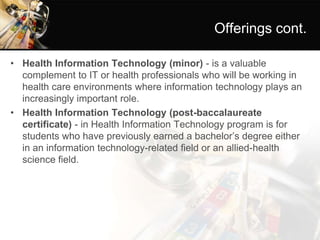
• Health Information Technology (minor) - is a valuable
complement to IT or health professionals who will be working in
health care environments where information technology plays an
increasingly important role.
• Health Information Technology (post-baccalaureate
certificate) - in Health Information Technology program is for
students who have previously earned a bachelor’s degree either
in an information technology-related field or an allied-health
science field.
References
• Gearon, C. (2012, Sep12). Discover 9 New College Majors with a Future.
Retreived from http://www.usnews.com/education/best-
colleges/articles/2012/09/12/discover-9-new-college-majors-with-a-
future?page=2
• Hickman, A. (2012, June11). ICD-9 and ICD-10 - What are some of the
differences? Retrieved from
http://www.ciproms.com/NewsEvents/tabid/65/EntryId/28/ICD-9-and-ICD-10-
What-are-some-of-the-differences.aspx
• Meaningful Use (HIT.Gov). Retrieved from http://www.healthit.gov/policy-
researchers-implementers/meaningful-use
• VISION 2016: A Blueprint for Quality Education in Health Information
Management (AHIMA) Retrieved from
http://www.ahima.org/schools/FacResources/RESEARCHVISION.pdf
• What are the advantages of electronic health records? (HIT.Gov). Retrieved from
http://www.healthit.gov/providers-professionals/faqs/what-are-advantages-
electronic-health-records
• Why choose a career in health information? (AHIMA). Retrieved from
http://www.hicareers.com/Health_Information101/why_health_information.aspx

Health information management .ppt

  • 1.
    Health Information Management PresentedBy Dr. Nick Rouse Drouse@Marymount.edu
  • 2.
    Why Health InformationManagement? • Graduates obtain a well-rounded yet focused skill set integrating clinical, information technology, leadership, and management skills. • Health Information Management (HIM) professionals use their knowledge of records management and technology to form a vital link between patients, medical professionals, administrators, and payers. • HIM professionals serve patients and the medical community by managing, analyzing, and utilizing health information (Johns, 2006).
  • 3.
    Career Prospects • Evolvingregulations and technologies are constantly driving changes in healthcare. • The demand for HIM professionals is rising at all levels of education and credentialing (certification). • Approximately 12,000 to 50,000 new jobs anticipated by 2017. • Medical records and health information technicians is one of the 20 fastest growing occupations in the US according to the Bureau of Labor Statistics • HIM was named the #4 top major in a recent article by US News and World report.
  • 4.
    Competitive Salaries • Over50% of new health information graduates with bachelor's degrees start with salaries in the $30,000 to $50,000 range. • Within five years one can earn upwards of $50,000 to $75,000 annually. • New health information graduates with associate's degrees jump right in and earn $20,000 to $30,000 annually. • At the baccalaureate level: – 30.5 percent of RHIA-credentialed members reporting are directors or managers – 18.5 percent are coding professionals – 2.2 percent of HIM (RHIA-credentialed) members with baccalaureate degrees are in C-level administrator/CEO/COO) roles.
  • 5.
    Salary for Certification:Registered Health Information Administrator (RHIA)
  • 6.
    Why Marymount? • MarymountUniversity is an independent Catholic institution located in Arlington, VA, a thriving urban community just across the Potomac River from downtown Washington, DC. Small class sizes, talented faculty, and a 100% internship completion rate for undergraduates make the Marymount experience truly unique.
  • 7.
    Why Marymount? • TheHIM program incorporates the most current knowledge of medicine, management, finance, information technology, and law into one curriculum. • This versatile blend of knowledge, health information graduates can choose from a variety of work settings across a wide range of healthcare environments. • Health information encompasses a varied array of job functions and settings. A sample includes medical records management, privacy officer, risk management, medical coding, corporate compliance, and data analysis and reporting.
  • 8.
    Drivers of theHIM Curriculum 1. The laws that govern the exchange of health information (privacy & security), a) HIPAA – In 1996, Congress passed legislation called Health Insurance Portability and Accountability Act (HIPAA). – The American Recovery and Reinvestment Act (ARRA) of 2009 provides changes to the original HIPPA provisions. – Theses changes are located in the Health Information Technology for Economic and Clinical Health Act (HITECH) of ARRA b) Provides a federal floor, or minimum on privacy requirements. c) Two Key Goals i. Provide individuals with greater rights with respect to his or her health information and ii. Provide greater privacy protections for one’s health information, which serves to limit access by others.
  • 9.
    Drivers of theHIM Curriculum cont. 2. A major change in the classification system (ICD-9 to ICD-10) a) The first change since 1977. b) ICD-9 is not adaptive to new technologies. c) ICD-10 is currently used most other industrialized nations.
  • 10.
    Differences in DiagnosisCode Sets ICD-9-CM ICD-10-CM 3-5 Characters in length 3-7 Characters in length Approximately 13,000 codes Approximately 68,000 codes First character may be alpha (V or E) or numeric, characters 2-5 are numeric Character 1 is alpha; Characters 2 and 3 are numeric; characters 4-7 are alpha or numeric Limited space for adding new codes Flexible for adding new codes Lacks detail Very specific Lacks laterality Has laterality (i.e. identifying right vs. left)
  • 11.
    Drivers of theHIM Curriculum cont. 3. A movement to electronic records (meaningful use). a) Meaningful use provides incentive payments to eligible providers and hospitals for meeting certain standards that govern the use of electronic health records. b) Benefits of electronic health records (EHR) i. Provide accurate, up-to-date, and complete information about patients at the point of care ii. Enable quick access to patient records for more coordinated, efficient care iii. Secure sharing of electronic information with patients and other clinicians
  • 12.
    Benefits of electronichealth records (EHR) cont. iv. Improve patient and provider interaction and communication, as well as health care convenience v. Help providers more effectively diagnose patients, reduce medical errors, and provide safer care vi. Enable safer, more reliable prescribing a. The ISMP points out that up to 7,000 Americans die each year due to medication errors resulting in a cost of about $77 billion annually. vii. Promote legible, complete documentation and accurate, streamlined coding and billing viii. Reduce costs through decreased paperwork, improved safety, reduced duplication of testing, and improved health
  • 13.
    Offerings • Health InformationManagement (B.S.) - The program combines knowledge of health care systems, information technology, and medical information management techniques, such as medical coding. You will get ample opportunity to practice the knowledge gained through hands-on experiences, inquiry- based learning, Professional Practice Experience (PPE) working with a real client.
  • 14.
    Offerings cont. • HealthInformation Technology (minor) - is a valuable complement to IT or health professionals who will be working in health care environments where information technology plays an increasingly important role. • Health Information Technology (post-baccalaureate certificate) - in Health Information Technology program is for students who have previously earned a bachelor’s degree either in an information technology-related field or an allied-health science field.
  • 15.
    References • Gearon, C.(2012, Sep12). Discover 9 New College Majors with a Future. Retreived from http://www.usnews.com/education/best- colleges/articles/2012/09/12/discover-9-new-college-majors-with-a- future?page=2 • Hickman, A. (2012, June11). ICD-9 and ICD-10 - What are some of the differences? Retrieved from http://www.ciproms.com/NewsEvents/tabid/65/EntryId/28/ICD-9-and-ICD-10- What-are-some-of-the-differences.aspx • Meaningful Use (HIT.Gov). Retrieved from http://www.healthit.gov/policy- researchers-implementers/meaningful-use • VISION 2016: A Blueprint for Quality Education in Health Information Management (AHIMA) Retrieved from http://www.ahima.org/schools/FacResources/RESEARCHVISION.pdf • What are the advantages of electronic health records? (HIT.Gov). Retrieved from http://www.healthit.gov/providers-professionals/faqs/what-are-advantages- electronic-health-records • Why choose a career in health information? (AHIMA). Retrieved from http://www.hicareers.com/Health_Information101/why_health_information.aspx