Section 9.1 Choosing Food Wisely
• You eat
Why You Eat
• Hunger is a feeling of physical discomfort that is
caused by your body’s need for nutrients.
• Appetite is a desire for food that is based on
emotional and other factors rather than nutritional
need.
• to meet your nutritional needs
• to satisfy your appetite
• to supply your body with energy
Section 9.1 Choosing Food Wisely
• Your basal metabolic rate (BMR) is the rate at
which you use energy when your body is at rest.
Basal Metabolic Rate
• The higher your BMR, the more calories you burn.
Section 9.1 Choosing Food Wisely
• Personal Preferences: Whatever your personal
preferences are, they have a huge impact on your
food choices every day.
The Foods You Choose
• Cultural Background: Cultural background, or
heritage, may influence your eating habits.
• Time and Convenience: A busy schedule might
lead you to choose foods that can be prepared
quickly or that can be easily carried.
• Friends: Friends might influence you to try new
foods or to change your eating habits.
• The Media: Advertising messages can influence
your decisions about what foods to eat or to avoid.
Section 9.1 Choosing Food Wisely
• When choosing foods, it is important to read and
evaluate the information on the food label.
Evaluating Food Choices
• The information includes
• nutrition facts
• nutrient and health claims
• Daily Values
• freshness dates
Section 9.1 Choosing Food Wisely
• The United States Food and Drug Administration
(FDA) requires manufacturers to include food labels
on most prepared foods.
Food Labels
• Food labels must list specific nutrition facts about the
food, including calorie and nutrient content, and the
ingredients.
Section 9.1 Choosing Food Wisely
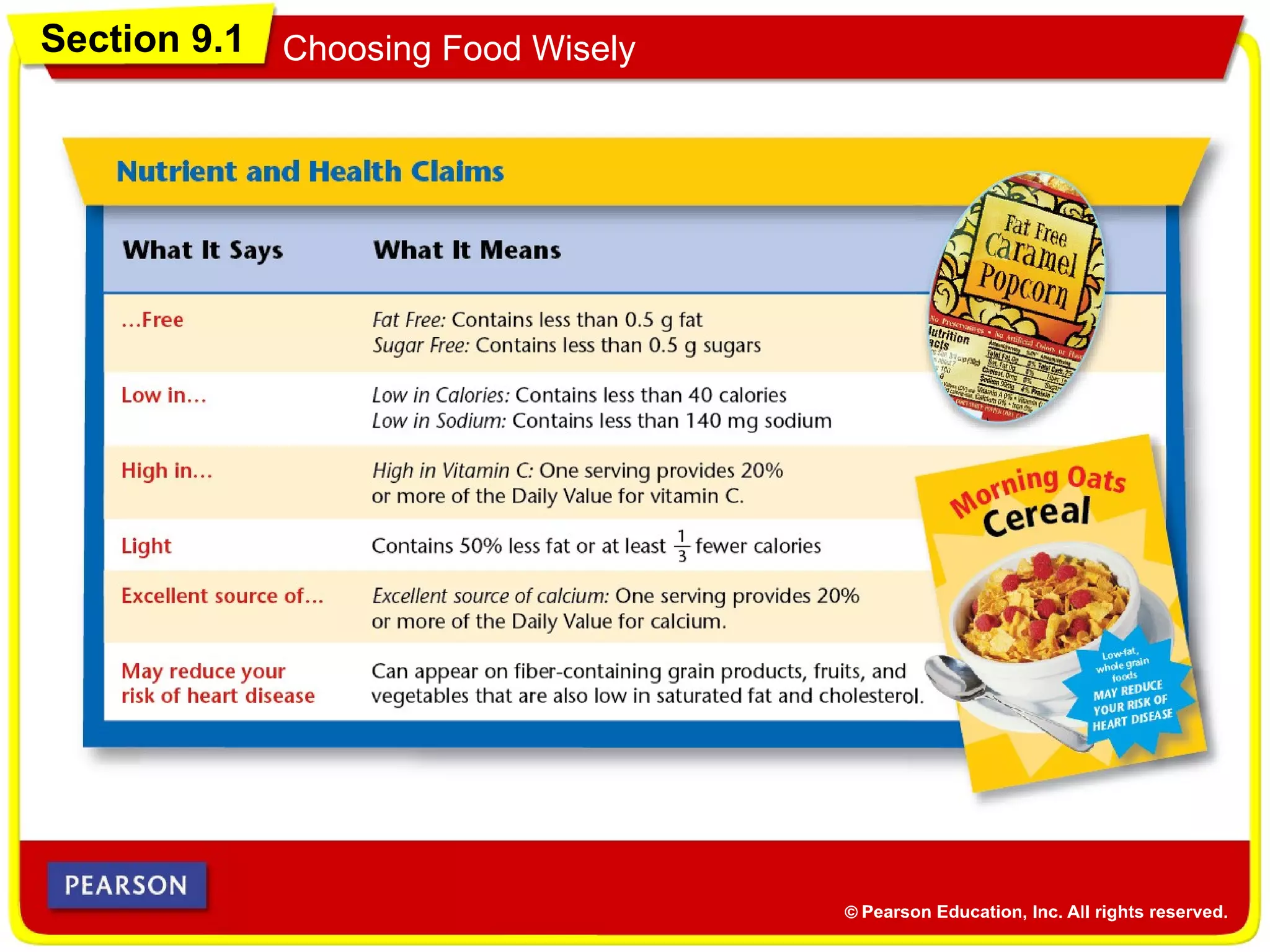
• The FDA sets standards regarding the nutrient
claims that can be printed on a food label.
Nutrient and Health Claims
• The FDA has approved the use of some health
claims on food labels.
• Health claims are statements that link use of the food
to certain health risks or benefits.
Section 9.1 Choosing Food Wisely
• Daily Values are recommendations that specify the
amounts of certain nutrients that the average person
should obtain each day.
Daily Values
• Daily Values are only a general guide because they
are calculated for the average person who consumes
a total of 2,000 calories a day.
Section 9.1 Choosing Food Wisely
• The labels on prepared foods also include open
dates.
Open Dates
• The “do-not-use-after” date is the expiration date.
• The “sell-by” date tells you the last date the product
can be sold.
• The “best-if-used-by” date tells you how long the
product will be at peak quality.
Section 9.2 Safely Managing Your Weight
• A person’s weight is determined by various factors,
including
What Weight Is Right for You?
• The weight that is right for you is the weight that
does not present any health risks.
• heredity
• level of activity
• body composition
Section 9.2 Safely Managing Your Weight
• There is a link between body weight and heredity.
Heredity
• You may have a natural tendency toward a certain
weight.
Section 9.2 Safely Managing Your Weight
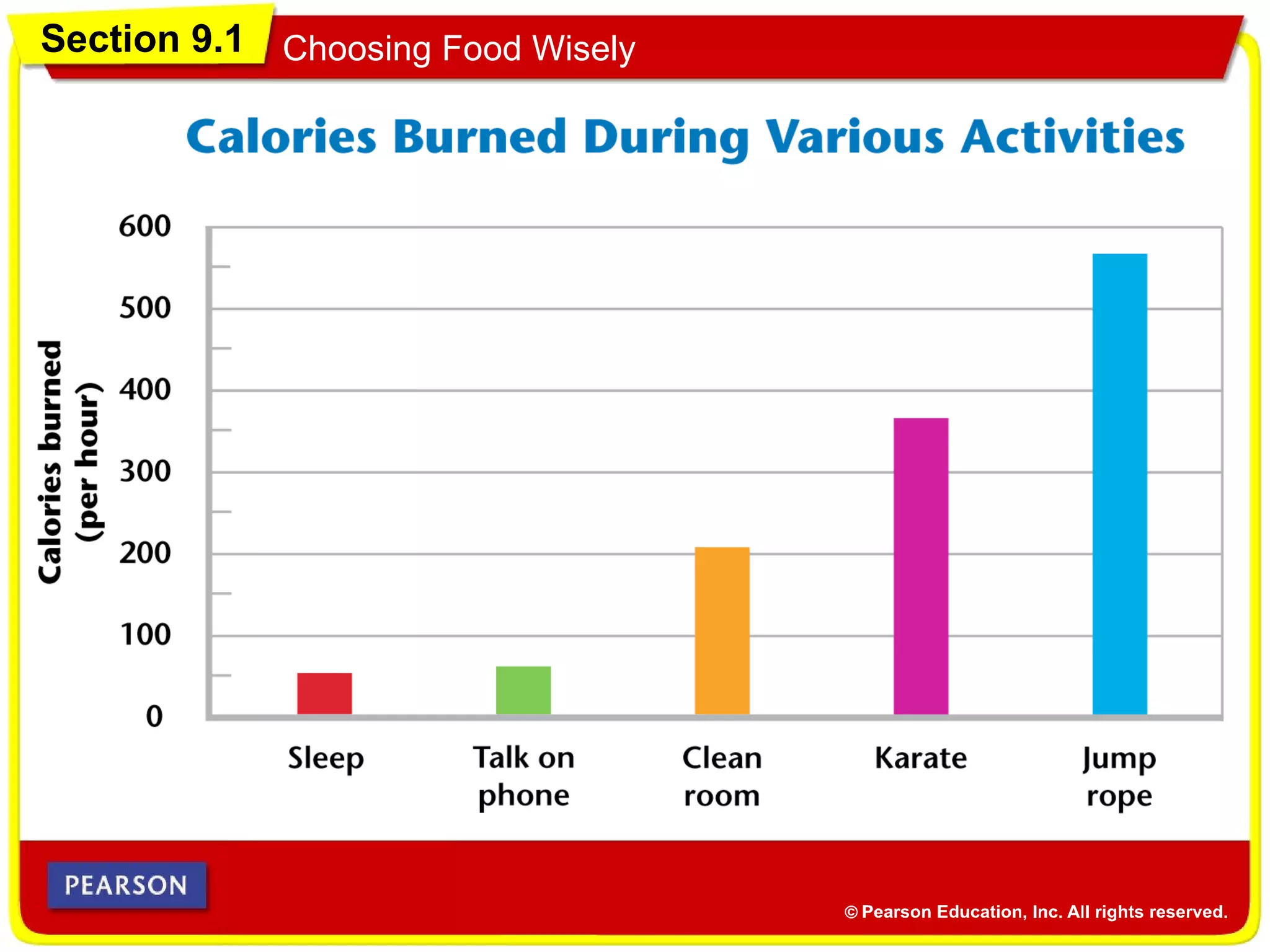
• The more active you are, the more calories you burn.
Activity Level
• If you are less active, you need fewer calories.
• The number of calories consumed must equal the
number of calories burned.
Section 9.2 Safely Managing Your Weight
• Body composition is a measure of how much body
fat you have, as compared to muscle and bone.
Body Composition
• Body composition is affected by sex and age.
• Women tend to have more body fat and lower
muscle mass than men.
Section 9.2 Safely Managing Your Weight
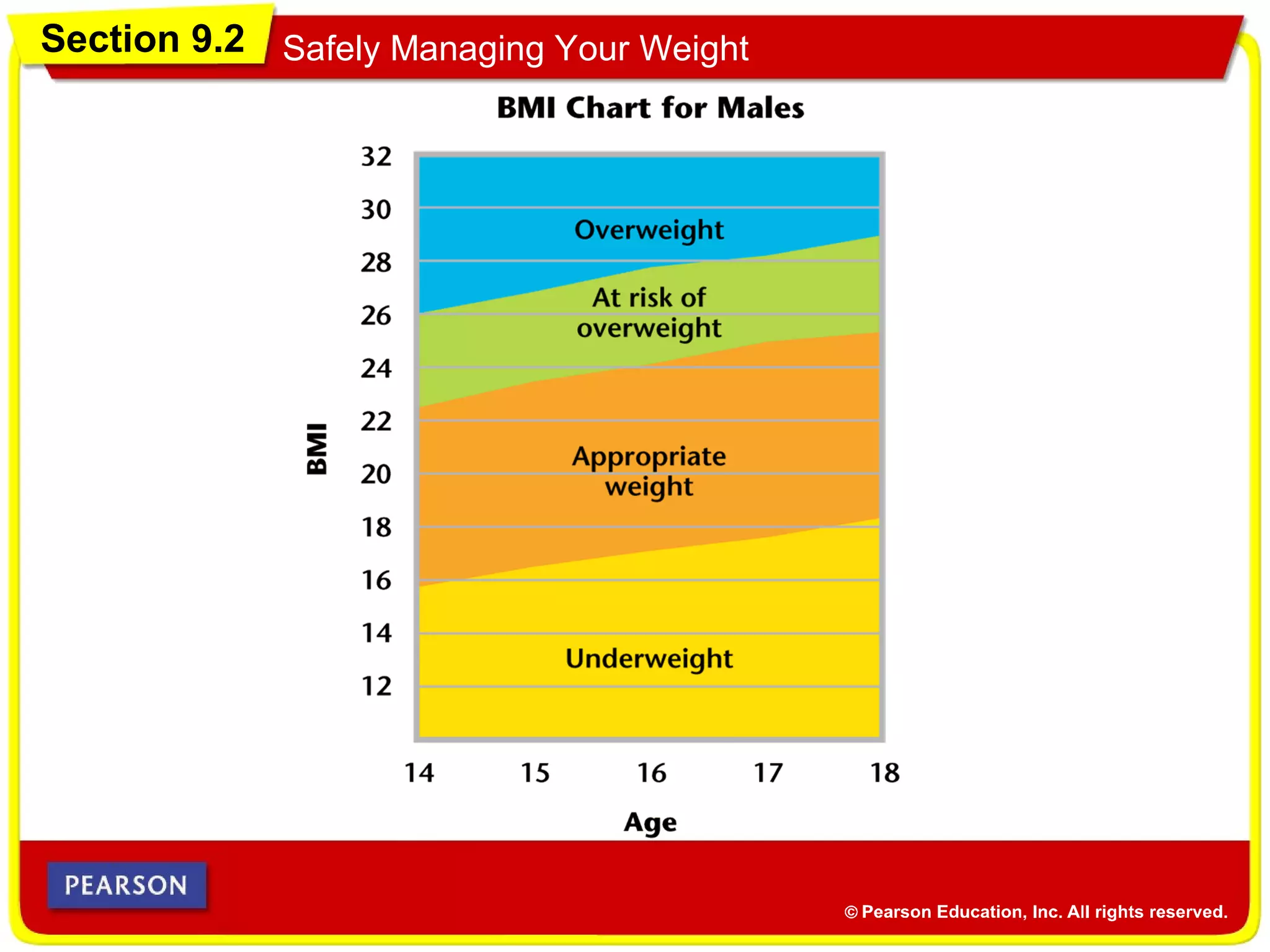
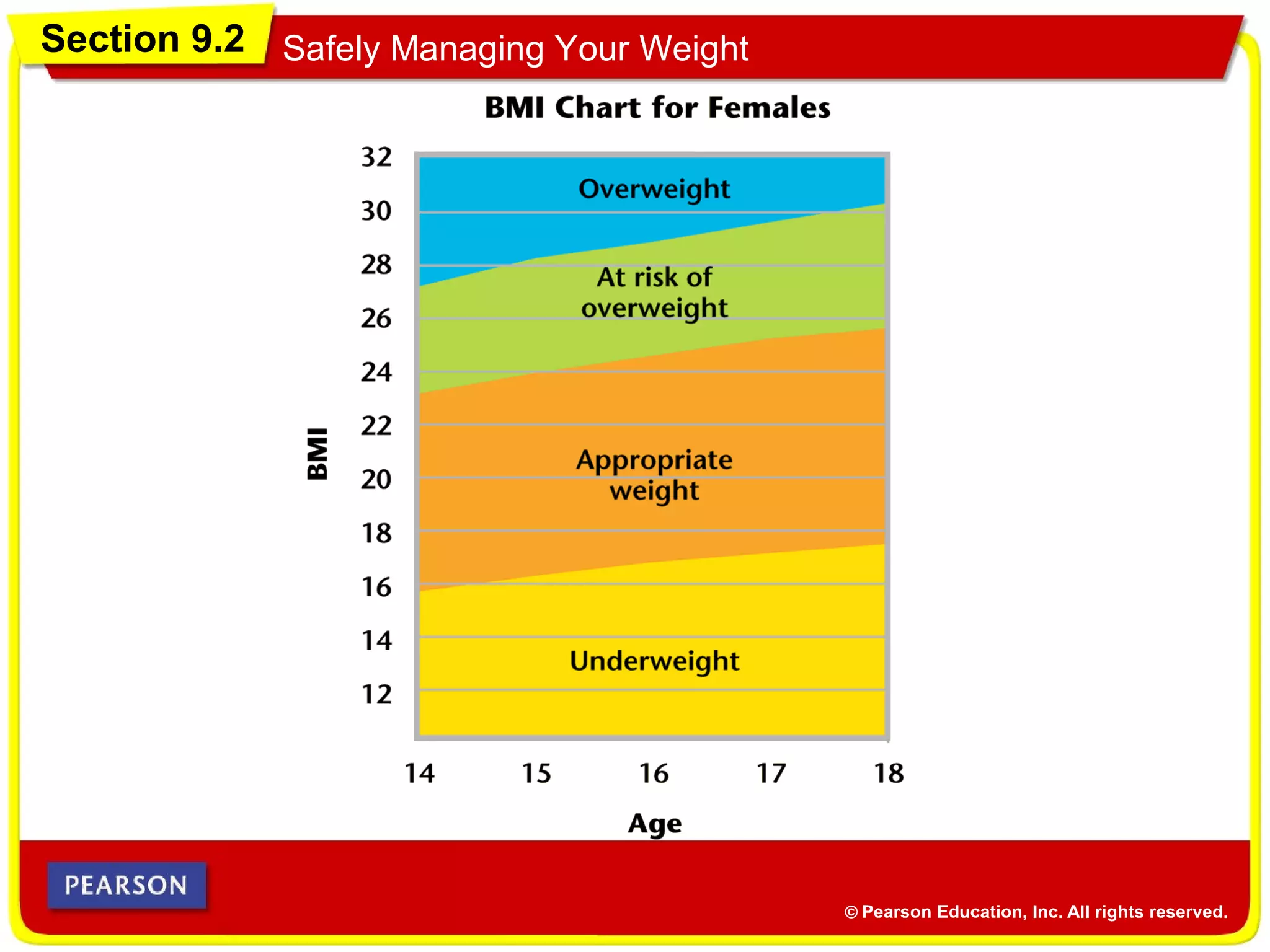
• Body mass index (BMI) is a ratio of your weight to
your height.
Body Mass Index
• Follow these steps to calculate your BMI.
BMI =
Weight (in pounds)
[Height (in inches)]2( ) x 703
1. Multiply your height (in inches) by your height (in
inches).
2. Divide your weight (in pounds) by the number
from Step 1.
3. Multiply the number from Step 2 by 703.
Section 9.2 Safely Managing Your Weight
• The number of people in the United States who are
overweight is increasing.
Overweight and Obesity
• Being overweight can lead to serious health
problems, including heart disease and diabetes.
Section 9.2 Safely Managing Your Weight
• Overweight is a term used to describe a person
who is heavier than the standard for the person’s
height.
A Growing Problem
• Obesity (oh BEE sih tee) refers specifically to adults
who have a BMI of 30 or higher.
• More calories are being consumed by people today.
• People today burn fewer calories.
Section 9.2 Safely Managing Your Weight
Overweight people tend to develop several health
problems
Health Risks
• high blood pressure
• excess cholesterol in the blood
• excess glucose in the blood
• heart disease
• stroke
• certain cancers
Section 9.2 Safely Managing Your Weight
• Prevention is the key to avoiding the health problems
associated with being overweight.
What You Can Do
• Healthy eating and regular exercise can help you
avoid becoming overweight in the first place.
Section 9.2 Safely Managing Your Weight
Underweight is a term used to describe a person who
is lighter than the standard for the person’s height.
Underweight
Section 9.2 Safely Managing Your Weight
Being underweight can be linked to health problems
Health Risks
• anemia
• heart irregularities
• trouble regulating body temperature
Section 9.2 Safely Managing Your Weight
• Be patient. As you mature, there probably will come
a time when your weight will start to increase.
What You Can Do
• Healthy eating and exercise are as important for
putting on weight as they are for taking off weight.
Section 9.2 Safely Managing Your Weight
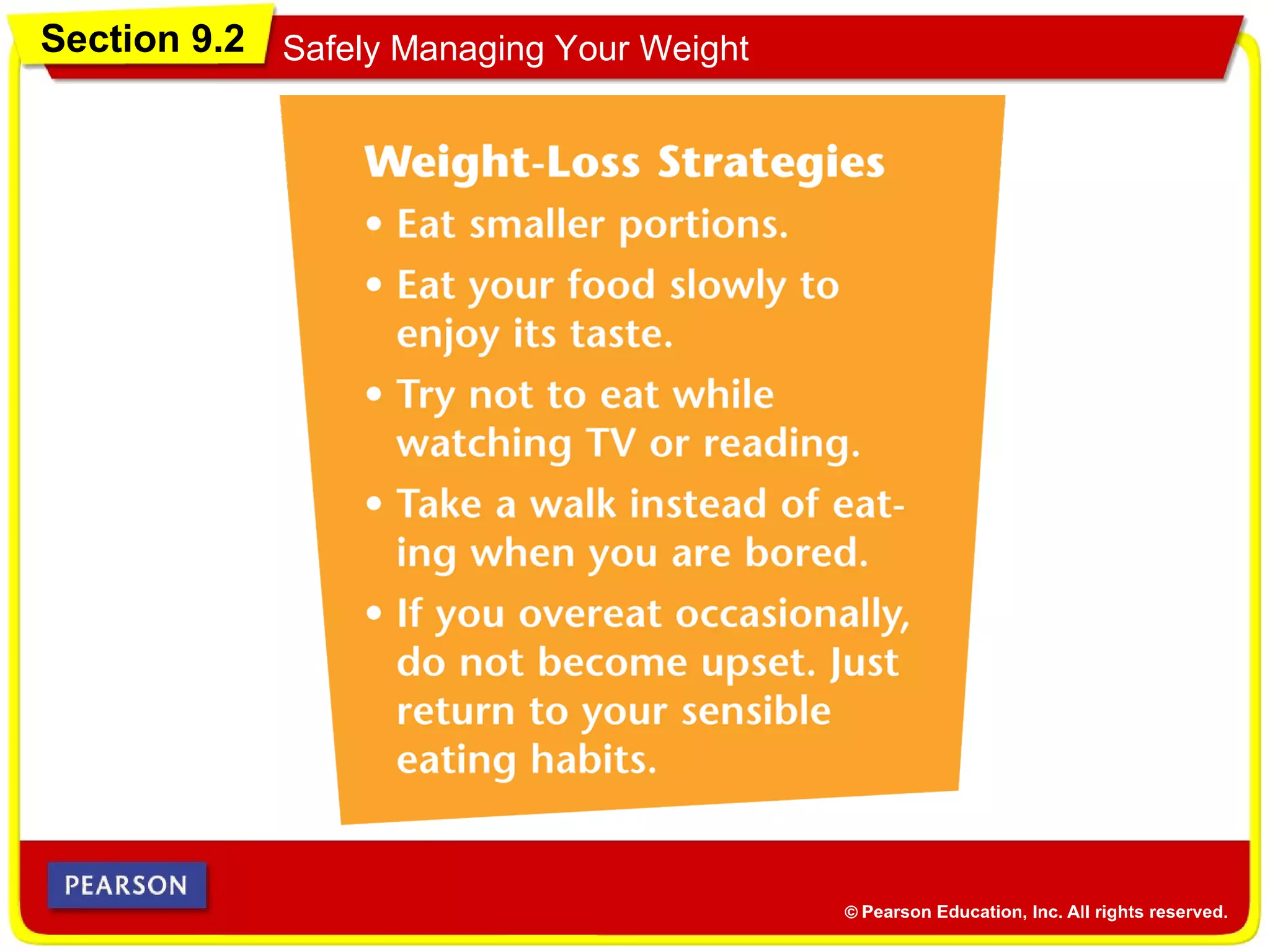
Sensible weight management involves
Healthy Weight Management
• avoiding dangerous diet plans
• choosing nutritionally balanced meals and snacks
• getting regular exercise
Section 9.2 Safely Managing Your Weight
• Fad Diets A fad diet is a popular diet that may help
a person lose or gain weight but without proper
regard for nutrition and other health issues.
Dangerous Diet Plans
• Diet Aids Diet aids include pills and candies that are
supposed to suppress appetite.
• Fasting Some people fast, or refrain from eating.
Section 9.2 Safely Managing Your Weight
• Recognize Eating Patterns Keep a diary of your
current eating habits.
Sensible Weight Loss
• Plan Helpful Strategies Change your eating habits
gradually.
• Exercise Your weight-loss program will be far more
effective if you exercise.
Section 9.2 Safely Managing Your Weight
• Avoid snacks right before mealtimes.
Sensible Weight Gain
• Choose nutrient-dense foods that are high in calories.
• Don’t increase your fat intake over what is
recommended in the MyPlate plan.
• Try not to skip meals.
• Take bigger helpings of food than usual.
• While you are increasing your caloric intake, do not
neglect exercise.
Section 9.3 Guidelines for Healthful Eating
• Diabetes is a disease with dietary requirements that
can help people manage their condition.
Diets for Diabetics
• Eating tips for diabetics
• Eat balanced meals and snacks on a regular
schedule.
• Monitor your carbohydrate intake.
• Get regular exercise.
• Control your weight.
Section 9.3 Guidelines for Healthful Eating
• A person who does not eat meat is called a vegetarian.
Vegetarian Diets
• Some vegetarians, called vegans, eat no food from
any animal source.
• Because vegetarians exclude certain foods from their
diets, they need to plan their food choices carefully
Section 9.3 Guidelines for Healthful Eating
• lower BMI
Benefits of a Vegetarian Diet
• lower risk of heart disease
• lower blood pressure
• lower risk of type 2 diabetes
Section 9.3 Guidelines for Healthful Eating
• inadequate intake of vitamin B12, which can result in
nerve damage
Risks of a Vegetarian Diet
• lack of adequate calcium, which can lead to bone
loss
• protein deficiency, which can result in hair and
muscle loss
Section 9.3 Guidelines for Healthful Eating
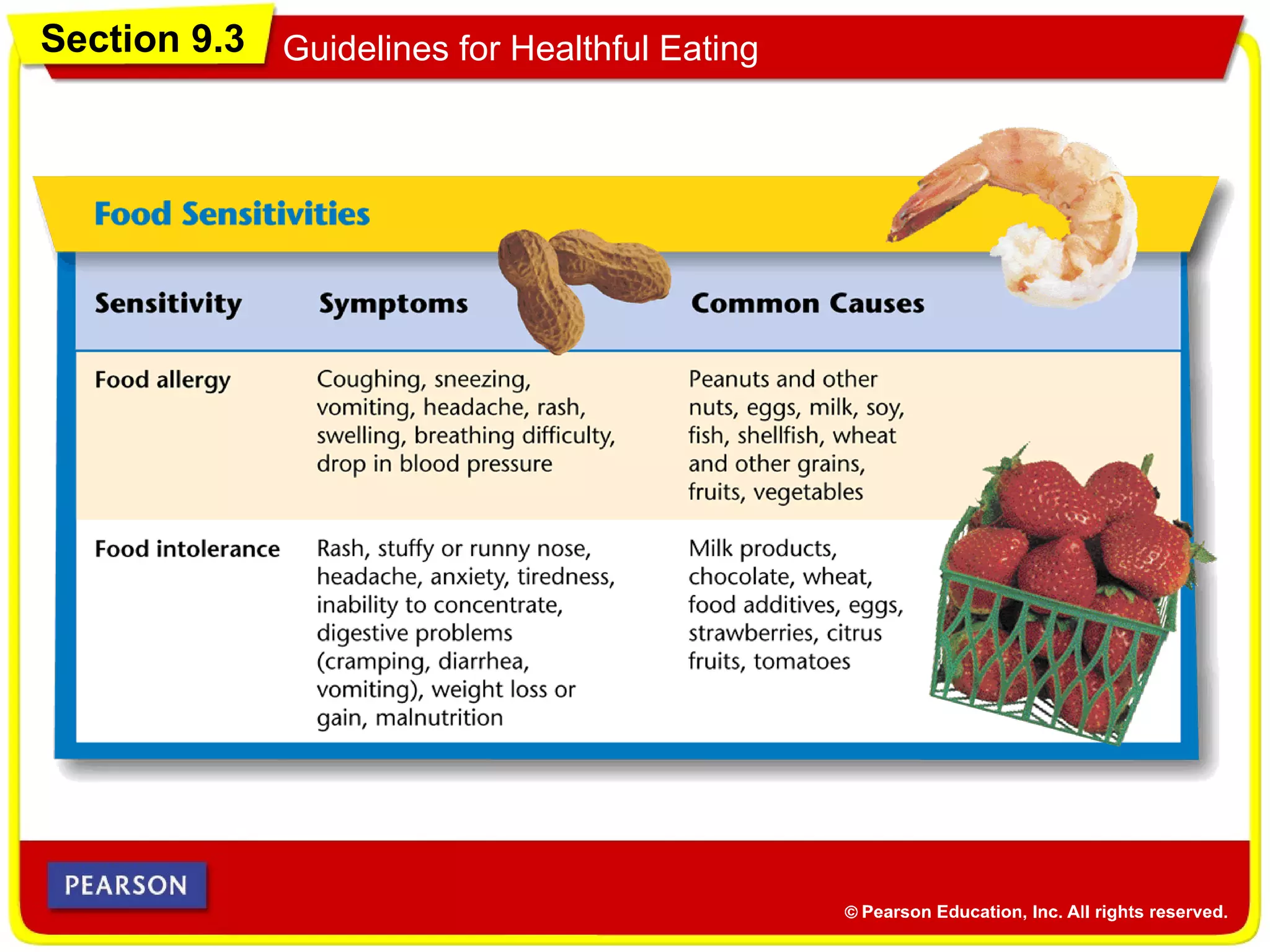
People with food sensitivities, which include food
allergies and food intolerances, may require special
diets.
Food Sensitivities
Section 9.3 Guidelines for Healthful Eating
• A food allergy is a response by your immune system to
the proteins in certain foods.
Food Allergies
• About eleven percent of the population has some kind
of food allergy.
Section 9.3 Guidelines for Healthful Eating
• A food intolerance is an inability to digest a particular
food or food additive.
Food Intolerances
• Food intolerances are more common than food
allergies.
Section 9.3 Guidelines for Healthful Eating
Athletes need a well-balanced diet with the
recommended amounts of carbohydrates, fats, and
proteins.
Healthy Diets for Athletes
Section 9.3 Guidelines for Healthful Eating
Calorie Intake
• Athletes should not restrict fat intake to less than that
recommended in the MyPlate plan.
• Athletes need to consume extra calories to fuel their
higher level of physical activity.
Section 9.3 Guidelines for Healthful Eating
Fluid Intake
• How much water athletes need depends on the duration
and intensity of the competition and weather factors.
• During competition, athletes should drink
plenty of fluids.
Section 9.3 Guidelines for Healthful Eating
• Carbohydrate loading is the practice of greatly
increasing carbohydrate intake and decreasing exercise
on the days immediately before a competition.
Carbohydrate Loading
• For marathon runners or other endurance athletes,
carbohydrate loading may help supply needed energy.
• For the average athlete, it probably is unnecessary.

Health Course Chapter 9

  • 1.
    Section 9.1 ChoosingFood Wisely • You eat Why You Eat • Hunger is a feeling of physical discomfort that is caused by your body’s need for nutrients. • Appetite is a desire for food that is based on emotional and other factors rather than nutritional need. • to meet your nutritional needs • to satisfy your appetite • to supply your body with energy
  • 2.
    Section 9.1 ChoosingFood Wisely • Your basal metabolic rate (BMR) is the rate at which you use energy when your body is at rest. Basal Metabolic Rate • The higher your BMR, the more calories you burn.
  • 3.
    Section 9.1 ChoosingFood Wisely • Personal Preferences: Whatever your personal preferences are, they have a huge impact on your food choices every day. The Foods You Choose • Cultural Background: Cultural background, or heritage, may influence your eating habits. • Time and Convenience: A busy schedule might lead you to choose foods that can be prepared quickly or that can be easily carried. • Friends: Friends might influence you to try new foods or to change your eating habits. • The Media: Advertising messages can influence your decisions about what foods to eat or to avoid.
  • 4.
  • 5.
    Section 9.1 ChoosingFood Wisely • When choosing foods, it is important to read and evaluate the information on the food label. Evaluating Food Choices • The information includes • nutrition facts • nutrient and health claims • Daily Values • freshness dates
  • 6.
    Section 9.1 ChoosingFood Wisely • The United States Food and Drug Administration (FDA) requires manufacturers to include food labels on most prepared foods. Food Labels • Food labels must list specific nutrition facts about the food, including calorie and nutrient content, and the ingredients.
  • 7.
    Section 9.1 ChoosingFood Wisely • The FDA sets standards regarding the nutrient claims that can be printed on a food label. Nutrient and Health Claims • The FDA has approved the use of some health claims on food labels. • Health claims are statements that link use of the food to certain health risks or benefits.
  • 8.
  • 9.
    Section 9.1 ChoosingFood Wisely • Daily Values are recommendations that specify the amounts of certain nutrients that the average person should obtain each day. Daily Values • Daily Values are only a general guide because they are calculated for the average person who consumes a total of 2,000 calories a day.
  • 10.
    Section 9.1 ChoosingFood Wisely • The labels on prepared foods also include open dates. Open Dates • The “do-not-use-after” date is the expiration date. • The “sell-by” date tells you the last date the product can be sold. • The “best-if-used-by” date tells you how long the product will be at peak quality.
  • 11.
    Section 9.2 SafelyManaging Your Weight • A person’s weight is determined by various factors, including What Weight Is Right for You? • The weight that is right for you is the weight that does not present any health risks. • heredity • level of activity • body composition
  • 12.
    Section 9.2 SafelyManaging Your Weight • There is a link between body weight and heredity. Heredity • You may have a natural tendency toward a certain weight.
  • 13.
    Section 9.2 SafelyManaging Your Weight • The more active you are, the more calories you burn. Activity Level • If you are less active, you need fewer calories. • The number of calories consumed must equal the number of calories burned.
  • 14.
    Section 9.2 SafelyManaging Your Weight • Body composition is a measure of how much body fat you have, as compared to muscle and bone. Body Composition • Body composition is affected by sex and age. • Women tend to have more body fat and lower muscle mass than men.
  • 15.
    Section 9.2 SafelyManaging Your Weight • Body mass index (BMI) is a ratio of your weight to your height. Body Mass Index • Follow these steps to calculate your BMI. BMI = Weight (in pounds) [Height (in inches)]2( ) x 703 1. Multiply your height (in inches) by your height (in inches). 2. Divide your weight (in pounds) by the number from Step 1. 3. Multiply the number from Step 2 by 703.
  • 16.
    Section 9.2 SafelyManaging Your Weight
  • 17.
    Section 9.2 SafelyManaging Your Weight
  • 18.
    Section 9.2 SafelyManaging Your Weight • The number of people in the United States who are overweight is increasing. Overweight and Obesity • Being overweight can lead to serious health problems, including heart disease and diabetes.
  • 19.
    Section 9.2 SafelyManaging Your Weight • Overweight is a term used to describe a person who is heavier than the standard for the person’s height. A Growing Problem • Obesity (oh BEE sih tee) refers specifically to adults who have a BMI of 30 or higher. • More calories are being consumed by people today. • People today burn fewer calories.
  • 20.
    Section 9.2 SafelyManaging Your Weight Overweight people tend to develop several health problems Health Risks • high blood pressure • excess cholesterol in the blood • excess glucose in the blood • heart disease • stroke • certain cancers
  • 21.
    Section 9.2 SafelyManaging Your Weight • Prevention is the key to avoiding the health problems associated with being overweight. What You Can Do • Healthy eating and regular exercise can help you avoid becoming overweight in the first place.
  • 22.
    Section 9.2 SafelyManaging Your Weight Underweight is a term used to describe a person who is lighter than the standard for the person’s height. Underweight
  • 23.
    Section 9.2 SafelyManaging Your Weight Being underweight can be linked to health problems Health Risks • anemia • heart irregularities • trouble regulating body temperature
  • 24.
    Section 9.2 SafelyManaging Your Weight • Be patient. As you mature, there probably will come a time when your weight will start to increase. What You Can Do • Healthy eating and exercise are as important for putting on weight as they are for taking off weight.
  • 25.
    Section 9.2 SafelyManaging Your Weight Sensible weight management involves Healthy Weight Management • avoiding dangerous diet plans • choosing nutritionally balanced meals and snacks • getting regular exercise
  • 26.
    Section 9.2 SafelyManaging Your Weight • Fad Diets A fad diet is a popular diet that may help a person lose or gain weight but without proper regard for nutrition and other health issues. Dangerous Diet Plans • Diet Aids Diet aids include pills and candies that are supposed to suppress appetite. • Fasting Some people fast, or refrain from eating.
  • 27.
    Section 9.2 SafelyManaging Your Weight • Recognize Eating Patterns Keep a diary of your current eating habits. Sensible Weight Loss • Plan Helpful Strategies Change your eating habits gradually. • Exercise Your weight-loss program will be far more effective if you exercise.
  • 28.
    Section 9.2 SafelyManaging Your Weight
  • 29.
    Section 9.2 SafelyManaging Your Weight • Avoid snacks right before mealtimes. Sensible Weight Gain • Choose nutrient-dense foods that are high in calories. • Don’t increase your fat intake over what is recommended in the MyPlate plan. • Try not to skip meals. • Take bigger helpings of food than usual. • While you are increasing your caloric intake, do not neglect exercise.
  • 30.
    Section 9.3 Guidelinesfor Healthful Eating • Diabetes is a disease with dietary requirements that can help people manage their condition. Diets for Diabetics • Eating tips for diabetics • Eat balanced meals and snacks on a regular schedule. • Monitor your carbohydrate intake. • Get regular exercise. • Control your weight.
  • 31.
    Section 9.3 Guidelinesfor Healthful Eating • A person who does not eat meat is called a vegetarian. Vegetarian Diets • Some vegetarians, called vegans, eat no food from any animal source. • Because vegetarians exclude certain foods from their diets, they need to plan their food choices carefully
  • 32.
    Section 9.3 Guidelinesfor Healthful Eating • lower BMI Benefits of a Vegetarian Diet • lower risk of heart disease • lower blood pressure • lower risk of type 2 diabetes
  • 33.
    Section 9.3 Guidelinesfor Healthful Eating • inadequate intake of vitamin B12, which can result in nerve damage Risks of a Vegetarian Diet • lack of adequate calcium, which can lead to bone loss • protein deficiency, which can result in hair and muscle loss
  • 34.
    Section 9.3 Guidelinesfor Healthful Eating
  • 35.
    Section 9.3 Guidelinesfor Healthful Eating People with food sensitivities, which include food allergies and food intolerances, may require special diets. Food Sensitivities
  • 36.
    Section 9.3 Guidelinesfor Healthful Eating • A food allergy is a response by your immune system to the proteins in certain foods. Food Allergies • About eleven percent of the population has some kind of food allergy.
  • 37.
    Section 9.3 Guidelinesfor Healthful Eating • A food intolerance is an inability to digest a particular food or food additive. Food Intolerances • Food intolerances are more common than food allergies.
  • 38.
    Section 9.3 Guidelinesfor Healthful Eating
  • 39.
    Section 9.3 Guidelinesfor Healthful Eating Athletes need a well-balanced diet with the recommended amounts of carbohydrates, fats, and proteins. Healthy Diets for Athletes
  • 40.
    Section 9.3 Guidelinesfor Healthful Eating Calorie Intake • Athletes should not restrict fat intake to less than that recommended in the MyPlate plan. • Athletes need to consume extra calories to fuel their higher level of physical activity.
  • 41.
    Section 9.3 Guidelinesfor Healthful Eating Fluid Intake • How much water athletes need depends on the duration and intensity of the competition and weather factors. • During competition, athletes should drink plenty of fluids.
  • 42.
    Section 9.3 Guidelinesfor Healthful Eating • Carbohydrate loading is the practice of greatly increasing carbohydrate intake and decreasing exercise on the days immediately before a competition. Carbohydrate Loading • For marathon runners or other endurance athletes, carbohydrate loading may help supply needed energy. • For the average athlete, it probably is unnecessary.