Section 8.1 Carbohydrates, Fats, and Proteins
• Food supplies your body with nutrients, substances
that the body needs to regulate bodily functions,
promote growth, repair body tissues, and obtain
energy.
Foods Supply Nutrients
• There are six classes of nutrients: carbohydrates,
fats, proteins, vitamins, minerals, and water.
• Carbohydrates, fats, and proteins can all be used by
the body as sources of energy.
Section 8.1 Carbohydrates, Fats, and Proteins
• The foods you eat are your body’s energy source.
Foods Supply Energy
• You need energy to maintain your body temperature,
keep your heart beating, and enable you to
understand what you read.
Section 8.1 Carbohydrates, Fats, and Proteins
• When your body uses the nutrients in foods, a series
of chemical reactions occurs inside your cells. As a
result, energy is released.
Fuel for Your Body
• Metabolism is the chemical process by which your
body breaks down food to release this energy.
• Metabolism also involves the use of this energy for
growth and repair of body tissue.
Section 8.1 Carbohydrates, Fats, and Proteins
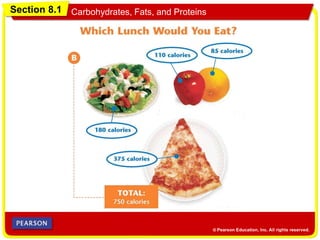
• The amount of energy released when nutrients are
broken down is measured in units called calories.
What are Calories?
• The more calories a food has, the more energy it
contains.
Section 8.1 Carbohydrates, Fats, and Proteins
• Carbohydrates are nutrients made of carbon,
hydrogen, and oxygen.
Carbohydrates
• Carbohydrates supply energy for your body’s
functions.
Section 8.1 Carbohydrates, Fats, and Proteins
• Fiber is a type of complex carbohydrate that is found
in plants.
Fiber
• A high-fiber diet
• may help prevent heart disease
• may reduce the risk of colon cancer
• helps prevent constipation
Section 8.1 Carbohydrates, Fats, and Proteins
• Cholesterol is a waxy, fatlike substance that is found
only in animal products.
Cholesterol
• Your body needs a certain amount of cholesterol to
make cell membranes and nerve tissue, certain
hormones, and substances that aid in the digestion
of fat.
Section 8.1 Carbohydrates, Fats, and Proteins
Proteins
• Proteins can serve as a source of energy.
• The most important function of proteins is their role
in the growth and repair of your body’s tissues.
• Nutrients that contain nitrogen as well as carbon,
hydrogen, and oxygen are called proteins.
Section 8.1 Carbohydrates, Fats, and Proteins
• Proteins are long chains of smaller “links” that are
bound together chemically.
Amino Acids
• These smaller substances are known as amino
acids.
Section 8.2 Vitamins, Minerals, and Water
• One of the first discoveries of the importance of
vitamins came in the 1700s.
Vitamins
• A Scottish doctor, James Lind, discovered that
sailors who were fed citrus fruits recovered from
scurvy.
• Today, health scientists know that scurvy is caused
by a lack of vitamin C, which is found in abundance
in citrus fruits.
Section 8.2 Vitamins, Minerals, and Water
• Nutrients that are made by living things, are required
only in small amounts, and that assist many
chemical reactions in the body are vitamins.
What Are Vitamins?
• There are two classes of vitamins
• fat-soluble vitamins—dissolve in fatty material
• water-soluble vitamins—dissolve in water
Section 8.2 Vitamins, Minerals, and Water
• Vitamins called antioxidants help protect healthy
cells from the damage caused by the normal aging
process as well as from certain types of cancer.
Antioxidants
• Vitamins C and E are two of the most powerful
antioxidants.
Section 8.2 Vitamins, Minerals, and Water
• Your body requires only small amounts of minerals,
which are nutrients that occur naturally in rocks and
soil.
Minerals
• You need seven minerals—calcium, sodium,
potassium, magnesium, phosphorus, chlorine, and
sulfur—in significant amounts.
Section 8.2 Vitamins, Minerals, and Water
• Calcium is important in blood clotting and the
functioning of your nervous system.
Calcium
• It is an essential ingredient in the formation and
maintenance of bones and teeth.
• A lack of calcium can sometimes lead to
osteoporosis, a condition in which the bones
gradually weaken.
Section 8.2 Vitamins, Minerals, and Water
• Potassium and sodium work together to maintain
water balance in the body.
Potassium
• Most Americans do not consume enough potassium.
Section 8.2 Vitamins, Minerals, and Water
• Iron is necessary for healthy red blood cells.
Iron
• If a person’s diet does not include enough iron, he or
she may develop anemia, a condition in which the
red blood cells do not contain enough hemoglobin.
Section 8.2 Vitamins, Minerals, and Water
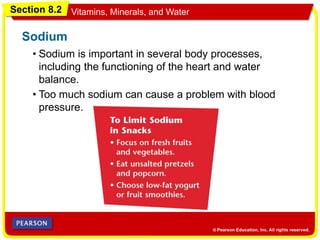
• Sodium is important in several body processes,
including the functioning of the heart and water
balance.
Sodium
• Too much sodium can cause a problem with blood
pressure.
Section 8.2 Vitamins, Minerals, and Water
• Vitamin and mineral supplements, therefore, are not
usually necessary if your diet is nutritious and well-
balanced.
Vitamin and Mineral Supplements
• An excess, or overdose, of vitamins or minerals may
damage your health.
• If you do take a vitamin or mineral supplement, a
health care provider can advise you about how much
is the right amount.
Section 8.2 Vitamins, Minerals, and Water
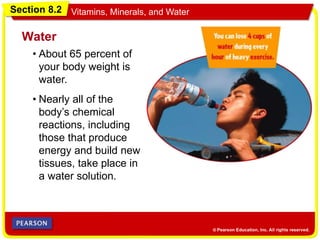
• About 65 percent of
your body weight is
water.
Water
• Nearly all of the
body’s chemical
reactions, including
those that produce
energy and build new
tissues, take place in
a water solution.
Section 8.2 Vitamins, Minerals, and Water
• Homeostasis is the process of maintaining a steady
state inside your body.
Water and Homeostasis
• When you become overheated, your body excretes
perspiration, which cools your body. Thus, water
regulates body temperature.
• Water contains dissolved substances called
electrolytes that regulate many processes in your
cells.
Section 8.2 Vitamins, Minerals, and Water
• Dehydration is a serious reduction in the body’s
water content.
Preventing Dehydration
• Symptoms of dehydration can include weakness,
rapid breathing, and a weak heartbeat.
Section 8.2 Vitamins, Minerals, and Water
• Every day, you need at least ten 8-ounce cups of
water if you are a female 14 to 18 years old.
How Much Water?
• Males in the same age group need 14 cups of water
per day.
Section 8.2 Vitamins, Minerals, and Water
• A sports drink is not necessary if you exercise for 60
minutes or less.
Water Versus Sports Drinks
• If you exercise longer, a sports drink that contains
carbohydrates may be beneficial.
• Sports drinks with electrolytes are not necessary
unless you exercise for 5 hours or more.
Section 8.3 Guidelines for Healthful Eating
• The Dietary Guidelines for Americans is a document
developed by nutrition experts to promote health.
The Dietary Guidelines
• The Dietary Guidelines provide information on how to
• make smart food choices
• balance food intake with physical activity
• get the most nutrition out of the calories you consume
• handle food safely
Section 8.3 Guidelines for Healthful Eating
• Choose a wide variety of foods.
Make Smart Food Choices
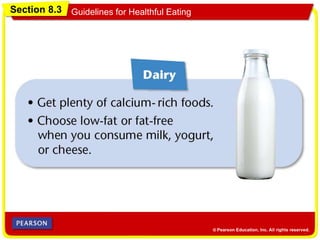
• Choose low-fat or nonfat milk and milk products.
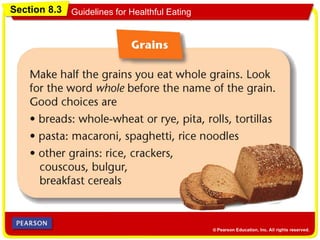
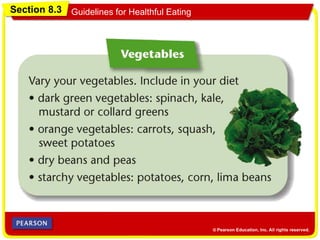
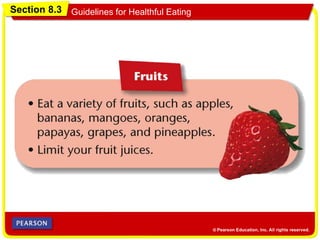
• Include plenty of whole-grain foods, vegetables, and
fruits.
Section 8.3 Guidelines for Healthful Eating
• Maintaining a healthy weight is a matter of balancing
the calories you take in with how active you are.
Balance Food and Physical Activity
• The Dietary Guidelines recommend that teenagers
be active for 60 minutes most days.
Section 8.3 Guidelines for Healthful Eating
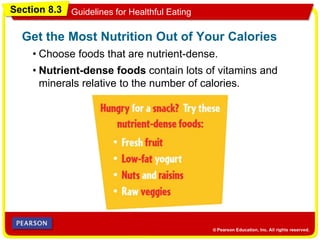
• Choose foods that are nutrient-dense.
Get the Most Nutrition Out of Your Calories
• Nutrient-dense foods contain lots of vitamins and
minerals relative to the number of calories.
Section 8.3 Guidelines for Healthful Eating
• Part of good nutrition is using safe procedures to
prepare, handle, and store the food you eat.
Handle Food Safely
• Keep your hands and surfaces that come into contact
with food clean.
• Separate raw and cooked foods while preparing or
storing them.
• Cook meat, poultry, and fish to safe internal
temperatures.
• If food is perishable, chill it right away.
• Thaw foods in the refrigerator, not the counter.
Section 8.3 Guidelines for Healthful Eating
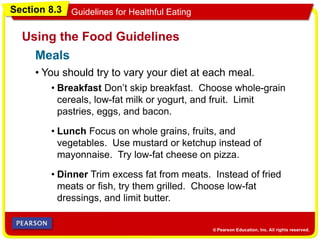
• You should try to vary your diet at each meal.
Using the Food Guidelines
• Breakfast Don’t skip breakfast. Choose whole-grain
cereals, low-fat milk or yogurt, and fruit. Limit
pastries, eggs, and bacon.
• Lunch Focus on whole grains, fruits, and
vegetables. Use mustard or ketchup instead of
mayonnaise. Try low-fat cheese on pizza.
• Dinner Trim excess fat from meats. Instead of fried
meats or fish, try them grilled. Choose low-fat
dressings, and limit butter.
Meals
Section 8.3 Guidelines for Healthful Eating
Using the Food Guidelines
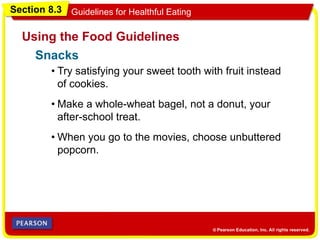
• Try satisfying your sweet tooth with fruit instead
of cookies.
• Make a whole-wheat bagel, not a donut, your
after-school treat.
• When you go to the movies, choose unbuttered
popcorn.
Snacks
Section 8.3 Guidelines for Healthful Eating
Follow these tips.
Using the Food Guidelines
• Substitute low-fat milk, water, or fruit juice for
shakes and soft drinks.
• Select the salad bar in place of fries or onion
rings. But go easy on dressings, cheese, bacon
bits, and croutons.
• Choose a grilled chicken sandwich instead of a
burger.
Eating Out

Health Course Chapter 8

  • 1.
    Section 8.1 Carbohydrates,Fats, and Proteins • Food supplies your body with nutrients, substances that the body needs to regulate bodily functions, promote growth, repair body tissues, and obtain energy. Foods Supply Nutrients • There are six classes of nutrients: carbohydrates, fats, proteins, vitamins, minerals, and water. • Carbohydrates, fats, and proteins can all be used by the body as sources of energy.
  • 2.
    Section 8.1 Carbohydrates,Fats, and Proteins • The foods you eat are your body’s energy source. Foods Supply Energy • You need energy to maintain your body temperature, keep your heart beating, and enable you to understand what you read.
  • 3.
    Section 8.1 Carbohydrates,Fats, and Proteins • When your body uses the nutrients in foods, a series of chemical reactions occurs inside your cells. As a result, energy is released. Fuel for Your Body • Metabolism is the chemical process by which your body breaks down food to release this energy. • Metabolism also involves the use of this energy for growth and repair of body tissue.
  • 4.
    Section 8.1 Carbohydrates,Fats, and Proteins • The amount of energy released when nutrients are broken down is measured in units called calories. What are Calories? • The more calories a food has, the more energy it contains.
  • 5.
    Section 8.1 Carbohydrates,Fats, and Proteins
  • 6.
    Section 8.1 Carbohydrates,Fats, and Proteins • Carbohydrates are nutrients made of carbon, hydrogen, and oxygen. Carbohydrates • Carbohydrates supply energy for your body’s functions.
  • 7.
    Section 8.1 Carbohydrates,Fats, and Proteins • Fiber is a type of complex carbohydrate that is found in plants. Fiber • A high-fiber diet • may help prevent heart disease • may reduce the risk of colon cancer • helps prevent constipation
  • 8.
    Section 8.1 Carbohydrates,Fats, and Proteins • Cholesterol is a waxy, fatlike substance that is found only in animal products. Cholesterol • Your body needs a certain amount of cholesterol to make cell membranes and nerve tissue, certain hormones, and substances that aid in the digestion of fat.
  • 9.
    Section 8.1 Carbohydrates,Fats, and Proteins Proteins • Proteins can serve as a source of energy. • The most important function of proteins is their role in the growth and repair of your body’s tissues. • Nutrients that contain nitrogen as well as carbon, hydrogen, and oxygen are called proteins.
  • 10.
    Section 8.1 Carbohydrates,Fats, and Proteins • Proteins are long chains of smaller “links” that are bound together chemically. Amino Acids • These smaller substances are known as amino acids.
  • 11.
    Section 8.2 Vitamins,Minerals, and Water • One of the first discoveries of the importance of vitamins came in the 1700s. Vitamins • A Scottish doctor, James Lind, discovered that sailors who were fed citrus fruits recovered from scurvy. • Today, health scientists know that scurvy is caused by a lack of vitamin C, which is found in abundance in citrus fruits.
  • 12.
    Section 8.2 Vitamins,Minerals, and Water • Nutrients that are made by living things, are required only in small amounts, and that assist many chemical reactions in the body are vitamins. What Are Vitamins? • There are two classes of vitamins • fat-soluble vitamins—dissolve in fatty material • water-soluble vitamins—dissolve in water
  • 13.
    Section 8.2 Vitamins,Minerals, and Water • Vitamins called antioxidants help protect healthy cells from the damage caused by the normal aging process as well as from certain types of cancer. Antioxidants • Vitamins C and E are two of the most powerful antioxidants.
  • 14.
    Section 8.2 Vitamins,Minerals, and Water • Your body requires only small amounts of minerals, which are nutrients that occur naturally in rocks and soil. Minerals • You need seven minerals—calcium, sodium, potassium, magnesium, phosphorus, chlorine, and sulfur—in significant amounts.
  • 15.
    Section 8.2 Vitamins,Minerals, and Water • Calcium is important in blood clotting and the functioning of your nervous system. Calcium • It is an essential ingredient in the formation and maintenance of bones and teeth. • A lack of calcium can sometimes lead to osteoporosis, a condition in which the bones gradually weaken.
  • 16.
    Section 8.2 Vitamins,Minerals, and Water • Potassium and sodium work together to maintain water balance in the body. Potassium • Most Americans do not consume enough potassium.
  • 17.
    Section 8.2 Vitamins,Minerals, and Water • Iron is necessary for healthy red blood cells. Iron • If a person’s diet does not include enough iron, he or she may develop anemia, a condition in which the red blood cells do not contain enough hemoglobin.
  • 18.
    Section 8.2 Vitamins,Minerals, and Water • Sodium is important in several body processes, including the functioning of the heart and water balance. Sodium • Too much sodium can cause a problem with blood pressure.
  • 19.
    Section 8.2 Vitamins,Minerals, and Water • Vitamin and mineral supplements, therefore, are not usually necessary if your diet is nutritious and well- balanced. Vitamin and Mineral Supplements • An excess, or overdose, of vitamins or minerals may damage your health. • If you do take a vitamin or mineral supplement, a health care provider can advise you about how much is the right amount.
  • 20.
    Section 8.2 Vitamins,Minerals, and Water • About 65 percent of your body weight is water. Water • Nearly all of the body’s chemical reactions, including those that produce energy and build new tissues, take place in a water solution.
  • 21.
    Section 8.2 Vitamins,Minerals, and Water • Homeostasis is the process of maintaining a steady state inside your body. Water and Homeostasis • When you become overheated, your body excretes perspiration, which cools your body. Thus, water regulates body temperature. • Water contains dissolved substances called electrolytes that regulate many processes in your cells.
  • 22.
    Section 8.2 Vitamins,Minerals, and Water • Dehydration is a serious reduction in the body’s water content. Preventing Dehydration • Symptoms of dehydration can include weakness, rapid breathing, and a weak heartbeat.
  • 23.
    Section 8.2 Vitamins,Minerals, and Water • Every day, you need at least ten 8-ounce cups of water if you are a female 14 to 18 years old. How Much Water? • Males in the same age group need 14 cups of water per day.
  • 24.
    Section 8.2 Vitamins,Minerals, and Water • A sports drink is not necessary if you exercise for 60 minutes or less. Water Versus Sports Drinks • If you exercise longer, a sports drink that contains carbohydrates may be beneficial. • Sports drinks with electrolytes are not necessary unless you exercise for 5 hours or more.
  • 25.
    Section 8.3 Guidelinesfor Healthful Eating • The Dietary Guidelines for Americans is a document developed by nutrition experts to promote health. The Dietary Guidelines • The Dietary Guidelines provide information on how to • make smart food choices • balance food intake with physical activity • get the most nutrition out of the calories you consume • handle food safely
  • 26.
    Section 8.3 Guidelinesfor Healthful Eating • Choose a wide variety of foods. Make Smart Food Choices • Choose low-fat or nonfat milk and milk products. • Include plenty of whole-grain foods, vegetables, and fruits.
  • 27.
    Section 8.3 Guidelinesfor Healthful Eating • Maintaining a healthy weight is a matter of balancing the calories you take in with how active you are. Balance Food and Physical Activity • The Dietary Guidelines recommend that teenagers be active for 60 minutes most days.
  • 28.
    Section 8.3 Guidelinesfor Healthful Eating • Choose foods that are nutrient-dense. Get the Most Nutrition Out of Your Calories • Nutrient-dense foods contain lots of vitamins and minerals relative to the number of calories.
  • 29.
    Section 8.3 Guidelinesfor Healthful Eating • Part of good nutrition is using safe procedures to prepare, handle, and store the food you eat. Handle Food Safely • Keep your hands and surfaces that come into contact with food clean. • Separate raw and cooked foods while preparing or storing them. • Cook meat, poultry, and fish to safe internal temperatures. • If food is perishable, chill it right away. • Thaw foods in the refrigerator, not the counter.
  • 30.
    Section 8.3 Guidelinesfor Healthful Eating
  • 31.
    Section 8.3 Guidelinesfor Healthful Eating
  • 32.
    Section 8.3 Guidelinesfor Healthful Eating
  • 33.
    Section 8.3 Guidelinesfor Healthful Eating
  • 34.
    Section 8.3 Guidelinesfor Healthful Eating
  • 35.
    Section 8.3 Guidelinesfor Healthful Eating • You should try to vary your diet at each meal. Using the Food Guidelines • Breakfast Don’t skip breakfast. Choose whole-grain cereals, low-fat milk or yogurt, and fruit. Limit pastries, eggs, and bacon. • Lunch Focus on whole grains, fruits, and vegetables. Use mustard or ketchup instead of mayonnaise. Try low-fat cheese on pizza. • Dinner Trim excess fat from meats. Instead of fried meats or fish, try them grilled. Choose low-fat dressings, and limit butter. Meals
  • 36.
    Section 8.3 Guidelinesfor Healthful Eating Using the Food Guidelines • Try satisfying your sweet tooth with fruit instead of cookies. • Make a whole-wheat bagel, not a donut, your after-school treat. • When you go to the movies, choose unbuttered popcorn. Snacks
  • 37.
    Section 8.3 Guidelinesfor Healthful Eating Follow these tips. Using the Food Guidelines • Substitute low-fat milk, water, or fruit juice for shakes and soft drinks. • Select the salad bar in place of fries or onion rings. But go easy on dressings, cheese, bacon bits, and croutons. • Choose a grilled chicken sandwich instead of a burger. Eating Out