HEALTH
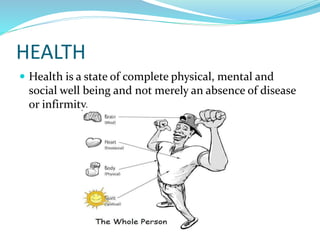
 Health is a state of complete physical, mental and
social well being and not merely an absence of disease
or infirmity.
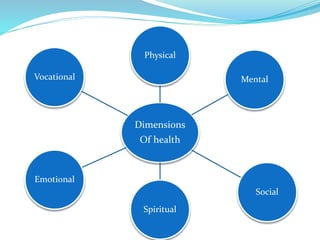
Dimensions
Of health
Physical
Mental
Social
Spiritual
Emotional
Vocational
PHYSICAL DIMENSION
 It is related to body structure and its physiology. It
refers to normal functioning of all organs and systems
of body resulting in harmonies functioning of the
body.
Signs of physical health in individual are: “ a good
complexion, a clear skin, bright eyes, not too fat, a
good appetite, sound sleep and smooth easily co-
ordinated body movement.
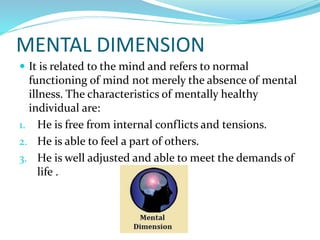
MENTAL DIMENSION
 It is related to the mind and refers to normal
functioning of mind not merely the absence of mental
illness. The characteristics of mentally healthy
individual are:
1. He is free from internal conflicts and tensions.
2. He is able to feel a part of others.
3. He is well adjusted and able to meet the demands of
life .
SOCIAL DIMENSION
It is defined as the quality an quantity of individual’s
interpersonal ties and the extent of involvement with
the community. Social dimension refers to the
abilities that enables the individual to become a whole
person in the existing social nature.
SPIRITUAL DIMENSION
It refers to believe in the super natural aspects of
universe which help individual to seek meaning and
purpose in life, to resolve internal as well as external
conflicts.
EMOTIONAL DIMENSION
 previously mental and emotional dimensions have
been seen as one element or as two closely related
elements. But now these two
dimensions are seen as
separate from each other.
VOCATIONAL DIMENSION
It is a part of the human existence. The importance of
this dimension is exposed when individuals suddenly
lose their jobs
DETERMINANTS OF HEALTH
 Health is always under the influence of various factors
which interact with each other and determine the
health status of an individual, family and community.
These factors are known as determinants of health.
These are categorized as
1. Human biology
2. Environment
3. Life style
4. Health and health allied resources
HUMAN BIOLOGY
It is one of the intrinsic determinant of health. It
includes the factors such as
1. Genetic inheritance
2. Age
3. Race
4. Self concept
1. GENETIC INHERITANCE: Genetic inheritance
influences physical characteristics and intellectual
potentials of an individual. Person with desirable
physical characteristics and intellectual
potentialities receive positive interaction and re-
inforcement from people around him.
2. AGE: Age affects illness susceptibility as well as
behaviour. Infants and elderly persons are more
susceptible to infection.
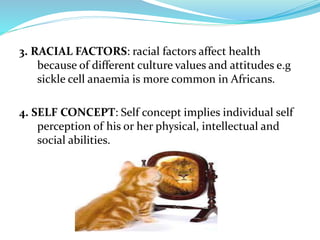
3. RACIAL FACTORS: racial factors affect health
because of different culture values and attitudes e.g
sickle cell anaemia is more common in Africans.
4. SELF CONCEPT: Self concept implies individual self
perception of his or her physical, intellectual and
social abilities.
ENVIRONMENT
Environment is one of the extrinsic factor which
influence health and wellness of human beings it may
be referred to as micro and macro environment.
Micro environment: it refers to the personal
environment.
Macro environment: it refers to the external
environment which is outside the home environment.
Components of environment
 Physical environment
 Biological environment
 Social environment
PHYSICAL ENVIRONMENT: the physical environment
is comprised of housing and building structures and
wide variety of physical substances that affect health.
These includes atmosphere, gravity, light,
temperature, humidity, solar radiation etc.
 BIOLOGICAL ENVIRONMENT: the biological
environment is comprised of plant and animal
kingdom which help in maintaining ecosystem and
thereby health of individual.
 SOCIAL ENVIRONMENT: the social environment
includes other people and social institution,
sociocultural events, religious beliefs, moral and
ethical values and social rules and regulations.
LIFE STYLE
 Life style refers to people way of living . It is composite
of daily living activities, behavioural and cultural
practices including customs and traditions.lie style is
acquired through formal and informal education.
HEALTH AND HEALTH ALLIED
RESOURCES
It includes
1. Health services
2. Socioeconomic condition
3. Political system
4. Health related services
Health services
Health services are directly concerned with the
improvement of health status of people. If the health
services are available and accessible then it puts a great
impact on the health status of the community.
Socio-Economic conditions:
Socioeconomic condition have significant influence on
the community health. Socioeconomic condition
includes economic status, education, occupation and
living standard.
 The economic status is determined by the per capita
gross net production. The increase in GNP will improve the
economic status of the country and of people.
 Education play a important role in health promotion. The
educated person will understand to adopt a life style which
is suitable to his/ her health.
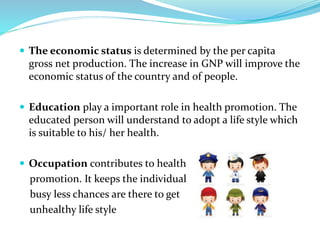
 Occupation contributes to health
promotion. It keeps the individual
busy less chances are there to get
unhealthy life style
POLITICAL SYSTEM
The political system has A very strong role in health
promotion of people. Decisions pertaining to health
policy, allocation of funds, programmes, infrastructure
and delivery of health services are made by the ruling
party.
HEALTH RELATED SERVICES
The health related services include education, food and
agriculture, industry, rural and urban development,
social welfare manpower development,
communication and transportation etc.
Health its dimensions

Health its dimensions

  • 2.
    HEALTH  Health isa state of complete physical, mental and social well being and not merely an absence of disease or infirmity.
  • 3.
  • 4.
    PHYSICAL DIMENSION  Itis related to body structure and its physiology. It refers to normal functioning of all organs and systems of body resulting in harmonies functioning of the body. Signs of physical health in individual are: “ a good complexion, a clear skin, bright eyes, not too fat, a good appetite, sound sleep and smooth easily co- ordinated body movement.
  • 5.
    MENTAL DIMENSION  Itis related to the mind and refers to normal functioning of mind not merely the absence of mental illness. The characteristics of mentally healthy individual are: 1. He is free from internal conflicts and tensions. 2. He is able to feel a part of others. 3. He is well adjusted and able to meet the demands of life .
  • 6.
    SOCIAL DIMENSION It isdefined as the quality an quantity of individual’s interpersonal ties and the extent of involvement with the community. Social dimension refers to the abilities that enables the individual to become a whole person in the existing social nature. SPIRITUAL DIMENSION It refers to believe in the super natural aspects of universe which help individual to seek meaning and purpose in life, to resolve internal as well as external conflicts.
  • 7.
    EMOTIONAL DIMENSION  previouslymental and emotional dimensions have been seen as one element or as two closely related elements. But now these two dimensions are seen as separate from each other. VOCATIONAL DIMENSION It is a part of the human existence. The importance of this dimension is exposed when individuals suddenly lose their jobs
  • 8.
    DETERMINANTS OF HEALTH Health is always under the influence of various factors which interact with each other and determine the health status of an individual, family and community. These factors are known as determinants of health. These are categorized as 1. Human biology 2. Environment 3. Life style 4. Health and health allied resources
  • 9.
    HUMAN BIOLOGY It isone of the intrinsic determinant of health. It includes the factors such as 1. Genetic inheritance 2. Age 3. Race 4. Self concept
  • 10.
    1. GENETIC INHERITANCE:Genetic inheritance influences physical characteristics and intellectual potentials of an individual. Person with desirable physical characteristics and intellectual potentialities receive positive interaction and re- inforcement from people around him. 2. AGE: Age affects illness susceptibility as well as behaviour. Infants and elderly persons are more susceptible to infection.
  • 11.
    3. RACIAL FACTORS:racial factors affect health because of different culture values and attitudes e.g sickle cell anaemia is more common in Africans. 4. SELF CONCEPT: Self concept implies individual self perception of his or her physical, intellectual and social abilities.
  • 12.
    ENVIRONMENT Environment is oneof the extrinsic factor which influence health and wellness of human beings it may be referred to as micro and macro environment. Micro environment: it refers to the personal environment. Macro environment: it refers to the external environment which is outside the home environment.
  • 13.
    Components of environment Physical environment  Biological environment  Social environment PHYSICAL ENVIRONMENT: the physical environment is comprised of housing and building structures and wide variety of physical substances that affect health. These includes atmosphere, gravity, light, temperature, humidity, solar radiation etc.
  • 14.
     BIOLOGICAL ENVIRONMENT:the biological environment is comprised of plant and animal kingdom which help in maintaining ecosystem and thereby health of individual.  SOCIAL ENVIRONMENT: the social environment includes other people and social institution, sociocultural events, religious beliefs, moral and ethical values and social rules and regulations.
  • 15.
    LIFE STYLE  Lifestyle refers to people way of living . It is composite of daily living activities, behavioural and cultural practices including customs and traditions.lie style is acquired through formal and informal education.
  • 16.
    HEALTH AND HEALTHALLIED RESOURCES It includes 1. Health services 2. Socioeconomic condition 3. Political system 4. Health related services
  • 17.
    Health services Health servicesare directly concerned with the improvement of health status of people. If the health services are available and accessible then it puts a great impact on the health status of the community. Socio-Economic conditions: Socioeconomic condition have significant influence on the community health. Socioeconomic condition includes economic status, education, occupation and living standard.
  • 18.
     The economicstatus is determined by the per capita gross net production. The increase in GNP will improve the economic status of the country and of people.  Education play a important role in health promotion. The educated person will understand to adopt a life style which is suitable to his/ her health.  Occupation contributes to health promotion. It keeps the individual busy less chances are there to get unhealthy life style
  • 19.
    POLITICAL SYSTEM The politicalsystem has A very strong role in health promotion of people. Decisions pertaining to health policy, allocation of funds, programmes, infrastructure and delivery of health services are made by the ruling party. HEALTH RELATED SERVICES The health related services include education, food and agriculture, industry, rural and urban development, social welfare manpower development, communication and transportation etc.