CONCEPT OF HEALTH
AND DISEASE
Dr. Vanlalduhsaki
Assistant Professor
Department of Community Medicine
Zoram Medical College & Hospital
Falkawn, Mizoram
Competency 1.2
• Define health; describe the concept of holistic health
including concept of spiritual health and the
relativeness and determinants of health
INTRODUCTION
• Health is a fundamental human right
• Health can mean different things to different people
• To some it may simply mean absence of disease while to some
it may mean harmonious functioning of all body systems in man
• Concept of health is multidimensional, complex, elusive and
subject to various interpretations
• Health has developed gradually as a concept from an individual
concern to worldwide social goal and encompasses the whole
quality of life
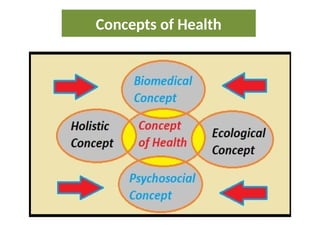
Concepts of Health
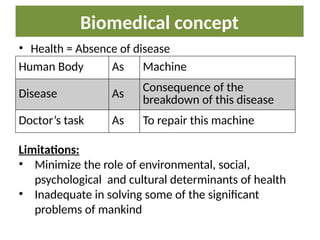
Biomedical concept
• Health = Absence of disease
Human Body As Machine
Disease As Consequence of the
breakdown of this disease
Doctor’s task As To repair this machine
Limitations:
• Minimize the role of environmental, social,
psychological and cultural determinants of health
• Inadequate in solving some of the significant
problems of mankind
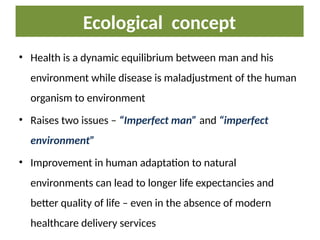
Ecological concept
• Health is a dynamic equilibrium between man and his
environment while disease is maladjustment of the human
organism to environment
• Raises two issues – “Imperfect man” and “imperfect
environment”
• Improvement in human adaptation to natural
environments can lead to longer life expectancies and
better quality of life – even in the absence of modern
healthcare delivery services
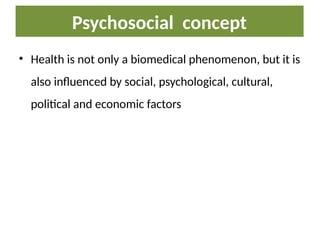
Psychosocial concept
• Health is not only a biomedical phenomenon, but it is
also influenced by social, psychological, cultural,
political and economic factors
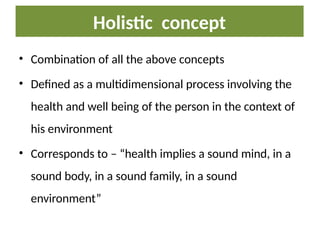
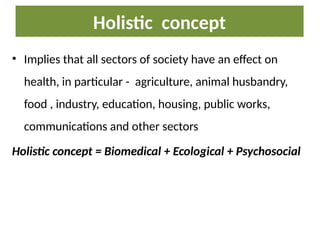
Holistic concept
• Combination of all the above concepts
• Defined as a multidimensional process involving the
health and well being of the person in the context of
his environment
• Corresponds to – “health implies a sound mind, in a
sound body, in a sound family, in a sound
environment”
Holistic concept
• Implies that all sectors of society have an effect on
health, in particular - agriculture, animal husbandry,
food , industry, education, housing, public works,
communications and other sectors
Holistic concept = Biomedical + Ecological + Psychosocial
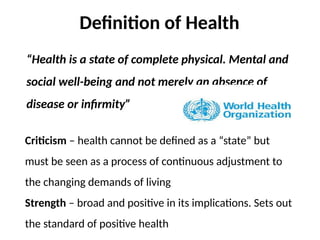
Definition of Health
“Health is a state of complete physical. Mental and
social well-being and not merely an absence of
disease or infirmity”
Criticism – health cannot be defined as a “state” but
must be seen as a process of continuous adjustment to
the changing demands of living
Strength – broad and positive in its implications. Sets out
the standard of positive health
11
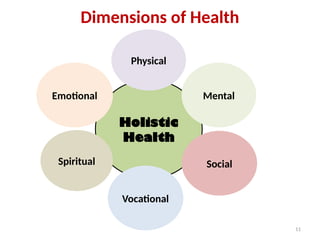
Dimensions of Health
Holistic
Health
Physical
Emotional
Spiritual
Vocational
Social
Mental
12
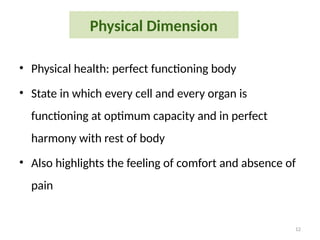
Physical Dimension
• Physical health: perfect functioning body
• State in which every cell and every organ is
functioning at optimum capacity and in perfect
harmony with rest of body
• Also highlights the feeling of comfort and absence of
pain
13
Signs of Physical Health
• Good complexion
• Clean skin
• Bright eyes
• Lustrous hair
• Firm flesh
• Not too fat
• Sweet breath
• Good appetite
• Sound sleep
• Regular bowel and
bladder habit
• Smooth, easy,
coordinated bodily
movements
• Size and function of organ
under normal range
• Sense organ intact
• Rate of gaining weight
and height under normal
range
14
Evaluation of physical health
Individual level:
• Clinical examination
• Nutritional & dietary
assessment
• Biochemical & laboratory
investigations
• Self assessment of health
• Inquiry into use of medical
services (No of visits to
physician, hospital,
hospitalization days etc)
Community level: (Indicators)
• Death rate
• Infant Mortality Rate
• Expectation of life
• Maternal Mortality Ratio
• Disease prevalence
15
Mental Dimension
• Mental Health – Not
merely absence of
mental illness
• Good mental health:
– Ability to respond to
different experiences
and situations of life
with flexibility and
with a sense of
purpose
• Definition:
– A state of balance
between the individual
and the surrounding
world;
– A state of harmony
between oneself and
others;
– Coexistence between
the realities of self,
others and environment
16
• Mind and body considered
independent entities (few decade back)
• Psychological factors can induce
illnesses, not only mental illness (recent
discovery)
• Eg. Hypertension, peptic ulcer,
bronchial asthma etc
• Inference:
– Behavioral, psychological or biological dysfunction
are inter-related – dependent on mental
equilibrium
– Does not only affect relationship between the
individual and society
17
Evaluation of Mental Health
Individual level:
• Free from internal conflicts:
“not at war with himself”
• Well-adjusted: able to get
along well, accept criticism
not being easily upset
• Searches for identity
• Has strong sense of self-
esteem
• Self actualization: knows his
limitations, problems, goals
and acts accordingly
• Good self-control: balances
rationality and emotions
• Coping with stress and
anxiety: faces problem and
tries to solve them
intelligently
18
Social Dimension
• Social well-being:
– Harmony and integration within an individual,
between each individuals, other members of
society and between individuals and world
• Defined as:
– Quantity and quality of an individual’s
interpersonal ties and extent of involvement with
the community
19
• Basis of Social Health:
– Positive material environment: focuses on
financial & residential matters
– Positive human environment: focuses on social
network of the person
• In general: Individuals health is dependent on
his interaction to family, community or society
20
Spiritual Dimension
• Spiritual health: urge of a person to reach out to
know the meaning and purpose of life
• Includes integrity, principles and ethics in relation to
purpose of life and committed to some higher being
• All our religious faith, values, beliefs, principles and
morals define our spirituality
• Spiritual health may help to resolve both internal as
well as external conflicts
21
Emotional Dimension
• Mental and emotional dimension seen as one element or
2 closely related elements
• But are different entities
• Mental Health: concern with “knowing” and “cognition”
• Emotional Health: concern with “feelings”
• This dimension focuses on awareness and acceptance of
stressors and feelings, both negative and positive
• Incorporates the ability to manage one’s feelings and
related behaviors, cope effectively with stress and adapt
to any change
22
Vocational Dimensions
• This dimension relates to growth and happiness in
one’s work
• Work if fully adapted as per the need of a person,
that satisfy goals, as per capabilities and limitations
of a person, it plays a role in promoting both physical
and mental health
• Conducive physical work => Physical Health
• Goal achievement and self-realization (excellence in
one’s work) => satisfaction & enhanced self-esteem
23
• Importance of this dimension:
– Sudden loss of job
– Face mandatory retirement
• For many individuals, the vocational dimension may
be merely a source of income
• Others – represents the culmination of the efforts
of other dimensions as they function together to
produce what the individual considers life “success”
• “Success” in life Success in Work;
• Loss of work Unsuccessful Life Adversely
affect Mental/Emotional Health
24
Other Dimensions
• Philosophical
• Cultural
• Socio-economic
• Environmental
• Educational
• Nutritional
• Curative
• Preventive
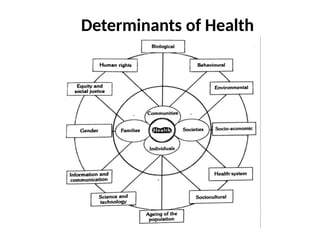
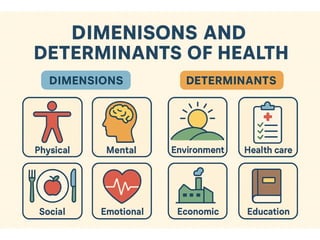
Determinants of Health
1. Biological determinants
• The physical and mental traits of every human being
are to some extent determined by the nature of his
gene at the time of conception
• Many diseases have a direct relationship with
heredity
• The state of health, therefore, depends partly on the
genetic constitution of man
• E.g. chromosomal anomalies, errors of metabolism,
mental retardation, some type od diabetes
2.Behavioral and Sociocultural determinants
• Behavioral and sociocultural factors are customs, lifestyles
and values that characterize a society
• Lifestyle is composed of cultural and behavioral patterns
and lifelong personal habits (e.g. smoking, alcoholism) that
have developed through processes of socialization
• Achievement of optimum health requires the adoption of
healthy lifestyles
• Many current health problems – coronary heart disease,
obesity, lung cancer and drug addiction – are strongly
associated with lifestyle changes
3. Environmental determinants
• Environment is classified as “internal” and “external”
• Internal environment – each and every part of the body
system
• External environment - all the external conditions and
circumstances to which man is exposed after conception.
Includes physical, biological and social components as a
whole
• Environmental factors range from housing, water supply,
psychosocial stress, family, food quality and safety, waste
disposal, hazardous substances and unsafe public spaces
4. Socioeconomic determinants
• Socioeconomic conditions have long been known to
influence human health
• Health status is determined primarily by their level of
socioeconomic development, e.g., per capita GNP,
education, nutrition, employment, housing, the political
system of the country etc.
• Countries with the lowest socioeconomic status find
higher mortality rates
4. Socioeconomic determinants
The critical socioeconomic factors influencing healthcare:
Economic status:
– Economic progress, a major factor in reducing
morbidity, increasing life expectancy and improving
quality of life
– Also an important factor in seeking healthcare
– Ironically, affluence may also be a contributory
cause of illness
4. Socioeconomic determinants
Education:
– The world map of illiteracy closely coincides with
the maps of poverty, malnutrition, ill-health, high
infant and child mortality rates
– Education, to some extent, compensates the effects
of poverty on health, irrespective of the availability
of health services
4. Socioeconomic determinants
Occupation:
– The very state of being employed in the productive
work promotes health
– Unemployed usually show a higher incidence of ill
health and death
– For many, loss of work may mean loss of income
and status
– It can cause psychological and social damage
4. Socioeconomic determinants
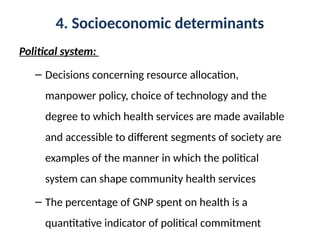
Political system:
– Decisions concerning resource allocation,
manpower policy, choice of technology and the
degree to which health services are made available
and accessible to different segments of society are
examples of the manner in which the political
system can shape community health services
– The percentage of GNP spent on health is a
quantitative indicator of political commitment
5. Health Services
• Covers a wide spectrum of personal and community
services for treatment of disease, prevention of illness
and promotion of health
• Purpose of health services – improve health
• Health services must reach the the social periphery,
equitably distributed, accessible at an affordable cost
and socially acceptable
6. Ageing of the population
• Percentage of people aged over 60 years have been on
the rise
• Major concern of rapid population ageing is the
increased prevalence of chronic diseases and
disabilities
• Elderly in many developed countries enjoy better
health
7. Gender
• The 1990s have witnessed an increased concentration
on women’s issues
• 1993 – Global Commission on Women’s Health
• Action on women’s health covering nutrition,
reproductive health, health consequences of violence,
ageing, lifestyle related conditions and occupational
environment
• Increased awareness among policy makers
8. Other factors
• Transition from post industrial age to information age
• Development of these technologies offer tremendous
opportunities in providing an easy and instant access
to medical information
• Contributes to dissemination of information
worldwide, serving the needs of many physicians,
health professionals, biomedical scientists and
researchers, the mass media and the public
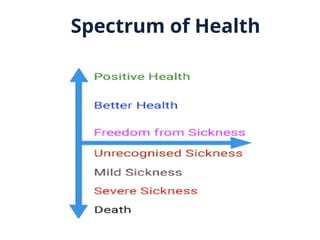
Spectrum of Health
Thank you