Migraine Overview
David Watson, MD
Director, WVU Headache Center
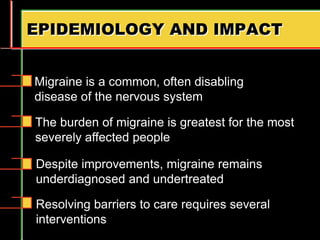
EPIDEMIOLOGY AND IMPACT
Resolving barriers to care requires several
interventions
Migraine is a common, often disabling
disease of the nervous system
The burden of migraine is greatest for the most
severely affected people
Despite improvements, migraine remains
underdiagnosed and undertreated
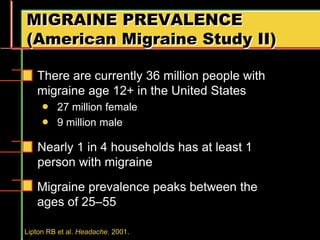
There are currently 36 million people with
migraine age 12+ in the United States
 27 million female
 9 million male
MIGRAINE PREVALENCE
(American Migraine Study II)
Lipton RB et al. Headache. 2001.
Nearly 1 in 4 households has at least 1
person with migraine
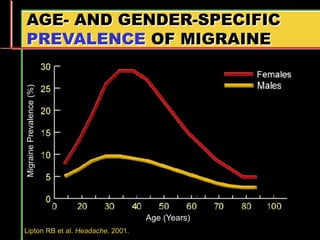
Migraine prevalence peaks between the
ages of 25–55
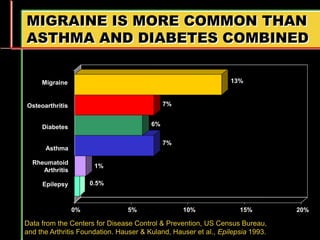
MIGRAINE IS MORE COMMON THAN
ASTHMA AND DIABETES COMBINED
Data from the Centers for Disease Control & Prevention, US Census Bureau,
and the Arthritis Foundation. Hauser & Kuland, Hauser et al., Epilepsia 1993.
1%
7%
6%
7%
13%
0% 5% 10% 15% 20%
Migraine
Osteoarthritis
Diabetes
Asthma
Rheumatoid
Arthritis
Epilepsy 0.5%
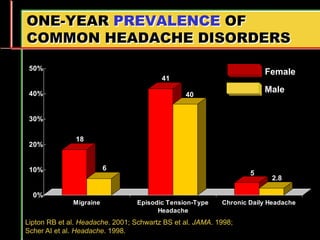
18
6
41
40
5
2.8
0%
10%
20%
30%
40%
50%
Migraine Episodic Tension-Type
Headache
Chronic Daily Headache
ONE-YEAR PREVALENCE OF
COMMON HEADACHE DISORDERS
Lipton RB et al. Headache. 2001; Schwartz BS et al. JAMA. 1998;
Scher AI et al. Headache. 1998.
Female
Male
AGE- AND GENDER-SPECIFIC
PREVALENCE OF MIGRAINE
Migraine
Prevalence
(%)
Age (Years)
Lipton RB et al. Headache. 2001.
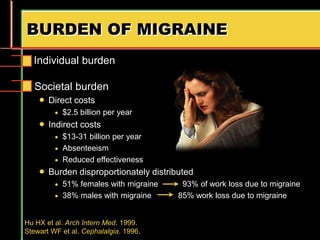
BURDEN OF MIGRAINE
Individual burden
Hu HX et al. Arch Intern Med. 1999.
Stewart WF et al. Cephalalgia. 1996.
Societal burden
 Direct costs
 $2.5 billion per year
 Indirect costs
 $13-31 billion per year
 Absenteeism
 Reduced effectiveness
 Burden disproportionately distributed
 51% females with migraine 93% of work loss due to migraine
 38% males with migraine 85% work loss due to migraine
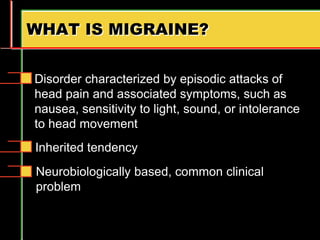
WHAT IS MIGRAINE?
Disorder characterized by episodic attacks of
head pain and associated symptoms, such as
nausea, sensitivity to light, sound, or intolerance
to head movement
Inherited tendency
Neurobiologically based, common clinical
problem
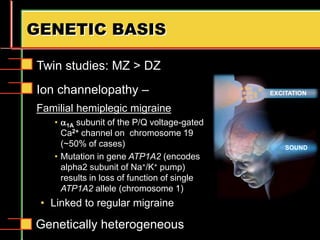
GENETIC BASIS
Twin studies: MZ > DZ
Ion channelopathy –
Familial hemiplegic migraine
• 1A subunit of the P/Q voltage-gated
Ca2+ channel on chromosome 19
(~50% of cases)
• Mutation in gene ATP1A2 (encodes
alpha2 subunit of Na+/K+ pump)
results in loss of function of single
ATP1A2 allele (chromosome 1)
• Linked to regular migraine
Genetically heterogeneous
EXCITATION
SOUND
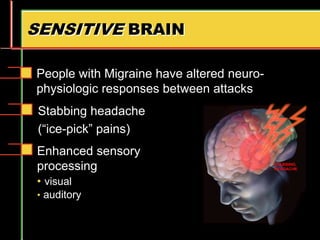
SENSITIVE BRAIN
People with Migraine have altered neuro-
physiologic responses between attacks
Stabbing headache
(“ice-pick” pains)
Enhanced sensory
processing
• visual
• auditory
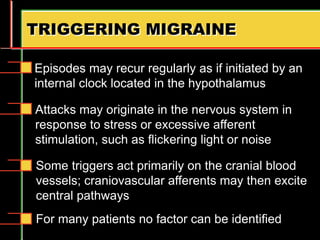
TRIGGERING MIGRAINE
Episodes may recur regularly as if initiated by an
internal clock located in the hypothalamus
Attacks may originate in the nervous system in
response to stress or excessive afferent
stimulation, such as flickering light or noise
Some triggers act primarily on the cranial blood
vessels; craniovascular afferents may then excite
central pathways
For many patients no factor can be identified
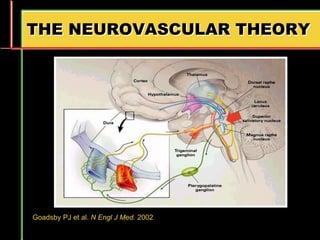
THE NEUROVASCULAR THEORY
Goadsby PJ et al. N Engl J Med. 2002.
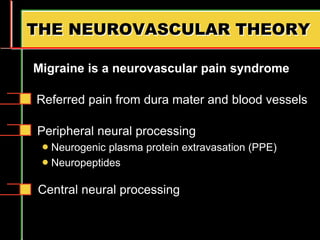
THE NEUROVASCULAR THEORY
Referred pain from dura mater and blood vessels
Peripheral neural processing
 Neurogenic plasma protein extravasation (PPE)
 Neuropeptides
Central neural processing
Migraine is a neurovascular pain syndrome
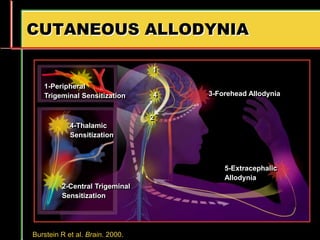
CUTANEOUS ALLODYNIA
Burstein R et al. Brain. 2000.
1-Peripheral
Trigeminal Sensitization
2-Central Trigeminal
Sensitization
3-Forehead Allodynia
4-Thalamic
Sensitization
5-Extracephalic
Allodynia
1
4
2
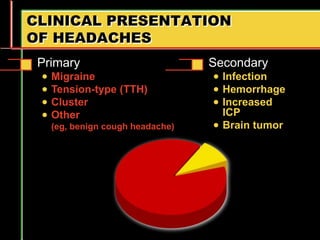
CLINICAL PRESENTATION
OF HEADACHES
Secondary
 Infection
 Hemorrhage
 Increased
ICP
 Brain tumor
Primary
 Migraine
 Tension-type (TTH)
 Cluster
 Other
(eg, benign cough headache)
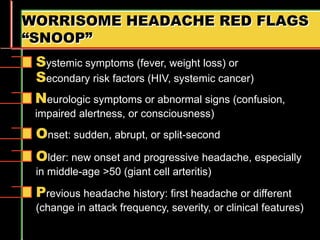
WORRISOME HEADACHE RED FLAGS
“SNOOP”
Older: new onset and progressive headache, especially
in middle-age >50 (giant cell arteritis)
Systemic symptoms (fever, weight loss) or
Secondary risk factors (HIV, systemic cancer)
Neurologic symptoms or abnormal signs (confusion,
impaired alertness, or consciousness)
Onset: sudden, abrupt, or split-second
Previous headache history: first headache or different
(change in attack frequency, severity, or clinical features)
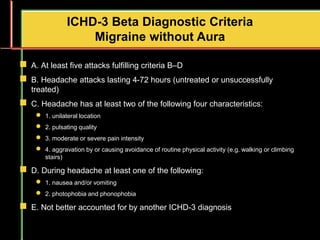
 A. At least five attacks fulfilling criteria B–D
 B. Headache attacks lasting 4-72 hours (untreated or unsuccessfully
treated)
 C. Headache has at least two of the following four characteristics:
 1. unilateral location
 2. pulsating quality
 3. moderate or severe pain intensity
 4. aggravation by or causing avoidance of routine physical activity (e.g. walking or climbing
stairs)
 D. During headache at least one of the following:
 1. nausea and/or vomiting
 2. photophobia and phonophobia
 E. Not better accounted for by another ICHD-3 diagnosis
ICHD-3 Beta Diagnostic Criteria
Migraine without Aura
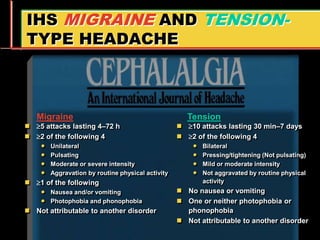
IHS MIGRAINE AND TENSION-
TYPE HEADACHE
 5 attacks lasting 4–72 h
 2 of the following 4
 Unilateral
 Pulsating
 Moderate or severe intensity
 Aggravation by routine physical activity
 1 of the following
 Nausea and/or vomiting
 Photophobia and phonophobia
 Not attributable to another disorder
Migraine Tension
 10 attacks lasting 30 min–7 days
 2 of the following 4
 Bilateral
 Pressing/tightening (Not pulsating)
 Mild or moderate intensity
 Not aggravated by routine physical
activity
 No nausea or vomiting
 One or neither photophobia or
phonophobia
 Not attributable to another disorder
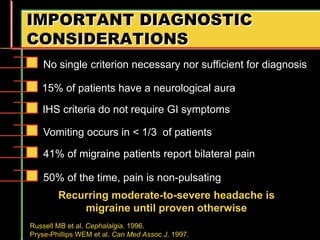
IMPORTANT DIAGNOSTIC
CONSIDERATIONS
Recurring moderate-to-severe headache is
migraine until proven otherwise
Russell MB et al. Cephalalgia. 1996.
Pryse-Phillips WEM et al. Can Med Assoc J. 1997.
No single criterion necessary nor sufficient for diagnosis
15% of patients have a neurological aura
IHS criteria do not require GI symptoms
Vomiting occurs in < 1/3 of patients
41% of migraine patients report bilateral pain
50% of the time, pain is non-pulsating
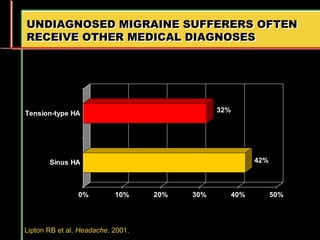
UNDIAGNOSED MIGRAINE SUFFERERS OFTEN
RECEIVE OTHER MEDICAL DIAGNOSES
Lipton RB et al. Headache. 2001.
42%
32%
0% 10% 20% 30% 40% 50%
Sinus HA
Tension-type HA
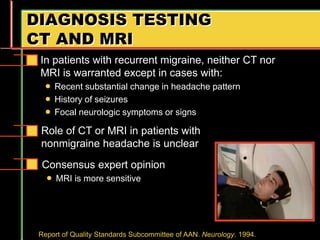
DIAGNOSIS TESTING
CT AND MRI
Consensus expert opinion
 MRI is more sensitive
Role of CT or MRI in patients with
nonmigraine headache is unclear
In patients with recurrent migraine, neither CT nor
MRI is warranted except in cases with:
 Recent substantial change in headache pattern
 History of seizures
 Focal neurologic symptoms or signs
Report of Quality Standards Subcommittee of AAN. Neurology. 1994.
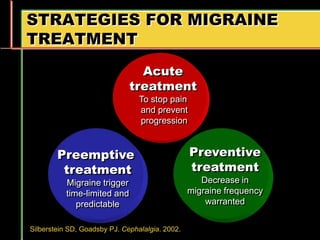
STRATEGIES FOR MIGRAINE
TREATMENT
Preemptive
treatment
Migraine trigger
time-limited and
predictable
Preventive
treatment
Decrease in
migraine frequency
warranted
Acute
treatment
To stop pain
and prevent
progression
Silberstein SD, Goadsby PJ. Cephalalgia. 2002.
ACUTE MIGRAINE MEDICATIONS
Nonspecific
 NSAIDs
 Combination analgesics
 Opioids?
 Neuroleptics/antiemetics
 Corticosteroids
Specific
 Ergotamine/DHE
 Triptans
 CGRP antibodies?
ACUTE TREATMENT
PRINCIPLES
Early intervention
Use correct dose and formulation
Use a maximum of 2–3 days/week




Use preventive therapy in selected patients

Stratified care
Silberstein SD. Neurology. 2000; Lipton RB, et al. JAMA. 2000.
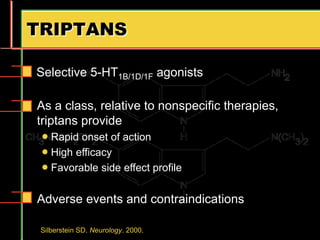
TRIPTANS
As a class, relative to nonspecific therapies,
triptans provide
 Rapid onset of action
 High efficacy
 Favorable side effect profile
Adverse events and contraindications
Selective 5-HT1B/1D/1F agonists
Silberstein SD. Neurology. 2000.
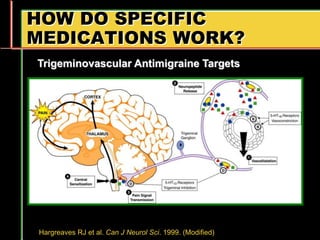
HOW DO SPECIFIC
MEDICATIONS WORK?
Trigeminovascular Antimigraine Targets
Hargreaves RJ et al. Can J Neurol Sci. 1999. (Modified)
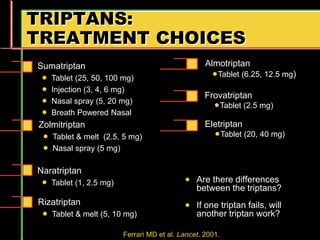
TRIPTANS:
TREATMENT CHOICES
 Are there differences
between the triptans?
 If one triptan fails, will
another triptan work?
Zolmitriptan
 Tablet & melt (2.5, 5 mg)
 Nasal spray (5 mg)
Rizatriptan
 Tablet & melt (5, 10 mg)
Naratriptan
 Tablet (1, 2.5 mg)
Almotriptan
Tablet (6.25, 12.5 mg)
Frovatriptan
Tablet (2.5 mg)
Sumatriptan
 Tablet (25, 50, 100 mg)
 Injection (3, 4, 6 mg)
 Nasal spray (5, 20 mg)
 Breath Powered Nasal
Ferrari MD et al. Lancet. 2001.
Eletriptan
Tablet (20, 40 mg)
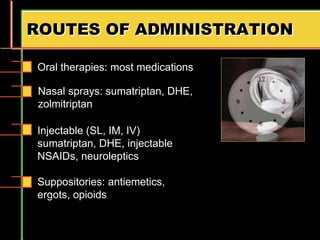
ROUTES OF ADMINISTRATION
Suppositories: antiemetics,
ergots, opioids
Oral therapies: most medications
Nasal sprays: sumatriptan, DHE,
zolmitriptan
Injectable (SL, IM, IV)
sumatriptan, DHE, injectable
NSAIDs, neuroleptics
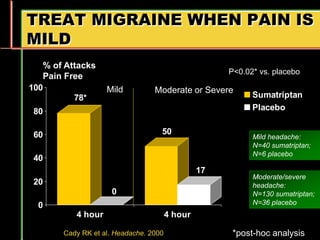
TREAT MIGRAINE WHEN PAIN IS
MILD
78*
0
50
17
0
20
40
60
80
100
4 hour 4 hour
Sumatriptan
Placebo
P<0.02* vs. placebo
Moderate or Severe
Mild
Mild headache:
N=40 sumatriptan;
N=6 placebo
Moderate/severe
headache:
N=130 sumatriptan;
N=36 placebo
Cady RK et al. Headache. 2000
% of Attacks
Pain Free
*post-hoc analysis
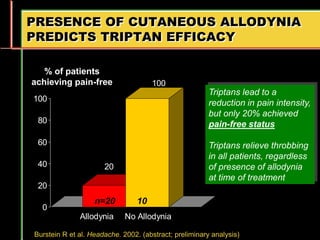
PRESENCE OF CUTANEOUS ALLODYNIA
PREDICTS TRIPTAN EFFICACY
% of patients
achieving pain-free
20
100
0
20
40
60
80
100
Allodynia No Allodynia
Burstein R et al. Headache. 2002. (abstract; preliminary analysis)
Triptans lead to a
reduction in pain intensity,
but only 20% achieved
pain-free status
Triptans relieve throbbing
in all patients, regardless
of presence of allodynia
at time of treatment
n=20 10
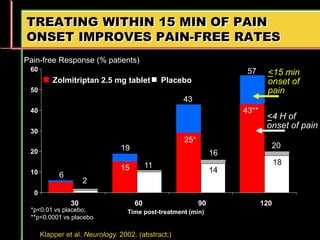
TREATING WITHIN 15 MIN OF PAIN
ONSET IMPROVES PAIN-FREE RATES
<15 min
onset of
pain
2
11
20
16
6
19
43
57
0
10
20
30
40
50
60
30 60 90 120
Zolmitriptan 2.5 mg tablet Placebo
Pain-free Response (% patients)
Time post-treatment (min)
*p<0.01 vs placebo;
**p<0.0001 vs placebo
15
25*
43**
14
18
<4 H of
onset of pain
Klapper et al. Neurology. 2002. (abstract;)
REBOUND
Rebound: Recurring headache induced
by repetitive and chronic overuse of acute
headache medication
Prevention: Limit frequency and dose of
medications
Treatment: Withdrawal and washout of
overused medication; consider using
preventives
Capobianco DJ et al. Headache. 2001.
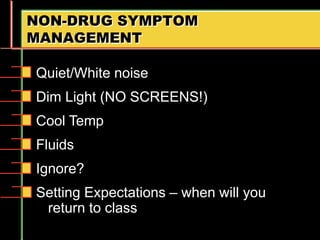
NON-DRUG SYMPTOM
MANAGEMENT
Quiet/White noise
Dim Light (NO SCREENS!)
Cool Temp
Fluids
Ignore?
Setting Expectations – when will you
return to class
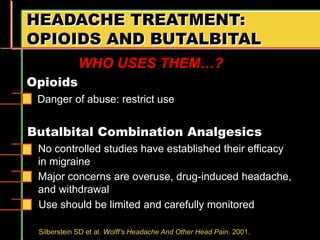
HEADACHE TREATMENT:
OPIOIDS AND BUTALBITAL
Opioids
Danger of abuse: restrict use
Major concerns are overuse, drug-induced headache,
and withdrawal
No controlled studies have established their efficacy
in migraine
Use should be limited and carefully monitored
Butalbital Combination Analgesics
Silberstein SD et al. Wolff’s Headache And Other Head Pain. 2001.
WHO USES THEM…?
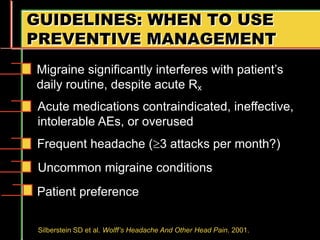
GUIDELINES: WHEN TO USE
PREVENTIVE MANAGEMENT
Uncommon migraine conditions
Silberstein SD et al. Wolff’s Headache And Other Head Pain. 2001.
Migraine significantly interferes with patient’s
daily routine, despite acute Rx
Acute medications contraindicated, ineffective,
intolerable AEs, or overused
Frequent headache (3 attacks per month?)
Patient preference
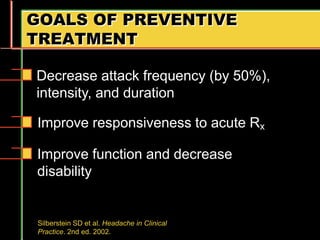
GOALS OF PREVENTIVE
TREATMENT
Silberstein SD et al. Headache in Clinical
Practice. 2nd ed. 2002.
Decrease attack frequency (by 50%),
intensity, and duration
Improve responsiveness to acute Rx
Improve function and decrease
disability
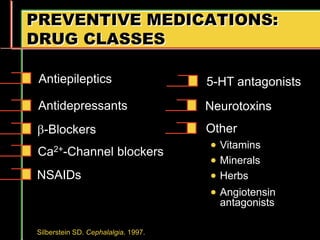
PREVENTIVE MEDICATIONS:
DRUG CLASSES
Ca2+-Channel blockers
Silberstein SD. Cephalalgia. 1997.
Antiepileptics
Antidepressants
-Blockers
NSAIDs
5-HT antagonists
Other
 Vitamins
 Minerals
 Herbs
 Angiotensin
antagonists
Neurotoxins
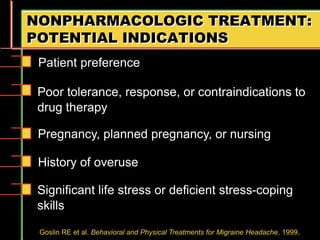
NONPHARMACOLOGIC TREATMENT:
POTENTIAL INDICATIONS
Goslin RE et al. Behavioral and Physical Treatments for Migraine Headache. 1999.
Patient preference
Poor tolerance, response, or contraindications to
drug therapy
Pregnancy, planned pregnancy, or nursing
History of overuse
Significant life stress or deficient stress-coping
skills
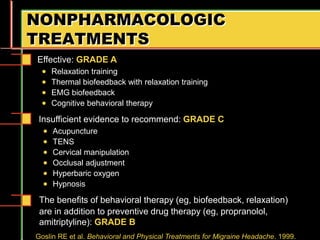
NONPHARMACOLOGIC
TREATMENTS
Insufficient evidence to recommend: GRADE C
 Acupuncture
 TENS
 Cervical manipulation
 Occlusal adjustment
 Hyperbaric oxygen
 Hypnosis
Goslin RE et al. Behavioral and Physical Treatments for Migraine Headache. 1999.
Effective: GRADE A
 Relaxation training
 Thermal biofeedback with relaxation training
 EMG biofeedback
 Cognitive behavioral therapy
The benefits of behavioral therapy (eg, biofeedback, relaxation)
are in addition to preventive drug therapy (eg, propranolol,
amitriptyline): GRADE B
Questions?

5-25-17-Migraines-PowerPoint.pptx

  • 1.
    Migraine Overview David Watson,MD Director, WVU Headache Center
  • 2.
    EPIDEMIOLOGY AND IMPACT Resolvingbarriers to care requires several interventions Migraine is a common, often disabling disease of the nervous system The burden of migraine is greatest for the most severely affected people Despite improvements, migraine remains underdiagnosed and undertreated
  • 3.
    There are currently36 million people with migraine age 12+ in the United States  27 million female  9 million male MIGRAINE PREVALENCE (American Migraine Study II) Lipton RB et al. Headache. 2001. Nearly 1 in 4 households has at least 1 person with migraine Migraine prevalence peaks between the ages of 25–55
  • 4.
    MIGRAINE IS MORECOMMON THAN ASTHMA AND DIABETES COMBINED Data from the Centers for Disease Control & Prevention, US Census Bureau, and the Arthritis Foundation. Hauser & Kuland, Hauser et al., Epilepsia 1993. 1% 7% 6% 7% 13% 0% 5% 10% 15% 20% Migraine Osteoarthritis Diabetes Asthma Rheumatoid Arthritis Epilepsy 0.5%
  • 5.
    18 6 41 40 5 2.8 0% 10% 20% 30% 40% 50% Migraine Episodic Tension-Type Headache ChronicDaily Headache ONE-YEAR PREVALENCE OF COMMON HEADACHE DISORDERS Lipton RB et al. Headache. 2001; Schwartz BS et al. JAMA. 1998; Scher AI et al. Headache. 1998. Female Male
  • 6.
    AGE- AND GENDER-SPECIFIC PREVALENCEOF MIGRAINE Migraine Prevalence (%) Age (Years) Lipton RB et al. Headache. 2001.
  • 7.
    BURDEN OF MIGRAINE Individualburden Hu HX et al. Arch Intern Med. 1999. Stewart WF et al. Cephalalgia. 1996. Societal burden  Direct costs  $2.5 billion per year  Indirect costs  $13-31 billion per year  Absenteeism  Reduced effectiveness  Burden disproportionately distributed  51% females with migraine 93% of work loss due to migraine  38% males with migraine 85% work loss due to migraine
  • 8.
    WHAT IS MIGRAINE? Disordercharacterized by episodic attacks of head pain and associated symptoms, such as nausea, sensitivity to light, sound, or intolerance to head movement Inherited tendency Neurobiologically based, common clinical problem
  • 9.
    GENETIC BASIS Twin studies:MZ > DZ Ion channelopathy – Familial hemiplegic migraine • 1A subunit of the P/Q voltage-gated Ca2+ channel on chromosome 19 (~50% of cases) • Mutation in gene ATP1A2 (encodes alpha2 subunit of Na+/K+ pump) results in loss of function of single ATP1A2 allele (chromosome 1) • Linked to regular migraine Genetically heterogeneous EXCITATION SOUND
  • 10.
    SENSITIVE BRAIN People withMigraine have altered neuro- physiologic responses between attacks Stabbing headache (“ice-pick” pains) Enhanced sensory processing • visual • auditory
  • 11.
    TRIGGERING MIGRAINE Episodes mayrecur regularly as if initiated by an internal clock located in the hypothalamus Attacks may originate in the nervous system in response to stress or excessive afferent stimulation, such as flickering light or noise Some triggers act primarily on the cranial blood vessels; craniovascular afferents may then excite central pathways For many patients no factor can be identified
  • 12.
    THE NEUROVASCULAR THEORY GoadsbyPJ et al. N Engl J Med. 2002.
  • 13.
    THE NEUROVASCULAR THEORY Referredpain from dura mater and blood vessels Peripheral neural processing  Neurogenic plasma protein extravasation (PPE)  Neuropeptides Central neural processing Migraine is a neurovascular pain syndrome
  • 14.
    CUTANEOUS ALLODYNIA Burstein Ret al. Brain. 2000. 1-Peripheral Trigeminal Sensitization 2-Central Trigeminal Sensitization 3-Forehead Allodynia 4-Thalamic Sensitization 5-Extracephalic Allodynia 1 4 2
  • 15.
    CLINICAL PRESENTATION OF HEADACHES Secondary Infection  Hemorrhage  Increased ICP  Brain tumor Primary  Migraine  Tension-type (TTH)  Cluster  Other (eg, benign cough headache)
  • 16.
    WORRISOME HEADACHE REDFLAGS “SNOOP” Older: new onset and progressive headache, especially in middle-age >50 (giant cell arteritis) Systemic symptoms (fever, weight loss) or Secondary risk factors (HIV, systemic cancer) Neurologic symptoms or abnormal signs (confusion, impaired alertness, or consciousness) Onset: sudden, abrupt, or split-second Previous headache history: first headache or different (change in attack frequency, severity, or clinical features)
  • 17.
     A. Atleast five attacks fulfilling criteria B–D  B. Headache attacks lasting 4-72 hours (untreated or unsuccessfully treated)  C. Headache has at least two of the following four characteristics:  1. unilateral location  2. pulsating quality  3. moderate or severe pain intensity  4. aggravation by or causing avoidance of routine physical activity (e.g. walking or climbing stairs)  D. During headache at least one of the following:  1. nausea and/or vomiting  2. photophobia and phonophobia  E. Not better accounted for by another ICHD-3 diagnosis ICHD-3 Beta Diagnostic Criteria Migraine without Aura
  • 18.
    IHS MIGRAINE ANDTENSION- TYPE HEADACHE  5 attacks lasting 4–72 h  2 of the following 4  Unilateral  Pulsating  Moderate or severe intensity  Aggravation by routine physical activity  1 of the following  Nausea and/or vomiting  Photophobia and phonophobia  Not attributable to another disorder Migraine Tension  10 attacks lasting 30 min–7 days  2 of the following 4  Bilateral  Pressing/tightening (Not pulsating)  Mild or moderate intensity  Not aggravated by routine physical activity  No nausea or vomiting  One or neither photophobia or phonophobia  Not attributable to another disorder
  • 19.
    IMPORTANT DIAGNOSTIC CONSIDERATIONS Recurring moderate-to-severeheadache is migraine until proven otherwise Russell MB et al. Cephalalgia. 1996. Pryse-Phillips WEM et al. Can Med Assoc J. 1997. No single criterion necessary nor sufficient for diagnosis 15% of patients have a neurological aura IHS criteria do not require GI symptoms Vomiting occurs in < 1/3 of patients 41% of migraine patients report bilateral pain 50% of the time, pain is non-pulsating
  • 20.
    UNDIAGNOSED MIGRAINE SUFFERERSOFTEN RECEIVE OTHER MEDICAL DIAGNOSES Lipton RB et al. Headache. 2001. 42% 32% 0% 10% 20% 30% 40% 50% Sinus HA Tension-type HA
  • 21.
    DIAGNOSIS TESTING CT ANDMRI Consensus expert opinion  MRI is more sensitive Role of CT or MRI in patients with nonmigraine headache is unclear In patients with recurrent migraine, neither CT nor MRI is warranted except in cases with:  Recent substantial change in headache pattern  History of seizures  Focal neurologic symptoms or signs Report of Quality Standards Subcommittee of AAN. Neurology. 1994.
  • 22.
    STRATEGIES FOR MIGRAINE TREATMENT Preemptive treatment Migrainetrigger time-limited and predictable Preventive treatment Decrease in migraine frequency warranted Acute treatment To stop pain and prevent progression Silberstein SD, Goadsby PJ. Cephalalgia. 2002.
  • 23.
    ACUTE MIGRAINE MEDICATIONS Nonspecific NSAIDs  Combination analgesics  Opioids?  Neuroleptics/antiemetics  Corticosteroids Specific  Ergotamine/DHE  Triptans  CGRP antibodies?
  • 24.
    ACUTE TREATMENT PRINCIPLES Early intervention Usecorrect dose and formulation Use a maximum of 2–3 days/week     Use preventive therapy in selected patients  Stratified care Silberstein SD. Neurology. 2000; Lipton RB, et al. JAMA. 2000.
  • 25.
    TRIPTANS As a class,relative to nonspecific therapies, triptans provide  Rapid onset of action  High efficacy  Favorable side effect profile Adverse events and contraindications Selective 5-HT1B/1D/1F agonists Silberstein SD. Neurology. 2000.
  • 26.
    HOW DO SPECIFIC MEDICATIONSWORK? Trigeminovascular Antimigraine Targets Hargreaves RJ et al. Can J Neurol Sci. 1999. (Modified)
  • 27.
    TRIPTANS: TREATMENT CHOICES  Arethere differences between the triptans?  If one triptan fails, will another triptan work? Zolmitriptan  Tablet & melt (2.5, 5 mg)  Nasal spray (5 mg) Rizatriptan  Tablet & melt (5, 10 mg) Naratriptan  Tablet (1, 2.5 mg) Almotriptan Tablet (6.25, 12.5 mg) Frovatriptan Tablet (2.5 mg) Sumatriptan  Tablet (25, 50, 100 mg)  Injection (3, 4, 6 mg)  Nasal spray (5, 20 mg)  Breath Powered Nasal Ferrari MD et al. Lancet. 2001. Eletriptan Tablet (20, 40 mg)
  • 28.
    ROUTES OF ADMINISTRATION Suppositories:antiemetics, ergots, opioids Oral therapies: most medications Nasal sprays: sumatriptan, DHE, zolmitriptan Injectable (SL, IM, IV) sumatriptan, DHE, injectable NSAIDs, neuroleptics
  • 29.
    TREAT MIGRAINE WHENPAIN IS MILD 78* 0 50 17 0 20 40 60 80 100 4 hour 4 hour Sumatriptan Placebo P<0.02* vs. placebo Moderate or Severe Mild Mild headache: N=40 sumatriptan; N=6 placebo Moderate/severe headache: N=130 sumatriptan; N=36 placebo Cady RK et al. Headache. 2000 % of Attacks Pain Free *post-hoc analysis
  • 30.
    PRESENCE OF CUTANEOUSALLODYNIA PREDICTS TRIPTAN EFFICACY % of patients achieving pain-free 20 100 0 20 40 60 80 100 Allodynia No Allodynia Burstein R et al. Headache. 2002. (abstract; preliminary analysis) Triptans lead to a reduction in pain intensity, but only 20% achieved pain-free status Triptans relieve throbbing in all patients, regardless of presence of allodynia at time of treatment n=20 10
  • 31.
    TREATING WITHIN 15MIN OF PAIN ONSET IMPROVES PAIN-FREE RATES <15 min onset of pain 2 11 20 16 6 19 43 57 0 10 20 30 40 50 60 30 60 90 120 Zolmitriptan 2.5 mg tablet Placebo Pain-free Response (% patients) Time post-treatment (min) *p<0.01 vs placebo; **p<0.0001 vs placebo 15 25* 43** 14 18 <4 H of onset of pain Klapper et al. Neurology. 2002. (abstract;)
  • 32.
    REBOUND Rebound: Recurring headacheinduced by repetitive and chronic overuse of acute headache medication Prevention: Limit frequency and dose of medications Treatment: Withdrawal and washout of overused medication; consider using preventives Capobianco DJ et al. Headache. 2001.
  • 33.
    NON-DRUG SYMPTOM MANAGEMENT Quiet/White noise DimLight (NO SCREENS!) Cool Temp Fluids Ignore? Setting Expectations – when will you return to class
  • 34.
    HEADACHE TREATMENT: OPIOIDS ANDBUTALBITAL Opioids Danger of abuse: restrict use Major concerns are overuse, drug-induced headache, and withdrawal No controlled studies have established their efficacy in migraine Use should be limited and carefully monitored Butalbital Combination Analgesics Silberstein SD et al. Wolff’s Headache And Other Head Pain. 2001. WHO USES THEM…?
  • 35.
    GUIDELINES: WHEN TOUSE PREVENTIVE MANAGEMENT Uncommon migraine conditions Silberstein SD et al. Wolff’s Headache And Other Head Pain. 2001. Migraine significantly interferes with patient’s daily routine, despite acute Rx Acute medications contraindicated, ineffective, intolerable AEs, or overused Frequent headache (3 attacks per month?) Patient preference
  • 36.
    GOALS OF PREVENTIVE TREATMENT SilbersteinSD et al. Headache in Clinical Practice. 2nd ed. 2002. Decrease attack frequency (by 50%), intensity, and duration Improve responsiveness to acute Rx Improve function and decrease disability
  • 37.
    PREVENTIVE MEDICATIONS: DRUG CLASSES Ca2+-Channelblockers Silberstein SD. Cephalalgia. 1997. Antiepileptics Antidepressants -Blockers NSAIDs 5-HT antagonists Other  Vitamins  Minerals  Herbs  Angiotensin antagonists Neurotoxins
  • 38.
    NONPHARMACOLOGIC TREATMENT: POTENTIAL INDICATIONS GoslinRE et al. Behavioral and Physical Treatments for Migraine Headache. 1999. Patient preference Poor tolerance, response, or contraindications to drug therapy Pregnancy, planned pregnancy, or nursing History of overuse Significant life stress or deficient stress-coping skills
  • 39.
    NONPHARMACOLOGIC TREATMENTS Insufficient evidence torecommend: GRADE C  Acupuncture  TENS  Cervical manipulation  Occlusal adjustment  Hyperbaric oxygen  Hypnosis Goslin RE et al. Behavioral and Physical Treatments for Migraine Headache. 1999. Effective: GRADE A  Relaxation training  Thermal biofeedback with relaxation training  EMG biofeedback  Cognitive behavioral therapy The benefits of behavioral therapy (eg, biofeedback, relaxation) are in addition to preventive drug therapy (eg, propranolol, amitriptyline): GRADE B
  • 40.