2017 Revised Classification of
Seizures
International League Against Epilepsy
(ILAE)
ILAE Classification Task Force 2013-7
Torbjörn Tomson, Emilio Perucca, Ingrid Scheffer, Jackie French, Yue-Hua Zhang
Satish Jain, Gary Mathern, Sam Wiebe, Edouard Hirsch, Sameer Zuberi, Nico Moshe
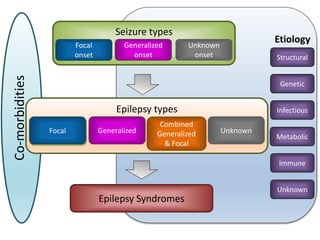
Classification of Epilepsies
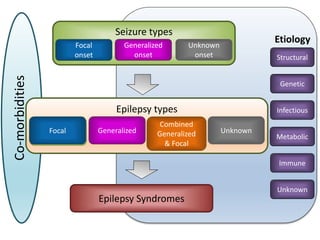
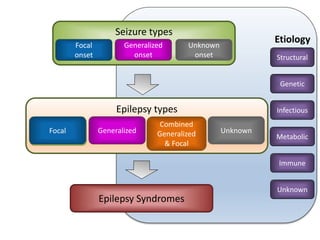
• a multilevel classification
• designed to cater to classifying epilepsy in different clinical
environments
• This is in acknowledgement of the wide variation in resources
around the world
• meaning that different levels of classification will be possible
depending on the resources available to the clinician making
the diagnosis
• a diagnosis at all three levels should be sought as well as the
etiology of the individual’s epilepsy
Unknown
Immune
Infectious
Structural
Etiology
Metabolic
Genetic
Co-morbidities
Epilepsy types
Focal Generalized
Combined
Generalized
& Focal
UnknownFocal
Epilepsy Syndromes
Seizure types
Generalized
onset
Unknown
onset
Focal
onset
Background
• official definition of a seizure is:
"a transient occurrence of signs and/or symptoms due to an
abnormal excessive or synchronous neuronal activity in the
brain.”
• large numbers of brain cells are activated abnormally at the
same time.
• Separating seizures into different types helps guide further
testing, treatment and prognosis.
History of Seizure Classification
• the most common words to describe seizures were grand mal
and petit mal
• system divided seizures into:
• partial (seizures starting in one area or side of the brain) and
• generalized (seizures starting in both sides of the brain at the
same time).
Partial Seizures
• Partial seizures were then defined by whether a person was
aware or conscious during the seizure.
• Simple partial seizures: Person is aware of what happens
during the event.
• Complex partial seizures: Person has some impaired
awareness during the seizure.
• They may be confused, partially aware, or not aware of
anything during a seizure.
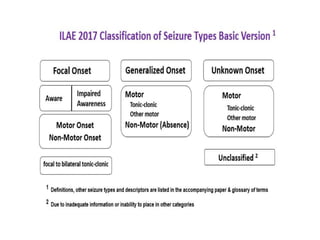
New Basic Classification
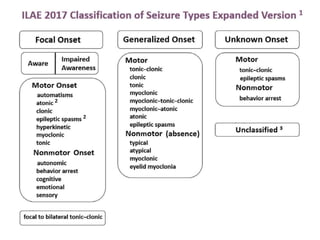
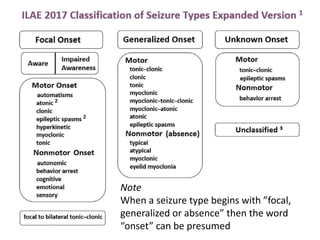
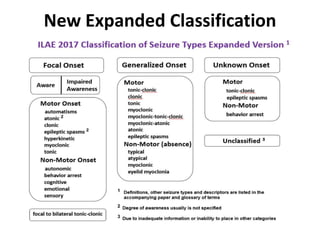
• The new basic seizure classification is based on 3 key features:
1. Where seizures begin in the brain
2. Level of awareness during a seizure
3. Other features of seizures
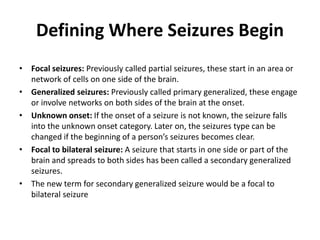
Defining Where Seizures Begin
• Focal seizures: Previously called partial seizures, these start in an area or
network of cells on one side of the brain.
• Generalized seizures: Previously called primary generalized, these engage
or involve networks on both sides of the brain at the onset.
• Unknown onset: If the onset of a seizure is not known, the seizure falls
into the unknown onset category. Later on, the seizures type can be
changed if the beginning of a person’s seizures becomes clear.
• Focal to bilateral seizure: A seizure that starts in one side or part of the
brain and spreads to both sides has been called a secondary generalized
seizures.
• The new term for secondary generalized seizure would be a focal to
bilateral seizure
Describing Awareness
• Practically importance because it is one of the main factors
affecting a person’s safety during a seizure
• Awareness is used instead of consciousness, because it is
simpler to evaluate
• Focal aware: If awareness remains intact, even if the person is
unable to talk or respond during a seizure, the seizure would
be called a focal aware seizure. This replaces the term simple
partial
• Focal impaired awareness:
If awareness is impaired or affected at any time during a
seizure, even if a person has a vague idea of what happened,
the seizure would be called focal impaired awareness. This
replaces the term complex partial seizure.
• Awareness unknown:
Sometimes it’s not possible to know if a person is aware or
not, for example if a person lives alone or has seizures only at
night. In this situation, the awareness term may not be used
or it would be described as awareness unknown.
• Generalized seizures:
These are all presumed to affect a person’s awareness or
consciousness in some way.
Thus no special terms are needed to describe awareness in
generalized seizures.
Motor and Other Symptoms in Focal
Seizures
• It is also possible for a focal aware or impaired awareness
seizure to be sub-classified as:
• Focal motor seizure:
This means that some type of movement occurs during the
event.
For example twitching, jerking, or stiffening movements of a
body part, or
Automatisms (automatic movements such as licking lips,
rubbing hands, walking, or running).
• Focal non-motor seizure:
This type of seizure has other symptoms that occur first.
Such as changes in sensation, emotions, thinking, or
experiences
• Auras:
Used to describe symptoms a person may feel in the
beginning of a seizure
These early symptoms may be the start of a seizure.
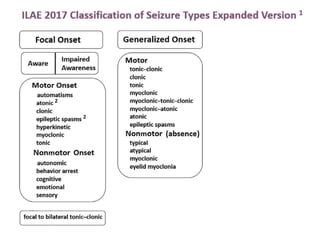
Describing Generalized Onset Seizures
• Generalized motor seizure:
The generalized tonic-clonic seizure term is still used to
describe seizures
This loosely corresponds to “grand mal.”
• Generalized non-motor seizure:
These are primarily absence seizures and corresponds to the
old term “petit mal.”
These seizures involve brief changes in awareness, staring,
and some may have automatic or repeated movements like
lipsmacking
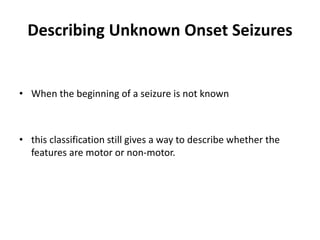
Describing Unknown Onset Seizures
• When the beginning of a seizure is not known
• this classification still gives a way to describe whether the
features are motor or non-motor.
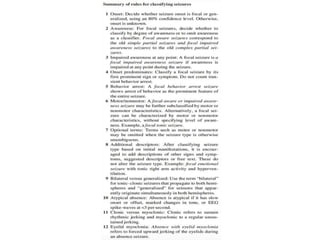
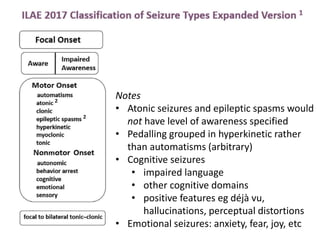
Notes
• Atonic seizures and epileptic spasms would
not have level of awareness specified
• Pedalling grouped in hyperkinetic rather
than automatisms (arbitrary)
• Cognitive seizures
• impaired language
• other cognitive domains
• positive features eg déjà vu,
hallucinations, perceptual distortions
• Emotional seizures: anxiety, fear, joy, etc
Note
When a seizure type begins with ”focal,
generalized or absence” then the word
“onset” can be presumed
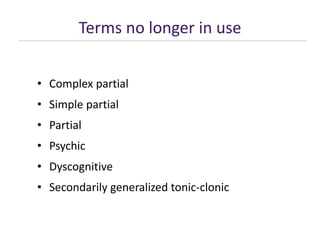
Terms no longer in use
• Complex partial
• Simple partial
• Partial
• Psychic
• Dyscognitive
• Secondarily generalized tonic-clonic
New Expanded Classification
Unknown
Immune
Infectious
Structural
Etiology
Metabolic
Genetic
Co-morbidities
Epilepsy types
Focal Generalized
Combined
Generalized
& Focal
UnknownFocal
Epilepsy Syndromes
Seizure types
Generalized
onset
Unknown
onset
Focal
onset
Definition of Epilepsy
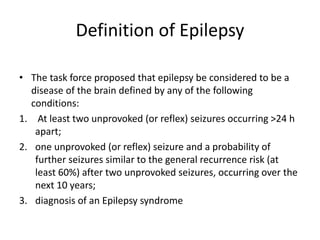
• The task force proposed that epilepsy be considered to be a
disease of the brain defined by any of the following
conditions:
1. At least two unprovoked (or reflex) seizures occurring >24 h
apart;
2. one unprovoked (or reflex) seizure and a probability of
further seizures similar to the general recurrence risk (at
least 60%) after two unprovoked seizures, occurring over the
next 10 years;
3. diagnosis of an Epilepsy syndrome
Generalized Epilepsy
• The diagnosis of generalized epilepsy is made on clinical
grounds, supported by the finding of typical interictal EEG
discharges
• Generalised spike-wave activity on EEG
• Caution needs to be exercised for a patient with generalized
tonic–clonic seizures and a normal EEG
• In such case, supportive evidence would need to be present
to make a diagnosis of generalized epilepsy, such as myoclonic
jerks or a relevant family history
Focal Epilepsy
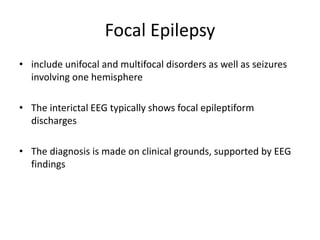
• include unifocal and multifocal disorders as well as seizures
involving one hemisphere
• The interictal EEG typically shows focal epileptiform
discharges
• The diagnosis is made on clinical grounds, supported by EEG
findings
Generalized and Focal Epilepsies
• These are patients who have both generalized and focal
seizures
• The diagnosis is made on clinical grounds, supported by EEG
findings
• Ictal recordings are helpful but not essential
• The interictal EEG may show both generalized spike-wave and
focal epileptiform discharges
• But epileptiform activity is not required for the diagnosis
Generalized and Focal Epilepsies
• Combined focal and generalized epilepsies
Examples
– Dravet syndrome
– Lennox-Gastaut syndrome
• What do with
– Multifocal epilepsies?
– Hemispheric epilepsies?
 focal
 focal
Unknown Epilepsy
• Patient has Epilepsy but the clinician is unable to determine if
the Epilepsy Type is focal or generalized because there is
insufficient information available
• variety of reasons: no access to EEG, or the EEG studies may
have been uninformative, for example, normal
• Epilepsy type may also be the final level of diagnosis
achievable
• Where clinician is unable to make an Epilepsy Syndrome
diagnosis or a diagnosis of Etiology
• Many examples:
– Non-lesional Temporal lobe epilepsy : Focal epilepsy with
no known etiology
– Generalized tonic-clonic seizures in a 5 year old with
generalized spike-wave
– Both focal impaired awareness seizures and absence
seizures in a patient
– Cannot tell if tonic-clonic seizure is focal or generalized
Unknown
Immune
Infectious
Structural
Etiology
Metabolic
Genetic
Epilepsy types
Focal Generalized
Combined
Generalized
& Focal
UnknownFocal
Epilepsy Syndromes
Seizure types
Generalized
onset
Unknown
onset
Focal
onset
Epilepsy Syndromes
• refers to a cluster of features incorporating seizure types, EEG,
and imaging features that tend to occur together
• age-dependent features such as age at onset and remission
• distinctive comorbidities such as intellectual and psychiatric
dysfunction
• It may have associated etiologic, prognostic, and treatment
implications
Epilepsy Syndromes
• There are no approved ILAE
epilepsy syndromes.
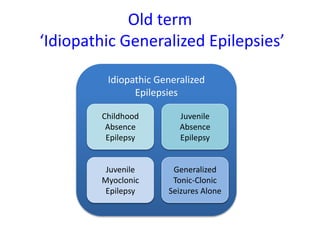
Old term
‘Idiopathic Generalized Epilepsies’
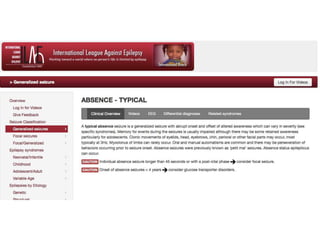
Idiopathic Generalized
Epilepsies
Childhood
Absence
Epilepsy
Generalized
Tonic-Clonic
Seizures Alone
Juvenile
Absence
Epilepsy
Juvenile
Myoclonic
Epilepsy
https://www.epilepsydiagnosis.org
Benign
• Many epilepsies not benign
– CAE :– psychosocial impact
– BECTS :– learning concerns
• Replaced by terms:
a) Self-limited: likely spontaneous resolution of a
syndrome
b) Pharmacoresponsive: syndrome will be likely to be
controlled with appropriate antiepileptic therapy
• No longer use:
– Malignant
– Catastrophic
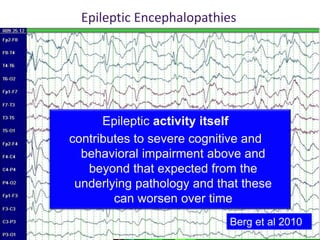
Epileptic activity itself
contributes to severe cognitive and
behavioral impairment above and
beyond that expected from the
underlying pathology and that these
can worsen over time
Epileptic Encephalopathies
Berg et al 2010
Epileptic Encephalopathies
• applicable to epilepsies at all ages
• such syndromes may have an acquired cause such as hypoxic-
ischemic encephalopathy or stroke, or
• may be associated with a malformation of cortical
development that may also have a genetic or acquired
etiology
• the abundant epileptiform activity interferes with
development resulting in cognitive slowing and often
regression
• A key component of the concept is that amelioration of the
epileptiform activity may have the potential to improve the
developmental consequences of the disorder
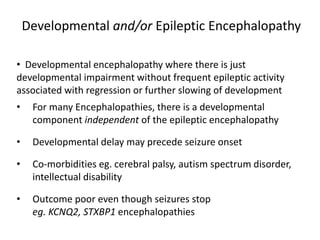
Developmental and/or Epileptic Encephalopathy
• Developmental encephalopathy where there is just
developmental impairment without frequent epileptic activity
associated with regression or further slowing of development
• For many Encephalopathies, there is a developmental
component independent of the epileptic encephalopathy
• Developmental delay may precede seizure onset
• Co-morbidities eg. cerebral palsy, autism spectrum disorder,
intellectual disability
• Outcome poor even though seizures stop
eg. KCNQ2, STXBP1 encephalopathies
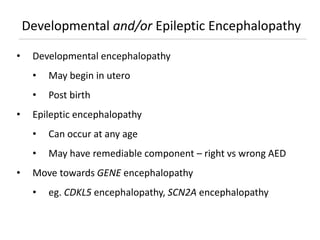
Developmental and/or Epileptic Encephalopathy
• Developmental encephalopathy
• May begin in utero
• Post birth
• Epileptic encephalopathy
• Can occur at any age
• May have remediable component – right vs wrong AED
• Move towards GENE encephalopathy
• eg. CDKL5 encephalopathy, SCN2A encephalopathy
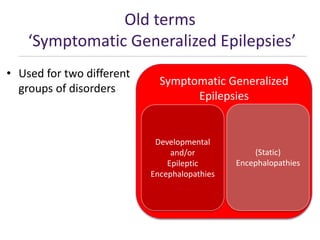
Old terms
‘Symptomatic Generalized Epilepsies’
• Used for two different
groups of disorders
Symptomatic Generalized
Epilepsies
Developmental
and/or
Epileptic
Encephalopathies
(Static)
Encephalopathies
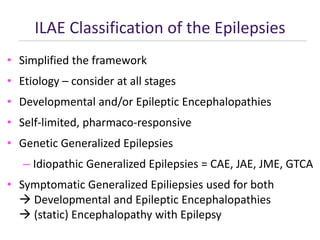
ILAE Classification of the Epilepsies
• Simplified the framework
• Etiology – consider at all stages
• Developmental and/or Epileptic Encephalopathies
• Self-limited, pharmaco-responsive
• Genetic Generalized Epilepsies
– Idiopathic Generalized Epilepsies = CAE, JAE, JME, GTCA
• Symptomatic Generalized Epiliepsies used for both
 Developmental and Epileptic Encephalopathies
 (static) Encephalopathy with Epilepsy
Impact on Clinical Care and Practice
• New classification framework will
• Change the approach to diagnosis in the clinic
• Be applied to patients and guide management
• Updates terminology to reflect
current thinking
• Scientific advances
2017 revised ILEA classification of seizures

2017 revised ILEA classification of seizures

  • 1.
    2017 Revised Classificationof Seizures International League Against Epilepsy (ILAE)
  • 2.
    ILAE Classification TaskForce 2013-7 Torbjörn Tomson, Emilio Perucca, Ingrid Scheffer, Jackie French, Yue-Hua Zhang Satish Jain, Gary Mathern, Sam Wiebe, Edouard Hirsch, Sameer Zuberi, Nico Moshe
  • 3.
    Classification of Epilepsies •a multilevel classification • designed to cater to classifying epilepsy in different clinical environments • This is in acknowledgement of the wide variation in resources around the world • meaning that different levels of classification will be possible depending on the resources available to the clinician making the diagnosis • a diagnosis at all three levels should be sought as well as the etiology of the individual’s epilepsy
  • 4.
    Unknown Immune Infectious Structural Etiology Metabolic Genetic Co-morbidities Epilepsy types Focal Generalized Combined Generalized &Focal UnknownFocal Epilepsy Syndromes Seizure types Generalized onset Unknown onset Focal onset
  • 5.
    Background • official definitionof a seizure is: "a transient occurrence of signs and/or symptoms due to an abnormal excessive or synchronous neuronal activity in the brain.” • large numbers of brain cells are activated abnormally at the same time. • Separating seizures into different types helps guide further testing, treatment and prognosis.
  • 6.
    History of SeizureClassification • the most common words to describe seizures were grand mal and petit mal • system divided seizures into: • partial (seizures starting in one area or side of the brain) and • generalized (seizures starting in both sides of the brain at the same time).
  • 7.
    Partial Seizures • Partialseizures were then defined by whether a person was aware or conscious during the seizure. • Simple partial seizures: Person is aware of what happens during the event. • Complex partial seizures: Person has some impaired awareness during the seizure. • They may be confused, partially aware, or not aware of anything during a seizure.
  • 8.
    New Basic Classification •The new basic seizure classification is based on 3 key features: 1. Where seizures begin in the brain 2. Level of awareness during a seizure 3. Other features of seizures
  • 10.
    Defining Where SeizuresBegin • Focal seizures: Previously called partial seizures, these start in an area or network of cells on one side of the brain. • Generalized seizures: Previously called primary generalized, these engage or involve networks on both sides of the brain at the onset. • Unknown onset: If the onset of a seizure is not known, the seizure falls into the unknown onset category. Later on, the seizures type can be changed if the beginning of a person’s seizures becomes clear. • Focal to bilateral seizure: A seizure that starts in one side or part of the brain and spreads to both sides has been called a secondary generalized seizures. • The new term for secondary generalized seizure would be a focal to bilateral seizure
  • 11.
    Describing Awareness • Practicallyimportance because it is one of the main factors affecting a person’s safety during a seizure • Awareness is used instead of consciousness, because it is simpler to evaluate • Focal aware: If awareness remains intact, even if the person is unable to talk or respond during a seizure, the seizure would be called a focal aware seizure. This replaces the term simple partial
  • 12.
    • Focal impairedawareness: If awareness is impaired or affected at any time during a seizure, even if a person has a vague idea of what happened, the seizure would be called focal impaired awareness. This replaces the term complex partial seizure. • Awareness unknown: Sometimes it’s not possible to know if a person is aware or not, for example if a person lives alone or has seizures only at night. In this situation, the awareness term may not be used or it would be described as awareness unknown.
  • 13.
    • Generalized seizures: Theseare all presumed to affect a person’s awareness or consciousness in some way. Thus no special terms are needed to describe awareness in generalized seizures.
  • 14.
    Motor and OtherSymptoms in Focal Seizures • It is also possible for a focal aware or impaired awareness seizure to be sub-classified as: • Focal motor seizure: This means that some type of movement occurs during the event. For example twitching, jerking, or stiffening movements of a body part, or Automatisms (automatic movements such as licking lips, rubbing hands, walking, or running).
  • 15.
    • Focal non-motorseizure: This type of seizure has other symptoms that occur first. Such as changes in sensation, emotions, thinking, or experiences • Auras: Used to describe symptoms a person may feel in the beginning of a seizure These early symptoms may be the start of a seizure.
  • 16.
    Describing Generalized OnsetSeizures • Generalized motor seizure: The generalized tonic-clonic seizure term is still used to describe seizures This loosely corresponds to “grand mal.” • Generalized non-motor seizure: These are primarily absence seizures and corresponds to the old term “petit mal.” These seizures involve brief changes in awareness, staring, and some may have automatic or repeated movements like lipsmacking
  • 17.
    Describing Unknown OnsetSeizures • When the beginning of a seizure is not known • this classification still gives a way to describe whether the features are motor or non-motor.
  • 19.
    Notes • Atonic seizuresand epileptic spasms would not have level of awareness specified • Pedalling grouped in hyperkinetic rather than automatisms (arbitrary) • Cognitive seizures • impaired language • other cognitive domains • positive features eg déjà vu, hallucinations, perceptual distortions • Emotional seizures: anxiety, fear, joy, etc
  • 22.
    Note When a seizuretype begins with ”focal, generalized or absence” then the word “onset” can be presumed
  • 23.
    Terms no longerin use • Complex partial • Simple partial • Partial • Psychic • Dyscognitive • Secondarily generalized tonic-clonic
  • 25.
  • 26.
    Unknown Immune Infectious Structural Etiology Metabolic Genetic Co-morbidities Epilepsy types Focal Generalized Combined Generalized &Focal UnknownFocal Epilepsy Syndromes Seizure types Generalized onset Unknown onset Focal onset
  • 27.
    Definition of Epilepsy •The task force proposed that epilepsy be considered to be a disease of the brain defined by any of the following conditions: 1. At least two unprovoked (or reflex) seizures occurring >24 h apart; 2. one unprovoked (or reflex) seizure and a probability of further seizures similar to the general recurrence risk (at least 60%) after two unprovoked seizures, occurring over the next 10 years; 3. diagnosis of an Epilepsy syndrome
  • 28.
    Generalized Epilepsy • Thediagnosis of generalized epilepsy is made on clinical grounds, supported by the finding of typical interictal EEG discharges • Generalised spike-wave activity on EEG • Caution needs to be exercised for a patient with generalized tonic–clonic seizures and a normal EEG • In such case, supportive evidence would need to be present to make a diagnosis of generalized epilepsy, such as myoclonic jerks or a relevant family history
  • 29.
    Focal Epilepsy • includeunifocal and multifocal disorders as well as seizures involving one hemisphere • The interictal EEG typically shows focal epileptiform discharges • The diagnosis is made on clinical grounds, supported by EEG findings
  • 30.
    Generalized and FocalEpilepsies • These are patients who have both generalized and focal seizures • The diagnosis is made on clinical grounds, supported by EEG findings • Ictal recordings are helpful but not essential • The interictal EEG may show both generalized spike-wave and focal epileptiform discharges • But epileptiform activity is not required for the diagnosis
  • 31.
    Generalized and FocalEpilepsies • Combined focal and generalized epilepsies Examples – Dravet syndrome – Lennox-Gastaut syndrome • What do with – Multifocal epilepsies? – Hemispheric epilepsies?  focal  focal
  • 32.
    Unknown Epilepsy • Patienthas Epilepsy but the clinician is unable to determine if the Epilepsy Type is focal or generalized because there is insufficient information available • variety of reasons: no access to EEG, or the EEG studies may have been uninformative, for example, normal
  • 33.
    • Epilepsy typemay also be the final level of diagnosis achievable • Where clinician is unable to make an Epilepsy Syndrome diagnosis or a diagnosis of Etiology • Many examples: – Non-lesional Temporal lobe epilepsy : Focal epilepsy with no known etiology – Generalized tonic-clonic seizures in a 5 year old with generalized spike-wave – Both focal impaired awareness seizures and absence seizures in a patient – Cannot tell if tonic-clonic seizure is focal or generalized
  • 34.
    Unknown Immune Infectious Structural Etiology Metabolic Genetic Epilepsy types Focal Generalized Combined Generalized &Focal UnknownFocal Epilepsy Syndromes Seizure types Generalized onset Unknown onset Focal onset
  • 35.
    Epilepsy Syndromes • refersto a cluster of features incorporating seizure types, EEG, and imaging features that tend to occur together • age-dependent features such as age at onset and remission • distinctive comorbidities such as intellectual and psychiatric dysfunction • It may have associated etiologic, prognostic, and treatment implications
  • 36.
    Epilepsy Syndromes • Thereare no approved ILAE epilepsy syndromes.
  • 37.
    Old term ‘Idiopathic GeneralizedEpilepsies’ Idiopathic Generalized Epilepsies Childhood Absence Epilepsy Generalized Tonic-Clonic Seizures Alone Juvenile Absence Epilepsy Juvenile Myoclonic Epilepsy
  • 38.
  • 43.
    Benign • Many epilepsiesnot benign – CAE :– psychosocial impact – BECTS :– learning concerns • Replaced by terms: a) Self-limited: likely spontaneous resolution of a syndrome b) Pharmacoresponsive: syndrome will be likely to be controlled with appropriate antiepileptic therapy • No longer use: – Malignant – Catastrophic
  • 44.
    Epileptic activity itself contributesto severe cognitive and behavioral impairment above and beyond that expected from the underlying pathology and that these can worsen over time Epileptic Encephalopathies Berg et al 2010
  • 45.
    Epileptic Encephalopathies • applicableto epilepsies at all ages • such syndromes may have an acquired cause such as hypoxic- ischemic encephalopathy or stroke, or • may be associated with a malformation of cortical development that may also have a genetic or acquired etiology • the abundant epileptiform activity interferes with development resulting in cognitive slowing and often regression • A key component of the concept is that amelioration of the epileptiform activity may have the potential to improve the developmental consequences of the disorder
  • 46.
    Developmental and/or EpilepticEncephalopathy • Developmental encephalopathy where there is just developmental impairment without frequent epileptic activity associated with regression or further slowing of development • For many Encephalopathies, there is a developmental component independent of the epileptic encephalopathy • Developmental delay may precede seizure onset • Co-morbidities eg. cerebral palsy, autism spectrum disorder, intellectual disability • Outcome poor even though seizures stop eg. KCNQ2, STXBP1 encephalopathies
  • 47.
    Developmental and/or EpilepticEncephalopathy • Developmental encephalopathy • May begin in utero • Post birth • Epileptic encephalopathy • Can occur at any age • May have remediable component – right vs wrong AED • Move towards GENE encephalopathy • eg. CDKL5 encephalopathy, SCN2A encephalopathy
  • 48.
    Old terms ‘Symptomatic GeneralizedEpilepsies’ • Used for two different groups of disorders Symptomatic Generalized Epilepsies Developmental and/or Epileptic Encephalopathies (Static) Encephalopathies
  • 49.
    ILAE Classification ofthe Epilepsies • Simplified the framework • Etiology – consider at all stages • Developmental and/or Epileptic Encephalopathies • Self-limited, pharmaco-responsive • Genetic Generalized Epilepsies – Idiopathic Generalized Epilepsies = CAE, JAE, JME, GTCA • Symptomatic Generalized Epiliepsies used for both  Developmental and Epileptic Encephalopathies  (static) Encephalopathy with Epilepsy
  • 50.
    Impact on ClinicalCare and Practice • New classification framework will • Change the approach to diagnosis in the clinic • Be applied to patients and guide management • Updates terminology to reflect current thinking • Scientific advances

Editor's Notes

  • #20 Classify aware or impaired awareness at any time during the sz then optionally add motor or non motor onset feature reflecting earliest motor or non motor sign or symptom other than awareness In some settings may not want to comment on awareness eg neonate so can omit this and classify by earliest motor or non motor feature Free text can be added to characterise sz
  • #21 Classify aware or impaired awareness at any time during the sz then optionally add motor or non motor onset feature reflecting earliest motor or non motor sign or symptom other than awareness In some settings may not want to comment on awareness eg neonate so can skip this Free text can be added to characterise sz
  • #22 Classify aware or impaired awareness at any time during the sz then optionally add motor or non motor onset feature reflecting earliest motor or non motor sign or symptom other than awareness In some settings may not want to comment on awareness eg neonate so can skip this Free text can be added to characterise sz
  • #23 Free text can be added to characterise sz
  • #32 Increasingly observed in clinical practice Previously incorrectly allocated to unknown
  • #34 Often a diagnosis regarding the type of epilepsy can be made (level 2: epilepsy classified by seizure type) and clinicians should strive to make a diagnosis at this level wherever possible. Added categories of “generalized and focal epilepsy” and “unknown if generalized or focal epilepsy”