Download to read offline
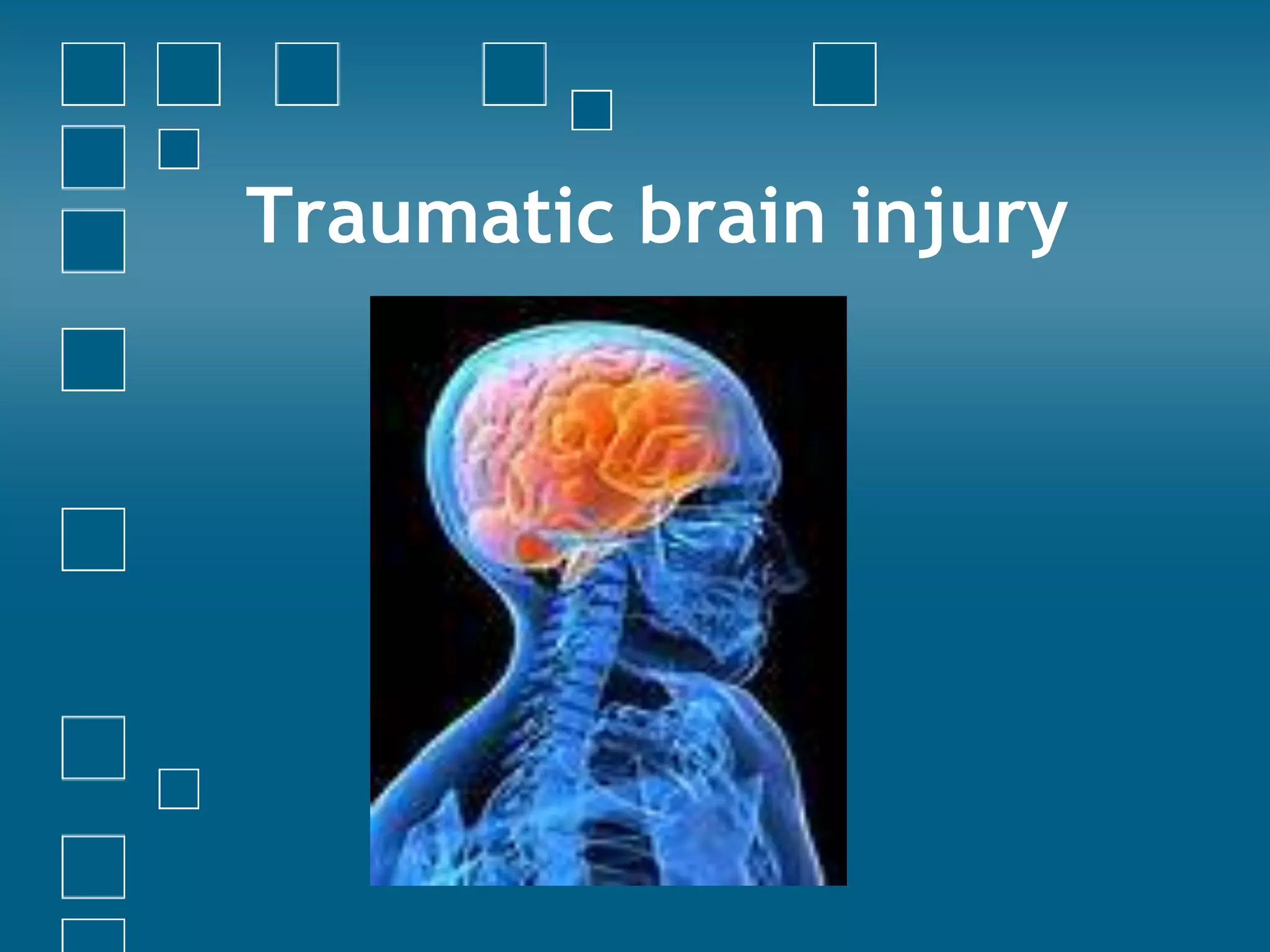
![TBI can cause a host of physical, cognitive, social, emotional, and
behavioral effects, and outcome can range from complete recovery to
permanent disability or death. The 20th century saw critical
developments in diagnosis and treatment that decreased death rates and
improved outcome. Some of the current imaging techniques used for
diagnosis and treatment include CT scans computed tomography and MRIs
magnetic resonance imaging. Depending on the injury, treatment
required may be minimal or may include interventions such as
medications, emergency surgery or surgery years later. Physical therapy,
speech therapy, recreation therapy, occupational therapy and vision
therapy may be employed for rehabilitation.
• Classification
• Traumatic brain injury is defined as damage to the brain resulting from
external mechanical force, such as rapid acceleration or deceleration,
impact, blast waves, or penetration by a projectile.[2] Brain function is
temporarily or permanently impaired and structural damage may or may
not be detectable with current technology.[3]](https://image.slidesharecdn.com/traumaticbraininjury-130211162740-phpapp01/85/Traumatic-brain-injury-3-320.jpg)
![• TBI is one of two subsets of acquired brain injury (brain damage that
occur after birth); the other subset is non-traumatic brain injury,
which does not involve external mechanical force (examples include
stroke and infection).[4][5] All traumatic brain injuries are head
injuries, but the latter term
May also refer to injury to other parts of the head.[6][7][8] However, the
terms head injury and brain injury are often used interchangeably.[9]
Similarly, brain injuries fall under the classification of central nervous
system injuries[10] and neurotrauma.[11] In neuropsychology research
literature, in general the term "traumatic brain injury" is used to refer
to non-penetrating traumatic brain injuries.
TBI is usually classified based on severity, anatomical features of the
injury, and the mechanism (the causative forces).[12] Mechanism-
related classification divides TBI into closed and penetrating head
injury.[2] A closed (also called nonpenetrating, or blunt)[6] injury
occurs when the brain is not exposed.[7] A penetrating, or open, head
injury occurs when an object pierces the skull and breaches the dura
mater, the outermost membrane surrounding the brain.[7]](https://image.slidesharecdn.com/traumaticbraininjury-130211162740-phpapp01/85/Traumatic-brain-injury-4-320.jpg)
![Severity
Brain injuries can be classified into mild, moderate, and severe
categories.[12] The Glasgow Coma Scale (GCS), the most commonly
used system for classifying TBI severity, grades a person's level of
consciousness on a scale of 3–15 based on verbal, motor, and eye-
opening reactions to stimuli.[14] It is generally agreed that a TBI with
a GCS of 13 or above is mild, 9–12 is moderate, and 8 or below is
severe.[3][8][15] Similar systems exist for young children.[8] However,
the GCS grading system has limited ability to predict outcomes.
Because of this, other classification systems such as the one shown in
the table are also used to help determine severity. A current model
developed by the Department of Defense and Department of
Veterans Affairs uses all three criteria of GCS after resuscitation,
duration of post-traumatic amnesia (PTA), and loss of consciousness
(LOC).[13] It also has been proposed to use changes that are visible on
neuroimaging, such as swelling, focal lesions, or diffuse injury as
method of classification.[2] Grading scales also exist to classify the
severity of mild TBI, commonly called concussion; these use duration
of LOC, PTA, and other concussion symptoms.](https://image.slidesharecdn.com/traumaticbraininjury-130211162740-phpapp01/85/Traumatic-brain-injury-5-320.jpg)
![Signs and symptoms
Unequal pupil size is potentially a sign of a serious brain injury.[32]
Symptoms are dependent on the type of TBI (diffuse or focal) and the
part of the brain that is affected.[33] Unconsciousness tends to last
longer for people with injuries on the left side of the brain than for
those with injuries on the right.[7] Symptoms are also dependent on
the injury's severity. With mild TBI, the patient may remain conscious
or may lose consciousness for a few seconds or minutes.[34] Other
symptoms of mild TBI include headache, vomiting, nausea, lack of
motor coordination, dizziness, difficulty balancing,[35]
lightheadedness, blurred vision or tired eyes, ringing in the ears, bad
taste in the mouth, fatigue or lethargy, and changes in sleep patterns.
Cognitive and emotional symptoms include behavioral or mood
changes, confusion, and trouble with memory, concentration,
attention, or thinking.[34] Mild TBI symptoms may also be present in
moderate and severe injuries.[34]](https://image.slidesharecdn.com/traumaticbraininjury-130211162740-phpapp01/85/Traumatic-brain-injury-6-320.jpg)
![A person with a moderate or severe TBI may have a headache that
does not go away, repeated vomiting or nausea, convulsions, an
inability to awaken, dilation of one or both pupils, slurred speech,
aphasia (word-finding difficulties), dysarthria (muscle weakness that
causes disordered speech), weakness or numbness in the limbs, loss of
coordination, confusion, restlessness, or agitation.[34] Common long-
term symptoms of moderate to severe TBI are changes in appropriate
social behavior, deficits in social judgment, and cognitive changes,
especially problems with sustained attention, processing speed, and
executive functioning.[27][36][37][38][39] Alexithymia, a deficiency in
identifying, understanding, processing, and describing emotions
occurs in 60.9% of individuals with TBI.[40] Cognitive and social deficits
have long-term consequences for the daily lives of people with
moderate to severe TBI, but can be improved with appropriate
rehabilitation.[39][41][42][43]
When the pressure within the skull (intracranial pressure, abbreviated
ICP) rises too high, it can be deadly.[44] Signs of increased ICP include
decreasing level of consciousness, paralysis or weakness on one side
of the body, and a blown pupil, one that fails to constrict in response
to light or is slow to do so.[44] Cushing's triad, a slow heart rate with
high blood pressure and respiratory depression is a classic
manifestation of significantly raised ICP.[3]](https://image.slidesharecdn.com/traumaticbraininjury-130211162740-phpapp01/85/Traumatic-brain-injury-7-320.jpg)
![Anisocoria, unequal pupil size, is another sign of serious TBI.[32]
Abnormal posturing, a characteristic positioning of the limbs caused
by severe diffuse injury or high ICP, is an ominous sign.[3]
Small children with moderate to severe TBI may have some of these
symptoms but have difficulty communicating them.[45] Other signs
seen in young children include persistent crying, inability to be
consoled, listlessness, refusal to nurse or eat,[45] and irritability.[3]
Causes
The most common causes of TBI in the U.S. include violence,
transportation accidents, construction, and sports.[35][46] Motor
bikes are major causes, increasing in significance in developing
countries as other causes reduce.[47] The estimates that between
1.6 and 3.8 million traumatic brain injuries each year are a result
of sports and recreation activities in the US.[48] In children aged two
to four, falls are the most common cause of TBI, while in older
children traffic accidents compete with falls for this position.](https://image.slidesharecdn.com/traumaticbraininjury-130211162740-phpapp01/85/Traumatic-brain-injury-8-320.jpg)
![• [49] TBI is the third most common injury to result from child
abuse.[50] Abuse causes 19% of cases of pediatric brain trauma, and
the death rate is higher among these cases.[51] Domestic violence is
another cause of TBI,[52] as are work-related and industrial
accidents.[53] Firearms[7] and blast injuries from explosions[54] are
other causes of TBI, which is the leading cause of death and disability
in war zones.[55] According to Representative Bill Pascrell (Democrat,
NJ), TBI is "the signature injury of the wars in Iraq and
Afghanistan."[56] There is a promising technology called activation
database guided EEG biofeedback which has been documented to
return a TBI's auditory memory ability to above the control group's
performance [57] [58]
Treatment
It is important to begin emergency treatment within the so-called
"golden hour" following the injury.[81] People with moderate to severe
injuries are likely to receive treatment in an intensive care unit
followed by a neurosurgical ward.[82] Treatment depends on the
recovery stage of the patient. In the acute stage the primary aim of
the medical personnel is to stabilize the patient and focus on
preventing further injury because little can be done to reverse the
initial damage caused by trauma.[](https://image.slidesharecdn.com/traumaticbraininjury-130211162740-phpapp01/85/Traumatic-brain-injury-9-320.jpg)
![82] Rehabilitation is the main treatment for the subacute and chronic
stages of recovery.[82] International clinical guidelines have been
proposed with the aim of guiding decisions in TBI treatment, as
defined by an authoritative examination of current evidence.[2]
• POSTED BY ATTORNEY RENE G. GARCIA:
For more information:- Some of our clients have suffered this kind of
injuries due to a serious accident. The Garcia Law Firm, P.C. was
able to successfully handle these types of cases. For a free
consultation please call us at 1-866- SCAFFOLD or 212-725-1313.
Links
http://en.wikipedia.org/wiki/Traumatic_brain_injury](https://image.slidesharecdn.com/traumaticbraininjury-130211162740-phpapp01/85/Traumatic-brain-injury-10-320.jpg)

Traumatic brain injury (TBI) occurs when an external force injures the brain and can range from mild to severe. It is a major cause of death and disability worldwide, especially in young people, due to causes like falls, vehicle accidents, and violence. TBI can cause physical, cognitive, and behavioral effects that require treatment such as medications, surgery, and rehabilitation therapy. Outcomes depend on the severity of the injury and range from full recovery to permanent disability or death.


![CTEV [ clubfoot] DR ARUN LAL ,DR MOHAMED ASHRAF travancore medical college k...](https://cdn.slidesharecdn.com/ss_thumbnails/ctevclubfootdrarunlaldrmohamedashraftravancoremedicalcollegekollamkeralaindia-260208063247-18fc466c-thumbnail.jpg?width=640&height=640&fit=bounds)


