D R N A Y A N A K U L K A R N I
C M C C
N A S I K
Anesthetic Considerations In Head
Neck
Oncosurgical Management
Objective
1/16/2016
dr nck cmcc nasik
2
 At the end of this session the delegate should have a
fair idea of:
 The peri-operative management of patients
undergoing surgery related to head and neck cancer
Head and neck cancer
1/16/2016
dr nck cmcc nasik
3
 Worldwide 644k incidence and 350 k deaths
• 50,000 Americans are diagnosed with a head or neck
cancer (not including skin cancers that occur in the
head or neck)
~ 5 percent of all cancers in the US
– Majority are squamous cell carcinoma
• Survival rates have improved
– aggressive treatment
– early detection
– declining rates of tobacco and ETOH abuse
• The role of HPV
– The % of oropharyngeal cancers caused by human
papillomavirus (HPV) has increased
– 80% of oropharyngeal cancers are now caused by HPV
(industrialized countries)
Epidemiology
1/16/2016
dr nck cmcc nasik
4
 Head and Neck Squamous cell carcinoma
(HNSCC), which constitutes the most common
upper aero digestive tract carcinomas.
 Accounts for 3% of all cancers in the developed
countries like USA whereas in developing countries
like India it accounts for 30% of all cancers.
EPIDEMIOLOGIC TRENDS OF HEAD AND NECK
CANCERS
1/16/2016
dr nck cmcc nasik
5
 Head and neck cancers are among the 10 most
common cancers globally.
 In India, it accounts for one fourth of male cancers
and one tenth of female cancers (Yeole 2001).
 Risk factors for head and neck cancers:
 Consumption of alcohol,
 Tobacco smoke,
 smokeless tobacco,
 alcohol,
 marijuana use,
 deficient diet,
 Human Papilloma virus infection
General considerations for HNF surgery
1/16/2016
dr nck cmcc nasik
6
• Airway Management
– Anatomy (c-spine, +/- ROM, large tongue) – stridor
or hoarseness
– hx neck surgery, trauma, difficult intubation –
infections (epiglottitis, abscess)
– head/neck cancer radiation therapy
 low threshold for fiberoptic
• backup plan
• sharing of airway with surgeon
• nasal intubation
Anesthetic considerations
1/16/2016
dr nck cmcc nasik
7
 Problems related to age
 Problems related to cancer
 Securing airway
 Recovery
Age
1/16/2016
dr nck cmcc nasik
8
 Generally older patients
 Cardiac- Co dec by 1% per yr after 30 yrs so ability
to in response to stress is diminished.
 Respiratory – PaO2 by 0.5% per yr after 20 yrs, so
rapid hypoxemia esp if pt is smoker
 Hepatic – drug clearance is impaired.
 Renal- cr clearance also dec 1ml/min/yr after 20
yrs it means high sr creat may indicate underlying
severe impairment in clearance.
Cancer
1/16/2016
dr nck cmcc nasik
9
 Chemo is given to cause tumor reduction.
 It can result in affection of multiple systems in body
Due to cumulative dosages and drug toxicity:
 Renal
 Hepatic
 Hematological / bone marrow suppression
 Cardiac
 Pulmonary
 GI
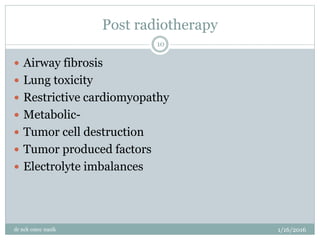
Post radiotherapy
1/16/2016
dr nck cmcc nasik
10
 Airway fibrosis
 Lung toxicity
 Restrictive cardiomyopathy
 Metabolic-
 Tumor cell destruction
 Tumor produced factors
 Electrolyte imbalances
Preoperative evaluation
Wyss, A. et. Al Am. J. Epidemiol. (2013) 178 (5): 679-690. doi:
10.1093/aje/kwt029
1/16/2016
dr nck cmcc nasik
11
 Determine degree of compromise and risk
 Focus preliminary exm on CVS , Airway and
Pulmonary systems.
 – elderly comorbidities
 – hx of smoking, EtOH
 – Hx CAD, HTN, CRI, COPD
 – Prior anesthesia hx
 – preop testing imaging studies, PFTs, cardiac
and hepatic function
Preoperative
evaluation
1/16/2016
dr nck cmcc nasik
12
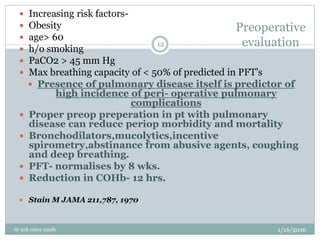
 Increasing risk factors-
 Obesity
 age> 60
 h/o smoking
 PaCO2 > 45 mm Hg
 Max breathing capacity of < 50% of predicted in PFT’s
 Presence of pulmonary disease itself is predictor of
high incidence of peri- operative pulmonary
complications
 Proper preop preperation in pt with pulmonary
disease can reduce periop morbidity and mortality
 Bronchodilators,mucolytics,incentive
spirometry,abstinance from abusive agents, coughing
and deep breathing.
 PFT- normalises by 8 wks.
 Reduction in COHb- 12 hrs.
 Stain M JAMA 211,787, 1970
1/16/2016
dr nck cmcc nasik
13
Images –difficult airway
1/16/2016
dr nck cmcc nasik
14
1/16/2016
dr nck cmcc nasik
15
1/16/2016
dr nck cmcc nasik
16
1/16/2016
dr nck cmcc nasik 17
1/16/2016
dr nck cmcc nasik
18
1/16/2016
dr nck cmcc nasik
19
Dr. Binnions Lemon Law: An easy way to
remember multiple tests…
1/16/2016
dr nck cmcc nasik
20
• Look externally.
• Evaluate the 3-3-2 rule.
• Mallampati.
• Obstruction?
• Neck mobility.
1/16/2016
dr nck cmcc nasik
21
Golden pearls
1/16/2016
dr nck cmcc nasik
22
 Fluid management in Cancer surgeries.
 Rehydration
 maintainance
 Replacement
 Other goals-
 Early ambulation
 Chest PT
 Recognise difficult airways and prepare for it.
General Considerations
1/16/2016
dr nck cmcc nasik
23
• Anesthetic Management –
-Smooth emergence
-Opioid based technique
-antiemetic prophylaxis
- OGT prior to emergence to empty stomach
+/-
– General with ETT vs. flexible ETT
General Considerations
1/16/2016
dr nck cmcc nasik
24
Adequate intra op/postop analgesia,
highly reflexogenic areas –
controlled hypotension –
decrease SBP< 100mmHg,
Keep MAP 60-70
Pt immobility muscle relaxation ?
Monitoring and access
1/16/2016
dr nck cmcc nasik
25
– ECG
– BP noninvasive vs. Arterial
– pulse Ox
– temp
– end tidal CO2
– RLN nerve monitoring current practice
– large bore IV, good access large bore IV, good
access
– positioning arms tucked, all access prior,
sticky pulse ox, nerve stimulator (where?)
Intraoperative
1/16/2016
dr nck cmcc nasik
26
- Protect eyes
– Cardiac function monitored
– Temp
–Head of bed can be elevated aids venous
drainage
– +/- Reinforced ETT
–Avoid drugs that stimulate sympathetic nervous
system
Options
1/16/2016
dr nck cmcc nasik
27
 ETT with GA
 Awake FOI
 Awake DL and then assess intubation status
 Recent IDL to predict level of difficulty
 Trach with LA
Difficult mask ventilation
1/16/2016
dr nck cmcc nasik
28
 Age>55
 Presence of beard
 BMI >26
 Edentulous
 h/o snoring
 Massive jaw
 Poor neck extension
 Large tongue
 Mandibular space
 TMD
 MMP
 Neck
 Pharyngeal pathology
 Facial deformity
 Facial dressings
 Tumor growth on face
 h/o difficult airway
 Overbite
 shape of palate
 Inter incisor length
 Cervical vertebral ROM
Intraop airway management
1/16/2016
dr nck cmcc nasik
29
 Secure ETT prefer reinforced ETT
 Assess Surgical field requirement accordingly fix
ETT
 Trach as an when indicated
 Prolonged reconstructions- keep head end elevated
to minimise supraglottic edema
 Give dexamentasone
 Minimise ETT movement
Extubation
1/16/2016
dr nck cmcc nasik
30
 Keep tube exchanger at hand (bougie)
 Jet ventilation /both
 Preferably Keep lengthy and reconstructive
surgical pts intubated overnight.
 Criterias for extubation-
 Severity of pulmonary disease
 Length and extent of surgery
 Ability to protect airway
 Ability to mobilize and remove secretions
 Amount of residual respiratory depression from
residual anesthetic agents
Thyroidectomy
1/16/2016
dr nck cmcc nasik
31
 Maintain adequate depth of anesthesia –
Remember DL is stimulant
– B-blockers are your friend
• Not particularly painful post-op.
– Complete reversal intact reflexes
– Recurrent Laryngeal Nerve Damage
• unilateral = hoarseness
• bilateral = aphonia and stridor
Thyroidectomy
1/16/2016
dr nck cmcc nasik
32
–Hematoma formation
–Hypoparathyroidism unintentional removal
of parathyroid glands.
(Chvostek’s and Trousseau’s)
–Awake vs Deep extubation
Thyroid Storm
1/16/2016
dr nck cmcc nasik
33
 Can occur intraop,
 most common 6-24 hour postop
 – Mimic MH intraop
 –Hyperpyrexia, tachycardia, altered consciousness
hypotension consciousness, hypotension
 – Tx: hydration,
 cooling,
 esmolol infusion,
 propylthiouracil,
 sodium iodide,
 cortisol
For Tracheostomy
1/16/2016
dr nck cmcc nasik
34
 • Pre-op Assessment
 – population usually includes: chronically ventilated
pts, pts having other procedure where trach is
required,
 pts with upper airway obstruction (emergency)
 – evaluate pt - ventilation settings
 – airway, coexisting dx
 – cardiac hx
 – neuro assessment may be sedated
 – In OR or Bedside +/- anesthesia
Intraop for Tracheostomy
1/16/2016
dr nck cmcc nasik
35
- For intubated pts GETA
–Airway compromised pts local anesthesia
– mucosal swelling
tissue fragility
• risk of tracheal mucosal separation and false passage
during trach
– Communicate with surgeon when using cautery in
the airway
– 100% O2 required before insertion of trach
Intraoperative Trach
1/16/2016
dr nck cmcc nasik
36
 Trachea opened above cuff, ETT retracted slowly
with visualization of surgeon (communication),
 do not remove all the way until trach in
place and +ETCO2 confirmation-
• Pneumothorax
• False passage
– recognize, no CO2,
PIP
absent breath sounds,
rigid bronchoscope and extra ETT available
Postoperative trach
1/16/2016
dr nck cmcc nasik
37
 Transport to ICU with meds, equipment
– Trach tube displacement,
 ETT and extra trach tube with stylet (obturator)
available
– Watch for bleeding
Anesthesia for ND
1/16/2016
dr nck cmcc nasik
38
• Radical, modified, or functional
• Usually performed with resection of primary lesion :
 thyroid,
 parathyroid,
 tongue,
 pharynx,
 larynx, etc.
Preop considerations for ND
1/16/2016
dr nck cmcc nasik
39
– Airway decreased mobility
2°to radiation
• backup plan
• surgeon available surgeon available
– Resp COPD,
CO2 retention,
PFTs
– Cardiac: HTN, carotid artery stenosis
Intraoperative
1/16/2016
dr nck cmcc nasik
40
– Moderate decrease in BP,
- avoid adrenergic responses
– Muscle relaxant +/-
–Humidify gases reduce mucous plugging
–VAE occurs rarely
– Manipulation of carotid sinus bradycardia,
-- ↓ BP
Esp right side neck dissection
1/16/2016
dr nck cmcc nasik
41
• Right Radical Neck dissection -
• may cause prolonged QT interval which may progress
to ventricular arrhythmias and cardiac arrest
(due to interruption of cervical sympathetic outflow to
heart via right stellate ganglion)
Postoperative Considerations in ND
1/16/2016
dr nck cmcc nasik
42
 –HTN,
 ↑HR 2° to carotid sinus denervation
 – Facial nerve injury
 – RLN damage
 –Diaphragmatic paralysis
 – Pneumothorax
 –Agitation
Special considerations- minor procedures but not
so minor!!
1/16/2016
dr nck cmcc nasik
43
 PEG insertion/ feeding gastrostomy in HN Ca pt on
RT- neck movement negligible,anatomical landmarks
not visible-
 Difficult airway so may need FOI GA PEG
insertion.
 DL in partial stridor pt-
 Discuss possibility of Emergency trach with
relatives in dire conditions as life saving
measure.
 ECA ligation post CT/RT-
 difficult mask ventilation possibility must be
kept in mind.
At the end TEAM EFFORT wins
1/16/2016
dr nck cmcc nasik
44

Head neck onco- anesthesia

  • 1.
    D R NA Y A N A K U L K A R N I C M C C N A S I K Anesthetic Considerations In Head Neck Oncosurgical Management
  • 2.
    Objective 1/16/2016 dr nck cmccnasik 2  At the end of this session the delegate should have a fair idea of:  The peri-operative management of patients undergoing surgery related to head and neck cancer
  • 3.
    Head and neckcancer 1/16/2016 dr nck cmcc nasik 3  Worldwide 644k incidence and 350 k deaths • 50,000 Americans are diagnosed with a head or neck cancer (not including skin cancers that occur in the head or neck) ~ 5 percent of all cancers in the US – Majority are squamous cell carcinoma • Survival rates have improved – aggressive treatment – early detection – declining rates of tobacco and ETOH abuse • The role of HPV – The % of oropharyngeal cancers caused by human papillomavirus (HPV) has increased – 80% of oropharyngeal cancers are now caused by HPV (industrialized countries)
  • 4.
    Epidemiology 1/16/2016 dr nck cmccnasik 4  Head and Neck Squamous cell carcinoma (HNSCC), which constitutes the most common upper aero digestive tract carcinomas.  Accounts for 3% of all cancers in the developed countries like USA whereas in developing countries like India it accounts for 30% of all cancers.
  • 5.
    EPIDEMIOLOGIC TRENDS OFHEAD AND NECK CANCERS 1/16/2016 dr nck cmcc nasik 5  Head and neck cancers are among the 10 most common cancers globally.  In India, it accounts for one fourth of male cancers and one tenth of female cancers (Yeole 2001).  Risk factors for head and neck cancers:  Consumption of alcohol,  Tobacco smoke,  smokeless tobacco,  alcohol,  marijuana use,  deficient diet,  Human Papilloma virus infection
  • 6.
    General considerations forHNF surgery 1/16/2016 dr nck cmcc nasik 6 • Airway Management – Anatomy (c-spine, +/- ROM, large tongue) – stridor or hoarseness – hx neck surgery, trauma, difficult intubation – infections (epiglottitis, abscess) – head/neck cancer radiation therapy  low threshold for fiberoptic • backup plan • sharing of airway with surgeon • nasal intubation
  • 7.
    Anesthetic considerations 1/16/2016 dr nckcmcc nasik 7  Problems related to age  Problems related to cancer  Securing airway  Recovery
  • 8.
    Age 1/16/2016 dr nck cmccnasik 8  Generally older patients  Cardiac- Co dec by 1% per yr after 30 yrs so ability to in response to stress is diminished.  Respiratory – PaO2 by 0.5% per yr after 20 yrs, so rapid hypoxemia esp if pt is smoker  Hepatic – drug clearance is impaired.  Renal- cr clearance also dec 1ml/min/yr after 20 yrs it means high sr creat may indicate underlying severe impairment in clearance.
  • 9.
    Cancer 1/16/2016 dr nck cmccnasik 9  Chemo is given to cause tumor reduction.  It can result in affection of multiple systems in body Due to cumulative dosages and drug toxicity:  Renal  Hepatic  Hematological / bone marrow suppression  Cardiac  Pulmonary  GI
  • 10.
    Post radiotherapy 1/16/2016 dr nckcmcc nasik 10  Airway fibrosis  Lung toxicity  Restrictive cardiomyopathy  Metabolic-  Tumor cell destruction  Tumor produced factors  Electrolyte imbalances
  • 11.
    Preoperative evaluation Wyss, A.et. Al Am. J. Epidemiol. (2013) 178 (5): 679-690. doi: 10.1093/aje/kwt029 1/16/2016 dr nck cmcc nasik 11  Determine degree of compromise and risk  Focus preliminary exm on CVS , Airway and Pulmonary systems.  – elderly comorbidities  – hx of smoking, EtOH  – Hx CAD, HTN, CRI, COPD  – Prior anesthesia hx  – preop testing imaging studies, PFTs, cardiac and hepatic function
  • 12.
    Preoperative evaluation 1/16/2016 dr nck cmccnasik 12  Increasing risk factors-  Obesity  age> 60  h/o smoking  PaCO2 > 45 mm Hg  Max breathing capacity of < 50% of predicted in PFT’s  Presence of pulmonary disease itself is predictor of high incidence of peri- operative pulmonary complications  Proper preop preperation in pt with pulmonary disease can reduce periop morbidity and mortality  Bronchodilators,mucolytics,incentive spirometry,abstinance from abusive agents, coughing and deep breathing.  PFT- normalises by 8 wks.  Reduction in COHb- 12 hrs.  Stain M JAMA 211,787, 1970
  • 13.
  • 14.
  • 15.
  • 16.
  • 17.
  • 18.
  • 19.
  • 20.
    Dr. Binnions LemonLaw: An easy way to remember multiple tests… 1/16/2016 dr nck cmcc nasik 20 • Look externally. • Evaluate the 3-3-2 rule. • Mallampati. • Obstruction? • Neck mobility.
  • 21.
  • 22.
    Golden pearls 1/16/2016 dr nckcmcc nasik 22  Fluid management in Cancer surgeries.  Rehydration  maintainance  Replacement  Other goals-  Early ambulation  Chest PT  Recognise difficult airways and prepare for it.
  • 23.
    General Considerations 1/16/2016 dr nckcmcc nasik 23 • Anesthetic Management – -Smooth emergence -Opioid based technique -antiemetic prophylaxis - OGT prior to emergence to empty stomach +/- – General with ETT vs. flexible ETT
  • 24.
    General Considerations 1/16/2016 dr nckcmcc nasik 24 Adequate intra op/postop analgesia, highly reflexogenic areas – controlled hypotension – decrease SBP< 100mmHg, Keep MAP 60-70 Pt immobility muscle relaxation ?
  • 25.
    Monitoring and access 1/16/2016 drnck cmcc nasik 25 – ECG – BP noninvasive vs. Arterial – pulse Ox – temp – end tidal CO2 – RLN nerve monitoring current practice – large bore IV, good access large bore IV, good access – positioning arms tucked, all access prior, sticky pulse ox, nerve stimulator (where?)
  • 26.
    Intraoperative 1/16/2016 dr nck cmccnasik 26 - Protect eyes – Cardiac function monitored – Temp –Head of bed can be elevated aids venous drainage – +/- Reinforced ETT –Avoid drugs that stimulate sympathetic nervous system
  • 27.
    Options 1/16/2016 dr nck cmccnasik 27  ETT with GA  Awake FOI  Awake DL and then assess intubation status  Recent IDL to predict level of difficulty  Trach with LA
  • 28.
    Difficult mask ventilation 1/16/2016 drnck cmcc nasik 28  Age>55  Presence of beard  BMI >26  Edentulous  h/o snoring  Massive jaw  Poor neck extension  Large tongue  Mandibular space  TMD  MMP  Neck  Pharyngeal pathology  Facial deformity  Facial dressings  Tumor growth on face  h/o difficult airway  Overbite  shape of palate  Inter incisor length  Cervical vertebral ROM
  • 29.
    Intraop airway management 1/16/2016 drnck cmcc nasik 29  Secure ETT prefer reinforced ETT  Assess Surgical field requirement accordingly fix ETT  Trach as an when indicated  Prolonged reconstructions- keep head end elevated to minimise supraglottic edema  Give dexamentasone  Minimise ETT movement
  • 30.
    Extubation 1/16/2016 dr nck cmccnasik 30  Keep tube exchanger at hand (bougie)  Jet ventilation /both  Preferably Keep lengthy and reconstructive surgical pts intubated overnight.  Criterias for extubation-  Severity of pulmonary disease  Length and extent of surgery  Ability to protect airway  Ability to mobilize and remove secretions  Amount of residual respiratory depression from residual anesthetic agents
  • 31.
    Thyroidectomy 1/16/2016 dr nck cmccnasik 31  Maintain adequate depth of anesthesia – Remember DL is stimulant – B-blockers are your friend • Not particularly painful post-op. – Complete reversal intact reflexes – Recurrent Laryngeal Nerve Damage • unilateral = hoarseness • bilateral = aphonia and stridor
  • 32.
    Thyroidectomy 1/16/2016 dr nck cmccnasik 32 –Hematoma formation –Hypoparathyroidism unintentional removal of parathyroid glands. (Chvostek’s and Trousseau’s) –Awake vs Deep extubation
  • 33.
    Thyroid Storm 1/16/2016 dr nckcmcc nasik 33  Can occur intraop,  most common 6-24 hour postop  – Mimic MH intraop  –Hyperpyrexia, tachycardia, altered consciousness hypotension consciousness, hypotension  – Tx: hydration,  cooling,  esmolol infusion,  propylthiouracil,  sodium iodide,  cortisol
  • 34.
    For Tracheostomy 1/16/2016 dr nckcmcc nasik 34  • Pre-op Assessment  – population usually includes: chronically ventilated pts, pts having other procedure where trach is required,  pts with upper airway obstruction (emergency)  – evaluate pt - ventilation settings  – airway, coexisting dx  – cardiac hx  – neuro assessment may be sedated  – In OR or Bedside +/- anesthesia
  • 35.
    Intraop for Tracheostomy 1/16/2016 drnck cmcc nasik 35 - For intubated pts GETA –Airway compromised pts local anesthesia – mucosal swelling tissue fragility • risk of tracheal mucosal separation and false passage during trach – Communicate with surgeon when using cautery in the airway – 100% O2 required before insertion of trach
  • 36.
    Intraoperative Trach 1/16/2016 dr nckcmcc nasik 36  Trachea opened above cuff, ETT retracted slowly with visualization of surgeon (communication),  do not remove all the way until trach in place and +ETCO2 confirmation- • Pneumothorax • False passage – recognize, no CO2, PIP absent breath sounds, rigid bronchoscope and extra ETT available
  • 37.
    Postoperative trach 1/16/2016 dr nckcmcc nasik 37  Transport to ICU with meds, equipment – Trach tube displacement,  ETT and extra trach tube with stylet (obturator) available – Watch for bleeding
  • 38.
    Anesthesia for ND 1/16/2016 drnck cmcc nasik 38 • Radical, modified, or functional • Usually performed with resection of primary lesion :  thyroid,  parathyroid,  tongue,  pharynx,  larynx, etc.
  • 39.
    Preop considerations forND 1/16/2016 dr nck cmcc nasik 39 – Airway decreased mobility 2°to radiation • backup plan • surgeon available surgeon available – Resp COPD, CO2 retention, PFTs – Cardiac: HTN, carotid artery stenosis
  • 40.
    Intraoperative 1/16/2016 dr nck cmccnasik 40 – Moderate decrease in BP, - avoid adrenergic responses – Muscle relaxant +/- –Humidify gases reduce mucous plugging –VAE occurs rarely – Manipulation of carotid sinus bradycardia, -- ↓ BP
  • 41.
    Esp right sideneck dissection 1/16/2016 dr nck cmcc nasik 41 • Right Radical Neck dissection - • may cause prolonged QT interval which may progress to ventricular arrhythmias and cardiac arrest (due to interruption of cervical sympathetic outflow to heart via right stellate ganglion)
  • 42.
    Postoperative Considerations inND 1/16/2016 dr nck cmcc nasik 42  –HTN,  ↑HR 2° to carotid sinus denervation  – Facial nerve injury  – RLN damage  –Diaphragmatic paralysis  – Pneumothorax  –Agitation
  • 43.
    Special considerations- minorprocedures but not so minor!! 1/16/2016 dr nck cmcc nasik 43  PEG insertion/ feeding gastrostomy in HN Ca pt on RT- neck movement negligible,anatomical landmarks not visible-  Difficult airway so may need FOI GA PEG insertion.  DL in partial stridor pt-  Discuss possibility of Emergency trach with relatives in dire conditions as life saving measure.  ECA ligation post CT/RT-  difficult mask ventilation possibility must be kept in mind.
  • 44.
    At the endTEAM EFFORT wins 1/16/2016 dr nck cmcc nasik 44