PAVEMENT DESIGN
AND ANALYSIS
(CE-860)
LEC-01
Fall Semester 2017
Dr. Arshad Hussain
arshad_nit@yahoo.com , Office Room#111, Tel:
05190854163, Cell: 03419756251
National Institute of Transportation (NIT)
School of Civil & Environmental Engineering (SCEE)
National University of Science and Technology (NUST)
NUST Campus, Sector H-12, Islamabad
TRANSPORTATION SECTOR
 Accounts for 12 % of GDP
 Growth rate Freight – 3%
 Growth rate Passenger – 4.5%
Road Sector Accounts for:
 Passenger Traffic – 90%
 Freight Traffic – 95%
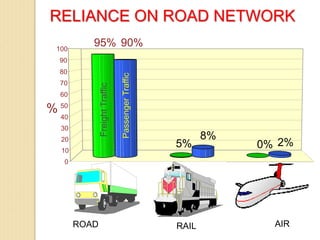
RELIANCE ON ROAD NETWORK
RAIL
ROAD RAIL
95% 90%
2%
0%
5%
8%
0
10
20
30
40
50
60
70
80
90
100
% Freight
Traffic
Passenger
Traffic
2
0
0.5
8
Passenger Traffic
ROAD AIR
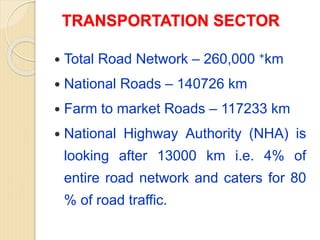
TRANSPORTATION SECTOR
 Total Road Network – 260,000 +km
 National Roads – 140726 km
 Farm to market Roads – 117233 km
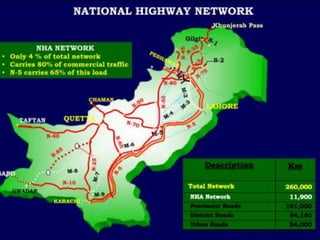
 National Highway Authority (NHA) is
looking after 13000 km i.e. 4% of
entire road network and caters for 80
% of road traffic.
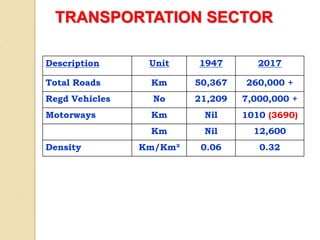
TRANSPORTATION SECTOR
Description Unit 1947 2017
Total Roads Km 50,367 260,000 +
Regd Vehicles No 21,209 7,000,000 +
Motorways Km Nil 1010 (3690)
Km Nil 12,600
Density Km/Km² 0.06 0.32
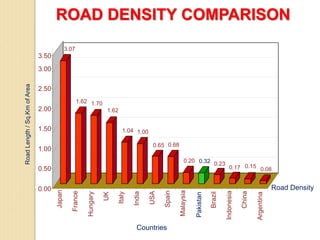
3.07
1.62 1.70
1.62
1.04 1.00
0.65 0.68
0.20 0.32 0.23
0.17 0.15
0.08
0.00
0.50
1.00
1.50
2.00
2.50
3.00
3.50
Japan
France
Hungary
UK
Italy
India
USA
Spain
Malaysia
Pakistan
Brazil
Indonesia
China
Argentina
Road Density
Road
Length
/
Sq.Km
of
Area
Countries
ROAD DENSITY COMPARISON
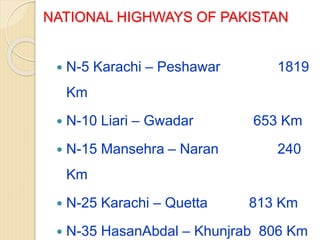
NATIONAL HIGHWAYS OF PAKISTAN
 N-5 Karachi – Peshawar 1819
Km
 N-10 Liari – Gwadar 653 Km
 N-15 Mansehra – Naran 240
Km
 N-25 Karachi – Quetta 813 Km
 N-35 HasanAbdal – Khunjrab 806 Km
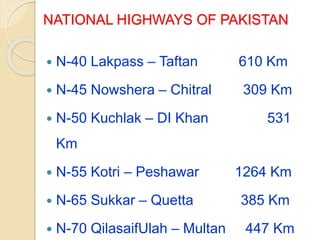
NATIONAL HIGHWAYS OF PAKISTAN
 N-40 Lakpass – Taftan 610 Km
 N-45 Nowshera – Chitral 309 Km
 N-50 Kuchlak – DI Khan 531
Km
 N-55 Kotri – Peshawar 1264 Km
 N-65 Sukkar – Quetta 385 Km
 N-70 QilasaifUlah – Multan 447 Km
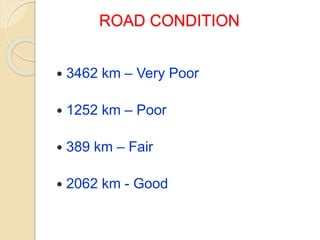
ROAD CONDITION
 3462 km – Very Poor
 1252 km – Poor
 389 km – Fair
 2062 km - Good
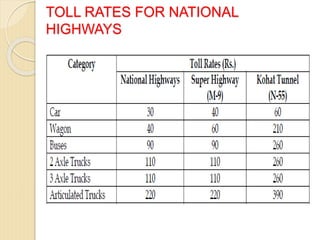
TOLL RATES FOR NATIONAL
HIGHWAYS
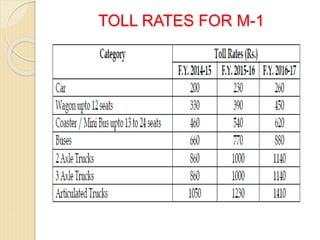
TOLL RATES FOR M-1
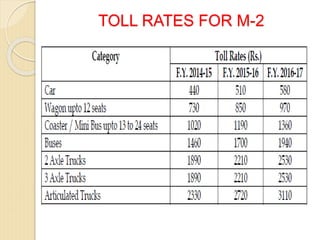
TOLL RATES FOR M-2
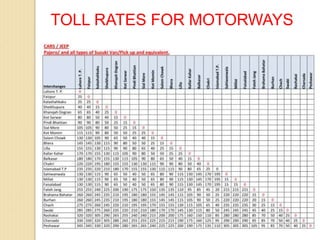
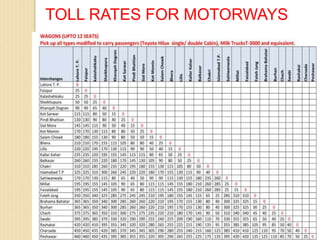
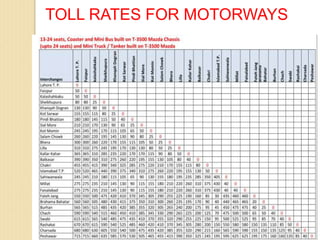
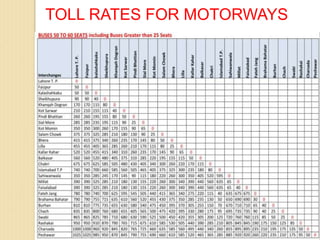
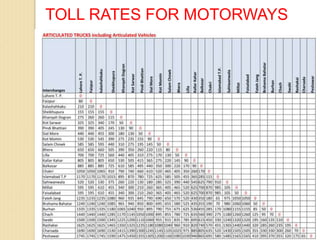
TOLL RATES FOR MOTORWAYS
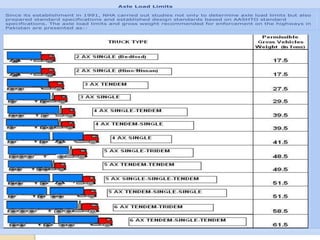
Axle Load Limits
Since its establishment in 1991, NHA carried out studies not only to determine axle load limits but also
prepared standard specifications and established design standards based on AASHTO standard
specifications. The axle load limits and gross weight recommended for enforcement on the highways in
Pakistan are presented as:-
Over Loading
In Pakistan presently there are around 136000 registered commercial trucks (3% of total vehicles) plying on our roads.
Since there is no adequate truck manufacturing industry in Pakistan, types and makes of these trucks varies. Bodies are
mostly manufactured in Pakistan by local Industry not following proper dimensions. Bed Ford (53%), Hino (23%), Nissan
(16%), Isuzu (5%), other (3%) are common types of trucks. According to a study carried out by NHA, composition of
Commercial vehicles determined in 1995 is presented below:-
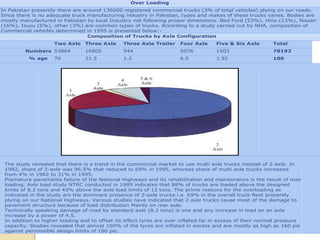
Composition of Trucks by Axle Configuration
Two Axle Three Axle Three Axle Trailer Four Axle Five & Six Axle Total
Numbers 53864 16805 944 5076 1503 78192
% age 70 21.5 1.2 6.5 1.92 100
The study revealed that there is a trend in the commercial market to use multi axle trucks instead of 2-axle. In
1982, share of 2-axle was 96.5% that reduced to 69% in 1995, whereas share of multi axle trucks increased
from 4% in 1982 to 31% in 1995.
Premature pavements failure of the National Highways and its rehabilitation and maintenance is the result of over
loading. Axle load study NTRC conducted in 1995 indicates that 88% of trucks are loaded above the designed
limits of 8.2 tons and 43% above the axle load limits of 12 tons. The prime reasons for the overloading as
indicated in the study are the dominant presence of 2-axle trucks i.e. 69% in the overall truck fleet presently
plying on our National Highways. Various studies nave indicated that 2 axle trucks cause most of the damage to
pavement structure because of load distribution Mainly on rear axle.
Technically speaking damage of road by standard axle (8.2 tons) is one and any increase in load on an axle
increase by a power of 4.5.
In addition to higher loading and to offset its effect tyres are over inflated far in excess of their normal pressure
capacity. Studies revealed that almost 100% of the tyres are inflated in excess and are mostly as high as 160 psi
against permissible design limits of 100 psi.
HISTORICAL BACKGROUND
 Concept of paved highways with the
beginning of automobile era in late
1800s is WRONG.
 Signs of road construction in ancient
Egypt relate with the discovery of
WHEEL, 3500 B.C.
 Romans were the first scientific road
builders, initiated VIA APPIA, or the
APPIAN way of road construction in
312 B.C. Generally, 3 to 5 feet thick
structure in 3 layers.
HISTORICAL BACKGROUND
 This practice continued for 2000 years until
superseded by MacAdam’s Light – Wearing
Course Surface in 19th Century.
 Most of the earlier work done by the
Europeans
 John MacAdam (1756-1836) is the father of
modern pavement construction. His road x-
section is based on the principle of drained
compacted base layer to support the load
and aggregate wearing course as surfacing.
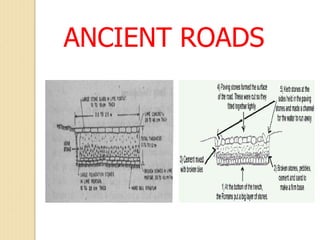
ANCIENT ROADS
Concept of Ancient Roads
(5000 years ago)
Definition: “Paths treaded by
animals and human beings”
Pavement Structure:
Stone –paved roads made of one
or two rows of slabs 50 mm thick
in central portion….,
ROMAN ROADS
Types of Roman Roads
 Ordinary roman roads
 Important Roman roads
 Built in straight line regardless of gradient
 Excavated parallel trenches 40-ft apart for
longitudinal drainage
 Foundation raised 3-ft above ground level
 Embankment covered with sand or mortar
CROSS-SECTION
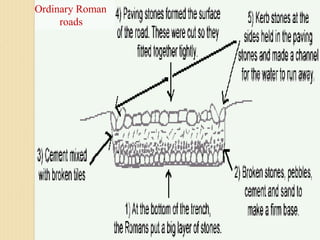
(Ordinary Roman Roads)
1) Foundation layer (10-24inch),composed of
large stones
2) Firm base 9-in thick made of broken
stones, pebbles, cement and sand
3) Nucleus layer about 12-in thick using
concrete made from gravel and coarse
sand
4) Wearing surface of large stone slabs at
least 6-in deep
5) Total thickness varied from 3ft to 6ft
Ordinary Roman
roads
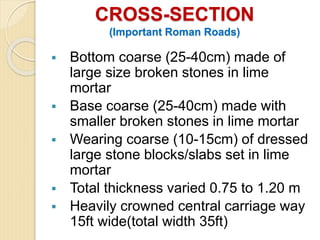
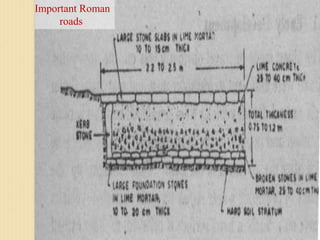
 Bottom coarse (25-40cm) made of
large size broken stones in lime
mortar
 Base coarse (25-40cm) made with
smaller broken stones in lime mortar
 Wearing coarse (10-15cm) of dressed
large stone blocks/slabs set in lime
mortar
 Total thickness varied 0.75 to 1.20 m
 Heavily crowned central carriage way
15ft wide(total width 35ft)
CROSS-SECTION
(Important Roman Roads)
Important Roman
roads
17th and 18th centuries.
MODERN ROADS
(17th & 18th Centuries)
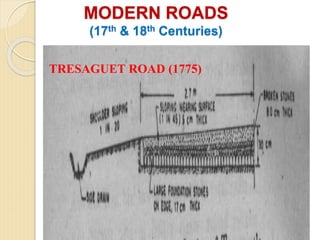
TRESAGUET ROAD (1775)
CROSS-SECTION
TRESAGUET ROAD (1775)
 The subgrade was prepared in level
 Layer of large foundation stone with large
kerb stones at edges
 Base coarse about 8cm of compacted small
broken stones
 Top wearing coarse 5cm at edges,
thickness increased towards center for
providing surface drainage
 Sloping shoulders with side drain
 Total thickness about 30cm
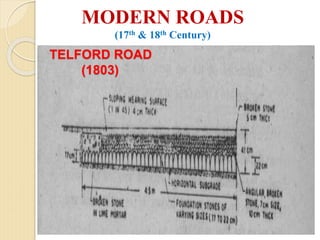
TELFORD ROAD
(1803)
MODERN ROADS
(17th & 18th Century)
CROSS-SECTION
TELFORD ROAD (1803)
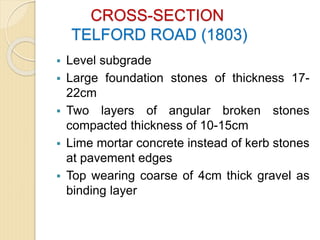
 Level subgrade
 Large foundation stones of thickness 17-
22cm
 Two layers of angular broken stones
compacted thickness of 10-15cm
 Lime mortar concrete instead of kerb stones
at pavement edges
 Top wearing coarse of 4cm thick gravel as
binding layer
MODERN ROADS
(17th & 18th Century)
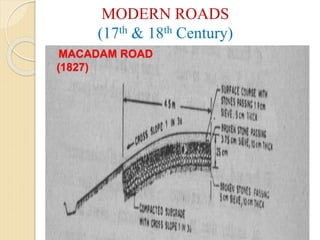
MACADAM ROAD
(1827)
CROSS-SECTION
MACADAM ROAD (1827)
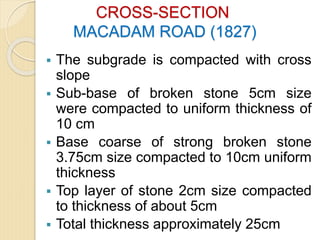
 The subgrade is compacted with cross
slope
 Sub-base of broken stone 5cm size
were compacted to uniform thickness of
10 cm
 Base coarse of strong broken stone
3.75cm size compacted to 10cm uniform
thickness
 Top layer of stone 2cm size compacted
to thickness of about 5cm
 Total thickness approximately 25cm
HISTORICAL BACKGROUND
 1906 – Bitumen MacAdam roads built
in Rhode Island, USA.
 1909 – First PCC road built in
Michigan, USA
 AASHO Road Tests conducted in
Ottawa, Illinois, USA from 1958 -
1961.
PAVEMENT DESIGN
 What is Design?
Conceive/ Develop plans for something
to serve a specific function
 Pavement Function?
Provide smooth, durable and safe
vehicle access between two points
under all climatic conditions
Thanks

PAVEMENT DESIGN AND ANALYSIS.ppt

  • 2.
    PAVEMENT DESIGN AND ANALYSIS (CE-860) LEC-01 FallSemester 2017 Dr. Arshad Hussain arshad_nit@yahoo.com , Office Room#111, Tel: 05190854163, Cell: 03419756251 National Institute of Transportation (NIT) School of Civil & Environmental Engineering (SCEE) National University of Science and Technology (NUST) NUST Campus, Sector H-12, Islamabad
  • 3.
    TRANSPORTATION SECTOR  Accountsfor 12 % of GDP  Growth rate Freight – 3%  Growth rate Passenger – 4.5% Road Sector Accounts for:  Passenger Traffic – 90%  Freight Traffic – 95%
  • 4.
    RELIANCE ON ROADNETWORK RAIL ROAD RAIL 95% 90% 2% 0% 5% 8% 0 10 20 30 40 50 60 70 80 90 100 % Freight Traffic Passenger Traffic 2 0 0.5 8 Passenger Traffic ROAD AIR
  • 5.
    TRANSPORTATION SECTOR  TotalRoad Network – 260,000 +km  National Roads – 140726 km  Farm to market Roads – 117233 km  National Highway Authority (NHA) is looking after 13000 km i.e. 4% of entire road network and caters for 80 % of road traffic.
  • 7.
    TRANSPORTATION SECTOR Description Unit1947 2017 Total Roads Km 50,367 260,000 + Regd Vehicles No 21,209 7,000,000 + Motorways Km Nil 1010 (3690) Km Nil 12,600 Density Km/Km² 0.06 0.32
  • 8.
    3.07 1.62 1.70 1.62 1.04 1.00 0.650.68 0.20 0.32 0.23 0.17 0.15 0.08 0.00 0.50 1.00 1.50 2.00 2.50 3.00 3.50 Japan France Hungary UK Italy India USA Spain Malaysia Pakistan Brazil Indonesia China Argentina Road Density Road Length / Sq.Km of Area Countries ROAD DENSITY COMPARISON
  • 9.
    NATIONAL HIGHWAYS OFPAKISTAN  N-5 Karachi – Peshawar 1819 Km  N-10 Liari – Gwadar 653 Km  N-15 Mansehra – Naran 240 Km  N-25 Karachi – Quetta 813 Km  N-35 HasanAbdal – Khunjrab 806 Km
  • 10.
    NATIONAL HIGHWAYS OFPAKISTAN  N-40 Lakpass – Taftan 610 Km  N-45 Nowshera – Chitral 309 Km  N-50 Kuchlak – DI Khan 531 Km  N-55 Kotri – Peshawar 1264 Km  N-65 Sukkar – Quetta 385 Km  N-70 QilasaifUlah – Multan 447 Km
  • 11.
    ROAD CONDITION  3462km – Very Poor  1252 km – Poor  389 km – Fair  2062 km - Good
  • 12.
    TOLL RATES FORNATIONAL HIGHWAYS
  • 13.
  • 14.
  • 15.
    TOLL RATES FORMOTORWAYS
  • 16.
    TOLL RATES FORMOTORWAYS
  • 17.
    TOLL RATES FORMOTORWAYS
  • 18.
    TOLL RATES FORMOTORWAYS
  • 19.
    TOLL RATES FORMOTORWAYS
  • 20.
    Axle Load Limits Sinceits establishment in 1991, NHA carried out studies not only to determine axle load limits but also prepared standard specifications and established design standards based on AASHTO standard specifications. The axle load limits and gross weight recommended for enforcement on the highways in Pakistan are presented as:-
  • 21.
    Over Loading In Pakistanpresently there are around 136000 registered commercial trucks (3% of total vehicles) plying on our roads. Since there is no adequate truck manufacturing industry in Pakistan, types and makes of these trucks varies. Bodies are mostly manufactured in Pakistan by local Industry not following proper dimensions. Bed Ford (53%), Hino (23%), Nissan (16%), Isuzu (5%), other (3%) are common types of trucks. According to a study carried out by NHA, composition of Commercial vehicles determined in 1995 is presented below:- Composition of Trucks by Axle Configuration Two Axle Three Axle Three Axle Trailer Four Axle Five & Six Axle Total Numbers 53864 16805 944 5076 1503 78192 % age 70 21.5 1.2 6.5 1.92 100 The study revealed that there is a trend in the commercial market to use multi axle trucks instead of 2-axle. In 1982, share of 2-axle was 96.5% that reduced to 69% in 1995, whereas share of multi axle trucks increased from 4% in 1982 to 31% in 1995. Premature pavements failure of the National Highways and its rehabilitation and maintenance is the result of over loading. Axle load study NTRC conducted in 1995 indicates that 88% of trucks are loaded above the designed limits of 8.2 tons and 43% above the axle load limits of 12 tons. The prime reasons for the overloading as indicated in the study are the dominant presence of 2-axle trucks i.e. 69% in the overall truck fleet presently plying on our National Highways. Various studies nave indicated that 2 axle trucks cause most of the damage to pavement structure because of load distribution Mainly on rear axle. Technically speaking damage of road by standard axle (8.2 tons) is one and any increase in load on an axle increase by a power of 4.5. In addition to higher loading and to offset its effect tyres are over inflated far in excess of their normal pressure capacity. Studies revealed that almost 100% of the tyres are inflated in excess and are mostly as high as 160 psi against permissible design limits of 100 psi.
  • 22.
    HISTORICAL BACKGROUND  Conceptof paved highways with the beginning of automobile era in late 1800s is WRONG.  Signs of road construction in ancient Egypt relate with the discovery of WHEEL, 3500 B.C.  Romans were the first scientific road builders, initiated VIA APPIA, or the APPIAN way of road construction in 312 B.C. Generally, 3 to 5 feet thick structure in 3 layers.
  • 24.
    HISTORICAL BACKGROUND  Thispractice continued for 2000 years until superseded by MacAdam’s Light – Wearing Course Surface in 19th Century.  Most of the earlier work done by the Europeans  John MacAdam (1756-1836) is the father of modern pavement construction. His road x- section is based on the principle of drained compacted base layer to support the load and aggregate wearing course as surfacing.
  • 25.
  • 26.
    Concept of AncientRoads (5000 years ago) Definition: “Paths treaded by animals and human beings” Pavement Structure: Stone –paved roads made of one or two rows of slabs 50 mm thick in central portion….,
  • 27.
    ROMAN ROADS Types ofRoman Roads  Ordinary roman roads  Important Roman roads  Built in straight line regardless of gradient  Excavated parallel trenches 40-ft apart for longitudinal drainage  Foundation raised 3-ft above ground level  Embankment covered with sand or mortar
  • 28.
    CROSS-SECTION (Ordinary Roman Roads) 1)Foundation layer (10-24inch),composed of large stones 2) Firm base 9-in thick made of broken stones, pebbles, cement and sand 3) Nucleus layer about 12-in thick using concrete made from gravel and coarse sand 4) Wearing surface of large stone slabs at least 6-in deep 5) Total thickness varied from 3ft to 6ft
  • 29.
  • 30.
     Bottom coarse(25-40cm) made of large size broken stones in lime mortar  Base coarse (25-40cm) made with smaller broken stones in lime mortar  Wearing coarse (10-15cm) of dressed large stone blocks/slabs set in lime mortar  Total thickness varied 0.75 to 1.20 m  Heavily crowned central carriage way 15ft wide(total width 35ft) CROSS-SECTION (Important Roman Roads)
  • 31.
  • 32.
    17th and 18thcenturies.
  • 33.
    MODERN ROADS (17th &18th Centuries) TRESAGUET ROAD (1775)
  • 34.
    CROSS-SECTION TRESAGUET ROAD (1775) The subgrade was prepared in level  Layer of large foundation stone with large kerb stones at edges  Base coarse about 8cm of compacted small broken stones  Top wearing coarse 5cm at edges, thickness increased towards center for providing surface drainage  Sloping shoulders with side drain  Total thickness about 30cm
  • 35.
  • 36.
    CROSS-SECTION TELFORD ROAD (1803) Level subgrade  Large foundation stones of thickness 17- 22cm  Two layers of angular broken stones compacted thickness of 10-15cm  Lime mortar concrete instead of kerb stones at pavement edges  Top wearing coarse of 4cm thick gravel as binding layer
  • 37.
    MODERN ROADS (17th &18th Century) MACADAM ROAD (1827)
  • 38.
    CROSS-SECTION MACADAM ROAD (1827) The subgrade is compacted with cross slope  Sub-base of broken stone 5cm size were compacted to uniform thickness of 10 cm  Base coarse of strong broken stone 3.75cm size compacted to 10cm uniform thickness  Top layer of stone 2cm size compacted to thickness of about 5cm  Total thickness approximately 25cm
  • 39.
    HISTORICAL BACKGROUND  1906– Bitumen MacAdam roads built in Rhode Island, USA.  1909 – First PCC road built in Michigan, USA  AASHO Road Tests conducted in Ottawa, Illinois, USA from 1958 - 1961.
  • 40.
    PAVEMENT DESIGN  Whatis Design? Conceive/ Develop plans for something to serve a specific function  Pavement Function? Provide smooth, durable and safe vehicle access between two points under all climatic conditions
  • 42.