Aggressive and Persistent: Using Frameworks
to Defend Against Cyber Attacks
Featuring cyber security experts Professor Scott J. Shackelford,
JD, PhD, of Indiana University's Kelley School of Business and
Andrew A. Proia of Indiana University's Center for Applied
Cybersecurity Research
Sponsored by
APRIL 16, 2014
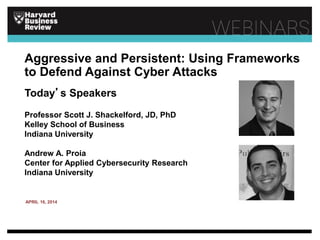
Today’s Speakers
Professor Scott J. Shackelford, JD, PhD
Kelley School of Business
Indiana University
Andrew A. Proia
Center for Applied Cybersecurity Research
Indiana University
Aggressive and Persistent: Using Frameworks
to Defend Against Cyber Attacks
APRIL 16, 2014
Harvard Business Review
Apr. 16, 2014
Advanced and Persistent: Using
Frameworks to Defend Against Cyber
Attacks
Prof. Scott Shackelford & Andrew Proia
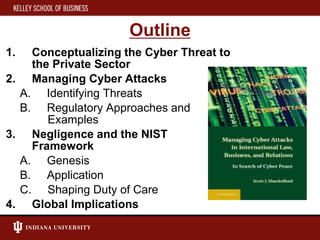
Outline
1. Conceptualizing the Cyber Threat to
the Private Sector
2. Managing Cyber Attacks
A. Identifying Threats
B. Regulatory Approaches and
Examples
3. Negligence and the NIST
Framework
A. Genesis
B. Application
C. Shaping Duty of Care
4. Global Implications
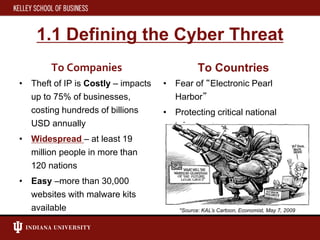
To Companies To Countries
• Theft of IP is Costly – impacts
up to 75% of businesses,
costing hundreds of billions
USD annually
• Widespread – at least 19
million people in more than
120 nations
• Easy –more than 30,000
websites with malware kits
available
• Fear of “Electronic Pearl
Harbor”
• Protecting critical national
infrastructure
1.1 Defining the Cyber Threat
*Source: KAL’s Cartoon, Economist, May 7, 2009
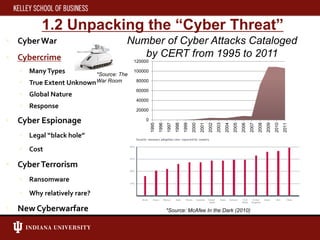
*Source: McAfee In the Dark (2010)
Number of Cyber Attacks Cataloged
by CERT from 1995 to 2011
1.2 Unpacking the “Cyber Threat”
 CyberWar
 Cybercrime
 ManyTypes
 True Extent Unknown
 Global Nature
 Response
 Cyber Espionage
 Legal “black hole”
 Cost
 CyberTerrorism
 Ransomware
 Why relatively rare?
 New Cyberwarfare
0
20000
40000
60000
80000
100000
120000
1995
1996
1997
1998
1999
2000
2001
2002
2003
2004
2005
2006
2007
2008
2009
2010
2011
*Source: The
War Room
Sponsored by
APRIL 16, 2014

HBR APT framework

  • 1.
    Aggressive and Persistent:Using Frameworks to Defend Against Cyber Attacks Featuring cyber security experts Professor Scott J. Shackelford, JD, PhD, of Indiana University's Kelley School of Business and Andrew A. Proia of Indiana University's Center for Applied Cybersecurity Research Sponsored by APRIL 16, 2014
  • 2.
    Today’s Speakers Professor ScottJ. Shackelford, JD, PhD Kelley School of Business Indiana University Andrew A. Proia Center for Applied Cybersecurity Research Indiana University Aggressive and Persistent: Using Frameworks to Defend Against Cyber Attacks APRIL 16, 2014
  • 3.
    Harvard Business Review Apr.16, 2014 Advanced and Persistent: Using Frameworks to Defend Against Cyber Attacks Prof. Scott Shackelford & Andrew Proia
  • 4.
    Outline 1. Conceptualizing theCyber Threat to the Private Sector 2. Managing Cyber Attacks A. Identifying Threats B. Regulatory Approaches and Examples 3. Negligence and the NIST Framework A. Genesis B. Application C. Shaping Duty of Care 4. Global Implications
  • 5.
    To Companies ToCountries • Theft of IP is Costly – impacts up to 75% of businesses, costing hundreds of billions USD annually • Widespread – at least 19 million people in more than 120 nations • Easy –more than 30,000 websites with malware kits available • Fear of “Electronic Pearl Harbor” • Protecting critical national infrastructure 1.1 Defining the Cyber Threat *Source: KAL’s Cartoon, Economist, May 7, 2009
  • 6.
    *Source: McAfee Inthe Dark (2010) Number of Cyber Attacks Cataloged by CERT from 1995 to 2011 1.2 Unpacking the “Cyber Threat”  CyberWar  Cybercrime  ManyTypes  True Extent Unknown  Global Nature  Response  Cyber Espionage  Legal “black hole”  Cost  CyberTerrorism  Ransomware  Why relatively rare?  New Cyberwarfare 0 20000 40000 60000 80000 100000 120000 1995 1996 1997 1998 1999 2000 2001 2002 2003 2004 2005 2006 2007 2008 2009 2010 2011 *Source: The War Room
  • 7.