CYBERSECURITY
DISCIPLINE?
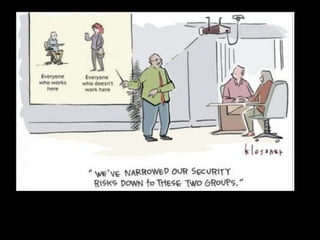
Kings Island, 1983
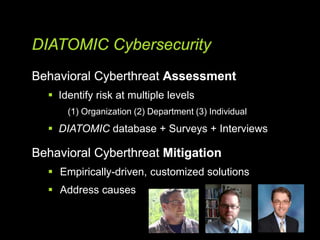
DIATOMIC Cybersecurity
Behavioral Cyberthreat Assessment
 Identify risk at multiple levels
(1) Organization (2) Department (3) Individual
 DIATOMIC database + Surveys + Interviews
Behavioral Cyberthreat Mitigation
 Empirically-driven, customized solutions
 Address causes
• University of Cincinnati
• ACM
• ABET/CSAB
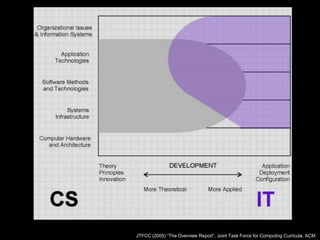
JTFCC (2005) “The Overview Report”, Joint Task Force for Computing Curricula, ACM
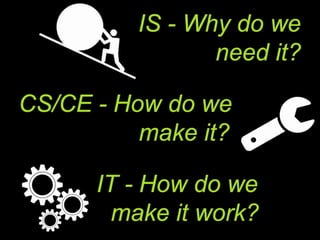
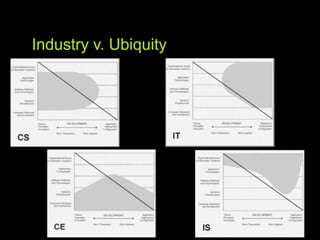
IS - Why do we
need it?
CS/CE - How do we
make it?
IT - How do we
make it work?
Industry v. Ubiquity
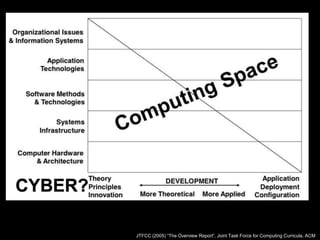
CYBER?
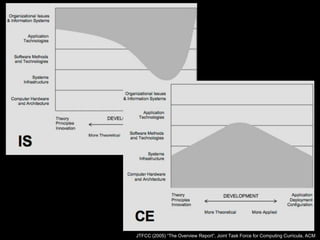
JTFCC (2005) “The Overview Report”, Joint Task Force for Computing Curricula, ACM
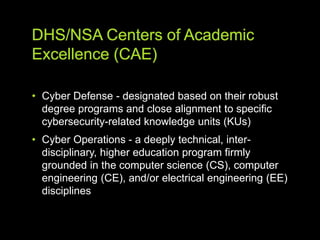
DHS/NSA Centers of Academic
Excellence (CAE)
• Cyber Defense - designated based on their robust
degree programs and close alignment to specific
cybersecurity-related knowledge units (KUs)
• Cyber Operations - a deeply technical, inter-
disciplinary, higher education program firmly
grounded in the computer science (CS), computer
engineering (CE), and/or electrical engineering (EE)
disciplines
ACM/IEEE Joint Task Force on
Cybersecurity Education - 2015
“computing-based discipline involving
technology, people, information, and
processes to enable assured operations. It
involves the creation, operation, analysis,
and testing of secure computer systems. It
is an interdisciplinary course of study,
including aspects of law, policy, human
factors, ethics, and risk management often
in the context of adversaries.”
ACM/IEEE Draft Knowledge Areas
1. Cyber Defense
2. Cyber Operations
3. Digital Forensics
4. Cyber Physical Systems
5. Secure Software Engineering
6. Cyber Ethics
7. Cyber Policy, Governance, and Law
8. Cyber Risk Management
9. Behavioral Science
cybereducationproject.org
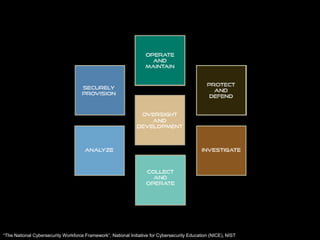
“The National Cybersecurity Workforce Framework”, National Initiative for Cybersecurity Education (NICE), NIST
Home UsingThis
Document
Sample
JobTitles
Securely
Provision
Operateand
Maintain
Protect and
Defend Investigate Collect and
Operate Analyze Oversight and
Development
D e f in in g t h e Cy b e r s e c u r it y w o r k f o r c e
Def ning the cybersecurity population using common, standar dized
labels and def nitions is an essential step in ensuring that our country
is able to educate, recruit, train, develop, and retain a highly-qualif ed
workforce. The NICE, in collaboration with federal gover nment
agencies, public and private experts and organizations, and industry
partners, has published version 1.0 of the National Cybersecurity
Workforce Framework (“the Framework”) to provide a common
understanding of and lexicon for cybersecurity work.
The National Cybersecurity Workforce Framework establishes the
common taxonomy and lexicon that is to be used to describe all
cybersecurity work and workers irrespective of where or for whom the
work is performed. The Framework is intended to be applied in the
public, private, and academic sectors. Use of the Framework does
not require that organizations change organizational or occupational
structures. In fact, the Framework was developed because requiring
such changes would be costly, impractical, ineffective, and ineff cient.
The Framework is agnostic to the particulars of a given or ganization
and is overarching by design so that it can be overlaid onto any existing
occupational structure to facilitate achieving an agile, highly-quali f ed
cybersecurity workforce.
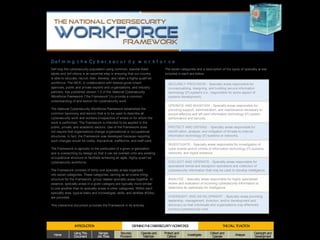
The Framework consists of thirty-one specialty ar eas organized
into seven categories. These categories, serving as an overar ching
structure for the Framework, group related specialty areas together. In
essence, specialty areas in a given category are typically more similar
to one another than to specialty areas in other categories. Within each
specialty area, typical tasks and knowledges, skills, and abilities (KSAs)
are provided.
This interactive document provides the Framework in its entirety.
The seven categories and a description of the types of specialty ar eas
included in each are below
SECURELY PROVISION - Specialty areas responsible for
conceptualizing, designing, and building secure information
technology (IT) systems (i.e., responsible for some aspect of
systems development).
OPERATE AND MAINTAIN - Specialty areas responsible for
providing support, administration, and maintenance necessary to
ensure effective and eff cient information technology (IT) system
performance and security.
PROTECT AND DEFEND - Specialty areas responsible for
identif cation, analysis, and mitigation of threats to internal
information technology (IT) systems or networks.
INVESTIGATE - Specialty areas responsible for investigation of
cyber events and/or crimes of information technology (IT) systems,
networks, and digital evidence.
COLLECT AND OPERATE - Specialty areas responsible for
specialized denial and deception operations and collection of
cybersecurity information that may be used to develop intelligence.
ANALYZE - Specialty areas responsible for highly specialized
review and evaluation of incoming cybersecurity information to
determine its usefulness for intelligence.
OVERSIGHT AND DEVELOPMENT - Specialty areas providing
leadership, management, direction, and/or development and
advocacy so that individuals and organizations may effectively
conduct cybersecurity work.
INTRODUCTION DEFININGTHECYBERSECURITYWORKFORCE THECALLTOACTION
NATIONAL INITIATIVE FOR CYBERSECURITY EDUCATION (NICE)
Thanks!
• mark.stockman@uc.edu
• @PutrNrd
• linkedin.com/in/putrnrd
• pinterest.com/putrnrd

Cybersecurity Discipline

  • 1.
  • 2.
  • 5.
    DIATOMIC Cybersecurity Behavioral CyberthreatAssessment  Identify risk at multiple levels (1) Organization (2) Department (3) Individual  DIATOMIC database + Surveys + Interviews Behavioral Cyberthreat Mitigation  Empirically-driven, customized solutions  Address causes
  • 6.
    • University ofCincinnati • ACM • ABET/CSAB
  • 7.
    JTFCC (2005) “TheOverview Report”, Joint Task Force for Computing Curricula, ACM
  • 8.
    JTFCC (2005) “TheOverview Report”, Joint Task Force for Computing Curricula, ACM
  • 9.
    IS - Whydo we need it? CS/CE - How do we make it? IT - How do we make it work?
  • 10.
  • 12.
    CYBER? JTFCC (2005) “TheOverview Report”, Joint Task Force for Computing Curricula, ACM
  • 13.
    DHS/NSA Centers ofAcademic Excellence (CAE) • Cyber Defense - designated based on their robust degree programs and close alignment to specific cybersecurity-related knowledge units (KUs) • Cyber Operations - a deeply technical, inter- disciplinary, higher education program firmly grounded in the computer science (CS), computer engineering (CE), and/or electrical engineering (EE) disciplines
  • 15.
    ACM/IEEE Joint TaskForce on Cybersecurity Education - 2015 “computing-based discipline involving technology, people, information, and processes to enable assured operations. It involves the creation, operation, analysis, and testing of secure computer systems. It is an interdisciplinary course of study, including aspects of law, policy, human factors, ethics, and risk management often in the context of adversaries.”
  • 16.
    ACM/IEEE Draft KnowledgeAreas 1. Cyber Defense 2. Cyber Operations 3. Digital Forensics 4. Cyber Physical Systems 5. Secure Software Engineering 6. Cyber Ethics 7. Cyber Policy, Governance, and Law 8. Cyber Risk Management 9. Behavioral Science cybereducationproject.org
  • 17.
    “The National CybersecurityWorkforce Framework”, National Initiative for Cybersecurity Education (NICE), NIST
  • 18.
    Home UsingThis Document Sample JobTitles Securely Provision Operateand Maintain Protect and DefendInvestigate Collect and Operate Analyze Oversight and Development D e f in in g t h e Cy b e r s e c u r it y w o r k f o r c e Def ning the cybersecurity population using common, standar dized labels and def nitions is an essential step in ensuring that our country is able to educate, recruit, train, develop, and retain a highly-qualif ed workforce. The NICE, in collaboration with federal gover nment agencies, public and private experts and organizations, and industry partners, has published version 1.0 of the National Cybersecurity Workforce Framework (“the Framework”) to provide a common understanding of and lexicon for cybersecurity work. The National Cybersecurity Workforce Framework establishes the common taxonomy and lexicon that is to be used to describe all cybersecurity work and workers irrespective of where or for whom the work is performed. The Framework is intended to be applied in the public, private, and academic sectors. Use of the Framework does not require that organizations change organizational or occupational structures. In fact, the Framework was developed because requiring such changes would be costly, impractical, ineffective, and ineff cient. The Framework is agnostic to the particulars of a given or ganization and is overarching by design so that it can be overlaid onto any existing occupational structure to facilitate achieving an agile, highly-quali f ed cybersecurity workforce. The Framework consists of thirty-one specialty ar eas organized into seven categories. These categories, serving as an overar ching structure for the Framework, group related specialty areas together. In essence, specialty areas in a given category are typically more similar to one another than to specialty areas in other categories. Within each specialty area, typical tasks and knowledges, skills, and abilities (KSAs) are provided. This interactive document provides the Framework in its entirety. The seven categories and a description of the types of specialty ar eas included in each are below SECURELY PROVISION - Specialty areas responsible for conceptualizing, designing, and building secure information technology (IT) systems (i.e., responsible for some aspect of systems development). OPERATE AND MAINTAIN - Specialty areas responsible for providing support, administration, and maintenance necessary to ensure effective and eff cient information technology (IT) system performance and security. PROTECT AND DEFEND - Specialty areas responsible for identif cation, analysis, and mitigation of threats to internal information technology (IT) systems or networks. INVESTIGATE - Specialty areas responsible for investigation of cyber events and/or crimes of information technology (IT) systems, networks, and digital evidence. COLLECT AND OPERATE - Specialty areas responsible for specialized denial and deception operations and collection of cybersecurity information that may be used to develop intelligence. ANALYZE - Specialty areas responsible for highly specialized review and evaluation of incoming cybersecurity information to determine its usefulness for intelligence. OVERSIGHT AND DEVELOPMENT - Specialty areas providing leadership, management, direction, and/or development and advocacy so that individuals and organizations may effectively conduct cybersecurity work. INTRODUCTION DEFININGTHECYBERSECURITYWORKFORCE THECALLTOACTION NATIONAL INITIATIVE FOR CYBERSECURITY EDUCATION (NICE)
  • 20.
    Thanks! • mark.stockman@uc.edu • @PutrNrd •linkedin.com/in/putrnrd • pinterest.com/putrnrd

Editor's Notes

  • #2 Armco Steel UC hire
  • #3 30 Years ago A few years later, coop student at DoD
  • #5 Before get into workforce, a pitch about my research Embedded with criminologists Hundreds of years of vetted theories for crime and prevention Evidence-based rather than just heuristics
  • #7 Associate Professor, School of IT – teach system admin, cloud/IaaS, Cyber UC – NSA Center for Academic Excellence in both Operations and Defense Hired – applied computing – CST/IET -> IT Research – Immersion w/ Criminologists
  • #8 Progression of IT discipline, CS ignored need of applied computing ACM Curriculum Guidelines Accreditation
  • #10 Cyber? Hiring folks for these jobs.
  • #12 My notion of needing ninjas CS ignoring security (Cloudpassage – none of top 10 require, 3 have no classes, 2 of top 50 require – mich/BYU) Strategic v. Tactical New industry/jobs
  • #13 Everywhere Industry specific and growing ubiquity Includes non-computing to tackle people and process (law, CJ, POLS, Business, Psychology) – interdisciplinary actually a good thing Runs contrary to goals of other computing/business (increase revenue, decrease costs)
  • #14 Government run standards
  • #15 Cyber education project, Curriculum Guidelines/Accreditation
  • #17 Computing Curriculum guidelines – 2017 – input at CISSE Accreditation following these, would need some coverage of each Read some Cybereducationproject.org
  • #19 Good working document – find job titles and duties