The Romantic Period
William Blake’s
“The Lamb” & “The Tiger”
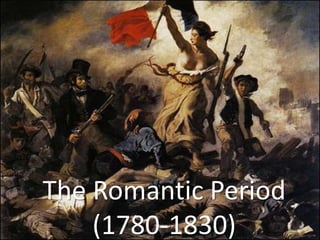
The Romantic Period
(1780-1830)
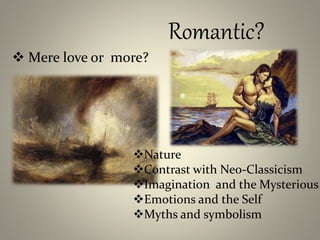
Romantic?
 Mere love or more?
Nature
Contrast with Neo-Classicism
Imagination and the Mysterious
Emotions and the Self
Myths and symbolism
• “Writers and artists particularly those associated with the
Romantic Movement not only found beauty in nature; they
also perceived truth and nobility in an earlier social age- the
Medieval period- that they then contrasted to the social
disorder of their own times” (Barthel, 88).
• “I am not made like anyone I have seen; I dare believe that I
am not made like anyone in existence. If I am not superior, at
least I am different” (Rousseau, Confessions).
Reaction to the Age of
Reason
• Age of Reason
– Reason is primal
– Emotions are unreliable
– Classical works are the best, they must be imitated
• Romanticism
– Reason alone is not enough
– Emotions are indispensable
– Imagination cannot be stopped, no boundaries
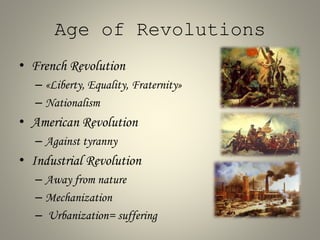
Age of Revolutions
• French Revolution
– «Liberty, Equality, Fraternity»
– Nationalism
• American Revolution
– Against tyranny
• Industrial Revolution
– Away from nature
– Mechanization
– Urbanization= suffering
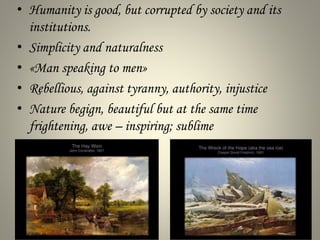
• Humanity is good, but corrupted by society and its
institutions.
• Simplicity and naturalness
• «Man speaking to men»
• Rebellious, against tyranny, authority, injustice
• Nature begign, beautiful but at the same time
frightening, awe – inspiring; sublime
Romanticism is characterized by the 5 “I”s
Imagination
Intuition and emotions
Idealism
Inspiration
Individuality
Imagination
Imagination was emphasized over
“reason.”
This was a backlash against the
rationalism characterized by the
Neoclassical period or “Age of Reason.”
Imagination was considered necessary for
creating all art.
British writer Samuel Taylor Coleridge
called it “intellectual intuition.”
Intuition
Romantics placed value on “intuition,” or
feeling and instincts, over reason.
Emotions were important in Romantic art.
British Romantic William Wordsworth
described poetry as “the spontaneous
overflow of powerful feelings.”
“I felt before I thought”
Idealism
Idealism is the concept that we can make
the world a better place.
Inspiration
The Romantic artist, musician, or writer,
is an “inspired creator” rather than a
“technical master.”
What this means is “going with the
moment” or being spontaneous, rather
than “getting it precise.”
Individuality
Romantics celebrated the individual.
During this time period, Women’s Rights
and Abolitionism were taking root as
major movements.
Walt Whitman, a later Romantic writer,
would write a poem entitled “Song of
Myself”: it begins, “I celebrate myself…”
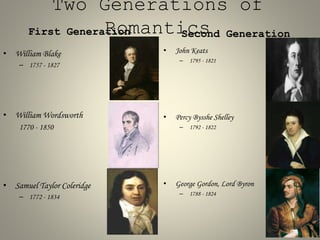
Two Generations of
Romantics
First Generation
• William Blake
– 1757 - 1827
• William Wordsworth
1770 - 1850
• Samuel Taylor Coleridge
– 1772 - 1834
Second Generation
• John Keats
– 1795 - 1821
• Percy Bysshe Shelley
– 1792 - 1822
• George Gordon, Lord Byron
– 1788 - 1824
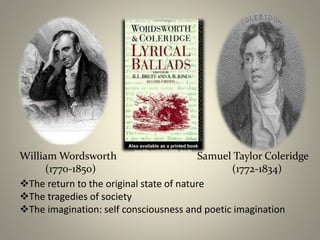
William Wordsworth
(1770-1850)
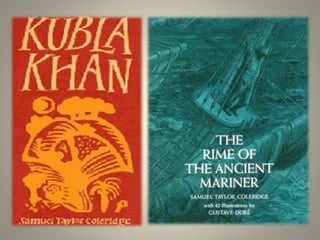
Samuel Taylor Coleridge
(1772-1834)
The return to the original state of nature
The tragedies of society
The imagination: self consciousness and poetic imagination
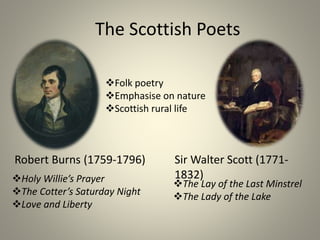
The Scottish Poets
Robert Burns (1759-1796) Sir Walter Scott (1771-
1832)
Folk poetry
Emphasise on nature
Scottish rural life
Holy Willie’s Prayer
The Cotter’s Saturday Night
Love and Liberty
The Lay of the Last Minstrel
The Lady of the Lake
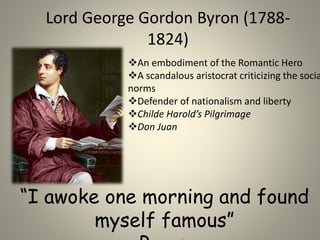
Lord George Gordon Byron (1788-
1824)
An embodiment of the Romantic Hero
A scandalous aristocrat criticizing the socia
norms
Defender of nationalism and liberty
Childe Harold’s Pilgrimage
Don Juan
“I awoke one morning and found
myself famous”
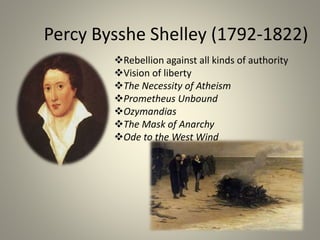
Percy Bysshe Shelley (1792-1822)
Rebellion against all kinds of authority
Vision of liberty
The Necessity of Atheism
Prometheus Unbound
Ozymandias
The Mask of Anarchy
Ode to the West Wind
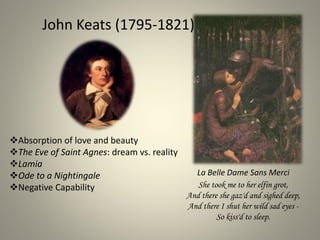
John Keats (1795-1821)
Absorption of love and beauty
The Eve of Saint Agnes: dream vs. reality
Lamia
Ode to a Nightingale
Negative Capability She took me to her elfin grot,
And there she gaz'd and sighed deep,
And there I shut her wild sad eyes -
So kiss'd to sleep.
La Belle Dame Sans Merci
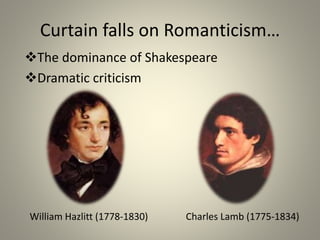
The dominance of Shakespeare
Dramatic criticism
Curtain falls on Romanticism…
William Hazlitt (1778-1830) Charles Lamb (1775-1834)
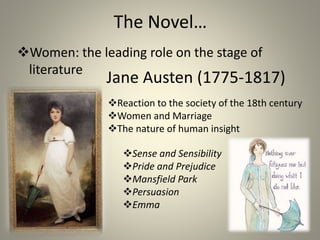
Women: the leading role on the stage of
literature
The Novel…
Reaction to the society of the 18th century
Women and Marriage
The nature of human insight
Jane Austen (1775-1817)
Sense and Sensibility
Pride and Prejudice
Mansfield Park
Persuasion
Emma
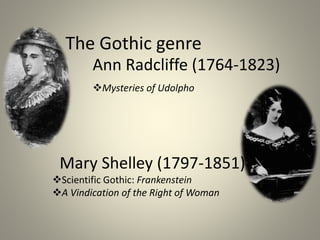
The Gothic genre
Mysteries of Udolpho
Ann Radcliffe (1764-1823)
Mary Shelley (1797-1851)
Scientific Gothic: Frankenstein
A Vindication of the Right of Woman
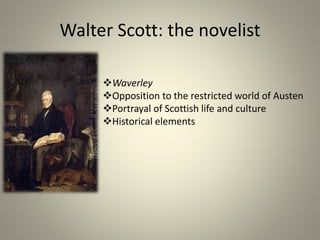
Walter Scott: the novelist
Waverley
Opposition to the restricted world of Austen
Portrayal of Scottish life and culture
Historical elements
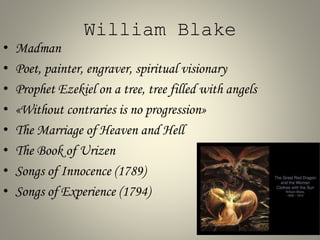
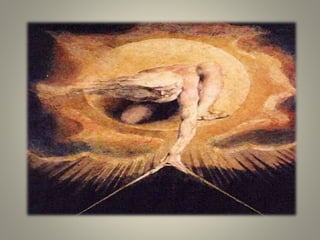
William Blake
• Madman
• Poet, painter, engraver, spiritual visionary
• Prophet Ezekiel on a tree, tree filled with angels
• «Without contraries is no progression»
• The Marriage of Heaven and Hell
• The Book of Urizen
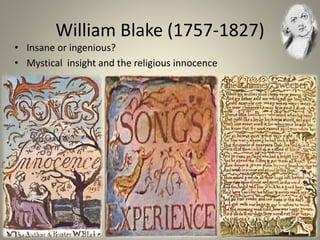
• Songs of Innocence (1789)
• Songs of Experience (1794)
• Insane or ingenious?
• Mystical insight and the religious innocence
William Blake (1757-1827)
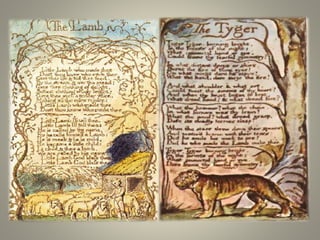
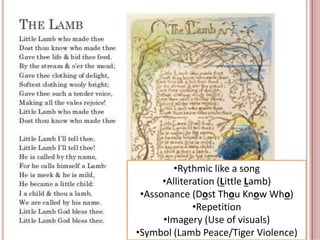
•Rythmic like a song
•Alliteration (Little Lamb)
•Assonance (Dost Thou Know Who)
•Repetition
•Imagery (Use of visuals)
•Symbol (Lamb Peace/Tiger Violence)
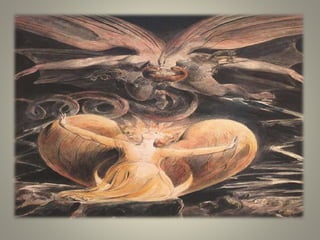
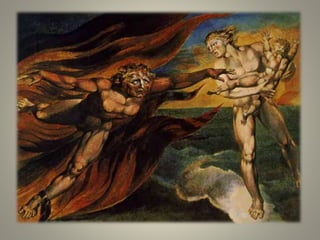
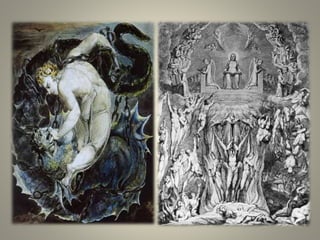
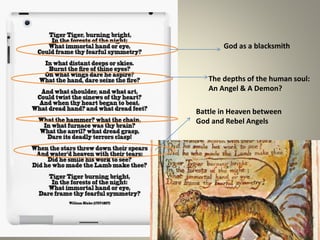
Battle in Heaven between
God and Rebel Angels
God as a blacksmith
The depths of the human soul:
An Angel & A Demon?
• Tiger => Powerful, proud, fearful, killer, evil
• Lamb => Ignorant, Meek, gentle, innocent, good
• Combined they represent life itself?
• Do we have free will?
Do we have freedom of choice?
• What does faith mean?
• In what ways are these poems reflective of
human nature / Existence?
• God as an artist and life/World as his creation?
• Why did God create the lamb & the tiger
together?

The Romantics - Blake.pptx

  • 1.
    The Romantic Period WilliamBlake’s “The Lamb” & “The Tiger”
  • 2.
  • 4.
    Romantic?  Mere loveor more? Nature Contrast with Neo-Classicism Imagination and the Mysterious Emotions and the Self Myths and symbolism
  • 5.
    • “Writers andartists particularly those associated with the Romantic Movement not only found beauty in nature; they also perceived truth and nobility in an earlier social age- the Medieval period- that they then contrasted to the social disorder of their own times” (Barthel, 88). • “I am not made like anyone I have seen; I dare believe that I am not made like anyone in existence. If I am not superior, at least I am different” (Rousseau, Confessions).
  • 6.
    Reaction to theAge of Reason • Age of Reason – Reason is primal – Emotions are unreliable – Classical works are the best, they must be imitated • Romanticism – Reason alone is not enough – Emotions are indispensable – Imagination cannot be stopped, no boundaries
  • 7.
    Age of Revolutions •French Revolution – «Liberty, Equality, Fraternity» – Nationalism • American Revolution – Against tyranny • Industrial Revolution – Away from nature – Mechanization – Urbanization= suffering
  • 8.
    • Humanity isgood, but corrupted by society and its institutions. • Simplicity and naturalness • «Man speaking to men» • Rebellious, against tyranny, authority, injustice • Nature begign, beautiful but at the same time frightening, awe – inspiring; sublime
  • 9.
    Romanticism is characterizedby the 5 “I”s Imagination Intuition and emotions Idealism Inspiration Individuality
  • 10.
    Imagination Imagination was emphasizedover “reason.” This was a backlash against the rationalism characterized by the Neoclassical period or “Age of Reason.” Imagination was considered necessary for creating all art. British writer Samuel Taylor Coleridge called it “intellectual intuition.”
  • 11.
    Intuition Romantics placed valueon “intuition,” or feeling and instincts, over reason. Emotions were important in Romantic art. British Romantic William Wordsworth described poetry as “the spontaneous overflow of powerful feelings.” “I felt before I thought”
  • 12.
    Idealism Idealism is theconcept that we can make the world a better place.
  • 13.
    Inspiration The Romantic artist,musician, or writer, is an “inspired creator” rather than a “technical master.” What this means is “going with the moment” or being spontaneous, rather than “getting it precise.”
  • 14.
    Individuality Romantics celebrated theindividual. During this time period, Women’s Rights and Abolitionism were taking root as major movements. Walt Whitman, a later Romantic writer, would write a poem entitled “Song of Myself”: it begins, “I celebrate myself…”
  • 15.
    Two Generations of Romantics FirstGeneration • William Blake – 1757 - 1827 • William Wordsworth 1770 - 1850 • Samuel Taylor Coleridge – 1772 - 1834 Second Generation • John Keats – 1795 - 1821 • Percy Bysshe Shelley – 1792 - 1822 • George Gordon, Lord Byron – 1788 - 1824
  • 16.
    William Wordsworth (1770-1850) Samuel TaylorColeridge (1772-1834) The return to the original state of nature The tragedies of society The imagination: self consciousness and poetic imagination
  • 18.
    The Scottish Poets RobertBurns (1759-1796) Sir Walter Scott (1771- 1832) Folk poetry Emphasise on nature Scottish rural life Holy Willie’s Prayer The Cotter’s Saturday Night Love and Liberty The Lay of the Last Minstrel The Lady of the Lake
  • 19.
    Lord George GordonByron (1788- 1824) An embodiment of the Romantic Hero A scandalous aristocrat criticizing the socia norms Defender of nationalism and liberty Childe Harold’s Pilgrimage Don Juan “I awoke one morning and found myself famous”
  • 20.
    Percy Bysshe Shelley(1792-1822) Rebellion against all kinds of authority Vision of liberty The Necessity of Atheism Prometheus Unbound Ozymandias The Mask of Anarchy Ode to the West Wind
  • 21.
    John Keats (1795-1821) Absorptionof love and beauty The Eve of Saint Agnes: dream vs. reality Lamia Ode to a Nightingale Negative Capability She took me to her elfin grot, And there she gaz'd and sighed deep, And there I shut her wild sad eyes - So kiss'd to sleep. La Belle Dame Sans Merci
  • 22.
    The dominance ofShakespeare Dramatic criticism Curtain falls on Romanticism… William Hazlitt (1778-1830) Charles Lamb (1775-1834)
  • 23.
    Women: the leadingrole on the stage of literature The Novel… Reaction to the society of the 18th century Women and Marriage The nature of human insight Jane Austen (1775-1817) Sense and Sensibility Pride and Prejudice Mansfield Park Persuasion Emma
  • 24.
    The Gothic genre Mysteriesof Udolpho Ann Radcliffe (1764-1823) Mary Shelley (1797-1851) Scientific Gothic: Frankenstein A Vindication of the Right of Woman
  • 25.
    Walter Scott: thenovelist Waverley Opposition to the restricted world of Austen Portrayal of Scottish life and culture Historical elements
  • 26.
    William Blake • Madman •Poet, painter, engraver, spiritual visionary • Prophet Ezekiel on a tree, tree filled with angels • «Without contraries is no progression» • The Marriage of Heaven and Hell • The Book of Urizen • Songs of Innocence (1789) • Songs of Experience (1794)
  • 27.
    • Insane oringenious? • Mystical insight and the religious innocence William Blake (1757-1827)
  • 33.
    •Rythmic like asong •Alliteration (Little Lamb) •Assonance (Dost Thou Know Who) •Repetition •Imagery (Use of visuals) •Symbol (Lamb Peace/Tiger Violence)
  • 34.
    Battle in Heavenbetween God and Rebel Angels God as a blacksmith The depths of the human soul: An Angel & A Demon?
  • 35.
    • Tiger =>Powerful, proud, fearful, killer, evil • Lamb => Ignorant, Meek, gentle, innocent, good • Combined they represent life itself? • Do we have free will? Do we have freedom of choice? • What does faith mean? • In what ways are these poems reflective of human nature / Existence? • God as an artist and life/World as his creation? • Why did God create the lamb & the tiger together?