NRT-1

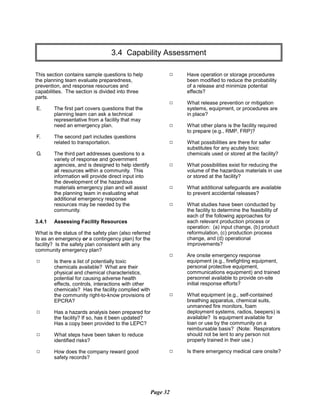
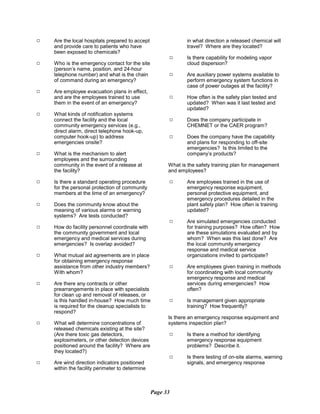
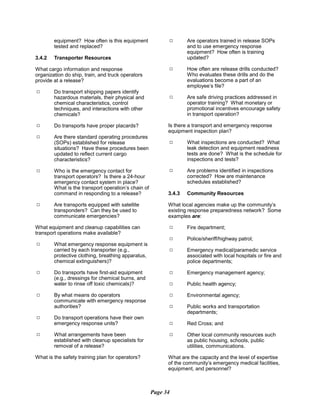
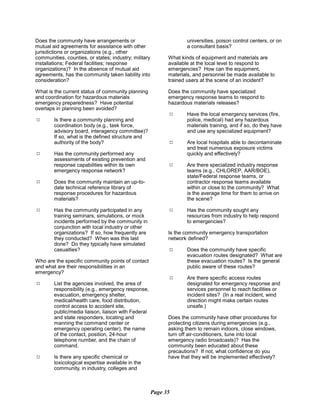
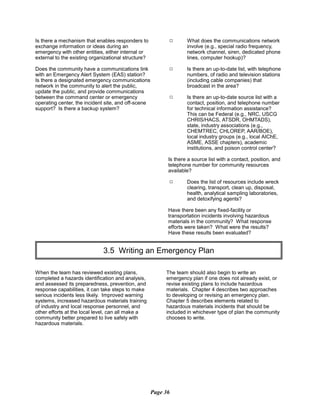
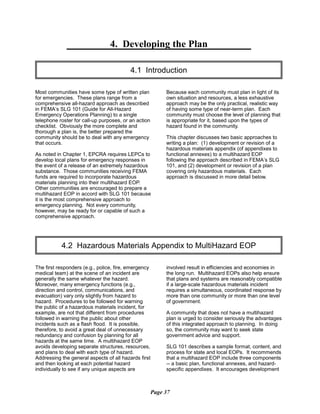
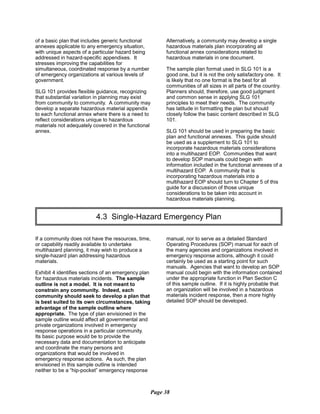
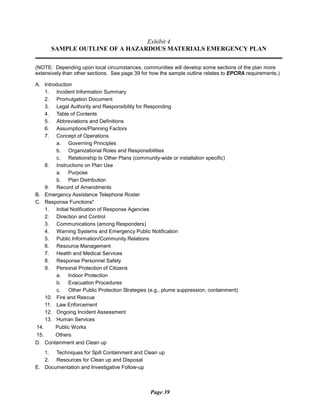
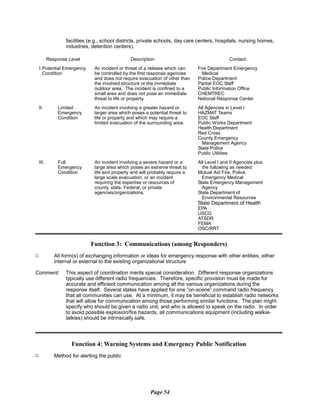
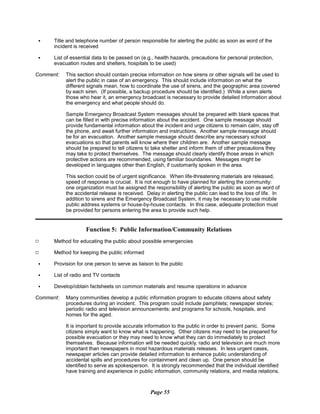
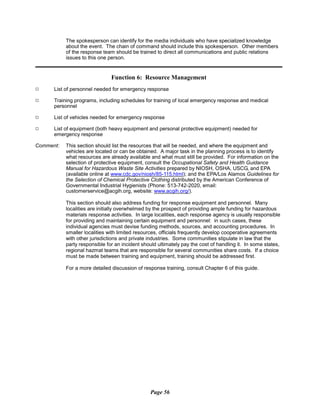
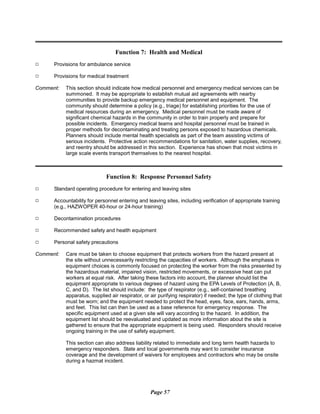
Hazardous Materials Emergency
Planning Guide
Updated 2001
NATIONAL RESPONSE TEAM
The National Response Team (NRT) – composed of 16 Federal agencies
having major responsibilities in environmental, transportation, emergency
management, worker safety, and public health areas -- is the national body
responsible for coordinating Federal planning, preparedness, and response
actions related to oil discharges and hazardous substance releases.
NRT member agencies are as follows: Environmental Protection Agency
(Chair), Department of Transportation (U.S. Coast Guard) (Vice-Chair),
Department of Commerce (National Oceanic and Atmospheric
Administration), Department of the Interior, Department of Agriculture,
Department of Defense, Department of State, Department of Justice,
Department of Transportation (Research and Special Programs
Administration), Department of Health and Human Services, Federal
Emergency Management Agency, Department of Energy, Department of
Labor, Nuclear Regulatory Commission, General Services Administration,
and Department of the Treasury.
Under the Emergency Planning and Community Right-to-Know Act of 1986,
the NRT is responsible for publishing guidance documents for the
preparation and implementation of hazardous substance emergency plans.
NRT-1 2001 Update -Summary of Changes
The NRT issued Hazardous Materials Emergency Planning Guide (NRT­
1) in 1987, as required by Emergency Planning and Community Right-to-
Know Act, to provide planning guidance for state and local governments in
the development of local emergency response plans. Since NRT-1 was
originally issued, many of the reference materials cited in the document
have either been withdrawn by the issuing agency or superseded by later
editions; in addition, much of the agency contact information cited in NRT­
1 has changed.
The NRT is issuing this update of NRT-1 to address outdated information
in the 1987 version. References to obsolete guidance have been
removed and, where applicable, replaced with references to current
guidance documents. The contact information referenced in NRT-1 has
been changed to reflect current information. Brief references to recent
legislation (e.g., Oil Pollution Act, Risk Management Programs required by
the Clean Air Act, and most recent National Contingency Plan (40CFR
Part 300) have been incorporated to encourage plan integration and
coordination. This updated version of NRT-1 includes new guidance on
integrating local emergency response plans prepared and updated by
Local Emergency Response Committees (LEPCs) with the planning
requirements contained in recent legislation. Planners are encouraged to
consult the new legislation cited in this document when updated LEPC
plans
NRT-1

Hazardous Materials Emergency
Planning Guide
July 2001
NATIONAL RESPONSE TEAM
(Replaces Hazardous Materials Emergency Planning Guide dated March 1987)
Table of Contents

PAGE
Preface . . . . . . . . . . . . . . . . . . . . . . . . . . . . . . . . . . . . . . . . . . . . . . . . . . . . . . . . . . . . . . i 

Background . . . . . . . . . . . . . . . . . . . . . . . . . . . . . . . . . . . . . . . . . . . . . . . . . . . . . . . . . ii 

1. Introduction . . . . . . . . . . . . . . . . . . . . . . . . . . . . . . . . . . . . . . . . . . . . . . . . . . . . . . . 1 

1.1 The Need for Hazardous Materials Emergency Planning . . . . . . . . . . . . . . . . . . . 1 

1.2 Purpose of This Guide . . . . . . . . . . . . . . . . . . . . . . . . . . . . . . . . . . . . . . . . . . . . . . 1 

1.3 How to Use This Guide . . . . . . . . . . . . . . . . . . . . . . . . . . . . . . . . . . . . . . . . . . . . . 2 

1.4 Requirements for Planning . . . . . . . . . . . . . . . . . . . . . . . . . . . . . . . . . . . . . . . . . . 4 

1.4.1 Federal Requirements . . . . . . . . . . . . . . . . . . . . . . . . . . . . . . . . . . . . . . . . . 4 

A. National Contingency Plan . . . . . . . . . . . . . . . . . . . . . . . . . . . . . . . . . . . 4 

B. Emergency Planning and Community Right-to-Know Act . . . . . . . . . . . . 6 

C. Resource Conservation and Recovery Act . . . . . . . . . . . . . . . . . . . . . . . 7 

D. Clean Air Act Risk Management Program Requirements . . . . . . . . . . . . 8 

E. FEMA Emergency Operations Plan Requirements . . . . . . . . . . . . . . . . 8 

F. Federal Radiological Emergency Response Plan . . . . . . . . . . . . . . . . . 8 

G. HAZWOPER . . . . . . . . . . . . . . . . . . . . . . . . . . . . . . . . . . . . . . . . . . . . . . 8 

H. The Oil Pollution Act of 1990 . . . . . . . . . . . . . . . . . . . . . . . . . . . . . . . . . . 9 

1.4.2 State and Local Requirements . . . . . . . . . . . . . . . . . . . . . . . . . . . . . . . . . . 10 

1.5 	Related Programs and Materials . . . . . . . . . . . . . . . . . . . . . . . . . . . . . . . . . . . . . 10 

1.5.1 FEMA’s Integrated Emergency Management System (SLG 101)

Chemistry Council Community Awareness and Emergency

Response and Transportation Community Awareness and Emergency

Response Programs

. . . . . . . . . . . . . . . . . . . . . . . . . . . . . . . . . . . . . . . . . . . . . . . . . . . . . . . . . . 11 

1.5.2 EPA’s Chemical Emergency Preparedness and Prevention Office . . . . . . 11 

1.5.3 DOT Materials . . . . . . . . . . . . . . . . . . . . . . . . . . . . . . . . . . . . . . . . . . . . . . 11 

1.5.4 American
. . . . . . . . . . . . . . . . . . . . . . . . . . . . . . . . . . . . . . . . . . . . . . . . . . . . . . . . . . 11 

1.5.5 Hazardous Materials Safety Assistance Team . . . . . . . . . . . . . . . . . . . . . . 12 

1.5.6 Response to Terrorist Events . . . . . . . . . . . . . . . . . . . . . . . . . . . . . . . . . . . 12 

1.5.7 National Fire Protection Association . . . . . . . . . . . . . . . . . . . . . . . . . . . . . . 13 

1.5.8 National Preparedness for Response Exercise Program . . . . . . . . . . . . . . 13 

1.5.9 Chemical Hazards Response Information System . . . . . . . . . . . . . . . . . . . 14 

2. Selecting and Organizing the Planning Team . . . . . . . . . . . . . . . . . . . . . . . . . . . . 14 

2.1 	Introduction . . . . . . . . . . . . . . . . . . . . . . . . . . . . . . . . . . . . . . . . . . . . . . . . . . . . . 14 

2.2 	The Planning Team . . . . . . . . . . . . . . . . . . . . . . . . . . . . . . . . . . . . . . . . . . . . . . . 14 

2.2.1 Forming the Planning Team . . . . . . . . . . . . . . . . . . . . . . . . . . . . . . . . . . . . 15 

2.2.2 Respecting All Legitimate Interests . . . . . . . . . . . . . . . . . . . . . . . . . . . . . . 15
Table of Contents(Continued)
2.2.3 Understanding the Special Importance of Local Governments . . . . . . . . . . 15 

2.2.4 Getting Local Industry Involved . . . . . . . . . . . . . . . . . . . . . . . . . . . . . . . . . 16 

2.2.5 Determining the Size of Planning Team . . . . . . . . . . . . . . . . . . . . . . . . . . . 16 

2.3 	Organizing the Planning Process . . . . . . . . . . . . . . . . . . . . . . . . . . . . . . . . . . . . 17 

a Team Leader . . . . . . . . . . . . . . . . . . . . . . . . . . . . . . . . . . . . . . 17 
2.3.1 Selecting
2.3.2 Organizing for Planning Team Responsibilities . . . . . . . . . . . . . . . . . . . . . 18 

2.4 	Beginning to Plan . . . . . . . . . . . . . . . . . . . . . . . . . . . . . . . . . . . . . . . . . . . . . . . . 21 

3. Tasks of the Planning Team . . . . . . . . . . . . . . . . . . . . . . . . . . . . . . . . . . . . . . . . . . 21 

3.1 	Introduction . . . . . . . . . . . . . . . . . . . . . . . . . . . . . . . . . . . . . . . . . . . . . . . . . . . . . 21 

3.2 	Review of Existing Plans . . . . . . . . . . . . . . . . . . . . . . . . . . . . . . . . . . . . . . . . . . . 21 

3.3 	Hazards Analysis: Hazards Identification, Vulnerability Analysis, Risk Analysis . 22

3.3.1 Developing the Hazards Analysis . . . . . . . . . . . . . . . . . . . . . . . . . . . . . . . . 23 

3.3.2 Obtaining Facility Information . . . . . . . . . . . . . . . . . . . . . . . . . . . . . . . . . . . 25 

3.3.3 An Example of Hazards Analysis . . . . . . . . . . . . . . . . . . . . . . . . . . . . . . . . 27 

3.4 Capability Assessment . . . . . . . . . . . . . . . . . . . . . . . . . . . . . . . . . . . . . . . . . . . . 30 

3.4.1 Assessing Facility Resources . . . . . . . . . . . . . . . . . . . . . . . . . . . . . . . . . . . 30 

Resources . . . . . . . . . . . . . . . . . . . . . . . . . . . . . . . . . . . . . . . . 32 
3.4.2 Transporter
3.4.3 Community Resources . . . . . . . . . . . . . . . . . . . . . . . . . . . . . . . . . . . . . . . . 32 

3.5 	Writing an Emergency Plan . . . . . . . . . . . . . . . . . . . . . . . . . . . . . . . . . . . . . . . . . 34 

4. Developing the Plan . . . . . . . . . . . . . . . . . . . . . . . . . . . . . . . . . . . . . . . . . . . . . . . 35 

4.1 	Introduction . . . . . . . . . . . . . . . . . . . . . . . . . . . . . . . . . . . . . . . . . . . . . . . . . . . . . 35 

4.2 	Hazardous Materials Appendix to MultiHazard EOP . . . . . . . . . . . . . . . . . . . . . . 35 

4.3 	Single-Hazard Emergency Plan . . . . . . . . . . . . . . . . . . . . . . . . . . . . . . . . . . . . . . 36 

5. Hazardous Materials Planning Elements . . . . . . . . . . . . . . . . . . . . . . . . . . . . . . . . 39 

5.1 	Introduction . . . . . . . . . . . . . . . . . . . . . . . . . . . . . . . . . . . . . . . . . . . . . . . . . . . . . 39 

5.2 	Discussion of Planning Elements . . . . . . . . . . . . . . . . . . . . . . . . . . . . . . . . . . . . 40 

6. Plan Appraisal and Continued Planning . . . . . . . . . . . . . . . . . . . . . . . . . . . . . . . . 65 

6.1 	Introduction . . . . . . . . . . . . . . . . . . . . . . . . . . . . . . . . . . . . . . . . . . . . . . . . . . . . . 65 

6.2 	Plan Review and Approval . . . . . . . . . . . . . . . . . . . . . . . . . . . . . . . . . . . . . . . . . . 65 

6.2.1.Internal Review . . . . . . . . . . . . . . . . . . . . . . . . . . . . . . . . . . . . . . . . . . . . . . 65 

6.2.2.External Review . . . . . . . . . . . . . . . . . . . . . . . . . . . . . . . . . . . . . . . . . . . . . 65
Table of Contents(Continued)
6.2.3.Plan Approval . . . . . . . . . . . . . . . . . . . . . . . . . . . . . . . . . . . . . . . . . . . . . . . 66 

6.3 	Keeping the Plan Up-to-Date . . . . . . . . . . . . . . . . . . . . . . . . . . . . . . . . . . . . . . . . 66 

6.4 	Continuing Planning . . . . . . . . . . . . . . . . . . . . . . . . . . . . . . . . . . . . . . . . . . . . . . 68 

APPENDIX A: EMERGENCY PLANNING AND COMMUNITY

APPENDIX D: CRITERIA FOR ASSESSING STATE AND

APPENDIX F: HOTLINE NUMBERS AND

6.4.1 Exercises . . . . . . . . . . . . . . . . . . . . . . . . . . . . . . . . . . . . . . . . . . . . . . . . . . 68 

6.4.2 Incident Review . . . . . . . . . . . . . . . . . . . . . . . . . . . . . . . . . . . . . . . . . . . . . 68 

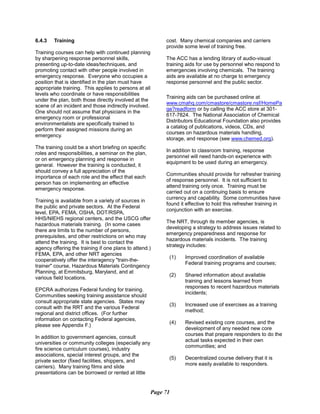
6.4.3 Training . . . . . . . . . . . . . . . . . . . . . . . . . . . . . . . . . . . . . . . . . . . . . . . . . . . . 69 

RIGHT-TO-KNOW ACT . . . . . . . . . . . . . . . . . . . . . . . . . . . . . . . . . . . . . . . . . . . A-1 

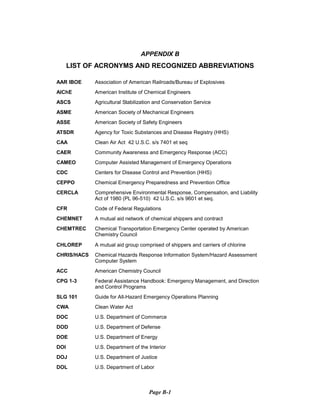
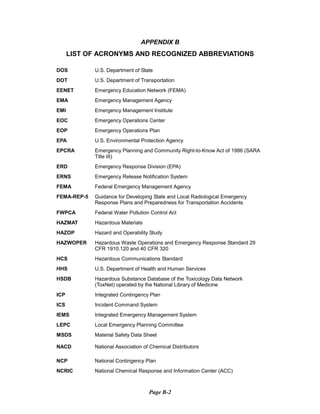
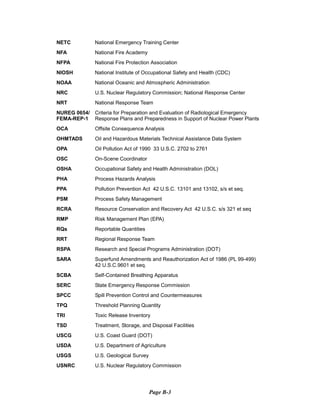
APPENDIX B: LIST OF ACRONYMS AND RECOGNIZED ABBREVIATIONS . . . . B-1 

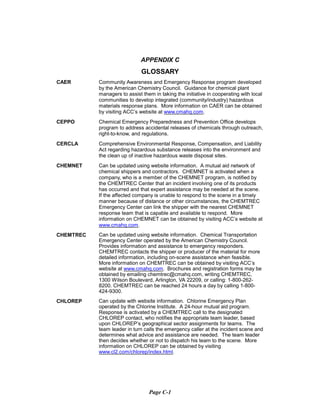
APPENDIX C: GLOSSARY . . . . . . . . . . . . . . . . . . . . . . . . . . . . . . . . . . . . . . . . . . . B-1 

LOCAL PREPAREDNESS . . . . . . . . . . . . . . . . . . . . . . . . . . . . . . . . . . . . . . . . . D-1 

APPENDIX E: BIBLIOGRAPHY . . . . . . . . . . . . . . . . . . . . . . . . . . . . . . . . . . . . . . . E-1 

FEDERAL AGENCY WEBSITE ADDRESSES . . . . . . . . . . . . . . . . . . . . . . . . . F-1 

APPENDIX G: NCP EXHIBITS . . . . . . . . . . . . . . . . . . . . . . . . . . . . . . . . . . . . . . . . G-1
Preface

All over America, large and small communities
are learning about nearby hazardous materials.
Trains derail. Trucks overturn. Pipelines rupture.
Ships collide and run aground. Facilities handling
chemicals have accidental leaks and releases.
This guidance will help local communities prepare
for incidents that may involve hazardous
materials. Some communities already have
integrated multihazard plans; other communities
are only now beginning to plan. This guidance
describes how to form a local planning team, find
a team leader, identify and analyze hazards,
identify existing response equipment and
personnel, write a plan, and keep a plan up-to­
date.
This guidance can be used both by local
communities developing their own plan, and by
Local Emergency Planning Committees (LEPCs)
formed in accordance with the Emergency
Planning and Community Right-to-Know Act of
1986 (EPCRA). This legislation makes it
mandatory for LEPCs to prepare an emergency
plan for possible releases of hazardous
substances, and for fixed facilities to cooperate in
this planning process. A detailed summary of this
legislation appears in Appendix A; the legislation
is referenced throughout this guide.
Information gathered during the planning process
will help communities take steps to minimize the
impact of incidents. Improved warning systems,
increased training of industry and local response
personnel in handling hazardous materials,
and other efforts at the local level, can all make a
community better prepared to
prevent and respond to hazardous materials
incidents.
Each community must plan according to its own
situation:
9	 The size of the community
(smaller communities may have
fewer hazards, but also fewer
planning and response resources
for the hazards they do have);
9	 The level of danger (small
communities are sometimes
surrounded by large industry or
are transportation corridors
between cities with large
industries); and
9	 Preparedness for planning (some
communities have active
planning agencies, while other
communities have yet to form
their first planning committee).
There is no single right way to write a plan. This
guidance presents a comprehensive approach to
planning. Small communities with few planning
resources, or communities with few or no
threatening hazards, can choose the planning
elements appropriate to their circumstances.
Every community, however, should evaluate its
preparedness for responding to a hazardous
materials incident, and act accordingly.
Sixteen Federal agencies have cooperated to
produce this guidance. We have tried to make
this guide consistent with other guides that might
be used during the planning process. We hope
that this unified approach will help your
community.
i
The Background of This Guidance

This Hazmat Emergency Planning Guide has
been developed cooperatively by 16 Federal
agencies. It is being published by the NRT in
compliance with Section 303(f) of EPCRA (42
U.S.C. 11011 et seq.).
This guide replaces the Federal Emergency
Management Agency’s (FEMA) Planning Guide
and Checklist for Hazardous Materials
Contingency Plans (popularly known as FEMA­
10).
This guide also incorporates material from the
U.S. Environmental Protection Agency’s (EPA)
interim guidance for its Chemical Emergency
Preparedness and Prevention Office (CEPPO)
published late in 1985. Included are Chapters 2
(“Organizing the Community”), 4 (“Contingency
Plan Development and Content”), and 5
(“Contingency Plan Appraisal and Continuing
Planning”). EPA’s Technical Guidance for
Hazards Analysis (also known as the “Green
Book”) includes site-specific guidance, criteria for
identifying extremely hazardous substances,
descriptions of hazardous chemicals, and a list of
such substances. Planners should use this
general planning guide in conjunction with the
CEPPO materials.
In recent years, the U.S. Department of
Transportation (DOT) has been active in
emergency planning. The Research and Special
Programs Administration (RSPA) has published
transportation-related reports and guides and has
contributed to this general planning guide. The
U.S. Coast Guard (USCG) has actively
implemented planning and response
requirements of the National Contingency Plan
(NCP) and has contributed to this general
planning guide.
The U.S. Occupational Safety and Health
Administration (OSHA) and the U.S. Agency for
Toxic Substances and Disease Registry (ATSDR)
have assisted in preparing this general planning
guide.
In addition to its FEMA-10, FEMA has developed
and published a variety of planning-related
materials. Of special interest here is Guide for
Development of State and Local Emergency
Operations Plans (known as SLG 101) that
encourages communities to develop multihazard
emergency operations plans (EOPs) covering all
hazards facing a community (e.g., floods,
earthquakes, hurricanes, as well as hazardous
materials incidents). This general planning guide
complements SLG 101 and indicates in Chapter
4 how hazardous materials planners can develop
or revise a multihazard EOP. Chapter 4 also
describes a sample outline for an emergency
plan covering only hazardous materials, if a
community does not have the resources to
develop a multihazard EOP.
The terms contingency plan, emergency plan,
and emergency operations plan are often used
interchangeably, depending upon whether one is
reading the NCP, SLG 101, or other planning
guides. This guide consistently refers to
emergency plans and emergency planning.
This guide will consistently use hazardous
materials when generally referring to hazardous
substances, petroleum, natural gas,* synthetic
gas, acutely toxic chemicals, and other toxic
chemicals. EPCRA uses the term extremely
hazardous substances to indicate those
chemicals that could cause serious irreversible
health effects from accidental releases.
The major differences between this document
and other versions proposed for review are the
expansion of the hazards analysis discussion
(Chapter 3) and the addition of Appendix A
explaining the planning provisions of EPCRA.
* We recognize that natural gas is under a
specific statute, but because this is a general
planning guide, local planners may want to
consider natural gas.
Page ii
1. Introduction

1.1 The Need for Hazardous Materials Emergency Planning

Major disasters like that in Bhopal, India, in
December 1984, which resulted in more than
2,000 deaths and over 100,000 injuries, are rare.
Reports of spills and releases of hazardous
materials, however, are increasingly
commonplace. Thousands of new chemicals are
developed each year. Citizens and officials are
concerned about accidents (e.g., highway
incidents, warehouse fires, train derailments,
shipping accidents, industrial incidents)
happening in their communities. Recent
evidence shows that many people consider
hazardous materials incidents to be the most
significant threat facing local jurisdictions. The
U.S. Department of Health and Human Services
(HHS) gathered data on hazardous substance
emergency events from 13 states between 1993
and 1998.
This study shows that the number of fixed-facility
and transportation-related hazardous substance
emergency events increased by 53 percent
between 1993 and 1998.
Because of the risk of incidents involving
hazardous materials incidents and because local
governments will be completely on their own in
the first stages of almost any such incident,
communities need to maintain a continuing
preparedness capacity. A specific, tangible result
of being prepared is an emergency plan. Some
communities might have sophisticated and
detailed written plans but, if the plans have not
recently been tested and revised, these
communities might be less prepared than they
think to handle a hazardous materials incident.
1.2 Purpose of This Guide

The purpose of this guide is to help communities
plan for hazardous materials incidents.
Communities refers primarily to local jurisdictions.
There are other groups of people, however, that
can profitably use this guide. Rural areas with
limited resources may need to plan at the county
or regional level. State officials seeking to
develop a state emergency plan that is closely
coordinated with local plans can adapt this
guidance to their purposes. Likewise, officials of
facilities handling chemicals, railroad yards, and
shipping and trucking companies can use this
guidance to coordinate their own hazardous
materials emergency planning with that of the
local community.
Hazardous materials refers generally to
hazardous substances, petroleum, natural gas,
synthetic gas, acutely toxic chemicals, and other
toxic chemicals. Extremely hazardous
substances is used in EPCRA to refer to those
chemicals that could cause serious health effects
following short-term exposure from accidental
releases. EPA has listed 356 extremely
hazardous substances for which emergency
planning is required. Because this list may be
revised, planners should contact EPA regional
offices to obtain information or contact CEPPO or
visit the CEPPO website. This guidance deals
specifically with response to hazardous materials
incidents--both at fixed facilities (manufacturing,
processing, storage, and disposal) and during
transportation (highways, waterways, rail,
pipelines, and air). Plans for responding to
radiological incidents and natural emergencies
such as hurricanes, floods, and earthquakes are
not the focus of this guidance, although most
aspects of plan development and appraisal are
common to these emergencies. Communities
should see NUREG 0654/FEMA-REP-1 (Rev. 1)
for assistance in radiological planning. (See
Appendix C.) Communities should be prepared,
however, for the possibility that natural
Page 1
emergencies, radiological incidents, and
hazardous materials incidents will cause or
reinforce each other.
The objectives of this guide are to:
9 Focus community attention on
emergency preparedness and
response;
9 Provide information that
communities will find useful in
organizing the planning task;
9	 Furnish criteria to determine risk
and to help communities decide
whether they need to plan for
hazardous materials incidents;
9	 Help communities conduct
planning that is consistent with
their needs and capabilities; and
9	 Provide a method for continually
updating a community’s
emergency plan.
This guide will not:
9	 Give a simple “fill-in-the-blanks”
model plan (because each
community needs an emergency
plan suited to its own unique
circumstances);
9	 Provide details on response
techniques; or
9	 Train personnel to respond to
incidents.
Community planners will need to consult other
resources in addition to this guide. Related
programs and materials are discussed in Section
1.5.
1.3 How to Use This Guide

This guide has been designed so it can be used
easily by communities with little or no planning
experience and by those with extensive planning
experience.
All planners should consult the decision tree in
Exhibit 1 for assistance in using this guide.
Chapter 2 describes how communities can
organize a planning team. Communities that are
beginning the emergency planning process for
the first time will need to follow Chapter 2 very
closely in order to organize their efforts
effectively. Communities with an active planning
agency might briefly review Chapter 2, to be sure
that all of the appropriate people are included in
the planning process, and move on to Chapter 3
for a detailed discussion of tasks for hazardous
materials planning. Planners should review
existing emergency plans, identify and analyze
hazards, assess prevention and response
capabilities, and then write or revise an
emergency plan.
Chapter 4 discusses two basic approaches to
writing an emergency plan: (a) incorporating
hazardous materials planning into a multihazard
EOP (see Section 1.5.1); and (b) developing or
revising a plan dealing only with hazardous
materials. Incorporating hazardous materials
planning into a multihazard approach is
preferable. Some communities, however, lack
the capability and the resources to do this
immediately. Communities that choose to
develop or revise an EOP should consult FEMA’s
SLG 101 for specific requirements for the plan, in
addition to the discussion in Section 1.5.1.
Communities that choose to develop or revise a
single-hazard plan for hazardous materials can
use the sample outline of an emergency plan in
Chapter 4 to organize the various hazardous
materials planning elements. (Note:
Communities receiving FEMA funds must
incorporate hazardous materials planning into a
multihazard EOP.)
Page 2
Exhibit 1
OVERVIEW OF PLANNING PROCESS
Start
Determine that a Plan is

Needed

Select Planning Team
Members and Team Leader
(See Chapter 2)
Begin to Plan
Assess Response
Capabilities
Review and Coordinate with
Existing Plans
(See Chapter 3)
Conduct Hazards
Identification and Analysis
(See Chapter 3)
Assess Industry Response
Capabilities
(See Chapter 3)
Assess Community
Response Capabilities
(See Chapter 3)
Write Plan
(See Chapters 4 and 5)
Develop or Revise Multi-
Hazard Emergency
Operations Plan
(See Chapter 4)
Develop or Revise
Hazardous Materials
Emergency Plan
(See Chapter 4)
Seek Plan Approval
Revise, Test, and
Maintain Plan
(See Chapter 6)
or
Page 3
Chapter 5 describes the elements to be
considered when planning for potential hazardous
materials incidents. All communities (both those
preparing an EOP under the multihazard
approach and those preparing a single-hazard
plan) should carefully follow the instructions in
Chapter 5 to ensure that they consider and
include the planning elements related to
hazardous materials.
Chapter 6 describes how to review and update a
plan. Experience shows that many communities
mistakenly assume that completing an
emergency plan automatically ensures adequate
preparedness for emergency response. All
communities should follow the recommendations
in Chapter 6 to ensure that emergency plans will
be helpful during a real incident.
Appendix A is a summary for implementing the
Emergency Planning and Community Right-to-
Know Act of 1986. Appendix B is a list of
acronyms and abbreviations used in this
guidance.
Appendix C is a glossary of terms used
throughout this guide. (Because this guide
necessarily contains many acronyms and
technical phrases, local planners should
regularly consult Appendixes B and C.)
Appendix D contains criteria for assessing state
and local preparedness. Planners should use
this appendix as a checklist to evaluate their
hazards analysis, the legal authority for
responding, the response organizational
structure, communication systems, resources,
and the completed emergency plan. Appendix E
is a list of references on various topics addressed
in this guidance. Appendix F is a listing of
addresses of Federal agencies at the national
level. Planners should contact the appropriate
office for assistance in the planning process.
1.4 Requirements for Planning

Planners should understand Federal, state, and
local requirements that apply to emergency
planning. The information included in this section
may change periodically. You should contact
regional representatives of the offices discussed
below for the most current information on Federal
planning requirements. Appendix F lists contact
information for Federal agencies.
1.4.1 Federal Requirements
This section discusses the principal Federal
planning requirements found in the NCP; EPCRA;
the Resource Conservation and Recovery Act
(RCRA); the Risk Management Program (RMP);
the Oil Pollution Act (OPA); FEMA’s requirements
for EOPs, and OSHA regulations.
A. National Contingency Plan
The National Oil and Hazardous Substances
Pollution Contingency Plan (NCP), required by
section 105 of the Comprehensive Environmental
Response, Compensation, and Liability Act
(CERCLA), establishes the roles and
responsibilities of various federal agencies to
provide for efficient, coordinated, and effective
action to minimize damage from oil discharges
and hazardous substances releases. The NRT,
comprised of representatives from 16 Federal
agencies with major environmental,
transportation, emergency management, worker
safety, and public health responsibilities, is
responsible for coordinating Federal emergency
preparedness and planning on a nationwide
basis.
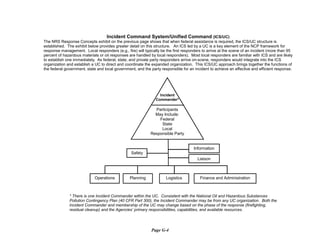
An essential element of the NCP framework for
response management is the Incident Command
System (ICS) led by a unified command. This
unified command approach brings together the
functions of the federal government, state and
local government, and the party responsible for
an incident to achieve an effective and efficient
response. Unified Command (UC) is a necessary
tool for effectively managing multijurisdictional
responses to oil spills and hazardous substances
releases.
A key element of Federal support to local
responders during hazardous materials
transportation and fixed-facility incidents is a
response by USCG or EPA On-Scene
Coordinators (OSCs). The OSC is the Federal
official predesignated to coordinate and direct
Federal responses and removals under the NCP.
Page 4
These OSCs are assisted by Regional Response
Teams (RRTs) that are available to provide
advice and support to the OSC and, through the
OSC, to local responders.
Federal responses may be triggered by a report
to the National Response Center, operated by the
USCG. Provisions of the Federal Water Pollution
Control Act (Clean Water Act or CWA), CERCLA
(Superfund), and various other Federal laws
require persons responsible for a discharge or
release to notify the National Response Center
immediately. The National Response Center
Duty Officer promptly relays each report to the
appropriate USCG or EPA OSC, depending on
the location of an incident. Based on this initial
report and any other information that can be
obtained, the OSC makes a preliminary
assessment of the need for a Federal response.
Managing a response, especially a complex,
multi-jurisdictional response is one of the most
important challenges facing the National
Response System (NRS). The OSC, the
state/local government representatives, and the
responsible party all are involved with varying
degrees of responsibility, regardless of the size or
severity of the incident. Effective coordination
between all of these groups at the scene of a
response is a key factor in ensuring successful
response to incidents.
The emphasis during spill response is on unified
government and industry action. An ICS/UC is an
efficient on-site tool to manage all emergency
response incidents, and the UC is a necessary
tool for managing multi-jurisdictional responses to
oil spills or hazardous substance releases. The
NCP states that the NRS functions as an ICS
under the direction of the Federal On-Scene
Coordinator (FOSC). When planned for and
practiced, ICS/UC is viewed as the most effective
response management system to address
discharges or releases.
In every case, the OSC retains the authority to
direct the spill response, and must direct
responses to spills that pose a substantial threat
to the public health or welfare of the United
States. However, on occasion, the OSC will
choose to assume a supervisory status. Here,
the OSC oversees the actions of the responsible
party and/or state/local governments providing
support and advice where appropriate. This
activity may or may not require the OSC or
his/her representative to go to the scene of an
incident. The USCG has OSCs at 45 locations
(zones) in 9 districts, and the EPA has OSCs in
its 10 regional offices and in certain EPA field
offices. (See Appendix F for appropriate Federal
agency contact information and website
addresses.)
RRTs are composed of representatives from
Federal agencies and a representative from each
state within a Federal region. During a response
to a major hazardous materials incident involving
transportation or a fixed facility, the OSC may
request that the RRT be convened to provide
advice or recommendations on specific issues
requiring resolution.
As a result of amendments to OPA in 1990, the
NCP was augmented to enhance preparedness
and planning activities on the part of the Federal
government. Subpart C of the NCP “Planning
and Preparedness” (§300.200) summarizes
emergency preparedness activities relating to
discharges of oil and releases of hazardous
substances, pollutants, or contaminants;
describes the three levels of contingency
planning under the National Response System
(NRS); and cross-references state and local
emergency preparedness activities under the
Superfund Amendment and Reauthorization Act
(SARA) Title III, also known as EPCRA. The
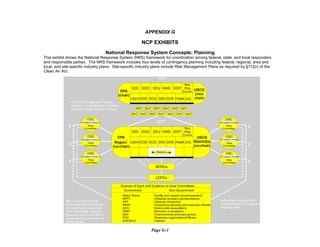
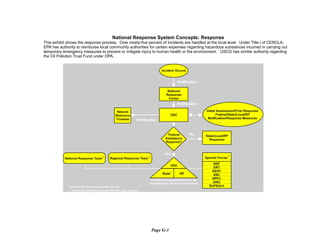
organizational concepts of the NRS are depicted
in the following figures in Appendix G: National
Response System Concepts: Planning; National
Response System Concepts: Relationship of
Plans; and National Response System Concepts:
Response.
EPCRA formalized local hazmat emergency
planning as a component of the NRS and
established the infrastructure that integrated
emergency preparedness activities (e.g.,
exercises, chemical emergencies, response
plans) at all levels of government.
At the regional level, planning and coordination is
accomplished through the standing RRTs. Each
standing RRT is responsible for developing and
maintaining a Regional Contingency Plan (RCP),
which is required under the NCP as part of the
NRS. The purpose of the RCP is to ensure that
the roles and responsibilities of Federal, state,
local, and other responders at an incident site are
clearly defined in advance of the incident. To the
greatest extent possible, any RCP must follow the
format of the NCP, and must be coordinated with
state emergency response plans, Area
Page 5
Contingency Plans (ACPs), and local emergency
response plans, as described below.
Under OPA, Area Committees are charged with
the responsibility to work with state and local
officials to enhance contingency planning and to
assure early planning for joint response efforts.
In the same way that RRTs develop RCPs, Area
Committees are required under the NCP to
develop ACPs, which describe the strategy for a
coordinated Federal, state, and local response to
a discharge of oil or a release of a hazardous
substance. The OSC responsible for the area
oversees the process and works with the
standing RRT and designated state, local, and
Indian tribal representatives throughout the ACP’s
development. The standing RRT can review the
ACP and serve as a mechanism to provide
feedback and guidance to Area Committees to
ensure inter-area consistency and consistency of
individual ACPs with the RCP and the NCP.
Under EPCRA, a State Emergency Response
Commission (SERC) is to be appointed by the
Governor of each state. The SERC is to
designate emergency planning districts, appoint
LEPCs, supervise and coordinate their activities,
and review local emergency response plans.
Each LEPC prepares a local emergency
response plan for its community and establishes
procedures for receiving and processing requests
from the public for information generated by
requests under Title III reporting requirements.
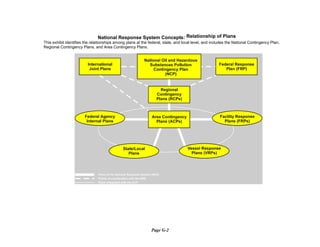
The relationship of the NCP, ACPs, RCPs, and
local plans is described in Figure 2 in Appendix
G.
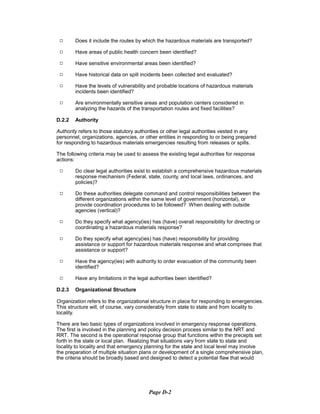
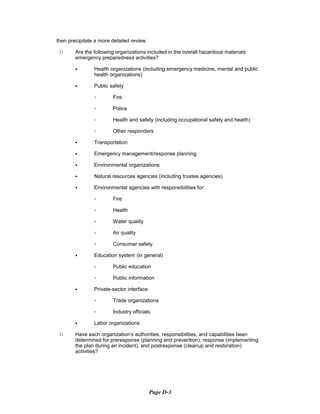
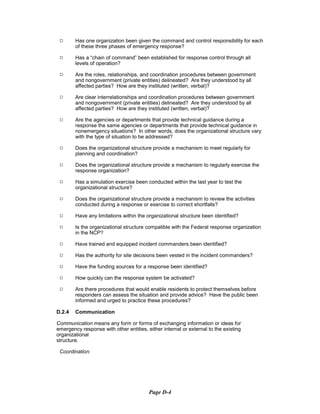
Appendix D of this guide contains an adaptation
of extensive criteria developed by the NRT
Preparedness Committee to assess state and
local emergency response preparedness
programs. These criteria should be used in
conjunction with Chapters 3, 4, and 5 of this
guide.
B.	 Emergency Planning and Community
Right-to-Know Act
Significant requirements for hazardous materials
emergency planning are contained in EPCRA.
(See Appendix A for a detailed summary on
implementing EPCRA.)
EPCRA requires the establishment of SERCs,
emergency planning districts, and LEPCs. The
Governor of each state appoints a SERC whose
responsibilities include designating emergency
planning districts; appointing local emergency
planning committees for each district; supervising
and coordinating the activities of planning
committees; reviewing emergency plans;
receiving chemical release notifications; and
establishing procedures for receiving and
processing requests from the public for
information about and copies of emergency
response plans, material safety data sheets, and
chemical inventory forms.
Forming emergency planning districts is intended
to facilitate the preparation and implementation of
emergency plans. Planning districts may be
existing political subdivisions or multijurisdictional
planning organizations. The LEPC for each
district must include representatives from each of
the following groups or organizations:
9 Elected state and local officials;
9 Law enforcement, firefighting,
health, local environmental,
hospital, and transportation
personnel;
9 Broadcast and print media;
9 Community groups; and
9 Owners and operators of
facilities subject to the
requirements of EPCRA.
Each LEPC is to establish procedures for
receiving and processing requests from the public
for information about and copies of emergency
response plans, material safety data sheets, and
chemical inventory forms. The committee must
designate an official to serve as coordinator of
information.
Facilities are subject to emergency planning and
notification requirements if a substance on EPA’s
list of extremely hazardous substances is present
at the facility in an amount above the threshold
planning quantity for that substance (40 CFR part
355). The Title III Consolidated List of Lists
provides more detail on regulated substances
and can be found at www.epa.gov/ceppo. The
owner or operator of each facility subject to these
requirements must notify the appropriate SERC
that the facility is subject to the requirements.
Each facility must also notify the appropriate
Page 6
LEPC of a facility representative who will
participate in the emergency planning process as
a facility emergency coordinator. Upon request,
facility owners and operators are to provide the
appropriate LEPC with information necessary for
developing and implementing the emergency plan
for the planning district.
EPCRA provisions help to ensure that adequate
information is available for the LEPC to know
which facilities to cover in the plan. (See
Appendix A for a discussion of how the LEPC can
use information generated by EPCRA.) Section
303(d)(3) requires facility owners and operators
to provide to the LEPC whatever information is
necessary for developing and implementing the
plan.
When there is a release of a chemical identified
by EPCRA, a facility owner or operator, or a
transporter of the chemical, must notify the
community emergency coordinator for the LEPC
for each area likely to be affected by the release,
and the SERC of any state likely to be affected by
the release. (This EPCRA requirement does not
replace the legal requirement to notify the
National Response Center for releases of
CERCLA Section 103 hazardous substances.)
Each LEPC reviews its emergency plan annually.
The committee also evaluates the need for
resources to develop, implement, and exercise
the emergency plan; and makes
recommendations with respect to additional
needed resources and how to provide them.
Each emergency plan must include facilities and
transportation routes related to specific
chemicals; response procedures of facilities, and
local emergency and medical personnel; the
names of community and facility emergency
coordinators; procedures for notifying officials
and the public in the event of a release; methods
for detecting a release and identifying areas and
populations at risk; a description of emergency
equipment and facilities in the community and at
specified fixed facilities; evacuation and shelter-
in-place plans; training programs; and
schedules for exercising the emergency plan.
(These plan requirements are listed in greater
detail in Chapter 5.) The completed plan shall be
reviewed by the SERC and, at the request of the
LEPC may be reviewed by the Federal RRT.
Finally, with regard to planning, EPCRA requires
the NRT to publish guidance for the preparation
and implementation of emergency plans. This
Hazardous Materials Emergency Planning Guide
is intended to fulfill this requirement. Other
EPCRA provisions supporting emergency
planning are discussed in Appendix A.
C.	 Resource Conservation and Recovery
Act
The Resource Conservation and Recovery Act
(RCRA) established a framework for the proper
management and disposal of all wastes. The
Hazardous and Solid Waste Amendments of
1984 (HSWA) expanded the scope of the law and
placed increased emphasis on waste reduction,
corrective action, and treatment of hazardous
wastes.
Under Subtitle C of RCRA, EPA identifies
hazardous wastes, both in generic terms and by
listing specific wastes and industrial process
waste streams; develops standards and
regulations for proper management of hazardous
wastes by the generator and transporter, which
include a manifest that accompanies waste
shipments; and develops standards for the
treatment, storage, and disposal of the wastes.
These standards are generally implemented
through permits which are issued by EPA or an
authorized state. To receive a permit, persons
wishing to treat, store, or dispose of hazardous
wastes are required to submit permit applications,
which must include a characterization of the
hazardous wastes to be handled at the facility,
demonstration of compliance with standards and
regulations that apply to the facility, and a
contingency plan. Opportunities for public
comment by local governments and the public on
the facility’s contingency plan are required. It is
important that local emergency response
authorities be familiar with contingency plans of
these facilities. Coordination with local
community emergency response agencies is
required by regulation (40 CFR 264.37), and EPA
strongly encourages active community
coordination of local response capabilities with
facility plans.
When a community is preparing an emergency
plan that includes underground storage tanks
(containing either wastes or products), it should
coordinate with EPA’s regional offices, the states,
and local governments. Underground storage
tanks are regulated under Subtitle C or I of
RCRA.
Page 7
D.	 Clean Air Act Risk Management Program
Requirements
Section 112(r) of the Clean Air Act (CAA) requires
EPA to publish regulations and guidance for the
prevention of accidental releases to air of
chemicals that could cause severe harm from
short-term exposures. In 1996, EPA published
the RMP rule, which requires certain facilities to
develop and implement prevention and
emergency response programs, to conduct offsite
consequence analyses, and to submit a risk
management plan that summarizes the
programs. Facilities subject to the RMP rule are
those that have more than specified quantities of
140 acutely toxic or highly flammable substances.
The rule can be found at 40 CFR part 68. EPA
has published materials ("RMPs Are on the Way"
and "Chemical Safety in Your Community,
Implementing EPCRA and Understanding
RMPs") to help LEPCs understand and use RMP
information. Electronic copies of the regulation
and related publications, as well as RMP
information submitted by specific facilities can be
found at www.epa.gov/ceppo.
E.	 FEMA Emergency Operations
Plan Requirements
Jurisdictions receiving FEMA funds as part of
Emergency Management Performance Grants
(EMPG) are required under 44 Code of Federal
Regulations (CFR) part 302 to prepare an EOP
that meets certain minimum requirements.
These state and local EOPs must identify
personnel, equipment, facilities, supplies and
other resources in the jurisdiction that may be
required to respond to an emergency. The plan
should also detail coordinated actions to be taken
in the event of disaster.
Under the EMPG program, latitude is given to
jurisdictions in meeting this requirement. NRT-1,
and other guidance, will be helpful in developing
effective operating plans.
The Federal Response Plan (FRP) provides a
mechanism for coordinating delivery of Federal
assistance and resources to augment the efforts
of state and local governments overwhelmed by a
major disaster or emergency. The FRP
coordinates the efforts of 27 Federal departments
and agencies, including the American Red Cross.
Assistance is provided through 12 Emergency
Support Functions (ESF)s. ESF #10 deals with
hazardous materials. EPA has the technical lead
for ESF #10 to provide aid to state and local
jurisdictions in an FRP activation.
F.	 Federal Radiological Emergency
Response Plan
The Federal Radiological Emergency Response
Plan (FRERP) describes how the Federal
government will respond to accidents involving
nuclear material. Local jurisdictions that are near
operating commercial nuclear power plans are
part of the FRERP. Exercises are conducted at
nuclear power plants with offisite authorities every
two years.
G.	 HAZWOPER
SARA Title III required the Occupational Safety
and Health Administration (OSHA) to issue a
safety and health regulation for employers
involved in hazardous waste operations and
emergency response (HAZWOPER). Paragraph
(q) of the HAZWOPER standard, 29 CFR
1910.120 or 1926.65, requires employers whose
employees are assigned to respond to releases
of hazardous substances at any location, at their
regular work location, or from a duty station such
as a fire department, fire brigade, or emergency
medical service, to have an emergency response
plan in accordance with paragraph (q)(2). As
also required by SARA, OSHA’s HAZWOPER
standard is adopted by EPA at 40 CFR 311 for
state and local government employees in
Federal-OSHA states and extends coverage to
volunteers in those states. Federal employers
must comply with OSHA standards or implement
comparable provisions.
The emergency response plan mandated by
HAZWOPER must include: (1) pre-emergency
planning and coordination with outside parties; (2)
personnel roles, lines of authority, training, and
communication; (3) emergency recognition and
prevention; (4) safe distances and places of
refuge; (5) site security and control; (6)
evacuation routes and procedures; (7)
decontamination; (8) emergency medical
treatment procedures; (9) emergency alerting and
response procedures; (10) critiques of response
and follow-up; and (11) personal protective
equipment and emergency equipment.
Employers may use the local or state emergency
response plans, or both, as part of the
emergency response plan to avoid duplication.
Likewise, those items of the emergency response
Page 8
plan properly addressed by SARA Title III plans
may be substituted into the employer’s
emergency response plan required under
paragraph (q)(2). Employers may also meet
HAZWOPER’s emergency response plan
provisions by following the NRT’s Integrated
Contingency Plan guidance, which can be found
at
http://www.nrt.org/nrt/home.nsf/ba1c0a48225833
4785256449000567e2/205d72330679296885256
46c00742664?OpenDocument. One important
requirement in the standard is to use a site-
specific ICS to coordinate and control the
communication between all site emergency
responders during an emergency involving
hazardous substances.
Employers involved in clean-up of uncontrolled
hazardous waste sites, remediation of RCRA
corrective actions, and operation of hazardous
waste treatment, storage, and disposal (TSD)
facilities must also have an emergency response
plan with similar elements, in accordance with
1910.120(l)(2) or 1910.120(p)(ii). (See 29 CFR
Part 1910.120 [Appendix C of the rule provides
specific guidance for compliance] or visit the
OSHA web site at www.osha.gov.)
A key provision of OSHA’s emergency planning
provisions under HAZWOPER is that employers
have to coordinate their emergency response
plans with outside parties such as LEPCs and
local response organizations.
H. The Oil Pollution Act of 1990
The Clean Water Act (a.k.a. CWA, the Federal
Water Pollution Control Act, and FWPCA)
provides the basis for the NRS. Key planning
requirements are embodied in this statute, which
has been amended several times by various
public laws, including in 1990, by OPA. OPA was
enacted to strengthen the national response
system. It provides for better coordination of spill
contingency planning among Federal, state, and
local authorities. Some of the requirements that
stem from this Act are: the NCP; ACPs;
Response Plans for tank vessels, offshore
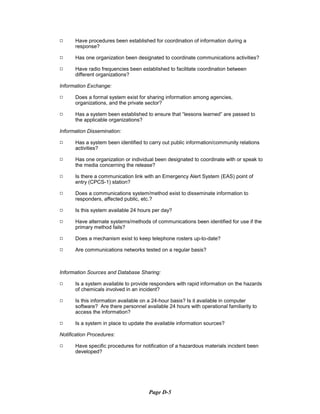
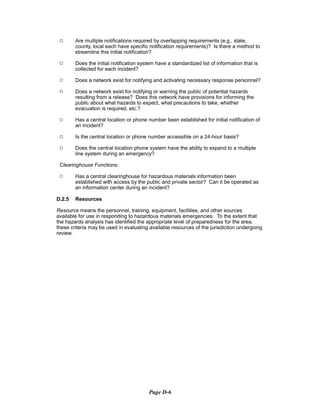
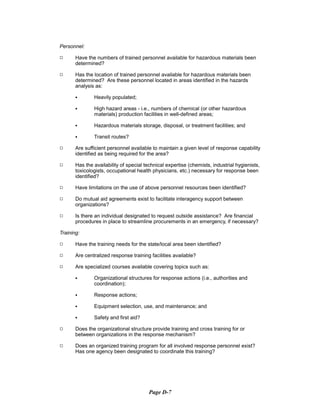
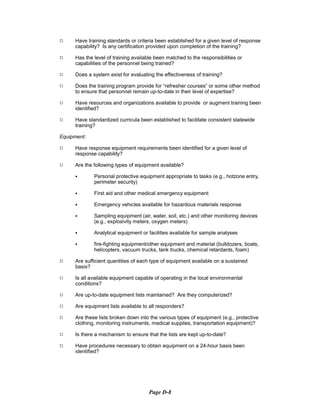
facilities and certain onshore facilities; emergency
response
drills; inspection of response equipment; and
EPA's listing of hazardous substances other than
oil.
Area Committees and Area Contingency Plans:
The OPA amendment to the CWA established,
among other things, new planning entities and
requirements for the NRS to deal specifically with
oil spills and CWA hazardous substances during
preparedness and response. The Area
Committee is one such entity, and ACPs are
planning requirements initiated by OPA. These
committees and plans are designed to improve
coordination among the national, regional, and
local planning levels and to enhance the
availability of trained personnel, necessary
equipment, and scientific support that may be
needed to adequately address all discharges. In
the inland zone, where there are region-wide
ACPs, subarea plans provide the detailed
information required by the NCP.
EPA has provided for LEPCs and SERCs to have
input into this area contingency planning process.
The LEPC's primary responsibility is to develop
an emergency response plan for potential
chemical accidents. SERCs are responsible for
supervising and coordinating the activities of the
LEPCs and for reviewing local emergency
response plans for chemical accidents. Thus, the
LEPCs and SERCs' expertise in planning for
response to chemical releases (including
releases of hazardous substances) allows the
Area Committees to effectively address
hazardous substance planning issues, as
necessary.
Under OPA, Area Committees also are charged
with the responsibility to work with state and local
officials to enhance contingency planning and to
assure early planning for joint response efforts.
Among the things Area Committee assistance
should include are appropriate procedures for the
following: mechanical recovery; dispersal;
shoreline clean-up; protecting sensitive
environmental areas; protecting, rescuing, and
rehabilitating fisheries and wildlife.
Area Committees also should help state and local
planners to expedite decisions for the use of
dispersants and other mitigating substances and
devices. Under the approval scheme presented
in the NCP, the Area Committee serves as an
advocate for the dispersant use plan, while the
RRT decides whether the plan is adequate and
may address region-wide or cross-regional
issues. This provides a necessary forum for
dispersant use review.
There is a slightly different procedure for spill
situations that are not addressed by the
pre-authorization plans. In this case, the OSC
Page 9
(with the concurrence of the EPA representative
to the RRT and, as appropriate, the concurrence
of the RRT representatives from the states with
jurisdiction over the navigable waters threatened
by the release or discharge, and in consultation
with the Department of Commerce (DOC) and
Department of the Interior (DOI) natural resource
trustees, when practicable) may authorize the use
of dispersants, surface washing agents, surface
collecting agents, bioremediation agents, or
miscellaneous oil spill control agents on the oil
discharge, provided that the products are listed
on the NCP Product Schedule.
Oil and hazardous substance response plans for
facilities and vessels: Another element of OPA,
requires the preparation and submission of
response plans for tank vessels, offshore
facilities, and onshore facilities that could
reasonably be expected to cause substantial
harm to the environment by discharging oil and
hazardous substances into or upon the navigable
waters, adjoining shorelines, or the exclusive
economic zone. Submitted response plans must:
C Be consistent with the NCP and the
applicable ACP;
C Identify a qualified individual with
responsibility to activate the response
plan;
C Identify and ensure by contract or other
approved means the availability of private
personnel and equipment necessary to
remove a worst case discharge (including
a discharge resulting from fire or
explosion), and to mitigate or prevent a
substantial threat of such a discharge;
C Describe the training, equipment testing,
periodic unannounced drills, and the
response action of persons on the vessel
or facility;
C Be periodically updated; and
C Be resubmitted for approval of each
significant change.
1.4.2 State and Local Requirements
Many states have adopted individual laws and
regulations that address local government
involvement in hazardous materials. Local
authorities should investigate state requirements
and programs before they initiate preparedness
and planning activities.
Emergency plans should include consideration of
any state or local community right-to-know laws,
state OSHA rules, local fire codes, and other
requirements. When these laws are more
demanding than the Federal law, the state and
local laws sometimes take precedence over the
Federal law. The members of the State
Emergency Response Commission and the Local
Emergency Planning Committee represents an
excellent resource for identifying these sorts of
requirements. CEPPO maintains a list of State
Emergency Response Commission (SERC)
contacts at www.epa.gov/serclist.htm. The
SERCs will be able to identify the active LEPCs in
your community, if you are not already a member.
1.5 Related Programs and Materials

Because emergency planning is a complex materials. Selected examples of planning
process involving a variety of issues and programs and materials that may be used in
concerns, community planners should consult conjunction with this guide follow. The
related public- and private-sector programs and information included in this section may change
Page 10
periodically. You should contact regional
representatives in the offices discussed below for
the most current information on Federal planning
requirements.
1.5.1	 FEMA’s Integrated Emergency
Management System (SLG 101)
FEMA's Guide for All-Hazard Emergency
Operations Planning (SLG-101) provides
information for emergency management
planners. This guide provides state and local
government with information about FEMA's
concept for developing risk-based, all hazard
emergency plans. SLG-101 provides extensive
guidance in the coordination, development,
review, validation, and revision of EOPs.
NRT-1 compliments the information contained in
the hazardous materials annex (Annex C) of SLG
101. Communities should obtain a SLG 101 from
FEMA and follow its guidance carefully. All
communities, even those with sophisticated multi-
hazard EOPs, should consult Chapter 5 of NRT-1
to ensure adequate consideration of hazardous
materials issues.
1.5.2	 EPA’s Chemical Emergency
Preparedness and Prevention Office
For 15 years, EPA has had in place a
comprehensive strategy to deal with planning for
the problem of toxics released to the air. CEPPO
addresses accidental releases of acutely toxic
chemicals. Its program has three goals: to
increase community awareness of chemical
hazards, to enhance state and local emergency
planning for dealing with chemical accidents, and
to prevent accidental releases. Many of the
CEPPO goals and objectives are included in
EPCRA (see Section 1.4.1). CEPPO has
developed a variety of materials (including
technical guidance, Computer-Aided
Management of Emergency Operations
(CAMEO) software, descriptions of hazardous
chemicals and lists, and risk management plan
information) designed to complement this
guidance and to help communities identify and
analyze hazards as described in Chapter 3 of this
guide. CEPPO materials can be obtained by
writing EPA (See page F-1) or visiting the CEPPO
website at www.epa.gov/ceppo/.
1.5.3	 DOT Materials
The DOT Emergency Response Guidebook
provides guidance for firefighters, police, and
other emergency services personnel to help them
protect themselves and the public during the
initial minutes immediately following a hazardous
materials incident. This widely used guidebook is
keyed to the identification placards required by
DOT regulations to be displayed prominently on
vehicles transporting hazardous materials. All
first responders should have access to copies of
the DOT Emergency Response Guidebook and
know how to use it. (See Page F-l for DOT’s
contact information and website address.)
The Hazardous Materials Emergency
Preparedness (HMEP) grants program was
established by Hazardous Materials
Transportation Uniform Safety Act of 1990. It
was designed to support the framework and
working relationships established within the NRS
and EPCRA or SARA Title III. The HMEP grant
program provides financial and technical
assistance as well as national direction and
guidance to enhance state, Territorial, Tribal, and
local hazardous materials emergency planning
and training. The program distributes fees
collected from certain shippers and carriers of
hazardous materials (hazmat) to emergency
responders for hazmat training and to LEPCs for
hazmat planning. Approximately $60 million has
been awarded since the program began in 1993.
This funding has been used to train, in part, over
810,000 emergency responders, conduct nearly
2,600 commodity flow surveys, support
approximately 4,500 exercises, and distribute
17,000 HMEP training curriculum guidelines.
Federal coordination of the HMEP grant program
is accomplished through the Training and
Curriculum subcommittee of the NRT’s
Preparedness Committee, co-chaired by DOT
and FEMA.
Videos, training materials, fact sheets,
newsletters, and other safety related information
are available from RSPA. A list of available
materials is located on the Hazmat Safety
website at: http://hazmat.dot.gov.
1.5.4	 American Chemistry Council
Community Awareness and Emergency
Response and Transportation
Community Awareness and Emergency
Response Programs
Page 11
The American Chemistry Council (ACC)
encourages relationships with communities and
others through its Responsible Care®
initiative.
The Transportation Community Awareness and
Emergency Response (TRANSCAER®
) program,
which is partly sponsored by ACC, promotes
relationships between chemical manufacturers,
transporters, communities, and others involved in
the transportation of hazardous materials. The
program works to coordinate with local
communities in the development of emergency
plans for responding to hazardous materials
incidents along transportation corridors.
Community Awareness and Emergency
Response (CAER) encourages companies to
work with the communities in which they operate
on emergency planning and response. CAER
also encourages companies to communicate
openly with its neighbors. During the planning
process chemical industry representatives can be
especially helpful because of their knowledge of
chemical risk and behavior. In addition, chemical
plant officials and transportation industry
representatives may be willing to share
equipment and personnel during response
operations. Local planners should contact
TRANSCAER®
(www.transcaer.org) or their local
plant sites for more information or to determine
what assistance might be available.
1.5.5	 Hazardous Materials Safety
Assistance Team
RSPA established the Hazardous Materials
Safety Assistance Team (HMSAT) to make
industry aware of the hazardous materials
regulations (HMR), to help businesses find the
resources needed to comply with the HMR, and
to provide technical assistance to the hazardous
materials community. HMSAT efforts are
coordinated from DOT headquarters in
Washington, DC and team members are located
at each of RSPA's regional offices in California,
Georgia, Illinois, New Jersey, and Texas. The
goal of the HMSAT is to increase hazardous
materials transportation safety through increased
awareness and training.
1.5.6 	 Response to Terrorist Events
Terrorist events can be described as intentional
acts by individuals or groups that are intended to
injure or otherwise terrorize innocent people
within a community. In the event such a act is
perpetrated in your community, two things can be
accurately predicted. (1) There will be a
tremendous number of citizens either injured or
agitated by the event; probably more than your
community can handle without outside
assistance. (2) There will be both a state and a
Federal response as soon as the event is
identified as a terrorist action. It should also be
noted that, in all the preparedness activities
related to this issue, any community that has
planned for chemical emergencies as laid out in
this guidance has been recognized by national
specialists as being well on the way to being
prepared to handle even the extremes of a
terrorist attack.
If there are mass casualties in your community,
then this is likely to be the focus of your
community until additional resources reach you.
You should plan to ask for those resources as
soon as it is realized that you are dealing with
mass casualties. Some of the resources that can
be made available include resources of the
Departments of Defense (DOD) (e.g., Regional
Medical Centers, National Guard Civil Support
Teams), Health and Human Services (HHS), and
Veterans Affairs (VA). To plan for their activation
and utilization, emergency planners should
contact the regional Health Administrator, your
regional VA Medical Center, and the state
Adjutant General or go through one of these to
the DOD regional coordinator.
Under current plans, the assistance provided by
outside agencies will come in two phases; a crisis
management phase and a consequence
management phase. In both phases, response
operations will occur in rough accordance with
the FRP previously described; however, the lead
agency will shift from the Federal Bureau of
Investigation (FBI) in the crisis phase to FEMA in
the consequence phase. Different agencies, like
the individuals who work there, have different
focuses and different styles, so there may be a
noticeable difference in the coordination of the
operations. To plan for the overall response to
these kinds of events, contact your local FBI
office or your FEMA regional Director.
Some websites to consider when thinking about
this issue in your planning are:
National Domestic Preparedness Office
www.ndpo.gov
FEMA’s Terrorism Annex to the FRP
www.fema.gov/r-n-r/frp/frpterr.htm
Page 12
FBI’s Awareness of National Security Issues and
Response Program
www.fbi.gov/programs/ansir/ansir.htm
DOD National Guard Civil Support Teams
www.arng.ngb.army.mil/tng/artsit.html
DOD in general
http://call.army.mil/call/nftf/janfeb98/domp
rep. htm
HHS/Office of Emergency Preparedness
http://ndms.dhhs.gov
HHS/Centers for Disease Control and Prevention
www.cdc.gov
1.5.7 	 National Fire Protection Association
The National Fire Protection Association (NFPA)
is a private organization that develops consensus
standards on a variety of fire protection and
emergency management topics. NFPA has
developed standards relating to hazardous
materials responder competencies.
Three national standards or recommended
practices have been developed by the HAZMAT
response community and published by NFPA to
address hazardous materials response issues:
9	 NFPA 471, Recommended
Practices for Responding to
Hazardous Materials Incidents,
outlines the minimum
requirements that should be
considered when dealing with
responses to hazardous
materials incidents.
9	 NFPA 472, Professional
Competencies of Responders to
Hazardous Materials Incidents,
specifies the minimum
competencies of those who will
respond to hazardous materials
incidents.
NFPA 473, Competencies for
EMS Personnel Responding to
Hazardous Materials Incidents,
specifies minimum requirements
of competence to enhance the
safety and protection of response
personnel and all components of
the medical services system.
These standards are compatible with §1910.120
of OSHA regulations and have been updated to
1997 editions. NFPA technical committees are
made up of experts in all aspects of hazardous
materials response. As published, NFPA
standards are voluntary, but many local and
federal jurisdictions adopt them into law based on
accepted technical foundation.
New revisions of these HAZMAT documents,
based on a system of public review and
comment, and incorporating updated information
on radiological incidents and weapons of mass
destruction, will be released in March 2002.
NFPA standards are reviewed and revised
approximately every five years on a schedule
determined by the technical committees.
1.5.8	 National Preparedness for Response
Exercise Program
The National Preparedness for Response
Exercise Program (PREP) was developed to
establish a workable exercise program that meets
the intent of OPA 90. The PREP was developed
to provide a mechanism for compliance with the
exercise requirements, while being economically
feasible for the government and oil industry to
adopt and sustain. The PREP is a unified federal
effort and satisfies the exercise requirements of
USCG, EPA, RSPA, the Office of Pipeline Safety,
and the Minerals Management Service (MMS).
Completion of the PREP exercises will satisfy all
OPA 90 mandated federal oil pollution response
exercise requirements.
At this time, the PREP addresses the exercise
requirements for oil pollution response only.
Regulations for hazardous substance response
plans for vessels and facilities are currently under
development. The hazardous substance
exercises requirements are also under
development and will be incorporated into the
PREP in the near future.
The PREP represents the minimum guidelines for
ensuring adequate response preparedness. If
personnel within an organization believe
additional exercises or an expansion of the scope
of the PREP exercises are warranted to ensure
enhanced preparedness, they are highly
encouraged to conduct these exercises.
Page 13
9
The PREP exercises should be viewed as an
opportunity for continuous improvement of the
response plans and the response system.
Planholders are responsible for addressing any
issues that arise from evaluation of the exercises,
and for making changes to the response plans
necessary to ensure the highest level of
preparedness.
1.5.9	 Chemical Hazards Response
Information System
The Chemical Hazards Response Information
System (CHRIS) is an excellent source of
chemical, physical, toxicological, thermodynamic,
and response information for over 1300
chemicals. If you need information in a spill
situation, CHRIS is a good place to start. It
provides very specific information about cargoes
such as boiling points, density, or exposure
levels.
USCG created CHRIS and the Hazardous
Assessment Computer System (HACS) over a
quarter of a century ago to predict what would
happen if a cargo spilled. CHRIS provides the
data so that response concerns such as how far
a vapor cloud could travel, what size of a safety
zone is needed around a burning pool, and what
will happen to a substance released into the
water, (will it sink, float, dissolve etc.) can be
addressed. CHRIS has recently been updated
and an interactive version has been developed
for computer use. This valuable tool is public
domain software and can easily be obtained over
the internet or a CD-ROM is available from the
USCG.
2. Selecting and Organizing the Planning Team

2.1 Introduction

This chapter discusses the selection and
organization of the team members who will
coordinate planning for handling hazardous
materials. The guidance stresses that successful
planning requires community involvement
throughout the process. Enlisting the cooperation
of all parties directly concerned with hazardous
materials will improve planning, make the plan
more likely to be used, and maximize the
likelihood of an effective response at the time of
an emergency. Experience shows that plans
that have been prepared by only one person
or one agency are not used. Emergency
response requires trust, coordination, and
cooperation among responders who need to
know who is responsible for what activities,
and who is capable of performing what
activities.
2.2 The Planning Team

Page 14
This knowledge is gained only through
personal interaction. Working together to
develop and update plans provides an
important opportunity for cooperative
interaction among responders. In the course
of selecting team members, it is important for
each individual to perform as nearly as possible
the same function in planning or response as in
more routine matters.
As indicated in Section 1.4.1, Title III of SARA
requires Governors to appoint a SERC that will
designate emergency planning districts and
appoint local emergency planning committees for
each district. The state commission might follow
the guidance in this chapter when appointing
planning committees.
Hazardous materials planning should grow out of
a process coordinated by a team. The team is
the best vehicle for incorporating the expertise of
a variety of sources into the planning process and
for producing an accurate and complete
document. The team approach also encourages
a planning process that reflects the consensus of
the entire community. Some individual
communities or areas that include several
communities have formed hazardous materials
advisory councils (HMACs). HMACs, where they
exist, are an excellent resource for the planning
team.
2.2.1	 Forming the Planning Team
In selecting the members of a team that will have
overall responsibility for hazardous materials
planning, four considerations are most important:
9	 The members of the group must
have the ability, commitment,
authority, and resources to get
the job done;
9	 The group must possess, or have
ready access to, a wide range of
expertise relating to the
community, its industrial facilities
and transportation systems, and
the mechanics of emergency
response and response planning;
The members of the group must
agree on their purpose and be
able to work cooperatively with
one another; and
9	 The group must be
representative of all elements of
the community with a substantial
interest in reducing the risks
posed by hazardous materials.
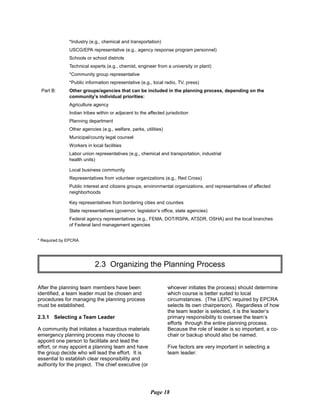
A comprehensive list of potential team members
is presented in Exhibit 2.
Planning courses are offered by FEMA through
USFA and EMI. Other NRT agencies also offer
training in planning. Current catalogues of
training are available from training providers.
2.2.2	 Respecting All Legitimate Interests
Although people may have a common interest in
reducing the risks posed by hazardous materials,
their differing economic, political, and social
perspectives may cause them to favor different
means of promoting safety. For example, people
who live near a facility with hazardous materials
are likely to be greatly concerned about avoiding
any threat to their lives, and are likely to be less
intensely concerned about the costs of developing
accident prevention and response measures.
Other members of the community may be more
sensitive to expenditures for unnecessarily
elaborate prevention and response measures.
Also, facility managers may be reluctant for
proprietary reasons to disclose materials and
processes beyond what is required by law.
There may also be differing views among the
agencies and organizations with emergency
response functions about the roles they should
play in case of an incident. The local fire
department, police department, emergency
Page 15
9
management agency, and public health agency
are all likely to have some responsibilities in
responding to an incident. However, each of
these organizations might envision a very
different set of responsibilities for their respective
agencies for planning or for management on
scene.
In organizing the community to address the
problems associated with hazardous materials, it
is important to bear in mind that all affected
parties have a legitimate interest in choosing
among planning alternatives. Therefore, strong
efforts should be made to ensure that all groups
with an interest in the planning process are
included.
Some interest groups in the community have well-
defined political identities and representation, but
others may not. Government agencies, private
industry, environmental groups, and trade unions
at the facilities are all likely to have ready
institutional access to an emergency planning
process. Nearby residents, however, may lack an
effective vehicle for institutional representation.
Organizations that may be available to represent
the residents’ interests include neighborhood
associations, church organizations, and ad hoc
organizations formed especially to deal with the
risks posed by the presence of specific hazardous
materials in a neighborhood. In many
communities, community health coalitions have
been formed which provide an existing ready-
made access to residents, industry, and
agencies.
2.2.3	 Understanding the Special Importance
of Local Governments
For several reasons, local governments have a
critical role to play in the development of
emergency preparedness.
A.	 First, local governments bear
major responsibilities for
protecting public health and
safety; local police and fire
departments, for example, often
have the lead responsibility for
the initial response to incidents
involving hazardous materials.
B.	 Second, one of the functions of
local government is to mediate
and resolve the sometimes
competing ideas of different
interest groups.
C.	 Third, local governments have
the resources to gather
necessary planning data.
D.	 Finally, local governments
generally have the legislative
authority to raise funds for
equipment and personnel
required for emergency
response. Support from the
executive and legislative
branches is essential to
successful planning. Appropriate
government leaders must give
adequate authority to those
responsible for emergency
planning.
2.2.4	 Getting Local Industry Involved
Because fixed-facility and transportation company
owners and operators are concerned about public
health and safety in the event of an accidental
release of a hazardous material, and because
many facility employees have technical expertise
that will be helpful to the planning team, the team
should include one or more facility and
transportation company representatives. EPCRA
requires facility owners or operators to notify the
emergency planning committee of a facility
representative who will participate in the
emergency planning process as a facility
emergency coordinator.
Page 16
In planning districts that include several fixed
facilities, one or more representative facility
emergency coordinators could be active
members of the planning team. The planning
team could consult with the other facility
emergency coordinators and assign them to task
forces or committees (see Section 2.3.2).
EPCRA also requires facilities to submit to the
local emergency planning committee any
information needed to develop the plan.
In some communities, transportation companies
may be the major contributor to the presence of
hazardous materials in the community. The
presence of a representative will almost always
be an important contribution.
2.2.5 Determining the Size of Planning Team
For the planning team to function effectively, its
size should be limited to a workable number. In
communities with many interested parties, it will
be necessary to select from among them carefully
so as to ensure fair and comprehensive
representation. Some individuals may feel left out
of the planning process. People should be given
access to the process through the various
approaches noted in the following sections, such
as membership on a task force or advisory
council. In addition, all interested parties should
have an opportunity for input during the review
process.
Exhibit 2
POTENTIAL MEMBERS OF AN EMERGENCY PLANNING TEAM
Part A:	 Experience shows that the following individuals, groups, and agencies should participate if a
successful plan is to be developed:
*Mayor/city manager (or representative)
*County executive (or representative)/board of supervisors
*State elected officials (or representative)
*Fire department (paid and volunteer)
*Police department
*Emergency management agency
*Environmental agency (e.g., air and water pollution control agency)
*Health department
Public works (e.g., waste disposal, water, sanitation, and roads)
*Hospitals, emergency medical service, veterinarians, medical community (especially occupational
medicine)
*Transportation agency (e.g., DOT, port authority, transit authority, bus company, truck or rail
companies)
Page 17
*Industry (e.g., chemical and transportation)

USCG/EPA representative (e.g., agency response program personnel)

Schools or school districts

Technical experts (e.g., chemist, engineer from a university or plant)

*Community group representative

*Public information representative (e.g., local radio, TV, press)

Part B:	 Other groups/agencies that can be included in the planning process, depending on the

community’s individual priorities:

Agriculture agency
Indian tribes within or adjacent to the affected jurisdiction
Planning department
Other agencies (e.g., welfare, parks, utilities)
Municipal/county legal counsel
Workers in local facilities
Labor union representatives (e.g., chemical and transportation, industrial
health units)
Local business community
Representatives from volunteer organizations (e.g., Red Cross)
Public interest and citizens groups, environmental organizations, and representatives of affected
neighborhoods
Key representatives from bordering cities and counties
State representatives (governor, legislator’s office, state agencies)
Federal agency representatives (e.g., FEMA, DOT/RSPA, ATSDR, OSHA) and the local branches
of Federal land management agencies
* Required by EPCRA
2.3 Organizing the Planning Process

After the planning team members have been
identified, a team leader must be chosen and
procedures for managing the planning process
must be established.
2.3.1 Selecting a Team Leader
A community that initiates a hazardous materials
emergency planning process may choose to
appoint one person to facilitate and lead the
effort, or may appoint a planning team and have
the group decide who will lead the effort. It is
essential to establish clear responsibility and
authority for the project. The chief executive (or
whoever initiates the process) should determine
which course is better suited to local
circumstances. (The LEPC required by EPCRA
selects its own chairperson). Regardless of how
the team leader is selected, it is the leader’s
primary responsibility to oversee the team’s
efforts through the entire planning process.
Because the role of leader is so important, a co­
chair or backup should also be named.
Five factors are very important in selecting a
team leader:
Page 18
9 The degree of respect the person
commands among groups with
an interest in hazardous
materials;
9 The person’s availability in terms
of time and sources;
9 The person’s history of working
relationships with concerned
community agencies and
organizations;
9	 The person’s management and
communication skills; and
9	 The person’s existing
responsibilities related to
emergency planning, prevention,
and response.
Logical sources for a team leader include the
following:
9	 The chief executive or other
elected official. Leadership by
a mayor, city or county council
member, or other senior official
is likely to contribute substantially
to public confidence, encourage
commitment of time and
resources by other key parties,
and expedite the implementation
of program initiatives. The
planning process can be
disrupted, however, if an elected
official leaves office.
9	 A public safety department. In
most communities, the fire
department or police department
bears principal responsibility for
responding to incidents involving
chemical releases and, typically,
for inspecting facilities as well. A
public safety department,
therefore, may have personnel
with experience in emergency
planning and knowledge of
existing responsibilities within the
community.
9 The emergency management
agency. In many communities,
officials of such an agency will be
knowledgeable and experienced
in planning for major disasters
that have a variety of causes.
One of the primary
responsibilities of a community’s
emergency management
coordinator is to guide, direct,
and participate in the
development of a multihazard
EOP. In some states, existing
laws require that this agency be
the lead agency to prepare and
distribute emergency plans.
9	 The local environmental
agency or public health
agency. Persons with expertise
and legal responsibility in these
areas will have special
knowledge about the risks posed
by hazardous materials.
9	 A planning agency. Officials in
a planning agency will be familiar
with the general planning
process and with the activities
and resources of the community.
9	 Others. Communities should be
creative and consider other
possible sources for a team
leader, such as civic groups,
industry, academic institutions,
volunteer organizations, and
agencies not mentioned above.
Experience in leading groups and
committees, regardless of their
purpose, will prove useful in
emergency planning.
Personal considerations as well as institutional
ones should be weighed in selecting a team
leader. For example, a particular organization
may appear to have all the right resources for
addressing hazardous materials incidents. But if
the person in charge of that organization does not
work well with other local officials, it might be
wise to look for a different leader.
Response coordinators generally are
knowledgeable about emergency plans and are
probably people who gets things done. Be
aware, however, that good response coordinators
are not necessarily good planners. They might
make good chief advisors to someone better
suited for the team leader job.
2.3.2 Organizing for Planning Team
Responsibilities
Page 19
The planning team must decide who shall
conduct the planning tasks and establish the
procedures for monitoring and approving the
planning tasks.
A. Staffing
Three basic staffing approaches may be
employed to accomplish the tasks involved in
emergency planning:
9	 Assign staff. Experience in
related planning efforts
demonstrates the usefulness of
assigning one or more dedicated
staff members to coordinate the
planning process and perform
specific planning tasks. The staff
may be assigned within a “lead
agency” having related
responsibilities or expertise, or
may be created separately
through outside hiring or staff
loans from government agencies
or industry.
9	 Assign task forces or
committees. Planning tasks can
be performed by task forces or
committees composed entirely or
in part of members of the
planning team. Adding
knowledgeable representatives
of government agencies,
industry, environmental, labor,
and other community
organizations to the individual
task forces or committees not
only supplements the planning
team expertise and resources,
but also provides an opportunity
for additional interested parties to
participate directly in the process.
9	 Hire contractors or
consultants. If the personnel
resources available for the
formation of a dedicated staff
and task forces or committees
are limited, and funds can be
provided, the planning team may
choose to hire contractors or
consultants. Work assigned to a
contractor can range from a
specialized job, such as
designing a survey, to performing
an entire planning task (e.g.,
hazards identification and
analysis). A disadvantage of
hiring contractors or consultants
is that it does not help build a
community-centered capability or
planning infrastructure.
The three approaches presented are not mutually
exclusive. A community may adopt any
combination of the approaches that best matches
its own circumstances and resources.
B. Managing the Planning Tasks
The monitoring and approval of planning
assignments are the central responsibilities of the
planning team. To have ongoing cooperation in
implementing the plan, the planning team should
operate on a consensus basis, reaching general
agreement by all members of the team.
Achieving consensus takes more time than
majority voting, but it is the best way to ensure
that all represented parties have an opportunity to
express their views and that the decisions
represent and balance competing interests. If it
is determined that a consensus method is
inappropriate or impossible (e.g., because of the
multijurisdictional nature of a group), the planning
team should formally decide how issues will be
resolved.
The team leader should work with the team
members to establish clear goals and deadlines
for various phases of the planning process.
Progress toward these goals and deadlines
should be monitored frequently.
Planning meetings, a necessary element of the
planning process, often do not make the best use
of available time. Meetings can be unnecessarily
long and unproductive if planning members get
bogged down on inappropriate side issues.
Sometimes, when several agencies or groups sit
down at one table, the meeting can become a
forum for expressing political differences and
other grievances fueled by long-standing
interagency rivalries. For a team to be effective,
a strong team leader must make sure that
meeting discussions focus solely on emergency
planning. Strict adherence to mutually agreed
agendas helps this process.
Page 20
Another point to consider is that the team evacuation routes, hospital and
approach requires the melding of inputs from school locations, and other
different individuals, each with a different style emergency-related information.
and sense of priorities. In some cases, even CAMEO also can be used with a
terminologies can be unique. A team leader must separate software application
ensure that the final plan is consistent in called LandView™ III to display
substance and tone. An editor may be used to EPA environmental databases
make sure that the plan’s grammar, style, and and demographic/economic
content all ultimately fit well together. information to support analysis of
environmental justice issues.
On critical decisions, it may be desirable to
extend the scope of participation beyond the
membership of the planning team. Approaches
9 Modeling. Planners might
consider applying air dispersion
that might be used to encourage community models for chemicals in their
consensus building through broadened community so that, during an
participation in the process include invited emergency, responders can
reviews by key interest groups, or formation of an predict the direction, velocity, and
advisory council composed of interested parties concentration of plume
that can independently review and comment on movement. Similarly, models
the planning team’s efforts. Chapter 6 contains can be developed to predict the
further guidance on consensus-building pathways of plumes in surface
approaches. water and ground water.
CAMEO is a system of software
The procedures to be used for monitoring and applications that can be very
approving planning assignments should be useful in modeling. The CAMEO
carefully thought out at the beginning of the system integrates a chemical
planning process; planning efforts work best database and a method to
when people understand the ground rules and manage the data, an air
know when and how they will be able to dispersion model, and a mapping
participate. The monitoring and approval process capability. All modules work
can be adjusted at any time to accommodate interactively to share and display
variations in local interest. critical information in a timely
fashion. More information on
LEPCs formed according to EPCRA develop their CAMEO, including how to obtain
own rules. These rules include provisions for a copy, can be found at
public notification of committee activities; public www.epa.gov/ceppo/
meetings to discuss the emergency plan; public cameo/what.htm
comments; response to public comments by the
committee; and distribution of the emergency 9 Information access.
plan. Responders can use a personal
computer onsite to learn the
C. Information Management identity of the chemical(s)
involved in the incident (e.g.,
Information management is a crucial element of when placards are partially
the planning process. The following list covered), the effects of the
summarizes some ways in which computers are chemical(s) on human health and
useful both in the planning process and for the environment, and appropriate
maintaining response preparedness. countermeasures to contain and
clean up the chemical(s).
9999 Electronic Planning. Planners
can use tools such as
Communities that intend to use
computers on scene should also
Geographic Information Systems provide a printer on scene. In
(GIS) and Global Positioning some cases, the printer can
Systems (GPS) to create double as a fax.
specialized area maps with
information about transportation
Page 21
9 Data storage. Communities can
store information about what
chemicals are present in various
local facilities, and what
equipment and personnel are
needed during responses to
incidents involving specific
chemical(s). Compliance with
EPCRA generates large amounts
of data (e.g., MSDS forms, data
on specific chemicals in specific
facilities, data on accidental
releases). (See Appendix A.)
Such data can be electronically
stored and retrieved on
computers, disks, zip disks, CD­
ROMS, or by another method
that becomes available as
advancements in data storage
are made. These data should be
reviewed and updated regularly.
2.4 Beginning to Plan

When the planning team members and their is in place, the team should address several
leader have been identified and a process for interrelated tasks. These planning tasks are
managing the planning tasks described in the next chapter.
3. Tasks of the Planning Team
3.1 Introduction

The major tasks of the planning team in
completing hazardous materials planning are as
follows:
9 Review of existing plans, which
prevents plan overlap and
inconsistency, provides useful
information and ideas, and
facilitates the coordination of the
plan with other plans;
9 Review of Risk Management
Plan information, which includes
reviews of RMPs, offsite
consequence analysis data, and
local facility plans;
9	 Hazards analysis, which
includes identification of hazards,
analysis of vulnerability, and
analysis of risk;
9	 Assessment of preparedness,
prevention, and response
capabilities, which identifies
existing prevention measures and
response capabilities (including
mutual aid agreements), and
assesses their adequacy;
Page 22
9	 Completion of hazardous
materials planning that
describes the personnel,
equipment, and procedures to be
used in case of accidental
release of a hazardous material;
and
9	 Development of an ongoing
program for plan implementation,
maintenance, training, and
exercising.
This chapter discusses the planning tasks that are
conducted before the emergency plan is
proposed. Chapters 4 and 5 provide guidance on
plan format and content. Chapter 6 discusses the
team’s responsibilities for conducting internal and
external reviews, exercises, incident reviews, and
training. This chapter begins with a discussion of
the organizational responsibilities of the planning
team.
3.2 Review of Existing Plans

Before undertaking any other work, steps should
be taken to search out and review all existing
emergency plans. The main reasons for
reviewing these plans are (1) to minimize work
efforts by building upon or modifying existing
emergency planning and response information
and (2) to ensure proper coordination with other
related plans. To the extent possible, currently
used plans should be amended to account for the
special problems posed by hazardous materials,
thereby avoiding redundant emergency plans.
Even plans that are no longer used may provide a
useful starting point. More general plans can also
be a source of information and ideas. In seeking
to identify existing plans, it will be helpful to
consult organizations such as the following:
9	 State and local emergency
management agencies;
9 Fire departments;
9 Police departments;
9 State and local environmental
agencies;
9 State and local transportation
agencies;
9 State and local public health
agencies;
9 Public service agencies;
9 Volunteer groups, such as the
Red Cross;
9 Local industry and industrial
associations;
Page 23
9 Area Committees under OPA;
9 Local USCG Marine Safety
Offices; and
9 Regional offices of Federal
agencies such as EPA or FEMA.
When reviewing the existing plans of local
industry and industrial associations, the planning
team should obtain a copy of the CAER program
handbook produced by ACC. (See Section 1.5.4.)
The handbook provides useful information and
encourages industry-community cooperation in
emergency planning. Facilities subject to
HAZWOPER and RMP requirements are required
to have facility emergency response plans.
Individual facility RMPs indicate whether a facility
has an emergency response plan in place.
In addition to the foregoing organizations,
planning teams should coordinate with the RRTs
and OSCs described in Section 1.4.1.
Communities can contact or obtain information on
the RRT and OSC covering their area through the
EPA regional office or USCG district office. (See
Appendix F for a list of Federal agency contacts.)
3.3 Hazards Analysis: Hazards Identification, Vulnerability

Analysis, Risk Analysis

A hazards analysis is a critical component of
planning for handling releases of hazardous
materials. The information developed in a
hazards analysis provides both the factual basis
to set priorities for planning and also the
necessary documentation for supporting
hazardous materials planning and response
efforts.
Several concepts are involved in analyzing the
dangers posed by hazardous materials. Three
terms -- hazard, vulnerability, risk -- have
different technical meanings but are sometimes
used interchangeably. (Facilities are often
required by regulation to conduct a process
hazards analysis (PHA). The PHA is an
organized and systematic effort to identify and
analyze potential hazards associated with the
processing or handling of highly hazardous
chemicals. LEPCs are usually not able to
conduct such a detailed analysis, but the LEPC
can use the results of a facility PHA as it
prepares a community plan.) This guidance
adopts the following definitions:
9	 Hazard. Any situation that has the
potential for causing injury to life, or
damage to property and the
environment.
9	 Vulnerability. The susceptibility of life,
property, and the environment to injury or
damage if a hazard manifests its
potential.
9	 Risk. The probability that injury to life, or
damage to property and the environment
will occur.
A hazards analysis may include vulnerability
analysis and risk analysis, or it may simply
identify the nature and location of hazards in the
community. Developing a complete hazards
analysis that examines all hazards,
Page 24
vulnerabilities, and risks may be neither possible	 This may be particularly true for smaller
nor desirable. 	 communities that have less expertise and fewer
resources to contribute to the task. The planning
team must determine the level of thoroughness
that is appropriate. In any case, planners should
ask local facilities whether they have already
completed a facility hazards analysis. EPCRA
requires facility owners or operators to provide to
local emergency planning committees
information needed for the planning process.
As important as knowing how to perform a hazards analysis is deciding how detailed an analysis to
conduct. While a complete analysis of all hazards would be informative, it may not be feasible or practical
given resource and time constraints. The value of a limited hazards analysis should not be
underestimated. Often the examination of only major hazards is necessary, and these may be studied
without undertaking an elaborate risk analysis. Thus, deciding what is really needed and what can be
afforded is an important early step in the hazards analysis process. In fact, screening hazards and setting
analysis priorities is an essential task of the planning team.
The costs of hazards analysis can and often
should be reduced by focusing on the hazards
posed by only the most common and/or most
hazardous substances. A small number of types
of hazardous materials account for the vast
majority of incidents and risk. The experience
from DOT’s Lessons Learned is that the most
prevalent dangers from hazardous materials are
posed by common substances, such as gasoline,
other flammable materials, and a few additional
chemicals. Besides gasoline fuels and LPG, a
list of the top 10 chemicals used in or transported
through the community may be a useful first step.
The CEPPO Technical Guidance for Hazards
Analysis (the “Green Book”) presents a method
that may be used to assist in ranking hazards
posed by less prevalent but extremely hazardous
substances, such as liquid chlorine, anhydrous
ammonia, and hydrochloric and sulfuric acids.
A hazards analysis can be greatly simplified by
using qualitative methods (i.e., analysis that is
based on judgment rather than measurement of
quantities involved). Smaller communities may
find that their fire and police chiefs can provide
highly accurate assessments of the community’s
hazardous materials problems. Larger
communities may have the expertise and
resources to use quantitative techniques but may
decide to substitute qualitative methods in their
place should it be cost effective to do so.
Simple or sophisticated, the hazards analysis
serves to characterize the nature of the problem
posed by hazardous materials. The information
that is developed in the hazards analysis should
then be used by the planning team to orient
planning appropriate to the community’s
situation. Do not commit valuable resources
to plan development until a hazards analysis
has been performed.
3.3.1 Developing the Hazards Analysis
The procedures that are presented in this section
are intended to provide a simplified approach to
hazards analysis for both facility and
transportation hazards. Communities
undertaking a hazards analysis should refer to
CEPPO technical guidance for fixed facilities and
to the Green Book. Risk Management Plans
submitted by facilities include valuable
information for the hazards analysis (e.g., types
of chemicals and quantities stored). This
information is available from Envirofacts
(www.epa.gov/enviro/). Also, CEPPO has RMP
guidance on how to conduct offsite consequence
analyses. CAMEO is a useful planning tool.
Information on CAMEO, including tutorials and
training, is available at
www.epa.gov/ceppo/cameo/what.htm.
The components of a hazards analysis include
the concepts of hazard, vulnerability, and risk.
The discussion that follows summarizes the
basic procedures for conducting each
component.
Page 25
A. Hazards Identification
The hazards identification provides information
on the facility and transportation situations that
have the potential for causing injury to life, or
damage to property and the environment due to
a hazardous materials spill or release. The
hazards identification should indicate the
following:
9	 The types and quantities of hazardous
materials located in or transported
through a community;
9	 The location of hazardous materials
facilities and routes; and
9	 The nature of the hazard (e.g., fire,
explosions) most likely to accompany
hazardous materials spills or releases.
To develop this information, consider hazardous
materials at fixed sites and those that are
transported by highway, rail, water, air, and
pipeline. Examine hazardous materials at:
9	 Chemical plants;
9	 Refineries;
9	 Industrial facilities;
9	 Petroleum and LPG tank farms;
9	 Storage facilities/warehouses;
9	 Trucking terminals;
9	 Drinking water plants;
9	 Wastewater treatment plants;
9	 Refrigeration plants;
9	 Select retailers (e.g., agricultural,
swimming pools suppliers, home supply
stores);
9	 Railroad yards;
9	 Hospital, educational, and government
facilities;
9	 Waste disposal and treatment facilities;
9	 Waterfront facilities, particularly
commercial marine terminals;
9	 Vessels in port;
9	 Airports;
9	 Nuclear facilities; and
9	 Major transportation corridors and
transfer points.
For individual facilities, consider:
9 Production;
9 Storage;
9 Processing;
9 Transportation; and
9 Disposal of hazardous materials.
Some situations will be obvious. To identify the
less obvious ones, interview fire and police
chiefs, industry leaders, and reporters; review
news releases and fire and police department
records of past incidents. Also, consult lists of
hazardous chemicals that have been identified as
a result of compliance with right-to-know laws.
(EPCRA requires facility owners and operators to
submit to the local emergency planning
committee a material safety data sheet (MSDS)
for specified chemicals (or a list of chemicals with
MSDSs), and annual hazardous chemical
inventory forms. Section 303(d)(3) of EPCRA
states that “upon request from the emergency
planning committee, the owner or operator of the
facility shall promptly provide information ...
necessary for developing and implementing the
emergency plan.") Use the Green Book for help
in evaluating the hazards associated with
airborne releases of extremely hazardous
substances.
The identification of hazards should result in
compilation of those situations that pose the most
serious threat of damage to the community.
Location maps and charts are an excellent
means of depicting this information. For more
sophisticated plans, use of GIS or CAMEO
software is an important innovation.
B. Vulnerability Analysis
The vulnerability analysis identifies what in the
community is susceptible to damage should a
hazardous materials release occur. LandView™
III, CAMEO, and Census data can be helpful
tools in this analysis. The vulnerability analysis
should provide information on the following:
9	 The extent of the vulnerable zone (i. e.,
the significantly affected area) for a spill
or release and the conditions that
influence the zone of impact (e.g., size of
release, wind direction);
9	 The sizes and types of populations (e.g.,
residents, employees, sensitive
populations -- hospitals, schools, nursing
homes, day care centers), that could be
Page 26
expected to be within the vulnerable
zone;
9	 The private and public property (e.g.,
homes, businesses, offices) that may be
damaged, including essential support
systems (e.g., water, food, power,
medical) and transportation corridors;
and
9	 The environment that may be affected,
and the impact on sensitive natural areas
and endangered species.
Refer to the Green Book to obtain information on
the vulnerable zone for a hazardous materials
release. For information on the population,
property, and environmental resources within the
vulnerable zone, consider conducting:
9	 Firsthand observations of the area (i. e.
by driving through an area);
9	 Interviews of fire, police, and planning
department personnel; and
9	 A review of planning department
documents, and statistics on land use,
population, highway usage, and the
area’s infrastructure.
The vulnerability analysis should summarize
information on all hazards determined to be
major in the hazards identification and include
toxicity information.
C. Risk Analysis
The risk analysis assesses the probability of
damage (or injury) that would occur in the
community if a hazardous materials were
released and the actual damage (or injury) that
might occur, in light of the vulnerability analysis.
Some planners may choose to analyze worst-
case scenarios. The risk analysis may provide
information on:
9	 The probability that a release will occur
and any unusual environmental
conditions, such as areas in flood plains,
or the possibility of simultaneous
emergency incidents (e.g., flooding or
fire hazards resulting in release of
hazardous materials);
9	 The type of harm to people (acute,
delayed, chronic) and the associated
high-risk groups;
9	 The type of damage to property
(temporary, repairable, permanent); and
9	 The type of damage to the environment
(recoverable, permanent).
Use the Chemical Profiles on the CEPPO
website or MSDSs (available at
www.hazard.com) to obtain information on the
type of risk associated with the accidental
airborne release of extremely hazardous
substances.
Developing occurrence probability data may not
be feasible for all communities. Such analysis
can require expertise not available to a
community. This is especially true of facility
releases that call for detailed analysis by
competent safety engineers and others (e.g.,
industrial hygienists) of the operations and
associated risk factors of the plant and
engineering system in question (refer to the
American Institute of Chemical Engineers’
Guidelines for Hazard Evaluation Procedures).
Transportation release analysis is more
straightforward, given the substantial research
and established techniques that have been
developed in this area.
Communities should not be overly concerned
about developing elaborate quantitative release
probabilities. Instead, occurrence probabilities
can be described in relative terms (e.g., low,
moderate, high). The emphasis should be on
developing reasonable estimates based on the
best available expertise.
3.3.2	 Obtaining Facility Information
The information that is needed about a facility for
hazards analysis may already be assembled as a
result of previous efforts. As indicated in Section
1.4.1, industry is required by EPCRA to provide
inventory and release information to the
appropriate LEPC. LEPCs are specifically
entitled to any information from facility owners
and operators deemed necessary for developing
and implementing the emergency plan. The EPA
Administrator can order facilities to comply with a
local committee’s requests for necessary
information; LEPCs can bring a civil suit against
a facility that refuses to provide requested
information. Many state and local governments
have adopted community right-to-know
legislation. These community right-to-know
provisions vary, but they generally require
industry and other handlers of hazardous
materials to provide information to state or local
authorities and the public about hazardous
Page 27
materials in the community. Wisconsin, for
example, requires all hazardous materials spills
to be reported to a state agency. Such
requirements provide a database that the
planning team can use to determine the types of
releases that have occurred in and around the
community.
For facilities subject to the RMP rule, a five-year
history of serious releases is available in the
RMPs (in RMP*Info at
www.epa.gov/enviro/epcra). You can also check
EPA’s ERNS database for a list of releases of all
hazardous substances (a much broader list of
substances than those covered by the RMP rule).
ERNS can be found at
www.epa.gov/ernsacct/pdf/index.html.
Requesting information from a facility for a
hazards analysis can be an opening for
continuing dialogue within the community. The
information should be sought in such a way that
facilities are encouraged to cooperate and
participate actively in the planning process along
with governmental agencies and other
community groups. Respecting a commercial
facility’s needs to protect confidential business
information (such as sensitive process
information) will encourage the facility to provide
the information necessary for the community’s
emergency planning. The planning team can
learn what the facility is doing and what
measures have been put in place to reduce risks,
and identify what additional resources such as
personnel, training, and equipment are needed.
Because facilities use different kinds of hazard
assessments (e.g., HAZOP, fault-tree analysis),
local planners need to indicate specifically what
categories of information they are interested in
receiving. These categories may include the
following:
9	 Identification of chemicals of concern;
9	 Identification of serious events that can
lead to releases (e.g., venting or system
leaks, runaway chemical reaction);
9	 Amounts of toxic material or energy (e.g.,
blast, fire, radiation) that could be
released;
9	 Predicted consequences of the release
(e.g., population exposure illustrated with
plume maps and damage rings) and
associated damages (e.g., deaths,
injuries); and
9	 Prevention measures in place onsite.
For facilities subject to the RMP rule, some of
this information is repeated in the RMP (e.g.,
chemical, quantities, process hazards, process
controls, mitigation, and detection systems). The
facility will also have summarized its offsite
consequence analysis (OCA) data in the
executive summary of its RMP.
The facilities themselves are a useful resource;
the community should work with the facility
personnel and use their expertise. A facility can
provide:
9 Technical experts;
9 Facility emergency plans;
9 Cleanup and recycling capabilities;
9 Spill prevention control and
countermeasures (SPCC);
9 Training and safe handling instructions;
and
9	 Participation in developing the
emergency plan, particularly in defining
how to handle spills on company
property.
Cooperative programs such as ACC’s CAER
program are another source for hazard
information. One of the major objectives of the
CAER program is to improve local emergency
plans by combining chemical plant emergency
plans with other local planning to achieve an
integrated community emergency plan. The
planning team should ask the facility if it is
participating in the CAER program; this query
may stimulate non-ACC members to use the
CAER approach. If a facility is participating in the
CAER program, the emergency plans developed
by the facility will serve as a good starting point in
information gathering and emergency planning.
The CAER program handbook also encourages
companies to perform hazards analyses of their
operations. Local planners should ask facilities if
they have adhered to this recommendation and
whether they are willing to share results with the
planning team.
3.3.3	 An Example of Hazards Analysis
Exhibit 6 presents an example of a very simple
hazards analysis for a hypothetical community.
Hazards A, B, and C are identified as three
among other major hazards in the community.
Information for the exhibit could have been
obtained from drive-through surveys of the area;
Page 28
CAMEO; information gained from facilities under
EPCRA provisions; or interviews with fire, police,
county planners, and facility representatives.
These interviews also could have provided
information for the exhibit’s qualitative
assessments of hazard occurrence.
Once completed, the hazards analysis is an
essential tool in the planning process. It assists
the planning team to decide:
9	 The level of detail that is necessary;
9	 The types of response to emphasize;
and
9	 Priority hazards or areas for planning.
The examples presented in Exhibit 3 illustrate the
basic fact that there are no hard and fast rules for
weighing the relative importance of different
types of hazards in the context of the planning
process. Compare example hazards B and C in
the exhibit. Hazard C involves a substance,
methyl isocyanate (MIC), whose lethal and
severe chronic effects were evident at Bhopal.
As described in the example, an MIC release
could affect 200 plant workers and 1,000 children
in a nearby school. By contrast, the ammonia in
example hazard B is less lethal than MIC and
threatens fewer people. With just this
information in mind, a planner might be expected
to assign the MIC a higher planning priority than
he would the ammonia.
Consider now the probability of occurrence. In
example C, plant safety and prevention
measures are excellent, and an MIC incident is
correspondingly unlikely to occur. On the other
hand, poor highway construction and weather
conditions that affect visibility make an ammonia
incident (example hazard B) far more probable.
Planners must balance all factors when deciding
whether to give planning priority to B or C. Both
situations are dangerous and require emergency
planning. Some would argue that the lethality of
MIC outweighs the presence of good safety and
prevention procedures; others would argue that
the frequency of highway interchange accidents
is reason enough to place greater emphasis on
planning to deal with an ammonia incident. Each
planning team must make such judgments on
priorities in light of local circumstances. Potential
protective measures that could be implemented
(e.g., enhanced SIP) to keep the population from
being exposed should also figure prominently in
this judgement call.
Before initiating plan development, the planning
team should complete an assessment of
available response resources, including
capabilities provided through mutual aid
agreements. Guidance for conducting such an
assessment is presented in the following section.
Page 29
Exhibit 3
EXAMPLE HAZARDS ANALYSIS FOR A HYPOTHETICAL COMMUNITY
Hazard A Hazard B	 Hazard C
1.	 HAZARDS IDENTIFICATION
(MAJOR HAZARDS)
a.	 Chemical
b.	 Location
c.	 Quantity
d.	 Properties
2. VULNERABILITY ANALYSIS
a.	 Vulnerable zone
b.	 Population within vulnerable zone
c.	 Private and public property that may
be damaged
d.	 Environment that may be affected
Chlorine
Water treatment plant
2,000 pounds
Poisonous; may be fatal if inhaled. Respiratory
conditions aggravated by exposure. Contact may
cause burns to skin and eyes. Corrosive. Effects
may be delayed.
A spill of 2,000 pounds of chlorine from a storage
tank could result in an area of radius 1650 feet (0.3
miles) where chlorine gas may exceed the level of
concern.
Approximately 500 residents of a nursing home;
workers at small factory.
Facility equipment, vehicles, and structures
susceptible to damage from corrosive fumes.
Community’’s water supply may be temporarily
affected given that the facility is its primary supplier.
Mixture with fuels may cause an explosion.
Terrestrial life.
Ammonia
Tank truck on local interstate highway
5,000 pounds
Poisonous; may be fatal if inhaled. Vapors cause
irritation of eyes and respiratory tract. Liquid will
burn skin and eyes. Contact with liquid may cause
frostbite. Effects may be delayed. Will burn within
certain vapor concentration limits and increase fire
hazard in the presence of oil or other combustible
materials.
A spill of 5,000 pounds of ammonia resulting from
a collision of a tank truck could result in an area of
radius 1320 feet (0.25 miles) where ammonia
exceeds its level of concern.
Up to 700 persons in residences, commercial
establishments, or vehicles near highway
interchange. Seasonal influx of visitors to forest
preserve in the fall.
25 residences, 2 fast-food restaurants, one 30-room
motel, a truck stop, a gas station and a mini­
market. Highway and nearby vehicles may be
susceptible to damage from a fire or explosion
resulting from the collision.
Adjacent forest preserve is highly susceptible to
forest fires especially during drought conditions.
Liquid methyl isocyanate (MIC)
Pesticide manufacturing plant in nearby semi-rural
area
5,000 pounds
Causesdeath by respiratory distress after inhalation.
Other health effects would include permanent eye
damage, respiratory distress, and disorientation.
Explosive. Extremely flammable.
A spill of 5,000 Ibs of methyl isocyanate could affect
an area of radius 3300 feet (0.6 miles) with MIC
vapors exceeding e level of concern (assuming that
the liquid is hot when spilled, the tank is not diked,
and the MIC is at 100% concentration).
Up to 200 workers at the plant and 1,000 children in
a school.
Runoff to a sewer may cause an explosion hazard
as MIC reacts violently with water.
Nearby farm animals.
Page 30
Exhibit 3 (Continued)
EXAMPLE HAZARDS ANALYSIS FOR A HYPOTHETICAL COMMUNITY
Hazard A Hazard B Hazard C
3. RISK ANALYSIS
a. Probability of hazard occurrence Low - because chlorine is stored in an area with
leak detection equipment In 24 hour service with
alarms. Protective equipment is kept outside
storage
High - Highway interchange has a history of
accidents due to poor visibility of exits and
entrances.
Low - facility has up-to-date containment facilities
with leak detection equipment, and an emergency
plan for its employees. There are good security
arrangements that would deter tampering or
accidents resulting from civil uprisings.
b. Consequences if people are
exposed
High levels of chlorine gas in the nursing home and
factory could cause death and respiratory distress.
Bedridden nursing home patients are especially
susceptible.
Release of vapors and subsequent fire may cause
traffic accidents. Injured and trapped motorists are
subject to lethal vapors and possible incineration.
Windblown vapors can cause respiratory distress
for nearby residents and business patrons.
If accident occurs while school is in session, children
could be killed, blinded, and/or suffer chronic
debilitating respiratory problems. Plant workers
would be subject to similar effects at any time.
c. Consequences for property Possible superficial damage to facility equipment
and structures from corrosive fumes (repairable).
Repairable damage to highway. Potential
destruction of nearby vehicles due to fire or
explosions.
Vapors may explode in a confined space causing
property damage (repairable). Damage could result
from fires (repairable).
d. Consequences of environmental
exposure
Possibledestructionofsurroundingfaunaandflora. Potential for fire damage to adjacent forest preserve
due to combustible material (recoverable in the long
term).
Farm animals and other fauna could be killed or
suffer health effects necessitating their destruction
or indirectly causing death.
e. Probability of simultaneous
emergencies
Low High Low
f. Unusual environmental conditions None Hilly terrain prone to mists, thus creating adverse
driving conditions.
Located in a 500 year river flood plan.
Page 31
3.4 Capability Assessment

This section contains sample questions to help
the planning team evaluate preparedness,
prevention, and response resources and
capabilities. The section is divided into three
parts.
E.	 The first part covers questions that the
planning team can ask a technical
representative from a facility that may
need an emergency plan.
F.	 The second part includes questions
related to transportation.
G.	 The third part addresses questions to a
variety of response and government
agencies, and is designed to help identify
all resources within a community. This
information will provide direct input into
the development of the hazardous
materials emergency plan and will assist
the planning team in evaluating what
additional emergency response
resources may be needed by the
community.
3.4.1	 Assessing Facility Resources
What is the status of the safety plan (also referred
to as an emergency or a contingency plan) for the
facility? Is the safety plan consistent with any
community emergency plan?
9	 Is there a list of potentially toxic
chemicals available? What are their
physical and chemical characteristics,
potential for causing adverse health
effects, controls, interactions with other
chemicals? Has the facility complied with
the community right-to-know provisions of
EPCRA?
9	 Has a hazards analysis been prepared for
the facility? If so, has it been updated?
Has a copy been provided to the LEPC?
9	 What steps have been taken to reduce
identified risks?
9	 How does the company reward good
safety records?
9	 Have operation or storage procedures
been modified to reduce the probability
of a release and minimize potential
effects?
9	 What release prevention or mitigation
systems, equipment, or procedures are
in place?
9	 What other plans is the facility required
to prepare (e.g., RMP, FRP)?
9	 What possibilities are there for safer
substitutes for any acutely toxic
chemicals used or stored at the facility?
9	 What possibilities exist for reducing the
volume of the hazardous materials in use
or stored at the facility?
9	 What additional safeguards are available
to prevent accidental releases?
9	 What studies have been conducted by
the facility to determine the feasibility of
each of the following approaches for
each relevant production process or
operation: (a) input change, (b) product
reformulation, (c) production process
change, and (d) operational
improvements?
9	 Are onsite emergency response
equipment (e.g., firefighting equipment,
personal protective equipment,
communications equipment) and trained
personnel available to provide on-site
initial response efforts?
9	 What equipment (e.g., self-contained
breathing apparatus, chemical suits,
unmanned fire monitors, foam
deployment systems, radios, beepers) is
available? Is equipment available for
loan or use by the community on a
reimbursable basis? (Note: Respirators
should not be lent to any person not
properly trained in their use.)
9	 Is there emergency medical care onsite?
Page 32
9	 Are the local hospitals prepared to accept
and provide care to patients who have
been exposed to chemicals?
9	 Who is the emergency contact for the site
(person’s name, position, and 24-hour
telephone number) and what is the chain
of command during an emergency?
9	 Are employee evacuation plans in effect,
and are the employees trained to use
them in the event of an emergency?
9	 What kinds of notification systems
connect the facility and the local
community emergency services (e.g.,
direct alarm, direct telephone hook-up,
computer hook-up) to address
emergencies onsite?
9	 What is the mechanism to alert
employees and the surrounding
community in the event of a release at
the facility?
9	 Is there a standard operating procedure
for the personal protection of community
members at the time of an emergency?
9	 Does the community know about the
meaning of various alarms or warning
systems? Are tests conducted?
9	 How do facility personnel coordinate with
the community government and local
emergency and medical services during
emergencies? Is overlap avoided?
9	 What mutual aid agreements are in place
for obtaining emergency response
assistance from other industry members?
With whom?
9	 Are there any contracts or other
prearrangements in place with specialists
for clean up and removal of releases, or
is this handled in-house? How much time
is required for the cleanup specialists to
respond?
9	 What will determine concentrations of
released chemicals existing at the site?
(Are there toxic gas detectors,
explosimeters, or other detection devices
positioned around the facility? Where are
they located?)
9	 Are wind direction indicators positioned
within the facility perimeter to determine
in what direction a released chemical will
travel? Where are they located?
9	 Is there capability for modeling vapor
cloud dispersion?
9	 Are auxiliary power systems available to
perform emergency system functions in
case of power outages at the facility?
9	 How often is the safety plan tested and
updated? When was it last tested and
updated?
9	 Does the company participate in
CHEMNET or the CAER program?
9	 Does the company have the capability
and plans for responding to off-site
emergencies? Is this limited to the
company’s products?
What is the safety training plan for management
and employees?
9	 Are employees trained in the use of
emergency response equipment,
personal protective equipment, and
emergency procedures detailed in the
plant safety plan? How often is training
updated?
9	 Are simulated emergencies conducted
for training purposes? How often? How
are these simulations evaluated and by
whom? When was this last done? Are
the local community emergency
response and medical service
organizations invited to participate?
9	 Are employees given training in methods
for coordinating with local community
emergency response and medical
services during emergencies? How
often?
9	 Is management given appropriate
training? How frequently?
Is there an emergency response equipment and
systems inspection plan?
9	 Is there a method for identifying
emergency response equipment
problems? Describe it.
9	 Is there testing of on-site alarms, warning
signals, and emergency response
Page 33
equipment? How often is this equipment
tested and replaced?
3.4.2	 Transporter Resources
What cargo information and response
organization do ship, train, and truck operators
provide at a release?
9	 Do transport shipping papers identify
hazardous materials, their physical and
chemical characteristics, control
techniques, and interactions with other
chemicals?
9	 Do transports have proper placards?
9	 Are there standard operating procedures
(SOPs) established for release
situations? Have these procedures been
updated to reflect current cargo
characteristics?
9	 Who is the emergency contact for
transport operators? Is there a 24-hour
emergency contact system in place?
What is the transport operation’s chain of
command in responding to a release?
9	 Are transports equipped with satellite
transponders? Can they be used to
communicate emergencies?
What equipment and cleanup capabilities can
transport operations make available?
9	 What emergency response equipment is
carried by each transporter (e.g.,
protective clothing, breathing apparatus,
chemical extinguishers)?
9	 Do transports have first-aid equipment
(e.g., dressings for chemical burns, and
water to rinse off toxic chemicals)?
9	 By what means do operators
communicate with emergency response
authorities?
9	 Do transport operations have their own
emergency response units?
9	 What arrangements have been
established with cleanup specialists for
removal of a release?
What is the safety training plan for operators?
9	 Are operators trained in release SOPs
and to use emergency response
equipment? How often is training
updated?
9	 How often are release drills conducted?
Who evaluates these drills and do the
evaluations become a part of an
employee’s file?
9	 Are safe driving practices addressed in
operator training? What monetary or
promotional incentives encourage safety
in transport operation?
Is there a transport and emergency response
equipment inspection plan?
9	 What inspections are conducted? What
leak detection and equipment readiness
tests are done? What is the schedule for
inspections and tests?
9	 Are problems identified in inspections
corrected? How are maintenance
schedules established?
3.4.3	 Community Resources
What local agencies make up the community’s
existing response preparedness network? Some
examples are:
9	 Fire department;
9	 Police/sheriff/highway patrol;
9	 Emergency medical/paramedic service
associated with local hospitals or fire and
police departments;
9	 Emergency management agency;
9	 Public health agency;
9	 Environmental agency;
9	 Public works and transportation
departments;
9	 Red Cross; and
9	 Other local community resources such
as public housing, schools, public
utilities, communications.
What are the capacity and the level of expertise
of the community’s emergency medical facilities,
equipment, and personnel?
Page 34
Does the community have arrangements or
mutual aid agreements for assistance with other
jurisdictions or organizations (e.g., other
communities, counties, or states; industry; military
installations; Federal facilities; response
organizations)? In the absence of mutual aid
agreements, has the community taken liability into
consideration?
What is the current status of community planning
and coordination for hazardous materials
emergency preparedness? Have potential
overlaps in planning been avoided?
9	 Is there a community planning and
coordination body (e.g., task force,
advisory board, interagency committee)?
If so, what is the defined structure and
authority of the body?
9	 Has the community performed any
assessments of existing prevention and
response capabilities within its own
emergency response network?
9	 Does the community maintain an up-to­
date technical reference library of
response procedures for hazardous
materials?
9	 Has the community participated in any
training seminars, simulations, or mock
incidents performed by the community in
conjunction with local industry or other
organizations? If so, how frequently are
they conducted? When was this last
done? Do they typically have simulated
casualties?
Who are the specific community points of contact
and what are their responsibilities in an
emergency?
9	 List the agencies involved, the area of
responsibility (e.g., emergency response,
evacuation, emergency shelter,
medical/health care, food distribution,
control access to accident site,
public/media liaison, liaison with Federal
and state responders, locating and
manning the command center or
emergency operating center), the name
of the contact, position, 24-hour
telephone number, and the chain of
command.
9	 Is there any specific chemical or
toxicological expertise available in the
community, in industry, colleges and
universities, poison control centers, or on
a consultant basis?
What kinds of equipment and materials are
available at the local level to respond to
emergencies? How can the equipment,
materials, and personnel be made available to
trained users at the scene of an incident?
Does the community have specialized
emergency response teams to respond to
hazardous materials releases?
9	 Have the local emergency services (fire,
police, medical) had any hazardous
materials training, and if so, do they have
and use any specialized equipment?
9	 Are local hospitals able to decontaminate
and treat numerous exposure victims
quickly and effectively?
9	 Are there specialized industry response
teams (e.g., CHLOREP, AAR/BOE),
state/Federal response teams, or
contractor response teams available
within or close to the community? What
is the average time for them to arrive on
the scene?
9	 Has the community sought any
resources from industry to help respond
to emergencies?
Is the community emergency transportation
network defined?
9	 Does the community have specific
evacuation routes designated? What are
these evacuation routes? Is the general
public aware of these routes?
9	 Are there specific access routes
designated for emergency response and
services personnel to reach facilities or
incident sites? (In a real incident, wind
direction might make certain routes
unsafe.)
Does the community have other procedures for
protecting citizens during emergencies (e.g.,
asking them to remain indoors, close windows,
turn off air-conditioners, tune into local
emergency radio broadcasts)? Has the
community been educated about these
precautions? If not, what confidence do you
have that they will be implemented effectively?
Page 35
Is there a mechanism that enables responders to
exchange information or ideas during an
emergency with other entities, either internal or
external to the existing organizational structure?
Does the community have a communications link
with an Emergency Alert System (EAS) station?
Is there a designated emergency communications
network in the community to alert the public,
update the public, and provide communications
between the command center or emergency
operating center, the incident site, and off-scene
support? Is there a backup system?
9	 What does the communications network
involve (e.g., special radio frequency,
network channel, siren, dedicated phone
lines, computer hookup)?
9	 Is there an up-to-date list, with telephone
numbers, of radio and television stations
(including cable companies) that
broadcast in the area?
9	 Is there an up-to-date source list with a
contact, position, and telephone number
for technical information assistance?
This can be Federal (e.g., NRC, USCG
CHRIS/HACS, ATSDR, OHMTADS),
state, industry associations (e.g.,
CHEMTREC, CHLOREP, AAR/BOE),
local industry groups (e.g., local AIChE,
ASME, ASSE chapters), academic
institutions, and poison control center?
Is there a source list with a contact, position, and
telephone number for community resources
available?
9	 Does the list of resources include wreck
clearing, transport, clean up, disposal,
health, analytical sampling laboratories,
and detoxifying agents?
Have there been any fixed-facility or
transportation incidents involving hazardous
materials in the community? What response
efforts were taken? What were the results?
Have these results been evaluated?
3.5 Writing an Emergency Plan

When the team has reviewed existing plans,
completed a hazards identification and analysis,
and assessed its preparedness, prevention, and
response capabilities, it can take steps to make
serious incidents less likely. Improved warning
systems, increased hazardous materials training
of industry and local response personnel, and
other efforts at the local level, can all make a
community better prepared to live safely with
hazardous materials.
The team should also begin to write an
emergency plan if one does not already exist, or
revise existing plans to include hazardous
materials. Chapter 4 describes two approaches
to developing or revising an emergency plan.
Chapter 5 describes elements related to
hazardous materials incidents that should be
included in whichever type of plan the community
chooses to write.
Page 36
4. Developing the Plan

4.1 Introduction

Most communities have some type of written plan
for emergencies. These plans range from a
comprehensive all-hazard approach as described
in FEMA’s SLG 101 (Guide for All-Hazard
Emergency Operations Planning) to a single
telephone roster for call-up purposes, or an action
checklist. Obviously the more complete and
thorough a plan is, the better prepared the
community should be to deal with any emergency
that occurs.
As noted in Chapter 1, EPCRA requires LEPCs to
develop local plans for emergency responses in
the event of a release of an extremely hazardous
substance. Those communities receiving FEMA
funds are required to incorporate hazardous
materials planning into their multihazard EOP.
Other communities are encouraged to prepare a
multihazard EOP in accord with SLG 101 because
it is the most comprehensive approach to
emergency planning. Not every community,
however, may be ready for or capable of such a
comprehensive approach.
Because each community must plan in light of its
own situation and resources, a less exhaustive
approach may be the only practical, realistic way
of having some type of near-term plan. Each
community must choose the level of planning that
is appropriate for it, based upon the types of
hazard found in the community.
This chapter discusses two basic approaches to
writing a plan: (1) development or revision of a
hazardous materials appendix (of appendixes to
functional annexes) to a multihazard EOP
following the approach described in FEMA’s SLG
101, and (2) development or revision of a plan
covering only hazardous materials. Each
approach is discussed in more detail below.
4.2 Hazardous Materials Appendix to MultiHazard EOP

The first responders (e.g., police, fire, emergency
medical team) at the scene of an incident are
generally the same whatever the hazard.
Moreover, many emergency functions (e.g.,
direction and control, communications, and
evacuation) vary only slightly from hazard to
hazard. Procedures to be followed for warning
the public of a hazardous materials incident, for
example, are not that different from procedures
followed in warning the public about other
incidents such as a flash flood. It is possible,
therefore, to avoid a great deal of unnecessary
redundancy and confusion by planning for all
hazards at the same time. A multihazard EOP
avoids developing separate structures, resources,
and plans to deal with each type of hazard.
Addressing the general aspects of all hazards first
and then looking at each potential hazard
individually to see if any unique aspects are
involved result in efficiencies and economies in
the long run. Multihazard EOPs also help ensure
that plans and systems are reasonably compatible
if a large-scale hazardous materials incident
requires a simultaneous, coordinated response by
more than one community or more than one level
of government.
A community that does not have a multihazard
plan is urged to consider seriously the advantages
of this integrated approach to planning. In doing
so, the community may want to seek state
government advice and support.
SLG 101 describes a sample format, content, and
process for state and local EOPs. It recommends
that a multihazard EOP include three components
-- a basic plan, functional annexes, and hazard-
specific appendixes. It encourages development
Page 37
of a basic plan that includes generic functional
annexes applicable to any emergency situation,
with unique aspects of a particular hazard being
addressed in hazard-specific appendixes. It
stresses improving the capabilities for
simultaneous, coordinated response by a number
of emergency organizations at various levels of
government.
SLG 101 provides flexible guidance, recognizing
that substantial variation in planning may exist
from community to community. A community may
develop a separate hazardous material appendix
to each functional annex where there is a need to
reflect considerations unique to hazardous
materials not adequately covered in the functional
annex.
Alternatively, a community may develop a single
hazardous materials plan incorporating all
functional annex considerations related to
hazardous materials in one document.
The sample plan format used in SLG 101 is a
good one, but it is not the only satisfactory one. It
is likely that no one format is the best for all
communities of all sizes in all parts of the country.
Planners should, therefore, use good judgment
and common sense in applying SLG 101
principles to meet their needs. The community
has latitude in formatting the plan but should
closely follow the basic content described in SLG
101.
SLG 101 should be used in preparing the basic
plan and functional annexes. This guide should
be used as a supplement to SLG 101 to
incorporate hazardous materials considerations
into a multihazard EOP. Communities that want
to develop SOP manuals could begin with
information included in the functional annexes of a
multihazard EOP. A community that is
incorporating hazardous materials into a
multihazard EOP should turn to Chapter 5 of this
guide for a discussion of those unique
considerations to be taken into account in
hazardous materials planning.
4.3 Single-Hazard Emergency Plan

If a community does not have the resources, time,
or capability readily available to undertake
multihazard planning, it may wish to produce a
single-hazard plan addressing hazardous
materials.
Exhibit 4 identifies sections of an emergency plan
for hazardous materials incidents. The sample
outline is not a model. It is not meant to
constrain any community. Indeed, each
community should seek to develop a plan that
is best suited to its own circumstances, taking
advantage of the sample outline where
appropriate. The type of plan envisioned in the
sample outline would affect all governmental and
private organizations involved in emergency
response operations in a particular community.
Its basic purpose would be to provide the
necessary data and documentation to anticipate
and coordinate the many persons and
organizations that would be involved in
emergency response actions. As such, the plan
envisioned in this sample outline is intended
neither to be a “hip-pocket” emergency response
manual, nor to serve as a detailed Standard
Operating Procedures (SOP) manual for each of
the many agencies and organizations involved in
emergency response actions, although it could
certainly be used as a starting point for such
manuals. Agencies that want to develop an SOP
manual could begin with the information contained
under the appropriate function in Plan Section C
of this sample outline. If it is highly probable that
an organization will be involved in a hazardous
materials incident response, then a more highly
detailed SOP should be developed.
Page 38
Exhibit 4
SAMPLE OUTLINE OF A HAZARDOUS MATERIALS EMERGENCY PLAN
(NOTE: Depending upon local circumstances, communities will develop some sections of the plan more
extensively than other sections. See page 39 for how the sample outline relates to EPCRA requirements.)
A. Introduction
1. Incident Information Summary
2. Promulgation Document
3. Legal Authority and Responsibility for Responding
4. Table of Contents
5. Abbreviations and Definitions
6. Assumptions/Planning Factors
7. Concept of Operations
a. Governing Principles
b. Organizational Roles and Responsibilities
c. Relationship to Other Plans (community-wide or installation specific)
8. Instructions on Plan Use
a. Purpose
b. Plan Distribution
9. Record of Amendments
B. Emergency Assistance Telephone Roster
C. Response Functions*
1. Initial Notification of Response Agencies
2. Direction and Control
3. Communications (among Responders)
4. Warning Systems and Emergency Public Notification
5. Public Information/Community Relations
6. Resource Management
7. Health and Medical Services
8. Response Personnel Safety
9. Personal Protection of Citizens
a. Indoor Protection
b. Evacuation Procedures
c. Other Public Protection Strategies (e.g., plume suppression, containment)
10. Fire and Rescue
11. Law Enforcement
12. Ongoing Incident Assessment
13. Human Services
14. Public Works
15. Others
D. Containment and Clean up
1. Techniques for Spill Containment and Clean up
2. Resources for Clean up and Disposal
E. Documentation and Investigative Follow-up
Page 39
F. Procedures for Testing and Updating Plan
1. Testing the Plan
2. Updating the Plan
G. Hazards Analysis (Summary)
H. References
1. Laboratory, Consultant, and Other Technical Support Resources
2. Technical Library
*These Response Functions are equivalent to the functional annexes of a multihazard EOP described in
SLG 101.
Page 40
5. Hazardous Materials Planning Elements

5.1 Introduction

This chapter presents and discusses a
comprehensive list of planning elements related to
hazardous materials incidents. Communities that
are developing a hazardous materials
appendix/plan need to review these elements
thoroughly. Communities that are revising an
existing appendix plan need to evaluate their
present appendix/plan and identify what elements
need to be added, deleted, or amended in order to
deal with the special problems associated with the
accidental spill or release of hazardous materials.
EPCRA requires each emergency plan to
include all of the following. The appropriate
section of the plan as indicated in Exhibit 7 is
shown in parentheses after each required
EPCRA plan element.
(1)	 Identification of facilities subject to the
EPCRA requirements that are within the
emergency planning district; identification
of routes likely to be used for the
transportation of substances on the list of
extremely hazardous substances; and
identification of additional facilities
contributing or subjected to additional risk
due to their proximity to facilities, such as
hospitals or natural gas facilities. (Exhibit
7, Sections A. 6 and G)
(2)	 Methods and procedures to be followed
by facility owners and operators and local
emergency and medical personnel to
respond to any releases of such
substances. (Exhibit 7, Section C)
(3)	 Designation of a community emergency
coordinator and facility emergency
coordinators, who shall make
determinations necessary to implement
the plan. (Exhibit 7, Section A. 7b)
(4)	 Procedures providing reliable, effective,
and timely notification by the facility
emergency coordinators and the
community emergency coordinator to
persons designated in the emergency
plan, and to the public, that a release has
occurred. (Exhibit 7, Sections C. 1 and C.
4)
(5)	 Methods for determining the occurrence
of a release, and the area or population
likely to be affected by such release.
(Exhibit 7, Sections A. 6 and G)
(6)	 A description of emergency equipment
and facilities in the community and at
each facility in the community subject to
EPCRA requirements, and an
identification of the persons responsible
for such equipment and facilities. (Exhibit
7, Section C. 6)
(7)	 Evacuation plans, including provisions for
a precautionary evacuation and
alternative traffic routes. (Exhibit 7,
Section C. 9b)
(8)	 Training programs, including schedules
for training of local emergency response
and medical personnel. (Exhibit 7,
Sections C. 6 and F-1
(9)	 Methods and schedules for exercising the
emergency plan. (Exhibit 7, Section F. 1)
The various planning elements are discussed
here in the same order as they appear in the
sample outline for a hazardous materials
emergency plan in Chapter 4. Community
planners might choose, however, to order these
planning elements differently in a multihazard plan
following the model of SLG 101.
Page 41
5.2 Discussion of Planning Elements

The remainder of this chapter describes in detail These issues need to be addressed in the
what sorts of information could be included in planning process. In some cases, they will be
each element of the emergency plan. adequately covered in SOPs and will not need to
be included in the emergency plan.
Planning Element A: Introduction
Planning Element A.1: Incident Information Summary
9 Develop a format for recording essential information about the incident:
C Date and time
C Name of person receiving call
C Name and telephone number of on-scene contact
C Location
C Nearby populations
C Nature (e.g., leak, explosion, spill, fire, derailment)
C Time of release
C Possible health effects/medical emergency information
C Number of dead or injured; where dead/injured are taken
C Rescue accomplished? Rescue needed?
C Name of material(s) released; if known
B Manifest/shipping invoice/billing label
B SSTC number
B CAS number
B MSDS available?
B Shipper/manufacturer identification
B Container type (e.g., truck, rail car, pipeline, drum)
B Railcar/truck 4-digit identification numbers
B Placard/label information
C Characteristics of material (e.g., color, smell, physical effects), only if readily detectable
Page 42
C	 Present physical state of the material (i.e., gas, liquid, solid)
C	 Total amount of material that may be released
C	 Other hazardous materials in area
C	 Amount of material released so far/duration of release
C	 Whether significant amounts of the material appear to be entering the atmosphere, nearby water,
storm drains, or soil
C	 Whether the release was in a confined space
C	 Direction, height, color, odor of any vapor clouds or plumes
C	 Weather conditions (wind direction, speed, inversion)
C	 Local terrain conditions significant to dispersion
C	 Personnel at the scene
Comment:	 Initial information is critical. Answers to some of these questions may be unknown by the
caller, but it is important to gather as much information as possible very quickly in order to
facilitate decisions on public notification and evacuation. Some questions will apply to fixed-
facility incidents and others will apply only to transportation incidents. Some questions will
apply specifically to air releases, while other questions will gather information about spills onto
the ground or into water. Identification numbers, shipping manifests, and placard
information are essential to identify any hazardous materials involved in transportation
incidents, and to take initial precautionary and containment steps. First responders should
use the DOT Emergency Response Guidebook to help identify hazardous materials.
Additional information about the identity and characteristics of chemicals is available by calling
CHEMTREC (800-424-9300). CHEMTREC is described in Appendix C.
This emergency response notification section should be:
•	 BRIEF -- never more than one page in length.
•	 EASILY ACCESSIBLE -- located on the cover of first page of the plan. It should also be
repeated at least once inside the plan, in case the cover is torn off.
•	 SIMPLE – information to be reported and emergency telephone numbers should be kept to
a minimum.
Copies of the emergency response notification form could be provided to potential
dischargers to familiarize them with information needed at the time of an incident.
Planning Element A.2: Promulgation Document
Statement of plan authority
Comment:	 A letter, signed by the community’s chief executive, should indicate legal authority and
responsibility for putting the plan into action. To the extent that the execution of this plan
involves various private- and public-sector organizations, it may be appropriate to include
letters of agreement signed by officials of these organizations.
Planning Element A.3: Legal Authority and Responsibility for Responding
Page 43
9
9 Authorizing legislation and regulations
C Federal (e.g., CERCLA, EPCRA, CWA, National Contingency Plan, Oil Pollution Act, and
Disaster Relief Act)
C State
C Regional
C Local
9 Mandated agency responsibilities
9 Letters of agreement
Comment: If there are applicable laws regarding planning for response to hazardous materials releases,
list them here. Analyze the basic authority of participating agencies and summarize the
results here. The community may choose to enact legislation in support of its plan. Be sure
to identify any agencies required to respond to particular emergencies.
Planning Element A.4: Table of Contents
Comment: All sections of the plan should be listed here and clearly labeled with a tab for easy access.
Planning Element A.5: Abbreviations and Definitions
Comment:	 Frequently used abbreviations, acronyms, and definitions should be gathered here for easy
reference.
Planning Element A. 6: Assumptions/Planning Factors
9 Geography
C Sensitive environmental areas
C Land use (actual and potential, in accordance with local development codes)
C Water supplies
C Public transportation network (roads, trains, buses)
C Population density
C Particularly sensitive institutions (e.g., schools, hospitals, homes for the aged) and individuals
9 Climate/weather statistics
9 Time variables (e.g., rush hour, vacation season)
9 Particular characteristics of each facility and the transportation routes for which the plan is intended
Page 44
C On-site details
C Neighboring population
C Surrounding terrain
C Known impediments (tunnels, bridges)
C Release collection point (e.g., gullies, sewers, catchments)
C Other areas at risk
9 Assumptions
Comment:	 This section is a summary of precisely what local conditions make an emergency plan
necessary. Information for this section will be derived from the hazards identification and
analysis. Appropriate maps should be included in this section. Maps should show: water
intakes, environmentally sensitive areas, major chemical manufacturing or storage facilities,
population centers, and the location of response resources.
Assumptions are the advance judgments concerning what would happen in the case of an
accidental spill or release. For example, planners might assume that a certain percentage of
local residents on their own will evacuate the area along routes other than specified
evacuation routes. Or planners might include the likely point where interventions may be
rapidly implemented (e.g., dikes at storm drains).
Planning Element A. 7: Concept of Operations
Planning Element A. 7a: Governing Principles
Comment: The plan should include brief statements of precisely what is expected to be accomplished
if an incident should occur.
. . . . . . . . . . . . .
Planning Element A.7b: Organizational Roles and Responsibilities
9 Municipal government
C Chief elected official
C Emergency management director
C Community emergency coordinator (EPCRA)
C Communications personnel
C Fire service
C Law enforcement
C Public health agency
C Environmental agency
C Public works
Page 45
9 County government
9 Officials of fixed facilities and transportation companies
C Facility emergency coordinators (EPCRA)
9 Nearby municipal and county governments
C Notification
C Mutual aid requests
9 Indian tribes within or nearby the affected jurisdiction
9 State government
C Environmental protection agency
C Emergency management agency
C Public health agency
C Transportation organization
C Public safety organization
9 Federal government
C EPA
C FEMA
C DOT
C HHS/ATSDR
C USCG
C DOL/OSHA
C USDA (farm animals)
C DOD
C DOE
C RRT
9 Predetermined arrangements
9 How to use outside resources
C Response capabilities
C Procedures for using outside resources
Comment: This section lists all those organizations and officials who are responsible for planning and
executing the preresponse (planning and prevention), response (implementing the plan during
an incident), and postresponse (cleanup and restoration) activities to a hazardous materials
Page 46
incident. One organization should be given command and control responsibility for each of
these three phases of the emergency response. The role of each organization/official should
be clearly described. The plan should clearly designate who is in charge and should
anticipate the potential involvement of state and Federal agencies and other response
organizations. (Note: The foregoing list of organizations and officials is not meant to be
complete. Each community will need to identify all the organizations/officials who are involved
in the local planning and response process.)
This section of the plan should contain descriptions and information on the RRTs and the
predesignated FOSC for the area covered by the plan. (See Section 1.4.1 of this guidance.)
Because of their distant location, it is often difficult for such organizations to reach a scene
quickly; planners should determine in advance approximately how much time would elapse
before the FOSC could arrive at the scene.
This section should also indicate where other disaster assistance can be obtained from
Federal, state, or regional sources. Prearrangements can be made with higher-level
government agencies, bordering political regions, and chemical plants.
Major hazardous materials releases may overwhelm even the best prepared community, and
an incident may even cross jurisdictional boundaries. Cooperative arrangements are an
efficient means of obtaining the additional personnel, equipment, and materials that are
needed in an emergency by reducing expenditures for maintaining extra or duplicative
resources. Any coordination with outside agencies should be formalized through mutual aid
and Good Samaritan agreements or memoranda of understanding specifying delegations of
authority, responsibility, and duties. These formal agreements can be included in the plan if
desired.
. . . . . . . . . . . . .
Planning Element A.7c: Relationship to Other Plans
Comment:	 A major task of the planning group is to integrate planning for hazardous materials incidents
into already existing plans. In larger communities, it is probable that several emergency plans
have been prepared. It is essential to coordinate these plans. When more than one plan
is put into action simultaneously, there is a real potential for confusion among response
personnel unless the plans are carefully coordinated. All emergency plans (including facility
plans and hospital plans) that might be employed in the event of an accidental spill or release
should be listed in this section. The community plan should include the methods and
procedures to be followed by facility owners and operators and local emergency response
personnel to respond to any releases of such substances. The NCP, the Federal regional
contingency plan, any OSC plan for the area, and any state plan should be referenced. Of
special importance are all local emergency plans.
Even where formal plans do not exist, various jurisdictions often have preparedness
capabilities. Planners should seek information about informal agreements involving cities,
counties, states, and countries.
Planning Element A.8: Instructions on Plan Use
Planning Element A.8a: Purpose
Comment: This should be a clear and succinct statement of when and how the plan is meant to be used.
It is appropriate to list those facilities and transportation routes explicitly considered in the
plan.
. . . . . . . . . . . . .
Page 47
Plan Section A.8b: Plan Distribution
9	 List of organizations/persons receiving plan
9	 Specify whether citizens living in close proximity to areas where spills are likely are expected to
take some immediate action to protect themselves and if so, they should be given appropriate
instructions.
Comment:	 The entire plan should be available to the public: it can be stored at a library, the local
emergency management agency, or some other public place. The plan should be distributed
to all persons responsible for response operations. The plan distribution list should account
for all organizations receiving such copies of the plan. This information is essential when
determining who should be sent revisions and updates to the plan.
Planning Element A.9: Record of Amendments
9 Change record sheet
C Date of change
C Recording signature
C Page numbers of changes made
Comment:	 Maintaining an up-to-date version of a plan is of prime importance. When corrections,
additions, or changes are made, they should be recorded in a simple bookkeeping style so
that all plan users will be aware that they are using a current plan.
All that is necessary for this page is a set of columns indicating date of change, the signature
of the person making the change, and the page number for identifying each change made.
Page 48
Planning Element B: References
Planning Element B.1: Laboratory, Consultant,
and Other Technical Support Resources
9 Telephone directory of technical support services
C Laboratories (environmental and public health)
C Private consultants
C Colleges or universities (chemistry departments and special courses)
C Local chemical plants
Comment:	 This section should identify the various groups capable of providing technical support and the
specific person to be contacted. Medical and environmental laboratory resources to assess
the impact of the most probable materials that could be released should be identified. Note
should be made about the ability of these laboratories to provide rapid analysis. These
technical experts can provide advice during a disaster and also be of great service during the
development of this plan. For this reason, one of the first planning steps should be gathering
information for this section.
Planning Element B.2: Technical Library
9 List of references, their location, and their availability
C General planning references
C Specific references for hazardous materials
C Technical references and methods for using national data bases
C Maps
Comment:	 Industry sources can provide many specific publications dealing with hazardous materials.
This section of the plan will list those published resources that are actually available in the
community. Also list any maps (e.g., of facilities, transportation routes) that will aid in the
response to an accidental spill or release.
The list of technical references in Appendix E could be helpful. Regional Federal offices
can also be contacted. (For further information on contacting Federal agencies, please
see Appendix F.)
It is important for planners to acquire, understand, and be able to use available hazardous
materials databases, including electronic databases available from commercial and
government sources. Planning guides such as ACC’s CAER program, and this guide
should also be available locally.
Page 49
Planning Element C: Emergency Assistance Telephone Roster
9 List of telephone numbers for:
C Participating agencies
C Technical and response personnel
C CHEMTREC
C Public and private sector support groups
C National Response Center
Comment:	 An accurate and up-to-date emergency telephone roster is an essential item. The name of a
contact person (and alternate) and the telephone number should be listed. Briefly indicate the
types of expertise, services, or equipment that each agency or group can provide. Indicate
the times of day when the number will be answered: note all 24-hour telephone numbers. All
phone numbers and names of personnel should be verified at least every six months. When
alternate numbers are available, these should be listed. This section of the plan should stand
alone so that copies can be carried by emergency response people and others. Examples of
organizations for possible inclusion in a telephone roster are shown on the following table.
Page 50
Community Assistance
Police
Fire
Emergency Management Agency
Public Health Department
Environmental Protection Agency
Department of Transportation
Public Works
Water Supply
Sanitation
Port Authority
Transit Authority
Rescue Squad
Ambulance
Hospitals
Utilities:
Gas

Phone

Electricity

Community Officials:
Mayor
City Manager
County Executive
Councils of Government
Volunteer Groups
Red Cross
Salvation Army
Church Groups
Ham Radio Operators
Off-Road Vehicle Club
Response Personnel
Incident Commander
Agency Coordinators
Response Team Members
Bordering Political Regions
Municipalities
Counties
States
Countries
River Basin Authorities
Irrigation Districts
Interstate Compacts
Regional Authorities
Bordering International Authorities
Sanitation Authorities/Commissions
Industry
Transporters
Chemical Producers/Consumers
Spill Cooperatives
Spill Response Teams
Media
Television
Telephone Roster
Newspaper
Radio
State Assistance
SERC (EPCRA)
State Environmental Protection Agency
Emergency Management Agency
Department of Transportation
Police
Public Health Department
Department of Agriculture
Federal Assistance (Consult websites in
Appendix F for appropriate telephone numbers.)
Federal On-Scene Coordinator
U.S. Department of Transportation
U.S. Coast Guard
U.S. Environmental Protection Agency

Federal Emergency Management Agency

U.S. Department of Agriculture
Occupational Safety and Health Administration
Agency for Toxic Substances and Disease
Registry
National Response Center (800-424-8802)
U.S. Army, Navy, Air Force
Bomb Disposal or Explosive Ordnance Team,
Tech. Escort, U.S. Army
Nuclear Regulatory Commission
U.S. Department of Energy Radiological

Assistance

U.S. Department of the Treasury
Bureau of Alcohol, Tobacco, and Firearms
Other Emergency Assistance
CHEMTREC

Emergency Number (800-424-9300)

Customer Service (800-262-8200)

CHEMNET

CHLOREP

Association of American Railroads
Bureau of Explosives

Poison Control Center

Cleanup Contractor

Page 51
Planning Element D: Response Functions
Comment:	 Each function should be clearly marked with a tab so that it can be located quickly. When
revising and updating a plan, communities might decide to add, delete, or combine individual
functions.
Each response “function” usually includes several response activities. Some communities
prepare a matrix that lists all response agencies down the left side of the page and all
response activities across the top of the page. Planners can then easily determine which
response activities need interagency coordination and which, if any, activities are not
adequately provided for in the plan.
Function 1: Initial Notification of Response Agencies
9 24-hour emergency response hotline telephone numbers
C Local number to notify area public officials and response personnel
C Number to notify state authorities
C National Response Center (800-424-8802)
9 Other agencies (with telephone numbers) to notify immediately (e.g., hospitals, health department,
Red Cross)
Comment: The local 24-hour emergency response hotline should be called first and therefore should
have a prominent place in the plan. Provision should be made for notifying nearby
municipalities and counties that could be affected by a vapor cloud or liquid plumes in a
water supply.
Normally, the organization that operates the emergency response hotline will inform other
emergency service organizations (e.g., health department, hospitals, Red Cross) once the
initial notification is made. The plan should provide a method for notifying all appropriate
local, state, and Federal officials and agencies, depending upon the severity of the
incident. To ensure that the appropriate FOSC is notified of a spill or release, the National
Response Center operated by the USCG should be included in the notification listing.
CERCLA requires that the National Response Center be notified by the responsible party
of releases of many hazardous materials in compliance with the reportable quantity (RQ)
provisions. The National Response Center telephone number is 800-424-8802. If there is
an emergency notification number at the state or regional level, it should be called before
the National Response Center, and then a follow-up call made to the National Response
Center as soon as practicable. It should be noted that notification is not, in an of itself, a
request for assistance. After size-up, appropriate assistance (e.g., air monitoring support,
medical management guidance) should be requested. It should also be noted that
assistance can be received without relinquishing local control in many cases.
The plan should indicate how volunteer and off-duty personnel will be summoned.
Similarly, there should be a method to notify special facilities (e.g., school districts, private
schools, nursing homes, day care centers, industries, detention centers), according to the
severity of the incident.
Function 2: Direction and Control
Page 52
9 Name of on-scene authority
9 Chain of command (illustrated in a block diagram)
9 Criteria for activating emergency operating center
9 Method for establishing on-scene command post and communications network for response
team(s)
9 Method for activating emergency response teams
9 List of priorities for response actions preplanned based on hazard analysis when possible
9 Levels of response based on incident severity
Comment:	 Response to a hazardous materials spill or release will involve many participants: police,
firefighters, facility personnel, health personnel, and others. It is also possible to have more
than one organization perform the same service; for example, local police, the county sheriff
and deputies, as well as the highway patrol may respond to perform police functions.
Because speed of response is so important, coordination is needed among the various
agencies providing the same service. It is essential to identify (by title or position) the one
individual responsible for each participating organization, and the one person responsible for
each major function and service. The plan should be based on an ICS.
Work out, in advance, the following:
(1) Who will be in charge (lead organization);
(2) What will be the chain of command;
(3) Who will activate the emergency operating center, if required;
(4) Who will maintain the on-scene command post and keep it secure;
(5) Who will have advisory roles (and what their precise roles are);
(6) Who will make the technical recommendations on response actions to the lead agency;
(7) Who (if anyone) will have veto power;
(8) Who is responsible for requesting assistance from outside the community (see note on
the preceding page); and
(9) Who is responsible for public information releases?
This chain of command should be clearly illustrated in a block diagram.
Response action checklists are a way of condensing much useful information. They are
helpful for a quick assessment of the response operation. If checklists are used, they should
be prepared in sufficient detail to ensure that all crucial activities are included.
Planners should consider whether to have categories of response actions in accordance with
the severity of an incident. The severity of an incident influences decisions on the level (or
degree) of response to be made. This will determine how much equipment and how many
personnel will be called, the extent of evacuation, and other factors.
The following chart summarizes who and what are involved in three typical emergency
conditions. Information about the three response levels should be provided to special
Page 53
9
facilities (e.g., school districts, private schools, day care centers, hospitals, nursing homes,
industries, detention centers).
Response Level
I.Potential Emergency
Condition
II.	 Limited
Emergency
Condition
III.	 Full
Emergency
Condition
Description
An incident or threat of a release which can
be controlled by the first response agencies
and does not require evacuation of other than
the involved structure or the immediate
outdoor area. The incident is confined to a
small area and does not pose an immediate
threat to life or property.
An incident involving a greater hazard or
larger area which poses a potential threat to
life or property and which may require a
limited evacuation of the surrounding area.
An incident involving a severe hazard or a
large area which poses an extreme threat to
life and property and will probably require a
large scale evacuation; or an incident
requiring the expertise or resources of
county, state, Federal, or private
agencies/organizations.
Contact:
Fire Department Emergency
Medical
Police Department
Partial EOC Staff
Public Information Office
CHEMTREC
National Response Center
All Agencies in Level I
HAZMAT Teams
EOC Staff
Public Works Department
Health Department
Red Cross
County Emergency
Management Agency
State Police
Public Utilities
All Level I and II Agencies plus
the following as needed:
Mutual Aid Fire, Police,
Emergency Medical
State Emergency Management
Agency
State Department of
Environmental Resources
State Department of Health
EPA
USCG
ATSDR
FEMA
OSC/RRT
Function 3: Communications (among Responders)
All form(s) of exchanging information or ideas for emergency response with other entities, either
internal or external to the existing organizational structure
Comment:	 This aspect of coordination merits special consideration. Different response organizations
typically use different radio frequencies. Therefore, specific provision must be made for
accurate and efficient communication among all the various organizations during the
response itself. Several states have applied for one “on-scene” command radio frequency
that all communities can use. At a minimum, it may be beneficial to establish radio networks
that will allow for communication among those performing similar functions. The plan might
specify who should be given a radio unit, and who is allowed to speak on the radio. In order
to avoid possible explosion/fire hazards, all communications equipment (including walkie­
talkies) should be intrinsically safe.
Function 4: Warning Systems and Emergency Public Notification
Method for alerting the public
Page 54
9
C
C	 Title and telephone number of person responsible for alerting the public as soon as word of the

incident is received

C	 List of essential data to be passed on (e.g., health hazards, precautions for personal protection,

evacuation routes and shelters, hospitals to be used)

Comment:	 This section should contain precise information on how sirens or other signals will be used to
alert the public in case of an emergency. This should include information on what the
different signals mean, how to coordinate the use of sirens, and the geographic area covered
by each siren. (If possible, a backup procedure should be identified.) While a siren alerts
those who hear it, an emergency broadcast is necessary to provide detailed information about
the emergency and what people should do.
Sample Emergency Broadcast System messages should be prepared with blank spaces that
can be filled in with precise information about the accident. One sample message should
provide fundamental information about the incident and urge citizens to remain calm, stay off
the phone, and await further information and instructions. Another sample message should
be for an evacuation. Another sample message should describe any necessary school
evacuations so that parents will know where their children are. Another sample message
should be prepared to tell citizens to take shelter and inform them of other precautions they
may take to protect themselves. The message should clearly identify those areas in which
protective actions are recommended, using familiar boundaries. Messages might be
developed in languages other than English, if customarily spoken in the area.
This section could be of urgent significance. When life-threatening materials are released,
speed of response is crucial. It is not enough to have planned for alerting the community:
one organization must be assigned the responsibility of alerting the public as soon as word of
the accidental release is received. Delay in alerting the public can lead to the loss of life. In
addition to sirens and the Emergency Broadcast System, it may be necessary to use mobile
public address systems or house-by-house contacts. In this case, adequate protection must
be provided for persons entering the area to provide such help.
Function 5: Public Information/Community Relations
9 Method for educating the public about possible emergencies
9 Method for keeping the public informed
C Provision for one person to serve as liaison to the public
C List of radio and TV contacts
Develop/obtain factsheets on common materials and resume operations in advance
Comment:	 Many communities develop a public information program to educate citizens about safety
procedures during an incident. This program could include pamphlets; newspaper stories;
periodic radio and television announcements; and programs for schools, hospitals, and
homes for the aged.
It is important to provide accurate information to the public in order to prevent panic. Some
citizens simply want to know what is happening. Other citizens may need to be prepared for
possible evacuation or they may need to know what they can do immediately to protect
themselves. Because information will be needed quickly, radio and television are much more
important than newspapers in most hazardous materials releases. In less urgent cases,
newspaper articles can provide detailed information to enhance public understanding of
accidental spills and procedures for containment and clean up. One person should be
identified to serve as spokesperson. It is strongly recommended that the individual identified
have training and experience in public information, community relations, and media relations.
Page 55
The spokesperson can identify for the media individuals who have specialized knowledge
about the event. The chain of command should include this spokesperson. Other members
of the response team should be trained to direct all communications and public relations
issues to this one person.
Function 6: Resource Management
9 List of personnel needed for emergency response
9 Training programs, including schedules for training of local emergency response and medical
personnel
9 List of vehicles needed for emergency response
9 List of equipment (both heavy equipment and personal protective equipment) needed for
emergency response
Comment:	 This section should list the resources that will be needed, and where the equipment and
vehicles are located or can be obtained. A major task in the planning process is to identify
what resources are already available and what must still be provided. For information on the
selection of protective equipment, consult the Occupational Safety and Health Guidance
Manual for Hazardous Waste Site Activities prepared by NIOSH, OSHA, USCG, and EPA
(available online at www.cdc.gov/niosh/85-115.html); and the EPA/Los Alamos Guidelines for
the Selection of Chemical Protective Clothing distributed by the American Conference of
Governmental Industrial Hygienists (Phone: 513-742-2020, email:
customerservice@acgih.org, website: www.acgih.org/).
This section should also address funding for response equipment and personnel. Many
localities are initially overwhelmed by the prospect of providing ample funding for hazardous
materials response activities. In large localities, each response agency is usually responsible
for providing and maintaining certain equipment and personnel: in such cases, these
individual agencies must devise funding methods, sources, and accounting procedures. In
smaller localities with limited resources, officials frequently develop cooperative agreements
with other jurisdictions and private industries. Some communities stipulate in law that the
party responsible for an incident should ultimately pay the cost of handling it. In some states,
regional hazmat teams that are responsible for several communities share costs. If a choice
must be made between training and equipment, training should be addressed first.
For a more detailed discussion of response training, consult Chapter 6 of this guide.
Page 56
Function 7: Health and Medical
9	 Provisions for ambulance service
9	 Provisions for medical treatment
Comment:	 This section should indicate how medical personnel and emergency medical services can be
summoned. It may be appropriate to establish mutual aid agreements with nearby
communities to provide backup emergency medical personnel and equipment. The
community should determine a policy (e.g., triage) for establishing priorities for the use of
medical resources during an emergency. Medical personnel must be made aware of
significant chemical hazards in the community in order to train properly and prepare for
possible incidents. Emergency medical teams and hospital personnel must be trained in
proper methods for decontaminating and treating persons exposed to hazardous chemicals.
Planners should include mental health specialists as part of the team assisting victims of
serious incidents. Protective action recommendations for sanitation, water supplies, recovery,
and reentry should be addressed in this section. Experience has shown that most victims in
large scale events transport themselves to the nearest hospital.
Function 8: Response Personnel Safety
9	 Standard operating procedure for entering and leaving sites
9	 Accountability for personnel entering and leaving sites, including verification of appropriate training
(e.g., HAZWOPER 40-hour or 24-hour training)
9	 Decontamination procedures
9	 Recommended safety and health equipment
9	 Personal safety precautions
Comment:	 Care must be taken to choose equipment that protects workers from the hazard present at
the site without unnecessarily restricting the capacities of workers. Although the emphasis in
equipment choices is commonly focused on protecting the worker from the risks presented by
the hazardous material, impaired vision, restricted movements, or excessive heat can put
workers at equal risk. After taking these factors into account, the planner should list the
equipment appropriate to various degrees of hazard using the EPA Levels of Protection (A, B,
C, and D). The list should include: the type of respirator (e.g., self-contained breathing
apparatus, supplied air respirator, or air purifying respirator) if needed; the type of clothing that
must be worn; and the equipment needed to protect the head, eyes, face, ears, hands, arms,
and feet. This list can then be used as a base reference for emergency response. The
specific equipment used at a given site will vary according to the hazard. In addition, the
equipment list should be reevaluated and updated as more information about the site is
gathered to ensure that the appropriate equipment is being used. Responders should receive
ongoing training in the use of safety equipment.
This section can also address liability related to immediate and long term health hazards to
emergency responders. State and local governments may want to consider insurance
coverage and the development of waivers for employees and contractors who may be onsite
during a hazmat incident.
Page 57
Function 9: Personal Protection of Citizens
Function 9a: Indoor Protection
9 Hazard-specific personal protection
Comment: The plan should clearly indicate what protective action should be taken in especially
hazardous situations. Evacuation is sometimes, but not always, necessary. (See Function
9b.) For some hazardous materials it is safer to keep citizens inside with doors and windows
closed rather than to evacuate them. It is perhaps appropriate to go upstairs (or downstairs).
Household items (e.g., wet towels) can provide personal protection for some chemical
hazards. Frequently a plume will move quickly past homes. Modern housing has adequate
air supply to allow residents to remain safely inside for an extended but not unlimited period of
time. Because air circulation systems can easily transport airborne toxic substances, a
warning should be given to shut off all air circulation systems (including heating, air
conditioning, clothes dryers, vent fans, and fire places) both in private and institutional
settings.
For an indoor protective strategy to be effective, planning and preparedness activities should
provide:
C An emergency management system and decision-making criteria for determining when an indoor
protection strategy should be used;
C A system for warning and advising the public;
C A system for determining when a cloud has cleared a particular area;
C A system for advising people to leave a building at an appropriate time; and
C Public education before the event on the value of indoor protection and on expedient means to
reduce ventilation.
. . . . . . . . . . . . .
Function 9b: Evacuation Procedures
9 Title of person and alternate(s) who can order/recommend an evacuation
9 Vulnerable zones where evacuation could be necessary and a method for notifying these places
9 Provisions for a precautionary evacuation
9 Methods for controlling traffic flow and providing alternate traffic routes
9 Locations of shelters and other provisions for evacuations (e.g., special assistance for hospitals)
9 Agreements with nearby jurisdictions to receive evacuees
9 Agreements with hospitals outside the local jurisdictions
9 Protective shelter for relocated populations
9 Reception and care of evacuees
Page 58
9 Re-entry procedures
Comment:	 Evacuation is the most sweeping response to an accidental release. The plan should clearly
identify under what circumstances evacuation would be appropriate and necessary. The DOT
Emergency Response Guidebook provides suggested distances for evacuating unprotected
people from the scene of an incident during the initial phase. It is important to distinguish
between general evacuation of the entire area and selective evacuation of a part of the risk
zone. In either case, the plan should identify how people will be moved (i.e., by city buses,
police cars, private vehicles). Provisions must be made for quickly moving traffic out of the
risk zone and also for preventing outside traffic from entering the risk zone. If schools are
located in the risk zone, the plan must identify the location to which students will be moved in
an evacuation and how parents will be notified of this location. Special attention must also be
paid to evacuating hospitals, nursing homes, and homes for the physically or mentally
disabled.
Maps (drawn to the same scale) with evacuation routes and alternatives clearly identified
should be prepared for each risk zone in the area. Maps should indicate precise routes to
another location where special populations (e.g., from schools, hospitals, nursing homes,
homes for the physically or mentally disabled) can be taken during an emergency evacuation,
and the methods of transportation during the evacuation.
Consideration of what conditions must be met, when, and how evacuees will return to their
homes should be part of this section.
This section on evacuation should include a description of how other agencies will coordinate
with the medical community.
Copies of evacuation procedures should be provided to all appropriate agencies and
organizations (e.g., Salvation Army, churches, schools, hospitals) and could periodically be
published in the local newspaper(s).
If a particular response action that poses a significant hazard is planned (e.g., hot-tapping a
pressure tank), then resident evacuation should be considered before operations are begun.
. . . . . . . . . . . . .
Function 9c: Other Public Protection Strategies
9 Relocation
9 Water supply protection
9 Sewage system protection
Comment:	 Some hazardous materials incidents may contaminate the soil or water of an area and pose a
chronic threat to people living there. It may be necessary for people to move out of the area
for a substantial period of time until the area is decontaminated or until natural weathering or
decay reduce the hazard. Planning must provide for the quick identification of a threat to the
drinking water supply, notification of the public and private system operators, and warning of
the users. Planners should also provide sewage system protection. A hazardous chemical
entering the sewage system can cause serious and long-term damage. It may be necessary
to divert sewage, creating another public health threat and environmental problems.
Page 59
Function 10: Fire and Rescue
9 Chain of command among firefighters
9 List of available support systems
9 List of all tasks for firefighters
Comment:	 This section lists all firefighting tasks, as well as the chain of command for firefighters. This
chain of command is especially important if firefighters from more than one jurisdiction will be
involved. Planners should check to see if firefighting tasks and the chain of command are
mandated by their state law. Firefighters should be trained in proper safety procedures when
approaching a hazardous materials incident. They should have copies of the DOT
Emergency Response Guidebook and know how to find shipping manifests in trucks, trains,
and vessels. Specific information about protective equipment for firefighters should be
included here. (See Function 6, “Resource Management," and the Occupational Safety and
Health Guidance Manual for Hazardous Waste Site Activities.)
This section should also identify any mutual aid or Good Samaritan agreements with
neighboring fire departments, hazmat teams, and other support systems.
Function 11: Law Enforcement
9 Chain of command for law enforcement officials
9 List of all tasks for law enforcement personnel
Comment:	 This section lists all the tasks for law enforcement personnel during an emergency response.
Planners should check to see if specific law enforcement tasks are mandated by their state
law. Because major emergencies will usually involve state, county, and local law enforcement
personnel, and possibly the military, a clear chain of command must be determined in
advance. Because they are frequently first on scene, law enforcement officials should be
trained in proper procedures for approaching a hazardous materials incident. They should
have copies of the DOT Emergency Response Guidebook and know how to find shipping
manifests in trucks, trains, and vessels. Specific information about protective equipment for
law enforcement officials should be included here. (See Function 6, “Resource
Management,” and the Occupational Safety and Health Guidance Manual for Hazardous
Waste Site Activities.)
This section should include maps that indicate control points where police officers should be
stationed in order to expedite the movement of responders toward the scene and of evacuees
away from the scene, to restrict unnecessary traffic from entering the scene, and to control
the possible spread of contamination.
Function 12: Ongoing Incident Assessment
9 Field monitoring teams
9 Provision for environmental assessment, biological monitoring, and contamination surveys
Page 60
9
9
Food/water controls
Comment:	 After notification that a release has occurred, it is crucial to monitor the release and assess its
impact, both onsite and offsite. A detailed log of all sampling results should be maintained.
Health officials should be kept informed of the situation. Often the facility at which the release
has occurred will have the best equipment for this purpose.
This section should describe who is responsible to monitor the size, concentration, and
movement of leaks, spills, and releases, and how they will do their work. Decisions about
response personnel safety, citizen protection (whether indoor or through evacuation), and the
use of food and water in the area will depend upon an accurate assessment of spill or plume
movement and concentration. Similarly, decisions about containment and clean up depend
upon monitoring data.
Air and water monitoring can be made simple as long as it is capable of detecting change in
the spill area. Suggestions include: CGI/O2, RAD, PID, compound specific detectors
(colorimetric tubes), pH paper, temperature and conductivity for water, particulate matter
meter, and compounds based on hazards analysis.
Function 13: Human Services
9 List of agencies providing human services
9 List of human services tasks
Comment:	 This section should coordinate the activities of organizations such as the Red Cross,
Salvation Army, local church groups, and others that will help people during a hazardous
materials emergency. These services are frequently performed by volunteers. Advance
coordination is essential to ensure the most efficient use of limited resources.
Function 14: Public Works
List of all tasks for public works personnel
Comment:	 This section lists all public works tasks during an emergency response. Public works officials
should also be familiar with Plan Section D (“Containment and Clean up”).
Public works personnel destined to operate heavy equipment in a hot zone should be properly
trained in protective measures or the hazmat team should cross train.
Function 15: Others
Comment: If the preceding list of functions does not adequately cover the various tasks to be performed
during emergency responses, additional response functions can be developed.
Page 61
Planning Element E: Containment and Clean up
Planning Element E.1: Techniques for Spill Containment and Clean up
9 Containment and mitigation actions
9 Clean up methods
9 Restoration of the surrounding environment
Comment:	 Local responders will typically emphasize the containment and stabilization of an incident:
state and Federal regulatory agencies can focus on cleanup details.
Federal RRT agencies can provide assistance during the cleanup process. It is the releaser’s
legal and financial responsibility to clean up and minimize the risk to the health of the general
public and workers that are involved. The FOSC or other government officials should monitor
the responsible party cleanup activities.
A clear and succinct list of appropriate containment and cleanup countermeasures should be
prepared for each hazardous material present in the community in significant quantities. This
section should be coordinated with the section on “Response Personnel Safety” so that
response teams are subjected to minimal danger. Planners should concentrate on the
techniques that are applicable to the hazardous materials and terrain of their area. It may be
helpful to include sketches and details on how clean up should occur for certain areas where
spills are more likely.
It is important to determine whether a fire should be extinguished or allowed to burn. Water
used in firefighting could become contaminated and then would need to be contained or
possibly treated. In addition, some materials may be water-reactive and pose a greater
hazard when in contact with water. Some vapors may condense into pools of liquid that must
be contained and removed. Accumulated pools may be recovered with appropriate pumps,
hoses, and storage containers. Various foams may be used to reduce vapor generation
rates. Water sprays or fog may be applied at downwind points away from “cold” pools to
absorb vapors and accelerate their dispersal in the atmosphere. (Sprays and fog might not
reduce an explosive atmosphere.) Volatile liquids might be diluted acids and bases or
neutralized.
If a toxic vapor comes to the ground on crops, on playgrounds, in drinking water, or other
places where humans are likely to be affected by it, the area should be tested for
contamination. Appropriate steps must be taken if animals (including fish and birds) that may
become part of the human food chain are in contact with a hazardous material. It is important
to identify in advance what instruments and methods can be used to detect the material in
question.
Restoration of the area is a long-range project, but general restoration steps should appear in
the plan. Specific consideration should be given to the mitigation of damages to the
environment.
Planning Element E.2: Resources for Clean up and Disposal
9 Cleanup/disposal contractors and services provided
9 Cleanup material and equipment
Page 62
9 Communications equipment
9 Provision for long-term site control during extended clean ups
9 Emergency transportation (e.g., aircraft, four-wheel-drive vehicles, boats)
9 Cleanup personnel
9 Personal protective equipment
9 Approved disposal sites
Comment: This section is similar to the yellow pages of the telephone book. It provides plan users with
the following important information:
C What types of resources are available (public and private);
C How much is stockpiled;
C Where it is located (address and telephone number); and
C What steps are necessary to obtain the resources.
Organizations that may have resources for use during a hazardous materials incident include:
C Public agencies (e.g., fire, police, public works, public health, agriculture, fish and game);
C Industry (e.g., chemical producers, transporters, storers, associations; spill cleanup
contractors; construction companies);
C Spill/equipment cooperatives; and
C Volunteer groups (ham radio operators, four-wheel-drive vehicle clubs).
Resource availability will change with time, so keep this section of the plan up-to-date.
Hazardous materials disposal may exceed the capabilities of smaller cities and towns: in
such cases, the plan should indicate the appropriate state or Federal agency that is
responsible for making decisions regarding disposal.
Disposal of hazardous materials or wastes is controlled by a number of Federal and state
laws and regulations. Both CERCLA and RCRA regulate waste disposal and it is important
that this section reflect the requirements of these regulations for on-site disposal,
transportation, and off-site disposal. The plan should include an updated list of RCRA
disposal facilities for possible use during an incident.
Many states have their own regulations regarding transport and ultimate disposal of
hazardous waste. Usually such regulations are similar and substantially equal to Federal
regulations. Contact appropriate state agency offices for information on state requirements
for hazardous waste disposal.
Planning Element E: Documentation and Investigative Follow-Up
List of required reports
Page 63
9
9
9 Reasons for requiring the reports
9 Format for reports
9 Methods for determining whether the response mechanism worked properly
9 Provision for cost recovery
Comment:	 This section indicates what information should be gathered about the release and the
response operation. Key response personnel could be instructed to maintain an accurate log
of their activities. Actual response costs should be documented to facilitate cost recovery.
It is also important to identify who is responsible for the postincident investigation to discover
quickly the exact circumstances and cause of the release. Critiques of real incidents, if
handled tactfully, allow improvements to be made based on actual experience. The
documentation described above should help this investigation determine whether response
operations were effective, whether the emergency plan should be amended, and what follow-
up responder and public training programs are needed.
OSHA’s Process Safety Management Rule and the RMP rule require facilities to conduct
accident investigations for covered processes. In addition, EPCRA requires follow-up reports
on covered releases.
Planning Element F: Procedures for Testing and Updating Plan
Planning Element F.1: Testing the Plan
Provision for regular tabletop, functional, and full-scale exercises
Comment:	 Exercises or drills (simulated accidental releases where emergency response personnel act
out their duties) are important tools in keeping a plan functionally up-to-date. The exercises
can be tabletop or they can be realistic enough so that equipment is deployed, communication
gear is tested, and “victims” are sent to hospitals with simulated injuries. Planners should
work with local industry and the private medical community when conducting simulation
exercises, and they should provide for drills that comply with state and local legal
requirements concerning the content and frequency of drills. EPCRA requires annual
exercises to test and update the plan. After the plan is tested, it should be revised and
retested until the planning team is confident that the plan is ready. The public should be
involved in or at least informed of these exercises. FEMA, EPA, and ACC provide guidance
on simulation exercises through their training programs complementing this guide.
This section should specify:
(1) The organization in charge of the exercise;
(2) The types of exercises;
(3) The frequency of exercises; and
(4) A procedure for evaluating performance, making changes to plans, and correcting
identified deficiencies in response capabilities as necessary. (See Chapter 6 of this
guide.)
Page 64
Planning Element F.2: Updating the Plan
9 Title and organization of responsible person(s)
9 Change in notification procedures
9 Frequency with which the plan should be audited and what mechanisms will be used to change the
plan
Comment:	 Responsibility should be delegated to someone to make sure that the plan is updated
frequently and that all plan holders are informed of the changes. Notification of changes
should be by written memorandum or letter: the changes should be recorded in the RECORD
OF AMENDMENTS page at the front of the completed plan. Changes should be
consecutively numbered for ease of tracking and accounting.
The following types of information must regularly be checked for accuracy:
(1) Identity and phone numbers of response personnel;
(2) Name, quantity, properties, and location of hazardous materials in the community (if new
hazardous materials are made, used, stored, or transported in the community, revise the
plan as needed);
(3) Facility maps;
(4) Transportation routes;
(5) Emergency services available;
(6) Resource availability;
(7) New institutions (hospitals, long-term care facilities); and
(8) New residential areas.

This topic is considered in greater detail in Chapter 6 of this guidance.

Planning Element G: Hazards Analysis (Summary)
9 Identification of hazards
9 Analysis of vulnerability
9 Analysis of risk
Comment:	 This analysis is a crucial aspect of the planning process. It consists of determining where
hazards are likely to exist, what places would most likely be adversely affected, what
hazardous materials could be involved, and what conditions might exist during a spill or
release. To prepare a hazards analysis, consult Chapter 3 of this guide, EPA’s RMP OCA
Guidance. Contact Federal offices (listed in Appendix F) or visit their websites for information
about CAMEO and RMP*Comp, programs that assist in a hazards analysis.
Page 65
Individual data sheets and maps for each facility and transportation routes of interest could be
included in this section. Similar data could be included for recurrent shipments of hazardous
materials through the area. This section will also assess the probability of damage and injury.
In communities with a great deal of hazardous materials activity, the hazards analysis will be
too massive to include in the emergency plan. In that case, all significant details should be
summarized here.
Page 66
6. Plan Appraisal and Continued Planning

6.1 Introduction

Any emergency plan must be evaluated and kept
up-to-date through the review of actual
responses, simulation exercises, and regular
collection of new data. Effective emergency
preparedness requires periodic review and
evaluation, and the necessary effort must be
sustained at the community level. Plans should
reflect any recent changes in the economy, land
use, permit waivers, available technology,
response capabilities, hazardous materials
present, Federal and state laws, local laws and
ordinances, road configurations, population
change, emergency telephone numbers, and
facility location. This chapter describes key
aspects of appraisal and provides specific
guidance for maintaining an updated hazardous
materials emergency plan.
6.2 Plan Review and Approval

Plan review and approval are critically important
responsibilities of the planning team. This section
discusses the various means by which a plan can
be reviewed thoroughly and systematically.
6.2.1. Internal Review
The planning team, after drafting the plan, should
conduct an internal review of the plan. It is not
sufficient merely to read over the plan for clarity or
to search for errors. The plan should also be
assessed for adequacy and completeness.
Appendix D is an adaptation of criteria developed
by the NRT that includes questions useful in
appraising emergency plans. Individual planning
team members can use these questions to review
their own work and the team can assign a
committee to review the total plan. In the case of
a hazardous materials appendix (or appendixes)
to a multihazard EOP, the team will have to review
the basic EOP as well as the functional annexes
to obtain an overall assessment of content. Once
the team accomplishes this internal review the
plan should be revised in preparation for external
review.
6.2.2. External Review
External review legitimizes the authority and
fosters community acceptance of the plan. The
review process should involve elements of peer
review, upper level review, and community input.
The planning team must devise a process to
receive, review, and respond to comments from
external reviewers.
A. Peer Review
Peer review entails finding qualified persons who
can provide objective reviews of the plan.
Persons with qualifications similar to those
considered for inclusion on the planning team
should be selected as peer reviewers. Examples
of appropriate persons include:
9	 The safety or environmental engineer in a
local industry;
9	 Responsible authorities from other
political jurisdictions (e.g. fire chief, police,
environmental and health officers);
9	 A local college professor familiar with
hazardous materials response operations;
and
9	 A concerned citizens’ group, such as the
League of Women Voters, that provides a
high level of objectivity along with the
appropriate environmental awareness.
Exhibit 5 (Chapter 2, page 13) presents a
comprehensive list of potential peer reviewers.
Page 67
Those selected as peer reviewers should use the
criteria contained in Appendix D to develop their
assessments of the plan.
B. Upper-Level Review
Upper level review involves submitting the plan to
an individual or group with oversight authority or
responsibility for the plan. Upper level review
should take place after peer review and
modification of the plan. This group should
specifically authorize and commit resources
specified in the plan.
C. Community Input
Community involvement is vital to success
throughout the planning process. At the plan
appraisal stage, such involvement greatly
facilitates formal acceptance of the plan by the
community. Approaches that can be used
include:
9	 Community workshops with short
presentations by planning team members
followed by a question-and-answer
period;
9	 Publication of notice for comment in
local newspapers, offering interested
individuals and groups an opportunity to
express their views in writing;
9	 Public meetings at which citizens can

submit oral and written comments;

9	 Invited reviews by key interest groups
that provide an opportunity for direct
participation for such groups that are not
represented on the planning team; and
9	 Advisory councils composed of a
relatively large number of interested
parties that can independently review and
comment on the planning team’s efforts.
These activities do more than encourage
community consensus building. Community
outreach at this stage in the process also
improves the soundness of the plan by increased
public input and expands public understanding of
the plan and thus the effectiveness of the
emergency response to a hazardous materials
incident.
D. State/Federal Review
After local review and testing through exercises, a
community may want to request review of the plan
by state and Federal officials. Such a review will
depend upon the availability of staff resources.
LEPCs set up in accordance with EPCRA are to
submit a copy of the emergency plan to the state
emergency response commission for review to
ensure coordination of the plan with emergency
plans of other planning districts. Federal RRTs
may review and comment upon an emergency
plan, at the request of a local emergency planning
committee. FEMA regional offices review FEMA-
funded multihazard EOPs using criteria in SLG
101.
6.2.3. Plan Approval
The planning team should identify and comply
with any local or state requirements for formal
plan approval. It may be necessary for local
officials to enact legislation that gives legal
recognition to the emergency plan.
6.3 Keeping the Plan Up-to-Date

All emergency plans become outdated because of
social, economic, and environmental changes.
Keeping the plan current is a difficult task, but can
be achieved by scheduling reviews regularly. As
noted in Chapter 5, the plan itself should indicate
who is responsible for keeping it up-to-date.
Outdated information should be replaced, and the
results of appraisal exercises should be
incorporated into the plan. The following
techniques will aid in keeping abreast of relevant
changes:
9	 Establish a regular review period,
preferably every six months, but at least
annually. (EPCRA requires an annual
review.)
Page 68
9 Test the plan through regularly scheduled the original distribution list, plus any new
exercises (at least annually). This testing copies that have been made or
should include debriefing after the distributed. It is advisable to send out a
exercises whenever gaps in periodic request to departments/branches
preparedness and response capabilities showing who is on the distribution list and
are identified. asking for any additions or corrections.
9 Publish a notice and announce a 9 Check all telephone numbers, persons
comment period for plan review and named with particular responsibilities, and
revisions. locations and availability of equipment. In
addition, ask departments and agencies
9 Maintain a list of individuals, agencies, to review sections of the plan defining
and organizations that will be interested in their responsibilities and actions.
participating in the review process.
9 Distribute changes. Changes should be
9 Make one reliable organization consecutively numbered for ease of
responsible for coordination of the review tracking. Be specific, e.g., “Replace page
and overall stewardship of the plan. Use with the attached new page.,” or “Cross
of the planning team in this role is out on page _ and write in the-following”
recommended, but team members may (new phone number, name, location,
not have time to do this. etc.). Any key change (new emergency
phone number, change in equipment
9 Require immediate reporting by any availability, etc.) should be distributed as
facility of an increase in quantities of soon as it is known. Do not wait for the
hazardous materials dealt with in the regular review period to notify plan
emergency plan, and require review and holders.
revision of plan if needed in response to
such new information. 9 If possible, the use of electronic word
processing is recommended because it
9 Include a “Record of Amendments and facilitates changing the plan. After a
Changes” sheet in the front section of the significant number of individual changes,
plan to help users of the plan stay abreast the entire plan should be redistributed to
of all plan modifications. ensure completeness.
9 Include a “When and Where to Report 9 If practical, request an acknowledgment
Changes” notice in the plan and a request of changes from those who have received
for holders of the plan to report any changes. The best way to do this is to
changes or suggested revisions to the include a self-addressed postcard to be
responsible organization at the returned with acknowledgment (e.g., “I
appropriate time. have received and entered changes dated
_. Signed_").
9 Make any sections of the plan that are
subject to frequent changes either easily 9 Attend any plan critique meetings and
replaceable (e.g., looseleaf, separate issue changes as may be required.
appendix), or provide blank space
(double- or triple-spaced typing) so that 9 Integrate changes with other related
old material may be crossed out and new plans.
data easily written in. This applies
particularly to telephone rosters and
resource and equipment listings.
The organization responsible for review should do
the following:
9 Maintain a list of plan holders, based on
Page 69
6.4 Continuing Planning

In addition to the periodic updates described
above, exercises, incident reviews, and training
are necessary to ensure current and effective
planning.
6.4.1 Exercises
The plan should also be evaluated through
exercises to see whether its required activities are
effective in practice and whether the evaluation
would reveal more efficient ways of responding to
a real emergency. As noted in Chapter 5, the
plan itself should indicate who is responsible for
conducting exercises. Simulations can be full-
scale, functional, or tabletop exercises.
A full-scale exercise is a mock emergency in
which the response organizations that would be
involved in an actual emergency perform the
actions they would take in the emergency. These
simulations may focus on limited objectives (e.g.,
testing the capability of local hospitals to handle
relocation problems). The responsible
environmental, public safety, and health agencies
simulate, as realistically as possible, notification,
hazards identification and analysis, command
structure, command post staging,
communications, health care, containment,
evacuation of affected areas, clean up, and
documentation. Responders use the protective
gear, radios, and response equipment and act as
they would in a real incident. These multiagency
exercises provide a clearer understanding of the
roles and resources of each responder.
A functional exercise involves testing or
evaluating the capability of individual or multiple
functions, or activities within a function.
A low-cost, valuable version of an exercise is the
staging of a tabletop exercise. In this exercise,
each agency representative describes and acts
out what he or she would do at each step of the
response under the circumstances given.
Exercises are most beneficial when followed by a
meeting of all participants to critique the
performance of those involved and the strengths
and weaknesses of the plan’s operation. The use
of an outside reviewer, free of local biases, is
desirable. State and Federal agencies as well as
industry, service organizations (e.g., Red Cross),
and academic institutions are sources for outsides
reviews, resources permitting. The emergency
plan should be amended according to the lessons
learned. Provisions should be made to follow up
exercises to see that identified deficiencies are
corrected.
Communities that want help in preparing and
conducting exercises should consult FEMA’s An
Orientation to Community Disaster Exercises, IS­
120 which includes sample exercises designed to
test a community’s emergency plan.
6.4.2 Incident Review
When a hazardous materials incident does occur,
a review or critique of the incident is a means of
evaluating the plan’s effectiveness.
Recommendations for conducting an incident
review are:
9	 Assign responsibility for incident review to
the same organization that is responsible
for plan update, for example, the planning
team.
9	 Conduct the review only after the
emergency is under control and sufficient
time has passed to allow emergency
respondents to be objective about the
incident.
9	 Use questionnaires, telephone interviews,
or personal interviews to obtain
comments and suggestions from
emergency respondents. Follow-up on no
respondents.
9	 Identify plan and response deficiencies:
items that were overlooked, improperly
identified, or were not effective.
9	 Convene the planning team to review

comments and make appropriate plan

changes.

9	 Revise the plan as necessary.
Communicate personal or departmental
deficiencies informally to the appropriate
person or department. Follow up to see
that deficiencies are corrected.
Page 70
6.4.3 Training
Training courses can help with continued planning
by sharpening response personnel skills,
presenting up-to-date ideas/techniques, and
promoting contact with other people involved in
emergency response. Everyone who occupies a
position that is identified in the plan must have
appropriate training. This applies to persons at all
levels who coordinate or have responsibilities
under the plan, both those directly involved at the
scene of an incident and those indirectly involved.
One should not assume that physicians in the
emergency room or professional
environmentalists are specifically trained to
perform their assigned missions during an
emergency.
The training could be a short briefing on specific
roles and responsibilities, a seminar on the plan,
or on emergency planning and response in
general. However the training is conducted, it
should convey a full appreciation of the
importance of each role and the effect that each
person has on implementing an effective
emergency response.
Training is available from a variety of sources in
the public and private sectors. At the Federal
level, EPA, FEMA, OSHA, DOT/RSPA,
HHS/NIEHS regional centers, and the USCG offer
hazardous materials training. (In some cases
there are limits to the number of persons,
prerequisites, and other restrictions on who may
attend the training. It is best to contact the
agency offering the training if one plans to attend.)
FEMA, EPA, and other NRT agencies
cooperatively offer the interagency "train-the­
trainer" course, Hazardous Materials Contingency
Planning, at Emmitsburg, Maryland, and at
various field locations.
EPCRA authorizes Federal funding for training.
Communities seeking training assistance should
consult appropriate state agencies. States may
consult with the RRT and the various Federal
regional and district offices. (For further
information on contacting Federal agencies,
please see Appendix F.)
In addition to government agencies, consult
universities or community colleges (especially any
fire science curriculum courses), industry
associations, special interest groups, and the
private sector (fixed facilities, shippers, and
carriers). Many training films and slide
presentations can be borrowed or rented at little
cost. Many chemical companies and carriers
provide some level of training free.
The ACC has a lending library of audio-visual
training aids for use by personnel who respond to
emergencies involving chemicals. The training
aids are available at no charge to emergency
response personnel and the public sector.
Training aids can be purchased online at
www.cmahq.com/cmastore/cmastore.nsf/HomePa
ge?readform or by calling the ACC store at 301­
617-7824. The National Association of Chemical
Distributors Educational Foundation also provides
a catalog of publications, videos, CDs, and
courses on hazardous materials handling,
storage, and response (see www.chemed.org).
In addition to classroom training, response
personnel will need hands-on experience with
equipment to be used during an emergency.
Communities should provide for refresher training
of response personnel. It is not sufficient to
attend training only once. Training must be
carried out on a continuing basis to ensure
currency and capability. Some communities have
found it effective to hold this refresher training in
conjunction with an exercise.
The NRT, through its member agencies, is
developing a strategy to address issues related to
emergency preparedness and response for
hazardous materials incidents. The training
strategy includes:
(1)	 Improved coordination of available
Federal training programs and courses;
(2)	 Shared information about available
training and lessons learned from
responses to recent hazardous materials
incidents;
(3)	 Increased use of exercises as a training
method;
(4)	 Revised existing core courses, and the
development of any needed new core
courses that prepare responders to do the
actual tasks expected in their own
communities; and
(5)	 Decentralized course delivery that it is

more easily available to responders.

Page 71
Further information about this training strategy
can be obtained from EPA or FEMA offices in
Washington, DC (see page F-1 for addresses).
Many Federal agencies have developed response
and planning guidance that can be used to
develop local training programs.
Page 72
APPENDIX A
EMERGENCY PLANNING AND COMMUNITY RIGHT-TO-KNOW ACT
This appendix includes a detailed summary of EPCRA (Title III of SARA). The material printed in
italics indicates how information generated by compliance with EPCRA can be of use to local
emergency planning committees. Exhibit 5 is a graphic representation of the flow of information
required by EPCRA. Exhibit 6 summarizes ways in which EPCRA information can be used by local
emergency planning committees. Exhibit 7 identifies various lists of chemicals mentioned in
EPCRA and indicates the purpose(s) of each list. A copy of EPCRA and all implementing
regulations can be found at www.epa.gov/ceppo/.
One part of the Superfund Amendments and
Reauthorization Act of 1986 (SARA) is the
Emergency Planning and Community Right-to-
Know Act of 1986 (EPCRA), sometimes referred
to as SARA Title III. EPCRA establishes
requirements for Federal, state, and local
governments, and industry regarding emergency
planning and community right-to-know reporting
on hazardous chemicals.
EPCRA has four major sections: emergency
planning (§§ 301-303)) emergency notification
(§§ 304), community right-to-know reporting
requirements (§§ 311, 312), and toxic chemical
release reporting – emissions inventory (§ 313).
The sections are interrelated in a way that
addresses the emergency planning and
community right-to-know provisions of Title Ill.
(See Exhibit 8.)
In addition to increasing the public’s knowledge and access to information on the presence of
hazardous chemicals in their communities and releases of these chemicals into the environment,
the community right-to-know provisions of EPCRA will be important in preparing emergency plans.
This appendix includes a summary of these four
major sections, followed by a discussion of other
Title Ill topics of interest to emergency planners.
Sections 301-303: Emergency Planning
The emergency planning sections are designed
to develop state and local government
emergency preparedness and response
capabilities through better coordination and
planning, especially at the local level.
EPCRA requires that each state have a State
Emergency Response Commission (SERC) in
place. Public agencies and departments
concerned with issues relating to the
environment, natural resources, emergency
management, public health, occupational safety,
and transportation all have important roles in
EPCRA activities. Various public and private-
sector groups and associations with interest and
expertise in EPCRA issues may be included on
the SERC.
The SERC designates local emergency planning
districts and appointed local emergency planning
committees (LEPCs). The SERC is responsible
for supervising and coordinating the activities of
the LEPCs, for establishing procedures for
receiving and processing public requests for
information collected under EPCRA Section 304,
311, and 312, and for reviewing local emergency
plans.
LEPCs include elected state and local officials,
police, fire, public health professionals,
environmental, hospital, and transportation
officials as well as representatives of facilities,
community groups, and the media. Interested
persons may petition the SERC to modify the
membership of an LEPC.
Facilities subject to the emergency planning
requirements must notify the LEPC of a
representative who participates in the planning
process as a facility emergency coordinator.
Page A - 1
Facility emergency coordinators can be very helpful to LEPCs. For example, they can provide
technical assistance, explain facility response procedures, provide information about chemicals
and their potential effects on nearby persons and the environment, and provide response training
opportunities. CEPPO experience revealed that, as a result of ACC’s CAER initiative, there already
exist a large number of plant managers and other facility personnel who are eager to cooperate
with local community planners.
The LEPC establishes rules, gives public notice
of its activities, and establishes procedures for
handling public requests for information.
When developing and reviewing emergency
response plans, LEPCs evaluate available
resources for preparing for and responding to a
potential chemical accident. The plan includes:
C	 Identification of facilities and extremely
hazardous substances transportation
routes;
C	 Emergency response procedures, onsite
and offsite;
C	 Designation of a community coordinator
and facility coordinator(s) to implement
the plan;
C	 Emergency notification procedures;
C	 Methods for determining the occurrence
of a release and the probable affected
area and population;
C	 Description of community and industry
emergency equipment and facilities, and
the identity of persons responsible for
them;
C	 Evacuation plans;
C	 Description and schedules of a training
program for emergency response to
chemical emergencies; and
C	 Methods and schedules for exercising
emergency response plans.
To assist the LEPC in preparing and reviewing
plans, Congress required the National Response
Team (NRT), composed of 16 Federal agencies
with emergency preparedness and response
responsibilities, to publish guidance on planning.
This Hazardous Materials Emergency Planning
Guide was originally published by the NRT in
March 1987 to fulfill this requirement. LEPCs
review the emergency plans annually. The
Regional Response Teams (RRTs), composed
of Federal Regional officials and state
representatives, may review the plans and
provide assistance if the LEPC requests.
The emergency planning activities of the LEPC
and facilities focus on extremely hazardous
substances listed in 40 CFR Part 355. The list
includes the threshold planning quantity (TPQ)
for each substance. EPA may revise the list and
TPQs but must take into account the toxicity,
reactivity, volatility, dispersability, combustibility,
or flammability of a substance. LEPCs may also
include plans for other hazardous materials.
Any facility that produces, uses, or stores any of
the listed chemicals in a quantity greater than the
TPQ must meet all emergency planning
requirements. In addition, the SERC or the
Governor can designate additional facilities, after
public comment, to be subject to these
requirements. Facilities must notify the SERC
that they are subject to these requirements.
When a facility first begins to produce, use, or
store an extremely hazardous substance in an
amount exceeding the threshold planning
quantity, it must notify the SERC and LEPC
within 60 days.
Page A - 2
To complete information on many sections of the emergency plan, the LEPC requires data from the
facilities covered under the plan. EPCRA provides authority for the LEPC to secure from a facility
information that it needs for emergency planning and response. This is provided by Section
303(d)(3), which states:
“Upon request from the emergency planning committee, the owner or operator of the facility shall
promptly provide information to such committee necessary for developing and implementing the
emergency plan.”
Within the trade secret restrictions contained in Section 322, LEPCs should be able to use this
authority to secure from any facility subject to the planning provisions of the law information
needed for such mandatory plan contents as facility equipment and emergency response
capabilities, facility emergency response personnel, and facility evacuation plans.
Section 304: Emergency Notification
If a facility produces, uses, or stores one or more
hazardous chemical, it must immediately notify
the LEPC and the SERC if there is a release of a
listed CERCLA hazardous substance or
extremely hazardous substance that exceeds the
reportable quantity for that substance. See
EPA’s List of Lists for the chemicals covered and
reportable quantities (www.epa.gov/ceppo/).
Information included in this initial notification (as well as the additional information in the follow-up
written notice described below) can be used by LEPCs to prepare and revise the emergency plan.
This information should be especially helpful in meeting the requirement to list methods for
determining if a release has occurred and identifying the area and population most likely to be
affected.
The initial notification of a release can be by
telephone, radio, or in person. Emergency
notification requirements involving transportation
incidents may be satisfied by dialing 911 or, in
the absence of a 911 emergency number, calling
the operator.
This emergency notification needs to include the
chemical name; an indication of whether the
substance is an extremely hazardous substance;
an estimate of the quantity released into the
environment; the time and duration of the
release; the medium into which the release
occurred; any known or anticipated acute or
chronic health risks associated with the
emergency and, where appropriate, advice
regarding medical attention necessary for
exposed individuals; proper precautions, such as
evacuation; and the name and telephone number
of a contact person.
Section 304 also requires a follow-up written
emergency notice after the release. The follow-
up
notice or notices shall update information
included in the initial notice and provide additional
information on actual response actions taken,
any known or anticipated data on chronic health
risks associated with the release, and advice
regarding medical attention necessary for
exposed individuals.
Page A - 3
As noted above, Section 303(d)(3) gives LEPCs access to information from facilities subject to
EPCRA planning requirements. Sections 311-12 provide information about the nature, quantity,
and location of chemicals at many facilities not subject to the Section 303(d)(3) requirement. For
this reason, LEPCs will find Sections 311-12 information especially helpful when preparing a
comprehensive plan for the entire planning district.
Sections 311-312: Community Right-to-Kno
Reporting Requirements
There are two community right-to-know reporting
requirements. Section 311 requires a facility that
must prepare or have available material safety
data sheets (MSDSs) under the Occupational
Safety and Health Administration (OSHA) hazard
communications standard and that has more
than specified quantities of the chemicals to
submit either copies of its MSDSs or a list of
MSDS chemicals to the LEPC, the SERC, and
the local fire department. For extremely
hazardous substances, the threshold is the
threshold planning quantity (TPQ) or 500 pounds,
whichever is less. For all other substances, the
threshold is 10,000 pounds. Most gasoline held
at retail gas stations is not covered.
The initial submission of the MSDSs is required
no later than 3 months after the facility is required
to prepare or have available an MSDS under the
OSHA standard. A revised MSDS must be
provided to update an MSDS which was originally
submitted if significant new information regarding
a chemical is discovered
In communities with a large number of facilities, handling large numbers of chemicals, and i
communities with limited capabilities to store and manage the MSDSs, the list of MSDS chemicals
from the facility would be more useful than the forms themselves, and likely to be more easily
produced.
LEPCs also have the option of using the chemical names provided to develop additional data on
each of the chemicals, using a variety of data sources, including several on-line databases
maintained by agencies of the Federal government.
Specific MSDSs could be requested on chemicals that are of particular concern. In general ever
MSDS will provide the LEPC and the departments in each community with the followin
information on each of the chemicals covered:
CCCC The chemical name;
CCCC Its basic characteristics, for example:
BBBB Toxicity, corrosivity, reactivity;
BBBB Known health effects, including chronic effects from exposure;
BBBB Basic precautions in handling, storage, and use;
BBBB Basic countermeasures to take in the event of a fire, explosion; and
BBBB Basic protective equipment to minimize exposure.
Page A - 4
In any case, these data should be useful for the planning to be accomplished by the LEPC and first
responders, especially fire departments and hazmat teams. Both hazards analysis and the
development of emergency countermeasures should be facilitated by the availability of MSDS
information. MSDSs can also be found online at www.hazard.com. The databases available
through this website can help you find a well-organized and easy-to-read version of an MSDS for a
chemical. However, the MSDS prepared by the manufacturer of a material is often more accurate
than a generic MSDS prepared by others.
If the facility owner or operator chooses to submit
a list of MSDS chemicals, the list must include
the chemical name or common name of each
substance and any hazardous component as
provided on the MSDS. This list must be
organized in categories of health and physical
hazards as set forth in EPA’s regulations (40
CFR Part 370)..
If a list is submitted, the facility must provide the
MSDS for any chemical on the list upon the
request of the LEPC.
The reporting requirement of Section 312
requires facilities to submit an annual hazardous
chemical inventory form to the LEPC, the SERC,
and the local fire department. The hazardous
chemicals covered by Section 312 are the same
chemicals for which facilities are required to
submit MSDS forms or the list for Section 311.
The inventory form incorporates a two-tier
approach. Under Tier I, facilities must submit the
following aggregate information for each
applicable category of health and physical
hazard:
C An estimate (in ranges) of the maximum
amount of chemicals for each category present
at any time during the preceding calendar year;
C An estimate (in ranges) of the average daily
amount of chemicals in each category; and
C The general location of hazardous chemicals in
each category.
Tier I information shall be submitted annually on
March 1.
Many states require Tier II information. The
public may also request additional information for
specific facilities from the SERC and LEPC.
Upon the request of the LEPC, the SERC, or the
local department, the facility must provide the
following Tier II information for each covered
substance to the organization making the
request:
C	 The chemical name or the common

name as indicated on the MSDS;

C	 An estimate (in ranges) maximum
amount of the chemical present at any
time during the preceding calendar year;
C	 A brief description of the manner of

storage of the chemical;

C	 The location of the chemical at the

facility; and

C	 An indication of whether the owner elects
to withhold information from disclosure to
the public.
The information submitted by facilities under
Sections 311 and 312 must generally be made
available to the public by local and state
governments during normal working hours.
As in the case of the MSDS data, this Section 312 information may be useful for LEPCs interested
in extending the scope of their planning beyond the facilities covered by Section 302, and for
reviewing and updating existing plans. Section 312 information about the quantity and location of
chemicals can be of use to fire departments in the development of prefire plans. Facility owners
or operators, at the request of the fire department, must allow the fire department to conduct an
on-site inspection and provide specific information about the location of hazardous chemicals.
Section 313: Toxic Chemical Release	 Reporting
Page A - 5
Section 313 of EPCRA requires facilities subject
to this reporting requirement to complete a toxic
release inventory (TRI) form for specified
chemicals. The form must be submitted to EPA
and those state officials designated by the
Governor annually on July 1, reflecting releases
during each preceding calendar year.
The purpose of this reporting requirement is to
inform government officials and the public about
releases of toxic chemicals into the environment.
The reporting requirement applies to owners and
operators of facilities that have 10 or more full-
time employees, that are in Standard Industrial
Classification (SIC) Codes 20 through 39, and
that manufactured, processed, or otherwise used
a listed toxic chemical in excess of specified
threshold quantities. The SIC Codes mentioned
cover basically all manufacturing industries. The
requirement also covers metal mining, coal
mining, oil and coal electrical utilities, RCRA
facilities, chemical distributors, petroleum bulk
terminals, and solvent recovery services. About
650 toxic chemicals are covered by Section 313
requirements.
Facilities using listed toxic chemicals in quantities
over 10,000 pounds in a calendar year or
manufacturing or processing more than 25,000
pounds in a year are required to submit the form
(certain bioaccumulative chemicals have lower
thresholds). EPA can revise these threshold
quantities and the categories involved.
In adding a chemical to the list, EPA must
consider the following factors:
(1)	 Is the substance known to cause cancer
or serious reproductive or neurological
disorders, genetic mutations, or other
chronic health effects?
(2)	 Can the substance cause significant
adverse acute health problems as a
result of continuous or frequently
recurring releases?
(3)	 Can the substance cause an adverse
effect on the environment because of its
persistence, or tendency to
bioaccumulate?
Chemicals can be deleted if there is not sufficient
evidence to establish any of these factors. State
Governors or any other person may petition the
EPA Administrator to add or delete a chemical
from the list for any of the above reasons. EPA
must either publish its reasons for denying the
petition, or initiate action to implement the petition
within 180 days. Through early consultation with
states or EPA regions, petitioners can avoid
duplicating previous petitions and be assisted in
locating sources of data already collected on the
problem of concern and data sources to support
their petitions. EPA will conduct information
searches on chemicals contained in a petition,
focusing on the effects the petitioners believes
warrant addition or deletion.
The toxic chemical release form includes the
following information for released chemicals:
C The name, location, and type of business;
C The extent to which the chemical is
manufactured, processed, or otherwise used
and the general categories of use of the
chemical;
C An estimate (in ranges) of the maximum
amounts of the toxic chemical present at the
facility at any time during the preceding year;
C Waste treatment and disposal methods and the
efficiency of methods for each waste stream;
C The quantity of the chemical entering each
environmental medium annually; and
C A certification by a senior official that the report
is complete and accurate.
Each year, EPA publishes a report summarizing
the TRI information that was submitted to EPA
and states during the previous year.
In addition, TRI data are available through EPA’s
Envirofacts database at www.epa.gov/enviro.
TRI data are also available at www.epa.gov/tri,
www.rtk.net, and www.scorecard.org.
EPA must establish and maintain a national toxic
chemical inventory based on the data submitted.
This information must be computer accessible on
a national database.
Page A - 6
In general these Section 313 reports contain information that can be used by local planners in
developing a more complete understanding of the total spectrum of hazards that a given facility
may pose to a community. These reports do not go to the LEPCs directly but they are available
online from EPA (www.epa.gov/tri/) RTK Net (www.rtk.net), and Scorecard (www.scorecard.org).
Other Title Ill Provisions
In addition to these four major sections of Title Ill, there are other provisions of interest to local
communities.
Preemption
Section 321 stipulates that (with the exception of the MSDS format and content required by Section
311) EPCRA does not preempt any state and local laws. In effect, EPCRA imposes minimum
planning and reporting standards where no such standards (or less stringent standards) exist,
while permitting states and localities to pursue more stringent requirements as they deem
appropriate.
Trade Secrets
Section 322 of EPCRA addresses trade secrets
and applies to Section 303 emergency planning
and Sections 311, 312, 313 regarding planning
information, community right-to-know reporting
requirements, and toxic chemical release
reporting. Any person may withhold the specific
chemical identity of an extremely hazardous
substance or toxic chemical for specific reasons.
Even if the chemical identity is withheld, the
generic class or category of the chemical must
be provided. Such information may be withheld if
the facility submits the withheld information to
EPA along with an explanation of why the
information is a trade secret. The information
may not be withheld as a trade secret unless the
facility shows each of the following:
C	 The information has not been disclosed
to any other person other than a member
of the LEPC, a government official, an
employee of such person or someone
bound by a confidentiality agreement,
and that measures have been taken to
protect the confidentiality;
C	 The information is not required to be
disclosed to the public under any other
Federal or state law;
C	 The information is likely to cause

substantial harm to the competitive

position of the facility; and
C	 The chemical identity could not
reasonably be discovered by anyone in
the absence of disclosure.
Even if information can be legally withheld from
the public, Section 323 requires that it not be
withheld from health professionals who require
the information for diagnostic purposes or from
local health officials who require the information
for assessment activities. In these cases, the
person receiving the information must be willing
to sign a confidentiality agreement with the
facility. Information claimed as trade secret and
substantiation for that claim must be submitted
to EPA. People may challenge trade secret
claims by petitioning EPA, which must then
review the claim and rule on its validity. In
practice, less than one percent of facilities have
such claims.
Enforcement
Section 325 identifies the following enforcement
procedures:
C	 Civil penalties for facility owners or

operators who fail to comply with

emergency planning requirements;

C	 Civil, administrative, and criminal
penalties for owners or operators who fail
Page A - 7
to comply with the emergency notification
requirements of Section 304;
C	 Civil and administrative penalties for
owners or operators who fail to comply
with the reporting requirements in
Sections 311-313;
C	 Civil and administrative penalties for

frivolous trade secret claims; and

C	 Criminal penalties for the disclosure of

trade secret information.

In addition to the Federal government, state and
local governments and individual citizens may
enforce the provisions of EPCRA through the
citizen suit authority provided in Section 326.
Training
Section 305 mandates that Federal emergency
training programs must emphasize hazardous
chemicals. It also authorizes the Federal
Emergency Management Agency (FEMA) to
provide training grants to support state and local
governments. These training grants are
designed to improve emergency planning,
preparedness, mitigation, response, and
recovery capabilities. Such programs must give
special emphasis to hazardous chemical
emergencies. The training grants may not
exceed 80 percent of the cost of any such
programs. The remaining 20 percent must come
from non-Federal sources. Consult FEMA and
EPA regional offices for a list of training courses.
Page A - 8
Exhibit 5
EPCRA - MAJOR INFORMATION FLOW/REQUIREMENTS
EXHIBIT 6
INFORMATION FROM FACILITIES PROVIDED BY EPCRA

IN SUPPORT OF LEPC PLAN DEVELOPMENT

Information Generated by EPCRA Compliance Authority How LEPC Can Use the Information
Facilities subject to EPCRA planning requirements Section 302; Hazards analysis -- Hazards identification (see p. 64)

(including those designated by the Governor or Notice from Governor/SERC

SERC)

Additional facilities near subject facilities (such as Sections 302(b)(2); 303(c)(1) Hazards analysis -- Vulnerability analysis (see p. 64)

hospitals, natural gas facilities, etc.)

Transportation routes Sections 303(c)(1); 303(d)(3) Hazards analysis -- Hazards identification (see p. 64)

Major chemical hazards (chemical name, properties, Section 303(d)(3) for extremely hazardous substances Hazards analysis -- Hazards identification (see p. 64)

location, and quantity) used, produced, stored

Section 311 MSDSs for chemicals manufactured or
imported
Section 312 inventories for chemicals manufactured
or imported
Facility and community response methods, Sections 303(c)(2); 303(d)(3) Response functions (see pp. 49ff)
procedures, and personnel
Facility and community emergency coordinators Sections 303(c)(3); 303(d)(1) Assistance in preparing and implementing the plan
(see p. 11)
Release detection and notification procedures Sections 303(c)(4); 303(d)(3) Initial notification (see p. 50)
Warning systems (see p. 53)
Methods for determining release occurrence and Sections 303(c)(5); 303(d)(3) Hazards analysis -- Vulnerability analysis and risk
population affected analysis (see p. 64)
Facility equipment and emergency facilities; persons Sections 303(c)(6); 303(d)(3) Resource management (see p. 54)

responsible for such equipment and facilities

Evacuation plans Sections 303(c)(7); 303(d)(3) Evacuation planning (see p. 57)

Training programs Sections 303(c)(8); 303(d)(3) Resource management (see p. 54)

Exercise methods and schedules Sections 303(c)(9); 303(d)(3) Testing and updating (see p. 63)

Page A - 9
EXHIBIT 7
EPCRA CHEMICAL LISTS AND THEIR PURPOSES
List	 Required in Section Purpose
Extremely Hazardous Substances
40 CFR Part 355
Substance requiring notification under Section 103(a)
of CERCLA (717 chemicals)
Hazardous Chemicals considered physical or health
hazards under OSHA's Hazard Communication
Standard (This is a performance standard, there is no
specific list of chemicals.) 29 CFR 1910.1200
Toxic Chemicals
(650 chemicals/chemical categories)
Section 302: Emergency Planning C	 Facilities with more than established planning
quantities of these substances must notify the
LEPC and SERC.
C Initial focus for preparation of emergency plans by
LEPCs
Section 304: Emergency Notification
C Certain releases of these chemicals trigger Section
304 notification to SERC and LEPC.
Section 304: Emergency Notification C	 Certain releases of these chemicals trigger Section
304 notification to SERC and LEPC as well as
CERCLA Section 103(a) requirement to notify
National Response Center.
Section 304: Emergency Notification C	 Identifies facilities subject to emergency notification
requirements
Section 311: Material Safety Data Sheets C	 MSDS or list of MSDS chemicals provided by
facilities to SERC, LEPC, and local fire department
C Covered facilities provide site-specific information
Section 312: Emergency and Hazardous Chemical on the quantity and location of chemicals to SERC,
Inventory LEPC, and local fire departments to inform the
community and assist in plan preparation.
Section 313: Toxic Release Inventory Reporting C	 These chemicals are reported on an emissions
inventory to inform government officials and the
public about releases of toxic chemicals in the
environment.
Page A - 10
APPENDIX B
LIST OF ACRONYMS AND RECOGNIZED ABBREVIATIONS
AAR IBOE Association of American Railroads/Bureau of Explosives
AlChE American Institute of Chemical Engineers
ASCS Agricultural Stabilization and Conservation Service
ASME American Society of Mechanical Engineers
ASSE American Society of Safety Engineers
ATSDR Agency for Toxic Substances and Disease Registry (HHS)
CAA Clean Air Act 42 U.S.C. s/s 7401 et seq
CAER Community Awareness and Emergency Response (ACC)
CAMEO Computer Assisted Management of Emergency Operations
CDC Centers for Disease Control and Prevention (HHS)
CEPPO Chemical Emergency Preparedness and Prevention Office
CERCLA Comprehensive Environmental Response, Compensation, and Liability
Act of 1980 (PL 96-510) 42 U.S.C. s/s 9601 et seq.
CFR Code of Federal Regulations
CHEMNET A mutual aid network of chemical shippers and contract
CHEMTREC Chemical Transportation Emergency Center operated by American
Chemistry Council
CHLOREP A mutual aid group comprised of shippers and carriers of chlorine
CHRlS/HACS Chemical Hazards Response Information System/Hazard Assessment
Computer System
ACC American Chemistry Council
CPG 1-3 Federal Assistance Handbook: Emergency Management, and Direction
and Control Programs
SLG 101 Guide for All-Hazard Emergency Operations Planning
CWA Clean Water Act
DOC U.S. Department of Commerce
DOD U.S. Department of Defense
DOE U.S. Department of Energy
DOI U.S. Department of the Interior
DOJ U.S. Department of Justice
DOL U.S. Department of Labor
Page B-1
APPENDIX B
LIST OF ACRONYMS AND RECOGNIZED ABBREVIATIONS
DOS U.S. Department of State
DOT U.S. Department of Transportation
EENET Emergency Education Network (FEMA)
EMA Emergency Management Agency
EMI Emergency Management Institute
EOC Emergency Operations Center
EOP Emergency Operations Plan
EPA U.S. Environmental Protection Agency
EPCRA Emergency Planning and Community Right-to-Know Act of 1986 (SARA
Title III)
ERD Emergency Response Division (EPA)
ERNS Emergency Release Notification System
FEMA Federal Emergency Management Agency
FEMA-REP-5 Guidance for Developing State and Local Radiological Emergency
Response Plans and Preparedness for Transportation Accidents
FWPCA Federal Water Pollution Control Act
HAZMAT Hazardous Materials
HAZOP Hazard and Operability Study
HAZWOPER Hazardous Waste Operations and Emergency Response Standard 29
CFR 1910.120 and 40 CFR 320
HCS Hazardous Communications Standard
HHS U.S. Department of Health and Human Services
HSDB Hazardous Substance Database of the Toxicology Data Network
(ToxNet) operated by the National Library of Medicine
ICP Integrated Contingency Plan
ICS Incident Command System
IEMS Integrated Emergency Management System
LEPC Local Emergency Planning Committee
MSDS Material Safety Data Sheet
NACD National Association of Chemical Distributors

NCP National Contingency Plan

NCRIC National Chemical Response and Information Center (ACC)

Page B-2
NETC National Emergency Training Center
NFA National Fire Academy
NFPA National Fire Protection Association
NIOSH National Institute of Occupational Safety and Health (CDC)
NOAA National Oceanic and Atmospheric Administration
NRC U.S. Nuclear Regulatory Commission; National Response Center
NRT National Response Team
NUREG 0654/ Criteria for Preparation and Evaluation of Radiological Emergency
FEMA-REP-1 Response Plans and Preparedness in Support of Nuclear Power Plants
OCA Offsite Consequence Analysis
OHMTADS Oil and Hazardous Materials Technical Assistance Data System
OPA Oil Pollution Act of 1990 33 U.S.C. 2702 to 2761
OSC On-Scene Coordinator
OSHA Occupational Safety and Health Administration (DOL)
PHA Process Hazards Analysis
PPA Pollution Prevention Act 42 U.S.C. 13101 and 13102, s/s et seq.
PSM Process Safety Management
RCRA Resource Conservation and Recovery Act 42 U.S.C. s/s 321 et seq
RMP Risk Management Plan (EPA)
RQs Reportable Quantities
RRT Regional Response Team
RSPA Research and Special Programs Administration (DOT)
SARA Superfund Amendments and Reauthorization Act of 1986 (PL 99-499)
42 U.S.C.9601 et seq.
SCBA Self-Contained Breathing Apparatus
SERC State Emergency Response Commission
SPCC Spill Prevention Control and Countermeasures
TPQ Threshold Planning Quantity
TRI Toxic Release Inventory
TSD Treatment, Storage, and Disposal Facilities
USCG U.S. Coast Guard (DOT)
USDA U.S. Department of Agriculture
USGS U.S. Geological Survey
USNRC U.S. Nuclear Regulatory Commission
Page B-3
APPENDIX C
GLOSSARY
CAER	 Community Awareness and Emergency Response program developed
by the American Chemistry Council. Guidance for chemical plant
managers to assist them in taking the initiative in cooperating with local
communities to develop integrated (community/industry) hazardous
materials response plans. More information on CAER can be obtained
by visiting ACC’s website at www.cmahq.com.
CEPPO	 Chemical Emergency Preparedness and Prevention Office develops
program to address accidental releases of chemicals through outreach,
right-to-know, and regulations.
CERCLA	 Comprehensive Environmental Response, Compensation, and Liability
Act regarding hazardous substance releases into the environment and
the clean up of inactive hazardous waste disposal sites.
CHEMNET	 Can be updated using website information. A mutual aid network of
chemical shippers and contractors. CHEMNET is activated when a
company, who is a member of the CHEMNET program, is notified by
the CHEMTREC Center that an incident involving one of its products
has occurred and that expert assistance may be needed at the scene.
If the affected company is unable to respond to the scene in a timely
manner because of distance or other circumstances, the CHEMTREC
Emergency Center can link the shipper with the nearest CHEMNET
response team that is capable and available to respond. More
information on CHEMNET can be obtained by visiting ACC’s website at
www.cmahq.com.
CHEMTREC	 Can be updated using website information. Chemical Transportation
Emergency Center operated by the American Chemistry Council.
Provides information and assistance to emergency responders.
CHEMTREC contacts the shipper or producer of the material for more
detailed information, including on-scene assistance when feasible.
More information on CHEMTREC can be obtained by visiting ACC’s
website at www.cmahq.com. Brochures and registration forms may be
obtained by emailing chemtrec@cmahq.com, writing CHEMTREC,
1300 Wilson Boulevard, Arlington, VA 22209, or calling: 1-800-262­
8200. CHEMTREC can be reached 24 hours a day by calling 1-800­
424-9300.
CHLOREP	 Can update with website information. Chlorine Emergency Plan
operated by the Chlorine Institute. A 24-hour mutual aid program.
Response is activated by a CHEMTREC call to the designated
CHLOREP contact, who notifies the appropriate team leader, based
upon CHLOREP’s geographical sector assignments for teams. The
team leader in turn calls the emergency caller at the incident scene and
determines what advice and assistance are needed. The team leader
then decides whether or not to dispatch his team to the scene. More
information on CHLOREP can be obtained by visiting
www.cl2.com/chlorep/index.html.
Page C-1
CHRIS/
HACS
CPG 1-3
SLG 101
EAS
EMI
ERT
EOP
EPCRA
FAULT-TREE
ANALYSIS
Chemical Hazards Response Information System/Hazard Assessment
Computer System developed by the U.S. Coast Guard. HACS is a
computerized model of the four CHRIS manuals that contain chemical-
specific data. FOSCs use HACS to find answers to specific questions
during a chemical spill/response. State and local officials and industry
representatives may ask an OSC to request a HACS run for contingency
planning purposes. The CHRIS manuals can be accessed online by
visiting www.chrismanual.com/Default.htm.
Federal Assistance Handbook: Emergency Management, Direction and
Control Programs, prepared by FEMA. Provides states with guidance on
administrative and programmatic requirements associated with FEMA
funds.
Guide for All-Hazard Emergency Operations Planning (see EOP below).
This document is available online at www.fema.gov/pte/gaheop.htm.
Emergency Alert System to be used to inform the public about the nature
of a hazardous materials incident and what safety steps they should
take.
The Emergency Management Institute is a component of FEMA’s
National Emergency Training Center located in Emmitsburg, Maryland.
It conducts resident and nonresident training activities for Federal, state,
and local government officials, managers in the private economic sector,
and members of professional and volunteer organizations on subjects
that range from civil nuclear preparedness systems to domestic
emergencies caused by natural and technological hazards. Nonresident
training activities are also conducted by State Emergency Management
Training Offices under cooperative agreements that offer financial and
technical assistance to establish annual training programs that fulfill
emergency management training requirements in communities
throughout the nation.
Environmental Response Team, a group of highly specialized experts
available through EPA 24 hours a day.
Emergency Operations Plan developed in accord with the guidance in
SLG 101. EOPs are multihazard, functional plans that treat emergency
management activities generically. EOPs provide for as much generally
applicable capability as possible without reference to any particular
hazard: then they address the unique aspects of individual disasters in
hazard-specific appendixes.
The Emergency Planning and Community Right-to-Know Act of 1986.
Specifies requirements for organizing the planning process at the state
and local levels for specified extremely hazardous substances; minimum
plan content; requirements for fixed-facility owners and operators to
inform officials about extremely hazardous substances present at the
facilities; and mechanisms for making information about extremely
hazardous substances available to citizens. (See Appendix A.)
A means of analyzing hazards. Hazardous events are first identified by
other techniques such as HAZOP. Then all combinations of individual
failures that can lead to that hazardous event are shown in the logical
format of the fault tree. By estimating the individual failure probabilities,
and then using the appropriate arithmetical expressions, the top-event
frequency can be calculated.
Page C-2
FEMA-REP-5	 Guidance for Developing State and Local Radiological Emergency
Response Plans and Preparedness for Transportation Accidents,
prepared by FEMA. Provides a basis for state and local governments to
develop emergency plans and improve emergency preparedness for
transportation accidents involving radioactive materials.
HAZARDOUS Refers generally to hazardous substances, petroleum, natural gas,
MATERIALS synthetic gas, acutely toxic chemicals, and other toxic chemicals.
HAZOP	 Hazard and operability study, a systematic technique for identifying
hazards or operability problems throughout an entire facility. One
examines each segment of a process and lists all possible deviations for
normal operating conditions and how they might occur. The
consequences on the process are assessed, and the means available to
detect and correct the deviations are examined.
ICS	 Incident Command System, the combination of facilities, equipment,
personnel, procedures, and communications operating within a common
organizational structure with responsibility for management of assigned
resources to effectively accomplish stated objectives at the scene of an
incident.
IEMS	 Integrated Emergency Management System, developed by FEMA in
recognition of the economies realized in planning for all hazards on a
generic functional basis as opposed to developing independent
structures and resources to deal with each type of hazard.
NCP	 National Oil and Hazardous Substances Pollution Contingency Plan (40
CFR Part 300), prepared by EPA to put into effect the response powers
and responsibilities created by CERCLA and the authorities established
by Section 311 of the Clean Water Act.
NFA	 The National Fire Academy is a component of FEMA’s National
Emergency Training Center located in Emmitsburg, Maryland. It
provides fire prevention and control training for the fire service and allied
services. Courses on campus are offered in technical, management,
and prevention subject areas. A growing off-campus course delivery
system is operated in conjunction with state fire training program offices.
NRC	 National Response Center, a communications center for activities
related to response actions, is located at Coast Guard headquarters in
Washington, DC. The NRC receives and relays notices of discharges or
releases to the appropriate OSC, disseminates OSC and RRT reports to
the NRT when appropriate, and provides facilities for the NRT to use in
coordinating a national response action when required. The toll-free
number (800-424-8802 can be reached 24 hours a day for reporting
actual or potential pollution incidents.
Page C-3
NRT
NSF
NUREG 0654/
FEMA-REP-1
(Rev. 1)
OHMTADS
OSC
National Response Team, consisting of representatives of 16
government agencies (DOD, DOI, DOT/RSPA, DOT/USCG, EPA,
DOC, FEMA, DOS, USDA, DOJ, HHS, DOL, Nuclear Regulatory
Commission, DOE, GSA, and Treasury), is the principal organization
for implementing the NCP. When the NRT is not activated for a
response action, it serves as a standing committee to develop and
maintain preparedness, to evaluate methods of responding to
discharges or releases, to recommend needed changes in the
response organization, and to recommend revisions to the NCP. The
NRT may consider and make recommendations to appropriate
agencies on the training, equipping, and protection of response teams:
and necessary research, development, demonstration, and evaluation
to improve response capabilities.
National Strike Force, made up of three Strike Teams. The USCG
counterpart to the EPA ERTs.
Criteria for Preparation and Evaluation of Radiological Emergency
Response Plans and Preparedness in Support of Nuclear Power
Plants, prepared by USNRC and FEMA. Provides a basis for state
and local government and nuclear facility operators to develop
radiological emergency plans and improve emergency preparedness.
The criteria also will be used by Federal agency reviewers in
determining the adequacy of state, local, and nuclear facility
emergency plans and preparedness.
Oil and Hazardous Materials Technical Assistance Data System, a
computerized data base containing chemical, biological, and
toxicological information about hazardous substances. OSCs use
OHMTADS to identify unknown chemicals and to learn how to best
handle known chemicals.
On-Scene Coordinator, the Federal official predesignated by EPA or
USCG to coordinate and direct Federal responses and removals
under the NCP; or the DOD official designated to coordinate and
direct the removal actions from releases of hazardous substances,
pollutants, or contaminants from DOD vessels and facilities. When
the National Response Center receives notification of a pollution
incident, the National Response Center Duty Officer notifies the
appropriate OSC, depending on the location of an incident. Based on
this initial report and any other information that can be obtained, the
OSC makes a preliminary assessment of the need for a Federal
response. If an on-scene response is required, the OSC will go to the
scene and monitor the response of the responsible party or state or
local government. If the responsible party is unknown or not taking
appropriate action, and the response is beyond the capability of state
and local governments, the OSC may initiate Federal actions, using
funding from the FWPCA Pollution Fund for oil discharges and the
CERCLA Trust Fund (Superfund) for hazardous substance releases.
Page C-4
RCRA	 Resource Conservation and Recovery Act (of 1976) established a
framework for the proper management and disposal of all wastes.
RCRA directed EPA to identify hazardous wastes, both generically
and by listing specific wastes and industrial process waste streams.
Generators and transporters are required to use good management
practices and to track the movement of wastes with a manifest
system. Owners and operators of treatment, storage, and disposal
facilities also must comply with standards, which are generally
implemented through permits issued by EPA or authorized states.
RRT	 Regional Response Teams composed of representatives of Federal
agencies and a representative from each state in the Federal region.
During a response to a major hazardous materials incident involving
transportation or a fixed facility, the OSC may request that the RRT be
convened to provide advice or recommendations in specific issues
requiring resolution. Under the NCP, RRTs may be convened by the
chairman when a hazardous materials discharge or release exceeds
the response capability available to the OSC in the place where it
occurs; crosses regional boundaries: or may pose a substantial threat
to the public health, welfare, or environment, or to regionally
significant amounts of property. Regional contingency plans specify
detailed criteria for activation of RRTs. RRTs may review plans
developed in compliance with Title Ill, if the local emergency planning
committee so requests.
SARA	 The Superfund Amendments and Reauthorization Act of 1986. Title
III of SARA includes detailed provisions for community planning and is
known as the Emergency Planning and Community Right-to-Know Act
(EPCRA).
Superfund	 The trust fund established under CERCLA to provide money the OSC
can use during a clean up.
Page C-5
APPENDIX D
CRITERIA FOR ASSESSING STATE AND
LOCAL PREPAREDNESS
D.1 INTRODUCTION
The criteria in this appendix, an adaptation of criteria developed by the Preparedness
Committee of the NRT, represent a basis for assessing a state or local hazardous
materials emergency response preparedness program. These criteria reflect the basic
elements judged to be important for a successful emergency preparedness program.
The criteria are separated into six categories, all of which are closely interrelated. These
categories are hazards analysis, authority, organizational structure, communications,
resources, and emergency planning.
These criteria may be used for assessing the emergency plan as well as the emergency
preparedness program in general. It must be recognized, however, that few state or
local governments will have the need or capability to address all these issues and
meet all these criteria to the fullest extent. Resource limitations and the results of the
hazards analysis will strongly influence the necessary degree of planning and
preparedness. Those governmental units that do not have adequate resources are
encouraged to seek assistance and take advantage of all resources that are available.
Other criteria exist that could be used for assessing a community’s preparedness and
emergency planning. These include FEMA’s SLG 101 (Guide for All-Hazard Emergency
Operations Planning). Additionally, states may have issued criteria for assessing
capability.
D.2 THE CRITERIA
D.2.1 Hazards Analysis
Hazards Analysis includes the procedures for determining the susceptibility or
vulnerability of a geographical area to a hazardous materials release, for identifying
potential sources of a hazardous materials release from fixed facilities that manufacture,
process, or otherwise use, store, or dispose of materials that are generally considered
hazardous when released into an uncontrolled environment. This also includes an
analysis of the potential or probable hazard of transporting hazardous materials through a
particular area.
A hazards analysis is generally considered to consist of identification of potential hazards,
determination of the vulnerability of an area as a result of the existing hazards, and an
assessment of the risk of a hazardous materials release or spill.
The following criteria may assist in assessing a hazards analysis:
9	 Has a hazards analysis been completed for the area? If one exists, when was it
last updated?
9	 Does the hazards analysis include the location, quantity, and types of hazardous
materials that are manufactured, processed, used, disposed, or stored within the
appropriate area?
9	 Was it done in accordance with community right-to-know laws and prefire plans?
Page D-1
9 Does it include the routes by which the hazardous materials are transported?
9 Have areas of public health concern been identified?
9 Have sensitive environmental areas been identified?
9	 Have historical data on spill incidents been collected and evaluated?
9	 Have the levels of vulnerability and probable locations of hazardous materials
incidents been identified?
9	 Are environmentally sensitive areas and population centers considered in
analyzing the hazards of the transportation routes and fixed facilities?
D.2.2 Authority
Authority refers to those statutory authorities or other legal authorities vested in any
personnel, organizations, agencies, or other entities in responding to or being prepared
for responding to hazardous materials emergencies resulting from releases or spills.
The following criteria may be used to assess the existing legal authorities for response
actions:
9	 Do clear legal authorities exist to establish a comprehensive hazardous materials
response mechanism (Federal, state, county, and local laws, ordinances, and
policies)?
9	 Do these authorities delegate command and control responsibilities between the
different organizations within the same level of government (horizontal), or
provide coordination procedures to be followed? When dealing with outside
agencies (vertical)?
9	 Do they specify what agency(ies) has (have) overall responsibility for directing or
coordinating a hazardous materials response?
9	 Do they specify what agency(ies) has (have) responsibility for providing
assistance or support for hazardous materials response and what comprises that
assistance or support?
9	 Have the agency(ies) with authority to order evacuation of the community been
identified?
9	 Have any limitations in the legal authorities been identified?
D.2.3 Organizational Structure
Organization refers to the organizational structure in place for responding to emergencies.
This structure will, of course, vary considerably from state to state and from locality to
locality.
There are two basic types of organizations involved in emergency response operations.
The first is involved in the planning and policy decision process similar to the NRT and
RRT. The second is the operational response group that functions within the precepts set
forth in the state or local plan. Realizing that situations vary from state to state and
locality to locality and that emergency planning for the state and local level may involve
the preparation of multiple situation plans or development of a single comprehensive plan,
the criteria should be broadly based and designed to detect a potential flaw that would
Page D-2
then precipitate a more detailed review.
9	 Are the following organizations included in the overall hazardous materials
emergency preparedness activities?
C Health organizations (including emergency medicine, mental and public
health organizations)
C	 Public safety
B Fire
B Police
B Health and safety (including occupational safety and health)
B Other responders
C Transportation
C Emergency management/response planning
C Environmental organizations
C Natural resources agencies (including trustee agencies)
C Environmental agencies with responsibilities for:
B Fire

B Health

B Water quality

B Air quality

B Consumer safety

C	 Education system (in general)

B Public education

B Public information

C	 Private-sector interface

B Trade organizations

B Industry officials

C Labor organizations
9 Have each organization’s authorities, responsibilities, and capabilities been
determined for preresponse (planning and prevention), response (implementing
the plan during an incident), and postresponse (cleanup and restoration)
activities?
Page D-3
9	 Has one organization been given the command and control responsibility for each
of these three phases of emergency response?
9	 Has a “chain of command” been established for response control through all

levels of operation?

9	 Are the roles, relationships, and coordination procedures between government

and nongovernment (private entities) delineated? Are they understood by all

affected parties? How are they instituted (written, verbal)?

9	 Are clear interrelationships and coordination procedures between government

and nongovernment (private entities) delineated? Are they understood by all

affected parties? How are they instituted (written, verbal)?

9	 Are the agencies or departments that provide technical guidance during a
response the same agencies or departments that provide technical guidance in
nonemergency situations? In other words, does the organizational structure vary
with the type of situation to be addressed?
9	 Does the organizational structure provide a mechanism to meet regularly for

planning and coordination?

9	 Does the organizational structure provide a mechanism to regularly exercise the
response organization?
9	 Has a simulation exercise been conducted within the last year to test the

organizational structure?

9	 Does the organizational structure provide a mechanism to review the activities

conducted during a response or exercise to correct shortfalls?

9	 Have any limitations within the organizational structure been identified?
9	 Is the organizational structure compatible with the Federal response organization
in the NCP?
9	 Have trained and equipped incident commanders been identified?
9	 Has the authority for site decisions been vested in the incident commanders?
9	 Have the funding sources for a response been identified?
9	 How quickly can the response system be activated?
9	 Are there procedures that would enable residents to protect themselves before
responders can assess the situation and provide advice? Have the public been
informed and urged to practice these procedures?
D.2.4 Communication
Communication means any form or forms of exchanging information or ideas for
emergency response with other entities, either internal or external to the existing
organizational
structure.
Coordination:
Page D-4
9 Have procedures been established for coordination of information during a
response?
9 Has one organization been designated to coordinate communications activities?
9 Have radio frequencies been established to facilitate coordination between
different organizations?
Information Exchange:
9	 Does a formal system exist for sharing information among agencies,
organizations, and the private sector?
9	 Has a system been established to ensure that “lessons learned” are passed to
the applicable organizations?
Information Dissemination:
9	 Has a system been identified to carry out public information/community relations
activities?
9	 Has one organization or individual been designated to coordinate with or speak to
the media concerning the release?
9	 Is there a communication link with an Emergency Alert System (EAS) point of
entry (CPCS-1) station?
9	 Does a communications system/method exist to disseminate information to
responders, affected public, etc.?
9	 Is this system available 24 hours per day?
9	 Have alternate systems/methods of communications been identified for use if the
primary method fails?
9	 Does a mechanism exist to keep telephone rosters up-to-date?
9	 Are communications networks tested on a regular basis?
Information Sources and Database Sharing:
9	 Is a system available to provide responders with rapid information on the hazards
of chemicals involved in an incident?
9	 Is this information available on a 24-hour basis? Is it available in computer
software? Are there personnel available 24 hours with operational familiarity to
access the information?
9	 Is a system in place to update the available information sources?
Notification Procedures:
9	 Have specific procedures for notification of a hazardous materials incident been
developed?
Page D-5
9	 Are multiple notifications required by overlapping requirements (e.g., state,
county, local each have specific notification requirements)? Is there a method to
streamline this initial notification?
9	 Does the initial notification system have a standardized list of information that is
collected for each incident?
9	 Does a network exist for notifying and activating necessary response personnel?
9	 Does a network exist for notifying or warning the public of potential hazards

resulting from a release? Does this network have provisions for informing the

public about what hazards to expect, what precautions to take, whether

evacuation is required, etc.?

9	 Has a central location or phone number been established for initial notification of
an incident?
9	 Is the central location or phone number accessible on a 24-hour basis?
9	 Does the central location phone system have the ability to expand to a multiple

line system during an emergency?

Clearinghouse Functions:
9	 Has a central clearinghouse for hazardous materials information been
established with access by the public and private sector? Can it be operated as
an information center during an incident?
D.2.5 Resources
Resource means the personnel, training, equipment, facilities, and other sources
available for use in responding to hazardous materials emergencies. To the extent that
the hazards analysis has identified the appropriate level of preparedness for the area,
these criteria may be used in evaluating available resources of the jurisdiction undergoing
review.
Page D-6
Personnel:
9	 Have the numbers of trained personnel available for hazardous materials been
determined?
9	 Has the location of trained personnel available for hazardous materials been
determined? Are these personnel located in areas identified in the hazards
analysis as:
C Heavily populated;

C High hazard areas - i.e., numbers of chemical (or other hazardous

materials) production facilities in well-defined areas;
C Hazardous materials storage, disposal, or treatment facilities; and
C Transit routes?
9	 Are sufficient personnel available to maintain a given level of response capability
identified as being required for the area?
9	 Has the availability of special technical expertise (chemists, industrial hygienists,
toxicologists, occupational health physicians, etc.) necessary for response been
identified?
9 Have limitations on the use of above personnel resources been identified?
9 Do mutual aid agreements exist to facilitate interagency support between
organizations?
9 Is there an individual designated to request outside assistance? Are financial
procedures in place to streamline procurements in an emergency, if necessary?
Training:
9 Have the training needs for the state/local area been identified?
9 Are centralized response training facilities available?
9 Are specialized courses available covering topics such as:
C Organizational structures for response actions (i.e., authorities and
coordination);
C Response actions;
C Equipment selection, use, and maintenance; and
C Safety and first aid?
9 Does the organizational structure provide training and cross training for or
between organizations in the response mechanism?
9 Does an organized training program for all involved response personnel exist?
Has one agency been designated to coordinate this training?
Page D-7
9 Have training standards or criteria been established for a given level of response
capability? Is any certification provided upon completion of the training?
9 Has the level of training available been matched to the responsibilities or
capabilities of the personnel being trained?
9 Does a system exist for evaluating the effectiveness of training?
9 Does the training program provide for “refresher courses” or some other method
to ensure that personnel remain up-to-date in their level of expertise?
9 Have resources and organizations available to provide or augment training been
identified?
9	 Have standardized curricula been established to facilitate consistent statewide
training?
Equipment:
9 Have response equipment requirements been identified for a given level of
response capability?
9 Are the following types of equipment available?
C Personal protective equipment appropriate to tasks (e.g., hotzone entry,
perimeter security)
C First aid and other medical emergency equipment
C Emergency vehicles available for hazardous materials response
C Sampling equipment (air, water, soil, etc.) and other monitoring devices
(e.g., explosivity meters, oxygen meters)
C Analytical equipment or facilities available for sample analyses
C fire-fighting equipment/other equipment and material (bulldozers, boats,
helicopters, vacuum trucks, tank trucks, chemical retardants, foam)
9 Are sufficient quantities of each type of equipment available on a sustained
basis?
9 Is all available equipment capable of operating in the local environmental
conditions?
9 Are up-to-date equipment lists maintained? Are they computerized?
9 Are equipment lists available to all responders?
9 Are these lists broken down into the various types of equipment (e.g., protective
clothing, monitoring instruments, medical supplies, transportation equipment)?
9 Is there a mechanism to ensure that the lists are kept up-to-date?
9 Have procedures necessary to obtain equipment on a 24-hour basis been
identified?
Page D-8
9	 Does a program exist to carry out required maintenance of equipment?
9	 Are there maintenance and repair records for each piece of equipment?
9	 Have mutual aid agreements been established for the use of specialized

response equipment?

9	 Is sufficient communications equipment available for notifying personnel or
transmitting information? Is the equipment of various participating agencies
compatible? Are there redundancies in the event circuits become overloaded?
9	 Is transportation equipment available for moving equipment rapidly to the scene
of an incident, and its state of readiness assured?
Facilities:
9	 Have facilities capable of performing rapid chemical analyses been identified?
9	 Do adequate facilities exist for storage and cleaning/reconditioning of response
equipment?
9	 Have locations or facilities been identified for the storage, treatment, recycling,
and disposal of wastes resulting from a release?
9	 Do adequate facilities exist for carrying out training programs?
9	 Do facilities exist that are capable of providing medical treatment to persons

injured by chemical exposure?

9	 Have facilities and procedures for housing persons requiring evacuation or

temporary relocation as a result of an incident been identified?

9	 Have facilities been identified that are suitable for command centers?
D.2.6 Emergency Plan
The emergency plan, which relates to many of the above criteria, also stands alone as a
means to assess preparedness at the state and local levels of government, and in the
private sector. The following questions are directed more toward evaluating the plan
rather than determining the preparedness level of the entity that has developed the plan.
It is not enough to ask if a plan exists; it is important to determine whether the existing
plan adequately addresses the needs of the community or entity for which the plan was
developed.
9	 Have the levels of vulnerability and probable locations of hazardous materials

incidents been identified in the plan?

9	 Have areas of public health concern been identified in the plan?
9	 Have sensitive environmental areas been identified in the plan?
9	 For the hazardous materials identified in the area, does the plan include
information on the chemical and physical properties of the materials, safety and
emergency response information, and hazard mitigation techniques? (NOTE: It
is not necessary to include all this information in the emergency plan; the plan
should, however, at least explain where such information is available.)
Page D-9
9	 Have all appropriate agencies, departments, or organizations been involved in the
process of developing or reviewing the plan?
9	 Have all the appropriate agencies, departments, or organizations approved the
plan?
9	 Has the organizational structure and notification list defined in the plan been
reviewed in the last six months?
9	 Is the organizational structure identified in the plan compatible with the Federal
response organization in the NCP?
9	 Has one organization been identified in the plan as having command and control
responsibility for the preresponse, response, and post response phases?
9	 Does the plan define the organizational responsibilities and relationships among
city, county, district, state, and Federal response agencies?
9	 Are all organizations that have a role in hazardous materials response identified
in the plan (public safety and health, occupational safety and health,
transportation, natural resources, environmental, enforcement, educational,
planning, and private sector)?
9	 Are the procedures and contacts necessary to activate or deactivate the
organization clearly given in the plan for the preresponse, response, and
postresponse phases?
9	 Does the organizational structure outlined in the plan provide a mechanism to
review the activities conducted during a response or exercise to correct
shortfalls?
9 Does the plan include a communications system/method to disseminate
information to responders, affected public, etc.?
9 Has a system been identified in the plan to carry out public
information/community relations activities?
9	 Has a central location or phone number been included in the plan for initial
notification of an incident?
9	 Have trained and equipped incident commanders been identified in the plan?
9	 Does the plan include the authority for vesting site decisions in the incident
commander?
9	 Have government agency personnel that may be involved in response activities
been involved in the planning process?
9	 Have local private response organizations (e.g., chemical manufacturers,
commercial cleanup contractors) that are available to assist during a response
been identified in the plan?
9	 Does the plan provide for frequent training exercises to train personnel or to test
the local contingency plans?
9	 Are lists/systems that identify emergency equipment available to response
personnel included in the plan?
Page D-10
9	 Have locations of materials most likely to be used in mitigating the effects of a
release (e.g., foam, sand, lime) been identified in the plan?
9	 Does the plan address the potential needs for evacuation, what agency is
authorized to order or recommend an evacuation, how it will be carried out, and
where people will be moved?
9	 Has an emergency operating center, command center, or other central location
with the necessary communications capabilities been identified in the plan for
coordination of emergency response activities?
9	 Are there follow-up response activities scheduled in the plan?
9	 Are there procedures for updating the plan?
9	 Are there addenda provided with the plan, such as laws and ordinances, statutory
responsibilities, evacuation plans, community relations plan, health plan, and
resource inventories (personnel, equipment, maps [not restricted to road maps],
and mutual aid agreements)?
9	 Does the plan address the probable simultaneous occurrence of different types of
emergencies (e.g., power outage and hazardous materials releases) and the
presence of multiple hazards (e.g., flammable and corrosive) during hazardous
materials emergencies?
Page D-11
APPENDIX E
BIBLIOGRAPHY
General Emergency Planning for Hazardous Materials
American Institute of Chemical Engineers, Center for Chemical Process Safety.
Guidelines for Hazard Evaluation Procedures, 2nd
edition, AIChE, 1992.
Bretherick, L. Handbook of Reactive Chemical Hazards. 2nd ed. Butterworth, 1979.
Cashman, John R. Hazardous Materials Emergencies: Response and Control. 1983.
Gabor, T. and T.K. Griffith. The Assessment of Community Vulnerability to Acute
Hazardous Materials Incidents. Newark, DE: University of Delaware, 1985.
Government Institutes, Inc. Md. RCRA. Hazardous Waste Handbook. 11th
edition. 1995.
Green, Don W., ed. Perry’s Chemical Engineers’ Handbook. 6th ed. McGraw-Hill, 1984.
Hawley, Gessner G., ed. Condensed Chemical Dictionary. 12th ed. New York: Van
Nostrand Reinhold, 1981.

National Fire Protection Association. Fire Protection Guide to Hazardous Materials.

Boston: NFPA, 1997.

Sax, N. Irving. Dangerous Properties of Industrial Materials. 6th ed. New York: Van

Nostrand Reinhold, 1984.

Sittig, Marshall. Handbook of Toxic and Hazardous Chemicals and Carcinogens. Noyes,

1985.

U.S. Coast Guard. Chemical Hazards Response Information System (CHRIS) Volumes 1
4, Commandant Instruction M16465.12C. Washington, DC: 2000. Copies of the CD­
ROM Version 1.0 can be obtained by writing to: Dr. Alan Schneider, Commandant (G­
MSO-3), U.S. Coast Guard, 2100 Second Street SW, Washington DC 20593-0001 or
email at: aschneider@comdt.uscg.mil.
U.S. Coast Guard. Incident Management Handbook. Washington, DC: April 2001.
Copies for this may be obtained through the Government Printing Office at 202-512-1800.
U.S. Department of Transportation. 2000 DOT Emergency Response Guidebook.
Washington, DC: 2000.
U.S. Environmental Protection Agency. Community Relations in Superfund: A Handbook.
Washington, DC.
U.S. Environmental Protection Agency. The National Oil and Hazardous Substances
Pollution Contingency Plan. 40 CFR 300.
U.S. Environmental Protection Agency. LEPCs and Deliberate Releases: Addressing
Terrorist Activities in the Local Emergency Plan. Washington, DC:2001.
www.epa.gov/ceppo/factsheets/lepcct.pdf
U.S. Nuclear Regulatory Commission and Federal Emergency Management Agency.
NUREG-0654 / FEMA REP-1 (Rev. 1).
Page E-1
9
Verschuaren, Karel. Handbook of Environmental Data on Organic Chemicals. 2nd ed.
New York: Van Nostrand Reinhold, 1983.
Spill Containment and Cleanup
Guswa, J.H. Groundwater Contamination and Emergency Response Guide. Noyes,
1984.
Personal Protection
International Association of Fire Chiefs. Fire Service Emergency Management
Handbook. Washington, DC: 1985.
National Institute of Occupational Safety and Health. Occupational Safety and Health
Guidance Manual for Hazardous Waste Site Activities. Washington, DC: DHHS
Publication No. 85-115, 1985.
U.S. Environmental Protection Agency. Standard Operating Safety Guides. Washington,
DC: 1984.
Site Security
U.S. Environmental Protection Agency. Chemical Accident Prevention: Site Security.
Washington, DC: 2000. http://www.epa.gov/ceppo/pubs/secale.pdf
VIDEOTAPES
The following videotape is available from the American Chemistry Council:
NCRIC: “First on the Scene”
Videotapes are available from FEMA’s National Emergency Training Center/Learning
Resource Center/Emergency Management Information Center.
Page E-2
APPENDIX F
HOTLINE NUMBERS AND 

FEDERAL AGENCY WEBSITE ADDRESSES

Listed below are the main website addresses for Federal agencies. These websites
contain contact information for regional offices. If you do not have access to the Internet,
visit your local library to get online. Local phone books will contain contact information for
state offices.
To report a spill call the 24-hour National Response Center Hotline: 1-800-424-8802
www.nrc.uscg.mil/
Federal Emergency Management Agency: www.fema.gov
U.S. Environmental Protection Agency: www.epa.gov/ceppo (EPA maintains the RCRA,
Superfund & EPCRA Hotline to answer questions at 1-800-424-9346 [local Washington,
DC area calls: 703-412-9810].)
Agency for Toxic Substances and Disease Registry: www.atsdr.cdc.gov/
U.S. Department of Energy: www.doe.gov
Department of Agriculture: www.usda.gov
Department of Labor, Occupational Safety & Health Administration: www.osha.gov
U.S. Coast Guard (G-MER), Marine Safety and Environmental Protection:
www.uscg.mil/hq/g-m/gmhome.htm
U.S. Dept. of Transportation, Research and Special Programs Administration, Office of
Hazardous Materials Safety HazMat Info Line 1-800-467-4922 and website
http:hazmat.dot.govhazmat.dot.gov/
Department of Justice, Environment and Natural Resources Division:
www.usdoj.gov/enrd/enrd-home.html
Department of the Interior: www.doi.gov
Department of Commerce, NOAA: www.noaa.gov
Department of State: www.state.gov
Department of Defense: www.defenselink.mil
Nuclear Regulatory Commission: www.nrc.gov
Page F-1
APPENDIX G
NCP EXHIBITS
National Response System Concepts: Planning
This exhibit shows the National Response System (NRS) framework for coordination among federal, state, and local responders
and responsible parties. The NRS framework includes four levels of contingency planning including federal, regional, area and
local, and site-specific industry plans. Site-specific industry plans include Risk Management Plans as required by §112(r) of the
Clean Air Act.
Page G-1
National Response System Concepts: Relationship of Plans

This exhibit identifies the relationships among plans at the federal, state, and local level, and includes the National Contingency Plan,

Regional Contingency Plans, and Area Contingency Plans.

Page G-2
National Response System Concepts: Response
This exhibit shows the response process. Over ninety-five percent of incidents are handled at the local level. Under Title I of CERCLA,
EPA has authority to reimburse local community authorities for certain expenses regarding hazardous substances incurred in carrying out
temporary emergency measures to prevent or mitigate injury to human health or the environment. USCG has similar authority regarding
the Oil Pollution Trust Fund under OPA.
Page G-3
Incident Command System/Unified Command (ICS/UC)
The NRS Response Concepts exhibit on the previous page shows that when federal assistance is required, the ICS/UC structure is
established. The exhibit below provides greater detail on this structure. An ICS led by a UC is a key element of the NCP framework for
response management. Local responders (e.g., fire) will typically be the first responders to arrive at the scene of an incident (more than 95
percent of hazardous materials or oil responses are handled by local responders). Most local responders are familiar with ICS and are likely
to establish one immediately. As federal, state, and private party responders arrive on-scene, responders would integrate into the ICS
organization and establish a UC to direct and coordinate the expanded organization. This ICS/UC approach brings together the functions of
the federal government, state and local government, and the party responsible for an incident to achieve an effective and efficient response.
Incident
Commander*
Participants
May Include:
Federal
State
Local
Responsible Party
Operations Finance and AdministrationLogisticsPlanning
Information
Safety
Liaison
* There is one Incident Commander within the UC. Consistent with the National Oil and Hazardous Substances
Pollution Contingency Plan (40 CFR Part 300), the Incident Commander may be from any UC organization. Both the
Incident Commander and membership of the UC may change based on the phase of the response (firefighting,
residual cleanup) and the Agencies’ primary responsibilities, capabilities, and available resources.
Page G-4

Hazardous materials emergency

  • 1.
    NRT-1 Hazardous Materials Emergency PlanningGuide Updated 2001 NATIONAL RESPONSE TEAM
  • 2.
    The National ResponseTeam (NRT) – composed of 16 Federal agencies having major responsibilities in environmental, transportation, emergency management, worker safety, and public health areas -- is the national body responsible for coordinating Federal planning, preparedness, and response actions related to oil discharges and hazardous substance releases. NRT member agencies are as follows: Environmental Protection Agency (Chair), Department of Transportation (U.S. Coast Guard) (Vice-Chair), Department of Commerce (National Oceanic and Atmospheric Administration), Department of the Interior, Department of Agriculture, Department of Defense, Department of State, Department of Justice, Department of Transportation (Research and Special Programs Administration), Department of Health and Human Services, Federal Emergency Management Agency, Department of Energy, Department of Labor, Nuclear Regulatory Commission, General Services Administration, and Department of the Treasury. Under the Emergency Planning and Community Right-to-Know Act of 1986, the NRT is responsible for publishing guidance documents for the preparation and implementation of hazardous substance emergency plans.
  • 3.
    NRT-1 2001 Update-Summary of Changes The NRT issued Hazardous Materials Emergency Planning Guide (NRT­ 1) in 1987, as required by Emergency Planning and Community Right-to- Know Act, to provide planning guidance for state and local governments in the development of local emergency response plans. Since NRT-1 was originally issued, many of the reference materials cited in the document have either been withdrawn by the issuing agency or superseded by later editions; in addition, much of the agency contact information cited in NRT­ 1 has changed. The NRT is issuing this update of NRT-1 to address outdated information in the 1987 version. References to obsolete guidance have been removed and, where applicable, replaced with references to current guidance documents. The contact information referenced in NRT-1 has been changed to reflect current information. Brief references to recent legislation (e.g., Oil Pollution Act, Risk Management Programs required by the Clean Air Act, and most recent National Contingency Plan (40CFR Part 300) have been incorporated to encourage plan integration and coordination. This updated version of NRT-1 includes new guidance on integrating local emergency response plans prepared and updated by Local Emergency Response Committees (LEPCs) with the planning requirements contained in recent legislation. Planners are encouraged to consult the new legislation cited in this document when updated LEPC plans
  • 4.
    NRT-1 Hazardous Materials Emergency PlanningGuide July 2001 NATIONAL RESPONSE TEAM (Replaces Hazardous Materials Emergency Planning Guide dated March 1987)
  • 5.
    Table of Contents PAGE Preface. . . . . . . . . . . . . . . . . . . . . . . . . . . . . . . . . . . . . . . . . . . . . . . . . . . . . . . . . . . . . . i Background . . . . . . . . . . . . . . . . . . . . . . . . . . . . . . . . . . . . . . . . . . . . . . . . . . . . . . . . . ii 1. Introduction . . . . . . . . . . . . . . . . . . . . . . . . . . . . . . . . . . . . . . . . . . . . . . . . . . . . . . . 1 1.1 The Need for Hazardous Materials Emergency Planning . . . . . . . . . . . . . . . . . . . 1 1.2 Purpose of This Guide . . . . . . . . . . . . . . . . . . . . . . . . . . . . . . . . . . . . . . . . . . . . . . 1 1.3 How to Use This Guide . . . . . . . . . . . . . . . . . . . . . . . . . . . . . . . . . . . . . . . . . . . . . 2 1.4 Requirements for Planning . . . . . . . . . . . . . . . . . . . . . . . . . . . . . . . . . . . . . . . . . . 4 1.4.1 Federal Requirements . . . . . . . . . . . . . . . . . . . . . . . . . . . . . . . . . . . . . . . . . 4 A. National Contingency Plan . . . . . . . . . . . . . . . . . . . . . . . . . . . . . . . . . . . 4 B. Emergency Planning and Community Right-to-Know Act . . . . . . . . . . . . 6 C. Resource Conservation and Recovery Act . . . . . . . . . . . . . . . . . . . . . . . 7 D. Clean Air Act Risk Management Program Requirements . . . . . . . . . . . . 8 E. FEMA Emergency Operations Plan Requirements . . . . . . . . . . . . . . . . 8 F. Federal Radiological Emergency Response Plan . . . . . . . . . . . . . . . . . 8 G. HAZWOPER . . . . . . . . . . . . . . . . . . . . . . . . . . . . . . . . . . . . . . . . . . . . . . 8 H. The Oil Pollution Act of 1990 . . . . . . . . . . . . . . . . . . . . . . . . . . . . . . . . . . 9 1.4.2 State and Local Requirements . . . . . . . . . . . . . . . . . . . . . . . . . . . . . . . . . . 10 1.5 Related Programs and Materials . . . . . . . . . . . . . . . . . . . . . . . . . . . . . . . . . . . . . 10 1.5.1 FEMA’s Integrated Emergency Management System (SLG 101) Chemistry Council Community Awareness and Emergency Response and Transportation Community Awareness and Emergency Response Programs . . . . . . . . . . . . . . . . . . . . . . . . . . . . . . . . . . . . . . . . . . . . . . . . . . . . . . . . . . 11 1.5.2 EPA’s Chemical Emergency Preparedness and Prevention Office . . . . . . 11 1.5.3 DOT Materials . . . . . . . . . . . . . . . . . . . . . . . . . . . . . . . . . . . . . . . . . . . . . . 11 1.5.4 American . . . . . . . . . . . . . . . . . . . . . . . . . . . . . . . . . . . . . . . . . . . . . . . . . . . . . . . . . . 11 1.5.5 Hazardous Materials Safety Assistance Team . . . . . . . . . . . . . . . . . . . . . . 12 1.5.6 Response to Terrorist Events . . . . . . . . . . . . . . . . . . . . . . . . . . . . . . . . . . . 12 1.5.7 National Fire Protection Association . . . . . . . . . . . . . . . . . . . . . . . . . . . . . . 13 1.5.8 National Preparedness for Response Exercise Program . . . . . . . . . . . . . . 13 1.5.9 Chemical Hazards Response Information System . . . . . . . . . . . . . . . . . . . 14 2. Selecting and Organizing the Planning Team . . . . . . . . . . . . . . . . . . . . . . . . . . . . 14 2.1 Introduction . . . . . . . . . . . . . . . . . . . . . . . . . . . . . . . . . . . . . . . . . . . . . . . . . . . . . 14 2.2 The Planning Team . . . . . . . . . . . . . . . . . . . . . . . . . . . . . . . . . . . . . . . . . . . . . . . 14 2.2.1 Forming the Planning Team . . . . . . . . . . . . . . . . . . . . . . . . . . . . . . . . . . . . 15 2.2.2 Respecting All Legitimate Interests . . . . . . . . . . . . . . . . . . . . . . . . . . . . . . 15
  • 6.
    Table of Contents(Continued) 2.2.3Understanding the Special Importance of Local Governments . . . . . . . . . . 15 2.2.4 Getting Local Industry Involved . . . . . . . . . . . . . . . . . . . . . . . . . . . . . . . . . 16 2.2.5 Determining the Size of Planning Team . . . . . . . . . . . . . . . . . . . . . . . . . . . 16 2.3 Organizing the Planning Process . . . . . . . . . . . . . . . . . . . . . . . . . . . . . . . . . . . . 17 a Team Leader . . . . . . . . . . . . . . . . . . . . . . . . . . . . . . . . . . . . . . 17 2.3.1 Selecting 2.3.2 Organizing for Planning Team Responsibilities . . . . . . . . . . . . . . . . . . . . . 18 2.4 Beginning to Plan . . . . . . . . . . . . . . . . . . . . . . . . . . . . . . . . . . . . . . . . . . . . . . . . 21 3. Tasks of the Planning Team . . . . . . . . . . . . . . . . . . . . . . . . . . . . . . . . . . . . . . . . . . 21 3.1 Introduction . . . . . . . . . . . . . . . . . . . . . . . . . . . . . . . . . . . . . . . . . . . . . . . . . . . . . 21 3.2 Review of Existing Plans . . . . . . . . . . . . . . . . . . . . . . . . . . . . . . . . . . . . . . . . . . . 21 3.3 Hazards Analysis: Hazards Identification, Vulnerability Analysis, Risk Analysis . 22 3.3.1 Developing the Hazards Analysis . . . . . . . . . . . . . . . . . . . . . . . . . . . . . . . . 23 3.3.2 Obtaining Facility Information . . . . . . . . . . . . . . . . . . . . . . . . . . . . . . . . . . . 25 3.3.3 An Example of Hazards Analysis . . . . . . . . . . . . . . . . . . . . . . . . . . . . . . . . 27 3.4 Capability Assessment . . . . . . . . . . . . . . . . . . . . . . . . . . . . . . . . . . . . . . . . . . . . 30 3.4.1 Assessing Facility Resources . . . . . . . . . . . . . . . . . . . . . . . . . . . . . . . . . . . 30 Resources . . . . . . . . . . . . . . . . . . . . . . . . . . . . . . . . . . . . . . . . 32 3.4.2 Transporter 3.4.3 Community Resources . . . . . . . . . . . . . . . . . . . . . . . . . . . . . . . . . . . . . . . . 32 3.5 Writing an Emergency Plan . . . . . . . . . . . . . . . . . . . . . . . . . . . . . . . . . . . . . . . . . 34 4. Developing the Plan . . . . . . . . . . . . . . . . . . . . . . . . . . . . . . . . . . . . . . . . . . . . . . . 35 4.1 Introduction . . . . . . . . . . . . . . . . . . . . . . . . . . . . . . . . . . . . . . . . . . . . . . . . . . . . . 35 4.2 Hazardous Materials Appendix to MultiHazard EOP . . . . . . . . . . . . . . . . . . . . . . 35 4.3 Single-Hazard Emergency Plan . . . . . . . . . . . . . . . . . . . . . . . . . . . . . . . . . . . . . . 36 5. Hazardous Materials Planning Elements . . . . . . . . . . . . . . . . . . . . . . . . . . . . . . . . 39 5.1 Introduction . . . . . . . . . . . . . . . . . . . . . . . . . . . . . . . . . . . . . . . . . . . . . . . . . . . . . 39 5.2 Discussion of Planning Elements . . . . . . . . . . . . . . . . . . . . . . . . . . . . . . . . . . . . 40 6. Plan Appraisal and Continued Planning . . . . . . . . . . . . . . . . . . . . . . . . . . . . . . . . 65 6.1 Introduction . . . . . . . . . . . . . . . . . . . . . . . . . . . . . . . . . . . . . . . . . . . . . . . . . . . . . 65 6.2 Plan Review and Approval . . . . . . . . . . . . . . . . . . . . . . . . . . . . . . . . . . . . . . . . . . 65 6.2.1.Internal Review . . . . . . . . . . . . . . . . . . . . . . . . . . . . . . . . . . . . . . . . . . . . . . 65 6.2.2.External Review . . . . . . . . . . . . . . . . . . . . . . . . . . . . . . . . . . . . . . . . . . . . . 65
  • 7.
    Table of Contents(Continued) 6.2.3.PlanApproval . . . . . . . . . . . . . . . . . . . . . . . . . . . . . . . . . . . . . . . . . . . . . . . 66 6.3 Keeping the Plan Up-to-Date . . . . . . . . . . . . . . . . . . . . . . . . . . . . . . . . . . . . . . . . 66 6.4 Continuing Planning . . . . . . . . . . . . . . . . . . . . . . . . . . . . . . . . . . . . . . . . . . . . . . 68 APPENDIX A: EMERGENCY PLANNING AND COMMUNITY APPENDIX D: CRITERIA FOR ASSESSING STATE AND APPENDIX F: HOTLINE NUMBERS AND 6.4.1 Exercises . . . . . . . . . . . . . . . . . . . . . . . . . . . . . . . . . . . . . . . . . . . . . . . . . . 68 6.4.2 Incident Review . . . . . . . . . . . . . . . . . . . . . . . . . . . . . . . . . . . . . . . . . . . . . 68 6.4.3 Training . . . . . . . . . . . . . . . . . . . . . . . . . . . . . . . . . . . . . . . . . . . . . . . . . . . . 69 RIGHT-TO-KNOW ACT . . . . . . . . . . . . . . . . . . . . . . . . . . . . . . . . . . . . . . . . . . . A-1 APPENDIX B: LIST OF ACRONYMS AND RECOGNIZED ABBREVIATIONS . . . . B-1 APPENDIX C: GLOSSARY . . . . . . . . . . . . . . . . . . . . . . . . . . . . . . . . . . . . . . . . . . . B-1 LOCAL PREPAREDNESS . . . . . . . . . . . . . . . . . . . . . . . . . . . . . . . . . . . . . . . . . D-1 APPENDIX E: BIBLIOGRAPHY . . . . . . . . . . . . . . . . . . . . . . . . . . . . . . . . . . . . . . . E-1 FEDERAL AGENCY WEBSITE ADDRESSES . . . . . . . . . . . . . . . . . . . . . . . . . F-1 APPENDIX G: NCP EXHIBITS . . . . . . . . . . . . . . . . . . . . . . . . . . . . . . . . . . . . . . . . G-1
  • 8.
    Preface All over America,large and small communities are learning about nearby hazardous materials. Trains derail. Trucks overturn. Pipelines rupture. Ships collide and run aground. Facilities handling chemicals have accidental leaks and releases. This guidance will help local communities prepare for incidents that may involve hazardous materials. Some communities already have integrated multihazard plans; other communities are only now beginning to plan. This guidance describes how to form a local planning team, find a team leader, identify and analyze hazards, identify existing response equipment and personnel, write a plan, and keep a plan up-to­ date. This guidance can be used both by local communities developing their own plan, and by Local Emergency Planning Committees (LEPCs) formed in accordance with the Emergency Planning and Community Right-to-Know Act of 1986 (EPCRA). This legislation makes it mandatory for LEPCs to prepare an emergency plan for possible releases of hazardous substances, and for fixed facilities to cooperate in this planning process. A detailed summary of this legislation appears in Appendix A; the legislation is referenced throughout this guide. Information gathered during the planning process will help communities take steps to minimize the impact of incidents. Improved warning systems, increased training of industry and local response personnel in handling hazardous materials, and other efforts at the local level, can all make a community better prepared to prevent and respond to hazardous materials incidents. Each community must plan according to its own situation: 9 The size of the community (smaller communities may have fewer hazards, but also fewer planning and response resources for the hazards they do have); 9 The level of danger (small communities are sometimes surrounded by large industry or are transportation corridors between cities with large industries); and 9 Preparedness for planning (some communities have active planning agencies, while other communities have yet to form their first planning committee). There is no single right way to write a plan. This guidance presents a comprehensive approach to planning. Small communities with few planning resources, or communities with few or no threatening hazards, can choose the planning elements appropriate to their circumstances. Every community, however, should evaluate its preparedness for responding to a hazardous materials incident, and act accordingly. Sixteen Federal agencies have cooperated to produce this guidance. We have tried to make this guide consistent with other guides that might be used during the planning process. We hope that this unified approach will help your community. i
  • 9.
    The Background ofThis Guidance This Hazmat Emergency Planning Guide has been developed cooperatively by 16 Federal agencies. It is being published by the NRT in compliance with Section 303(f) of EPCRA (42 U.S.C. 11011 et seq.). This guide replaces the Federal Emergency Management Agency’s (FEMA) Planning Guide and Checklist for Hazardous Materials Contingency Plans (popularly known as FEMA­ 10). This guide also incorporates material from the U.S. Environmental Protection Agency’s (EPA) interim guidance for its Chemical Emergency Preparedness and Prevention Office (CEPPO) published late in 1985. Included are Chapters 2 (“Organizing the Community”), 4 (“Contingency Plan Development and Content”), and 5 (“Contingency Plan Appraisal and Continuing Planning”). EPA’s Technical Guidance for Hazards Analysis (also known as the “Green Book”) includes site-specific guidance, criteria for identifying extremely hazardous substances, descriptions of hazardous chemicals, and a list of such substances. Planners should use this general planning guide in conjunction with the CEPPO materials. In recent years, the U.S. Department of Transportation (DOT) has been active in emergency planning. The Research and Special Programs Administration (RSPA) has published transportation-related reports and guides and has contributed to this general planning guide. The U.S. Coast Guard (USCG) has actively implemented planning and response requirements of the National Contingency Plan (NCP) and has contributed to this general planning guide. The U.S. Occupational Safety and Health Administration (OSHA) and the U.S. Agency for Toxic Substances and Disease Registry (ATSDR) have assisted in preparing this general planning guide. In addition to its FEMA-10, FEMA has developed and published a variety of planning-related materials. Of special interest here is Guide for Development of State and Local Emergency Operations Plans (known as SLG 101) that encourages communities to develop multihazard emergency operations plans (EOPs) covering all hazards facing a community (e.g., floods, earthquakes, hurricanes, as well as hazardous materials incidents). This general planning guide complements SLG 101 and indicates in Chapter 4 how hazardous materials planners can develop or revise a multihazard EOP. Chapter 4 also describes a sample outline for an emergency plan covering only hazardous materials, if a community does not have the resources to develop a multihazard EOP. The terms contingency plan, emergency plan, and emergency operations plan are often used interchangeably, depending upon whether one is reading the NCP, SLG 101, or other planning guides. This guide consistently refers to emergency plans and emergency planning. This guide will consistently use hazardous materials when generally referring to hazardous substances, petroleum, natural gas,* synthetic gas, acutely toxic chemicals, and other toxic chemicals. EPCRA uses the term extremely hazardous substances to indicate those chemicals that could cause serious irreversible health effects from accidental releases. The major differences between this document and other versions proposed for review are the expansion of the hazards analysis discussion (Chapter 3) and the addition of Appendix A explaining the planning provisions of EPCRA. * We recognize that natural gas is under a specific statute, but because this is a general planning guide, local planners may want to consider natural gas. Page ii
  • 10.
    1. Introduction 1.1 TheNeed for Hazardous Materials Emergency Planning Major disasters like that in Bhopal, India, in December 1984, which resulted in more than 2,000 deaths and over 100,000 injuries, are rare. Reports of spills and releases of hazardous materials, however, are increasingly commonplace. Thousands of new chemicals are developed each year. Citizens and officials are concerned about accidents (e.g., highway incidents, warehouse fires, train derailments, shipping accidents, industrial incidents) happening in their communities. Recent evidence shows that many people consider hazardous materials incidents to be the most significant threat facing local jurisdictions. The U.S. Department of Health and Human Services (HHS) gathered data on hazardous substance emergency events from 13 states between 1993 and 1998. This study shows that the number of fixed-facility and transportation-related hazardous substance emergency events increased by 53 percent between 1993 and 1998. Because of the risk of incidents involving hazardous materials incidents and because local governments will be completely on their own in the first stages of almost any such incident, communities need to maintain a continuing preparedness capacity. A specific, tangible result of being prepared is an emergency plan. Some communities might have sophisticated and detailed written plans but, if the plans have not recently been tested and revised, these communities might be less prepared than they think to handle a hazardous materials incident. 1.2 Purpose of This Guide The purpose of this guide is to help communities plan for hazardous materials incidents. Communities refers primarily to local jurisdictions. There are other groups of people, however, that can profitably use this guide. Rural areas with limited resources may need to plan at the county or regional level. State officials seeking to develop a state emergency plan that is closely coordinated with local plans can adapt this guidance to their purposes. Likewise, officials of facilities handling chemicals, railroad yards, and shipping and trucking companies can use this guidance to coordinate their own hazardous materials emergency planning with that of the local community. Hazardous materials refers generally to hazardous substances, petroleum, natural gas, synthetic gas, acutely toxic chemicals, and other toxic chemicals. Extremely hazardous substances is used in EPCRA to refer to those chemicals that could cause serious health effects following short-term exposure from accidental releases. EPA has listed 356 extremely hazardous substances for which emergency planning is required. Because this list may be revised, planners should contact EPA regional offices to obtain information or contact CEPPO or visit the CEPPO website. This guidance deals specifically with response to hazardous materials incidents--both at fixed facilities (manufacturing, processing, storage, and disposal) and during transportation (highways, waterways, rail, pipelines, and air). Plans for responding to radiological incidents and natural emergencies such as hurricanes, floods, and earthquakes are not the focus of this guidance, although most aspects of plan development and appraisal are common to these emergencies. Communities should see NUREG 0654/FEMA-REP-1 (Rev. 1) for assistance in radiological planning. (See Appendix C.) Communities should be prepared, however, for the possibility that natural Page 1
  • 11.
    emergencies, radiological incidents,and hazardous materials incidents will cause or reinforce each other. The objectives of this guide are to: 9 Focus community attention on emergency preparedness and response; 9 Provide information that communities will find useful in organizing the planning task; 9 Furnish criteria to determine risk and to help communities decide whether they need to plan for hazardous materials incidents; 9 Help communities conduct planning that is consistent with their needs and capabilities; and 9 Provide a method for continually updating a community’s emergency plan. This guide will not: 9 Give a simple “fill-in-the-blanks” model plan (because each community needs an emergency plan suited to its own unique circumstances); 9 Provide details on response techniques; or 9 Train personnel to respond to incidents. Community planners will need to consult other resources in addition to this guide. Related programs and materials are discussed in Section 1.5. 1.3 How to Use This Guide This guide has been designed so it can be used easily by communities with little or no planning experience and by those with extensive planning experience. All planners should consult the decision tree in Exhibit 1 for assistance in using this guide. Chapter 2 describes how communities can organize a planning team. Communities that are beginning the emergency planning process for the first time will need to follow Chapter 2 very closely in order to organize their efforts effectively. Communities with an active planning agency might briefly review Chapter 2, to be sure that all of the appropriate people are included in the planning process, and move on to Chapter 3 for a detailed discussion of tasks for hazardous materials planning. Planners should review existing emergency plans, identify and analyze hazards, assess prevention and response capabilities, and then write or revise an emergency plan. Chapter 4 discusses two basic approaches to writing an emergency plan: (a) incorporating hazardous materials planning into a multihazard EOP (see Section 1.5.1); and (b) developing or revising a plan dealing only with hazardous materials. Incorporating hazardous materials planning into a multihazard approach is preferable. Some communities, however, lack the capability and the resources to do this immediately. Communities that choose to develop or revise an EOP should consult FEMA’s SLG 101 for specific requirements for the plan, in addition to the discussion in Section 1.5.1. Communities that choose to develop or revise a single-hazard plan for hazardous materials can use the sample outline of an emergency plan in Chapter 4 to organize the various hazardous materials planning elements. (Note: Communities receiving FEMA funds must incorporate hazardous materials planning into a multihazard EOP.) Page 2
  • 12.
    Exhibit 1 OVERVIEW OFPLANNING PROCESS Start Determine that a Plan is Needed Select Planning Team Members and Team Leader (See Chapter 2) Begin to Plan Assess Response Capabilities Review and Coordinate with Existing Plans (See Chapter 3) Conduct Hazards Identification and Analysis (See Chapter 3) Assess Industry Response Capabilities (See Chapter 3) Assess Community Response Capabilities (See Chapter 3) Write Plan (See Chapters 4 and 5) Develop or Revise Multi- Hazard Emergency Operations Plan (See Chapter 4) Develop or Revise Hazardous Materials Emergency Plan (See Chapter 4) Seek Plan Approval Revise, Test, and Maintain Plan (See Chapter 6) or Page 3
  • 13.
    Chapter 5 describesthe elements to be considered when planning for potential hazardous materials incidents. All communities (both those preparing an EOP under the multihazard approach and those preparing a single-hazard plan) should carefully follow the instructions in Chapter 5 to ensure that they consider and include the planning elements related to hazardous materials. Chapter 6 describes how to review and update a plan. Experience shows that many communities mistakenly assume that completing an emergency plan automatically ensures adequate preparedness for emergency response. All communities should follow the recommendations in Chapter 6 to ensure that emergency plans will be helpful during a real incident. Appendix A is a summary for implementing the Emergency Planning and Community Right-to- Know Act of 1986. Appendix B is a list of acronyms and abbreviations used in this guidance. Appendix C is a glossary of terms used throughout this guide. (Because this guide necessarily contains many acronyms and technical phrases, local planners should regularly consult Appendixes B and C.) Appendix D contains criteria for assessing state and local preparedness. Planners should use this appendix as a checklist to evaluate their hazards analysis, the legal authority for responding, the response organizational structure, communication systems, resources, and the completed emergency plan. Appendix E is a list of references on various topics addressed in this guidance. Appendix F is a listing of addresses of Federal agencies at the national level. Planners should contact the appropriate office for assistance in the planning process. 1.4 Requirements for Planning Planners should understand Federal, state, and local requirements that apply to emergency planning. The information included in this section may change periodically. You should contact regional representatives of the offices discussed below for the most current information on Federal planning requirements. Appendix F lists contact information for Federal agencies. 1.4.1 Federal Requirements This section discusses the principal Federal planning requirements found in the NCP; EPCRA; the Resource Conservation and Recovery Act (RCRA); the Risk Management Program (RMP); the Oil Pollution Act (OPA); FEMA’s requirements for EOPs, and OSHA regulations. A. National Contingency Plan The National Oil and Hazardous Substances Pollution Contingency Plan (NCP), required by section 105 of the Comprehensive Environmental Response, Compensation, and Liability Act (CERCLA), establishes the roles and responsibilities of various federal agencies to provide for efficient, coordinated, and effective action to minimize damage from oil discharges and hazardous substances releases. The NRT, comprised of representatives from 16 Federal agencies with major environmental, transportation, emergency management, worker safety, and public health responsibilities, is responsible for coordinating Federal emergency preparedness and planning on a nationwide basis. An essential element of the NCP framework for response management is the Incident Command System (ICS) led by a unified command. This unified command approach brings together the functions of the federal government, state and local government, and the party responsible for an incident to achieve an effective and efficient response. Unified Command (UC) is a necessary tool for effectively managing multijurisdictional responses to oil spills and hazardous substances releases. A key element of Federal support to local responders during hazardous materials transportation and fixed-facility incidents is a response by USCG or EPA On-Scene Coordinators (OSCs). The OSC is the Federal official predesignated to coordinate and direct Federal responses and removals under the NCP. Page 4
  • 14.
    These OSCs areassisted by Regional Response Teams (RRTs) that are available to provide advice and support to the OSC and, through the OSC, to local responders. Federal responses may be triggered by a report to the National Response Center, operated by the USCG. Provisions of the Federal Water Pollution Control Act (Clean Water Act or CWA), CERCLA (Superfund), and various other Federal laws require persons responsible for a discharge or release to notify the National Response Center immediately. The National Response Center Duty Officer promptly relays each report to the appropriate USCG or EPA OSC, depending on the location of an incident. Based on this initial report and any other information that can be obtained, the OSC makes a preliminary assessment of the need for a Federal response. Managing a response, especially a complex, multi-jurisdictional response is one of the most important challenges facing the National Response System (NRS). The OSC, the state/local government representatives, and the responsible party all are involved with varying degrees of responsibility, regardless of the size or severity of the incident. Effective coordination between all of these groups at the scene of a response is a key factor in ensuring successful response to incidents. The emphasis during spill response is on unified government and industry action. An ICS/UC is an efficient on-site tool to manage all emergency response incidents, and the UC is a necessary tool for managing multi-jurisdictional responses to oil spills or hazardous substance releases. The NCP states that the NRS functions as an ICS under the direction of the Federal On-Scene Coordinator (FOSC). When planned for and practiced, ICS/UC is viewed as the most effective response management system to address discharges or releases. In every case, the OSC retains the authority to direct the spill response, and must direct responses to spills that pose a substantial threat to the public health or welfare of the United States. However, on occasion, the OSC will choose to assume a supervisory status. Here, the OSC oversees the actions of the responsible party and/or state/local governments providing support and advice where appropriate. This activity may or may not require the OSC or his/her representative to go to the scene of an incident. The USCG has OSCs at 45 locations (zones) in 9 districts, and the EPA has OSCs in its 10 regional offices and in certain EPA field offices. (See Appendix F for appropriate Federal agency contact information and website addresses.) RRTs are composed of representatives from Federal agencies and a representative from each state within a Federal region. During a response to a major hazardous materials incident involving transportation or a fixed facility, the OSC may request that the RRT be convened to provide advice or recommendations on specific issues requiring resolution. As a result of amendments to OPA in 1990, the NCP was augmented to enhance preparedness and planning activities on the part of the Federal government. Subpart C of the NCP “Planning and Preparedness” (§300.200) summarizes emergency preparedness activities relating to discharges of oil and releases of hazardous substances, pollutants, or contaminants; describes the three levels of contingency planning under the National Response System (NRS); and cross-references state and local emergency preparedness activities under the Superfund Amendment and Reauthorization Act (SARA) Title III, also known as EPCRA. The organizational concepts of the NRS are depicted in the following figures in Appendix G: National Response System Concepts: Planning; National Response System Concepts: Relationship of Plans; and National Response System Concepts: Response. EPCRA formalized local hazmat emergency planning as a component of the NRS and established the infrastructure that integrated emergency preparedness activities (e.g., exercises, chemical emergencies, response plans) at all levels of government. At the regional level, planning and coordination is accomplished through the standing RRTs. Each standing RRT is responsible for developing and maintaining a Regional Contingency Plan (RCP), which is required under the NCP as part of the NRS. The purpose of the RCP is to ensure that the roles and responsibilities of Federal, state, local, and other responders at an incident site are clearly defined in advance of the incident. To the greatest extent possible, any RCP must follow the format of the NCP, and must be coordinated with state emergency response plans, Area Page 5
  • 15.
    Contingency Plans (ACPs),and local emergency response plans, as described below. Under OPA, Area Committees are charged with the responsibility to work with state and local officials to enhance contingency planning and to assure early planning for joint response efforts. In the same way that RRTs develop RCPs, Area Committees are required under the NCP to develop ACPs, which describe the strategy for a coordinated Federal, state, and local response to a discharge of oil or a release of a hazardous substance. The OSC responsible for the area oversees the process and works with the standing RRT and designated state, local, and Indian tribal representatives throughout the ACP’s development. The standing RRT can review the ACP and serve as a mechanism to provide feedback and guidance to Area Committees to ensure inter-area consistency and consistency of individual ACPs with the RCP and the NCP. Under EPCRA, a State Emergency Response Commission (SERC) is to be appointed by the Governor of each state. The SERC is to designate emergency planning districts, appoint LEPCs, supervise and coordinate their activities, and review local emergency response plans. Each LEPC prepares a local emergency response plan for its community and establishes procedures for receiving and processing requests from the public for information generated by requests under Title III reporting requirements. The relationship of the NCP, ACPs, RCPs, and local plans is described in Figure 2 in Appendix G. Appendix D of this guide contains an adaptation of extensive criteria developed by the NRT Preparedness Committee to assess state and local emergency response preparedness programs. These criteria should be used in conjunction with Chapters 3, 4, and 5 of this guide. B. Emergency Planning and Community Right-to-Know Act Significant requirements for hazardous materials emergency planning are contained in EPCRA. (See Appendix A for a detailed summary on implementing EPCRA.) EPCRA requires the establishment of SERCs, emergency planning districts, and LEPCs. The Governor of each state appoints a SERC whose responsibilities include designating emergency planning districts; appointing local emergency planning committees for each district; supervising and coordinating the activities of planning committees; reviewing emergency plans; receiving chemical release notifications; and establishing procedures for receiving and processing requests from the public for information about and copies of emergency response plans, material safety data sheets, and chemical inventory forms. Forming emergency planning districts is intended to facilitate the preparation and implementation of emergency plans. Planning districts may be existing political subdivisions or multijurisdictional planning organizations. The LEPC for each district must include representatives from each of the following groups or organizations: 9 Elected state and local officials; 9 Law enforcement, firefighting, health, local environmental, hospital, and transportation personnel; 9 Broadcast and print media; 9 Community groups; and 9 Owners and operators of facilities subject to the requirements of EPCRA. Each LEPC is to establish procedures for receiving and processing requests from the public for information about and copies of emergency response plans, material safety data sheets, and chemical inventory forms. The committee must designate an official to serve as coordinator of information. Facilities are subject to emergency planning and notification requirements if a substance on EPA’s list of extremely hazardous substances is present at the facility in an amount above the threshold planning quantity for that substance (40 CFR part 355). The Title III Consolidated List of Lists provides more detail on regulated substances and can be found at www.epa.gov/ceppo. The owner or operator of each facility subject to these requirements must notify the appropriate SERC that the facility is subject to the requirements. Each facility must also notify the appropriate Page 6
  • 16.
    LEPC of afacility representative who will participate in the emergency planning process as a facility emergency coordinator. Upon request, facility owners and operators are to provide the appropriate LEPC with information necessary for developing and implementing the emergency plan for the planning district. EPCRA provisions help to ensure that adequate information is available for the LEPC to know which facilities to cover in the plan. (See Appendix A for a discussion of how the LEPC can use information generated by EPCRA.) Section 303(d)(3) requires facility owners and operators to provide to the LEPC whatever information is necessary for developing and implementing the plan. When there is a release of a chemical identified by EPCRA, a facility owner or operator, or a transporter of the chemical, must notify the community emergency coordinator for the LEPC for each area likely to be affected by the release, and the SERC of any state likely to be affected by the release. (This EPCRA requirement does not replace the legal requirement to notify the National Response Center for releases of CERCLA Section 103 hazardous substances.) Each LEPC reviews its emergency plan annually. The committee also evaluates the need for resources to develop, implement, and exercise the emergency plan; and makes recommendations with respect to additional needed resources and how to provide them. Each emergency plan must include facilities and transportation routes related to specific chemicals; response procedures of facilities, and local emergency and medical personnel; the names of community and facility emergency coordinators; procedures for notifying officials and the public in the event of a release; methods for detecting a release and identifying areas and populations at risk; a description of emergency equipment and facilities in the community and at specified fixed facilities; evacuation and shelter- in-place plans; training programs; and schedules for exercising the emergency plan. (These plan requirements are listed in greater detail in Chapter 5.) The completed plan shall be reviewed by the SERC and, at the request of the LEPC may be reviewed by the Federal RRT. Finally, with regard to planning, EPCRA requires the NRT to publish guidance for the preparation and implementation of emergency plans. This Hazardous Materials Emergency Planning Guide is intended to fulfill this requirement. Other EPCRA provisions supporting emergency planning are discussed in Appendix A. C. Resource Conservation and Recovery Act The Resource Conservation and Recovery Act (RCRA) established a framework for the proper management and disposal of all wastes. The Hazardous and Solid Waste Amendments of 1984 (HSWA) expanded the scope of the law and placed increased emphasis on waste reduction, corrective action, and treatment of hazardous wastes. Under Subtitle C of RCRA, EPA identifies hazardous wastes, both in generic terms and by listing specific wastes and industrial process waste streams; develops standards and regulations for proper management of hazardous wastes by the generator and transporter, which include a manifest that accompanies waste shipments; and develops standards for the treatment, storage, and disposal of the wastes. These standards are generally implemented through permits which are issued by EPA or an authorized state. To receive a permit, persons wishing to treat, store, or dispose of hazardous wastes are required to submit permit applications, which must include a characterization of the hazardous wastes to be handled at the facility, demonstration of compliance with standards and regulations that apply to the facility, and a contingency plan. Opportunities for public comment by local governments and the public on the facility’s contingency plan are required. It is important that local emergency response authorities be familiar with contingency plans of these facilities. Coordination with local community emergency response agencies is required by regulation (40 CFR 264.37), and EPA strongly encourages active community coordination of local response capabilities with facility plans. When a community is preparing an emergency plan that includes underground storage tanks (containing either wastes or products), it should coordinate with EPA’s regional offices, the states, and local governments. Underground storage tanks are regulated under Subtitle C or I of RCRA. Page 7
  • 17.
    D. Clean AirAct Risk Management Program Requirements Section 112(r) of the Clean Air Act (CAA) requires EPA to publish regulations and guidance for the prevention of accidental releases to air of chemicals that could cause severe harm from short-term exposures. In 1996, EPA published the RMP rule, which requires certain facilities to develop and implement prevention and emergency response programs, to conduct offsite consequence analyses, and to submit a risk management plan that summarizes the programs. Facilities subject to the RMP rule are those that have more than specified quantities of 140 acutely toxic or highly flammable substances. The rule can be found at 40 CFR part 68. EPA has published materials ("RMPs Are on the Way" and "Chemical Safety in Your Community, Implementing EPCRA and Understanding RMPs") to help LEPCs understand and use RMP information. Electronic copies of the regulation and related publications, as well as RMP information submitted by specific facilities can be found at www.epa.gov/ceppo. E. FEMA Emergency Operations Plan Requirements Jurisdictions receiving FEMA funds as part of Emergency Management Performance Grants (EMPG) are required under 44 Code of Federal Regulations (CFR) part 302 to prepare an EOP that meets certain minimum requirements. These state and local EOPs must identify personnel, equipment, facilities, supplies and other resources in the jurisdiction that may be required to respond to an emergency. The plan should also detail coordinated actions to be taken in the event of disaster. Under the EMPG program, latitude is given to jurisdictions in meeting this requirement. NRT-1, and other guidance, will be helpful in developing effective operating plans. The Federal Response Plan (FRP) provides a mechanism for coordinating delivery of Federal assistance and resources to augment the efforts of state and local governments overwhelmed by a major disaster or emergency. The FRP coordinates the efforts of 27 Federal departments and agencies, including the American Red Cross. Assistance is provided through 12 Emergency Support Functions (ESF)s. ESF #10 deals with hazardous materials. EPA has the technical lead for ESF #10 to provide aid to state and local jurisdictions in an FRP activation. F. Federal Radiological Emergency Response Plan The Federal Radiological Emergency Response Plan (FRERP) describes how the Federal government will respond to accidents involving nuclear material. Local jurisdictions that are near operating commercial nuclear power plans are part of the FRERP. Exercises are conducted at nuclear power plants with offisite authorities every two years. G. HAZWOPER SARA Title III required the Occupational Safety and Health Administration (OSHA) to issue a safety and health regulation for employers involved in hazardous waste operations and emergency response (HAZWOPER). Paragraph (q) of the HAZWOPER standard, 29 CFR 1910.120 or 1926.65, requires employers whose employees are assigned to respond to releases of hazardous substances at any location, at their regular work location, or from a duty station such as a fire department, fire brigade, or emergency medical service, to have an emergency response plan in accordance with paragraph (q)(2). As also required by SARA, OSHA’s HAZWOPER standard is adopted by EPA at 40 CFR 311 for state and local government employees in Federal-OSHA states and extends coverage to volunteers in those states. Federal employers must comply with OSHA standards or implement comparable provisions. The emergency response plan mandated by HAZWOPER must include: (1) pre-emergency planning and coordination with outside parties; (2) personnel roles, lines of authority, training, and communication; (3) emergency recognition and prevention; (4) safe distances and places of refuge; (5) site security and control; (6) evacuation routes and procedures; (7) decontamination; (8) emergency medical treatment procedures; (9) emergency alerting and response procedures; (10) critiques of response and follow-up; and (11) personal protective equipment and emergency equipment. Employers may use the local or state emergency response plans, or both, as part of the emergency response plan to avoid duplication. Likewise, those items of the emergency response Page 8
  • 18.
    plan properly addressedby SARA Title III plans may be substituted into the employer’s emergency response plan required under paragraph (q)(2). Employers may also meet HAZWOPER’s emergency response plan provisions by following the NRT’s Integrated Contingency Plan guidance, which can be found at http://www.nrt.org/nrt/home.nsf/ba1c0a48225833 4785256449000567e2/205d72330679296885256 46c00742664?OpenDocument. One important requirement in the standard is to use a site- specific ICS to coordinate and control the communication between all site emergency responders during an emergency involving hazardous substances. Employers involved in clean-up of uncontrolled hazardous waste sites, remediation of RCRA corrective actions, and operation of hazardous waste treatment, storage, and disposal (TSD) facilities must also have an emergency response plan with similar elements, in accordance with 1910.120(l)(2) or 1910.120(p)(ii). (See 29 CFR Part 1910.120 [Appendix C of the rule provides specific guidance for compliance] or visit the OSHA web site at www.osha.gov.) A key provision of OSHA’s emergency planning provisions under HAZWOPER is that employers have to coordinate their emergency response plans with outside parties such as LEPCs and local response organizations. H. The Oil Pollution Act of 1990 The Clean Water Act (a.k.a. CWA, the Federal Water Pollution Control Act, and FWPCA) provides the basis for the NRS. Key planning requirements are embodied in this statute, which has been amended several times by various public laws, including in 1990, by OPA. OPA was enacted to strengthen the national response system. It provides for better coordination of spill contingency planning among Federal, state, and local authorities. Some of the requirements that stem from this Act are: the NCP; ACPs; Response Plans for tank vessels, offshore facilities and certain onshore facilities; emergency response drills; inspection of response equipment; and EPA's listing of hazardous substances other than oil. Area Committees and Area Contingency Plans: The OPA amendment to the CWA established, among other things, new planning entities and requirements for the NRS to deal specifically with oil spills and CWA hazardous substances during preparedness and response. The Area Committee is one such entity, and ACPs are planning requirements initiated by OPA. These committees and plans are designed to improve coordination among the national, regional, and local planning levels and to enhance the availability of trained personnel, necessary equipment, and scientific support that may be needed to adequately address all discharges. In the inland zone, where there are region-wide ACPs, subarea plans provide the detailed information required by the NCP. EPA has provided for LEPCs and SERCs to have input into this area contingency planning process. The LEPC's primary responsibility is to develop an emergency response plan for potential chemical accidents. SERCs are responsible for supervising and coordinating the activities of the LEPCs and for reviewing local emergency response plans for chemical accidents. Thus, the LEPCs and SERCs' expertise in planning for response to chemical releases (including releases of hazardous substances) allows the Area Committees to effectively address hazardous substance planning issues, as necessary. Under OPA, Area Committees also are charged with the responsibility to work with state and local officials to enhance contingency planning and to assure early planning for joint response efforts. Among the things Area Committee assistance should include are appropriate procedures for the following: mechanical recovery; dispersal; shoreline clean-up; protecting sensitive environmental areas; protecting, rescuing, and rehabilitating fisheries and wildlife. Area Committees also should help state and local planners to expedite decisions for the use of dispersants and other mitigating substances and devices. Under the approval scheme presented in the NCP, the Area Committee serves as an advocate for the dispersant use plan, while the RRT decides whether the plan is adequate and may address region-wide or cross-regional issues. This provides a necessary forum for dispersant use review. There is a slightly different procedure for spill situations that are not addressed by the pre-authorization plans. In this case, the OSC Page 9
  • 19.
    (with the concurrenceof the EPA representative to the RRT and, as appropriate, the concurrence of the RRT representatives from the states with jurisdiction over the navigable waters threatened by the release or discharge, and in consultation with the Department of Commerce (DOC) and Department of the Interior (DOI) natural resource trustees, when practicable) may authorize the use of dispersants, surface washing agents, surface collecting agents, bioremediation agents, or miscellaneous oil spill control agents on the oil discharge, provided that the products are listed on the NCP Product Schedule. Oil and hazardous substance response plans for facilities and vessels: Another element of OPA, requires the preparation and submission of response plans for tank vessels, offshore facilities, and onshore facilities that could reasonably be expected to cause substantial harm to the environment by discharging oil and hazardous substances into or upon the navigable waters, adjoining shorelines, or the exclusive economic zone. Submitted response plans must: C Be consistent with the NCP and the applicable ACP; C Identify a qualified individual with responsibility to activate the response plan; C Identify and ensure by contract or other approved means the availability of private personnel and equipment necessary to remove a worst case discharge (including a discharge resulting from fire or explosion), and to mitigate or prevent a substantial threat of such a discharge; C Describe the training, equipment testing, periodic unannounced drills, and the response action of persons on the vessel or facility; C Be periodically updated; and C Be resubmitted for approval of each significant change. 1.4.2 State and Local Requirements Many states have adopted individual laws and regulations that address local government involvement in hazardous materials. Local authorities should investigate state requirements and programs before they initiate preparedness and planning activities. Emergency plans should include consideration of any state or local community right-to-know laws, state OSHA rules, local fire codes, and other requirements. When these laws are more demanding than the Federal law, the state and local laws sometimes take precedence over the Federal law. The members of the State Emergency Response Commission and the Local Emergency Planning Committee represents an excellent resource for identifying these sorts of requirements. CEPPO maintains a list of State Emergency Response Commission (SERC) contacts at www.epa.gov/serclist.htm. The SERCs will be able to identify the active LEPCs in your community, if you are not already a member. 1.5 Related Programs and Materials Because emergency planning is a complex materials. Selected examples of planning process involving a variety of issues and programs and materials that may be used in concerns, community planners should consult conjunction with this guide follow. The related public- and private-sector programs and information included in this section may change Page 10
  • 20.
    periodically. You shouldcontact regional representatives in the offices discussed below for the most current information on Federal planning requirements. 1.5.1 FEMA’s Integrated Emergency Management System (SLG 101) FEMA's Guide for All-Hazard Emergency Operations Planning (SLG-101) provides information for emergency management planners. This guide provides state and local government with information about FEMA's concept for developing risk-based, all hazard emergency plans. SLG-101 provides extensive guidance in the coordination, development, review, validation, and revision of EOPs. NRT-1 compliments the information contained in the hazardous materials annex (Annex C) of SLG 101. Communities should obtain a SLG 101 from FEMA and follow its guidance carefully. All communities, even those with sophisticated multi- hazard EOPs, should consult Chapter 5 of NRT-1 to ensure adequate consideration of hazardous materials issues. 1.5.2 EPA’s Chemical Emergency Preparedness and Prevention Office For 15 years, EPA has had in place a comprehensive strategy to deal with planning for the problem of toxics released to the air. CEPPO addresses accidental releases of acutely toxic chemicals. Its program has three goals: to increase community awareness of chemical hazards, to enhance state and local emergency planning for dealing with chemical accidents, and to prevent accidental releases. Many of the CEPPO goals and objectives are included in EPCRA (see Section 1.4.1). CEPPO has developed a variety of materials (including technical guidance, Computer-Aided Management of Emergency Operations (CAMEO) software, descriptions of hazardous chemicals and lists, and risk management plan information) designed to complement this guidance and to help communities identify and analyze hazards as described in Chapter 3 of this guide. CEPPO materials can be obtained by writing EPA (See page F-1) or visiting the CEPPO website at www.epa.gov/ceppo/. 1.5.3 DOT Materials The DOT Emergency Response Guidebook provides guidance for firefighters, police, and other emergency services personnel to help them protect themselves and the public during the initial minutes immediately following a hazardous materials incident. This widely used guidebook is keyed to the identification placards required by DOT regulations to be displayed prominently on vehicles transporting hazardous materials. All first responders should have access to copies of the DOT Emergency Response Guidebook and know how to use it. (See Page F-l for DOT’s contact information and website address.) The Hazardous Materials Emergency Preparedness (HMEP) grants program was established by Hazardous Materials Transportation Uniform Safety Act of 1990. It was designed to support the framework and working relationships established within the NRS and EPCRA or SARA Title III. The HMEP grant program provides financial and technical assistance as well as national direction and guidance to enhance state, Territorial, Tribal, and local hazardous materials emergency planning and training. The program distributes fees collected from certain shippers and carriers of hazardous materials (hazmat) to emergency responders for hazmat training and to LEPCs for hazmat planning. Approximately $60 million has been awarded since the program began in 1993. This funding has been used to train, in part, over 810,000 emergency responders, conduct nearly 2,600 commodity flow surveys, support approximately 4,500 exercises, and distribute 17,000 HMEP training curriculum guidelines. Federal coordination of the HMEP grant program is accomplished through the Training and Curriculum subcommittee of the NRT’s Preparedness Committee, co-chaired by DOT and FEMA. Videos, training materials, fact sheets, newsletters, and other safety related information are available from RSPA. A list of available materials is located on the Hazmat Safety website at: http://hazmat.dot.gov. 1.5.4 American Chemistry Council Community Awareness and Emergency Response and Transportation Community Awareness and Emergency Response Programs Page 11
  • 21.
    The American ChemistryCouncil (ACC) encourages relationships with communities and others through its Responsible Care® initiative. The Transportation Community Awareness and Emergency Response (TRANSCAER® ) program, which is partly sponsored by ACC, promotes relationships between chemical manufacturers, transporters, communities, and others involved in the transportation of hazardous materials. The program works to coordinate with local communities in the development of emergency plans for responding to hazardous materials incidents along transportation corridors. Community Awareness and Emergency Response (CAER) encourages companies to work with the communities in which they operate on emergency planning and response. CAER also encourages companies to communicate openly with its neighbors. During the planning process chemical industry representatives can be especially helpful because of their knowledge of chemical risk and behavior. In addition, chemical plant officials and transportation industry representatives may be willing to share equipment and personnel during response operations. Local planners should contact TRANSCAER® (www.transcaer.org) or their local plant sites for more information or to determine what assistance might be available. 1.5.5 Hazardous Materials Safety Assistance Team RSPA established the Hazardous Materials Safety Assistance Team (HMSAT) to make industry aware of the hazardous materials regulations (HMR), to help businesses find the resources needed to comply with the HMR, and to provide technical assistance to the hazardous materials community. HMSAT efforts are coordinated from DOT headquarters in Washington, DC and team members are located at each of RSPA's regional offices in California, Georgia, Illinois, New Jersey, and Texas. The goal of the HMSAT is to increase hazardous materials transportation safety through increased awareness and training. 1.5.6 Response to Terrorist Events Terrorist events can be described as intentional acts by individuals or groups that are intended to injure or otherwise terrorize innocent people within a community. In the event such a act is perpetrated in your community, two things can be accurately predicted. (1) There will be a tremendous number of citizens either injured or agitated by the event; probably more than your community can handle without outside assistance. (2) There will be both a state and a Federal response as soon as the event is identified as a terrorist action. It should also be noted that, in all the preparedness activities related to this issue, any community that has planned for chemical emergencies as laid out in this guidance has been recognized by national specialists as being well on the way to being prepared to handle even the extremes of a terrorist attack. If there are mass casualties in your community, then this is likely to be the focus of your community until additional resources reach you. You should plan to ask for those resources as soon as it is realized that you are dealing with mass casualties. Some of the resources that can be made available include resources of the Departments of Defense (DOD) (e.g., Regional Medical Centers, National Guard Civil Support Teams), Health and Human Services (HHS), and Veterans Affairs (VA). To plan for their activation and utilization, emergency planners should contact the regional Health Administrator, your regional VA Medical Center, and the state Adjutant General or go through one of these to the DOD regional coordinator. Under current plans, the assistance provided by outside agencies will come in two phases; a crisis management phase and a consequence management phase. In both phases, response operations will occur in rough accordance with the FRP previously described; however, the lead agency will shift from the Federal Bureau of Investigation (FBI) in the crisis phase to FEMA in the consequence phase. Different agencies, like the individuals who work there, have different focuses and different styles, so there may be a noticeable difference in the coordination of the operations. To plan for the overall response to these kinds of events, contact your local FBI office or your FEMA regional Director. Some websites to consider when thinking about this issue in your planning are: National Domestic Preparedness Office www.ndpo.gov FEMA’s Terrorism Annex to the FRP www.fema.gov/r-n-r/frp/frpterr.htm Page 12
  • 22.
    FBI’s Awareness ofNational Security Issues and Response Program www.fbi.gov/programs/ansir/ansir.htm DOD National Guard Civil Support Teams www.arng.ngb.army.mil/tng/artsit.html DOD in general http://call.army.mil/call/nftf/janfeb98/domp rep. htm HHS/Office of Emergency Preparedness http://ndms.dhhs.gov HHS/Centers for Disease Control and Prevention www.cdc.gov 1.5.7 National Fire Protection Association The National Fire Protection Association (NFPA) is a private organization that develops consensus standards on a variety of fire protection and emergency management topics. NFPA has developed standards relating to hazardous materials responder competencies. Three national standards or recommended practices have been developed by the HAZMAT response community and published by NFPA to address hazardous materials response issues: 9 NFPA 471, Recommended Practices for Responding to Hazardous Materials Incidents, outlines the minimum requirements that should be considered when dealing with responses to hazardous materials incidents. 9 NFPA 472, Professional Competencies of Responders to Hazardous Materials Incidents, specifies the minimum competencies of those who will respond to hazardous materials incidents. NFPA 473, Competencies for EMS Personnel Responding to Hazardous Materials Incidents, specifies minimum requirements of competence to enhance the safety and protection of response personnel and all components of the medical services system. These standards are compatible with §1910.120 of OSHA regulations and have been updated to 1997 editions. NFPA technical committees are made up of experts in all aspects of hazardous materials response. As published, NFPA standards are voluntary, but many local and federal jurisdictions adopt them into law based on accepted technical foundation. New revisions of these HAZMAT documents, based on a system of public review and comment, and incorporating updated information on radiological incidents and weapons of mass destruction, will be released in March 2002. NFPA standards are reviewed and revised approximately every five years on a schedule determined by the technical committees. 1.5.8 National Preparedness for Response Exercise Program The National Preparedness for Response Exercise Program (PREP) was developed to establish a workable exercise program that meets the intent of OPA 90. The PREP was developed to provide a mechanism for compliance with the exercise requirements, while being economically feasible for the government and oil industry to adopt and sustain. The PREP is a unified federal effort and satisfies the exercise requirements of USCG, EPA, RSPA, the Office of Pipeline Safety, and the Minerals Management Service (MMS). Completion of the PREP exercises will satisfy all OPA 90 mandated federal oil pollution response exercise requirements. At this time, the PREP addresses the exercise requirements for oil pollution response only. Regulations for hazardous substance response plans for vessels and facilities are currently under development. The hazardous substance exercises requirements are also under development and will be incorporated into the PREP in the near future. The PREP represents the minimum guidelines for ensuring adequate response preparedness. If personnel within an organization believe additional exercises or an expansion of the scope of the PREP exercises are warranted to ensure enhanced preparedness, they are highly encouraged to conduct these exercises. Page 13 9
  • 23.
    The PREP exercisesshould be viewed as an opportunity for continuous improvement of the response plans and the response system. Planholders are responsible for addressing any issues that arise from evaluation of the exercises, and for making changes to the response plans necessary to ensure the highest level of preparedness. 1.5.9 Chemical Hazards Response Information System The Chemical Hazards Response Information System (CHRIS) is an excellent source of chemical, physical, toxicological, thermodynamic, and response information for over 1300 chemicals. If you need information in a spill situation, CHRIS is a good place to start. It provides very specific information about cargoes such as boiling points, density, or exposure levels. USCG created CHRIS and the Hazardous Assessment Computer System (HACS) over a quarter of a century ago to predict what would happen if a cargo spilled. CHRIS provides the data so that response concerns such as how far a vapor cloud could travel, what size of a safety zone is needed around a burning pool, and what will happen to a substance released into the water, (will it sink, float, dissolve etc.) can be addressed. CHRIS has recently been updated and an interactive version has been developed for computer use. This valuable tool is public domain software and can easily be obtained over the internet or a CD-ROM is available from the USCG. 2. Selecting and Organizing the Planning Team 2.1 Introduction This chapter discusses the selection and organization of the team members who will coordinate planning for handling hazardous materials. The guidance stresses that successful planning requires community involvement throughout the process. Enlisting the cooperation of all parties directly concerned with hazardous materials will improve planning, make the plan more likely to be used, and maximize the likelihood of an effective response at the time of an emergency. Experience shows that plans that have been prepared by only one person or one agency are not used. Emergency response requires trust, coordination, and cooperation among responders who need to know who is responsible for what activities, and who is capable of performing what activities. 2.2 The Planning Team Page 14
  • 24.
    This knowledge isgained only through personal interaction. Working together to develop and update plans provides an important opportunity for cooperative interaction among responders. In the course of selecting team members, it is important for each individual to perform as nearly as possible the same function in planning or response as in more routine matters. As indicated in Section 1.4.1, Title III of SARA requires Governors to appoint a SERC that will designate emergency planning districts and appoint local emergency planning committees for each district. The state commission might follow the guidance in this chapter when appointing planning committees. Hazardous materials planning should grow out of a process coordinated by a team. The team is the best vehicle for incorporating the expertise of a variety of sources into the planning process and for producing an accurate and complete document. The team approach also encourages a planning process that reflects the consensus of the entire community. Some individual communities or areas that include several communities have formed hazardous materials advisory councils (HMACs). HMACs, where they exist, are an excellent resource for the planning team. 2.2.1 Forming the Planning Team In selecting the members of a team that will have overall responsibility for hazardous materials planning, four considerations are most important: 9 The members of the group must have the ability, commitment, authority, and resources to get the job done; 9 The group must possess, or have ready access to, a wide range of expertise relating to the community, its industrial facilities and transportation systems, and the mechanics of emergency response and response planning; The members of the group must agree on their purpose and be able to work cooperatively with one another; and 9 The group must be representative of all elements of the community with a substantial interest in reducing the risks posed by hazardous materials. A comprehensive list of potential team members is presented in Exhibit 2. Planning courses are offered by FEMA through USFA and EMI. Other NRT agencies also offer training in planning. Current catalogues of training are available from training providers. 2.2.2 Respecting All Legitimate Interests Although people may have a common interest in reducing the risks posed by hazardous materials, their differing economic, political, and social perspectives may cause them to favor different means of promoting safety. For example, people who live near a facility with hazardous materials are likely to be greatly concerned about avoiding any threat to their lives, and are likely to be less intensely concerned about the costs of developing accident prevention and response measures. Other members of the community may be more sensitive to expenditures for unnecessarily elaborate prevention and response measures. Also, facility managers may be reluctant for proprietary reasons to disclose materials and processes beyond what is required by law. There may also be differing views among the agencies and organizations with emergency response functions about the roles they should play in case of an incident. The local fire department, police department, emergency Page 15 9
  • 25.
    management agency, andpublic health agency are all likely to have some responsibilities in responding to an incident. However, each of these organizations might envision a very different set of responsibilities for their respective agencies for planning or for management on scene. In organizing the community to address the problems associated with hazardous materials, it is important to bear in mind that all affected parties have a legitimate interest in choosing among planning alternatives. Therefore, strong efforts should be made to ensure that all groups with an interest in the planning process are included. Some interest groups in the community have well- defined political identities and representation, but others may not. Government agencies, private industry, environmental groups, and trade unions at the facilities are all likely to have ready institutional access to an emergency planning process. Nearby residents, however, may lack an effective vehicle for institutional representation. Organizations that may be available to represent the residents’ interests include neighborhood associations, church organizations, and ad hoc organizations formed especially to deal with the risks posed by the presence of specific hazardous materials in a neighborhood. In many communities, community health coalitions have been formed which provide an existing ready- made access to residents, industry, and agencies. 2.2.3 Understanding the Special Importance of Local Governments For several reasons, local governments have a critical role to play in the development of emergency preparedness. A. First, local governments bear major responsibilities for protecting public health and safety; local police and fire departments, for example, often have the lead responsibility for the initial response to incidents involving hazardous materials. B. Second, one of the functions of local government is to mediate and resolve the sometimes competing ideas of different interest groups. C. Third, local governments have the resources to gather necessary planning data. D. Finally, local governments generally have the legislative authority to raise funds for equipment and personnel required for emergency response. Support from the executive and legislative branches is essential to successful planning. Appropriate government leaders must give adequate authority to those responsible for emergency planning. 2.2.4 Getting Local Industry Involved Because fixed-facility and transportation company owners and operators are concerned about public health and safety in the event of an accidental release of a hazardous material, and because many facility employees have technical expertise that will be helpful to the planning team, the team should include one or more facility and transportation company representatives. EPCRA requires facility owners or operators to notify the emergency planning committee of a facility representative who will participate in the emergency planning process as a facility emergency coordinator. Page 16
  • 26.
    In planning districtsthat include several fixed facilities, one or more representative facility emergency coordinators could be active members of the planning team. The planning team could consult with the other facility emergency coordinators and assign them to task forces or committees (see Section 2.3.2). EPCRA also requires facilities to submit to the local emergency planning committee any information needed to develop the plan. In some communities, transportation companies may be the major contributor to the presence of hazardous materials in the community. The presence of a representative will almost always be an important contribution. 2.2.5 Determining the Size of Planning Team For the planning team to function effectively, its size should be limited to a workable number. In communities with many interested parties, it will be necessary to select from among them carefully so as to ensure fair and comprehensive representation. Some individuals may feel left out of the planning process. People should be given access to the process through the various approaches noted in the following sections, such as membership on a task force or advisory council. In addition, all interested parties should have an opportunity for input during the review process. Exhibit 2 POTENTIAL MEMBERS OF AN EMERGENCY PLANNING TEAM Part A: Experience shows that the following individuals, groups, and agencies should participate if a successful plan is to be developed: *Mayor/city manager (or representative) *County executive (or representative)/board of supervisors *State elected officials (or representative) *Fire department (paid and volunteer) *Police department *Emergency management agency *Environmental agency (e.g., air and water pollution control agency) *Health department Public works (e.g., waste disposal, water, sanitation, and roads) *Hospitals, emergency medical service, veterinarians, medical community (especially occupational medicine) *Transportation agency (e.g., DOT, port authority, transit authority, bus company, truck or rail companies) Page 17
  • 27.
    *Industry (e.g., chemicaland transportation) USCG/EPA representative (e.g., agency response program personnel) Schools or school districts Technical experts (e.g., chemist, engineer from a university or plant) *Community group representative *Public information representative (e.g., local radio, TV, press) Part B: Other groups/agencies that can be included in the planning process, depending on the community’s individual priorities: Agriculture agency Indian tribes within or adjacent to the affected jurisdiction Planning department Other agencies (e.g., welfare, parks, utilities) Municipal/county legal counsel Workers in local facilities Labor union representatives (e.g., chemical and transportation, industrial health units) Local business community Representatives from volunteer organizations (e.g., Red Cross) Public interest and citizens groups, environmental organizations, and representatives of affected neighborhoods Key representatives from bordering cities and counties State representatives (governor, legislator’s office, state agencies) Federal agency representatives (e.g., FEMA, DOT/RSPA, ATSDR, OSHA) and the local branches of Federal land management agencies * Required by EPCRA 2.3 Organizing the Planning Process After the planning team members have been identified, a team leader must be chosen and procedures for managing the planning process must be established. 2.3.1 Selecting a Team Leader A community that initiates a hazardous materials emergency planning process may choose to appoint one person to facilitate and lead the effort, or may appoint a planning team and have the group decide who will lead the effort. It is essential to establish clear responsibility and authority for the project. The chief executive (or whoever initiates the process) should determine which course is better suited to local circumstances. (The LEPC required by EPCRA selects its own chairperson). Regardless of how the team leader is selected, it is the leader’s primary responsibility to oversee the team’s efforts through the entire planning process. Because the role of leader is so important, a co­ chair or backup should also be named. Five factors are very important in selecting a team leader: Page 18
  • 28.
    9 The degreeof respect the person commands among groups with an interest in hazardous materials; 9 The person’s availability in terms of time and sources; 9 The person’s history of working relationships with concerned community agencies and organizations; 9 The person’s management and communication skills; and 9 The person’s existing responsibilities related to emergency planning, prevention, and response. Logical sources for a team leader include the following: 9 The chief executive or other elected official. Leadership by a mayor, city or county council member, or other senior official is likely to contribute substantially to public confidence, encourage commitment of time and resources by other key parties, and expedite the implementation of program initiatives. The planning process can be disrupted, however, if an elected official leaves office. 9 A public safety department. In most communities, the fire department or police department bears principal responsibility for responding to incidents involving chemical releases and, typically, for inspecting facilities as well. A public safety department, therefore, may have personnel with experience in emergency planning and knowledge of existing responsibilities within the community. 9 The emergency management agency. In many communities, officials of such an agency will be knowledgeable and experienced in planning for major disasters that have a variety of causes. One of the primary responsibilities of a community’s emergency management coordinator is to guide, direct, and participate in the development of a multihazard EOP. In some states, existing laws require that this agency be the lead agency to prepare and distribute emergency plans. 9 The local environmental agency or public health agency. Persons with expertise and legal responsibility in these areas will have special knowledge about the risks posed by hazardous materials. 9 A planning agency. Officials in a planning agency will be familiar with the general planning process and with the activities and resources of the community. 9 Others. Communities should be creative and consider other possible sources for a team leader, such as civic groups, industry, academic institutions, volunteer organizations, and agencies not mentioned above. Experience in leading groups and committees, regardless of their purpose, will prove useful in emergency planning. Personal considerations as well as institutional ones should be weighed in selecting a team leader. For example, a particular organization may appear to have all the right resources for addressing hazardous materials incidents. But if the person in charge of that organization does not work well with other local officials, it might be wise to look for a different leader. Response coordinators generally are knowledgeable about emergency plans and are probably people who gets things done. Be aware, however, that good response coordinators are not necessarily good planners. They might make good chief advisors to someone better suited for the team leader job. 2.3.2 Organizing for Planning Team Responsibilities Page 19
  • 29.
    The planning teammust decide who shall conduct the planning tasks and establish the procedures for monitoring and approving the planning tasks. A. Staffing Three basic staffing approaches may be employed to accomplish the tasks involved in emergency planning: 9 Assign staff. Experience in related planning efforts demonstrates the usefulness of assigning one or more dedicated staff members to coordinate the planning process and perform specific planning tasks. The staff may be assigned within a “lead agency” having related responsibilities or expertise, or may be created separately through outside hiring or staff loans from government agencies or industry. 9 Assign task forces or committees. Planning tasks can be performed by task forces or committees composed entirely or in part of members of the planning team. Adding knowledgeable representatives of government agencies, industry, environmental, labor, and other community organizations to the individual task forces or committees not only supplements the planning team expertise and resources, but also provides an opportunity for additional interested parties to participate directly in the process. 9 Hire contractors or consultants. If the personnel resources available for the formation of a dedicated staff and task forces or committees are limited, and funds can be provided, the planning team may choose to hire contractors or consultants. Work assigned to a contractor can range from a specialized job, such as designing a survey, to performing an entire planning task (e.g., hazards identification and analysis). A disadvantage of hiring contractors or consultants is that it does not help build a community-centered capability or planning infrastructure. The three approaches presented are not mutually exclusive. A community may adopt any combination of the approaches that best matches its own circumstances and resources. B. Managing the Planning Tasks The monitoring and approval of planning assignments are the central responsibilities of the planning team. To have ongoing cooperation in implementing the plan, the planning team should operate on a consensus basis, reaching general agreement by all members of the team. Achieving consensus takes more time than majority voting, but it is the best way to ensure that all represented parties have an opportunity to express their views and that the decisions represent and balance competing interests. If it is determined that a consensus method is inappropriate or impossible (e.g., because of the multijurisdictional nature of a group), the planning team should formally decide how issues will be resolved. The team leader should work with the team members to establish clear goals and deadlines for various phases of the planning process. Progress toward these goals and deadlines should be monitored frequently. Planning meetings, a necessary element of the planning process, often do not make the best use of available time. Meetings can be unnecessarily long and unproductive if planning members get bogged down on inappropriate side issues. Sometimes, when several agencies or groups sit down at one table, the meeting can become a forum for expressing political differences and other grievances fueled by long-standing interagency rivalries. For a team to be effective, a strong team leader must make sure that meeting discussions focus solely on emergency planning. Strict adherence to mutually agreed agendas helps this process. Page 20
  • 30.
    Another point toconsider is that the team evacuation routes, hospital and approach requires the melding of inputs from school locations, and other different individuals, each with a different style emergency-related information. and sense of priorities. In some cases, even CAMEO also can be used with a terminologies can be unique. A team leader must separate software application ensure that the final plan is consistent in called LandView™ III to display substance and tone. An editor may be used to EPA environmental databases make sure that the plan’s grammar, style, and and demographic/economic content all ultimately fit well together. information to support analysis of environmental justice issues. On critical decisions, it may be desirable to extend the scope of participation beyond the membership of the planning team. Approaches 9 Modeling. Planners might consider applying air dispersion that might be used to encourage community models for chemicals in their consensus building through broadened community so that, during an participation in the process include invited emergency, responders can reviews by key interest groups, or formation of an predict the direction, velocity, and advisory council composed of interested parties concentration of plume that can independently review and comment on movement. Similarly, models the planning team’s efforts. Chapter 6 contains can be developed to predict the further guidance on consensus-building pathways of plumes in surface approaches. water and ground water. CAMEO is a system of software The procedures to be used for monitoring and applications that can be very approving planning assignments should be useful in modeling. The CAMEO carefully thought out at the beginning of the system integrates a chemical planning process; planning efforts work best database and a method to when people understand the ground rules and manage the data, an air know when and how they will be able to dispersion model, and a mapping participate. The monitoring and approval process capability. All modules work can be adjusted at any time to accommodate interactively to share and display variations in local interest. critical information in a timely fashion. More information on LEPCs formed according to EPCRA develop their CAMEO, including how to obtain own rules. These rules include provisions for a copy, can be found at public notification of committee activities; public www.epa.gov/ceppo/ meetings to discuss the emergency plan; public cameo/what.htm comments; response to public comments by the committee; and distribution of the emergency 9 Information access. plan. Responders can use a personal computer onsite to learn the C. Information Management identity of the chemical(s) involved in the incident (e.g., Information management is a crucial element of when placards are partially the planning process. The following list covered), the effects of the summarizes some ways in which computers are chemical(s) on human health and useful both in the planning process and for the environment, and appropriate maintaining response preparedness. countermeasures to contain and clean up the chemical(s). 9999 Electronic Planning. Planners can use tools such as Communities that intend to use computers on scene should also Geographic Information Systems provide a printer on scene. In (GIS) and Global Positioning some cases, the printer can Systems (GPS) to create double as a fax. specialized area maps with information about transportation Page 21
  • 31.
    9 Data storage.Communities can store information about what chemicals are present in various local facilities, and what equipment and personnel are needed during responses to incidents involving specific chemical(s). Compliance with EPCRA generates large amounts of data (e.g., MSDS forms, data on specific chemicals in specific facilities, data on accidental releases). (See Appendix A.) Such data can be electronically stored and retrieved on computers, disks, zip disks, CD­ ROMS, or by another method that becomes available as advancements in data storage are made. These data should be reviewed and updated regularly. 2.4 Beginning to Plan When the planning team members and their is in place, the team should address several leader have been identified and a process for interrelated tasks. These planning tasks are managing the planning tasks described in the next chapter. 3. Tasks of the Planning Team 3.1 Introduction The major tasks of the planning team in completing hazardous materials planning are as follows: 9 Review of existing plans, which prevents plan overlap and inconsistency, provides useful information and ideas, and facilitates the coordination of the plan with other plans; 9 Review of Risk Management Plan information, which includes reviews of RMPs, offsite consequence analysis data, and local facility plans; 9 Hazards analysis, which includes identification of hazards, analysis of vulnerability, and analysis of risk; 9 Assessment of preparedness, prevention, and response capabilities, which identifies existing prevention measures and response capabilities (including mutual aid agreements), and assesses their adequacy; Page 22
  • 32.
    9 Completion ofhazardous materials planning that describes the personnel, equipment, and procedures to be used in case of accidental release of a hazardous material; and 9 Development of an ongoing program for plan implementation, maintenance, training, and exercising. This chapter discusses the planning tasks that are conducted before the emergency plan is proposed. Chapters 4 and 5 provide guidance on plan format and content. Chapter 6 discusses the team’s responsibilities for conducting internal and external reviews, exercises, incident reviews, and training. This chapter begins with a discussion of the organizational responsibilities of the planning team. 3.2 Review of Existing Plans Before undertaking any other work, steps should be taken to search out and review all existing emergency plans. The main reasons for reviewing these plans are (1) to minimize work efforts by building upon or modifying existing emergency planning and response information and (2) to ensure proper coordination with other related plans. To the extent possible, currently used plans should be amended to account for the special problems posed by hazardous materials, thereby avoiding redundant emergency plans. Even plans that are no longer used may provide a useful starting point. More general plans can also be a source of information and ideas. In seeking to identify existing plans, it will be helpful to consult organizations such as the following: 9 State and local emergency management agencies; 9 Fire departments; 9 Police departments; 9 State and local environmental agencies; 9 State and local transportation agencies; 9 State and local public health agencies; 9 Public service agencies; 9 Volunteer groups, such as the Red Cross; 9 Local industry and industrial associations; Page 23
  • 33.
    9 Area Committeesunder OPA; 9 Local USCG Marine Safety Offices; and 9 Regional offices of Federal agencies such as EPA or FEMA. When reviewing the existing plans of local industry and industrial associations, the planning team should obtain a copy of the CAER program handbook produced by ACC. (See Section 1.5.4.) The handbook provides useful information and encourages industry-community cooperation in emergency planning. Facilities subject to HAZWOPER and RMP requirements are required to have facility emergency response plans. Individual facility RMPs indicate whether a facility has an emergency response plan in place. In addition to the foregoing organizations, planning teams should coordinate with the RRTs and OSCs described in Section 1.4.1. Communities can contact or obtain information on the RRT and OSC covering their area through the EPA regional office or USCG district office. (See Appendix F for a list of Federal agency contacts.) 3.3 Hazards Analysis: Hazards Identification, Vulnerability Analysis, Risk Analysis A hazards analysis is a critical component of planning for handling releases of hazardous materials. The information developed in a hazards analysis provides both the factual basis to set priorities for planning and also the necessary documentation for supporting hazardous materials planning and response efforts. Several concepts are involved in analyzing the dangers posed by hazardous materials. Three terms -- hazard, vulnerability, risk -- have different technical meanings but are sometimes used interchangeably. (Facilities are often required by regulation to conduct a process hazards analysis (PHA). The PHA is an organized and systematic effort to identify and analyze potential hazards associated with the processing or handling of highly hazardous chemicals. LEPCs are usually not able to conduct such a detailed analysis, but the LEPC can use the results of a facility PHA as it prepares a community plan.) This guidance adopts the following definitions: 9 Hazard. Any situation that has the potential for causing injury to life, or damage to property and the environment. 9 Vulnerability. The susceptibility of life, property, and the environment to injury or damage if a hazard manifests its potential. 9 Risk. The probability that injury to life, or damage to property and the environment will occur. A hazards analysis may include vulnerability analysis and risk analysis, or it may simply identify the nature and location of hazards in the community. Developing a complete hazards analysis that examines all hazards, Page 24
  • 34.
    vulnerabilities, and risksmay be neither possible This may be particularly true for smaller nor desirable. communities that have less expertise and fewer resources to contribute to the task. The planning team must determine the level of thoroughness that is appropriate. In any case, planners should ask local facilities whether they have already completed a facility hazards analysis. EPCRA requires facility owners or operators to provide to local emergency planning committees information needed for the planning process. As important as knowing how to perform a hazards analysis is deciding how detailed an analysis to conduct. While a complete analysis of all hazards would be informative, it may not be feasible or practical given resource and time constraints. The value of a limited hazards analysis should not be underestimated. Often the examination of only major hazards is necessary, and these may be studied without undertaking an elaborate risk analysis. Thus, deciding what is really needed and what can be afforded is an important early step in the hazards analysis process. In fact, screening hazards and setting analysis priorities is an essential task of the planning team. The costs of hazards analysis can and often should be reduced by focusing on the hazards posed by only the most common and/or most hazardous substances. A small number of types of hazardous materials account for the vast majority of incidents and risk. The experience from DOT’s Lessons Learned is that the most prevalent dangers from hazardous materials are posed by common substances, such as gasoline, other flammable materials, and a few additional chemicals. Besides gasoline fuels and LPG, a list of the top 10 chemicals used in or transported through the community may be a useful first step. The CEPPO Technical Guidance for Hazards Analysis (the “Green Book”) presents a method that may be used to assist in ranking hazards posed by less prevalent but extremely hazardous substances, such as liquid chlorine, anhydrous ammonia, and hydrochloric and sulfuric acids. A hazards analysis can be greatly simplified by using qualitative methods (i.e., analysis that is based on judgment rather than measurement of quantities involved). Smaller communities may find that their fire and police chiefs can provide highly accurate assessments of the community’s hazardous materials problems. Larger communities may have the expertise and resources to use quantitative techniques but may decide to substitute qualitative methods in their place should it be cost effective to do so. Simple or sophisticated, the hazards analysis serves to characterize the nature of the problem posed by hazardous materials. The information that is developed in the hazards analysis should then be used by the planning team to orient planning appropriate to the community’s situation. Do not commit valuable resources to plan development until a hazards analysis has been performed. 3.3.1 Developing the Hazards Analysis The procedures that are presented in this section are intended to provide a simplified approach to hazards analysis for both facility and transportation hazards. Communities undertaking a hazards analysis should refer to CEPPO technical guidance for fixed facilities and to the Green Book. Risk Management Plans submitted by facilities include valuable information for the hazards analysis (e.g., types of chemicals and quantities stored). This information is available from Envirofacts (www.epa.gov/enviro/). Also, CEPPO has RMP guidance on how to conduct offsite consequence analyses. CAMEO is a useful planning tool. Information on CAMEO, including tutorials and training, is available at www.epa.gov/ceppo/cameo/what.htm. The components of a hazards analysis include the concepts of hazard, vulnerability, and risk. The discussion that follows summarizes the basic procedures for conducting each component. Page 25
  • 35.
    A. Hazards Identification Thehazards identification provides information on the facility and transportation situations that have the potential for causing injury to life, or damage to property and the environment due to a hazardous materials spill or release. The hazards identification should indicate the following: 9 The types and quantities of hazardous materials located in or transported through a community; 9 The location of hazardous materials facilities and routes; and 9 The nature of the hazard (e.g., fire, explosions) most likely to accompany hazardous materials spills or releases. To develop this information, consider hazardous materials at fixed sites and those that are transported by highway, rail, water, air, and pipeline. Examine hazardous materials at: 9 Chemical plants; 9 Refineries; 9 Industrial facilities; 9 Petroleum and LPG tank farms; 9 Storage facilities/warehouses; 9 Trucking terminals; 9 Drinking water plants; 9 Wastewater treatment plants; 9 Refrigeration plants; 9 Select retailers (e.g., agricultural, swimming pools suppliers, home supply stores); 9 Railroad yards; 9 Hospital, educational, and government facilities; 9 Waste disposal and treatment facilities; 9 Waterfront facilities, particularly commercial marine terminals; 9 Vessels in port; 9 Airports; 9 Nuclear facilities; and 9 Major transportation corridors and transfer points. For individual facilities, consider: 9 Production; 9 Storage; 9 Processing; 9 Transportation; and 9 Disposal of hazardous materials. Some situations will be obvious. To identify the less obvious ones, interview fire and police chiefs, industry leaders, and reporters; review news releases and fire and police department records of past incidents. Also, consult lists of hazardous chemicals that have been identified as a result of compliance with right-to-know laws. (EPCRA requires facility owners and operators to submit to the local emergency planning committee a material safety data sheet (MSDS) for specified chemicals (or a list of chemicals with MSDSs), and annual hazardous chemical inventory forms. Section 303(d)(3) of EPCRA states that “upon request from the emergency planning committee, the owner or operator of the facility shall promptly provide information ... necessary for developing and implementing the emergency plan.") Use the Green Book for help in evaluating the hazards associated with airborne releases of extremely hazardous substances. The identification of hazards should result in compilation of those situations that pose the most serious threat of damage to the community. Location maps and charts are an excellent means of depicting this information. For more sophisticated plans, use of GIS or CAMEO software is an important innovation. B. Vulnerability Analysis The vulnerability analysis identifies what in the community is susceptible to damage should a hazardous materials release occur. LandView™ III, CAMEO, and Census data can be helpful tools in this analysis. The vulnerability analysis should provide information on the following: 9 The extent of the vulnerable zone (i. e., the significantly affected area) for a spill or release and the conditions that influence the zone of impact (e.g., size of release, wind direction); 9 The sizes and types of populations (e.g., residents, employees, sensitive populations -- hospitals, schools, nursing homes, day care centers), that could be Page 26
  • 36.
    expected to bewithin the vulnerable zone; 9 The private and public property (e.g., homes, businesses, offices) that may be damaged, including essential support systems (e.g., water, food, power, medical) and transportation corridors; and 9 The environment that may be affected, and the impact on sensitive natural areas and endangered species. Refer to the Green Book to obtain information on the vulnerable zone for a hazardous materials release. For information on the population, property, and environmental resources within the vulnerable zone, consider conducting: 9 Firsthand observations of the area (i. e. by driving through an area); 9 Interviews of fire, police, and planning department personnel; and 9 A review of planning department documents, and statistics on land use, population, highway usage, and the area’s infrastructure. The vulnerability analysis should summarize information on all hazards determined to be major in the hazards identification and include toxicity information. C. Risk Analysis The risk analysis assesses the probability of damage (or injury) that would occur in the community if a hazardous materials were released and the actual damage (or injury) that might occur, in light of the vulnerability analysis. Some planners may choose to analyze worst- case scenarios. The risk analysis may provide information on: 9 The probability that a release will occur and any unusual environmental conditions, such as areas in flood plains, or the possibility of simultaneous emergency incidents (e.g., flooding or fire hazards resulting in release of hazardous materials); 9 The type of harm to people (acute, delayed, chronic) and the associated high-risk groups; 9 The type of damage to property (temporary, repairable, permanent); and 9 The type of damage to the environment (recoverable, permanent). Use the Chemical Profiles on the CEPPO website or MSDSs (available at www.hazard.com) to obtain information on the type of risk associated with the accidental airborne release of extremely hazardous substances. Developing occurrence probability data may not be feasible for all communities. Such analysis can require expertise not available to a community. This is especially true of facility releases that call for detailed analysis by competent safety engineers and others (e.g., industrial hygienists) of the operations and associated risk factors of the plant and engineering system in question (refer to the American Institute of Chemical Engineers’ Guidelines for Hazard Evaluation Procedures). Transportation release analysis is more straightforward, given the substantial research and established techniques that have been developed in this area. Communities should not be overly concerned about developing elaborate quantitative release probabilities. Instead, occurrence probabilities can be described in relative terms (e.g., low, moderate, high). The emphasis should be on developing reasonable estimates based on the best available expertise. 3.3.2 Obtaining Facility Information The information that is needed about a facility for hazards analysis may already be assembled as a result of previous efforts. As indicated in Section 1.4.1, industry is required by EPCRA to provide inventory and release information to the appropriate LEPC. LEPCs are specifically entitled to any information from facility owners and operators deemed necessary for developing and implementing the emergency plan. The EPA Administrator can order facilities to comply with a local committee’s requests for necessary information; LEPCs can bring a civil suit against a facility that refuses to provide requested information. Many state and local governments have adopted community right-to-know legislation. These community right-to-know provisions vary, but they generally require industry and other handlers of hazardous materials to provide information to state or local authorities and the public about hazardous Page 27
  • 37.
    materials in thecommunity. Wisconsin, for example, requires all hazardous materials spills to be reported to a state agency. Such requirements provide a database that the planning team can use to determine the types of releases that have occurred in and around the community. For facilities subject to the RMP rule, a five-year history of serious releases is available in the RMPs (in RMP*Info at www.epa.gov/enviro/epcra). You can also check EPA’s ERNS database for a list of releases of all hazardous substances (a much broader list of substances than those covered by the RMP rule). ERNS can be found at www.epa.gov/ernsacct/pdf/index.html. Requesting information from a facility for a hazards analysis can be an opening for continuing dialogue within the community. The information should be sought in such a way that facilities are encouraged to cooperate and participate actively in the planning process along with governmental agencies and other community groups. Respecting a commercial facility’s needs to protect confidential business information (such as sensitive process information) will encourage the facility to provide the information necessary for the community’s emergency planning. The planning team can learn what the facility is doing and what measures have been put in place to reduce risks, and identify what additional resources such as personnel, training, and equipment are needed. Because facilities use different kinds of hazard assessments (e.g., HAZOP, fault-tree analysis), local planners need to indicate specifically what categories of information they are interested in receiving. These categories may include the following: 9 Identification of chemicals of concern; 9 Identification of serious events that can lead to releases (e.g., venting or system leaks, runaway chemical reaction); 9 Amounts of toxic material or energy (e.g., blast, fire, radiation) that could be released; 9 Predicted consequences of the release (e.g., population exposure illustrated with plume maps and damage rings) and associated damages (e.g., deaths, injuries); and 9 Prevention measures in place onsite. For facilities subject to the RMP rule, some of this information is repeated in the RMP (e.g., chemical, quantities, process hazards, process controls, mitigation, and detection systems). The facility will also have summarized its offsite consequence analysis (OCA) data in the executive summary of its RMP. The facilities themselves are a useful resource; the community should work with the facility personnel and use their expertise. A facility can provide: 9 Technical experts; 9 Facility emergency plans; 9 Cleanup and recycling capabilities; 9 Spill prevention control and countermeasures (SPCC); 9 Training and safe handling instructions; and 9 Participation in developing the emergency plan, particularly in defining how to handle spills on company property. Cooperative programs such as ACC’s CAER program are another source for hazard information. One of the major objectives of the CAER program is to improve local emergency plans by combining chemical plant emergency plans with other local planning to achieve an integrated community emergency plan. The planning team should ask the facility if it is participating in the CAER program; this query may stimulate non-ACC members to use the CAER approach. If a facility is participating in the CAER program, the emergency plans developed by the facility will serve as a good starting point in information gathering and emergency planning. The CAER program handbook also encourages companies to perform hazards analyses of their operations. Local planners should ask facilities if they have adhered to this recommendation and whether they are willing to share results with the planning team. 3.3.3 An Example of Hazards Analysis Exhibit 6 presents an example of a very simple hazards analysis for a hypothetical community. Hazards A, B, and C are identified as three among other major hazards in the community. Information for the exhibit could have been obtained from drive-through surveys of the area; Page 28
  • 38.
    CAMEO; information gainedfrom facilities under EPCRA provisions; or interviews with fire, police, county planners, and facility representatives. These interviews also could have provided information for the exhibit’s qualitative assessments of hazard occurrence. Once completed, the hazards analysis is an essential tool in the planning process. It assists the planning team to decide: 9 The level of detail that is necessary; 9 The types of response to emphasize; and 9 Priority hazards or areas for planning. The examples presented in Exhibit 3 illustrate the basic fact that there are no hard and fast rules for weighing the relative importance of different types of hazards in the context of the planning process. Compare example hazards B and C in the exhibit. Hazard C involves a substance, methyl isocyanate (MIC), whose lethal and severe chronic effects were evident at Bhopal. As described in the example, an MIC release could affect 200 plant workers and 1,000 children in a nearby school. By contrast, the ammonia in example hazard B is less lethal than MIC and threatens fewer people. With just this information in mind, a planner might be expected to assign the MIC a higher planning priority than he would the ammonia. Consider now the probability of occurrence. In example C, plant safety and prevention measures are excellent, and an MIC incident is correspondingly unlikely to occur. On the other hand, poor highway construction and weather conditions that affect visibility make an ammonia incident (example hazard B) far more probable. Planners must balance all factors when deciding whether to give planning priority to B or C. Both situations are dangerous and require emergency planning. Some would argue that the lethality of MIC outweighs the presence of good safety and prevention procedures; others would argue that the frequency of highway interchange accidents is reason enough to place greater emphasis on planning to deal with an ammonia incident. Each planning team must make such judgments on priorities in light of local circumstances. Potential protective measures that could be implemented (e.g., enhanced SIP) to keep the population from being exposed should also figure prominently in this judgement call. Before initiating plan development, the planning team should complete an assessment of available response resources, including capabilities provided through mutual aid agreements. Guidance for conducting such an assessment is presented in the following section. Page 29
  • 39.
    Exhibit 3 EXAMPLE HAZARDSANALYSIS FOR A HYPOTHETICAL COMMUNITY Hazard A Hazard B Hazard C 1. HAZARDS IDENTIFICATION (MAJOR HAZARDS) a. Chemical b. Location c. Quantity d. Properties 2. VULNERABILITY ANALYSIS a. Vulnerable zone b. Population within vulnerable zone c. Private and public property that may be damaged d. Environment that may be affected Chlorine Water treatment plant 2,000 pounds Poisonous; may be fatal if inhaled. Respiratory conditions aggravated by exposure. Contact may cause burns to skin and eyes. Corrosive. Effects may be delayed. A spill of 2,000 pounds of chlorine from a storage tank could result in an area of radius 1650 feet (0.3 miles) where chlorine gas may exceed the level of concern. Approximately 500 residents of a nursing home; workers at small factory. Facility equipment, vehicles, and structures susceptible to damage from corrosive fumes. Community’’s water supply may be temporarily affected given that the facility is its primary supplier. Mixture with fuels may cause an explosion. Terrestrial life. Ammonia Tank truck on local interstate highway 5,000 pounds Poisonous; may be fatal if inhaled. Vapors cause irritation of eyes and respiratory tract. Liquid will burn skin and eyes. Contact with liquid may cause frostbite. Effects may be delayed. Will burn within certain vapor concentration limits and increase fire hazard in the presence of oil or other combustible materials. A spill of 5,000 pounds of ammonia resulting from a collision of a tank truck could result in an area of radius 1320 feet (0.25 miles) where ammonia exceeds its level of concern. Up to 700 persons in residences, commercial establishments, or vehicles near highway interchange. Seasonal influx of visitors to forest preserve in the fall. 25 residences, 2 fast-food restaurants, one 30-room motel, a truck stop, a gas station and a mini­ market. Highway and nearby vehicles may be susceptible to damage from a fire or explosion resulting from the collision. Adjacent forest preserve is highly susceptible to forest fires especially during drought conditions. Liquid methyl isocyanate (MIC) Pesticide manufacturing plant in nearby semi-rural area 5,000 pounds Causesdeath by respiratory distress after inhalation. Other health effects would include permanent eye damage, respiratory distress, and disorientation. Explosive. Extremely flammable. A spill of 5,000 Ibs of methyl isocyanate could affect an area of radius 3300 feet (0.6 miles) with MIC vapors exceeding e level of concern (assuming that the liquid is hot when spilled, the tank is not diked, and the MIC is at 100% concentration). Up to 200 workers at the plant and 1,000 children in a school. Runoff to a sewer may cause an explosion hazard as MIC reacts violently with water. Nearby farm animals. Page 30
  • 40.
    Exhibit 3 (Continued) EXAMPLEHAZARDS ANALYSIS FOR A HYPOTHETICAL COMMUNITY Hazard A Hazard B Hazard C 3. RISK ANALYSIS a. Probability of hazard occurrence Low - because chlorine is stored in an area with leak detection equipment In 24 hour service with alarms. Protective equipment is kept outside storage High - Highway interchange has a history of accidents due to poor visibility of exits and entrances. Low - facility has up-to-date containment facilities with leak detection equipment, and an emergency plan for its employees. There are good security arrangements that would deter tampering or accidents resulting from civil uprisings. b. Consequences if people are exposed High levels of chlorine gas in the nursing home and factory could cause death and respiratory distress. Bedridden nursing home patients are especially susceptible. Release of vapors and subsequent fire may cause traffic accidents. Injured and trapped motorists are subject to lethal vapors and possible incineration. Windblown vapors can cause respiratory distress for nearby residents and business patrons. If accident occurs while school is in session, children could be killed, blinded, and/or suffer chronic debilitating respiratory problems. Plant workers would be subject to similar effects at any time. c. Consequences for property Possible superficial damage to facility equipment and structures from corrosive fumes (repairable). Repairable damage to highway. Potential destruction of nearby vehicles due to fire or explosions. Vapors may explode in a confined space causing property damage (repairable). Damage could result from fires (repairable). d. Consequences of environmental exposure Possibledestructionofsurroundingfaunaandflora. Potential for fire damage to adjacent forest preserve due to combustible material (recoverable in the long term). Farm animals and other fauna could be killed or suffer health effects necessitating their destruction or indirectly causing death. e. Probability of simultaneous emergencies Low High Low f. Unusual environmental conditions None Hilly terrain prone to mists, thus creating adverse driving conditions. Located in a 500 year river flood plan. Page 31
  • 41.
    3.4 Capability Assessment Thissection contains sample questions to help the planning team evaluate preparedness, prevention, and response resources and capabilities. The section is divided into three parts. E. The first part covers questions that the planning team can ask a technical representative from a facility that may need an emergency plan. F. The second part includes questions related to transportation. G. The third part addresses questions to a variety of response and government agencies, and is designed to help identify all resources within a community. This information will provide direct input into the development of the hazardous materials emergency plan and will assist the planning team in evaluating what additional emergency response resources may be needed by the community. 3.4.1 Assessing Facility Resources What is the status of the safety plan (also referred to as an emergency or a contingency plan) for the facility? Is the safety plan consistent with any community emergency plan? 9 Is there a list of potentially toxic chemicals available? What are their physical and chemical characteristics, potential for causing adverse health effects, controls, interactions with other chemicals? Has the facility complied with the community right-to-know provisions of EPCRA? 9 Has a hazards analysis been prepared for the facility? If so, has it been updated? Has a copy been provided to the LEPC? 9 What steps have been taken to reduce identified risks? 9 How does the company reward good safety records? 9 Have operation or storage procedures been modified to reduce the probability of a release and minimize potential effects? 9 What release prevention or mitigation systems, equipment, or procedures are in place? 9 What other plans is the facility required to prepare (e.g., RMP, FRP)? 9 What possibilities are there for safer substitutes for any acutely toxic chemicals used or stored at the facility? 9 What possibilities exist for reducing the volume of the hazardous materials in use or stored at the facility? 9 What additional safeguards are available to prevent accidental releases? 9 What studies have been conducted by the facility to determine the feasibility of each of the following approaches for each relevant production process or operation: (a) input change, (b) product reformulation, (c) production process change, and (d) operational improvements? 9 Are onsite emergency response equipment (e.g., firefighting equipment, personal protective equipment, communications equipment) and trained personnel available to provide on-site initial response efforts? 9 What equipment (e.g., self-contained breathing apparatus, chemical suits, unmanned fire monitors, foam deployment systems, radios, beepers) is available? Is equipment available for loan or use by the community on a reimbursable basis? (Note: Respirators should not be lent to any person not properly trained in their use.) 9 Is there emergency medical care onsite? Page 32
  • 42.
    9 Are thelocal hospitals prepared to accept and provide care to patients who have been exposed to chemicals? 9 Who is the emergency contact for the site (person’s name, position, and 24-hour telephone number) and what is the chain of command during an emergency? 9 Are employee evacuation plans in effect, and are the employees trained to use them in the event of an emergency? 9 What kinds of notification systems connect the facility and the local community emergency services (e.g., direct alarm, direct telephone hook-up, computer hook-up) to address emergencies onsite? 9 What is the mechanism to alert employees and the surrounding community in the event of a release at the facility? 9 Is there a standard operating procedure for the personal protection of community members at the time of an emergency? 9 Does the community know about the meaning of various alarms or warning systems? Are tests conducted? 9 How do facility personnel coordinate with the community government and local emergency and medical services during emergencies? Is overlap avoided? 9 What mutual aid agreements are in place for obtaining emergency response assistance from other industry members? With whom? 9 Are there any contracts or other prearrangements in place with specialists for clean up and removal of releases, or is this handled in-house? How much time is required for the cleanup specialists to respond? 9 What will determine concentrations of released chemicals existing at the site? (Are there toxic gas detectors, explosimeters, or other detection devices positioned around the facility? Where are they located?) 9 Are wind direction indicators positioned within the facility perimeter to determine in what direction a released chemical will travel? Where are they located? 9 Is there capability for modeling vapor cloud dispersion? 9 Are auxiliary power systems available to perform emergency system functions in case of power outages at the facility? 9 How often is the safety plan tested and updated? When was it last tested and updated? 9 Does the company participate in CHEMNET or the CAER program? 9 Does the company have the capability and plans for responding to off-site emergencies? Is this limited to the company’s products? What is the safety training plan for management and employees? 9 Are employees trained in the use of emergency response equipment, personal protective equipment, and emergency procedures detailed in the plant safety plan? How often is training updated? 9 Are simulated emergencies conducted for training purposes? How often? How are these simulations evaluated and by whom? When was this last done? Are the local community emergency response and medical service organizations invited to participate? 9 Are employees given training in methods for coordinating with local community emergency response and medical services during emergencies? How often? 9 Is management given appropriate training? How frequently? Is there an emergency response equipment and systems inspection plan? 9 Is there a method for identifying emergency response equipment problems? Describe it. 9 Is there testing of on-site alarms, warning signals, and emergency response Page 33
  • 43.
    equipment? How oftenis this equipment tested and replaced? 3.4.2 Transporter Resources What cargo information and response organization do ship, train, and truck operators provide at a release? 9 Do transport shipping papers identify hazardous materials, their physical and chemical characteristics, control techniques, and interactions with other chemicals? 9 Do transports have proper placards? 9 Are there standard operating procedures (SOPs) established for release situations? Have these procedures been updated to reflect current cargo characteristics? 9 Who is the emergency contact for transport operators? Is there a 24-hour emergency contact system in place? What is the transport operation’s chain of command in responding to a release? 9 Are transports equipped with satellite transponders? Can they be used to communicate emergencies? What equipment and cleanup capabilities can transport operations make available? 9 What emergency response equipment is carried by each transporter (e.g., protective clothing, breathing apparatus, chemical extinguishers)? 9 Do transports have first-aid equipment (e.g., dressings for chemical burns, and water to rinse off toxic chemicals)? 9 By what means do operators communicate with emergency response authorities? 9 Do transport operations have their own emergency response units? 9 What arrangements have been established with cleanup specialists for removal of a release? What is the safety training plan for operators? 9 Are operators trained in release SOPs and to use emergency response equipment? How often is training updated? 9 How often are release drills conducted? Who evaluates these drills and do the evaluations become a part of an employee’s file? 9 Are safe driving practices addressed in operator training? What monetary or promotional incentives encourage safety in transport operation? Is there a transport and emergency response equipment inspection plan? 9 What inspections are conducted? What leak detection and equipment readiness tests are done? What is the schedule for inspections and tests? 9 Are problems identified in inspections corrected? How are maintenance schedules established? 3.4.3 Community Resources What local agencies make up the community’s existing response preparedness network? Some examples are: 9 Fire department; 9 Police/sheriff/highway patrol; 9 Emergency medical/paramedic service associated with local hospitals or fire and police departments; 9 Emergency management agency; 9 Public health agency; 9 Environmental agency; 9 Public works and transportation departments; 9 Red Cross; and 9 Other local community resources such as public housing, schools, public utilities, communications. What are the capacity and the level of expertise of the community’s emergency medical facilities, equipment, and personnel? Page 34
  • 44.
    Does the communityhave arrangements or mutual aid agreements for assistance with other jurisdictions or organizations (e.g., other communities, counties, or states; industry; military installations; Federal facilities; response organizations)? In the absence of mutual aid agreements, has the community taken liability into consideration? What is the current status of community planning and coordination for hazardous materials emergency preparedness? Have potential overlaps in planning been avoided? 9 Is there a community planning and coordination body (e.g., task force, advisory board, interagency committee)? If so, what is the defined structure and authority of the body? 9 Has the community performed any assessments of existing prevention and response capabilities within its own emergency response network? 9 Does the community maintain an up-to­ date technical reference library of response procedures for hazardous materials? 9 Has the community participated in any training seminars, simulations, or mock incidents performed by the community in conjunction with local industry or other organizations? If so, how frequently are they conducted? When was this last done? Do they typically have simulated casualties? Who are the specific community points of contact and what are their responsibilities in an emergency? 9 List the agencies involved, the area of responsibility (e.g., emergency response, evacuation, emergency shelter, medical/health care, food distribution, control access to accident site, public/media liaison, liaison with Federal and state responders, locating and manning the command center or emergency operating center), the name of the contact, position, 24-hour telephone number, and the chain of command. 9 Is there any specific chemical or toxicological expertise available in the community, in industry, colleges and universities, poison control centers, or on a consultant basis? What kinds of equipment and materials are available at the local level to respond to emergencies? How can the equipment, materials, and personnel be made available to trained users at the scene of an incident? Does the community have specialized emergency response teams to respond to hazardous materials releases? 9 Have the local emergency services (fire, police, medical) had any hazardous materials training, and if so, do they have and use any specialized equipment? 9 Are local hospitals able to decontaminate and treat numerous exposure victims quickly and effectively? 9 Are there specialized industry response teams (e.g., CHLOREP, AAR/BOE), state/Federal response teams, or contractor response teams available within or close to the community? What is the average time for them to arrive on the scene? 9 Has the community sought any resources from industry to help respond to emergencies? Is the community emergency transportation network defined? 9 Does the community have specific evacuation routes designated? What are these evacuation routes? Is the general public aware of these routes? 9 Are there specific access routes designated for emergency response and services personnel to reach facilities or incident sites? (In a real incident, wind direction might make certain routes unsafe.) Does the community have other procedures for protecting citizens during emergencies (e.g., asking them to remain indoors, close windows, turn off air-conditioners, tune into local emergency radio broadcasts)? Has the community been educated about these precautions? If not, what confidence do you have that they will be implemented effectively? Page 35
  • 45.
    Is there amechanism that enables responders to exchange information or ideas during an emergency with other entities, either internal or external to the existing organizational structure? Does the community have a communications link with an Emergency Alert System (EAS) station? Is there a designated emergency communications network in the community to alert the public, update the public, and provide communications between the command center or emergency operating center, the incident site, and off-scene support? Is there a backup system? 9 What does the communications network involve (e.g., special radio frequency, network channel, siren, dedicated phone lines, computer hookup)? 9 Is there an up-to-date list, with telephone numbers, of radio and television stations (including cable companies) that broadcast in the area? 9 Is there an up-to-date source list with a contact, position, and telephone number for technical information assistance? This can be Federal (e.g., NRC, USCG CHRIS/HACS, ATSDR, OHMTADS), state, industry associations (e.g., CHEMTREC, CHLOREP, AAR/BOE), local industry groups (e.g., local AIChE, ASME, ASSE chapters), academic institutions, and poison control center? Is there a source list with a contact, position, and telephone number for community resources available? 9 Does the list of resources include wreck clearing, transport, clean up, disposal, health, analytical sampling laboratories, and detoxifying agents? Have there been any fixed-facility or transportation incidents involving hazardous materials in the community? What response efforts were taken? What were the results? Have these results been evaluated? 3.5 Writing an Emergency Plan When the team has reviewed existing plans, completed a hazards identification and analysis, and assessed its preparedness, prevention, and response capabilities, it can take steps to make serious incidents less likely. Improved warning systems, increased hazardous materials training of industry and local response personnel, and other efforts at the local level, can all make a community better prepared to live safely with hazardous materials. The team should also begin to write an emergency plan if one does not already exist, or revise existing plans to include hazardous materials. Chapter 4 describes two approaches to developing or revising an emergency plan. Chapter 5 describes elements related to hazardous materials incidents that should be included in whichever type of plan the community chooses to write. Page 36
  • 46.
    4. Developing thePlan 4.1 Introduction Most communities have some type of written plan for emergencies. These plans range from a comprehensive all-hazard approach as described in FEMA’s SLG 101 (Guide for All-Hazard Emergency Operations Planning) to a single telephone roster for call-up purposes, or an action checklist. Obviously the more complete and thorough a plan is, the better prepared the community should be to deal with any emergency that occurs. As noted in Chapter 1, EPCRA requires LEPCs to develop local plans for emergency responses in the event of a release of an extremely hazardous substance. Those communities receiving FEMA funds are required to incorporate hazardous materials planning into their multihazard EOP. Other communities are encouraged to prepare a multihazard EOP in accord with SLG 101 because it is the most comprehensive approach to emergency planning. Not every community, however, may be ready for or capable of such a comprehensive approach. Because each community must plan in light of its own situation and resources, a less exhaustive approach may be the only practical, realistic way of having some type of near-term plan. Each community must choose the level of planning that is appropriate for it, based upon the types of hazard found in the community. This chapter discusses two basic approaches to writing a plan: (1) development or revision of a hazardous materials appendix (of appendixes to functional annexes) to a multihazard EOP following the approach described in FEMA’s SLG 101, and (2) development or revision of a plan covering only hazardous materials. Each approach is discussed in more detail below. 4.2 Hazardous Materials Appendix to MultiHazard EOP The first responders (e.g., police, fire, emergency medical team) at the scene of an incident are generally the same whatever the hazard. Moreover, many emergency functions (e.g., direction and control, communications, and evacuation) vary only slightly from hazard to hazard. Procedures to be followed for warning the public of a hazardous materials incident, for example, are not that different from procedures followed in warning the public about other incidents such as a flash flood. It is possible, therefore, to avoid a great deal of unnecessary redundancy and confusion by planning for all hazards at the same time. A multihazard EOP avoids developing separate structures, resources, and plans to deal with each type of hazard. Addressing the general aspects of all hazards first and then looking at each potential hazard individually to see if any unique aspects are involved result in efficiencies and economies in the long run. Multihazard EOPs also help ensure that plans and systems are reasonably compatible if a large-scale hazardous materials incident requires a simultaneous, coordinated response by more than one community or more than one level of government. A community that does not have a multihazard plan is urged to consider seriously the advantages of this integrated approach to planning. In doing so, the community may want to seek state government advice and support. SLG 101 describes a sample format, content, and process for state and local EOPs. It recommends that a multihazard EOP include three components -- a basic plan, functional annexes, and hazard- specific appendixes. It encourages development Page 37
  • 47.
    of a basicplan that includes generic functional annexes applicable to any emergency situation, with unique aspects of a particular hazard being addressed in hazard-specific appendixes. It stresses improving the capabilities for simultaneous, coordinated response by a number of emergency organizations at various levels of government. SLG 101 provides flexible guidance, recognizing that substantial variation in planning may exist from community to community. A community may develop a separate hazardous material appendix to each functional annex where there is a need to reflect considerations unique to hazardous materials not adequately covered in the functional annex. Alternatively, a community may develop a single hazardous materials plan incorporating all functional annex considerations related to hazardous materials in one document. The sample plan format used in SLG 101 is a good one, but it is not the only satisfactory one. It is likely that no one format is the best for all communities of all sizes in all parts of the country. Planners should, therefore, use good judgment and common sense in applying SLG 101 principles to meet their needs. The community has latitude in formatting the plan but should closely follow the basic content described in SLG 101. SLG 101 should be used in preparing the basic plan and functional annexes. This guide should be used as a supplement to SLG 101 to incorporate hazardous materials considerations into a multihazard EOP. Communities that want to develop SOP manuals could begin with information included in the functional annexes of a multihazard EOP. A community that is incorporating hazardous materials into a multihazard EOP should turn to Chapter 5 of this guide for a discussion of those unique considerations to be taken into account in hazardous materials planning. 4.3 Single-Hazard Emergency Plan If a community does not have the resources, time, or capability readily available to undertake multihazard planning, it may wish to produce a single-hazard plan addressing hazardous materials. Exhibit 4 identifies sections of an emergency plan for hazardous materials incidents. The sample outline is not a model. It is not meant to constrain any community. Indeed, each community should seek to develop a plan that is best suited to its own circumstances, taking advantage of the sample outline where appropriate. The type of plan envisioned in the sample outline would affect all governmental and private organizations involved in emergency response operations in a particular community. Its basic purpose would be to provide the necessary data and documentation to anticipate and coordinate the many persons and organizations that would be involved in emergency response actions. As such, the plan envisioned in this sample outline is intended neither to be a “hip-pocket” emergency response manual, nor to serve as a detailed Standard Operating Procedures (SOP) manual for each of the many agencies and organizations involved in emergency response actions, although it could certainly be used as a starting point for such manuals. Agencies that want to develop an SOP manual could begin with the information contained under the appropriate function in Plan Section C of this sample outline. If it is highly probable that an organization will be involved in a hazardous materials incident response, then a more highly detailed SOP should be developed. Page 38
  • 48.
    Exhibit 4 SAMPLE OUTLINEOF A HAZARDOUS MATERIALS EMERGENCY PLAN (NOTE: Depending upon local circumstances, communities will develop some sections of the plan more extensively than other sections. See page 39 for how the sample outline relates to EPCRA requirements.) A. Introduction 1. Incident Information Summary 2. Promulgation Document 3. Legal Authority and Responsibility for Responding 4. Table of Contents 5. Abbreviations and Definitions 6. Assumptions/Planning Factors 7. Concept of Operations a. Governing Principles b. Organizational Roles and Responsibilities c. Relationship to Other Plans (community-wide or installation specific) 8. Instructions on Plan Use a. Purpose b. Plan Distribution 9. Record of Amendments B. Emergency Assistance Telephone Roster C. Response Functions* 1. Initial Notification of Response Agencies 2. Direction and Control 3. Communications (among Responders) 4. Warning Systems and Emergency Public Notification 5. Public Information/Community Relations 6. Resource Management 7. Health and Medical Services 8. Response Personnel Safety 9. Personal Protection of Citizens a. Indoor Protection b. Evacuation Procedures c. Other Public Protection Strategies (e.g., plume suppression, containment) 10. Fire and Rescue 11. Law Enforcement 12. Ongoing Incident Assessment 13. Human Services 14. Public Works 15. Others D. Containment and Clean up 1. Techniques for Spill Containment and Clean up 2. Resources for Clean up and Disposal E. Documentation and Investigative Follow-up Page 39
  • 49.
    F. Procedures forTesting and Updating Plan 1. Testing the Plan 2. Updating the Plan G. Hazards Analysis (Summary) H. References 1. Laboratory, Consultant, and Other Technical Support Resources 2. Technical Library *These Response Functions are equivalent to the functional annexes of a multihazard EOP described in SLG 101. Page 40
  • 50.
    5. Hazardous MaterialsPlanning Elements 5.1 Introduction This chapter presents and discusses a comprehensive list of planning elements related to hazardous materials incidents. Communities that are developing a hazardous materials appendix/plan need to review these elements thoroughly. Communities that are revising an existing appendix plan need to evaluate their present appendix/plan and identify what elements need to be added, deleted, or amended in order to deal with the special problems associated with the accidental spill or release of hazardous materials. EPCRA requires each emergency plan to include all of the following. The appropriate section of the plan as indicated in Exhibit 7 is shown in parentheses after each required EPCRA plan element. (1) Identification of facilities subject to the EPCRA requirements that are within the emergency planning district; identification of routes likely to be used for the transportation of substances on the list of extremely hazardous substances; and identification of additional facilities contributing or subjected to additional risk due to their proximity to facilities, such as hospitals or natural gas facilities. (Exhibit 7, Sections A. 6 and G) (2) Methods and procedures to be followed by facility owners and operators and local emergency and medical personnel to respond to any releases of such substances. (Exhibit 7, Section C) (3) Designation of a community emergency coordinator and facility emergency coordinators, who shall make determinations necessary to implement the plan. (Exhibit 7, Section A. 7b) (4) Procedures providing reliable, effective, and timely notification by the facility emergency coordinators and the community emergency coordinator to persons designated in the emergency plan, and to the public, that a release has occurred. (Exhibit 7, Sections C. 1 and C. 4) (5) Methods for determining the occurrence of a release, and the area or population likely to be affected by such release. (Exhibit 7, Sections A. 6 and G) (6) A description of emergency equipment and facilities in the community and at each facility in the community subject to EPCRA requirements, and an identification of the persons responsible for such equipment and facilities. (Exhibit 7, Section C. 6) (7) Evacuation plans, including provisions for a precautionary evacuation and alternative traffic routes. (Exhibit 7, Section C. 9b) (8) Training programs, including schedules for training of local emergency response and medical personnel. (Exhibit 7, Sections C. 6 and F-1 (9) Methods and schedules for exercising the emergency plan. (Exhibit 7, Section F. 1) The various planning elements are discussed here in the same order as they appear in the sample outline for a hazardous materials emergency plan in Chapter 4. Community planners might choose, however, to order these planning elements differently in a multihazard plan following the model of SLG 101. Page 41
  • 51.
    5.2 Discussion ofPlanning Elements The remainder of this chapter describes in detail These issues need to be addressed in the what sorts of information could be included in planning process. In some cases, they will be each element of the emergency plan. adequately covered in SOPs and will not need to be included in the emergency plan. Planning Element A: Introduction Planning Element A.1: Incident Information Summary 9 Develop a format for recording essential information about the incident: C Date and time C Name of person receiving call C Name and telephone number of on-scene contact C Location C Nearby populations C Nature (e.g., leak, explosion, spill, fire, derailment) C Time of release C Possible health effects/medical emergency information C Number of dead or injured; where dead/injured are taken C Rescue accomplished? Rescue needed? C Name of material(s) released; if known B Manifest/shipping invoice/billing label B SSTC number B CAS number B MSDS available? B Shipper/manufacturer identification B Container type (e.g., truck, rail car, pipeline, drum) B Railcar/truck 4-digit identification numbers B Placard/label information C Characteristics of material (e.g., color, smell, physical effects), only if readily detectable Page 42
  • 52.
    C Present physicalstate of the material (i.e., gas, liquid, solid) C Total amount of material that may be released C Other hazardous materials in area C Amount of material released so far/duration of release C Whether significant amounts of the material appear to be entering the atmosphere, nearby water, storm drains, or soil C Whether the release was in a confined space C Direction, height, color, odor of any vapor clouds or plumes C Weather conditions (wind direction, speed, inversion) C Local terrain conditions significant to dispersion C Personnel at the scene Comment: Initial information is critical. Answers to some of these questions may be unknown by the caller, but it is important to gather as much information as possible very quickly in order to facilitate decisions on public notification and evacuation. Some questions will apply to fixed- facility incidents and others will apply only to transportation incidents. Some questions will apply specifically to air releases, while other questions will gather information about spills onto the ground or into water. Identification numbers, shipping manifests, and placard information are essential to identify any hazardous materials involved in transportation incidents, and to take initial precautionary and containment steps. First responders should use the DOT Emergency Response Guidebook to help identify hazardous materials. Additional information about the identity and characteristics of chemicals is available by calling CHEMTREC (800-424-9300). CHEMTREC is described in Appendix C. This emergency response notification section should be: • BRIEF -- never more than one page in length. • EASILY ACCESSIBLE -- located on the cover of first page of the plan. It should also be repeated at least once inside the plan, in case the cover is torn off. • SIMPLE – information to be reported and emergency telephone numbers should be kept to a minimum. Copies of the emergency response notification form could be provided to potential dischargers to familiarize them with information needed at the time of an incident. Planning Element A.2: Promulgation Document Statement of plan authority Comment: A letter, signed by the community’s chief executive, should indicate legal authority and responsibility for putting the plan into action. To the extent that the execution of this plan involves various private- and public-sector organizations, it may be appropriate to include letters of agreement signed by officials of these organizations. Planning Element A.3: Legal Authority and Responsibility for Responding Page 43 9
  • 53.
    9 Authorizing legislationand regulations C Federal (e.g., CERCLA, EPCRA, CWA, National Contingency Plan, Oil Pollution Act, and Disaster Relief Act) C State C Regional C Local 9 Mandated agency responsibilities 9 Letters of agreement Comment: If there are applicable laws regarding planning for response to hazardous materials releases, list them here. Analyze the basic authority of participating agencies and summarize the results here. The community may choose to enact legislation in support of its plan. Be sure to identify any agencies required to respond to particular emergencies. Planning Element A.4: Table of Contents Comment: All sections of the plan should be listed here and clearly labeled with a tab for easy access. Planning Element A.5: Abbreviations and Definitions Comment: Frequently used abbreviations, acronyms, and definitions should be gathered here for easy reference. Planning Element A. 6: Assumptions/Planning Factors 9 Geography C Sensitive environmental areas C Land use (actual and potential, in accordance with local development codes) C Water supplies C Public transportation network (roads, trains, buses) C Population density C Particularly sensitive institutions (e.g., schools, hospitals, homes for the aged) and individuals 9 Climate/weather statistics 9 Time variables (e.g., rush hour, vacation season) 9 Particular characteristics of each facility and the transportation routes for which the plan is intended Page 44
  • 54.
    C On-site details CNeighboring population C Surrounding terrain C Known impediments (tunnels, bridges) C Release collection point (e.g., gullies, sewers, catchments) C Other areas at risk 9 Assumptions Comment: This section is a summary of precisely what local conditions make an emergency plan necessary. Information for this section will be derived from the hazards identification and analysis. Appropriate maps should be included in this section. Maps should show: water intakes, environmentally sensitive areas, major chemical manufacturing or storage facilities, population centers, and the location of response resources. Assumptions are the advance judgments concerning what would happen in the case of an accidental spill or release. For example, planners might assume that a certain percentage of local residents on their own will evacuate the area along routes other than specified evacuation routes. Or planners might include the likely point where interventions may be rapidly implemented (e.g., dikes at storm drains). Planning Element A. 7: Concept of Operations Planning Element A. 7a: Governing Principles Comment: The plan should include brief statements of precisely what is expected to be accomplished if an incident should occur. . . . . . . . . . . . . . Planning Element A.7b: Organizational Roles and Responsibilities 9 Municipal government C Chief elected official C Emergency management director C Community emergency coordinator (EPCRA) C Communications personnel C Fire service C Law enforcement C Public health agency C Environmental agency C Public works Page 45
  • 55.
    9 County government 9Officials of fixed facilities and transportation companies C Facility emergency coordinators (EPCRA) 9 Nearby municipal and county governments C Notification C Mutual aid requests 9 Indian tribes within or nearby the affected jurisdiction 9 State government C Environmental protection agency C Emergency management agency C Public health agency C Transportation organization C Public safety organization 9 Federal government C EPA C FEMA C DOT C HHS/ATSDR C USCG C DOL/OSHA C USDA (farm animals) C DOD C DOE C RRT 9 Predetermined arrangements 9 How to use outside resources C Response capabilities C Procedures for using outside resources Comment: This section lists all those organizations and officials who are responsible for planning and executing the preresponse (planning and prevention), response (implementing the plan during an incident), and postresponse (cleanup and restoration) activities to a hazardous materials Page 46
  • 56.
    incident. One organizationshould be given command and control responsibility for each of these three phases of the emergency response. The role of each organization/official should be clearly described. The plan should clearly designate who is in charge and should anticipate the potential involvement of state and Federal agencies and other response organizations. (Note: The foregoing list of organizations and officials is not meant to be complete. Each community will need to identify all the organizations/officials who are involved in the local planning and response process.) This section of the plan should contain descriptions and information on the RRTs and the predesignated FOSC for the area covered by the plan. (See Section 1.4.1 of this guidance.) Because of their distant location, it is often difficult for such organizations to reach a scene quickly; planners should determine in advance approximately how much time would elapse before the FOSC could arrive at the scene. This section should also indicate where other disaster assistance can be obtained from Federal, state, or regional sources. Prearrangements can be made with higher-level government agencies, bordering political regions, and chemical plants. Major hazardous materials releases may overwhelm even the best prepared community, and an incident may even cross jurisdictional boundaries. Cooperative arrangements are an efficient means of obtaining the additional personnel, equipment, and materials that are needed in an emergency by reducing expenditures for maintaining extra or duplicative resources. Any coordination with outside agencies should be formalized through mutual aid and Good Samaritan agreements or memoranda of understanding specifying delegations of authority, responsibility, and duties. These formal agreements can be included in the plan if desired. . . . . . . . . . . . . . Planning Element A.7c: Relationship to Other Plans Comment: A major task of the planning group is to integrate planning for hazardous materials incidents into already existing plans. In larger communities, it is probable that several emergency plans have been prepared. It is essential to coordinate these plans. When more than one plan is put into action simultaneously, there is a real potential for confusion among response personnel unless the plans are carefully coordinated. All emergency plans (including facility plans and hospital plans) that might be employed in the event of an accidental spill or release should be listed in this section. The community plan should include the methods and procedures to be followed by facility owners and operators and local emergency response personnel to respond to any releases of such substances. The NCP, the Federal regional contingency plan, any OSC plan for the area, and any state plan should be referenced. Of special importance are all local emergency plans. Even where formal plans do not exist, various jurisdictions often have preparedness capabilities. Planners should seek information about informal agreements involving cities, counties, states, and countries. Planning Element A.8: Instructions on Plan Use Planning Element A.8a: Purpose Comment: This should be a clear and succinct statement of when and how the plan is meant to be used. It is appropriate to list those facilities and transportation routes explicitly considered in the plan. . . . . . . . . . . . . . Page 47
  • 57.
    Plan Section A.8b:Plan Distribution 9 List of organizations/persons receiving plan 9 Specify whether citizens living in close proximity to areas where spills are likely are expected to take some immediate action to protect themselves and if so, they should be given appropriate instructions. Comment: The entire plan should be available to the public: it can be stored at a library, the local emergency management agency, or some other public place. The plan should be distributed to all persons responsible for response operations. The plan distribution list should account for all organizations receiving such copies of the plan. This information is essential when determining who should be sent revisions and updates to the plan. Planning Element A.9: Record of Amendments 9 Change record sheet C Date of change C Recording signature C Page numbers of changes made Comment: Maintaining an up-to-date version of a plan is of prime importance. When corrections, additions, or changes are made, they should be recorded in a simple bookkeeping style so that all plan users will be aware that they are using a current plan. All that is necessary for this page is a set of columns indicating date of change, the signature of the person making the change, and the page number for identifying each change made. Page 48
  • 58.
    Planning Element B:References Planning Element B.1: Laboratory, Consultant, and Other Technical Support Resources 9 Telephone directory of technical support services C Laboratories (environmental and public health) C Private consultants C Colleges or universities (chemistry departments and special courses) C Local chemical plants Comment: This section should identify the various groups capable of providing technical support and the specific person to be contacted. Medical and environmental laboratory resources to assess the impact of the most probable materials that could be released should be identified. Note should be made about the ability of these laboratories to provide rapid analysis. These technical experts can provide advice during a disaster and also be of great service during the development of this plan. For this reason, one of the first planning steps should be gathering information for this section. Planning Element B.2: Technical Library 9 List of references, their location, and their availability C General planning references C Specific references for hazardous materials C Technical references and methods for using national data bases C Maps Comment: Industry sources can provide many specific publications dealing with hazardous materials. This section of the plan will list those published resources that are actually available in the community. Also list any maps (e.g., of facilities, transportation routes) that will aid in the response to an accidental spill or release. The list of technical references in Appendix E could be helpful. Regional Federal offices can also be contacted. (For further information on contacting Federal agencies, please see Appendix F.) It is important for planners to acquire, understand, and be able to use available hazardous materials databases, including electronic databases available from commercial and government sources. Planning guides such as ACC’s CAER program, and this guide should also be available locally. Page 49
  • 59.
    Planning Element C:Emergency Assistance Telephone Roster 9 List of telephone numbers for: C Participating agencies C Technical and response personnel C CHEMTREC C Public and private sector support groups C National Response Center Comment: An accurate and up-to-date emergency telephone roster is an essential item. The name of a contact person (and alternate) and the telephone number should be listed. Briefly indicate the types of expertise, services, or equipment that each agency or group can provide. Indicate the times of day when the number will be answered: note all 24-hour telephone numbers. All phone numbers and names of personnel should be verified at least every six months. When alternate numbers are available, these should be listed. This section of the plan should stand alone so that copies can be carried by emergency response people and others. Examples of organizations for possible inclusion in a telephone roster are shown on the following table. Page 50
  • 60.
    Community Assistance Police Fire Emergency ManagementAgency Public Health Department Environmental Protection Agency Department of Transportation Public Works Water Supply Sanitation Port Authority Transit Authority Rescue Squad Ambulance Hospitals Utilities: Gas Phone Electricity Community Officials: Mayor City Manager County Executive Councils of Government Volunteer Groups Red Cross Salvation Army Church Groups Ham Radio Operators Off-Road Vehicle Club Response Personnel Incident Commander Agency Coordinators Response Team Members Bordering Political Regions Municipalities Counties States Countries River Basin Authorities Irrigation Districts Interstate Compacts Regional Authorities Bordering International Authorities Sanitation Authorities/Commissions Industry Transporters Chemical Producers/Consumers Spill Cooperatives Spill Response Teams Media Television Telephone Roster Newspaper Radio State Assistance SERC (EPCRA) State Environmental Protection Agency Emergency Management Agency Department of Transportation Police Public Health Department Department of Agriculture Federal Assistance (Consult websites in Appendix F for appropriate telephone numbers.) Federal On-Scene Coordinator U.S. Department of Transportation U.S. Coast Guard U.S. Environmental Protection Agency Federal Emergency Management Agency U.S. Department of Agriculture Occupational Safety and Health Administration Agency for Toxic Substances and Disease Registry National Response Center (800-424-8802) U.S. Army, Navy, Air Force Bomb Disposal or Explosive Ordnance Team, Tech. Escort, U.S. Army Nuclear Regulatory Commission U.S. Department of Energy Radiological Assistance U.S. Department of the Treasury Bureau of Alcohol, Tobacco, and Firearms Other Emergency Assistance CHEMTREC Emergency Number (800-424-9300) Customer Service (800-262-8200) CHEMNET CHLOREP Association of American Railroads Bureau of Explosives Poison Control Center Cleanup Contractor Page 51
  • 61.
    Planning Element D:Response Functions Comment: Each function should be clearly marked with a tab so that it can be located quickly. When revising and updating a plan, communities might decide to add, delete, or combine individual functions. Each response “function” usually includes several response activities. Some communities prepare a matrix that lists all response agencies down the left side of the page and all response activities across the top of the page. Planners can then easily determine which response activities need interagency coordination and which, if any, activities are not adequately provided for in the plan. Function 1: Initial Notification of Response Agencies 9 24-hour emergency response hotline telephone numbers C Local number to notify area public officials and response personnel C Number to notify state authorities C National Response Center (800-424-8802) 9 Other agencies (with telephone numbers) to notify immediately (e.g., hospitals, health department, Red Cross) Comment: The local 24-hour emergency response hotline should be called first and therefore should have a prominent place in the plan. Provision should be made for notifying nearby municipalities and counties that could be affected by a vapor cloud or liquid plumes in a water supply. Normally, the organization that operates the emergency response hotline will inform other emergency service organizations (e.g., health department, hospitals, Red Cross) once the initial notification is made. The plan should provide a method for notifying all appropriate local, state, and Federal officials and agencies, depending upon the severity of the incident. To ensure that the appropriate FOSC is notified of a spill or release, the National Response Center operated by the USCG should be included in the notification listing. CERCLA requires that the National Response Center be notified by the responsible party of releases of many hazardous materials in compliance with the reportable quantity (RQ) provisions. The National Response Center telephone number is 800-424-8802. If there is an emergency notification number at the state or regional level, it should be called before the National Response Center, and then a follow-up call made to the National Response Center as soon as practicable. It should be noted that notification is not, in an of itself, a request for assistance. After size-up, appropriate assistance (e.g., air monitoring support, medical management guidance) should be requested. It should also be noted that assistance can be received without relinquishing local control in many cases. The plan should indicate how volunteer and off-duty personnel will be summoned. Similarly, there should be a method to notify special facilities (e.g., school districts, private schools, nursing homes, day care centers, industries, detention centers), according to the severity of the incident. Function 2: Direction and Control Page 52
  • 62.
    9 Name ofon-scene authority 9 Chain of command (illustrated in a block diagram) 9 Criteria for activating emergency operating center 9 Method for establishing on-scene command post and communications network for response team(s) 9 Method for activating emergency response teams 9 List of priorities for response actions preplanned based on hazard analysis when possible 9 Levels of response based on incident severity Comment: Response to a hazardous materials spill or release will involve many participants: police, firefighters, facility personnel, health personnel, and others. It is also possible to have more than one organization perform the same service; for example, local police, the county sheriff and deputies, as well as the highway patrol may respond to perform police functions. Because speed of response is so important, coordination is needed among the various agencies providing the same service. It is essential to identify (by title or position) the one individual responsible for each participating organization, and the one person responsible for each major function and service. The plan should be based on an ICS. Work out, in advance, the following: (1) Who will be in charge (lead organization); (2) What will be the chain of command; (3) Who will activate the emergency operating center, if required; (4) Who will maintain the on-scene command post and keep it secure; (5) Who will have advisory roles (and what their precise roles are); (6) Who will make the technical recommendations on response actions to the lead agency; (7) Who (if anyone) will have veto power; (8) Who is responsible for requesting assistance from outside the community (see note on the preceding page); and (9) Who is responsible for public information releases? This chain of command should be clearly illustrated in a block diagram. Response action checklists are a way of condensing much useful information. They are helpful for a quick assessment of the response operation. If checklists are used, they should be prepared in sufficient detail to ensure that all crucial activities are included. Planners should consider whether to have categories of response actions in accordance with the severity of an incident. The severity of an incident influences decisions on the level (or degree) of response to be made. This will determine how much equipment and how many personnel will be called, the extent of evacuation, and other factors. The following chart summarizes who and what are involved in three typical emergency conditions. Information about the three response levels should be provided to special Page 53
  • 63.
    9 facilities (e.g., schooldistricts, private schools, day care centers, hospitals, nursing homes, industries, detention centers). Response Level I.Potential Emergency Condition II. Limited Emergency Condition III. Full Emergency Condition Description An incident or threat of a release which can be controlled by the first response agencies and does not require evacuation of other than the involved structure or the immediate outdoor area. The incident is confined to a small area and does not pose an immediate threat to life or property. An incident involving a greater hazard or larger area which poses a potential threat to life or property and which may require a limited evacuation of the surrounding area. An incident involving a severe hazard or a large area which poses an extreme threat to life and property and will probably require a large scale evacuation; or an incident requiring the expertise or resources of county, state, Federal, or private agencies/organizations. Contact: Fire Department Emergency Medical Police Department Partial EOC Staff Public Information Office CHEMTREC National Response Center All Agencies in Level I HAZMAT Teams EOC Staff Public Works Department Health Department Red Cross County Emergency Management Agency State Police Public Utilities All Level I and II Agencies plus the following as needed: Mutual Aid Fire, Police, Emergency Medical State Emergency Management Agency State Department of Environmental Resources State Department of Health EPA USCG ATSDR FEMA OSC/RRT Function 3: Communications (among Responders) All form(s) of exchanging information or ideas for emergency response with other entities, either internal or external to the existing organizational structure Comment: This aspect of coordination merits special consideration. Different response organizations typically use different radio frequencies. Therefore, specific provision must be made for accurate and efficient communication among all the various organizations during the response itself. Several states have applied for one “on-scene” command radio frequency that all communities can use. At a minimum, it may be beneficial to establish radio networks that will allow for communication among those performing similar functions. The plan might specify who should be given a radio unit, and who is allowed to speak on the radio. In order to avoid possible explosion/fire hazards, all communications equipment (including walkie­ talkies) should be intrinsically safe. Function 4: Warning Systems and Emergency Public Notification Method for alerting the public Page 54 9
  • 64.
    C C Title andtelephone number of person responsible for alerting the public as soon as word of the incident is received C List of essential data to be passed on (e.g., health hazards, precautions for personal protection, evacuation routes and shelters, hospitals to be used) Comment: This section should contain precise information on how sirens or other signals will be used to alert the public in case of an emergency. This should include information on what the different signals mean, how to coordinate the use of sirens, and the geographic area covered by each siren. (If possible, a backup procedure should be identified.) While a siren alerts those who hear it, an emergency broadcast is necessary to provide detailed information about the emergency and what people should do. Sample Emergency Broadcast System messages should be prepared with blank spaces that can be filled in with precise information about the accident. One sample message should provide fundamental information about the incident and urge citizens to remain calm, stay off the phone, and await further information and instructions. Another sample message should be for an evacuation. Another sample message should describe any necessary school evacuations so that parents will know where their children are. Another sample message should be prepared to tell citizens to take shelter and inform them of other precautions they may take to protect themselves. The message should clearly identify those areas in which protective actions are recommended, using familiar boundaries. Messages might be developed in languages other than English, if customarily spoken in the area. This section could be of urgent significance. When life-threatening materials are released, speed of response is crucial. It is not enough to have planned for alerting the community: one organization must be assigned the responsibility of alerting the public as soon as word of the accidental release is received. Delay in alerting the public can lead to the loss of life. In addition to sirens and the Emergency Broadcast System, it may be necessary to use mobile public address systems or house-by-house contacts. In this case, adequate protection must be provided for persons entering the area to provide such help. Function 5: Public Information/Community Relations 9 Method for educating the public about possible emergencies 9 Method for keeping the public informed C Provision for one person to serve as liaison to the public C List of radio and TV contacts Develop/obtain factsheets on common materials and resume operations in advance Comment: Many communities develop a public information program to educate citizens about safety procedures during an incident. This program could include pamphlets; newspaper stories; periodic radio and television announcements; and programs for schools, hospitals, and homes for the aged. It is important to provide accurate information to the public in order to prevent panic. Some citizens simply want to know what is happening. Other citizens may need to be prepared for possible evacuation or they may need to know what they can do immediately to protect themselves. Because information will be needed quickly, radio and television are much more important than newspapers in most hazardous materials releases. In less urgent cases, newspaper articles can provide detailed information to enhance public understanding of accidental spills and procedures for containment and clean up. One person should be identified to serve as spokesperson. It is strongly recommended that the individual identified have training and experience in public information, community relations, and media relations. Page 55
  • 65.
    The spokesperson canidentify for the media individuals who have specialized knowledge about the event. The chain of command should include this spokesperson. Other members of the response team should be trained to direct all communications and public relations issues to this one person. Function 6: Resource Management 9 List of personnel needed for emergency response 9 Training programs, including schedules for training of local emergency response and medical personnel 9 List of vehicles needed for emergency response 9 List of equipment (both heavy equipment and personal protective equipment) needed for emergency response Comment: This section should list the resources that will be needed, and where the equipment and vehicles are located or can be obtained. A major task in the planning process is to identify what resources are already available and what must still be provided. For information on the selection of protective equipment, consult the Occupational Safety and Health Guidance Manual for Hazardous Waste Site Activities prepared by NIOSH, OSHA, USCG, and EPA (available online at www.cdc.gov/niosh/85-115.html); and the EPA/Los Alamos Guidelines for the Selection of Chemical Protective Clothing distributed by the American Conference of Governmental Industrial Hygienists (Phone: 513-742-2020, email: customerservice@acgih.org, website: www.acgih.org/). This section should also address funding for response equipment and personnel. Many localities are initially overwhelmed by the prospect of providing ample funding for hazardous materials response activities. In large localities, each response agency is usually responsible for providing and maintaining certain equipment and personnel: in such cases, these individual agencies must devise funding methods, sources, and accounting procedures. In smaller localities with limited resources, officials frequently develop cooperative agreements with other jurisdictions and private industries. Some communities stipulate in law that the party responsible for an incident should ultimately pay the cost of handling it. In some states, regional hazmat teams that are responsible for several communities share costs. If a choice must be made between training and equipment, training should be addressed first. For a more detailed discussion of response training, consult Chapter 6 of this guide. Page 56
  • 66.
    Function 7: Healthand Medical 9 Provisions for ambulance service 9 Provisions for medical treatment Comment: This section should indicate how medical personnel and emergency medical services can be summoned. It may be appropriate to establish mutual aid agreements with nearby communities to provide backup emergency medical personnel and equipment. The community should determine a policy (e.g., triage) for establishing priorities for the use of medical resources during an emergency. Medical personnel must be made aware of significant chemical hazards in the community in order to train properly and prepare for possible incidents. Emergency medical teams and hospital personnel must be trained in proper methods for decontaminating and treating persons exposed to hazardous chemicals. Planners should include mental health specialists as part of the team assisting victims of serious incidents. Protective action recommendations for sanitation, water supplies, recovery, and reentry should be addressed in this section. Experience has shown that most victims in large scale events transport themselves to the nearest hospital. Function 8: Response Personnel Safety 9 Standard operating procedure for entering and leaving sites 9 Accountability for personnel entering and leaving sites, including verification of appropriate training (e.g., HAZWOPER 40-hour or 24-hour training) 9 Decontamination procedures 9 Recommended safety and health equipment 9 Personal safety precautions Comment: Care must be taken to choose equipment that protects workers from the hazard present at the site without unnecessarily restricting the capacities of workers. Although the emphasis in equipment choices is commonly focused on protecting the worker from the risks presented by the hazardous material, impaired vision, restricted movements, or excessive heat can put workers at equal risk. After taking these factors into account, the planner should list the equipment appropriate to various degrees of hazard using the EPA Levels of Protection (A, B, C, and D). The list should include: the type of respirator (e.g., self-contained breathing apparatus, supplied air respirator, or air purifying respirator) if needed; the type of clothing that must be worn; and the equipment needed to protect the head, eyes, face, ears, hands, arms, and feet. This list can then be used as a base reference for emergency response. The specific equipment used at a given site will vary according to the hazard. In addition, the equipment list should be reevaluated and updated as more information about the site is gathered to ensure that the appropriate equipment is being used. Responders should receive ongoing training in the use of safety equipment. This section can also address liability related to immediate and long term health hazards to emergency responders. State and local governments may want to consider insurance coverage and the development of waivers for employees and contractors who may be onsite during a hazmat incident. Page 57
  • 67.
    Function 9: PersonalProtection of Citizens Function 9a: Indoor Protection 9 Hazard-specific personal protection Comment: The plan should clearly indicate what protective action should be taken in especially hazardous situations. Evacuation is sometimes, but not always, necessary. (See Function 9b.) For some hazardous materials it is safer to keep citizens inside with doors and windows closed rather than to evacuate them. It is perhaps appropriate to go upstairs (or downstairs). Household items (e.g., wet towels) can provide personal protection for some chemical hazards. Frequently a plume will move quickly past homes. Modern housing has adequate air supply to allow residents to remain safely inside for an extended but not unlimited period of time. Because air circulation systems can easily transport airborne toxic substances, a warning should be given to shut off all air circulation systems (including heating, air conditioning, clothes dryers, vent fans, and fire places) both in private and institutional settings. For an indoor protective strategy to be effective, planning and preparedness activities should provide: C An emergency management system and decision-making criteria for determining when an indoor protection strategy should be used; C A system for warning and advising the public; C A system for determining when a cloud has cleared a particular area; C A system for advising people to leave a building at an appropriate time; and C Public education before the event on the value of indoor protection and on expedient means to reduce ventilation. . . . . . . . . . . . . . Function 9b: Evacuation Procedures 9 Title of person and alternate(s) who can order/recommend an evacuation 9 Vulnerable zones where evacuation could be necessary and a method for notifying these places 9 Provisions for a precautionary evacuation 9 Methods for controlling traffic flow and providing alternate traffic routes 9 Locations of shelters and other provisions for evacuations (e.g., special assistance for hospitals) 9 Agreements with nearby jurisdictions to receive evacuees 9 Agreements with hospitals outside the local jurisdictions 9 Protective shelter for relocated populations 9 Reception and care of evacuees Page 58
  • 68.
    9 Re-entry procedures Comment: Evacuation is the most sweeping response to an accidental release. The plan should clearly identify under what circumstances evacuation would be appropriate and necessary. The DOT Emergency Response Guidebook provides suggested distances for evacuating unprotected people from the scene of an incident during the initial phase. It is important to distinguish between general evacuation of the entire area and selective evacuation of a part of the risk zone. In either case, the plan should identify how people will be moved (i.e., by city buses, police cars, private vehicles). Provisions must be made for quickly moving traffic out of the risk zone and also for preventing outside traffic from entering the risk zone. If schools are located in the risk zone, the plan must identify the location to which students will be moved in an evacuation and how parents will be notified of this location. Special attention must also be paid to evacuating hospitals, nursing homes, and homes for the physically or mentally disabled. Maps (drawn to the same scale) with evacuation routes and alternatives clearly identified should be prepared for each risk zone in the area. Maps should indicate precise routes to another location where special populations (e.g., from schools, hospitals, nursing homes, homes for the physically or mentally disabled) can be taken during an emergency evacuation, and the methods of transportation during the evacuation. Consideration of what conditions must be met, when, and how evacuees will return to their homes should be part of this section. This section on evacuation should include a description of how other agencies will coordinate with the medical community. Copies of evacuation procedures should be provided to all appropriate agencies and organizations (e.g., Salvation Army, churches, schools, hospitals) and could periodically be published in the local newspaper(s). If a particular response action that poses a significant hazard is planned (e.g., hot-tapping a pressure tank), then resident evacuation should be considered before operations are begun. . . . . . . . . . . . . . Function 9c: Other Public Protection Strategies 9 Relocation 9 Water supply protection 9 Sewage system protection Comment: Some hazardous materials incidents may contaminate the soil or water of an area and pose a chronic threat to people living there. It may be necessary for people to move out of the area for a substantial period of time until the area is decontaminated or until natural weathering or decay reduce the hazard. Planning must provide for the quick identification of a threat to the drinking water supply, notification of the public and private system operators, and warning of the users. Planners should also provide sewage system protection. A hazardous chemical entering the sewage system can cause serious and long-term damage. It may be necessary to divert sewage, creating another public health threat and environmental problems. Page 59
  • 69.
    Function 10: Fireand Rescue 9 Chain of command among firefighters 9 List of available support systems 9 List of all tasks for firefighters Comment: This section lists all firefighting tasks, as well as the chain of command for firefighters. This chain of command is especially important if firefighters from more than one jurisdiction will be involved. Planners should check to see if firefighting tasks and the chain of command are mandated by their state law. Firefighters should be trained in proper safety procedures when approaching a hazardous materials incident. They should have copies of the DOT Emergency Response Guidebook and know how to find shipping manifests in trucks, trains, and vessels. Specific information about protective equipment for firefighters should be included here. (See Function 6, “Resource Management," and the Occupational Safety and Health Guidance Manual for Hazardous Waste Site Activities.) This section should also identify any mutual aid or Good Samaritan agreements with neighboring fire departments, hazmat teams, and other support systems. Function 11: Law Enforcement 9 Chain of command for law enforcement officials 9 List of all tasks for law enforcement personnel Comment: This section lists all the tasks for law enforcement personnel during an emergency response. Planners should check to see if specific law enforcement tasks are mandated by their state law. Because major emergencies will usually involve state, county, and local law enforcement personnel, and possibly the military, a clear chain of command must be determined in advance. Because they are frequently first on scene, law enforcement officials should be trained in proper procedures for approaching a hazardous materials incident. They should have copies of the DOT Emergency Response Guidebook and know how to find shipping manifests in trucks, trains, and vessels. Specific information about protective equipment for law enforcement officials should be included here. (See Function 6, “Resource Management,” and the Occupational Safety and Health Guidance Manual for Hazardous Waste Site Activities.) This section should include maps that indicate control points where police officers should be stationed in order to expedite the movement of responders toward the scene and of evacuees away from the scene, to restrict unnecessary traffic from entering the scene, and to control the possible spread of contamination. Function 12: Ongoing Incident Assessment 9 Field monitoring teams 9 Provision for environmental assessment, biological monitoring, and contamination surveys Page 60
  • 70.
    9 9 Food/water controls Comment: Afternotification that a release has occurred, it is crucial to monitor the release and assess its impact, both onsite and offsite. A detailed log of all sampling results should be maintained. Health officials should be kept informed of the situation. Often the facility at which the release has occurred will have the best equipment for this purpose. This section should describe who is responsible to monitor the size, concentration, and movement of leaks, spills, and releases, and how they will do their work. Decisions about response personnel safety, citizen protection (whether indoor or through evacuation), and the use of food and water in the area will depend upon an accurate assessment of spill or plume movement and concentration. Similarly, decisions about containment and clean up depend upon monitoring data. Air and water monitoring can be made simple as long as it is capable of detecting change in the spill area. Suggestions include: CGI/O2, RAD, PID, compound specific detectors (colorimetric tubes), pH paper, temperature and conductivity for water, particulate matter meter, and compounds based on hazards analysis. Function 13: Human Services 9 List of agencies providing human services 9 List of human services tasks Comment: This section should coordinate the activities of organizations such as the Red Cross, Salvation Army, local church groups, and others that will help people during a hazardous materials emergency. These services are frequently performed by volunteers. Advance coordination is essential to ensure the most efficient use of limited resources. Function 14: Public Works List of all tasks for public works personnel Comment: This section lists all public works tasks during an emergency response. Public works officials should also be familiar with Plan Section D (“Containment and Clean up”). Public works personnel destined to operate heavy equipment in a hot zone should be properly trained in protective measures or the hazmat team should cross train. Function 15: Others Comment: If the preceding list of functions does not adequately cover the various tasks to be performed during emergency responses, additional response functions can be developed. Page 61
  • 71.
    Planning Element E:Containment and Clean up Planning Element E.1: Techniques for Spill Containment and Clean up 9 Containment and mitigation actions 9 Clean up methods 9 Restoration of the surrounding environment Comment: Local responders will typically emphasize the containment and stabilization of an incident: state and Federal regulatory agencies can focus on cleanup details. Federal RRT agencies can provide assistance during the cleanup process. It is the releaser’s legal and financial responsibility to clean up and minimize the risk to the health of the general public and workers that are involved. The FOSC or other government officials should monitor the responsible party cleanup activities. A clear and succinct list of appropriate containment and cleanup countermeasures should be prepared for each hazardous material present in the community in significant quantities. This section should be coordinated with the section on “Response Personnel Safety” so that response teams are subjected to minimal danger. Planners should concentrate on the techniques that are applicable to the hazardous materials and terrain of their area. It may be helpful to include sketches and details on how clean up should occur for certain areas where spills are more likely. It is important to determine whether a fire should be extinguished or allowed to burn. Water used in firefighting could become contaminated and then would need to be contained or possibly treated. In addition, some materials may be water-reactive and pose a greater hazard when in contact with water. Some vapors may condense into pools of liquid that must be contained and removed. Accumulated pools may be recovered with appropriate pumps, hoses, and storage containers. Various foams may be used to reduce vapor generation rates. Water sprays or fog may be applied at downwind points away from “cold” pools to absorb vapors and accelerate their dispersal in the atmosphere. (Sprays and fog might not reduce an explosive atmosphere.) Volatile liquids might be diluted acids and bases or neutralized. If a toxic vapor comes to the ground on crops, on playgrounds, in drinking water, or other places where humans are likely to be affected by it, the area should be tested for contamination. Appropriate steps must be taken if animals (including fish and birds) that may become part of the human food chain are in contact with a hazardous material. It is important to identify in advance what instruments and methods can be used to detect the material in question. Restoration of the area is a long-range project, but general restoration steps should appear in the plan. Specific consideration should be given to the mitigation of damages to the environment. Planning Element E.2: Resources for Clean up and Disposal 9 Cleanup/disposal contractors and services provided 9 Cleanup material and equipment Page 62
  • 72.
    9 Communications equipment 9Provision for long-term site control during extended clean ups 9 Emergency transportation (e.g., aircraft, four-wheel-drive vehicles, boats) 9 Cleanup personnel 9 Personal protective equipment 9 Approved disposal sites Comment: This section is similar to the yellow pages of the telephone book. It provides plan users with the following important information: C What types of resources are available (public and private); C How much is stockpiled; C Where it is located (address and telephone number); and C What steps are necessary to obtain the resources. Organizations that may have resources for use during a hazardous materials incident include: C Public agencies (e.g., fire, police, public works, public health, agriculture, fish and game); C Industry (e.g., chemical producers, transporters, storers, associations; spill cleanup contractors; construction companies); C Spill/equipment cooperatives; and C Volunteer groups (ham radio operators, four-wheel-drive vehicle clubs). Resource availability will change with time, so keep this section of the plan up-to-date. Hazardous materials disposal may exceed the capabilities of smaller cities and towns: in such cases, the plan should indicate the appropriate state or Federal agency that is responsible for making decisions regarding disposal. Disposal of hazardous materials or wastes is controlled by a number of Federal and state laws and regulations. Both CERCLA and RCRA regulate waste disposal and it is important that this section reflect the requirements of these regulations for on-site disposal, transportation, and off-site disposal. The plan should include an updated list of RCRA disposal facilities for possible use during an incident. Many states have their own regulations regarding transport and ultimate disposal of hazardous waste. Usually such regulations are similar and substantially equal to Federal regulations. Contact appropriate state agency offices for information on state requirements for hazardous waste disposal. Planning Element E: Documentation and Investigative Follow-Up List of required reports Page 63 9
  • 73.
    9 9 Reasons forrequiring the reports 9 Format for reports 9 Methods for determining whether the response mechanism worked properly 9 Provision for cost recovery Comment: This section indicates what information should be gathered about the release and the response operation. Key response personnel could be instructed to maintain an accurate log of their activities. Actual response costs should be documented to facilitate cost recovery. It is also important to identify who is responsible for the postincident investigation to discover quickly the exact circumstances and cause of the release. Critiques of real incidents, if handled tactfully, allow improvements to be made based on actual experience. The documentation described above should help this investigation determine whether response operations were effective, whether the emergency plan should be amended, and what follow- up responder and public training programs are needed. OSHA’s Process Safety Management Rule and the RMP rule require facilities to conduct accident investigations for covered processes. In addition, EPCRA requires follow-up reports on covered releases. Planning Element F: Procedures for Testing and Updating Plan Planning Element F.1: Testing the Plan Provision for regular tabletop, functional, and full-scale exercises Comment: Exercises or drills (simulated accidental releases where emergency response personnel act out their duties) are important tools in keeping a plan functionally up-to-date. The exercises can be tabletop or they can be realistic enough so that equipment is deployed, communication gear is tested, and “victims” are sent to hospitals with simulated injuries. Planners should work with local industry and the private medical community when conducting simulation exercises, and they should provide for drills that comply with state and local legal requirements concerning the content and frequency of drills. EPCRA requires annual exercises to test and update the plan. After the plan is tested, it should be revised and retested until the planning team is confident that the plan is ready. The public should be involved in or at least informed of these exercises. FEMA, EPA, and ACC provide guidance on simulation exercises through their training programs complementing this guide. This section should specify: (1) The organization in charge of the exercise; (2) The types of exercises; (3) The frequency of exercises; and (4) A procedure for evaluating performance, making changes to plans, and correcting identified deficiencies in response capabilities as necessary. (See Chapter 6 of this guide.) Page 64
  • 74.
    Planning Element F.2:Updating the Plan 9 Title and organization of responsible person(s) 9 Change in notification procedures 9 Frequency with which the plan should be audited and what mechanisms will be used to change the plan Comment: Responsibility should be delegated to someone to make sure that the plan is updated frequently and that all plan holders are informed of the changes. Notification of changes should be by written memorandum or letter: the changes should be recorded in the RECORD OF AMENDMENTS page at the front of the completed plan. Changes should be consecutively numbered for ease of tracking and accounting. The following types of information must regularly be checked for accuracy: (1) Identity and phone numbers of response personnel; (2) Name, quantity, properties, and location of hazardous materials in the community (if new hazardous materials are made, used, stored, or transported in the community, revise the plan as needed); (3) Facility maps; (4) Transportation routes; (5) Emergency services available; (6) Resource availability; (7) New institutions (hospitals, long-term care facilities); and (8) New residential areas. This topic is considered in greater detail in Chapter 6 of this guidance. Planning Element G: Hazards Analysis (Summary) 9 Identification of hazards 9 Analysis of vulnerability 9 Analysis of risk Comment: This analysis is a crucial aspect of the planning process. It consists of determining where hazards are likely to exist, what places would most likely be adversely affected, what hazardous materials could be involved, and what conditions might exist during a spill or release. To prepare a hazards analysis, consult Chapter 3 of this guide, EPA’s RMP OCA Guidance. Contact Federal offices (listed in Appendix F) or visit their websites for information about CAMEO and RMP*Comp, programs that assist in a hazards analysis. Page 65
  • 75.
    Individual data sheetsand maps for each facility and transportation routes of interest could be included in this section. Similar data could be included for recurrent shipments of hazardous materials through the area. This section will also assess the probability of damage and injury. In communities with a great deal of hazardous materials activity, the hazards analysis will be too massive to include in the emergency plan. In that case, all significant details should be summarized here. Page 66
  • 76.
    6. Plan Appraisaland Continued Planning 6.1 Introduction Any emergency plan must be evaluated and kept up-to-date through the review of actual responses, simulation exercises, and regular collection of new data. Effective emergency preparedness requires periodic review and evaluation, and the necessary effort must be sustained at the community level. Plans should reflect any recent changes in the economy, land use, permit waivers, available technology, response capabilities, hazardous materials present, Federal and state laws, local laws and ordinances, road configurations, population change, emergency telephone numbers, and facility location. This chapter describes key aspects of appraisal and provides specific guidance for maintaining an updated hazardous materials emergency plan. 6.2 Plan Review and Approval Plan review and approval are critically important responsibilities of the planning team. This section discusses the various means by which a plan can be reviewed thoroughly and systematically. 6.2.1. Internal Review The planning team, after drafting the plan, should conduct an internal review of the plan. It is not sufficient merely to read over the plan for clarity or to search for errors. The plan should also be assessed for adequacy and completeness. Appendix D is an adaptation of criteria developed by the NRT that includes questions useful in appraising emergency plans. Individual planning team members can use these questions to review their own work and the team can assign a committee to review the total plan. In the case of a hazardous materials appendix (or appendixes) to a multihazard EOP, the team will have to review the basic EOP as well as the functional annexes to obtain an overall assessment of content. Once the team accomplishes this internal review the plan should be revised in preparation for external review. 6.2.2. External Review External review legitimizes the authority and fosters community acceptance of the plan. The review process should involve elements of peer review, upper level review, and community input. The planning team must devise a process to receive, review, and respond to comments from external reviewers. A. Peer Review Peer review entails finding qualified persons who can provide objective reviews of the plan. Persons with qualifications similar to those considered for inclusion on the planning team should be selected as peer reviewers. Examples of appropriate persons include: 9 The safety or environmental engineer in a local industry; 9 Responsible authorities from other political jurisdictions (e.g. fire chief, police, environmental and health officers); 9 A local college professor familiar with hazardous materials response operations; and 9 A concerned citizens’ group, such as the League of Women Voters, that provides a high level of objectivity along with the appropriate environmental awareness. Exhibit 5 (Chapter 2, page 13) presents a comprehensive list of potential peer reviewers. Page 67
  • 77.
    Those selected aspeer reviewers should use the criteria contained in Appendix D to develop their assessments of the plan. B. Upper-Level Review Upper level review involves submitting the plan to an individual or group with oversight authority or responsibility for the plan. Upper level review should take place after peer review and modification of the plan. This group should specifically authorize and commit resources specified in the plan. C. Community Input Community involvement is vital to success throughout the planning process. At the plan appraisal stage, such involvement greatly facilitates formal acceptance of the plan by the community. Approaches that can be used include: 9 Community workshops with short presentations by planning team members followed by a question-and-answer period; 9 Publication of notice for comment in local newspapers, offering interested individuals and groups an opportunity to express their views in writing; 9 Public meetings at which citizens can submit oral and written comments; 9 Invited reviews by key interest groups that provide an opportunity for direct participation for such groups that are not represented on the planning team; and 9 Advisory councils composed of a relatively large number of interested parties that can independently review and comment on the planning team’s efforts. These activities do more than encourage community consensus building. Community outreach at this stage in the process also improves the soundness of the plan by increased public input and expands public understanding of the plan and thus the effectiveness of the emergency response to a hazardous materials incident. D. State/Federal Review After local review and testing through exercises, a community may want to request review of the plan by state and Federal officials. Such a review will depend upon the availability of staff resources. LEPCs set up in accordance with EPCRA are to submit a copy of the emergency plan to the state emergency response commission for review to ensure coordination of the plan with emergency plans of other planning districts. Federal RRTs may review and comment upon an emergency plan, at the request of a local emergency planning committee. FEMA regional offices review FEMA- funded multihazard EOPs using criteria in SLG 101. 6.2.3. Plan Approval The planning team should identify and comply with any local or state requirements for formal plan approval. It may be necessary for local officials to enact legislation that gives legal recognition to the emergency plan. 6.3 Keeping the Plan Up-to-Date All emergency plans become outdated because of social, economic, and environmental changes. Keeping the plan current is a difficult task, but can be achieved by scheduling reviews regularly. As noted in Chapter 5, the plan itself should indicate who is responsible for keeping it up-to-date. Outdated information should be replaced, and the results of appraisal exercises should be incorporated into the plan. The following techniques will aid in keeping abreast of relevant changes: 9 Establish a regular review period, preferably every six months, but at least annually. (EPCRA requires an annual review.) Page 68
  • 78.
    9 Test theplan through regularly scheduled the original distribution list, plus any new exercises (at least annually). This testing copies that have been made or should include debriefing after the distributed. It is advisable to send out a exercises whenever gaps in periodic request to departments/branches preparedness and response capabilities showing who is on the distribution list and are identified. asking for any additions or corrections. 9 Publish a notice and announce a 9 Check all telephone numbers, persons comment period for plan review and named with particular responsibilities, and revisions. locations and availability of equipment. In addition, ask departments and agencies 9 Maintain a list of individuals, agencies, to review sections of the plan defining and organizations that will be interested in their responsibilities and actions. participating in the review process. 9 Distribute changes. Changes should be 9 Make one reliable organization consecutively numbered for ease of responsible for coordination of the review tracking. Be specific, e.g., “Replace page and overall stewardship of the plan. Use with the attached new page.,” or “Cross of the planning team in this role is out on page _ and write in the-following” recommended, but team members may (new phone number, name, location, not have time to do this. etc.). Any key change (new emergency phone number, change in equipment 9 Require immediate reporting by any availability, etc.) should be distributed as facility of an increase in quantities of soon as it is known. Do not wait for the hazardous materials dealt with in the regular review period to notify plan emergency plan, and require review and holders. revision of plan if needed in response to such new information. 9 If possible, the use of electronic word processing is recommended because it 9 Include a “Record of Amendments and facilitates changing the plan. After a Changes” sheet in the front section of the significant number of individual changes, plan to help users of the plan stay abreast the entire plan should be redistributed to of all plan modifications. ensure completeness. 9 Include a “When and Where to Report 9 If practical, request an acknowledgment Changes” notice in the plan and a request of changes from those who have received for holders of the plan to report any changes. The best way to do this is to changes or suggested revisions to the include a self-addressed postcard to be responsible organization at the returned with acknowledgment (e.g., “I appropriate time. have received and entered changes dated _. Signed_"). 9 Make any sections of the plan that are subject to frequent changes either easily 9 Attend any plan critique meetings and replaceable (e.g., looseleaf, separate issue changes as may be required. appendix), or provide blank space (double- or triple-spaced typing) so that 9 Integrate changes with other related old material may be crossed out and new plans. data easily written in. This applies particularly to telephone rosters and resource and equipment listings. The organization responsible for review should do the following: 9 Maintain a list of plan holders, based on Page 69
  • 79.
    6.4 Continuing Planning Inaddition to the periodic updates described above, exercises, incident reviews, and training are necessary to ensure current and effective planning. 6.4.1 Exercises The plan should also be evaluated through exercises to see whether its required activities are effective in practice and whether the evaluation would reveal more efficient ways of responding to a real emergency. As noted in Chapter 5, the plan itself should indicate who is responsible for conducting exercises. Simulations can be full- scale, functional, or tabletop exercises. A full-scale exercise is a mock emergency in which the response organizations that would be involved in an actual emergency perform the actions they would take in the emergency. These simulations may focus on limited objectives (e.g., testing the capability of local hospitals to handle relocation problems). The responsible environmental, public safety, and health agencies simulate, as realistically as possible, notification, hazards identification and analysis, command structure, command post staging, communications, health care, containment, evacuation of affected areas, clean up, and documentation. Responders use the protective gear, radios, and response equipment and act as they would in a real incident. These multiagency exercises provide a clearer understanding of the roles and resources of each responder. A functional exercise involves testing or evaluating the capability of individual or multiple functions, or activities within a function. A low-cost, valuable version of an exercise is the staging of a tabletop exercise. In this exercise, each agency representative describes and acts out what he or she would do at each step of the response under the circumstances given. Exercises are most beneficial when followed by a meeting of all participants to critique the performance of those involved and the strengths and weaknesses of the plan’s operation. The use of an outside reviewer, free of local biases, is desirable. State and Federal agencies as well as industry, service organizations (e.g., Red Cross), and academic institutions are sources for outsides reviews, resources permitting. The emergency plan should be amended according to the lessons learned. Provisions should be made to follow up exercises to see that identified deficiencies are corrected. Communities that want help in preparing and conducting exercises should consult FEMA’s An Orientation to Community Disaster Exercises, IS­ 120 which includes sample exercises designed to test a community’s emergency plan. 6.4.2 Incident Review When a hazardous materials incident does occur, a review or critique of the incident is a means of evaluating the plan’s effectiveness. Recommendations for conducting an incident review are: 9 Assign responsibility for incident review to the same organization that is responsible for plan update, for example, the planning team. 9 Conduct the review only after the emergency is under control and sufficient time has passed to allow emergency respondents to be objective about the incident. 9 Use questionnaires, telephone interviews, or personal interviews to obtain comments and suggestions from emergency respondents. Follow-up on no respondents. 9 Identify plan and response deficiencies: items that were overlooked, improperly identified, or were not effective. 9 Convene the planning team to review comments and make appropriate plan changes. 9 Revise the plan as necessary. Communicate personal or departmental deficiencies informally to the appropriate person or department. Follow up to see that deficiencies are corrected. Page 70
  • 80.
    6.4.3 Training Training coursescan help with continued planning by sharpening response personnel skills, presenting up-to-date ideas/techniques, and promoting contact with other people involved in emergency response. Everyone who occupies a position that is identified in the plan must have appropriate training. This applies to persons at all levels who coordinate or have responsibilities under the plan, both those directly involved at the scene of an incident and those indirectly involved. One should not assume that physicians in the emergency room or professional environmentalists are specifically trained to perform their assigned missions during an emergency. The training could be a short briefing on specific roles and responsibilities, a seminar on the plan, or on emergency planning and response in general. However the training is conducted, it should convey a full appreciation of the importance of each role and the effect that each person has on implementing an effective emergency response. Training is available from a variety of sources in the public and private sectors. At the Federal level, EPA, FEMA, OSHA, DOT/RSPA, HHS/NIEHS regional centers, and the USCG offer hazardous materials training. (In some cases there are limits to the number of persons, prerequisites, and other restrictions on who may attend the training. It is best to contact the agency offering the training if one plans to attend.) FEMA, EPA, and other NRT agencies cooperatively offer the interagency "train-the­ trainer" course, Hazardous Materials Contingency Planning, at Emmitsburg, Maryland, and at various field locations. EPCRA authorizes Federal funding for training. Communities seeking training assistance should consult appropriate state agencies. States may consult with the RRT and the various Federal regional and district offices. (For further information on contacting Federal agencies, please see Appendix F.) In addition to government agencies, consult universities or community colleges (especially any fire science curriculum courses), industry associations, special interest groups, and the private sector (fixed facilities, shippers, and carriers). Many training films and slide presentations can be borrowed or rented at little cost. Many chemical companies and carriers provide some level of training free. The ACC has a lending library of audio-visual training aids for use by personnel who respond to emergencies involving chemicals. The training aids are available at no charge to emergency response personnel and the public sector. Training aids can be purchased online at www.cmahq.com/cmastore/cmastore.nsf/HomePa ge?readform or by calling the ACC store at 301­ 617-7824. The National Association of Chemical Distributors Educational Foundation also provides a catalog of publications, videos, CDs, and courses on hazardous materials handling, storage, and response (see www.chemed.org). In addition to classroom training, response personnel will need hands-on experience with equipment to be used during an emergency. Communities should provide for refresher training of response personnel. It is not sufficient to attend training only once. Training must be carried out on a continuing basis to ensure currency and capability. Some communities have found it effective to hold this refresher training in conjunction with an exercise. The NRT, through its member agencies, is developing a strategy to address issues related to emergency preparedness and response for hazardous materials incidents. The training strategy includes: (1) Improved coordination of available Federal training programs and courses; (2) Shared information about available training and lessons learned from responses to recent hazardous materials incidents; (3) Increased use of exercises as a training method; (4) Revised existing core courses, and the development of any needed new core courses that prepare responders to do the actual tasks expected in their own communities; and (5) Decentralized course delivery that it is more easily available to responders. Page 71
  • 81.
    Further information aboutthis training strategy can be obtained from EPA or FEMA offices in Washington, DC (see page F-1 for addresses). Many Federal agencies have developed response and planning guidance that can be used to develop local training programs. Page 72
  • 82.
    APPENDIX A EMERGENCY PLANNINGAND COMMUNITY RIGHT-TO-KNOW ACT This appendix includes a detailed summary of EPCRA (Title III of SARA). The material printed in italics indicates how information generated by compliance with EPCRA can be of use to local emergency planning committees. Exhibit 5 is a graphic representation of the flow of information required by EPCRA. Exhibit 6 summarizes ways in which EPCRA information can be used by local emergency planning committees. Exhibit 7 identifies various lists of chemicals mentioned in EPCRA and indicates the purpose(s) of each list. A copy of EPCRA and all implementing regulations can be found at www.epa.gov/ceppo/. One part of the Superfund Amendments and Reauthorization Act of 1986 (SARA) is the Emergency Planning and Community Right-to- Know Act of 1986 (EPCRA), sometimes referred to as SARA Title III. EPCRA establishes requirements for Federal, state, and local governments, and industry regarding emergency planning and community right-to-know reporting on hazardous chemicals. EPCRA has four major sections: emergency planning (§§ 301-303)) emergency notification (§§ 304), community right-to-know reporting requirements (§§ 311, 312), and toxic chemical release reporting – emissions inventory (§ 313). The sections are interrelated in a way that addresses the emergency planning and community right-to-know provisions of Title Ill. (See Exhibit 8.) In addition to increasing the public’s knowledge and access to information on the presence of hazardous chemicals in their communities and releases of these chemicals into the environment, the community right-to-know provisions of EPCRA will be important in preparing emergency plans. This appendix includes a summary of these four major sections, followed by a discussion of other Title Ill topics of interest to emergency planners. Sections 301-303: Emergency Planning The emergency planning sections are designed to develop state and local government emergency preparedness and response capabilities through better coordination and planning, especially at the local level. EPCRA requires that each state have a State Emergency Response Commission (SERC) in place. Public agencies and departments concerned with issues relating to the environment, natural resources, emergency management, public health, occupational safety, and transportation all have important roles in EPCRA activities. Various public and private- sector groups and associations with interest and expertise in EPCRA issues may be included on the SERC. The SERC designates local emergency planning districts and appointed local emergency planning committees (LEPCs). The SERC is responsible for supervising and coordinating the activities of the LEPCs, for establishing procedures for receiving and processing public requests for information collected under EPCRA Section 304, 311, and 312, and for reviewing local emergency plans. LEPCs include elected state and local officials, police, fire, public health professionals, environmental, hospital, and transportation officials as well as representatives of facilities, community groups, and the media. Interested persons may petition the SERC to modify the membership of an LEPC. Facilities subject to the emergency planning requirements must notify the LEPC of a representative who participates in the planning process as a facility emergency coordinator. Page A - 1
  • 83.
    Facility emergency coordinatorscan be very helpful to LEPCs. For example, they can provide technical assistance, explain facility response procedures, provide information about chemicals and their potential effects on nearby persons and the environment, and provide response training opportunities. CEPPO experience revealed that, as a result of ACC’s CAER initiative, there already exist a large number of plant managers and other facility personnel who are eager to cooperate with local community planners. The LEPC establishes rules, gives public notice of its activities, and establishes procedures for handling public requests for information. When developing and reviewing emergency response plans, LEPCs evaluate available resources for preparing for and responding to a potential chemical accident. The plan includes: C Identification of facilities and extremely hazardous substances transportation routes; C Emergency response procedures, onsite and offsite; C Designation of a community coordinator and facility coordinator(s) to implement the plan; C Emergency notification procedures; C Methods for determining the occurrence of a release and the probable affected area and population; C Description of community and industry emergency equipment and facilities, and the identity of persons responsible for them; C Evacuation plans; C Description and schedules of a training program for emergency response to chemical emergencies; and C Methods and schedules for exercising emergency response plans. To assist the LEPC in preparing and reviewing plans, Congress required the National Response Team (NRT), composed of 16 Federal agencies with emergency preparedness and response responsibilities, to publish guidance on planning. This Hazardous Materials Emergency Planning Guide was originally published by the NRT in March 1987 to fulfill this requirement. LEPCs review the emergency plans annually. The Regional Response Teams (RRTs), composed of Federal Regional officials and state representatives, may review the plans and provide assistance if the LEPC requests. The emergency planning activities of the LEPC and facilities focus on extremely hazardous substances listed in 40 CFR Part 355. The list includes the threshold planning quantity (TPQ) for each substance. EPA may revise the list and TPQs but must take into account the toxicity, reactivity, volatility, dispersability, combustibility, or flammability of a substance. LEPCs may also include plans for other hazardous materials. Any facility that produces, uses, or stores any of the listed chemicals in a quantity greater than the TPQ must meet all emergency planning requirements. In addition, the SERC or the Governor can designate additional facilities, after public comment, to be subject to these requirements. Facilities must notify the SERC that they are subject to these requirements. When a facility first begins to produce, use, or store an extremely hazardous substance in an amount exceeding the threshold planning quantity, it must notify the SERC and LEPC within 60 days. Page A - 2
  • 84.
    To complete informationon many sections of the emergency plan, the LEPC requires data from the facilities covered under the plan. EPCRA provides authority for the LEPC to secure from a facility information that it needs for emergency planning and response. This is provided by Section 303(d)(3), which states: “Upon request from the emergency planning committee, the owner or operator of the facility shall promptly provide information to such committee necessary for developing and implementing the emergency plan.” Within the trade secret restrictions contained in Section 322, LEPCs should be able to use this authority to secure from any facility subject to the planning provisions of the law information needed for such mandatory plan contents as facility equipment and emergency response capabilities, facility emergency response personnel, and facility evacuation plans. Section 304: Emergency Notification If a facility produces, uses, or stores one or more hazardous chemical, it must immediately notify the LEPC and the SERC if there is a release of a listed CERCLA hazardous substance or extremely hazardous substance that exceeds the reportable quantity for that substance. See EPA’s List of Lists for the chemicals covered and reportable quantities (www.epa.gov/ceppo/). Information included in this initial notification (as well as the additional information in the follow-up written notice described below) can be used by LEPCs to prepare and revise the emergency plan. This information should be especially helpful in meeting the requirement to list methods for determining if a release has occurred and identifying the area and population most likely to be affected. The initial notification of a release can be by telephone, radio, or in person. Emergency notification requirements involving transportation incidents may be satisfied by dialing 911 or, in the absence of a 911 emergency number, calling the operator. This emergency notification needs to include the chemical name; an indication of whether the substance is an extremely hazardous substance; an estimate of the quantity released into the environment; the time and duration of the release; the medium into which the release occurred; any known or anticipated acute or chronic health risks associated with the emergency and, where appropriate, advice regarding medical attention necessary for exposed individuals; proper precautions, such as evacuation; and the name and telephone number of a contact person. Section 304 also requires a follow-up written emergency notice after the release. The follow- up notice or notices shall update information included in the initial notice and provide additional information on actual response actions taken, any known or anticipated data on chronic health risks associated with the release, and advice regarding medical attention necessary for exposed individuals. Page A - 3
  • 85.
    As noted above,Section 303(d)(3) gives LEPCs access to information from facilities subject to EPCRA planning requirements. Sections 311-12 provide information about the nature, quantity, and location of chemicals at many facilities not subject to the Section 303(d)(3) requirement. For this reason, LEPCs will find Sections 311-12 information especially helpful when preparing a comprehensive plan for the entire planning district. Sections 311-312: Community Right-to-Kno Reporting Requirements There are two community right-to-know reporting requirements. Section 311 requires a facility that must prepare or have available material safety data sheets (MSDSs) under the Occupational Safety and Health Administration (OSHA) hazard communications standard and that has more than specified quantities of the chemicals to submit either copies of its MSDSs or a list of MSDS chemicals to the LEPC, the SERC, and the local fire department. For extremely hazardous substances, the threshold is the threshold planning quantity (TPQ) or 500 pounds, whichever is less. For all other substances, the threshold is 10,000 pounds. Most gasoline held at retail gas stations is not covered. The initial submission of the MSDSs is required no later than 3 months after the facility is required to prepare or have available an MSDS under the OSHA standard. A revised MSDS must be provided to update an MSDS which was originally submitted if significant new information regarding a chemical is discovered In communities with a large number of facilities, handling large numbers of chemicals, and i communities with limited capabilities to store and manage the MSDSs, the list of MSDS chemicals from the facility would be more useful than the forms themselves, and likely to be more easily produced. LEPCs also have the option of using the chemical names provided to develop additional data on each of the chemicals, using a variety of data sources, including several on-line databases maintained by agencies of the Federal government. Specific MSDSs could be requested on chemicals that are of particular concern. In general ever MSDS will provide the LEPC and the departments in each community with the followin information on each of the chemicals covered: CCCC The chemical name; CCCC Its basic characteristics, for example: BBBB Toxicity, corrosivity, reactivity; BBBB Known health effects, including chronic effects from exposure; BBBB Basic precautions in handling, storage, and use; BBBB Basic countermeasures to take in the event of a fire, explosion; and BBBB Basic protective equipment to minimize exposure. Page A - 4
  • 86.
    In any case,these data should be useful for the planning to be accomplished by the LEPC and first responders, especially fire departments and hazmat teams. Both hazards analysis and the development of emergency countermeasures should be facilitated by the availability of MSDS information. MSDSs can also be found online at www.hazard.com. The databases available through this website can help you find a well-organized and easy-to-read version of an MSDS for a chemical. However, the MSDS prepared by the manufacturer of a material is often more accurate than a generic MSDS prepared by others. If the facility owner or operator chooses to submit a list of MSDS chemicals, the list must include the chemical name or common name of each substance and any hazardous component as provided on the MSDS. This list must be organized in categories of health and physical hazards as set forth in EPA’s regulations (40 CFR Part 370).. If a list is submitted, the facility must provide the MSDS for any chemical on the list upon the request of the LEPC. The reporting requirement of Section 312 requires facilities to submit an annual hazardous chemical inventory form to the LEPC, the SERC, and the local fire department. The hazardous chemicals covered by Section 312 are the same chemicals for which facilities are required to submit MSDS forms or the list for Section 311. The inventory form incorporates a two-tier approach. Under Tier I, facilities must submit the following aggregate information for each applicable category of health and physical hazard: C An estimate (in ranges) of the maximum amount of chemicals for each category present at any time during the preceding calendar year; C An estimate (in ranges) of the average daily amount of chemicals in each category; and C The general location of hazardous chemicals in each category. Tier I information shall be submitted annually on March 1. Many states require Tier II information. The public may also request additional information for specific facilities from the SERC and LEPC. Upon the request of the LEPC, the SERC, or the local department, the facility must provide the following Tier II information for each covered substance to the organization making the request: C The chemical name or the common name as indicated on the MSDS; C An estimate (in ranges) maximum amount of the chemical present at any time during the preceding calendar year; C A brief description of the manner of storage of the chemical; C The location of the chemical at the facility; and C An indication of whether the owner elects to withhold information from disclosure to the public. The information submitted by facilities under Sections 311 and 312 must generally be made available to the public by local and state governments during normal working hours. As in the case of the MSDS data, this Section 312 information may be useful for LEPCs interested in extending the scope of their planning beyond the facilities covered by Section 302, and for reviewing and updating existing plans. Section 312 information about the quantity and location of chemicals can be of use to fire departments in the development of prefire plans. Facility owners or operators, at the request of the fire department, must allow the fire department to conduct an on-site inspection and provide specific information about the location of hazardous chemicals. Section 313: Toxic Chemical Release Reporting Page A - 5
  • 87.
    Section 313 ofEPCRA requires facilities subject to this reporting requirement to complete a toxic release inventory (TRI) form for specified chemicals. The form must be submitted to EPA and those state officials designated by the Governor annually on July 1, reflecting releases during each preceding calendar year. The purpose of this reporting requirement is to inform government officials and the public about releases of toxic chemicals into the environment. The reporting requirement applies to owners and operators of facilities that have 10 or more full- time employees, that are in Standard Industrial Classification (SIC) Codes 20 through 39, and that manufactured, processed, or otherwise used a listed toxic chemical in excess of specified threshold quantities. The SIC Codes mentioned cover basically all manufacturing industries. The requirement also covers metal mining, coal mining, oil and coal electrical utilities, RCRA facilities, chemical distributors, petroleum bulk terminals, and solvent recovery services. About 650 toxic chemicals are covered by Section 313 requirements. Facilities using listed toxic chemicals in quantities over 10,000 pounds in a calendar year or manufacturing or processing more than 25,000 pounds in a year are required to submit the form (certain bioaccumulative chemicals have lower thresholds). EPA can revise these threshold quantities and the categories involved. In adding a chemical to the list, EPA must consider the following factors: (1) Is the substance known to cause cancer or serious reproductive or neurological disorders, genetic mutations, or other chronic health effects? (2) Can the substance cause significant adverse acute health problems as a result of continuous or frequently recurring releases? (3) Can the substance cause an adverse effect on the environment because of its persistence, or tendency to bioaccumulate? Chemicals can be deleted if there is not sufficient evidence to establish any of these factors. State Governors or any other person may petition the EPA Administrator to add or delete a chemical from the list for any of the above reasons. EPA must either publish its reasons for denying the petition, or initiate action to implement the petition within 180 days. Through early consultation with states or EPA regions, petitioners can avoid duplicating previous petitions and be assisted in locating sources of data already collected on the problem of concern and data sources to support their petitions. EPA will conduct information searches on chemicals contained in a petition, focusing on the effects the petitioners believes warrant addition or deletion. The toxic chemical release form includes the following information for released chemicals: C The name, location, and type of business; C The extent to which the chemical is manufactured, processed, or otherwise used and the general categories of use of the chemical; C An estimate (in ranges) of the maximum amounts of the toxic chemical present at the facility at any time during the preceding year; C Waste treatment and disposal methods and the efficiency of methods for each waste stream; C The quantity of the chemical entering each environmental medium annually; and C A certification by a senior official that the report is complete and accurate. Each year, EPA publishes a report summarizing the TRI information that was submitted to EPA and states during the previous year. In addition, TRI data are available through EPA’s Envirofacts database at www.epa.gov/enviro. TRI data are also available at www.epa.gov/tri, www.rtk.net, and www.scorecard.org. EPA must establish and maintain a national toxic chemical inventory based on the data submitted. This information must be computer accessible on a national database. Page A - 6
  • 88.
    In general theseSection 313 reports contain information that can be used by local planners in developing a more complete understanding of the total spectrum of hazards that a given facility may pose to a community. These reports do not go to the LEPCs directly but they are available online from EPA (www.epa.gov/tri/) RTK Net (www.rtk.net), and Scorecard (www.scorecard.org). Other Title Ill Provisions In addition to these four major sections of Title Ill, there are other provisions of interest to local communities. Preemption Section 321 stipulates that (with the exception of the MSDS format and content required by Section 311) EPCRA does not preempt any state and local laws. In effect, EPCRA imposes minimum planning and reporting standards where no such standards (or less stringent standards) exist, while permitting states and localities to pursue more stringent requirements as they deem appropriate. Trade Secrets Section 322 of EPCRA addresses trade secrets and applies to Section 303 emergency planning and Sections 311, 312, 313 regarding planning information, community right-to-know reporting requirements, and toxic chemical release reporting. Any person may withhold the specific chemical identity of an extremely hazardous substance or toxic chemical for specific reasons. Even if the chemical identity is withheld, the generic class or category of the chemical must be provided. Such information may be withheld if the facility submits the withheld information to EPA along with an explanation of why the information is a trade secret. The information may not be withheld as a trade secret unless the facility shows each of the following: C The information has not been disclosed to any other person other than a member of the LEPC, a government official, an employee of such person or someone bound by a confidentiality agreement, and that measures have been taken to protect the confidentiality; C The information is not required to be disclosed to the public under any other Federal or state law; C The information is likely to cause substantial harm to the competitive position of the facility; and C The chemical identity could not reasonably be discovered by anyone in the absence of disclosure. Even if information can be legally withheld from the public, Section 323 requires that it not be withheld from health professionals who require the information for diagnostic purposes or from local health officials who require the information for assessment activities. In these cases, the person receiving the information must be willing to sign a confidentiality agreement with the facility. Information claimed as trade secret and substantiation for that claim must be submitted to EPA. People may challenge trade secret claims by petitioning EPA, which must then review the claim and rule on its validity. In practice, less than one percent of facilities have such claims. Enforcement Section 325 identifies the following enforcement procedures: C Civil penalties for facility owners or operators who fail to comply with emergency planning requirements; C Civil, administrative, and criminal penalties for owners or operators who fail Page A - 7
  • 89.
    to comply withthe emergency notification requirements of Section 304; C Civil and administrative penalties for owners or operators who fail to comply with the reporting requirements in Sections 311-313; C Civil and administrative penalties for frivolous trade secret claims; and C Criminal penalties for the disclosure of trade secret information. In addition to the Federal government, state and local governments and individual citizens may enforce the provisions of EPCRA through the citizen suit authority provided in Section 326. Training Section 305 mandates that Federal emergency training programs must emphasize hazardous chemicals. It also authorizes the Federal Emergency Management Agency (FEMA) to provide training grants to support state and local governments. These training grants are designed to improve emergency planning, preparedness, mitigation, response, and recovery capabilities. Such programs must give special emphasis to hazardous chemical emergencies. The training grants may not exceed 80 percent of the cost of any such programs. The remaining 20 percent must come from non-Federal sources. Consult FEMA and EPA regional offices for a list of training courses. Page A - 8
  • 90.
    Exhibit 5 EPCRA -MAJOR INFORMATION FLOW/REQUIREMENTS
  • 91.
    EXHIBIT 6 INFORMATION FROMFACILITIES PROVIDED BY EPCRA IN SUPPORT OF LEPC PLAN DEVELOPMENT Information Generated by EPCRA Compliance Authority How LEPC Can Use the Information Facilities subject to EPCRA planning requirements Section 302; Hazards analysis -- Hazards identification (see p. 64) (including those designated by the Governor or Notice from Governor/SERC SERC) Additional facilities near subject facilities (such as Sections 302(b)(2); 303(c)(1) Hazards analysis -- Vulnerability analysis (see p. 64) hospitals, natural gas facilities, etc.) Transportation routes Sections 303(c)(1); 303(d)(3) Hazards analysis -- Hazards identification (see p. 64) Major chemical hazards (chemical name, properties, Section 303(d)(3) for extremely hazardous substances Hazards analysis -- Hazards identification (see p. 64) location, and quantity) used, produced, stored Section 311 MSDSs for chemicals manufactured or imported Section 312 inventories for chemicals manufactured or imported Facility and community response methods, Sections 303(c)(2); 303(d)(3) Response functions (see pp. 49ff) procedures, and personnel Facility and community emergency coordinators Sections 303(c)(3); 303(d)(1) Assistance in preparing and implementing the plan (see p. 11) Release detection and notification procedures Sections 303(c)(4); 303(d)(3) Initial notification (see p. 50) Warning systems (see p. 53) Methods for determining release occurrence and Sections 303(c)(5); 303(d)(3) Hazards analysis -- Vulnerability analysis and risk population affected analysis (see p. 64) Facility equipment and emergency facilities; persons Sections 303(c)(6); 303(d)(3) Resource management (see p. 54) responsible for such equipment and facilities Evacuation plans Sections 303(c)(7); 303(d)(3) Evacuation planning (see p. 57) Training programs Sections 303(c)(8); 303(d)(3) Resource management (see p. 54) Exercise methods and schedules Sections 303(c)(9); 303(d)(3) Testing and updating (see p. 63) Page A - 9
  • 92.
    EXHIBIT 7 EPCRA CHEMICALLISTS AND THEIR PURPOSES List Required in Section Purpose Extremely Hazardous Substances 40 CFR Part 355 Substance requiring notification under Section 103(a) of CERCLA (717 chemicals) Hazardous Chemicals considered physical or health hazards under OSHA's Hazard Communication Standard (This is a performance standard, there is no specific list of chemicals.) 29 CFR 1910.1200 Toxic Chemicals (650 chemicals/chemical categories) Section 302: Emergency Planning C Facilities with more than established planning quantities of these substances must notify the LEPC and SERC. C Initial focus for preparation of emergency plans by LEPCs Section 304: Emergency Notification C Certain releases of these chemicals trigger Section 304 notification to SERC and LEPC. Section 304: Emergency Notification C Certain releases of these chemicals trigger Section 304 notification to SERC and LEPC as well as CERCLA Section 103(a) requirement to notify National Response Center. Section 304: Emergency Notification C Identifies facilities subject to emergency notification requirements Section 311: Material Safety Data Sheets C MSDS or list of MSDS chemicals provided by facilities to SERC, LEPC, and local fire department C Covered facilities provide site-specific information Section 312: Emergency and Hazardous Chemical on the quantity and location of chemicals to SERC, Inventory LEPC, and local fire departments to inform the community and assist in plan preparation. Section 313: Toxic Release Inventory Reporting C These chemicals are reported on an emissions inventory to inform government officials and the public about releases of toxic chemicals in the environment. Page A - 10
  • 93.
    APPENDIX B LIST OFACRONYMS AND RECOGNIZED ABBREVIATIONS AAR IBOE Association of American Railroads/Bureau of Explosives AlChE American Institute of Chemical Engineers ASCS Agricultural Stabilization and Conservation Service ASME American Society of Mechanical Engineers ASSE American Society of Safety Engineers ATSDR Agency for Toxic Substances and Disease Registry (HHS) CAA Clean Air Act 42 U.S.C. s/s 7401 et seq CAER Community Awareness and Emergency Response (ACC) CAMEO Computer Assisted Management of Emergency Operations CDC Centers for Disease Control and Prevention (HHS) CEPPO Chemical Emergency Preparedness and Prevention Office CERCLA Comprehensive Environmental Response, Compensation, and Liability Act of 1980 (PL 96-510) 42 U.S.C. s/s 9601 et seq. CFR Code of Federal Regulations CHEMNET A mutual aid network of chemical shippers and contract CHEMTREC Chemical Transportation Emergency Center operated by American Chemistry Council CHLOREP A mutual aid group comprised of shippers and carriers of chlorine CHRlS/HACS Chemical Hazards Response Information System/Hazard Assessment Computer System ACC American Chemistry Council CPG 1-3 Federal Assistance Handbook: Emergency Management, and Direction and Control Programs SLG 101 Guide for All-Hazard Emergency Operations Planning CWA Clean Water Act DOC U.S. Department of Commerce DOD U.S. Department of Defense DOE U.S. Department of Energy DOI U.S. Department of the Interior DOJ U.S. Department of Justice DOL U.S. Department of Labor Page B-1
  • 94.
    APPENDIX B LIST OFACRONYMS AND RECOGNIZED ABBREVIATIONS DOS U.S. Department of State DOT U.S. Department of Transportation EENET Emergency Education Network (FEMA) EMA Emergency Management Agency EMI Emergency Management Institute EOC Emergency Operations Center EOP Emergency Operations Plan EPA U.S. Environmental Protection Agency EPCRA Emergency Planning and Community Right-to-Know Act of 1986 (SARA Title III) ERD Emergency Response Division (EPA) ERNS Emergency Release Notification System FEMA Federal Emergency Management Agency FEMA-REP-5 Guidance for Developing State and Local Radiological Emergency Response Plans and Preparedness for Transportation Accidents FWPCA Federal Water Pollution Control Act HAZMAT Hazardous Materials HAZOP Hazard and Operability Study HAZWOPER Hazardous Waste Operations and Emergency Response Standard 29 CFR 1910.120 and 40 CFR 320 HCS Hazardous Communications Standard HHS U.S. Department of Health and Human Services HSDB Hazardous Substance Database of the Toxicology Data Network (ToxNet) operated by the National Library of Medicine ICP Integrated Contingency Plan ICS Incident Command System IEMS Integrated Emergency Management System LEPC Local Emergency Planning Committee MSDS Material Safety Data Sheet NACD National Association of Chemical Distributors NCP National Contingency Plan NCRIC National Chemical Response and Information Center (ACC) Page B-2
  • 95.
    NETC National EmergencyTraining Center NFA National Fire Academy NFPA National Fire Protection Association NIOSH National Institute of Occupational Safety and Health (CDC) NOAA National Oceanic and Atmospheric Administration NRC U.S. Nuclear Regulatory Commission; National Response Center NRT National Response Team NUREG 0654/ Criteria for Preparation and Evaluation of Radiological Emergency FEMA-REP-1 Response Plans and Preparedness in Support of Nuclear Power Plants OCA Offsite Consequence Analysis OHMTADS Oil and Hazardous Materials Technical Assistance Data System OPA Oil Pollution Act of 1990 33 U.S.C. 2702 to 2761 OSC On-Scene Coordinator OSHA Occupational Safety and Health Administration (DOL) PHA Process Hazards Analysis PPA Pollution Prevention Act 42 U.S.C. 13101 and 13102, s/s et seq. PSM Process Safety Management RCRA Resource Conservation and Recovery Act 42 U.S.C. s/s 321 et seq RMP Risk Management Plan (EPA) RQs Reportable Quantities RRT Regional Response Team RSPA Research and Special Programs Administration (DOT) SARA Superfund Amendments and Reauthorization Act of 1986 (PL 99-499) 42 U.S.C.9601 et seq. SCBA Self-Contained Breathing Apparatus SERC State Emergency Response Commission SPCC Spill Prevention Control and Countermeasures TPQ Threshold Planning Quantity TRI Toxic Release Inventory TSD Treatment, Storage, and Disposal Facilities USCG U.S. Coast Guard (DOT) USDA U.S. Department of Agriculture USGS U.S. Geological Survey USNRC U.S. Nuclear Regulatory Commission Page B-3
  • 96.
    APPENDIX C GLOSSARY CAER CommunityAwareness and Emergency Response program developed by the American Chemistry Council. Guidance for chemical plant managers to assist them in taking the initiative in cooperating with local communities to develop integrated (community/industry) hazardous materials response plans. More information on CAER can be obtained by visiting ACC’s website at www.cmahq.com. CEPPO Chemical Emergency Preparedness and Prevention Office develops program to address accidental releases of chemicals through outreach, right-to-know, and regulations. CERCLA Comprehensive Environmental Response, Compensation, and Liability Act regarding hazardous substance releases into the environment and the clean up of inactive hazardous waste disposal sites. CHEMNET Can be updated using website information. A mutual aid network of chemical shippers and contractors. CHEMNET is activated when a company, who is a member of the CHEMNET program, is notified by the CHEMTREC Center that an incident involving one of its products has occurred and that expert assistance may be needed at the scene. If the affected company is unable to respond to the scene in a timely manner because of distance or other circumstances, the CHEMTREC Emergency Center can link the shipper with the nearest CHEMNET response team that is capable and available to respond. More information on CHEMNET can be obtained by visiting ACC’s website at www.cmahq.com. CHEMTREC Can be updated using website information. Chemical Transportation Emergency Center operated by the American Chemistry Council. Provides information and assistance to emergency responders. CHEMTREC contacts the shipper or producer of the material for more detailed information, including on-scene assistance when feasible. More information on CHEMTREC can be obtained by visiting ACC’s website at www.cmahq.com. Brochures and registration forms may be obtained by emailing chemtrec@cmahq.com, writing CHEMTREC, 1300 Wilson Boulevard, Arlington, VA 22209, or calling: 1-800-262­ 8200. CHEMTREC can be reached 24 hours a day by calling 1-800­ 424-9300. CHLOREP Can update with website information. Chlorine Emergency Plan operated by the Chlorine Institute. A 24-hour mutual aid program. Response is activated by a CHEMTREC call to the designated CHLOREP contact, who notifies the appropriate team leader, based upon CHLOREP’s geographical sector assignments for teams. The team leader in turn calls the emergency caller at the incident scene and determines what advice and assistance are needed. The team leader then decides whether or not to dispatch his team to the scene. More information on CHLOREP can be obtained by visiting www.cl2.com/chlorep/index.html. Page C-1
  • 97.
    CHRIS/ HACS CPG 1-3 SLG 101 EAS EMI ERT EOP EPCRA FAULT-TREE ANALYSIS ChemicalHazards Response Information System/Hazard Assessment Computer System developed by the U.S. Coast Guard. HACS is a computerized model of the four CHRIS manuals that contain chemical- specific data. FOSCs use HACS to find answers to specific questions during a chemical spill/response. State and local officials and industry representatives may ask an OSC to request a HACS run for contingency planning purposes. The CHRIS manuals can be accessed online by visiting www.chrismanual.com/Default.htm. Federal Assistance Handbook: Emergency Management, Direction and Control Programs, prepared by FEMA. Provides states with guidance on administrative and programmatic requirements associated with FEMA funds. Guide for All-Hazard Emergency Operations Planning (see EOP below). This document is available online at www.fema.gov/pte/gaheop.htm. Emergency Alert System to be used to inform the public about the nature of a hazardous materials incident and what safety steps they should take. The Emergency Management Institute is a component of FEMA’s National Emergency Training Center located in Emmitsburg, Maryland. It conducts resident and nonresident training activities for Federal, state, and local government officials, managers in the private economic sector, and members of professional and volunteer organizations on subjects that range from civil nuclear preparedness systems to domestic emergencies caused by natural and technological hazards. Nonresident training activities are also conducted by State Emergency Management Training Offices under cooperative agreements that offer financial and technical assistance to establish annual training programs that fulfill emergency management training requirements in communities throughout the nation. Environmental Response Team, a group of highly specialized experts available through EPA 24 hours a day. Emergency Operations Plan developed in accord with the guidance in SLG 101. EOPs are multihazard, functional plans that treat emergency management activities generically. EOPs provide for as much generally applicable capability as possible without reference to any particular hazard: then they address the unique aspects of individual disasters in hazard-specific appendixes. The Emergency Planning and Community Right-to-Know Act of 1986. Specifies requirements for organizing the planning process at the state and local levels for specified extremely hazardous substances; minimum plan content; requirements for fixed-facility owners and operators to inform officials about extremely hazardous substances present at the facilities; and mechanisms for making information about extremely hazardous substances available to citizens. (See Appendix A.) A means of analyzing hazards. Hazardous events are first identified by other techniques such as HAZOP. Then all combinations of individual failures that can lead to that hazardous event are shown in the logical format of the fault tree. By estimating the individual failure probabilities, and then using the appropriate arithmetical expressions, the top-event frequency can be calculated. Page C-2
  • 98.
    FEMA-REP-5 Guidance forDeveloping State and Local Radiological Emergency Response Plans and Preparedness for Transportation Accidents, prepared by FEMA. Provides a basis for state and local governments to develop emergency plans and improve emergency preparedness for transportation accidents involving radioactive materials. HAZARDOUS Refers generally to hazardous substances, petroleum, natural gas, MATERIALS synthetic gas, acutely toxic chemicals, and other toxic chemicals. HAZOP Hazard and operability study, a systematic technique for identifying hazards or operability problems throughout an entire facility. One examines each segment of a process and lists all possible deviations for normal operating conditions and how they might occur. The consequences on the process are assessed, and the means available to detect and correct the deviations are examined. ICS Incident Command System, the combination of facilities, equipment, personnel, procedures, and communications operating within a common organizational structure with responsibility for management of assigned resources to effectively accomplish stated objectives at the scene of an incident. IEMS Integrated Emergency Management System, developed by FEMA in recognition of the economies realized in planning for all hazards on a generic functional basis as opposed to developing independent structures and resources to deal with each type of hazard. NCP National Oil and Hazardous Substances Pollution Contingency Plan (40 CFR Part 300), prepared by EPA to put into effect the response powers and responsibilities created by CERCLA and the authorities established by Section 311 of the Clean Water Act. NFA The National Fire Academy is a component of FEMA’s National Emergency Training Center located in Emmitsburg, Maryland. It provides fire prevention and control training for the fire service and allied services. Courses on campus are offered in technical, management, and prevention subject areas. A growing off-campus course delivery system is operated in conjunction with state fire training program offices. NRC National Response Center, a communications center for activities related to response actions, is located at Coast Guard headquarters in Washington, DC. The NRC receives and relays notices of discharges or releases to the appropriate OSC, disseminates OSC and RRT reports to the NRT when appropriate, and provides facilities for the NRT to use in coordinating a national response action when required. The toll-free number (800-424-8802 can be reached 24 hours a day for reporting actual or potential pollution incidents. Page C-3
  • 99.
    NRT NSF NUREG 0654/ FEMA-REP-1 (Rev. 1) OHMTADS OSC NationalResponse Team, consisting of representatives of 16 government agencies (DOD, DOI, DOT/RSPA, DOT/USCG, EPA, DOC, FEMA, DOS, USDA, DOJ, HHS, DOL, Nuclear Regulatory Commission, DOE, GSA, and Treasury), is the principal organization for implementing the NCP. When the NRT is not activated for a response action, it serves as a standing committee to develop and maintain preparedness, to evaluate methods of responding to discharges or releases, to recommend needed changes in the response organization, and to recommend revisions to the NCP. The NRT may consider and make recommendations to appropriate agencies on the training, equipping, and protection of response teams: and necessary research, development, demonstration, and evaluation to improve response capabilities. National Strike Force, made up of three Strike Teams. The USCG counterpart to the EPA ERTs. Criteria for Preparation and Evaluation of Radiological Emergency Response Plans and Preparedness in Support of Nuclear Power Plants, prepared by USNRC and FEMA. Provides a basis for state and local government and nuclear facility operators to develop radiological emergency plans and improve emergency preparedness. The criteria also will be used by Federal agency reviewers in determining the adequacy of state, local, and nuclear facility emergency plans and preparedness. Oil and Hazardous Materials Technical Assistance Data System, a computerized data base containing chemical, biological, and toxicological information about hazardous substances. OSCs use OHMTADS to identify unknown chemicals and to learn how to best handle known chemicals. On-Scene Coordinator, the Federal official predesignated by EPA or USCG to coordinate and direct Federal responses and removals under the NCP; or the DOD official designated to coordinate and direct the removal actions from releases of hazardous substances, pollutants, or contaminants from DOD vessels and facilities. When the National Response Center receives notification of a pollution incident, the National Response Center Duty Officer notifies the appropriate OSC, depending on the location of an incident. Based on this initial report and any other information that can be obtained, the OSC makes a preliminary assessment of the need for a Federal response. If an on-scene response is required, the OSC will go to the scene and monitor the response of the responsible party or state or local government. If the responsible party is unknown or not taking appropriate action, and the response is beyond the capability of state and local governments, the OSC may initiate Federal actions, using funding from the FWPCA Pollution Fund for oil discharges and the CERCLA Trust Fund (Superfund) for hazardous substance releases. Page C-4
  • 100.
    RCRA Resource Conservationand Recovery Act (of 1976) established a framework for the proper management and disposal of all wastes. RCRA directed EPA to identify hazardous wastes, both generically and by listing specific wastes and industrial process waste streams. Generators and transporters are required to use good management practices and to track the movement of wastes with a manifest system. Owners and operators of treatment, storage, and disposal facilities also must comply with standards, which are generally implemented through permits issued by EPA or authorized states. RRT Regional Response Teams composed of representatives of Federal agencies and a representative from each state in the Federal region. During a response to a major hazardous materials incident involving transportation or a fixed facility, the OSC may request that the RRT be convened to provide advice or recommendations in specific issues requiring resolution. Under the NCP, RRTs may be convened by the chairman when a hazardous materials discharge or release exceeds the response capability available to the OSC in the place where it occurs; crosses regional boundaries: or may pose a substantial threat to the public health, welfare, or environment, or to regionally significant amounts of property. Regional contingency plans specify detailed criteria for activation of RRTs. RRTs may review plans developed in compliance with Title Ill, if the local emergency planning committee so requests. SARA The Superfund Amendments and Reauthorization Act of 1986. Title III of SARA includes detailed provisions for community planning and is known as the Emergency Planning and Community Right-to-Know Act (EPCRA). Superfund The trust fund established under CERCLA to provide money the OSC can use during a clean up. Page C-5
  • 101.
    APPENDIX D CRITERIA FORASSESSING STATE AND LOCAL PREPAREDNESS D.1 INTRODUCTION The criteria in this appendix, an adaptation of criteria developed by the Preparedness Committee of the NRT, represent a basis for assessing a state or local hazardous materials emergency response preparedness program. These criteria reflect the basic elements judged to be important for a successful emergency preparedness program. The criteria are separated into six categories, all of which are closely interrelated. These categories are hazards analysis, authority, organizational structure, communications, resources, and emergency planning. These criteria may be used for assessing the emergency plan as well as the emergency preparedness program in general. It must be recognized, however, that few state or local governments will have the need or capability to address all these issues and meet all these criteria to the fullest extent. Resource limitations and the results of the hazards analysis will strongly influence the necessary degree of planning and preparedness. Those governmental units that do not have adequate resources are encouraged to seek assistance and take advantage of all resources that are available. Other criteria exist that could be used for assessing a community’s preparedness and emergency planning. These include FEMA’s SLG 101 (Guide for All-Hazard Emergency Operations Planning). Additionally, states may have issued criteria for assessing capability. D.2 THE CRITERIA D.2.1 Hazards Analysis Hazards Analysis includes the procedures for determining the susceptibility or vulnerability of a geographical area to a hazardous materials release, for identifying potential sources of a hazardous materials release from fixed facilities that manufacture, process, or otherwise use, store, or dispose of materials that are generally considered hazardous when released into an uncontrolled environment. This also includes an analysis of the potential or probable hazard of transporting hazardous materials through a particular area. A hazards analysis is generally considered to consist of identification of potential hazards, determination of the vulnerability of an area as a result of the existing hazards, and an assessment of the risk of a hazardous materials release or spill. The following criteria may assist in assessing a hazards analysis: 9 Has a hazards analysis been completed for the area? If one exists, when was it last updated? 9 Does the hazards analysis include the location, quantity, and types of hazardous materials that are manufactured, processed, used, disposed, or stored within the appropriate area? 9 Was it done in accordance with community right-to-know laws and prefire plans? Page D-1
  • 102.
    9 Does itinclude the routes by which the hazardous materials are transported? 9 Have areas of public health concern been identified? 9 Have sensitive environmental areas been identified? 9 Have historical data on spill incidents been collected and evaluated? 9 Have the levels of vulnerability and probable locations of hazardous materials incidents been identified? 9 Are environmentally sensitive areas and population centers considered in analyzing the hazards of the transportation routes and fixed facilities? D.2.2 Authority Authority refers to those statutory authorities or other legal authorities vested in any personnel, organizations, agencies, or other entities in responding to or being prepared for responding to hazardous materials emergencies resulting from releases or spills. The following criteria may be used to assess the existing legal authorities for response actions: 9 Do clear legal authorities exist to establish a comprehensive hazardous materials response mechanism (Federal, state, county, and local laws, ordinances, and policies)? 9 Do these authorities delegate command and control responsibilities between the different organizations within the same level of government (horizontal), or provide coordination procedures to be followed? When dealing with outside agencies (vertical)? 9 Do they specify what agency(ies) has (have) overall responsibility for directing or coordinating a hazardous materials response? 9 Do they specify what agency(ies) has (have) responsibility for providing assistance or support for hazardous materials response and what comprises that assistance or support? 9 Have the agency(ies) with authority to order evacuation of the community been identified? 9 Have any limitations in the legal authorities been identified? D.2.3 Organizational Structure Organization refers to the organizational structure in place for responding to emergencies. This structure will, of course, vary considerably from state to state and from locality to locality. There are two basic types of organizations involved in emergency response operations. The first is involved in the planning and policy decision process similar to the NRT and RRT. The second is the operational response group that functions within the precepts set forth in the state or local plan. Realizing that situations vary from state to state and locality to locality and that emergency planning for the state and local level may involve the preparation of multiple situation plans or development of a single comprehensive plan, the criteria should be broadly based and designed to detect a potential flaw that would Page D-2
  • 103.
    then precipitate amore detailed review. 9 Are the following organizations included in the overall hazardous materials emergency preparedness activities? C Health organizations (including emergency medicine, mental and public health organizations) C Public safety B Fire B Police B Health and safety (including occupational safety and health) B Other responders C Transportation C Emergency management/response planning C Environmental organizations C Natural resources agencies (including trustee agencies) C Environmental agencies with responsibilities for: B Fire B Health B Water quality B Air quality B Consumer safety C Education system (in general) B Public education B Public information C Private-sector interface B Trade organizations B Industry officials C Labor organizations 9 Have each organization’s authorities, responsibilities, and capabilities been determined for preresponse (planning and prevention), response (implementing the plan during an incident), and postresponse (cleanup and restoration) activities? Page D-3
  • 104.
    9 Has oneorganization been given the command and control responsibility for each of these three phases of emergency response? 9 Has a “chain of command” been established for response control through all levels of operation? 9 Are the roles, relationships, and coordination procedures between government and nongovernment (private entities) delineated? Are they understood by all affected parties? How are they instituted (written, verbal)? 9 Are clear interrelationships and coordination procedures between government and nongovernment (private entities) delineated? Are they understood by all affected parties? How are they instituted (written, verbal)? 9 Are the agencies or departments that provide technical guidance during a response the same agencies or departments that provide technical guidance in nonemergency situations? In other words, does the organizational structure vary with the type of situation to be addressed? 9 Does the organizational structure provide a mechanism to meet regularly for planning and coordination? 9 Does the organizational structure provide a mechanism to regularly exercise the response organization? 9 Has a simulation exercise been conducted within the last year to test the organizational structure? 9 Does the organizational structure provide a mechanism to review the activities conducted during a response or exercise to correct shortfalls? 9 Have any limitations within the organizational structure been identified? 9 Is the organizational structure compatible with the Federal response organization in the NCP? 9 Have trained and equipped incident commanders been identified? 9 Has the authority for site decisions been vested in the incident commanders? 9 Have the funding sources for a response been identified? 9 How quickly can the response system be activated? 9 Are there procedures that would enable residents to protect themselves before responders can assess the situation and provide advice? Have the public been informed and urged to practice these procedures? D.2.4 Communication Communication means any form or forms of exchanging information or ideas for emergency response with other entities, either internal or external to the existing organizational structure. Coordination: Page D-4
  • 105.
    9 Have proceduresbeen established for coordination of information during a response? 9 Has one organization been designated to coordinate communications activities? 9 Have radio frequencies been established to facilitate coordination between different organizations? Information Exchange: 9 Does a formal system exist for sharing information among agencies, organizations, and the private sector? 9 Has a system been established to ensure that “lessons learned” are passed to the applicable organizations? Information Dissemination: 9 Has a system been identified to carry out public information/community relations activities? 9 Has one organization or individual been designated to coordinate with or speak to the media concerning the release? 9 Is there a communication link with an Emergency Alert System (EAS) point of entry (CPCS-1) station? 9 Does a communications system/method exist to disseminate information to responders, affected public, etc.? 9 Is this system available 24 hours per day? 9 Have alternate systems/methods of communications been identified for use if the primary method fails? 9 Does a mechanism exist to keep telephone rosters up-to-date? 9 Are communications networks tested on a regular basis? Information Sources and Database Sharing: 9 Is a system available to provide responders with rapid information on the hazards of chemicals involved in an incident? 9 Is this information available on a 24-hour basis? Is it available in computer software? Are there personnel available 24 hours with operational familiarity to access the information? 9 Is a system in place to update the available information sources? Notification Procedures: 9 Have specific procedures for notification of a hazardous materials incident been developed? Page D-5
  • 106.
    9 Are multiplenotifications required by overlapping requirements (e.g., state, county, local each have specific notification requirements)? Is there a method to streamline this initial notification? 9 Does the initial notification system have a standardized list of information that is collected for each incident? 9 Does a network exist for notifying and activating necessary response personnel? 9 Does a network exist for notifying or warning the public of potential hazards resulting from a release? Does this network have provisions for informing the public about what hazards to expect, what precautions to take, whether evacuation is required, etc.? 9 Has a central location or phone number been established for initial notification of an incident? 9 Is the central location or phone number accessible on a 24-hour basis? 9 Does the central location phone system have the ability to expand to a multiple line system during an emergency? Clearinghouse Functions: 9 Has a central clearinghouse for hazardous materials information been established with access by the public and private sector? Can it be operated as an information center during an incident? D.2.5 Resources Resource means the personnel, training, equipment, facilities, and other sources available for use in responding to hazardous materials emergencies. To the extent that the hazards analysis has identified the appropriate level of preparedness for the area, these criteria may be used in evaluating available resources of the jurisdiction undergoing review. Page D-6
  • 107.
    Personnel: 9 Have thenumbers of trained personnel available for hazardous materials been determined? 9 Has the location of trained personnel available for hazardous materials been determined? Are these personnel located in areas identified in the hazards analysis as: C Heavily populated; C High hazard areas - i.e., numbers of chemical (or other hazardous materials) production facilities in well-defined areas; C Hazardous materials storage, disposal, or treatment facilities; and C Transit routes? 9 Are sufficient personnel available to maintain a given level of response capability identified as being required for the area? 9 Has the availability of special technical expertise (chemists, industrial hygienists, toxicologists, occupational health physicians, etc.) necessary for response been identified? 9 Have limitations on the use of above personnel resources been identified? 9 Do mutual aid agreements exist to facilitate interagency support between organizations? 9 Is there an individual designated to request outside assistance? Are financial procedures in place to streamline procurements in an emergency, if necessary? Training: 9 Have the training needs for the state/local area been identified? 9 Are centralized response training facilities available? 9 Are specialized courses available covering topics such as: C Organizational structures for response actions (i.e., authorities and coordination); C Response actions; C Equipment selection, use, and maintenance; and C Safety and first aid? 9 Does the organizational structure provide training and cross training for or between organizations in the response mechanism? 9 Does an organized training program for all involved response personnel exist? Has one agency been designated to coordinate this training? Page D-7
  • 108.
    9 Have trainingstandards or criteria been established for a given level of response capability? Is any certification provided upon completion of the training? 9 Has the level of training available been matched to the responsibilities or capabilities of the personnel being trained? 9 Does a system exist for evaluating the effectiveness of training? 9 Does the training program provide for “refresher courses” or some other method to ensure that personnel remain up-to-date in their level of expertise? 9 Have resources and organizations available to provide or augment training been identified? 9 Have standardized curricula been established to facilitate consistent statewide training? Equipment: 9 Have response equipment requirements been identified for a given level of response capability? 9 Are the following types of equipment available? C Personal protective equipment appropriate to tasks (e.g., hotzone entry, perimeter security) C First aid and other medical emergency equipment C Emergency vehicles available for hazardous materials response C Sampling equipment (air, water, soil, etc.) and other monitoring devices (e.g., explosivity meters, oxygen meters) C Analytical equipment or facilities available for sample analyses C fire-fighting equipment/other equipment and material (bulldozers, boats, helicopters, vacuum trucks, tank trucks, chemical retardants, foam) 9 Are sufficient quantities of each type of equipment available on a sustained basis? 9 Is all available equipment capable of operating in the local environmental conditions? 9 Are up-to-date equipment lists maintained? Are they computerized? 9 Are equipment lists available to all responders? 9 Are these lists broken down into the various types of equipment (e.g., protective clothing, monitoring instruments, medical supplies, transportation equipment)? 9 Is there a mechanism to ensure that the lists are kept up-to-date? 9 Have procedures necessary to obtain equipment on a 24-hour basis been identified? Page D-8
  • 109.
    9 Does aprogram exist to carry out required maintenance of equipment? 9 Are there maintenance and repair records for each piece of equipment? 9 Have mutual aid agreements been established for the use of specialized response equipment? 9 Is sufficient communications equipment available for notifying personnel or transmitting information? Is the equipment of various participating agencies compatible? Are there redundancies in the event circuits become overloaded? 9 Is transportation equipment available for moving equipment rapidly to the scene of an incident, and its state of readiness assured? Facilities: 9 Have facilities capable of performing rapid chemical analyses been identified? 9 Do adequate facilities exist for storage and cleaning/reconditioning of response equipment? 9 Have locations or facilities been identified for the storage, treatment, recycling, and disposal of wastes resulting from a release? 9 Do adequate facilities exist for carrying out training programs? 9 Do facilities exist that are capable of providing medical treatment to persons injured by chemical exposure? 9 Have facilities and procedures for housing persons requiring evacuation or temporary relocation as a result of an incident been identified? 9 Have facilities been identified that are suitable for command centers? D.2.6 Emergency Plan The emergency plan, which relates to many of the above criteria, also stands alone as a means to assess preparedness at the state and local levels of government, and in the private sector. The following questions are directed more toward evaluating the plan rather than determining the preparedness level of the entity that has developed the plan. It is not enough to ask if a plan exists; it is important to determine whether the existing plan adequately addresses the needs of the community or entity for which the plan was developed. 9 Have the levels of vulnerability and probable locations of hazardous materials incidents been identified in the plan? 9 Have areas of public health concern been identified in the plan? 9 Have sensitive environmental areas been identified in the plan? 9 For the hazardous materials identified in the area, does the plan include information on the chemical and physical properties of the materials, safety and emergency response information, and hazard mitigation techniques? (NOTE: It is not necessary to include all this information in the emergency plan; the plan should, however, at least explain where such information is available.) Page D-9
  • 110.
    9 Have allappropriate agencies, departments, or organizations been involved in the process of developing or reviewing the plan? 9 Have all the appropriate agencies, departments, or organizations approved the plan? 9 Has the organizational structure and notification list defined in the plan been reviewed in the last six months? 9 Is the organizational structure identified in the plan compatible with the Federal response organization in the NCP? 9 Has one organization been identified in the plan as having command and control responsibility for the preresponse, response, and post response phases? 9 Does the plan define the organizational responsibilities and relationships among city, county, district, state, and Federal response agencies? 9 Are all organizations that have a role in hazardous materials response identified in the plan (public safety and health, occupational safety and health, transportation, natural resources, environmental, enforcement, educational, planning, and private sector)? 9 Are the procedures and contacts necessary to activate or deactivate the organization clearly given in the plan for the preresponse, response, and postresponse phases? 9 Does the organizational structure outlined in the plan provide a mechanism to review the activities conducted during a response or exercise to correct shortfalls? 9 Does the plan include a communications system/method to disseminate information to responders, affected public, etc.? 9 Has a system been identified in the plan to carry out public information/community relations activities? 9 Has a central location or phone number been included in the plan for initial notification of an incident? 9 Have trained and equipped incident commanders been identified in the plan? 9 Does the plan include the authority for vesting site decisions in the incident commander? 9 Have government agency personnel that may be involved in response activities been involved in the planning process? 9 Have local private response organizations (e.g., chemical manufacturers, commercial cleanup contractors) that are available to assist during a response been identified in the plan? 9 Does the plan provide for frequent training exercises to train personnel or to test the local contingency plans? 9 Are lists/systems that identify emergency equipment available to response personnel included in the plan? Page D-10
  • 111.
    9 Have locationsof materials most likely to be used in mitigating the effects of a release (e.g., foam, sand, lime) been identified in the plan? 9 Does the plan address the potential needs for evacuation, what agency is authorized to order or recommend an evacuation, how it will be carried out, and where people will be moved? 9 Has an emergency operating center, command center, or other central location with the necessary communications capabilities been identified in the plan for coordination of emergency response activities? 9 Are there follow-up response activities scheduled in the plan? 9 Are there procedures for updating the plan? 9 Are there addenda provided with the plan, such as laws and ordinances, statutory responsibilities, evacuation plans, community relations plan, health plan, and resource inventories (personnel, equipment, maps [not restricted to road maps], and mutual aid agreements)? 9 Does the plan address the probable simultaneous occurrence of different types of emergencies (e.g., power outage and hazardous materials releases) and the presence of multiple hazards (e.g., flammable and corrosive) during hazardous materials emergencies? Page D-11
  • 112.
    APPENDIX E BIBLIOGRAPHY General EmergencyPlanning for Hazardous Materials American Institute of Chemical Engineers, Center for Chemical Process Safety. Guidelines for Hazard Evaluation Procedures, 2nd edition, AIChE, 1992. Bretherick, L. Handbook of Reactive Chemical Hazards. 2nd ed. Butterworth, 1979. Cashman, John R. Hazardous Materials Emergencies: Response and Control. 1983. Gabor, T. and T.K. Griffith. The Assessment of Community Vulnerability to Acute Hazardous Materials Incidents. Newark, DE: University of Delaware, 1985. Government Institutes, Inc. Md. RCRA. Hazardous Waste Handbook. 11th edition. 1995. Green, Don W., ed. Perry’s Chemical Engineers’ Handbook. 6th ed. McGraw-Hill, 1984. Hawley, Gessner G., ed. Condensed Chemical Dictionary. 12th ed. New York: Van Nostrand Reinhold, 1981. National Fire Protection Association. Fire Protection Guide to Hazardous Materials. Boston: NFPA, 1997. Sax, N. Irving. Dangerous Properties of Industrial Materials. 6th ed. New York: Van Nostrand Reinhold, 1984. Sittig, Marshall. Handbook of Toxic and Hazardous Chemicals and Carcinogens. Noyes, 1985. U.S. Coast Guard. Chemical Hazards Response Information System (CHRIS) Volumes 1 4, Commandant Instruction M16465.12C. Washington, DC: 2000. Copies of the CD­ ROM Version 1.0 can be obtained by writing to: Dr. Alan Schneider, Commandant (G­ MSO-3), U.S. Coast Guard, 2100 Second Street SW, Washington DC 20593-0001 or email at: aschneider@comdt.uscg.mil. U.S. Coast Guard. Incident Management Handbook. Washington, DC: April 2001. Copies for this may be obtained through the Government Printing Office at 202-512-1800. U.S. Department of Transportation. 2000 DOT Emergency Response Guidebook. Washington, DC: 2000. U.S. Environmental Protection Agency. Community Relations in Superfund: A Handbook. Washington, DC. U.S. Environmental Protection Agency. The National Oil and Hazardous Substances Pollution Contingency Plan. 40 CFR 300. U.S. Environmental Protection Agency. LEPCs and Deliberate Releases: Addressing Terrorist Activities in the Local Emergency Plan. Washington, DC:2001. www.epa.gov/ceppo/factsheets/lepcct.pdf U.S. Nuclear Regulatory Commission and Federal Emergency Management Agency. NUREG-0654 / FEMA REP-1 (Rev. 1). Page E-1
  • 113.
    9 Verschuaren, Karel. Handbookof Environmental Data on Organic Chemicals. 2nd ed. New York: Van Nostrand Reinhold, 1983. Spill Containment and Cleanup Guswa, J.H. Groundwater Contamination and Emergency Response Guide. Noyes, 1984. Personal Protection International Association of Fire Chiefs. Fire Service Emergency Management Handbook. Washington, DC: 1985. National Institute of Occupational Safety and Health. Occupational Safety and Health Guidance Manual for Hazardous Waste Site Activities. Washington, DC: DHHS Publication No. 85-115, 1985. U.S. Environmental Protection Agency. Standard Operating Safety Guides. Washington, DC: 1984. Site Security U.S. Environmental Protection Agency. Chemical Accident Prevention: Site Security. Washington, DC: 2000. http://www.epa.gov/ceppo/pubs/secale.pdf VIDEOTAPES The following videotape is available from the American Chemistry Council: NCRIC: “First on the Scene” Videotapes are available from FEMA’s National Emergency Training Center/Learning Resource Center/Emergency Management Information Center. Page E-2
  • 114.
    APPENDIX F HOTLINE NUMBERSAND FEDERAL AGENCY WEBSITE ADDRESSES Listed below are the main website addresses for Federal agencies. These websites contain contact information for regional offices. If you do not have access to the Internet, visit your local library to get online. Local phone books will contain contact information for state offices. To report a spill call the 24-hour National Response Center Hotline: 1-800-424-8802 www.nrc.uscg.mil/ Federal Emergency Management Agency: www.fema.gov U.S. Environmental Protection Agency: www.epa.gov/ceppo (EPA maintains the RCRA, Superfund & EPCRA Hotline to answer questions at 1-800-424-9346 [local Washington, DC area calls: 703-412-9810].) Agency for Toxic Substances and Disease Registry: www.atsdr.cdc.gov/ U.S. Department of Energy: www.doe.gov Department of Agriculture: www.usda.gov Department of Labor, Occupational Safety & Health Administration: www.osha.gov U.S. Coast Guard (G-MER), Marine Safety and Environmental Protection: www.uscg.mil/hq/g-m/gmhome.htm U.S. Dept. of Transportation, Research and Special Programs Administration, Office of Hazardous Materials Safety HazMat Info Line 1-800-467-4922 and website http:hazmat.dot.govhazmat.dot.gov/ Department of Justice, Environment and Natural Resources Division: www.usdoj.gov/enrd/enrd-home.html Department of the Interior: www.doi.gov Department of Commerce, NOAA: www.noaa.gov Department of State: www.state.gov Department of Defense: www.defenselink.mil Nuclear Regulatory Commission: www.nrc.gov Page F-1
  • 115.
    APPENDIX G NCP EXHIBITS NationalResponse System Concepts: Planning This exhibit shows the National Response System (NRS) framework for coordination among federal, state, and local responders and responsible parties. The NRS framework includes four levels of contingency planning including federal, regional, area and local, and site-specific industry plans. Site-specific industry plans include Risk Management Plans as required by §112(r) of the Clean Air Act. Page G-1
  • 116.
    National Response SystemConcepts: Relationship of Plans This exhibit identifies the relationships among plans at the federal, state, and local level, and includes the National Contingency Plan, Regional Contingency Plans, and Area Contingency Plans. Page G-2
  • 117.
    National Response SystemConcepts: Response This exhibit shows the response process. Over ninety-five percent of incidents are handled at the local level. Under Title I of CERCLA, EPA has authority to reimburse local community authorities for certain expenses regarding hazardous substances incurred in carrying out temporary emergency measures to prevent or mitigate injury to human health or the environment. USCG has similar authority regarding the Oil Pollution Trust Fund under OPA. Page G-3
  • 118.
    Incident Command System/UnifiedCommand (ICS/UC) The NRS Response Concepts exhibit on the previous page shows that when federal assistance is required, the ICS/UC structure is established. The exhibit below provides greater detail on this structure. An ICS led by a UC is a key element of the NCP framework for response management. Local responders (e.g., fire) will typically be the first responders to arrive at the scene of an incident (more than 95 percent of hazardous materials or oil responses are handled by local responders). Most local responders are familiar with ICS and are likely to establish one immediately. As federal, state, and private party responders arrive on-scene, responders would integrate into the ICS organization and establish a UC to direct and coordinate the expanded organization. This ICS/UC approach brings together the functions of the federal government, state and local government, and the party responsible for an incident to achieve an effective and efficient response. Incident Commander* Participants May Include: Federal State Local Responsible Party Operations Finance and AdministrationLogisticsPlanning Information Safety Liaison * There is one Incident Commander within the UC. Consistent with the National Oil and Hazardous Substances Pollution Contingency Plan (40 CFR Part 300), the Incident Commander may be from any UC organization. Both the Incident Commander and membership of the UC may change based on the phase of the response (firefighting, residual cleanup) and the Agencies’ primary responsibilities, capabilities, and available resources. Page G-4