Prepared by
Miss Unnati .M. Patel
F.Y.M Pharm(PQA)
Guided by
Dr A.D.Kulkarni Sir
HOD of PQA
Sanjivani College of Pharmaceutical Education and Research
3/7/20192
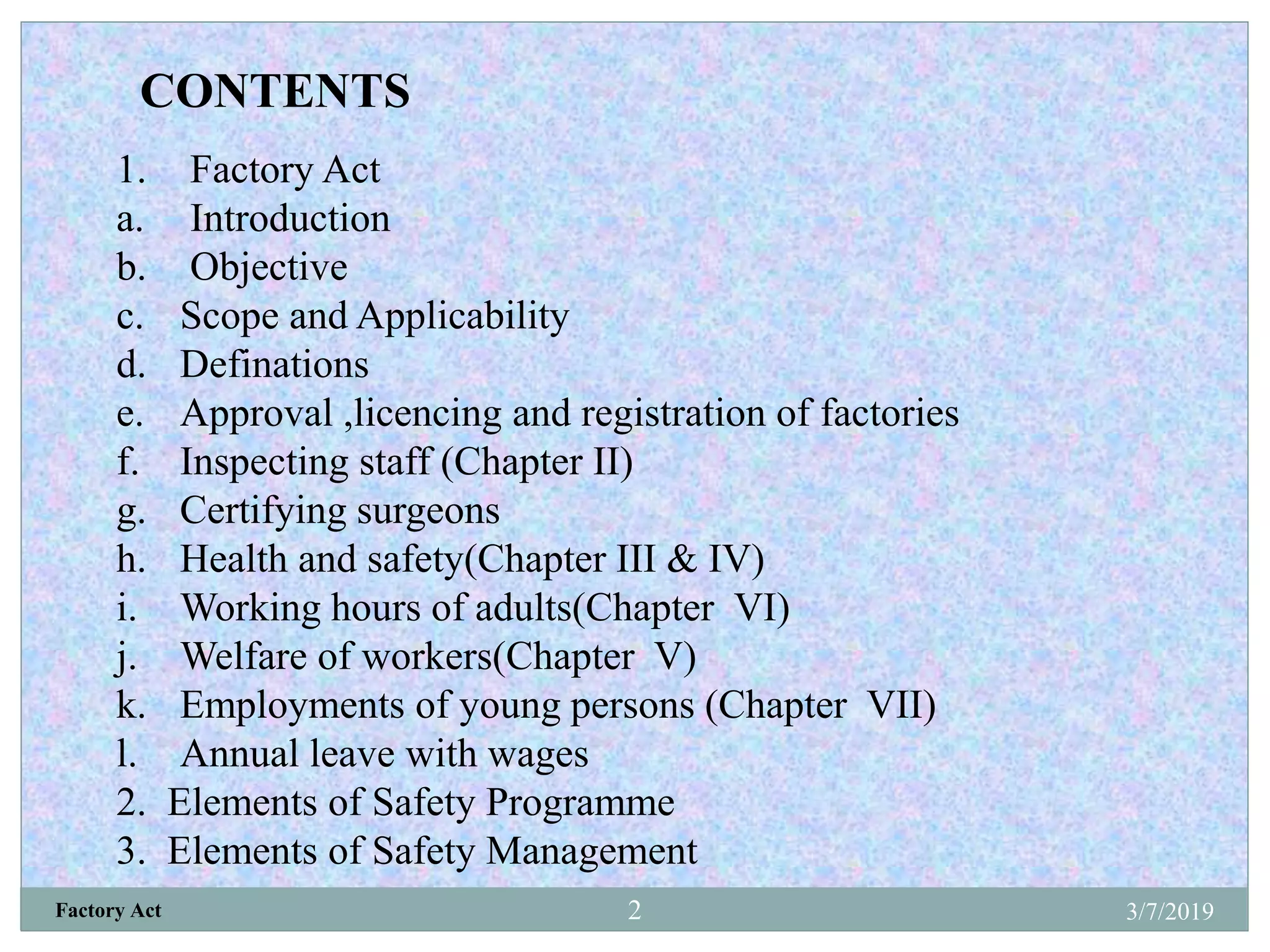
CONTENTS
1. Factory Act
a. Introduction
b. Objective
c. Scope and Applicability
d. Definations
e. Approval ,licencing and registration of factories
f. Inspecting staff (Chapter II)
g. Certifying surgeons
h. Health and safety(Chapter III & IV)
i. Working hours of adults(Chapter VI)
j. Welfare of workers(Chapter V)
k. Employments of young persons (Chapter VII)
l. Annual leave with wages
2. Elements of Safety Programme
3. Elements of Safety Management
Factory Act
a. Introduction
In India the first Factories Act was passed in 1881. This Act
was basically designed to protect employee and to provide
safety to the workers. This law was applicable to only those
factories where employed 100 or more workers. In 1891
another factories Act was pased which extended to the
factories employing 50/more workers.
3/7/20193
b. Objective
1. To protect workers employed in factories against industrial
and occupational hazard.
2. It also seek to provide that employees should work in
healthly condition and precautions are to be taken for safety
and prevention of accidents.
Factory Act
3/7/20194
c. Scope and applicability
1. Applies to all factories including factories belonging to
control / any state government.
2. The benefits are made avaliable to persons working in
factory.
d. Definations
1. Adult 9. Prime mover
2. Adolescent 10. Calender year
3. Child
4. Young person
5. Day
6. Week
7. Power
8. Occupier
Factory Act
3/7/20195
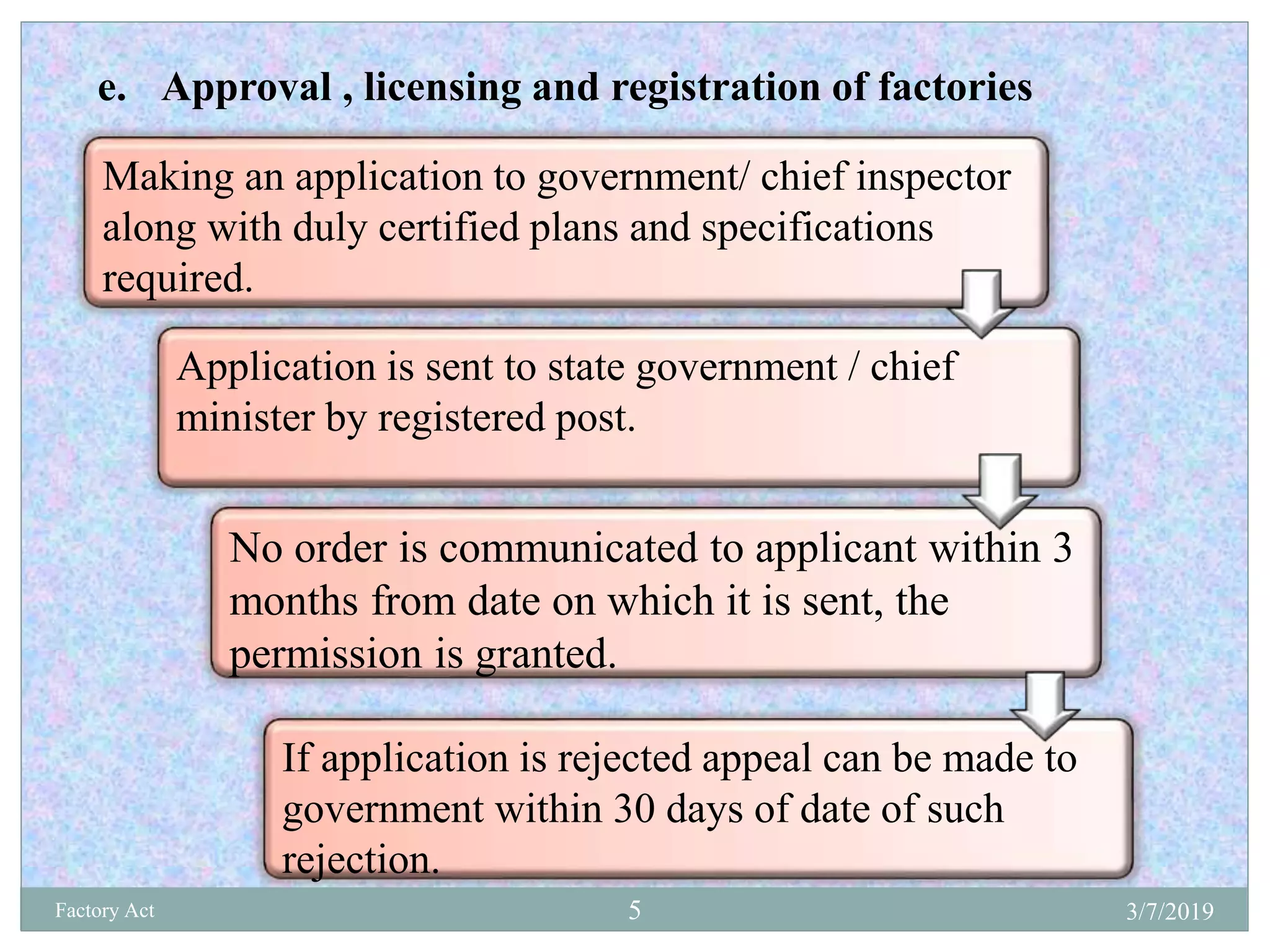
Making an application to government/ chief inspector
along with duly certified plans and specifications
required.
If application is rejected appeal can be made to
government within 30 days of date of such
rejection.
No order is communicated to applicant within 3
months from date on which it is sent, the
permission is granted.
Application is sent to state government / chief
minister by registered post.
e. Approval , licensing and registration of factories
Factory Act
3/7/20196
Notice by Occupier
The occupier shall sent a written notice to chief
inspector containing following details
a) Name and situation of factory
b) Name and address of occupier
c) Name and address of owner of premises/building
d) Name of manager of factory for purpose of this
act.
e) Total rated horse power installed in factory
f) No. of workers to be employed in factory
g) Avg. no. of workers per day employed during last
12 months in factory.
Factory Act
3/7/20197
f. Inspecting staff(Chapter II)
State government to appoint inspector by notification.
1. Chief inspector
2. Additional chief inspector
3. Joint chief inspector
4. Deputy chief inspector
g. Certifying Surgeons
State government appoint qualified medical
practitioners to be as certifying surgeons. He / she
should follow its respective duties.
Factory Act
3/7/20198
h. Health
and
safety
Cleanlin
ess
Artificial
humdific
ation
Ventilati
on
Drinking
water
Disposal
of waste
Dust &
fumes
Lighting
Factory Act
3/7/20199
i. Working hours of adults
a) Section 51: NMT 48 hrs a week
b) Section 52: Sunday shall be holiday
c) Section 53: Compensatory holidays
d) Section 54: In daily working hrs no adult worker shall
be allowed to work in a factory for more than 9 hr. in
any day.
e) Section 55: Interval for rest- no worker shall work for
more than 5 hr he had interval for rest of at least half
hr.
Inspector may increase it upto 6 hr.
Factory Act
3/7/201910
j. Employments of young persons
 No child who has not complete his 14 yr allowed to work
in factory.
 Certificate of fitness is required
 It is issued by certifying surgeons after examination and
ascertaining fitness for work in factory.
 It is valid for 12 months
 Revocation of certificate by surgeon if worker is no
longer fit.
 Employment of women
 Prohibition of women workers at night shift and shall not
be allowed to work in any factory except between 6am to
7 pm.
 Working hrs NMT 48 hr weekly and daily 9 hr.
Factory Act
3/7/201911
k. Annual leave with wages
 The maternity leave not exceeding 12 weeks and earned leave
in previous year should be included.
 Payment of wages to worker for leave period if he is discharge /
if he quits service.
l. Welfare of workers
 Washing facilities(section 42)
 Facilities of storing and drying clothes(section 43)
 Facilities of sitting(section 44)
 First aid appliances(section 45)
 Canteen(section 46) > 250 workers
 Rest room , shelters, lunch room(section 47) > 150 mens
 Welfare officers(section 48) > 500 workers
Factory Act
3/7/201912
Offences and Penalties – Sec.92-106
Factory Act
3/7/201913
Elements of Safety Programme
1. Hazard Recognition, Evaluation, and Control
2. Workplace Design and Engineering
3. Safety Performance Management
4. Regulatory Compliance Management
5. Training and Orientation
6. Organizational Communications
7. Management and Control of External Exposures
8. Workplace Planning and Staffing
9. Assessments, Audits, and Evaluations
Factory Act
3/7/201914
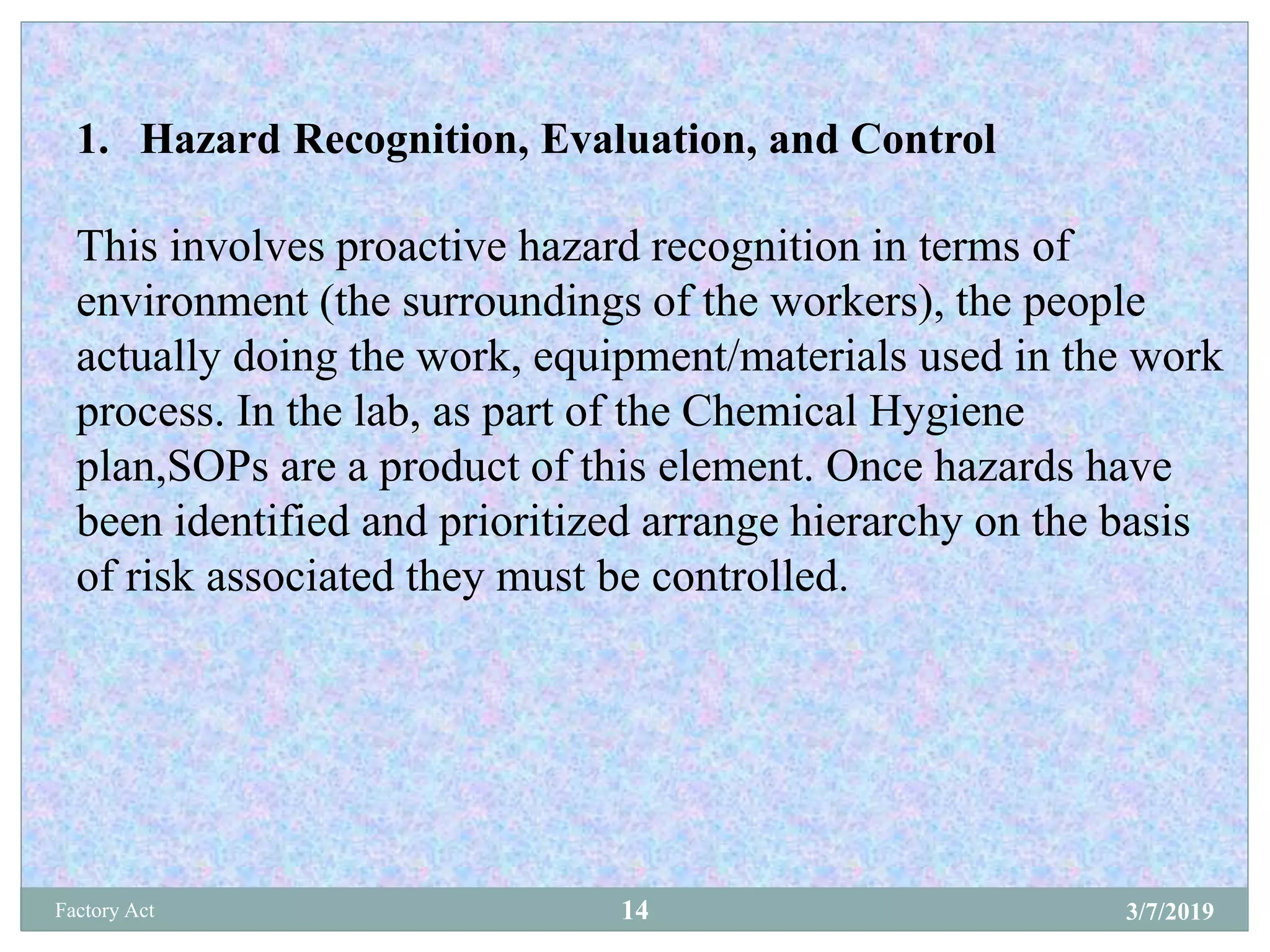
1. Hazard Recognition, Evaluation, and Control
This involves proactive hazard recognition in terms of
environment (the surroundings of the workers), the people
actually doing the work, equipment/materials used in the work
process. In the lab, as part of the Chemical Hygiene
plan,SOPs are a product of this element. Once hazards have
been identified and prioritized arrange hierarchy on the basis
of risk associated they must be controlled.
Factory Act
3/7/2019Factory Act 15
2. Workplace Design and Engineering
Designing safety into a workplace is as important as
designing in efficiency . Some of this is already done
by building code (e.g., electrical standards, fire
suppression, and exit requirements) and other aspects
such as ergonomics(comfort), ventilation, and noise
requirements for the anticipated work , equipment
and safeguarding, materials handling and storage, use
of automated processes must be added.
3/7/201916
3. Safety Performance Management
The actions of employees in relation to safety in their work.
Performance measurement should reflect how workers are
actually doing compared to applicable regulatory requirements.
This should include a system of accountability for meeting
those standards within their control.
4. Regulatory Compliance Management
Animal care facilities must meet OSHA(occupational safety and
health administration), EPA(US Env. Protection Agency),
DOT(department of transportation). It is very important to have
a mechanism for staying informed and complying with existing
regulations and standards. A self-assessment or assessment
conducted by an outside party is a good tool for determining
level of compliance.
Factory Act
3/7/201917
5. Organizational Communications
Communication within the organization keeps employees
informed of new and existing policies, procedures and
missions. Likewise it provides avenues from the front line to
upper management for consideration in the development and
revision of those polices. The flow of information provides
effective health and safety program.
6. Management and Control of External Exposures
This include consideration of incident or emergency
planning. Plans need to be developed for emergencies such
as severe weather, “neighborhood incidents,” and manmade
issues such as protestors or activists.
Factory Act
3/7/201918
8. Workplace Planning and Staffing
In providing an effective safety and health program effective
human resource management is critical. It includes
development of accurate job descriptions to take into
consideration job duties (such as respirator use or hearing
protection use, manual material handling, exposure to
allergens) . Limiting exposures by administrative controls or
other safety considerations (e.g. tasks requiring two people)
and development of safety rules would both be considered in
this element.
Factory Act
3/7/2019Factory Act 19
9. Assessments, Audits, and Evaluations
This final set of tools provides a measure for how an
organization is doing in terms of health and safety. These are
used to monitor compliance, behaviors, and provide a yardstick
for progress. A variety of tools are required to address these
needs. These can be performed by in-house staff, committees,
as part of a job task, or with outside consultants. The
assessment results serve as a way for improvement
3/7/201920
Elements of
safety
management
Safety
Plan
Training &
induction
Policies,
procedures
and
processes
Monitoring
Supervision
Reporting
Factory Act
3/7/201921
1. Safety Plan
A safety plan is a strategic action plan that forms part
of the business plan. It analyses the current and
prospective risk for a company and charts how the risks
will be controlled over a period.
2. Policies, procedures and processes
Policies, procedures and processes include all safety paper
infrastructures within the company. This paperwork will
describe all safety behaviour, expectations, record-keeping,
incident reporting, and incident notification documentation.
Factory Act
3/7/201922
3. Training & induction
Depending on the nature of the workplace (whether it is low-risk or
high-risk), everyone who enters the workplace should receive
training on:
the rules of the company;
the rules of the site; and
the rules of the location they are visiting.
The training content will depend on the level of risk the person is
exposed to.
4. Monitoring
The level of risk is consider , higher the risk, the more frequent and
detailed the monitoring needs to be.
It should be done to ensure that all risk has been covered by a new
risk assessment that has been carried out due to a change in process,
e.g. the installation of new workstations.
Factory Act
3/7/201923
5. Supervision
The only way to ensure workers are carrying out their safety
obligations is to have adequate supervision. The level of
supervision required in workplace will increase if the level of
safety control put in place to reduce a risk is low, i.e. the less
effective the control measure used, the higher the level of
supervision necessary.
6. Reporting
Workers need to know about safety – what’s going right and
what’s going wrong. This can only occur when they receive
safety feedback , e.g. how many hazards were identified, the
risk levels associated with those hazards and what control
measures were implemented.
Factory Act
3/7/201924
Reference
1. Vince McLeod, CIH and Glenn R. Ketcham. 9 Essential
Elements for a Successful Health and Safety Program
2. Patwari, P. B. The Factories Act, 1948 Indian Legal
Publications. 3-50
3. Joanna Weekes (2017). 6 elements of an effective safety
management system
Factory Act
3/7/201925Factory Act

factory act 1948 ,element of safety management and program

  • 1.
    Prepared by Miss Unnati.M. Patel F.Y.M Pharm(PQA) Guided by Dr A.D.Kulkarni Sir HOD of PQA Sanjivani College of Pharmaceutical Education and Research
  • 2.
    3/7/20192 CONTENTS 1. Factory Act a.Introduction b. Objective c. Scope and Applicability d. Definations e. Approval ,licencing and registration of factories f. Inspecting staff (Chapter II) g. Certifying surgeons h. Health and safety(Chapter III & IV) i. Working hours of adults(Chapter VI) j. Welfare of workers(Chapter V) k. Employments of young persons (Chapter VII) l. Annual leave with wages 2. Elements of Safety Programme 3. Elements of Safety Management Factory Act
  • 3.
    a. Introduction In Indiathe first Factories Act was passed in 1881. This Act was basically designed to protect employee and to provide safety to the workers. This law was applicable to only those factories where employed 100 or more workers. In 1891 another factories Act was pased which extended to the factories employing 50/more workers. 3/7/20193 b. Objective 1. To protect workers employed in factories against industrial and occupational hazard. 2. It also seek to provide that employees should work in healthly condition and precautions are to be taken for safety and prevention of accidents. Factory Act
  • 4.
    3/7/20194 c. Scope andapplicability 1. Applies to all factories including factories belonging to control / any state government. 2. The benefits are made avaliable to persons working in factory. d. Definations 1. Adult 9. Prime mover 2. Adolescent 10. Calender year 3. Child 4. Young person 5. Day 6. Week 7. Power 8. Occupier Factory Act
  • 5.
    3/7/20195 Making an applicationto government/ chief inspector along with duly certified plans and specifications required. If application is rejected appeal can be made to government within 30 days of date of such rejection. No order is communicated to applicant within 3 months from date on which it is sent, the permission is granted. Application is sent to state government / chief minister by registered post. e. Approval , licensing and registration of factories Factory Act
  • 6.
    3/7/20196 Notice by Occupier Theoccupier shall sent a written notice to chief inspector containing following details a) Name and situation of factory b) Name and address of occupier c) Name and address of owner of premises/building d) Name of manager of factory for purpose of this act. e) Total rated horse power installed in factory f) No. of workers to be employed in factory g) Avg. no. of workers per day employed during last 12 months in factory. Factory Act
  • 7.
    3/7/20197 f. Inspecting staff(ChapterII) State government to appoint inspector by notification. 1. Chief inspector 2. Additional chief inspector 3. Joint chief inspector 4. Deputy chief inspector g. Certifying Surgeons State government appoint qualified medical practitioners to be as certifying surgeons. He / she should follow its respective duties. Factory Act
  • 8.
  • 9.
    3/7/20199 i. Working hoursof adults a) Section 51: NMT 48 hrs a week b) Section 52: Sunday shall be holiday c) Section 53: Compensatory holidays d) Section 54: In daily working hrs no adult worker shall be allowed to work in a factory for more than 9 hr. in any day. e) Section 55: Interval for rest- no worker shall work for more than 5 hr he had interval for rest of at least half hr. Inspector may increase it upto 6 hr. Factory Act
  • 10.
    3/7/201910 j. Employments ofyoung persons  No child who has not complete his 14 yr allowed to work in factory.  Certificate of fitness is required  It is issued by certifying surgeons after examination and ascertaining fitness for work in factory.  It is valid for 12 months  Revocation of certificate by surgeon if worker is no longer fit.  Employment of women  Prohibition of women workers at night shift and shall not be allowed to work in any factory except between 6am to 7 pm.  Working hrs NMT 48 hr weekly and daily 9 hr. Factory Act
  • 11.
    3/7/201911 k. Annual leavewith wages  The maternity leave not exceeding 12 weeks and earned leave in previous year should be included.  Payment of wages to worker for leave period if he is discharge / if he quits service. l. Welfare of workers  Washing facilities(section 42)  Facilities of storing and drying clothes(section 43)  Facilities of sitting(section 44)  First aid appliances(section 45)  Canteen(section 46) > 250 workers  Rest room , shelters, lunch room(section 47) > 150 mens  Welfare officers(section 48) > 500 workers Factory Act
  • 12.
    3/7/201912 Offences and Penalties– Sec.92-106 Factory Act
  • 13.
    3/7/201913 Elements of SafetyProgramme 1. Hazard Recognition, Evaluation, and Control 2. Workplace Design and Engineering 3. Safety Performance Management 4. Regulatory Compliance Management 5. Training and Orientation 6. Organizational Communications 7. Management and Control of External Exposures 8. Workplace Planning and Staffing 9. Assessments, Audits, and Evaluations Factory Act
  • 14.
    3/7/201914 1. Hazard Recognition,Evaluation, and Control This involves proactive hazard recognition in terms of environment (the surroundings of the workers), the people actually doing the work, equipment/materials used in the work process. In the lab, as part of the Chemical Hygiene plan,SOPs are a product of this element. Once hazards have been identified and prioritized arrange hierarchy on the basis of risk associated they must be controlled. Factory Act
  • 15.
    3/7/2019Factory Act 15 2.Workplace Design and Engineering Designing safety into a workplace is as important as designing in efficiency . Some of this is already done by building code (e.g., electrical standards, fire suppression, and exit requirements) and other aspects such as ergonomics(comfort), ventilation, and noise requirements for the anticipated work , equipment and safeguarding, materials handling and storage, use of automated processes must be added.
  • 16.
    3/7/201916 3. Safety PerformanceManagement The actions of employees in relation to safety in their work. Performance measurement should reflect how workers are actually doing compared to applicable regulatory requirements. This should include a system of accountability for meeting those standards within their control. 4. Regulatory Compliance Management Animal care facilities must meet OSHA(occupational safety and health administration), EPA(US Env. Protection Agency), DOT(department of transportation). It is very important to have a mechanism for staying informed and complying with existing regulations and standards. A self-assessment or assessment conducted by an outside party is a good tool for determining level of compliance. Factory Act
  • 17.
    3/7/201917 5. Organizational Communications Communicationwithin the organization keeps employees informed of new and existing policies, procedures and missions. Likewise it provides avenues from the front line to upper management for consideration in the development and revision of those polices. The flow of information provides effective health and safety program. 6. Management and Control of External Exposures This include consideration of incident or emergency planning. Plans need to be developed for emergencies such as severe weather, “neighborhood incidents,” and manmade issues such as protestors or activists. Factory Act
  • 18.
    3/7/201918 8. Workplace Planningand Staffing In providing an effective safety and health program effective human resource management is critical. It includes development of accurate job descriptions to take into consideration job duties (such as respirator use or hearing protection use, manual material handling, exposure to allergens) . Limiting exposures by administrative controls or other safety considerations (e.g. tasks requiring two people) and development of safety rules would both be considered in this element. Factory Act
  • 19.
    3/7/2019Factory Act 19 9.Assessments, Audits, and Evaluations This final set of tools provides a measure for how an organization is doing in terms of health and safety. These are used to monitor compliance, behaviors, and provide a yardstick for progress. A variety of tools are required to address these needs. These can be performed by in-house staff, committees, as part of a job task, or with outside consultants. The assessment results serve as a way for improvement
  • 20.
  • 21.
    3/7/201921 1. Safety Plan Asafety plan is a strategic action plan that forms part of the business plan. It analyses the current and prospective risk for a company and charts how the risks will be controlled over a period. 2. Policies, procedures and processes Policies, procedures and processes include all safety paper infrastructures within the company. This paperwork will describe all safety behaviour, expectations, record-keeping, incident reporting, and incident notification documentation. Factory Act
  • 22.
    3/7/201922 3. Training &induction Depending on the nature of the workplace (whether it is low-risk or high-risk), everyone who enters the workplace should receive training on: the rules of the company; the rules of the site; and the rules of the location they are visiting. The training content will depend on the level of risk the person is exposed to. 4. Monitoring The level of risk is consider , higher the risk, the more frequent and detailed the monitoring needs to be. It should be done to ensure that all risk has been covered by a new risk assessment that has been carried out due to a change in process, e.g. the installation of new workstations. Factory Act
  • 23.
    3/7/201923 5. Supervision The onlyway to ensure workers are carrying out their safety obligations is to have adequate supervision. The level of supervision required in workplace will increase if the level of safety control put in place to reduce a risk is low, i.e. the less effective the control measure used, the higher the level of supervision necessary. 6. Reporting Workers need to know about safety – what’s going right and what’s going wrong. This can only occur when they receive safety feedback , e.g. how many hazards were identified, the risk levels associated with those hazards and what control measures were implemented. Factory Act
  • 24.
    3/7/201924 Reference 1. Vince McLeod,CIH and Glenn R. Ketcham. 9 Essential Elements for a Successful Health and Safety Program 2. Patwari, P. B. The Factories Act, 1948 Indian Legal Publications. 3-50 3. Joanna Weekes (2017). 6 elements of an effective safety management system Factory Act
  • 25.