Ver. No.: 1.1
Quality Content for Outcome based Learning
HASHING
Day 1
Ver. No.: 1.1
Quality Content for Outcome based Learning
HASHING
Hashing
3
Hashing
4
Hashing
Search complexity dependent on input size. If we don’t
want our search dependent on input size, then we use
hashing.
H: K- L
Apply hash functions on key k (search element) to find the
location L.
It provides constant time searching technique.
5
Hashing
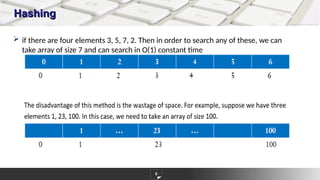
 if there are four elements 3, 5, 7, 2. Then in order to search any of these, we can
take array of size 7 and can search in O(1) constant time
6
Hashing
7
Hashing
8
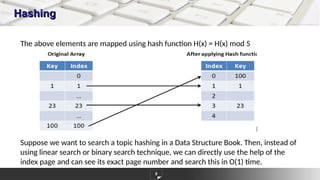
The above elements are mapped using hash function H(x) = H(x) mod 5
Suppose we want to search a topic hashing in a Data Structure Book. Then, instead of
using linear search or binary search technique, we can directly use the help of the
index page and can see its exact page number and search this in O(1) time.
Definition of Hashing
9
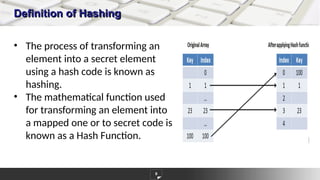
• The process of transforming an
element into a secret element
using a hash code is known as
hashing.
• The mathematical function used
for transforming an element into
a mapped one or to secret code is
known as a Hash Function.
Definition of Hashing
10
• Hash Table: A structure
that maps keys to
Values.
Hashing Functions
11
Three Types
1. Division Method
2. Mid Square Method
3. Folding Method
Hashing Functions
12
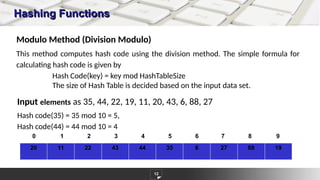
Modulo Method (Division Modulo)
This method computes hash code using the division method. The simple formula for
calculating hash code is given by
Hash Code(key) = key mod HashTableSize
The size of Hash Table is decided based on the input data set.
Input elements as 35, 44, 22, 19, 11, 20, 43, 6, 88, 27
Hash code(35) = 35 mod 10 = 5,
Hash code(44) = 44 mod 10 = 4
20 11 22 43 44 35 6 27 88 19
0 1 2 3 4 5 6 7 8 9
Hashing Functions
13
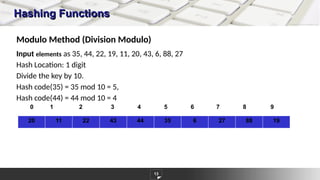
Modulo Method (Division Modulo)
Input elements as 35, 44, 22, 19, 11, 20, 43, 6, 88, 27
Hash Location: 1 digit
Divide the key by 10.
Hash code(35) = 35 mod 10 = 5,
Hash code(44) = 44 mod 10 = 4
20 11 22 43 44 35 6 27 88 19
0 1 2 3 4 5 6 7 8 9
Hashing Functions
14
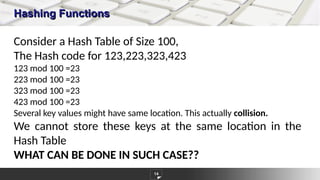
Consider a Hash Table of Size 100,
The Hash code for 123,223,323,423
123 mod 100 =23
223 mod 100 =23
323 mod 100 =23
423 mod 100 =23
Several key values might have same location. This actually collision.
We cannot store these keys at the same location in the
Hash Table
WHAT CAN BE DONE IN SUCH CASE??
Hashing Functions
15
WHAT CAN BE DONE IN SUCH CASE??
We find the number that has least chance of collision.
So, we chose prime no. nearest to upper bound of an
array.
For above eg. We chose prime number nearest to 100.
So , we select 97.
K%97
Hashing Functions
16
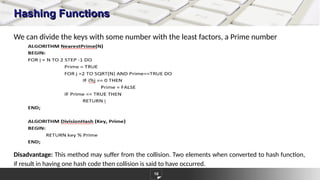
We can divide the keys with some number with the least factors, a Prime number
Disadvantage: This method may suffer from the collision. Two elements when converted to hash function,
if result in having one hash code then collision is said to have occurred.
Hashing Functions
17
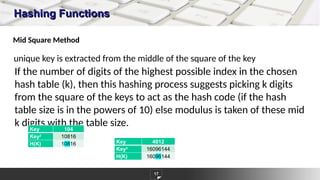
Mid Square Method
unique key is extracted from the middle of the square of the key
If the number of digits of the highest possible index in the chosen
hash table (k), then this hashing process suggests picking k digits
from the square of the keys to act as the hash code (if the hash
table size is in the powers of 10) else modulus is taken of these mid
k digits with the table size.
Key 104
Key2
10816
H(K) 10816 Key 4012
Key2
16096144
H(K) 16096144
Hashing Functions
18
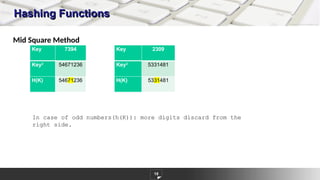
Mid Square Method
Key 7394
Key2
54671236
H(K) 54671236
Key 2309
Key2
5331481
H(K) 5331481
In case of odd numbers(h(K)): more digits discard from the
right side.
Hashing Functions
19
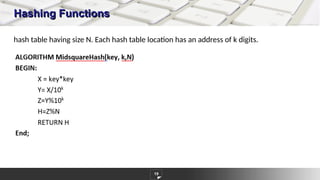
hash table having size N. Each hash table location has an address of k digits.
Hashing Functions
20
Folding Method
• Divide the key into equal size of pieces (of the same length as that of the
length of the largest address in the table size) and then these are added
together.
• Modulus is taken of sum with the table size, which results in the hash
code.
H(k) = sum mod N
eg.
Hashing Functions
21
Folding Method
eg.
2.
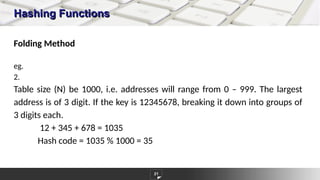
Table size (N) be 1000, i.e. addresses will range from 0 – 999. The largest
address is of 3 digit. If the key is 12345678, breaking it down into groups of
3 digits each.
12 + 345 + 678 = 1035
Hash code = 1035 % 1000 = 35
Hashing Functions
22
Folding Method (Variations )
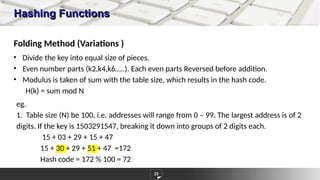
• Divide the key into equal size of pieces.
• Even number parts (k2,k4,k6…..). Each even parts Reversed before addition.
• Modulus is taken of sum with the table size, which results in the hash code.
H(k) = sum mod N
eg.
1. Table size (N) be 100, i.e. addresses will range from 0 – 99. The largest address is of 2
digits. If the key is 1503291547, breaking it down into groups of 2 digits each.
15 + 03 + 29 + 15 + 47
15 + 30 + 29 + 51 + 47 =172
Hash code = 172 % 100 = 72
Hashing Functions
23
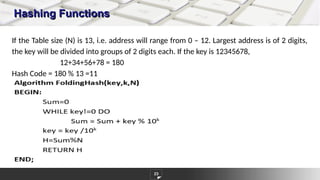
If the Table size (N) is 13, i.e. address will range from 0 – 12. Largest address is of 2 digits,
the key will be divided into groups of 2 digits each. If the key is 12345678,
12+34+56+78 = 180
Hash Code = 180 % 13 =11
Hashing Functions
24
A variation of the folding method is Reverse Folding, in which either the odd group or the
even group is reversed before addition.
Collision Resolution in Hashing
25
The situation when the location found for two keys are same, the situation
can be termed as collision.
H:Key1→ L
H:Key2→ L
As two data values cannot be kept in the exact location, collision is not
desirable situation.
Avoiding collisions completely is difficult, even with a good hash function.
Some method should be used to resolve this.
Collision Resolution in Hashing
26
There are two known methods of collision resolution in Hashing.
• Open Addressing
• Separate Chaining
Collision Resolution in Hashing
27
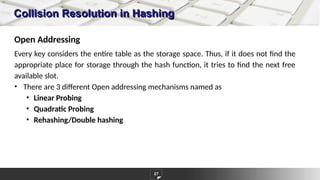
Open Addressing
Every key considers the entire table as the storage space. Thus, if it does not find the
appropriate place for storage through the hash function, it tries to find the next free
available slot.
• There are 3 different Open addressing mechanisms named as
• Linear Probing
• Quadratic Probing
• Rehashing/Double hashing
Collision Resolution in Hashing
28
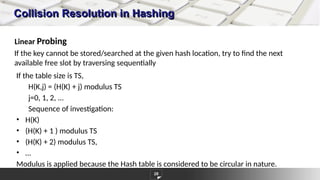
Linear Probing
If the key cannot be stored/searched at the given hash location, try to find the next
available free slot by traversing sequentially
If the table size is TS,
H(K,j) = (H(K) + j) modulus TS
j=0, 1, 2, ...
Sequence of investigation:
• H(K)
• (H(K) + 1 ) modulus TS
• (H(K) + 2) modulus TS,
• …
Modulus is applied because the Hash table is considered to be circular in nature.
Collision Resolution in Hashing
29
Disadvantages of Linear Probing
One main disadvantages of linear probing is that records tends to
cluster that is appear next to one another, when the load factor is
greater than 50%. In this case the average search time for a record is
increasing.
Collision Resolution in Hashing
30
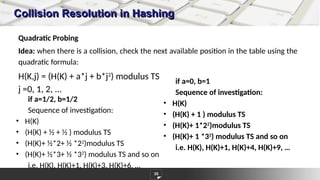
Quadratic Probing
Idea: when there is a collision, check the next available position in the table using the
quadratic formula:
H(K,j) = (H(K) + a*j + b*j2
) modulus TS
j =0, 1, 2, ...
if a=1/2, b=1/2
Sequence of investigation:
• H(K)
• (H(K) + ½ + ½ ) modulus TS
• (H(K)+ ½*2+ ½ *22
)modulus TS
• (H(K)+ ½*3+ ½ *32
) modulus TS and so on
i.e. H(K), H(K)+1, H(K)+3, H(K)+6, …
if a=0, b=1
Sequence of investigation:
• H(K)
• (H(K) + 1 ) modulus TS
• (H(K)+ 1*22
)modulus TS
• (H(K)+ 1 *32
) modulus TS and so on
i.e. H(K), H(K)+1, H(K)+4, H(K)+9, …
Collision Resolution in Hashing
31
Quadratic Probing
In Quadratic probing insertion may be impossible is the table is more than half full;
Linear probing guarantee that all empty positions will be examined if necessary, quadratic
probing doesnot.
Collision Resolution in Hashing
32
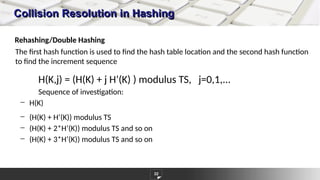
Rehashing/Double Hashing
The first hash function is used to find the hash table location and the second hash function
to find the increment sequence
H(K,j) = (H(K) + j H’(K) ) modulus TS, j=0,1,...
Sequence of investigation:
- H(K)
- (H(K) + H’(K)) modulus TS
- (H(K) + 2*H’(K)) modulus TS and so on
- (H(K) + 3*H’(K)) modulus TS and so on
Collision Resolution in Hashing
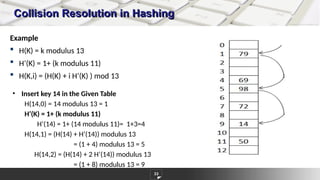
Example
 H(K) = k modulus 13
 H’(K) = 1+ (k modulus 11)
 H(K,i) = (H(K) + i H’(K) ) mod 13
33
• Insert key 14 in the Given Table
H(14,0) = 14 modulus 13 = 1
H’(K) = 1+ (k modulus 11)
H’(14) = 1+ (14 modulus 11)= 1+3=4
H(14,1) = (H(14) + H’(14)) modulus 13
= (1 + 4) modulus 13 = 5
H(14,2) = (H(14) + 2 H’(14)) modulus 13
= (1 + 8) modulus 13 = 9
Collision Resolution in Hashing
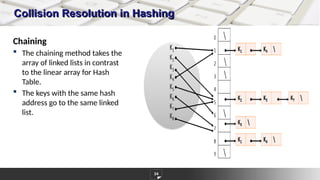
Chaining
 The chaining method takes the
array of linked lists in contrast
to the linear array for Hash
Table.
 The keys with the same hash
address go to the same linked
list.
34
35
Load Factor of a Hash Table
• S(λ): Average number of probes for successful search
• Load factor is defined as
S(λ) = N/TS
S(λ): Average number of probes for successful search
– N refers to the Total number of keys stored in the hash table
– TS refers to the Hash Table Size
36
Load Factor of a Hash Table
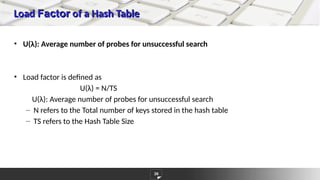
• U(λ): Average number of probes for unsuccessful search
• Load factor is defined as
U(λ) = N/TS
U(λ): Average number of probes for unsuccessful search
– N refers to the Total number of keys stored in the hash table
– TS refers to the Hash Table Size
37
Thank You

hashing explained in detail with hash functions

  • 1.
    Ver. No.: 1.1 QualityContent for Outcome based Learning HASHING Day 1
  • 2.
    Ver. No.: 1.1 QualityContent for Outcome based Learning HASHING
  • 3.
  • 4.
  • 5.
    Hashing Search complexity dependenton input size. If we don’t want our search dependent on input size, then we use hashing. H: K- L Apply hash functions on key k (search element) to find the location L. It provides constant time searching technique. 5
  • 6.
    Hashing  if thereare four elements 3, 5, 7, 2. Then in order to search any of these, we can take array of size 7 and can search in O(1) constant time 6
  • 7.
  • 8.
    Hashing 8 The above elementsare mapped using hash function H(x) = H(x) mod 5 Suppose we want to search a topic hashing in a Data Structure Book. Then, instead of using linear search or binary search technique, we can directly use the help of the index page and can see its exact page number and search this in O(1) time.
  • 9.
    Definition of Hashing 9 •The process of transforming an element into a secret element using a hash code is known as hashing. • The mathematical function used for transforming an element into a mapped one or to secret code is known as a Hash Function.
  • 10.
    Definition of Hashing 10 •Hash Table: A structure that maps keys to Values.
  • 11.
    Hashing Functions 11 Three Types 1.Division Method 2. Mid Square Method 3. Folding Method
  • 12.
    Hashing Functions 12 Modulo Method(Division Modulo) This method computes hash code using the division method. The simple formula for calculating hash code is given by Hash Code(key) = key mod HashTableSize The size of Hash Table is decided based on the input data set. Input elements as 35, 44, 22, 19, 11, 20, 43, 6, 88, 27 Hash code(35) = 35 mod 10 = 5, Hash code(44) = 44 mod 10 = 4 20 11 22 43 44 35 6 27 88 19 0 1 2 3 4 5 6 7 8 9
  • 13.
    Hashing Functions 13 Modulo Method(Division Modulo) Input elements as 35, 44, 22, 19, 11, 20, 43, 6, 88, 27 Hash Location: 1 digit Divide the key by 10. Hash code(35) = 35 mod 10 = 5, Hash code(44) = 44 mod 10 = 4 20 11 22 43 44 35 6 27 88 19 0 1 2 3 4 5 6 7 8 9
  • 14.
    Hashing Functions 14 Consider aHash Table of Size 100, The Hash code for 123,223,323,423 123 mod 100 =23 223 mod 100 =23 323 mod 100 =23 423 mod 100 =23 Several key values might have same location. This actually collision. We cannot store these keys at the same location in the Hash Table WHAT CAN BE DONE IN SUCH CASE??
  • 15.
    Hashing Functions 15 WHAT CANBE DONE IN SUCH CASE?? We find the number that has least chance of collision. So, we chose prime no. nearest to upper bound of an array. For above eg. We chose prime number nearest to 100. So , we select 97. K%97
  • 16.
    Hashing Functions 16 We candivide the keys with some number with the least factors, a Prime number Disadvantage: This method may suffer from the collision. Two elements when converted to hash function, if result in having one hash code then collision is said to have occurred.
  • 17.
    Hashing Functions 17 Mid SquareMethod unique key is extracted from the middle of the square of the key If the number of digits of the highest possible index in the chosen hash table (k), then this hashing process suggests picking k digits from the square of the keys to act as the hash code (if the hash table size is in the powers of 10) else modulus is taken of these mid k digits with the table size. Key 104 Key2 10816 H(K) 10816 Key 4012 Key2 16096144 H(K) 16096144
  • 18.
    Hashing Functions 18 Mid SquareMethod Key 7394 Key2 54671236 H(K) 54671236 Key 2309 Key2 5331481 H(K) 5331481 In case of odd numbers(h(K)): more digits discard from the right side.
  • 19.
    Hashing Functions 19 hash tablehaving size N. Each hash table location has an address of k digits.
  • 20.
    Hashing Functions 20 Folding Method •Divide the key into equal size of pieces (of the same length as that of the length of the largest address in the table size) and then these are added together. • Modulus is taken of sum with the table size, which results in the hash code. H(k) = sum mod N eg.
  • 21.
    Hashing Functions 21 Folding Method eg. 2. Tablesize (N) be 1000, i.e. addresses will range from 0 – 999. The largest address is of 3 digit. If the key is 12345678, breaking it down into groups of 3 digits each. 12 + 345 + 678 = 1035 Hash code = 1035 % 1000 = 35
  • 22.
    Hashing Functions 22 Folding Method(Variations ) • Divide the key into equal size of pieces. • Even number parts (k2,k4,k6…..). Each even parts Reversed before addition. • Modulus is taken of sum with the table size, which results in the hash code. H(k) = sum mod N eg. 1. Table size (N) be 100, i.e. addresses will range from 0 – 99. The largest address is of 2 digits. If the key is 1503291547, breaking it down into groups of 2 digits each. 15 + 03 + 29 + 15 + 47 15 + 30 + 29 + 51 + 47 =172 Hash code = 172 % 100 = 72
  • 23.
    Hashing Functions 23 If theTable size (N) is 13, i.e. address will range from 0 – 12. Largest address is of 2 digits, the key will be divided into groups of 2 digits each. If the key is 12345678, 12+34+56+78 = 180 Hash Code = 180 % 13 =11
  • 24.
    Hashing Functions 24 A variationof the folding method is Reverse Folding, in which either the odd group or the even group is reversed before addition.
  • 25.
    Collision Resolution inHashing 25 The situation when the location found for two keys are same, the situation can be termed as collision. H:Key1→ L H:Key2→ L As two data values cannot be kept in the exact location, collision is not desirable situation. Avoiding collisions completely is difficult, even with a good hash function. Some method should be used to resolve this.
  • 26.
    Collision Resolution inHashing 26 There are two known methods of collision resolution in Hashing. • Open Addressing • Separate Chaining
  • 27.
    Collision Resolution inHashing 27 Open Addressing Every key considers the entire table as the storage space. Thus, if it does not find the appropriate place for storage through the hash function, it tries to find the next free available slot. • There are 3 different Open addressing mechanisms named as • Linear Probing • Quadratic Probing • Rehashing/Double hashing
  • 28.
    Collision Resolution inHashing 28 Linear Probing If the key cannot be stored/searched at the given hash location, try to find the next available free slot by traversing sequentially If the table size is TS, H(K,j) = (H(K) + j) modulus TS j=0, 1, 2, ... Sequence of investigation: • H(K) • (H(K) + 1 ) modulus TS • (H(K) + 2) modulus TS, • … Modulus is applied because the Hash table is considered to be circular in nature.
  • 29.
    Collision Resolution inHashing 29 Disadvantages of Linear Probing One main disadvantages of linear probing is that records tends to cluster that is appear next to one another, when the load factor is greater than 50%. In this case the average search time for a record is increasing.
  • 30.
    Collision Resolution inHashing 30 Quadratic Probing Idea: when there is a collision, check the next available position in the table using the quadratic formula: H(K,j) = (H(K) + a*j + b*j2 ) modulus TS j =0, 1, 2, ... if a=1/2, b=1/2 Sequence of investigation: • H(K) • (H(K) + ½ + ½ ) modulus TS • (H(K)+ ½*2+ ½ *22 )modulus TS • (H(K)+ ½*3+ ½ *32 ) modulus TS and so on i.e. H(K), H(K)+1, H(K)+3, H(K)+6, … if a=0, b=1 Sequence of investigation: • H(K) • (H(K) + 1 ) modulus TS • (H(K)+ 1*22 )modulus TS • (H(K)+ 1 *32 ) modulus TS and so on i.e. H(K), H(K)+1, H(K)+4, H(K)+9, …
  • 31.
    Collision Resolution inHashing 31 Quadratic Probing In Quadratic probing insertion may be impossible is the table is more than half full; Linear probing guarantee that all empty positions will be examined if necessary, quadratic probing doesnot.
  • 32.
    Collision Resolution inHashing 32 Rehashing/Double Hashing The first hash function is used to find the hash table location and the second hash function to find the increment sequence H(K,j) = (H(K) + j H’(K) ) modulus TS, j=0,1,... Sequence of investigation: - H(K) - (H(K) + H’(K)) modulus TS - (H(K) + 2*H’(K)) modulus TS and so on - (H(K) + 3*H’(K)) modulus TS and so on
  • 33.
    Collision Resolution inHashing Example  H(K) = k modulus 13  H’(K) = 1+ (k modulus 11)  H(K,i) = (H(K) + i H’(K) ) mod 13 33 • Insert key 14 in the Given Table H(14,0) = 14 modulus 13 = 1 H’(K) = 1+ (k modulus 11) H’(14) = 1+ (14 modulus 11)= 1+3=4 H(14,1) = (H(14) + H’(14)) modulus 13 = (1 + 4) modulus 13 = 5 H(14,2) = (H(14) + 2 H’(14)) modulus 13 = (1 + 8) modulus 13 = 9
  • 34.
    Collision Resolution inHashing Chaining  The chaining method takes the array of linked lists in contrast to the linear array for Hash Table.  The keys with the same hash address go to the same linked list. 34
  • 35.
    35 Load Factor ofa Hash Table • S(λ): Average number of probes for successful search • Load factor is defined as S(λ) = N/TS S(λ): Average number of probes for successful search – N refers to the Total number of keys stored in the hash table – TS refers to the Hash Table Size
  • 36.
    36 Load Factor ofa Hash Table • U(λ): Average number of probes for unsuccessful search • Load factor is defined as U(λ) = N/TS U(λ): Average number of probes for unsuccessful search – N refers to the Total number of keys stored in the hash table – TS refers to the Hash Table Size
  • 37.