International Research Journal of Engineering and Technology (IRJET) e-ISSN: 2395-0056
Volume: 04 Issue: 08 | Aug -2017 www.irjet.net p-ISSN: 2395-0072
© 2017, IRJET | Impact Factor value: 5.181 | ISO 9001:2008 Certified Journal | Page 2340
Harmonic Mitigation using Modified Synchronous Reference
Frame Theory
Mr. Bhushan S. Rakhonde1, Astt.Prof. C. M. Bobade 2
1M.E. student, Electrical Power System Engineering, G.H.R.C.E.M. Amravati, Maharashtra, India
2Assistant Professor, Electrical Engineering Department, G.H.R.C.E.M. Amravati, Maharashtra, India
---------------------------------------------------------------------***---------------------------------------------------------------------
Abstract - Use of nonlinear load increasing day by day
because it consumes less power as compared to linear load.
Although this power electronics equipment make our life
convenient, they inject harmonic into power system. These
harmonics affects amplitude and nature of sourcecurrentand
hence performance ofsystem. Thereforepower qualitybecame
very serious issue. Conventionally, passive filters have been
used to eliminate harmonics from power system but it has
some limitations. So, new solution to eliminate harmonics is
developed which is shunt active power filter.
This paper presents a new three-phase shunt active
power filter to compensate harmonics is implemented in
MATLAB. Main part of shunt active power filter is reference
current generation control algorithm. This Paper includes
simulation of three reference current generation techniques
viz. Modified synchronous reference frame (MSRF) theory,
Key Words: InstantaneousReactivePowerTheory,Total
Harmonic Distortion (THD), Reference current
generation, filter, power quality, Shunt Active Power
Filter.
1.INTRODUCTION
As we know that the harmonics generated by
nonlinear loads affects on amplitude and nature of source
current hence the performance of system. Nonlinear loads
cause high disturbances on power system. harmonics cause
many problems like heat, losses, failure of electrical
equipment and interference withcommunicationsystem. So,
elimination of harmonics is important issue andtosolvethis
problem shunt active power filter (SAPF) came into
action[1].
The most popular solution to eliminate these
harmonics is Shunt Active PowerFilter(SAPF)becauseSAPF
can eliminate harmonics easily, overcome voltage sag and
improves power factor[6].
Significance of SAPF can be understood as follows.
Assume that load connected to system is drawing
unbalanced harmonic current. In addition, the load power
factor is poor. This will obviously lead to unbalance and
distortion in other system quantities which is undesirable.
Therefore, it important to install some corrective measures
in system to solve above problem.Itiswell knownthatshunt
capacitor is good solution for correcting poor power factor.
Similarly tuned filter are also used with power electronic
loads to bypass harmonic currents. The problem of load
balancing also has to solve by some method. However, all
these problems can be solved bysingledevice whichiscalled
shunt active power factor (SAPF). Principle of SAPF is to
inject current in the system which is equal and opposite in
polarity to harmonic current. It has many advantages over
passive filter like reactive power compensation, voltage
regulation also SAPF is smaller, more versatile, more
selective, better damped and less prone to failure. They are
studied widely and great developments have taken place in
theory and application of active power filters. The
performance of SAPF depends on control algorithm usedfor
reference current generation which is then used as a
reference for filter current. Finally, this filter current is used
for compensation of harmonics. In this way, we can achieve
harmonic mitigation and improve power quality, voltage
regulation, load current unbalance, power factor etc. of
power system.
When shunt active power filter is connected in the
system and modified synchronous reference frame method
is used for reference current generation thenthepercentage
THD is reduced to 3.25%.
1.1 Passive Filter
Passive filters have been most commonly used to
limit the flow of harmonics currents in distribution system.
They are usually custom designed for application. However,
their performance is limited to a fewharmonicsandtheycan
introduce resonance in the power system.
Passive filters use reactive storage components, namely
capacitors and inductors and they do not rely upon any type
of external power source. In addition, they are not going to
rely on transistors or any other type of active components
for working. The inductors will block high frequency signals
and conduct low frequency signals. The capacitors are going
to do just the opposites. By tuning these elements passive
filters are designed to shunt harmonics from the lines or
block their flow through some parts of system. They have
some advantages such as simplicity, reliability, efficiency,
International Research Journal of Engineering and Technology (IRJET) e-ISSN: 2395-0056
Volume: 04 Issue: 08 | Aug -2017 www.irjet.net p-ISSN: 2395-0072
© 2017, IRJET | Impact Factor value: 5.181 | ISO 9001:2008 Certified Journal | Page 2341
and cost. These filters are tuned and fixed according to the
impedance of the point at which they will be connected and
hence cannot be adjusted instantaneously in accordance to
the load. As a result their cutoff frequency changes
unexpectedly after any change in the load impedance
resulting in producing a resonance with other elements
installed in the system. Other drawbacks are interference
with communication system, they are heavy and bulky,
overloaded when the load harmonics increase.
1.2 Active Filter
There are basically two types of active filters: the
shunt type and the series type. Shunt active power filter is
able to compensate for both current harmonics and power
factor. Furthermore, it allows loadbalancing,eliminating the
current in the neutral wire. Series active power filter is the
dual of the shunt active filter, and is able to compensate for
distortion in the power line voltages, making the voltages
applied to the load sinusoidal (compensating for voltage
harmonics). Depending on the particular application or
electrical problem to be solved, active power filters can be
implemented as shunt type, series type, or a combination of
shunt and series active filters (shunt-series type). These
filters can also be combined with passive filters to create
hybrid power filters.
The shunt-connected active power filter, with a self-
controlled dc bus, has a topology similar to that of a static
compensator (STATCOM) used for reactive power
compensation in power transmission systems. Shunt active
power filters compensate load current harmonics by
injecting equal-but opposite harmonic compensating
current. In this case the shunt active power filteroperatesas
a current source injecting the harmonic components
generated by the load but phase-shifted by 180°. Series
active power filters were introduced by the end ofthe1980s
and operate mainly as a voltage regulator and as a harmonic
isolator between the nonlinear load and the utility system.
The series-connected filter protects the consumer from an
inadequate supply voltage quality.
2. BASIC COMPENSATION PRINCIPLE
The basic principle of a shunt active power filter is
that it generates a current equal and opposite in polarity to
the harmonic current drawn by the load and injects it to the
point of common coupling, thereby forcing the source
current to be pure sinusoidal. Harmonic and reactive
currents are thus cancelled at the source end and the result
is undistorted sinusoidal balanced currents.
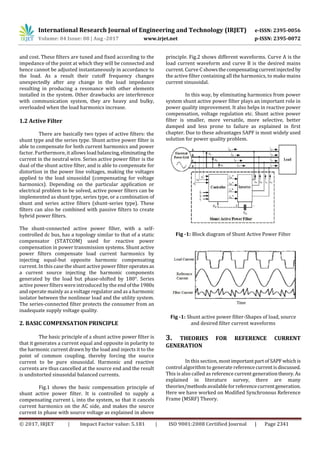
Fig.1 shows the basic compensation principle of
shunt active power filter. It is controlled to supply a
compensating current ic into the system, so that it cancels
current harmonics on the AC side, and makes the source
current in phase with source voltage as explained in above
principle. Fig.2 shows different waveforms. Curve A is the
load current waveform and curve B is the desired mains
current. Curve C showsthecompensatingcurrentinjectedby
the active filter containing all the harmonics, to make mains
current sinusoidal.
In this way, by eliminating harmonics from power
system shunt active power filter plays an important role in
power quality improvement. It also helps in reactive power
compensation, voltage regulation etc. Shunt active power
filter is smaller, more versatile, more selective, better
damped and less prone to failure as explained in first
chapter. Due to these advantages SAPF is most widely used
solution for power quality problem.
Fig -1: Block diagram of Shunt Active Power Filter
Fig -1: Shunt active power filter-Shapes of load, source
and desired filter current waveforms
3. THEORIES FOR REFERENCE CURRENT
GENERATION
In this section, most importantpartof SAPFwhichis
control algorithm to generate referencecurrentisdiscussed.
This is also called as reference current generation theory. As
explained in literature survey, there are many
theories/methodsavailableforreferencecurrentgeneration.
Here we have worked on Modified Synchronous Reference
Frame (MSRF) Theory.
International Research Journal of Engineering and Technology (IRJET) e-ISSN: 2395-0056
Volume: 04 Issue: 08 | Aug -2017 www.irjet.net p-ISSN: 2395-0072
© 2017, IRJET | Impact Factor value: 5.181 | ISO 9001:2008 Certified Journal | Page 2342
3.2ModifiedSynchronousReferenceFrame(MSRF)
Theory
The modified synchronous referenceframemethod
is also called as the instantaneous current component ( )
method. As the name suggest this method is similar to the
SRF method only small modification is done. In SRF method
we get transformation angle from PLL, but here in
modified SRF, transformation angle is obtained with the
voltages of AC network. Similar to SRF method it is also
based on the principle that harmonics change their
frequency in a rotating reference frame, so they are better
isolated with filters.
The difference is that due to voltage harmonics and
imbalance, the speed of reference frame is no longer
constant. It varies instantaneously depending on the
waveform of the three phase voltage system. One of the
important characteristics of this algorithm is that
compensating currents are obtained from theinstantaneous
active and reactive current components of the nonlinear
load. This method can achieve fast andaccurateextractionof
the harmonic content and of the reactive component of a
distorted current.
Reference frame transformation is the
transformation of coordinates from a three-phase a-b-c
stationary coordinate system to the 0-d-q rotating
coordinate system. Therefore similar to synchronous
reference frame method, here first weconvertthreephasea-
b-c stationarycoordinatesystemtotwo-phaseα-βstationary
coordinate system which is called Clark’s transformation.
Then this two phase α-β stationary coordinate system is
converted into two phase d-q rotating coordinate system
which is called Park’s transformation.
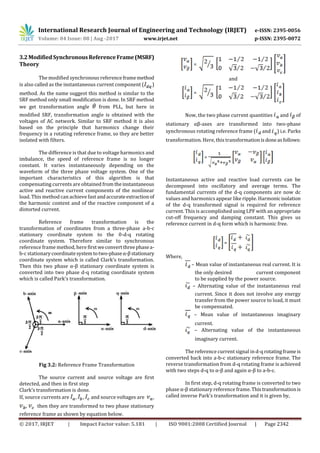
Fig 3.2: Reference Frame Transformation
The source current and source voltage are first
detected, and then in first step
Clark’s transformation is done.
If, source currents are , , and source voltages are ,
, then they are transformed to two phase stationary
reference frame as shown by equation below.
=
and
=
Now, the two phase current quantities and of
stationary αβ-axes are transformed into two-phase
synchronous rotating reference frame ( and ) i.e. Parks
transformation. Here, this transformationisdoneasfollows:
=
Instantaneous active and reactive load currents can be
decomposed into oscillatory and average terms. The
fundamental currents of the d-q components are now dc
values and harmonics appear like ripple. Harmonicisolation
of the d-q transformed signal is required for reference
current. This is accomplished using LPF with an appropriate
cut-off frequency and damping constant. This gives us
reference current in d-q form which is harmonic free.
=
Where,
– Mean value of instantaneous real current. It is
the only desired current component
to be supplied by the power source.
– Alternating value of the instantaneous real
current. Since it does not involve any energy
transfer from the power source to load, it must
be compensated.
– Mean value of instantaneous imaginary
current.
– Alternating value of the instantaneous
imaginary current.
The reference current signal in d-q rotatingframeis
converted back into a-b-c stationary reference frame. The
reverse transformation from d-q rotating frame is achieved
with two steps d-q to α-β and again α-β to a-b-c.
In first step, d-q rotating frame is converted to two
phase α-β stationary reference frame.Thistransformationis
called inverse Park’s transformation and it is given by,
International Research Journal of Engineering and Technology (IRJET) e-ISSN: 2395-0056
Volume: 04 Issue: 08 | Aug -2017 www.irjet.net p-ISSN: 2395-0072
© 2017, IRJET | Impact Factor value: 5.181 | ISO 9001:2008 Certified Journal | Page 2343
=
In second step, two phase α-β stationary reference
frame is converted to three phase a-b-c stationary reference
frame and it is called as inverse Clark’s transformation. It is
given by,
=
These are the three phase stationary reference
current a-b-c which are harmonic free. These reference
currents are used for the generation of the PWM pulses by
using the hysteresis current controller (HCC).
In the hysteresis current controller we compare
reference current with the load current and filter current to
get the pulses for the inverter.
By using
= -
= -
= -
These pulses will be used for triggering of the IGBT’s used in
the inverter circuit. With these GATE pulses the output of
inverter is the filter current i.e. the compensating current
required to eliminate the harmonics, these filter current is
fed to the system to compensate the harmonics in the
system.
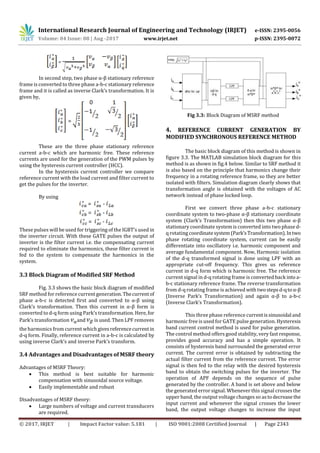
3.3 Block Diagram of Modified SRF Method
Fig. 3.3 shows the basic block diagram of modified
SRF method for reference current generation. Thecurrentof
phase a-b-c is detected first and converted to α-β using
Clark’s transformation. Then this current in α-β form is
converted to d-q form using Park’s transformation. Here, for
Park’s transformation and is used. Then LPF removes
the harmonics from current which givesreferencecurrentin
d-q form. Finally, reference current in a-b-c is calculated by
using inverse Clark’s and inverse Park’s transform.
3.4 Advantages and Disadvantages of MSRF theory
Advantages of MSRF Theory:
 This method is best suitable for harmonic
compensation with sinusoidal source voltage.
 Easily implementable and robust
Disadvantages of MSRF theory:
 Large numbers of voltage and current transducers
are required.
Fig 3.3: Block Diagram of MSRF method
4. REFERENCE CURRENT GENERATION BY
MODIFIED SYNCHRONOUS REFERENCE METHOD
The basic block diagram of this method is shown in
figure 3.3. The MATLAB simulation block diagram for this
method is as shown in fig.4 below. Similar to SRF method it
is also based on the principle that harmonics change their
frequency in a rotating reference frame, so they are better
isolated with filters. Simulation diagram clearly shows that
transformation angle is obtained with the voltages of AC
network instead of phase locked loop.
First we convert three phase a-b-c stationary
coordinate system to two-phase α-β stationary coordinate
system (Clark’s Transformation) then this two phase α-β
stationary coordinate system is converted into two phase d-
q rotating coordinatesystem (Park’sTransformation).Intwo
phase rotating coordinate system, current can be easily
differentiate into oscillatory i.e. harmonic component and
average fundamental component. Now, Harmonic isolation
of the d-q transformed signal is done using LPF with an
appropriate cut-off frequency. This gives us reference
current in d-q form which is harmonic free. The reference
current signal in d-q rotating frame is converted back into a-
b-c stationary reference frame. The reverse transformation
from d-q rotating frame is achieved withtwostepsd-qto α-β
(Inverse Park’s Transformation) and again α-β to a-b-c
(Inverse Clark’s Transformation).
This three phase reference currentissinusoidal and
harmonic free is used for GATE pulse generation. Hysteresis
band current control method is used for pulse generation.
The control method offers good stability, very fast response,
provides good accuracy and has a simple operation. It
consists of hysteresis band surrounded the generated error
current. The current error is obtained by subtracting the
actual filter current from the reference current. The error
signal is then fed to the relay with the desired hysteresis
band to obtain the switching pulses for the inverter. The
operation of APF depends on the sequence of pulse
generated by the controller. A band is set above and below
the generated error signal. Whenever this signal crosses the
upper band, the output voltage changes so astodecrease the
input current and whenever the signal crosses the lower
band, the output voltage changes to increase the input
International Research Journal of Engineering and Technology (IRJET) e-ISSN: 2395-0056
Volume: 04 Issue: 08 | Aug -2017 www.irjet.net p-ISSN: 2395-0072
© 2017, IRJET | Impact Factor value: 5.181 | ISO 9001:2008 Certified Journal | Page 2344
current. Accordingly switching signals are generated for
inverter.
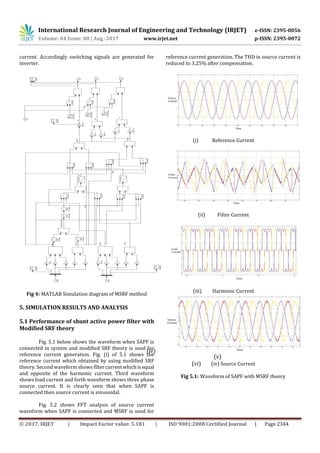
Fig 4: MATLAB Simulation diagram of MSRF method
5. SIMULATION RESULTS AND ANALYSIS
5.1 Performance of shunt active power filter with
Modified SRF theory
Fig. 5.1 below shows the waveform when SAPF is
connected in system and modified SRF theory is used for
reference current generation. Fig. (i) of 5.1 shows the
reference current which obtained by using modified SRF
theory. Second waveform shows filtercurrentwhichisequal
and opposite of the harmonic current. Third waveform
shows load current and forth waveform shows three phase
source current. It is clearly seen that when SAPF is
connected then source current is sinusoidal.
Fig. 5.2 shows FFT analysis of source current
waveform when SAPF is connected and MSRF is used for
reference current generation. The THD in source current is
reduced to 3.25% after compensation.
(i) Reference Current
(ii) Filter Current
(iii) Harmonic Current
(iv)
(v)
(vi) (iv) Source Current
Fig 5.1: Waveform of SAPF with MSRF theory
International Research Journal of Engineering and Technology (IRJET) e-ISSN: 2395-0056
Volume: 04 Issue: 08 | Aug -2017 www.irjet.net p-ISSN: 2395-0072
© 2017, IRJET | Impact Factor value: 5.181 | ISO 9001:2008 Certified Journal | Page 2345
Fig. 5.2: FFT analysis of source current with MSRF theory
REFERENCES
[1] Bhim Singh, J. Solanki, “A Comparison of Control
Algorithms for DSTATCOM”, IEEE Transactions on
Industrial Electronics, VOL. 56, NO. 7, Page(s): 2738 –
2745, JULY 2009.
[2] A. Bhattacharya, C. Chakraborty and S. Bhattacharya,
“ShuntCompensation,Reviewing Traditional Methodsof
Reference Current Generation”, IEEE Industrial
Electronics Magazine, Sept. 2009.
[3] Akagi H., Kanazawa Y., Nabae A.,“Instantaneousreactive
power compensation comprising switching devices
without energy storage components”, IEEE Trans. Ind.
Appl., vol. IA-20, 2010, pp- 625-630.
[4] Chen Duo, Chen Xincan, Kang Mingcai, “An Analysis on
Sequence of the Harmonic in Power System”, China
International Conference on Electricity Distribution
(CICED 2014).
[5] P. Santiprapan and K-L. Areerak, “Performance
Improvement ofHarmonic DetectionusingSynchronous
Reference Frame Method”, International Conference on
Advances in Energy Engineering 2010.
[6] Nilesh M. Chamat, Prof. S. P. Diwan, Vikas S. Bhandare
and Snehal Jamadade, “Instantaneous Reactive Power
Theory for Real Time Control of Three-Phase Shunt
Active Power Filter (SAPF),” 2014 International
Conference on Circuit, Power and Computing
Technologies [ICCPCT], IEEE, pp. 792- 796.
[7] P. Salmerón and S. P. Litrán, “Improvement of the
Electric Power Quality Using Series Active and Shunt
Passive Filters”, IEEE Transactions on Power Delivery,
Vol. 25, April 2010, pp. 1058-1067.
[8] SQUARE D Product Data Bulletin, Power System
Harmonics Causes and Effects of Variable Frequency
Drives Relative to the IEEE 519-1992 Standard, Bulletin
No. 8803PD9402, August, 1994.
BIOGRAPHIES
Mr. Bhushan S. Rakhonde
He received Bachelor of
Engineering degree in Electrical
Engineering. pursuing Master of
Engineering in Electrical Power
System Engineering, G.H.R.C.E.M.
Amravati, Maharashtra, India
Mr. C. M. Bobade
Assistant Professor & H.o.D.
Electrical EngineeringDepartment,
G.H.R.C.E.M. Amravati,

Harmonic Mitigation using Modified Synchronous Reference Frame Theory

  • 1.
    International Research Journalof Engineering and Technology (IRJET) e-ISSN: 2395-0056 Volume: 04 Issue: 08 | Aug -2017 www.irjet.net p-ISSN: 2395-0072 © 2017, IRJET | Impact Factor value: 5.181 | ISO 9001:2008 Certified Journal | Page 2340 Harmonic Mitigation using Modified Synchronous Reference Frame Theory Mr. Bhushan S. Rakhonde1, Astt.Prof. C. M. Bobade 2 1M.E. student, Electrical Power System Engineering, G.H.R.C.E.M. Amravati, Maharashtra, India 2Assistant Professor, Electrical Engineering Department, G.H.R.C.E.M. Amravati, Maharashtra, India ---------------------------------------------------------------------***--------------------------------------------------------------------- Abstract - Use of nonlinear load increasing day by day because it consumes less power as compared to linear load. Although this power electronics equipment make our life convenient, they inject harmonic into power system. These harmonics affects amplitude and nature of sourcecurrentand hence performance ofsystem. Thereforepower qualitybecame very serious issue. Conventionally, passive filters have been used to eliminate harmonics from power system but it has some limitations. So, new solution to eliminate harmonics is developed which is shunt active power filter. This paper presents a new three-phase shunt active power filter to compensate harmonics is implemented in MATLAB. Main part of shunt active power filter is reference current generation control algorithm. This Paper includes simulation of three reference current generation techniques viz. Modified synchronous reference frame (MSRF) theory, Key Words: InstantaneousReactivePowerTheory,Total Harmonic Distortion (THD), Reference current generation, filter, power quality, Shunt Active Power Filter. 1.INTRODUCTION As we know that the harmonics generated by nonlinear loads affects on amplitude and nature of source current hence the performance of system. Nonlinear loads cause high disturbances on power system. harmonics cause many problems like heat, losses, failure of electrical equipment and interference withcommunicationsystem. So, elimination of harmonics is important issue andtosolvethis problem shunt active power filter (SAPF) came into action[1]. The most popular solution to eliminate these harmonics is Shunt Active PowerFilter(SAPF)becauseSAPF can eliminate harmonics easily, overcome voltage sag and improves power factor[6]. Significance of SAPF can be understood as follows. Assume that load connected to system is drawing unbalanced harmonic current. In addition, the load power factor is poor. This will obviously lead to unbalance and distortion in other system quantities which is undesirable. Therefore, it important to install some corrective measures in system to solve above problem.Itiswell knownthatshunt capacitor is good solution for correcting poor power factor. Similarly tuned filter are also used with power electronic loads to bypass harmonic currents. The problem of load balancing also has to solve by some method. However, all these problems can be solved bysingledevice whichiscalled shunt active power factor (SAPF). Principle of SAPF is to inject current in the system which is equal and opposite in polarity to harmonic current. It has many advantages over passive filter like reactive power compensation, voltage regulation also SAPF is smaller, more versatile, more selective, better damped and less prone to failure. They are studied widely and great developments have taken place in theory and application of active power filters. The performance of SAPF depends on control algorithm usedfor reference current generation which is then used as a reference for filter current. Finally, this filter current is used for compensation of harmonics. In this way, we can achieve harmonic mitigation and improve power quality, voltage regulation, load current unbalance, power factor etc. of power system. When shunt active power filter is connected in the system and modified synchronous reference frame method is used for reference current generation thenthepercentage THD is reduced to 3.25%. 1.1 Passive Filter Passive filters have been most commonly used to limit the flow of harmonics currents in distribution system. They are usually custom designed for application. However, their performance is limited to a fewharmonicsandtheycan introduce resonance in the power system. Passive filters use reactive storage components, namely capacitors and inductors and they do not rely upon any type of external power source. In addition, they are not going to rely on transistors or any other type of active components for working. The inductors will block high frequency signals and conduct low frequency signals. The capacitors are going to do just the opposites. By tuning these elements passive filters are designed to shunt harmonics from the lines or block their flow through some parts of system. They have some advantages such as simplicity, reliability, efficiency,
  • 2.
    International Research Journalof Engineering and Technology (IRJET) e-ISSN: 2395-0056 Volume: 04 Issue: 08 | Aug -2017 www.irjet.net p-ISSN: 2395-0072 © 2017, IRJET | Impact Factor value: 5.181 | ISO 9001:2008 Certified Journal | Page 2341 and cost. These filters are tuned and fixed according to the impedance of the point at which they will be connected and hence cannot be adjusted instantaneously in accordance to the load. As a result their cutoff frequency changes unexpectedly after any change in the load impedance resulting in producing a resonance with other elements installed in the system. Other drawbacks are interference with communication system, they are heavy and bulky, overloaded when the load harmonics increase. 1.2 Active Filter There are basically two types of active filters: the shunt type and the series type. Shunt active power filter is able to compensate for both current harmonics and power factor. Furthermore, it allows loadbalancing,eliminating the current in the neutral wire. Series active power filter is the dual of the shunt active filter, and is able to compensate for distortion in the power line voltages, making the voltages applied to the load sinusoidal (compensating for voltage harmonics). Depending on the particular application or electrical problem to be solved, active power filters can be implemented as shunt type, series type, or a combination of shunt and series active filters (shunt-series type). These filters can also be combined with passive filters to create hybrid power filters. The shunt-connected active power filter, with a self- controlled dc bus, has a topology similar to that of a static compensator (STATCOM) used for reactive power compensation in power transmission systems. Shunt active power filters compensate load current harmonics by injecting equal-but opposite harmonic compensating current. In this case the shunt active power filteroperatesas a current source injecting the harmonic components generated by the load but phase-shifted by 180°. Series active power filters were introduced by the end ofthe1980s and operate mainly as a voltage regulator and as a harmonic isolator between the nonlinear load and the utility system. The series-connected filter protects the consumer from an inadequate supply voltage quality. 2. BASIC COMPENSATION PRINCIPLE The basic principle of a shunt active power filter is that it generates a current equal and opposite in polarity to the harmonic current drawn by the load and injects it to the point of common coupling, thereby forcing the source current to be pure sinusoidal. Harmonic and reactive currents are thus cancelled at the source end and the result is undistorted sinusoidal balanced currents. Fig.1 shows the basic compensation principle of shunt active power filter. It is controlled to supply a compensating current ic into the system, so that it cancels current harmonics on the AC side, and makes the source current in phase with source voltage as explained in above principle. Fig.2 shows different waveforms. Curve A is the load current waveform and curve B is the desired mains current. Curve C showsthecompensatingcurrentinjectedby the active filter containing all the harmonics, to make mains current sinusoidal. In this way, by eliminating harmonics from power system shunt active power filter plays an important role in power quality improvement. It also helps in reactive power compensation, voltage regulation etc. Shunt active power filter is smaller, more versatile, more selective, better damped and less prone to failure as explained in first chapter. Due to these advantages SAPF is most widely used solution for power quality problem. Fig -1: Block diagram of Shunt Active Power Filter Fig -1: Shunt active power filter-Shapes of load, source and desired filter current waveforms 3. THEORIES FOR REFERENCE CURRENT GENERATION In this section, most importantpartof SAPFwhichis control algorithm to generate referencecurrentisdiscussed. This is also called as reference current generation theory. As explained in literature survey, there are many theories/methodsavailableforreferencecurrentgeneration. Here we have worked on Modified Synchronous Reference Frame (MSRF) Theory.
  • 3.
    International Research Journalof Engineering and Technology (IRJET) e-ISSN: 2395-0056 Volume: 04 Issue: 08 | Aug -2017 www.irjet.net p-ISSN: 2395-0072 © 2017, IRJET | Impact Factor value: 5.181 | ISO 9001:2008 Certified Journal | Page 2342 3.2ModifiedSynchronousReferenceFrame(MSRF) Theory The modified synchronous referenceframemethod is also called as the instantaneous current component ( ) method. As the name suggest this method is similar to the SRF method only small modification is done. In SRF method we get transformation angle from PLL, but here in modified SRF, transformation angle is obtained with the voltages of AC network. Similar to SRF method it is also based on the principle that harmonics change their frequency in a rotating reference frame, so they are better isolated with filters. The difference is that due to voltage harmonics and imbalance, the speed of reference frame is no longer constant. It varies instantaneously depending on the waveform of the three phase voltage system. One of the important characteristics of this algorithm is that compensating currents are obtained from theinstantaneous active and reactive current components of the nonlinear load. This method can achieve fast andaccurateextractionof the harmonic content and of the reactive component of a distorted current. Reference frame transformation is the transformation of coordinates from a three-phase a-b-c stationary coordinate system to the 0-d-q rotating coordinate system. Therefore similar to synchronous reference frame method, here first weconvertthreephasea- b-c stationarycoordinatesystemtotwo-phaseα-βstationary coordinate system which is called Clark’s transformation. Then this two phase α-β stationary coordinate system is converted into two phase d-q rotating coordinate system which is called Park’s transformation. Fig 3.2: Reference Frame Transformation The source current and source voltage are first detected, and then in first step Clark’s transformation is done. If, source currents are , , and source voltages are , , then they are transformed to two phase stationary reference frame as shown by equation below. = and = Now, the two phase current quantities and of stationary αβ-axes are transformed into two-phase synchronous rotating reference frame ( and ) i.e. Parks transformation. Here, this transformationisdoneasfollows: = Instantaneous active and reactive load currents can be decomposed into oscillatory and average terms. The fundamental currents of the d-q components are now dc values and harmonics appear like ripple. Harmonicisolation of the d-q transformed signal is required for reference current. This is accomplished using LPF with an appropriate cut-off frequency and damping constant. This gives us reference current in d-q form which is harmonic free. = Where, – Mean value of instantaneous real current. It is the only desired current component to be supplied by the power source. – Alternating value of the instantaneous real current. Since it does not involve any energy transfer from the power source to load, it must be compensated. – Mean value of instantaneous imaginary current. – Alternating value of the instantaneous imaginary current. The reference current signal in d-q rotatingframeis converted back into a-b-c stationary reference frame. The reverse transformation from d-q rotating frame is achieved with two steps d-q to α-β and again α-β to a-b-c. In first step, d-q rotating frame is converted to two phase α-β stationary reference frame.Thistransformationis called inverse Park’s transformation and it is given by,
  • 4.
    International Research Journalof Engineering and Technology (IRJET) e-ISSN: 2395-0056 Volume: 04 Issue: 08 | Aug -2017 www.irjet.net p-ISSN: 2395-0072 © 2017, IRJET | Impact Factor value: 5.181 | ISO 9001:2008 Certified Journal | Page 2343 = In second step, two phase α-β stationary reference frame is converted to three phase a-b-c stationary reference frame and it is called as inverse Clark’s transformation. It is given by, = These are the three phase stationary reference current a-b-c which are harmonic free. These reference currents are used for the generation of the PWM pulses by using the hysteresis current controller (HCC). In the hysteresis current controller we compare reference current with the load current and filter current to get the pulses for the inverter. By using = - = - = - These pulses will be used for triggering of the IGBT’s used in the inverter circuit. With these GATE pulses the output of inverter is the filter current i.e. the compensating current required to eliminate the harmonics, these filter current is fed to the system to compensate the harmonics in the system. 3.3 Block Diagram of Modified SRF Method Fig. 3.3 shows the basic block diagram of modified SRF method for reference current generation. Thecurrentof phase a-b-c is detected first and converted to α-β using Clark’s transformation. Then this current in α-β form is converted to d-q form using Park’s transformation. Here, for Park’s transformation and is used. Then LPF removes the harmonics from current which givesreferencecurrentin d-q form. Finally, reference current in a-b-c is calculated by using inverse Clark’s and inverse Park’s transform. 3.4 Advantages and Disadvantages of MSRF theory Advantages of MSRF Theory:  This method is best suitable for harmonic compensation with sinusoidal source voltage.  Easily implementable and robust Disadvantages of MSRF theory:  Large numbers of voltage and current transducers are required. Fig 3.3: Block Diagram of MSRF method 4. REFERENCE CURRENT GENERATION BY MODIFIED SYNCHRONOUS REFERENCE METHOD The basic block diagram of this method is shown in figure 3.3. The MATLAB simulation block diagram for this method is as shown in fig.4 below. Similar to SRF method it is also based on the principle that harmonics change their frequency in a rotating reference frame, so they are better isolated with filters. Simulation diagram clearly shows that transformation angle is obtained with the voltages of AC network instead of phase locked loop. First we convert three phase a-b-c stationary coordinate system to two-phase α-β stationary coordinate system (Clark’s Transformation) then this two phase α-β stationary coordinate system is converted into two phase d- q rotating coordinatesystem (Park’sTransformation).Intwo phase rotating coordinate system, current can be easily differentiate into oscillatory i.e. harmonic component and average fundamental component. Now, Harmonic isolation of the d-q transformed signal is done using LPF with an appropriate cut-off frequency. This gives us reference current in d-q form which is harmonic free. The reference current signal in d-q rotating frame is converted back into a- b-c stationary reference frame. The reverse transformation from d-q rotating frame is achieved withtwostepsd-qto α-β (Inverse Park’s Transformation) and again α-β to a-b-c (Inverse Clark’s Transformation). This three phase reference currentissinusoidal and harmonic free is used for GATE pulse generation. Hysteresis band current control method is used for pulse generation. The control method offers good stability, very fast response, provides good accuracy and has a simple operation. It consists of hysteresis band surrounded the generated error current. The current error is obtained by subtracting the actual filter current from the reference current. The error signal is then fed to the relay with the desired hysteresis band to obtain the switching pulses for the inverter. The operation of APF depends on the sequence of pulse generated by the controller. A band is set above and below the generated error signal. Whenever this signal crosses the upper band, the output voltage changes so astodecrease the input current and whenever the signal crosses the lower band, the output voltage changes to increase the input
  • 5.
    International Research Journalof Engineering and Technology (IRJET) e-ISSN: 2395-0056 Volume: 04 Issue: 08 | Aug -2017 www.irjet.net p-ISSN: 2395-0072 © 2017, IRJET | Impact Factor value: 5.181 | ISO 9001:2008 Certified Journal | Page 2344 current. Accordingly switching signals are generated for inverter. Fig 4: MATLAB Simulation diagram of MSRF method 5. SIMULATION RESULTS AND ANALYSIS 5.1 Performance of shunt active power filter with Modified SRF theory Fig. 5.1 below shows the waveform when SAPF is connected in system and modified SRF theory is used for reference current generation. Fig. (i) of 5.1 shows the reference current which obtained by using modified SRF theory. Second waveform shows filtercurrentwhichisequal and opposite of the harmonic current. Third waveform shows load current and forth waveform shows three phase source current. It is clearly seen that when SAPF is connected then source current is sinusoidal. Fig. 5.2 shows FFT analysis of source current waveform when SAPF is connected and MSRF is used for reference current generation. The THD in source current is reduced to 3.25% after compensation. (i) Reference Current (ii) Filter Current (iii) Harmonic Current (iv) (v) (vi) (iv) Source Current Fig 5.1: Waveform of SAPF with MSRF theory
  • 6.
    International Research Journalof Engineering and Technology (IRJET) e-ISSN: 2395-0056 Volume: 04 Issue: 08 | Aug -2017 www.irjet.net p-ISSN: 2395-0072 © 2017, IRJET | Impact Factor value: 5.181 | ISO 9001:2008 Certified Journal | Page 2345 Fig. 5.2: FFT analysis of source current with MSRF theory REFERENCES [1] Bhim Singh, J. Solanki, “A Comparison of Control Algorithms for DSTATCOM”, IEEE Transactions on Industrial Electronics, VOL. 56, NO. 7, Page(s): 2738 – 2745, JULY 2009. [2] A. Bhattacharya, C. Chakraborty and S. Bhattacharya, “ShuntCompensation,Reviewing Traditional Methodsof Reference Current Generation”, IEEE Industrial Electronics Magazine, Sept. 2009. [3] Akagi H., Kanazawa Y., Nabae A.,“Instantaneousreactive power compensation comprising switching devices without energy storage components”, IEEE Trans. Ind. Appl., vol. IA-20, 2010, pp- 625-630. [4] Chen Duo, Chen Xincan, Kang Mingcai, “An Analysis on Sequence of the Harmonic in Power System”, China International Conference on Electricity Distribution (CICED 2014). [5] P. Santiprapan and K-L. Areerak, “Performance Improvement ofHarmonic DetectionusingSynchronous Reference Frame Method”, International Conference on Advances in Energy Engineering 2010. [6] Nilesh M. Chamat, Prof. S. P. Diwan, Vikas S. Bhandare and Snehal Jamadade, “Instantaneous Reactive Power Theory for Real Time Control of Three-Phase Shunt Active Power Filter (SAPF),” 2014 International Conference on Circuit, Power and Computing Technologies [ICCPCT], IEEE, pp. 792- 796. [7] P. Salmerón and S. P. Litrán, “Improvement of the Electric Power Quality Using Series Active and Shunt Passive Filters”, IEEE Transactions on Power Delivery, Vol. 25, April 2010, pp. 1058-1067. [8] SQUARE D Product Data Bulletin, Power System Harmonics Causes and Effects of Variable Frequency Drives Relative to the IEEE 519-1992 Standard, Bulletin No. 8803PD9402, August, 1994. BIOGRAPHIES Mr. Bhushan S. Rakhonde He received Bachelor of Engineering degree in Electrical Engineering. pursuing Master of Engineering in Electrical Power System Engineering, G.H.R.C.E.M. Amravati, Maharashtra, India Mr. C. M. Bobade Assistant Professor & H.o.D. Electrical EngineeringDepartment, G.H.R.C.E.M. Amravati,