International Research Journal of Engineering and Technology (IRJET) e-ISSN: 2395-0056
Volume: 05 Issue: 12 | Dec 2018 www.irjet.net p-ISSN: 2395-0072
© 2018, IRJET | Impact Factor value: 7.211 | ISO 9001:2008 Certified Journal | Page 754
Total Quality Management and Organizational Performance
Aditya Ajay Choudhari
Student, Dept. of Mechanical Engineering, Prof. Ram Meghe Institute of Technology and Research,
Maharashtra, India
---------------------------------------------------------------------***----------------------------------------------------------------------
Abstract - This research came to scrutinize the impact of
Total quality management (TQM) practices and blueprints of
an organization. TQM is defined as a continuous process of
improving defects, quality of products, goods, and services
with respect to customer demand and satisfaction. This paper
discusses the application of TQM, which is implemented in
organizations. The finding indicates that the TQM either
hinders the outcome or the goal of the organization or
performance
Key Words: Total Quality Management, Customer Service,
Customer Satisfaction, Organization, Quality products,
defects.
1. INTRODUCTION
Till now, the business environment has gone under many
tremendous changes and augmentation in quality and has
become the main strategy in any industry to achieve the
dream goal i.e., customer satisfaction. Furthermore, due to
increase in the labor market, an organization should look
after the quality of products and customer satisfaction
mainly to survive in the competition. TQM is based on, a
management framework based on the belief that an
organization can build long-term success by having all its
members, from lowest level workers to its highest ranking
executives, focus on quality improvement and, thus,
delivering customer satisfaction with quality products. (1)
“TQM is a philosophy for managing an organization in a way
which enables it to meet stakeholderneedsandexpectations
efficiently and effectively, without compromising ethical
values” (Chartered Quality Institute). (2)"A management
approach of an organization centered on quality, based on
the participation of all its members and aiming at long-term
success through customer satisfaction and benefits to all
members of the organization and society." (International
Organization for Standardization). (3)“TQM can be
defined as a strategy that aims togenerateandtransfermore
efficient and superior services, through achieving
cooperation between organizational members” (Lakhal et
al., 2006). From this, it can be inferred that each and every
individual has own and different understanding for TQM.
Some categories of total quality management were
considered as crucial performance predictors such as
leadership, management, customer satisfaction. This paper
mainly discusses the TQM practices and its performance in
an organization.
2. Literature Review
2.1 Total Quality Management
The quality concept was recognized since the 1930s in
Japan. After that several firms were indulged in ensuring the
good quality products and utilizing tools that directly aim to
control quality. The developed countries of North America
and Western Europe agonized economically due to the stiff
competition from Japan in the 1970s and early 1980s, Japan
was producing high-quality products at a competitive price.
Furthermore, countries like USA and UK accepted the idea of
quality management specifically in manufacturing firms.
Quality management has been recognized widely in
International Standards such as ISO 9000.
The method that evolved during the 1950s and 1960s
became known as Total Quality Management. Organizations
globally took note of Japan’s successes using TQM. US firms
throughout the 1970s and1980sadoptedmanufacturingand
quality methods, also TQM to compete in the increasingly
global marketplace. In spite the fact that, Deming, Juran,
Shewart and many others published books and papers
regarding TQM, allot of firms opted only some part of TQM
principles and evolved some new ideas to meet their own
goals or needs. Besides, as the efficiency, productivity and
quality have further evolved, many firms opted for a new
methodology of management techniques. Moreover, TQM is
still influential.
Various methods were proposed forqualitymanagement
(QM) to produce quality based products and to satisfy
customer’s requirement. One of the method or technique
which is globally accepted and practiced is Total Quality
Management in which, this approach essentially attempts to
create a relation between the customer’s need and
organization’s dream goal. For a Customer focused
organization, it involvescontinuousimprovementandituses
strategy, data and effective communication to inculcate the
quality discipline into the culture and activities of the
organization.
2.2 Elements of TQM
1. Focus On customer
When TQM isimplemented,thecustomerplaysavitalrole
in determining the quality of products that the firm
manufactures. So it is necessary to keep in mind, customer
evaluates the product by product quality and servicethatthe
organization provides.
International Research Journal of Engineering and Technology (IRJET) e-ISSN: 2395-0056
Volume: 05 Issue: 12 | Dec 2018 www.irjet.net p-ISSN: 2395-0072
© 2018, IRJET | Impact Factor value: 7.211 | ISO 9001:2008 Certified Journal | Page 755
2. Employee involvement
Employees are the internalcustomersoftheorganization,
which also plays a crucial role in determining the quality of
product and service. Employee involvement largely
contributes in a determination of the quality of product and
services.
3. Process-centered
A process is the guiding principle and employee must
support that on the facts of vision and strategy of the
organization.
4. Integrated systems
It is necessary to have an integrated system which can be
modeled by ISO 9000 when following the process centered
principles.
5. A strategic and systematic approach
Strategies should be made to achieve the dream goal of
the organization and this can be achieved by approaching it
by following a systematic manner.
6. Decision making based on the facts
Decision making should be based on the facts, not the
opinions. This is because opinions can vary from person to
person.
7. Communication
Communication strategy is must when the goal is set and
the firm has the vision and mission to achieve it. The strategy
comprises of employees, stakeholders, etc.
8. Continuous improvement
By using right measurementtoolsandinnovativeideasan
organization can lead to its highest level of quality
management
Figure: Basic Principles of Total Quality Management
2.3 Organization Performance
Organization performance comprisesofactual outputas
measured against the intended output. Performance
Management is the main and the only element to achieve an
effective organizational management performance.
Performance management directly affects the factors like
financial planning and their strategies. Organization
performance surround of three main areas of firmsoutcome
1. Financial outcomes
2. Stalk holders return
3. Product market performance
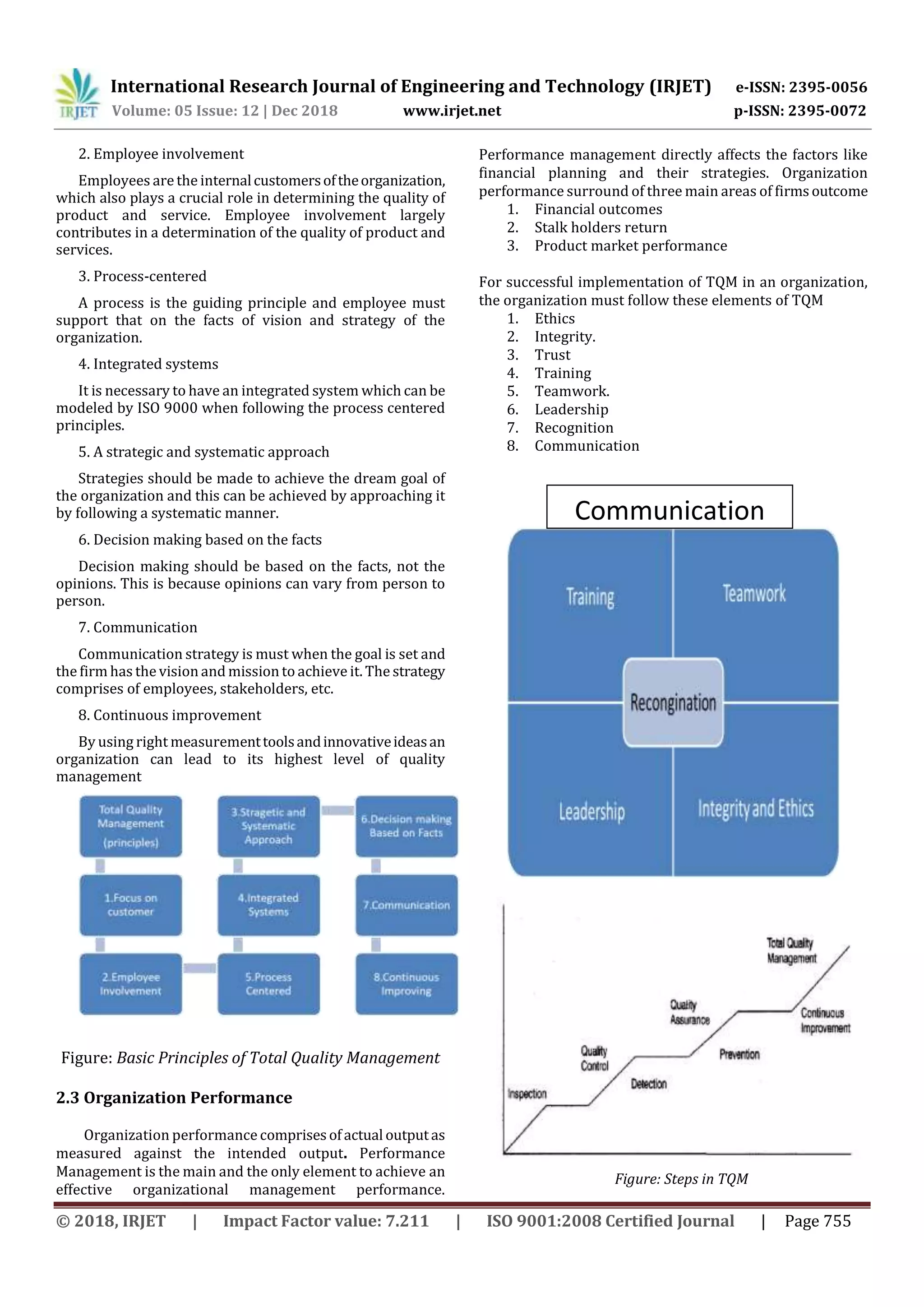
For successful implementation of TQM in an organization,
the organization must follow these elements of TQM
1. Ethics
2. Integrity.
3. Trust
4. Training
5. Teamwork.
6. Leadership
7. Recognition
8. Communication
Figure: Steps in TQM
Communication
International Research Journal of Engineering and Technology (IRJET) e-ISSN: 2395-0056
Volume: 05 Issue: 12 | Dec 2018 www.irjet.net p-ISSN: 2395-0072
© 2018, IRJET | Impact Factor value: 7.211 | ISO 9001:2008 Certified Journal | Page 756
3. Organization performance and Total Quality
Management
Performance measurement plays a vital role in all the
management processes and traditionally. It has involved
management accountants through the use of budgetary
control and the return on investment. Nevertheless, it has
been claimed that conventional aggregate financial
accountings are misplaced in TQM. Many authors have said
that the TQM method leads to profitability, improvement in
quality, effective efforts, effective management, and
development of the plant. With the day to day increasing
awareness in the quality of final products and services,
companies have recognized that the concept of high quality
must be applied to production processes to generate quality
products and minimize costs. TQM has evolved as a
philosophy that emphasizes the need to provide customer
high-end products and to doso improvements in eliminating
waste, reducing lead times at all stages, reducing cost and
improving continuously. TQM provides a Prospective for an
organizationtoenhancetheircompetitiveness.TQMhasbeen
associated with succor improvements in organizational
profitability.
4. CONCLUSION
This above study shows the indirect relation between Total
Quality Management and Financial Management. Final
findings show that competitive strategies are positioned
between TQM and Financial Performance. Researchers
suggest that to achieve excellence, top management should
be involved in the application of Quality Management. They
also suggest that all the functions, employees should
participate to improvethe qualityand improvementprocess.
Nevertheless, the main conclusion can be inferred from this
research that customer satisfactionandqualityperformance
of products and services can be enhanced by implementing
different quality initiatives.
REFERENCES
[1] García-Bernal, J. and García-Casarejos, N. (2012).
Economic analysis of TQM adoption in the construction
sector. Total Quality Management & Business
Excellence, I First, 1–13.
[2] Gimenez-Espin, J.A, Jiménez-Jiménez, D., and Martínez-
Costa, M. (2012). Organizational culture for total quality
management. Total Quality Management & Business
Excellence, I First, 1–15
[3] Firm characteristics, total quality management, and
financial performance. Journal of Operations
Management, 19, 269–285.
[4] Hoang, D.T., Igel, B., and Laosirihongthong, T. (2010).
Total quality management (TQM) strategy and
organizational characteristics: Evidence from a recent
WTO member, Total Quality Management & Business
Excellence, 21(9), 931-951
[5] Kaynak, H. (2003).The relationship between total
quality management practices and their effects on firm
performance. Journal of Operations Management, 21,
405-435.
[6] Lam, S.Y., Lee, V.S, Ooi, K.B., and Lin, B. (2011). The
relationship between TQM, learning orientation and
market performance in service organizations: an
empirical analysis, Total Quality Management &
Business Excellence, 22(12), 1277-1297.
[7] Leonard, Frank, S., and Sasser W.E. (1982).TheInclineof
Quality. Harvard Business Review, 163- 171.
[8] Miller, D. (1986).Configurations of strategy and
structure: Towards a Synthesis. Strategic Management
Journal, 7,233-249
[9] Terzioski, M., Samson, D., 2000. The effect of company
size on the relationship between TQM strategy and
organizational performance. TQMMagazine12(2),144-
148.
[10] Longbottom, D., Mayer, R., Casey, J., 2000. Marketing,
total quality management and benchmarking:exploring
the divide. Journal of StrategicMarketing8(4),327-340.
[11] Porter, M., 1980. Competitive Strategy. New York: Free
Press
[12] Hall, R. W., Johnson, H. T. and Turney, P. B., 1991.
Measuring up: Charting Pathways to Manufacturing
Excellence, Homewood, Illinois, Irwin.
[13] Morgan, C., Murgatroyd, S., 1994. Total Quality
Management in the PublicSector.OpenUniversityPress,
Buckingham, UK
[14] Lubben, R.T., 1988. Just-In-Time Manufacturing,
McGraw-Hill, New York
[15] Mahesh, C. 1993. Total quality management in
management development, Journal of Management
Development 12 (7) 19-31
[16] Reed, R. Lemak, D.J. Montgomery, J.C. 1996. Beyond
process: TQM content and firm performance, Academy
of Management Review 21 (1) 173-202
[17] Ittner, C.D., Larcker, D.F., 1996. Measuring the impact of
quality initiatives on firm financial performance. In:
Fedor, D.D., Ghost, S. (Eds.), Advances in the
Management of Organizational Quality, vol. 1. JAI Press,
Greenwich, CT
[18] Schmenner, R. W. and Cook, R. L., 1985. Explaining
Productivity Differences in North Carolina Factories,
Journal of Operations Management, 5, 273-289.
[19] 4.Schreurs, Jeanne. "Total Quality Management
Framework for e-learning based on EFQM and
Kirkpatrick models." iJET International Journal of
Emerging Technologies in Learning (2006): 1-6.
[20] Mehrotra, Dheeraj."ApplyingTotal QualityManagement
in Academic." iSixSigma (2010).
[21] Hashmi, Khurram. "Introduction andImplementationof
Total Quality Management." iSixSigma (2010).
[22] Deming, W.E. (1986). Out of the crisis. Cambridge, MA:
Massachusetts Institute of Technology, Center for
Advanced Engineering Study
[23] Dahlgaard-Park, S.M. (2012). Core values – the entrance
to human satisfaction and commitment. Total Quality
Management & Business Excellence, 23(2), 125-140
[24] Duh, R., Hsu, A. W., and Huang, P. (2012).Determinants
and performance effect of TQM practices: An integrated
model approach, Total Quality Management & Business
Excellence, 23(5-6), 689-701.
International Research Journal of Engineering and Technology (IRJET) e-ISSN: 2395-0056
Volume: 05 Issue: 12 | Dec 2018 www.irjet.net p-ISSN: 2395-0072
© 2018, IRJET | Impact Factor value: 7.211 | ISO 9001:2008 Certified Journal | Page 757
[25] Tanninen, K., Puumalainen, K. and Sandström, J.
(2010).The power of TQM: analysis of its effects on
profitability, productivity and customer satisfaction,
Total Quality Management & BusinessExcellence,21(2),
171-184
[26] Sila, I., (2007). Examining the effects of contextual
factors on TQM and performance through the lens of
organizational theories: an empirical study. Journal of
Operations Management, 25 (1), 83– 109.
[27] Reed, R., Lemak, D.J., and Montgomery, J.C.
(1996).Beyond process: TQM content and firm
performance. Academy of Management Review, 21 (1)
173–202

IRJET- Total Quality Management and Organizational Performance

  • 1.
    International Research Journalof Engineering and Technology (IRJET) e-ISSN: 2395-0056 Volume: 05 Issue: 12 | Dec 2018 www.irjet.net p-ISSN: 2395-0072 © 2018, IRJET | Impact Factor value: 7.211 | ISO 9001:2008 Certified Journal | Page 754 Total Quality Management and Organizational Performance Aditya Ajay Choudhari Student, Dept. of Mechanical Engineering, Prof. Ram Meghe Institute of Technology and Research, Maharashtra, India ---------------------------------------------------------------------***---------------------------------------------------------------------- Abstract - This research came to scrutinize the impact of Total quality management (TQM) practices and blueprints of an organization. TQM is defined as a continuous process of improving defects, quality of products, goods, and services with respect to customer demand and satisfaction. This paper discusses the application of TQM, which is implemented in organizations. The finding indicates that the TQM either hinders the outcome or the goal of the organization or performance Key Words: Total Quality Management, Customer Service, Customer Satisfaction, Organization, Quality products, defects. 1. INTRODUCTION Till now, the business environment has gone under many tremendous changes and augmentation in quality and has become the main strategy in any industry to achieve the dream goal i.e., customer satisfaction. Furthermore, due to increase in the labor market, an organization should look after the quality of products and customer satisfaction mainly to survive in the competition. TQM is based on, a management framework based on the belief that an organization can build long-term success by having all its members, from lowest level workers to its highest ranking executives, focus on quality improvement and, thus, delivering customer satisfaction with quality products. (1) “TQM is a philosophy for managing an organization in a way which enables it to meet stakeholderneedsandexpectations efficiently and effectively, without compromising ethical values” (Chartered Quality Institute). (2)"A management approach of an organization centered on quality, based on the participation of all its members and aiming at long-term success through customer satisfaction and benefits to all members of the organization and society." (International Organization for Standardization). (3)“TQM can be defined as a strategy that aims togenerateandtransfermore efficient and superior services, through achieving cooperation between organizational members” (Lakhal et al., 2006). From this, it can be inferred that each and every individual has own and different understanding for TQM. Some categories of total quality management were considered as crucial performance predictors such as leadership, management, customer satisfaction. This paper mainly discusses the TQM practices and its performance in an organization. 2. Literature Review 2.1 Total Quality Management The quality concept was recognized since the 1930s in Japan. After that several firms were indulged in ensuring the good quality products and utilizing tools that directly aim to control quality. The developed countries of North America and Western Europe agonized economically due to the stiff competition from Japan in the 1970s and early 1980s, Japan was producing high-quality products at a competitive price. Furthermore, countries like USA and UK accepted the idea of quality management specifically in manufacturing firms. Quality management has been recognized widely in International Standards such as ISO 9000. The method that evolved during the 1950s and 1960s became known as Total Quality Management. Organizations globally took note of Japan’s successes using TQM. US firms throughout the 1970s and1980sadoptedmanufacturingand quality methods, also TQM to compete in the increasingly global marketplace. In spite the fact that, Deming, Juran, Shewart and many others published books and papers regarding TQM, allot of firms opted only some part of TQM principles and evolved some new ideas to meet their own goals or needs. Besides, as the efficiency, productivity and quality have further evolved, many firms opted for a new methodology of management techniques. Moreover, TQM is still influential. Various methods were proposed forqualitymanagement (QM) to produce quality based products and to satisfy customer’s requirement. One of the method or technique which is globally accepted and practiced is Total Quality Management in which, this approach essentially attempts to create a relation between the customer’s need and organization’s dream goal. For a Customer focused organization, it involvescontinuousimprovementandituses strategy, data and effective communication to inculcate the quality discipline into the culture and activities of the organization. 2.2 Elements of TQM 1. Focus On customer When TQM isimplemented,thecustomerplaysavitalrole in determining the quality of products that the firm manufactures. So it is necessary to keep in mind, customer evaluates the product by product quality and servicethatthe organization provides.
  • 2.
    International Research Journalof Engineering and Technology (IRJET) e-ISSN: 2395-0056 Volume: 05 Issue: 12 | Dec 2018 www.irjet.net p-ISSN: 2395-0072 © 2018, IRJET | Impact Factor value: 7.211 | ISO 9001:2008 Certified Journal | Page 755 2. Employee involvement Employees are the internalcustomersoftheorganization, which also plays a crucial role in determining the quality of product and service. Employee involvement largely contributes in a determination of the quality of product and services. 3. Process-centered A process is the guiding principle and employee must support that on the facts of vision and strategy of the organization. 4. Integrated systems It is necessary to have an integrated system which can be modeled by ISO 9000 when following the process centered principles. 5. A strategic and systematic approach Strategies should be made to achieve the dream goal of the organization and this can be achieved by approaching it by following a systematic manner. 6. Decision making based on the facts Decision making should be based on the facts, not the opinions. This is because opinions can vary from person to person. 7. Communication Communication strategy is must when the goal is set and the firm has the vision and mission to achieve it. The strategy comprises of employees, stakeholders, etc. 8. Continuous improvement By using right measurementtoolsandinnovativeideasan organization can lead to its highest level of quality management Figure: Basic Principles of Total Quality Management 2.3 Organization Performance Organization performance comprisesofactual outputas measured against the intended output. Performance Management is the main and the only element to achieve an effective organizational management performance. Performance management directly affects the factors like financial planning and their strategies. Organization performance surround of three main areas of firmsoutcome 1. Financial outcomes 2. Stalk holders return 3. Product market performance For successful implementation of TQM in an organization, the organization must follow these elements of TQM 1. Ethics 2. Integrity. 3. Trust 4. Training 5. Teamwork. 6. Leadership 7. Recognition 8. Communication Figure: Steps in TQM Communication
  • 3.
    International Research Journalof Engineering and Technology (IRJET) e-ISSN: 2395-0056 Volume: 05 Issue: 12 | Dec 2018 www.irjet.net p-ISSN: 2395-0072 © 2018, IRJET | Impact Factor value: 7.211 | ISO 9001:2008 Certified Journal | Page 756 3. Organization performance and Total Quality Management Performance measurement plays a vital role in all the management processes and traditionally. It has involved management accountants through the use of budgetary control and the return on investment. Nevertheless, it has been claimed that conventional aggregate financial accountings are misplaced in TQM. Many authors have said that the TQM method leads to profitability, improvement in quality, effective efforts, effective management, and development of the plant. With the day to day increasing awareness in the quality of final products and services, companies have recognized that the concept of high quality must be applied to production processes to generate quality products and minimize costs. TQM has evolved as a philosophy that emphasizes the need to provide customer high-end products and to doso improvements in eliminating waste, reducing lead times at all stages, reducing cost and improving continuously. TQM provides a Prospective for an organizationtoenhancetheircompetitiveness.TQMhasbeen associated with succor improvements in organizational profitability. 4. CONCLUSION This above study shows the indirect relation between Total Quality Management and Financial Management. Final findings show that competitive strategies are positioned between TQM and Financial Performance. Researchers suggest that to achieve excellence, top management should be involved in the application of Quality Management. They also suggest that all the functions, employees should participate to improvethe qualityand improvementprocess. Nevertheless, the main conclusion can be inferred from this research that customer satisfactionandqualityperformance of products and services can be enhanced by implementing different quality initiatives. REFERENCES [1] García-Bernal, J. and García-Casarejos, N. (2012). Economic analysis of TQM adoption in the construction sector. Total Quality Management & Business Excellence, I First, 1–13. [2] Gimenez-Espin, J.A, Jiménez-Jiménez, D., and Martínez- Costa, M. (2012). Organizational culture for total quality management. Total Quality Management & Business Excellence, I First, 1–15 [3] Firm characteristics, total quality management, and financial performance. Journal of Operations Management, 19, 269–285. [4] Hoang, D.T., Igel, B., and Laosirihongthong, T. (2010). Total quality management (TQM) strategy and organizational characteristics: Evidence from a recent WTO member, Total Quality Management & Business Excellence, 21(9), 931-951 [5] Kaynak, H. (2003).The relationship between total quality management practices and their effects on firm performance. Journal of Operations Management, 21, 405-435. [6] Lam, S.Y., Lee, V.S, Ooi, K.B., and Lin, B. (2011). The relationship between TQM, learning orientation and market performance in service organizations: an empirical analysis, Total Quality Management & Business Excellence, 22(12), 1277-1297. [7] Leonard, Frank, S., and Sasser W.E. (1982).TheInclineof Quality. Harvard Business Review, 163- 171. [8] Miller, D. (1986).Configurations of strategy and structure: Towards a Synthesis. Strategic Management Journal, 7,233-249 [9] Terzioski, M., Samson, D., 2000. The effect of company size on the relationship between TQM strategy and organizational performance. TQMMagazine12(2),144- 148. [10] Longbottom, D., Mayer, R., Casey, J., 2000. Marketing, total quality management and benchmarking:exploring the divide. Journal of StrategicMarketing8(4),327-340. [11] Porter, M., 1980. Competitive Strategy. New York: Free Press [12] Hall, R. W., Johnson, H. T. and Turney, P. B., 1991. Measuring up: Charting Pathways to Manufacturing Excellence, Homewood, Illinois, Irwin. [13] Morgan, C., Murgatroyd, S., 1994. Total Quality Management in the PublicSector.OpenUniversityPress, Buckingham, UK [14] Lubben, R.T., 1988. Just-In-Time Manufacturing, McGraw-Hill, New York [15] Mahesh, C. 1993. Total quality management in management development, Journal of Management Development 12 (7) 19-31 [16] Reed, R. Lemak, D.J. Montgomery, J.C. 1996. Beyond process: TQM content and firm performance, Academy of Management Review 21 (1) 173-202 [17] Ittner, C.D., Larcker, D.F., 1996. Measuring the impact of quality initiatives on firm financial performance. In: Fedor, D.D., Ghost, S. (Eds.), Advances in the Management of Organizational Quality, vol. 1. JAI Press, Greenwich, CT [18] Schmenner, R. W. and Cook, R. L., 1985. Explaining Productivity Differences in North Carolina Factories, Journal of Operations Management, 5, 273-289. [19] 4.Schreurs, Jeanne. "Total Quality Management Framework for e-learning based on EFQM and Kirkpatrick models." iJET International Journal of Emerging Technologies in Learning (2006): 1-6. [20] Mehrotra, Dheeraj."ApplyingTotal QualityManagement in Academic." iSixSigma (2010). [21] Hashmi, Khurram. "Introduction andImplementationof Total Quality Management." iSixSigma (2010). [22] Deming, W.E. (1986). Out of the crisis. Cambridge, MA: Massachusetts Institute of Technology, Center for Advanced Engineering Study [23] Dahlgaard-Park, S.M. (2012). Core values – the entrance to human satisfaction and commitment. Total Quality Management & Business Excellence, 23(2), 125-140 [24] Duh, R., Hsu, A. W., and Huang, P. (2012).Determinants and performance effect of TQM practices: An integrated model approach, Total Quality Management & Business Excellence, 23(5-6), 689-701.
  • 4.
    International Research Journalof Engineering and Technology (IRJET) e-ISSN: 2395-0056 Volume: 05 Issue: 12 | Dec 2018 www.irjet.net p-ISSN: 2395-0072 © 2018, IRJET | Impact Factor value: 7.211 | ISO 9001:2008 Certified Journal | Page 757 [25] Tanninen, K., Puumalainen, K. and Sandström, J. (2010).The power of TQM: analysis of its effects on profitability, productivity and customer satisfaction, Total Quality Management & BusinessExcellence,21(2), 171-184 [26] Sila, I., (2007). Examining the effects of contextual factors on TQM and performance through the lens of organizational theories: an empirical study. Journal of Operations Management, 25 (1), 83– 109. [27] Reed, R., Lemak, D.J., and Montgomery, J.C. (1996).Beyond process: TQM content and firm performance. Academy of Management Review, 21 (1) 173–202