Hardware & Software
             Taufiq H. Ghilan
     towfeeq2k5@yahoo.com
Agenda or Summary Layout
         Introduction

Part 1   What is Hardware ?

         Hardware components
Part 2   What is Software?
         What are Software Types ?

         Software key features

Part 3
         Relationship between Hardware & Software

          Conclusion
Introduction

Computers Has Made Our Life Different.
They Changed Our Behaviors, Habits, And Even
Our Course Of Life.
So, What Are Computers? What Is This Creature
Made Of? And, Does It Have A Body And Soul?
Lets Navigate Deeper To Know More….
What is Hardware ?
- It is a Collection of physical components that comprises the
computer system.
- Something that can be touched. It is the body of the computer

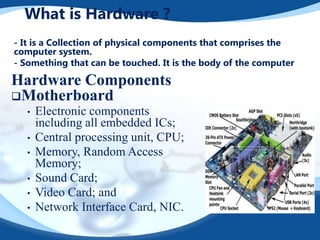
Hardware Components
Motherboard
  •   Electronic components
      including all embedded ICs;
  •   Central processing unit, CPU;
  •   Memory, Random Access
      Memory;
  •   Sound Card;
  •   Video Card; and
  •   Network Interface Card, NIC.
What is Hardware ?                          Continued…

Central   processing unit – also called “ CPU”, a Processor, “
The Chip”, or Microprocessor.
 CPU is often described as the brain of the computer.
 CPU is an integrated circuit which processes instructions and
data.
 CPU has many types, i.e. Intel Pentium processors, AMD
Athalon Processors, and Sun Microsystems Sparc Processors.
CPU speed measured by the number of completed instruction
cycle per second.
CPU has different families depending on the usage of the
processor of the platform of the computer using it, i.e. laptop
processors, workstation processors, servers processors, smart
phones processors.
What is Hardware ?                                Continued…


Random Access     Memory, RAM – it is the waiting room for the
computer’s “ CPU”.
 Holds instructions for processing data, processed data, and raw data.

 RAM is measured by: capacity ( in Megabytes or Gigabytes), and speed
( in nanoseconds)
 Amount of Ram installed determines :

    Which      software applications will run efficiently?
         All
            applications has certain memory requirements listed on their
         package for the minimum and recommended memory.
    How    many applications can be opened simultaneously ?
RAM   are cost-effective to and upgrade and easy to install.
What is Hardware ?                             Continued…

Sound    Card – it has line-in, line-out, and microphone
interfaces.
 process sound signals from digital to analog and vise- versa.

 Microphone interface sends the sound waves to the PC to be then
processed, recorded, and saved in the PC.
 line-out interface sends the digital signal of the voice from the PC
to other media like speakers.
Line-in interface receives analogue signal from analogue device,
like tape-recorder, and process it in the PC in digital form.
What is Hardware ?                                 Continued…

Video   card – it is connected on the Motherboard, sometimes
integrated, and has inside and outside interfaces on the case of the
computer.
 process the picture from the digital form to the analogue form to be
displayed on the monitor.
Has a small microprocessor that is used to process the picture details like
the 3D and the high density pictures.
Has a separate memory of its card for high definition of the pictures.
Developed a lot in the past years
 high resolution cards with multiple interfaces of multiple purposes has
high price reaching the price of PC itself, $ 2000.

Network  interface card – it is used to connect the computer to the
network and share data with other computers or devices.
What is Hardware ?                Continued..
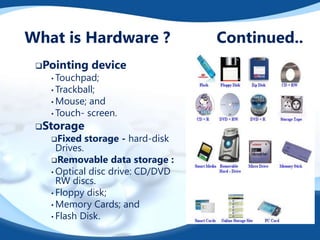
 Pointing    device
   • Touchpad;
   • Trackball;
   • Mouse;  and
   • Touch- screen.
 Storage
   Fixed   storage - hard-disk
     Drives.
   Removable data storage :
   • Optical disc drive: CD/DVD
     RW discs.
   • Floppy disk;
   • Memory Cards; and
   • Flash Disk.
What is Hardware ?                     Continued..
Pointing   device – is used to guide the user on the
screen to access different objects and icons on the screen.
  Has many forms:
  • Touchpad – used in laptops to move the mouse cursor
  • Trackball – A small ball especially on laptops used to
    move the cursor of the mouse to perform specific
    action;
  • Mouse – An external device used to move the cursor on
    the screen in Graphical interfaces; and
  • Touch- screen – An electronic sensitive screens that
    translates the movements of the finger into signals
    understood by the operating system to perform specific
    action.
What is Hardware ?                               Continued…

Storage   – Electronic devices that store, retrieve, and save data.
  Forms   of Storage
     Fixed     storage - hard-disk Drives.
           It is a magnetic storage device used to
            store, OS, applications, and data.
           Capacity started in kilobytes, now in Gigabytes & Terabytes.
     Removable data storage :
     • Optical disc drive: CD/DVD RW discs.
     • Floppy disk – started capacity in Kilobytes up to 2.88
       Megabytes, and finally disappeared from the market industry;
     • Memory Cards – new technology that has great demand and
       many new devices, i.e. digital cameras, are using it; and finally
     • Flash Disk- a media that is using flash memory technology to store
       data on demand, plug, save or retrieve, then go…
  Capacity & speed are important factors when selecting a
   new storage device or media.
What is Hardware ?    Continued..
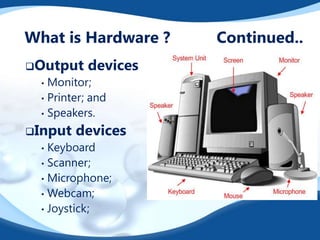
Output     devices
  • Monitor;
  • Printer; and
  • Speakers.

Input   devices
  • Keyboard
  • Scanner;
  • Microphone;
  • Webcam;
  • Joystick;
What is Hardware ?                                       Continued…

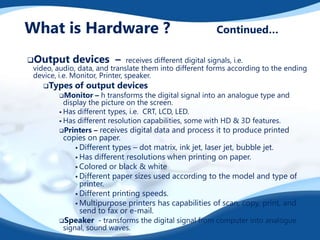
Output devices – receives different digital signals, i.e.
 video, audio, data, and translate them into different forms according to the ending
 device, i.e. Monitor, Printer, speaker.
    Types    of output devices
         Monitor    – h transforms the digital signal into an analogue type and
           display the picture on the screen.
          Has different types, i.e. CRT, LCD, LED.
          Has different resolution capabilities, some with HD & 3D features.
         Printers – receives digital data and process it to produce printed
          copies on paper.
              Different types – dot matrix, ink jet, laser jet, bubble jet.
              Has different resolutions when printing on paper.
              Colored or black & white
              Different paper sizes used according to the model and type of
               printer.
              Different printing speeds.
              Multipurpose printers has capabilities of scan, copy, print, and
               send to fax or e-mail.
         Speaker - transforms the digital signal from computer into analogue
          signal, sound waves.
What is Hardware ?                                 Continued…

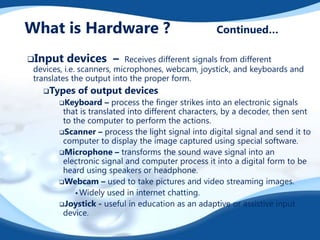
Input devices – Receives different signals from different
 devices, i.e. scanners, microphones, webcam, joystick, and keyboards and
 translates the output into the proper form.
    Types   of output devices
        Keyboard    – process the finger strikes into an electronic signals
         that is translated into different characters, by a decoder, then sent
         to the computer to perform the actions.
        Scanner – process the light signal into digital signal and send it to
         computer to display the image captured using special software.
        Microphone – transforms the sound wave signal into an
         electronic signal and computer process it into a digital form to be
         heard using speakers or headphone.
        Webcam – used to take pictures and video streaming images.
              Widely used in internet chatting.
        Joystick - useful in education as an adaptive or assistive input
         device.
What is Hardware?                                Continued..
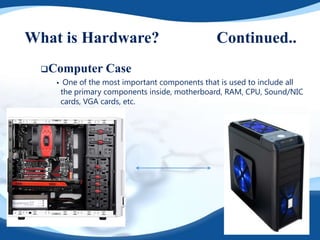
  Computer         Case
        One of the most important components that is used to include all
        the primary components inside, motherboard, RAM, CPU, Sound/NIC
        cards, VGA cards, etc.
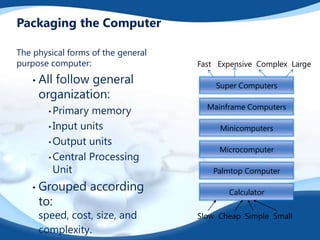
Packaging the Computer

The physical forms of the general
purpose computer:                   Fast Expensive Complex Large

    •   All follow general              Super Computers
        organization:
                                      Mainframe Computers
          • Primary memory
          • Input units                  Minicomputers
          • Output units
                                         Microcomputer
          • Central Processing
            Unit                       Palmtop Computer

    •   Grouped according                  Calculator
        to:
        speed, cost, size, and      Slow Cheap Simple Small
        complexity.
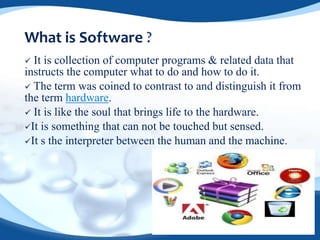
What is Software ?
 It is collection of computer programs & related data that
instructs the computer what to do and how to do it.
 The term was coined to contrast to and distinguish it from
the term hardware.
 It is like the soul that brings life to the hardware.
It is something that can not be touched but sensed.
It s the interpreter between the human and the machine.
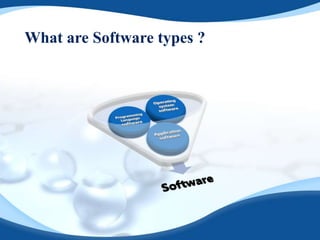
What are Software types ?
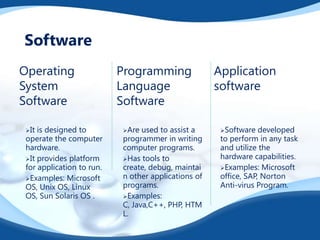
Software
Operating                  Programming               Application
System                     Language                  software
Software                   Software

 It is designed to        Are  used to assist a     Software   developed
 operate the computer      programmer in writing      to perform in any task
 hardware.                 computer programs.         and utilize the
 It provides platform     Has tools to              hardware capabilities.
 for application to run.   create, debug, maintai     Examples: Microsoft
 Examples: Microsoft      n other applications of    office, SAP, Norton
 OS, Unix OS, Linux        programs.                  Anti-virus Program.
 OS, Sun Solaris OS .      Examples:
                           C, Java,C++, PHP, HTM
                           L.
Software Key Features
Reliability          & Quality
• Any software should be reliable to well accepted.
•Softwarethat has many errors and faults are considered to have bugs and
needs more test.
•Bigsoftware companies such as Microsoft, Sun Microsystems has testing
departments.
Updates and service packs are used by the users of the software to
eliminate bugs and make it more reliable.
Software Key Features                                        continued…


      License
•software has license agreement that enables the user to use the software legally.

      Execution
In order to use the software:
•it   should be installed on the operating system.
•thecomputer is able to execute the software by passing instructions from the
application, to the operating system.
•then the hardware that, at the end, receives the instructions as machine code to
carry out certain operation.
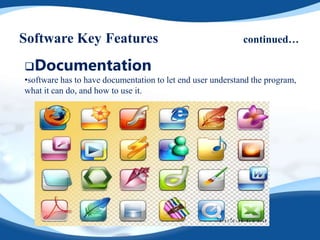
Software Key Features                                       continued…

Documentation
•software has to have documentation to let end user understand the program,
what it can do, and how to use it.
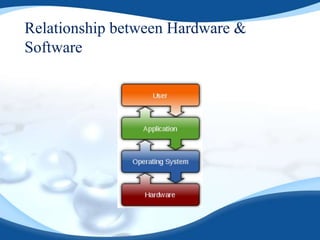
Relationship between Hardware &
Software
Moving Information Within the Computer

Without the integration between Software and
Hardware, computers will never be able to speak
with us.
Software is like the blood in the artery of the
hardware, without it computers are pile of metal
pieces.
Software instructs the hardware to move
information from place to place.
Software without hardware is only an imaginary
creature that only exists in our minds.
Moving Information Within the Computer

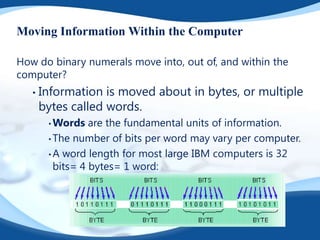
How do binary numerals move into, out of, and within the
computer?
   •   Information is moved about in bytes, or multiple
       bytes called words.
        • Words   are the fundamental units of information.
        • The number of bits per word may vary per computer.

        • A word length for most large IBM computers is 32
          bits= 4 bytes= 1 word:
Moving Information Within the Computer


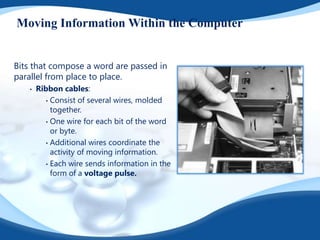
Bits that compose a word are passed in
parallel from place to place.
   •   Ribbon cables:
          • Consist of several wires, molded
            together.
          • One wire for each bit of the word
            or byte.
          • Additional wires coordinate the
            activity of moving information.
          • Each wire sends information in the
            form of a voltage pulse.
Conclusion
We Conclude That Computers Are Two Parts, Software &
Hardware, That Can Never Be Useful Without Its Two
Components.
Software And Hardware Are Complimentary To Each
Other and That Made It A Creature With Two
Components.
That Is The Secret Behind This Mysterious Creature That
Changed Our Life…
BIBLIOGRAPHY

  1. (n.d.). retrieved October 9, 2012, from what is the typical configuration
  of a computer sold today?: http://www.tec-
  search.net/en/group/77669/central_processing_unit
  2. Google. (n.d.). retrieved October 9, 2012, from http://www.google.com
  3. Poirot, d. (n.d.). retrieved October 9, 2012, from www.tcet.unt.edu:
  www.tcet.unt.edu/weblibrary/ppt/hwswb.ppt
  4. Wikipedia encyclopedia inc. (n.d.). retrieved October 10, 2012, from
  http://en.wikipedia.org/wiki/internet_in_yemen

Hardware software comparisom

  • 1.
    Hardware & Software Taufiq H. Ghilan towfeeq2k5@yahoo.com
  • 2.
    Agenda or SummaryLayout Introduction Part 1 What is Hardware ? Hardware components Part 2 What is Software? What are Software Types ? Software key features Part 3 Relationship between Hardware & Software Conclusion
  • 3.
    Introduction Computers Has MadeOur Life Different. They Changed Our Behaviors, Habits, And Even Our Course Of Life. So, What Are Computers? What Is This Creature Made Of? And, Does It Have A Body And Soul? Lets Navigate Deeper To Know More….
  • 4.
    What is Hardware? - It is a Collection of physical components that comprises the computer system. - Something that can be touched. It is the body of the computer Hardware Components Motherboard • Electronic components including all embedded ICs; • Central processing unit, CPU; • Memory, Random Access Memory; • Sound Card; • Video Card; and • Network Interface Card, NIC.
  • 5.
    What is Hardware? Continued… Central processing unit – also called “ CPU”, a Processor, “ The Chip”, or Microprocessor.  CPU is often described as the brain of the computer.  CPU is an integrated circuit which processes instructions and data.  CPU has many types, i.e. Intel Pentium processors, AMD Athalon Processors, and Sun Microsystems Sparc Processors. CPU speed measured by the number of completed instruction cycle per second. CPU has different families depending on the usage of the processor of the platform of the computer using it, i.e. laptop processors, workstation processors, servers processors, smart phones processors.
  • 6.
    What is Hardware? Continued… Random Access Memory, RAM – it is the waiting room for the computer’s “ CPU”.  Holds instructions for processing data, processed data, and raw data.  RAM is measured by: capacity ( in Megabytes or Gigabytes), and speed ( in nanoseconds)  Amount of Ram installed determines :  Which software applications will run efficiently?  All applications has certain memory requirements listed on their package for the minimum and recommended memory.  How many applications can be opened simultaneously ? RAM are cost-effective to and upgrade and easy to install.
  • 7.
    What is Hardware? Continued… Sound Card – it has line-in, line-out, and microphone interfaces.  process sound signals from digital to analog and vise- versa.  Microphone interface sends the sound waves to the PC to be then processed, recorded, and saved in the PC.  line-out interface sends the digital signal of the voice from the PC to other media like speakers. Line-in interface receives analogue signal from analogue device, like tape-recorder, and process it in the PC in digital form.
  • 8.
    What is Hardware? Continued… Video card – it is connected on the Motherboard, sometimes integrated, and has inside and outside interfaces on the case of the computer.  process the picture from the digital form to the analogue form to be displayed on the monitor. Has a small microprocessor that is used to process the picture details like the 3D and the high density pictures. Has a separate memory of its card for high definition of the pictures. Developed a lot in the past years  high resolution cards with multiple interfaces of multiple purposes has high price reaching the price of PC itself, $ 2000. Network interface card – it is used to connect the computer to the network and share data with other computers or devices.
  • 9.
    What is Hardware? Continued.. Pointing device • Touchpad; • Trackball; • Mouse; and • Touch- screen. Storage Fixed storage - hard-disk Drives. Removable data storage : • Optical disc drive: CD/DVD RW discs. • Floppy disk; • Memory Cards; and • Flash Disk.
  • 10.
    What is Hardware? Continued.. Pointing device – is used to guide the user on the screen to access different objects and icons on the screen. Has many forms: • Touchpad – used in laptops to move the mouse cursor • Trackball – A small ball especially on laptops used to move the cursor of the mouse to perform specific action; • Mouse – An external device used to move the cursor on the screen in Graphical interfaces; and • Touch- screen – An electronic sensitive screens that translates the movements of the finger into signals understood by the operating system to perform specific action.
  • 11.
    What is Hardware? Continued… Storage – Electronic devices that store, retrieve, and save data. Forms of Storage Fixed storage - hard-disk Drives.  It is a magnetic storage device used to store, OS, applications, and data.  Capacity started in kilobytes, now in Gigabytes & Terabytes. Removable data storage : • Optical disc drive: CD/DVD RW discs. • Floppy disk – started capacity in Kilobytes up to 2.88 Megabytes, and finally disappeared from the market industry; • Memory Cards – new technology that has great demand and many new devices, i.e. digital cameras, are using it; and finally • Flash Disk- a media that is using flash memory technology to store data on demand, plug, save or retrieve, then go… Capacity & speed are important factors when selecting a new storage device or media.
  • 12.
    What is Hardware? Continued.. Output devices • Monitor; • Printer; and • Speakers. Input devices • Keyboard • Scanner; • Microphone; • Webcam; • Joystick;
  • 13.
    What is Hardware? Continued… Output devices – receives different digital signals, i.e. video, audio, data, and translate them into different forms according to the ending device, i.e. Monitor, Printer, speaker. Types of output devices Monitor – h transforms the digital signal into an analogue type and display the picture on the screen.  Has different types, i.e. CRT, LCD, LED.  Has different resolution capabilities, some with HD & 3D features. Printers – receives digital data and process it to produce printed copies on paper.  Different types – dot matrix, ink jet, laser jet, bubble jet.  Has different resolutions when printing on paper.  Colored or black & white  Different paper sizes used according to the model and type of printer.  Different printing speeds.  Multipurpose printers has capabilities of scan, copy, print, and send to fax or e-mail. Speaker - transforms the digital signal from computer into analogue signal, sound waves.
  • 14.
    What is Hardware? Continued… Input devices – Receives different signals from different devices, i.e. scanners, microphones, webcam, joystick, and keyboards and translates the output into the proper form. Types of output devices Keyboard – process the finger strikes into an electronic signals that is translated into different characters, by a decoder, then sent to the computer to perform the actions. Scanner – process the light signal into digital signal and send it to computer to display the image captured using special software. Microphone – transforms the sound wave signal into an electronic signal and computer process it into a digital form to be heard using speakers or headphone. Webcam – used to take pictures and video streaming images.  Widely used in internet chatting. Joystick - useful in education as an adaptive or assistive input device.
  • 15.
    What is Hardware? Continued.. Computer Case  One of the most important components that is used to include all the primary components inside, motherboard, RAM, CPU, Sound/NIC cards, VGA cards, etc.
  • 16.
    Packaging the Computer Thephysical forms of the general purpose computer: Fast Expensive Complex Large • All follow general Super Computers organization: Mainframe Computers • Primary memory • Input units Minicomputers • Output units Microcomputer • Central Processing Unit Palmtop Computer • Grouped according Calculator to: speed, cost, size, and Slow Cheap Simple Small complexity.
  • 17.
    What is Software?  It is collection of computer programs & related data that instructs the computer what to do and how to do it.  The term was coined to contrast to and distinguish it from the term hardware.  It is like the soul that brings life to the hardware. It is something that can not be touched but sensed. It s the interpreter between the human and the machine.
  • 18.
  • 19.
    Software Operating Programming Application System Language software Software Software It is designed to Are used to assist a Software developed operate the computer programmer in writing to perform in any task hardware. computer programs. and utilize the It provides platform Has tools to hardware capabilities. for application to run. create, debug, maintai Examples: Microsoft Examples: Microsoft n other applications of office, SAP, Norton OS, Unix OS, Linux programs. Anti-virus Program. OS, Sun Solaris OS . Examples: C, Java,C++, PHP, HTM L.
  • 20.
    Software Key Features Reliability & Quality • Any software should be reliable to well accepted. •Softwarethat has many errors and faults are considered to have bugs and needs more test. •Bigsoftware companies such as Microsoft, Sun Microsystems has testing departments. Updates and service packs are used by the users of the software to eliminate bugs and make it more reliable.
  • 21.
    Software Key Features continued…  License •software has license agreement that enables the user to use the software legally.  Execution In order to use the software: •it should be installed on the operating system. •thecomputer is able to execute the software by passing instructions from the application, to the operating system. •then the hardware that, at the end, receives the instructions as machine code to carry out certain operation.
  • 22.
    Software Key Features continued… Documentation •software has to have documentation to let end user understand the program, what it can do, and how to use it.
  • 23.
  • 24.
    Moving Information Withinthe Computer Without the integration between Software and Hardware, computers will never be able to speak with us. Software is like the blood in the artery of the hardware, without it computers are pile of metal pieces. Software instructs the hardware to move information from place to place. Software without hardware is only an imaginary creature that only exists in our minds.
  • 25.
    Moving Information Withinthe Computer How do binary numerals move into, out of, and within the computer? • Information is moved about in bytes, or multiple bytes called words. • Words are the fundamental units of information. • The number of bits per word may vary per computer. • A word length for most large IBM computers is 32 bits= 4 bytes= 1 word:
  • 26.
    Moving Information Withinthe Computer Bits that compose a word are passed in parallel from place to place. • Ribbon cables: • Consist of several wires, molded together. • One wire for each bit of the word or byte. • Additional wires coordinate the activity of moving information. • Each wire sends information in the form of a voltage pulse.
  • 27.
    Conclusion We Conclude ThatComputers Are Two Parts, Software & Hardware, That Can Never Be Useful Without Its Two Components. Software And Hardware Are Complimentary To Each Other and That Made It A Creature With Two Components. That Is The Secret Behind This Mysterious Creature That Changed Our Life…
  • 28.
    BIBLIOGRAPHY 1.(n.d.). retrieved October 9, 2012, from what is the typical configuration of a computer sold today?: http://www.tec- search.net/en/group/77669/central_processing_unit 2. Google. (n.d.). retrieved October 9, 2012, from http://www.google.com 3. Poirot, d. (n.d.). retrieved October 9, 2012, from www.tcet.unt.edu: www.tcet.unt.edu/weblibrary/ppt/hwswb.ppt 4. Wikipedia encyclopedia inc. (n.d.). retrieved October 10, 2012, from http://en.wikipedia.org/wiki/internet_in_yemen