SystemVerilogアサーション 入
門
ヅオン・ディエップ
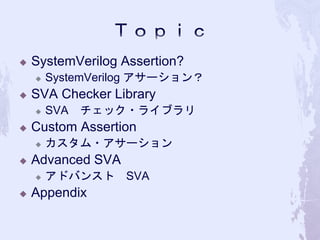
 SystemVerilog Assertion?
 SystemVerilog アサーション?
 SVA Checker Library
 SVA チェック・ライブラリ
 Custom Assertion
 カスタム・アサーション
 Advanced SVA
 アドバンスト SVA
 Appendix
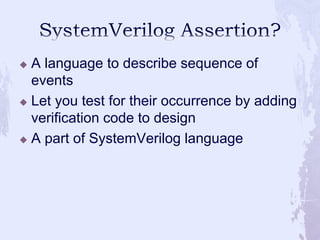
 A language to describe sequence of
events
 Let you test for their occurrence by adding
verification code to design
 A part of SystemVerilog language
 Concurrent (コンカレント)
 assert property
 Immediate (イミディエイト)
 assert
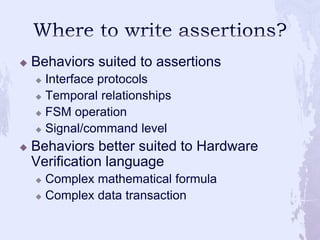
 Behaviors suited to assertions
 Interface protocols
 Temporal relationships
 FSM operation
 Signal/command level
 Behaviors better suited to Hardware
Verification language
 Complex mathematical formula
 Complex data transaction
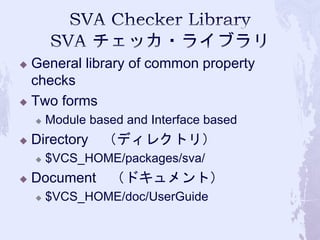
 General library of common property
checks
 Two forms
 Module based and Interface based
 Directory (ディレクトリ)
 $VCS_HOME/packages/sva/
 Document (ドキュメント)
 $VCS_HOME/doc/UserGuide
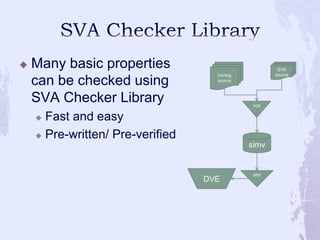
 Many basic properties
can be checked using
SVA Checker Library
 Fast and easy
 Pre-written/ Pre-verified
Verilog
source
SVA
source
vcs
simv
DVE
sim
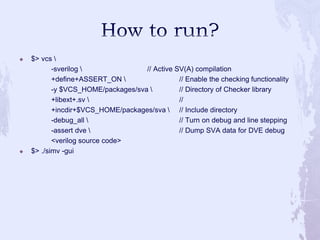
 $> vcs 
-sverilog  // Active SV(A) compilation
+define+ASSERT_ON  // Enable the checking functionality
-y $VCS_HOME/packages/sva  // Directory of Checker library
+libext+.sv  //
+incdir+$VCS_HOME/packages/sva  // Include directory
-debug_all  // Turn on debug and line stepping
-assert dve  // Dump SVA data for DVE debug
<verilog source code>
 $> ./simv -gui
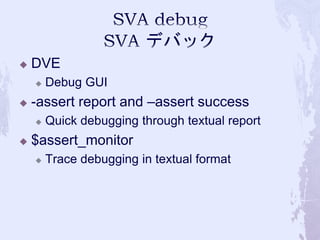
 DVE
 Debug GUI
 -assert report and –assert success
 Quick debugging through textual report
 $assert_monitor
 Trace debugging in textual format
 SVA syntax (SVA シンタックス)
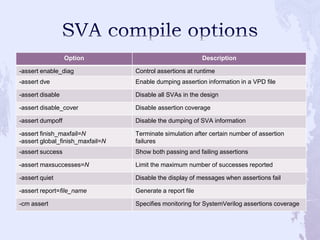
 SVA compile options
 Sequence (シーケンス)
 ##t1, ##[t1:t2], ##[t1:$]
 [*r1:r2], [->r1:r2], [=r1:r2]
 and, or, throughout, intersect, within, first_match, |->, |=>
 Function (ファンクション)
 $rose, $fell, $stable
 System (システム)
 $isunknow, $info, $error, $warning, $fatal, $past, $countones,
$onehot, $onehot0
 Keyword (キーワード)
 bind, sequence, property, assert, not, ended, matched
 endsequence, endproperty, assert property, cover property
 Verify Directives
 assert, cover, bind,…
 Property Operators
 |->, |=>, disable iff, not,…
 Sequence Operators
 And, or, ##t, ##[t1:t2], …
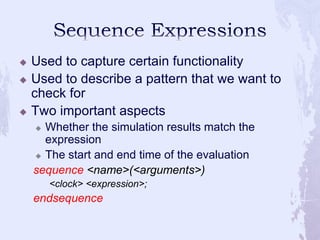
 Used to capture certain functionality
 Used to describe a pattern that we want to
check for
 Two important aspects
 Whether the simulation results match the
expression
 The start and end time of the evaluation
sequence <name>(<arguments>)
<clock> <expression>;
endsequence
 Specifying Delays
 Fixed time
 ##1
 ##0: Special case used to joint two sequences
 Time interval
 ##[1:3]
 Open ended, eventually
 ##[1:$]: Next clock cycles to the end of simulation
 The delay is in clock cycles, not nanoseconds
 How to use?
 req ##2 ack
 ack should be high two cycles after req
 req ##2 ack ##3 !ack
 ack will remain high for only 3 cycles
 req ##2 ack ##3 !ack ##[1:3] $fell(done)
 done falls 1 to 3 clocks after ack is removed
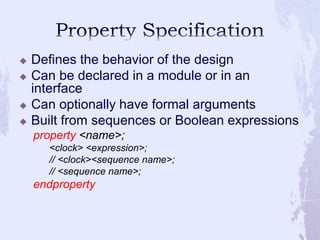
 Defines the behavior of the design
 Can be declared in a module or in an
interface
 Can optionally have formal arguments
 Built from sequences or Boolean expressions
property <name>;
<clock> <expression>;
// <clock><sequence name>;
// <sequence name>;
endproperty
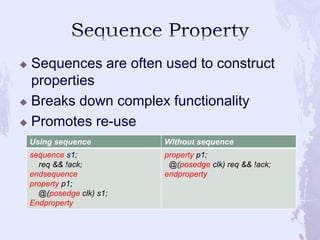
 Sequences are often used to construct
properties
 Breaks down complex functionality
 Promotes re-use
Using sequence Without sequence
sequence s1;
req && !ack;
endsequence
property p1;
@(posedge clk) s1;
Endproperty
property p1;
@(posedge clk) req && !ack;
endproperty
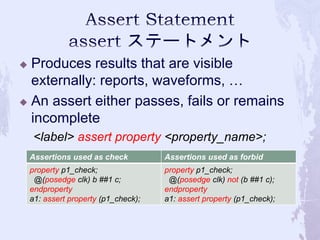
 Produces results that are visible
externally: reports, waveforms, …
 An assert either passes, fails or remains
incomplete
<label> assert property <property_name>;
Assertions used as check Assertions used as forbid
property p1_check;
@(posedge clk) b ##1 c;
endproperty
a1: assert property (p1_check);
property p1_check;
@(posedge clk) not (b ##1 c);
endproperty
a1: assert property (p1_check);
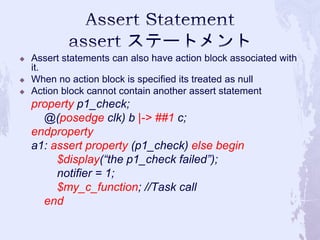
 Assert statements can also have action block associated with
it.
 When no action block is specified its treated as null
 Action block cannot contain another assert statement
property p1_check;
@(posedge clk) b |-> ##1 c;
endproperty
a1: assert property (p1_check) else begin
$display(“the p1_check failed”);
notifier = 1;
$my_c_function; //Task call
end
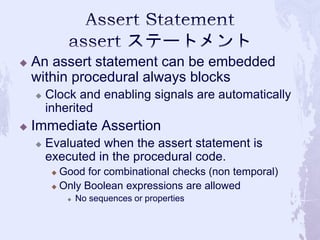
 An assert statement can be embedded
within procedural always blocks
 Clock and enabling signals are automatically
inherited
 Immediate Assertion
 Evaluated when the assert statement is
executed in the procedural code.
 Good for combinational checks (non temporal)
 Only Boolean expressions are allowed
 No sequences or properties
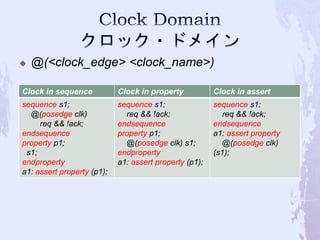
 @(<clock_edge> <clock_name>)
Clock in sequence Clock in property Clock in assert
sequence s1;
@(posedge clk)
req && !ack;
endsequence
property p1;
s1;
endproperty
a1: assert property (p1);
sequence s1;
req && !ack;
endsequence
property p1;
@(posedge clk) s1;
endproperty
a1: assert property (p1);
sequence s1;
req && !ack;
endsequence
a1: assert property
@(posedge clk)
(s1);
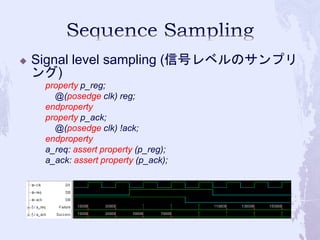
 Signal level sampling (信号レベルのサンプリ
ング)
property p_reg;
@(posedge clk) reg;
endproperty
property p_ack;
@(posedge clk) !ack;
endproperty
a_req: assert property (p_reg);
a_ack: assert property (p_ack);
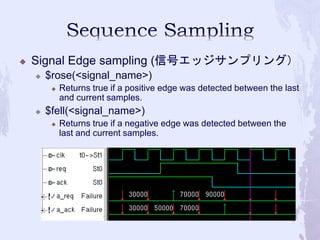
 Signal Edge sampling (信号エッジサンプリング)
 $rose(<signal_name>)
 Returns true if a positive edge was detected between the last
and current samples.
 $fell(<signal_name>)
 Returns true if a negative edge was detected between the
last and current samples.
 Property adds constructs for evaluation
control
 not: inverts the expression
 Good for forbid a property
 Implication: |->, |=>
 disable iff (if and only if)
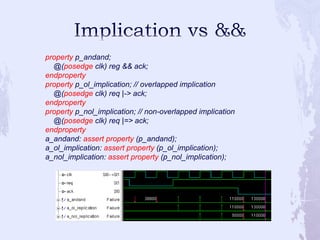
 Implication is equivalent to if-then structure
 Overlapped implication: |->
 If antecedent evaluates to true, the consequent is
evaluated on same clock cycle
 Assertion does not fail if antecedent is false
 Vacuous Success
 Non-overlapped implication: |=>
 If there is a match on the antecedent, the consequent is
evaluated one clock cycle later
 The statement: a |=> b is equivalent to: a |-> ##1 b
 Useful to synchronize data between multiple clocks
 Implication has a default else clause
 The statement: req |-> ack is equivalent to: if
req then ack else 1
 The following are NOT the same:
 req && ack
 Fails when req = 0
 req |-> ack
 Succeeds when req = 0
property p_andand;
@(posedge clk) reg && ack;
endproperty
property p_ol_implication; // overlapped implication
@(posedge clk) req |-> ack;
endproperty
property p_nol_implication; // non-overlapped implication
@(posedge clk) req |=> ack;
endproperty
a_andand: assert property (p_andand);
a_ol_implication: assert property (p_ol_implication);
a_nol_implication: assert property (p_nol_implication);
 Use disable iff to abort property valuation
on a Boolean condition (e.g., reset)
 If reset is TRUE, terminates the attempt with a
vacuous success
 $stable(expr)
 Returns true if the value of an expression did not
change between the last and current samples.
 $past(expr, n)
 Returns the value of an expr n samples earlier.
 $isunknown(expr)
 Returns true if any bit of the expression is X or Z.
 $countones(expr)
 Returns an integer equal to the number of 1’s in the
expression.
 Bindings are used to attach SVAs to the
design
 Allows SVAs to be written in a separate module
 Module bindings
 The module/interface containing the properties become
part of that module and all its instances
bind <module_name> <SVA_module_name> #(parameter_list)
<instance_name> (port_list);
 Instance bindings
 The module/interface containing the properties become
part of the specific instance
bind <instance_name> <SVA_module_name> #(parameter_list)
<instance_name> (port_list);
 Bindings are easy way to use checker libraries
 Verification engineers developing complex properties to verify
interfaces should write properties in a separate module/interface and
bind it to the design
module check_par(clk, parity, data);
input clk, parity; input [31:0] data;
property p_check_par;
@(posedge clk) ^(data^parity) == 1’b0;
endproperty
a_check_par: assert property(p_check_par);
endmodule
bind data_bus check_par a1(m_clk, m_parity, m_data);
bind top.mid.u1 check_par a2 (i_clk, i_parity, i_data);
Option Description
-assert enable_diag Control assertions at runtime
-assert dve Enable dumping assertion information in a VPD file
-assert disable Disable all SVAs in the design
-assert disable_cover Disable assertion coverage
-assert dumpoff Disable the dumping of SVA information
-assert finish_maxfail=N
-assert global_finish_maxfail=N
Terminate simulation after certain number of assertion
failures
-assert success Show both passing and failing assertions
-assert maxsuccesses=N Limit the maximum number of successes reported
-assert quiet Disable the display of messages when assertions fail
-assert report=file_name Generate a report file
-cm assert Specifies monitoring for SystemVerilog assertions coverage
 Sequence repetition operators
 Consecutive repetition [*n]
 Range repetition [*min:max]/ [*min:$]
 Go to repetition [->n]
 Non-consecutive repetition [=n]
 Implication and repetition
 Repetition as an antecedent
 Repetition as an consequence
 A[*1]: A ##1 A
 A[*n]: A ##1 A ##1 A ##1 A …. ##1 A
 A[*1:$]: A[*1], A[*2], A[*3], …
 A[*min:max]
 A[->1]  (!A[*0:$] ##1 A)
 A[->n]  (!A[*0:$] ##1 A)[*n]  A[->1][*n]
 A[->1:3]  A[->1] or A[->2] or A[->3]
 A[->min:max]  A[->min] or A[->(min+1)] or… A[->(max-
1)] or A[->max]
 A[=1]  (A[->1] ##1 !A[*0:$])
 A[=n]  (A[->n] ##1 !A[*0:$])
 Use the repetition operator to loop on a
sequence or Boolean expression
 sequence [*n] // n = integer number of
iterations
 There is an implicit ##1 between each loop
 “ready asserted for 3 consecutive cycles”
 ready ##1 ready ##1 ready
property p_ready_3;
@(posedge clk) ready[*3];
endproperty
 Same as consecutive but with an upper bound
sequence [*min:max]
 Generates (max – min) + 1 threads
 There is an implicit ##1 between each loop
 “ ready repeated 1 to 3 times”
 ready or ready ##1 ready or #ready ##1 ready ##1 ready
property p_ready_13;
@(posedge clk) ready[*1:3];
endproperty
 A[*1:$]: A[*1], A[*2], A[*3], …
 Upper bound $: the sequence repeats at least the number
of times specified by the lower bound.
 Non-consecutive exact repetition' operator for
Boolean expression
 It checks if a Boolean expression has been true
for specified number of times but not necessarily
on consecutive clock cycles.
 The sequence starts with the first occurrence of
the Boolean expression and ends with the last
 A[->1]  (!A[*0:$] ##1 A)
 A[->n]  (!A[*0:$] ##1 A)[*n]  A[->1][*n]
 A[->1:3]  A[->1] or A[->2] or A[->3]
 A[->min:max]  A[->min] or A[->(min+1)] or… A[->(max-1)] or
A[->max]
 Similar to the [-> ] operator
 When the ends with the last true value of
the operand, [= ] operation may extend
beyond such last true value.
 A[=1]  (A[->1] ##1 !A[*0:$])
 A[=n]  (A[->n] ##1 !A[*0:$])
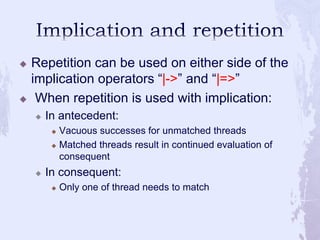
 Repetition can be used on either side of the
implication operators “|->” and “|=>”
 When repetition is used with implication:
 In antecedent:
 Vacuous successes for unmatched threads
 Matched threads result in continued evaluation of
consequent
 In consequent:
 Only one of thread needs to match
property p_antecedent;
@(posedge clk) req[*3] |=> ack;
endproperty
property p_antecedent;
@(posedge clk) req[*1:3] |=> ack;
endproperty
property p_consequence;
@(posedge clk) $rose(gnt) |-> ack[*2:3] ##1 !ack;
endproperty

SystemVerilog Assertion.pptx

  • 1.
  • 2.
     SystemVerilog Assertion? SystemVerilog アサーション?  SVA Checker Library  SVA チェック・ライブラリ  Custom Assertion  カスタム・アサーション  Advanced SVA  アドバンスト SVA  Appendix
  • 3.
     A languageto describe sequence of events  Let you test for their occurrence by adding verification code to design  A part of SystemVerilog language
  • 4.
     Concurrent (コンカレント) assert property  Immediate (イミディエイト)  assert
  • 5.
     Behaviors suitedto assertions  Interface protocols  Temporal relationships  FSM operation  Signal/command level  Behaviors better suited to Hardware Verification language  Complex mathematical formula  Complex data transaction
  • 6.
     General libraryof common property checks  Two forms  Module based and Interface based  Directory (ディレクトリ)  $VCS_HOME/packages/sva/  Document (ドキュメント)  $VCS_HOME/doc/UserGuide
  • 7.
     Many basicproperties can be checked using SVA Checker Library  Fast and easy  Pre-written/ Pre-verified Verilog source SVA source vcs simv DVE sim
  • 8.
     $> vcs -sverilog // Active SV(A) compilation +define+ASSERT_ON // Enable the checking functionality -y $VCS_HOME/packages/sva // Directory of Checker library +libext+.sv // +incdir+$VCS_HOME/packages/sva // Include directory -debug_all // Turn on debug and line stepping -assert dve // Dump SVA data for DVE debug <verilog source code>  $> ./simv -gui
  • 9.
     DVE  DebugGUI  -assert report and –assert success  Quick debugging through textual report  $assert_monitor  Trace debugging in textual format
  • 10.
     SVA syntax(SVA シンタックス)  SVA compile options
  • 11.
     Sequence (シーケンス) ##t1, ##[t1:t2], ##[t1:$]  [*r1:r2], [->r1:r2], [=r1:r2]  and, or, throughout, intersect, within, first_match, |->, |=>  Function (ファンクション)  $rose, $fell, $stable  System (システム)  $isunknow, $info, $error, $warning, $fatal, $past, $countones, $onehot, $onehot0  Keyword (キーワード)  bind, sequence, property, assert, not, ended, matched  endsequence, endproperty, assert property, cover property
  • 12.
     Verify Directives assert, cover, bind,…  Property Operators  |->, |=>, disable iff, not,…  Sequence Operators  And, or, ##t, ##[t1:t2], …
  • 13.
     Used tocapture certain functionality  Used to describe a pattern that we want to check for  Two important aspects  Whether the simulation results match the expression  The start and end time of the evaluation sequence <name>(<arguments>) <clock> <expression>; endsequence
  • 14.
     Specifying Delays Fixed time  ##1  ##0: Special case used to joint two sequences  Time interval  ##[1:3]  Open ended, eventually  ##[1:$]: Next clock cycles to the end of simulation  The delay is in clock cycles, not nanoseconds
  • 15.
     How touse?  req ##2 ack  ack should be high two cycles after req  req ##2 ack ##3 !ack  ack will remain high for only 3 cycles  req ##2 ack ##3 !ack ##[1:3] $fell(done)  done falls 1 to 3 clocks after ack is removed
  • 16.
     Defines thebehavior of the design  Can be declared in a module or in an interface  Can optionally have formal arguments  Built from sequences or Boolean expressions property <name>; <clock> <expression>; // <clock><sequence name>; // <sequence name>; endproperty
  • 17.
     Sequences areoften used to construct properties  Breaks down complex functionality  Promotes re-use Using sequence Without sequence sequence s1; req && !ack; endsequence property p1; @(posedge clk) s1; Endproperty property p1; @(posedge clk) req && !ack; endproperty
  • 18.
     Produces resultsthat are visible externally: reports, waveforms, …  An assert either passes, fails or remains incomplete <label> assert property <property_name>; Assertions used as check Assertions used as forbid property p1_check; @(posedge clk) b ##1 c; endproperty a1: assert property (p1_check); property p1_check; @(posedge clk) not (b ##1 c); endproperty a1: assert property (p1_check);
  • 19.
     Assert statementscan also have action block associated with it.  When no action block is specified its treated as null  Action block cannot contain another assert statement property p1_check; @(posedge clk) b |-> ##1 c; endproperty a1: assert property (p1_check) else begin $display(“the p1_check failed”); notifier = 1; $my_c_function; //Task call end
  • 20.
     An assertstatement can be embedded within procedural always blocks  Clock and enabling signals are automatically inherited  Immediate Assertion  Evaluated when the assert statement is executed in the procedural code.  Good for combinational checks (non temporal)  Only Boolean expressions are allowed  No sequences or properties
  • 21.
     @(<clock_edge> <clock_name>) Clockin sequence Clock in property Clock in assert sequence s1; @(posedge clk) req && !ack; endsequence property p1; s1; endproperty a1: assert property (p1); sequence s1; req && !ack; endsequence property p1; @(posedge clk) s1; endproperty a1: assert property (p1); sequence s1; req && !ack; endsequence a1: assert property @(posedge clk) (s1);
  • 22.
     Signal levelsampling (信号レベルのサンプリ ング) property p_reg; @(posedge clk) reg; endproperty property p_ack; @(posedge clk) !ack; endproperty a_req: assert property (p_reg); a_ack: assert property (p_ack);
  • 23.
     Signal Edgesampling (信号エッジサンプリング)  $rose(<signal_name>)  Returns true if a positive edge was detected between the last and current samples.  $fell(<signal_name>)  Returns true if a negative edge was detected between the last and current samples.
  • 24.
     Property addsconstructs for evaluation control  not: inverts the expression  Good for forbid a property  Implication: |->, |=>  disable iff (if and only if)
  • 25.
     Implication isequivalent to if-then structure  Overlapped implication: |->  If antecedent evaluates to true, the consequent is evaluated on same clock cycle  Assertion does not fail if antecedent is false  Vacuous Success  Non-overlapped implication: |=>  If there is a match on the antecedent, the consequent is evaluated one clock cycle later  The statement: a |=> b is equivalent to: a |-> ##1 b  Useful to synchronize data between multiple clocks
  • 26.
     Implication hasa default else clause  The statement: req |-> ack is equivalent to: if req then ack else 1  The following are NOT the same:  req && ack  Fails when req = 0  req |-> ack  Succeeds when req = 0
  • 27.
    property p_andand; @(posedge clk)reg && ack; endproperty property p_ol_implication; // overlapped implication @(posedge clk) req |-> ack; endproperty property p_nol_implication; // non-overlapped implication @(posedge clk) req |=> ack; endproperty a_andand: assert property (p_andand); a_ol_implication: assert property (p_ol_implication); a_nol_implication: assert property (p_nol_implication);
  • 28.
     Use disableiff to abort property valuation on a Boolean condition (e.g., reset)  If reset is TRUE, terminates the attempt with a vacuous success
  • 29.
     $stable(expr)  Returnstrue if the value of an expression did not change between the last and current samples.  $past(expr, n)  Returns the value of an expr n samples earlier.  $isunknown(expr)  Returns true if any bit of the expression is X or Z.  $countones(expr)  Returns an integer equal to the number of 1’s in the expression.
  • 30.
     Bindings areused to attach SVAs to the design  Allows SVAs to be written in a separate module  Module bindings  The module/interface containing the properties become part of that module and all its instances bind <module_name> <SVA_module_name> #(parameter_list) <instance_name> (port_list);  Instance bindings  The module/interface containing the properties become part of the specific instance bind <instance_name> <SVA_module_name> #(parameter_list) <instance_name> (port_list);
  • 31.
     Bindings areeasy way to use checker libraries  Verification engineers developing complex properties to verify interfaces should write properties in a separate module/interface and bind it to the design module check_par(clk, parity, data); input clk, parity; input [31:0] data; property p_check_par; @(posedge clk) ^(data^parity) == 1’b0; endproperty a_check_par: assert property(p_check_par); endmodule bind data_bus check_par a1(m_clk, m_parity, m_data); bind top.mid.u1 check_par a2 (i_clk, i_parity, i_data);
  • 32.
    Option Description -assert enable_diagControl assertions at runtime -assert dve Enable dumping assertion information in a VPD file -assert disable Disable all SVAs in the design -assert disable_cover Disable assertion coverage -assert dumpoff Disable the dumping of SVA information -assert finish_maxfail=N -assert global_finish_maxfail=N Terminate simulation after certain number of assertion failures -assert success Show both passing and failing assertions -assert maxsuccesses=N Limit the maximum number of successes reported -assert quiet Disable the display of messages when assertions fail -assert report=file_name Generate a report file -cm assert Specifies monitoring for SystemVerilog assertions coverage
  • 33.
     Sequence repetitionoperators  Consecutive repetition [*n]  Range repetition [*min:max]/ [*min:$]  Go to repetition [->n]  Non-consecutive repetition [=n]  Implication and repetition  Repetition as an antecedent  Repetition as an consequence
  • 34.
     A[*1]: A##1 A  A[*n]: A ##1 A ##1 A ##1 A …. ##1 A  A[*1:$]: A[*1], A[*2], A[*3], …  A[*min:max]  A[->1]  (!A[*0:$] ##1 A)  A[->n]  (!A[*0:$] ##1 A)[*n]  A[->1][*n]  A[->1:3]  A[->1] or A[->2] or A[->3]  A[->min:max]  A[->min] or A[->(min+1)] or… A[->(max- 1)] or A[->max]  A[=1]  (A[->1] ##1 !A[*0:$])  A[=n]  (A[->n] ##1 !A[*0:$])
  • 35.
     Use therepetition operator to loop on a sequence or Boolean expression  sequence [*n] // n = integer number of iterations  There is an implicit ##1 between each loop  “ready asserted for 3 consecutive cycles”  ready ##1 ready ##1 ready property p_ready_3; @(posedge clk) ready[*3]; endproperty
  • 36.
     Same asconsecutive but with an upper bound sequence [*min:max]  Generates (max – min) + 1 threads  There is an implicit ##1 between each loop  “ ready repeated 1 to 3 times”  ready or ready ##1 ready or #ready ##1 ready ##1 ready property p_ready_13; @(posedge clk) ready[*1:3]; endproperty  A[*1:$]: A[*1], A[*2], A[*3], …  Upper bound $: the sequence repeats at least the number of times specified by the lower bound.
  • 37.
     Non-consecutive exactrepetition' operator for Boolean expression  It checks if a Boolean expression has been true for specified number of times but not necessarily on consecutive clock cycles.  The sequence starts with the first occurrence of the Boolean expression and ends with the last  A[->1]  (!A[*0:$] ##1 A)  A[->n]  (!A[*0:$] ##1 A)[*n]  A[->1][*n]  A[->1:3]  A[->1] or A[->2] or A[->3]  A[->min:max]  A[->min] or A[->(min+1)] or… A[->(max-1)] or A[->max]
  • 38.
     Similar tothe [-> ] operator  When the ends with the last true value of the operand, [= ] operation may extend beyond such last true value.  A[=1]  (A[->1] ##1 !A[*0:$])  A[=n]  (A[->n] ##1 !A[*0:$])
  • 39.
     Repetition canbe used on either side of the implication operators “|->” and “|=>”  When repetition is used with implication:  In antecedent:  Vacuous successes for unmatched threads  Matched threads result in continued evaluation of consequent  In consequent:  Only one of thread needs to match
  • 40.
    property p_antecedent; @(posedge clk)req[*3] |=> ack; endproperty property p_antecedent; @(posedge clk) req[*1:3] |=> ack; endproperty
  • 41.
    property p_consequence; @(posedge clk)$rose(gnt) |-> ack[*2:3] ##1 !ack; endproperty