Fashion Forecasting
‘The future is here, its just not very well distributed.’ William Gibson, science fiction writer
FASHION FORECASTING
Target: For-Level-III
BY; Mezgebu Tesfaye
Course name;
Develop Design concept
FASHION FORECASTING
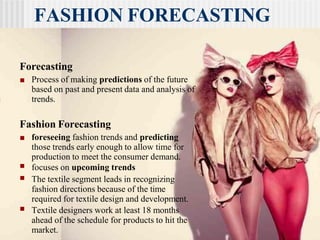
Forecasting
■ Process of making predictions of the future
based on past and present data and analysis of
trends.
Fashion Forecasting
■ foreseeing fashion trends and predicting
those trends early enough to allow time for
production to meet the consumer demand.
focuses on upcoming trends
■
■ The textile segment leads in recognizing
fashion directions because of the time
required for textile design and development.
■ Textile designers work at least 18 months
ahead of the schedule for products to hit the
market.
■ The fashion forecasting
process includes the basic
steps of :
■ understanding the vision of
the business and profile of
target customers,
■ collecting information about
available merchandise,
preparing information,
■
■
■
determining trends, and
choosing merchandise
appropriate for the
company and target
customer.
FASHION FORECASTING
Aims:
■ To provide you with an
understanding
of what trend forecasting is
and how organizations use
this information
■ To examine how trends
evolve and
how they are tracked.
Objectives
To enable you to:
■ Undertake research & analysis by
identifying and tracking fashion trends
■ Apply knowledge of fashion
forecasting
to understand how trends evolve and
are
interpreted by industry
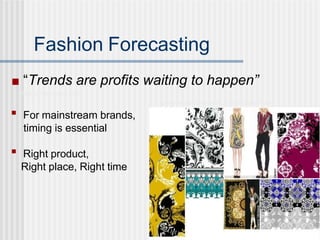
Fashion Forecasting
■ “Trends are profits waiting to happen”
Martin Raymond 2009
Versace scarf prints for AW12 Nelly Rodi
■
For mainstream brands,
timing is essential
■
Right product,
Right place, Right time
FASHION TRENDS
Trend
■ The behavior of large group of people,
that is accepted and followed
extensively for a period of time.
Fashion Trends
■ The direction of movement of public
acceptance of color, texture, and
silhouette in fashion.
■ Newest styles and silhouettes
■ Important colors for upcoming seasons
■ Newest developments in the fiber and
fabric markets
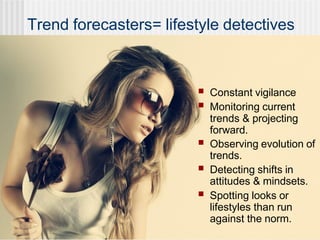
Trend forecasters= lifestyle detectives
Constant vigilance
■
■ Monitoring current
trends & projecting
forward.
■ Observing evolution of
trends.
■ Detecting shifts in
attitudes & mindsets.
■ Spotting looks or
lifestyles than run
against the norm.
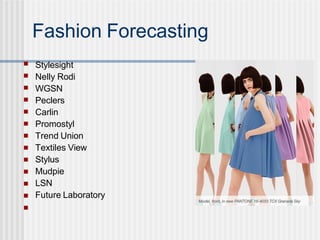
Fashion Forecasting
Stylesight
Nelly Rodi
WGSN
Peclers
Carlin
Promostyl
Trend Union
Textiles View
Stylus
Mudpie
LSN
Future Laboratory
■
■
■
■
■
■
■
■
■
■
■
■
■
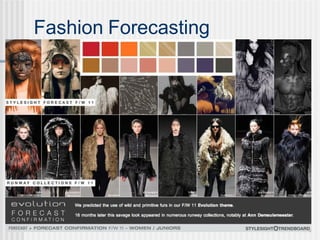
Fashion Forecasting
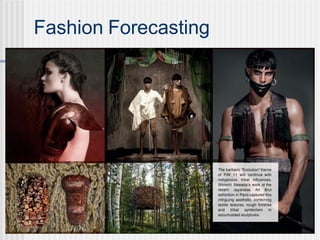
Fashion Forecasting
Fashion Forecasting
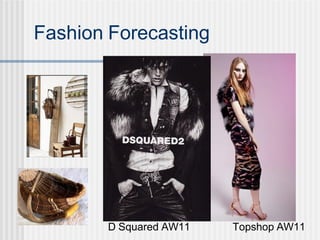
D Squared AW11 Topshop AW11
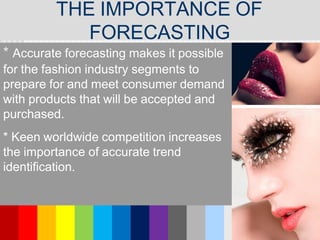
* Accurate forecasting makes it possible
for the fashion industry segments to
prepare for and meet consumer demand
with products that will be accepted and
purchased.
* Keen worldwide competition increases
the importance of accurate trend
identification.
THE IMPORTANCE OF
FORECASTING
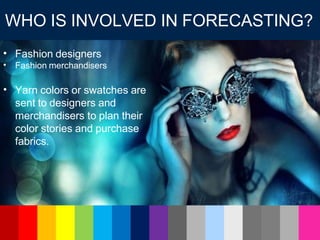
Fashion designers
•
• Fashion merchandisers
• Yarn colors or swatches are
sent to designers and
merchandisers to plan their
color stories and purchase
fabrics.
WHO IS INVOLVED IN FORECASTING?
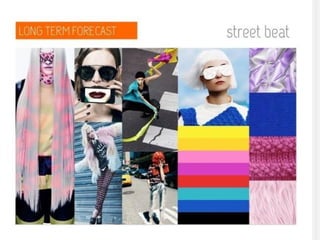
Long term forecasting
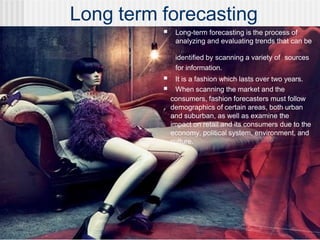
■ Long-term forecasting is the process of
analyzing and evaluating trends that can be
identified by scanning a variety of sources
for information.
It is a fashion which lasts over two years.
■
■ When scanning the market and the
consumers, fashion forecasters must follow
demographics of certain areas, both urban
and suburban, as well as examine the
impact on retail and its consumers due to the
economy, political system, environment, and
culture.
Long-term forecasting seeks to identify:
■
■ major changes in international and
domestic demographics,
■ shifts in the fashion industry along with
market structures, consumer expectations,
values, and impulsion to buy,
■
■ new developments in technology and
science, and
■ shifts in the economic, political, and
cultural alliances between certain
countries.
■ There are many specialized marketing
consultants that focus on long-term
forecasting and attend trade shows and
other events that notify the industry on
what is to come.
Long term forecasting
Short term forecasting
■ Short-term forecasting focuses on current
events both domestically and internationally as
well as pop culture in order to identify possible
trends that can be communicated to the
customer through the seasonal color palette,
fabric, and silhouette stories.
■ It gives fashion a modern twist to a classic look
that intrigues our eyes.
■ Some important areas to follow when scanning
the environment are: current events, art, sports,
science and technology.
■ Short-term forecasting can also be considered
fad forecasting.
* Standard Color of Textile Dictionnaire
* Pantone, Inc.
* International Color Authority
* The Color Box
* The Color Marketing Group
* Concepts in Color
* Huepoint
•Color Portfolio, Inc.
Color services: Fashion and textile
industry professionals who meet twice a
year to pool their knowledge of color
cycles and preferences and to project
color trends for the future.
Examples of color services
■ Each retailer's trend forecasting varies and is
mainly dependent upon whether the
company is a wholesale brand or private
label developer. "Every season, there are
hundreds of designers showing breathtaking
collections that the average consumer will
never see.
■ What does matter is who sees them—the in-
house designers and buyers at fast fashion
retailers, people who are paying close
attention, identifying and predicting which
styles, patterns and cuts will appeal to the
average woman.
Responsibility for trend
forecasting
■ Larger companies such as Forever 21
have their own trend departments where
they follow the styles, fabrics, and colors
for the upcoming seasons.
■ This can also be referred to as vertical
integration.
■ A company with its own trend department
has a better advantage than those who do
not because its developers are able to
work together to create a unified look for
their sales floor.
■ Each seasonal collection offered by a
product developer is the result of trend
research focused on the target market it
has defined for itself.
Responsibility for trend
forecasting
Responsibility for
trend forecasting
■ A merchandiser also plays a key role
in the direction of upcoming trends.
■ Different from developers,
merchandisers have much more
experience in buying and are
knowledgeable in what consumers
will be looking for.
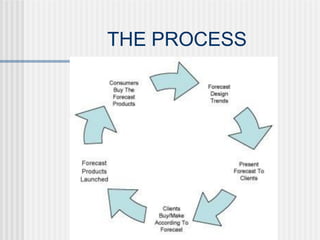
THE PROCESS
ACTIVITIES IN FASHION
FORECASTING
■ Making and reporting
predictions
■ Coordinating information
from fiber, yarn, and
apparel companies, and
textile shows worldwide
■ Analyzing the fashion
press, visiting the world’s
fashion centers, and
observing fashion leaders
■ Conducting marketing
research
■ Consumer research
• Surveys by telephone or mail to
determine income levels,
lifestyles, fashion preferences,
and shopping habits
• Consumer focus groups to
discuss the pros and cons of
currently offered merchandise
• In-store informal interviewing to
assess what customers like and
dislike
ACTIVITIES IN FASHION
FORECASTING
■ Conducting marketing
research (cont.)
■ Market research
• Study of market
conditions
• Study consumer
lifestyles
• Study of current
events, the arts,
and the mood of
the public
ACTIVITIES IN FASHION
FORECASTING
■ Conducting marketing
research (cont.)
■ Sales research
• Evaluation of
previous sales trend
• Rising sales
• Declining sales
• Weak sales
ACTIVITIES IN FASHION
FORECASTING
■ Conducting marketing
research (cont.)
■ Comparison shopping
• Current popular designer
collections
• Review of fashion
publications, catalogs,
websites
• Observation of “street”
fashions and celebrity
wardrobes
ACTIVITIES IN FASHION
FORECASTING
SOURCES OF INFORMATION
■ Trade publications
■ Magazines,
newspapers, and books
about and for a specific
industry
■ Examples: WWD and
DNR
■ Consumer publications
• Magazines that
provide fashion news
for the consumer
• Examples: Teen,
Vogue, Glamour, G
WHAT INFLUENCES THE
TREND FORECASTERS?
■ Ethnographic research
■ Market research
■ Art & culture
■ Economic
■ Societal
■ Environmental
■ Technological
■ Globalization
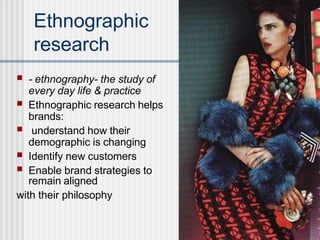
Ethnographic
research
■ - ethnography- the study of
every day life & practice
■ Ethnographic research helps
brands:
■ understand how their
demographic is changing
Identify new customers
■
■ Enable brand strategies to
remain aligned
with their philosophy
THANK
YOU

fashion forecasting for levele 3.pdf

  • 1.
    Fashion Forecasting ‘The futureis here, its just not very well distributed.’ William Gibson, science fiction writer FASHION FORECASTING Target: For-Level-III BY; Mezgebu Tesfaye Course name; Develop Design concept
  • 2.
    FASHION FORECASTING Forecasting ■ Processof making predictions of the future based on past and present data and analysis of trends. Fashion Forecasting ■ foreseeing fashion trends and predicting those trends early enough to allow time for production to meet the consumer demand. focuses on upcoming trends ■ ■ The textile segment leads in recognizing fashion directions because of the time required for textile design and development. ■ Textile designers work at least 18 months ahead of the schedule for products to hit the market.
  • 3.
    ■ The fashionforecasting process includes the basic steps of : ■ understanding the vision of the business and profile of target customers, ■ collecting information about available merchandise, preparing information, ■ ■ ■ determining trends, and choosing merchandise appropriate for the company and target customer. FASHION FORECASTING
  • 5.
    Aims: ■ To provideyou with an understanding of what trend forecasting is and how organizations use this information ■ To examine how trends evolve and how they are tracked.
  • 6.
    Objectives To enable youto: ■ Undertake research & analysis by identifying and tracking fashion trends ■ Apply knowledge of fashion forecasting to understand how trends evolve and are interpreted by industry
  • 7.
    Fashion Forecasting ■ “Trendsare profits waiting to happen” Martin Raymond 2009 Versace scarf prints for AW12 Nelly Rodi ■ For mainstream brands, timing is essential ■ Right product, Right place, Right time
  • 8.
    FASHION TRENDS Trend ■ Thebehavior of large group of people, that is accepted and followed extensively for a period of time. Fashion Trends ■ The direction of movement of public acceptance of color, texture, and silhouette in fashion. ■ Newest styles and silhouettes ■ Important colors for upcoming seasons ■ Newest developments in the fiber and fabric markets
  • 9.
    Trend forecasters= lifestyledetectives Constant vigilance ■ ■ Monitoring current trends & projecting forward. ■ Observing evolution of trends. ■ Detecting shifts in attitudes & mindsets. ■ Spotting looks or lifestyles than run against the norm.
  • 10.
    Fashion Forecasting Stylesight Nelly Rodi WGSN Peclers Carlin Promostyl TrendUnion Textiles View Stylus Mudpie LSN Future Laboratory ■ ■ ■ ■ ■ ■ ■ ■ ■ ■ ■ ■ ■
  • 11.
  • 12.
  • 13.
  • 14.
    * Accurate forecastingmakes it possible for the fashion industry segments to prepare for and meet consumer demand with products that will be accepted and purchased. * Keen worldwide competition increases the importance of accurate trend identification. THE IMPORTANCE OF FORECASTING
  • 15.
    Fashion designers • • Fashionmerchandisers • Yarn colors or swatches are sent to designers and merchandisers to plan their color stories and purchase fabrics. WHO IS INVOLVED IN FORECASTING?
  • 16.
    Long term forecasting ■Long-term forecasting is the process of analyzing and evaluating trends that can be identified by scanning a variety of sources for information. It is a fashion which lasts over two years. ■ ■ When scanning the market and the consumers, fashion forecasters must follow demographics of certain areas, both urban and suburban, as well as examine the impact on retail and its consumers due to the economy, political system, environment, and culture.
  • 17.
    Long-term forecasting seeksto identify: ■ ■ major changes in international and domestic demographics, ■ shifts in the fashion industry along with market structures, consumer expectations, values, and impulsion to buy, ■ ■ new developments in technology and science, and ■ shifts in the economic, political, and cultural alliances between certain countries. ■ There are many specialized marketing consultants that focus on long-term forecasting and attend trade shows and other events that notify the industry on what is to come. Long term forecasting
  • 18.
    Short term forecasting ■Short-term forecasting focuses on current events both domestically and internationally as well as pop culture in order to identify possible trends that can be communicated to the customer through the seasonal color palette, fabric, and silhouette stories. ■ It gives fashion a modern twist to a classic look that intrigues our eyes. ■ Some important areas to follow when scanning the environment are: current events, art, sports, science and technology. ■ Short-term forecasting can also be considered fad forecasting.
  • 19.
    * Standard Colorof Textile Dictionnaire * Pantone, Inc. * International Color Authority * The Color Box * The Color Marketing Group * Concepts in Color * Huepoint •Color Portfolio, Inc. Color services: Fashion and textile industry professionals who meet twice a year to pool their knowledge of color cycles and preferences and to project color trends for the future. Examples of color services
  • 22.
    ■ Each retailer'strend forecasting varies and is mainly dependent upon whether the company is a wholesale brand or private label developer. "Every season, there are hundreds of designers showing breathtaking collections that the average consumer will never see. ■ What does matter is who sees them—the in- house designers and buyers at fast fashion retailers, people who are paying close attention, identifying and predicting which styles, patterns and cuts will appeal to the average woman. Responsibility for trend forecasting
  • 23.
    ■ Larger companiessuch as Forever 21 have their own trend departments where they follow the styles, fabrics, and colors for the upcoming seasons. ■ This can also be referred to as vertical integration. ■ A company with its own trend department has a better advantage than those who do not because its developers are able to work together to create a unified look for their sales floor. ■ Each seasonal collection offered by a product developer is the result of trend research focused on the target market it has defined for itself. Responsibility for trend forecasting
  • 24.
    Responsibility for trend forecasting ■A merchandiser also plays a key role in the direction of upcoming trends. ■ Different from developers, merchandisers have much more experience in buying and are knowledgeable in what consumers will be looking for.
  • 25.
  • 26.
    ACTIVITIES IN FASHION FORECASTING ■Making and reporting predictions ■ Coordinating information from fiber, yarn, and apparel companies, and textile shows worldwide ■ Analyzing the fashion press, visiting the world’s fashion centers, and observing fashion leaders
  • 27.
    ■ Conducting marketing research ■Consumer research • Surveys by telephone or mail to determine income levels, lifestyles, fashion preferences, and shopping habits • Consumer focus groups to discuss the pros and cons of currently offered merchandise • In-store informal interviewing to assess what customers like and dislike ACTIVITIES IN FASHION FORECASTING
  • 28.
    ■ Conducting marketing research(cont.) ■ Market research • Study of market conditions • Study consumer lifestyles • Study of current events, the arts, and the mood of the public ACTIVITIES IN FASHION FORECASTING
  • 29.
    ■ Conducting marketing research(cont.) ■ Sales research • Evaluation of previous sales trend • Rising sales • Declining sales • Weak sales ACTIVITIES IN FASHION FORECASTING
  • 30.
    ■ Conducting marketing research(cont.) ■ Comparison shopping • Current popular designer collections • Review of fashion publications, catalogs, websites • Observation of “street” fashions and celebrity wardrobes ACTIVITIES IN FASHION FORECASTING
  • 31.
    SOURCES OF INFORMATION ■Trade publications ■ Magazines, newspapers, and books about and for a specific industry ■ Examples: WWD and DNR ■ Consumer publications • Magazines that provide fashion news for the consumer • Examples: Teen, Vogue, Glamour, G
  • 32.
    WHAT INFLUENCES THE TRENDFORECASTERS? ■ Ethnographic research ■ Market research ■ Art & culture ■ Economic ■ Societal ■ Environmental ■ Technological ■ Globalization
  • 33.
    Ethnographic research ■ - ethnography-the study of every day life & practice ■ Ethnographic research helps brands: ■ understand how their demographic is changing Identify new customers ■ ■ Enable brand strategies to remain aligned with their philosophy
  • 34.