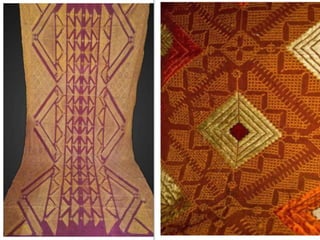
PHULKARI COULD BE CHARACTERIZED ON
THE BASIS OF FOLLOWING FACTORS:-
• On the basis of type of designed area-
I. Types of phulkari i.e. with scattered
motifs
II. Types of Baghs with fully covered
designs.
• On the basis of motifs.
TYPES OF PHULKARI
• CHOPE- Done on the borders. Same design on
both sides. It is gifted to the bride by her
grandmother during some ceremony before
wedding. It is usually done with one color( golden
or yellowish golden). It is done on coarse
khaddar. Done mainly in eastern parts of Punjab.
• SUBER-Red colored phulkari worn by bride at the
time of Pheras during wedding. Its color is similar
to chope but has central five group motif and
similar motif on four corners. These are also
presented by the maternal uncle. Done in eastern
parts.
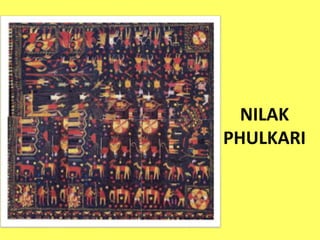
• Nilak- As the name suggests it has phulkari of
blue color .Worn by farm women with
embroidery done in yellow n crimson pat.
Sometimes also done on black.Motifs include
articles like comb, fan, umbrella, rumal and
flowers.
• Til patra- Design resembles sprinkled sesame
seeds, scarcely embroidered. Inferior,
inexpensive khaddar used with small tiny dots
and worn by maids during wedding and such
auspicious rituals.
NILAK
PHULKARI
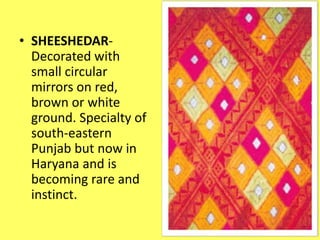
• SHEESHEDAR-
Decorated with
small circular
mirrors on red,
brown or white
ground. Specialty of
south-eastern
Punjab but now in
Haryana and is
becoming rare and
instinct.
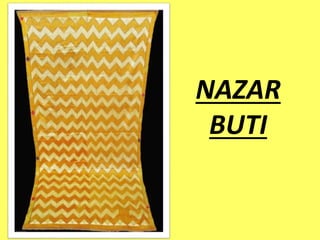
NAZAR
BUTI
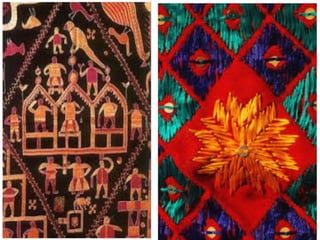
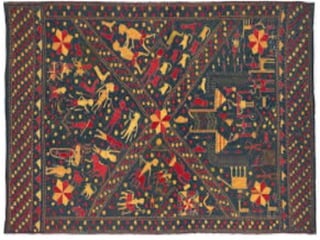
• SAINCHI-The motifs depicts the rural life and includes
ploughing, harvesting, a water carrier, a smoking
hukkah, drinking, hawkers, and also domestic work like
churning, spinning, weaving, etc. . In other words
whole life of villagers is depicted. The plain red n black
khaddar veil is used as daily wear and also known as
salu (saloo). Mainly done in Malwa region.
• KAETA- Thick embroidery is done that both ends look
similar. This type of phulkari has same design on both
sides and is done with utmost care.
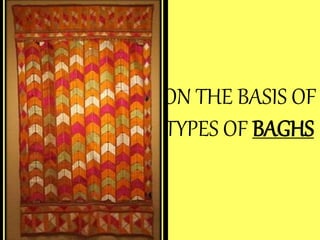
ON THE BASIS OF
TYPES OF BAGHS
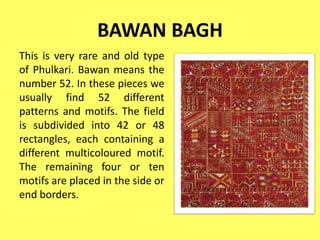
BAWAN BAGH
This is very rare and old type
of Phulkari. Bawan means the
number 52. In these pieces we
usually find 52 different
patterns and motifs. The field
is subdivided into 42 or 48
rectangles, each containing a
different multicoloured motif.
The remaining four or ten
motifs are placed in the side or
end borders.
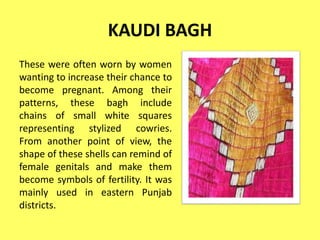
KAUDI BAGH
These were often worn by women
wanting to increase their chance to
become pregnant. Among their
patterns, these bagh include
chains of small white squares
representing stylized cowries.
From another point of view, the
shape of these shells can remind of
female genitals and make them
become symbols of fertility. It was
mainly used in eastern Punjab
districts.
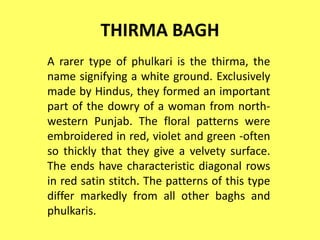
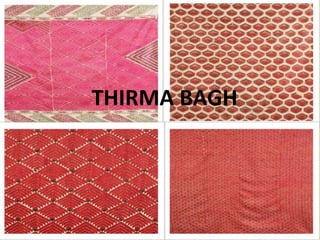
THIRMA BAGH
A rarer type of phulkari is the thirma, the
name signifying a white ground. Exclusively
made by Hindus, they formed an important
part of the dowry of a woman from north-
western Punjab. The floral patterns were
embroidered in red, violet and green -often
so thickly that they give a velvety surface.
The ends have characteristic diagonal rows
in red satin stitch. The patterns of this type
differ markedly from all other baghs and
phulkaris.
THIRMA BAGH
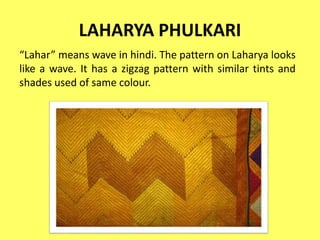
LAHARYA PHULKARI
“Lahar” means wave in hindi. The pattern on Laharya looks
like a wave. It has a zigzag pattern with similar tints and
shades used of same colour.
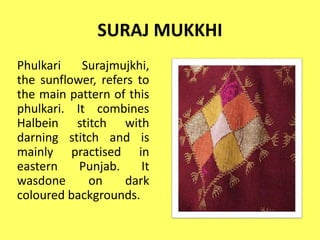
SURAJ MUKKHI
Phulkari Surajmujkhi,
the sunflower, refers to
the main pattern of this
phulkari. It combines
Halbein stitch with
darning stitch and is
mainly practised in
eastern Punjab. It
wasdone on dark
coloured backgrounds.
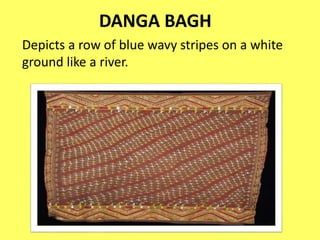
DANGA BAGH
Depicts a row of blue wavy stripes on a white
ground like a river.
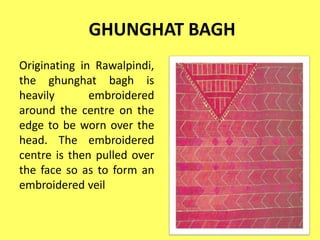
GHUNGHAT BAGH
Originating in Rawalpindi,
the ghunghat bagh is
heavily embroidered
around the centre on the
edge to be worn over the
head. The embroidered
centre is then pulled over
the face so as to form an
embroidered veil
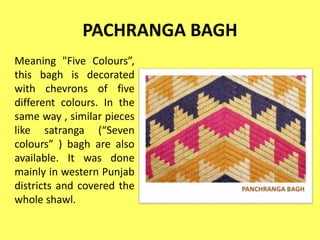
PACHRANGA BAGH
Meaning "Five Colours”,
this bagh is decorated
with chevrons of five
different colours. In the
same way , similar pieces
like satranga (“Seven
colours” ) bagh are also
available. It was done
mainly in western Punjab
districts and covered the
whole shawl.
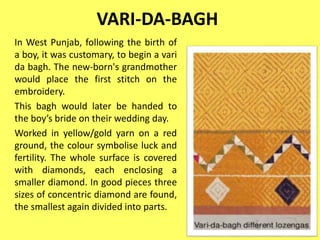
VARI-DA-BAGH
In West Punjab, following the birth of
a boy, it was customary, to begin a vari
da bagh. The new-born's grandmother
would place the first stitch on the
embroidery.
This bagh would later be handed to
the boy’s bride on their wedding day.
Worked in yellow/gold yarn on a red
ground, the colour symbolise luck and
fertility. The whole surface is covered
with diamonds, each enclosing a
smaller diamond. In good pieces three
sizes of concentric diamond are found,
the smallest again divided into parts.
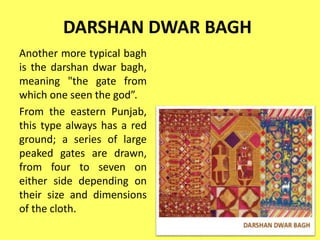
DARSHAN DWAR BAGH
Another more typical bagh
is the darshan dwar bagh,
meaning "the gate from
which one seen the god”.
From the eastern Punjab,
this type always has a red
ground; a series of large
peaked gates are drawn,
from four to seven on
either side depending on
their size and dimensions
of the cloth.
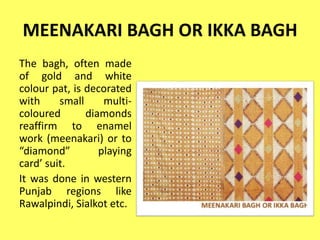
MEENAKARI BAGH OR IKKA BAGH
The bagh, often made
of gold and white
colour pat, is decorated
with small multi-
coloured diamonds
reaffirm to enamel
work (meenakari) or to
“diamond” playing
card’ suit.
It was done in western
Punjab regions like
Rawalpindi, Sialkot etc.
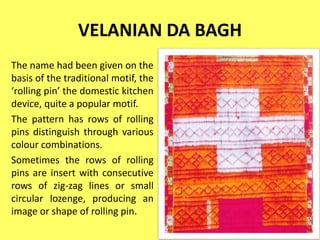
VELANIAN DA BAGH
The name had been given on the
basis of the traditional motif, the
‘rolling pin’ the domestic kitchen
device, quite a popular motif.
The pattern has rows of rolling
pins distinguish through various
colour combinations.
Sometimes the rows of rolling
pins are insert with consecutive
rows of zig-zag lines or small
circular lozenge, producing an
image or shape of rolling pin.
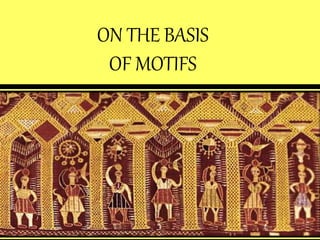
ON THE BASIS
OF MOTIFS
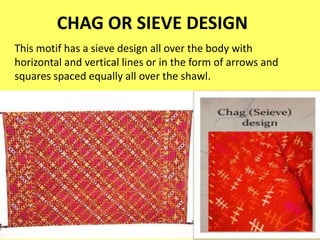
CHAG OR SIEVE DESIGN
This motif has a sieve design all over the body with
horizontal and vertical lines or in the form of arrows and
squares spaced equally all over the shawl.
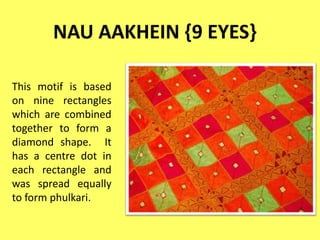
NAU AAKHEIN {9 EYES}
This motif is based
on nine rectangles
which are combined
together to form a
diamond shape. It
has a centre dot in
each rectangle and
was spread equally
to form phulkari.
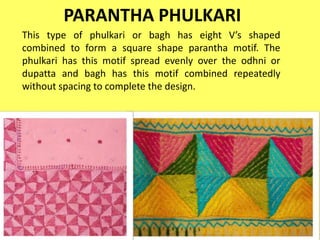
PARANTHA PHULKARI
This type of phulkari or bagh has eight V’s shaped
combined to form a square shape parantha motif. The
phulkari has this motif spread evenly over the odhni or
dupatta and bagh has this motif combined repeatedly
without spacing to complete the design.
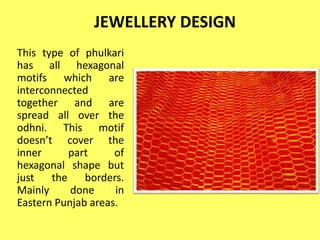
JEWELLERY DESIGN
This type of phulkari
has all hexagonal
motifs which are
interconnected
together and are
spread all over the
odhni. This motif
doesn’t cover the
inner part of
hexagonal shape but
just the borders.
Mainly done in
Eastern Punjab areas.
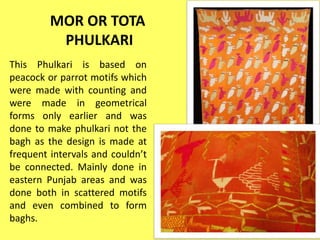
MOR OR TOTA
PHULKARI
This Phulkari is based on
peacock or parrot motifs which
were made with counting and
were made in geometrical
forms only earlier and was
done to make phulkari not the
bagh as the design is made at
frequent intervals and couldn’t
be connected. Mainly done in
eastern Punjab areas and was
done both in scattered motifs
and even combined to form
baghs.
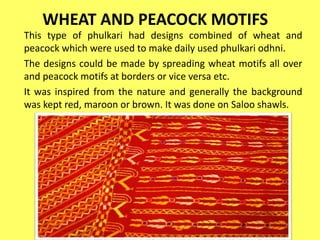
WHEAT AND PEACOCK MOTIFS
This type of phulkari had designs combined of wheat and
peacock which were used to make daily used phulkari odhni.
The designs could be made by spreading wheat motifs all over
and peacock motifs at borders or vice versa etc.
It was inspired from the nature and generally the background
was kept red, maroon or brown. It was done on Saloo shawls.
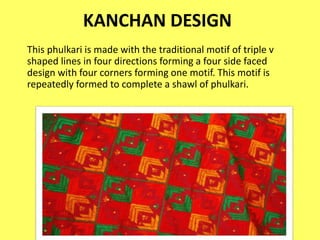
KANCHAN DESIGN
This phulkari is made with the traditional motif of triple v
shaped lines in four directions forming a four side faced
design with four corners forming one motif. This motif is
repeatedly formed to complete a shawl of phulkari.
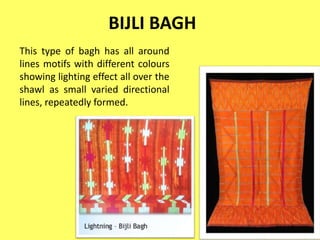
BIJLI BAGH
This type of bagh has all around
lines motifs with different colours
showing lighting effect all over the
shawl as small varied directional
lines, repeatedly formed.
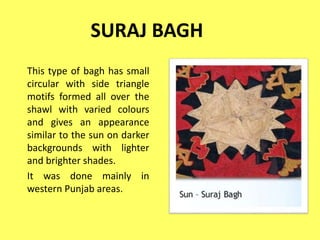
SURAJ BAGH
This type of bagh has small
circular with side triangle
motifs formed all over the
shawl with varied colours
and gives an appearance
similar to the sun on darker
backgrounds with lighter
and brighter shades.
It was done mainly in
western Punjab areas.
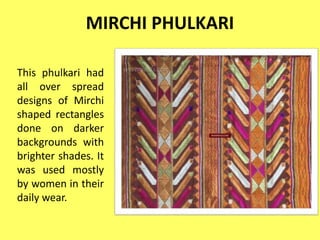
MIRCHI PHULKARI
This phulkari had
all over spread
designs of Mirchi
shaped rectangles
done on darker
backgrounds with
brighter shades. It
was used mostly
by women in their
daily wear.
CONCLUSION
Phulkari was and will remain the
traditional art of Punjab and it is
characterized both on the basis of region
as well as on the basis of design and
motifs.
In eastern Punjab more commonly Baghs
i.e. Fully embroidered shawls were used
i.e. In districts of Peshawar, Sialkot,
Rawalpindi, Lahore and used colours as
orange, brown, red mainly. They mainly
repeatedly used motifs to form Baghs.
Whereas in west Punjab more scattered
motifs phulkaris were used and these
were even combined with mirror work
and used bright colours as navy blue,
browns, red and yellow shades.
BIBLIOGRAPHY
• https://en.wikipedia.org/wiki/Phulkari
• https://phulkariembroidery.wordpress.com/20
17/02/24/types-of-bagh-phulkaris/
• http://www.dsource.in/resource/phulkari/typ
es-phulkari-0
• Traditional Embroideries of India
By – Dr. Shailaja D. Naik
• Indian embroideries
By – John Irwin and Margaret Hall
THANKS
SUBMITTED TO:-
Dr. SURABHI MAHAJAN
Dr. SUMEET GREWAL
SUBMITTED BY:-
MANKRITI KAUR
LOVELEEN JINDAL
MANBIR KAUR
KULDEEP KAUR

Types phulkari

  • 2.
    PHULKARI COULD BECHARACTERIZED ON THE BASIS OF FOLLOWING FACTORS:- • On the basis of type of designed area- I. Types of phulkari i.e. with scattered motifs II. Types of Baghs with fully covered designs. • On the basis of motifs.
  • 3.
    TYPES OF PHULKARI •CHOPE- Done on the borders. Same design on both sides. It is gifted to the bride by her grandmother during some ceremony before wedding. It is usually done with one color( golden or yellowish golden). It is done on coarse khaddar. Done mainly in eastern parts of Punjab. • SUBER-Red colored phulkari worn by bride at the time of Pheras during wedding. Its color is similar to chope but has central five group motif and similar motif on four corners. These are also presented by the maternal uncle. Done in eastern parts.
  • 5.
    • Nilak- Asthe name suggests it has phulkari of blue color .Worn by farm women with embroidery done in yellow n crimson pat. Sometimes also done on black.Motifs include articles like comb, fan, umbrella, rumal and flowers. • Til patra- Design resembles sprinkled sesame seeds, scarcely embroidered. Inferior, inexpensive khaddar used with small tiny dots and worn by maids during wedding and such auspicious rituals.
  • 6.
  • 7.
    • SHEESHEDAR- Decorated with smallcircular mirrors on red, brown or white ground. Specialty of south-eastern Punjab but now in Haryana and is becoming rare and instinct.
  • 8.
  • 9.
    • SAINCHI-The motifsdepicts the rural life and includes ploughing, harvesting, a water carrier, a smoking hukkah, drinking, hawkers, and also domestic work like churning, spinning, weaving, etc. . In other words whole life of villagers is depicted. The plain red n black khaddar veil is used as daily wear and also known as salu (saloo). Mainly done in Malwa region. • KAETA- Thick embroidery is done that both ends look similar. This type of phulkari has same design on both sides and is done with utmost care.
  • 12.
    ON THE BASISOF TYPES OF BAGHS
  • 13.
    BAWAN BAGH This isvery rare and old type of Phulkari. Bawan means the number 52. In these pieces we usually find 52 different patterns and motifs. The field is subdivided into 42 or 48 rectangles, each containing a different multicoloured motif. The remaining four or ten motifs are placed in the side or end borders.
  • 14.
    KAUDI BAGH These wereoften worn by women wanting to increase their chance to become pregnant. Among their patterns, these bagh include chains of small white squares representing stylized cowries. From another point of view, the shape of these shells can remind of female genitals and make them become symbols of fertility. It was mainly used in eastern Punjab districts.
  • 15.
    THIRMA BAGH A rarertype of phulkari is the thirma, the name signifying a white ground. Exclusively made by Hindus, they formed an important part of the dowry of a woman from north- western Punjab. The floral patterns were embroidered in red, violet and green -often so thickly that they give a velvety surface. The ends have characteristic diagonal rows in red satin stitch. The patterns of this type differ markedly from all other baghs and phulkaris.
  • 16.
  • 17.
    LAHARYA PHULKARI “Lahar” meanswave in hindi. The pattern on Laharya looks like a wave. It has a zigzag pattern with similar tints and shades used of same colour.
  • 18.
    SURAJ MUKKHI Phulkari Surajmujkhi, thesunflower, refers to the main pattern of this phulkari. It combines Halbein stitch with darning stitch and is mainly practised in eastern Punjab. It wasdone on dark coloured backgrounds.
  • 19.
    DANGA BAGH Depicts arow of blue wavy stripes on a white ground like a river.
  • 20.
    GHUNGHAT BAGH Originating inRawalpindi, the ghunghat bagh is heavily embroidered around the centre on the edge to be worn over the head. The embroidered centre is then pulled over the face so as to form an embroidered veil
  • 21.
    PACHRANGA BAGH Meaning "FiveColours”, this bagh is decorated with chevrons of five different colours. In the same way , similar pieces like satranga (“Seven colours” ) bagh are also available. It was done mainly in western Punjab districts and covered the whole shawl.
  • 22.
    VARI-DA-BAGH In West Punjab,following the birth of a boy, it was customary, to begin a vari da bagh. The new-born's grandmother would place the first stitch on the embroidery. This bagh would later be handed to the boy’s bride on their wedding day. Worked in yellow/gold yarn on a red ground, the colour symbolise luck and fertility. The whole surface is covered with diamonds, each enclosing a smaller diamond. In good pieces three sizes of concentric diamond are found, the smallest again divided into parts.
  • 23.
    DARSHAN DWAR BAGH Anothermore typical bagh is the darshan dwar bagh, meaning "the gate from which one seen the god”. From the eastern Punjab, this type always has a red ground; a series of large peaked gates are drawn, from four to seven on either side depending on their size and dimensions of the cloth.
  • 24.
    MEENAKARI BAGH ORIKKA BAGH The bagh, often made of gold and white colour pat, is decorated with small multi- coloured diamonds reaffirm to enamel work (meenakari) or to “diamond” playing card’ suit. It was done in western Punjab regions like Rawalpindi, Sialkot etc.
  • 25.
    VELANIAN DA BAGH Thename had been given on the basis of the traditional motif, the ‘rolling pin’ the domestic kitchen device, quite a popular motif. The pattern has rows of rolling pins distinguish through various colour combinations. Sometimes the rows of rolling pins are insert with consecutive rows of zig-zag lines or small circular lozenge, producing an image or shape of rolling pin.
  • 26.
  • 27.
    CHAG OR SIEVEDESIGN This motif has a sieve design all over the body with horizontal and vertical lines or in the form of arrows and squares spaced equally all over the shawl.
  • 28.
    NAU AAKHEIN {9EYES} This motif is based on nine rectangles which are combined together to form a diamond shape. It has a centre dot in each rectangle and was spread equally to form phulkari.
  • 29.
    PARANTHA PHULKARI This typeof phulkari or bagh has eight V’s shaped combined to form a square shape parantha motif. The phulkari has this motif spread evenly over the odhni or dupatta and bagh has this motif combined repeatedly without spacing to complete the design.
  • 30.
    JEWELLERY DESIGN This typeof phulkari has all hexagonal motifs which are interconnected together and are spread all over the odhni. This motif doesn’t cover the inner part of hexagonal shape but just the borders. Mainly done in Eastern Punjab areas.
  • 31.
    MOR OR TOTA PHULKARI ThisPhulkari is based on peacock or parrot motifs which were made with counting and were made in geometrical forms only earlier and was done to make phulkari not the bagh as the design is made at frequent intervals and couldn’t be connected. Mainly done in eastern Punjab areas and was done both in scattered motifs and even combined to form baghs.
  • 32.
    WHEAT AND PEACOCKMOTIFS This type of phulkari had designs combined of wheat and peacock which were used to make daily used phulkari odhni. The designs could be made by spreading wheat motifs all over and peacock motifs at borders or vice versa etc. It was inspired from the nature and generally the background was kept red, maroon or brown. It was done on Saloo shawls.
  • 33.
    KANCHAN DESIGN This phulkariis made with the traditional motif of triple v shaped lines in four directions forming a four side faced design with four corners forming one motif. This motif is repeatedly formed to complete a shawl of phulkari.
  • 34.
    BIJLI BAGH This typeof bagh has all around lines motifs with different colours showing lighting effect all over the shawl as small varied directional lines, repeatedly formed.
  • 35.
    SURAJ BAGH This typeof bagh has small circular with side triangle motifs formed all over the shawl with varied colours and gives an appearance similar to the sun on darker backgrounds with lighter and brighter shades. It was done mainly in western Punjab areas.
  • 36.
    MIRCHI PHULKARI This phulkarihad all over spread designs of Mirchi shaped rectangles done on darker backgrounds with brighter shades. It was used mostly by women in their daily wear.
  • 37.
    CONCLUSION Phulkari was andwill remain the traditional art of Punjab and it is characterized both on the basis of region as well as on the basis of design and motifs. In eastern Punjab more commonly Baghs i.e. Fully embroidered shawls were used i.e. In districts of Peshawar, Sialkot, Rawalpindi, Lahore and used colours as orange, brown, red mainly. They mainly repeatedly used motifs to form Baghs. Whereas in west Punjab more scattered motifs phulkaris were used and these were even combined with mirror work and used bright colours as navy blue, browns, red and yellow shades.
  • 38.
    BIBLIOGRAPHY • https://en.wikipedia.org/wiki/Phulkari • https://phulkariembroidery.wordpress.com/20 17/02/24/types-of-bagh-phulkaris/ •http://www.dsource.in/resource/phulkari/typ es-phulkari-0 • Traditional Embroideries of India By – Dr. Shailaja D. Naik • Indian embroideries By – John Irwin and Margaret Hall
  • 39.
    THANKS SUBMITTED TO:- Dr. SURABHIMAHAJAN Dr. SUMEET GREWAL SUBMITTED BY:- MANKRITI KAUR LOVELEEN JINDAL MANBIR KAUR KULDEEP KAUR