EXAMINATION OF THE HAND
Dr B Socutshana
SMU Orthopaedic Department
Introduction
• Introduce yourself to the patient
• Wash your hands
• Briefly explain to the patient what
the examination involves
• Ask the patients for consent
INSPECTION
SKIN
• discoloration
• erythema (cellulitis)
• white (arterial insufficiency)
• blue/purple (venous congestion)
• black spots (melanoma)
• trophic changes (i.e. increased hair growth or altered
sweat production)
• can represent derangement of sympathetic nervous
system
• scars/wounds
INSPECTION
SWELLINGS
• Oedema
• Rheumatoid nodules
• Heberden’s and Brouchard’s nodes in
osteoarthritis
• Ganglions
• Enchondroma
• Tophi
INSPECTION
• NAIL SIGNS
• e.g. the pitting of psoriasis
INSPECTION
MUSCLE ATROPHY
• Thenar atrophy - median nerve
involvement - caused by carpal
tunnel syndrome
Interossei atrophy
• Ulnar nerve involvement
• caused by cubital tunnel or
cervical radiculopathy.
INSPECTION
DERFOMITY
• asymmetry
• angulation
• rotation
• absence of normal anatomy (previous
amputation)
• Cascade sign: fingers converge toward the
scaphoid tubercle when flexed at the MCPJ
and PIPJ
• if one or more fingers do not converge, then
trauma to the digits has likely altered normal
alignment
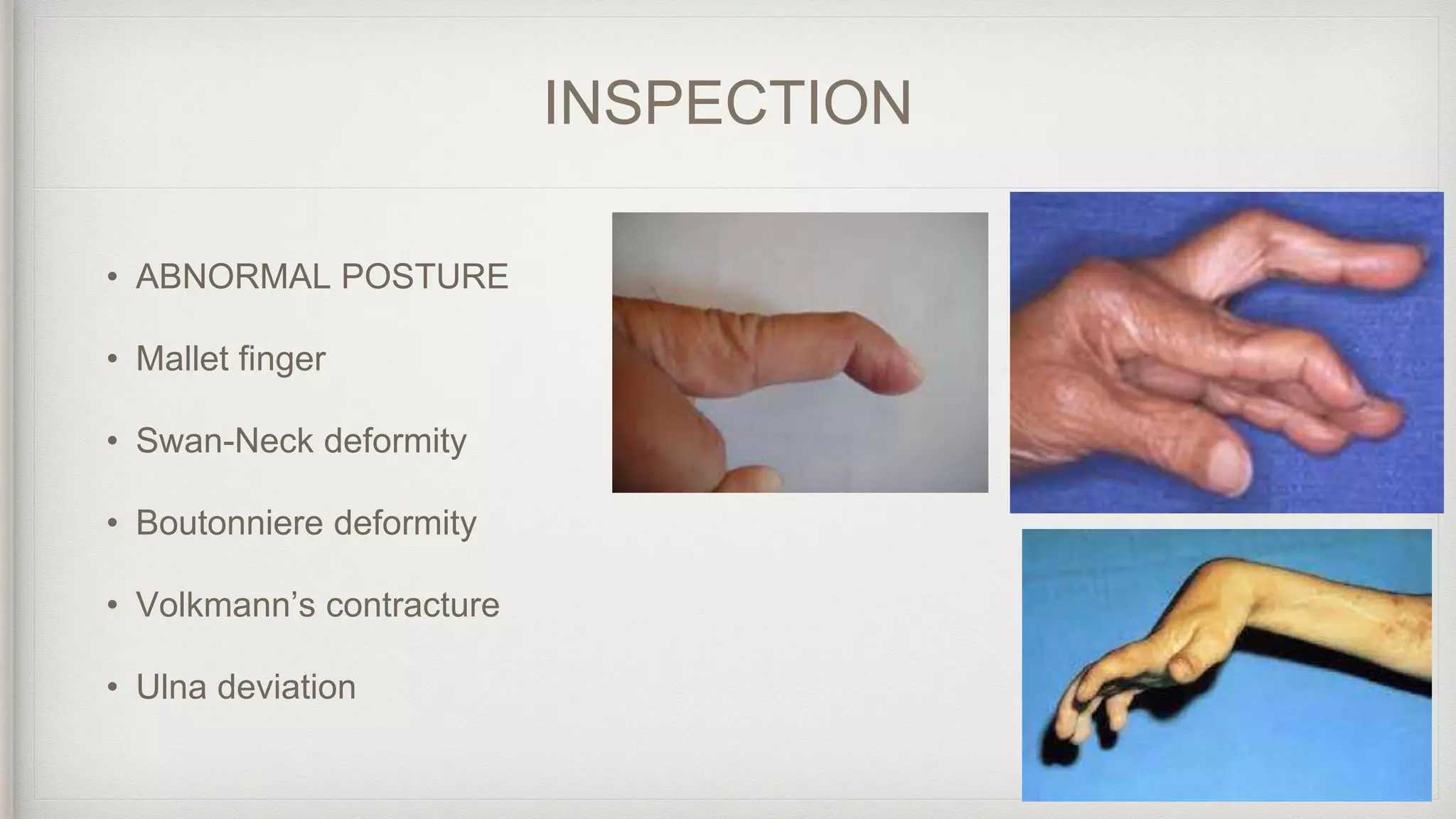
INSPECTION
• ABNORMAL POSTURE
• Mallet finger
• Swan-Neck deformity
• Boutonniere deformity
• Volkmann’s contracture
• Ulna deviation
PALPATION
• Masses (ganglions, nodules)
Temperature
• warm: infection, inflammation
• cool: vascular pathology
• Tenderness
• Texture: dryness, sweaty
• Muscle bulk e.g. thenar atrophy
• Crepitus (fracture)
• Clicking or snapping (tendonitis)
• Joint effusion (infection, inflammation, trauma)
Range of Motion
Active and passive
• MCP: 0° extension to 85° of flexion
• PIP: 0° extension to 110° of flexion
• DIP: 0° extension to 65° of flexion
Wrist
• 60° flexion
• 60° extension
• 50° radioulnar deviation arc
NEUROVASCULAR EXAM
Sensation
• two-point discrimination
NEUROVASCULAR EXAM
MOTOR
• radial nerve: test thumb IP joint
extension against resistance
• median nerve
• recurrent motor branch: palmar abduction
of thumb
• anterior interosseous branch: flexion of
thumb IP and index DIP ("A-OK sign”)
• ulnar nerve: cross-fingers or abduct
fingers against resistance
NEUROVASCULAR EXAM
Vascular
• radial pulse
• ulnar pulse
• Allen's test
• capillary refill
SPECIAL TESTS
• Grind test
• used to test for pathology at the
thumb carpometacarpal joint
(CMC)
• examiners applies axial load to
first metacarpal and rotates or
"grinds" it
• positive findings: pain, crepitus,
instability
SEPECIAL TESTS
• Finkelstein’s test
• used to test for DeQuervain's
tenosynovitis
• patient makes fist with fingers
overlying thumb
• examiner gently ulnarly deviates the
wrist
• positive findings: pain along the 1st
compartment
Range of motion
• Flexor profundus
• used to test continuity of FDP
tendons
• MCP + PIP joints held in extension
while patient asked to flex FDP,
thereby isolating FDP (from FDS)
as the only tendon capable of
flexing the finger
Special tests
ROM
• Flexor sublimus
• used to test for continuity of FDS
tendon
• MCP, PIP and DIP of all fingers
held in extension with hand flat
and palm up; the finger to be
tested is then allowed to flex at
PIP joint.
Special tests
• Bunnel's test
• examiner passively flexes PIPJ twice
• first with MCP in extension
• next with MCP held in flexion
• intrinsic tightness present if PIP can be
flexed easily when MCP is flexed but NOT
when MCP is extended
• extrinsic tightness present if PIP can be
flexed easily when MCP is extended but
NOT when MCP is flexed
NERVE ASSESSMENT
• Tinel’s test
• tests for carpal tunnel syndrome
• examiner percusses with two
fingers over distal palmar crease
in the midline
• positive if patient reports
paresthesias in median nerve
distribution
NERVE ASSESSMENT
Phanel’s test
• tests for carpal tunnel syndrome
• with the hands pointed up, the
patient's wrist is allowed to flex by
gravity in palmar flexion for 2
minutes maximum
• positive if patient reports
paresthesias in median nerve
distribution
NERVE ASSESSMENT
• Froment's sign
• tests for ulnar nerve motor
weakness
• patient asked to hold a piece of
paper between thumb and radial
side of index
• positive if as the paper is pulled
away by the examiner the patient
flexes the thumb IP joint in an
attempt to hold on to paper
Nerve assessment
• Wartenberg’s sign
• tests ulnar nerve motor weakness
• patient asked to hold fingers fully
adducted with MCP, PIP, and DIP
joints fully extended
• positive if small finger drifts away
from others into abduction
Nerve assessment
• Jeanne’s sign
• tests for ulnar nerve motor
weakness
• ask patient to demosntrate key
pinch
• positive finding if patients first
MCP joint is hyperextended
Stability tests
• Scaphoid shift test (Watson's test)
• Lunotriquetral ballottement
• Midcarpal instability
• Ulnar carpal abutement
• Gamekeeper's

HAND EXAM .pptx

  • 1.
    EXAMINATION OF THEHAND Dr B Socutshana SMU Orthopaedic Department
  • 2.
    Introduction • Introduce yourselfto the patient • Wash your hands • Briefly explain to the patient what the examination involves • Ask the patients for consent
  • 3.
    INSPECTION SKIN • discoloration • erythema(cellulitis) • white (arterial insufficiency) • blue/purple (venous congestion) • black spots (melanoma) • trophic changes (i.e. increased hair growth or altered sweat production) • can represent derangement of sympathetic nervous system • scars/wounds
  • 4.
    INSPECTION SWELLINGS • Oedema • Rheumatoidnodules • Heberden’s and Brouchard’s nodes in osteoarthritis • Ganglions • Enchondroma • Tophi
  • 5.
    INSPECTION • NAIL SIGNS •e.g. the pitting of psoriasis
  • 6.
    INSPECTION MUSCLE ATROPHY • Thenaratrophy - median nerve involvement - caused by carpal tunnel syndrome Interossei atrophy • Ulnar nerve involvement • caused by cubital tunnel or cervical radiculopathy.
  • 7.
    INSPECTION DERFOMITY • asymmetry • angulation •rotation • absence of normal anatomy (previous amputation) • Cascade sign: fingers converge toward the scaphoid tubercle when flexed at the MCPJ and PIPJ • if one or more fingers do not converge, then trauma to the digits has likely altered normal alignment
  • 8.
    INSPECTION • ABNORMAL POSTURE •Mallet finger • Swan-Neck deformity • Boutonniere deformity • Volkmann’s contracture • Ulna deviation
  • 9.
    PALPATION • Masses (ganglions,nodules) Temperature • warm: infection, inflammation • cool: vascular pathology • Tenderness • Texture: dryness, sweaty • Muscle bulk e.g. thenar atrophy • Crepitus (fracture) • Clicking or snapping (tendonitis) • Joint effusion (infection, inflammation, trauma)
  • 10.
    Range of Motion Activeand passive • MCP: 0° extension to 85° of flexion • PIP: 0° extension to 110° of flexion • DIP: 0° extension to 65° of flexion Wrist • 60° flexion • 60° extension • 50° radioulnar deviation arc
  • 11.
  • 12.
    NEUROVASCULAR EXAM MOTOR • radialnerve: test thumb IP joint extension against resistance • median nerve • recurrent motor branch: palmar abduction of thumb • anterior interosseous branch: flexion of thumb IP and index DIP ("A-OK sign”) • ulnar nerve: cross-fingers or abduct fingers against resistance
  • 13.
    NEUROVASCULAR EXAM Vascular • radialpulse • ulnar pulse • Allen's test • capillary refill
  • 14.
    SPECIAL TESTS • Grindtest • used to test for pathology at the thumb carpometacarpal joint (CMC) • examiners applies axial load to first metacarpal and rotates or "grinds" it • positive findings: pain, crepitus, instability
  • 15.
    SEPECIAL TESTS • Finkelstein’stest • used to test for DeQuervain's tenosynovitis • patient makes fist with fingers overlying thumb • examiner gently ulnarly deviates the wrist • positive findings: pain along the 1st compartment
  • 16.
    Range of motion •Flexor profundus • used to test continuity of FDP tendons • MCP + PIP joints held in extension while patient asked to flex FDP, thereby isolating FDP (from FDS) as the only tendon capable of flexing the finger
  • 17.
    Special tests ROM • Flexorsublimus • used to test for continuity of FDS tendon • MCP, PIP and DIP of all fingers held in extension with hand flat and palm up; the finger to be tested is then allowed to flex at PIP joint.
  • 18.
    Special tests • Bunnel'stest • examiner passively flexes PIPJ twice • first with MCP in extension • next with MCP held in flexion • intrinsic tightness present if PIP can be flexed easily when MCP is flexed but NOT when MCP is extended • extrinsic tightness present if PIP can be flexed easily when MCP is extended but NOT when MCP is flexed
  • 19.
    NERVE ASSESSMENT • Tinel’stest • tests for carpal tunnel syndrome • examiner percusses with two fingers over distal palmar crease in the midline • positive if patient reports paresthesias in median nerve distribution
  • 20.
    NERVE ASSESSMENT Phanel’s test •tests for carpal tunnel syndrome • with the hands pointed up, the patient's wrist is allowed to flex by gravity in palmar flexion for 2 minutes maximum • positive if patient reports paresthesias in median nerve distribution
  • 21.
    NERVE ASSESSMENT • Froment'ssign • tests for ulnar nerve motor weakness • patient asked to hold a piece of paper between thumb and radial side of index • positive if as the paper is pulled away by the examiner the patient flexes the thumb IP joint in an attempt to hold on to paper
  • 22.
    Nerve assessment • Wartenberg’ssign • tests ulnar nerve motor weakness • patient asked to hold fingers fully adducted with MCP, PIP, and DIP joints fully extended • positive if small finger drifts away from others into abduction
  • 23.
    Nerve assessment • Jeanne’ssign • tests for ulnar nerve motor weakness • ask patient to demosntrate key pinch • positive finding if patients first MCP joint is hyperextended
  • 24.
    Stability tests • Scaphoidshift test (Watson's test) • Lunotriquetral ballottement • Midcarpal instability • Ulnar carpal abutement • Gamekeeper's