OSHA Office of Training and Education
1
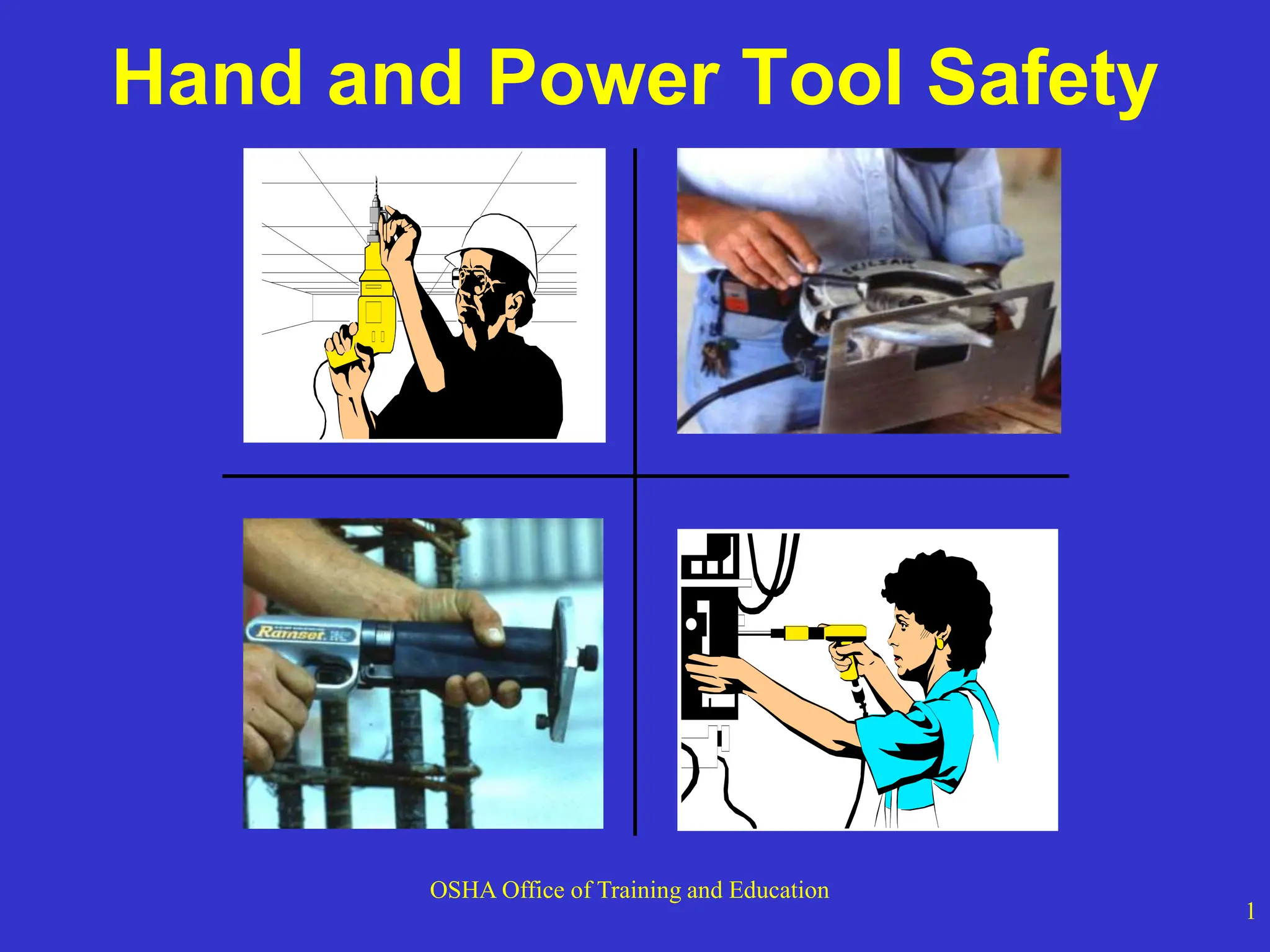
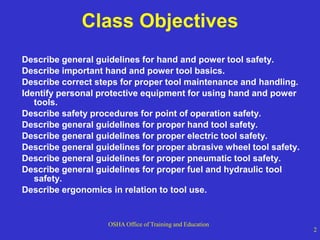
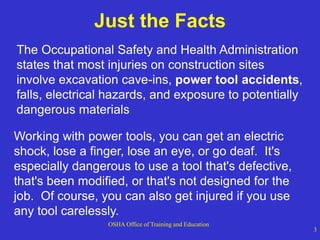
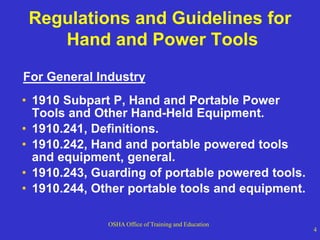
Hand and Power Tool Safety
OSHA Office of Training and Education
2
Class Objectives
Describe general guidelines for hand and power tool safety.
Describe important hand and power tool basics.
Describe correct steps for proper tool maintenance and handling.
Identify personal protective equipment for using hand and power
tools.
Describe safety procedures for point of operation safety.
Describe general guidelines for proper hand tool safety.
Describe general guidelines for proper electric tool safety.
Describe general guidelines for proper abrasive wheel tool safety.
Describe general guidelines for proper pneumatic tool safety.
Describe general guidelines for proper fuel and hydraulic tool
safety.
Describe ergonomics in relation to tool use.
OSHA Office of Training and Education
3
Just the Facts
The Occupational Safety and Health Administration
states that most injuries on construction sites
involve excavation cave-ins, power tool accidents,
falls, electrical hazards, and exposure to potentially
dangerous materials
Working with power tools, you can get an electric
shock, lose a finger, lose an eye, or go deaf. It's
especially dangerous to use a tool that's defective,
that's been modified, or that's not designed for the
job. Of course, you can also get injured if you use
any tool carelessly.
OSHA Office of Training and Education
4
Regulations and Guidelines for
Hand and Power Tools
For General Industry
• 1910 Subpart P, Hand and Portable Power
Tools and Other Hand-Held Equipment.
• 1910.241, Definitions.
• 1910.242, Hand and portable powered tools
and equipment, general.
• 1910.243, Guarding of portable powered tools.
• 1910.244, Other portable tools and equipment.
OSHA Office of Training and Education
5
OSHA Publication 3080
Hand and Power Tools (2002 revised)
___________________________________
http://www.osha.gov/Publications/osha3080.pdf
Great reference that can be saved or printed for your use
OSHA Office of Training and Education
6
What the Regulations say about
Hand Tools
Each employer shall be responsible
for the safe condition of tools and
equipment used by employees
This includes tools and equipment
which may be furnished by employees
OSHA Office of Training and Education
7
What the Regulations say about
Hand Tools
 Employers shall not issue or permit the use of
unsafe hand tools
 Wrenches, including adjustable, pipe, end, and
socket wrenches shall not be used when jaws are
sprung to the point that slippage occurs
 Impact tools, such as drift pins, wedges, and
chisels, shall be kept free of mushroomed heads
 The wooden handles of tools shall be kept free of
splinters or cracks and shall be kept tight in the
tool
OSHA Office of Training and Education
8
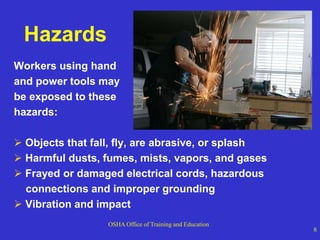
Hazards
Workers using hand
and power tools may
be exposed to these
hazards:
 Objects that fall, fly, are abrasive, or splash
 Harmful dusts, fumes, mists, vapors, and gases
 Frayed or damaged electrical cords, hazardous
connections and improper grounding
 Vibration and impact
OSHA Office of Training and Education
9
What do you think are the most
common injuries from working with
hand and power tools?
• Electric shock
• Flash burns
• Falling
• Hand and Eye injuries
• Hearing loss
• Crushing, cuts or
losing a body part
• Ergonomic injuries
OSHA Office of Training and Education
10
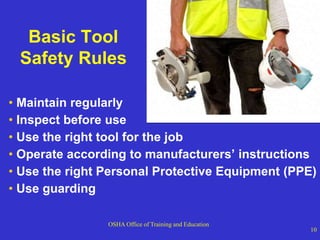
Basic Tool
Safety Rules
• Maintain regularly
• Inspect before use
• Use the right tool for the job
• Operate according to manufacturers’ instructions
• Use the right Personal Protective Equipment (PPE)
• Use guarding
OSHA Office of Training and Education
11
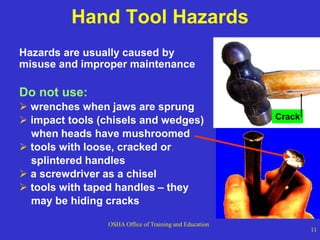
Hand Tool Hazards
Hazards are usually caused by
misuse and improper maintenance
Do not use:
 wrenches when jaws are sprung
 impact tools (chisels and wedges)
when heads have mushroomed
 tools with loose, cracked or
splintered handles
 a screwdriver as a chisel
 tools with taped handles – they
may be hiding cracks
Crack
OSHA Office of Training and Education
12
Cutting and Slicing Tools
(Knives, Box Cutters, Scissors, Razor Blades, etc…)
Safety Gloves – Protection against accidental cuts and vibration
A Sharp Blade Is Safer – When dull, a blade can slip from the object
being cut and cause a serious injury.
Cut Downward – Always away from your hand.
Put It Back – Never leave a cutting tool lying on a table, chair, sink or
desk. There are only three places that a cutting tool should ever be
1) in use,
2) stored safely in a drawer, tool box, in a knife rack, or,
3) in the dishwasher (blade down, handle up)
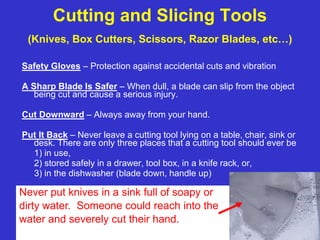
Never put knives in a sink full of soapy or
dirty water. Someone could reach into the
water and severely cut their hand.
OSHA Office of Training and Education
13
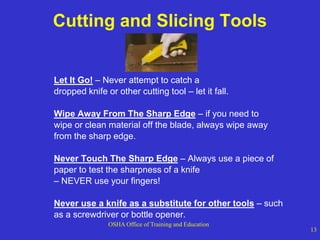
Cutting and Slicing Tools
Let It Go! – Never attempt to catch a
dropped knife or other cutting tool – let it fall.
Wipe Away From The Sharp Edge – if you need to
wipe or clean material off the blade, always wipe away
from the sharp edge.
Never Touch The Sharp Edge – Always use a piece of
paper to test the sharpness of a knife
– NEVER use your fingers!
Never use a knife as a substitute for other tools – such
as a screwdriver or bottle opener.
OSHA Office of Training and Education
14
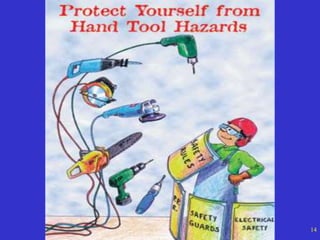
OSHA Office of Training and Education
15
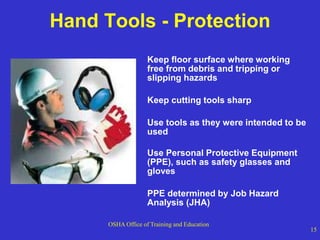
Hand Tools - Protection
Keep floor surface where working
free from debris and tripping or
slipping hazards
Keep cutting tools sharp
Use tools as they were intended to be
used
Use Personal Protective Equipment
(PPE), such as safety glasses and
gloves
PPE determined by Job Hazard
Analysis (JHA)
OSHA Office of Training and Education
16
OSHA Office of Training and Education 9
Examples of PPE
Examples of PPE
earplugs, earmuffs
Hearing
vests
Bodies
gloves
Hands and arms
safety shoes
Feet
hard hats
Head
face shields
Face
safety glasses, goggles
Eye
Body Part Protection
OSHA Office of Training and Education
17
Does PPE Help?
A trash bag that held a turpentine
container ruptured. Without warning, the
can exploded and the mixture of paint
thinner and paint sprayed all over Phil's
face, head, and upper body. The force of
the explosion knocked him to the
ground.
While applying siding with an air powered
staple gun, the son fired a staple, hitting a
metal plate behind the siding. It ricocheted back
towards his face and one leg of the staple
penetrated the safety
glasses' lens. The staple
hit with such force that
the frames were cracked
and the son received
bruising on the eyebrow
and cheekbone.
OSHA Office of Training and Education
18
PPE Standards
Various OSHA standards list specific requirements
for various types/levels of PPE
 Logging Standards
 Electrical Standards
 Hazardous Noise Standards
 Respiratory Protection Standards
 Chemical-Specific Standards
OSHA Office of Training and Education
19
Personal Protective Equipment
OSHA Office of Training and Education 8
Responsibilities
Responsibilities
• Employer
Assess workplace for hazards
Provide PPE
Determine when to use
Provide PPE training for employees and
instruction in proper use
• Employee
Use PPE in accordance with training
received and other instructions
Inspect daily and maintain in a clean and
reliable condition
OSHA Office of Training and Education
20
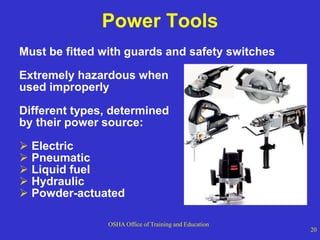
Power Tools
Must be fitted with guards and safety switches
Extremely hazardous when
used improperly
Different types, determined
by their power source:
 Electric
 Pneumatic
 Liquid fuel
 Hydraulic
 Powder-actuated
OSHA Office of Training and Education
21
General Safety Guidelines for
Power Tools
Be aware of all power lines and electrical circuits,
water pipes, and other mechanical hazards in
your work area, particularly those below the work
surface, hidden from the operator's view, that
may be contacted.
Wear proper apparel. Do not wear loose clothing,
dangling objects or jewelry. Long hair must be
restrained. Gloves should not be worn when
operating certain power tools. Check appropriate
tool manuals.
OSHA Office of Training and Education
22
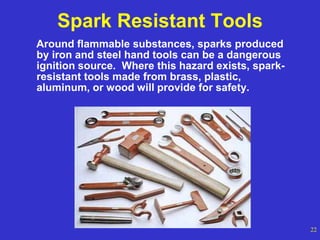
Spark Resistant Tools
Around flammable substances, sparks produced
by iron and steel hand tools can be a dangerous
ignition source. Where this hazard exists, spark-
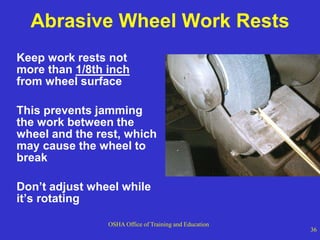
resistant tools made from brass, plastic,
aluminum, or wood will provide for safety.
OSHA Office of Training and Education
23
"Non-sparking", "spark-resistant" or "spark-proof“
tools are names given to tools made of metals such
as brass, bronze, Monel metal (copper-nickel alloy),
copper-aluminum alloys (aluminum bronze),
copper-beryllium alloys (beryllium bronze), and
titanium.
Preferred "non-sparking" metals have less tensile
strength than steels usually used to make tools.
A lower tensile strength means the metal has less
strength or resistance to tearing apart when
stretched under test conditions.
It also means that these tools are softer, wear down
more quickly than ordinary steel tools, and have
to be dressed more frequently.
OSHA Office of Training and Education
24
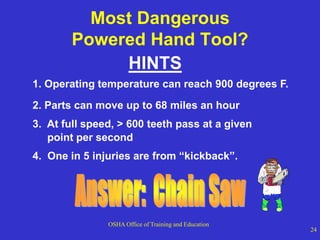
Most Dangerous
Powered Hand Tool?
HINTS
2. Parts can move up to 68 miles an hour
1. Operating temperature can reach 900 degrees F.
3. At full speed, > 600 teeth pass at a given
point per second
4. One in 5 injuries are from “kickback”.
OSHA Office of Training and Education
25
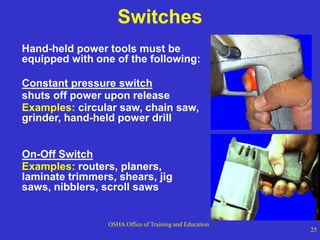
Switches
Hand-held power tools must be
equipped with one of the following:
Constant pressure switch
shuts off power upon release
Examples: circular saw, chain saw,
grinder, hand-held power drill
On-Off Switch
Examples: routers, planers,
laminate trimmers, shears, jig
saws, nibblers, scroll saws
OSHA Office of Training and Education
26
Power Tools - Precautions
• Disconnect tools when not in use, before servicing and
cleaning, and when changing accessories
• Keep people not involved with the work away
from the work
• Secure work with clamps or a vise, freeing both
hands to operate the tool
• Don’t hold the switch button while carrying a plugged-in tool
• Keep tools sharp and clean
• Remove damaged electric tools & tag them: “Do Not Use”
OSHA Office of Training and Education
27
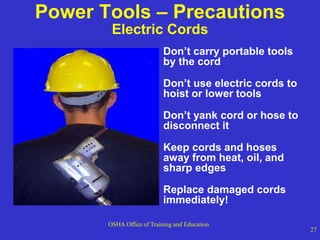
Power Tools – Precautions
Electric Cords
Don’t carry portable tools
by the cord
Don’t use electric cords to
hoist or lower tools
Don’t yank cord or hose to
disconnect it
Keep cords and hoses
away from heat, oil, and
sharp edges
Replace damaged cords
immediately!
OSHA Office of Training and Education
28
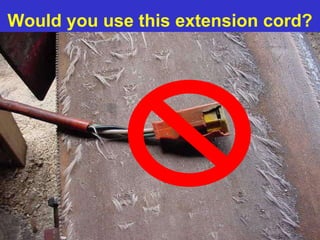
Would you use this extension cord?
OSHA Office of Training and Education
29
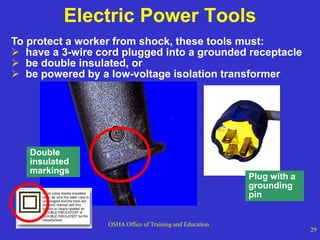
To protect a worker from shock, these tools must:
 have a 3-wire cord plugged into a grounded receptacle
 be double insulated, or
 be powered by a low-voltage isolation transformer
Electric Power Tools
Double
insulated
markings
Plug with a
grounding
pin
OSHA Office of Training and Education
30
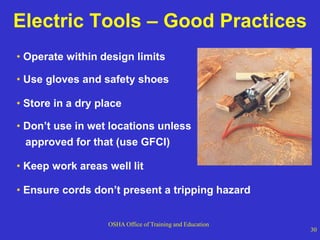
Electric Tools – Good Practices
• Operate within design limits
• Use gloves and safety shoes
• Store in a dry place
• Don’t use in wet locations unless
approved for that (use GFCI)
• Keep work areas well lit
• Ensure cords don’t present a tripping hazard
OSHA Office of Training and Education
31
Good
Practice?
OSHA Office of Training and Education
32
Cordless Tools Need Love Too
OSHA Office of Training and Education
33
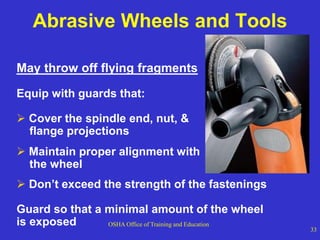
Abrasive Wheels and Tools
May throw off flying fragments
Equip with guards that:
 Cover the spindle end, nut, &
flange projections
 Maintain proper alignment with
the wheel
 Don’t exceed the strength of the fastenings
Guard so that a minimal amount of the wheel
is exposed
OSHA Office of Training and Education
34
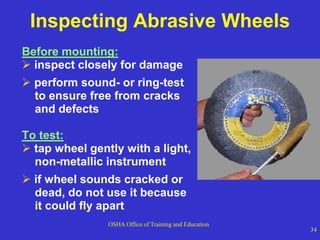
Inspecting Abrasive Wheels
Before mounting:
 inspect closely for damage
 perform sound- or ring-test
to ensure free from cracks
and defects
To test:
 tap wheel gently with a light,
non-metallic instrument
 if wheel sounds cracked or
dead, do not use it because
it could fly apart
OSHA Office of Training and Education
35
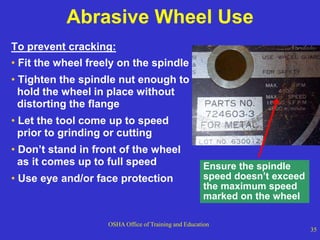
Abrasive Wheel Use
To prevent cracking:
• Fit the wheel freely on the spindle
• Tighten the spindle nut enough to
hold the wheel in place without
distorting the flange
• Let the tool come up to speed
prior to grinding or cutting
• Don’t stand in front of the wheel
as it comes up to full speed
• Use eye and/or face protection
Ensure the spindle
speed doesn’t exceed
the maximum speed
marked on the wheel
OSHA Office of Training and Education
36
Abrasive Wheel Work Rests
Keep work rests not
more than 1/8th inch
from wheel surface
This prevents jamming
the work between the
wheel and the rest, which
may cause the wheel to
break
Don’t adjust wheel while
it’s rotating
OSHA Office of Training and Education
37
Guarding
Guard exposed moving
parts of power tools
Guard belts, gears,
shafts, pulleys,
sprockets, spindles,
flywheels, chains, or
other moving parts
Never remove a guard
when a tool is in use
OSHA Office of Training and Education
38
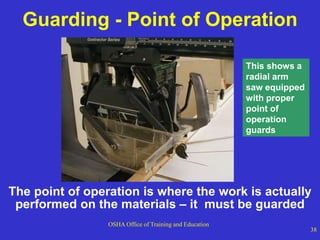
The point of operation is where the work is actually
performed on the materials – it must be guarded
Guarding - Point of Operation
This shows a
radial arm
saw equipped
with proper
point of
operation
guards
OSHA Office of Training and Education
39
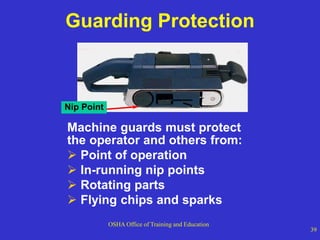
Guarding Protection
Machine guards must protect
the operator and others from:
 Point of operation
 In-running nip points
 Rotating parts
 Flying chips and sparks
Nip Point
OSHA Office of Training and Education
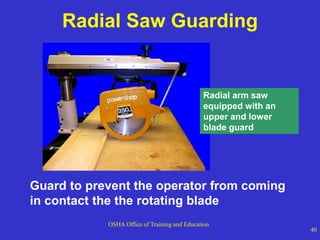
40
Guard to prevent the operator from coming
in contact the the rotating blade
Radial Saw Guarding
Radial arm saw
equipped with an
upper and lower
blade guard
OSHA Office of Training and Education
41
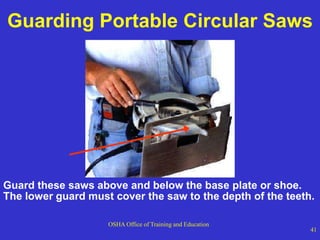
Guard these saws above and below the base plate or shoe.
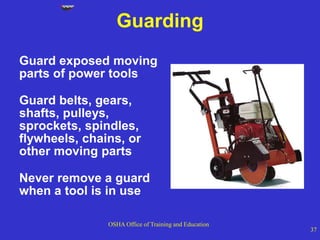
The lower guard must cover the saw to the depth of the teeth.
Guarding Portable Circular Saws
OSHA Office of Training and Education
42
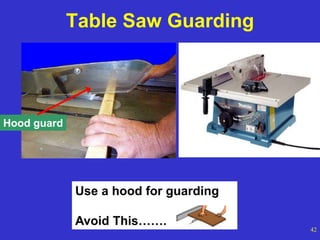
Use a hood for guarding
Avoid This…….
Hood guard
Table Saw Guarding
OSHA Office of Training and Education
43
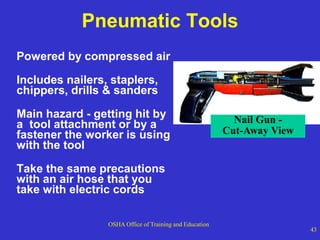
Pneumatic Tools
Powered by compressed air
Includes nailers, staplers,
chippers, drills & sanders
Main hazard - getting hit by
a tool attachment or by a
fastener the worker is using
with the tool
Take the same precautions
with an air hose that you
take with electric cords
Nail Gun -
Cut-Away View
OSHA Office of Training and Education
44
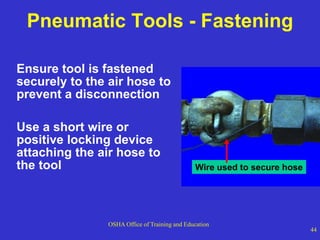
Pneumatic Tools - Fastening
Ensure tool is fastened
securely to the air hose to
prevent a disconnection
Use a short wire or
positive locking device
attaching the air hose to
the tool Wire used to secure hose
OSHA Office of Training and Education
45
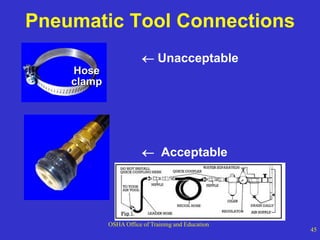
Pneumatic Tool Connections
 Unacceptable
 Acceptable
Hose
clamp
OSHA Office of Training and Education
46
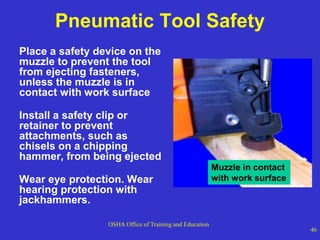
Pneumatic Tool Safety
Place a safety device on the
muzzle to prevent the tool
from ejecting fasteners,
unless the muzzle is in
contact with work surface
Install a safety clip or
retainer to prevent
attachments, such as
chisels on a chipping
hammer, from being ejected
Wear eye protection. Wear
hearing protection with
jackhammers.
Muzzle in contact
with work surface
OSHA Office of Training and Education
47
Compressed Air Cleaning
Don’t use compressed air for cleaning
Exception - where reduced to less than 30
p.s.i. with effective chip guarding and PPE
OSHA Office of Training and Education
48
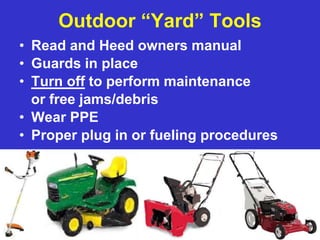
Outdoor “Yard” Tools
• Read and Heed owners manual
• Guards in place
• Turn off to perform maintenance
or free jams/debris
• Wear PPE
• Proper plug in or fueling procedures
OSHA Office of Training and Education
49
Liquid Fuel Tools
Usually gas powered
Main hazard – fuel vapors
Carbon Monoxide Hazards
Use only approved flammable
liquid containers
Before refilling a fuel-powered
tool tank, shut down the engine
and allow it to cool
Refuel at least 10 feet from combustible
materials
OSHA Office of Training and Education
50
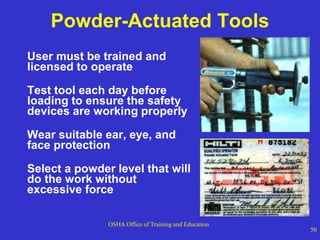
Powder-Actuated Tools
User must be trained and
licensed to operate
Test tool each day before
loading to ensure the safety
devices are working properly
Wear suitable ear, eye, and
face protection
Select a powder level that will
do the work without
excessive force
OSHA Office of Training and Education
51
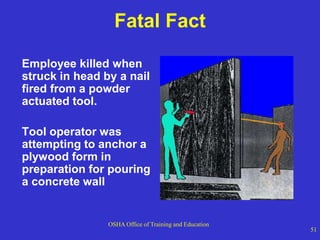
Fatal Fact
Employee killed when
struck in head by a nail
fired from a powder
actuated tool.
Tool operator was
attempting to anchor a
plywood form in
preparation for pouring
a concrete wall
OSHA Office of Training and Education
52
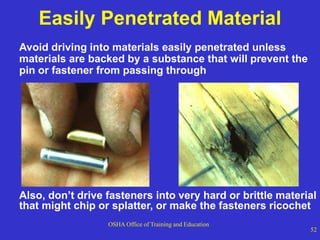
Easily Penetrated Material
Avoid driving into materials easily penetrated unless
materials are backed by a substance that will prevent the
pin or fastener from passing through
Also, don’t drive fasteners into very hard or brittle material
that might chip or splatter, or make the fasteners ricochet
OSHA Office of Training and Education
53
Powder-Actuated Tool Safety Tips
• Don’t use in explosive or flammable atmosphere
• Inspect tool before use to ensure:
 it is clean,
 that moving parts operate freely
 the barrel is free from obstructions and has
the proper shield, guard, and attachments
• Don’t load the tool unless using immediately
• Don’t leave a loaded tool unattended
• Keep hands clear of the barrel end
• Never point the tool at anyone
• Store unloaded in a locked box
OSHA Office of Training and Education
54
Powder-Actuated Tool Safety
OSHA Office of Training and Education
55
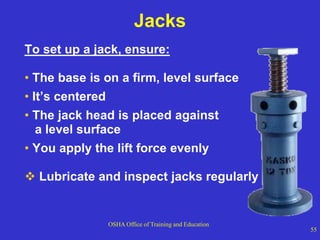
Jacks
To set up a jack, ensure:
• The base is on a firm, level surface
• It’s centered
• The jack head is placed against
a level surface
• You apply the lift force evenly
 Lubricate and inspect jacks regularly
OSHA Office of Training and Education
56
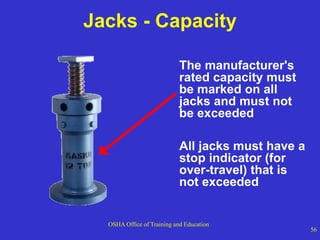
Jacks - Capacity
The manufacturer's
rated capacity must
be marked on all
jacks and must not
be exceeded
All jacks must have a
stop indicator (for
over-travel) that is
not exceeded
OSHA Office of Training and Education
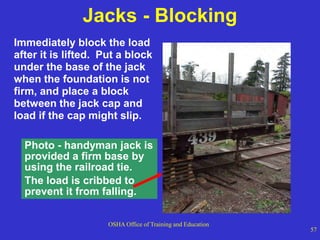
57
Immediately block the load
after it is lifted. Put a block
under the base of the jack
when the foundation is not
firm, and place a block
between the jack cap and
load if the cap might slip.
Jacks - Blocking
Photo - handyman jack is
provided a firm base by
using the railroad tie.
The load is cribbed to
prevent it from falling.
OSHA Office of Training and Education
58
Reporting Accidents/Injuries
 First priority is to receive prompt medical
attention (call 911)
 Report all work-related accidents, injuries
or illnesses to your supervisor
• Regardless of severity
 Paperwork to be filled out
• Incident Report
• Workers’ Compensation
Hospitalization must be reported immediately to
EHS&RM and no later than 8 hours from time of accident
OSHA Office of Training and Education
59
Summary
Hazards are usually the result of improper tool use or
not following one or more of these protection
techniques:
 Inspecting the tool before use
 Read Tool Owners Manual prior to use
 Using PPE (Personal Protective Equipment)
 Using guards
 Properly storing and maintaining the tool
 Keep the workplace neat and free of clutter
 Using safe handling techniques
QUIZ located at www.uaf.edu/safety Training then UAF
Safety Training Powerpoints 60
Quiz

Hand and Power Tool Safety Training Program

  • 1.
    OSHA Office ofTraining and Education 1 Hand and Power Tool Safety
  • 2.
    OSHA Office ofTraining and Education 2 Class Objectives Describe general guidelines for hand and power tool safety. Describe important hand and power tool basics. Describe correct steps for proper tool maintenance and handling. Identify personal protective equipment for using hand and power tools. Describe safety procedures for point of operation safety. Describe general guidelines for proper hand tool safety. Describe general guidelines for proper electric tool safety. Describe general guidelines for proper abrasive wheel tool safety. Describe general guidelines for proper pneumatic tool safety. Describe general guidelines for proper fuel and hydraulic tool safety. Describe ergonomics in relation to tool use.
  • 3.
    OSHA Office ofTraining and Education 3 Just the Facts The Occupational Safety and Health Administration states that most injuries on construction sites involve excavation cave-ins, power tool accidents, falls, electrical hazards, and exposure to potentially dangerous materials Working with power tools, you can get an electric shock, lose a finger, lose an eye, or go deaf. It's especially dangerous to use a tool that's defective, that's been modified, or that's not designed for the job. Of course, you can also get injured if you use any tool carelessly.
  • 4.
    OSHA Office ofTraining and Education 4 Regulations and Guidelines for Hand and Power Tools For General Industry • 1910 Subpart P, Hand and Portable Power Tools and Other Hand-Held Equipment. • 1910.241, Definitions. • 1910.242, Hand and portable powered tools and equipment, general. • 1910.243, Guarding of portable powered tools. • 1910.244, Other portable tools and equipment.
  • 5.
    OSHA Office ofTraining and Education 5 OSHA Publication 3080 Hand and Power Tools (2002 revised) ___________________________________ http://www.osha.gov/Publications/osha3080.pdf Great reference that can be saved or printed for your use
  • 6.
    OSHA Office ofTraining and Education 6 What the Regulations say about Hand Tools Each employer shall be responsible for the safe condition of tools and equipment used by employees This includes tools and equipment which may be furnished by employees
  • 7.
    OSHA Office ofTraining and Education 7 What the Regulations say about Hand Tools  Employers shall not issue or permit the use of unsafe hand tools  Wrenches, including adjustable, pipe, end, and socket wrenches shall not be used when jaws are sprung to the point that slippage occurs  Impact tools, such as drift pins, wedges, and chisels, shall be kept free of mushroomed heads  The wooden handles of tools shall be kept free of splinters or cracks and shall be kept tight in the tool
  • 8.
    OSHA Office ofTraining and Education 8 Hazards Workers using hand and power tools may be exposed to these hazards:  Objects that fall, fly, are abrasive, or splash  Harmful dusts, fumes, mists, vapors, and gases  Frayed or damaged electrical cords, hazardous connections and improper grounding  Vibration and impact
  • 9.
    OSHA Office ofTraining and Education 9 What do you think are the most common injuries from working with hand and power tools? • Electric shock • Flash burns • Falling • Hand and Eye injuries • Hearing loss • Crushing, cuts or losing a body part • Ergonomic injuries
  • 10.
    OSHA Office ofTraining and Education 10 Basic Tool Safety Rules • Maintain regularly • Inspect before use • Use the right tool for the job • Operate according to manufacturers’ instructions • Use the right Personal Protective Equipment (PPE) • Use guarding
  • 11.
    OSHA Office ofTraining and Education 11 Hand Tool Hazards Hazards are usually caused by misuse and improper maintenance Do not use:  wrenches when jaws are sprung  impact tools (chisels and wedges) when heads have mushroomed  tools with loose, cracked or splintered handles  a screwdriver as a chisel  tools with taped handles – they may be hiding cracks Crack
  • 12.
    OSHA Office ofTraining and Education 12 Cutting and Slicing Tools (Knives, Box Cutters, Scissors, Razor Blades, etc…) Safety Gloves – Protection against accidental cuts and vibration A Sharp Blade Is Safer – When dull, a blade can slip from the object being cut and cause a serious injury. Cut Downward – Always away from your hand. Put It Back – Never leave a cutting tool lying on a table, chair, sink or desk. There are only three places that a cutting tool should ever be 1) in use, 2) stored safely in a drawer, tool box, in a knife rack, or, 3) in the dishwasher (blade down, handle up) Never put knives in a sink full of soapy or dirty water. Someone could reach into the water and severely cut their hand.
  • 13.
    OSHA Office ofTraining and Education 13 Cutting and Slicing Tools Let It Go! – Never attempt to catch a dropped knife or other cutting tool – let it fall. Wipe Away From The Sharp Edge – if you need to wipe or clean material off the blade, always wipe away from the sharp edge. Never Touch The Sharp Edge – Always use a piece of paper to test the sharpness of a knife – NEVER use your fingers! Never use a knife as a substitute for other tools – such as a screwdriver or bottle opener.
  • 14.
    OSHA Office ofTraining and Education 14
  • 15.
    OSHA Office ofTraining and Education 15 Hand Tools - Protection Keep floor surface where working free from debris and tripping or slipping hazards Keep cutting tools sharp Use tools as they were intended to be used Use Personal Protective Equipment (PPE), such as safety glasses and gloves PPE determined by Job Hazard Analysis (JHA)
  • 16.
    OSHA Office ofTraining and Education 16 OSHA Office of Training and Education 9 Examples of PPE Examples of PPE earplugs, earmuffs Hearing vests Bodies gloves Hands and arms safety shoes Feet hard hats Head face shields Face safety glasses, goggles Eye Body Part Protection
  • 17.
    OSHA Office ofTraining and Education 17 Does PPE Help? A trash bag that held a turpentine container ruptured. Without warning, the can exploded and the mixture of paint thinner and paint sprayed all over Phil's face, head, and upper body. The force of the explosion knocked him to the ground. While applying siding with an air powered staple gun, the son fired a staple, hitting a metal plate behind the siding. It ricocheted back towards his face and one leg of the staple penetrated the safety glasses' lens. The staple hit with such force that the frames were cracked and the son received bruising on the eyebrow and cheekbone.
  • 18.
    OSHA Office ofTraining and Education 18 PPE Standards Various OSHA standards list specific requirements for various types/levels of PPE  Logging Standards  Electrical Standards  Hazardous Noise Standards  Respiratory Protection Standards  Chemical-Specific Standards
  • 19.
    OSHA Office ofTraining and Education 19 Personal Protective Equipment OSHA Office of Training and Education 8 Responsibilities Responsibilities • Employer Assess workplace for hazards Provide PPE Determine when to use Provide PPE training for employees and instruction in proper use • Employee Use PPE in accordance with training received and other instructions Inspect daily and maintain in a clean and reliable condition
  • 20.
    OSHA Office ofTraining and Education 20 Power Tools Must be fitted with guards and safety switches Extremely hazardous when used improperly Different types, determined by their power source:  Electric  Pneumatic  Liquid fuel  Hydraulic  Powder-actuated
  • 21.
    OSHA Office ofTraining and Education 21 General Safety Guidelines for Power Tools Be aware of all power lines and electrical circuits, water pipes, and other mechanical hazards in your work area, particularly those below the work surface, hidden from the operator's view, that may be contacted. Wear proper apparel. Do not wear loose clothing, dangling objects or jewelry. Long hair must be restrained. Gloves should not be worn when operating certain power tools. Check appropriate tool manuals.
  • 22.
    OSHA Office ofTraining and Education 22 Spark Resistant Tools Around flammable substances, sparks produced by iron and steel hand tools can be a dangerous ignition source. Where this hazard exists, spark- resistant tools made from brass, plastic, aluminum, or wood will provide for safety.
  • 23.
    OSHA Office ofTraining and Education 23 "Non-sparking", "spark-resistant" or "spark-proof“ tools are names given to tools made of metals such as brass, bronze, Monel metal (copper-nickel alloy), copper-aluminum alloys (aluminum bronze), copper-beryllium alloys (beryllium bronze), and titanium. Preferred "non-sparking" metals have less tensile strength than steels usually used to make tools. A lower tensile strength means the metal has less strength or resistance to tearing apart when stretched under test conditions. It also means that these tools are softer, wear down more quickly than ordinary steel tools, and have to be dressed more frequently.
  • 24.
    OSHA Office ofTraining and Education 24 Most Dangerous Powered Hand Tool? HINTS 2. Parts can move up to 68 miles an hour 1. Operating temperature can reach 900 degrees F. 3. At full speed, > 600 teeth pass at a given point per second 4. One in 5 injuries are from “kickback”.
  • 25.
    OSHA Office ofTraining and Education 25 Switches Hand-held power tools must be equipped with one of the following: Constant pressure switch shuts off power upon release Examples: circular saw, chain saw, grinder, hand-held power drill On-Off Switch Examples: routers, planers, laminate trimmers, shears, jig saws, nibblers, scroll saws
  • 26.
    OSHA Office ofTraining and Education 26 Power Tools - Precautions • Disconnect tools when not in use, before servicing and cleaning, and when changing accessories • Keep people not involved with the work away from the work • Secure work with clamps or a vise, freeing both hands to operate the tool • Don’t hold the switch button while carrying a plugged-in tool • Keep tools sharp and clean • Remove damaged electric tools & tag them: “Do Not Use”
  • 27.
    OSHA Office ofTraining and Education 27 Power Tools – Precautions Electric Cords Don’t carry portable tools by the cord Don’t use electric cords to hoist or lower tools Don’t yank cord or hose to disconnect it Keep cords and hoses away from heat, oil, and sharp edges Replace damaged cords immediately!
  • 28.
    OSHA Office ofTraining and Education 28 Would you use this extension cord?
  • 29.
    OSHA Office ofTraining and Education 29 To protect a worker from shock, these tools must:  have a 3-wire cord plugged into a grounded receptacle  be double insulated, or  be powered by a low-voltage isolation transformer Electric Power Tools Double insulated markings Plug with a grounding pin
  • 30.
    OSHA Office ofTraining and Education 30 Electric Tools – Good Practices • Operate within design limits • Use gloves and safety shoes • Store in a dry place • Don’t use in wet locations unless approved for that (use GFCI) • Keep work areas well lit • Ensure cords don’t present a tripping hazard
  • 31.
    OSHA Office ofTraining and Education 31 Good Practice?
  • 32.
    OSHA Office ofTraining and Education 32 Cordless Tools Need Love Too
  • 33.
    OSHA Office ofTraining and Education 33 Abrasive Wheels and Tools May throw off flying fragments Equip with guards that:  Cover the spindle end, nut, & flange projections  Maintain proper alignment with the wheel  Don’t exceed the strength of the fastenings Guard so that a minimal amount of the wheel is exposed
  • 34.
    OSHA Office ofTraining and Education 34 Inspecting Abrasive Wheels Before mounting:  inspect closely for damage  perform sound- or ring-test to ensure free from cracks and defects To test:  tap wheel gently with a light, non-metallic instrument  if wheel sounds cracked or dead, do not use it because it could fly apart
  • 35.
    OSHA Office ofTraining and Education 35 Abrasive Wheel Use To prevent cracking: • Fit the wheel freely on the spindle • Tighten the spindle nut enough to hold the wheel in place without distorting the flange • Let the tool come up to speed prior to grinding or cutting • Don’t stand in front of the wheel as it comes up to full speed • Use eye and/or face protection Ensure the spindle speed doesn’t exceed the maximum speed marked on the wheel
  • 36.
    OSHA Office ofTraining and Education 36 Abrasive Wheel Work Rests Keep work rests not more than 1/8th inch from wheel surface This prevents jamming the work between the wheel and the rest, which may cause the wheel to break Don’t adjust wheel while it’s rotating
  • 37.
    OSHA Office ofTraining and Education 37 Guarding Guard exposed moving parts of power tools Guard belts, gears, shafts, pulleys, sprockets, spindles, flywheels, chains, or other moving parts Never remove a guard when a tool is in use
  • 38.
    OSHA Office ofTraining and Education 38 The point of operation is where the work is actually performed on the materials – it must be guarded Guarding - Point of Operation This shows a radial arm saw equipped with proper point of operation guards
  • 39.
    OSHA Office ofTraining and Education 39 Guarding Protection Machine guards must protect the operator and others from:  Point of operation  In-running nip points  Rotating parts  Flying chips and sparks Nip Point
  • 40.
    OSHA Office ofTraining and Education 40 Guard to prevent the operator from coming in contact the the rotating blade Radial Saw Guarding Radial arm saw equipped with an upper and lower blade guard
  • 41.
    OSHA Office ofTraining and Education 41 Guard these saws above and below the base plate or shoe. The lower guard must cover the saw to the depth of the teeth. Guarding Portable Circular Saws
  • 42.
    OSHA Office ofTraining and Education 42 Use a hood for guarding Avoid This……. Hood guard Table Saw Guarding
  • 43.
    OSHA Office ofTraining and Education 43 Pneumatic Tools Powered by compressed air Includes nailers, staplers, chippers, drills & sanders Main hazard - getting hit by a tool attachment or by a fastener the worker is using with the tool Take the same precautions with an air hose that you take with electric cords Nail Gun - Cut-Away View
  • 44.
    OSHA Office ofTraining and Education 44 Pneumatic Tools - Fastening Ensure tool is fastened securely to the air hose to prevent a disconnection Use a short wire or positive locking device attaching the air hose to the tool Wire used to secure hose
  • 45.
    OSHA Office ofTraining and Education 45 Pneumatic Tool Connections  Unacceptable  Acceptable Hose clamp
  • 46.
    OSHA Office ofTraining and Education 46 Pneumatic Tool Safety Place a safety device on the muzzle to prevent the tool from ejecting fasteners, unless the muzzle is in contact with work surface Install a safety clip or retainer to prevent attachments, such as chisels on a chipping hammer, from being ejected Wear eye protection. Wear hearing protection with jackhammers. Muzzle in contact with work surface
  • 47.
    OSHA Office ofTraining and Education 47 Compressed Air Cleaning Don’t use compressed air for cleaning Exception - where reduced to less than 30 p.s.i. with effective chip guarding and PPE
  • 48.
    OSHA Office ofTraining and Education 48 Outdoor “Yard” Tools • Read and Heed owners manual • Guards in place • Turn off to perform maintenance or free jams/debris • Wear PPE • Proper plug in or fueling procedures
  • 49.
    OSHA Office ofTraining and Education 49 Liquid Fuel Tools Usually gas powered Main hazard – fuel vapors Carbon Monoxide Hazards Use only approved flammable liquid containers Before refilling a fuel-powered tool tank, shut down the engine and allow it to cool Refuel at least 10 feet from combustible materials
  • 50.
    OSHA Office ofTraining and Education 50 Powder-Actuated Tools User must be trained and licensed to operate Test tool each day before loading to ensure the safety devices are working properly Wear suitable ear, eye, and face protection Select a powder level that will do the work without excessive force
  • 51.
    OSHA Office ofTraining and Education 51 Fatal Fact Employee killed when struck in head by a nail fired from a powder actuated tool. Tool operator was attempting to anchor a plywood form in preparation for pouring a concrete wall
  • 52.
    OSHA Office ofTraining and Education 52 Easily Penetrated Material Avoid driving into materials easily penetrated unless materials are backed by a substance that will prevent the pin or fastener from passing through Also, don’t drive fasteners into very hard or brittle material that might chip or splatter, or make the fasteners ricochet
  • 53.
    OSHA Office ofTraining and Education 53 Powder-Actuated Tool Safety Tips • Don’t use in explosive or flammable atmosphere • Inspect tool before use to ensure:  it is clean,  that moving parts operate freely  the barrel is free from obstructions and has the proper shield, guard, and attachments • Don’t load the tool unless using immediately • Don’t leave a loaded tool unattended • Keep hands clear of the barrel end • Never point the tool at anyone • Store unloaded in a locked box
  • 54.
    OSHA Office ofTraining and Education 54 Powder-Actuated Tool Safety
  • 55.
    OSHA Office ofTraining and Education 55 Jacks To set up a jack, ensure: • The base is on a firm, level surface • It’s centered • The jack head is placed against a level surface • You apply the lift force evenly  Lubricate and inspect jacks regularly
  • 56.
    OSHA Office ofTraining and Education 56 Jacks - Capacity The manufacturer's rated capacity must be marked on all jacks and must not be exceeded All jacks must have a stop indicator (for over-travel) that is not exceeded
  • 57.
    OSHA Office ofTraining and Education 57 Immediately block the load after it is lifted. Put a block under the base of the jack when the foundation is not firm, and place a block between the jack cap and load if the cap might slip. Jacks - Blocking Photo - handyman jack is provided a firm base by using the railroad tie. The load is cribbed to prevent it from falling.
  • 58.
    OSHA Office ofTraining and Education 58 Reporting Accidents/Injuries  First priority is to receive prompt medical attention (call 911)  Report all work-related accidents, injuries or illnesses to your supervisor • Regardless of severity  Paperwork to be filled out • Incident Report • Workers’ Compensation Hospitalization must be reported immediately to EHS&RM and no later than 8 hours from time of accident
  • 59.
    OSHA Office ofTraining and Education 59 Summary Hazards are usually the result of improper tool use or not following one or more of these protection techniques:  Inspecting the tool before use  Read Tool Owners Manual prior to use  Using PPE (Personal Protective Equipment)  Using guards  Properly storing and maintaining the tool  Keep the workplace neat and free of clutter  Using safe handling techniques
  • 60.
    QUIZ located atwww.uaf.edu/safety Training then UAF Safety Training Powerpoints 60 Quiz