6/24/2020
Construction Occupational Safety and Health
Hand and Power Tools
Emergency Exits Restrooms Clinic/
First
Aid
Please Smoke Only in
Designated Areas
Please switch off
your mobile phone
CONSTRUCTION OCCUPATIONAL SAFETY and HEALTH
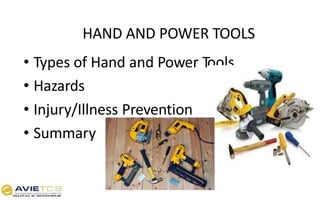
HAND AND POWER TOOLS
• Types of Hand and Power Tools
• Hazards
• Injury/Illness Prevention
• Summary
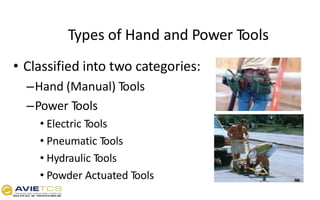
Types of Hand and Power Tools
• Classified into two categories:
–Hand (Manual) Tools
–Power Tools
• Electric Tools
• Pneumatic Tools
• Hydraulic Tools
• Powder Actuated Tools
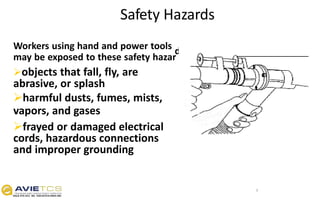
Safety Hazards
Workers using hand and power tools
may be exposed to these safety hazar
objects that fall, fly, are
abrasive, or splash
harmful dusts, fumes, mists,
vapors, and gases
frayed or damaged electrical
cords, hazardous connections
and improper grounding
ds:
7
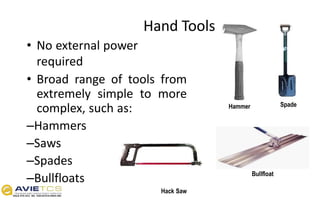
Hand Tools
• No external power
required
• Broad range of tools from
extremely simple to more
complex, such as:
–Hammers
–Saws
–Spades
–Bullfloats
Hack Saw
Hammer Spade
Bullfloat
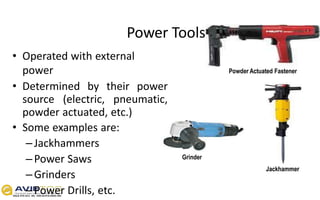
Power Tools
• Operated with external
power
• Determined by their power
source (electric, pneumatic,
powder actuated, etc.)
• Some examples are:
–Jackhammers
–Power Saws
–Grinders
–Power Drills, etc.
Powder Actuated Fastener
Grinder
Jackhammer
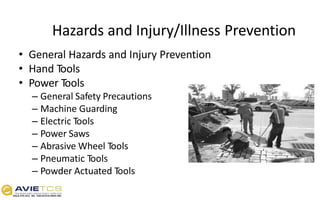
Hazards and Injury/Illness Prevention
• General Hazards and Injury Prevention
• Hand Tools
• Power Tools
– General Safety Precautions
– Machine Guarding
– Electric Tools
– Power Saws
– Abrasive Wheel Tools
– Pneumatic Tools
– Powder Actuated Tools
General Hazards
• Dust, fumes and sparks generated by hand
and power tools
• Falling, flying, abrasive, and splashing
objects
• Lack of Personal Protective Equipment
(PPE)
– e.g. lack of eye protection may result in foreign
body in the eye
• Untrained and/or unauthorized person
working with the tools
General Precations
• Keep all tools in good condition with proper
storage and regular maintenance
• Use the right tool for the job
• Examine each tool for damage before use
– Do not use damaged tools
• Operate tools according to the manufacturers’
instructions and recommendations
• Provide and use appropriate PPE
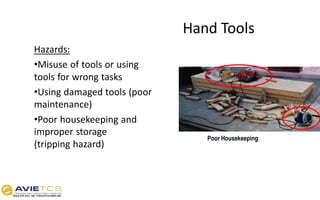
Hand Tools
Hazards:
•Misuse of tools or using
tools for wrong tasks
•Using damaged tools (poor
maintenance)
•Poor housekeeping and
improper storage
(tripping hazard)
Poor Housekeeping
Hand Tools
Injury/Illness Prevention:
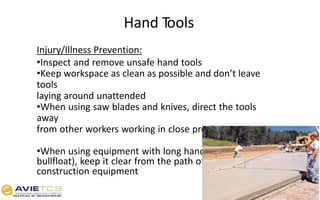
•Inspect and remove unsafe hand tools
•Keep workspace as clean as possible and don’t leave
tools
laying around unattended
•When using saw blades and knives, direct the tools
away
from other workers working in close proximity
•When using equipment with long handles (e.g.
bullfloat), keep it clear from the path of traffic or
construction equipment
Hand Tools
Injury/Illness Prevention:
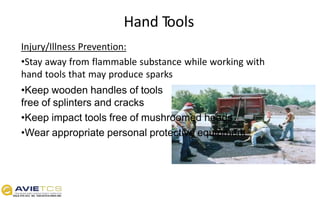
•Stay away from flammable substance while working with
hand tools that may produce sparks
•Keep wooden handles of tools
free of splinters and cracks
•Keep impact tools free of mushroomed heads
•Wear appropriate personal protective equipment
General Safety Precautions for Power Tools
• Disconnect tools when not in use
• Never carry a tool by the cord or hose
• Keep cords and hoses away from heat, oil, and
sharp edges
• Avoid accidental starting
– Do not hold fingers on the switch button while carrying a
plugged-in tool
General Safety Precautions for Power Tools
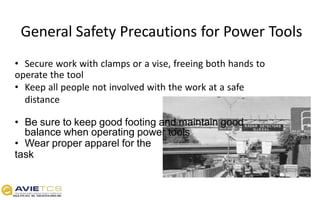
• Secure work with clamps or a vise, freeing both hands to
operate the tool
• Keep all people not involved with the work at a safe
distance
• Be sure to keep good footing and maintain good
balance when operating power tools
• Wear proper apparel for the
task
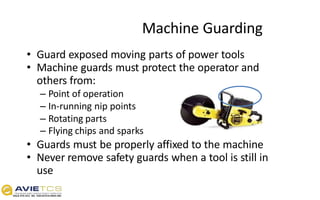
• Guard exposed moving parts of power tools
• Machine guards must protect the operator and
others from:
– Point of operation
– In-running nip points
– Rotating parts
– Flying chips and sparks
• Guards must be properly affixed to the machine
• Never remove safety guards when a tool is still in
use
Machine Guarding
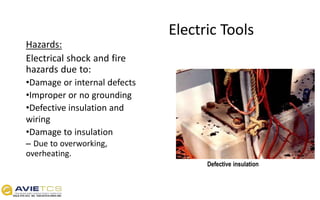
Electric Tools
Hazards:
Electrical shock and fire
hazards due to:
•Damage or internal defects
•Improper or no grounding
•Defective insulation and
wiring
•Damage to insulation
– Due to overworking,
overheating.
Defective insulation
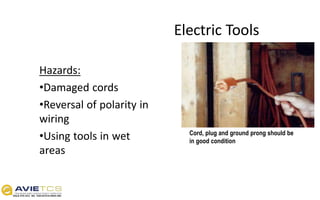
Electric Tools
Hazards:
•Damaged cords
•Reversal of polarity in
wiring
•Using tools in wet
areas
Cord, plug and ground prong should be
in good condition
Electric Tools
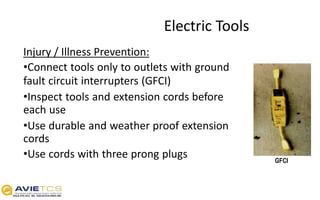
Injury / Illness Prevention:
•Connect tools only to outlets with ground
fault circuit interrupters (GFCI)
•Inspect tools and extension cords before
each use
•Use durable and weather proof extension
cords
•Use cords with three prong plugs GFCI
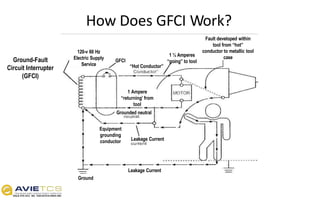
How Does GFCI Work?
Ground-Fault
Circuit Interrupter
(GFCI)
Equipment
grounding
conductor
Ground
Leakage Current
Leakage Current
GFCI
“Hot Conductor”
Fault developed within
tool from “hot”
conductor to metallic tool
case
1 ½ Amperes
“going” to tool
120-v 60 Hz
Electric Supply
Service
1 Ampere
“returning’ from
tool
Grounded neutral
Electric Tools
Injury / Illness Prevention:
•Operate electric tools within the limits of their
design
•Do not use electrical tools in damp and /or wet
areas
•Remove all damaged portable electric tools from
use
•Ensure that electrical cords do not present tripping
hazards
•Use gloves and appropriate safety footwear when
using electric tools
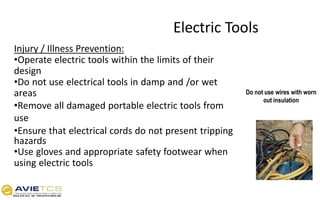
Do not use wires with worn
out insulation
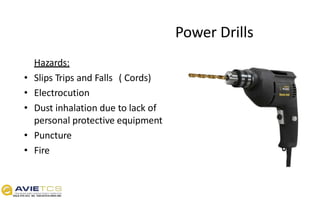
Power Drills
Hazards:
• Slips Trips and Falls ( Cords)
• Electrocution
• Dust inhalation due to lack of
personal protective equipment
• Puncture
• Fire
Power Saws
Hazards:
•Lack of proper guarding
•Sawing objects not
adequately supported
•Dust inhalation due to lack of
personal protective
equipment
•Operator distraction
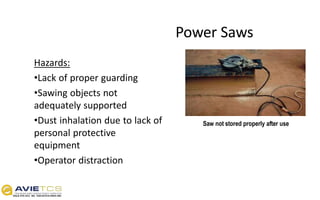
Saw not stored properly after use
Power Saws
Power Saws
Power Saws
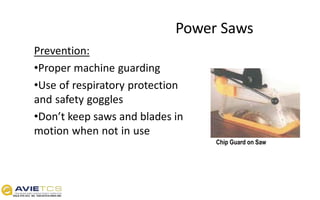
Prevention:
•Proper machine guarding
•Use of respiratory protection
and safety goggles
•Don’t keep saws and blades in
motion when not in use
Chip Guard on Saw
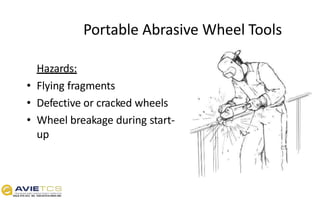
Portable Abrasive Wheel Tools
Hazards:
• Flying fragments
• Defective or cracked wheels
• Wheel breakage during start-
up
Portable Abrasive Wheel Tools
Injury/Illness Prevention:
•Proper machine guarding
– Cover the spindle end, nut, and flange projections
– Maintain proper alignment with the wheel
– Do not exceed the strength of the fastenings
•Before mounting the wheel, inspect for damage and perform
“ring- testing” (tap with a light instrument)
•Ensure wheel fits freely on the spindle
– Spindle speed should not exceed the maximum operating speed
•Never stand in the plane of rotation as the wheel accelerates to
full
operating speed
Pneumatic Tools
Hazards:
•Getting hit by one of tool’s
attachments
•Air hose (disconnection,
tripping hazard)
•Flying fragments
•Fatigue and strains while using
jackhammers
•Noise
Pneumatic Tools
Injury/Illness Prevention:
•Securely fasten the pneumatic tool to the air hose
•Install a safety clip or a retainer to prevent attachments
such as chisels on a chipping hammer from being ejected
during tool operation
•Set up screens to protect nearby workers from being struck
by flying fragments
•Use heavy rubber grips to reduce fatigue and strain caused
by operating jackhammers
•Use appropriate hearing protection
Powder Actuated Tool Hazards
Hazards:
• Using tools on unsuitable materials
• Thorough penetration
• Ricochet of fasteners
• Spalling of material
• Misfiring
• Operating near explosive materials
Powder Actuated Tools
Injury / Illness Prevention:
•Only trained operators must use powder-actuated tools
•An appropriate powder level must be selected to
perform
the work without using excessive force
•If a powder actuated tool misfires, the user must hold
the tool in the operating position for at least 30 seconds
before trying to fire it again
•Suitable ear, eye, and face protection must be worn
ANY QUESTIONS???

2Hand and Power Tools 2018.ppt

  • 1.
    6/24/2020 Construction Occupational Safetyand Health Hand and Power Tools
  • 2.
    Emergency Exits RestroomsClinic/ First Aid Please Smoke Only in Designated Areas Please switch off your mobile phone CONSTRUCTION OCCUPATIONAL SAFETY and HEALTH
  • 3.
    HAND AND POWERTOOLS • Types of Hand and Power Tools • Hazards • Injury/Illness Prevention • Summary
  • 6.
    Types of Handand Power Tools • Classified into two categories: –Hand (Manual) Tools –Power Tools • Electric Tools • Pneumatic Tools • Hydraulic Tools • Powder Actuated Tools
  • 7.
    Safety Hazards Workers usinghand and power tools may be exposed to these safety hazar objects that fall, fly, are abrasive, or splash harmful dusts, fumes, mists, vapors, and gases frayed or damaged electrical cords, hazardous connections and improper grounding ds: 7
  • 8.
    Hand Tools • Noexternal power required • Broad range of tools from extremely simple to more complex, such as: –Hammers –Saws –Spades –Bullfloats Hack Saw Hammer Spade Bullfloat
  • 9.
    Power Tools • Operatedwith external power • Determined by their power source (electric, pneumatic, powder actuated, etc.) • Some examples are: –Jackhammers –Power Saws –Grinders –Power Drills, etc. Powder Actuated Fastener Grinder Jackhammer
  • 10.
    Hazards and Injury/IllnessPrevention • General Hazards and Injury Prevention • Hand Tools • Power Tools – General Safety Precautions – Machine Guarding – Electric Tools – Power Saws – Abrasive Wheel Tools – Pneumatic Tools – Powder Actuated Tools
  • 11.
    General Hazards • Dust,fumes and sparks generated by hand and power tools • Falling, flying, abrasive, and splashing objects • Lack of Personal Protective Equipment (PPE) – e.g. lack of eye protection may result in foreign body in the eye • Untrained and/or unauthorized person working with the tools
  • 12.
    General Precations • Keepall tools in good condition with proper storage and regular maintenance • Use the right tool for the job • Examine each tool for damage before use – Do not use damaged tools • Operate tools according to the manufacturers’ instructions and recommendations • Provide and use appropriate PPE
  • 13.
    Hand Tools Hazards: •Misuse oftools or using tools for wrong tasks •Using damaged tools (poor maintenance) •Poor housekeeping and improper storage (tripping hazard) Poor Housekeeping
  • 14.
    Hand Tools Injury/Illness Prevention: •Inspectand remove unsafe hand tools •Keep workspace as clean as possible and don’t leave tools laying around unattended •When using saw blades and knives, direct the tools away from other workers working in close proximity •When using equipment with long handles (e.g. bullfloat), keep it clear from the path of traffic or construction equipment
  • 15.
    Hand Tools Injury/Illness Prevention: •Stayaway from flammable substance while working with hand tools that may produce sparks •Keep wooden handles of tools free of splinters and cracks •Keep impact tools free of mushroomed heads •Wear appropriate personal protective equipment
  • 16.
    General Safety Precautionsfor Power Tools • Disconnect tools when not in use • Never carry a tool by the cord or hose • Keep cords and hoses away from heat, oil, and sharp edges • Avoid accidental starting – Do not hold fingers on the switch button while carrying a plugged-in tool
  • 17.
    General Safety Precautionsfor Power Tools • Secure work with clamps or a vise, freeing both hands to operate the tool • Keep all people not involved with the work at a safe distance • Be sure to keep good footing and maintain good balance when operating power tools • Wear proper apparel for the task
  • 18.
    • Guard exposedmoving parts of power tools • Machine guards must protect the operator and others from: – Point of operation – In-running nip points – Rotating parts – Flying chips and sparks • Guards must be properly affixed to the machine • Never remove safety guards when a tool is still in use Machine Guarding
  • 19.
    Electric Tools Hazards: Electrical shockand fire hazards due to: •Damage or internal defects •Improper or no grounding •Defective insulation and wiring •Damage to insulation – Due to overworking, overheating. Defective insulation
  • 20.
    Electric Tools Hazards: •Damaged cords •Reversalof polarity in wiring •Using tools in wet areas Cord, plug and ground prong should be in good condition
  • 21.
    Electric Tools Injury /Illness Prevention: •Connect tools only to outlets with ground fault circuit interrupters (GFCI) •Inspect tools and extension cords before each use •Use durable and weather proof extension cords •Use cords with three prong plugs GFCI
  • 22.
    How Does GFCIWork? Ground-Fault Circuit Interrupter (GFCI) Equipment grounding conductor Ground Leakage Current Leakage Current GFCI “Hot Conductor” Fault developed within tool from “hot” conductor to metallic tool case 1 ½ Amperes “going” to tool 120-v 60 Hz Electric Supply Service 1 Ampere “returning’ from tool Grounded neutral
  • 23.
    Electric Tools Injury /Illness Prevention: •Operate electric tools within the limits of their design •Do not use electrical tools in damp and /or wet areas •Remove all damaged portable electric tools from use •Ensure that electrical cords do not present tripping hazards •Use gloves and appropriate safety footwear when using electric tools Do not use wires with worn out insulation
  • 25.
    Power Drills Hazards: • SlipsTrips and Falls ( Cords) • Electrocution • Dust inhalation due to lack of personal protective equipment • Puncture • Fire
  • 26.
    Power Saws Hazards: •Lack ofproper guarding •Sawing objects not adequately supported •Dust inhalation due to lack of personal protective equipment •Operator distraction Saw not stored properly after use
  • 27.
  • 28.
  • 29.
    Power Saws Prevention: •Proper machineguarding •Use of respiratory protection and safety goggles •Don’t keep saws and blades in motion when not in use Chip Guard on Saw
  • 30.
    Portable Abrasive WheelTools Hazards: • Flying fragments • Defective or cracked wheels • Wheel breakage during start- up
  • 31.
  • 32.
  • 33.
    Portable Abrasive WheelTools Injury/Illness Prevention: •Proper machine guarding – Cover the spindle end, nut, and flange projections – Maintain proper alignment with the wheel – Do not exceed the strength of the fastenings •Before mounting the wheel, inspect for damage and perform “ring- testing” (tap with a light instrument) •Ensure wheel fits freely on the spindle – Spindle speed should not exceed the maximum operating speed •Never stand in the plane of rotation as the wheel accelerates to full operating speed
  • 34.
    Pneumatic Tools Hazards: •Getting hitby one of tool’s attachments •Air hose (disconnection, tripping hazard) •Flying fragments •Fatigue and strains while using jackhammers •Noise
  • 36.
    Pneumatic Tools Injury/Illness Prevention: •Securelyfasten the pneumatic tool to the air hose •Install a safety clip or a retainer to prevent attachments such as chisels on a chipping hammer from being ejected during tool operation •Set up screens to protect nearby workers from being struck by flying fragments •Use heavy rubber grips to reduce fatigue and strain caused by operating jackhammers •Use appropriate hearing protection
  • 37.
    Powder Actuated ToolHazards Hazards: • Using tools on unsuitable materials • Thorough penetration • Ricochet of fasteners • Spalling of material • Misfiring • Operating near explosive materials
  • 38.
    Powder Actuated Tools Injury/ Illness Prevention: •Only trained operators must use powder-actuated tools •An appropriate powder level must be selected to perform the work without using excessive force •If a powder actuated tool misfires, the user must hold the tool in the operating position for at least 30 seconds before trying to fire it again •Suitable ear, eye, and face protection must be worn
  • 40.