Topic: Hand & Power Tools Safety
Name of facilitator: Syed Neyaz Ahmad
HSE Officer
EMIRATES GENERAL PETROLEUM CORPORATION (EMARAT)
Ph. +971563671957
Email. Neyaz.qhse@gmail.com
Scope: Construction of Utility Building &
Miscellaneous Work At Emarat Jebel Ali Terminal
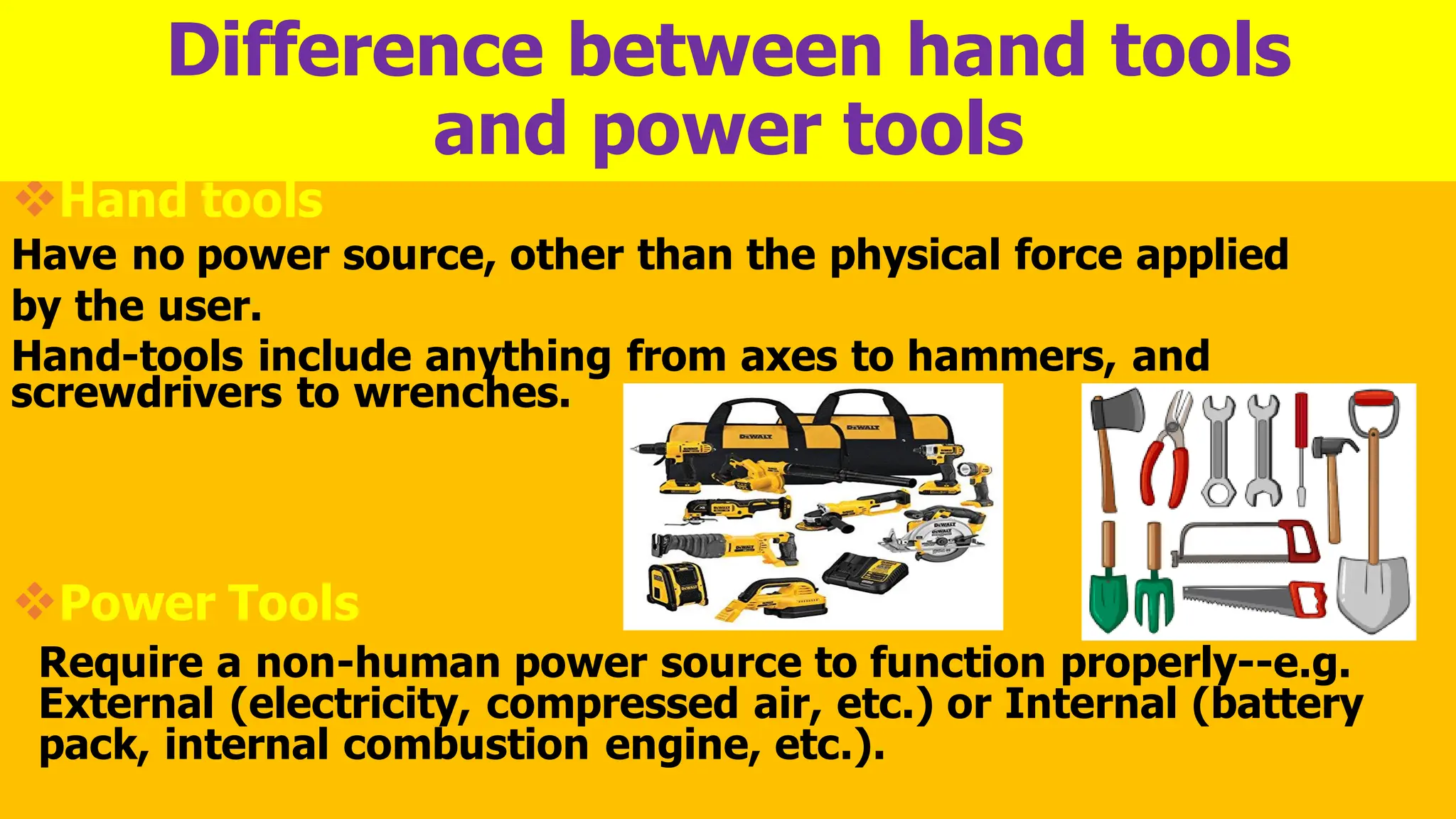
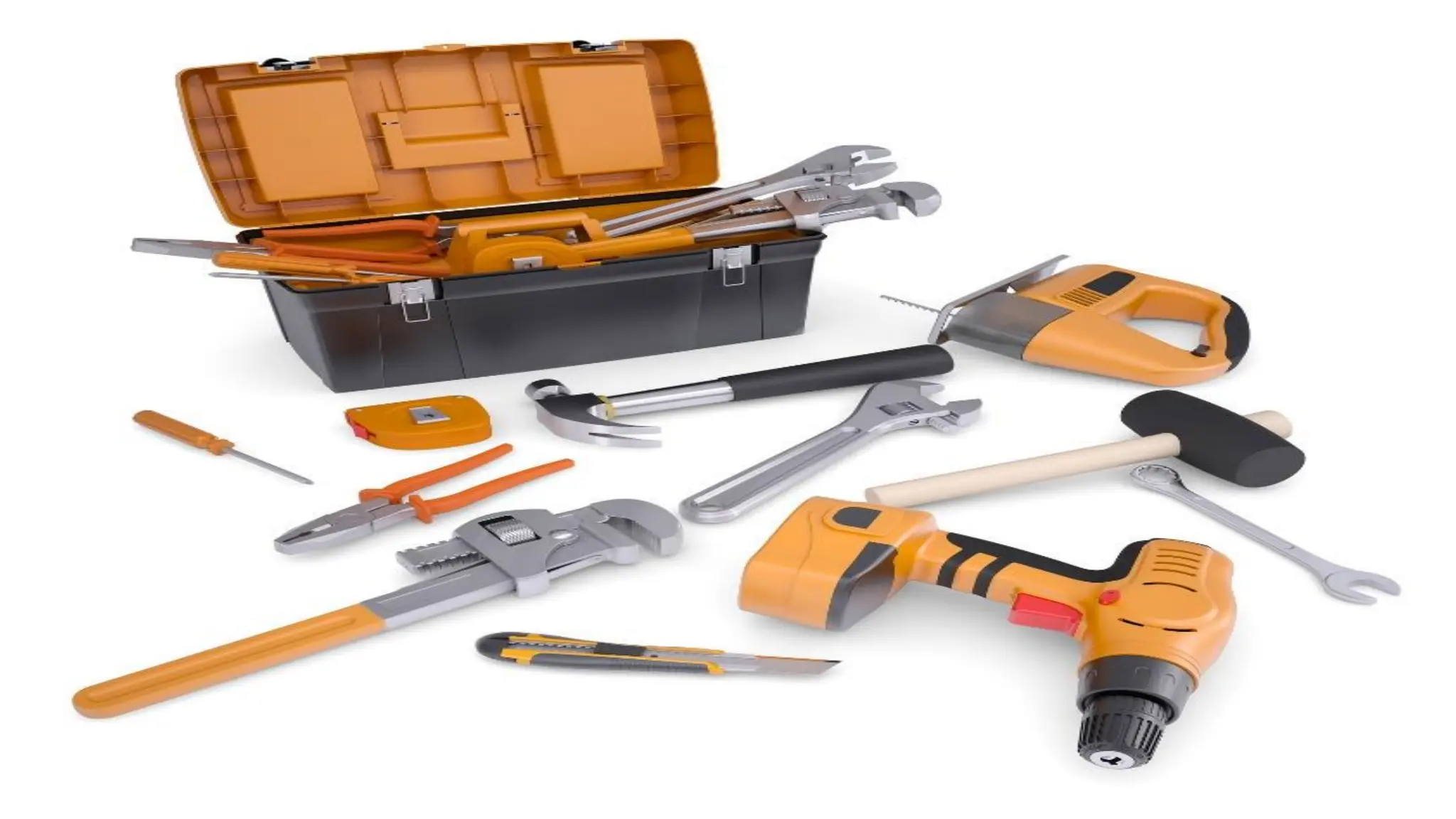
❖Hand tools
Have no power source, other than the physical force applied
by the user.
Hand-tools include anything from axes to hammers, and
screwdrivers to wrenches.
❖Power Tools
Require a non-human power source to function properly--e.g.
External (electricity, compressed air, etc.) or Internal (battery
pack, internal combustion engine, etc.).
Difference between hand tools
and power tools
Both kinds of tools require specific safety precautions or
rules to be followed; yet some rules will apply to both.
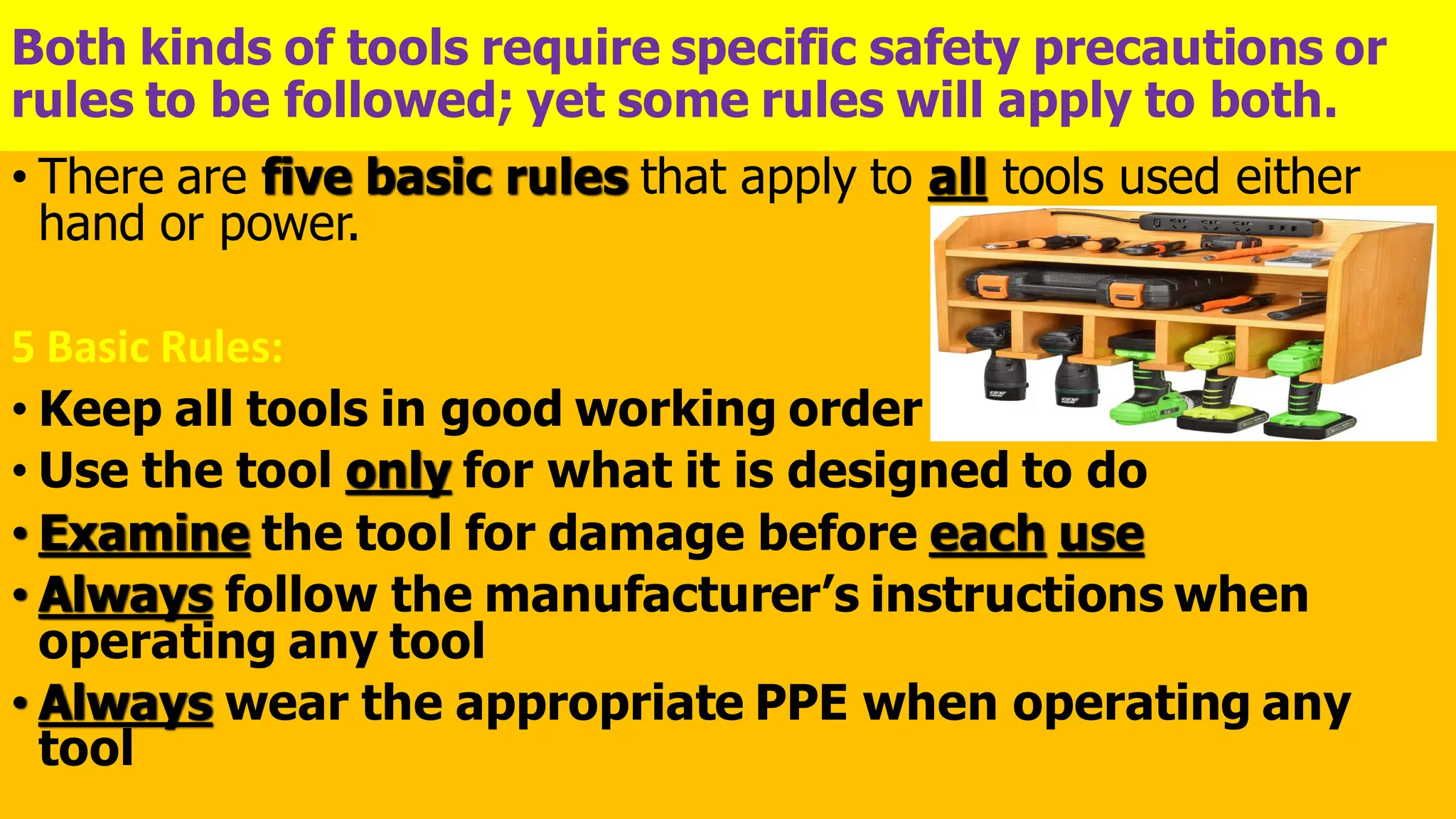
• There are five basic rules that apply to all tools used either
hand or power.
5 Basic Rules:
• Keep all tools in good working order
• Use the tool only for what it is designed to do
• Examine the tool for damage before each use
• Always follow the manufacturer’s instructions when
operating any tool
• Always wear the appropriate PPE when operating any
tool
GENERAL Hand Tool RULES
• Do not throw tools from one location to another or from one
employee to another
• When working on a ladder or scaffolding be sure you and your
tools are secure
• Do not carry tools in your hand while climbing, use a tool belt or
host the tools by using a hand line
The Greatest Hazards of Hand Tools:
Misuse/Improper Maintenance
• Using a screwdriver as a chisel
• Could cause the tip to break and fly, hitting either the operator
or bystanders
• A wooden handle on tool such as a hammer or an axe is loose,
splintered (piece) or cracked
• The tool head could fly off and strike the operator or bystanders
SAFETY RULES For Hand Tools cont’d
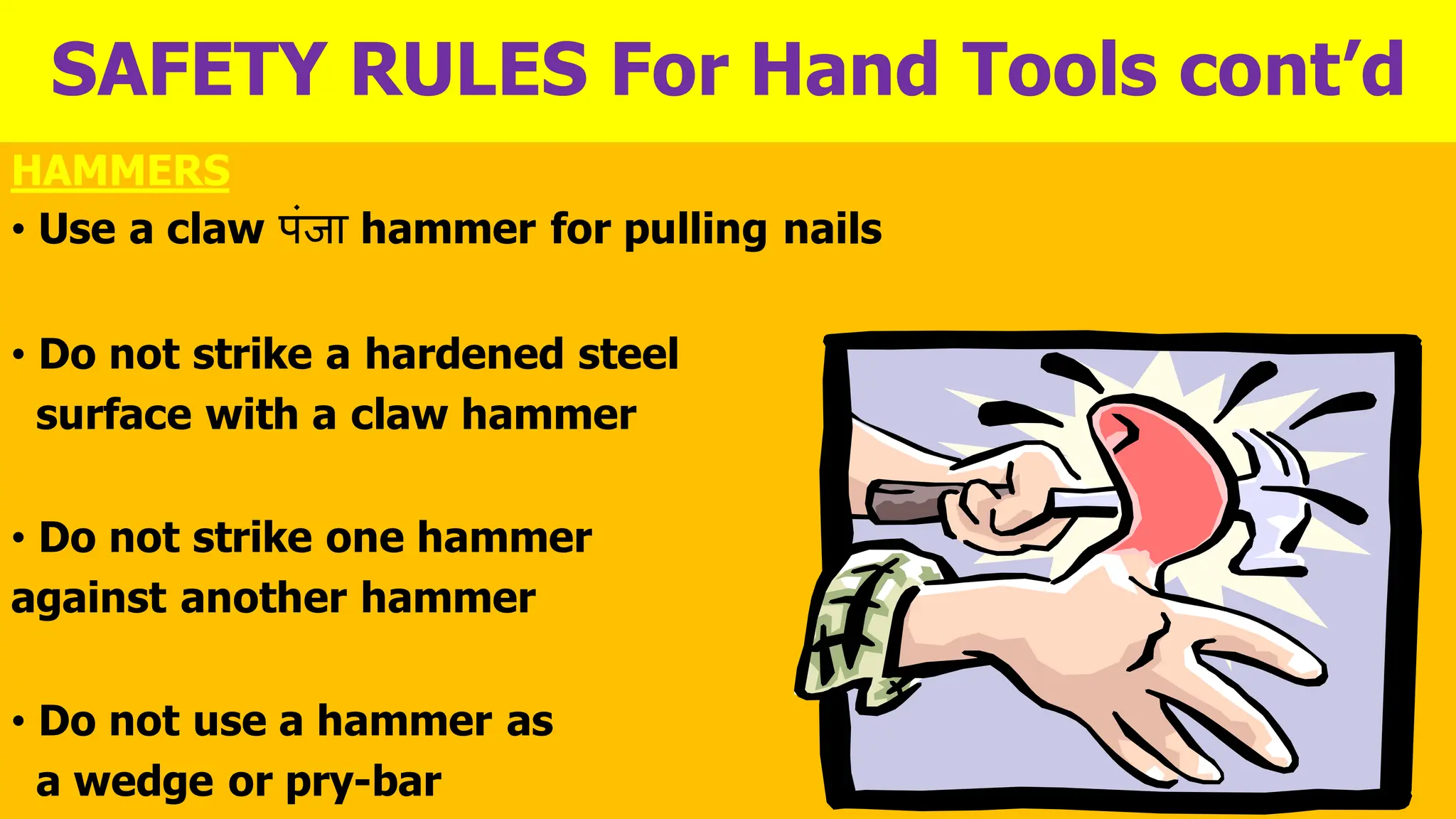
HAMMERS
• Use a claw पंजा hammer for pulling nails
• Do not strike a hardened steel
surface with a claw hammer
• Do not strike one hammer
against another hammer
• Do not use a hammer as
a wedge or pry-bar
SAFETY RULES For Hand Tools cont’d
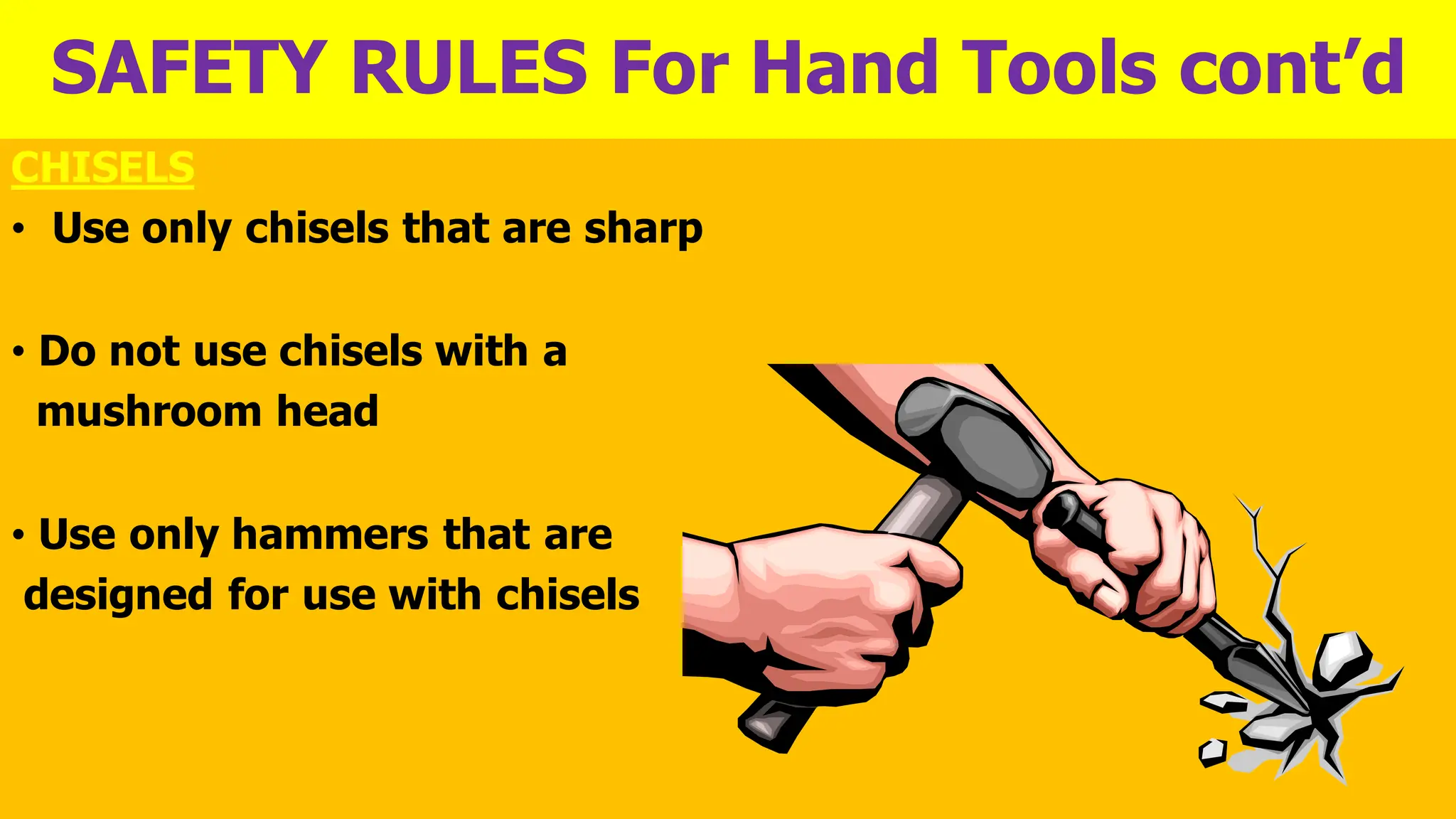
CHISELS
• Use only chisels that are sharp
• Do not use chisels with a
mushroom head
• Use only hammers that are
designed for use with chisels
SAFETY RULES For Hand Tools cont’d
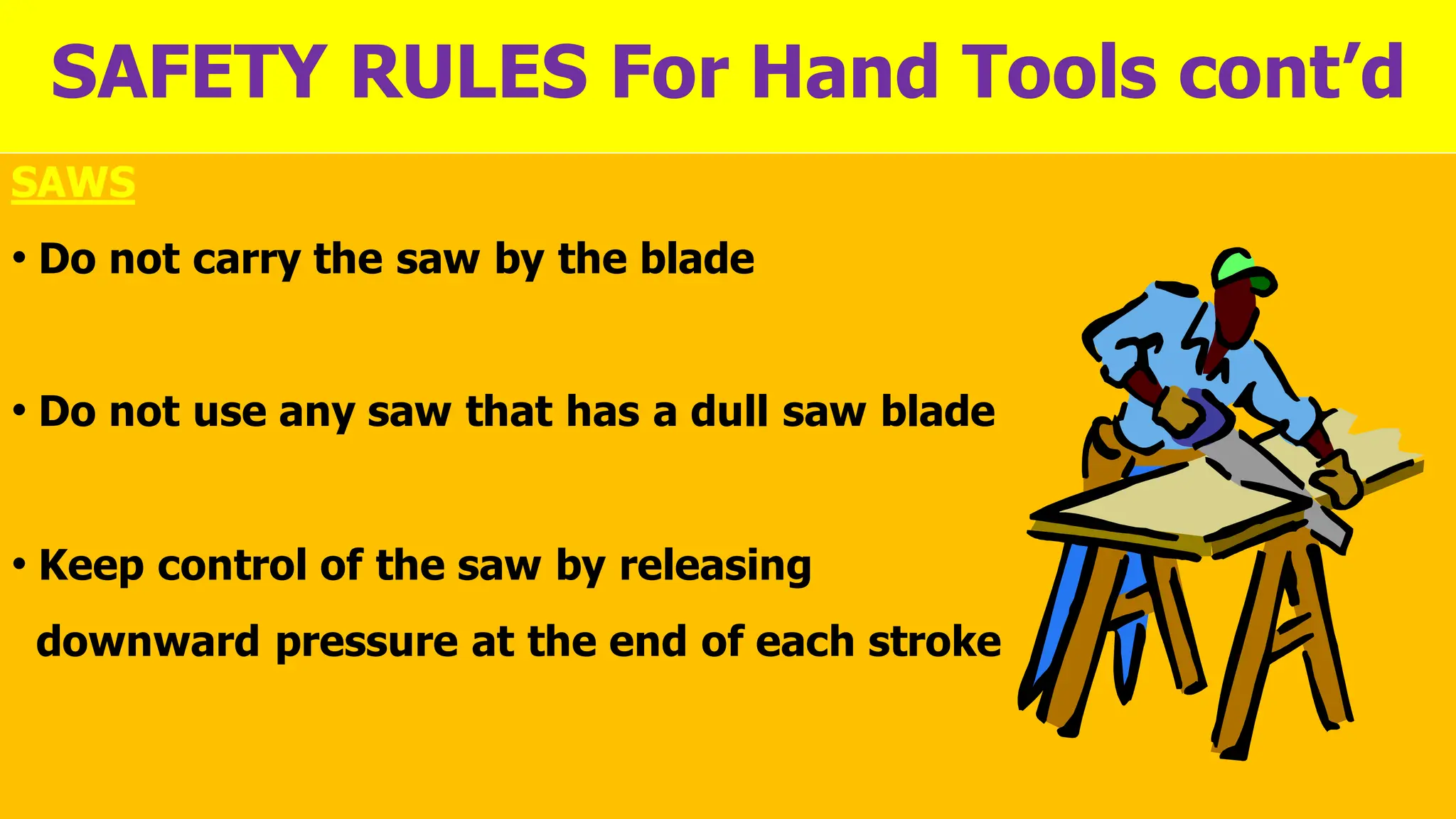
SAWS
• Do not carry the saw by the blade
• Do not use any saw that has a dull saw blade
• Keep control of the saw by releasing
downward pressure at the end of each stroke
SAFETY RULES For Hand Tools cont’d
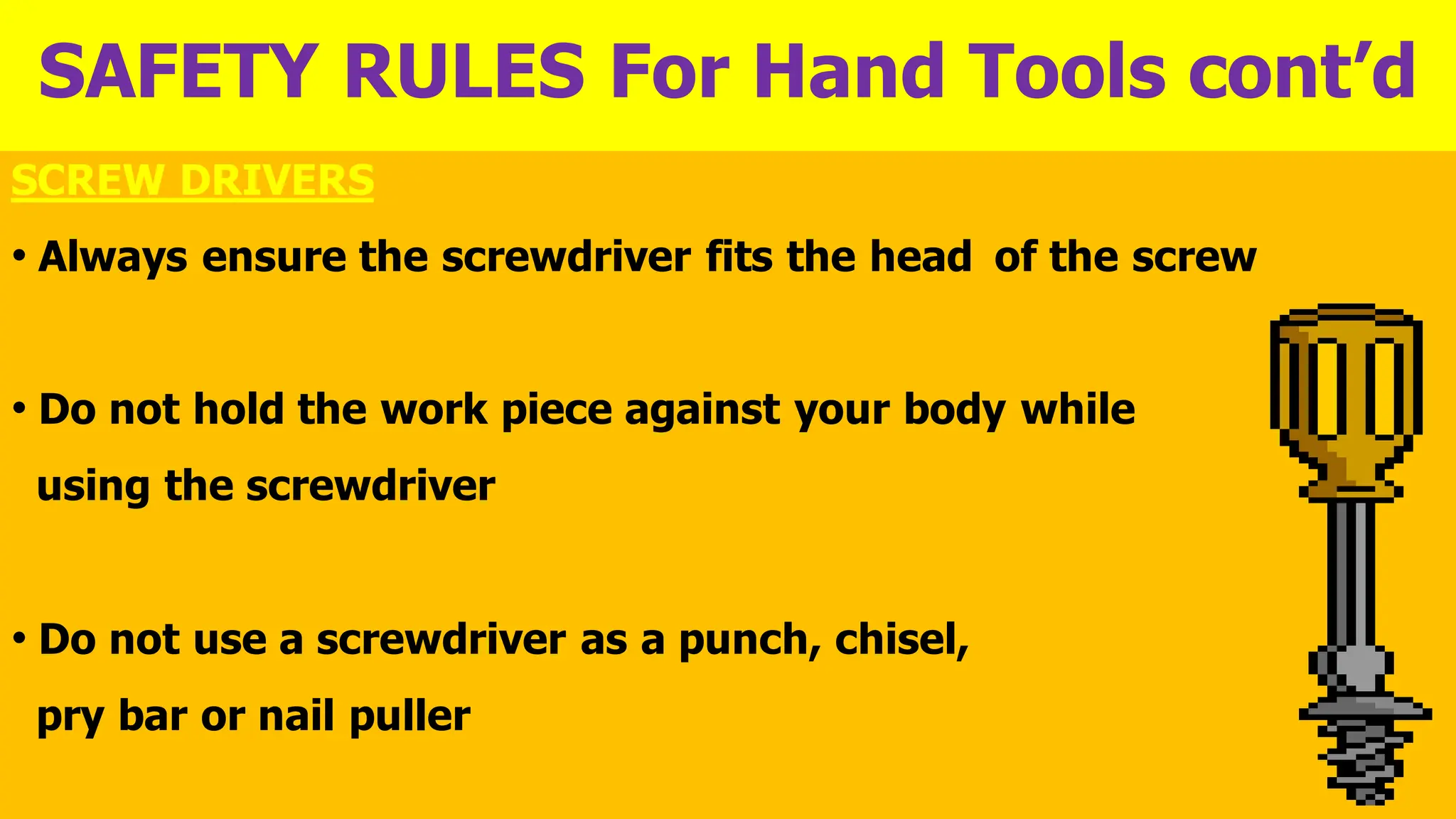
SCREW DRIVERS
• Always ensure the screwdriver fits the head of the screw
• Do not hold the work piece against your body while
using the screwdriver
• Do not use a screwdriver as a punch, chisel,
pry bar or nail puller
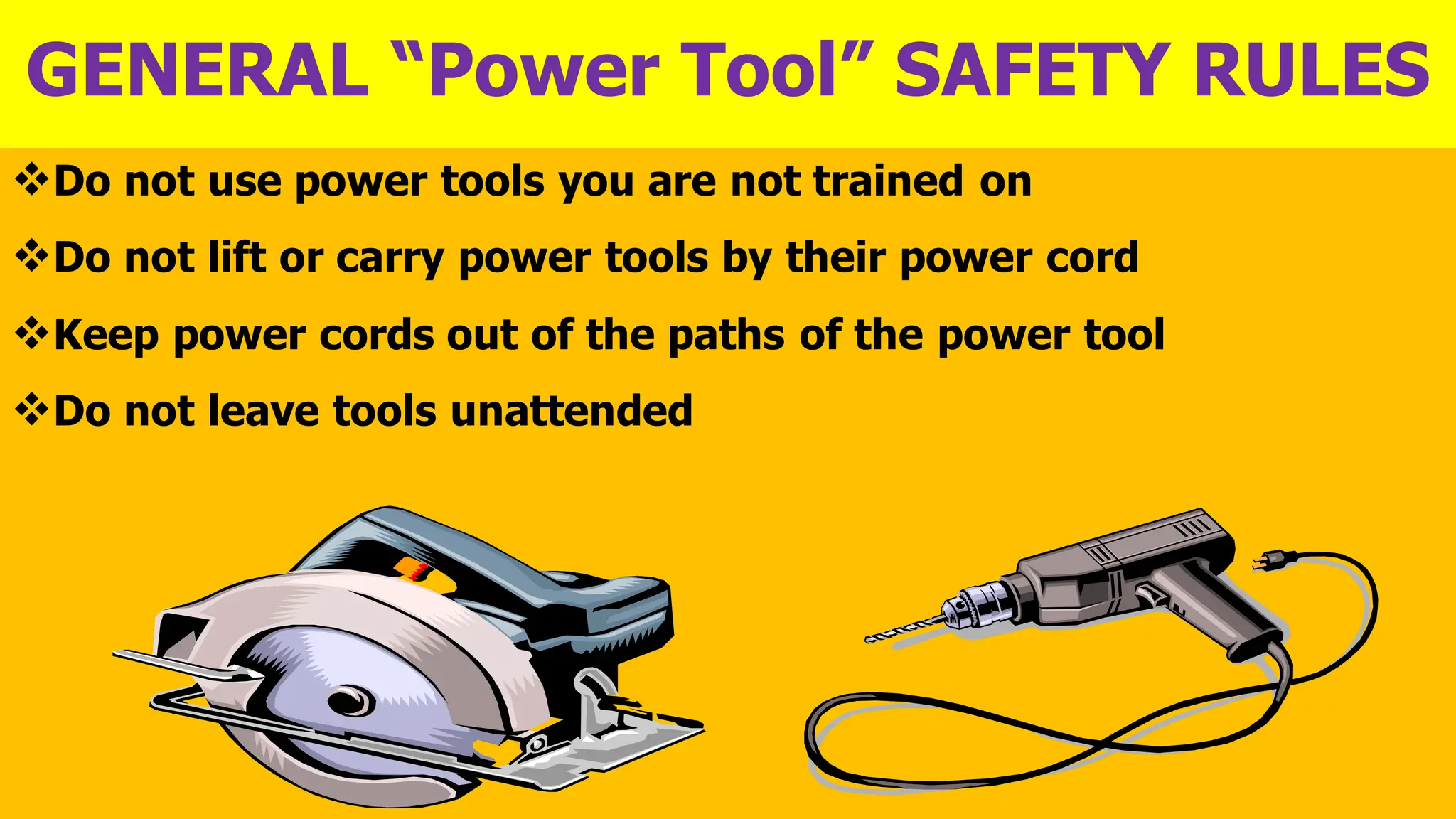
GENERAL “Power Tool” SAFETY RULES
❖Do not use power tools you are not trained on
❖Do not lift or carry power tools by their power cord
❖Keep power cords out of the paths of the power tool
❖Do not leave tools unattended
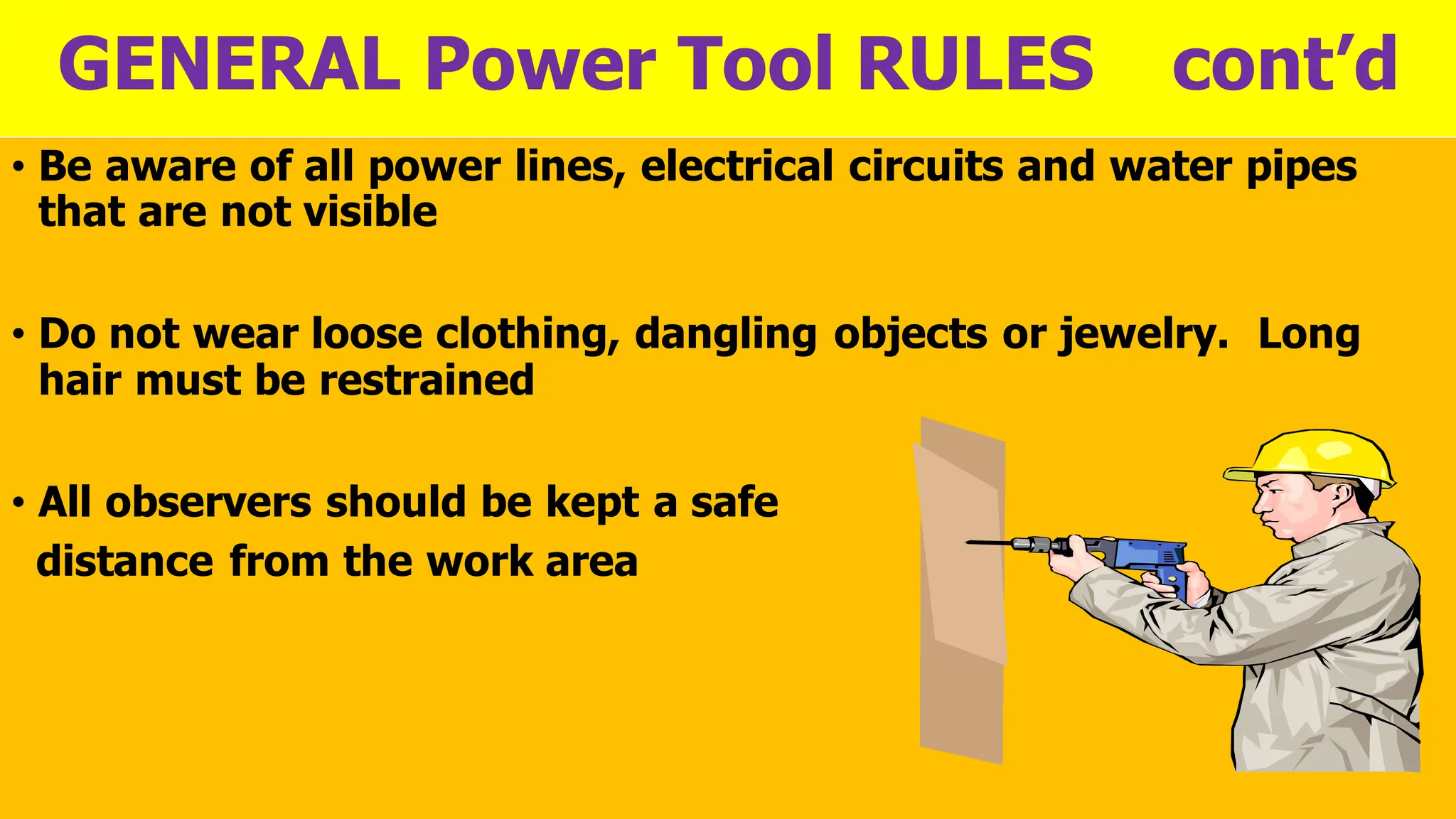
GENERAL Power Tool RULES cont’d
• Be aware of all power lines, electrical circuits and water pipes
that are not visible
• Do not wear loose clothing, dangling objects or jewelry. Long
hair must be restrained
• All observers should be kept a safe
distance from the work area
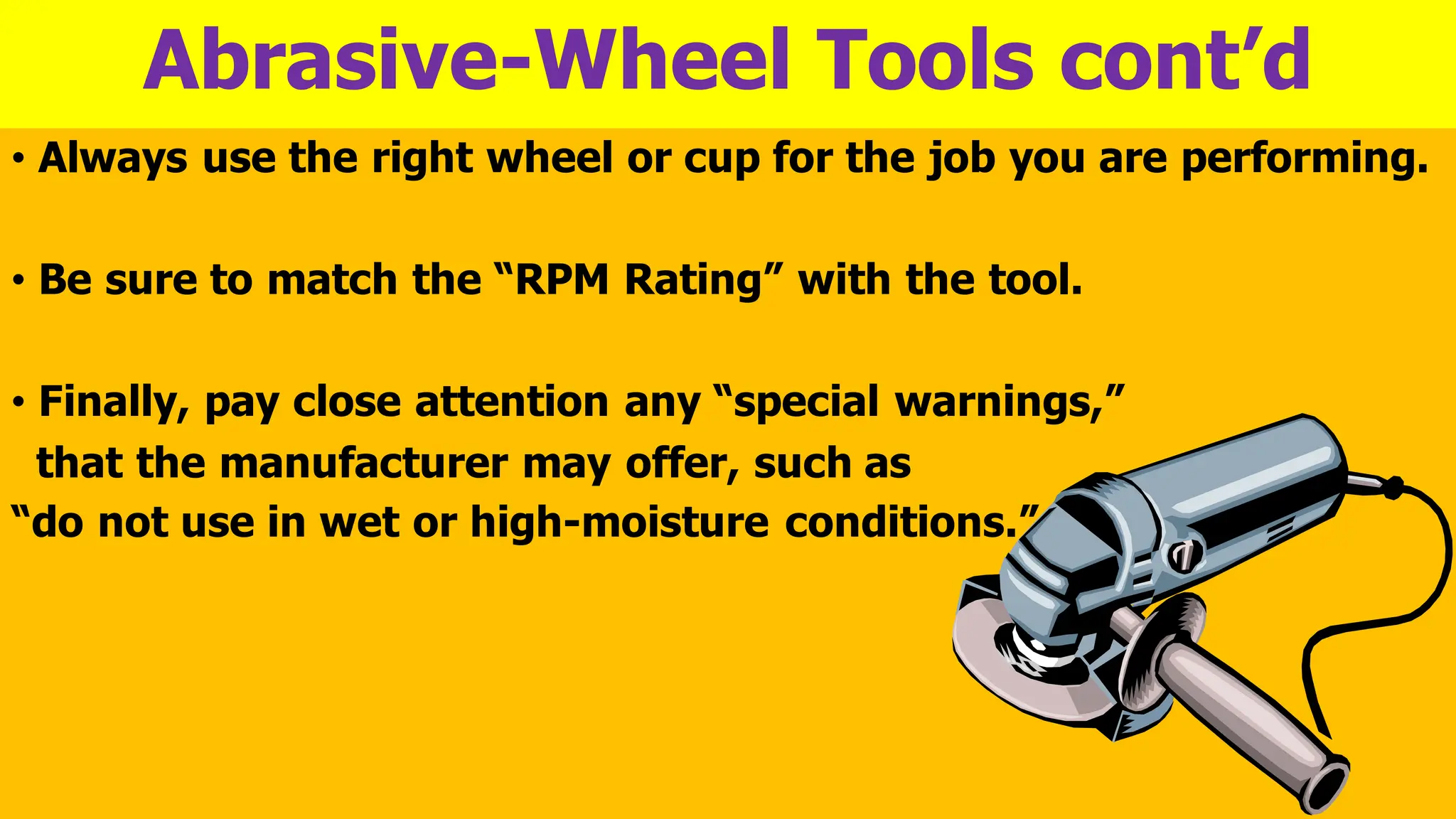
Abrasive-Wheel Tools cont’d
• Always use the right wheel or cup for the job you are performing.
• Be sure to match the “RPM Rating” with the tool.
• Finally, pay close attention any “special warnings,”
that the manufacturer may offer, such as
“do not use in wet or high-moisture conditions.”
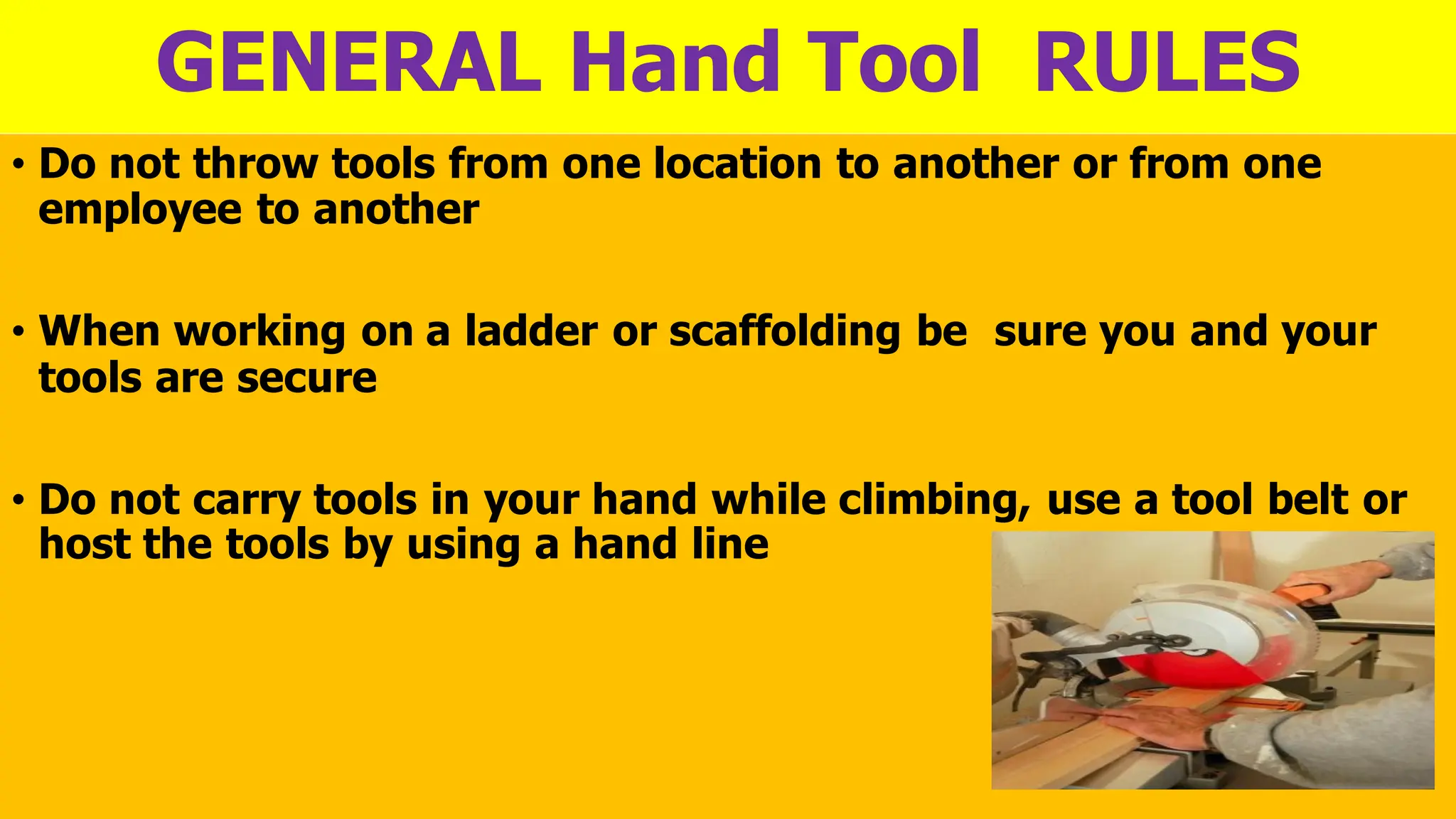
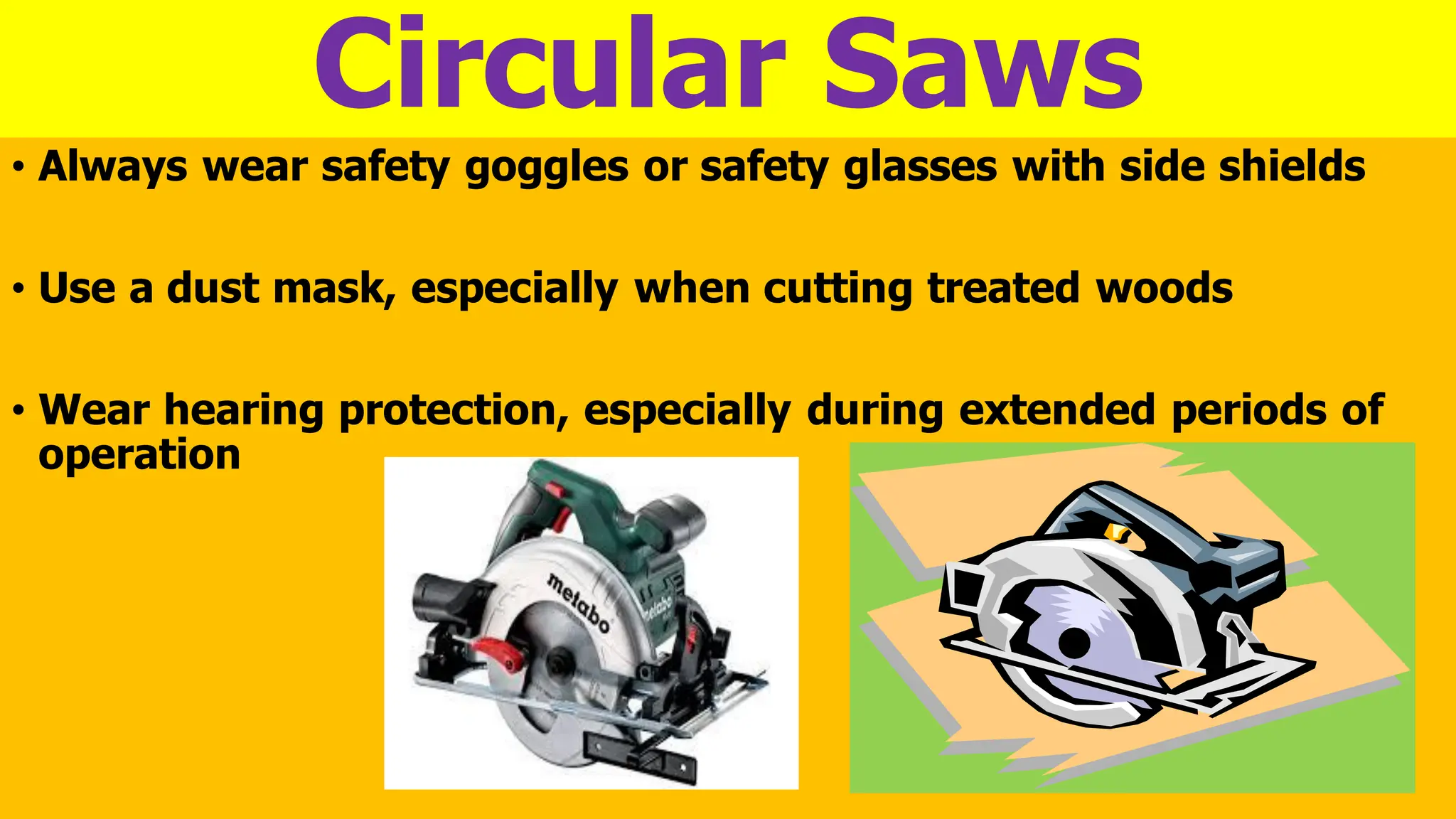
Circular Saws
• Always wear safety goggles or safety glasses with side shields
• Use a dust mask, especially when cutting treated woods
• Wear hearing protection, especially during extended periods of
operation
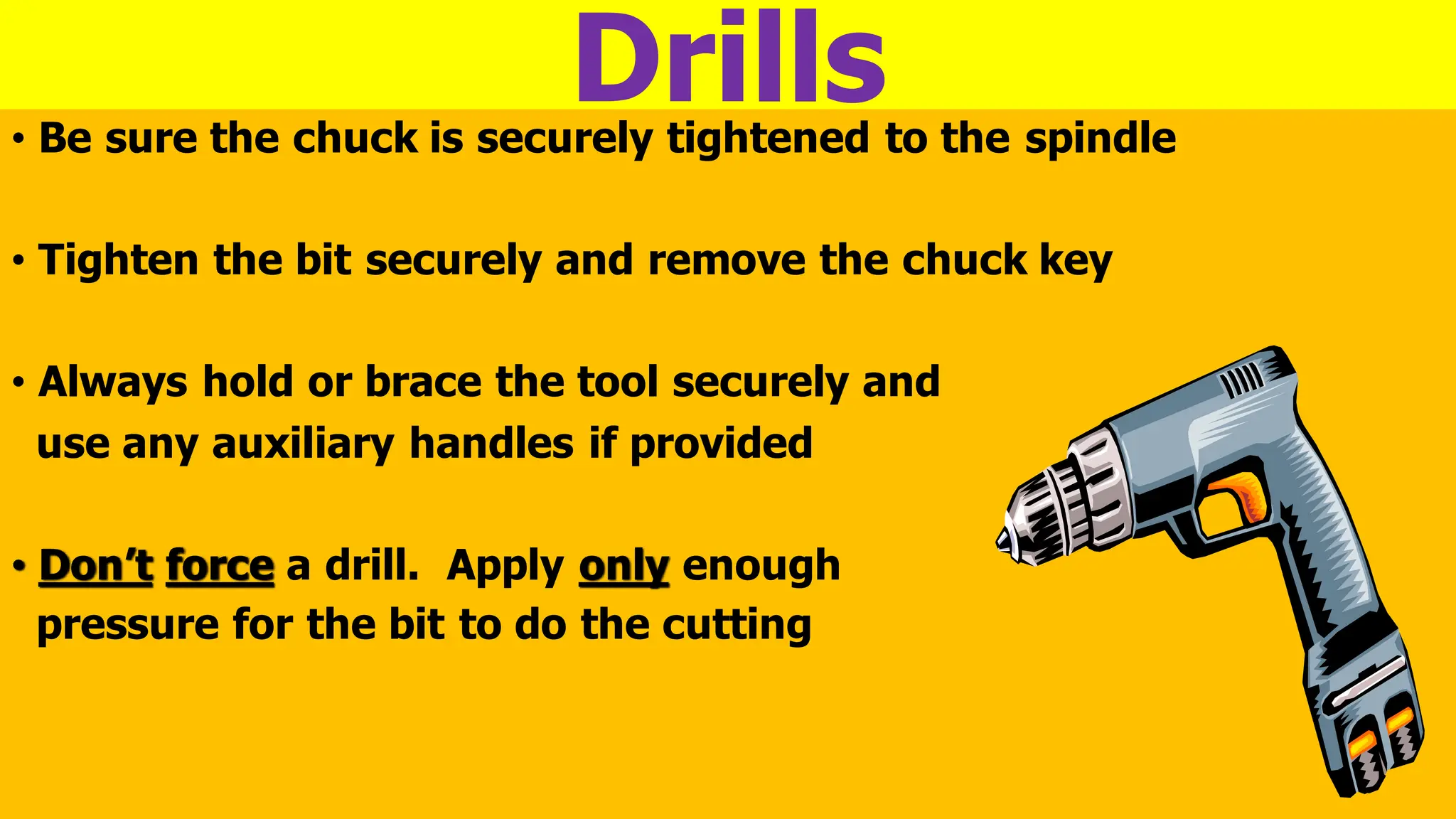
Drills
• Be sure the chuck is securely tightened to the spindle
• Tighten the bit securely and remove the chuck key
• Always hold or brace the tool securely and
use any auxiliary handles if provided
• Don’t force a drill. Apply only enough
pressure for the bit to do the cutting
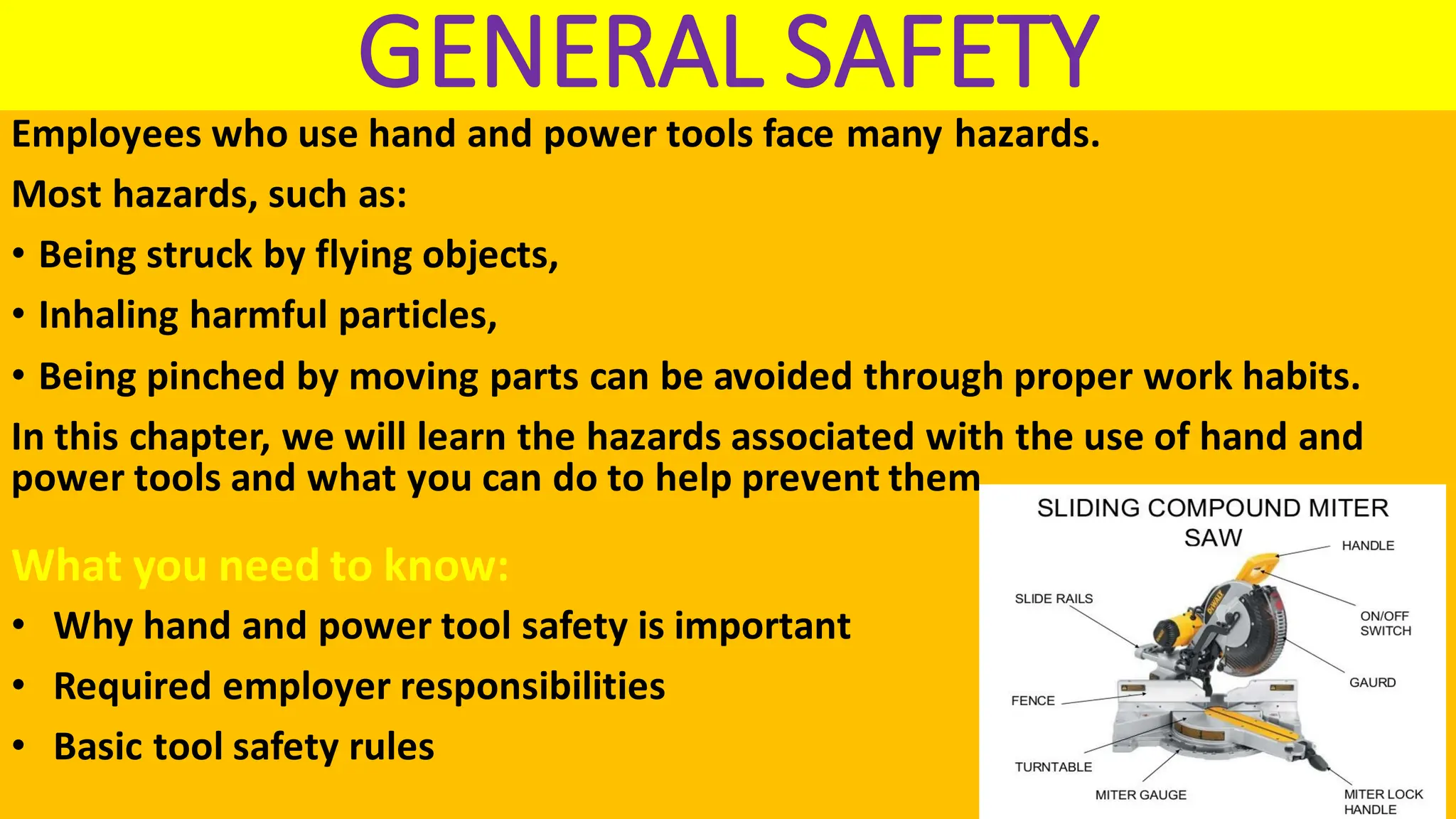
GENERAL SAFETY
Employees who use hand and power tools face many hazards.
Most hazards, such as:
• Being struck by flying objects,
• Inhaling harmful particles,
• Being pinched by moving parts can be avoided through proper work habits.
In this chapter, we will learn the hazards associated with the use of hand and
power tools and what you can do to help prevent them.
What you need to know:
• Why hand and power tool safety is important
• Required employer responsibilities
• Basic tool safety rules
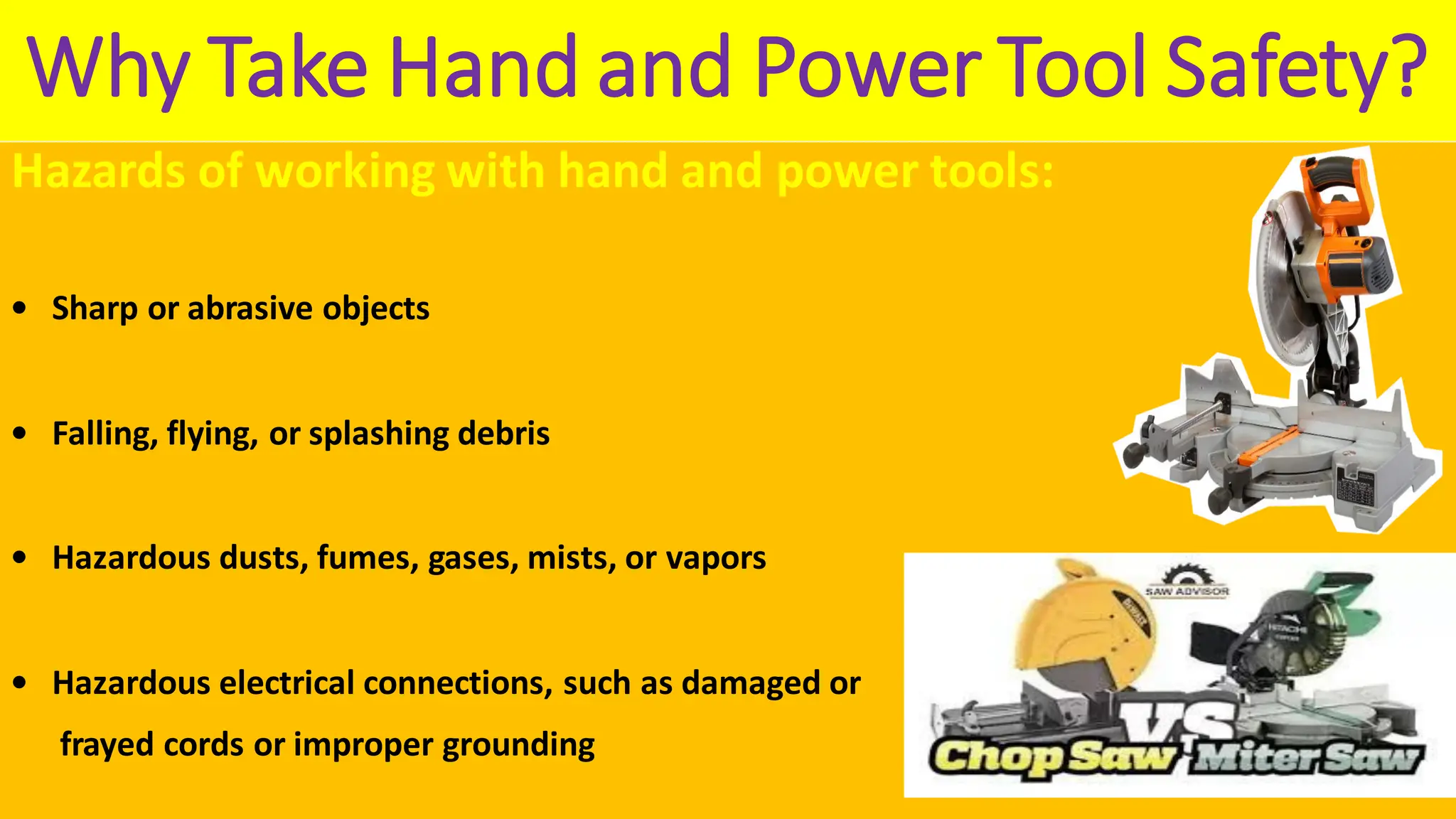
Why Take Hand and Power Tool Safety?
Hazards of working with hand and power tools:
• Sharp or abrasive objects
• Falling, flying, or splashing debris
• Hazardous dusts, fumes, gases, mists, or vapors
• Hazardous electrical connections, such as damaged or
frayed cords or improper grounding
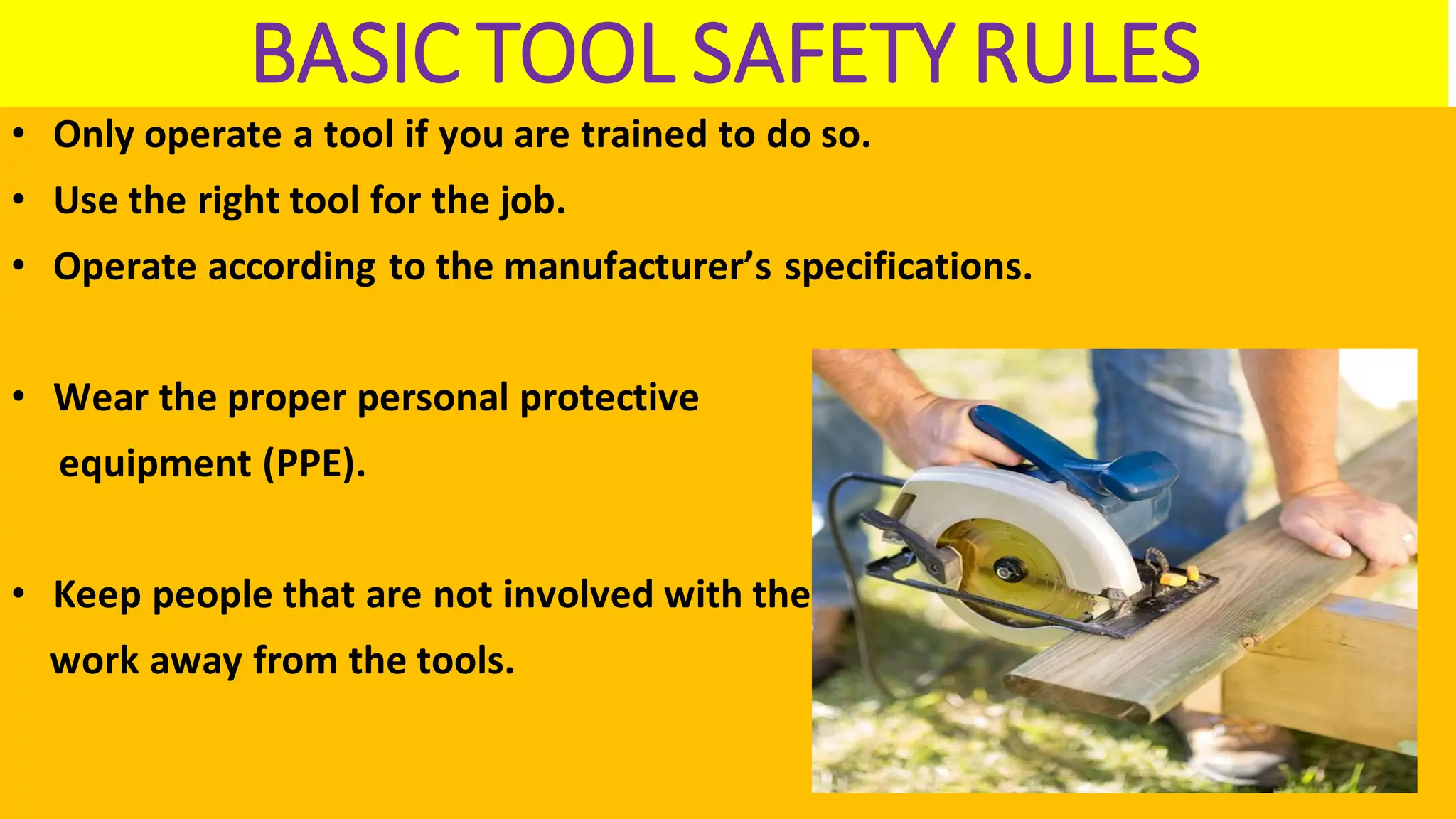
BASIC TOOL SAFETY RULES
• Only operate a tool if you are trained to do so.
• Use the right tool for the job.
• Operate according to the manufacturer’s specifications.
• Wear the proper personal protective
equipment (PPE).
• Keep people that are not involved with the
work away from the tools.
Inspection and Maintenance
• Perform regular maintenance.
‒ Keep all tools clean.
‒ Keep sharp tools sharp.
• Inspect the tool and perform tests daily and prior to use to
verify that all safety measures are working properly.
• Remove damaged tools from service and tag them, “Do Not
Use.”
HandTool Hazards
Most handtool hazards resultfromimproper maintenanceor use
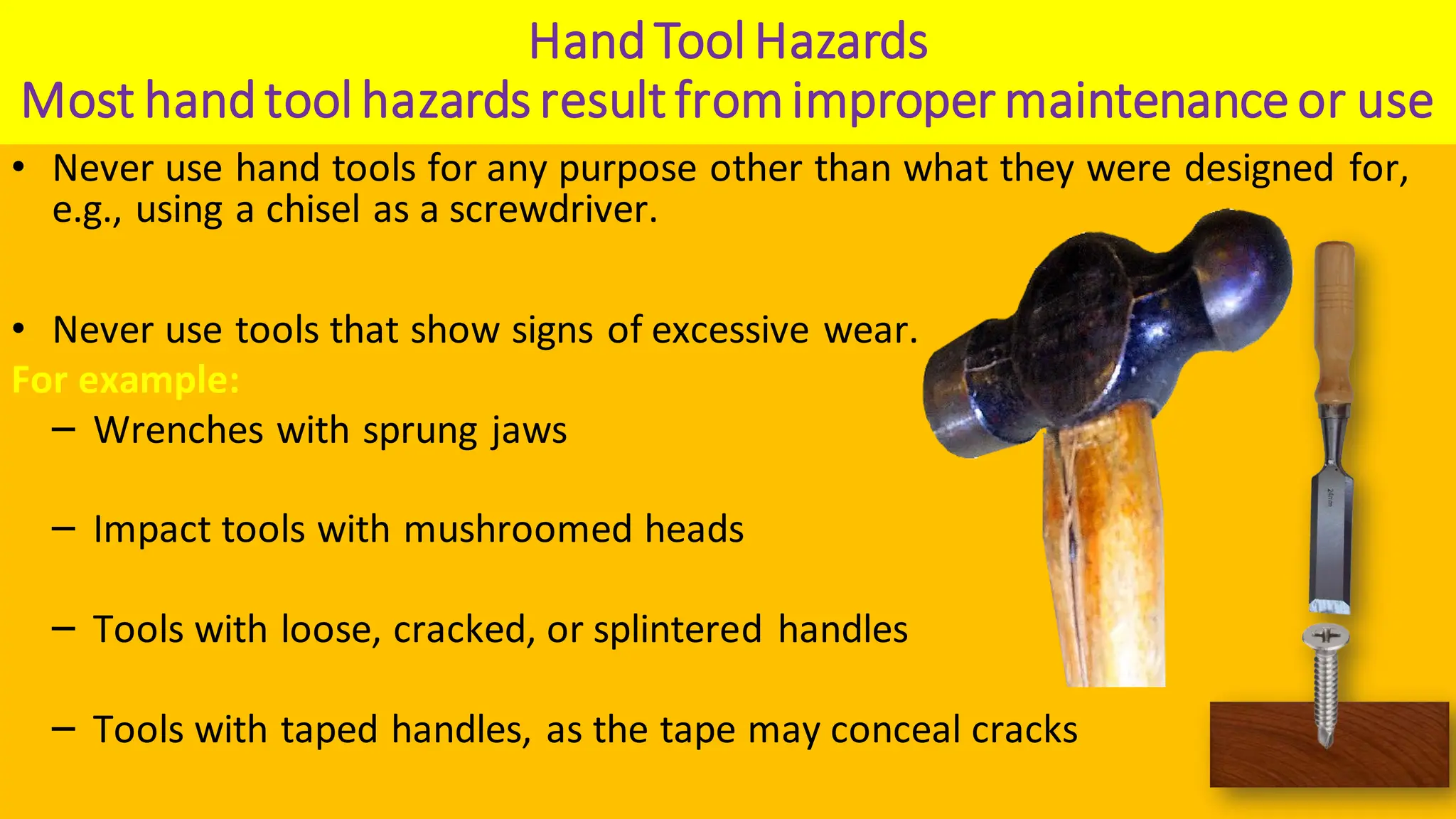
• Never use hand tools for any purpose other than what they were designed for,
e.g., using a chisel as a screwdriver.
• Never use tools that show signs of excessive wear.
For example:
‒ Wrenches with sprung jaws
‒ Impact tools with mushroomed heads
‒ Tools with loose, cracked, or splintered handles
‒ Tools with taped handles, as the tape may conceal cracks
Hand Tool Hazards
Sparks:
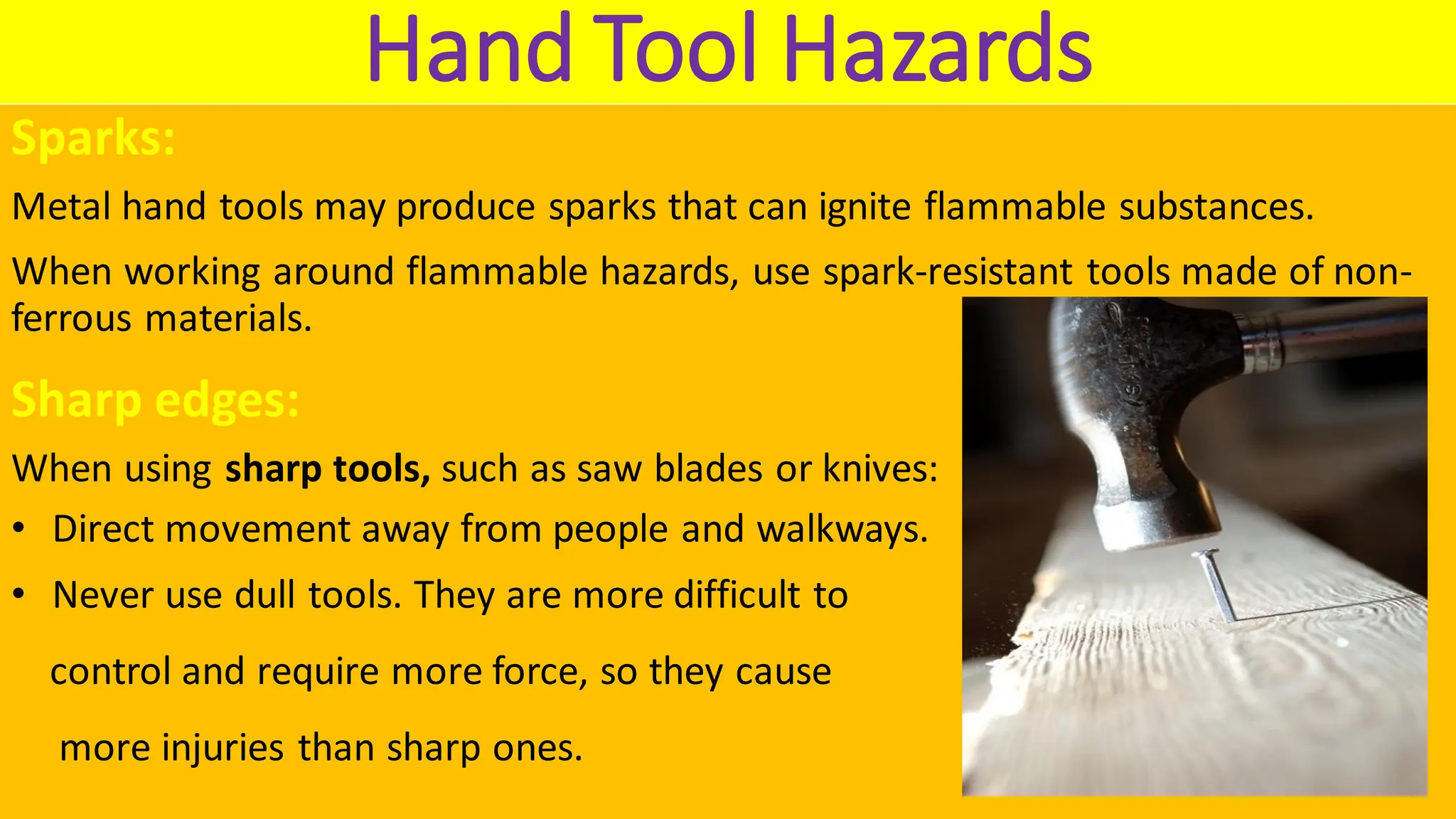
Metal hand tools may produce sparks that can ignite flammable substances.
When working around flammable hazards, use spark-resistant tools made of non-
ferrous materials.
Sharp edges:
When using sharp tools, such as saw blades or knives:
• Direct movement away from people and walkways.
• Never use dull tools. They are more difficult to
control and require more force, so they cause
more injuries than sharp ones.
Electrical Tools
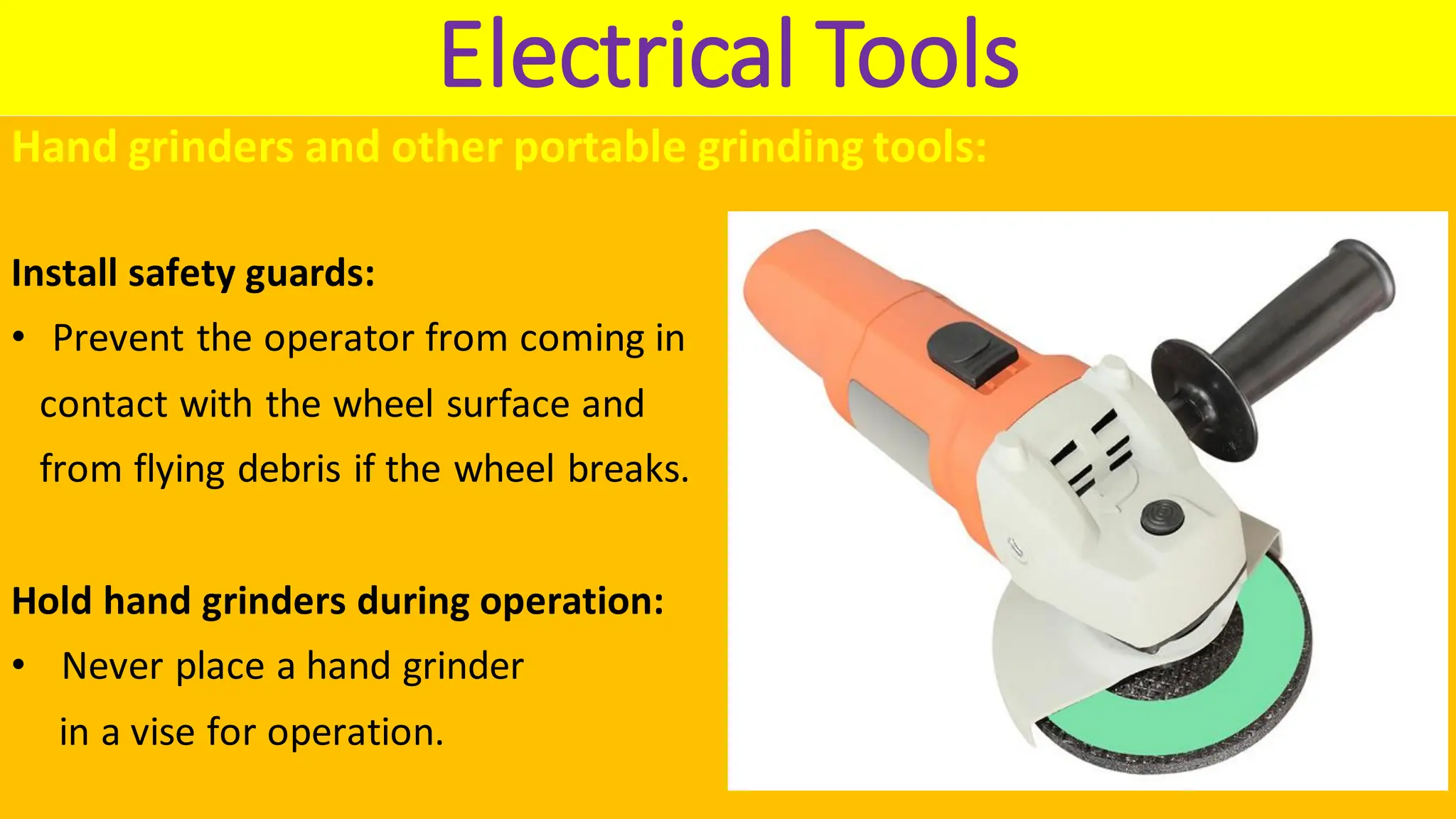
Hand grinders and other portable grinding tools:
Install safety guards:
• Prevent the operator from coming in
contact with the wheel surface and
from flying debris if the wheel breaks.
Hold hand grinders during operation:
• Never place a hand grinder
in a vise for operation.
Required PPE
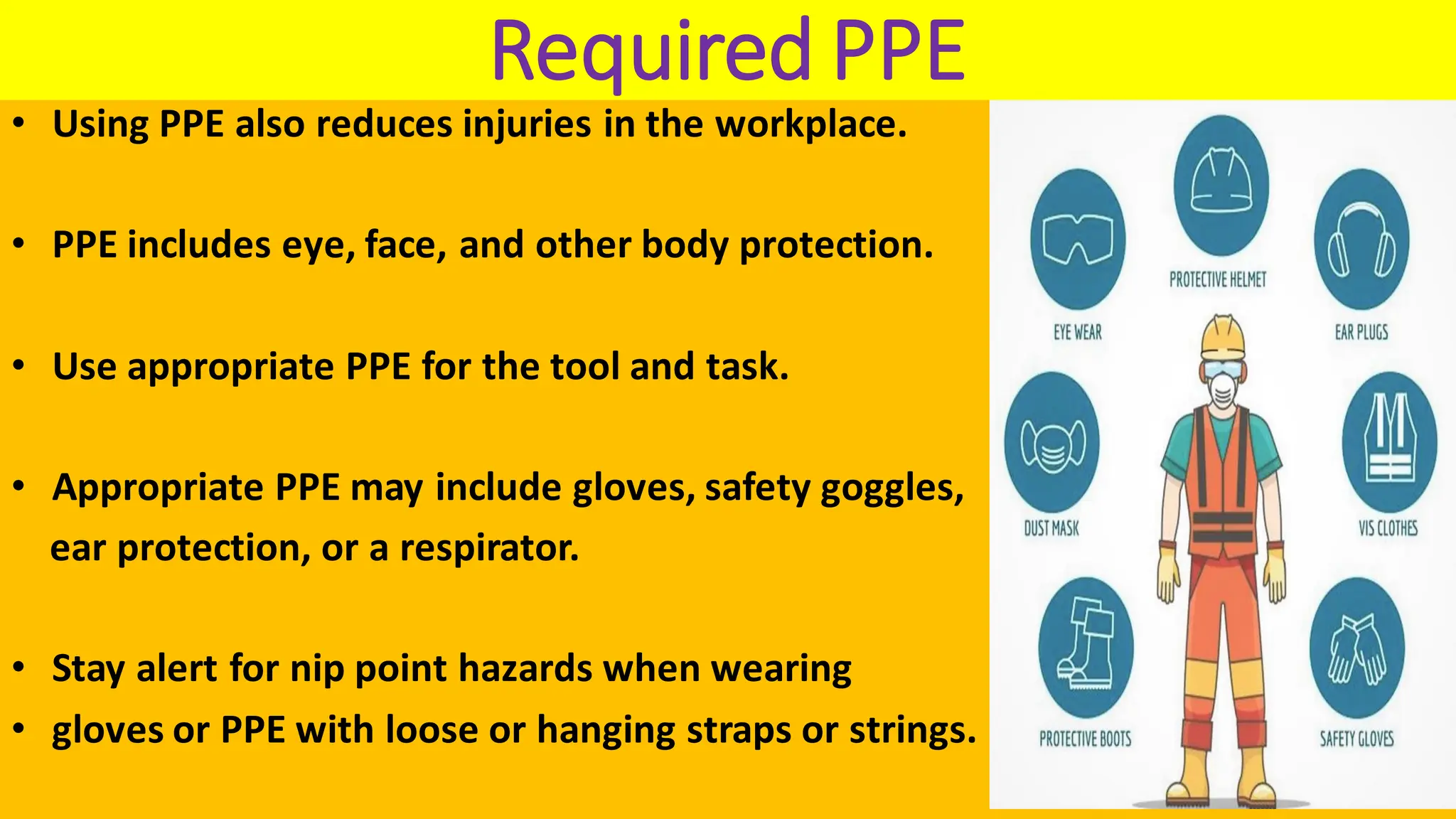
• Using PPE also reduces injuries in the workplace.
• PPE includes eye, face, and other body protection.
• Use appropriate PPE for the tool and task.
• Appropriate PPE may include gloves, safety goggles,
ear protection, or a respirator.
• Stay alert for nip point hazards when wearing
• gloves or PPE with loose or hanging straps or strings.
Summary
Most hazards are caused by improper use or maintenance.
• Only use tools after proper training.
• Wear appropriate PPE.
• Perform an inspection of the tool prior to use.
• Verify that points of operation and motion hazards are guarded.
• Always use safe handling and operating practices.
• Keep body parts away from hazardous areas.
• Store and maintain tools properly.
QUIZ
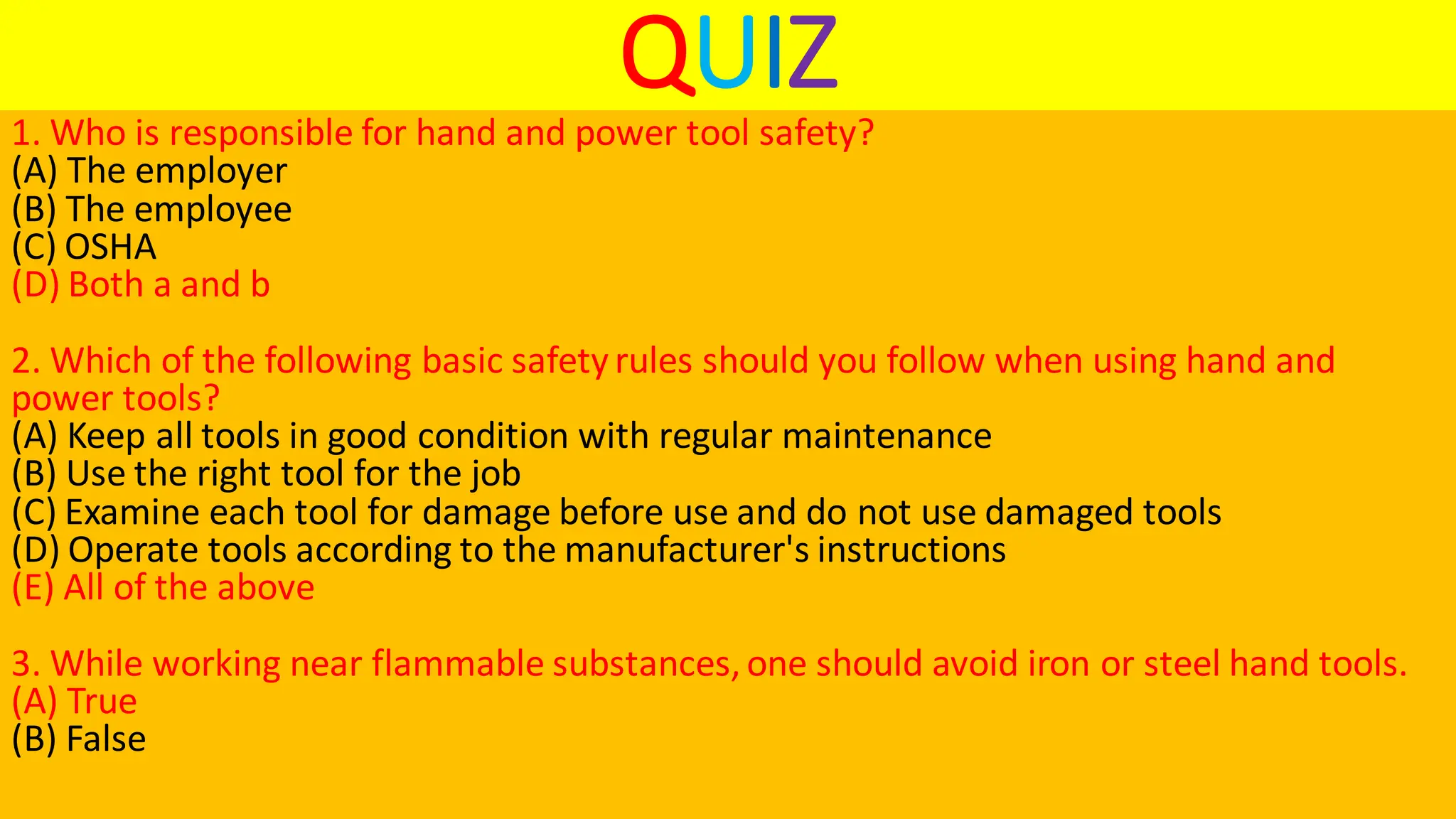
1. Who is responsible for hand and power tool safety?
(A) The employer
(B) The employee
(C) OSHA
(D) Both a and b
2. Which of the following basic safetyrules should you follow when using hand and
power tools?
(A) Keep all tools in good condition with regular maintenance
(B) Use the right tool for the job
(C) Examine each tool for damage before use and do not use damaged tools
(D) Operate tools according to the manufacturer's instructions
(E) All of the above
3. While working near flammable substances,one should avoid iron or steel hand tools.
(A) True
(B) False
QUIZ Continued…
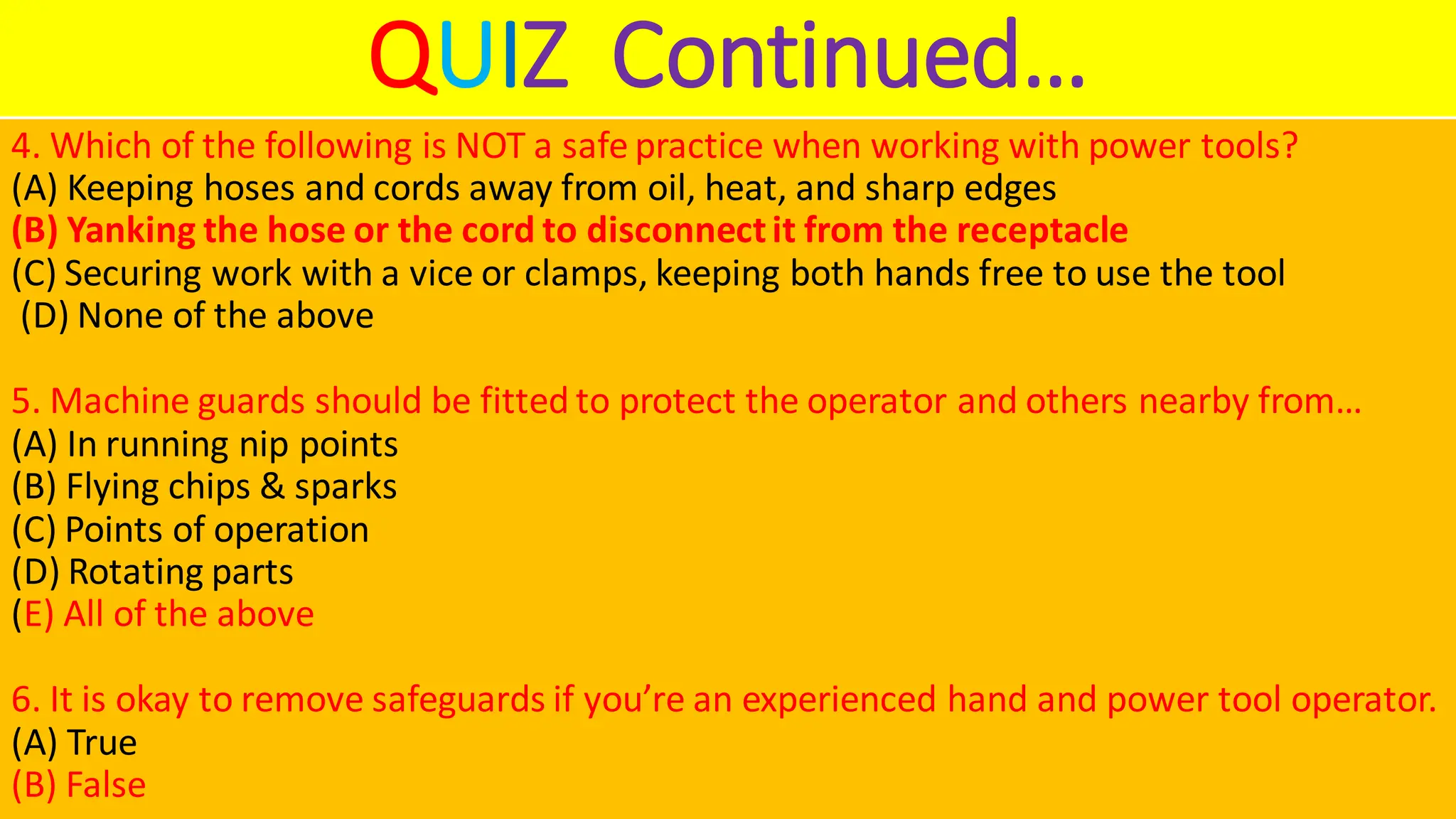
4. Which of the following is NOT a safe practice when working with power tools?
(A) Keeping hoses and cords away from oil, heat, and sharp edges
(B) Yanking the hose or the cord to disconnectit from the receptacle
(C) Securing work with a vice or clamps, keeping both hands free to use the tool
(D) None of the above
5. Machine guards should be fitted to protect the operator and others nearby from…
(A) In running nip points
(B) Flying chips & sparks
(C) Points of operation
(D) Rotating parts
(E) All of the above
6. It is okay to remove safeguards if you’re an experienced hand and power tool operator.
(A) True
(B) False
QUIZ Continued..
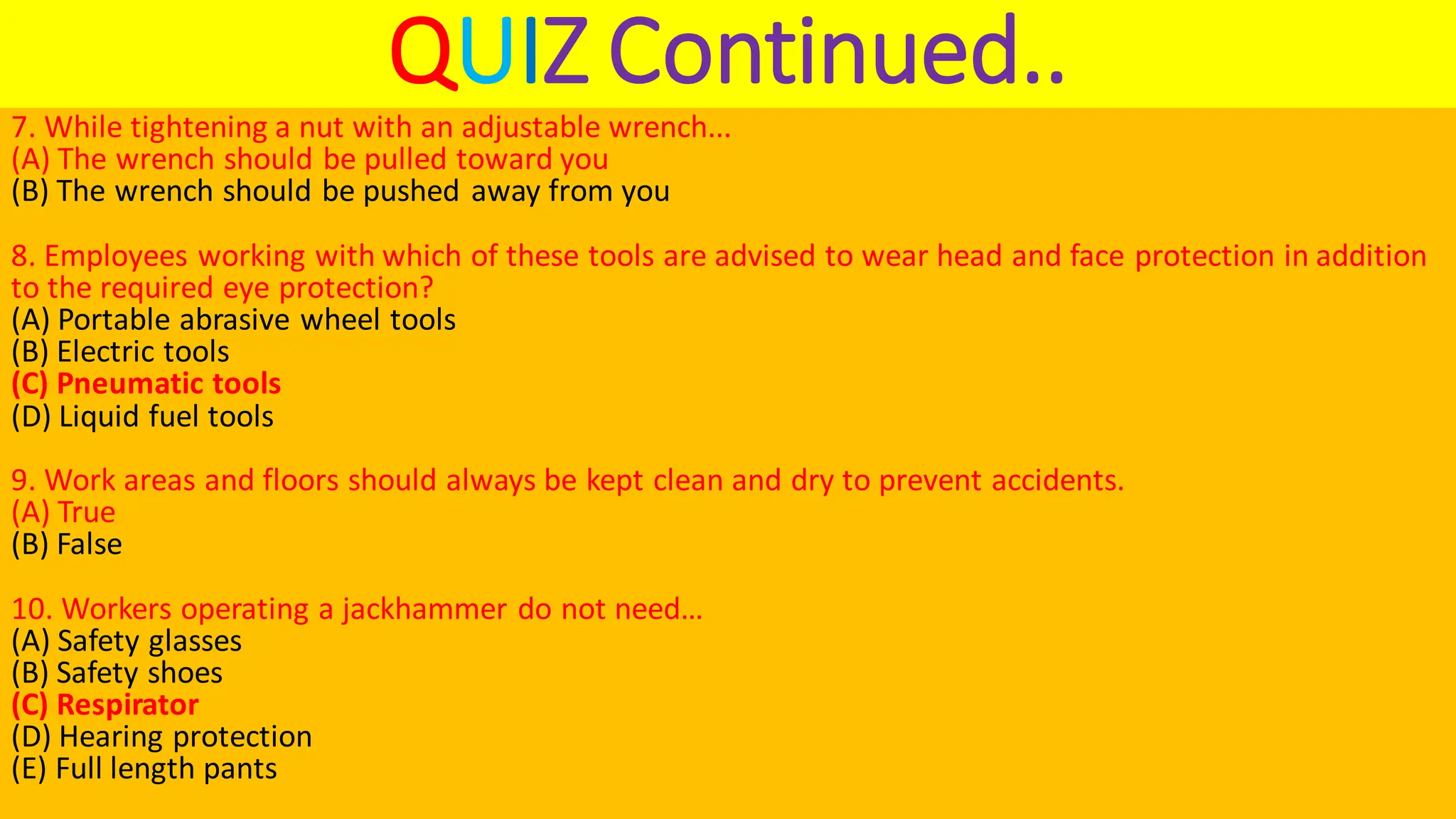
7. While tightening a nut with an adjustable wrench...
(A) The wrench should be pulled toward you
(B) The wrench should be pushed away from you
8. Employees working with which of these tools are advised to wear head and face protection in addition
to the required eye protection?
(A) Portable abrasive wheel tools
(B) Electric tools
(C) Pneumatic tools
(D) Liquid fuel tools
9. Work areas and floors should always be kept clean and dry to prevent accidents.
(A) True
(B) False
10. Workers operating a jackhammer do not need…
(A) Safety glasses
(B) Safety shoes
(C) Respirator
(D) Hearing protection
(E) Full length pants
Thank you
Congratulations! You have
completed
Hand and Power Tool Safety.
Any Question?
Ref:
www.google.com
www.osha.com

Hand tool and power tools training selfs

  • 1.
    Topic: Hand &Power Tools Safety Name of facilitator: Syed Neyaz Ahmad HSE Officer EMIRATES GENERAL PETROLEUM CORPORATION (EMARAT) Ph. +971563671957 Email. Neyaz.qhse@gmail.com Scope: Construction of Utility Building & Miscellaneous Work At Emarat Jebel Ali Terminal
  • 3.
    ❖Hand tools Have nopower source, other than the physical force applied by the user. Hand-tools include anything from axes to hammers, and screwdrivers to wrenches. ❖Power Tools Require a non-human power source to function properly--e.g. External (electricity, compressed air, etc.) or Internal (battery pack, internal combustion engine, etc.). Difference between hand tools and power tools
  • 4.
    Both kinds oftools require specific safety precautions or rules to be followed; yet some rules will apply to both. • There are five basic rules that apply to all tools used either hand or power. 5 Basic Rules: • Keep all tools in good working order • Use the tool only for what it is designed to do • Examine the tool for damage before each use • Always follow the manufacturer’s instructions when operating any tool • Always wear the appropriate PPE when operating any tool
  • 5.
    GENERAL Hand ToolRULES • Do not throw tools from one location to another or from one employee to another • When working on a ladder or scaffolding be sure you and your tools are secure • Do not carry tools in your hand while climbing, use a tool belt or host the tools by using a hand line
  • 6.
    The Greatest Hazardsof Hand Tools: Misuse/Improper Maintenance • Using a screwdriver as a chisel • Could cause the tip to break and fly, hitting either the operator or bystanders • A wooden handle on tool such as a hammer or an axe is loose, splintered (piece) or cracked • The tool head could fly off and strike the operator or bystanders
  • 7.
    SAFETY RULES ForHand Tools cont’d HAMMERS • Use a claw पंजा hammer for pulling nails • Do not strike a hardened steel surface with a claw hammer • Do not strike one hammer against another hammer • Do not use a hammer as a wedge or pry-bar
  • 8.
    SAFETY RULES ForHand Tools cont’d CHISELS • Use only chisels that are sharp • Do not use chisels with a mushroom head • Use only hammers that are designed for use with chisels
  • 9.
    SAFETY RULES ForHand Tools cont’d SAWS • Do not carry the saw by the blade • Do not use any saw that has a dull saw blade • Keep control of the saw by releasing downward pressure at the end of each stroke
  • 10.
    SAFETY RULES ForHand Tools cont’d SCREW DRIVERS • Always ensure the screwdriver fits the head of the screw • Do not hold the work piece against your body while using the screwdriver • Do not use a screwdriver as a punch, chisel, pry bar or nail puller
  • 11.
    GENERAL “Power Tool”SAFETY RULES ❖Do not use power tools you are not trained on ❖Do not lift or carry power tools by their power cord ❖Keep power cords out of the paths of the power tool ❖Do not leave tools unattended
  • 12.
    GENERAL Power ToolRULES cont’d • Be aware of all power lines, electrical circuits and water pipes that are not visible • Do not wear loose clothing, dangling objects or jewelry. Long hair must be restrained • All observers should be kept a safe distance from the work area
  • 13.
    Abrasive-Wheel Tools cont’d •Always use the right wheel or cup for the job you are performing. • Be sure to match the “RPM Rating” with the tool. • Finally, pay close attention any “special warnings,” that the manufacturer may offer, such as “do not use in wet or high-moisture conditions.”
  • 14.
    Circular Saws • Alwayswear safety goggles or safety glasses with side shields • Use a dust mask, especially when cutting treated woods • Wear hearing protection, especially during extended periods of operation
  • 15.
    Drills • Be surethe chuck is securely tightened to the spindle • Tighten the bit securely and remove the chuck key • Always hold or brace the tool securely and use any auxiliary handles if provided • Don’t force a drill. Apply only enough pressure for the bit to do the cutting
  • 18.
    GENERAL SAFETY Employees whouse hand and power tools face many hazards. Most hazards, such as: • Being struck by flying objects, • Inhaling harmful particles, • Being pinched by moving parts can be avoided through proper work habits. In this chapter, we will learn the hazards associated with the use of hand and power tools and what you can do to help prevent them. What you need to know: • Why hand and power tool safety is important • Required employer responsibilities • Basic tool safety rules
  • 19.
    Why Take Handand Power Tool Safety? Hazards of working with hand and power tools: • Sharp or abrasive objects • Falling, flying, or splashing debris • Hazardous dusts, fumes, gases, mists, or vapors • Hazardous electrical connections, such as damaged or frayed cords or improper grounding
  • 20.
    BASIC TOOL SAFETYRULES • Only operate a tool if you are trained to do so. • Use the right tool for the job. • Operate according to the manufacturer’s specifications. • Wear the proper personal protective equipment (PPE). • Keep people that are not involved with the work away from the tools.
  • 21.
    Inspection and Maintenance •Perform regular maintenance. ‒ Keep all tools clean. ‒ Keep sharp tools sharp. • Inspect the tool and perform tests daily and prior to use to verify that all safety measures are working properly. • Remove damaged tools from service and tag them, “Do Not Use.”
  • 22.
    HandTool Hazards Most handtoolhazards resultfromimproper maintenanceor use • Never use hand tools for any purpose other than what they were designed for, e.g., using a chisel as a screwdriver. • Never use tools that show signs of excessive wear. For example: ‒ Wrenches with sprung jaws ‒ Impact tools with mushroomed heads ‒ Tools with loose, cracked, or splintered handles ‒ Tools with taped handles, as the tape may conceal cracks
  • 23.
    Hand Tool Hazards Sparks: Metalhand tools may produce sparks that can ignite flammable substances. When working around flammable hazards, use spark-resistant tools made of non- ferrous materials. Sharp edges: When using sharp tools, such as saw blades or knives: • Direct movement away from people and walkways. • Never use dull tools. They are more difficult to control and require more force, so they cause more injuries than sharp ones.
  • 24.
    Electrical Tools Hand grindersand other portable grinding tools: Install safety guards: • Prevent the operator from coming in contact with the wheel surface and from flying debris if the wheel breaks. Hold hand grinders during operation: • Never place a hand grinder in a vise for operation.
  • 25.
    Required PPE • UsingPPE also reduces injuries in the workplace. • PPE includes eye, face, and other body protection. • Use appropriate PPE for the tool and task. • Appropriate PPE may include gloves, safety goggles, ear protection, or a respirator. • Stay alert for nip point hazards when wearing • gloves or PPE with loose or hanging straps or strings.
  • 26.
    Summary Most hazards arecaused by improper use or maintenance. • Only use tools after proper training. • Wear appropriate PPE. • Perform an inspection of the tool prior to use. • Verify that points of operation and motion hazards are guarded. • Always use safe handling and operating practices. • Keep body parts away from hazardous areas. • Store and maintain tools properly.
  • 27.
    QUIZ 1. Who isresponsible for hand and power tool safety? (A) The employer (B) The employee (C) OSHA (D) Both a and b 2. Which of the following basic safetyrules should you follow when using hand and power tools? (A) Keep all tools in good condition with regular maintenance (B) Use the right tool for the job (C) Examine each tool for damage before use and do not use damaged tools (D) Operate tools according to the manufacturer's instructions (E) All of the above 3. While working near flammable substances,one should avoid iron or steel hand tools. (A) True (B) False
  • 28.
    QUIZ Continued… 4. Whichof the following is NOT a safe practice when working with power tools? (A) Keeping hoses and cords away from oil, heat, and sharp edges (B) Yanking the hose or the cord to disconnectit from the receptacle (C) Securing work with a vice or clamps, keeping both hands free to use the tool (D) None of the above 5. Machine guards should be fitted to protect the operator and others nearby from… (A) In running nip points (B) Flying chips & sparks (C) Points of operation (D) Rotating parts (E) All of the above 6. It is okay to remove safeguards if you’re an experienced hand and power tool operator. (A) True (B) False
  • 29.
    QUIZ Continued.. 7. Whiletightening a nut with an adjustable wrench... (A) The wrench should be pulled toward you (B) The wrench should be pushed away from you 8. Employees working with which of these tools are advised to wear head and face protection in addition to the required eye protection? (A) Portable abrasive wheel tools (B) Electric tools (C) Pneumatic tools (D) Liquid fuel tools 9. Work areas and floors should always be kept clean and dry to prevent accidents. (A) True (B) False 10. Workers operating a jackhammer do not need… (A) Safety glasses (B) Safety shoes (C) Respirator (D) Hearing protection (E) Full length pants
  • 30.
    Thank you Congratulations! Youhave completed Hand and Power Tool Safety. Any Question? Ref: www.google.com www.osha.com